



Abstract
Justifications may promote unethical behavior because they constitute a convenient loophole through which people can gain from immoral behavior and preserve a positive self-image at the same time. A justification that is widely used is rooted in conformity: Unethical choices become more permissible because one’s peers are expected to make the same unethical choices. In the current study, we tested whether an exogenous alteration of conformity led to a lower inclination to adhere to a widely accepted norm (i.e., honesty) under the pressure of competition. We took advantage of the well-known effects of intranasally applied oxytocin on affiliation, in-group conformity, and in-group favoritism in humans. We found that conformity was enhanced by oxytocin, and this enhancement had a detrimental effect on honesty in a competitive environment but not in a noncompetitive environment. Our findings contribute to recent evidence showing that competition may lead to unethical behavior and erode moral values.
Keen competition in markets may lead to an erosion of moral values (Falk & Szech, 2013; Faravelli, Friesen, & Gangadharan, 2015; Shleifer, 2004). Such a potential incentive to engage in unethical behavior calls into question the notion that perfect markets unconditionally generate positive welfare effects. Competition could force companies to engage in the same unethical behavior as their competitors; otherwise, they would be driven out of the market (Shleifer, 2004). In a famous example, a large German company paid a $1.6 billion fine for bribing government officials in numerous countries (Schubert & Miller, 2008), and one of the managers accused argued that bribery was commonplace in the company’s type of business. If this were true, immoral (and illegal) behavior could be promoted not only by intrinsic motivations (e.g., greed) but also by a competitive environment. In fact, competitors are often used to justify unethical behavior. If beliefs about competition and (un)ethical behavior are shared among market participants, unethical behavior could become a norm and thus even be considered appropriate (Falk & Szech, 2013; Gino, Ayal, & Ariely, 2009). Recent empirical work confirms that the mere presence of competition may render unethical behavior an acceptable measure (Belot & Schröder, 2013; Falk & Szech, 2013; Faravelli et al., 2015; Schwieren & Weichselbaumer, 2010).
Empirical evidence regarding the reasons for accepting unethical behavior (e.g., dishonesty) in competitive environments remains surprisingly scarce. In the current work, we argue that competition using unethical measures constitutes an environment that contains an element of in-group conformity; all subjects accept this situation and all subjects expect other subjects to use the same unethical measures. In other words, an alternative social norm is created, and a stronger preference for in-group conformity reinforces unethical behavior once the belief about engaging in unethical behavior is shared sufficiently widely. Unsurprisingly, “everyone does it” is a justification used frequently in competitive environments and explains the persistence and prevalence of unethical behavior in sports (doping), business (fraudulent accounting), and politics (using lies in electoral campaigning), despite regulations, rules, and harsh punishments against misconduct (Faravelli et al., 2015).
The roots of in-group conformity in social beings, including humans, lie in the evolutionary advantage of sharing common behavior, opinions, and knowledge within a community (Cialdini & Goldstein, 2004). We argue that when unethical behavior becomes the “new” norm, evolved neurobiological circuits that sustain and motivate in-group conformity may also be involved in promoting unethical conduct in competitive environments. If this is true, an exogenous manipulation of the preference for conformity should lead to a change in the prevalence of unethical conduct in the presence of competition.
To achieve this manipulation, we linked unethical competitive behavior to oxytocin, an endogenous neuropeptide produced in the mammalian hypothalamus. Oxytocin plays an important role in group affiliation (Donaldson & Young, 2008) and in-group conformity (Stallen, De Dreu, Shalvi, Smidts, & Sanfey, 2012). A chemically induced alteration of conformity allowed us to produce the desired effect on a subconscious level, which enabled us to exclude possible experimenter demand effects. For example, Stallen et al. (2012) provided evidence that subjects given oxytocin showed a higher inclination to conform their judgments to those of other subjects when they were asked to rate the attractiveness of novel visual stimuli. This in-group bias was absent in subjects treated with placebo. Moreover, oxytocin has a significant discriminatory effect on moral judgments: Subjects favored their in-group over an out-group in the commonly used trolley problem (De Dreu, Greer, Van Kleef, Shalvi, & Handgraaf, 2011). In addition, subjects who were under the influence of oxytocin showed a higher propensity to cooperate with in-groups than with out-groups (De Dreu et al., 2010) and would even lie for the benefit of their in-group (Shalvi & De Dreu, 2014). Taken together, these findings suggest that oxytocin is involved in the modulation of humans’ preferences for conformity.
Despite the accumulated evidence regarding oxytocin’s positive effects on affiliation and in-group conformity, the full scope of oxytocin’s modulation of social behavior among mammals is still not completely understood (Churchland & Winkielman, 2012). Although its prosocial effects are modulated by social information about coplayers in cooperative (Mikolajczak et al., 2010) and coordination games (Declerck, Boone, & Kiyonari, 2010), intranasally applied oxytocin was found to decrease the adherence to widely accepted social norms (Radke & de Bruijn, 2012), which indicates a more nuanced role for the neuropeptide in social behavior (Bartz, Zaki, Bolger, & Ochsner, 2011) than previously thought. To address this complexity and ensure that the observed behavioral effects of oxytocin are indeed rooted in an alteration of preferences regarding in-group conformity, we tested the induction of in-group conformity by computing an index that reflected how well a subject’s actions were coherent with his or her beliefs about peers’ actions. In addition, to account for possible general negative effects of oxytocin on norm adherence, we used a control condition (i.e., a noncompetitive environment) in which breaking the norm of honesty was not justifiable with potential immoral acts of competitors.
Consequently, because of the positive effects of oxytocin on in-group conformity, we hypothesized that it increases unethical conduct in a competitive environment when accompanied by the belief that peers engage in the same unethical behavior. If this belief is not present in a noncompetitive environment, oxytocin should not have any effect on unethical behavior, and we would expect no general negative effects of oxytocin on norm adherence. In particular, we tested whether exogenous variation in brain oxytocin levels modulated the inclination to break (or bend) a widely accepted norm (i.e., honesty) in a competitive situation compared with a noncompetitive situation. In the interest of parsimony, we excluded the possibility that unethical conduct could be detected at the individual level.
Method
We recruited 120 male subjects (mean age = 23.125 years, SD = 3.32) from different universities in Munich via the Online Recruitment System for Economic Experiments (Greiner, 2015). This sample size is within the range that is suggested to be sufficient for detecting an effect in experiments using intranasally applied oxytocin (Walum, Waldman, & Young, 2016). Subjects took part in seven experimental sessions at the Munich Experimental Laboratory for Economic and Social Sciences (MELESSA). Subjects were excluded if they had significant medical or psychiatric disorders, took medication, smoked more than 15 cigarettes per day, or abused drugs or alcohol. Subjects were instructed to abstain from alcohol, smoking, and caffeine for 24 hr before the experiment and from food for 1 hr before the experiment. At the time of recruitment, subjects were informed that the experiment was about the influence of oxytocin on economic decision making. The ethics committee of the Department of Medicine at the University of Munich approved the study. All subjects provided written informed consent before participation.
To test our hypothesis about oxytocin’s negative effect on ethical conduct in a competitive environment, we randomly assigned subjects in a double-blind and placebo-controlled experiment to either the oxytocin group (n = 60) or the placebo group (n = 60). Under the supervision of the experimenter, subjects self-administered a nasal spray that contained a dose of 24 IU of oxytocin (Syntocinon spray; Defiante Farmaceutica S.A., Funchal, Portugal) or a placebo. Each application consisted of three puffs per nostril; the puffs contained either 4 IU of oxytocin or a placebo with the same inactive ingredients minus the neuropeptide. To exclude possible confounding effects related to the prosocial reputation of oxytocin, we tested whether subjects were able to determine whether they received placebo or oxytocin, Fisher’s exact test, p = .199.
Sixty minutes after intake, subjects received a coin and performed two different versions of a coin-tossing task that has been shown to reliably measure dishonesty (Abeler, Becker, & Falk, 2014; Cohn, Fehr, & Marechal, 2014; Houser, Vetter, & Winter, 2012; Shalvi & De Dreu, 2014). Subjects were told to privately flip the coin and were paid according to the reported results. The advantage of this task lies in the fact that subjects do not face the risk of detection because we were credibly unable to observe lying in any particular subject. However, by comparing the reported outcomes of all individuals with their statistical chance implied by a fair coin, we were able to assess honesty on an aggregate level. 1 This method in particular gives subjects the opportunity to lie only a bit and maintain a positive self-image at the same time: It has been shown that subjects report desired counterfactuals (i.e., not the relevant outcome but the best outcome of all tosses) and treat them as if they really happened. This generates an acceptable loophole for maintaining a positive self-image (Fischbacher & Föllmi-Heusi, 2013; Shalvi, Eldar, & Bereby-Meyer, 2012).
In the baseline version of the coin-tossing task (or noncompetitive lying task), subjects received a €1 coin. They were told to flip the coin three times but to report the outcome of the first two tosses. For each reported instance of “tails,” they would win a real monetary prize of €1.66 (for details, see the Supplemental Material available online). In this baseline version, we measured subjects’ general inclination to break a norm (i.e., lying) for a financial benefit without any consideration of other people’s behavior. In this task, subjects have no peer with whom to compare themselves, because other people’s behavior is not rendered salient in the noncompetitive task. Therefore, the noncompetitive task constitutes an ideal tool to analyze behavior when no enhanced element of conformity is present.
In the competitive version of the coin-tossing task (or competitive lying task), subjects were also asked to flip a coin three times and to report only the first two outcomes. However, to induce a competitive environment, subjects’ payment in this part depended on their reports and on the report of a randomly matched subject in their session. In particular, the subject who reported the highest number of tosses with tails in a group won €3.33. In case of a tie, the prize was split equally. Because this task was a zero-sum game, we could exclude any efficiency considerations that subjects might have had. However, the competitive lying task involves a strategic element, given that subjects may want to form beliefs about the actions of other people if they care about the norm at all. Therefore, immediately after both parts, we elicited subjects’ beliefs regarding the frequency of tails reported in their experimental session. Subjects earned an additional €1.66 for a correct prediction of the frequency of tails reported in their session.
In contrast to the baseline treatment, the actions of other people are rendered salient in the competitive lying task because subjects were matched to each other randomly and had to interact in a strategic setting. By comparing the effect of oxytocin on behavior in the competitive (strategic) task with that in the noncompetitive (nonstrategic) task, we disentangled the effect of oxytocin on general dishonesty and the oxytocin-induced effect of conformity on lying behavior.
Empirical evidence suggests that lying causes psychological costs because of the loss of a positive self-image (Abeler et al., 2014; Cohn et al., 2014; Fischbacher & Föllmi-Heusi, 2013; Mazar, Amir, & Ariely, 2008; Shalvi et al., 2012), so at the end of the experiment, we asked subjects to describe their emotional state regarding eight general emotions: anger, gratefulness, guilt, joy, irritation, shame, surprise, and disappointment (Hopfensitz & Reuben, 2009). Specifically, we asked subjects to rate their current state for each of the eight emotions using a 7-point Likert scale (1 = completely disagree, 7 = completely agree). To control for individual-level effects, we conducted the rating twice: immediately after substance administration and immediately after the coin-tossing tasks. This probably enabled us to indirectly detect a guilty conscience associated with dishonest reports. Because of a decrease in psychological lying costs in the competitive environment, we conjectured that subjects would exhibit more negative emotions related to overreporting tails in the noncompetitive task than in the competitive task.
The entire experiment took about 90 min and was programmed using the Zurich Toolbox for Readymade Economic Experiments (z-Tree) software (Version 3.3.10; Fischbacher, 2007). The final payoff consisted of the sum of incomes from the different parts added to a flat payment of €4 for participation.
Results
Because the flip of the coin was private, we measured honesty on an aggregate level by comparing reported tosses with their expected frequency from a fair toss. Subjects’ behavior strongly deviated from honest reporting, regardless of environment or treatment (Fig. 1). Overall, subjects in both environments reported more successful results (i.e., tossing tails twice) than would be expected by chance—noncompetitive environment: 65%, binomial z = 10.11, p < .001; competitive environment: 80.8%, binomial z = 14.12, p < .001. A comparison of the two environments reveals that dishonesty was more pronounced in the competitive environment than in the noncompetitive environment, Wilcoxon matched-pairs test, z = 2.237, p = .025.
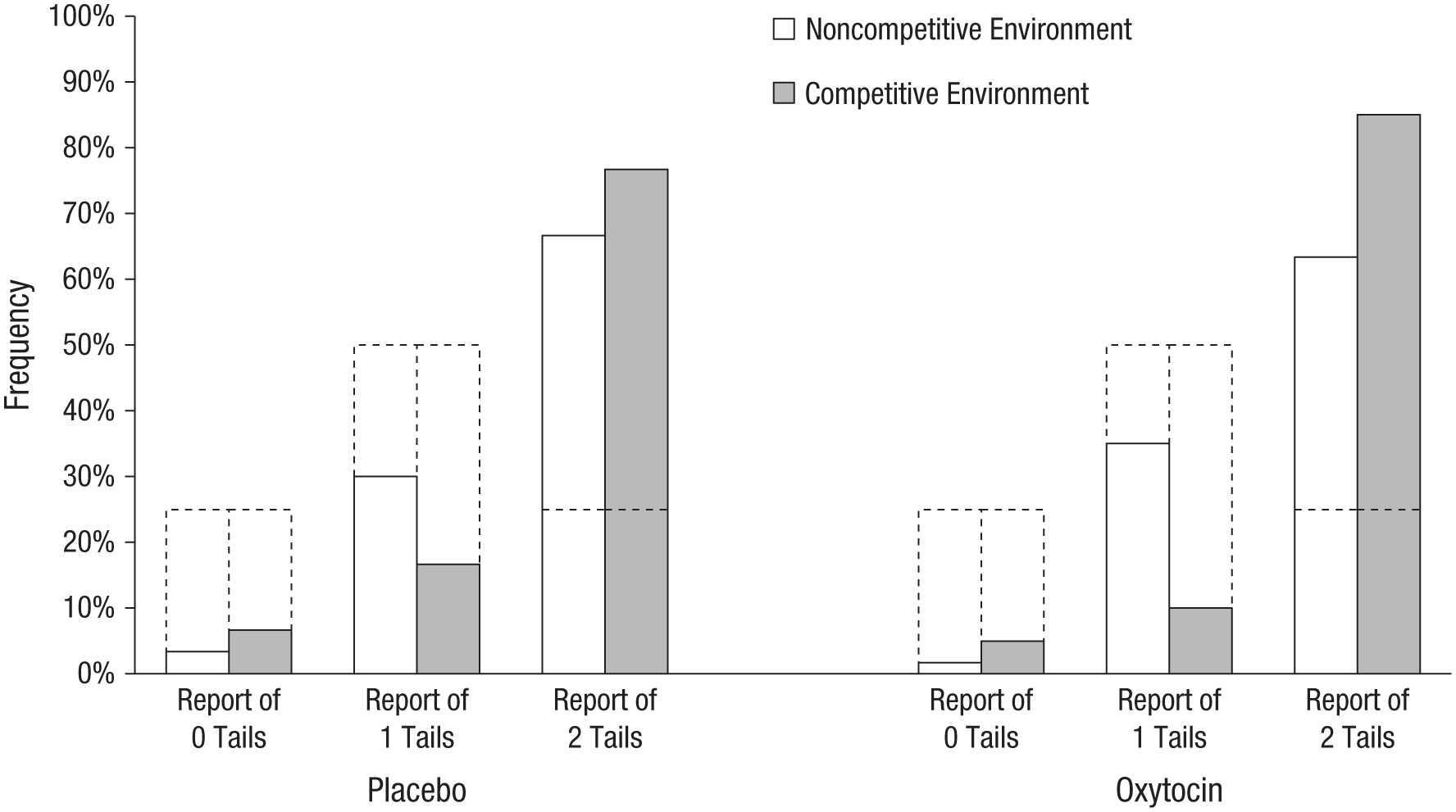
Frequency of reports of 0 tails, 1 tails, and 2 tails for each treatment group (oxytocin or placebo), presented separately for the noncompetitive and competitive environments. The bars with dashed lines indicate the outcomes expected by chance (i.e., honest reporting).
However, this dishonesty effect was driven almost completely by subjects given oxytocin; subjects treated with placebo barely reacted to the competitive environment, Wilcoxon matched-pairs test, z = 0.724, p = .469. Conversely, in the oxytocin group, we found, on average, a substantial change to more dishonest reports in the competitive environment; the difference between the two environments was significant, Wilcoxon matched-pairs test, z = 2.315, p = .021. Subjects under the influence of oxytocin showed a significantly higher inclination to break a norm (i.e., honesty) in a competitive environment.
Previous empirical findings indicate that there may be two types of dishonesty: Some subjects lie to the fullest possible extent to maximize profits, whereas some subjects lie only partially, to preserve a certain level of positive self-image (Fischbacher & Föllmi-Heusi, 2013; Gino et al., 2009; Houser et al., 2012; Utikal & Fischbacher, 2013). In our experiment, subjects had the opportunity to report honestly, lie partially, or lie fully about the outcome of their coin tosses. Hence, we defined α1 as the proportion of our sample who were partial liars and α2 as the proportion of our sample who were full liars. Because full liars would always report 2 tails, the probability of their reporting this outcome was 1. In contrast to full liars, partial liars were assumed to improve their overall outcome by exactly one favorable outcome and report 1 tails instead of 0 tails or 2 tails instead of 1 tails. By comparing the reported frequency f(x), of each outcome (x ∈ {0, 1, 2}) with its statistical probability, we were able to compute an estimate for the actual frequency of each lying type as a function of the observed frequency of each outcome (for proof, see Section B1 of the Supplemental Material): 2


Table 1 shows the computed proportions of each lying type in the competitive environment. Accordingly, a comparison between treatment groups in the competitive environment revealed that more lying was present in the oxytocin group, Fisher’s exact test, p = .003; the neuropeptide increased full lying by 33.3% (i.e., to .80 in the oxytocin group compared with .60 in the placebo group). Partial lying completely vanished in the oxytocin group between the competitive and noncompetitive environments, which indicates that subjects who partially lied to benefit from dishonesty but still wanted to preserve a positive self-image became completely dishonest under the influence of oxytocin. This, combined with the finding that oxytocin showed no effect on lying in the noncompetitive environment, suggests that the effect of oxytocin on dishonesty was limited to the competitive environment. Thus, it seems that an intake of oxytocin results in a drop in the psychological costs of lying, purportedly making lying more ethically permissible during competition.
Proportion of Subjects of the Three Liar Types in the Oxytocin and Placebo Groups in the Competitive Environment

The question remained whether the adverse effect of oxytocin on honesty was rooted in a preference for conforming one’s actions to those of peers. If so, subjects in the oxytocin group would anticipate more lying from peers than would subjects in the placebo group. To test whether our observed treatment effect was in line with subjects’ beliefs about the actions of others, we elicited their beliefs regarding the lying rate in their sessions. Specifically, we asked them to guess the frequency of subjects who reported the profit-maximizing outcome (i.e., tossing tails twice). If the observed treatment effect of oxytocin was rooted in an increase of in-group conformity, we would expect more lying when subjects believed other people would lie as well. Figure 2 shows the average anticipated overreporting for each environment. Remarkably, the anticipated lying rate in the competitive environment was significantly higher in the oxytocin group (87.7%) than in the placebo group (76.5%), Mann-Whitney U test, z = −2.746, p = .006. However, there was no significant difference between oxytocin (83.7%) and placebo (81.1%) in the noncompetitive environment, Mann-Whitney U test, z = −1.035, p = .300, which suggests that the change in dishonesty in the oxytocin group was mainly driven by beliefs about other people’s honesty. Because oxytocin negatively influenced those beliefs, we argue that subjects found it ethically more permissible to lie as long as others would lie as well.

Subject’s belief about the lying rate in a given session as a function of treatment with oxytocin or placebo, presented separately for the noncompetitive and competitive environments. The asterisk indicates a significant difference between groups (p < .01). Error bars represent ±1 SEM.
To determine if oxytocin induced in-group conformity, we tested whether subjects aligned their actions with the actions of their peers. Subjects received no information about their peers’ choices, so we assumed that a conformist subject would do exactly what he believed other people would do. To elicit beliefs precisely, we asked subjects to guess the reported frequency g(x), of each outcome within each session. Accordingly, we were able to compute each subject i’s belief, b, regarding the outcome that their peers would report on average in each session j:
In-group conformity requires that a person’s actions cohere with his or her beliefs about peers’ actions. Thus, if oxytocin caused in-group conformity, then the difference between beliefs about cheating rates and actual cheating behavior should have been smaller in the oxytocin group than in the placebo group. To test the hypothesis that oxytocin causes in-group conformity, we computed a nonconformity index, λ, for each subject i by calculating the absolute difference of that subject’s actual decision, a, and his belief about the mean of all reported outcomes within a given session j (bij). Hence, the nonconformity index was defined as follows:
The nonconformity index increases proportionally with the divergence of a subject’s actions from the choices that he believes peers have made; a value of 0 indicates a minimum of nonconformity. That is, the index has a value of 0 if a subject chose what he believed other people would choose. Our empirical analysis of nonconformity levels revealed that, in the competitive environment, the difference between actions and beliefs was significantly less in the oxytocin group (M = 0.19) than in the placebo group (M = 0.26), Mann-Whitney U test, z = 2.120, p = .034. This result is in line with the notion that oxytocin induced conformity to the actions that subjects believed their peers would take. In the noncompetitive situation, when strategic considerations played no role, the two groups did not differ significantly in terms of the nonconformity index (oxytocin: M = 0.36, placebo: M = 0.31), Mann-Whitney U test, z = −0.621, p = .534. 4 That is, in nonstrategic situations, subjects treated with oxytocin and those treated with placebo did not show different levels of nonconformity; the absence of oxytocin-induced conformity in the noncompetitive task is not surprising. However, this changed in the competitive environment, because the actions of other people became much more salient because subjects had to interact with each other in a strategic setting. We argue that this inherent difference between the competitive and noncompetitive environments diverted subjects’ attention from themselves to their peers.
We next addressed the question of why oxytocin-induced conformity had a strong effect on the inclination to lie. One possible explanation could be a change in psychological costs: Subjects perceive an immoral act as more permissible when other people choose to behave unethically as well. If this explanation were true, then we should have observed a significant correlation between negative emotions and subsequent dishonesty in the noncompetitive task but not in the competitive task. Table 2 shows that in the noncompetitive environment, reported tosses and beliefs about the lying rate in the respective session were good predictors for the emotion shame. We found no such correlation in the competitive environment; shame increased as dishonesty increased and decreased as a subject’s beliefs about the average dishonesty level of other people decreased. Remarkably, this relationship was present only in the noncompetitive environment. Shame was correlated with behavior and beliefs only in a nonstrategic situation, so it seems that the presence of a competitive environment eclipses the production of negative emotions. Competition may be perceived as a legitimate reason for lying. As expected, because oxytocin is not known to modulate negative emotions, it had no direct effect on shame independently of actions and beliefs. We were able to rule out any general effects of oxytocin on dishonesty or on psychological costs related to unethical behavior. 5
Results of the Ordinary Least Squares Regressions Predicting Change in Self-Reported Shame
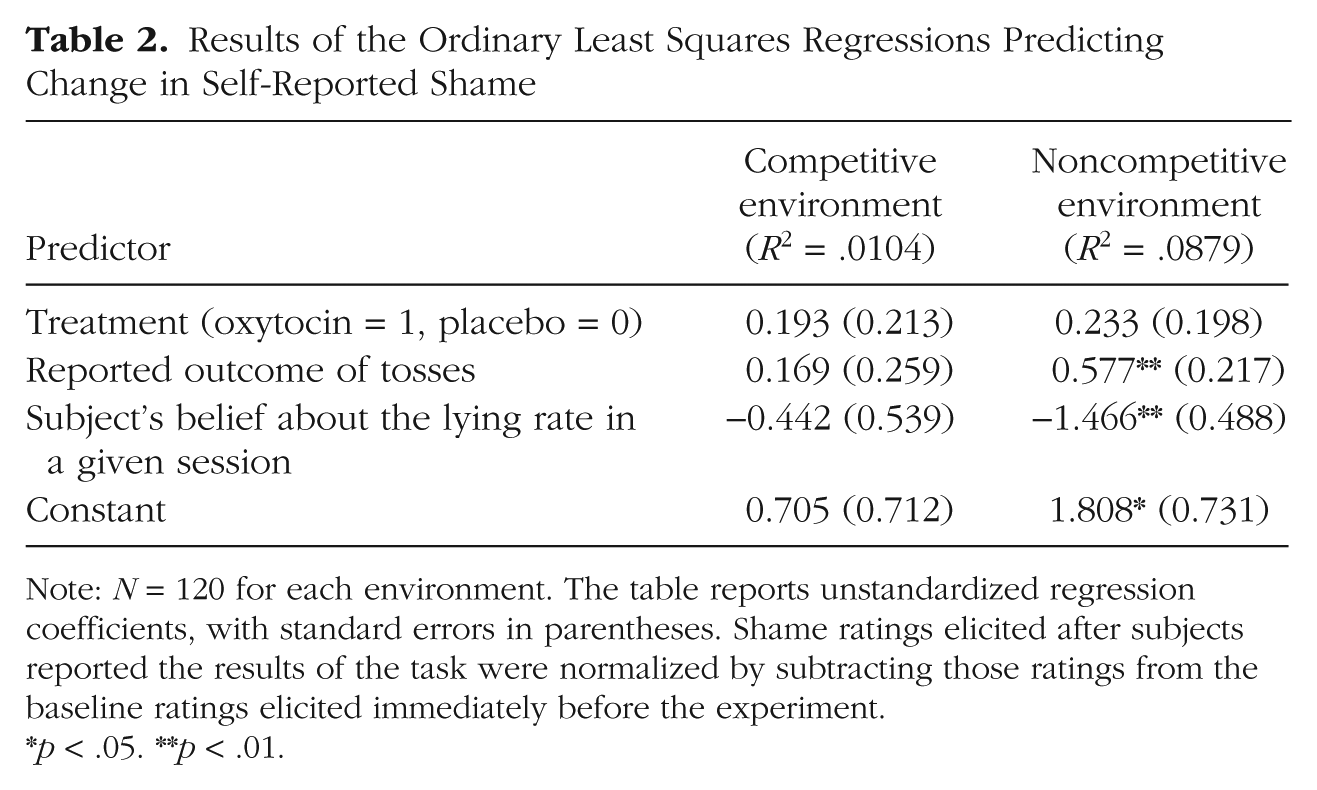
Note: N = 120 for each environment. The table reports unstandardized regression coefficients, with standard errors in parentheses. Shame ratings elicited after subjects reported the results of the task were normalized by subtracting those ratings from the baseline ratings elicited immediately before the experiment.
p < .05. **p < .01.
Because we found no association of negative emotions with dishonesty in competition, we concluded that subjects in the oxytocin group were conforming to their peers and faced lower psychological costs of unethical behavior, which was accompanied by increases in dishonest behavior.
Discussion
The present work examined the effect of oxytocin on honesty by comparing lying rates in two environments: competitive and noncompetitive. We used a coin-tossing task in which we could not detect individual lies but could infer dishonesty unobtrusively on an aggregate level. Our results show that oxytocin had a detrimental effect on honesty in the competitive environment but not in the noncompetitive environment. Moreover, subjects who were given oxytocin showed a higher inclination to conform with their peers’ dishonest behavior, which indicates that the detrimental effects of oxytocin on dishonesty in competition were driven by conformity. In particular, we found that the actions of subjects who were given oxytocin were more coherent with their beliefs about peers’ actions, which is in line with our hypothesis and with previous studies that document the positive effects of oxytocin on conformity (Stallen et al., 2012) and in-group-oriented thinking (De Dreu et al., 2010, 2011; Shalvi & De Dreu, 2014).
However, to address the complexity of oxytocin’s role in social behavior and to control for possible general negative effects of oxytocin on norm adherence (Radke & de Bruijn, 2012), we used a control condition (i.e., a noncompetitive environment) in which breaking the norm of honesty could not be justified with immoral competitors. Because oxytocin showed no effect on the inclination to lie when competition was not present, and considering previous work that showed no general effects of oxytocin on dishonesty (Shalvi & De Dreu, 2014), we concluded that oxytocin has no unconditional effect on adherence to the social norm of honesty. Moreover, we also ensured anonymity of subjects and provided neither feedback nor other social information about their randomly matched peers, because oxytocin has been found to enhance the effects of behavioral-ly relevant social information (Declerck et al., 2010; Mikolajczak et al., 2010). We concluded that subjects who were given oxytocin showed a higher inclination to conform with overreporting of their potential competitors, which led to an increase in dishonest reporting in competition. This finding agrees with work demonstrating the general detrimental effects of markets on ethical behavior (Belot & Schröder, 2013; Falk & Szech, 2013; Faravelli et al., 2015; Schwieren & Weichselbaumer, 2010). However, we extended previous findings by showing that conforming to actions and measures of competitors played a crucial role in rendering immoral behavior more permissible, because it creates a mind-set of “everyone does it,” which constitutes a convenient loophole to justify dishonest behavior in competition.
Our study is closely related to that of Shalvi and De Dreu (2014), in which subjects self-administered oxytocin or placebo and could lie for the financial benefit of their group. The authors found that an exogenous application of oxytocin increased group-serving lying, because dishonesty generated a joint profit among those in their group. Their result agrees with well-documented prosocial effects of oxytocin, given that mutually beneficial dishonesty may be rooted in reciprocal motives (De Dreu et al., 2010; Kosfeld, Heinrichs, Zak, Fischbacher, & Fehr, 2005; Zak, Stanton, Ahmadi, & Brosnan, 2007). 6 However, we still found an effect of oxytocin-induced conformity in a competitive environment, although by design in our experiment, lying generated negative externalities for peers. In our setting, positive reciprocal motives could not have played a role. Because the detrimental effect of oxytocin on honesty persisted in both competitive and cooperative situations, we argue that conformity to others’ actions might have been the main driver of observed dishonesty.
Moreover, Shalvi et al. (2012) also showed that a lack of justifications might increase honesty in a simple lying task. They argued that justifications enable people to lie and preserve a positive self-image at the same time. Similar logic applies to markets with negative externalities on third parties. Falk and Szech (2013) argued that market participants may perceive themselves as not pivotal to the market outcome and might therefore trade unethically produced goods (e.g., child labor), despite their general objection to those production terms. Gino et al. (2009) found that the inclination to lie is significantly higher when subjects observe dishonest behavior of an in-group peer and lower when subjects observe the same behavior of an out-group member. These authors argued that subjects distance themselves from unethical out-group behavior to maintain a positive self-image and perceive the identical immoral behavior to be more permissible if socially accepted by their peers.
A comparable pattern can be found in our study, because oxytocin might have altered subjects’ perception of competitors so that they became an in-group and thereby made the subjects’ level of dishonesty socially acceptable. Unsurprisingly, negative business cultures have been found to have a detrimental effect on employees’ honesty (Cohn et al., 2014). It is therefore straightforward to assume that justifications may suffice to reduce psychological costs of unethical behavior. In our experiment, conformity with other people’s unethical behavior served as a form of justification that eroded moral values in competition. By conforming to their peers, subjects given oxytocin could justify their actions by arguing that “everyone does it” and thereby share the responsibility. Because of the substantial shift from partial lying to full lying in the oxytocin group relative to the placebo group, we argue that subjects who partially lied to preserve a positive self-image were more prone to this form of justification.
We found that self-reported shame was correlated with overreporting only in the noncompetitive environment, not in the competitive environment, which is further evidence of the importance of psychological costs in dishonest reporting. Remarkably, this obliterating effect of justifications on negative emotions followed by immoral behavior was also demonstrated by Shalvi et al. (2012). Their results show that dishonesty was associated with negative emotions only when subjects lacked the opportunity to form justifications, whereas there was no relationship when people formed justifications by reporting desired counterfactuals.
Our results suggest that it is necessary to prevent unethical conduct by avoiding the perception that unethical behavior is standard practice. Because of conformity, the mere belief that other people use unethical measures can detrimentally affect honesty. For example, tax avoidance could be perceived as widespread, corruption as commonplace in business activities, and performance-enhancing drugs as normal for athletics. Therefore, we argue that policies and regulations should tackle unethical behavior not only by using deterrence measures but also by preventing the perception of widespread unethical conduct. This might be achieved by rendering other people’s disapproval of such behavior more salient (Schultz, Nolan, Cialdini, Goldstein, & Griskevicius, 2007) by actively promoting a positive professional business culture (Cohn et al., 2014) and by appealing to one’s personal responsibility (Mazar & Aggarwal, 2011). Thus, an open and transparent business culture with an emphasis on professional ethics might prevent or even overcome a climate of “everyone does it.”
Footnotes
Acknowledgements
We thank Lukas Abt, Leonard Doyle, Jamie Josephs, Sarah Krüger, Karina Reinlein, Johanna Staffler, and Jesse St. Amand for research assistance, and Nadja Furtner, Felix Klimm, and Simeon Schudy for very helpful comments.
Action Editor
Timothy J. Pleskac served as action editor for this article.
Declaration of Conflicting Interests
The authors declared that they had no conflicts of interest with respect to their authorship or the publication of this article.
Funding
The nasal sprays containing oxytocin or placebo were prepared and delivered free of charge by Defiante Farmaceutica S.A. (Funchal, Portugal). The compensation for the participants in the experiment came from internal funds of Ludwig Maximilian University Munich.

Notes
References
Supplementary Material
Please find the following supplemental material available below.
For Open Access articles published under a Creative Commons License, all supplemental material carries the same license as the article it is associated with.
For non-Open Access articles published, all supplemental material carries a non-exclusive license, and permission requests for re-use of supplemental material or any part of supplemental material shall be sent directly to the copyright owner as specified in the copyright notice associated with the article.
