



Abstract
Prospective, longitudinal analyses revealed that over a 12-year period from ages 6 to 18, individuals who grew up with mothers with more proenvironmental attitudes engaged in more proenvironmental behavior as young adults. A similar marginal association was uncovered between mothers’ proenvironmental behaviors and the proenvironmental behavior of their young adult offspring. Maternal educational attainment, but not political ideology, was also associated with more proenvironmental behavior as children matured. Moreover, childhood time spent outdoors was positively associated with increased environmentally responsible behavior in young adulthood. Interestingly, one’s own childhood proenvironmental behavior and attitude, at least as assessed at age 6, bear little on one’s eventual proenvironmental behavior as a young adult. Finally, among this set of childhood factors, maternal education and childhood time spent outdoors were independent predictors of positive changes in environmental behavior from early childhood to young adulthood.
Global, regional, and local environmental challenges cannot be met without a better understanding of how individuals mature into environmentally responsible citizens. More than three decades of research has generated reliable estimates of the proportion of citizens who tend to behave in a more environmentally responsible manner, along with insights about robust correlates of adult environmental behavior. These correlates include environmental attitude, knowledge of environmental issues, and personal characteristics such as gender, education, culture, and political values (Bamberg & Möser, 2007; Gifford & Nilsson, 2014; Hines, Hungerford, & Tomera, 1986). But what are the childhood origins of adult proenvironmental behavior? In the present research, we conducted the first prospective study of childhood factors that predict adult environmental behavior, utilizing a standard self-report measure that has undergone extensive psychometric validation, including observations of overt environmental behaviors. Moreover, prospective, longitudinal analyses incorporating childhood environmental behavior as a covariate reveal how changes in environmental behavior from 6 to 18 years of age can be explained by childhood factors.
Research on the origins of adult proenvironmental behavior has uncovered a few childhood factors that appear to be correlated with adult environmental behavior. None of this work, however, measured childhood factors during childhood—all of this research relied on adults’ retrospective reports of information about their childhood. Perhaps the most widely documented childhood correlate of adult proenvironmental behavior is childhood experiences in nature. Several studies show that more environmentally active adults (e.g., members of environmental organizations) recall childhoods wherein they had abundant interactions with natural settings (Chawla & Derr, 2012). In the most rigorous investigation of this topic with a large nationally representative sample of American adults, Wells and Lekies (2006) showed that adult’s recollection of greater childhood experiences in wild nature, such as spending time exploring, was particularly instrumental.
Parental environmental attitude and behavior may influence children’s environmental behavior, but whether this persists over the life course is unknown. In 6-year-olds (Evans, Brauchle, et al., 2007) and in 9- to 12-year-olds (Collado, Evans, Corraliza, & Sorrel, 2015), multi-item measures of overall parental environmental behavior had no relation to children’s overall environmental behavior. Matthies, Selge, and Klöckner (2012), however, found a more complex relation between specific parental environmental behaviors and fourth grader’s behaviors. For the reuse of paper, parental behavior was not significant, whereas for recycling, parental behavior positively correlated with their child’s recycling. This difference was probably due to the more easily observable behavior of recycling than reuse of paper. Grønhøj and Thøgersen (2009, 2012) found that parents’ proenvironmental behavior (e.g., buying organic products) positively related to the same proenvironmental behavior among their adolescent children. Moreover, when both parental behavior and attitude were used simultaneously to predict their child’s proenvironmental behavior, only the former influenced adolescent environmental behavior. A few cross-sectional studies suggest that among adolescents (DeLeeuw, Valois, Ajzen, & Schmidt, 2015; Meinhold & Markus, 2005), modest positive correlations exist between indices of environmental attitude and overall proenvironmental behavior that incorporate a wide range of specific environmental behaviors. The extent to which parental environmental attitude and behavior predict their adult offspring’s environmental behavior is unknown. All of the prior studies have been confined to concurrent parental and child environmental attitude and behavior relations.
Although there is a robust association between adult political values and environmental behavior, with more progressive values associated with more proenvironmental behavior (Bamberg & Möser, 2007; Gifford & Nilsson, 2014; Hines et al., 1986), no data exist on parental political values and the environmental behavior of their children or adult offspring. Similarly, while adults with more education tend to have a stronger environmental attitude and to behave more proenvironmentally (Bamberg & Möser, 2007; Gifford & Nilsson, 2014; Hines et al., 1986), we do not know whether growing up in a better-educated family leads to more proenvironmental behavior as an adult. Finally, an interesting question is whether one’s own childhood environmental attitude and behavior predict one’s environmental behavior as an adult.
Thus, the objective of this study was to examine whether several childhood factors predict young adults’ proenvironmental behavior. These factors, derived from the literature on environmental attitude and behavior, include maternal environmental attitude and behavior, along with maternal political values and educational attainment. We also investigated whether young adult’s own childhood outdoor experiences as well as their own environmental attitude and behavior as a child predict their adult environmental behavior. Proenvironmental behavior was measured with self-reports of a wide range of behaviors, varying in difficulty and utilizing a psychometrically advanced measure of overall environmental behavior.
Method
Participants
Ninety-nine children in first and second grade (M = 6.8 years; 48% female) and their mothers were recruited through local public schools in rural upstate New York beginning in 2002. Data on adult environmental behavior were collected from 74 of the same children when they were seniors in high school, 12 years later (mean age = 17.5 years). Assuming a medium effect size (R2) of .13, setting power at .80, a sample size of 89 with six predictors would be sufficient to obtain a significant effect at α = .05.
Procedure and measures
Children’s proenvironmental behavior and attitude were assessed at age 6 along with information on how much time the child spent outdoors. In addition, proenvironmental behavior and environmental attitude were assessed from the child’s mother when the child was 6 years old. Maternal education and political ideology were also evaluated when the child was 6 years old. Twelve years later, at age 18, young adult’s proenvironmental behavior was reassessed in order to examine how childhood factors relate to young adult, proenvironmental behavior.
Childhood data were obtained from the child and her or his mother in the home by a pair of college undergraduates. The political ideology of the mother (1 = conservative, 2 = moderate, 3 = liberal, 4 = other) and her educational attainment (1 = less than ninth grade, 6 = more than college degree) were coded. The amount of time her child spent playing outdoors was coded as follows: 1 = never, 2 = sometimes, 3 = most of the time. Her environmental attitude was assessed by the New Environmental Paradigm (NEP) scale (Dunlap, 2008; Dunlap, Van Liere, Mertig, & Jones, 2000). This standard scale has multiple, Likert scale items (rated from 1–5) reflecting dispositions about limits to growth, maintaining a balance between human activities and nature, anthropocentrism, societal exemption from environmental constraints, and the likelihood of environmental crises. The NEP scale has been used worldwide on literally thousands of individuals. A copy of the full scale is in Dunlap et al. (2000). Environmental behavior was assessed by self-reports of a wide range of behaviors with the General Ecological Behavior (GEB) scale. This scale has been widely used in North America and Europe (Kaiser, 1998; Kaiser & Wilson, 2000, 2004). A copy of the full scale for adults is available in Kaiser and Wilson (2004). Each of these instruments has undergone extensive psychometric development and been used in many different, cross-cultural samples with adults.
Reliability for the NEP scale was excellent (α = .87) and similar to Dunlap’s psychometric evaluations. For the GEB scale, a Rasch model was used to generate five sets of plausible values (Adams, Wu, & Wilson, 2015; Mislevy, 1991). Plausible values are derived for each person as a random draw from the estimated distribution of the Rasch-model-based estimates of persons with similar patterns of item responses. Plausible values represent possible observed scores (consisting of the true scores and their corresponding measurement errors) for each individual. In other words, with plausible values, we can basically replicate our statistical explorations. Rasch models take advantage of the fact that engagement in any one behavior likely depends on the difficulty or effort required to engage in a behavior (e.g., turning off lights when leaving a room is probably easier than using public transport for the daily commute). Rasch models are formally identical to the Guttman model but, instead of being deterministic, allow for elasticity in the tendency to engage in behaviors of varying difficulty, thus reflecting an underlying probabilistic model (Bond & Fox, 2001). We employed ConQuest 4.5.2 software (Adams et al., 2015) to estimate five plausible values for each individual. The estimated reliability across the five plausible values was .73, indicating accuracy in discriminating persons in their adult GEB scores. Kaiser and colleagues (Arnold & Kaiser, 2016; Arnold, Kibbe, Hartig, & Kaiser, 2017; Arnold, Kibbe, Vetter, Adler, & Kaiser, 2017; Byrka, Kaiser, & Olko, 2017; Kaiser, 1998; Kaiser, Frick, & Stoll-Kleemann, 2001) have amassed impressive data on criterion validity of the environmental behavior self-report scale and observations of a wide range of environmental behaviors. At age 18, the young adults completed the same adult versions of NEP and GEB scales as their mother had done 12 years earlier.
In order to assess the constructs of environmental attitude and environmental behavior in early childhood, we adapted the adult NEP and GEB scales for use with young children ages 6 to 7. For childhood environmental attitude and behavior, a set of interactive games was used. As described in greater detail in Evans, Brauchle, et al. (2007), these games were developed through an iterative series of pilot studies with multiple, different samples of children to ensure comprehension and generate reliable and valid data. The attitude games were modeled after the issues covered in the adult NEP scale. During initial scale development, multiple items were generated by a team of individuals knowledgeable about the adult NEP scale. We then explored 30 first- and second-grade children’s understanding of these items one on one. An initial set of games was then developed and pilot tested with a different sample of 100 first and second graders. Random probes of different subsets of items were used with this second sample, asking the child to explain in his or her own words what the question was asking and what their answer meant. An independent set of observers scored each of these, agreeing between Ƙ = .56 to 1, M = .75 with the game format choices. Minor wording adjustments were made in the 12 items without perfect agreement, which were then utilized in the psychometric assessments of reliability and validity reported below for different samples of first and second graders.
Each game began with a practice item, including feedback from the child, to ensure comprehension. The first measure consisted of a game in which the child and experimenter rolled dice to move a piece around a game board. At various junctures, they each had to choose an option that was depicted visually (e.g., play outside vs. watch TV inside, use a leaf blower or a rake to clear leaves). The game was set up such that the child always came to each decision point before the experimenter. The second set of attitudinal measures were felt boards depicting two alternative environmental scenarios. The child constructed each scenario with precut pieces and then responded to a query about which board more closely matched how he or she felt about the issue (e.g., water pollution causing serious harm vs. minor harm to the environment, use of chemicals in the garden to kill pests but protect flowers vs. no chemicals but damage to flowers). The third game used a worry thermometer depicting faces (no worry, some worry, a lot of worry) about visual depictions of issues such as air pollution in the local community and toxic waste from a landfill encroaching on a neighborhood. The full set of child attitude and behavior items are available in Evans, Brauchle, et al. (2007).
In addition to the steps described above to develop and pilot-test the childhood version of the NEP scale, we validated this scale with a different sample of 41 first- and second-grade children before and after a 1-week nature day camp focused on environmental education. A significant increase in environmental attitude was found from before camp (M = 2.60) to after camp (M = 2.86), t(40) = 15.92, p < .001. Reliability for the child version of the NEP was adequate (α = .69) for the final sample of 99 children. Three-week test-retest reliability was very good for the child NEP scale, r = .89, 95% confidence interval (CI) = [.84, .93].
In order to assess proenvironmental behavior using the GEB scale, we employed a scaling technique developed by Bandura and Schunk (1981). The child was asked to jump to the appropriate line on the floor indicating how frequently (never, sometimes, most of the time) he or she engaged in the behavior. Note that “never” still entailed jumping to a line. Example items included recycling a bottle versus throwing it into a trash can and leaving the room and forgetting to turn off the lights. These options were depicted with drawings. See Evans, Brauchle, et al. (2007) for an illustration of the jumping-game protocol and the full set of items. The same multistep set of iterative procedures was used to develop the child version of the GEB scale as was used for the child NEP scale. The same validation study using a group of children in nature camp before and after the camp experience was used to examine the validity of the child GEB scale. We found no increase in proenvironmental behavior from before (M = .15) to after (M = .18) camp, t(40) = 0.16, p = .788. For the final sample of 99 children, the estimated reliability across the five plausible values for children was .46, indicative of fairly low accuracy in discriminating persons. Three-week test-retest reliability was adequate, r = .70, 95% CI = [.58, .79], for the child GEB scale.
Results
None of the variables except for mother education reflected selective attrition from age 6 to age 18. Young adults whose mothers were less educated (M = 4.78) were less likely to remain in the study over the 12 year period compared with those remaining (M = 5.30), where 1 = less than ninth grade and 6 = more than college degree. Multiple imputations were undertaken to estimate missing values with SPSS Version 21, which uses a fully conditional specification. All variables in the data set were used, and five multiple imputation data sets were generated. The zero-order correlation matrix between the imputed proenvironmental behavior scores and the five continuous predictor variables (i.e., child environmental behavior, child environmental attitude, parental environmental behavior, parental environmental attitude) was virtually identical when calculated with raw data only. The means for the categorical predictor variable, maternal political ideology, were also essentially the same for the raw and imputed data. The overall means for the young adult proenvironmental behavior scores were .01 (SD = .55) and .01 (SD = .51) for the imputed and raw data, respectively. Descriptive statistics and zero-order correlations for all of the continuous variables used in the analyses are shown in Table 1. Means for all of the variables in relation to maternal political ideology are shown in Table 2.
Descriptive Statistics and Zero-Order Correlations
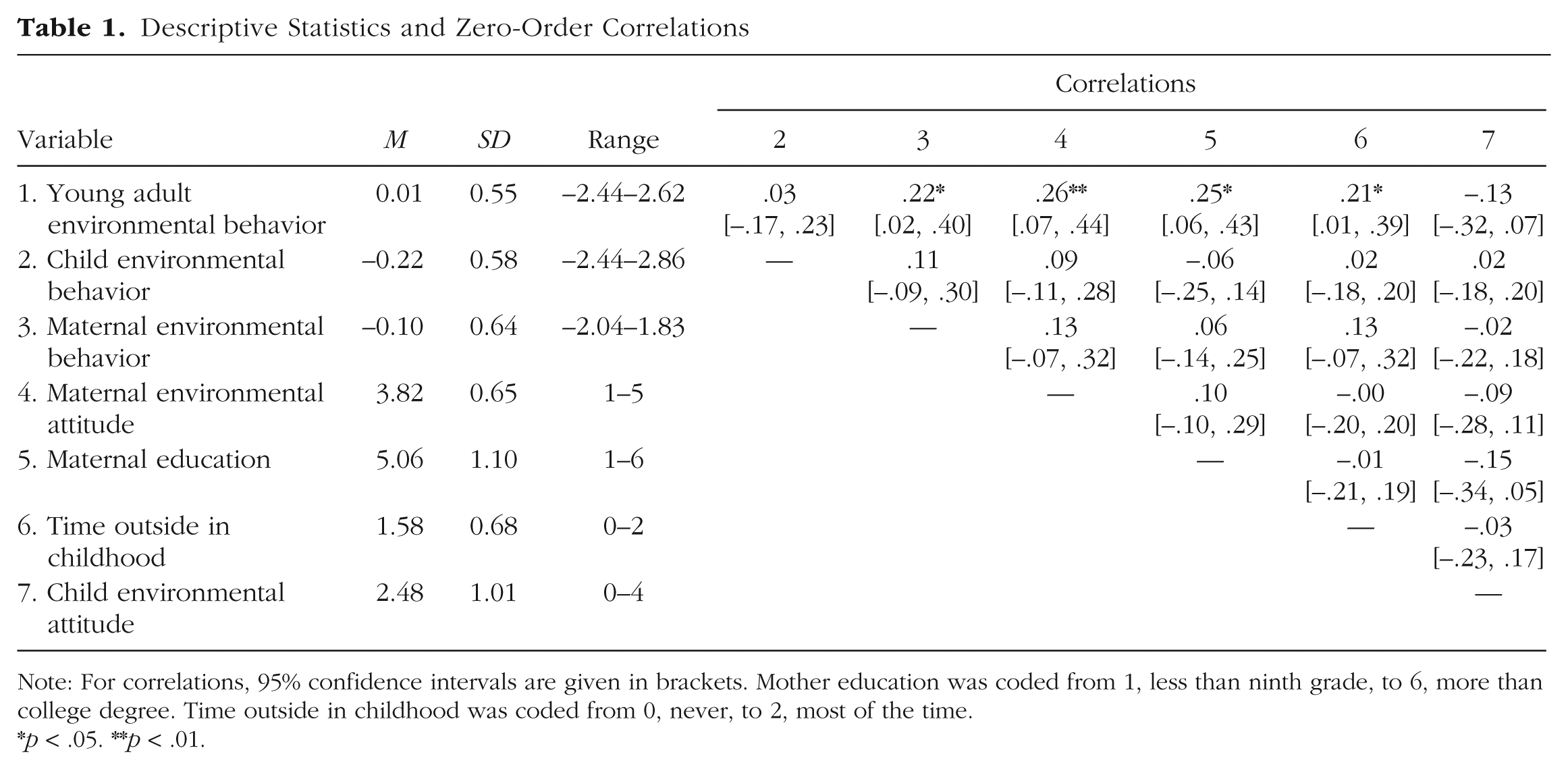
Note: For correlations, 95% confidence intervals are given in brackets. Mother education was coded from 1, less than ninth grade, to 6, more than college degree. Time outside in childhood was coded from 0, never, to 2, most of the time.
p < .05. **p < .01.
Means in Relation to Maternal Political Ideology

Note: Standard deviations are given in parentheses. Eleven mothers who indicated their political ideology as “other” were not included in these analyses.
In order to examine whether change in proenvironmental behavior from childhood to early adulthood could be explained by this same set of childhood factors, we employed a prospective, longitudinal analysis with a general linear model (GLM). Proenvironmental behavior at age 6 was included as a covariate in all of the equations (see Section 1 in the Supplemental Material available online). The regression estimates are the average outcomes across five repetitions for each of the five plausible values as described in the Method section. See Section 2 in the Supplemental Material for the results of each of the five iterative analyses. For maternal political values (conservative, moderate, liberal), we treated the variable as categorical. Eleven participants who answered “other” for political ideology were excluded. All other variables were treated as continuous.
We conducted a series of regression models in which each predictor was added individually to the age 6 proenvironmental behavior measure (child GEB) to examine changes in proenvironmental behavior from age 6 to 18. The young adult’s own environmental behavior as a child did not predict changes in his or her proenvironmental behavior from age 6 to age 18, b = 0.02 (SE = 0.10), p = .658, ΔR2 = .00. Maternal proenvironmental behavior predicted marginal change in adult offspring’s proenvironmental behavior from age 6 to age 18, b = 0.20 (SE = 0.09), p = .084, ΔR2 = .06. Individuals who grew up in a home with mothers who behaved more proenvironmentally engaged in relatively more proenvironmental behaviors at age 18. Young adults with mothers who had a more green environmental attitude when the adult was 6 years old also behaved comparatively more proenvironmentally at age 18, b = 0.22 (SE = 0.08), p = .013, ΔR2 = .07. Young adults at the age of 18 as well behaved more proenvironmentally (compared with their behavior at the age of 6) if their mother was better educated, b = 0.13 (SE = 0.05), p = .019, ΔR2 = .07. The prospective, longitudinal relation for time spent outdoors in childhood and young adult behavior reveals that individuals who spent more time outside as a child behaved comparatively more proenvironmentally as a young adult, b = 0.18 (SE = 0.08), p = .039, ΔR2 = .05. Young adults’ own environmental attitudes when they were a child was unrelated to changes in environmental behavior between childhood and adulthood, b = −0.07 (SE = 0.06), p = .219, ΔR2 = .02. Eighteen-year-olds from conservative and moderate political family backgrounds did not differ in their change in environmental behavior in comparison with young adults from politically liberal families, F(2, 84) = 1.55, p = .223, conservative: b = −0.28 (SE = 0.17), p = .107; moderate: b = −0.14 (SE = 0.13), p = .299.
Note that if instead of looking at changes in proenvironmental behavior within the same person from childhood to early adulthood, we look at the prospective effect of each one of the seven childhood factors on early adult proenvironmental behavior (i.e., we drop childhood proenvironmental behavior as a covariate from the GLM), the prospective analyses reveal the same set of significant effects as the prospective, longitudinal analyses with the behavior change criterion described above.
Another issue was the relative importance of the different childhood factors in predicting young adult proenvironmental behavior. In order to examine this topic, we repeated the prospective, longitudinal analyses above, entering all seven of the childhood predictor variables simultaneously into a GLM. As above, the regression results are the average across five regression models for each of the plausible values for young adult environmental behavior (see Section 1 in the Supplemental Material). As shown in Table 3, when all of the childhood predictor variables were in the equation at the same time, only two variables, time spent outdoors as a child and maternal education, had independent, positive effects on changes in proenvironmental behavior between the ages of 6 and 18. Across the five plausible values for young adult environmental behavior, approximately one quarter of the variance in young adults’ environmental behavior is accounted for when all the predictors are considered simultaneously, R2 = .25, F(8, 79) = 3.21, p = .007. Section 2 in the Supplemental Material depicts each of the individual regression results for the five plausible values.
Simultaneous Childhood Predictors of Adult Proenvironmental Behavior in a General Linear Model
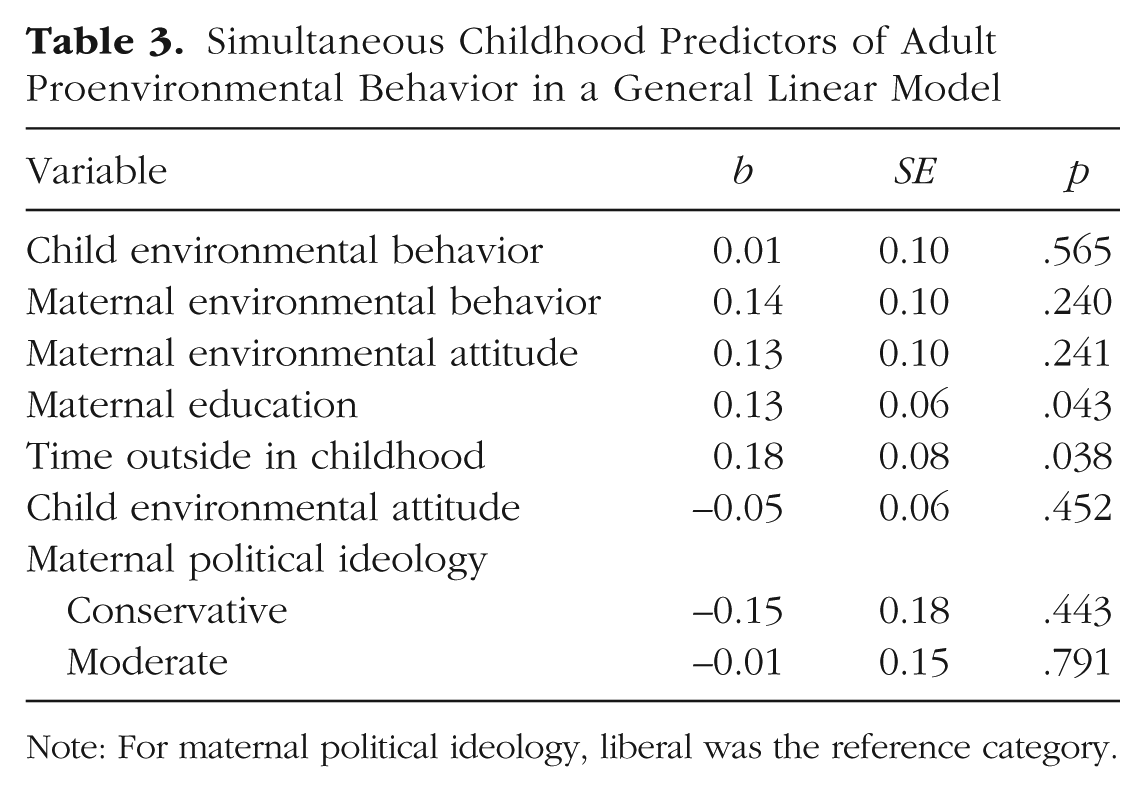
Note: For maternal political ideology, liberal was the reference category.
Discussion
Given the central contributions of human decision making and behavior to local, regional, and global environmental challenges, better insight into the early origins of adult environmental behavior is fundamental to understanding and ultimately changing environmentally destructive human activity. In the present research, we showed that several factors in individuals’ early childhood, when they were 6 years old, significantly predicted changes in their own adult proenvironmental behavior 12 years later at age 18. Prior retrospective work contrasting environmental activists with nonactivists has suggested that early experiences in nature play a formative role in the etiology of more green behavior (Chawla & Derr, 2012; Wells & Lekies, 2006). The prospective, longitudinal data herein show that changes in proenvironmental behavior from childhood to young adulthood are predicted by time spent outdoors as a child. Moreover as indicated in Table 3, this factor, along with better maternal education, independently predicts greater increases in proenvironmental behavior from early childhood to young adulthood. In future work, it would be valuable to examine in greater detail what types of outdoor activities children engage in that lead to the formation of more environmentally responsible behavior in adulthood. For instance there is some evidence that childhood experiences with wild nature (e.g., playing in the woods, hunting or fishing) have a more positive association with adult proenvironmental behaviors in comparison with early experiences with more domesticated nature, such as gardening (Wells & Lekies, 2006). A related issue warranting more research is what are the underlying psychological processes that mediate the apparent link between experiences in nature and engagement in more environmentally responsible behavior? For instance, Otto and Pensini (2017) showed that outdoor experiences elevate children’s connectedness to nature, which, in turn, led to more proenvironmental behavior among children. Given our crude index of interaction with natural settings, we may be underestimating the true importance of early childhood experiences in nature and the development of more environmentally responsible behavior in adulthood. On the other hand, as in most field studies, we cannot rule out all alternative explanations for the childhood outdoor play effect. Although the apparent influence of time outside in early childhood on changes in proenvironmental behavior from age 6 to age 18 was significant with statistical controls, it is possible that some other variable might explain this effect.
Growing up in a household with a mother who engages in more proenvironmental behavior and with a mother who has stronger environmental attitudes was also associated prospectively over a 12-year period with greater changes in proenvironmental behavior among young adult offspring. Prior work has found mixed data on cross-sectional comparisons, suggesting that parental behavior in particular can sometimes be consequential for adolescent proenvironmental behavior (Collado et al., 2015; Grønhøj & Thøgersen, 2009, 2012). This is the first study to show that these parental factors matter for the eventual development of an adult’s engagement in proenvironmental behavior. It is noteworthy that whereas mothers’ environmental attitudes and behavior influence those of their children at maturity, the young adult’s own childhood environmental attitudes and behavior have little bearing on their eventual adult proenvironmental behavior. One possible reason for this might be methodological. Reliability figures for the childhood versions of the adult environmental attitude and behavior scales, as summarized above, were weak to moderate and clearly not as strong as the adult versions of these instruments. However, even if we correct for measurement error attenuation for the childhood environmental attitude and the two behavior scales, the estimated correlations between the two childhood measures and young adult proenvironmental behavior remain nonsignificant, r = .05, 95% CI = [−.15, .25], and r = −.18, 95% CI = [−.32, .02], for child environmental behavior and environmental attitude, respectively. We believe that a more likely explanation for the poor explanatory power of the child environmental attitude and behavior measures in accounting for young adult proenvironmental behavior is that it likely takes time for young children’s environmental attitude and environmental behavior to become more stable.
The apparent power of maternal education in predicting adult offspring’s proenvironmental behavior was likely underestimated in the present study given the lack of variance, particularly at the low end, of maternal education. On average, mothers of the young adults in the present sample had some postcollege education, and very few mothers were high school dropouts. Because we focused on maternal influences on the development of environmental behavior, additional work should also examine paternal influences. One of the most consistent correlates of adult proenvironmental behavior is political ideology (Bamberg & Möser, 2007; Gifford & Nilsson, 2014; Hines et al., 1986). Our data, although in the expected direction, do not provide strong evidence that this relation holds over time, since maternal political ideology in early childhood did not predict young adult environmental behavior.
An additional contribution of the present study is the use of a well-established measure of overall environmental behavior. The GEB not only is based on engagement in a wide range of behaviors but also takes into account the relative difficulty or effort to engage in the various behaviors. Scales that contain few items or that ignore the differential difficulties of engaging in specific environmental behaviors do not provide as accurate and sensitive indicators of overall proenvironmental behavior. For instance, many people recycle but still drive a car with poor gas mileage or live in an energy inefficient home. The GEB scale yields a score that more adequately captures the extent of one’s behavioral commitments to the full range of proenvironmental behaviors. Nonetheless, the GEB is based on self-reports and thus may not be equivalent to actual engagement in proenvironmental behaviors. A recent meta-analysis reveals modest correlations (mean r = .45) between self-reported and observed environmental behavior among adults (Kormos & Gifford, 2014). Moreover, as noted in the Method section, Kaiser and colleagues (Arnold & Kaiser, 2016; Arnold, Kibbe, Hartig, & Kaiser, 2017; Arnold, Kibbe, Vetter et al., 2017; Byrka et al., 2017; Kaiser et al., 2001) present considerable evidence for convergence between GEB scores and observations of a wide range of environmental behaviors, including electricity consumption, use of public transit, and political support for nature conservation practices. Nonetheless, the conceptual distinction between attitude and behavior remains contentious (DeFleur & Westie, 1963; Kaiser, Byrka, & Hartig, 2010; Kaiser, Hartig, Brügger, & Duvier, 2013).
An important limitation of this study was the sample. The sample was modest in size and not random or representative of the American public. The families agreeing to be in the study were well educated, politically moderate to liberal, and lived in small towns and rural areas of upstate New York. On the other hand, this is the only empirical study to examine how various factors measured in childhood subsequently predict the same person’s proenvironmental behavior as a young adult. Larger, more heterogeneous samples of individuals need to be tracked from early childhood through adulthood. Given increasing evidence of national differences in environmental attitude among children (Boeve-de Pauw & Van Petegem, 2013; Evans, Juen, Corral-Verdugo, Corraliza, & Kaiser, 2007; Müller, Kals, & Pansa, 2009), longitudinal samples such as ours should also be collected internationally. We also completed data collection during children’s senior year in high school. Whether and to what extent the environmental behavior of young adults assessed in this study would change with further maturation is unknown. Given these constraints on the generalizability of our sample, we believe that our results are limited to rural children from well-educated families and might be modified if more socioeconomically heterogeneous populations were sampled. We also suspect that the predominantly moderate to progressive political ideology of our sample may lead to underestimation of the importance of familial political values in shaping the development of children’s proenvironmental behaviors. Finally, as indicated, we believe that a more nuanced index of early childhood interaction with natural settings would lead to better prediction of eventual adult proenvironmental behaviors. It is less clear from the small amount of international data on children to what extent our results might generalize to other countries. Given the literature on early environmental attitudes and proenvironmental behaviors, we have no reason to believe that our results depend on other important factors that were omitted. On the other hand, caution is warranted, because this is the first prospective, longitudinal study on the topic of the early origins of adult proenvironmental behavior.
In summary, we conducted prospective, longitudinal analyses of childhood factors, which predicted changes in and the extent of proenvironmental behavior between the ages of 6 and 18 years. Young adults who grow up with mothers who behaved in a more environmentally sustainable manner and had a stronger environmental attitude behaved in a more proenvironmental manner themselves. If their mothers were better educated, they also engaged in more proenvironmental behavior as young adults. Furthermore, children who spend more time outdoors grew up to become more environmentally responsible young adults. Interestingly, one’s own childhood environmental behavior and environmental attitude, at least as assessed at age 6, bear little on one’s eventual environmental behavior at age 18. Finally, among this set of childhood factors, maternal education and time spent outdoors appear to be the most salient precursors to more environmentally responsible adult behavior.
Footnotes
Action Editor
Ralph Adolphs served as action editor for this article.
Author Contributions
G. W. Evans developed the study, collected and analyzed data, and drafted the manuscript. S. Otto and F. G. Kaiser analyzed the data and drafted the manuscript.
Declaration of Conflicting Interests
The author(s) declared that there were no conflicts of interest with respect to the authorship or the publication of this article.

References
Supplementary Material
Please find the following supplemental material available below.
For Open Access articles published under a Creative Commons License, all supplemental material carries the same license as the article it is associated with.
For non-Open Access articles published, all supplemental material carries a non-exclusive license, and permission requests for re-use of supplemental material or any part of supplemental material shall be sent directly to the copyright owner as specified in the copyright notice associated with the article.
