




Abstract
How often are creative ideas generated during episodes of mind wandering, and do they differ from those generated while on task? In two studies (N = 98, N = 87), professional writers and physicists reported on their most creative idea of the day, what they were thinking about and doing when it occurred, whether the idea felt like an “aha” moment, and the quality of the idea. Participants reported that one fifth of their most significant ideas of the day were formed during spontaneous task-independent mind wandering—operationalized here as (a) engaging in an activity other than working and (b) thinking about something unrelated to the generated idea. There were no differences between ratings of the creativity or importance of ideas that occurred during mind wandering and those that occurred on task. However, ideas that occurred during mind wandering were more likely to be associated with overcoming an impasse on a problem and to be experienced as “aha” moments, compared with ideas generated while on task.
Mind wandering about topics unrelated to one’s immediate circumstances routinely impairs performance (Smallwood & Schooler, 2015) and produces dysphoria (Killingsworth & Gilbert, 2010), raising the question of why this mental state occupies such a large proportion of people’s waking hours. Here, we consider one potential benefit—creative ideas—that may be associated with one particular type of mind wandering. Definitions of mind wandering vary, with some accounts emphasizing task-independent thought (Smallwood & Schooler, 2015), others focusing on spontaneous thoughts (Christoff, Irving, Fox, Spreng, & Andrews-Hanna, 2016), and others arguing that mind wandering possesses no singular defining properties (Seli et al., in press), so researchers should specify the specific kind of mind wandering they are referring to. In keeping with all three approaches, we refer here to a particular form of mind wandering—spontaneous task-independent mind wandering—that involves thoughts that are both independent from the task at hand and a spontaneous departure from the prior line of thought. In the context of creative professional ideas, such mind wandering corresponds to situations in which inventive thoughts occur when one is not at work and not actively pursuing the problem.
Although anecdotes of creative thoughts arising during spontaneous task-independent mind wandering abound, few are more celebrated than the mathematician Poincaré’s description of the moment the foundation of noneuclidean geometry unexpectedly sprang to mind: “We entered an omnibus for some excursion or other; the instant I set my foot on the step the idea came to me, without anything in my former thoughts seeming to have paved the way for it” (Poincaré, 1910, p. 327). Complementing anecdotal reports are empirical studies suggesting a relationship between being prone to mind wandering (defined as having task-independent thoughts) and performance on creative tasks in the lab (Baird et al., 2012; White & Shah, 2011; Zedelius & Schooler, 2015), as well as experimental evidence suggesting that filling an incubation interval with a task that encourages mind wandering enhances creative performance (Baird et al., 2012). Theoretical analyses also implicate mind wandering as a source of inspiration (Zedelius & Schooler, 2016). Creative solutions often entail overcoming an impasse when the more straightforward approaches to a problem have failed (Davidson, 1995; Schooler & Melcher, 1995). Such impasses can increase the accessibility of a problem (Zeigarnik, 1938), which in turn can lead to increased mind wandering (Masicampo & Baumeister, 2011). Accordingly, mind wandering may foster the revisiting of creative problems in a variety of contexts, which may enable their consideration from alternative vantages and thereby enhance the likelihood of overcoming the impasse (Ritter et al., 2012).
Although these findings hint at the role of spontaneous task-independent mind wandering in the generation of creative ideas, there is a notable absence of any systematic investigation of the frequency, manner, and impact of this form of mind wandering in ecologically valid studies of the everyday lives of creative professionals (although see Amabile, Barsade, Mueller, & Staw, 2005). This type of research is critical for testing theoretical premises, boundary conditions, and baseline frequencies in their relevant contexts (Reis, 2012). Do innovations of creative individuals routinely occur outside of work when they are not actively pursuing the problem? If so, how do such musings compare with those that occur when these individuals are at work or actively thinking about the problem? Phenomenologically, are they particularly associated with a sudden “aha” experience? Conceptually, are they more likely to entail overcoming a long-standing impasse? And factually, how well do they stand the test of time?
To address these questions, we examined how creative work-related ideas unfold in the daily lives of people whose livelihood depends on being creative. We recruited participants from two highly innovative, yet distinct, professions: elite scientists (theoretical physicists) and professional writers (mainly screenwriters). These two populations were selected because of the disparity in the creative products that they generate: The problems that physicists encounter typically involve convergent progress toward a single solution, whereas writers tackle more divergent problems with many alternative possible resolutions. In both studies, participants were queried every day regarding any creative idea they had related to their profession, what they were doing and thinking when they had the idea, whether it entailed overcoming an impasse or felt like an “aha” moment, and how important and creative the idea was. In Study 1, participants were sent their verbatim description of each idea 6 months later and were asked to rate the idea’s creativity and importance. Study 2 was a replication of Study 1, except that participants were sent their idea descriptions 3 months later. We predicted (a) that a significant proportion of creative ideas would be reported to occur during mind wandering, when participants were not working at the task and not thinking about the general topic or problem; (b) that ideas that involved mind wandering would be especially likely to involve overcoming impasses; and (c) that the quality of ideas that occurred during mind wandering would be equal to or better than the quality of ideas that occurred when individuals were at work or otherwise actively working on the problem.
Method
Participants
Study 1
Participants in Study 1 were 45 physicists and 53 professional writers who were paid $150 for completing the 2-week diary (payment was prorated if participants did not complete all the surveys) and $50 for completing the follow-up survey. Our goal (for both studies) was to enroll up to 100 participants during a 6-month recruitment period. The physicists were recruited through the Kavli Institute for Theoretical Physics, located at the University of California, Santa Barbara. Of the 45 physicists, 8 were female and 37 were male, and their average age was 35.07 years (SD = 8.34 years). Nine participants were completing their PhDs at the time of the study; the remaining participants had earned their PhDs an average of 8.52 years earlier (SD = 8.99 years).
The professional writers were recruited through advertisements placed in the Writers Guild of America’s quarterly magazine, Written By, a trade publication for professional screenwriters. In addition, a few participants received information about the study from an enrolled participant and contacted us directly. Only individuals who indicated that they were professional writers and spent at least 20 hr per week on writing and writing-related activities were enrolled in the study. Participants’ occupations included screenwriting for film and television, writing novels, and writing nonfiction; 28 of the professional writers were female and 25 were male, and their average age was 49.65 years (SD = 11.18 years).
Study 2
Eighty-seven participants—27 physicists and 60 professional writers—participated in Study 2. Recruitment procedures and compensation for participation were identical to those used in Study 1. Of the 27 physicists, 1 was female, 1 declined to indicate gender, and 25 were male; their average age was 39.69 years (SD = 10.74 years). Of the 60 writers, 30 were female, 1 declined to indicate gender, and 29 were male; their average age was 49.20 years (SD = 12.69 years). Four of the physicists were completing their PhDs at the time of the study, and the remaining participants had earned their PhDs an average of 13.42 years (SD = 10.39 years) earlier.
Procedure
The procedures and all study materials were approved by the University of California, Santa Barbara Human Subjects Committee. After providing informed consent and demographic information, participants were e-mailed a survey each night for 2 weeks (Study 1) or 1 week (Study 2). Participants listed the most important creative idea of the day (if they had a creative idea) and then answered several questions about the idea and its generation. Participants were also asked general questions about the day, including time spent working, sleep, exercise, and mood, which are not the focus of this report. 1
Follow-up survey procedure
Approximately 6 months later (Study 1) or 3 months later (Study 2), participants were asked to complete a follow-up survey. If participants did not respond to the initial follow-up survey, they were sent up to five weekly reminders. In Study 1, 94% of participants completed the follow-up survey; in Study 2, 88% completed the follow-up survey. Participants were given each of the creative ideas they generated in the daily diary portion of the study (using their verbatim text) and responded to questions regarding the idea.
Nightly survey measures
Creative ideas
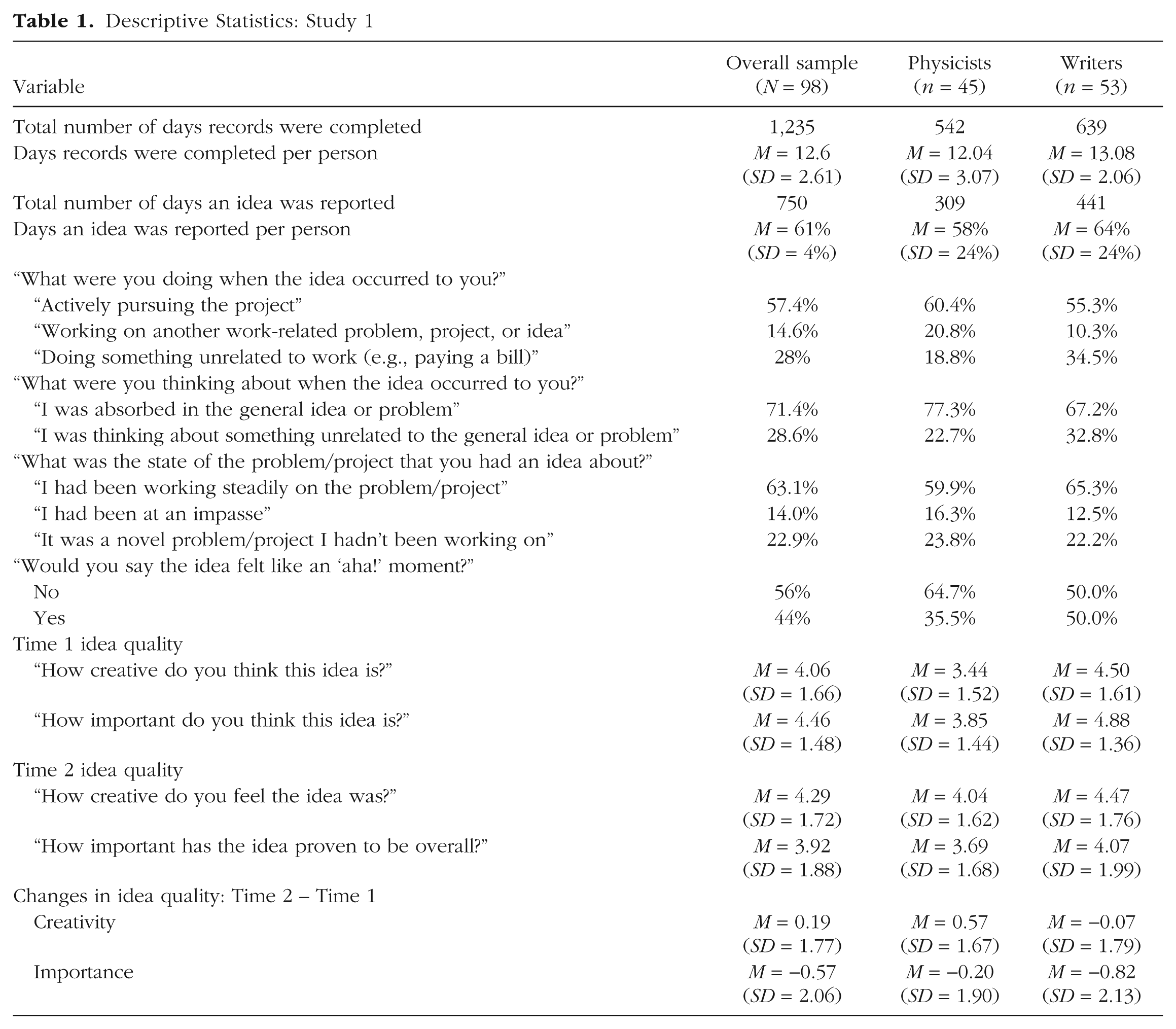
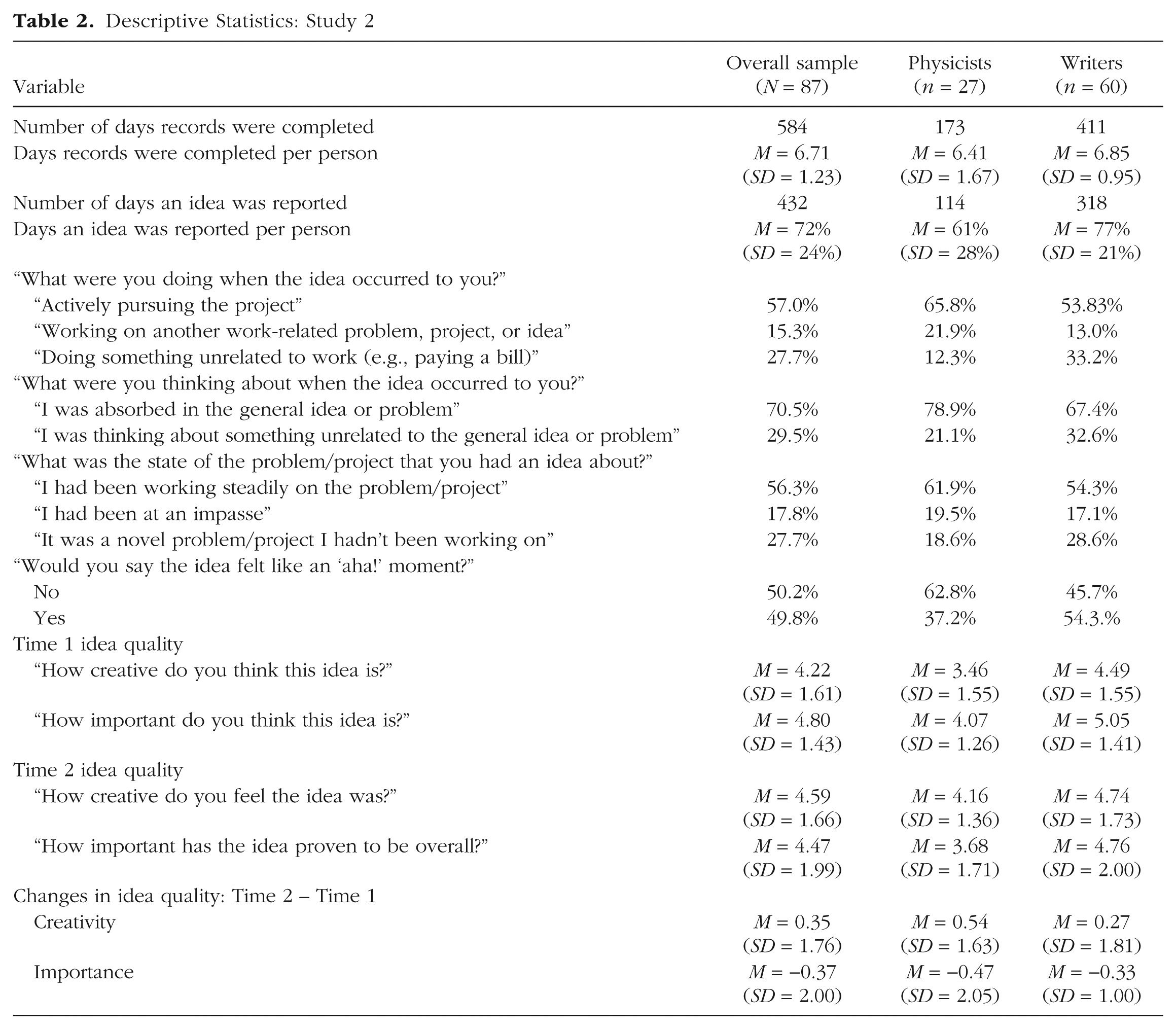
Participants were asked to describe their most meaningful creative idea of the day in terms they would recognize later. Participants were informed that we did not necessarily expect everyone to have creative ideas every day and that if they had no significant ideas to report they could skip the relevant section of the survey. Because definitions of creativity vary in research and between writers and physicists, we did not provide a definition of a creative idea beyond the following daily prompt: “Please describe in a sentence or two the most important creative idea you had today.” Two trained researchers independently coded whether the text entered in response to the question was indeed a valid idea (e.g., eliminating entries such as “I was too busy doing administrative work today”). Descriptive data can be found in Tables 1 and 2.
Descriptive Statistics: Study 1
Descriptive Statistics: Study 2
Context of idea
To assess what participants were thinking and doing when the idea occurred, we asked them two questions. The first was “What were you thinking about when the idea occurred to you?” The response options were “I was absorbed in the general idea or problem” or “I was thinking about something unrelated to the general idea or problem.” They were then asked a second question: “What were you doing when the idea occurred to you?” The response options were “Actively pursuing the project,” “Working on another work-related problem, project or idea,” or “Doing something unrelated to work (e.g., paying a bill).” To assess the general state of their idea, we also asked, “What was the state of the problem/project that you had an idea about?” Response options were “I had been working steadily on the problem/project,” “I had been at an impasse,” or “It was a novel problem/project I hadn’t been working on.”
Quality and phenomenology of idea
To assess the quality of the idea, we asked participants, “Would you say the idea felt like an ‘aha!’ moment?” Response options were “Yes” or “No.” To assess participants’ immediate perceptions of idea quality, we asked, “How important do you think this idea is?” (response scale ranged from 1, not at all important, to 7, extremely important) and “How creative do you think this idea is?” (response scale ranged from 1, slightly creative, to 7, extremely creative).
Follow-up survey measures
Following the presentation of each of their ideas provided in the nightly surveys 6 months earlier (Study 1) or 3 months earlier (Study 2), participants were asked (using the same 7-point scales from the daily survey), “How creative do you feel the idea was?” and “How important has the idea proven to be overall?”
Results
Descriptive data are presented in Table 1 (Study 1) and Table 2 (Study 2). Traditional analysis-of-variance methods assume independence of observations, an assumption that is violated when the same individual completes the same measures repeatedly over several occasions, so we used two-level hierarchical linear modeling techniques (Hierarchical Linear and Nonlinear Modeling software Version 7.01 for Windows; Raudenbush & Bryk, 2002; Raudenbush, Bryk, Cheong, Congdon, & Du Toit, 2011) to test our main hypotheses. In these models, we analyzed reports from participants’ recorded ideas, so ideas (Level 1) were nested within persons (Level 2). Results presented below are unstandardized coefficients that can be interpreted as follows: Every one unit increase in the predictor variable is associated with a change in the outcome variable equivalent to the coefficient (in size and direction). For binary-outcome coefficients, we also present the corresponding odds ratios. We first conducted analyses modeling occupation (writer/physicist) as a Level 2 predictor, but the pattern of findings was so similar that here we present the results of models collapsed across occupation. (The analyses with the two groups modeled separately are provided in the Supplemental Material available online.)
To examine context, we used participants’ answers to both the “what were you thinking” and “what were you doing” questions. Specifically, an idea was defined as occurring on task if participants answered the “doing” questions with either “actively pursuing the project” or “working on another work-related project or idea” or answered the “thinking” question with “I was absorbed in the general idea or problem.” An idea was defined as occurring during spontaneous task-independent mind wandering if participants responded to the “doing” question with “doing something unrelated to work (e.g., paying a bill)” and responded to the “thinking” question with “I was thinking about something unrelated to the general idea or problem.” We note that this is a highly conservative definition of mind wandering, but it is consistent with our definition of spontaneous task-independent mind wandering: Participants’ ideas had to have occurred while they were doing something unrelated to work and while thinking about something other than the general topic. We conducted additional analyses using a more liberal definition of mind wandering; they yielded similar results and can be found in the Supplemental Material.
In Study 1, on-task ideas made up 80.1% of reported ideas, and ideas that occurred during mind wandering made up 19.9% (n = 148). A nearly identical distribution was found in Study 2, with 80.8% of ideas reported to occur on task and 19.2% (n = 82) while mind wandering. Thus, on average across the two studies, participants reported that about one in five of their most significant ideas were formed during episodes of mind wandering. To test incubation effects, we examined whether ideas addressing problems or projects on which participants were at an impasse were more likely to occur during mind wandering than would be expected by base rates. To do this, we excluded ideas categorized as pertaining to a new or novel problem or project and examined ideas only about problems and projects that people were making steady progress or were at an impasse on (n = 574 ideas in Study 1 and n = 317 ideas in Study 2).
Specifically, we constructed equations that predicted whether an idea at which one was at an impasse was more likely to occur during mind wandering than would be expected by base rates. We used a Bernoulli distribution model using penalized quasilikelihood estimation appropriate for dichotomous outcomes. The outcome measure was idea context (on task or mind wandering, dummy coded 0 or 1, respectively), and the predictor variable (dummy coded) was uncentered. In this and all subsequent equations, the random component (r) of the intercept was free to vary, but the random component of the slope was constrained to zero. See Equation 1 in the Supplemental Material.
Results of these and all subsequent analyses can be found in Table 3. Analyses revealed that, in both studies, ideas addressing problems on which participants were at an impasse were significantly more likely than nonimpasse ideas to come during mind wandering. Specifically, in Study 1, 26.2% of the ideas on which participants were at impasse came during mind wandering, whereas 13.9% of the ideas on which participants were making steady progress came during mind wandering. In Study 2, 19.7% of the ideas on which participants were at impasse came during mind wandering, whereas 9.2% of the ideas on which participants were making steady progress came during mind wandering.
Results of Multilevel Models
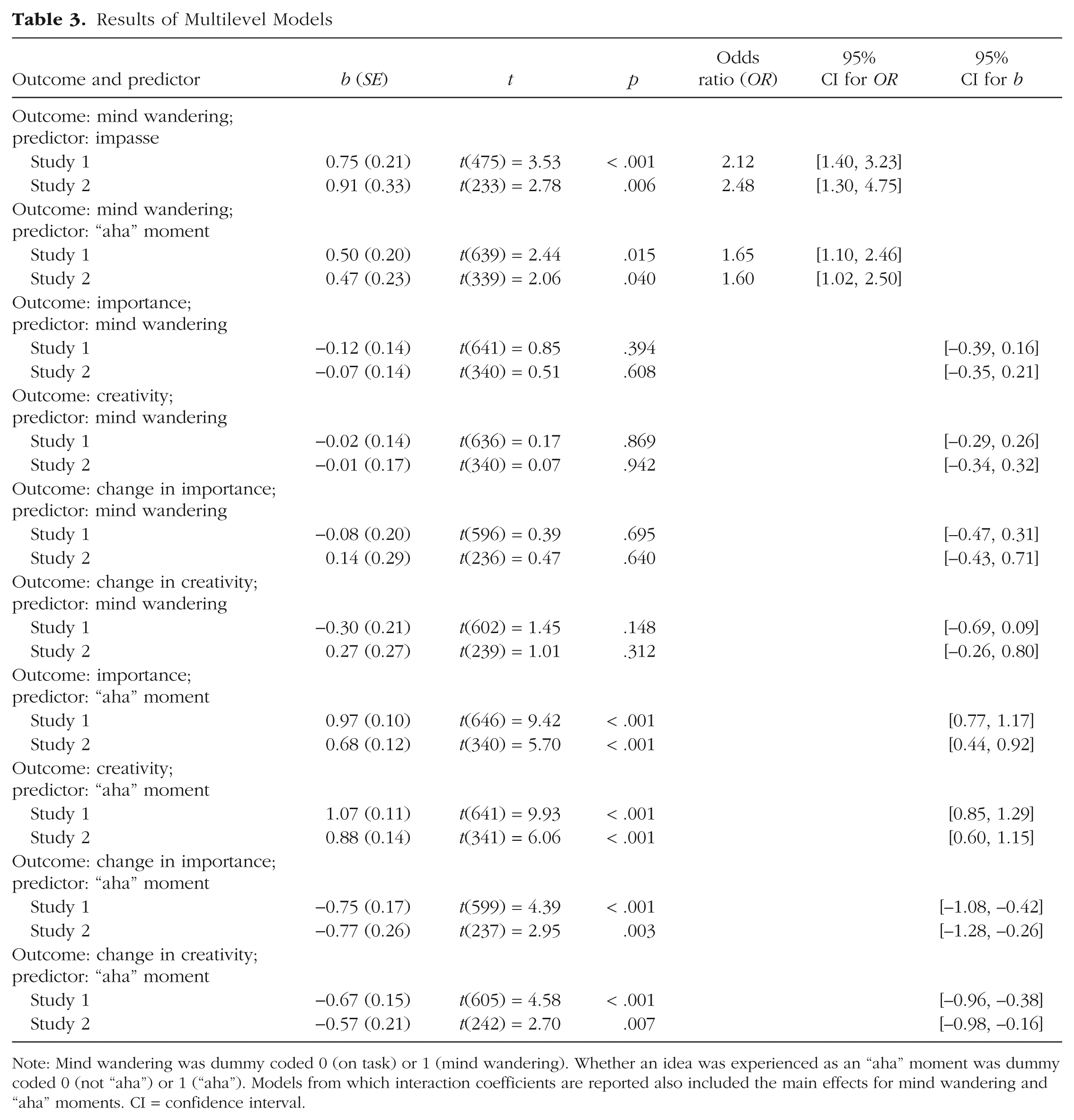
Note: Mind wandering was dummy coded 0 (on task) or 1 (mind wandering). Whether an idea was experienced as an “aha” moment was dummy coded 0 (not “aha”) or 1 (“aha”). Models from which interaction coefficients are reported also included the main effects for mind wandering and “aha” moments. CI = confidence interval.
We next turned to an examination of idea quality. To test whether idea quality differed by idea context, we constructed equations that predicted idea quality (creativity, importance, or change in creativity or importance from Time 1 to Time 2) from the idea context (on task or mind wandering; dummy coded 0 or 1, respectively); we created a normal distribution model using restricted maximum-likelihood estimation appropriate for continuous outcomes. The outcome measure was the idea-quality variable, and the predictor variable was the idea context, uncentered. See Equation 2 in the Supplemental Material.
We found that ideas that occurred during mind wandering did not differ from on-task ideas on same-day ratings of creativity or importance. This was true in both Study 1 and Study 2 (see Table 3). We then examined how idea quality held up over time, regardless of idea context, by using Equation 2 but replacing the outcome variable with change in idea quality from Time 1 to Time 2 and dropping the context predictor. Overall, in both studies, we found that participants rated their ideas as slightly more creative but less important at follow-up (6 months later in Study 1 and 3 months later in Study 2) than they did when those ideas occurred. Although our previous analyses showed that ideas generated on task did not differ in quality from ideas generated during mind wandering at the time they occurred, we nevertheless examined how the quality of ideas generated in these two contexts held up over time: We reran the analyses with context as a Level 1 predictor. These analyses showed that on-task and mind-wandering ideas were not significantly different from one another in ratings of changes in creativity or importance (see Table 3).
To address how mind wandering affects the phenomenology of idea generation, we assessed whether ideas that occurred during mind wandering were as likely to be experienced as an “aha” moment as ideas that occurred on task. To do this, we modeled mind wandering from a predictor variable representing whether the idea was experienced as an “aha” (dummy coded 0 for not “aha” or 1 for “aha”). This two-level nonlinear analysis showed that ideas occurring during mind wandering were more likely to be reported as “aha” moments (see Table 3). Specifically, 25.2% of ideas from Study 1 and 22.3% of ideas from Study 2 that felt like “aha” moments came during mind wandering, while 15.9% of ideas from Study 1 and 16.4% of ideas from Study 2 that did not feel like “aha” moments came during mind wandering.
We then examined whether ideas experienced as “aha” moments differed from other ideas in importance and creativity. Analyses showed that ideas experienced as “aha” moments were rated as more creative and important than other ideas. Analyses of changes in creativity and importance ratings over the follow-up period showed that in both studies, ratings of creativity and importance for “aha” ideas declined significantly more than for ideas not experienced as “aha” moments (see Table 3).
Discussion
These findings provide the first direct evidence that a significant proportion of creative individuals’ ideas occur while engaged in a particular type of mind-wandering: spontaneous task-independent mind wandering, here operationalized as profession-related ideas that occur outside of work when participants are not actively thinking about the topic. Strikingly, approximately 20% of ideas occurred to both physicists and creative writers in this manner, and this was observed in two entirely independent samples. These results thus bear out the numerous anecdotes and indirect sources of evidence suggesting that creative inspiration routinely occurs during moments of mind wandering. In addition, the present findings also speak to the distinctive quality of ideas that occur during this type of mind wandering. It might be expected that ideas that individuals have while actively engaged in their vocation would be of higher quality than those that spring to mind when otherwise engaged. Nevertheless, we found that ideas that occurred while mind wandering were rated comparably with on-task ideas on all metrics, both when the idea occurred and during the 3- and 6-month follow-up assessment.
Although ideas that occurred while participants were both on task and mind wandering did not differ in overall quality, there were several dimensions on which they did consistently differ. Specifically, relative to on-task ideas, ideas that occurred while mind wandering were reported to be experienced with a greater sense of “aha” and were more likely to involve overcoming an impasse. These findings potentially speak to the unique value that mind wandering may offer in the creative process. Many creative solutions require overcoming some form of impasse, and it is precisely these problems that individuals are likely to set aside in hopes that a solution will come. Furthermore, encountering impasses is known to increase the accessibility of problems (Zeigarnik, 1938) and to increase mind wandering about that problem (Masicampo & Baumeister, 2011). This increased accessibility may serve a functional role by enabling ideas to spring to mind in novel or otherwise opportune contexts, offering unique solutions that resolve the impasse (Seifert, Meyer, Davidson, Patalano, & Yaniv, 1994).
The present findings have potential limitations, chief among which are their reliance on self-reports and correlations. However, these constraints necessarily stem from a central strength of this work, namely that it investigates the actual innovations of creative professionals in their everyday lives. Although the causal role of mind wandering remains to be more fully established, we now know that creative professionals routinely report having creative ideas outside of work while not actively pursuing a problem and that such ideas are associated with overcoming impasses. A second potential concern is that although ideas that occurred while mind wandering tended to be characterized as overcoming impasses, so too did “aha” experiences more generally, χ2(1, N = 660) = 5.09, p = .028 in Study 1 and χ2(1, N = 269) = 3.02, p = .054 in Study 2. It is thus possible that the surprise of ideas appearing out of the blue produced false inferences of overcoming impasses (Dougal & Schooler, 2007). However, contrary to this account, the relationship between mind wandering and overcoming impasses held even when “aha” experiences were accounted for—Study 1, b = 0.73, t(472) = 3.45, p = .001, odds ratio = 2.08, 95% confidence interval = [1.37, 3.16]; Study 2, b = 0.82, t(230) = 2.61, p = .010, odds ratio = 2.28, 95% confidence interval = [1.22, 4.25]. A further possible concern is that the significant proportion of creative ideas that occurred outside of the context of work could have arisen because participants were not working much of the time. However, even if finding creative solutions while mind wandering is less efficient than while working, it is notable that it occurs at all.
Regardless of the efficiency of creative mind wandering, the present findings are consistent with the view that spontaneous task-independent mind wandering represents a source of the inventive ideas that individuals have each day. This potential function of mind wandering may help to explain why a mental state that can be associated with significant negative outcomes is nevertheless so ubiquitous (Killingsworth & Gilbert, 2010).
Supplemental Material
GableOpenPracticesDisclosure – Supplemental material for When the Muses Strike: Creative Ideas of Physicists and Writers Routinely Occur During Mind Wandering
Supplemental material, GableOpenPracticesDisclosure for When the Muses Strike: Creative Ideas of Physicists and Writers Routinely Occur During Mind Wandering by Shelly L. Gable, Elizabeth A. Hopper and Jonathan W. Schooler in Psychological Science
Supplemental Material
GableSupplementalMaterial – Supplemental material for When the Muses Strike: Creative Ideas of Physicists and Writers Routinely Occur During Mind Wandering
Supplemental material, GableSupplementalMaterial for When the Muses Strike: Creative Ideas of Physicists and Writers Routinely Occur During Mind Wandering by Shelly L. Gable, Elizabeth A. Hopper and Jonathan W. Schooler in Psychological Science
Footnotes
Acknowledgements
We thank Josh Conviser, Gregg Hurwitz, and Chetan Nayak for their insight and advice on the daily creative lives of professional writers and physicists. We also thank David Gross and Lars Bildsten for facilitating our recruitment efforts at the Kavli Institute for Theoretical Physics at the University of California, Santa Barbara; Mike Mrazek and Jonathan Smallwood for contributions to the measures; and Claire Zedelius for comments on an earlier version of this manuscript.
Action Editor
Bill von Hippel served as action editor for this article.
Author Contributions
S. L. Gable and J. W. Schooler developed the study concept and designed the study. Testing and data collection were performed by E. A. Hopper. S. L. Gable analyzed the data, and S. L. Gable and J. W. Schooler interpreted the data. S. L. Gable and J. W. Schooler drafted the manuscript. All authors approved the final version of the manuscript for submission.
Declaration of Conflicting Interests
The author(s) declared that there were no conflicts of interest with respect to the authorship or the publication of this article.
Funding
This research was supported by a Templeton Foundation grant awarded to S. L. Gable and J. W. Schooler.
Open Practices
All data and materials have been made publicly available via Harvard Dataverse and can be accessed at https://dataverse.harvard.edu/dataset.xhtml?persistentId=doi:10.7910/DVN/GGDUND and https://dataverse.harvard.edu/dataset.xhtml?persistentId=doi:10.7910/DVN/8SS9PX, respectively. The design and analysis plans for the experiments were not preregistered. The complete Open Practices Disclosure for this article can be found at https://journals-sagepub-com.web.bisu.edu.cn/doi/suppl/10.1177/0956797618820626. This article has received badges for Open Data and Open Materials. More information about the Open Practices badges can be found at  .
.
Notes
References
Supplementary Material
Please find the following supplemental material available below.
For Open Access articles published under a Creative Commons License, all supplemental material carries the same license as the article it is associated with.
For non-Open Access articles published, all supplemental material carries a non-exclusive license, and permission requests for re-use of supplemental material or any part of supplemental material shall be sent directly to the copyright owner as specified in the copyright notice associated with the article.
