



Abstract
The COVID-19 pandemic is creating unprecedented, sustained, and unavoidable stress for the entire population, and older people are facing particularly heightened risk of contracting the virus and suffering severe complications, including death. The present study was conducted when the pandemic was spreading exponentially in the United States. To address important theoretical questions about age differences in emotional experience in times of crisis, we surveyed a representative sample of 945 Americans between the ages of 18 and 76 years and assessed the frequency and intensity of a range of positive and negative emotions. We also assessed perceived risk of contagion and complications from the virus, as well as personality, health, and demographic characteristics. Age was associated with relatively greater emotional well-being both when analyses did and did not control for perceived risk and other covariates. The present findings extend previous research about age and emotion by demonstrating that older adults’ relatively better emotional well-being persists even in the face of prolonged stress.
Keywords
The COVID-19 pandemic has taken an unprecedented toll on daily life around the world. In addition to engendering grave risks to physical health, the pandemic has resulted in looming uncertainties about contagion, fears about shortages, restricted social contacts, and profound economic uncertainties. A threat of this scope and severity holds the potential to reduce global collective well-being.
In addition to the practical importance of understanding the emotional reactions people are experiencing during these extraordinary times, examining age differences in responses to population-wide stressors may also shed light on important theoretical questions about age differences in emotional experience and emotion regulation. There is abundant evidence that emotional well-being improves with age. However, it is unclear whether this relatively positive emotional profile reflects improved regulation of experienced emotions or the active avoidance of environments that elicit negative emotions. Below, we describe empirical findings about emotion and aging and review two important theoretical accounts of age differences. We then present findings from a survey that assessed age differences at the point when threats to well-being from the COVID-19 pandemic were first peaking in the United States and inescapable external shocks to daily life were ubiquitous.
Emotional Experience Improves With Age
There is substantial evidence that, on balance, older people’s daily emotional experience is more positive than younger people’s (Burr, Castrellon, Zald, & Samanez-Larkin, 2020; Carstensen, Pasupathi, Mayr, & Nesselroade, 2000; Carstensen et al., 2011; Stone, Schwartz, Broderick, & Deaton, 2010). Older people report that they manage their emotions better than they did when they were younger (Gross et al., 1997) and display greater emotional stability in day-to-day life (Burr et al., 2020). When faced with serious diseases such as cancer, older patients report better affective states than younger patients (Hart & Charles, 2013). Life satisfaction also increases from mid- to late life (Blanchflower & Oswald, 2008; Galambos, Krahn, Johnson, & Lachman, 2020); and while there is some evidence that satisfaction begins to decline after 70 (Baird, Lucas, & Donnellan, 2010), the decline is better predicted by closeness to death than chronological age (Gerstorf, Ram, Rocke, Lindenberger, & Smith, 2008).
Theoretical Accounts of Improved Emotional Experience
Considerable theoretical work has been devoted to explaining these widely documented age associations with emotional well-being. While virtually all life-span theories view selection as essential to adult development, some theories posit that age-related advantages reflect the avoidance of stressors, while others maintain that age advantages are driven by motivational shifts that direct cognitive and behavioral resources to positive and meaningful aspects of life.
Shifts in motivation and goals
Socioemotional selectivity theory (SST; Carstensen, 1993, 2006; Carstensen, Isaacowitz, & Charles, 1999) posits that late-life improvements in emotional well-being result from motivational shifts that occur as individuals perceive constraints on future time. When time is perceived as expansive, as it typically is in youth, goals about exploration and expanding horizons are prioritized because these goals prepare individuals to adapt to nebulous future conditions. In contrast, when future time is constrained, goals and related preferences favor emotional meaning and positive experience. SST maintains that the approach of endings allows people to live in the present and to prioritize feeling states over future preparedness. While mortality represents a powerful ending, geographical relocations, college graduations, and political events that prime the fragility of life (e.g., terrorist attacks) also result in the prioritization of emotionally meaningful goals (Fredrickson & Carstensen, 1990; Fung & Carstensen, 2004). In a study by Barber, Opitz, Martins, Sakaki, and Mather (2016), the experimental priming of endings instantiated the positivity effect in young adults. And, importantly, when time horizons are expanded experimentally, older people display preferences for exploration (Fung & Carstensen, 2004).
Statement of Relevance
The COVID-19 pandemic poses grave risks to physical health. It also is resulting in persistent stress stemming from limited social contact and economic uncertainty. The pandemic impacts the entire population, yet it poses a heightened risk for older adults. In this research, we asked how these extraordinary times are impacting the emotional health and well-being of adults across the life span. We surveyed a sample of Americans between 18 and 76 years of age, asking them to tell us about their positive and negative emotional experiences. We observed better emotional well-being in older adults compared with their younger counterparts. These findings are consistent with the broader literature. Our study extends them to the unprecedented situation of COVID-19. The work provides additional evidence for emotional gains in late life. It also suggests that the gains stem not from avoidance of high-stress situations—which is not possible in the time of COVID-19—but instead from prioritizing goals about meaningful aspects of life.
SST predicts that because goals direct cognitive processing, attention and memory come to support emotionally meaningful goals as people grow older. Older people react less to negative situations, are less distracted by irrelevant negative stimuli, and display preferential attention to and memory for emotionally meaningful and positive stimuli (Reed, Chan, & Mikels, 2014). This is termed the positivity effect (see Charles, Mather, & Carstensen, 2003; Mather & Carstensen, 2005), and the literature on it suggests that differential emotion processing is a default mode of processing that emerges across adulthood and involves minimal cognitive effort in directing attention to positive elements of life (Allard, Wadlinger, & Isaacowitz, 2010). Mather (2012) maintains that the positivity effect reflects cognitive control and has proposed a model that illuminates preservation of cognitive and neural support for emotion processing that favors positive stimuli over negative information. Attending to and remembering positive information over negative—although not a conscious strategy—may well contribute to improved emotional experience.
Situation selection and avoidance of stressors
A complementary conceptualization of age-related advantages in emotional well-being is provided by the strength and vulnerability integration (SAVI) model (Charles, 2010). The SAVI model acknowledges age-related improvements in emotional experience in daily life but suggests that advantages rest primarily on the avoidance of stressful situations. Under conditions in which stress is prolonged and inescapable, the SAVI model posits that the degradation of physiological homeostasis will limit the capacity to effectively regulate emotions, and subsequently, age-related advantages will be eliminated or reversed. In one study, Charles, Piazza, Luong, and Almeida (2009) observed that older people experienced less affective reactivity than younger people when they were able to avoid stressful or tense interactions, yet when they did engage in these stressful interactions, older and younger people experienced similar levels of reactivity. Similarly, Birditt (2014) found that older people reported less reactivity than younger adults to a mildly distressing event they could largely avoid, but when they were required to engage in such events, similar levels of reactivity were observed across age. The degree to which situation selection accounts for emotional well-being in daily life is unknown, however, and age differences in the use of situation selection have not been observed when directly examined (Eldesouky & English, 2018).
In summary, theory and empirical evidence suggest that aging is associated with improved emotional experience. An important unresolved issue is whether age-related gains in emotional experience rest principally on avoiding stressors or whether other factors, such as cognitive control, play a role. To answer this question experimentally, researchers would need to expose older and younger people to prolonged, inescapable, high-stress conditions. For obvious ethical reasons, this has never been done. However, the COVID-19 pandemic has been providing just such conditions, forcing people to shelter in place and raising fears and uncertainties about a mortal threat that is affecting the entire population and is especially dangerous for older adults.
The Present Study
In April 2020, we deployed a survey assessing positive and negative emotional experiences of a sample of American adults ranging from 18 to 76 years old. The pandemic was appearing at different rates and times around the world. It first surged in the United States during April. Hundreds of thousands of Americans contracted the virus, and COVID-related deaths increased exponentially from roughly 5,000 at the beginning of the month to 60,000 at the end. News about the pandemic was omnipresent, and it was clear that older people were at greatly heightened risk of both health complications and death.
We reasoned that if avoidance (aka situation selection) accounts for the demonstrated advantages in emotional experience in older people, then conditions such as these would eliminate age differences. If, instead, age differences in emotional experience remained, findings would speak against situation selection as the central explanation for observed age advantages. Reasoning from SST and bolstered by empirical evidence concerning an age-related positivity effect, we hypothesized that age differences would be preserved, even during this fragile time.
Method
Participants
The study was approved by Stanford University’s Institutional Review Board, and informed consent was obtained from all participants. Following recent recommendations to recruit large samples when testing age effects (Brydges, 2019), we preregistered a sample size of 970. We used Prolific (www.prolific.co) to recruit an online sample of 974 adults who were currently living in the United States; age and gender were stratified across the sample. Participants were invited to complete a study entitled “Responses to the Coronavirus” and received a payment of $4 as compensation. Data from all participants were collected using Qualtrics survey software on April 23 and 24, 2020.
Exclusions
Following our preregistered plan, we excluded data from participants (n = 20) who completed the entire survey in less than 5 min on the presumption that they had not paid adequate attention to the survey items and instructions. On Prolific’s recommendation, we also excluded eight cases with suspicious response patterns. We also excluded data from one participant who did not report age, resulting in a final sample size of 945.
Sample characteristics
Participants were 49.2% female and ranged in age from 18 to 76 years (M = 45.15, SD = 16.79). Seventy-five percent of participants identified as White. The median household income for the sample was between $50,000 and $60,000, which is comparable with the median U.S. income of $62,000 (U.S. Census Bureau, 2018a). Fifty-six percent of participants were currently working for pay, which is comparable with the 60% employment rate nationwide (Bureau of Labor Statistics, 2020). The sample was somewhat more educated than the U.S. population: 88% of participants reported attending at least some college, compared with 60% in the U.S. population (U.S. Census Bureau, 2019). Twenty-three percent of participants reported living alone, again comparable with the 28% of American households with one occupant (U.S. Census Bureau, 2018b).
Measures
Emotional well-being
Emotional well-being was assessed with items about the frequency and intensity of 29 emotions (16 positive and 13 negative). These emotions were adapted from the study by Carstensen et al. (2011) and designed to vary in valence and arousal level. Participants first rated how often they experienced each of the emotions over the past week, using a scale from never (coded as 0) to all or nearly all of the time (coded as 4). After all frequency ratings were completed, participants were asked to rate the intensity for each of the emotions they had reported experiencing (i.e., any emotion they rated as anything other than never). Intensity of emotions was rated on a scale from 1, not at all [emotion], to 5, extremely [emotion]. For example, participants who reported that they had felt angry over the past week would see an item asking, “When you felt
In instances when frequency for an emotion was endorsed but intensity was rated as “not at all,” we entered frequency as “N/A,” per the preregistration plan. Cronbach’s alphas indicated high internal consistency for frequencies (α = .90 for both positive and negative emotions) and intensities of emotions (positive: α =.90, negative: α = .89). Thus, we averaged frequency and intensity within valence and used composite scores in all subsequent analyses.
Time horizons
Time horizons were measured with the Future Time Perspective (FTP) scale (Carstensen & Lang, 1996). The scale contains 10 statements about people’s subjective perceptions of time (e.g., “Many opportunities await me in the future”), and participants rate how true each statement is for them using a scale from 1, very untrue, to 7, very true. After reverse-coding three items (e.g., “I have the sense that time is running out”), we averaged the 10 items to create an overall FTP score, with higher scores indicating more expansive futures (α = .93, M = 4.09, SD = 1.35). On the basis of a recent factor analysis by Rohr, John, Fung, and Lang (2017) suggesting that the FTP scale reflects three related but separate constructs, we calculated scores for each subscale: Extension (subjective sense of time left in life; α = .87, M = 4.02, SD = 1.91), Opportunity (future opportunities; α = .92, M = 4.73, SD = 1.62), and Constraint (future limitations; α = .83, M = 3.74, SD = 1.76). Because perceived time left aligns best with the key theoretical mechanism postulated in SST, FTP-Extension was used in subsequent analyses of time horizons. 1
Perceived risk
We measured perceived risk related to coronavirus in terms of personal risk as well as perceived risk to others. Using a 6-point scale (0 = no risk, 1 = very low risk, 2 = low risk, 3 = moderate risk, 4 = high risk, and 5 = very high risk), participants rated their own risk of contracting coronavirus (M = 2.36, SD = 1.11) as well as their risk of complications from coronavirus given their current health status (M = 2.45, SD = 1.34). Participants used the same 6-point scale to rate the risk of contracting coronavirus in the general population (M = 2.97, SD = 0.94).
Effect on employment
Participants also indicated the extent to which their employment or retirement status had been affected by the coronavirus pandemic, using a scale from 0, not at all, to 4, a great deal (M = 1.41, SD = 1.46).
Subjective health
Subjective health was measured using one item from the 36-item short form of the Medical Outcomes Study (Ware & Sherbourne, 1992) that asks participants to describe their health on a scale from 1, excellent, to 5, poor. Responses were reverse-coded so higher scores indicate better health (M = 3.36; SD = 0.99).
Personality
We measured personality traits with the Ten-Item Personality Inventory (TIPI; Gosling, Rentfrow, & Swann, 2003), which captures the Big Five personality traits of extraversion, conscientiousness, agreeableness, openness, and emotional stability. Participants read 10 pairs of personality traits (e.g., “Dependable, self-disciplined”; “Reserved, quiet”) and rated the extent to which each applied to them using a scale from 1, disagree strongly, to 7, agree strongly. The two items for each trait were averaged to create a score for each of the five personality domains. Means ranged from 3.44 (SD = 1.65) for extraversion to 5.23 (SD = 1.33) for conscientiousness.
Results
All analyses were conducted using R Version 3.6.1 (R Core Team, 2019). See the “R Packages” section in the Supplemental Material available online for specific packages.
Preliminary analyses
As a whole, participants reported positive emotions (M = 1.97, SD = 0.56) more frequently than negative emotions (M = 1.42, SD = 0.66), t(944) = 15.41, p < .001, d = 0.53, 95% confidence interval (CI) for the mean difference = [0.48, 0.63]. As noted above, Cronbach’s alphas within valence were high for both positive and negative emotions. 2 Repeated measures analyses of variance documented significant differences in the frequencies of specific positive emotions, within-subjects F(15, 13446) = 194.6, p < .001, and negative emotions, within-subjects F(12, 10501) = 500.2, p < .001. The top three most frequently reported positive emotions (with comparable frequencies) were calm, quiet, and appreciative. Of the negative emotions, concern was reported more frequently than other emotions. See Table 1 for full results.
Mean Frequencies of Emotions

Note: N = 945. Within each valence, means that share a subscript do not differ significantly, as determined using a paired-samples t test with an α of .05, Bonferroni-corrected for multiple comparisons. CI = confidence interval.
Participants also rated positive emotions (M = 1.92, SD = 0.58) as more intense than negative emotions (M = 1.77, SD = 0.70), though the difference was small, t(941) = 4.48, p < .001, d = 0.15, 95% CI for the mean difference = [0.09, 0.22]). Overall, the most frequently reported emotions were also rated as most intense. Responses indicated that among the negative emotions, concern was most intense, followed by frustration, anxiety/worry, and boredom. Among positive emotions, participants reported that appreciation and quietness were experienced most intensely, followed by calmness and interest. See “Intensity of Emotions” and Table S1 in the Supplemental Material for full results for emotional intensity.
Primary analyses
Age and frequency of emotions
Next, we examined the correlations of age with key variables in the study (see Table 2). We found that age was positively correlated with perceived risk, suggesting that older adults were aware of their heightened risk and related threats to emotional well-being.
Simple Correlations of Age and Dependent Variables With Background Variables

Note: Terms in parentheses after variable names denote binary variables coded as 1. Values in brackets are 95% confidence intervals.
p < .05. **p < .01. ***p < .001.
To test the hypothesis that age is associated with a reduction in the frequency of negative emotions, we ran a series of linear regressions with frequency of negative emotions as the dependent measure. 3 In the first model, we established that age was inversely associated with the frequency of negative emotions (see Fig. 1 and full results in Table 3). We then added the two perceived risk items (risk of contracting coronavirus and risk of coronavirus-related complications) to the model and found that the effect of age was stronger when accounting for risk and that perceived risk was associated with experiencing negative emotions more frequently. This suggests that although older adults were exposed to greater risk and its negative emotional outcomes, they still reported experiencing negative emotions less frequently. Next, we added TIPI personality traits to the model. Age remained a significant predictor of the frequency of negative emotions. Finally, we added demographic variables that were significantly associated with age (i.e., health, race, living alone, and employment status) 4 into the model. The significant association of age and negative emotional frequency remained.

Scatterplots showing the relation between age and frequency of emotional experience (top row) and between age and intensity of emotional experience (bottom row), averaged separately across positive and negative emotions. Frequency of emotions was rated on a scale from 0, never, to 4, all or nearly all of the time; intensity of emotions was rated from 0, not at all [emotion], to 4, extremely [emotion]. Solid lines show best-fitting regressions, and gray bands represent 95% confidence intervals. Correlation coefficients can be found in Table 2.
Age Effects on Frequency of Negative Emotions

Note: Adjusted R2 for Models 1 to 4 was .07, .15, .37, and .37, respectively. Tests for change in R2 between models yielded the following results—Models 1 and 2: F(2, 941) = 57.07, p < .001; Models 2 and 3: F(5, 936) = 67.91, p < .001; Models 3 and 4: F(5, 928) = 0.17. Terms in parentheses after variable names denote binary variables coded as 1. The dependent (predicted) variable and the binary predictors (race, employed, live alone) were unstandardized. Continuous predictors (all others) were standardized. CI = confidence interval.
p < .05. **p < .01. ***p < .001.
To test the relationship between age and frequency of positive emotions, we used the same hierarchical regression approach described above (see full results in Table 4). When age alone was included in the model, it was positively associated with the frequency of positive emotions. Mirroring our findings for negative emotions, this relationship was significant, and the explained variance increased when perceived risk, personality, and demographics were added in consecutive steps to the model.
Age Effects on Frequency of Positive Emotions
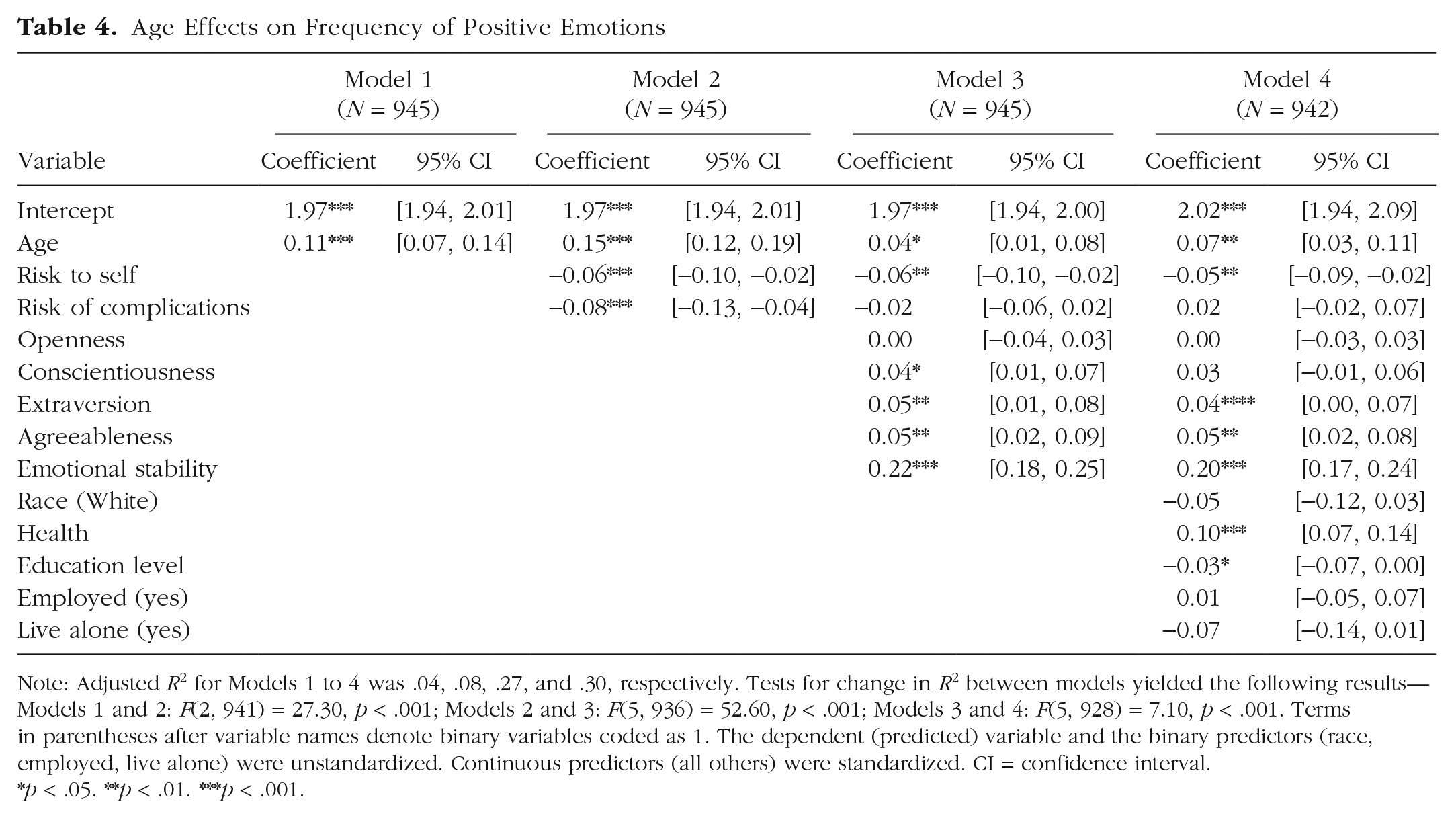
Note: Adjusted R2 for Models 1 to 4 was .04, .08, .27, and .30, respectively. Tests for change in R2 between models yielded the following results—Models 1 and 2: F(2, 941) = 27.30, p < .001; Models 2 and 3: F(5, 936) = 52.60, p < .001; Models 3 and 4: F(5, 928) = 7.10, p < .001. Terms in parentheses after variable names denote binary variables coded as 1. The dependent (predicted) variable and the binary predictors (race, employed, live alone) were unstandardized. Continuous predictors (all others) were standardized. CI = confidence interval.
p < .05. **p < .01. ***p < .001.
Age and the intensity of experienced emotions
We used similar hierarchical linear regressions to test the relationship between age and the intensity of negative and positive emotional experience. In this sample, we found relatively strong correlations between frequency and intensity scores, r(943) = .78 for positive emotions and r(940) = .70 for negative emotions, both ps < .001. The pattern of results was similar. As shown in Tables 5 and 6, age was negatively associated with the intensity of negative emotions and positively associated with the intensity of positive emotions. Both relationships were significant when perceived risk was entered into the model, and models accounting for risk were better fits for the data, again suggesting that older adults reported experiencing greater well-being during the pandemic even though they were at greater risk. The inverse association of age with intensity of negative emotions remained significant after analyses controlled for personality and demographics, whereas the association of age and intensity of positive emotions was no longer significant. 5
Age Effects on Intensity of Negative Emotions
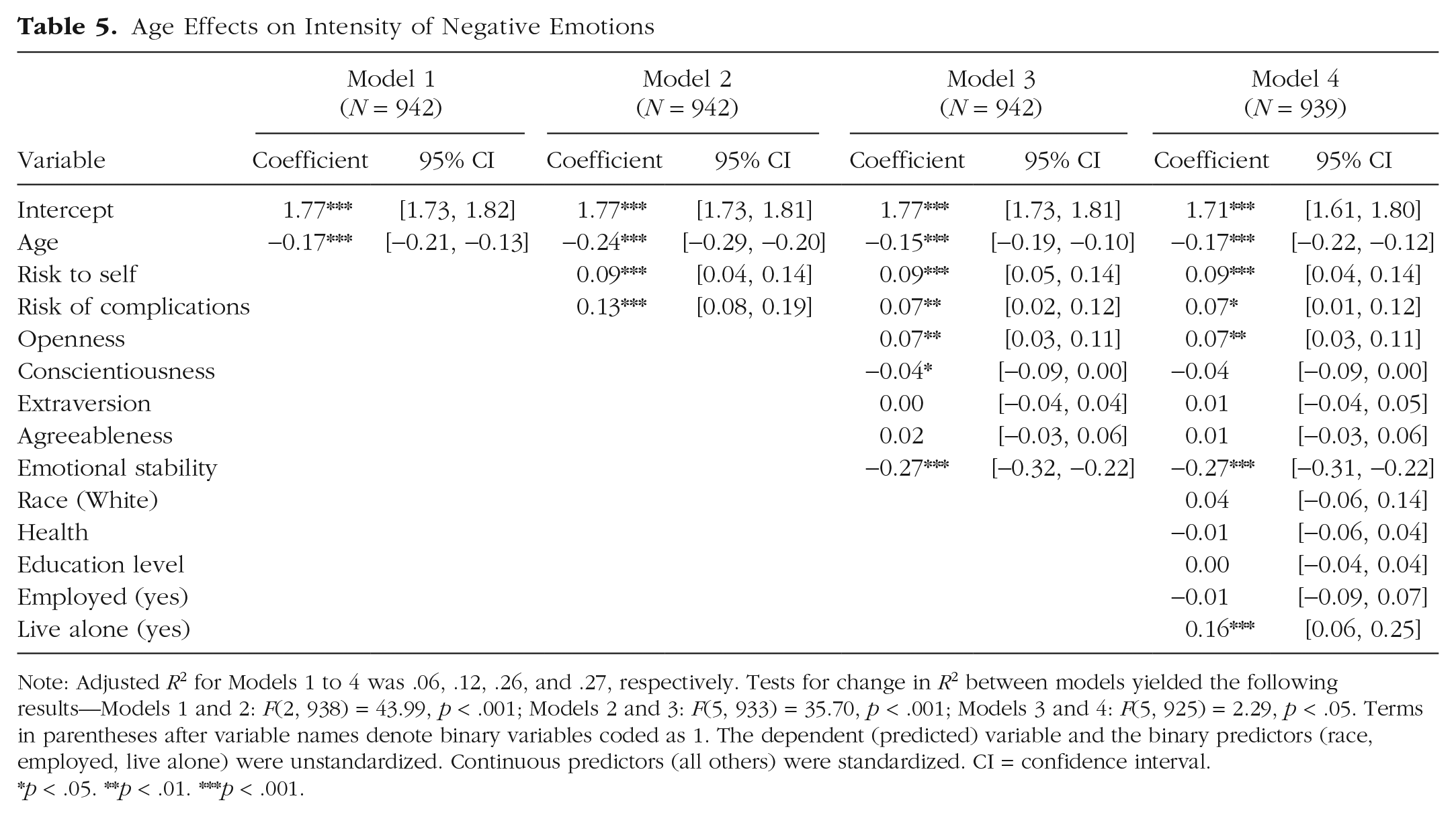
Note: Adjusted R2 for Models 1 to 4 was .06, .12, .26, and .27, respectively. Tests for change in R2 between models yielded the following results—Models 1 and 2: F(2, 938) = 43.99, p < .001; Models 2 and 3: F(5, 933) = 35.70, p < .001; Models 3 and 4: F(5, 925) = 2.29, p < .05. Terms in parentheses after variable names denote binary variables coded as 1. The dependent (predicted) variable and the binary predictors (race, employed, live alone) were unstandardized. Continuous predictors (all others) were standardized. CI = confidence interval.
p < .05. **p < .01. ***p < .001.
Age Effects on Intensity of Positive Emotions

Note: Adjusted R2 for Models 1 to 4 was .01, .03, .18, and .20, respectively. Tests for change in R2 between models yielded the following results—Models 1 and 2: F(2, 941) = 11.94, p < .001; Models 2 and 3: F(5, 936) = 36.09, p < .001; Models 3 and 4: F(5, 928) = 6.34, p < .001. Terms in parentheses after variable names denote binary variables coded as 1. The dependent (predicted) variable and the binary predictors (race, employed, live alone) were unstandardized. Continuous predictors (all others) were standardized. CI = confidence interval.
p < .05. **p < .01. ***p < .001.
Mediation by FTP
To examine whether age effects were mediated by FTP, we followed Baron and Kenny’s (1986) mediation method complemented with a bootstrap analysis advocated by Preacher and Hayes (2008). We used a bias-corrected 95% CI of the bootstrapped indirect effects to measure statistical significance for each of our dependent variables. To facilitate interpretation of effect sizes, we standardized all variables so that estimates reflected the strength of the correlations. Results for frequency and intensity of positive and negative emotions are shown in Figure 2.

Mediation models illustrating the statistical suppression of future time perspective (FTP; Extension subscale) on the relationship between age and better emotional well-being. Separate models show results when well-being was indexed by negative affect (NA) frequency, positive affect (PA) frequency, NA intensity, and PA intensity, respectively. Measures were standardized such that the coefficients represent correlations between variables. Asterisks indicate statistically significant paths (**p < .01, ***p < .001).
As expected, age was significantly associated with FTP. However, longer time horizons were associated with greater emotional well-being (see Table 2). When both age and FTP-Extension were included in the model, a suppression effect was observed. Namely, the effect of age became stronger rather than weaker. This was the case for frequency of negative emotions, frequency of positive emotions, intensity of negative emotions, and intensity of positive emotions (95% bootstrapped CIs for the indirect effects = [0.13, 0.23], [−0.36, −0.25], [0.13, 0.24], and [−0.32, −0.22], respectively). In all models, perceiving more time left in life was associated with better emotional well-being, suggesting that older adults experience better emotional well-being despite perceiving less time left in life.
Discussion
The present survey was deployed in April 2020, as the COVID-19 pandemic began its initial surge in the United States. It had become clear that the risks of severe illness and death increased starkly with age and that these threats would be compounded by extended economic uncertainty and social isolation. The unique circumstances of the pandemic allowed us to address an important theoretical issue about emotional aging. Namely, do relative age advantages in emotional experience persist when people are exposed to prolonged and inescapable threats? The present findings suggest that they do.
Reasoning from SST, we hypothesized that emotional well-being would be preserved. As people age and perceive shrinking time horizons, priority is increasingly placed on emotionally meaningful goals, and goal-supportive behavior and cognitive processing operate in the service of emotional fulfillment. However, another important conceptual model, SAVI, maintains that the avoidance of stressful situations plays a central role in the preservation of emotional well-being at older ages. The SAVI model posits that emotional advantages will be eliminated or even reversed if older people are exposed to prolonged and inescapable stress. In contrast, because SST attributes advantages to broad motivational shifts, it predicts that relative advantages will persist even when people are exposed to stress. For ethical reasons, experimental tests of these predictions have been quite limited and mostly indirect. Sadly, the COVID-19 pandemic has created precisely the type of unavoidable stress in which predictions derived from the SAVI model and SST diverge.
Interestingly, the present findings provide no evidence that the pandemic is altering widely documented age patterns of emotional well-being. Granted, we do not have a pre-pandemic baseline for the present sample. However, the findings are strikingly similar to those of multiple studies conducted before the pandemic. Compared with younger participants, older participants reported less negative emotion and more positive emotion in their current lives. This relative age advantage cannot be explained by risk denial: Older participants perceived greater risk than younger adults and comparable amounts of financial stress. Recent reports suggest that older adults are following COVID-19 news even more closely than younger adults (Jurkowitz & Mitchell, 2020), suggesting that it is unlikely that limited exposure to stressors or a lack of awareness account for preserved well-being.
Though the present findings provide no evidence that emotional well-being has been degraded in older people during the pandemic, it is possible that the experience is not generating the type of high arousal states specified by the SAVI model. It is also possible that findings would be different in a much older sample or in populations at highest risk, such as frail nursing-home residents. Importantly, however, the avoidance of stress outlined in the SAVI model has been interpreted broadly in the literature on emotion and aging as the primary explanation for improved emotional well-being with age (Birditt, 2014; Katana & Hill, 2020; Wrzus, Müller, Wagner, Lindenberger, & Riediger, 2014). The present findings speak against this interpretation. In the midst of a major life-altering experience, older people continue to report better emotional experiences than younger people report.
Future time horizons, as measured by the FTP scale, did not mediate age differences in emotional experience, which is consistent with findings from a number of recent studies suggesting that longer, not shorter, perceived futures predict better emotional functioning (Grühn, Sharifian, & Chu, 2016), less preoccupation with negative events (Strough et al., 2016), and higher levels of achievement motivation (Kooij, Kanfer, Betts, & Rudolph, 2018). The FTP scale (Carstensen & Lang, 1996) was developed to document the face-valid association of age and time left in life, which has proven highly reliable. However, the construct has not proven to be a good proxy for the sense of time running out that leads to a reprioritization of goals (Barber, Lopez, Cadambi, & Alferez, 2020), even though there is ample evidence that the priming of endings leads to prioritizing emotional goals (Fredrickson & Carstensen, 1990; Fung & Carstensen, 2006). Indeed, one recent study instantiated the positivity effect in young people by experimentally priming endings (Barber et al., 2016). Considered together, findings from this emerging literature suggest that the deliberative assessment of mortality risk, captured by the FTP measure, does not reflect the more visceral sense of time scarcity that SST postulates leads to shifts in goal priorities.
All told, the present findings add to evidence that emotional functioning not only may be spared from age-related decline but also may improve. Even when enveloped by persistent and dire threats to health and well-being, older people display notable emotional resilience.
Supplemental Material
Carstensen_Supplemental_Material_rev – Supplemental material for Age Advantages in Emotional Experience Persist Even Under Threat From the COVID-19 Pandemic
Supplemental material, Carstensen_Supplemental_Material_rev for Age Advantages in Emotional Experience Persist Even Under Threat From the COVID-19 Pandemic by Laura L. Carstensen, Yochai Z. Shavit and Jessica T. Barnes in Psychological Science
Footnotes
Acknowledgements
The authors thank the members of the Life-Span Development Laboratory at Stanford University for their feedback on the research and the manuscript.
Transparency
Action Editor: Karen Rodrigue
Editor: Patricia J. Bauer
Author Contributions
L. L. Carstensen developed the study concept. All authors contributed to the study design. Data collection was overseen by J. T. Barnes. Y. Z. Shavit analyzed the data and interpreted the results under the supervision of L. L. Carstensen. L. L. Carstensen drafted the manuscript with considerable input from Y. Z. Shavit and J. T. Barnes. All authors approved the final version of the manuscript for submission.

Notes
References
Supplementary Material
Please find the following supplemental material available below.
For Open Access articles published under a Creative Commons License, all supplemental material carries the same license as the article it is associated with.
For non-Open Access articles published, all supplemental material carries a non-exclusive license, and permission requests for re-use of supplemental material or any part of supplemental material shall be sent directly to the copyright owner as specified in the copyright notice associated with the article.
