



Abstract
This work documents a relationship-maintenance strategy that individuals use when they perceive their time with a partner as scarce (vs. abundant): choosing to share extraordinary experiences (i.e., those characterized by uniqueness and superiority; pilot study N = 57). Study 1 first tested this notion in a social media experiment (N = 35,848 ad impressions on 25,148 adults). Study 2 (N = 393 adults) suggested that individuals choose extraordinary experiences as a way of sustaining the focal relationship, which leads them to prioritize extraordinariness over other attributes, such as quantity (Study 3: N = 100 adults) and convenience (Study 4: N = 799 adults). Consistent with the relationship-maintenance account, results showed that this prioritization of extraordinary experiences when facing shared time scarcity occurs only when individuals have a strong relationship-maintenance goal (Study 4). Taken together, these studies advance our understanding of the antecedents of experiential choices in close relationships.
Keywords
Although being socially connected is a strong predictor of a happy and meaningful life (Baumeister & Leary, 1995), shared time with loved ones is becoming increasingly scarce. For instance, one study found that American families spend only 37 min of quality time together per day, and the average family has only 7 days a year to go on vacation (Visit Anaheim, 2018). Recent estimates indicate that almost four million married Americans reported living apart from their spouses (U.S. Census Bureau, 2018), thereby invariably being restricted in their ability to see each other frequently (Stafford & Merolla, 2007). Further, the number of dual-career households is on the rise (Pew Research Center, 2016), increasing the likelihood that conflicting work schedules will prevent partners from seeing each other.
Personal relationships satisfy fundamental needs, such as emotional closeness, social support, and security (Hazan & Shaver, 1987). Although relationships between partners and friends vary in their levels of interdependence and commitment (Rusbult & Van Lange, 2003), the more interdependent a relationship becomes, the more frequent and long-lasting the impact the partners can have on each other (Berscheid et al., 1989). However, the very interdependence that confers benefits to relationships may be threatened when individuals feel they have limited time with their partners.
Here, we examine how perceptions of shared time in close relationships impact preferences for shared experiences. We demonstrate that when individuals perceive that they have limited time with a relationship partner, they prioritize sharing extraordinary experiences over other factors, such as the convenience of seeking out a shared experience or the quantity of products consumed together, as a way of sustaining the focal relationship.
Theoretical Development
Time is an important resource tied to outcomes such as happiness, life meaning, and social connection (Rudd et al., 2019). Just as with money or other tangible objects, people can perceive time to be abundant or scarce, and these perceptions are malleable (e.g., Etkin, 2016). Such perceptions of resource scarcity can encourage the adoption of strategies to deal with this shortage, such as engaging in activities that would afford added time (Etkin et al., 2015) and using time more efficiently (Kurtz, 2008; Shu & Gneezy, 2010). But if individuals are unable to objectively increase the amount of resources they have on hand, they will maximize the focal resource by engaging in efficiency-seeking behaviors (Fernbach et al., 2015), such as focusing on pressing needs (Shah et al., 2015).
Much of this research has examined the role of resource scarcity when it is experienced alone (e.g., Perlow, 1999) or in terms of money (e.g., Sharma & Alter, 2012). Here, we focused on a specific type of resource scarcity—shared time scarcity (i.e., the subjective sense of needing more time with a relationship partner than one already has; e.g., Cannon et al., 2019)—and investigate how perceiving shared time with a relationship partner as scarce or abundant differentially influences choices for shared experiences. Although there are different ways that individuals can deal with managing time scarcity (e.g., prioritizing a more convenient option), we argue that when the scarce resource is shared time, relationship-maintenance goals will be activated, leading individuals to enact behaviors that they believe will help maintain the relationship’s well-being.
Why might this be? Time, compared with money, is tied to social motivations. For instance, Mogilner (2010) showed that when people are primed to think about time, they spend more time socializing than when primed to think about money. Relatedly, when people become aware of their remaining time (e.g., as a result of aging), they prioritize relationships over professional ambitions (Loewenstein, 1999) and prefer relationships that are more likely to succeed (Fredrickson & Carstensen, 1990). These findings suggest that when people perceive their time with a relationship partner to be scarce, they will engage in relationship-maintenance strategies to sustain their relational ties.
Prior work has shown that to maintain close relationships, people rely on cognitive strategies to influence themselves (e.g., constructing positive narratives about their partner to dampen feelings of doubt; Murray & Holmes, 1993) and behavioral strategies focused on influencing how their partners think about the relationship (e.g., being more accommodating or sacrificing; Finkel et al., 2002; Rusbult et al., 1991). Here, we examined a previously undocumented behavioral relationship-maintenance strategy—choosing shared extraordinary experiences—that people may deploy to help sustain the well-being of a relationship when shared time is perceived as scarce. People may believe that sharing extraordinary experiences can help them sustain the well-being of the relationship because their partner will remember such experiences more than ordinary ones when they are not together. Indeed, extraordinary experiences—previously described as those that “go beyond the realm of everyday life” (Bhattacharjee & Mogilner, 2014, p. 2)—are more memorable (Zhang et al., 2014), and people treat special memories as assets they should strategically protect (Zauberman et al., 2008). This might be in part because unusual or novel experiences—attributes commonly associated with extraordinary experiences—are often perceived as more exciting (Aron et al., 2000) and productive (Keinan & Kivetz, 2011).
Statement of Relevance
Though spending quality time with other people is important for well-being, many individuals today struggle to find time for loved ones because they are deluged with work and personal responsibilities. In the present work, we studied the psychology underlying this recent trend of shared time scarcity by examining what experiences people prefer when they perceive their time with a relationship partner as limited. In four studies, we found that individuals choose to share extraordinary experiences (those characterized by their uniqueness and superiority) when they perceive their time with a partner as scarce—above and beyond other factors such as the convenience or quantity of the shared experience. This happens because people believe that engaging in extraordinary experiences together will help them sustain the well-being of the relationship. Overall, these findings demonstrate that choosing extraordinary experiences is a relationship-maintenance strategy and thus inform how individuals cope as they seek to maximize the limited time they have with loved ones.
Thus, we predicted that perceiving one’s time with a relationship partner as scarce would lead individuals to prioritize the extraordinariness of a shared experience over other factors such as the convenience or quantity of that experience. This effect should be driven by a person’s belief that extraordinary experiences will help maintain the well-being of their relationship because their partner will remember them more when they are not together. A natural corollary of this argument is that this prioritization of extraordinary experiences will happen only when individuals have a strong goal of maintaining the relationship.
The Present Research
Because many definitions of extraordinary experiences have been used in the existing literature, we first identified the representative features of extraordinary experiences using an inductive approach (pilot study). Four studies then assessed the causal link between shared time scarcity and preferences for extraordinary experiences. On the basis of prior research suggesting that perceptions of resource scarcity are malleable and can be evoked in multiple ways, we operationalized shared time scarcity both by varying the perceptions of shared time while holding the objective amount of time constant (Studies 1 and 2) and by varying the actual amount of time people have with relationship partners (Studies 3 and 4). We also operationalized extraordinary experiences by using the term “extraordinary” (Study 1) and employing more specific features derived from the pilot study in the rest of the studies. We report all conditions and measures and did not exclude any observations unless otherwise indicated. For all studies, we determined the sample size before any data were collected and did not analyze data until collection was completed. We preregistered analyses for all studies reported below except for Study 3, which we ran before preregistration became our standard practice. These studies were approved by the University of Virginia’s Institutional Review Board.
Pilot Study
To identify and validate the features that best represent the concept of extraordinary experiences, we employed the prototype methodology, a commonly used means of defining a concept (e.g., Fehr, 1988). Participants generated a list of features they associate with the concept of extraordinary experiences.
Method
Participants
We recruited 57 adults from the online subject pool of a mid-Atlantic university located in the United States (16% male; mean age = 24.05 years, SD = 8.33). This population included both community members and university students. Before collecting the data, we preregistered this study on AsPredicted.org (https://aspredicted.org/ev378.pdf), stating that we would target 50 participants.
Procedure
To elicit the features of extraordinary experiences, we adapted the instructions of Fehr (1988). Participants first read the following: “An extraordinary experience is a member of a large class of global concepts that researchers have found useful in characterizing certain experiences. This is a simple study to find out the characteristics and attributes of this concept.” Following Fehr (1988), we provided participants with a list of potential features of the concepts of extraversion and terror as examples (for the full questionnaire, see https://osf.io/84ztd/).
Participants then read the following: When thinking about what makes an experience extraordinary, you might ask yourself: What manifestations are there of them? What thoughts do you have about them? It might help to imagine you’re explaining the concept extraordinary experiences to a foreigner or to someone who has never experienced them. So include the obvious. Tell us how it comes about and what happens after. But emphasize a description of how one feels and acts.
We then asked participants to list as many features as they could think of to describe the concept of “extraordinary experience,” giving them space to include up to 20 attributes. On average, participants spent 4 min (SD = 2.40 min) working on this task and listed 11.65 attributes. On the next page, participants reported their gender and age.
Once the survey was closed, a research assistant blind to the research questions coded all responses using a procedure in which identical and highly synonymous responses were combined. A second research assistant then looked over the work, and the two assistants resolved any disagreements through discussion. Intercoder agreement was 75%.
Results
Participants listed a total of 664 characteristics. The research assistants classified them into 32 features, combining identical and highly synonymous responses. Participants associated the construct of “extraordinary experiences” with many different features, suggesting that the construct is multidimensional (see Table S1 in the Supplemental Material). However, the two features that participants seemed to agree were the most representative were “superior” (16%) and “unique” (15%). Each of these features was also highly related to other identified features, such as “invaluable” (5%) and “positive” (2%) for the former and “unexpected” (6%) and “unbelievable” (3%) for the latter.
On the basis of these data, we operationalized extraordinariness in the following ways. First, recognizing the multidimensional nature of extraordinariness and the implication of the pilot study’s results that people have an intuitive, shared understanding of extraordinariness, we simply used the term “extraordinary” to assess people’s preferences in the first study (Study 1). In the rest of the studies (Studies 2–4), we operationalized extraordinariness by varying one or two of the two most frequently listed features: (a) uniqueness (i.e., the perception that the experience is one of its kind) and (b) superiority (i.e., the perception that the quality of the experience being shared transcends other alternatives).
Study 1
To test whether evoking perceptions of shared time scarcity leads to a preference for extraordinary experiences, we conducted a field experiment on a social media platform, where we ran two different ad campaigns for a product that was described as extraordinary. We predicted that the campaign evoking shared time scarcity would be more likely to generate greater interest (assessed by click-through rates) in a product described as extraordinary, compared with a control campaign.
Method
Participants
We ran an experiment on a social media platform for 10 days (from May 30, 2019, through June 10, 2019). Before collecting the data, we preregistered this study on AsPredicted.org (https://aspredicted.org/qi4pm.pdf). The preregistration stated that we would run the experiment for 10 days or until we reached 60,000 individuals (whichever condition was met first). The resulting sample size was large enough to detect a very small effect (w = 0.02) with 90% statistical power (α = .05).
Procedure
The study had a two-condition, between-subjects design: abundant versus scarce shared time. The experiment ran over the course of 10 days and targeted registered users over 18 years of age residing in the Boston, Massachusetts, area. We created two types of ads: Those in the abundant condition read, “Summer just began so you will have a lot of time to hang out with your loved ones! Check out these extraordinary experiences in Boston,” whereas those in the scarce condition read, “Summer is so short so you won’t have that much time to hang out with your loved ones! Check out these extraordinary experiences in Boston.” Because these two ad campaigns were running during the same time period, we were effectively holding the objective amount of time constant while manipulating participants’ subjective sense of shared time. Both ads featured a panoramic photograph of the city and advertised a blog post we created for this experiment called “Top Five Extraordinary Experiences in Boston” (see Fig. 1).
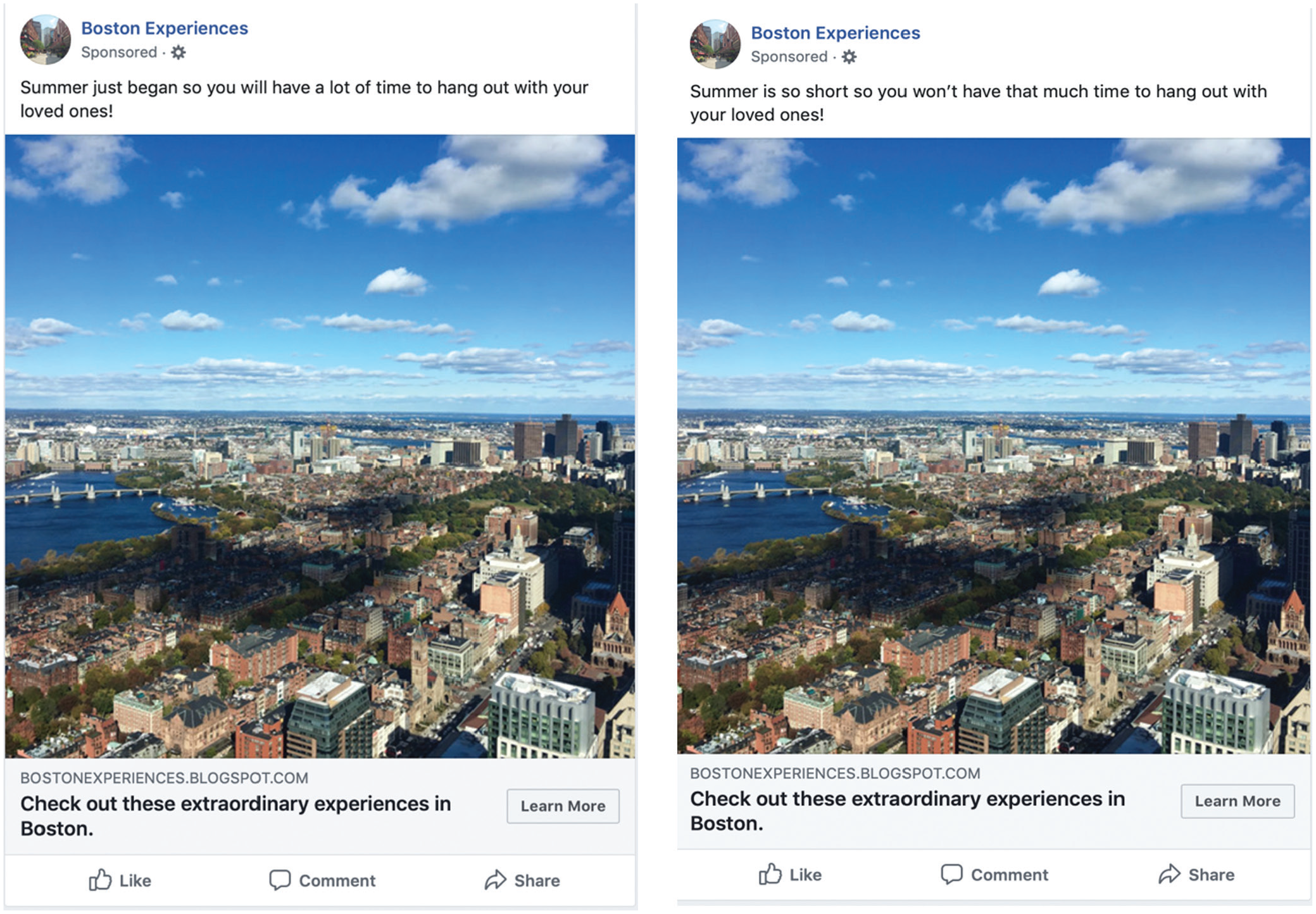
Social media advertisements used in the abundant (left) and scarce (right) conditions in Study 1. The URL of the blog post was deactivated once the study was over, but the exact materials used in the blog post can be accessed at https://osf.io/84ztd/.
To verify that the ad for the scarce condition evoked more shared time scarcity than the ad for the abundant condition, we showed one of these two ads to a sample of 401 U.S. participants recruited via Amazon Mechanical Turk (52% male; mean age = 39.18 years, SD = 12.10) and asked them to indicate to what extent they would feel their time with loved ones is scarce. As expected, participants who saw the scarce ad reported that they would perceive their time with loved ones as more scarce (M = 4.51, SD = 1.68) than those who saw the abundant ad (M = 3.20, SD = 1.64), t(399) = 7.85, p < .001, d = 0.79, 95% confidence interval (CI) = [0.59, 0.99].
The number of participants who clicked on this link to read the blog post served as our dependent measure in this field experiment. To ensure that users were not exposed to both ads, we used the platform’s A/B testing feature, which divided our budget equally and randomly assigned the specified population into two groups such that each user was exposed to only one of our ads. We received a report listing total clicks, total reaches (i.e., total number of people who saw each ad), and total impressions (i.e., the number of times each ad was displayed); we did not obtain any individual-level data.
Results
Our ad reached 25,148 users and had 35,848 impressions; Table 1 displays ad performance by condition. Critically, a χ2 test comparing the number of clicks with the number of reaches revealed that a greater percentage of users clicked on the ad when it evoked shared time scarcity (8.85%) than when it did not (7.50%), χ2(1, N = 25,148) = 15.26, p < .001, φ = 0.02, 95% CI = [0.01, 0.04]. Similarly, a χ2 test comparing the number of clicks with the number of impressions revealed that a greater percentage of users clicked on the ad when it evoked shared time scarcity (6.04%) than when it did not (5.40%), χ2(1, N = 35,848) = 6.79, p = .009, φ = 0.01, 95% CI = [0.01, 0.02]. The small effect size observed here may be due to the study being conducted in the field, where our participants likely had several distractions, such as other advertisements and updates from their social networks appearing in their news feeds.
Ad Performance in Study 1
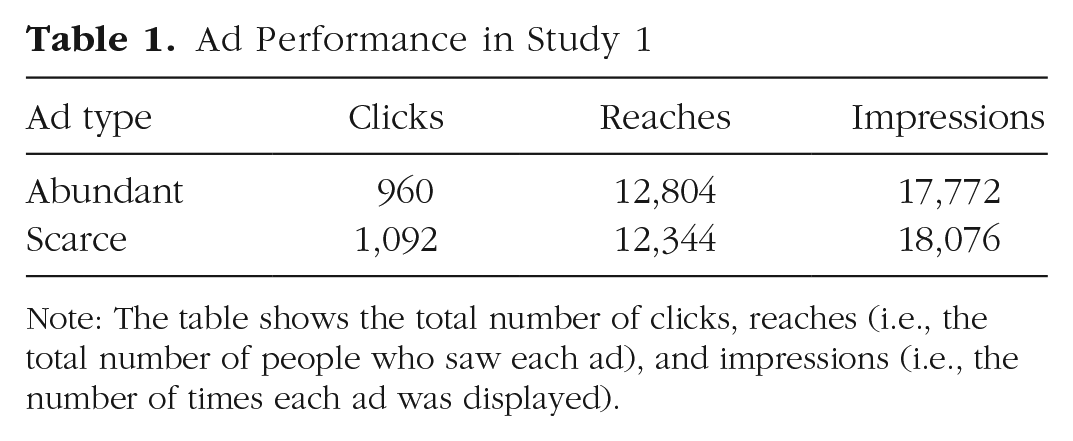
Note: The table shows the total number of clicks, reaches (i.e., the total number of people who saw each ad), and impressions (i.e., the number of times each ad was displayed).
Study 2
Study 1 provided preliminary evidence that evoking shared time scarcity leads individuals to prefer sharing extraordinary experiences. In Study 2, we replicated this effect in the lab by manipulating the perception of shared time available through a writing task. We also explored whether choosing extraordinary experiences is a behavioral relationship-maintenance strategy deployed to influence how partners think about the relationship rather than to influence how the participants themselves think about the relationship.
Method
Participants
We used Prolific Academic’s “prescreeners” (which allow only eligible participants to see the survey) to target 400 adults who were currently in a romantic relationship and who resided in the United States. At the beginning of the study, participants were asked to validate their relationships status; those who said that they were not in a romantic relationship (n = 9) were directed to take a different study, leaving us with a valid sample of 393 participants for this study (46% male; mean age = 35.35 years, SD = 11.50). To determine the sample size for this study, we assumed a Cohen’s d of 0.30 for the effect of shared time scarcity on preference for extraordinary experiences and 85% statistical power to detect this effect (α = .05, two-tailed). This study was preregistered on AsPredicted.org (https://aspredicted.org/6qj2x.pdf).
Procedure
The study had a two-condition, between-subjects design. We used the COVID-19 context to frame shared time between partners as abundant or scarce. Participants read the following text (words in brackets varied in the abundant and scarce conditions, respectively): The COVID-19 pandemic has reshaped our personal relationships in unprecedented ways, forcing us to live closer together with some people and further apart from others. And given the many changes that have come with the pandemic, people now have [more/less] time to spend with their romantic partner. Below please write about the ways in which you perceive the shared time with your partner as [abundant/scarce] these days.
After the writing task, participants read that they were considering a variety of activities for an upcoming date with their partner and indicated the extent to which they thought it was important to select an extraordinary experience for this upcoming date (i.e., an experience that is special and unusual) on a 7-point scale (1 = not at all, 7 = to a great extent). On the next page, we assessed relationship-maintenance motivations by asking participants to indicate to what extent they agreed with two statements: (a) “When my partner and I are not together, it is critical for the success of our relationship that my partner thinks about me frequently” (partner-focused) and (b) “When my partner and I are not together, it is critical for the success of our relationship that I think about my partner frequently” (self-focused). Response options were presented on 7-point scales (1 = not at all, 7 = very much). Finally, participants indicated the extent to which they felt their time with their partner was scarce (1 = not at all, 7 = very much), which served as our manipulation check. They then answered six demographic questions (gender, age, income, cohabiting status, relationship status, and relationship length).
Results
Shared time
As intended, participants in the scarce condition felt that their time with their partner was more scarce (M = 3.76, SD = 1.91) than those in the abundant condition did (M = 3.05, SD = 1.97), t(391) = 3.63, p < .001, d = 0.37, 95% CI = [0.17, 0.57].
Preference for extraordinary experiences
Importantly, participants in the scarce condition indicated that it would be more important to select an extraordinary experience for their upcoming date (M = 4.70, SD = 1.70) than those in the abundant condition did (M = 4.35, SD = 1.72), t(391) = 2.08, p = .038, d = 0.20, 95% CI = [0.01, 0.40]; see Figure 2.
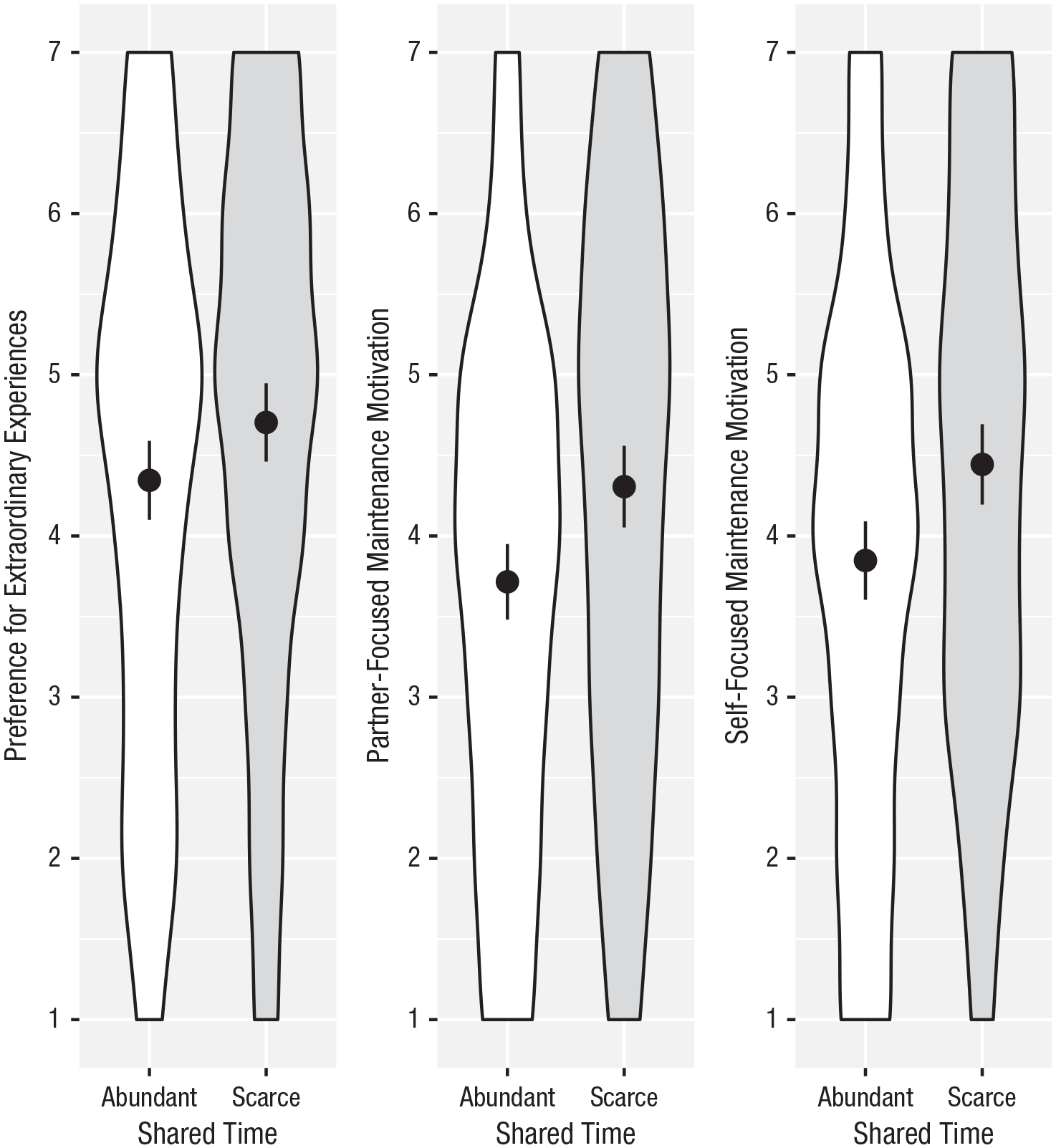
Results from Study 2: preference for extraordinary experiences, partner-focused relationship-maintenance motivation, and self-focused relationship-maintenance motivation, separately for the abundant and scarce conditions. Dots indicate average ratings; error bars represent ±2 SE. The width of the violin plots represents the density of the data.
Partner-focused relationship-maintenance motivation
Participants in the scarce condition indicated that it was more critical for the success of their relationship that their partner think about them frequently when they were not together (M = 4.31, SD = 1.77) than those in the abundant condition did (M = 3.72, SD = 1.65), t(391) = 3.42, p = .001, d = 0.34, 95% CI = [0.15, 0.54]; see Figure 2.
Self-focused relationship-maintenance motivation
Participants in the scarce condition indicated that it was more critical for the success of their relationship that they think about their partner frequently when they were not together (M = 4.44, SD = 1.74) than those in the abundant condition did (M = 3.85, SD = 1.71), t(391) = 3.43, p = .001, d = 0.34, 95% CI = [0.14, 0.54]; see Figure 2.
Mediation
We explored whether choosing extraordinary experiences is a behavioral relationship-maintenance strategy that participants deploy to influence how their partners think about the relationship rather than to influence how they themselves think about the relationship. Following our preregistration, we first created a parallel mediation model entering partner-focused and self-focused relationship-maintenance motivation as simultaneous mediators of the effect of shared time scarcity on preference for extraordinary experiences. A 5,000-sample bootstrap analysis using PROCESS Model 4 (Hayes, 2018) revealed a significant indirect effect (ab) through partner-focused relationship-maintenance motivation (b = 0.14, SE = 0.07, 95% CI = [0.02, 0.31]), but not through self-focused relationship-maintenance motivation (b = 0.05, SE = 0.06, 95% CI = [−0.06, 0.17]). Next, we conducted a robustness check using the R package multimediate (Version 2; Jérolon et al., 2021), which yielded the same pattern: The effect of shared time scarcity on preference for extraordinary experiences was mediated by partner-focused (b = 0.14, 95% CI = [0.02, 0.31]) and not by self-focused (b = 0.05, 95% CI = [−0.06, 0.17]) relationship-maintenance motivation.
In sum, these results suggest the possibility that people’s preference for sharing extraordinary experiences when facing shared time scarcity is driven by their desire to maintain the well-being of the focal relationship—by, for instance, influencing how one’s partner thinks about the relationship. However, we acknowledge that we are unable to make causal claims from mediation analyses (e.g., Bullock et al., 2010; Imai et al., 2010), and thus we further explored our relationship-maintenance account in Study 4 via moderation.
Robustness checks
Although we did not preregister this next analysis, we asked two research assistants blind to our research question and hypotheses to review all open-ended responses and identify poor-quality responses (i.e., responses that did not include any reference to shared time). Intercoder agreement was 80%, and disagreements were resolved through discussion between the two coders. This coding revealed that 37 participants did not do the writing task properly. The results reported above held when we excluded these responses; for example, the effect of shared time scarcity on preference for extraordinary experiences remained significant, t(354) = 2.09, p = .038, d = 0.22, 95% CI = [0.02, 0.43].
Finally, we also conceptually replicated this finding: In Studies S1 and S2 (reported in the Supplemental Material; total N = 1,000), we demonstrated that individuals prioritize the memorability of a shared experience over other attributes, such as convenience, when they perceive their time with a relationship partner as scarce (as opposed to abundant).
Study 3
To more robustly demonstrate our account, in Study 3, we examined whether individuals prioritize the extraordinariness of the experience over other factors that may have been appealing in other circumstances, such as the quantity of a good being consumed. We used a consequential dependent measure and also induced close relationships in the lab. We predicted that participants who felt that their time with their partner was scarce (compared with those who did not) would care less about quantity and thus would choose an extraordinary option over the ordinary option.
Method
Participants
We recruited 111 adults from a university pool and asked them to come to the lab to participate in a session of unrelated studies; this study was conducted at a university in the northeastern United States. The sample size was determined by the number of students participating in a bundle of unrelated studies in the behavioral lab over the course of 1 week (October 29 through November 5, 2018).
Our study involved participants completing a task in pairs. In some sessions, we had an odd number of participants: In such cases, those without partners were instructed to interact with one of our research assistants. However, because participants were aware that they were interacting with a research assistant, we predetermined that we would exclude these participants from our analyses (n = 11). Thus, our valid sample size was 100 participants (31% male; mean age = 21.55 years, SD = 5.77). A sensitivity analysis revealed that this sample size was large enough to detect a small effect (w = 0.28) with 80% statistical power (α = .05).
Procedure
The study had a two-condition, between-subjects design: abundant versus scarce shared time. First, all participants began by answering a series of demographic questions: gender, age, income, student status, and relationship status. Then each was randomly paired with another participant, and they engaged in the relationship-closeness induction task together (Sedikides et al., 1999). After the induction task, participants answered questions on a computer screen, reporting the number of questions they covered from each list, their thoughts about the interaction, and their feelings toward their partner (this last subsection included questions about liking, similarity, closeness, and friendship intent with their new partner; responses were made on 9-point scales).
Critically, participants were then informed that they would have two more interactions. Those in the abundant condition were informed that both interactions would be with the same partner with whom they had just interacted, and therefore they would have “plenty of time” to interact with their partner. Those in the scarce condition, on the other hand, were informed that only one of these interactions would be with the same partner, and thus they would have “very little time” to interact with their partner.
Then all participants read that they had to select a chocolate to share with their partner during the next interaction; in other words, the choice they made would be implemented and would impact both themselves and their partner. All participants made a choice between sharing one gourmet chocolate (which we intended to serve as the extraordinary option) and sharing two regular chocolates (which we intended to serve as the ordinary experience) with their partner. These options were described as follows: “one piece of gourmet chocolate (6 grams): unique, made in Switzerland, handmade by small scale artisans (chocolatiers) who use premium origin beans” and “two pieces of regular chocolate (6 grams per chocolate): standard, made in Brazil, mass produced by a large-scale company who uses normal cacao beans.” Thus, we operationalized extraordinariness on the basis of the two features that stood out in our pilot study: uniqueness and superiority. By creating a trade-off between quantity and extraordinariness, we could assess whether participants were more likely to prioritize an extraordinary experience when they were facing shared time scarcity with their partner.
After making this choice, all participants rated the extent to which they thought their time with their partner during their final interaction would be scarce (1 = not at all, 7 = very much) and also which option they deemed as more extraordinary (1 = consuming regular chocolate, 7 = consuming gourmet chocolate). We also asked participants to indicate the extent to which they like chocolate in general, as a control variable. Because we were interested only in participants’ chocolate choice, we did not have participants interact with the same partner one more time after they responded to the aforementioned questions. Instead, all participants received both options at the end of the session (i.e., two pieces of regular chocolate and one piece of gourmet chocolate).
Results
Relationship-closeness induction task
A one-sample t test revealed that the relationship-closeness induction task was successful at creating close relationships in the lab: The average rating of the composite measure of liking, closeness, similarity, and friendship intent (α = .75) was significantly higher than the midpoint of the scale (M = 6.22, SD = 1.28), t(99) = 9.50, p < .001, d = 0.95, 95% CI = [0.71, 1.19], and there was no difference between our two conditions (scarce condition: M = 6.20, SD = 1.17; abundant condition: M = 6.23, SD = 1.38), t(98) = −0.12, p = .907, d = −0.02, 95% CI = [−0.42, 0.37].
Extraordinariness
Also as intended, participants deemed the option of consuming gourmet chocolate as a more extraordinary experience than the option of consuming regular chocolate. The mean response was significantly higher than the midpoint of the scale (M = 5.82, SD = 1.16), t(99) = 15.72, p < .001, d = 1.57, 95% CI = [1.27, 1.86], and there was no difference between conditions (scarce condition: M = 6.00, SD = 1.12; abundant condition: M = 5.67, SD = 1.18), t(98) = 1.44, p = .152, d = 0.29, 95% CI = [−0.11, 0.68].
Shared time
As intended, participants in the scarce condition reported that their time with their partner was more scarce (M = 4.70, SD = 0.96) than did those in the abundant condition (M = 3.19, SD = 1.38), t(98) = 6.26, p < .001, d = 1.25, 95% CI = [0.82, 1.68].
Choice of chocolate
Critically, the percentage of participants who chose the more extraordinary option (i.e., sharing one gourmet chocolate rather than sharing two regular chocolates) was higher in the scarce condition (80%) than in the abundant condition (63%), though we could reject the null hypothesis with only 90% confidence, χ2(1, N = 100) = 3.68, p = .055, φ = 0.19, 95% CI = [−0.01, 0.38]; these results held when controlling for dyad assignment, b = 0.92, SE = 0.47, Wald = 3.81, p = .051, exp(b) = 2.51. One potential limitation of this study is that participants in the scarce condition may have preferred one over two chocolates for practical reasons (i.e., less time to eat the chocolate); however, we note that eating half a piece as opposed to a whole piece during a single interaction most likely did not feel like a substantive time saving, and thus time-saving motivations likely did not serve as the primary driver of our results. We also note that other studies included here did not suffer from this potential limitation.
Study 4
We had three goals in Study 4. First, following Study 3’s approach, we asked participants to make another trade-off decision: an experience that is extraordinary versus convenient. Second, to more conservatively test our account, we operationalized extraordinariness by manipulating uniqueness while holding quality constant. Third, we further tested the notion that selecting an extraordinary experience when shared time is scarce is a relationship-maintenance strategy by investigating whether individuals no longer prioritize extraordinary experiences when they have a weak (vs. strong) relationship-maintenance goal.
Method
Participants
We recruited 799 adults currently living in the United States from Amazon’s Mechanical Turk and asked them to complete a short online study in exchange for monetary compensation (47% male; mean age = 40.77 years, SD = 13.10). We determined the sample size on the basis of a pilot study with a similar design; we assumed 80% statistical power and a small effect (f = 0.10) for the interaction between shared time and relationship-maintenance goal. This study was preregistered on AsPredicted.org (https://aspredicted.org/g7py5.pdf).
Procedure
The study had a 2 (shared time: abundant vs. scarce) × 2 (relationship goal: weak vs. strong) between-subjects design. First, participants imagined that they had a work colleague who lived in another city but had spent the last 2 weeks in town working with them. Then participants in the strong-relationship-goal condition read and wrote about how during this time, they connected strongly with this colleague, so they really cared about maintaining a relationship with them in the future. Participants in the weak-relationship-goal condition read and wrote about how during this time, they did not connect strongly with this colleague, so they really did not care about maintaining a relationship with them in the future.
On the next page, participants read that their colleague would be in town for several more months (shared-time-abundant condition) or for just one more day (shared-time-scarce condition). Then participants were asked to choose between two restaurants where they would have dinner with their colleague that night. The two restaurants had similar price levels and food quality but varied in two aspects: convenience and uniqueness. One restaurant offered a unique experience but was not very convenient because it was far from work, whereas the other restaurant did not offer a unique experience but was convenient because it was close to work (see Fig. 3 for restaurant descriptions). The choice was presented on a 100-point slider scale with the end points 0 (definitely [name of convenient restaurant]) to 100 (definitely [name of unique restaurant]).
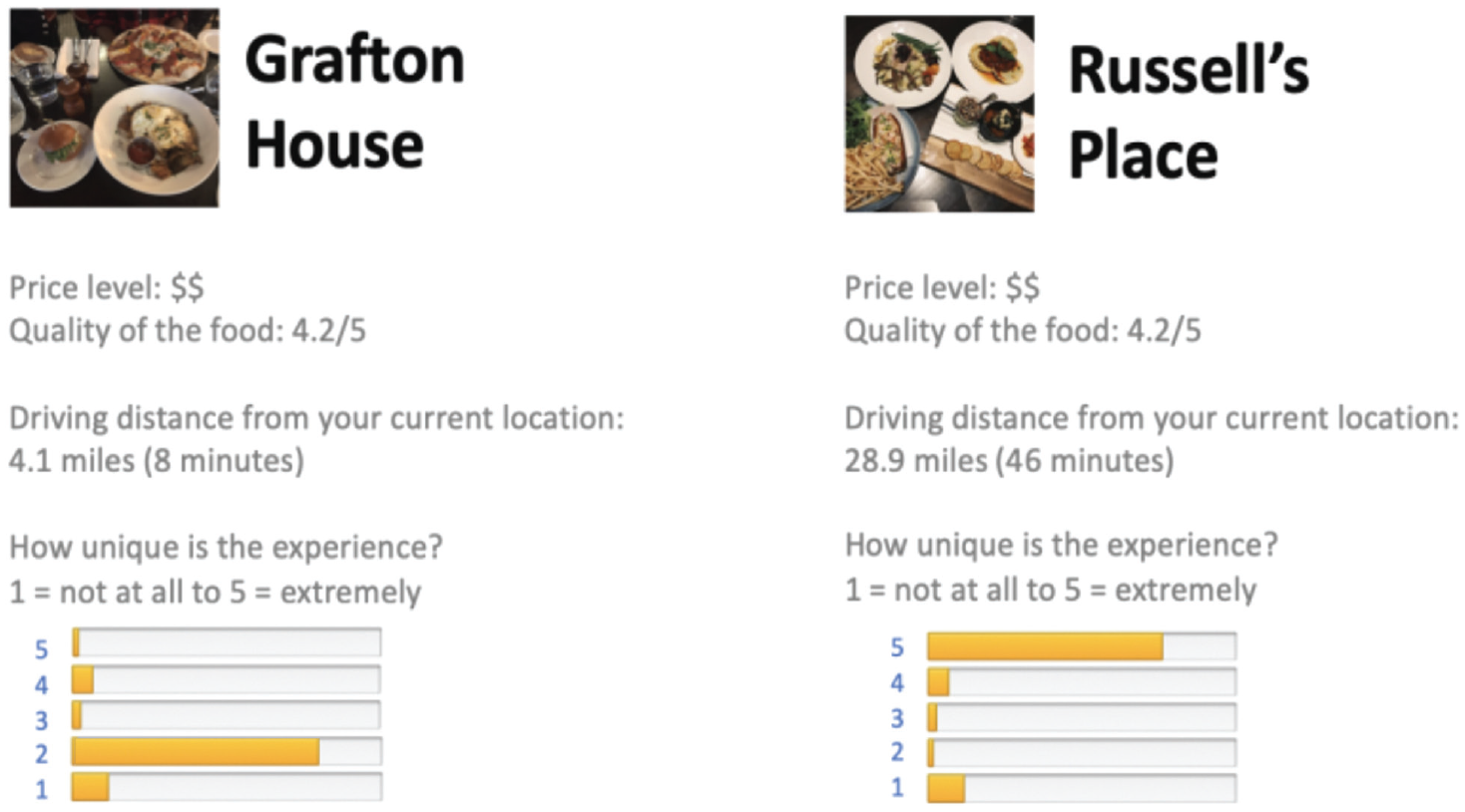
Restaurant information used in Study 4. The two options had the same price level and food quality; however, the option on the left was more convenient (in terms of distance from work) but less unique, and the option on the right was less convenient but more unique.
Next we administered four reading-check questions asking participants to identify which restaurant offered a more unique experience, was more convenient for them, was more expensive, and offered higher-quality food; these four questions were presented on 7-point Likert-type scales with the end points 0 (definitely [name of convenient restaurant]) to 100 (definitely [name of unique restaurant]). Finally, participants indicated the extent to which they felt their time with their partner was scarce (1 = not at all, 7 = very much), indicated the extent to which they had the goal of maintaining their relationship (1 = not at all, 7 = very much), and answered three demographic questions (gender, age, and income).
Results
Shared time
As intended, participants in the shared-time-scarce condition felt that their time with their partner was more scarce (M = 4.79, SD = 1.96) than those in the shared-time-abundant condition did (M = 3.32, SD = 1.75), t(797) = 11.13, p < .001, d = 0.79, 95% CI = [0.65, 0.93].
Relationship goal
As intended, participants in the strong-relationship-goal condition reported that they had a stronger goal of maintaining the relationship with this colleague (M = 6.27, SD = 0.87) than those in the weak-relationship-goal condition did (M = 2.13, SD = 1.42), t(797) = 49.54, p < .001, d = 3.50, 95% CI = [3.28, 3.72].
Restaurant preference
As predicted, relationship goal moderated the effect of shared time on restaurant preference, F(1, 795) = 6.30, p = .012, η p 2 = .01, 95% CI = [0.00, 0.02] (see Fig. 4). In the strong-relationship-goal condition, participants in the shared-time-scarce condition preferred the unique restaurant (M = 56.12, SD = 37.43) more than participants in the shared-time-abundant condition did (M = 48.21, SD = 38.37), F(1, 795) = 4.71, p = .030, η p 2 = .01, 95% CI = [0.00, 0.02]; consistently, in the shared-time-scarce condition, participants’ preference for the unique restaurant was significantly above the scale midpoint, t(193) = 2.28, p = .024, d = 0.16, 95% CI = [0.02, 0.30], but it was not significantly different from the scale midpoint for those in the shared-time-abundant condition, t(199) = −0.66, p = .510, d = −0.05, 95% CI = [−0.19, 0.09].
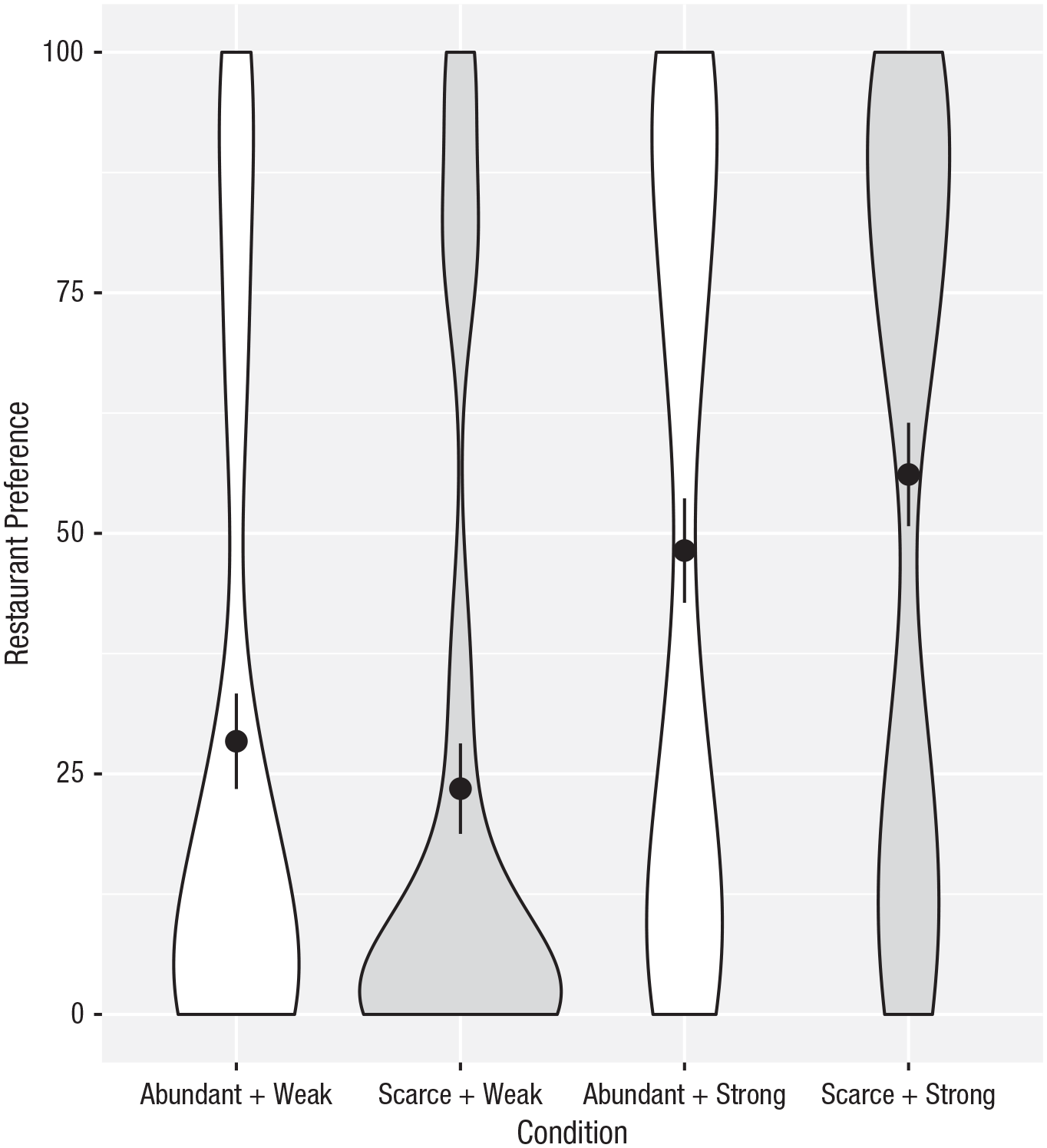
Results from Study 4: restaurant preference as a function of shared time between the participants and their colleague (abundant vs. scarce) and the participants’ relationship goals (weak vs. strong). Dots indicate average ratings; error bars represent ±2 SE. The width of the violin plots represents the density of the data.
In contrast, in the weak-relationship-goal condition, there was no significant difference in participants’ restaurant preference, whether they were in the shared-time-scarce condition (M = 23.46, SD = 33.88) or in the shared-time-abundant condition (M = 28.39, SD = 34.82), F(1, 795) = 1.88, p = .171, η p 2 < .01, 95% CI = [0.00, 0.01]. In fact, participants’ restaurant preferences skewed toward the more convenient restaurant; their ratings were significantly below the midpoint of the scale (ps < .001). Finally, the interaction between shared time and relationship goal remained significant when we controlled for perceived expensiveness and food quality, F(1, 793) = 5.83, p = .016, η p 2 = .01, 95% CI = [0.00, 0.02].
Another study (N = 401 Mechanical Turk participants; 48% male; mean age = 37.52 years, SD = 12.55) provided converging evidence for our relationship-maintenance account: The effect of shared time (abundant vs. scarce) on preference for extraordinary experiences was moderated by partner liking, F(1, 397) = 7.64, p = .006, η p 2 = .02, so that it emerged only when individuals liked their relationship partner. See Study S3 in the Supplemental Material.
General Discussion
This work shows that when individuals perceive their time with a relationship partner as scarce, they place increased weight on sharing extraordinary experiences—those characterized by their uniqueness and superiority (pilot study). This effect persisted even when we merely evoked the perception that shared time is scarce (Studies 1 and 2) and when individuals made trade-offs between attributes (Studies 3 and 4). The results of Studies 2 and 4 suggest that this prioritization of extraordinary experiences under shared time scarcity is a relationship-maintenance strategy deployed to maintain the well-being of the focal relationship.
Although prior work on efficiency-seeking behaviors has shown that individuals will allocate a scarce resource by focusing on pressing needs (Shah et al., 2015; see also Study S4 in the Supplemental Material), we contributed to the literature by examining how such behaviors will actually manifest in the context of close relationships. Our work suggests that a different underlying psychology is at play when the scarce resource is that of shared time with a partner, pointing to the possibility that individuals prioritize options that they believe will be symbolically meaningful (Carstensen et al., 1999; Lang & Carstensen, 2002).
We also advance the current understanding of close relationships by documenting the prioritization of shared extraordinary activities as a relationship-maintenance strategy. As demonstrated in Study 2, people choose extraordinary experiences to influence the extent to which their partner thinks about them when they are not together. This strategy differs from existing work on cognitive relationship-maintenance strategies that have been self-focused (e.g., constructing a positive narrative). By showing how individuals rely on consumption choices to maintain relationship well-being, we also contribute to a small, albeit growing, literature on making choices for other people (e.g., Liu et al., 2019).
Our research offers several avenues for future research. For example, do these effects hold when individuals decide together what to do when their shared time is limited? If partners have the opportunity to discuss and evaluate alternatives together, they might realize that they do not need to rely on memorability to sustain the relationship’s well-being. Relatedly, future work could investigate whether individuals opt for shared extraordinary experiences because they infer that such endeavors are what their partners want. If this is indeed the case, individuals who choose extraordinary experiences may become less happy than if they had chosen ordinary experiences, suggesting that the effects we documented may have resulted in suboptimal choices. It would also be important to further unpack the mechanism underlying our effects. Though Study 2’s results suggest that when facing shared time scarcity, individuals have a desire to be remembered by their partners as a way of sustaining the focal relationship, it is possible that the item we employed is correlated with other relationship variables (e.g., wanting the partner to be more committed to the relationship). Thus, future work should further pinpoint exactly why people believe that extraordinary experiences will help them maintain their relationship’s well-being under shared time scarcity.
Future research could also examine how choices made under shared time scarcity influence relationship well-being. Sharing an experience with other people, especially with psychologically proximate individuals, can amplify the experience (Boothby et al., 2016). At the same time, relationship partners, especially those who do not see each other often, may be better off prioritizing experiences that allow them to focus on each other (e.g., conversations) rather than those that direct their focus to attributes of the experiences themselves (Min et al., 2018).
Finally, although we employed a diverse set of participants in our studies (e.g., members drawn from a university pool, workers from online panels, and social media users), all of our participants were U.S. residents. Thus, it would be important to explore whether the effects documented here are generalizable across different countries, because it is possible that there are cultural differences in how much people value their time and their social relationships.
As our introductory examples attest, shared time with loved ones is becoming increasingly scarce. Our findings demonstrate how individuals may cope when facing limited time with their loved ones: by prioritizing extraordinary experiences. By doing so, we highlight the important role of shared time scarcity in further understanding the antecedents of experiential choices in close relationships.
Supplemental Material
sj-docx-1-pss-10.1177_09567976211026981 – Supplemental material for Shared Time Scarcity and the Pursuit of Extraordinary Experiences
Supplemental material, sj-docx-1-pss-10.1177_09567976211026981 for Shared Time Scarcity and the Pursuit of Extraordinary Experiences by Ximena Garcia-Rada and Tami Kim in Psychological Science
Footnotes
Acknowledgements
We would like to give special thanks to Mike Norton, Leslie John, Ting Zhang, Rebecca Ratner, David Levari, and Xiang Ao for their insightful feedback on this manuscript. We also thank the members of the Nifty Experimental Research (Across) Disciplines (NERD) Lab at Harvard Business School and Promoting Excellence in Experimental Research (PEER) Lab at the University of Virginia for their helpful comments and the members of the Behavioral Research at Darden Lab and Rhys Aglio for their valuable research assistance.
Transparency
Action Editor: Mark Brandt
Editor: Patricia J. Bauer
Author Contributions
X. Garcia-Rada and T. Kim jointly developed the study concept and designed the study. Both authors also collected, analyzed, and interpreted the data; drafted and revised the manuscript; and approved the final manuscript for submission.

References
Supplementary Material
Please find the following supplemental material available below.
For Open Access articles published under a Creative Commons License, all supplemental material carries the same license as the article it is associated with.
For non-Open Access articles published, all supplemental material carries a non-exclusive license, and permission requests for re-use of supplemental material or any part of supplemental material shall be sent directly to the copyright owner as specified in the copyright notice associated with the article.
