



Abstract
In popular belief, emotions are regarded as deeply subjective and thus as lacking truth value. Is this reflected at the behavioral or brain level? This work compared counter-normative emotion reports with perceptual-decision errors. Participants (university students; N = 29, 16, 40, and 60 in Experiments 1–4, respectively) were given trials comprising two tasks and were asked to (a) report their pleasant or unpleasant feelings in response to emotion-invoking pictures (emotion report) and (b) indicate the gender of faces (perceptual decision). Focusing on classical error markers, we found that the results of both tasks indicated (a) post-error slowing, (b) speed/accuracy trade-offs, (c) a heavier right tail of the reaction time distribution for errors or counter-normative responses relative to correct or normative responses, and (d) inconclusive evidence for error-related negativity in electroencephalograms. These results suggest that at both the behavioral and the brain levels, the experience of reporting counter-normative emotions is remarkably similar to that accompanying perceptual-decision errors.
Keywords
Imagine that you are angry but your spouse tells you “you have nothing to be angry about.” According to our conceptual framework, your spouse considers your emotion reaction to be erroneous. You, on the other hand, much like 58.6% of the students who participated in a short survey that was conducted alongside the main study (N = 174), have a strong intuition that there is no right or wrong when it comes to emotions, given their deeply subjective nature. This intuition implies that no one can tell you that you are wrong to be angry.
Whether emotions may be wrong relates to the functionality of emotion experiences. Arguably, consciously felt emotion experiences (which may be considered as metacognitions) play a role in at least two partially overlapping domains: decision-making and communication. According to the “affect-as-information” approach that focuses on intrapersonal dynamics, our emotion experience holds information regarding the situation at hand and thus shapes cognitive processing, judgments, and ultimately decisions (Clore et al., 2001). Feelings also play a part in interpersonal dynamics, because we often communicate our emotion experiences to others. This communication provides fellow humans with vital input, which improves their prediction of upcoming events and affects their behavior (Parkinson, 2006). We acknowledge the fact that people may try to hide their emotions, but observers would be influenced by the emotion nonetheless (Butler et al., 2003). This phenomenon of one’s emotion experience affecting others is so fundamental to human emotions that it is already evident in 1-year-old babies (Sorce et al., 1985). As we communicate our emotion experiences to ourselves and others, the quality and appropriateness of the emotion experience becomes crucial.
To our knowledge, the appropriateness or correctness of emotion experience is rarely discussed in the literature. One exception can be found in appraisal theories of emotion (Moors et al., 2013), which posit that an emotion experience is evoked by appraisals. This implies that one can assign a truth value to emotion-related appraisals and ultimately (given that appraisals are closely coupled with the emotion experience) to the emotion experience itself. An incorrect appraisal can arise from false information (Valins, 1966) or a wrong evaluation of the situation, as shown in cognitive biases (Beck & Weishaar, 1989), for example. The possibility that emotion experiences may be wrong also accords with emotion-as-perception theories. In the spirit of Tappolet (2016), just as it is wrong to experience the moon as red given its lack of redness, it is wrong to fear a puppy, which is a nonfearsome object. To extend Tappolet’s view, when one is afraid of a puppy, it is not wrong to report that one is afraid, but it is intersubjectively wrong to be afraid in such a situation. Along similar lines, emotional abnormalities such as specific phobias are defined in the Diagnostic and Statistical Manual of Mental Disorders (American Psychiatric Association, 2013) as “irrational”—that is, erroneous. For example, hemophobia, the fear of seeing blood, represents an attribution error because merely seeing blood is intersubjectively considered to be safe. However, unlike perceptual-decision errors that are considered errors in reference to an objective value, counter-normative emotion expressions are evaluated against an intersubjective norm.
The question of whether emotions can be wrong may prove to be difficult to answer empirically. What can be answered empirically is whether the common belief in emotions’ lack of truth value is reflected in cognitive behavioral processing and in brain recording. In a sense, we ask whether the mind and brain regard normative and counter-normative emotions as being alike (as lack of truth value suggests) or whether it differentiates between them in a similar manner as it differentiates between correct and erroneous responses. To address this question, we ran a series of preregistered experiments and preregistered analyses of previously published experiments (links are provided in the Open Practices section). In these experiments, we examined whether counter-normative emotion reports show classical error-related effects typically shown in perceptual-decision tasks: post-error slowing (PES; Laming, 1968; Rabbitt & Rodgers, 1977), speed/accuracy trade-offs (Schouten & Bekker, 1967; Wickelgren, 1977), a heavier right tail of the reaction time (RT) distribution (Balota & Yap, 2011; Luce, 1986), and the error-related negativity and the correct-related negativity in electroencephalograms (EEGs; Holroyd & Coles, 2002; Wessel, 2012). To simplify our exposition in the following discussion, we will refer to errors and counter-normative responses as “aberrations” and correct and normative responses as “expected.”
Statement of Relevance
People often believe that there is no right or wrong when it comes to emotions, given that emotions are deeply subjective. On the other hand, we may judge others’ emotional responses as disproportionate, out of place, inappropriate, or as lacking sensitivity. These contradictory beliefs generate a dispute in the research community regarding the “correctness” of emotions. In the present work, we studied emotion reports and performance in a perceptual task in which there was an objectively defined answer. We found that when the emotion reports deviated from social norms, cognitive processing closely resembled that seen when participants made errors in the perceptual task. These results show that at the processing level, emotions are regarded as being wrong.
Method
General details
Sample sizes were determined using Bayes factor (BF) design analysis (Schönbrodt & Wagenmakers, 2018) using an expected effect size (d) of 0.5. The protocols of the experiments were approved by the ethics committee of the Department of Psychology at Ben-Gurion University of the Negev. All the participants (see demographic details below) were undergraduate students from Ben-Gurion University of the Negev who were recruited via an online participant-recruitment platform. They were compensated by a course credit and signed an informed consent form. BF analyses employed the default priors.
Challenges in measuring emotion reports
It is crucial to distinguish between (a) the emotion report and (b) the emotion experience itself. We aimed to minimize the possible gap between the two, which enabled us to trust the emotion reports as representing genuine experiences. To this end, we masked the goal of the experiment and shifted participants’ focus to the perceptual task. At the same time, we emphasized the deeply subjective nature of emotions, and we explicitly stressed that there is no right and wrong in emotions. Additionally, we used stimuli that were unlikely to invoke socially unacceptable emotion reactions, such as pornographic pictures or pictures that elicit morbid curiosity, for which participants might hesitate to report what they truly feel. Last, we capitalized on previously published results (Givon et al., 2020), in which we compared a group who were asked to report their truly experienced feelings with a group who were asked to report the feeling that the stimulus was expected to evoke. The latter group showed an increased rate of normative responses and a relatively more homogeneous decision process in terms of the rate of evidence accumulation, as assessed using the linear ballistic accumulator (LBA) model (Brown & Heathcote, 2008). These differences suggest, at minimum, that when asked to report truly experienced feelings, people do not report the expected feeling. Importantly, all the present results come from experiments in which participants were asked to report their truly experienced feelings.
Paradigm
Participants were asked to perform two tasks alternately—the emotion task, in which they reported their pleasant or unpleasant feelings, and the faces task, in which they indicated the gender of a face (for which the gender of the photographed person was known). The paradigm comprised 200 pairs of trials of both tasks. The emotion task included 200 emotion-eliciting photos with established norms (Nencki Affective Picture System database; Marchewka et al., 2014): 100 were slightly negative (valence range = 3.5–4.5 on a scale from 1, extremely negative, to 9, extremely positive), and 100 were positive (valence range = 6.5–7.5). We ensured that there would be equal representation of various content categories (animals, objects, faces, people, and landscapes) in the positive and negative picture groups and that the photos would not contain socially controversial content. For each trial, response identity and RT were collected, and aberrations were defined as responding “pleasant” to a normatively negative photo or responding “unpleasant” to a normatively positive photo. The faces task included 200 pictures of male and female faces (with gender being defined by the gender of the photographed person), evenly divided between genders. The face database was provided by the Max Planck Institute for Biological Cybernetics in Tübingen, Germany (Blanz & Vetter, 1999; Troje & Bülthoff, 1996). In each trial, accuracy and RT were recorded, and aberrations were defined as responding “male” to a picture of a woman and vice versa. RT was defined as the time from picture presentation until participants responded by pressing a key.
Experiments 1 and 2
In Experiments 1 and 2, we analyzed previously published data (Givon et al., 2020; Experiment 1, self-group: N = 29, 20 females, mean age = 23.24 years; Experiment 2: N = 16, 14 females, mean age = 23.25 years). In these experiments, participants completed the basic paradigm as described above.
Experiment 3
In Experiment 3 (N = 40, 22 females, mean age = 23.41 years), we ran a variation of the basic paradigm with a speed/accuracy manipulation. The experiment began with a baseline phase (identical to the basic paradigm; 100 trials), followed by two conditions: speed emphasis (“please respond
Experiment 4
In Experiment 4 (N = 60, 34 females, mean age = 23.77 years), we recorded EEGs while participants performed the basic paradigm with a few minor changes: (a) the emotion-evoking photo was presented for 5 s regardless of the participants’ response, (b) the fixation point was presented for a random duration ranging from 800 to 1,200 ms, and (c) the RT limit for the faces task was calculated per participant on the basis of performance in the training block (specifically, it was set as mean RT + 2.5 SD).
Results
Post-error slowing
In our design involving two alternating tasks, aberrant responses could occur in both tasks (faces and emotion) and impact performance either in the trial that immediately followed (involving a different task) or in the same task (coming two trials later). This generated four combinations representing the four conditions of PES analysis: face responses following aberrant emotion responses, emotion responses following aberrant emotion responses, emotion responses following aberrant face responses, and face responses following aberrant face responses. Differences in RT between postaberrant and postexpected responses were computed separately for each of the aforementioned PES conditions. We found PES in face responses following aberrant emotion reports, t(67) = 4.91, p < .001, BF favoring the alternative over the null hypothesis (BF10) = 2,805.22, and in face responses following aberrant face responses, t(67) = 2.93, p < .005, BF10 = 6.55. The remaining conditions produced nonsignificant PES and BFs that offered no conclusive evidence for either the alternative or the null hypothesis (BF10 = 0.69 and 0.59; see Fig. 1a). To clarify the lack of PES when measured in the following emotion response, we ran a post hoc analysis in which we separated pleasant and unpleasant stimuli (see the Discussion section for rationale). Following face errors, there was a significant PES in emotion reports to pleasant stimuli (M = 209.43 ms), t(67) = 2.94, p < .004, BF10 = 6.78. When the emotion reports were made to unpleasant stimuli, there was a trend for a reversed PES (M = −68.01 ms), t(67) = −0.94, p < .3, BF10 = 0.20. This difference in PES trends proved significant, t(67) = 2.63, p < .01, BF10 = 3.20.
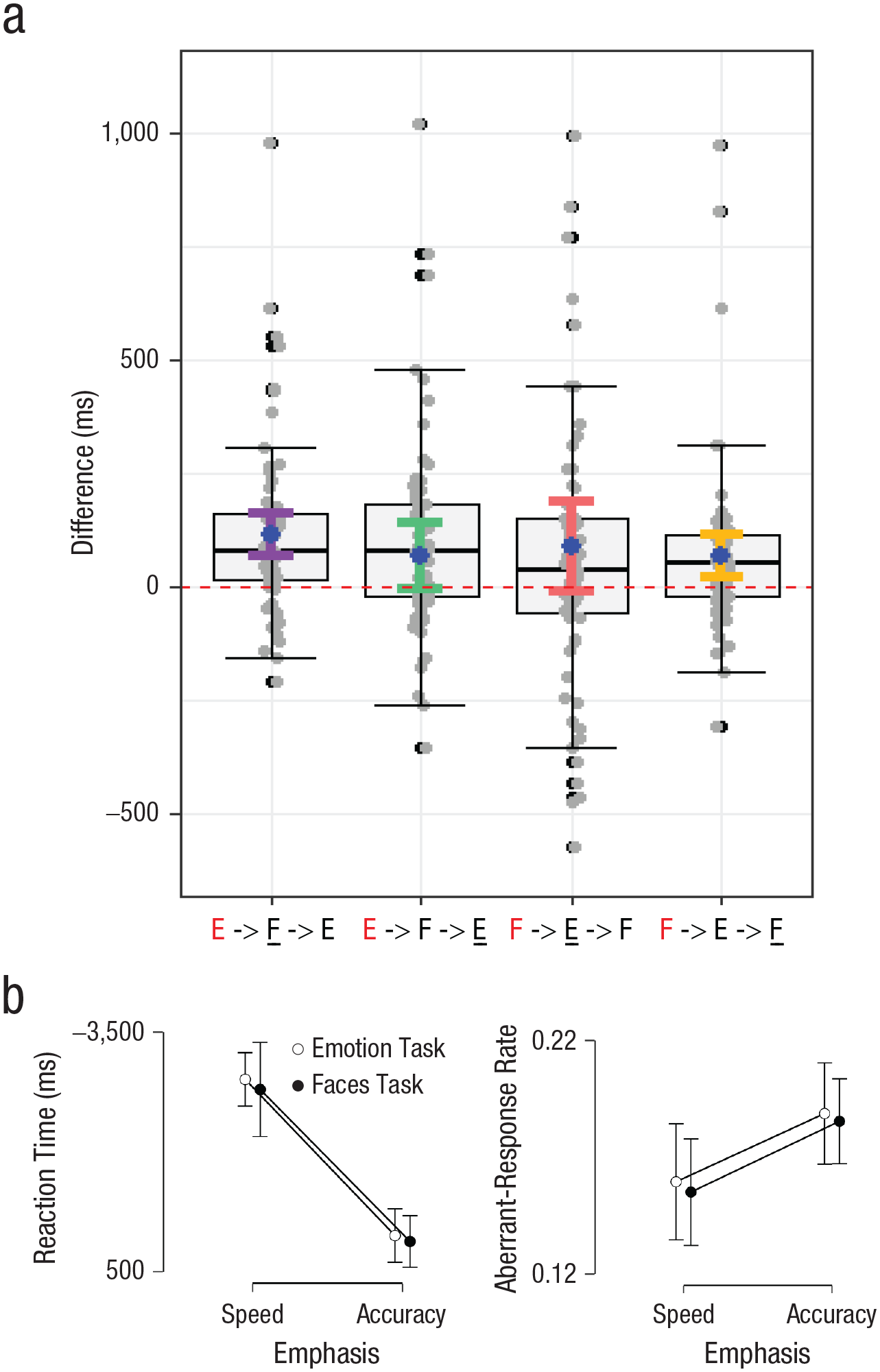
Results for post-error slowing (PES) and speed/accuracy trade-off. Differences between postaberration and postexpected trials are shown in (a). Each plot depicts a specific PES condition, and “E” and “F” represent emotion or face responses, respectively. The bold red letters indicate aberrant responses, and the underlined letters mark the postaberration response that was analyzed. Blue dots show the mean difference value for each PES condition, and colored error bars represent 95% credible intervals. Boxes indicate the interquartile range of the data, black horizontal lines show the medians, and whiskers extend 1.5 times the interquartile range. Gray and black dots show individual data. The red dashed line represents a difference value of zero. In (b), mean reaction time (left) and aberrant-response rate (right) are shown as a function of emphasis and task. Error bars show 95% credible intervals.
Speed/accuracy trade-off
A repeated measures Bayesian analysis of variance (ANOVA) included the independent variables emphasis (speed vs. accuracy) and task (emotion vs. faces). We found main effects for emphasis on RT, F(1, 39) = 47.46, p < .001, BF10 = 6.11 × 10¹³, and on the rate of aberrant responses, F(1, 39) = 10.49, p < .003, BF10 = 5.31. Main effects for task and interactions involving task were all nonsignificant, and the BFs favored the null over the alternative hypothesis (BF01s > 3; see Fig. 1b). Importantly, we found that the best-fitting LBA model was one allowing the threshold parameter (and, unpredictably, also the starting point) to differ between speed/accuracy conditions. This model indicates that more evidence (a higher threshold) was required for responding when accuracy was emphasized (see the Supplemental Material available online).
RT distributions
We plotted the RT distributions for expected and aberrant responses for both tasks (see Fig. 2a). The visible difference in the shapes of the RT distributions mainly indicates a heavier right tail for aberrant responses compared with expected responses in both tasks. This difference was assessed by quantifying the shape of the distribution with the ex-Gaussian model (Balota & Yap, 2011). We performed Bayesian bootstrapping on the data, creating 10,000 samples per task. In each sample, we extracted ex-Gaussian parameters for expected and aberrant responses and calculated the difference between the parameters of these two distributions. Histograms of the differences between the parameters are presented in Figure 2b. Although differences in µ and s parameters were not reliably different from zero, the 95% credible interval of the difference in the τ parameter (describing the heaviness of the right tail) did not include zero, indicating its significance. This pattern confirms that in both tasks, there was a heavier RT-distribution tail for aberrations than for expected responses.

Reaction time (RT) distributions and error-related negativity results, separately for the emotion task (left) and the faces task (right). Density plots for RT distributions (a) show results separately for expected and aberrant responses. Results from the Bayesian bootstrapping analyses for ex-Gaussian parameters (b) are shown separately for the parameters µ, s, and τ. The spaces between the dashed vertical lines represent 95% credible intervals. Response-locked event-related potentials (c) are shown for expected (green) and aberrant (red) trials. Solid lines represent the average amplitude, and error bands show standard errors.
Event-related potentials
We analyzed the response-locked event-related potential (ERP) waveform for expected and aberrant responses in both tasks at the FCz electrode. We performed a repeated measures Bayesian ANOVA with the independent variables task (emotion vs. faces) and response (expected vs. aberrant) on the mean amplitudes in the time window following the response (0–130 ms). We found no significant main effects or interactions, and BFs favored the null hypothesis for the main effect of task (BF01 = 6.73) and the interaction (BF01 = 4.29). The BF for the error-related negativity effect (expected compared with aberrant) was inconclusive but favored the null hypothesis (BF01 = 2.47; see Fig. 2c). We found similar results even when restricting the analyses to relatively quick responses (in which error-related negativity is more likely to be found; Stahl et al., 2020; see the Supplemental Material).
Discussion
Can feelings be wrong? The widespread popular belief (as our survey shows) is that feelings are deeply subjective and thus lack truth value and cannot be wrong. Because the question itself may prove difficult to answer empirically, we tackled a related question—whether this lack of truth value is reflected in cognitive processing and in brain recording. We specifically compared counter-normative emotion reports with objectively defined errors in a perceptual-decision task. Indeed, counter-normative emotion reports showed a highly similar pattern of results to that found in perceptual-decision errors, both behaviorally and in terms of brain activity: We found that emotion reports responded to the speed/accuracy manipulation and produced the same trade-offs as perceptual decisions. Counter-normative emotion reports and perceptual-decision errors were both characterized by exceptionally slow RTs (a heavier right tail of the RT distribution) compared with normative and correct responses. Both counter-normative responses and perceptual-decision errors showed PES in the following perceptual-decision trial. Regarding error-related negativity, we expected both tasks to generate this effect. However, we could not find this ERP component in any of the tasks. Surprised by these results, we came across a study suggesting that error-related negativity can be found only in relatively short RTs (Stahl et al., 2020). We suspect that the relatively slow responses compared with those in typical studies on error-related negativity may be the reason why we failed to find this effect. In the current study, the RTs in both tasks were relatively long. This reflects the fact that we chose a perceptual-decision task that would be comparable in terms of RT and the rate of aberrant responses. In any event, our results show that people’s cognitive performance treats counter-normative emotion responses as if they were errors, in contrast to the widespread popular belief that emotions lack truth value.
Could it be that counter-normative emotion responses reflect emotion-unrelated processes, such as inattention or failing to press the correct key? We argue that this is unlikely to be the case. First, we previously found that reappraisal increased the rate of aberrant emotion reports (made in response to negative pictures; Singer-Landau & Meiran, 2021) showing that the aberrations are emotion related. Second, both RT and aberrations were explained by joint modeling, in terms of evidence accumulation (Givon et al., 2020; Singer-Landau & Meiran, 2021). In addition, our modeling provides an explanation for the heavier right RT-distribution tail in aberrant responses. The model specifically shows that this heavier tail reflects a slower rate of evidence accumulation, perhaps indicating less confidence, as suggested by one of the reviewers. If, as the model shows, counter-normative emotion reports reflect slower (emotional) evidence accumulation, this implies that their being counter-normative is emotion related. Last, participants’ reports during debriefing indicate that they felt that some of their reports were counter-normative. This suggests that at least some aberrations were emotion related. Our informal observation is supported by the discrepancy in the rate of aberrant responses between a group who were asked to report the expected feeling (showing ~10% aberrant responses across two experiments) and a group who reported genuinely felt emotions (~18%; Givon et al., 2020). On the basis of these observations, we find it extremely unlikely that the aberrant emotion responses were unrelated to emotion.
In an attempt to explain the common denominator of counter-normative emotion reports and perceptual-decision errors, we considered the affective-signaling hypothesis (Dignath et al., 2020). According to this hypothesis, errors are accompanied by negative affect, which in turn changes decision policy. For example, it implies that PES reflects increased caution following errors (but see Notebaert et al., 2009). An interesting implication is that emotion reports following aberrations should differ as a function of emotion. When the stimulus is expected to generate pleasantness, error-related negative affect would mix with the positive affect that the stimulus evokes, and this mixed evidence would result in response slowing. When the stimulus is expected to generate an unpleasant experience, error-related negative affect would add to the negative affect generated by the picture, resulting in response speeding. Our post hoc analyses generally aligned with this prediction. Specifically, when the emotion reports concerned normatively positive pictures, we found a significant PES following face errors. In contrast, when the emotion reports concerned normatively negative pictures, there was a trend for a reversed PES. The difference between the two types of emotion reports was substantial. These considerations provide additional support for the analogy between counter-normative emotion reports and perceptual-decision errors (and for affective signaling).
We suggest that at the cognitive-performance brain level, counter-normative emotion reports are experienced in the same manner that errors are experienced. This suggestion seems to align with the broader theory (James, 1884) that emotion experiences resemble perception. James’s position and our suggestion both imply that the boundaries between cognition and emotion may be less clear than what many people seem to believe. Before concluding, we add that the analogy between emotion and decision-related aberrations is partially limited, considering the experimental design, the type of stimuli (pictures), the type of emotions, and the sample (students). We thus propose that future research explore counter-normative emotion reports in other cultures and clinical populations, using other materials, and under different levels of motivation to adhere to social norms.
In conclusion, we found that counter-normative emotion reports are accompanied by similar cognitive brain-processing signatures as perceptual-decision errors. These findings are surprising given that most people believe that emotions lack truth value because of their deeply subjective nature. Considering that emotional feelings are tightly coupled with attributions and play a central communicative role, the findings may not be so surprising after all.
Supplemental Material
sj-docx-1-pss-10.1177_09567976211063915 – Supplemental material for Can Feelings “Feel” Wrong? Similarities Between Counter-Normative Emotion Reports and Perceptual Errors
Supplemental material, sj-docx-1-pss-10.1177_09567976211063915 for Can Feelings “Feel” Wrong? Similarities Between Counter-Normative Emotion Reports and Perceptual Errors by Ella Givon, Gal Udelsman-Danieli, Ophir Almagor, Tomer Fekete, Oren Shriki and Nachshon Meiran in Psychological Science
Footnotes
Transparency
Action Editor: Jamin Halberstadt
Editor: Patricia J. Bauer
Author Contributions
E. Givon and G. Udelsman-Danieli contributed equally to this article. E. Givon, G. Udelsman-Danieli, and N. Meiran developed the theoretical framework and conceived and planned the experiments. E. Givon collected and analyzed the data from Experiments 1, 2, and 3. G. Udelsman-Danieli and O. Almagor collected and analyzed the data from Experiment 4. T. Fekete and O. Shriki conceived and wrote the code for cleaning the electroencephalogram data. E. Givon, G. Udelsman-Danieli, and N. Meiran discussed the results and wrote the final manuscript. All authors approved the final manuscript for submission.

References
Supplementary Material
Please find the following supplemental material available below.
For Open Access articles published under a Creative Commons License, all supplemental material carries the same license as the article it is associated with.
For non-Open Access articles published, all supplemental material carries a non-exclusive license, and permission requests for re-use of supplemental material or any part of supplemental material shall be sent directly to the copyright owner as specified in the copyright notice associated with the article.
