



Abstract
False accusations of wrongdoing are common and can have grave consequences. In six studies, we document a worrisome paradox in perceivers’ subjective judgments of a suspect’s guilt. Specifically, we found that people (including online panelists, n = 4,983, and working professionals such as fraud investigators and auditors, n = 136) use suspects’ angry responses to accusations as cues of guilt. However, we found that such anger is an invalid cue of guilt and is instead a valid cue of innocence; accused individuals (university students, n = 230) and online panelists (n = 401) were angrier when they are falsely relative to accurately accused. Moreover, we found that individuals who remain silent are perceived to be at least as guilty as those who angrily deny an accusation.
False accusations permeate social life—from the mundane blaming of other people to more serious accusations of infidelity and workplace wrongdoing. Importantly, false accusations can have grave consequences, including broken relationships, job loss, and reputational damage.
False accusations arise in part because many accusations are not supported by physical evidence (Peterson et al., 1987), and it is difficult to tell whether suspects are being truthful (DePaulo & Pfeifer, 1986). As a result, laypeople (Ekman & O’Sullivan, 1991; ten Brinke et al., 2016) and professionals (DePaulo & Pfeifer, 1986) often rely on invalid cues when making subjective judgments about suspects’ credibility (Kraut & Poe, 1980; ten Brinke et al., 2016). In this article, we document an equally pernicious phenomenon—the misuse of anger as a cue to predict whether a suspect has been falsely accused.
Person Perception and Deceit Detection
According to the Brunswik (1952) lens model, a distal objective reality is manifested through various cues that are used to judge reality. By distinguishing ecological validity, or the relationship between objective reality and cues, from cue utilization, or the relationship between perceived cues and judgment, this model provides an account of judgment accuracy. In the context of our research questions, a cue’s ecological validity refers to the extent to which a suspect’s anger is related to their guilt, and cue utilization refers to the extent to which a suspect’s anger correlates with observers’ perceptions of the suspect’s guilt.
Use of anger as a cue of guilt
People look to others’ emotions when seeking to understand social situations (van Kleef, 2009), particularly when trying to determine whether someone is lying (see Vrij & Granhag, 2007). Angry responses are common in initial accusations (Reisig et al., 2004). Because angry responses are one of the first potential cues in an accusation process, it is worth investigating whether they affect perceivers’ judgments of guilt and whether these inferences are valid.
We contend that when judging whether a suspect has been accurately accused, perceivers interpret suspects’ anger as a sign of guilt. We argue that this is because, first, anger can make people come across as untrustworthy (Dunn & Schweitzer, 2005). Second, perceivers use untrustworthiness in guilt judgments (Porter & ten Brinke, 2009). As a result, we propose that when perceivers are alerted to a suspect’s anger, perceivers are apt to find the suspect untrustworthy, prompting a judgment of guilt. Perceivers may even interpret a suspect’s displayed anger as an inauthentic attempt to look innocent by faking moral indignation. This would further explain why perceivers deem an angry suspect guilty via perceptions of authenticity and inauthenticity.
That said, there are important distinctions between the experience of anger (the feeling of being angry) and its display (the expression or communication of anger). We argue that if an observer is simply aware of an accused person’s anger—even if it is not displayed—it should positively relate to observers’ guilt judgments. This is because knowing that someone is angry triggers a perception of uncooperativeness (van Doorn et al., 2012), which is associated with judgments of deceit (DePaulo et al., 2003). Further, if an individual is believed to be experiencing but not displaying anger, observers may feel as though the accused is dishonest and inauthentic (Côté et al., 2013), decreasing trust and shaping guilt perceptions.
We tested our prediction for the effect of anger on perceived guilt relative to three conditions (calmness, irritation, and silence). We reasoned that calmness likely signals cooperativeness and pleasantness, which are negatively associated with deceit perceptions (DePaulo et al., 2003). For robustness purposes, we tested whether the predicted effect holds for mild anger (irritation). Finally, we included a silent condition based on research demonstrating that people distrust others whom they perceive to be withholding information (John et al., 2016); we predicted that perceivers would also infer guilt from silent denials.
Ecological validity of anger as a cue of guilt
Meta-analyses have documented a paucity of ecologically valid deception cues (DePaulo et al., 2003; DePaulo & Morris, 2004). Moreover, the few ecologically valid cues identified (such as eye dilation; DePaulo et al., 2003) have small predictive relationships and are difficult to reliably perceive, impeding utilization. Here, we propose that perceivers use suspects’ anger as an invalid cue of guilt but that this cue is actually predictive of innocence.
Statement of Relevance
When people are accused of wrongdoing, they may respond with a variety of emotions, including anger. Do observers take expressions of anger as evidence that the accused person is guilty? Across six studies, we found that perceivers do indeed interpret suspects’ angry responses to accusations as evidence of their guilt. However, people are angrier when they are falsely accused than accurately accused, suggesting that, if anything, anger is a signal of innocence. Therefore, our research shows that observers mistake an accused person’s anger as a sign of guilt—a potentially serious error. We found that both laypeople and people in consequential decision-making roles are prone to this error when making judgments of a suspect’s guilt. These findings are important because the consequences of wrongful accusations can include job loss, incarceration, and even the death penalty.
Despite much research examining the ecological validity of different emotional cues for determining truthfulness (Ekman, 2001), the validity of anger as a cue to guilt is not yet known. Decades of research demonstrate that anger occurs when people experience a negative event or outcome (Smith et al., 1993), especially when, as is the case in a false accusation, they perceive someone else as blameworthy (Berkowitz & Harmon-Jones, 2004). Moreover, anger results from experiencing injustice (Averill, 1983), motivating individuals to fight back to correct it (Batson et al., 2007; Frijda, 1986); therefore, it is a likely emotion among the falsely accused. Although it is possible that guilty suspects also experience anger because they have been caught or feel mistreated, we argue that anger is likely to be stronger among the innocent, whose experience is a greater injustice.
Research Overview
Studies 1 to 4 examined cue utilization; Studies 5 and 6 examined ecological validity. We tested our hypotheses across different types of accusations (e.g., serious vs. trivial, physically aggressive vs. not physically aggressive) and contexts (e.g., more formal vs. less formal) as well as types of anger expressions (subtle and strong) and with both felt and displayed anger.
We report all manipulations, measures, studies, and exclusions. All studies were approved by institutional review boards, and all participants provided informed consent. In addition to the measures reported, all studies concluded with demographic questions. All stimuli and data are posted at https://osf.io/rvzna/.
Cue Utilization: Perceivers Interpret Suspects’ Anger as Evidence of Guilt
Study 1
Method
Participants and procedure
Participants were 1,920 Amazon Mechanical Turk (MTurk) workers (882 men, 1,024 women, 12 nonbinary, two other; 1,395 White, 221 Black, 113 Hispanic, 111 Asian, 45 multiracial, and 35 other or preferred not to answer; age: M = 37.18 years, SD = 12.01).
We designed this study to test whether perceivers interpret real suspects’ anger as evidence of their guilt. Each participant was randomly assigned to view one of 33 clips in which a person accused on the television show “Judge Faith” pleaded their case. For information on clip selection and a link to the clips, see the Supplemental Material available online. “Judge Faith” is a televised courtroom show in which actual disputes are heard by a real judge (Judge Faith) who makes judgments, although it is not a formal legal proceeding. At the outset of the study, all participants confirmed their willingness and ability to watch and pay attention to a short video clip. This study was preregistered at https://osf.io/b97up/.
Measures
Our primary outcome measures were participants’ judgments of the accused’s anger and guilt; we counterbalanced presentation order between participants. To measure perceptions of anger, we drew items from extant measures (Harmon-Jones & Sigelman, 2001; Lerner & Keltner, 2001) and asked participants to indicate to what extent the accused seemed angry, aggravated, frustrated, upset, and irritated on a scale from 1 (very slightly or not at all) to 5 (extremely). To measure perceptions of guilt, we asked participants, “Based on the video you just watched, how likely is it that the defendant 1 is guilty?” which they answered on a 7-point scale (1 = extremely unlikely, 7 = extremely likely). We also asked participants what they anticipated the judge would decide. Participants could respond, “The judge will say that the defendant is not guilty” or “The judge will say that the defendant is guilty.” We incentivized their choice by adding that they would earn a $0.10 bonus if they correctly guessed the judge’s decision (clips in which the claim was dismissed or in which the judge decided in favor of the accused were counted as “not guilty”; those in which the judge ruled in favor of the accuser were counted as “guilty”).
To ensure that results were not driven by perceptions of negative traits or negative emotion, we assessed participants’ perceptions of the accused’s sadness (sad, blue, downhearted, alone, or lonely, from the expanded version of the Positive and Negative Affect Schedule [PANAS-X]; Watson & Clark, 1994) and competence (competent, confident, independent, competitive, or intelligent; Fiske et al., 2002). Both were measured on 5-point scales (1 = not at all, 5 = extremely; the order of sadness and competence was counterbalanced between participants). These measures help to assess the specificity of our predicted effect—that judgments of guilt are uniquely associated with anger and not with other cues such as negative emotions (sadness) or traits (incompetence).
In an attention check, we administered one question that had a correct answer: “Was the defendant in the clip a man or a woman?” (response options: man, woman, unsure). To exclude participants who had difficulty watching the video, we asked, “In the video you watched, what crime/offense was the defendant accused of?” Participants were given an open response box or could select one of the following: “I could not hear sound in the video,” “I could not see the video,” “I could not see or hear the video,” or “I don’t know or don’t remember what the defendant was accused of.” Finally, to remove bots and inattentive participants, we also asked participants two open-ended questions: “Please describe two of the questions that you answered in this [task]” and “What did you eat for dinner last night?” A research assistant blind to the hypotheses determined legitimate responses to these questions. Additionally, we probed for how often participants had previously watched “Judge Faith.”
Results
Analysis strategy
As indicated in our preregistration, we excluded participants who indicated that they could not watch or hear the clip (n = 53), who took fewer than 2 min or more than 2 standard deviations above the average time to finish the study (≥ 768.4 s; n = 86), who failed the attention check (n = 99), who wrote gibberish in the open-ended responses (n = 65), and who had duplicate Internet protocol (IP) addresses or MTurk IDs (n = 5), resulting in a final sample of 1,677 (average of 50.82 participants per clip).
As detailed in our preregistration, because participants were nested within video clips, our data were multilevel; therefore, we used hierarchical linear modeling in jamovi software (The jamovi Project, 2020). This analysis allowed us to hold constant the characteristics of the videos themselves, such as the type of offense or the race and gender of the accused and accuser, and to isolate the association between participants’ judgments of anger and perceived guilt of the accused. We used restricted maximum likelihood estimation for the continuous dependent variable and logistic models for the dichotomous outcome, included a fixed intercept, modeled the random coefficient component for the intercept, and specified participant-level variables at Level 1 (Enders & Tofighi, 2007). We report participant-level fixed-effects estimates with unstandardized coefficients and report conditional R2 estimates from the model. Significant clustering at the video level was observed in null models with a likelihood-ratio test for random effects and intraclass correlation coefficients in both dependent variables (ps < .001).
Perceptions of guilt
Participants’ judgments of the accused’s anger were significantly and positively associated with judgments of guilt, for both the continuous measure, b = 0.24, SE = 0.04, 95% confidence interval (CI) = [0.17, 0.31], t(1643) = 6.45, R2 = .23, p < .001, and the incentivized choice, b = 0.21, SE = 0.06, 95% CI = [0.09, 0.34], z = 3.38, R2 = .23, p < .001.
Robustness checks
The positive relationship between perceptions of the accused’s anger and participants’ judgment of guilt held when we included participants’ judgments of the accused’s sadness and competence in the model (ps for anger remained < .001). Therefore, the effects for anger are unlikely to be explained by the negative valence of the emotion or by associations with judgments of the accused’s competence. These models showed that sadness was not a statistically significant predictor for either guilt measure, but competence was. Modeling competence as a predictor, we found that judgments of the accused’s competence were negatively related to guilt judgments in the continuous measure—competence: b = −0.37, SE = 0.04, 95% CI = [−0.45, −0.29], t(1643) = −9.01, R2 = .25, p < .001—and the incentivized choice measure—competence: b = −0.64, SE = 0.07, 95% CI = [−0.79, −0.50], z = −8.64, R2 = .24, p < .001. In addition, we had two research assistants, blind to the purpose of the study, code the videos to determine the target of the accused’s anger. Of the clips with anger, research assistants coded 69% to have anger directed at the accuser. All results held when we excluded data from participants who watched one of the five videos with anger directed at other parties (e.g., the judge, the IRS).
We also conducted exploratory analyses including modeling participants’, accusers’, and accused’s demographic characteristics, which we report in the Supplemental Material.
Discussion
We found that participants’ judgments of suspects’ anger were predictive of their perceptions of the suspects’ guilt. However, Study 1 is subject to alternate interpretations, such as reverse causality or perceivers’ individual differences increasing sensitivity to anger and guilt. Of note, the anger mean across the 33 clips was low (grand mean = 2.43 on a 5-point scale, SD = 0.60), which may have meant that the accused regulated their anger when in formal settings, when they had time to process the accusation, or when on television. Finally, there might have been more disputes in which the accused was unwilling to compromise or admit guilt, possibly reducing variance, making our estimates conservative. That said, participants might have perceived anger displays in court as inappropriate, inferring that someone who displayed anger has self-control issues indicative of latent misbehavior. We addressed these issues in Studies 2 and 3.
Study 2
Method
Participants and procedure
Study 2 encompassed three nearly identical experiments testing our main hypothesis that observers use anger as a cue to guilt, testing causality. Study 2a was conducted on MTurk (N = 402), Study 2b was a replication with a nationally representative sample (N = 1,578 participants from ROIRocket, an online panel; roirocket.com), and Study 2c was a preregistered replication on MTurk (N = 375 after preregistered exclusions). Results across these three studies were consistent. For simplicity, in this section, we describe their common methods and procedures and report combined results (i.e., a meta-analysis of the three studies; N = 1,782). We provide full details, participant demographics and exclusions, and analyses of all three studies separately in the Supplemental Material. We targeted a minimum sample size of 100 participants per between-subjects condition, consistent with recent thinking on appropriate sample sizes (Simmons, 2014), for Studies 2a and 2c, and we targeted 1,500 responses for the nationally representative Study 2b.
Across all three studies, participants read a scenario about Andrew Smith, a fictitious accused who was described as pleading not guilty to charges of armed robbery. We designed our experiment to test our predictions that the suspect would be perceived as guiltier when angry relative to when calm or irritated (irritation—a weak display of anger—fell between the two). Moreover, although remaining silent may seem to offer the innocent an elixir to the hypothesized danger of appearing angry, we predicted that participants would also infer guilt from silence (John et al., 2016).
In the silent condition, participants read that although he was pleading not guilty, Smith was not testifying, as was his constitutional right. In each of the other three conditions, participants read about Smith’s reaction while denying his guilt during his testimony (for the full text of the manipulation, see the Supplemental Material). In the calm condition, Smith was described as reacting calmly, saying, “I really can’t believe I’m being accused of this crime,” without raising his voice. In the irritated condition, Smith was described as raising his voice, saying, “I’m irritated that I’m being accused of this crime.” Finally, in the anger condition, Smith was described as raising his voice and very angrily saying, “I’m so fucking OUTRAGED that I’m being accused of this crime!” Although such extreme reactions are probably not very common in the courtroom, we intentionally used such a reaction to compare the guilt perceptions it garnered with a less extreme, and likely more representative, display of anger (i.e., the irritated condition).
Measures
Participants rated their perceptions of the accused’s guilt on a scale ranging from 1 (extremely unlikely) to 7 (extremely likely). To examine mechanisms, we also asked participants how authentic and trustworthy the accused seemed, expecting those variables to mediate the relationship between suspects’ anger and judgments of guilt.
Results
All manipulation checks were significant and in the expected direction; these results are reported for each individual study in the Supplemental Material.
There was a significant effect of condition on perceptions of Smith’s guilt (ρ = .25, p < .001, 95% CI = [.21, .29]; see Fig. 1). Smith was perceived as guiltier when he reacted angrily than when he reacted in an irritated manner (d = 0.22, 95% CI = [0.10, 0.34]) and when he reacted angrily than calmly (d = 0.38, 95% CI = [0.26, 0.50]). Smith was perceived as guiltier when he reacted in an irritated manner as opposed to calmly (d = 0.16, 95% CI = [0.04, 0.27]) and guiltier when he was silent as opposed to reacted angrily (d = −0.15, 95% CI = [−0.27, −0.04]). Finally, Smith was perceived as guiltier when he was silent than when he was calm (d = 0.55, 95% CI = [0.43, 0.67]).
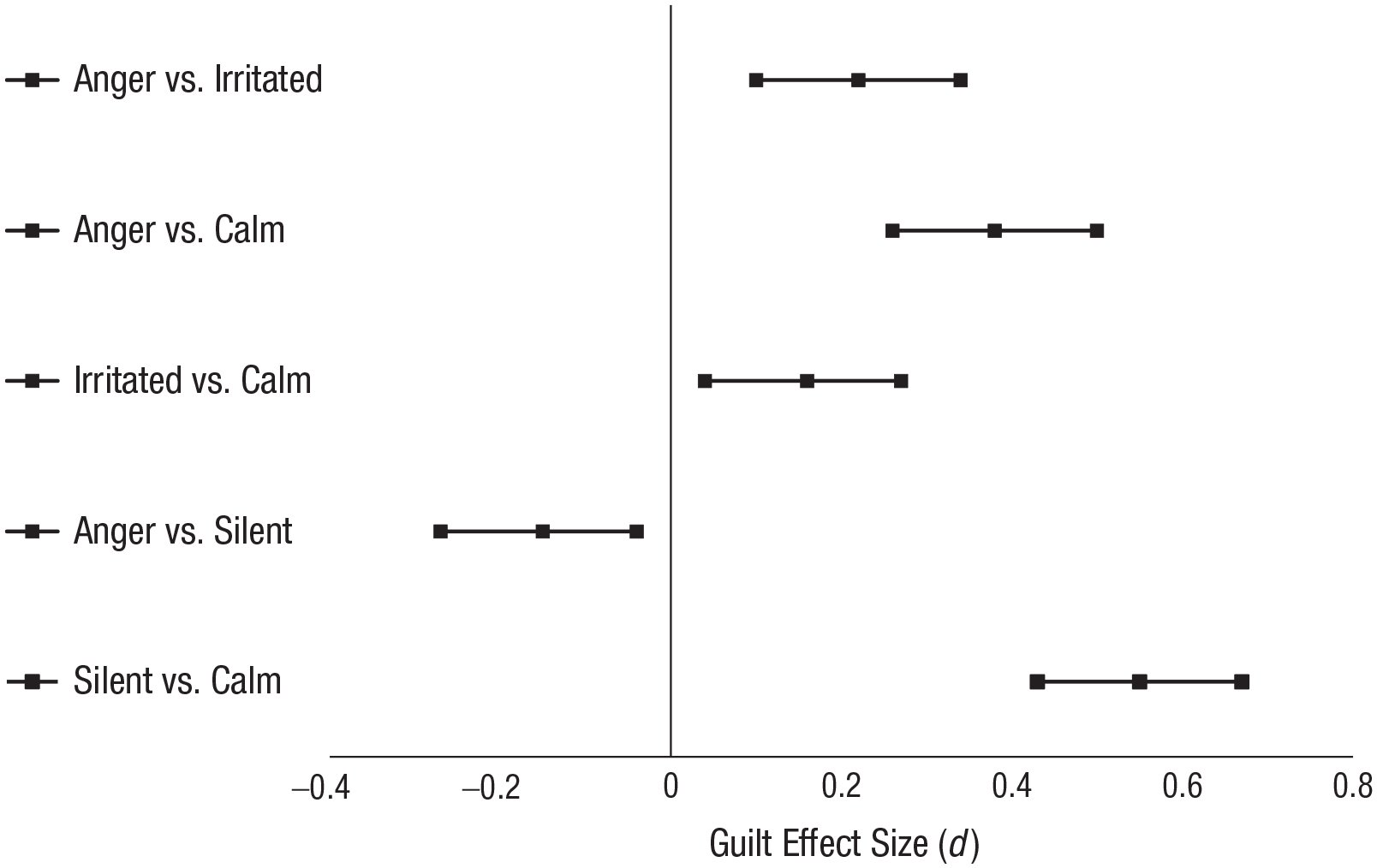
Results from the meta-analysis of Studies 2a to 2c: effect size (Cohen’s d) for the extent to which participants thought the accused person was guilty as a function of each comparison of the accused person’s reactions. Error bars represent 95% confidence intervals.
Indirect effects
Mediation analyses suggested that anger (compared with calmness) was perceived to be less authentic and less trustworthy; both significantly mediated the effect of anger on judgments of guilt—authenticity: b = 0.08, 95% CI = [0.05, 0.11]; trust: b = 0.10, 95% CI = [0.07, 0.13].
Additional analyses
In Study 2a, we tested alternative mechanisms for the relationship between anger and perceived guilt, including the extent to which anger was an appropriate response or made the accused seem defensive, impulsive, or lacking in self-control (among other possibilities; see the Supplemental Material). When we compared these mechanisms, only authenticity and trustworthiness emerged as candidates for mediation. The indirect effects through all other measures were not significant; all bootstrapped coefficients were less than or equal to 0.07 (for a full discussion, see the Supplemental Material). Additionally, the main effect of emotion response on perceptions of guilt remained significant when we controlled for these measures, F(3, 392) = 7.10, p < .001, η2 = .05, 95% CI = [.01, .09].
Discussion
Studies 1 and 2 showed that laypeople interpret an accused’s anger as a sign of guilt, provided evidence for the mechanisms of this association, and demonstrated that it holds when analyses control for several alternative explanations. Moreover, we found that this effect also manifests in an irritation condition as well as the more extreme anger manipulation.
In Study 2, participants were given information on what emotion a suspect displayed and did not necessarily feel. Thus, participants may have believed the anger to be feigned. Accordingly, our mediation analysis found that the effect of anger on perceived guilt was mediated by both perceived untrustworthiness and perceived inauthenticity. That said, an additional study (see Study 2d in the Supplemental Material), in which we described the accused as simply feeling angry or feeling calm when denying their involvement, showed consistent results.
Finally, we note that Study 2 employed stylized courtroom scenarios. Although our results supported our hypotheses, criminal-justice experts may aptly note that actual criminal-justice proceedings contain many contextual factors not captured in our scenarios and that such factors affect perceived guilt—perhaps even more so than our variable of interest: anger. Thus, we note that the predictive validity of our results—the extent to which any given defendant’s display of anger affects perceivers’ judgments of guilt—may be modest. Therefore, in the next study, we moved away from the criminal-justice context and employed a more informal accusation of wrongdoing—one that a scenario study could more readily capture with reasonable fidelity.
Study 3
Method
Participants
We recruited participants from Prolific Academic (https://www.prolific.co/). According to an a priori power analysis, 352 participants per condition were needed to detect a small to medium-size effect (two tailed, d = 0.30). Therefore, we aimed to recruit 800 participants (and 815 people opened the survey link) with the goal of ending up with 704 participants after preregistered exclusions: (a) those who did not correctly answer a question designed to check for bots (they were directed out of the study before reading the scenario), (b) those who failed an attention check, and (c) those who provided nonsensical responses to an open-ended question. We successfully recruited 708 participants (337 men, 359 women, 12 unspecified; age: M = 32.79 years, SD = 12.27). We preregistered this study at https://aspredicted.org/z5bk6.pdf.
Procedure
We designed this study to test whether the use of anger as a cue of guilt generalizes to accusations other than those in a courtroom scenario. Each participant was randomly assigned to read one of two scenarios. 2 In the first scenario, participants were told that Nathan has been in a 5-year relationship with his partner but has recently been emotionally distant, says he has to work late, and lays his cell phone face down when not looking at it; his partner suspects he is cheating on her. In the second scenario, participants were told that Nathan works at a small grocery store and that his manager has noticed that the cash registers sometimes come up short, resulting in a total loss of about $500 over the past few months; she suspects Nathan. Next, each participant was randomly assigned to read that when confronted, Nathan either “raises his voice and angrily denies responsibility, yelling, ‘I am so pissed off that you think I would do this!’” or “calmly denies responsibility, stating, ‘I really can’t believe you think I would do this.’”
Next, participants rated their perceptions of the accused’s guilt, completed two manipulation checks, and provided demographic information.
Perceptions of guilt
We asked, “How likely is it that Nathan is guilty?” (1 = extremely unlikely, 7 = extremely likely).
Manipulation and attention checks
To check our manipulations of anger and calmness, we asked two items: “In the scenario you read, how angrily did Nathan react?” and “In the scenario you read, how calmly did Nathan react?” (1 = not at all, 7 = very).
We used two preregistered attention checks to remove noncompliant participants and bots. In an attention check, we asked, “According to the scenario you read, what was Nathan accused of?” If the person did not select “stealing from a cash register” or “cheating on his partner,” we excluded their data from analysis. We also asked, “As part of this study, you read a short scenario. Please briefly describe what it was about.” Participants who provided nonsensical responses, as coded by a research assistant blind to the purpose of the study, were excluded from analysis.
Results
The effect of emotional response on guilt perceptions did not vary by scenario (stealing vs. cheating accusation), F < 0.01, p = .995. Therefore, the results are collapsed across scenarios.
Manipulation checks
Participants thought that the accused was angrier in the angry condition (M = 6.27, 95% CI = [6.17, 6.37]) than in the calm condition (M = 2.88, 95% CI = [2.71, 3.05]), t(576.94) = 33.58, p < .001, d = 2.52, 95% CI = [2.32, 2.72]. Participants thought that the accused was calmer in the calm condition (M = 5.02, 95% CI = [4.85, 5.20]) than in the angry condition (M = 1.61, 95% CI = [1.50, 1.72]), t(593.66) = 32.37, p < .001, d = 2.42, 95% CI = [2.23, 2.62].
Perceptions of guilt
The angry target (M = 4.69, 95% CI = [4.56, 4.82]) was perceived to be guiltier than the calm target (M = 4.30, 95% CI = [4.18, 4.43]), t(706) = 4.15, p < .001, d = 0.31, 95% CI = [0.16, 0.46].
Discussion
Study 3 showed that relative to individuals who calmly deny an accusation, those who issue angry denials are perceived as guiltier, a finding that held across several common accusations. An additional study (see Study 3b in the Supplemental Material) indicated that these results were robust to perceived appropriateness.
Study 4
Method
Participants
We designed this study to examine whether perceivers’ use of anger as a guilt cue holds among working professionals, such as fraud investigators and auditors, who, as part of their job, may routinely form consequential judgments of other individuals’ guilt. Thus, we sought to present each type of professional with a scenario that was relevant to their occupation and required an assessment of an accused individual’s guilt. We recruited participants by posting a request on the website of a large professional association of certified-fraud examiners, by sending solicitation e-mails to law-related LISTSERVs (e.g., local bar associations), and by distributing requests via personal contacts in the legal and police professions. We sought to obtain at least 100 participants (aiming for 50 per cell) and successfully recruited 197 working professionals (91 men, 43 women, 134 unreported; age: M = 52.24 years, SD = 13.21; 86 White, three Black, 14 Asian, 13 Hispanic, 15 other, 66 unreported). Participants completed this study in exchange for their choice of an Amazon gift card or payment via PayPal worth $10. We did not conduct analyses until data collection was completed. We excluded 61 participants who did not fully complete the study (of these, 58 did not complete any dependent measures), yielding a final sample of 136. The results hold when we include the responses from the three participants who completed some, but not all, dependent measures. In total, 44.1% of the sample indicated that they were fraud investigators, 11% police or criminal investigators, 3.6% lawyers, 2.9% loss prevention or security personnel, 2.9% law-enforcement students, and 35.3% other professions (mostly auditors or fraud examiners).
Procedure
Participants read that they had been called in to help with an incident at a mid-size accounting firm. To enhance realism, we tailored the phrasing of this role to the given participant’s profession (i.e., fraud accountants, police/criminal investigators, loss prevention/security personnel, or law/law enforcement students read that they had been “called to help investigate an incident”; criminal-defense lawyers read that they had been “hired to help defend three employees who were recently involved in an incident”; and criminal-prosecution lawyers read that they were working on a “prosecution involving an incident at a mid-size accounting firm”). We used a scenario that was similar to that in Studies 2a to 2c: $6,000 of computing equipment had been stolen from a storage room, and only three employees had access to that room. In a within-subjects design, we described how each suspect reacted when called into his boss’s office and accused of wrongdoing: John reacted angrily (“John reacts angrily to the accusation. He screams, ‘I can’t believe you would accuse me of stealing fucking computers! I’ve never taken a goddamn thing from storage!’”), Patrick reacted calmly (“Patrick reacts calmly to the accusation. He says, ‘I didn’t know the computers were missing. I didn’t steal them. I’ve never taken anything from storage.’”), and Richard did not respond (“Richard sits there silently and does not say anything in response to the accusation.”). The order of the descriptions was randomized between participants. We then asked participants, “How likely do you think that each of these employees is guilty?” (1 = extremely likely, 7 = extremely unlikely). After participants completed the ratings, they completed an open-ended response to the following prompt: “Please briefly describe why you think each of these employees are (un)likely to be guilty. Please describe how, if at all, your training, experience, and expertise influenced your decision.”
Results
A repeated measures analysis of variance (ANOVA) showed that guilt perceptions depended on the accused’s response, F(2, 270) = 11.92, p < .001, η2 = .081, 95% CI = [.03, .14]. Replicating Study 2, results showed that participants thought both the angry employee (M = 3.24, 95% CI = [2.94, 3.55]) and the silent employee (M = 2.92, 95% CI = [2.66, 3.17]) were guiltier than the calm employee (M = 3.90, 95% CI = [3.65, 4.16]), t(135) = 3.11, p = .002, d = 0.27, 95% CI = [0.10, 0.44], and t(135) = 5.08, p < .001, d = 0.44, 95% CI = [0.26, 0.61], respectively. The difference between the angry and silent employees was not significant, t(135) = 1.54, p = .125, d = 0.13, 95% CI = [−0.04, 0.30]. A qualitative analysis of participants’ open-ended commentary on their perceptions of the suspects’ guilt was consistent with these quantitative results and is reported in the Supplemental Material.
Discussion
Using a sample of working professionals, including fraud investigators and auditors, we found in Study 4 that an angry response to an accusation was interpreted as a sign of guilt, relative to remaining calm. Moreover, compared with remaining calm and with angrily denying an accusation, remaining silent was also perceived as a cue of guilt and therefore does not appear to be a viable solution for the accused to avoid the negative effects of anger.
Ecological Validity: Anger Is a Predictor of Innocence
Next, we describe experiments that examined whether suspects’ anger was related to their actual guilt or innocence.
Study 5
Method
Participants
We sought to recruit 100 participants per cell of the design (N = 400). Participants (N = 401; 212 men, 189 women; age: M = 35.29 years, SD = 10.29; 299 White, 40 Black, 29 Asian, 26 Hispanic, seven other) were U.S. residents recruited from MTurk. Note that we also conducted a conceptual replication of this study (see Study 5b in the Supplemental Material).
Procedure
We conducted a 2 (accusation type: false, rightful) × 2 (seriousness: serious, trivial) between-subjects study. We included a seriousness condition to examine whether the effect of accusation type on anger was consistent across both serious incidents—which have greater stakes—and trivial accusations, which usually have lesser consequences. Each participant was randomly assigned to one of four conditions asking them to write about a time they had been accused of wrongdoing. Specifically, in the serious rightful-accusation condition, participants responded to the prompt, “Tell us about a time that you were rightfully accused of a serious wrongdoing (e.g., cheating on a spouse, workplace misconduct, academic dishonesty). That is to say, recall a time when someone accused you of doing something you actually did.” In the serious false-accusation condition, participants responded to the prompt, “Tell us about a time that you were falsely accused of a serious wrongdoing (e.g., cheating on a spouse, workplace misconduct, academic dishonesty). That is to say, recall a time when someone accused you of doing something you actually did not do.” In the serious conditions, we substituted the word “trivial” for “serious.”
After describing the incident, participants were asked, “How long ago did this incident occur?” (“less than a day ago,” “1 day–1 week ago,” “1 week–1 month ago,” “1 month–6 months ago,” “6 months–1 year ago,” “1–3 years ago,” “3–5 years ago,” and “5+ years ago”) and “Did you deny this accusation?” (“yes,” “no”).
Next, participants reported how much they felt (“Try to remember the emotions you were feeling at the time of the accusation”) and displayed (“Try to remember the emotions you displayed in the interaction with your accuser”) anger and calmness. The anger items (angry, aggravated, hostile, irritable, and frustrated) were adapted from an established scale (Harmon-Jones & Sigelman, 2001). The calmness items (calmness, relaxation) were developed by the researchers. All emotions were rated on scales ranging from 1 (very slightly or not at all) to 5 (extremely)—felt anger: α = .92, and displayed anger: α = .93; felt calm: r(401) = .77, p < .001, and displayed calm: r(401) = .72, p < .001. We then asked two manipulation-check questions: “How serious was the incident you were accused of?” (1 = not at all serious, 5 = extremely serious) and “To what extent were you actually guilty of what you were accused of?” (1 = I was not guilty, 7 = I was guilty). Finally, participants provided demographic information.
Results
Manipulation checks
As expected, participants in the rightful-accusation condition (M = 6.18, 95% CI = [5.94, 6.42]) reported being more guilty than participants in the false-accusation condition (M = 1.35, 95% CI = [1.19, 1.51]), F(1, 399) = 1,113.10, p < .001, η p 2 = .74, 95% CI = [.70, .77]. Participants in the false-accusation condition (M = 2.94, 95% CI = [2.75, 3.13]) also reported that their incident was more serious than participants in the rightful-accusation condition (M = 2.56, 95% CI = [2.38, 2.74]), F(1, 399) = 8.12, p = .005, η p 2 = .02, 95% CI = [.002, .055].
Participants in the serious condition reported that the incident was more serious (M = 3.45, 95% CI = [3.28, 3.61]) than participants in the trivial condition (M = 2.12, 95% CI = [1.96, 2.28]), F(1, 399) = 123.97, p < .001, η p 2 = .24, 95% CI = [.17, .30]. The interaction between the accusation type and serious conditions was not significant for either manipulation-check measure (both ps ≥ .245).
Anger
A univariate ANOVA revealed a main effect of accusation type, F(1, 397) = 74.50, p < .001, η p 2 = .158, 95% CI = [.10, .22], and a main effect of seriousness, F(1, 397) = 4.93, p = .027, η p 2 = .012, 95% CI = [.00, .04], on felt anger (see Fig. 2). When the accusation was false, people felt angrier (M = 3.57, 95% CI = [3.41, 3.73]) than when the accusation was rightful (M = 2.57, 95% CI = [2.40, 2.73]). For displayed anger, there was a main effect of accusation type, F(1, 397) = 50.87, p < .001, η p 2 = .114, 95% CI = [.06, .17], but the main effect of seriousness was not significant, F(1, 397) = 3.19, p = .075, η p 2 = .008, 95% CI = [.00, .03]. When the accusation was false, people displayed more anger (M = 3.10, 95% CI = [2.94, 3.27]) than when the accusation was rightful (M = 2.25, 95% CI = [2.08, 2.42]).
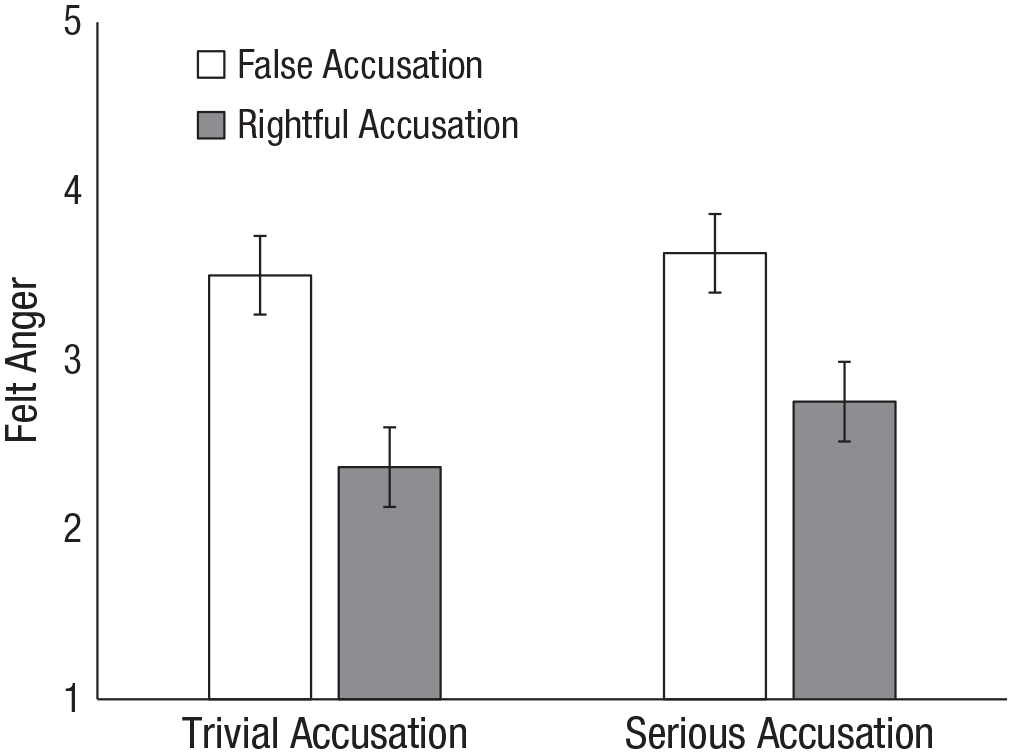
Results from Study 5: mean anger rating in response to the seriousness of the accusation, separately for situations in which the accusation was false (the person was innocent) and rightful (the person was guilty). Error bars represent ±1 SE.
The interaction between emotional response and severity was not significant for either felt or displayed anger (both ps ≥ .272, both η p 2s ≤ .003), suggesting that the effect held for both trivial (e.g., taking a roommate’s food) and serious (e.g., cheating on a romantic partner, assault) accusations.
Calm
The main effects of accusation type and seriousness on how much participants reported feeling calm were not significant, F(1, 397) = 3.09, p = .080, η p 2 = .008, 95% CI = [.000, .034], and F(1, 397) = 3.23, p = .073, η p 2 = .008, 95% CI = [000, .034], respectively. There was a tendency for participants to report feeling more calm when the accusation was trivial (M = 1.69, 95% CI = [1.56, 1.83]) rather than serious (M = 1.52, 95% CI = [1.38, 1.66]) and when the accusation was rightful (M = 1.69, 95% CI = [1.55, 1.83]) rather than false (M = 1.52, 95% CI = [1.38, 1.65]). The main effects of accusation type and seriousness were not significant for displayed calm, F(1, 397) = 1.76, p = .186, η p 2 = .004, 95% CI = [000, .026], and F(1, 397) = 1.89, p = .170, η p 2 = .004, 95% CI = [.000, .027], respectively. The interaction between accusation type and seriousness was not significant for felt or displayed calm (both ps ≥ .671, both η p 2s ≤ .00).
Additional analyses
Participants were more likely to report denying a false accusation (94.6%) than a rightful accusation (40.6%), χ2(1, N = 401) = 134.47, p < .001, V = .58, consistent with our assumption that individuals who are falsely accused tend to deny the accusation. Participants were equally likely to deny a trivial than a serious accusation, χ2(1, N = 401) = 0.75, p = .387, V = .04. Additionally, denial did not interact with accusation type to predict felt or displayed anger or calm (all ps ≥ .096), and when we restricted the sample to only those individuals who denied wrongdoing, all results remained the same (for the analyses, see the Supplemental Material).
Additionally, all results held when we controlled for the amount of time since the transgression had occurred. Finally, when we excluded 47 participants (11.7%) who failed to follow instructions (i.e., wrote nonsensical essays or wrote about a false accusation in the rightful-accusation condition), results held.
Discussion
Turning to cue ecological validity, we found that—across a variety of trivial and serious recalled accusations—people reported feeling and displaying more anger when they were falsely than rightfully accused. We note that anger in this study was just above the scale midpoint, suggesting that the effects of recalled anger may dissipate relative to the moment of an accusation (which might be true especially for serious, real accusations that we cannot ethically manipulate). We examined suspects facing an accusation in real time in Study 6.
Study 6
Method
Participants
We sought to recruit as many participants as possible within a reasonable time frame, aiming for a total sample size of 200 (100 per cell of the design). We did not analyze data until data collection was complete. We recruited 230 participants for an in-person laboratory study from a participant pool at a large U.S. university (77 men, 151 women, two unreported; age: M = 25.93 years, SD = 9.05; 106 White, 23 Black, 73 Asian, 16 Hispanic, 10 other, two unreported). Participants were invited to take part in the study as part of a larger group of studies and were told that they would be given a $2.00 bonus for completing the current study correctly (i.e., this payment would be in addition to their guaranteed compensation for participating in the study).
Procedure
We designed this study to manipulate a real-time accusation in the lab and to assess the mechanism behind this relationship (feelings of injustice). We employed a two-cell between-subjects design; each participant was randomly assigned to either a false- or a rightful-accusation condition. We adapted a scenario that Higgins and colleagues (1977) used to study impression formation describing a man named Donald (we changed the name of the main character from Donald to John so as not to evoke feelings about the current president of the United States, Donald Trump). We asked all participants to copy and paste a paragraph of text about John into a text box and then manipulated false and rightful accusation using task difficulty. In the rightful-accusation condition, participants were tasked with correctly identifying and deleting adverbs from the paragraph (“difficult task”). In the false-accusation condition, the task was much easier and involved correctly identifying and capitalizing the first and last letter of the paragraph (“easy task”).
After participants completed their task, we asked them to wait while the researcher checked their work. This cover story was plausible because a research assistant was visible at the start of the experiment, sitting in front of a computer, in plain sight of the participants. Thus, participants could reasonably assume that their work was being assessed in real time. After a short waiting period after submitting their work, we accused each participant of wrongdoing by sending them a message ostensibly from a research assistant that they had not properly paid attention and not followed instructions and that, as a result, a $2 bonus payment would be withheld (we did not actually withhold any payment). It was phrased, “We believe that your response to the previous question was incorrect and indicates that you have not been paying adequate attention. We may withhold the $2.00 bonus.” We reasoned that if we accused all participants of not completing the task correctly, we could simulate both false accusations (easy task) and correct accusations (difficult task).
After this message, we asked participants, “To what extent do you feel that the task is fair?” and “To what extent do you feel that our assessment of your performance on the task was fair?” (1 = extremely unfair, 7 = extremely fair). This was important because it could be that participants believed that the harder task itself was less fair (rightful-accusation condition). However, we anticipated that participants would feel that the researcher’s assessment of the easier task (i.e., the false accusation) was more unfair, consistent with our theory about why individuals would be angry when falsely accused.
Participants next completed the key dependent variable using the same five-item measure of felt anger (α = .91) and the same two-item measure of felt calm, r(230) = .89, p < .001, used in Study 5. In an attention check, we asked participants to recall their task instructions with the question, “What were you asked to do in the editing task today?” Response options were “capitalize the first letter of every word,” “delete every noun in the passage,” “capitalize all the ‘e’s in the passage,” “delete every adverb in the passage,” and “capitalize the first and last letter of the passage.” Finally, we asked participants, “To what extent do you feel like you were falsely accused in this study?” (1 = not at all, 5 = to a great extent). All participants received the $2.00 bonus and were debriefed.
Results
Attention and manipulation checks
Of the 230 participants, four people recalled the task instructions incorrectly, and four people did not complete the assigned task (i.e., they pasted incorrect text into the text box). All participants were retained in the analyses that follow. The results did not change when these noncompliant participants were excluded.
Participants were more likely to report feeling falsely accused in the false-accusation (easy task) condition (M = 4.06, 95% CI = [3.84, 4.27]) than in the rightful-accusation (difficult task) condition (M = 2.84, 95% CI = [2.60, 3.08]), F(1, 228) = 54.62, p < .001, η2 = .193, 95% CI = [.11, .28]. Participants in the false-accusation condition (82.6%) were more likely to complete the task properly (i.e., to be falsely accused of failing) than participants in the rightful-accusation condition (0.8%), χ2(1, N = 230) = 160.24, p < .001, V = .84.
Anger
Participants reported feeling angrier in the false-accusation condition (M = 2.30, 95% CI = [2.10, 2.49]) relative to the rightful-accusation condition (M = 1.96, 95% CI = [1.80, 2.12]), F(1, 228) = 7.22, p = .008, η2 = .031, 95% CI = [.002, .086]. Additionally, the feeling of being falsely accused correlated significantly with anger, r(230) = .41, p < .001.
Fairness
Participants also believed that the researcher’s assessment of their performance was less fair in the false-accusation condition (M = 2.16, 95% CI = [1.89, 2.42]) relative to the rightful-accusation condition (M = 3.72, 95% CI = [3.40, 4.04]), F(1, 228) = 53.17, p < .001, η2 = .189, 95% CI = [.11, .28]). We also analyzed participants’ perceptions of overall task fairness to ensure that the accusation itself, rather than the task, was driving fairness perceptions. Participants perceived the difficult task (M = 4.26, 95% CI = [3.93, 4.60]) to be equally as fair as the easy task (M = 3.84, 95% CI = [3.45, 4.24]), F(1, 228) = 2.68, p = .103, η2 = .01, 95% CI = [.00, .05].
As predicted, there was an indirect effect of the experimental condition on anger via participants’ feelings that the assessment was unfair (b = 0.26, 95% CI = [0.12, 0.41]).
Calm
Participants felt equally calm when they were in the false-accusation condition (M = 2.80, 95% CI = [2.59, 3.02]) or rightful-accusation condition (M = 3.04, 95% CI = [2.84, 3.25]), F(1, 228) = 2.56, p = .111, η2 = .00, 95% CI = [.00, .02].
Additional analyses
In the Supplemental Material, we report the treatment-on-the-treated results; that is, we restricted the analysis to the 90 of 109 participants who were actually falsely accused (i.e., the participants in the easy-task condition who actually did the task correctly) and the 119 of 121 participants who were actually rightfully accused (i.e., those in the difficult-task condition who actually did the task incorrectly). The pattern of these results is consistent with those reported here.
Discussion
In the context of an experiment with a controlled, real accusation, participants were angrier when they were falsely (vs. rightfully) accused, which was associated with felt injustice. The relatively low mean for anger is perhaps due to our use of a minor accusation in order to manipulate an accusation ethically; this makes our test of these differences conservative.
General Discussion
Our research suggests that when observing real or hypothetical angry suspects, working professionals, students, and online samples alike believed them to be guiltier. However, in the context of both real and recalled accusations, people were angrier when they were falsely accused than when they were accurately accused. Further, we reliably found these effects in the two sets of studies across formal and informal settings, serious and trivial accusations, the expression and experience of anger, the timing of the response relative to the accusation, and the strength and target of the anger. Our findings are consistent with the deceit-detection literature (Bond & DePaulo, 2006) showing that perceivers are not accurate lie detectors and that they rely on emotional cues from suspects in forming judgments. We contribute to this literature by showing not only that anger is used as an invalid cue of guilt but also that it is a valid cue of innocence. This is particularly important because most research on emotional cues of deception has found little to no association between other discrete emotions and guilt (see Bond & DePaulo, 2006; DePaulo et al., 2003; Vrij, 2008). Although scholarship posits that the social information conveyed by anger is that someone else is to blame (van Kleef, 2010), we found that anger in this context misportrays the opposite to other people: guilt.
Our work is not without limitations, and questions remain for future research. Our research was not conducted in real courts or with real crimes. Therefore, there could be differences such as sample selection or contextual issues that affect the expression or perception of anger, which limit its direct application to the criminal-justice system. Moreover, we note that our results do not imply that falsely accused individuals are always angrier than accurately accused individuals; indeed, falsely accused individuals may sometimes react calmly in response to a false accusation. Likewise, our results do not imply that anger always leads to perceptions of guilt. Indeed, there is likely to be a multiplicity of additional factors—held constant in our experiments—that moderate the relationships we have documented here. As in all experiments, our findings are limited to the samples and stimuli employed in the research. Therefore, we welcome additional research that tests for the boundaries of our effects, especially in real-world contexts.
Additionally, following the lens model, we note the importance of perception—if observers do not perceive that a suspect is angry or an accused person does not believe themselves to be innocent, we might not see the same pattern. Furthermore, we did not examine individual differences in participants and perceivers that might affect the relationships studied, including gender, race, or trait self-control. We also do not know how strategic relative to unintentional expressions of anger might affect these dynamics. More research is also needed on the subtleties of emotion regulation in the accusation process and to understand within-person variance, such as multiple accusations or responses that could occur over time, and other social contextual factors, such as the amount of evidence accompanying the accusation. Finally, it would be interesting to examine other contexts, such as trusting relationships, which could differ from third parties observing other individuals’ reactions to accusations of wrongdoing.
There are many reasons to be angry when accused of wrongdoing, but perhaps none as strong as the belief that one has been falsely accused.
Supplemental Material
sj-docx-1-pss-10.1177_0956797621994770 – Supplemental material for Anger Damns the Innocent
Supplemental material, sj-docx-1-pss-10.1177_0956797621994770 for Anger Damns the Innocent by Katherine A. DeCelles, Gabrielle S. Adams, Holly S. Howe and Leslie K. John in Psychological Science
Footnotes
Acknowledgements
We thank Ben Newcombe, Mike Norton, Matt Feinberg, Sophie Trawalter, and Chen-bo Zhong for their comments on early versions of the manuscript and research assistants Caroline Daniel, Laurel Detert, Sophie Edouard, Uriel Espinoza Gutierrez, Hannah Koizumi, Shannon Sciarappa, Trevor Spelman, Benjamin Stein, and Margaret Wiwuga. We also thank Elizabeth Linos for help with sample recruitment.
Transparency
Action Editor: Eddie Harmon-Jones
Editor: Patricia J. Bauer
Author Contributions
All the authors designed the research. K. A. DeCelles, G. S. Adams, and H. S. Howe conducted the analyses. All the authors wrote the manuscript and approved the final version for submission.

Notes
References
Supplementary Material
Please find the following supplemental material available below.
For Open Access articles published under a Creative Commons License, all supplemental material carries the same license as the article it is associated with.
For non-Open Access articles published, all supplemental material carries a non-exclusive license, and permission requests for re-use of supplemental material or any part of supplemental material shall be sent directly to the copyright owner as specified in the copyright notice associated with the article.
