




Abstract
Francesco Borromini, one of the great geniuses of Baroque architecture, was tormented and solitary, and was increasingly frustrated by the fame and success of his rival, Gian Lorenzo Bernini. Borromini was an unhappy man, constantly dogged by disaster, quarrelling even with his best patrons and closest friends. In the culmination of one of the fits of depression that overcame the architect more and more frequently as his life progressed, Borromini literally fell on his own sword; he lingered in excruciating pain for 24 hours before dying. Largely forgotten, his architecture has again been recognized since the twentieth century as the creation of genius. We try to describe the personality and suicide of this pessimist giant of architecture.
Introduction
The Council of Trent, held between 1545 and 1563, declared that art should be used to explain the profound dogmas of the Christian faith to everyone, not just the educated. While the Protestants harshly criticized the cult of images, the Catholic Church ardently embraced the religious power of art. In the two decades following the close of the Council, churchmen such as Milan’s Cardinal Carlo Borromeo, recommended that artists and architects respond to the religious concerns expressed by the Council by means of an ‘emotional stimulus to piety’. The religious zeal of the Catholic reformers inspired a surge of artistic activity, especially in Italy and Spain. The Church’s emphasis on art’s pastoral role prompted artists to experiment with new and more direct means of engaging the viewer. To accomplish this, religious art was to be direct, emotionally persuasive and designed to fire the spiritual imagination and inspire the viewer to greater piety. A vigorous new style – the baroque – became the vehicle for a new, more dynamic, outpouring of religious fervour. The word ‘baroque’ has a long, complex and controversial history; it is possibly derived from the Portuguese word Barocco, a misshapen pearl. Most pearls were prized for their spherical perfection, but sometimes one of such a bizarre shape was found that it was also highly prized and was set in spectacular jewellery. Baroque’s earliest manifestations, which occurred in Italy, date from the latter decades of the sixteenth century. Promoted by generations of popes, cardinals, priests, missionaries, worshippers and lay-patrons, the style spread to throughout the world. Strong curves, rich decoration and general complexity are all typical features of Baroque art. It emphasized massiveness and monumentality, as well as dramatic spatial and lighting sequences. Facades were full of movement, columns were twisted, and ground plans were composed of curves and ovals. The result was an abundance of dynamic masterpieces that still define the urban fabric of the Eternal City.
The two giants of Roman Baroque
In the first half of the seventeenth century, the foremost names in Baroque architecture were Gian Lorenzo Bernini and Francesco Borromini, both of whom worked primarily in Rome. They were opposites in character, personality, artistic style and tastes, yet they both created the Roman Baroque style. Borromini’s rational geometry and Bernini’s emotional theatricality set them apart and caused their rivalry. Their different characters, backgrounds and attitudes to life presumably provoked the antagonism. Bernini saw architecture as a staging of an experience, and used theatricality and drama in his design to heighten the visitor’s emotional and spiritual response; Borromini, on the other hand, stretched the limits of classical architecture, which had made a revival during the Renaissance, by distorting pure classical elements to create dynamic, sculptural spaces (Killien, 2008). Bernini, at heart, was a sculptor who manipulated space. Borromini was an architect who sculpted it (Morrissey, 2005: 179). The two duelling geniuses spent their professional lives locked in a complex, sometimes acrimonious rivalry. The relationship turned especially ugly when Borromini publicly and vehemently criticized the instability of Bernini’s bell towers at St Peter’s. Bernini actively spoke against Borromini on several occasions: during his Paris visit of 1665 he accused Borromini of abandoning the anthropometric basis of architecture and devastated the rival architect in the eyes of French intellectuals when he explained that Borromini’s architecture was ‘extravagant’ and that he was an ‘ignorant Goth who had corrupted architecture’ (Blunt, 1979: 212). After the death of his rival, Bernini said that ‘only Borromini understood this profession, but that he was never content and that he wanted to hollow out one thing inside another, and another inside that without ever getting to the end’ (Glancey, 2011).
Although Borromini was reasonably successful in his career, he seems to have been permanently embittered by Bernini’s greater fame. The two geniuses promoted completely different architectural visions at a time when the Catholic Church was struggling to redefine and reassert itself in the face of the Protestant threat; whereas Bernini embraced a Baroque classicism, Borromini’s architecture adapted classical elements to a more innovative architecture that was defined by organically curving lines and a complicated interplay of geometrical forms. It may seem simplistic – but it is also true to some extent – to see Borromini as the genius-pessimist, with his impassioned, single-minded devotion to architecture, and Bernini as the genius-optimist, with his easy-going, matter-of-fact mastery of architecture, sculpture and painting (Rosenthal and Perl, 2009). Where Bernini was suave, Borromini was grave; where Borromini worried, Bernini celebrated. While Bernini was the father of a large family, master to a large workshop, friend to princes and popes, Borromini was tormented and solitary. In Borromini we find the polarity between an exceptional open-mindedness and capacity for acceptance, and a resolute will to renew; he used tradition as a basis for design but did not view it as an ultimate, unalterable law. Borromini firmly rejected the ruling conventions and, being a genius, invented a whole new way to deal with space, to the horror of contemporary critics. For all his austerity, however, Borromini also had a sense of drama, evident in small touches like the niche window topped by a dramatically broken waving pediment from which a flame-like motif rises. He revolutionized architecture by his treatment of light and space as architectonic components. After Borromini died, Bernini continued his anti-Borromini propaganda, which was taken up by the Italian architectural community. Borromini was considered by succeeding generations of architects to be too radical and excessive. During the eighteenth and nineteenth centuries, Borromini was considered one of the most unconventional and extravagant architects in history, and his works aroused passionate disapproval, particularly in Protestant Europe and Northern America. As Neoclassicism gained prominence, he was considered inferior and was ignored (Steinberg, 1977: 343). Borromini’s Roman churches epitomize the High Baroque with their spectacular, theatrical and organic designs. Examples are San Carlo alle Quattro Fontane (also known as San Carlino; see Figure 1), built between 1634 and 1648, and Sant’Ivo alla Sapienza, 1642 to 1670, the two buildings that best represent Borromini’s style. Entering one of Borromini’s churches is a dizzying experience. Shapes morph into one another. A convex curve suddenly becomes concave, and it is impossible to determine exactly how or where the transformation took place. Largely forgotten during most of the nineteenth century, Borromini’s architecture has again been recognized since the twentieth century as the creation of a genius, rich in passion, experimentation, movement, prayer and sensuality.
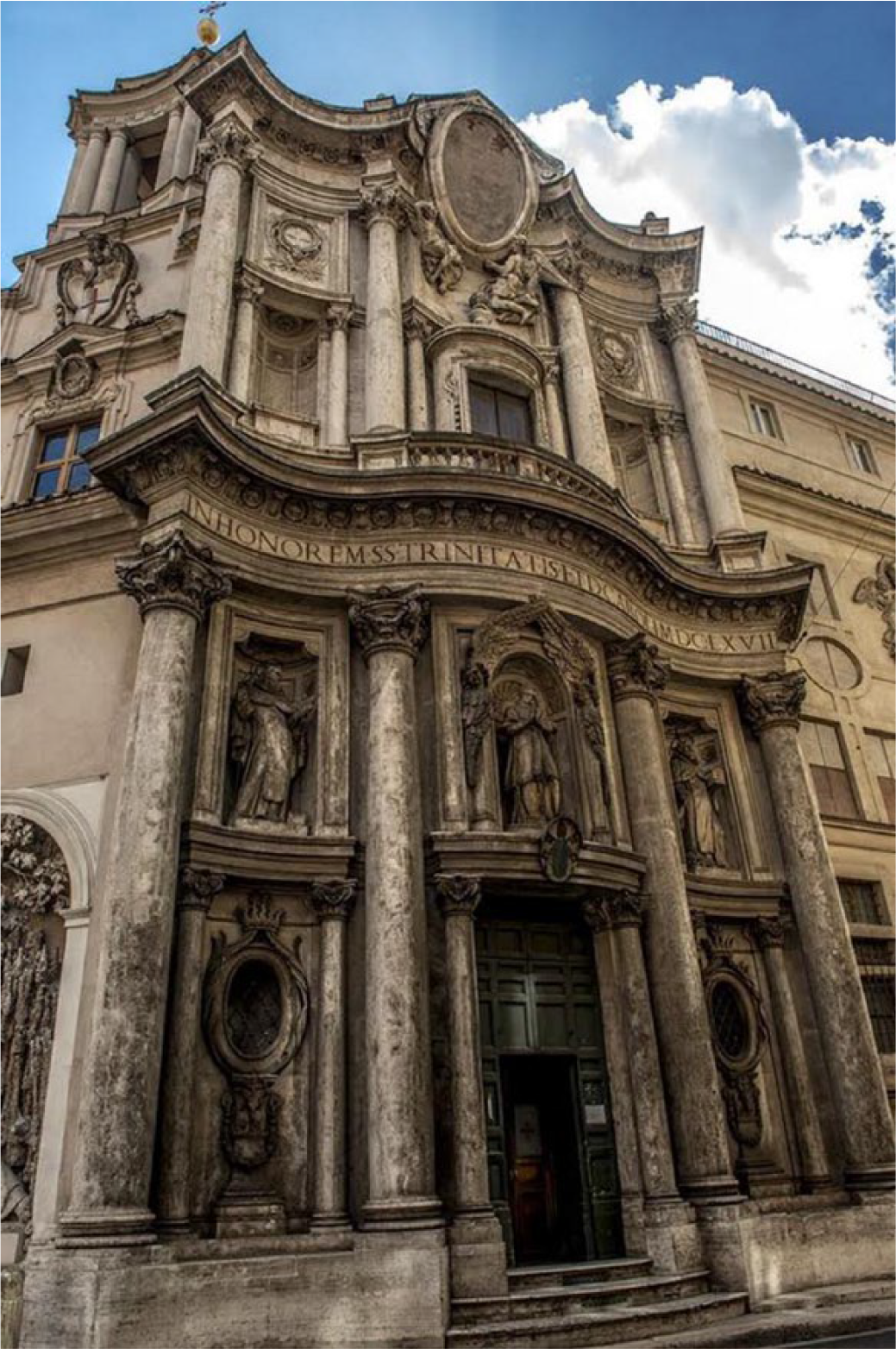
Church of San Carlo alle Quattro Fontane, Rome (photo: Gabriele Cipriani, 2015).
The tormented genius
Francesco Borromini, the son of a stonemason, is one of the great geniuses of Baroque architecture, perhaps the greatest in inventiveness and in use of spatial effects and the true creator of a new architectonic language. His prodigious talent unfortunately brought him more misery than joy. He was born on 25 September, 1599 at Bissone, on Lake Lugano, in the northern region of Canton Ticino in what is now Switzerland (the territory around the lake of Lugano had been part of the duchy of Milan under the Visconti and their Sforza successors). His real name was Francesco Castelli, but he changed it in Borromino (or Borromini), which was a name used in his mother’s family; he may have done this because of his devotion to San Carlo Borromeo, the patron saint of Milan, reflecting Borromini’s deeply rooted Catholic sentiments.
In 1609 the young Francesco moved to Milan to learn the skill of stonecutting, and then went to Rome in 1619 (Blunt, 1979: 13). Borromini started his career there as a decorative sculptor under the tutelage of his cousin, the architect Carlo Maderno. The city had a profound impact on Borromini’s melancholic personality, and his creative work ethics were challenged by his professional relationships, especially with Bernini. Borromini was a devout Catholic, and his devotion was shown in his architecture. He aimed to venerate God through geometry that emphasized the rationality of nature. He used some two basic geometric figures, the triangle and the circle, as religious metaphors. The triangle represented the Trinity of the Father, the Son and the Holy Spirit; the circle represented the eternity of God.
Borromini’s career was constrained by his difficult and tormented personality, and during his lifetime his reputation varied. He had a solitary and retiring nature, was gloomy, depressed, often irascible; he was also iconoclastic, rebellious, subversive, and he despised common opinions (Zevi, 1995: 32), quarrelling even with his best patrons and closest friends. While renovating the interior of the Basilica of St John Lateran in Rome, Borromini once instructed his workers to punish an altar boy, a certain Marco Antonio Bussoni who had been caught damaging ornate marble sculptures made by Francesco himself. The angry workers beat Bussoni to the point of killing him (on 6 December 1649, his body was found battered and bound in a room where he had been pushed by the workmen). Borromini was investigated by the police, but at the time he had strong protection of influential friends and the scandal was hushed up. This was an example of his irascible character and of his problem controlling his impulses. At some times he was difficult, at other times vague, intractable or absent-minded. His eccentric mode of dressing (usually in austere Spanish fashion) and lack of restraint were tolerated by his patrons only because these traits were, at that time, considered a sign of genius. Unmarried and probably chaste, he was both melancholic and quick-tempered, which resulted in him withdrawing from certain jobs (Blunt, 1979: 21).
Only two confirmed portraits of Borromini survive. One, which was rather typical for the time, was done as the frontispiece for the his Opus Architectonicum (Figure 2), a sort of summing-up of his beliefs, written in 1647 but published posthumously in 1725; the other portrait is a caricature, in ink, drawn by the younger architect, Carlo Fontana (McCargar and Widder, 2010). Portoghesi, one of the foremost Borromini scholars of the twentieth century, says both portraits are ‘filled with melancholy’, predominately in the gaze (Portoghesi, 1997). This melancholy introduces a connection with a psychological state and begins to change the understanding of Borromini’s unusual tendencies as not only a straying from moral values, but perhaps derived from an upset or unhappy state of mind (McCargar and Widder, 2010). After the election of Pope Innocent X, Pamphilj (or Pamphili), in 1644, a period of great success began for Borromini, to the detriment of Bernini who had temporarily fallen into disgrace. The pontificate of Innocent X was Borromini’s busiest and most prosperous period. In 1652 the pope appointed him a Knight of the Order of Christ, but after the pontiff’s death in 1655, a period of serious crises began for Borromini, when his creativity was affected by psychological torment and pain. From 1657 to 1667, he was struck by several tragic events and suffered several setbacks. His major commission for designing Sant’Agnese in Agone, in Piazza Navona, Rome, was taken away from him and was completed by someone else; his work on Sant’Andrea della Fratte had stopped; and his facade of St Philip Neri was disfigured by lateral extensions. In additon, his patron, Padre Virgilio Spada, and his only disciple, Francesco Righi, both died. In his last years of his life, Borromini was full of doubts and uncertainties and became more and more isolated, even from his friends, and spent all his time shut up in his studio working at plans, which he probably realized would never be executed. One day he collected together all the drawings which he had guarded so jealously throughout his working life, and burned them to prevent them from falling into the hands of his enemies and rivals. In the summer of 1667, Borromini fell into what was later described as a ‘hypochondria’, which in a few days reduced him to such a state that no one recognized him. In particular, his distraught appearance greatly distressed his friends, who decided he should not be left alone. After dinner on 1 August 1667, Borromini began to compose a new will, writing in pencil until midnight (Connors, 1999). The following night, he asked repeatedly for a light, a pen and some paper, but these were refused, on doctor’s orders (Gayford, 2005), and the failure of his servant to obey his orders enraged him. Seizing the opportunity when his guardian was distracted, Borromini stabbed himself with his own sword, but not even this final act of defiance against a world that never truly accepted his irascible personality or idiosyncratic talent went according to plan: Borromini survived his own mortal blow for some hours, even managing to leave behind a first-hand account of the bloody event. He recovered sufficiently to receive the last rites. On 3 August 1667 Borromini died, as he lived, in difficulty and pain, from self-inflicted wounds. His sad, strange suicide was complicated, just as the man was: he had to die as he had lived and worked, in his own way, for his own reasons, twisted and personal (Morrissey, 2005: 4). Borromini was buried anonymously in the grave of his teacher and friend, Maderno, in the church of S Giovanni dei Fiorentini (Rome). In recent times, his name was added to the marble plaque below the tomb and a commemorative plaque was also placed on a pillar of the church.
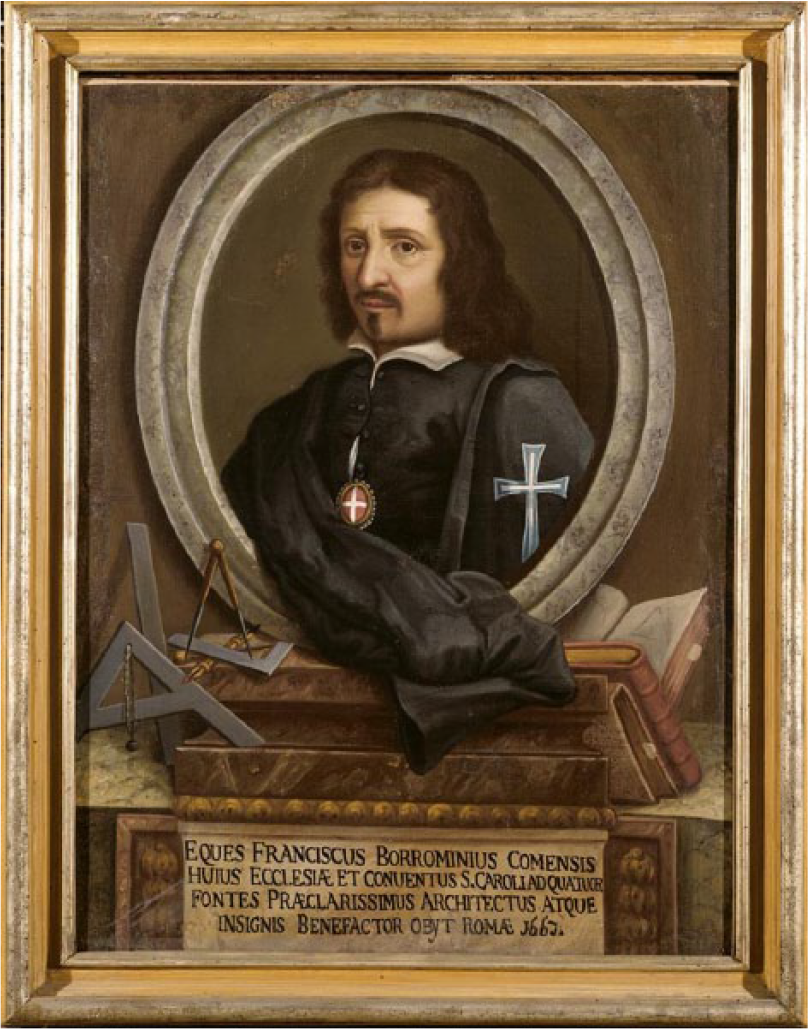
Portrait of Francesco Borromini (artist unknown), kept in Convento dei Trinitari, San Carlo alle Quattro Fontane, Rome (photo: Gabriele Cipriani, 2015).
Borromini was 68 at the time of his final crisis. Today he might have been classified as chronically depressed. For Bruno Zevi, a twentieth-century architect, the suicide was related to a host of Romantic notions about misunderstood and unrecognized genius; ‘he killed himself’, Zevi (1968: 175) said, ‘because he felt and knew that everything he had been struggling to accomplish during his life was doomed to failure’. As a cultural figure of European significance, Borromini is important for his intense dedication to artistic originality and his sense of the supreme value of innovation in the professional practice of architecture.
Footnotes
Funding
This research received no specific grant from any funding agency in the public, commercial, or not-for-profit sectors.