



Abstract
The ‘mad-doctor’ Dr Francis Willis achieved national and international celebrity following his successful treatment of King George III’s first major episode of insanity in 1788–9. At the time of his summons to attend the King, Willis was a well-established provincial practitioner and madhouse proprietor. An anonymous French visitor published a description of Willis’s Lincolnshire madhouse and his therapeutic practices in 1796. The translated text of the full article provides a unique insight into the work of a key figure in the historical development of psychological medicine. The accompanying Introduction summarizes Francis Willis’s career as a mad-doctor and uses salient information from the original text to place him and his madhouse practice within a contemporary context.
Introduction
Francis Willis (1718–1807) was a great-nephew of the celebrated seventeenth-century physician Dr Thomas Willis (Hughes, 2009), and son of a Lincoln Cathedral minister. Willis attended Oxford University, obtaining an MA in 1741, before taking holy orders. He simultaneously studied medicine, and was eventually awarded his MD in 1759. He had married in 1749 and took up residence at Dunston, seven miles outside Lincoln, where he established himself initially as an un-licensed general medical practitioner (Willis, 1823: 177–8; see also Porter, 2012). Willis began to specialize in the treatment of mentally disordered people, and by 1760 Dunston was functioning as a private madhouse. 1 His practice flourished, and some of his clientele emanated from the highest social circles. Among his patients was the Warwickshire peer Lord Leigh (1742–86), who was at Dunston from 1771 to 1774 and paid Willis the remarkably large sum of 100 guineas per month plus expenses (Bearman, 2003: 150–1; Lane, 2001: 102). 2 Another wealthy Warwickshire landowner, the gentleman-architect Sanderson Miller (1716–80), spent periods at Dunston in 1772 and 1774 (Hawkins, 2005: 41, 46, 328–9).

Willis family tree.
At Dunston, Willis was a tenant of Lord Despenser, and by 1770 their relationship was becoming increasingly strained. Having spent several thousand pounds on furnishing and equipping the house, Willis sought a long lease, which Despenser was unwilling to grant. Intending to bring up two of his sons to ‘physick’, Willis in 1770 declared his wish to acquire another property in order to leave them ‘in possession of an accustom’d House for wrongheads, with proper conveniencys for their reception’. 3 Attempts over the next few years to resolve the acrimonious disputes with Lord Despenser failed, and in early 1776 Willis obtained the large house at Greatford, near Stamford, which functioned as his madhouse until his death in 1807 (Parry-Jones, 1972: 75–6). 4
At Greatford, Francis Willis perpetuated the methods that he had developed at Dunston, and created the regime which a French visitor described in ‘Détails sur l’Établissement du Docteur Willis, pour la Guérison des Aliénés’ (Anon., 1796). 5 His clientele continued to be drawn from the middle and higher ranks of society, and the charges of at least three or four guineas per week placed Greatford among the more expensive private madhouses. 6 Some patients were accommodated in the main house, while others were boarded out with farmers in the surrounding area. Such an arrangement was illustrated in the case of Reverend Francis Massingberd, who was lodged with a farmer during his two spells at Greatford in the early 1790s. 7 The visitor’s evocative depiction of lunatics wandering harmlessly around the local country roads was echoed in the recollections of the playwright Frederick Reynolds, who had visited Greatford in about 1793. As Reynolds entered the vicinity he was most surprised to see ‘ploughmen, gardeners, threshers, thatchers, and other labourers, attired in black coats, white waistcoats, black silk breeches and stockings’, who were all ‘the Doctor’s patients’ (Reynolds, 1827: 154; see also Parry-Jones, 1972: 183–4; Porter, 1987: 10).
The arrangements for boarding-out and provision of opportunities for outdoor occupation and exercise were all part of the cohesive system that Willis established at Greatford. The ‘Details on the Establishment’ show that his more formal therapeutics comprised both medical and psychological or ‘moral’ elements. As was standard practice among eighteenth-century mad-doctors, a good deal of attention was given to the possible presence of physical health problems (Cox, 1804: 76–96; Porter, 1987: 193–205; Smith, 2007: 139–49). Following a period of observation and assessment, in which the ‘keepers’ were allocated an important role, 8 a range of medicines and other remedies were prescribed by Willis to address bodily symptoms and to ensure the restoration of proper balances in the ‘vital functions’. These measures were accompanied by dietary restrictions and the promotion of vigorous exercise, particularly through walking.
However, it was in the arena of ‘management’, and in what became more generally known as ‘moral treatment’, that Willis evidently focused his main efforts. The testimonies of two recovered former patients helped the French visitor to construct a perceptive summary of the techniques deployed. Initial efforts were directed towards bringing violent or otherwise errant behavioural manifestations under control. To this end, it is clear that strait waistcoats were regularly used as part of the steps taken for harm prevention. Simultaneously, Willis employed various psychological means to assert and gain control over the individual patient. He used his countenance charismatically to create an aura of domination and to command respect; his intense piercing gaze or use of ‘the eye’ was to become well known in his treatment of the King (Macalpine and Hunter, 1969: 270–2; Porter, 1987: 209–10; 1995: 257–9). Willis deliberately made use of techniques construed as intimidatory, in order to maintain a sensation of fear and bring about submission. If all went according to plan, the discipline and constraints imposed would be accompanied by lengthening periods of mental stability. Willis would then take the opportunity to introduce milder forms of psycho-social counselling that included consolation, reasoning, and consideration of means for relapse prevention. He maintained in 1788 that his methods achieved recoveries in nine out of ten cases of people who were admitted within three months of the onset of insanity (Report from the Committee, 1788: 15).
Willis’s regimes at Dunston and Greatford were developed within a wider contemporary context. As Roy Porter carefully demonstrated, many of the ideas and practices later associated with The Retreat at York, which opened in 1796, were already being implemented elsewhere during the eighteenth century. It was a period when eclectic, empirical approaches increasingly characterized the treatment of mental disorders (Porter, 1981–2; 1987: 206–28; 1995: 259–64). In the 1750s, the two most eminent physician mad-doctors, William Battie and his rival John Monro, separately emphasized the practical importance of ‘management’ as an essential part of the therapeutic regimen. Significantly, both men became proprietors of private madhouses (Andrews and Scull, 2001: 52–9, 179–89; Battie, 1758: 68–9; Monro, 1758: 36–8; Porter, 1987: 206–8; Smith, 2007: 98–9, 138, 150). Those aspects of Willis’s therapeutic regime that focused on management, and the use of various means to attain control over the patient, had become part of psychiatric orthodoxy. Writers on insanity such as William Pargeter reinforced their importance, and they formed central elements in the treatment approaches of several provincial insanity specialists (Pargeter, 1792: 49–53; Porter, 1987: 209–17; 1995: 257–70). Willis’s regional competitor Dr Thomas Arnold of Leicester, who took over his father’s madhouse in 1767, strongly endorsed the importance of attaining ‘ascendancy’ over the insane patent. As he stressed in 1809, ‘No pains should be spared to procure their ready and quiet or at least their actual, submission to all control. Authority over them is absolutely necessary’ (Arnold, 1809: 8, 11–12, 23–6 [quote: p. 23]; see also Carpenter, 1989: 201, 213–16; Smith, 2007: 35, 77, 100). Dr Joseph Mason Cox, who inherited his late grandfather’s madhouse at Fishponds near Bristol in 1788, 9 adopted a similar perspective (Cox, 1804: 23–5, 46–52).
Like Willis, both Arnold and Cox regarded the imposition of authority and control as only one part, albeit a significant one, of a treatment system that also comprised more gentle psychological techniques. As Cox (1804: 25) put it, ‘Maniacs, of almost every description, are sensible to kindness and tenderness, and, in general, are to be managed and controlled with more facility by these than by harsher means’, which were only to be used in ‘cases of absolute necessity’ (Arnold, 1809: 37–44, 48–54; Cox, 1804: 76–96). The skilful deployment of interpersonal relationships, including psychological and spiritual counselling, was evident in the work of men like Dr Nathaniel Cotton at his St Albans madhouse in the 1760s, so evocatively described by the poet William Cowper as ‘the place of my second nativity’ (Cowper, 1816: 71–82; see also Hayley, 1812: 97–8, 111–12; Porter, 1981–2: 15; 1987: 146, 277). Spiritual influences and religious orientations were influential in the approaches of several practitioners. In the 1760s, at Joseph Mason’s madhouse each day began with ‘family religion’, when Mason and his wife joined in prayer with the patients and staff, as part of the domestic, family-orientated milieu promoted within the house. Many of Mason’s patients ‘revered and loved him as a father’ (Evans, 1780: 6–7; Smith, 2016; Temple Phillips and Phillips, 1972). The Methodist Richard Henderson of Hanham near Bristol also earned the love of his patients. John Wesley wrote in 1782 that ‘there is not such another house for Lunatics in the three kingdoms’, Henderson’s ‘particular art of governing his patients’ being ‘not by fear but by love’. For Wesley, he was ‘the best physician for lunatics in England’ (Wesley, 1786: 70, 1791: 172). 10
The locational and environmental aspects highlighted at Greatford were also influenced by pre-existing principles and practices. From the late seventeenth century onwards, madhouse proprietors were publicizing the pleasantness of the surroundings, the quality of the air and the availability of gardens for exercise as attributes conducive to good physical and mental health (Philo, 2004: 342–7). A 1713 advertisement for a madhouse ‘near the May-pole at Newington Butts beyond South-wark at the end of St George’s Fields’ offered ‘a convenient House in a good Air, and Walks’. Another London madhouse proprietor, Robert Norris, announced in the same year that he had moved from Snow-Hill to Hatton Garden, where ‘he hath a very Convenient large House and Garden, Airy, and fit to receive Persons of the best Rank’. 11 When John and Martha Pearson opened Carlisle House on Wandsworth Hill in 1783 they declared it to be ‘pleasantly and conveniently situated’ opposite the common, the air being ‘the finest about London’. 12 Provincial proprietors had less difficulty in claiming locational benefits. In 1766, Dr John Hall of Newcastle described the newly-opened St Luke’s House as being ‘upon the edge of the Town-moor, at some Distance from any public Road, on a Situation very dry and healthy, facing the south, with a spacious and very delightful Garden in Front’. 13 In 1774, the surgeon William Perfect claimed that the site of his house at Town-Malling in Kent ‘for pleasantness of situation, and salubrity of air, is inferior to no one spot in the kingdom’. 14 Interestingly, Francis Willis appears never to have considered it necessary to advertise the advantages of either Dunston or Greatford.
By the late 1780s, Willis (see Figure 2) and his madhouse had attained a considerable reputation, based on the number of successful ‘cures’ and the high social standing of some of those he had treated. These had included the mother of Lady Harcourt, whose recommendation was influential in leading to the 70-year-old Willis being summoned to Kew to participate in the treatment of King George III in late November 1788. He was also recommended by Dr Anthony Addington, physician to William Pitt and erstwhile proprietor of a private madhouse in Reading. From the reports of their first meeting, it appears that the King had some prior awareness of Willis and his madhouse (Macalpine and Hunter, 1969: 44, 52–3; Parry-Jones, 1972: 76; Winslow, 1839: 165). Willis’s presence and the increasing amount of professional autonomy he was accorded were strongly resented by the established royal physicians, notably Drs Richard Warren and George Baker. They considered him a social and professional inferior, not being a member of the Royal College of Physicians. The legitimacy of his qualifications as a physician was also questioned, which, together with his proprietorship of a Lincolnshire madhouse, led him to be regarded in some quarters as ‘not much better than a mountebank’ (Macalpine and Hunter, 1969: 52–3, 59–62).
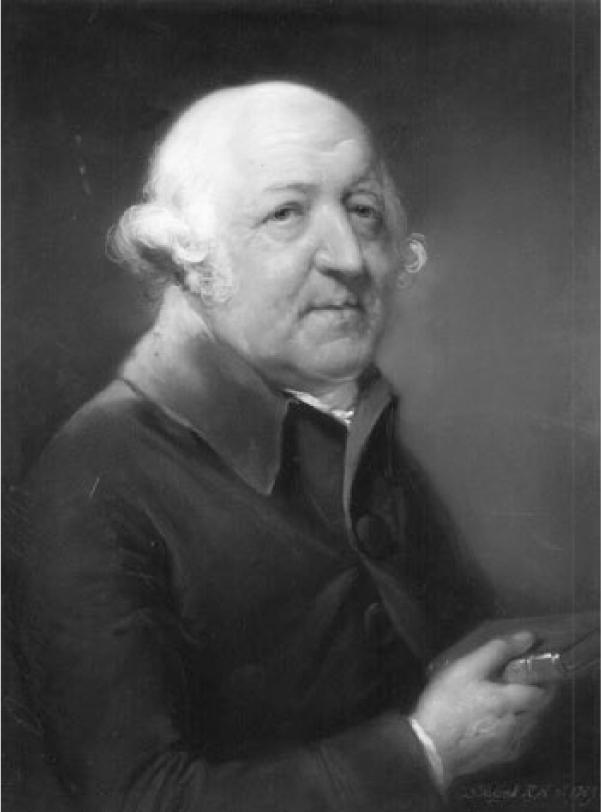
Dr Francis Willis, painted by John Russell, 1789 (NPG 2186); © National Portrait Gallery, London.
In treating the King’s mania, 15 Francis Willis was assisted by two of his sons and three keepers brought from Greatford. The reported evidence indicates that he implemented similar techniques to those utilized in Lincolnshire. These included the use of medicines, blisters and frequent mechanical restraint, a regime of healthy exercise, and psychological and dramatic techniques designed to induce submission to Willis’s authority. Despite the animosity, resistance and criticism to which he and his entourage were continually exposed from the other medical men, Willis persevered. As he had predicted from the outset, the King made a gradual recovery, and by the middle of March 1789 he was well enough to return to Windsor Castle. On 23 April a service of thanksgiving for his recovery was held at St Paul’s Cathedral (Macalpine and Hunter, 1969: 53–96; Peters and Beveridge, 2010: 24–8; Report from the Committee, 1788: 14–19; Winslow, 1839: 170–5).
Notwithstanding the drastic nature of the treatment to which he had been subjected, George III felt profound gratitude to Willis, according with what the French visitor described in relation to patients who had recovered at Greatford. The King presented Willis with a gold watch, described in a letter as ‘a token of that regard I shall ever retain for Him’, declaring a conviction of ‘the Doctor’s loyalty, Uprightness and Friendship by the whole tenour of his conduct towards me’. The moving letter showed both deep personal regard for Willis and a genuine solicitousness for the welfare of his family (Haslam, 1997: 546–7). 16 For his part, Willis was prepared to accept the reflected credit, arranging for the issue of a publicity medal with his own face on one side and bearing the inscription ‘britons rejoice your king’s restored 1789’. He was rewarded in 1790 with a substantial annual pension of £1000, in addition to the smaller pensions received by his sons (Macalpine and Hunter, 1969: 93–5). As the ‘Details on the Establishment’ illustrated, his reputation was greatly enhanced and the numbers of his patients increased significantly. His acquired fame also brought him a lucrative, prestigious commission to treat Queen Maria I of Portugal, but her mental health problems proved rather more intractable than those of George III in 1788–9 (Peters and Willis, 2013).
The ‘Details on the Establishment of Dr Willis, for the Cure of Lunatics’ was published in French in 1796, seven years after his successful treatment of the king. He had by then established himself as the most famous specialist insanity physician in England, and Greatford had become the country’s most celebrated private madhouse. The article itself provides an unparalleled insight into the operation of the house and the diverse therapeutic methods employed by its remarkable proprietor, at what Roy Porter has shown to be an important transitional juncture in the history of British psychiatry (Porter, 1995: 257, 260–4, 269–70). The translation follows the punctuation in the original.
Footnotes
Acknowledgements
We wish to acknowledge the contributions of Terry Hunt and the late Clive Willis in translation of the original text from French. We are also grateful to Liz Jack and Patricia Phillips for their work in the preparation of the Willis Family Tree.
Funding
This research received no specific grant from any funding agency in the public, commercial, or not-for-profit sectors.