



Abstract
Colette’s 1913 memoir, L’Envers du music-hall, documents the behind-the-scenes lives of music-hall performers, contrasting their staged glamour to their private indigence. Generally read as an admiring but uncomplaining depiction of performers’ heroism in early twentieth-century Paris, the text – I argue – deploys mute practices of spectation that ultimately indict the stage’s exploitive labour practice. Such tensions culminate in a rehearsal scene in which an actress, stripping down after long hours of effort, no longer resembles the royal mistress she portrays. Comparing her instead to a young, revolutionary drummer-boy, the text positions her to step offstage, sound the call to revolt, and summon her fellow performers to strike. In ironising the topos of the stripper disrobing for the pleasure of the male gaze, such cross-undressing joins other textual strategies in ‘laying bare’ the polemical energy straining this ‘uncomplaining’ memoir.
In Colette’s 1913 memoir of her years on the French music-hall stage, an actress rehearses her role as a king’s concubine, stripping off progressively as the long, hot hours of rehearsal wear on. She ends up resembling not so much the royal mistress she officially portrays, but – in knickers, bare knees and rolled stockings – a young, revolutionary drummer-boy, ready to sound the call to battle (Colette, 1913: 53). This highly freighted reversal, from king’s mistress to revolutionary, conveys the implicit political energy with which Colette’s collection of vignettes, L’Envers du music-hall, crackles and strains in subtle ways. Yet, just as it fails to bring about the particular ‘battle’, or performers’ strike, for which its characters are poised, it has also failed to be recognised as polemical text. 1 The resistant, militant energy of its project to reveal the hidden, to give voice to the mute, is implicit in the title of the collection itself, however, drawn from the claim made in one vignette by an accompanist. At some remove from the stage, neither spectator nor performer nor producer, she enjoys a dispassionate, panoramic vision of the whole – a vision that, curiously, ultimately eliminates the stage itself. For she asserts that there is effectively no stage, no glittery, costumed spectacle for her. Instead, the accompanist sees only the sweat, the yellowed skin revealed by harsh daylight, the discouragement of the performers’ lives. ‘C’est comme si j’étais seule à connaître l’envers de ce que les autres regardent à l’endroit’ (Colette, 1913: 67).
Such a collapse of the difference between onstage and offstage is fundamental to my argument for the text’s implicit dismantling of the opposition between ‘l’envers’ and ‘l’endroit’. For, I argue, Colette’s deployment of the accompanist’s vision – that is, the truth of what lies offstage – only serves, in a curious but ruthless paradox, to reinscribe the stage – but in all its ubiquity and power. In exploring the behind-the-scenes hardships of her performers’ lives, Colette ultimately demonstrates the extent to which offstage space – what appears to be the realm of the private, the personal – is infiltrated, colonised and appropriated by the stage. The apparent and topologically indisputable distinction between ‘offstage’ and ‘onstage’ is thus laid bare as myth in the ideology of the money-making music-hall enterprise. For underpaid and overworked performers are induced to believe in the difference between the two: the public, paid, onstage space of spectacle and performance, and the private, personal, unpaid space that lies offstage. As long as the illusion that these are different spaces can be maintained, performers remain exploitable, believing they have access to a personal realm even as the music-hall robs them of it. In the end, although Colette’s memoir initially appears structured by such an offstage/onstage distinction, it operates a subtle and polemical dissolution of this dichotomy: a dichotomy overtly promoted by the music-hall, yet one it insidiously refuses to respect. In my polemicised reading of L’Envers du music-hall, the ‘envers’ of Colette’s exhausted, impoverished performers is revealed as myth. There is no ‘envers’: no space that is not, in some way or another, arrogated for purposes of the stage, and thus essentially an extension of it. Consequently, trapped in a punitive performativity, music-hall performers fill the spaces of a vacated interiority with the empty gestures of staged roles. Colette’s comparison of an actress to a revolutionary young drummer-boy can only be heavily ironic, pointing to the futility of any possibility of revolution. For, in the context of royal absolutism implied by this rehearsal scene for ‘Les Grandes Concubines de l’Histoire’, performers are made endlessly subject, endlessly available without reprieve, to the ‘royal’ whim of the music-hall economy’s commercial imperative.
Such imperialism is apparent in the narrator’s weary, observing presence within the darkness of the hall, at this rehearsal for a dance number of ‘royal mistresses’. Here, in her liminal position as part spectator, part performer, she is due herself to rehearse a pantomime once the ‘Grandes Concubines’ have been dismissed. While she yearns, from her spectator’s seat, to prolong the spectacle, it is not – in a curious, ironised reversal – for her own spectating pleasure; rather, it is for the sake of postponing her own imminent return to the spectacle itself. Not a pleasurable space of leisure and repose, a space other than and separate from the stage, this spectatorial moment is ironised as an extension of it – for Colette’s narrator occupies a spectator’s seat as exhausted performer, allowed to leave the stage only to prepare for re-entry.
By way of detailing the tyranny of the stage, one might begin with the occupational hazards of its performers. One impresario who organised many a tour in the provinces, including those undertaken by Colette, confesses in his memoirs to such appalling conditions of sanitation that any concern for such matters would oblige the actors to perform, he admits, in deep-sea diving equipment (Baret, 1909, quoted in Pichois, 1984: 168). Music-hall artists on tour provided their own costumes (with the exception of historical costumes), assumed hotel and maintenance expenses and train fares, and were subject to fines for drunkenness or ‘tout autres faits qui seraient de nature à compromettre le bon renom de la Tournée’ (Baret, 1909, quoted in Pichois, 1984: 522). Precarious finances often resulted in performers being stranded in the provinces and abandoned by unscrupulous impresarios: a plight so frequent that, in 1909, a benefit banquet was organised to raise funds for the repatriation of such unfortunate artists. Indigence was their defining and repressive condition, as the managers’ cruel and dismissive shorthand – based on a metonymy of salary standing in for women dancers – makes clear: ‘Qu’est-ce que c’est donc que cette petite?’ ‘C’est du trois francs trente-trois’ (Colette, 1913: 91).
Remembering a past when he could still order on credit at the bistro, but had no money to buy bread, Brague the mime reflects on his anguished longing for a crust to dip in his cheap wine (Colette, 1913: 15). For women, the boundary between the stage and the prostitute’s sidewalk was very permeable, as implied by the impoverished performers’ matter-of-fact resignation: ‘naturellement qu’il faut vivre’ (Colette, 1913: 92). Indeed, the prostitute’s marketing of the erotic only too aptly figures and extends the same marketing by the music-hall. 2 In one densely significant image of such marketing, an actress arrayed in sumptuous velvet and brocade suffers the scrutiny and analysis of her person by male producers, who eventually decree that one breast should be revealed: a decision that leaves her indifferent, her only thought being, ‘de toutes les forces de son âme’ for ‘un sandwich au jambon, ou deux – ou trois – avec de la moutarde’ (Colette, 1984: 79–80). The careful tending and husbandry of male sexual appetite – apparent here in the long detailed scrutiny and conference that leads to the producers’ decision – stand in cruel contrast to the producers’ indifference to the actress’s own far more urgent hunger. Indeed, one might even remark, in the actress’s very indifference to such scrutiny, a hint of the compartmentalised behaviour of trauma victims – who endure an ordeal such as rape by effectively detaching themselves from it. The ordeal thus unfolds as though it were happening to someone else, with the victim a removed witness to the events; the starved performer’s very detachment from her own sexual commodification thus suggests an uneasy parallel to the endurance of trauma.
Performers on the French music-hall stage of the belle époque were eminently exploitable; in comparison to the numbers in other industries, they were simply too few and too fragmented by itinerancy to be unionised – and essentially too preponderantly female. Later in the volume, Colette, in an authentically spectatorial position this time, notices that she is in the midst of a virtually exclusively male audience: ‘Que d’hommes, que d’hommes!’ (Colette, 1913: 94) – whereas onstage, are ‘Trop de femmes, trop de femmes!’ (1913: 96). The result of broader ‘social patriarchy,’ sex-specific labour legislation under the Third Republic was ‘resolutely paternalistic’ (Stewart, 1989: 13); consequently, it focused on protecting the more acceptable ‘female’ professions, such as that of seamstress: the law of 2 November 1892, for example, prohibited women’s work between 9 p.m. and 5 a.m. (Stewart, 1989: 134). In other professions, sex-specific labour legislation limiting working hours was driven less by paternal concerns for the delicate female constitution and more by male fears over female competition, so such legislation is present particularly in labour forces with a heavily male component (Stewart, 1989: 13). The relatively small number of music-hall performers, however, involving eroticised women threatening to bourgeois values, fell outside the paternalistic purview of social policy – as it fell outside the risk of arousing male anxiety over female competition in the workplace. The contrast between ‘paternalised’, and thus protected, working women and music-hall performers is eloquently evoked in a reference to the fleeting return home that the more fortunate performers are able to make between rehearsals and performance. These performers, however, must then jump back into the metro or tram, ‘pêle-mêle avec les autres employées modistes, cousettes, caissières, dactylographes, qui ont, elles, fini leur journée’ (Colette, 1913: 55). Such a ‘pêle-mêle’ mix of women on public transport is resonantly suggestive of differential labour regulations. Although this comparison to other female professions has been quoted to claim that ‘female music-hall performers are portrayed once again as diligent labourers, not pleasure-seeking slatterns’ (Tilburg, 2009: 114), a pointed distinction is apparent. The honest wage-earning labour of music-hall performers is not so much likened to that of secretaries, cashiers and seamstresses, as contrasted; these two female populations indeed intersect in the public tram, but this ‘pêle-mêle’ commingling is heavily ironised by their different destinations. One population, its working hours limited by state intervention, is returning home, whereas the other transits fleetingly through home in a trajectory that is a ‘return’ only to the music-hall stage.
The ironic contrast between these two female working populations – those protected by the state’s ten-hour working day for women, enacted in 1900, versus the music-hall performers’ unlimited hours – weakens feminist arguments for the value of labour provided by women performers. It is tempting to see female labour in so sanguine a perspective as the claim that Colette’s female performer, ‘while living outside the bounds of middle-class respectability, found moral contentment in honest, wage-paying manual labour and domestic order’ (Tilburg, 2009: 101). However, such claims are undermined by domestic scenes depicted as precarious, fleeting, virtually illusory. One scrambles home, essentially in a round-trip trajectory back to the stage, only to ‘se laver les mains, renouer le ruban qui serre le front et les cheveux, s’assurer que le gosse n’est pas tombé par la fenêtre et ne s’est pas brûlé au poêle, et hop! On repart’ (Colette, 1913: 55).
It is equally tempting to deploy, in this context, Juliette Rogers’ arguments for an empowered gendered collective in two of Colette’s novels (Rogers, 1996). Drawing on Felski’s notion of a ‘gendered counter-public sphere’ in which identity in feminist literature is linked to community – but to community understood differently from that defined by masculinist, universalist perspectives – Rogers finds in two Colette novels, a ‘gendered community that exists both within mainstream society and simultaneously in opposition to it’ (1996: 737). Yet, in the memoir L’Envers du music-hall, a more sombre view of community would seem to be presented; for the solidarity crucial to such a construct is fractured by the demands imposed by the stage. While the claim has been made that ‘artists share a discreet but warm sense of comradeship’ (Holmes, 1991: 52), any possibility of ‘community’, whether organised by gender or other parameters, is undermined when the narrator of Notes de tournée compares her own expectation of solidarity to the indifference, ‘jealously’ guarded privacy and solitude she finds, instead, among fellow performers. Having expected that being ‘on tour’ implied the ‘pilgrimage’ of a close ‘fraternal’ band of fellow travellers, Colette’s narrator discovers, instead, ‘Pendant les rencontres inévitables sous les porches d’auberges, des regards jaloux, obliques, de chiens qui disent, sans paroles: “Je garde mon os. Passe au large”’ (Colette, 1984: 203)
In L’Envers, one might expect the majority of women performers to constitute a gendered ‘counter-public sphere’ (Felski, 1995; Rogers, 1996). Yet the very possibility of community is eliminated by the stage’s monopoly of time and energy, leaving performers with little but their fierce pride and independence. Beneath their professional camaraderie, their informal use of ‘le tutoiement’, they resist any overture: ‘connaître leur intimité, leur vie privée, leur souci qui les attache, tous, à un point invisible et jalousement dérobé, cela, je le répète, est difficile et tentant’ (Colette, 1984: 207). 3
In yet another example of the coercion and imperialism of the stage, Colette’s impoverished performers are perversely driven to cope with their hardships through role-playing – further demonstrating the stage’s monopoly of the private, intimate realm. Two actresses have refined their own off-stage mini-drama, positioning themselves in a bistro and loudly proclaiming what they would order if only they had the cash; subsequently, steaming platters often arrive, along with the hopeful benefactor who has overheard. An emaciated young actor invents an alibi to refuse Colette’s invitation to coffee, not having the means to reciprocate –‘les nerfs, vous savez’ (1913: 29). A teenage actress who nearly faints from hunger during rehearsal claims, ‘C’est mon amant … qui m’a fatiguée’ (1913: 16). Coerced by their subsistence wages into these proud alibis, the performers are also ultimately victimised by them – for such offstage role-playing effectively and ultimately blocks any cohesion and solidarity among performers – the elements necessary to bring about change.
The pride that fractures solidarity among performers also expresses itself as a fervent, pious belief in one’s ‘art’: a conviction that yet again leaves performers vulnerable. The skeletal young actor complaining that nerves keep him away from caffeine pursues his artistic calling at the price of being disinherited by his father, in a demonstration of the performers’ commitment to ‘art for art’s sake’. Such an attitude implies the commitment to art as a greater good, as a worthy value for which one might suffer; yet it is not shared by music-hall producers, as it might be by the avant-garde stage. Indeed, the music-hall imperative is diametrically opposed, as Bourdieu argues, to that of the avant-garde. Defined by maximal production, ‘subordonnée aux attentes du grand public’, the music-hall’s commercial imperative opposes it to the avant-garde, which represents ‘le pôle de la production pure, où les producteurs tendent à n’avoir pour clients que les autres producteurs’ (Bourdieu, 1992: 175). Yet the austere, self-depriving, avant-gardist ‘art-for-art’s-sake’ attitudes of performers feed into the music-hall’s collection of maximum profits at minimal cost.
Beyond the ubiquity of performers’ staged alibis, however, the theatrical usurps the quotidian in even more coercive and insidious ways, as the reader notices in Colette’s opening vignette, ‘La Halte’. Here, waiting in a provincial town to change trains, the little troupe of performers kill time in reflections about the country. Yet, in this most off-duty, most offstage of spaces, it is as though performers – having lost touch with any more authentic, more individual interiority – are condemned to play their stage roles. Predictably – too predictably – the comic yawns over the boredom of the countryside, saying how sleepy it makes him; yes, but it is a healthy fatigue, remonstrates ‘la duègne’. Shrugging her plump young shoulders, the ‘ingénue’ claims that nothing ages a woman so much as country living, ‘c’est connu’ (Colette, 1913: 9). Even to the most sympathetic and compassionate gaze, the performers emerge not as individuals, but as typecast, theatrical stereotypes. Each one involuntarily – and the more cruelly, because the more unknowingly – plays out his or her appointed role in the master script that sells seats at the music-hall.
Outside the music-hall, what alternatives were available to performers of the belle époque? Colette’s text makes scattered allusions to the bourgeoning film industry of the time. When no other work seems on the horizon, ‘Je rapplique au ciné’ admits one actor – thereby implying the shame associated with cinema acting in the early twentieth century. 4 Another character in Colette’s text alludes to the increasing competition between the cinema and music-hall entertainment industries, suggesting cynically that any strike by music-hall performers would only enrich cinema owners (Colette, 1913: 55). For films were quickly becoming an appealing alternative for music-hall audiences. Originally a side-show entertainment at itinerant fairs, early films began to be screened in café-concerts and music-halls (Abel, 1993: 366); but by late 1906, Pathé had begun constructing cinemas, and within three years there were 200 throughout France (Abel, 1993: 81). As of 1905, short fiction films begin to replace actualités and compete with music-hall programmes. By the time the Assemblée Nationale legislated a weekly day off in 1906, creating an obligatory day of leisure, and thus, potentially, hordes of newly available customers, quantities of actors were being sought and recruited from music-halls, theatres and circuses (Abel, 1998: 21–2). With these actors, both Pathé and Méliès produced opulent fantasy versions of fairy-tales, adapting the successful material of theatre and music-hall stages.
Yet, the plight of actors in the early cinema industry was no less grim than that of stage performers. Only the most successful actors – such as Mistinguette, whose payment for performances all but doubled between 1910 and 1913 (Le Forestier, 2006: 189) – were hired by both theatres and cinema, which increased their leverage with each when it came to salary negotiations. Otherwise, regular appearances tended to render actors dependent on the cinema alone, which diminished their negotiating power. Another move to ‘désolidariser le groupe social des comédiens’ was that regular lower-paid cinema actors were paid out in Vincennes, whereas the more infrequent, higher-paid ‘stars’ were paid in Paris itself, at Pathé’s headquarters (Le Forestier, 2006: 189). Pathé actors, used to the tradition of being paid on a per-performance basis, were paid by half-days of work – although occasionally, a ‘star’ was hired on different terms. 5 Gaumont paid similarly by the half-day, but bound its actors to a yearly contract; in this way, Gaumont actors were able to earn more over a year, but were paid less per film – a tactic consonant with Gaumont’s refusal to hire better-known theatre actors. In contrast, Le Film d’Art worked only with well-known actors, who were paid between 600 and 1500 francs for each film shoot (Le Forestier, 2006: 190): figures we might compare to the pitiful 3 francs, 33 centimes paid by the music-hall – as we saw earlier, in the managers’ scornful shorthand for women dancers – per performance for cameo roles (Colette, 1913: 91). Only in 1912, as Colette, who was pregnant, was leaving the stage, was a Chambre syndicale de la cinématographie created, demonstrating interest in the internal functioning of the various film studios – in particular, work hours, payment and filming conditions (Aimone, 1997: 89). Another union, L’Amicale des artistes, founded in 1915, attempted to ensure a practice that was ‘normal, correct, digne et probe d’une profession irrégulière et vagabonde en son essence’. 6
Meanwhile, however, with no personal space that was not colonised by the stage, the problem of identifying a potential site of opposition for music-hall actors became acute. Departures from the stage allowed them not so much to inhabit the space of release, of the private and personal, as to assure themselves of the myth of its existence, to allow them to continue to believe in the illusion of an offstage. ‘Ils vont encore nous coller une générale à minuit et demi, comme c’est commode’ complains one actress matter-of-factly.
Alors, vous comprenez, la générale finit sur les trois heures et demie, peut-être quatre heures, et je suis sûre de rentrer sur mes pattes, juste à temps pour faire la soupe à mon mari qui s’en va à cinq heures et demie, et puis, après, les deux gosses qu’il faut qu’ils aillent à l’école. (Colette, 1913: 56)
The dress rehearsal, scheduled to begin after midnight, allows performers to reach home only to assist the departure of loved ones before confronting the emptied domestic spaces of an evacuated personal life. In these vignettes, the space of the personal, shattered by the demands of the music-hall, is littered with the debris of failed relationships (‘La Travailleuse’, ‘Amour’), lost childhoods (‘L’Enfant prodige’), peopled by single mothers (‘L’Enfant de Bastienne’), marked by loneliness and abandonment (‘Le Laissé pour compte’, ‘Gitanette’).
Could the homoerotic, as a space outside the heterosexual economy in which the music-hall – run by male producers for primarily male consumers – was so heavily invested, offer, if not a site of opposition, at least a refuge where performers might access an authentically personal realm? It might be argued that homoerotic relationships constitute a truly ‘other’ space: one not binarily other, but radically, utterly other, in an alterity sequestered from the music-hall’s exploitive economy. 7 We might identify a homoerotic energy, for example, in the vignette ‘L’Ouvroir’, in which a half-hour intermission finds five actresses in stages of undress, bent over their sewing in a cramped dressing-room, knees lifted on high stools under open kimonos. Pichois claims that the text here carefully affirms the sexual innocence of the undressed actresses through the extended metaphor of the nunnery sewing-room: descriptions such as ‘chastes dos penchées’ emphasise ‘la moralité des artistes de music-hall’ (1984: 1350). A woodcut illustration by Hermine Mayeras from a 1929 edition of L’Envers du music-hall also fosters such a ‘chaste’ reading, with each actress placed slightly askew, in apparent indifference to the others (Figure 1). The actresses are not only concentrated on their mending; each bends her head to such an extent as to place the others beyond her field of vision – excluding them, implicitly, from her interest. It is for another reason, however, that a homoerotic reading of this intimate scene becomes as superficial, as false and forced as the vulgar rouge that blotches the cheeks; for any erotic potential would appear to be overcome by the dressing-room’s odoriferous and oppressive proximity to the latrine, prompting a gasping, anguished exclamation from one actress (Colette, 1913: 20). 8 Instead, during their half-hour offstage and bent over their sewing, the women begin to sing ‘une involontaire chanson enfantine’ in a spontaneous retreat to pre-pubescence. Music-hall performers cope not through resistance, but through fantasmatic escape.
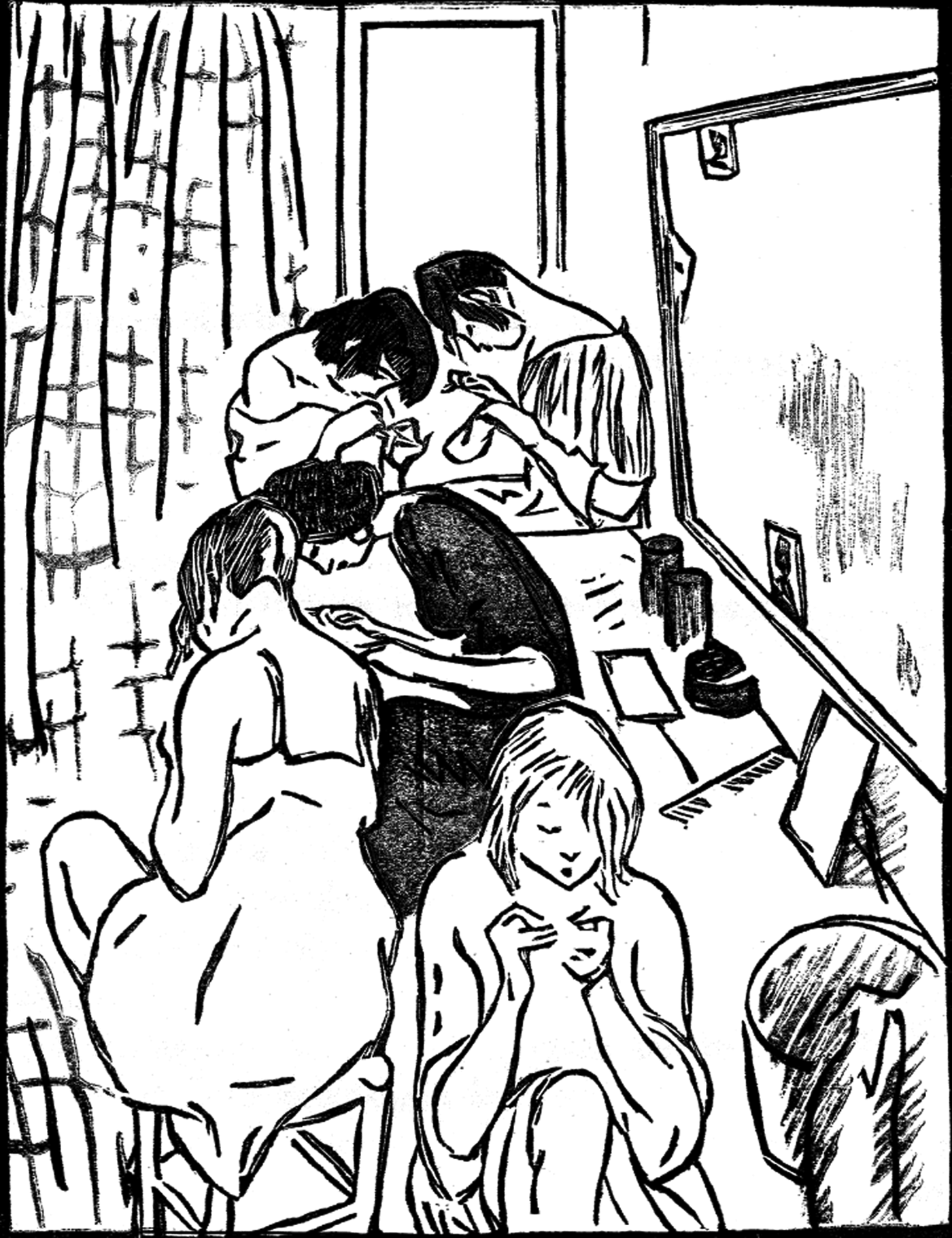
Woodcut by Hermine Mayeras
The question of how and where to draw the boundary between the private unpaid space of the personal realm and the public space of paid performance becomes acute in the scene with which I began – the vignette depicting a rehearsal for the ‘Great Mistresses of History’. As the long hot hours of rehearsal drag on, there is an atmosphere of rebellion, and the possibility of a strike is on everyone’s lips; for the performers are not compensated for the endless hours of rehearsal time, nor for the exhausting double performances on ‘matinée’ days. As heat and fatigue rise, leaving the actresses minimally dressed, tensions converge on the figure of Madame de Pompadour, mistress of Louis XV: ‘elle ressemble étrangement, avec sa culotte noire, ses genoux nus au-dessus des bas roulés, à un jeune tambour de la Révolution. Tout son petit être têtu et meurtri s’insurge et semble crier: “Vive la grève!”’ 9
This cross-undressing actress provides a rich, suggestive inscription of revolutionary potential. For stripping onstage is the act of the music-hall’s hired performing body, offering up the spectacle of the feminine to the prurient and paying male gaze. Here, however, that body, in stripping from heavy brocaded gown to black knickers and bare knees, emerges masculinised as a rebelling revolutionary. Such a moment of promise and possibility offers a reversal in which the staged feminine is overturned, refused, in a striptease that yields not an inviting compliant feminine, exposed and available to desire, but an emblem of resistance. This female cross-undresser, ready for action in her revolutionary outfit, merely needs to step offstage and lead the revolt. Yet this unscripted scene, rich with potential, remains only that: a staged scene, an act. 10 In the end, this impassioned embodiment of striking, of resistance, becomes just another role, a discourse passionately mouthed but privately denied: a part performed without conviction. Onstage, everything about this actress cries out, ‘vive la grève’; offstage, she asks earnestly, ‘vous êtes pour la grève, n’est-ce pas?’ Yet ultimately this rebel is unable to move from the simulation of resistance to resistance itself. Dressed – that is, undressed – for the real drama in her sulky expression and revolutionary outfit, this actress cannot step off the stage and be a revolutionary drummer-boy, sounding the call to battle. For as another actress puts it, pithily and cynically, ‘La grève, pour avancer à quoi? À engraisser les marchands de cinéma … Et pendant ce temps-là, quoi qu’on bouffera?’ (Colette, 1913: 55). Striking is a luxury the enslaved performers cannot afford. 11
Neither can they afford the space and time for the personal realm: a space, as we have seen, increasingly exposed as myth for the music-hall performers. One vignette describes the endless hours of a typical music-hall dancer who, exhausted after the evening performance, goes on to earn a few francs dancing at a restaurant from midnight until 6 a.m. Each evening this all-night dancer singles out a couple she fondly gazes upon, constructing for them a loving scenario through which she accesses a vicarious and distant companionship. It is this remote, refracted companionship, however, that must stand in for any other for the deprived dancer. And it is, moreover, not only a refracted, but an illusory companionship: for the favoured couple, as the text implies, are actually quite unhappy (Colette, 1913: 40). Such unhappiness, contradicting the dancer’s romantic projection, underscores the poignant illusion that gives rise to such vicarious gratification, rendering the dancer’s loneliness only the more apparent. In another example, the most pitiful character in the collection, the abandoned, nameless young girl everyone calls ‘Le laissé-pour-compte’, lives in a miserable garret room high above the Montmartre cemetery, as though her only companionship must come from phantoms. Consuming her summer luxury, half a pound of plums, she flings the pits as far as she can, triumphantly exclaiming, whenever she hears a resonant ‘ping’ against an iron cross, ‘Ah! J’ai gagné!’ (Colette, 1913: 92): an equally resonant irony the reader cannot fail to miss, for in her bereft circumstances the nameless girl can only lose.
A final image of the fractured myth defining the personal realm for music-hall performers depicts a collection of exhausted English dancers, asleep in a tangled pile on the floor and compared to a litter of orphaned kittens, huddled together for warmth. A more pointed, biting message might be read into this scene, once we notice – beneath its relaxed grace – its dismembered parts. For, happening upon the heaped bodies, the narrator narrowly avoids stepping on a trailing hand, making out elsewhere a thin arm (Colette, 1973: 83). These body parts and pieces become eloquent emblems of the dismantled private lives of dancers asleep on the workplace floor.
The depiction of these dismembered lives culminates in the final section of the 1913 memoir as we follow Colette’s narrator into the spectators’ seats, this time to explore an ‘authentic’ spectating space: a move the text certifies by entitling the memoir’s closing section, ‘Dans le public’. Having set out to reveal the behind-the-scenes life of the music-hall, why, we might ask, is the text concluding by taking us into the space of spectation so abusive of music-hall performers; how can these seats, filled almost exclusively with men engaged in the handshakes and exchanges of jocular familiarity, show us the hidden truth of the music-hall? The purpose of this section, Pichois claims, is to ‘normalise’ Colette’s narrator, reintegrating her into the bourgeoisie (1984: 1353). Yet such claims fail to account for the text’s strategic manipulation of this spectating space. It is onstage that the offstage truth ultimately forces itself into visibility, in a silent exchange of gazes between Colette’s narrator, sitting in the audience, and one of the performers, Lucette de Nice. As Lucette’s gaze catches and recognises the narrator’s, all the desperation of her plight becomes visible: ‘Je lis sur sa figure d’enfant pauvre le désir de me rejoindre, de me parler’ (Colette, 1913: 95). At the end of her dance number, Lucette de Nice smiles suddenly, as though about to cry, before bumping into the scenery as she makes a hasty exit (1913: 96). Through this Althusserian interpellation, however, we recognise a cry for help addressed to Colette’s now-spectating narrator. For the first time in the collection of vignettes, the plight of the performer is visible within the very spectacle itself, forcing itself upon our spectating attention as the dreamy illusion created by the stage is shattered by the eruption, onstage, of the performer’s desperation. In this episode, the exchange of glances between performer and spectator positions and implicates us as readers. Having followed Colette’s narrator into the wings and recesses of music-hall life, the reader, now informed and aware, is called upon to respond, to act on her knowledge of the performers’ plight. Reminding us of our new knowledge, Colette’s narrator falls into a summary of all the clues of hardship now newly legible to us as spectators following our behind-the-scenes tour: the frayed hem, the red wrists, the calloused hands; she guesses at ripped stockings, at peeling soles of shoes; she imagines the icy room, the brief light of the candle. As the text slips metonymically from the telltale clues of poverty and deprivation, we move from the miserable garret room to the many indigent women profiled in the one, as Lucette de Nice becomes emblematic of all other performers (1913: 96). As though this meditation is too painful for Colette’s narrator, she suggests, suddenly, a precipitous departure: ‘Allons-nous-en, dis?’ (1913: 96). From her new spectating position, however, Colette’s narrator’s ‘nous’ now imperceptibly slides away from her solidarity with other stage performers to embrace, insidiously, the reader. The sudden proposition of flight becomes a direct challenge to us.
Will we follow Colette out of the music-hall in her flight from the onstage actress’s beseeching gaze? Or will we, enlightened by all we have seen beyond the stage, now feel compelled to respond to the actress’s mute call for help? The text, having shown us how extensively the stage imperialises all offstage space, now calls upon us to respond: to desert the masculinised, spectating position, but not to cede to despair and flee, as Colette’s narrator herself does. In a reversal of the drummer-boy scene – where an actress failed to heed the call to revolution, to step offstage and strike – we are called upon to take up the stalled revolution ourselves: to redress this failure by stepping onstage ourselves, leaving our seats to disrupt the performance as – in solidarity with the performers – we revolt against the music-hall’s tyranny and bring down the curtain on an abusive male-dominated economy.
Should we hesitate, the collection’s closing vignette would appear to strengthen our resolve through an account of the failure of a lesbian relationship, after a lover is effectively bought, with free-flowing champagne, by a rival music-hall actress.
12
Again the text explicitly poses, only to eliminate, the possibility of the homoerotic as an alternative site of personal and emotional investment, a refuge from male-controlled exploitation. Within the relationship, Gitanette and her lover are ‘défendues l’une par l’autre de la prostitution désolante, de l’homme souvent méchant’ (1913: 98–9). Yet the ultimate betrayal – abandonment by one of Gitanette’s own, a lesbian fellow- performer – within this singularly sheltered space is recounted in a poignant narrative prompted by the narrator’s questions. As though to goad the hesitating reader into action, such questions as ‘Vous avez eu envie de mourir, Gitanette?’ culminate in the final paragraph: ‘Et vous êtes moins triste, à present?’ (1913: 101). Our expectation, of course, is that time has helped Gitanette overcome her loss. Yet in the collection’s closing lines she recounts her unrelieved grief as she summarises her story:
Moi, n’est-ce pas, je n’ai rien connu que Rita. ça s’est trouvé comme ça, je n’ai pas eu d’ami, je ne sais pas ce que c’est qu’un enfant, j’ai perdu mes parents toute petite, mais quand je voyais des amants heureux ensemble, ou bien des gens en famille avec des petits enfants sur les genoux, je me disais: ‘J’ai tout ce qu’ils ont, puisque j’ai Rita.’
Through Gitanette’s own account, we feel the anguish of an indigent partner abandoned for the better material conditions offered by a champagne-drinking rival, in a final demonstration of the music-hall’s monopoly of performers’ private lives. 13 Bereft, Gitanette describes her grief and suffering, concluding that she now does not know what she would do without her very unhappiness. Her last words, and the final line of Colette’s collection, are ‘Cela me tient compagnie’ (1913: 102). In an absence yet more wrenching than the cemetery whose tombstones provide the ‘Laissé-pour-compte’ with her only companionship, Gitanette’s companion becomes her very loss itself: a loss embodied as grief for the lover who deserted her. As throughout these vignettes, phantasmatic absence substitutes for presence in a closing line that seems to summarise and proclaim the fate of music-hall performers. It is the phantasm of a private life, a space that might ‘keep one company’ – the illusion of having a personal realm – that must substitute for any such private domain; for the demands of the stage imperialise the most private of lives.
Just as Colette herself attempted to disclose the hidden truths of her performers’ lives, I have sought to continue her project by revealing the implicit polemical energy and possibility that animate L’Envers du music-hall and other writings. In following Colette’s accompanist behind the scenes of music-hall life, we discover precisely that, to rephrase Derrida, there is no ‘hors-scène’: the stage tyrannises its performers both onstage and off. For Colette’s oppressed, exhausted, impoverished performers, there is, in a strict sense, no behind-the-scenes reprieve. The ‘Grandes Concubines’ may strut about the stage, embodying the favour, privilege and power of kings’ mistresses on lavish display. Yet the real ‘Grandes Concubines de l’Histoire’, of course, were ultimately tethered to sexual availability. A miniature, or mise-en-abyme of exploitive labour practice, this scene depicts the stage itself as an absolute monarch, parading its mistresses. Yet, unable to afford the luxury of revolution, the empty-bellied performers displayed in royal brocades are forced into 24-hour availability, in a coercive and merciless prostitution, to the music-hall stage. The stalled revolutionary project implied yet unrealised by the cross-undressing actress is ultimately offered to the reader. Positioned as complicit spectator, Colette’s reader is exhorted to interrupt the spectacle, bringing down the curtain upon the music-hall’s exploitation of its performers. The burden is now upon ourselves, Colette’s readers, to redress the generalised destitution culminating in Gitanette’s haunting and haunted companionship, the ultimate emblem of other spectral partners of music-hall lives: phantasmic companions, grief and loss incarnate.
Footnotes
Acknowledgements
In the course of working through this argument, I have greatly benefited, from fruitful and inspiring exchanges with, in particular, M. Mortimer Guiney, Susan Harrow, Edward J. Hughes and Catherine Perry.