



Abstract
This article shows the results of a method of acoustic measurements performed when a disturbing sound source cannot be turned off. This case happens when it is not possible accessing to disturbing sound source that we want to characterize, or when it cannot be switched off for reasons linked to production cycle. It is possible to carry out acoustic measurement of residual noise (noise present when disturbing source is off) with the technique of acoustically similar place. The residual noise in a certain area is a result of noise level emitted from various sound sources operating with a certain typicality in a considered area. This noise is going to be combined with noise of disturbing sound source, in place where complaints show up. If it is not possible to control disturbing sound source, residual noise surveys may be carried out in a similar place, or in a place where an environmental noise is equal and the influence of disturbing sound source is negligible.
Introduction
This article shows the results of a method of acoustic measurements performed when a disturbing sound source cannot be turned off. This case happens when it is not possible accessing to disturbing sound source that we want to characterize, or when it cannot be switched off for reasons linked to production cycle. Therefore, to assess the effects of possible noise generated from a sound source considered disturbing (i.e. increase to total sound field due to operation of sound source compared with residual noise), it is possible to carry out acoustic measurement of residual noise (noise present when disturbing source is off) with the technique of acoustically similar place. 1 In fact, according to this evaluation technique, the residual noise in a certain area is a result of noise level emitted from various sound sources operating with a certain typicality in a considered area. This noise is going to be combined with noise of disturbing sound source, in place where complaints show up. If it is not possible to control disturbing sound source, residual noise surveys may be carried out in a similar place, or in a place where an environmental noise is similarly present, but for which the influence of disturbing sound source is negligible.
Description of measurement place
The acoustic measurements were made in a house located in a rural area in central Italy, in suburbs of a village of about 2500 inhabitants and placed at 120 m above sea level. This site has many green areas, and its main feature is wine production. In fact, of about 14 km 2 of total area, about 11 km 2 are covered with vineyard crops; for tourism reasons, landscape aspect is a very important and required quality by visitors. Whereby in this area, need of acoustic quietness has a fundamental importance.
Description of disturbing sound source
The disturbing sound source was constituted by cooling apparatus of a radio base station for transmission of mobile telephone; for operating requirements of the system, it must be always maintained at a constant temperature and then a continuous cooling of electronic components inside the radio base station is necessary. When a certain temperature inside the box overcomes, air cooling systems will start in an automatic way, which are constituted by conventional heat exchangers and compressors that allow air to be cooled and then fed into a room containing electronic systems. Cooling operation system generates a noise that people living in neighboring house consider annoying. Figure 1 shows aerial view of home and disturbing sound source detected in cooling apparatus of the radio base station for transmitting mobile phone.
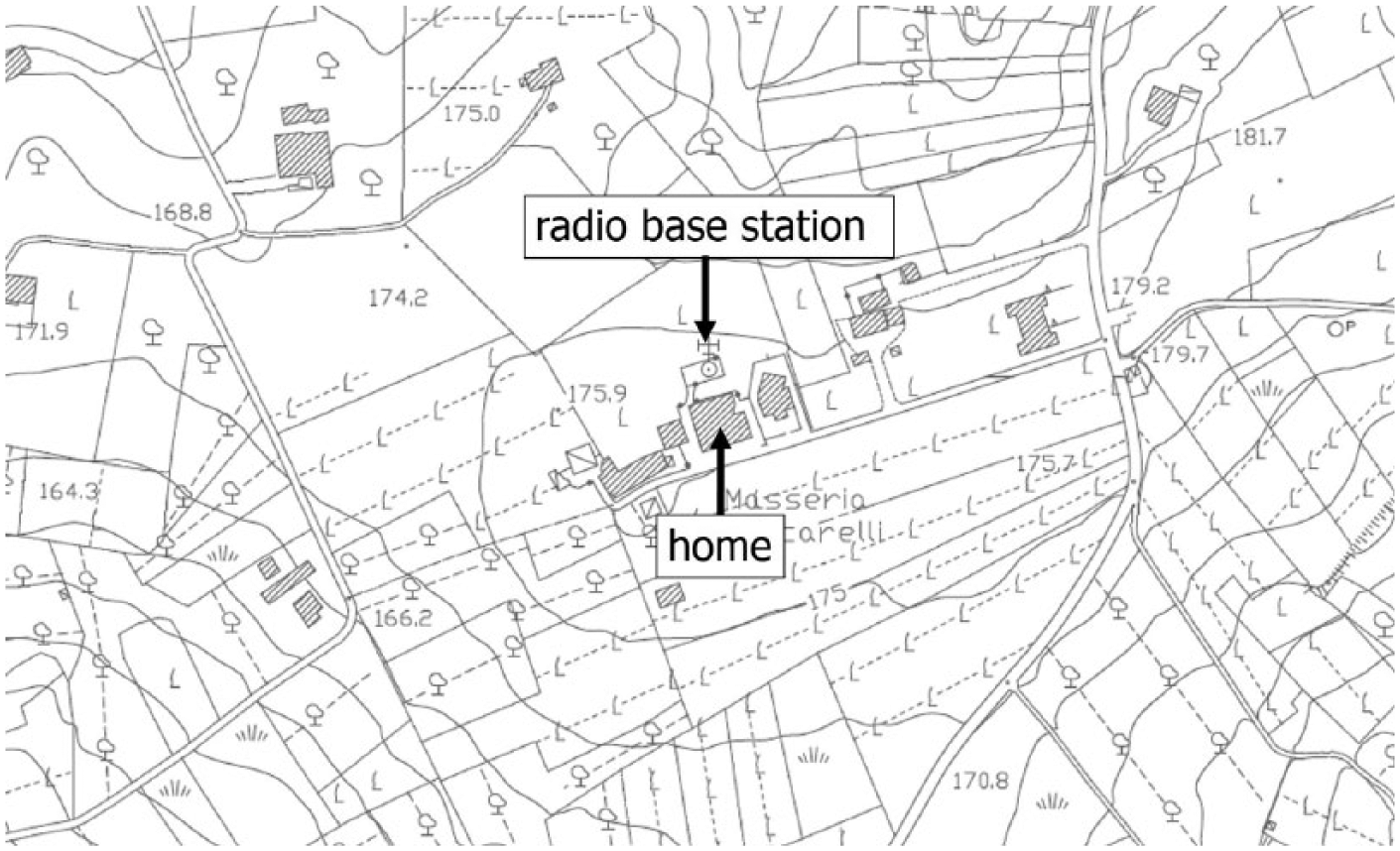
Aerial view of the area where the acoustic measurements were carried out.
Description of measurement instrumentations
Instrumentation used for the acoustic measurements is composed of an integrating sound level meter “Larson Davis” model “LXT1” Class 1 (IEC 651, IEC 804, and IEC 61672-1) and of a calibrator “Larson Davis” model “CAL 200.” Before each acoustic measurement, the sound level meter was calibrated with a signal at 94 dB at the frequency of 1000 Hz. The sound level meter has been configured to measure the equivalent sound pressure level weighted “A” and the statistical levels (L10, L50, L90, L95). In order to detect the presence of tone components (CT) in noise, a spectral analysis of minimum values has been carried out, for 1/3 octave normalized bands. 2 The sound level meter was positioned on a tripod at 1.5 m from the floor, at a distance greater than 1 m from reflective walls, at 1.0 m from the window. In the home, the acoustic measurements were performed with open windows; this configuration is the most noise condition. 3
Measurement methodology
The following acoustic parameters are defined. Residual noise level (LR): it is the continuous equivalent level of weighted sound pressure “A,” which is detected when a specific disturbing source is excluded. It must be measured with the same methods used for measurement of environmental noise and should not contain atypical sound events. Ambient noise level (LA): it is the continuous equivalent level of weighted sound pressure “A,” produced by all existing noise sources in a given place and during a certain time. Ambient noise is constituted by total of residual noise and the one produced by specific disturbing sources, with the exception of individually identifiable sound events of an exceptional nature compared with environmental value of the area. Differential noise level (LD): difference between LA and LR: LD = (LA − LR). With the aid of sound level meter, acoustic measurements were made in closeness of disturbing sound source, at 1 m from the fence which delimits boundary of the radio base station, in order to evaluate sound emission levels and characterize disturbing sound source. Figure 2 shows sound level meter during measurement phases near the station boundary.

Exterior of home, where sound measurements were performed.
While the acoustic measurements inside the house for evaluation of the environmental noise and of the residual noise were carried out; so that it is possible to evaluate the noises increases due to the sound source considered disturbing. For environmental noise measurement, the sound level meters were placed in a room of the house, next to the window that overlooks the radio base station from which disturbing noise comes (the window faces toward North). Due to was not being able to turn off sound source, because it was not possible to stop operation of telephone services. The residual noise measurements (noise measured when a specific disturbing source is excluded) have been performed in an acoustically similar place. This place was identified for them a room of the same house, located on the opposite side of disturbing sound source position, overlooking (toward South) the access road. The sound level meter has been placed in this room and the acoustic measurements were carried out with an open window.4 –6 From this position, noise of disturbing source is negligible. Figure 2 shows exterior of dwelling, where sound measurements were performed, while Figure 3 shows the radio base station for mobile telephony during the acoustic measurements.

Radio base station for mobile telephony during the acoustic measurements.
Acoustic measurements
The sound level meter was placed inside the dwelling as a “receptor” of sound noise coming from operation of equipment at service of radio base station. The acoustic measurements were carried out on August from 10:00 to 12:00. Outdoor temperature was about 35°C and wind speed nothing.
Because of a noise in a steady state, the duration of disturbing noise measurement is about 5 min, while for residual noise evaluation, the measuring time was set at 30 min. The object of measurement area is agricultural and is far away from busy roads and railway lines; in fact, during this measurement, significant sound events have been not detected such as passing cars or other sound events.
Figure 4 shows the window to north side that overlooks the sound source (radio base station) for measuring environmental noise, while Figure 5 shows the window to south side of the same dwelling that overlooks the street and the countryside for measuring background and residual noise. Figure 6 shows the south side of home on the access road, and this area is opposite to the noise source. Figure 7 shows the time domain acoustic measurements, and these values have a constant trend because the noise is stationary.
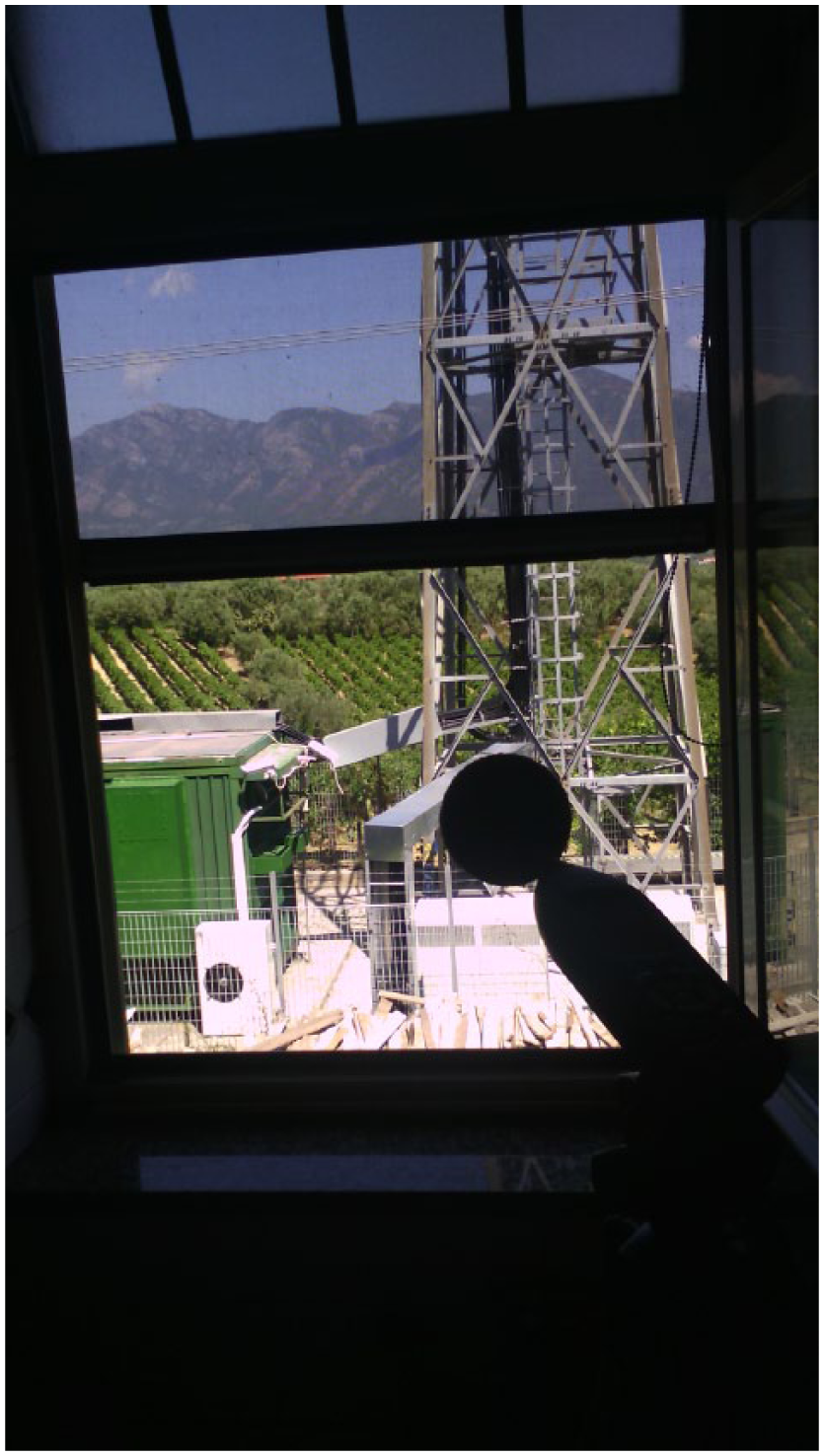
Sound level meter inside the north side of dwelling, near radio base station, for measuring environmental noise.

Sound level meter inside the south side of dwelling on the access road, for measuring residual noise.
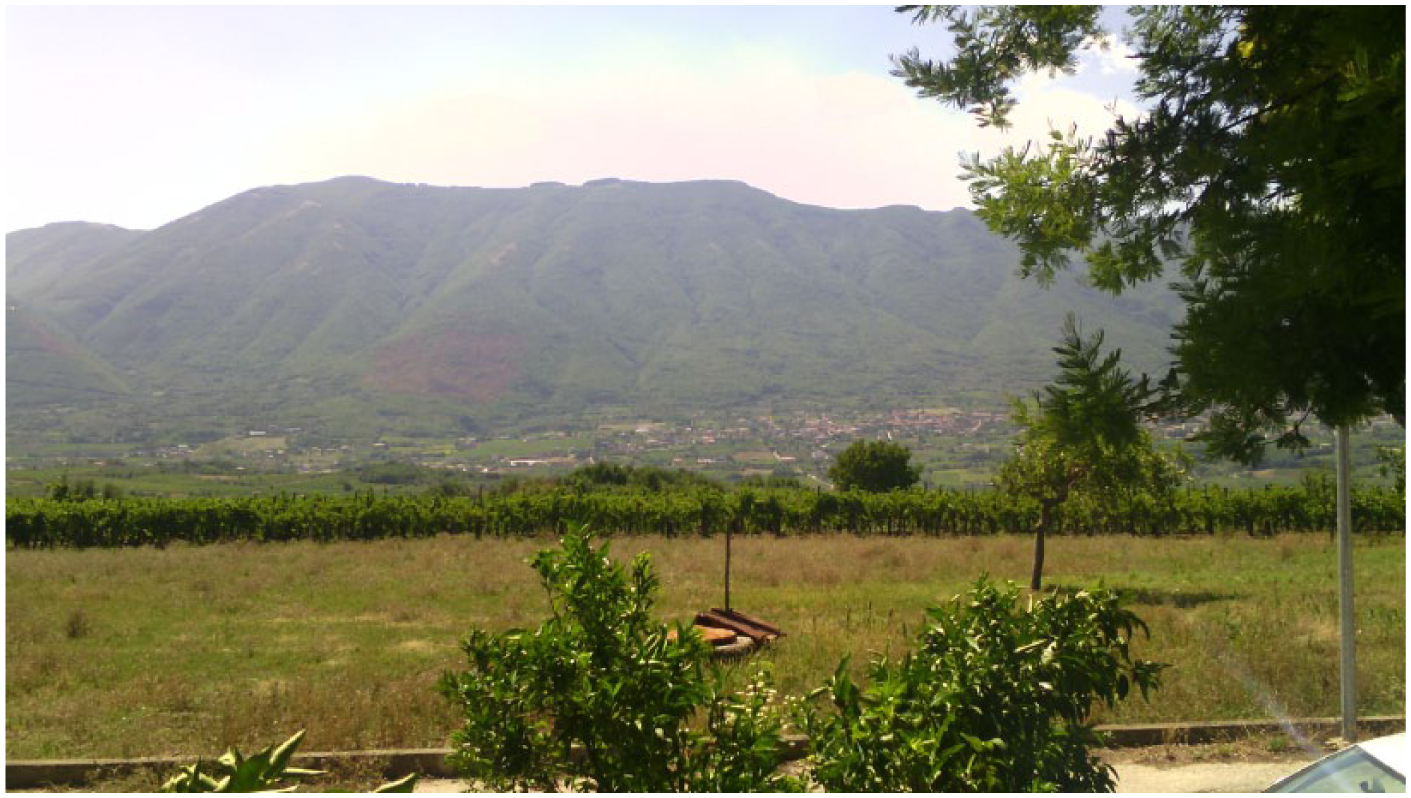
South side of home on the access road, area opposite to the noise source.
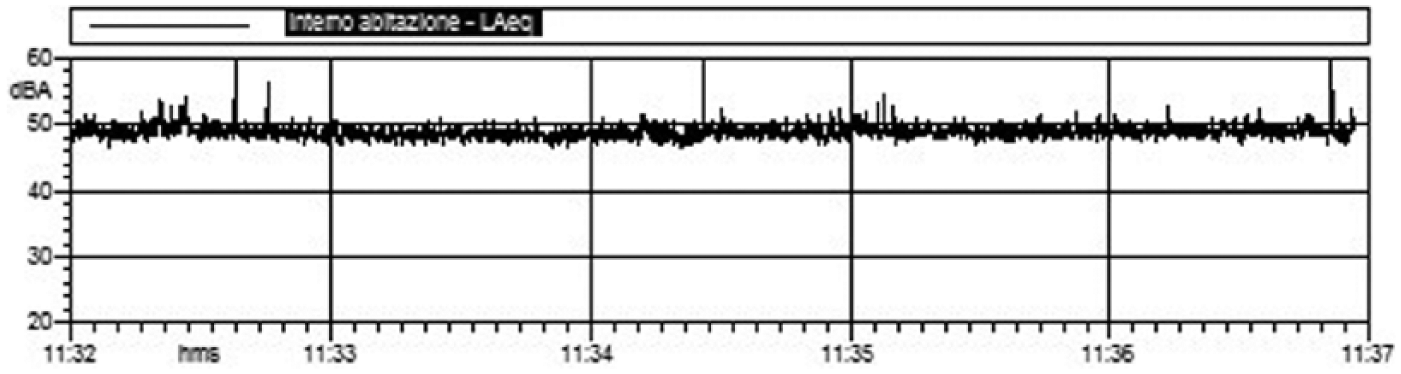
Time domain acoustic measurements.
Identification of tone noise components
In order to detect the presence tonal components (CT), a spectral analysis for normalized bands of 1/3 octave has been carried out. Only CT having a stationary character over time and in frequency are considered. When sequential filters are used, they determine the minimum of each band with a constant fast time. If parallel filters are used, level of stationary spectrum is evidenced by minimum level in each band. To highlight CT located at crossover frequency of two filters at 1/3 octave, filters with greater selective power or alternative intersection frequencies can be used. The analysis is performed in a frequency range between 20 Hz and 20 kHz. We are in presence of a CT if minimum level of a band exceeds minimum levels of adjacent bands for at least 5 dB. The reference technical standard is ISO 266: 1987. 7 Figure 8 shows frequency domain of minimum values spectrum, while Figure 9 shows frequency domain of average values spectrum. Furthermore, Figure 8 shows the presence of a CT at a frequency of 160 Hz.
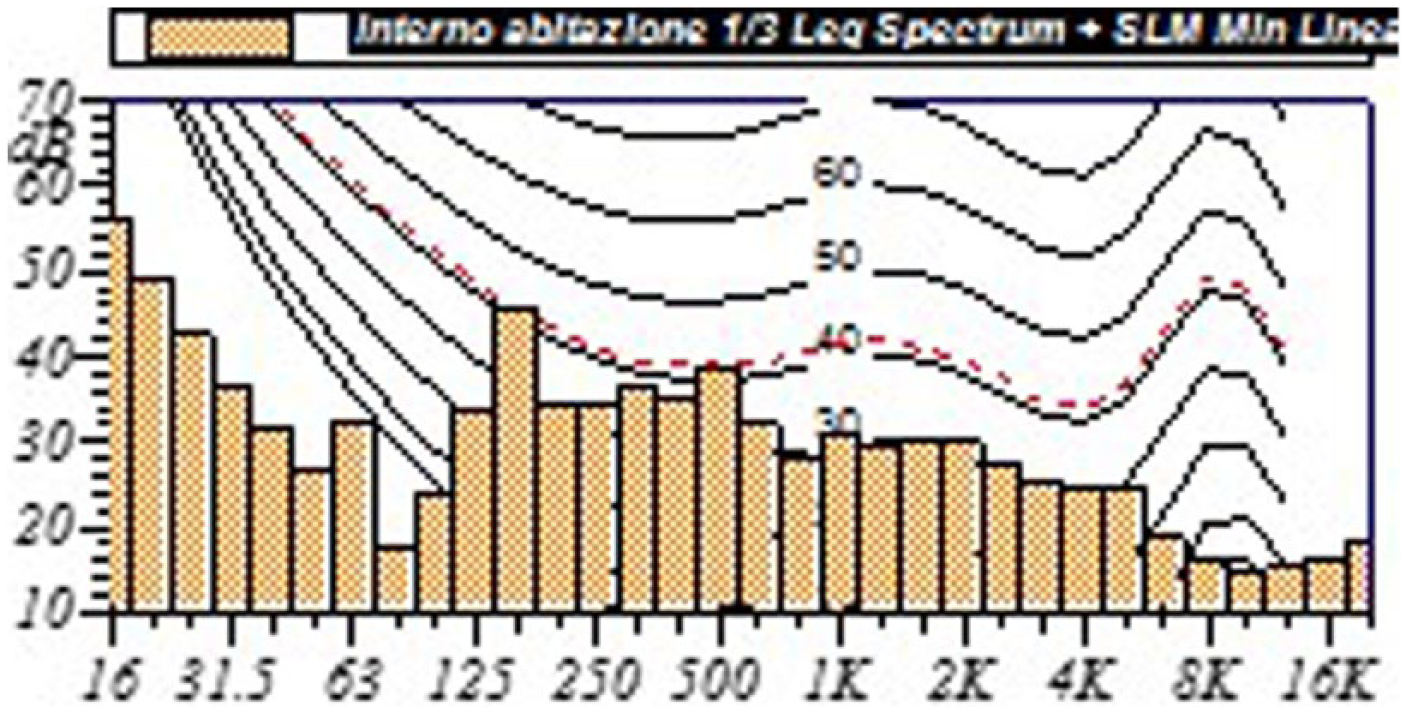
Frequency domain of minimum values spectrum.

Frequency domain of average values spectrum.
Discussion
Table 1 shows synthesis of the acoustic measurements conducted in two positions inside the house: north side toward base radio station and south side toward access road to the house, where the influence of noise from disturbing sound source disturbing is negligible.
Synthesis of acoustic measurements, indoor.

LA: ambient noise level; LR: residual noise level.
LD is the increase due to the presence of the disturbing sound source (differential noise level), LD is defined as the difference between LA and LR. Moreover, the presence of a tonal component at frequency of 160 Hz increases discomfort generated by noise perceived by people living in dwelling (+3 dB)
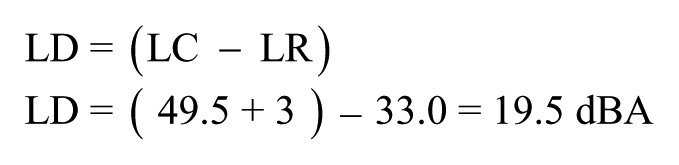
So, the presence of operation of radio base station to mobile telephony service entails an increase of 19.5 dBA compared with background noise.
Conclusion
In this paper are reported the values of acoustic measurements carried out in a dwelling, when the disturbing sound source is in operation (LA) and when the disturbing sound source is off (LR), this acoustic measurements have shown the presence of annoying noisy due to operation of air cooling system to the radio base station service. Moreover, the presence of a CT at frequency of 160 Hz increases discomfort generated by the noise perceived by people living in the home. Therefore, sound inclusions inside home turn out to be troublesome. With this simple method, it is possible to evaluate sound inclusions inside a home when disturbing sound source cannot be turned off.
Footnotes
Declaration of conflicting interests
The author(s) declared no potential conflicts of interest with respect to the research, authorship, and/or publication of this article.
Funding
The author(s) received no financial support for the research, authorship, and/or publication of this article.