



Abstract
This article analyzes English textbooks used in Israel to examine whether their cultural content is appropriate for the Palestinian Arab learner. This topic is significant, as the English curriculum in Israel is uniform in all sectors. The article presents a critical discourse analysis of six English textbooks used in Israeli high schools to examine the recurrence of seven discursive devices that might possibly serve as a means for shaping or (re)producing ideological values: (1) culturally distinctive names, (2) pronouns, (3) the passive/active voice when relating to the Other, (4) explicit statements defining the target audience, (5) narratives involving faraway cultures that perpetuate Western stereotypes and exclude the Other, (6) a demand for culturally specific prior knowledge, and (7) discourse constructing identities and collective memories. These devices serve to foster English learners imbued with Western oriented Jewish-Zionist ideology, while reproducing and perpetuating hegemonic ideology. Thus, English textbooks in Israel marginalize the Palestinian Arab minority, its culture and common traditions, thereby engendering a learning environment that creates a negative learning experience for students of this sector.
Keywords
Introduction
This article questions the cultural suitability of English school textbooks that might have implications for education and multiculturalism far beyond English learning in Israel. It presents a discursive analysis of English textbooks used in Israel (for Jews and Arabs alike) which identifies and examines the ideological bias of narratives and texts used in them and verifies their cultural relevance for the target audiences they address. Although this article examines English textbooks, I have situated myself within a larger framework of textbook analysis in Israel concerning other subjects as geography and civil science (see Nasser and Nasser, 2008; Peled-Elhanan, 2012; Podeh, 2000, 2002). Since research into language acquisition and cognitive development confirms that a thorough grounding in one’s first language and culture enhances the ability to acquire other languages, literacies, and knowledge (Canagarajah, 1999: 2), I would argue that Palestinian Arab learners have difficulty in relating culturally to English curricular materials that assume an upper-middle class Jewish exposure to US and/or Western cultures.
Textbooks as ideological vehicles
Schoolbooks are perceived as a major channel for transmitting ideas and ideologies so as to shape learners’ identities and construct a desired collective memory. Many researchers have identified the significant role played by schoolbooks in modern states. According to Nasser and Nasser (2008),
Through education, a state’s elite can grant or deny certain individuals or groups membership in a nation and have the power to produce knowledge that reconstructs their past and collective memory. (p. 629)
Wertsch (2002) further notes that ‘it is hard to think of a more extended and massive effort to create and control collective memory than that mounted by modern states, especially through their education system’ (p. 172). Wertsch (2002) further argues that the main task of schoolbooks is to construct a continuous national narrative or collective memories in order to consolidate a national identity for all citizens, or at least for those who constitute the dominant group. Regarding the educational situation in Israel, Peled-Elhanan (2012), basing herself on Wertsch (2002), observes that ‘this is undoubtedly true for Israel, where neither the Jewish students who constitute the “majority” nor the Palestinian-Israeli students who constitute the “minority,” are taught the Palestinian national narrative and all learn the Zionist one’ (Peled-Elhanan, 2012: 3).
In both the Jewish and Arab sectors in Israel, the choice of curricular materials is administered and determined by educators and government officials with mainstream Jewish-Zionist views. This form of majority-controlled educational policy creates inequality and segregation between the two sectors since, as explained by Yiftachel (2006),
The ethnocratic public space is formulated around a set of cultural and religious symbols, representations, traditions and practices which tend to reinforce the narratives of the dominant ethno-national group while silencing, degrading, or ridiculing contesting cultures or perspectives. (p. 37)
Teachers and educators must acknowledge the consequences of Yiftachel’s observations, as such a state policy ‘may influence not only the historical collective memory and identity of each student but, more significantly, may shape intergroup relations as well as the roles Palestinian and Jewish students will occupy as adult citizens’ (Nasser and Nasser, 2008: 629). Furthermore, Podeh (2002), who studied Israeli schoolbooks from 1950 until 2000, claims that they are ‘agents of memory whose aim is to ensure the transmission of certain “approved knowledge” to the younger generation’ (p. 5). Podeh (2000) states elsewhere that ‘since the state controls the educational apparatus, it can shape the nation’s collective memory by determining what is to be included and what excluded from the curricula and from textbooks’ (p. 65).
This article demonstrates how English textbooks promote intercultural understanding between Israel and the West and among Israel’s divergent groups, to the exclusion of the Palestinian Arab minority. It is worthy of mention that among Israel’s divergent groups, there are less privileged ones (i.e. Ethiopian Jews); however, they are not targeted for exclusion. Moreover, my analysis will show how these textbooks tend to ignore and deny the very existence of the Palestinian Arab minority, as Arabs are not represented either by name or by any cultural symbols. On the very few (insignificant) occasions when Arabs or their culture are mentioned, they are misrepresented as underdeveloped, dependent, and traditionalist, associated with the desert and camels and referred to as Bedouins; namely, they are stereotypically presented through the accepted European image of Bedouins.
Identifying impeding cultural factors means examining the cultural suitability of the textbooks and hence entails analyzing whether elements of English teaching and learning are culturally biased. For this purpose, six English textbooks that are used in Israeli high schools were selected as the research corpus of this study and systematically analyzed according to the assumption that the language used for teaching English in Israel is affected by ideology, and therefore may also constructively shape peoples’ ideologies, stands, and identities. Examining how school texts address (or fail to address) the issue of cultural diversity can demonstrate how their underlying ideologies shape a learner’s perception. The discourse analysis applied to texts derived from the six selected books utilized an integrated method combining models that presuppose an ideologically and socially motivated relationship between form and meaning. I conducted a systematic text oriented discourse analysis (TODA) of various linguistic devices appearing in the texts and how they construct learners’ knowledge, shape identities, and perpetuate dominant ideologies. Grammatical structures, lexical words, rhetorical techniques, types of discourse, and deictic words are perceived to have significance that goes beyond their semantic make-up and consequently require examination.
Toward a systematic TODA
In order to perform a text analysis of the collected data, a number of models were employed, including TODA (Fairclough, 1992), Critical Discourse Analysis (CDA) (Van Dijk, 2006), Social Semiotic Enquiry (Kress, 1993), and other models (Bucholtz and Hall, 2005; Lin, 2004; Tajfel and Turner, 1986; Wortham, 1996). The research questions were as follows:
In what ways do English school textbooks perpetuate and reproduce dominant ideologies within Israeli society?
Do cultural factors play a role in alienating Palestinian Arab learners from the content of English school textbooks?
To what extent are English school textbooks employed to construct a Jewish national identity and collective memory?
In order to answer these research questions, I analyzed seven discursive devices used in English textbooks:
the use of culturally distinctive names referring to people or places to check whether these textbooks address their target audiences; three categories of names were observed: Western-American, Jewish-Israeli, and Arabic (based on Chiu and Chiang, 2012);
pronoun usage in context (based on Wortham, 1996);
the passive/active voice used when relating to the Other (based on Fairclough, 1992; Van Dijk, 2006);
explicit statements used to define the target audience of the text (e.g. stating that ‘In our Western world, …’) in order to show how some texts are designed to address a specific group and exclude others (Van Dijk, 2006);
employing narratives about faraway cultures and their roles as discursive devices in representing the Other and/or perpetuating Western stereotypes regarding the Other (based on Van Dijk, 2006);
assuming culturally specific prior knowledge in reading comprehension texts (based on Lin, 2004);
using discourse for constructing identities and collective memories (based on Bucholtz and Hall, 2005; Tajfel and Turner, 1986; Wodak, 2002).
The following literature review supports the evaluation of these discursive devices as diagnostic tools for assessing ideological bias. English textbooks appear to utilize discursive devices that function as an ideological means of reproducing and perpetuating inequality, skewed multicultural representations, and even discriminatory values.
Naming practices
This study assumes that English textbooks mainly cater to the Jewish cultural milieu in Israel without considering Arabic speakers (20% of the learner population), for whom these textbooks are also designed. Naming practices of characters and places in textbooks may have an ideological basis, so studying them might shed light on the ideological stand of those engaged in selecting names. As a minority, Palestinian Arab learners may fairly claim the right to be represented by their ethnic names in school textbooks, as this practice is a metaphorical acknowledgment of their existence.
In order to examine Palestinian Arabs’ representation in English textbooks as opposed to that of Westerners, Americans, and Jews, I counted all the names of people and places in each textbook and classified them into three categories: (1) Western-American, (2) Jewish-Israeli, and (3) Arab. It is worthy of mention that social identity theory argues that social categorization, which is the subjective process of classifying people into groups (e.g. through the use of ethnic names), involves a basic distinction between the category containing Self (the in-group or ‘us’) and Other (the out-group or ‘them’) (Tajfel and Turner, 1986).
Indexical pronouns
Analyzing the use of various cohesive devices establishes the role(s) played by each clause or textual unit regarding another. The use of personal pronouns, such as ‘we’ or ‘they’, among other types of deictic words, may enable the analyst to uncover an ideological position such as establishing an interactional in-group feeling as opposed to an out-group feeling, or creating a ‘We’ versus ‘Them’ distinction through presenting ‘us’ in a positive and upgrading manner and ‘them’ (i.e. the Other) in a negative and degrading manner.
The use of pronouns is also evident in texts dealing with the relationship between dominant and dominated groups, majority and minority groups and – more specifically – between the Western and the Eastern worlds. These dualities are often represented in the form of ‘We’ versus ‘They’, where ‘We’ are positively represented whereas ‘They’ are negatively presented. Such positive or negative presentations are often based on biases that serve the dominant group’s ideological interests. Thus, the use of pronouns may serve to express ideological positions or create in the reader a sense of belonging to the ‘in-group’ or the ‘out-group’.
The use of the passive/active voice when referring to the Other
Presenting a clause structure in the passive may sometimes reflect the reader–text relationship that the writer wishes to construct. Apart from cases where the agent is unknown or already known and thus omitted, the passive may be used when the agent ‘is judged irrelevant or perhaps in order to leave agency and hence responsibility vague’ (Fairclough, 1992). The rationale behind using the passive or active voice in a certain narrative depends on whether the individual subject is perceived as a receptive or a free agent. In his article on discourse and manipulation, Van Dijk (2006) differentiates between assigning an active or passive role to recipients and claims that each practice might be interpreted differently. Whereas an active role to a subject presupposes a capacity to believe or act freely, assigning a passive role presupposes the inability to understand real messages and act accordingly.
Thus, choosing certain grammatical forms might affect readers’ attitudes and ideological positions, functioning to maintain or create stereotypes and prejudices concerning the Other. Namely, ‘the use of active vs. passive sentences, nominalizations (de)emphasize Our/Their positive/negative agency, responsibility’ (Van Dijk, 2006: 373).
The use of explicit statements to define the target audience
The assumption that English textbooks in Israel are mainly aimed at Jewish learners and associated with Western culture demands an examination of explicit statements that define the target audience of these texts. Such statements may posit that Israeli Jews are part of a larger Western culture by explicitly presenting features of Western or American cultures that the English language is generally associated with. This indicates that texts which explicitly address Jews or associate Jews with the West or America implicitly and explicitly exclude Palestinian Arab learners, who are associated with the East and Arab culture, thus creating a Self (or We) versus Other (or They) situation. Using phrases such as ‘our modern Western Culture’ explicitly includes those associated with that culture and simultaneously excludes those who are not. Through analyzing recurring phrases such as these in textbooks, I will demonstrate to what extent these practices may function as cultural gatekeepers, preventing minority students from identifying with these texts and perpetuating their status as outsiders. Therefore, one of the strategies used by writers to produce ‘local meanings of Our/Their positive/negative actions’ is by ‘being explicit/implicit’ (Van Dijk, 2006: 373).
The use of narratives from remote cultures: Negative or positive representation?
The curriculum states that one of the main principles underlying English teaching is including culture as a significant component of presenting language to learners. Therefore, including narratives about other cultures and peoples in English textbooks corresponds with the teaching requirements of the curriculum. One example of this in textbooks is presenting cultures from remote places (such as India or Pakistan). Although this is ostensibly a presentation of a variety of cultures, a deeper analysis of such narratives might reveal a less egalitarian agenda. Hence, this article will attempt to uncover how these cultures are represented negatively in light of Van Dijk’s (2006) strategies for analyzing discourse about the Other:
Overall interaction strategies. Positively presenting the Self and negatively presenting the Other.
Lexical selection. Positive words for Us, negative words for Them.
Rhetorical figures. Using metonymies and metaphors emphasizing Our/Their positive/negative properties (Van Dijk, 2006: 373).
According to Van Dijk, implementing these ideological strategies in schoolbooks may constitute ‘socio-political manipulation’.
The use of culturally specific prior knowledge in reading comprehension texts
A meta-cognitive perspective on reading emphasizes the reader’s ‘need to be aware of what is involved in the process of reading and of utilizing effective reading strategies to enhance reading ability’ (Carrell et al., 1989, 1991, cited in Lin, 2004). In order to enhance reading abilities, Lin (2004) considers the ‘recognition of EFL readers’ cultural prior knowledge as a guiding factor in improving reading comprehension’. In reading English texts, comprehension depends on the learner’s ability to connect new information with culturally specific prior knowledge that the writer assumes he or she has, but this might not necessarily be the case. This means that when writing texts, writers base newly presented information on prior knowledge that the reader already possesses. However, being familiar with New York’s Central Park or the Yankees baseball team, for example, is not necessary true for all readers, as this kind of knowledge is culturally based. Culturally based knowledge may impede readers’ comprehension and even cause them to lose interest.
This study assumes that the culturally specific information presented in English textbooks is based on familiarity with Western (American and European) culture, so it caters more to privileged mainstream Israeli learners than to minority and underprivileged learners who might be Palestinian Arabs or members of Israeli-Jewish groups. However, the manner in which culturally specific information is presented to English learners in Israel raises a fundamental and complex question: Should English be taught as a foreign language by ‘domesticating’ it or by preserving its Anglo-centric hegemony? Whereas the former transforms English into an ‘alien’ medium in order to suit the cultural milieu of the people learning it (Akere, 2006: 2), the latter presents English through an Anglo-centric lens, that is, through mainly exposing the English as a foreign language (EFL) learner to American and British culture. Determining which approach should be adopted as part of the language policy and planning in Israel is clearly a multifaceted issue that needs to be dealt with elsewhere. Nevertheless, materials should be designed so that they cater locally to the specific cultures of the learners and globally so as to place English in its broader, international-language context. What I am suggesting, then, is neither pure domestication nor pure preservation of the Anglo-centrism of English, but rather a balanced approach between the two.
The use of discourse for constructing identities and collective memories
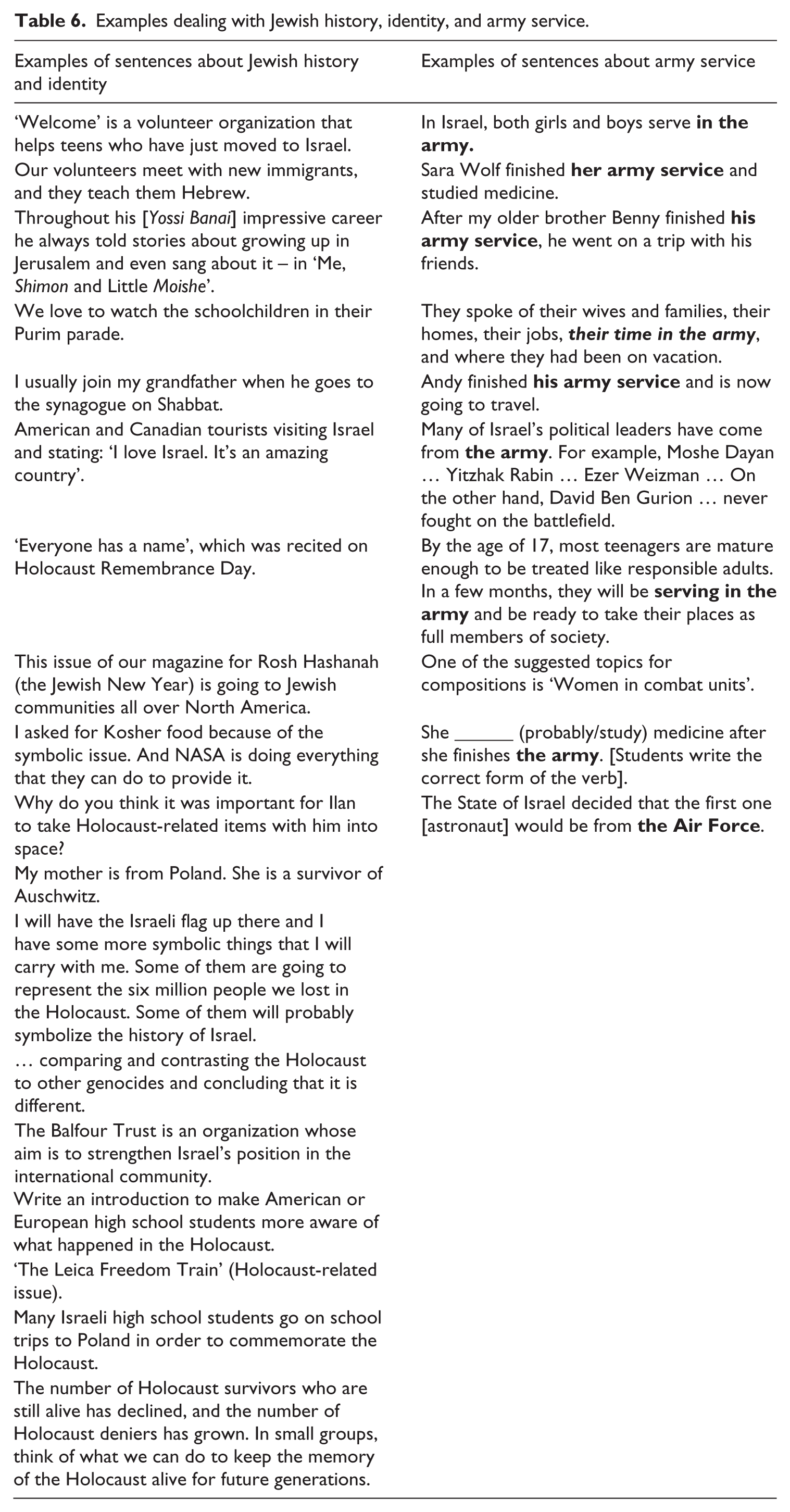
One way to linguistically indicate identity is by using certain discursive devices, such as indexical pronouns (as discussed earlier) or certain lexical items that aim at uniting a group under one national or ethnic identity. My assumption is that the narratives used in English textbooks formulate national identities and maintain collective memories. A national identity may emerge if a learner associates himself or herself with a character that ‘usually joins his grandfather when he goes to the synagogue on Shabbat’ (Maor and Zir, 2009: 66), or with a youngster who has ‘finished his army service and is now going to travel’ (Cohen et al., 2006: 31). Collective memories may also be maintained when Israeli-Jewish learners read about the Holocaust and how symbols of it were carried into space by the late Israeli astronaut Ilan Ramon that ‘represent the six million people WE lost in the Holocaust’ (Komet and Partouche, 2006: 48 (my emphasis)). To sum up, the inculcation of these and other symbolic national concepts such as the Israeli flag, celebrating Purim or Hanukah, or referring to places in Hebrew but with English transliterations may all function as building blocks that construct identity cons.
Data collection and data analysis
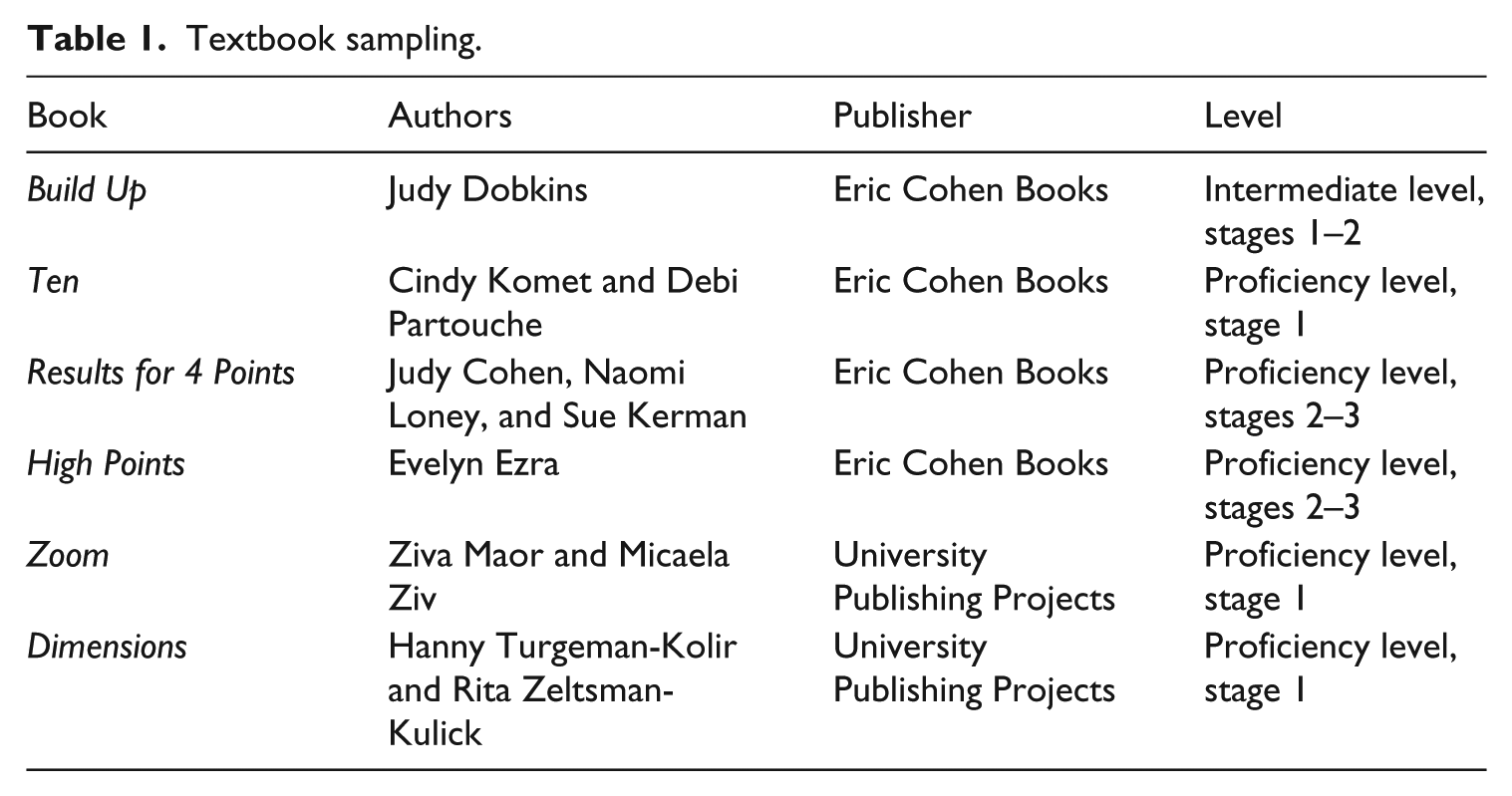
My research corpus consists of six English high school textbooks approved by the Ministry of Education, published by two different publishers and distributed to various Israeli high schools. The sample textbooks are listed in Table 1. The textbook analysis was based on the approach recommended by the TODA model (Fairclough, 1992) and the CDA model (Van Dijk, 2006, 2008). In launching TODA, Fairclough (1992) sought
to bring together linguistically-oriented discourse analysis and social and political thought relevant to discourse and language, in the form of a framework which will be suitable for use in social scientific research and specifically in the study of social change. (p. 62)
Textbook sampling.
Van Dijk (2008), however, emphasizes that ‘CDA is not a theory or a method of research, but an academic movement of scholars specifically interested in the analysis of fundamental social problems, such as the discursive reproduction of illegitimate domination’ (p. 822). The data analysis will be systematically presented according to the order of the discursive devices presented here.
Analyzing naming practices
Among all the names used in the researched textbooks, Western and American names were the most dominant (70% of the occurrences) (Table 2). The assumption that most textbook writers and designers associate English culture mainly with the United States and the United Kingdom is compatible with the recurrent use of Western and American names in the textbooks. Similarly, other researchers have found that locally produced English textbooks contained mostly British and Anglo-American cultural values, rather than globally oriented materials (Shin et al., 2011).
The distribution of people’s names used in the textbooks.
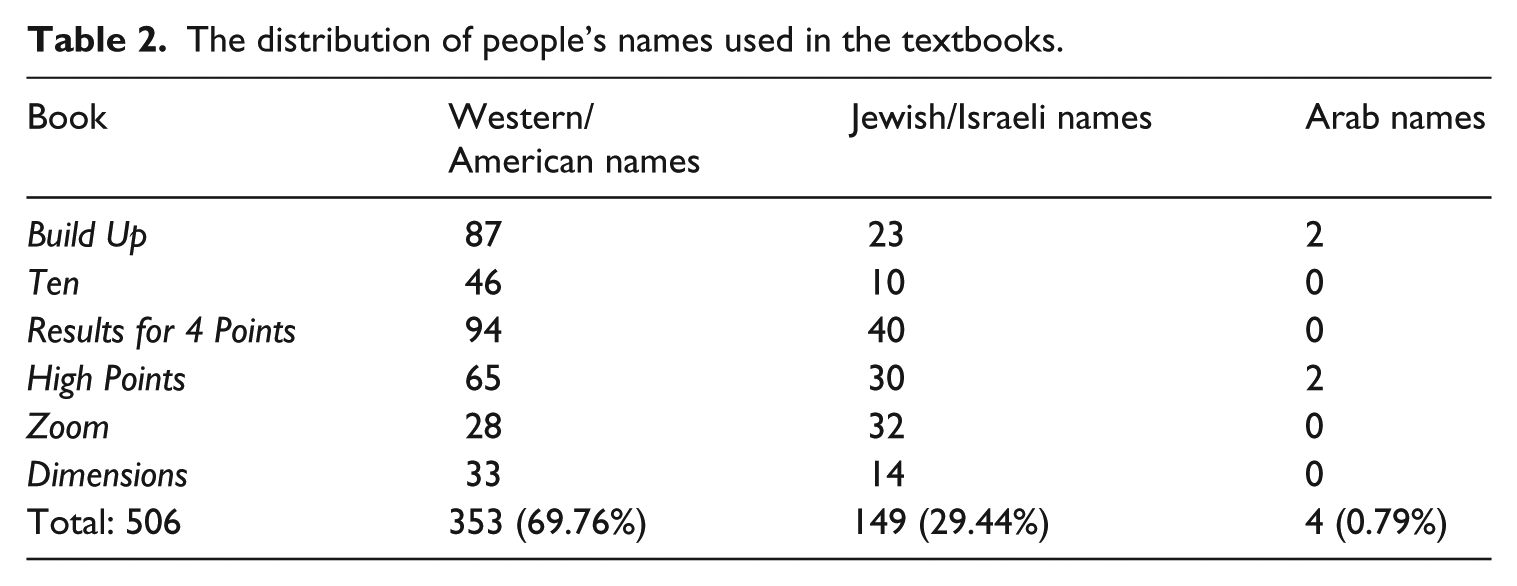
In addition, Israeli-Jewish names of people and places were used in almost 30% of the cases (Tables 2 and 3). One prevalent linguistic practice for presenting Jewish names (especially of places) was by an English transliteration of a Hebrew name despite the availability of an English alternative, for example: Kinneret or Tveria instead of Tiberius, Akko instead of Acre, and Agam Hula instead of Hula Lake. Furthermore, this linguistic practice was also employed to name Jewish organizations or social customs such as Galgal Bema’agal to refer to dancing in wheelchairs, Magen David Adom (Red Star of David or Red Mogen David) to refer to Israel’s national ambulance service, Matkot to refer to the paddleball game, Ulpan to refer to institutes for intensive Hebrew study for immigrants, and Rosh Hashanah to refer to the Jewish New Year.
The distribution of place names in the textbooks.
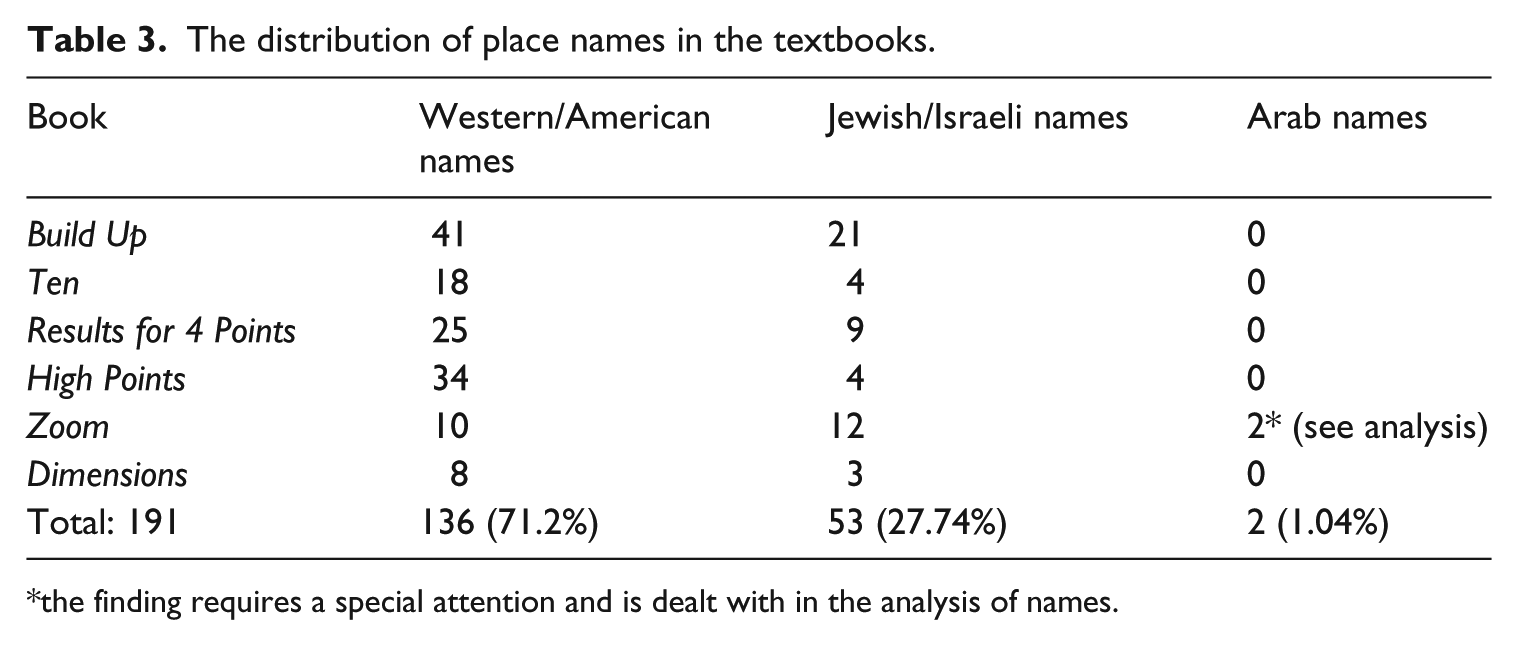
the finding requires a special attention and is dealt with in the analysis of names.
As opposed to the widespread Western-American and Jewish-Israeli names used, the study revealed an almost complete avoidance of using Arab names (less than 1%). While studying the textbooks, however, I did encounter the use of six ‘Arab’ names (out of 506) in contexts that need to be explained.
The first name (Muhammad; one occurrence) is used to refer to an Indian Muslim from Bangladesh who is a professor of economics and a Nobel Prize winner (Ezra, 2011: 40); so Muhammad is not an Arab. The second and third names (Mahmoud and Miriam; one occurrence each) are used to refer to Bedouins of the Negev. The two are discussed as members of Bedouin society without mentioning any details associating them with the Palestinian Arab minority in Israel, such as the fact that their native language is Arabic or that they form a part of this large minority. The implications of not referring to Bedouins as ‘Arabs’ in the only two incidences in which ‘Arabs’ are implicitly mentioned raise serious questions regarding how these textbooks present Arabs to Israeli learners. The narratives in which these two ‘characters’ are presented depict Bedouin society as underdeveloped and traditionalist and associate Bedouins with the desert and camels. Similar to the Indian ‘Muhammad’, both ‘Moussa’ and ‘Rokia’ (supposedly Arabic names) are used (one occurrence each) to refer to children from Mali who are Muslims, but not Arabs. Again, the narrative depicts their environment as poor, underdeveloped, extremely needy, and dependent on the ‘good-hearted and generous’ West for support. Therefore, these two appearances of ‘Arab’ names obviously do not represent Palestinian Arabs living in Israel.
Finally, the last Arab name, ‘Samira’, was one of the most questionable instances I encountered. The relevant text (Dobkins, 2008: 37) mentions students from Herzog School acting as volunteers and Samira as one of them. It soon becomes obvious that Herzog School is not an Arab school, so including a girl with an Arabic name (Samira) among eight Western and Jewish names without bothering to place her in her natural cultural setting seems incongruous. The situation would have been different had Samira been a Palestinian Arab studying in a Jewish school (an unusual occurrence). In fact, if adequately presented, a text about a Palestinian Arab student studying in a Jewish school could have offered a new ideological challenge for Israeli learners, Jews and Arabs alike.
Analyzing the textual use of indexical pronouns
Establishing an interactional in-group or a nonreciprocal out-group feeling may be achieved through the use of ‘we’ or ‘us’ and might indicate a desire to include a certain group of people while excluding others. In my analysis, I encountered numerous usages of the pronoun ‘we’ that might be interpreted as ideological discursive devices which, intentionally or otherwise, include Jewish-Israeli learners and exclude Palestinian Arab ones.
It is worthy of mention that analyzing the use of singular pronouns such as I versus he or she, for example, complements the analysis of the plural pronouns We/They as components in constructing Self–Other dichotomies. Furthermore, the use of the direct pronoun You to address readers may also be used to create an in- or out-group feeling, especially if what ‘you’ are asked to do or think about does not conform with what you really do or think about in reality.
The most prominent use of pronouns as a discursive device for forming in- or out-group feelings was in the text involving an interview with the late Israeli astronaut, Ilan Ramon (Komet and Partouche, 2006: 47). The text highlighted the central role of Ramon’s Jewish national identity through facts such as his having been born to Holocaust survivors, having served in the Israeli Air Force and having participated in famous Air Force attacks, among other things. All of these details were presented as reasons motivating Ramon to become Israel’s first astronaut and why ‘
Ramon seems to use the pronoun Some of them are going to represent the six million people lost in the Holocaust.
Nonetheless, the use of ‘we’ puts emphasis on the loss of 6 million people as being the loss of the Jewish people only, as opposed to a more universalist view that would also consider it a loss for all of humanity, in addition to the obvious loss for the Jewish people. On one hand, students of all backgrounds should be able to relate to the Holocaust from a humanistic perspective and realize the implications of this horrible atrocity, while on the other hand sympathizing with the impact of this tragedy on the Jewish people. However, when some students are treated as ‘outsiders’ in school textbooks, whose ostensive aim is to teach all students about the Holocaust, they may not be able to form the appropriate attitude.
Analyzing the use of the passive/active voice when referring to the Other
In analyzing the narratives and texts referring to the Other (who may be non-Western, non-Jewish, or nonmainstream), I have noticed that these narratives tend to use the passive voice. Members of minorities are presented in some of the textbooks as examples of people who have managed to succeed despite difficulties. Such characters (whether African-Americans, Bedouins, Indians, or members of other minority groups) are depicted in the passive voice, thus emphasizing that their success was determined by another explicitly or implicitly mentioned agent (usually American, British, or European) that intervened and changed the course of their destinies. On the other hand, inspiring stories about people who originated from similar conditions but are members of the prevailing majority are depicted in the active voice as agents of their own change. An example of such a distinction may be found in the English textbook Results for 4 Points, in which two juxtaposed texts describe teenagers who have overcome failure. The first character is Ryan, a Black ‘dropout’ from Britain (who is explicitly referred to in the text as a minority child), and the second is Liz, a White homeless teenager from New York. Ryan is depicted as follows:
As part of a remarkable social experiment, Ryan Williams, a black teenage dropout, It wasn’t always so … he might easily have ended up in jail. What this demonstrates is that in the right environment, children’s lives
Ryan’s success, then, was determined by someone else’s initiative (Pepper Productions) and he was accepted at one of Britain’s top schools not due to his resourcefulness or that of his mother, but according to somebody else’s choice. Thus, Ryan’s excellence was determined by an outside force, namely Pepper Productions, which gave him the opportunity to excel, assigning the boy himself a passive role.
As opposed to Ryan’s passive representation, Liz Murray, a White New Yorker who was also doomed to failure, is described in the active voice, as demonstrated by the following excerpt:
… Liz Murray
The succession of active verbs in this excerpt depicts Liz as an energetic, motivated, and self-determined young woman who is moved by inner forces and not dependent upon external ones. Throughout the text, Liz’s decisions are unaffected by anything but herself and her will to change the status quo. As opposed to Ryan, who is referred to as a ‘black . . . dropout’, she herself made the decision to drop out of school, as well as that to go back to school and resume her education. Ryan, as mentioned earlier, ‘was placed’ back in school after his mother ‘was approached’ by Pepper Productions.
The use of active/passive voice may, of course, be motivated also by various nonideological factors. One may perhaps claim that the choice of active/passive voice is not ideologically motivated. Yet these two examples of almost ‘minimal pairs’ illustrate how a writer’s choice of a certain grammatical feature (i.e. active or passive voice) may reflect underlying assumptions regarding certain religious, ethnic, disabled, gendered, or culturally different groups. Thus, choosing grammatical forms may affect readers’ attitudes and ideological positions, functioning as a tool for maintaining or creating stereotypes and prejudices concerning the Other. Members of minority groups must depend on the intervention of [“good-hearted”] White people, who are [“always prepared”] to offer them ‘the right environment’, so that every ‘black’ child’s life (like Ryan’s) ‘can be changed’. (See the above quote from Cohen et al., 2006.)
Another example of this is in an article about Miriam, who is described as an exceptional young Bedouin woman who was not like ‘most Bedouin women who …
Although Miriam herself, as opposed to the other Bedouin women in her society, is not directly depicted in the passive voice, she is definitely assigned a passive role when ‘chance’ intervenes in her life course. Had it not been for the British woman, Miriam could probably not have ‘made it’ as a non-typical entrepreneur since ‘it was she [the British woman] who ultimately made it possible for Miriam’ to be taken out of her traditional society, where she would presumably have entered into an arranged marriage, like all the other Bedouin women.
Analyzing the use of explicit statements to define the target audience
Van Dijk (2006) claims that writers usually determine local meanings by being explicit. Basing myself on Van Dijk (2006), I would like to suggest that through the use of explicit statements containing the terms ‘Western’, ‘American’, or ‘Jewish’, writers are targeting their texts at Jewish learners only. Examples of utilizing such explicit statements in English textbooks are demonstrated in Table 4.
Examples of explicit statements associating the target audience with the West.
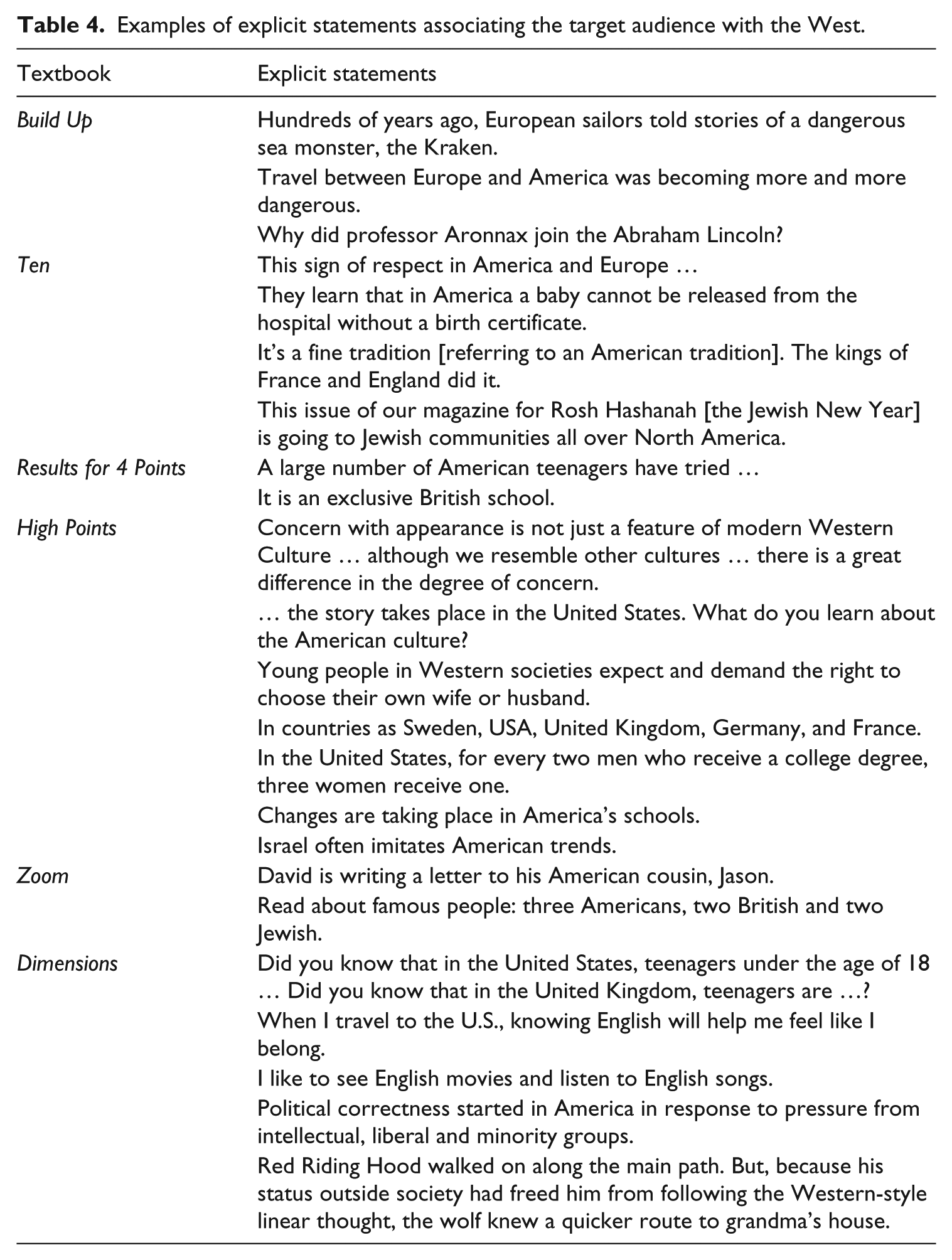
One editorial text entitled ‘You and the People Around You: International Teen Magazine’ discusses international teen issues for the ostensible purpose of finding common ground. However, the text opens by explicitly stating, ‘Did you know that in the United States, teenagers under the age of 18 … Did you know that in the United Kingdom, teenagers are …’ (Turgeman-Kolir and Zeltsman-Kulick, 2008: 32). The editorial exclusively discusses issues involving American and British teenagers, hence limiting the all-inclusive term ‘international’ to two countries only, namely, the United States and the United Kingdom. An international coverage of teenage issues might have presented problems of teenagers in various parts of the world characterized by different social, cultural, or religious customs and conventions.
Thus, the hegemonic role given to the United States and the United Kingdom in discussing international affairs may allude to an intentional policy of presenting these countries as dominant forces in the Western world. This serves to fix Israel as a supporter of Western – chiefly American – hegemony in the minds of learners. The desire to connect Israel to the West and specifically to America is evident in explicitly stating that ‘Israel often imitates American trends’ (Ezra, 2011: 102) or in creating an explicit bond between Israeli Jews and Americans/Westerners by stating, for example, that ‘David is writing a letter to his American cousin, Jason’ (Maor et al., 2009: 16) or ‘We are visiting my grandparents in London this week’ (Dobkins, 2008: 27). This emphasis on the fact that Israeli Jews have blood relations in the West further supports my assumption regarding the tendency of English textbooks to associate Israel with the West. It may also be argued, however, that in creating such a close bond between Israel and America or Britain, an even closer bond is created among certain mainstream Israeli-Jewish groups – who are probably also upper-middle class – to whom America or Britain (metonymically representing Europe) are their homeland countries/cultures.
Analyzing the use of narratives from remote cultures: Negative or positive representations?
Including culture as a significant component of language learning is a principle implemented in English textbooks as required by the English curriculum. Analyzing the content of how other cultures are presented in six English textbooks has shown incidences involving remote cultures (e.g. Indian, Chinese, or Pakistani). However, no fair and accurate description of local Palestinian Arab culture was presented, since the only two examples offered in the textbooks dealt with Bedouins (without referring to them as Arabs). In one of the teaching units entitled A World of Stories, the theme is the universal role of storytelling and fairytales in different cultures. The unit highlights the common features of storytelling and the universal values appearing in this literary genre, such as love, hate, jealousy, and betrayal. It is obvious, then, that the unit’s main objective is to increase students’ intercultural awareness. Therefore, fairytales and folktales from China, India, and Ethiopia are presented. These are juxtaposed, however, with popular Western fairytales such as ‘Snow White’ and ‘Cinderella’.
One text reviews the history of fairytales and informs students that the best-known fairytale ‘Cinderella’ can be traced back to 9th-century China. However, when adapted for the West (by the German Brothers Grimm), these tales are edited and changed through ‘removing the darker and more terrifying elements of the stories’ (Turgeman-Kolir and Zeltsman-Kulick, 2008: 95). The underlying message here is that there is a dark aspect of Chinese culture that cannot be adopted by the West without undergoing a critical editing process. The example provided to support this claim in the text is that in the original Chinese version of Cinderella, the older stepsister cannot get her big toe into the glass slipper, so her mother hands her a knife and tells her to cut it off, since once she is queen she will no longer need to walk, so the daughter does as she is told. These words create an image of violence and mutilation in the reader’s mind which, it could be fairly argued, is not an exclusively Chinese characteristic. In fact, it is a feature commonly manifested in Western literature and filmmaking. In other words, when learners read about these negative violent images as deriving from Chinese culture and rejected by Western culture, they may unconsciously form a negative attitude toward Chinese culture and a positive attitude toward Western culture. The use of such discursive strategies may perpetuate prevailing Western stereotypes regarding other cultures, which mainly depict them as inferior. This is achieved, however, as Van Dijk (2006) suggests, through Self-positive as opposed to Other-negative representations.
The following example (from the English textbook Building Blocks) describes touring the Negev and is entitled ‘Desert camel tours in the Negev’. It opens as follows:
On our tour, we use the desert’s most ancient form of travel – the camel. (Dobkins, 2008: 10)
Unsurprisingly, we are presented with ‘Mahmoud’, a guide for desert travelers. The narrative portrays a scene in which Western travelers are wandering in the desert on camelback guided by a Bedouin Arab wearing a ‘galabiya’ (a long cloak) and an ‘iqal’ (a white head scarf), which are traditional Arabic clothing. The text is accompanied by a photograph showing the travelers (Western-looking in clothes and appearance) on camelback accompanied by a Bedouin guide, who is leading the camels and carrying a shepherd’s Crook.
My claim is that such a representation may imprint a stereotypical image of Arabs on learners’ minds. Numerous studies involving Western images of Arabs have revealed ‘a strong anti-Arab bias as reflected in the public’s negative stereotypes of Arabs – their society, culture, and institutions’ (Hamada, 2001: 7). These stereotypes might create a negative attitude toward the Palestinian Arab minority, which deserves to be more fairly represented in English textbooks. This by no means suggests that Bedouins are not worthy of representing the Palestinian Arab minority, but when they are presented as the sole representatives without mentioning the other groups who form this population, or the fact that they are Arabs, this is definitely inadequate. Furthermore, it is worthy of mention that a large number of Bedouins in Israel are urbanizing, thus, living in cities and leading a modern ‘Westernized’ lifestyle.
Analyzing the use of culturally specific prior knowledge in reading comprehension texts
The problematic aspect of cultural knowledge arises from the fact that textbook writers (who are mostly native English speakers) assume that what they consider to be common knowledge of Western culture is indeed available to all English learners. Culturally specific prior knowledge entails a familiarity with common Western or American cultural symbols starting with knowledge of central locations (such as Fifth Avenue), famous people (such as Abraham Lincoln), movies or TV programs (such as Friends), and ending with knowledge of abstract notions such as ‘Murphy’s law’ or ‘progressive Berkeley’. Table 5 demonstrates some of the examples observed in my analysis of the English textbooks. When texts mention the names of supposedly well-known American or Western personalities such as Abraham Lincoln, Stephen King, or Stephen Hawking, the underlying assumption is that they are well-known to everybody, whereas this does not conform to reality. Furthermore, comprehension questions that usually follow reading texts ask students to connect between these characters and find out what they have in common. Students who are unfamiliar with them and their position in American and British culture/history will be incapable of drawing the required conclusion and thus will be unable to perform the task.
Examples of culturally specific prior knowledge in English texts.
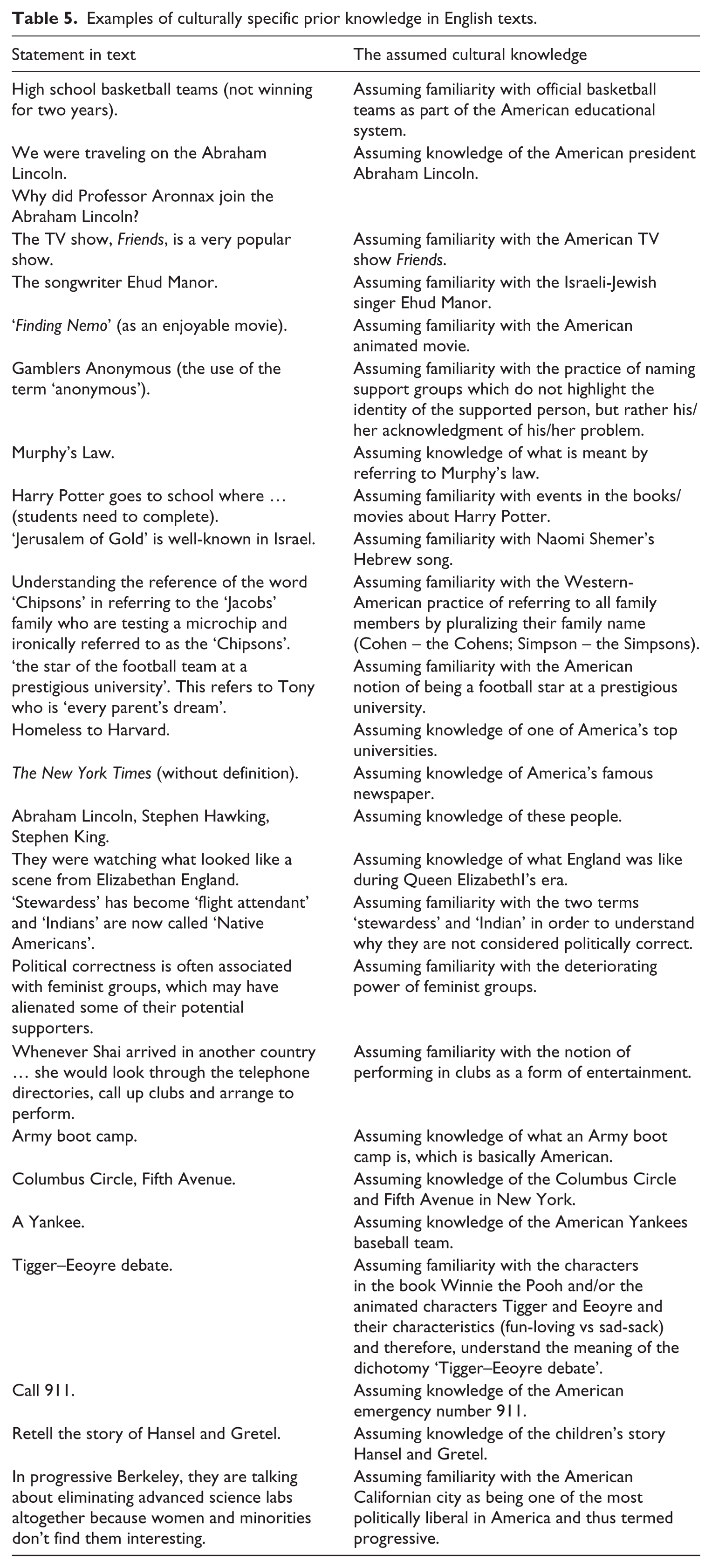
Other texts focus on topics dealing with the history, lifestyle, and/or other social-cultural aspects of the United States or Britain. For example, in a text about the Great American Depression of the 1920s, the text mentions well-known American locations such as Columbus Circle, Fifth Avenue, and Central Park without indicating that they are major New York venues. These and other American localities and cultural symbols are only known to native speakers of English or specific groups of Israeli learners.
Assuming that most Israeli students have early contact with English through family, travel, or meeting overseas visitors is like assuming that most Israelis (Palestinian Arabs as well as other underprivileged Israeli citizens) are established middle-class citizens, whereas the actual socio-economic situation is quite different. Therefore, the intensity of Western/American culturally oriented information in English textbooks, which often constitutes the basis for comprehending English passages, is excessive and constitutes an insensitive, one-dimensional, and even ‘naïve’ view of the status of EFL in Israel.
The English textbooks studied seem to be chiefly based on Western culture and ideology that are mainstream and metropolitan in nature. Teaching English through the use of narratives depicting one sector of privileged people who share similar speech practices, customs, lifestyles, and behavior constructs an image of English being associated with these commonalities. However, this may not be considered positive by everyone. The exclusiveness of these narratives may well increase feelings of hostility and alienation among people who do not associate themselves with mainstream Western culture.
Analyzing the use of discourse for constructing identities and collective memories
As noted earlier in this article, school textbooks are used as agents for producing and perpetuating national identity and collective memory. In Israel, Zerubavel (2002) maintains,
… as is typical of conflictual societies, and especially since the Jewish ethno-nation is a mixture of people from all over the world with hardly anything in common, questions of collective and individual identities are still ‘passionately’ debated and often become heated arguments and even history wars.
Therefore, textbook writers tend to include materials that comply with the dominant ideology of educational policy makers. These materials include ideas, symbols, practices, and historical names and figures that are the foundation of Jewish-Zionist national identity and collective memory. Textbook writers are, as Bernstein (1996) puts it, ‘working in the field of re-contextualization’ and thus contributing to the perpetuation and reproduction of already existent features of identity and memory.
When a text states that ‘many of Israel’s political leaders have come from
On the other hand, Palestinian Arab learners, who do not serve in the Israeli army, have different ways of constituting their national identity as Palestinian Arabs living in Israel. The problematic aspect of dealing with the issue of army service among Palestinian Arabs is their common rejection of the role the Israeli army plays against the other Palestinians in the Occupied Territories. The repeated use of such narratives excludes Palestinian Arab learners and contributes to their out-group feeling.
The last point to be made in this section involves the choice of lexical words that might create a Jewish national bond. Examples would be words and phrases relating to the Holocaust, such as ‘Holocaust survivor’, ‘Auschwitz’, ‘Holocaust Remembrance Day’, ‘commemorating the Holocaust’, ‘annual trips to Poland’, ‘Holocaust deniers’, and so on (Table 6). All of these terms unite the Jewish people by one shared collective memory that aims at keeping the memory of the Holocaust alive and central to Jewish-Zionist identity. Other narratives use terms such as ‘the Israeli flag’, ‘synagogue’, ‘Purim’, ‘kosher’, and so on, which may cause the Jewish learner to identify passionately when reading these narratives and engaging in the discussion activities that follow them. These passionate feelings experienced by Jewish learners are hardly experienced by their counterparts, Arab learners, who may not sympathize with or even understand the symbolic significance of such words. The analysis of the ideological roles of English narratives has revealed prominent use of the army service issue as a major constituent of Jewish national identity and repeated use of Jewish/Zionist notions as major constituents in Jewish collective memory.
Examples dealing with Jewish history, identity, and army service.
EFL materials: A means of reproduction or change?
The national English curriculum is one of the official determiners of English language policy and planning in Israel. It claims to provide an overall set of principles as guidelines for EFL teachers, whose aim is to reach the utmost level of proficiency in the target language. Nevertheless, the curriculum emphasizes that English teaching in Israel should be autonomous and varied due to the diversity of Israel’s learning population.
Although the curriculum ostensibly promotes autonomy, teachers are still bound by the instructions provided by the English inspectorate. Spolsky and Shohamy (1999) support this claim and state that the matriculation exam has often served to promote what is perceived by the English inspectorate as desirable. They further state that other decisions concerning the teaching of foreign languages in Israel are ‘in part educational, but in large part they are influenced by political and cultural and other factors’ (Spolsky and Shohamy, 1999: 45). Thus, English teachers are left with no choice but to limit their teaching materials to those offered by the inspectorate, mainly its authorized textbooks. Shohamy (2003) relates the policy for teaching EFL in Israel to the general top-down imposition of Language Educational Policy (LEP) where there is a ‘limited representation of broad sectors of the population in decisions and in implementation of the LEP, even though they are strongly affected by it’ (p. 282). Thus, the current Israeli LEP serves the interests of the dominant groups who impose their ideologies through the educational system.
The freedom of action of each component within the English Language Teaching (ELT) educational system (i.e. inspector, teacher, and learner) can be conceptualized in the perception of the person as an individual, a subject, or an agent. Sensitivity to the differences among these three approaches to human beings might contribute to our analysis of how textbooks reproduce mainstream ideologies and shape learners’ ideological viewpoints.
First, the notion of an individual relates to an enlightened and modern Western person, who is viewed as free and rational. The Western individual is cohesive, having no inner contradictions:
The individual is able to act upon his decisions and take responsibility for these actions. He may listen to different suggestions, then apply his own scientific logic and draw conclusions. In doing so, he makes a contribution to the benefit of the human race. (Kuzar, 2011: 224)
As opposed to the free and rational individual, the subject, in psychological Freudian terms,
… often acts in an irrational manner, driven by factors he has no control over. The subject may develop some self-awareness, but this ability is limited. (Kuzar, 2011: 226)
Althusser (1977) postulates that a subject may be subconsciously ‘interpellated’ without his being aware that this is taking place:
The representation of a person as an individual in possession of free will and free choice is itself an effect of ideological interpellation. (Kuzar, 2011: 226)
The interpellation of subjects is, therefore, ‘the process that constitutes the person as an ideological subject’ and in which the subject is summoned by authoritative ideologies. Althusser terms these (i.e. the media, educational texts, textbooks, or religions) ‘ideological state apparatuses’ that usually share a common ideology. Furthermore, subjects conform to ideological state apparatuses without being aware of doing so. It is important to understand how these ideologies interpellate subjects in modern Western states, where free will and choice are valued. This article is specifically concerned with understanding how modern Jewish-Israeli ideological interpellation operates. Kuzar (2011) suggests that in the modern Jewish nation,
The common […] denominator includes the self-image of the Jewish collective as a modern nation getting built in the land of Israel, i.e. Zionism. If the dominant ideology is successful … they develop an ideological mixture based on what they share with the western world on one hand and on their specific membership in the Zionist collective on the other. (p. 226)
Regarding textbooks and curricula, subjects might unconsciously conform to textual ideologies and participate in reproducing dominant mainstream ideological discourses. In such a discourse, an ‘inner voice’ in the text addresses readers/learners, continuously informing them of which type of intergroup relations to formulate (i.e. with the ‘in’-or ‘out’-group), which knowledge to construct, and which values or images of the Self/Other to accept or perpetuate. This could be done, for example, through presenting ‘Us’ in a positive and progressive manner (e.g. the right of Westerners to choose whom to marry) and ‘Them’ in a negative and less progressive manner (e.g. arranged marriages in traditional groups such as Bedouin society). The choice of clause type may also convey to the learner what ideas about people to form, for example, by using the active voice to positively represent an assertive, initiating character and the passive voice to represent a less positive, dependent one. Thus, if students constantly read about the essential role of army service in achieving future success, they will internalize a favorable attitude to those who serve in the army and an unfavorable one toward those who do not. Ideological interpellation might cause students to carry this value with them into their everyday encounters outside the classroom, thus contributing to the perpetuation of this and other such values promoted by textbooks.
However, situations in which the interpellated subject is exposed to conflicting or controversial ideological texts might awaken in him or her an inner voice of logic urging him or her to question and eventually object to textual representations of inequality, discrimination, or denial of the Other. In other words, viewing the person as a subject only ignores the potential of some individuals to go against dominant ideology. It also ‘understates the capacity of subjects to act individually or collectively as agents, including engagement in critique of, and opposition to, ideological practices’ (Fairclough, 1992: 91).
It appears, then, that alongside the passive interpellated subject there is also an agent, who is ‘endowed with a logic that is not fully predictable and can be creative, in which case it may be subversive’ (Kuzar, 2011). Therefore, the subject and the agent are not dichotomous but rather complementary representations of a person. In order to activate the agentive aspect of interpellated subjects, we need to offer them ideological challenges – that is, conflicting texts – that would result in subversive thinking, sometimes directly opposed to mainstream thought.
School textbooks could offer an ideologically creative challenge if they presented an alternative narrative (unlike the previously described one) that focuses on individual merit rather than on majority based distinctions (such as army service). Reading such texts would allow individuals to acknowledge and implement sound principles governing human relations (i.e. judging people on individual merit) and might, as a result, change their attitudes toward others.
English inspectors, teachers, and/or learners should be able to change the educational status quo prevalent today of unequal educational opportunities for the Palestinian Arab minority, deliberate or otherwise. If they are creative enough, they might even offer an alternative to current materials, textbooks, and cultural contexts. Jewish mainstream educators and students might become aware that Israel, although ethnically and religiously divided, is still a multicultural state, giving them the opportunity to become more committed to universal human rights, which call for equal opportunities for all. At the same time, Palestinian Arab teachers and learners might realize that although the educational system seems to discriminate against them, they must make a greater effort to reach a higher understanding of their role as agents and act to replace the status quo of underachievement, lack of equal opportunities, and frustration with a better reality.
This article advocates that people affected by discursive practices struggle to transform social conventions. In order to struggle against the controversial meanings offered in school textbooks, individuals must critically examine the linguistic signs they encounter in texts. In order for the subject to become an active agent, textbook designers must choose their materials more critically, bearing in mind Kuzar’s (2011) statement:
… the more creative the agent becomes in applying his logic, the better the chance for him to become subversive, hence doubting and challenging the premises of his native ideology. (p. 228)
This position is inspired by Certeau’s (1984) postulation that language can be used both to reproduce and preserve social conventions and to effect social change. As a tool, language might set in motion particular types of social processes that should be examined within a discourse community. Furthermore, learners and teachers need to be aware of the socio-political nature of language as a system of signs in order to become critical readers of the textbooks they use. In this context Kress (1993) states,
On the one hand all signs are metaphors; hence code ideological positions in that they realize the social, cultural and therefore political position of their producer. On the other hand all signs are thus equally subject to critical reading. (p. 174)
To conclude, learners and teachers should internalize the fact that signs are not innocent, and therefore every text may and should be subjected to critical reading (Kress, 1993: 174).
Conclusion
The cultural suitability of English textbooks has been examined in this study in an attempt to check whether their cultural content caters to the Palestinian Arab cultural milieu. Discourse has been viewed as a special practice which is imbued with power and ideology, and therefore, a discourse analysis of the English textbooks has been conducted.
Textbook analysis has shown how through the reoccurrence of Western and basically American and Jewish culturally based issues, the textbooks interpellate English learners as Western oriented Jewish-Zionist subjects, thus contributing to the reproduction and perpetuation of Western and Jewish hegemony. Besides serving as a tool for perpetuating and reproducing dominant mainstream ideas, English textbooks in Israel reinforce the marginalization of the Palestinian Arab minority.
To sum up, it should be noted that students learn from their schoolbooks and mostly ‘learn to present interpretations as facts, to insert personal views into seemingly neutral representations; in short they learn the language of power’ (Coffin, 1997, cited in Peled-Elhanan, 2012: 231). However, textbooks are duty bound to offer learners a language that represents facts and views of other people. This article has presented preliminary concerns regarding the ideological nature of the language used to teach and learn English in Israel. It did not, however, study the effects the cultural aspects of this language could have on comprehension or on learners’ attitudes toward the target language. A future study is required in order to determine the pedagogical role of these English textbooks in impeding language acquisition processes, and if they do, the need for change may become even more obvious.
Footnotes
Funding
This research received no specific grant from any funding agency in the public, commercial, or not-for-profit sectors.