



Abstract
This article advances a synthetic framework for examining the relationship between affect and power. Combining critical discursive psychology with analyses of stance and emotion thematization, the framework enables a dialogic analysis of the macro and micro levels on which affect weaves into social life. The approach is applied in an analysis of women’s talk about their hair, which they construct as ‘black’ or ‘African’. Guided by the notion of ‘affective-discursive practice’, the article investigates the relationship between affect and meaning-making revealed in talk, as well as relations of power that arise from it. In the analysis, individuals are found to articulate their affective experiences in unlike ways and to hence position themselves differently in relation to the hegemonic discourses of beauty and race. The article discusses how the dialogic research on affect and discourse enriches our understanding of the role of feelings in the micropolitics of everyday life.
Keywords
Introduction
The analysis presented in this article is part of a larger study on the discursive constructions of body and beauty among women in post-apartheid South Africa. The participants’ relationship with their bodies was found profoundly affective and mediated by the global and local discourses of race and gender. A strong mediation of some of the discourses raises the question of the relationship between body, affect and power. Investigating this relationship, the article disputes the so-called ‘affective turn’ in humanities, that is, the scholarship that regards affect as a-social and non-discursive. This article seeks to reclaim the notion of affect for discourse studies both conceptually and analytically. It advances and empirically applies a framework that combines critical discursive psychology (henceforth DP) and – its cognate DP of affect (Wetherell, 2012) – with analyses of stance (Biber et al., 1999; DuBois, 2007) and emotion thematization (Fiehler, 2002). The framework is applied in the analysis of women’s talk about their hair, which they referred to as ‘black’ or ‘African’.
Affective turn versus discourse analysis
Affect has its moment in social sciences. The ‘turn to affect’ has given rise to numerous discussions of affect as autonomous, that is, somatic, a-social and a-cognitive. This conceptualization has been questioned on a number of accounts (e.g. Hemmings, 2005; Leys, 2011). Importantly for this article, separating the affective and social entails what Wetherell (2012) calls the ‘rubbishing of discourse’. For authors identifying with the non-representational approach to affect, ‘it sometimes seems that what is most exciting about affect is that it is not discourse. Affect seems to index a realm beyond talk, words and texts, . . . and beyond conscious representation’ (p. 19). Discourse analysis has been challenged insofar as it allows studying talk about affect, rather than affect itself (Blackman and Cromby, 2007). Such studies are said to at their most ‘[point], more or less imperfectly, to a realm of affect and feelings [and thus provide] . . . tangential evidence for their presence’ (Blackman and Cromby, 2007: 19). Discourse analysis is moreover considered to reduce the body to ‘the inert mass or dumb materiality of corporeality’ (Blackman and Venn, 2010: 16) and even to ‘[write it] out of critical psychological theory’ (Blackman and Cromby, 2007: 6). While discourse analysis, most probably like any approach, has its limitations with regard to examining affect, repudiating its relevance to affect studies could be disputed on a number of grounds. 1 This article defends the relevance by observing the tangled dynamic of the affective and socio-semiotic processes within the ‘extended present moment’.
Defining affect
The notion of ‘extended present moment’ is advanced by Wetherell (2012) in opposition to defining affect as instantaneous somatic arousals, which she considers reductive and falsifying. Critical of the arbitrary divisions between feeling and signification, Wetherell (2012: 83) writes: Perhaps we ‘live’ not quite in the active chronological moment of the turn-by-turn, but most strongly and personally in the narratives ruminating on some outburst of affect after it has taken place, whether these are narratives told to others, or narratives rehearsed internally to ourselves?
From the perspective of the non-representational theory of affect, once affect is given a meaningful referent, it becomes an emotion. Indeed, the distinction between an intensity felt by the body and a feeling with a ‘“narrativized” content . . . shaped through specific cultural, social, and political contexts’ (Rice, 2008: 201) makes sense. However, to what extent discourse and affect feature experience as separate is speculative considering the tangled, unstable constitution of the affective domain: In affective practice, bits of the body . . . get patterned together with feelings and thoughts, interaction patterns and relationships, narratives and interpretative repertoires, social relations, personal histories . . . Somatic, neural, phenomenological, discursive, relational, cultural, economic, developmental, and historical patterns interrupt, cancel, contradict, modulate, build and interweave with each other. (Wetherell, 2013: 13–14)
This conceptualization does not radically differ from how the role of affect in subjectivity processes is construed in the affective turn scholarship. Its theorists too emphasize the complexity of the human subject, the subject’s non-finiteness, instability, as well as intersubjective and interobjective entanglement. Regarding the latter, the idea that sensations are produced and experienced transhumanly (by and beyond humans), and shared by bodies (often non-consciously), has been interestingly pursued in research on, for example, trauma (Walkerdine, 2010), media consumption (Featherstone, 2010), well-being (Andrews et al., 2014) and the health impact of music (Andrews, 2014a). The role of the material and nonconscious in subjectivity processes cannot be overrated in light of the exponential growth of socio-technological developments such as algorithmically managed new media, clout computing, software databases etc. These developments raise the question of ‘spacing the subject’ within the ‘spatio-temporal atmospheres’ that modulate human attention and shape sociopolitical life below the threshold of observability and meaning (Featherstone, 2010; Simpson, 2017: 9).
Nevertheless, the article considers, while it strengthens the understanding of subjectivity processes, this perspective does not imply that the processes need not be examined discursively. The ‘rubbishing of discourse’ makes the affective turn scholarship prone to the same kind of criticism that its authors have leveled against discourse studies. For example, it leads to the omissions and reductions that stem from reliance on a specific analytic (Papoulias and Callard, 2010). Perhaps the major methodological predicament posed by the arbitrary separation of discourse and affect is that it makes the latter un-researchable (Pile, 2010; Wetherell, 2012, 2013). The unfeasibility of the separation is often acknowledged by researchers pursuing the autonomous status of affect (e.g. Andrews et al., 2014; Walkerdine, 2010). That these studies eventually provide discursive representations of what their authors consider as a-discursive highlights two related concerns: over the actual possibility of presenting events before they acquire meaning and over the scope of the non-representational accounts of affect beyond individuals’ self-reflection upon it (Andrews, 2014b; Cresswell, 2012b; Kearns, 2014).
Among studies defying the divide between sensing and sensibility are the analyses that investigate the power implications of what they variously (often interchangeably) term as feelings, emotions and affect (e.g. Breeze, 2018; Buttny and Elllis, 2007; Kemper, 1990; Lutz and Abu-Lughod, 1990; Piwoni, 2018; Yam, 2016). The studies cast a sidelight on another point which this article finds problematic in the affective turn – the fact that the scholarship under its rubric has been referred to (though, it seems, not commonly) as Critical Affect Studies (Rice, 2008). In academic scholarship, this article observes, ‘critical’ designates a research position interested in exposing relations of power (Billig, 2003: 37–40). Despite affective turn scholars’ engagement with politics (e.g. Amin and Thrift, 2013), it remains disputed whether such research can be conducted on affect that is defined as flows of energy, combinations of hormones and so on.
The ‘asocial implications’ (Nash, 2000: 657) of the non-representational approach to affecting subject have been noted by numerous researchers (Cresswell, 2012b; Thien, 2005; Tolia-Kelly, 2006; Wylie, 2010). Addressing the critique, affective turn scholars (e.g. Amin and Thrift, 2013; Colls, 2012; Saldanha, 2010) have, for example, sought to acknowledge differences between subjects yet without compromising the idea that meanings and differences are produced in action (rather than via pre-existing structures or discourses), and that the emergent differences between affecting subjects are not oppositional or hierarchical (Cresswell, 2012b). Yet, as a consequence, the non-representational approach to affect is still found to invoke the unmarked, universalist subject; to leave unaccounted for social injustices and differences in agency; and to obscure the stability of the differences by emphasizing the creative power of affect (Cresswell, 2012b; Simpson, 2017). In other words, studies under the rubric of the affective turn fail to demonstrate the awareness that while ‘encounters between affecting bodies “exceed the boundaries of reified identities”, which demands that we focus on the contingent nature of identity, belonging and power, they also demand that we keep hold of how societal attitudes, discourses and categorisations shape and constrain them’ (Wilson, 2016: 5).
Observing the polarizing relationship between the affective and discursive turns, Moreno-Gabriel and Johnson (2019) advocate what they consider as a more dialogic shift in research on affect, namely, the ‘reparative turn’. Drawing from Sedgwick (1997), the authors distinguish between the ‘paranoid’ and ‘reparative’ reading, the former consisting in interpreting ‘hidden’ meanings and structures and emphasizing their repressive implications, the latter replacing such interpretations with ‘close/surface’ reading of immediate experience. Advocating the latter, Moreno-Gabriel and Johnson (2019) argue in favor of research based on rich descriptions of individuals’ accounts that are not ‘too concerned with [scholarly] theorization’ 2 (p. 9) and are preferably reinforced by the use embodied methodologies, which ‘get the body more conspicuously involved in the act of “reading”’ (p. 19). Interestingly, what the authors recognize as the main challenges of the reparative turn is a low level of the body’s involvement in the reparative research process and analysts’ continuous reliance on text in citing lived experiences. The persistence of the latter in both affective- and reparative-turn research strengthens the central observation of the current article – that separating matter and meaning is ‘an implausible divide’ (McAvoy, 2015: 25).
Considering the above, in what follows, I demonstrate that exploring affect discursively does not necessarily lead to theorizing detached from participants’ lived experience, neither does it defy the somatic aspects of feeling and subjectivity processes. The article considers that apart from acknowledging the aspects, critical affect studies should ‘situate them in the social body such that one can examine how emotional discourses are formed by and in the shapes of ecologies and political economies in which they arise’ (Lutz and Abu-Lughod, 1990: 13). This perspective is attained here via the notion of ‘affective-discursive practice’ (Wetherell, 2012).
Analytical approach
The application of the concept of ‘affective-discursive practice’ in critical research has a relatively short history. For example, in her mixed-methods analysis of media discourse, Breeze (2018) follows Wetherell’s emphasis on the hybridity of discourse and affect to show mobilization of affect by political parties in legitimizing their view of society (see also Wetherell et al., 2015). McAvoy (2015: 31) follows this conceptualization investigating individuals’ auto-narratives, in which she observes ‘the uptake of ideology through the subjectified body [and] the affective practices which co-constitute that subjectivity’. While Breeze is mainly interested in identifying affect in a corpus of discourse, and McAvoy focuses on the discursive psychological processes of subject formation, this article combines interest in subjectivity and power with a more specific focus on the interweaving of discourse and affect. This analytic preoccupation, the article regards, is all the more significant in the light of the scholarship undermining the existence of the relationship between the two. Here, the analytic lens on the affective–discursive intertwining is sharpened by combining Wetherell’s discursive psychological approach to affect with frameworks that specifically focus on language.
The relationship of DP with lived experience has proven to be a contentious issue. Interestingly, in a discussion illustrating this
3
, with one exception of Buttny (2012: 602–608), the contributors do not explicitly mention ‘affect’. The discursive psychological approaches to the experiential proposed so far (e.g. Cresswell, 2012a; Demuth, 2013; Potter, 2012) examine the interactional embedding of affect without asking about power, in line with the ethos of Conversation Analysis which they affiliate with. Conversely, explicitly interested in power, this study represents the critical strand of DP, known for its idea of subjectivity as constituted in the interplay of in situ interactions and broader discourses. Here, this synthetic framework is combined with another dialogic (albeit less known) discursive psychological approach, namely, Wetherell’s psychosocial approach to experience. The latter involves examining the history of an affective practice and the power relations it might sustain or disrupt . . . [as well as] investigations of the social implications of the broader cultural resources participants might draw upon, and the implications of their particular semiotic choices that exceed what other participants notice. (Wetherell, 2012: 100)
With this angle, the analysis below is not simply interested in women’s lived experience but in how individuals constructing this experience constitute themselves as embodied and emoting subjects amid the hegemonic discourses of body and beauty.
Drawing from critical DP (Edley and Wetherell, 1997; Potter and Wetherell, 1987), the analysis below investigates interpretative repertoires and subject positions. The former are recurring sets of expressions that are ‘known and understood through shared cultural membership’ (Reynolds et al., 2007: 335). The latter mean vantage points of speaking that enable specific ways of relating to others and self (Davies and Harré, 1990). Identified during cycling readings of study data, these units represent culturally available discourses regulating local relations of power (Potter and Wetherell, 1987).
In addition, drawing on DuBois’ (2007) stance triangle, the study examines talk about affect in terms of dialogically emergent stances. Resonating with the study’s discursive psychological perspective, DuBois regards stance-taking as inherently related with positioning. He considers that ‘taking a stance, the stancetaker (1) evaluates an object, (2) positions a subject (usually the self), and (3) aligns 4 with other subjects’ (p. 163). In line with DP, examining how individuals position themselves as affective through the three interrelated acts, the study seeks to pursue DuBois’ idea that in stance-taking, ‘[s]ocial actors are accountable for how they manage and indeed reshape the systems of social value on which we all depend’ (p. 173). On this premise, the study will investigate what value systems are revealed when stance-takers establish positions of accountability and what part affect plays in how the systems are related to.
The study identifies affect on the basis of two frameworks. One is a corpus-based framework that enables distinguishing overt lexico-grammatical stance markers (Biber et al., 1999). The other one is Fiehler’s (2002) model for emotion expression and thematization. In line with the model, in the study data, emotion/affect is to some extent expressed, but predominantly thematized, that is, ‘made the topic of the interaction’ (p. 86). Thematization of emotion, following Fiehler, can be accomplished in various ways, also through the features of talk that are not readily associated with emoting. 5 Fiehler’s open, yet systematic framework concurs with the study’s goal of providing a non-reductive view of how experiential processes are constructed – a view that spans a continuum of constructions, from culturally conventional ‘emotion words’ (Edwards, 1999) to less obvious, contextually specific forms of thematizing feeling. Such an account resonates with the notion of affective-discursive practice as inchoate, complex and dynamic, that is, contingently merging feelings, sensations and thoughts.
Adding the non-formulaic frameworks to the analysis of affective-discursive practices, the study observes the critique that discourse studies have received for their heavy-handed linguistic classifications of the psychic and somatic (Wetherell, 2013: 353). Finally, the complementary frameworks align with DP of affect also in that they too represent a non-cognitive approach to affect/emotion, that is, they allow examining talk as ‘in and about social life rather than as veridically referential to some internal state’ (Lutz and Abu-Lughod, 1990: 11).
The study
As stated, the extracts presented below come from a study whose overarching question concerns discursive constructions of body and beauty by young South African women. The study consisted in semi-structured, ca. 1.5-hour long interviews. Recruited through judgmental sampling, the participants included 13 black African, 15 colored, 16 Indian and 11 white university students. All of them identified themselves as middle class and able-bodied, and – with the exceptions of one lesbian and two bisexual participants – heterosexual. The interviewees were ensured of the study’s confidentiality and signed informed consent forms. The interview questions followed from those only implying the idea of the body to those about, for example, beauty ideals in South Africa. The data were also elicited by presenting the interviewees with a women’s lifestyle magazine. Examining interview transcripts, I looked for recurrent discursive resources – shared within and across participant groups.
Although the validity of talk about experience, just like the integrity of any interview data, has been often undermined in DP (Henwood, 2007; Potter, 2012), here, I defend this method of data collection. First, as indicated, rather than pursue the practical management of experience (e.g. Hepburn and Potter, 2007), this analysis is interested in what Buttny (2012: 605) calls the ‘emergent experience’, that is, ‘the sense of experience [that] arises in the moment-by-moment contact of interacting with other(s)’. Second, many of the experiences and practices that this study is interested in are mundane (e.g. grooming hair). Therefore, they might not have been mentioned by the participants without me communicating their relevance to the study. Hence, obviously enough, not to impose any interpretative frames on the interviewees, I avoided inviting them to ‘talk about their feelings’ and waited for their own references to affect (Griffin, 2007). Yet, if the interviewees signaled their emotional investment without elaborating on it, I asked ‘How did/does it make you feel?’
Cresswell (2012a) critiques DP for seeing individuals’ accounts of experience solely as rhetorical resources, while neglecting speakers’ ‘phenomenogically immediate experience’. However, the article considers that the intertwining of direct, embodied experience with language is not denied by DP. Rejected by its epistemology is the possibility of discerning (by analysts and speakers alike) if a given part of an account is, say, a form of identity work or if it (also) communicates the immediate experience of this very act. Accordingly, here, affective experience is considered as both what we talk about (construct) and what we live through language. This understanding sits squarely with the idea of extended present moment, that is, a moment which enfolds the lived experience of, for example, combing hair and the contextually immediate experience of rehearsing it.
Among the most affectively invested accounts in the study were black interviewees’ constructions of their hair. The experiences the women described were found to represent [t]he domains of affective practice . . . where the body has been more intrusive than it ordinarily is. . . . where there is notable talk occurring about emotion and feelings, and . . . where something personally significant seems to have occurred that someone wants to mark. (Wetherell, 2012: 97)
Black hair
Black hair that we know from the findings of numerous sociological and cultural inquiries is the product of intense, racialized power relations (Candelario, 2007; Spellers and Moffitt, 2010). Like the entire black female body, black hair has been caught up between contending discourses of beauty. In the westernized imagery, it has been pervasively positioned as repulsive and uncivilized (Craig, 2011). Devalued on the grounds of their coarse hair, women across African diaspora have treated straightening and extending it with weaves 6 not only as a means of self-beautification (Tate, 2007) but also of upward social mobility (Rooks, 1996). These practices have been denounced by African culturalists as symptomatic of the internalization of white, racist aesthetics (Taylor, 1999), in contrast to the natural (coarse) hair, which they regard as the signifier of cultural authenticity and pride (Banks, 2000). Consequently, it could be considered that, through their hair, black women negotiate their relationship with the conflicting discourses of the westernized and the black antiracist aesthetics. As put by Banks (2000: 4), ‘[i]f cultural theorists want to understand how Black women and girls view their worlds, it is essential to understand why hair matters to them’.
Here, I am not primarily interested in why participants find hair important. My curiosity concerns how hair matters to them. As stated, apart from examining how meanings of hair are constructed, I seek to identify the discursive mechanisms of constituting oneself as the affective subject and to examine the role of affect in negotiating one’s subjectivity in relation to the dominant discourses of body and beauty. Clearly, this article advances an approach to individuals’ relationship with their bodies rather than seeks to contribute to research on black aesthetics. 7 Therefore, the discussion is based on a close-range analysis of a limited number of extracts presented to elaborate on the applicability of the approach.
Data analysis
Feeling about the body
In Extract 1, Tin, a 21-year-old medicine student, starts talking about hair when discussing her reception of the prompt magazine:
8
Extract 1
Like this article stood out a lot. ‘The white color, the black hair’ one?
What is it about?
It’s about how people are perceived in their workplace and how a certain image is something that just doesn’t fit in and I thought it was really interesting because I feel like, as for black girls, certain hairstyles and things are expected of you, and then you don’t necessarily expect to see a white lady with braids or so, it was really interesting to see what impact it has on workplace and on people around it and . . . [. . .]
Are you affected by that in any way?
I think that I definitely am because . . . um . . . particularly with females um amongst the different races, when you start in school, um, in the school that I went to, I was surrounded by lots of white girls, and um . . . and you always wanted to become that person. You don’t realize it from young age at all but like my [lil sister]
[You mean] a white person?
Yes, you really really do.
Why?
I don’t know what it is.[. . .] My sister plays with brown dolls. She’s seven. But she says they are ugly. We went to shop with her and she said buy me a white woman cause the others are ugly. She wants her hair in a certain way, she wants to be a ballerina, and all those sorts of things.[. . .]
Why does this title here specifically talk about hair?
It’s because it mainly says how your hair impacts your environment.
Do you get that idea as well, like when you go to varsity?
Mm, it is a thing for girls. Um, I think it’s just the image that girls with weaves are more attractive. There was something like a while ago, and I think it was ‘Elle’ magazine? And they were saying you won’t find girls on the magazine covers very often without weaves and very few people embrace natural black hair. And even when I am on campus, you always see the girl with the weave looking better than the girl without the weave. It’s just ingrained in your mind. Even if the girl without the weave looks better.
Extract 1 includes several forms of what Fiehler (2002) terms as ‘complex experience thematization’: experiential declarative formulas 9 (‘I feel like’), metaphoric use of language (‘embrace’ 10 ) and descriptions of circumstances relevant to an experience (Tin’s and her sister’s body insecurities). Consequently, although Tin does not use many emotion words (such as ‘love’ and ‘hate’), she constructs her relationship with hair as felt and embodied. Thus, the article argues that there is no better notion for what Tin describes than ‘affect’, that is, the unnamed yet subjectively lived experience which happens in the present and extended present moments.
Relating to the article that she singled out from the prompt magazine, Tin takes two stances. The one on the article is marked by the verb of cognition (‘thought’) and the evaluative-stance adjective ‘interesting’ in the complement clause (Biber et al., 1999). The other stance taken by Tin is affective (‘I feel’) and it concerns the ways in which the racialized hair aesthetics works in the everyday life. Although it is still related to the article, the second stance allows Tin to frame the aesthetics as subjectively lived by her as a black woman, instead of solely retelling what happened to a white woman who, the article describes, wore ‘African hairstyles’.
Subsequently, Tin returns to the original stance on the article (‘it was interesting to see. . .’), but the introjected stance object is then picked up by me, when I explicitly ask about the role of the racialized aesthetics in Tin’s life. Although Tin frames her response with an epistemic stance marker (‘I think’), she constructs her experience of the aesthetics as felt, that is, subjectively relevant but not comprehended, or reflected upon. Tin constructs the experience in terms of the unconscious appreciation of silky hair over any other and of ‘wanting to become that person’. When she says ‘You don’t realize it’, ‘it’ relates anaphorically to that wish. The obscurity of Tin’s wish is reasserted through a negative epistemic stance when she responds to my question about what causes this way of feeling (‘I don’t know what it is’). These constructions of a nebulous, phenomenologically relevant experience point to Tin’s affective relationship with her subjective reality.
Tin’s accounts make evident the rhetorical and identity-building role of affect (Bamberg, 1997; Edwards, 1999). Constructing her lived experience of hair, Tin threads an intersectional, black female, subjectivity. She does so by invoking the categories of white and black femininity and indexically relating to them. Specifically, when Tin positions herself as a black schoolgirl ‘surrounded by lots of white girls’, her constructions of school time hint at a sense of estrangement. When she says ‘you always wanted to become that person’, the verb denoting change (‘become’ rather than ‘be’) implies Tin’s sense of distinctness between who she was/is and who she wanted to be. Similarly, the remoteness of the desired body/self and the distance between Tin and her peers, like whom she wanted to become, are indexed by the demonstrative pronoun ‘that’ (as opposed to ‘this’). Tin’s position of alienation from her peers is reinforced through the quantifier ‘lots of’, which positions her as the odd one out – the other. Silent pauses and vocalizations of hesitation may also point to Tin’s affective relationship with the school experience (Fiehler, 2002).
Contrasting with the position of distance from white femininity, another important intersubjective relationship through which Tin establishes her subjectivity, and which transpires in much of her stance-taking, is the relationship with black women. Tin constructs her feelings about hair as their shared experience – both explicitly (e.g. ‘particularly with females um amongst the different races’) and implicitly. The latter form of intersubjectivity is attained via ambiguous attribution of stance (Biber et al., 1999: 977), for example, when Tin’s coveting to ‘become that person’ is indexed as shared with other subjects via the generic ‘you’. The same generic form is used when Tin constructs the aesthetic superiority of silky hair as ‘ingrained in your mind’. Here, the metaphor of ‘ingraining’ communicates a process that is largely beyond individuals’ control, perhaps inevitable to anybody sharing the broad position of a black woman who acquires (rather than creates) the very idea, and who is thus made to feel in a given way.
Tin’s affective relationship with her hair is also constructed through the qualifier ‘just’. Its contextual meaning can be inferred from reading Tin’s deployments of the particle in relation to one another and in relation to how she positioned herself to the racialized hair aesthetics throughout the interview. In this context, ‘just’ seems to index Tin’s distance from the aesthetics. First, when Tin says that black hairstyles represent an ‘image’ which ‘just doesn’t fit’, it is unspecified whether she means that the hairstyles are not accepted on a white woman’s head, or in a professional setting. Either way, the particle seems to communicate the arbitrariness with which African hairstyles are denounced – the depreciation is either inexplicable or the explanations are not culturally warranted. Second, before she states that women with weaves are considered better looking even if ‘the girl without the weave looks better’, Tin says, ‘it’s just an image’. Here, ‘just’ seems to index superiority of silky hair as difficult to rationalize but incontestable. Finally, lack of control over the acquired perception of hair, or of will to justify (or explain) it, is similarly emphasized when Tin refers to the perception as ‘just ingrained’. As such, ‘just’ seems to index Tin’s experience of the racialized aesthetics as subjectively real and overbearing, yet inexplicable.
From the perspective of the black antiracist aesthetics, to regard the rough texture of one’s hair as aesthetically inferior to silky (‘white’) hair signifies the internalized racist gaze of the westernized aesthetics. In discursive psychological terms, this negatively valued position poses ‘identity trouble’ (Reynolds et al., 2007). In this sense, the generic structures, the qualifying ‘just’ and the metaphor of ingraining (which externalizes the authorship of the notion that ‘black hair is ugly’) seem a form of ‘repair work’ (Wetherell and Edley, 1998) around the ‘trouble’. Building up a distance from the idea of the aesthetic inferiority of rough hair, Tin indirectly positions herself as accountable to the black antiracist discourse. The repair work, the article underscores, should be regarded as communicating both Tin’s awareness of a specific body politics and a subjectively lived emotion related with the politics – Tin’s unease related with how she feels about her body. Hence, both the position of the aesthetic inferiority of the black female subject and accounting for invoking the position are forms of affective-discursive practice.
Affecting from the body
Apart from affect springing from one’s intersubjective relations with the social world, another type of constructions which the study identified concerns affect emerging from the body. In Extract 2, Avu (a 20-year-old student of architecture) first refers to a black female model that she noticed in the prompt magazine: Extract 2
I liked her hair.
Straight.
Dark, straight, thick volume.
[Mm]
[Black] hair. Yeah.
Do you think it’s her natural hair?
Yes, I do. She looks like she could have that kind of hair. ((chuckles))[. . .]
Um, could you first explain what your hair is like?
Black people’s hair?
No, your hair.
My hair. Um, has, rough texture?
[Mm]
[And] it’s really hard to maintain, hard to handle, hard to deal with.
Mm
And . . . it’s just, it’s so much admin to . . . hhh, to look after it. You need to wash it regularly. When you comb it, it is so painful.
Painful?
Yes, because it is so . . . texture is just . . . different. So it’s more rough, and it’s more hard, and it has knots and it’s just argh, it’s a mission.[. . .]
So do you change your hair often?
Mm, I do.
How often?
Um, I think I have been with my own hair only once, once or twice this year. I have always had something. Like braids. Or extensions. And things like that.
So which is your favorite?
>I like braids.<
Why?
Because they look nice.[. . .]
And in which kind of hair do you feel most natural?
I think in these ones.
Which ones?
Which are really expensive. Like your Brazilian. ((a type of non-synthetic extensions))
So is this your natural hair?
Yes, they are real. They last.
So because they’re real, does it make you feel it’s your own hair?
Your own hair! ((smile voice)) It’s just, oh . . . ((chuckles)) we don’t like our own hair.((laughs))
Like Tin, thematizing her emotions, Avu uses experiential declarative formulas (‘we don’t like’), expresses herself by means of metaphoric language (‘admin’, ‘mission’) and describes circumstances relevant to emotional experience (practices of haircare). As mentioned, unlike Tin, who focused on the intersubjective dynamics of affect, or else, ‘the carriers of experience’ (Fiehler, 2002: 89), Avu thematizes affect by localizing it in the body (Fiehler, 2002), specifically in hair texture (e.g. ‘it’s more rough, [. . .] hard, and it has knots’).
Avu’s constructions of hair-grooming feature affective stance markers – paralinguistic 11 (e.g. chuckling, vocalization of irritation (‘argh’)) and lexical (intensifying adverbs 12 (‘really’, ‘so’, ‘so much’) and word repetition). The repeated ‘hard’ is post-modified by almost synonymous verbs. This redundancy emphasizes what seems a continuous struggle and thus implies an invested position. What could be a ‘neutral’ claim, ‘You need to wash it regularly’, is also a negative evaluative stance. 13 First, the construction is a continuation of Avu’s negative stance-taking on rough hair. Second, it chimes with complaints from other black participants, who explained that wet coarse hair requires hours of blow-drying. The participants also used the expressions ‘admin’ and ‘mission’ with reference to the tediousness of looking after their ‘natural’ hair. The expressions can thus be also regarded as a form of negative evaluation. Other, paralinguistic affective stance markers – the interjection ‘oh’, a false start followed by a silent pause and laughter (Biber et al., 1999) – resurface Avu’s talk when she returns to the topic of natural hair at the end of Extract 2. In all these instances, Avu constructs her impatience and dislike of her natural hair.
Importantly, although Avu, unlike Tin, talks about an intrasubjective (haptic) experience, through her stance-taking, she eventually constructs her experience of hair as intersubjective too. First, Avu attributes her negative stance on natural black hair to herself and black people in general (‘we don’t like our hair’). In this sense, as the notion of extended present moment envisions, Avu’s intrasubjective relationship with the texture of hair entangles with an intersubjective experience of black people’s shared dislike of it. Second, this form of intersubjectivity is also established when Avu responds to my question if Brazilian extensions ‘feel like your own hair’. The question can be considered as form of a stance lead (DuBois, 2007), that is, an invitation to evaluate weaves. Although Avu accepts it, the repetition in the following turn (‘your own hair’) suggests that she finds my question problematic (Fox and Thompson, 2010). That she does so is also implied by the exclamatory intonation and voice quality marking amusement or irony. Crucially, following the repetition, rather than evaluate extensions, Avu reasserts her dislike of her natural hair. Her affective stance is marked by paralinguistic cues (laughter, false starts and pause) and an attitudinal-stance verb predicate (‘like’). Apart from the recalibrated stance object, another shift in Avu’s response consists in introducing the collective subject of the stance (‘we’), 14 a position she introjects earlier in the extract, in her checking question ‘Black people’s hair?’
As mentioned, the stance triangle envisions that in the dialogic sequence of stance-taking, evaluating and positioning involve the intersubjective processes of (dis)aligning. Here, Avu’s stance recalibration makes vivid our disalignement with reference to black hair and, thus, our disparate positions. First, the emotionally neutral tone of my question about the ‘natural’ feel of non-synthetic weaves contrasts with Avu’s affectively marked response. Another difference is revealed when Avu introduces a collective subject position. The positioning gains a particular significance through its resonance with Tin’s construction of her affective experience of hair as shared with other black women. Clearly, although in both interviews my questions were meant as concerning their personal experiences of hair, the women constructed their experiences, whether of pain and nuisance, or shame and longing, as part of their black or black female identity. As such, the experiences cannot be reduced to a solely somatic level. The subjectivities threaded via Tin’s and Avu’s affective stances on hair show the body’s entanglement with the sociocultural backdrop against which the women position themselves. The subjectivities bear the traces of symbolic power reproduced in affective-discursive practices by racialized aesthetics and body politics.
Affective intersectionality
The question of power relations becomes apparent in Extract 2 once it is read from the perspective of the black antiracist aesthetics. Following its logic, Avu’s constructions indirectly reproduce the westernized, hegemonic aesthetics. First, the extract opens with Avu’s positive appraisal of the model’s ‘straight’ (soft) hair. Second, when Avu says that her hair ‘is just . . . different. So it’s more rough’, lack of complements following the comparative structures points to the presupposed point of reference – soft hair. Soft hair is hence an implied norm. 15 Also, it is ambiguous that although Avu’s negative relationship with natural hair is dominated by references to its texture, she constructs superiority of braids in terms of their aesthetic value (‘they look nice’). This notwithstanding, it needs to be observed that by foregrounding her affective, haptic relationship with hair, Avu subverts two normative discourses – the westernized and the culturalist aesthetics that hold women accountable for how they look, and disregard the fact that women feel their bodies. Thematizing her affect, and organizing it into the repertoires of pain and nuisance, Avu creates for herself a position outside of the dominant discourses.
Such shifts in positioning and inconsistent deployments of repertoires, rather than dismissed as troubling the otherwise coherent findings, are considered here as a pointer to the multiplicity and ambiguity of affective-discursive practices, which qualities have been recognized by discursive psychologists as intrinsic to subjectivity processes (Billig et al., 1988). The poststructuralist tenet of the complex and dynamic self corresponds with another notion advanced by Wetherell with reference to affect, namely, ‘affective intersectionality’. The idea implies that ‘people are likely to be able to mobilise (and be mobilised by) quite wide-ranging and diverse repertoires of affective practices closely linked to context’ (Wetherell, 2012: 118).
The wide range of the ‘repertoires of affective practices’, and their power implications, were also manifest in Tin’s accounts. For instance, in Extract 3, Tin constructs her hair through a repertoire unlike those of alienation, inferiority, and accountability in Extract 1: Extract 3
So tell me about your hair. What is it like?
I have extensions, it’s braids. So it’s basically touch-extension onto your hair and they just braid it out. It’s the same as the weave but it’s just braided.
So why did you decide to do this, not weaves?
Because there’s an idea that weaves are more fake. And I think the weave it’s a lot of more effort to brush your hair out. And I always had natural hair my whole life so it suddenly switching into a weave would be a bit much.
So why did you switch to braids?
My hair was getting very damaged from stretching it a lot in high school. And braids just kind of it keeps it safe in a way? And it’s very easy in the morning. It just you don’t have to worry about brushing it.
Describing her hair, Tin first deploys the restrictive adverbs ‘just’ and ‘basically’. Read in the sequential context, these qualifiers index braids in relation to weaves as ‘something less’. The specific meaning of the two stances becomes clear when Tin constructs weaves through the repertoires of tediousness (‘it’s a lot of more effort to brush your hair out’) and authenticity (‘more fake’, switching from natural hair to weaves as ‘a bit much’). Accordingly, regarding the latter repertoire, describing hair as ‘just braided’ qualifies braids as ‘less fake’ extensions. Saying that a given type of hair is fake and hedging the apparent ‘fakeness’ of her own hairstyle, Tin positions herself as accountable to the discourse of black antiracist aesthetics, to which the repertoire of authenticity belongs. Importantly, Tin used the repertoire elsewhere in the interview, when she said, ‘I think it’s [braids] a bit of deviation from who I am. My dad points out a lot that I’ve become more image-conscious’. Pitting her self-cultivated appearance (braids) against what she implicitly constructed as who she ‘really’ is (‘deviation from who I am’), Tin constructed her bodily appearance as estranging her from her self. Claiming the latter, Tin positioned specifically herself as the stance subject, although she next referred to her father’s related standpoint, perhaps implying (in consistency with what she said in Extract 1) the acquired nature of her feelings about her hair.
In Extract 3, Tin takes two stances on weaves and frames them differently depending on the repertoires on which the stances are premised. Taking the first stance, Tin relies on the repertoire of authenticity. Introducing the stance by means of the existential clause ‘there is’ and the epistemic-stance marker ‘idea’, Tin refers to the black antiracist aesthetics without explicitly affiliating herself with it. Like in Extract 1, that a hairstyle can alienate her from her ‘true’ self is constructed as a generally accepted way of thinking rather than Tin’s personal judgment, or her lived feeling (e.g. the haptic sense of the synthetic thread of braids). Taking the second stance, Tin ascribes it to herself (‘I think the weave. . .’). Although she constructs her relationship with weaves as a result of a cognitive process, she thematizes the bodily and affective, not the symbolic, aspects of her experience. Both weaving and braiding are constructed through the repertoire of the hassle of hair-grooming (‘you don’t have to worry’, ‘a lot of more effort to brush’, ‘a way to keep it safe’). Therefore, in the sequential context of Extract 3, ‘just’ and ‘basically’, the indexical, attitudinal-stance markers from the beginning of the extract, could well refer to the repertoire of the tediousness of hair-grooming.
Importantly, although such constructions are still a form of accounting, they are not mediated by the prescriptive discourse of racialized aesthetics. It is also worth noting that in contrast to how she frames the repertoire of authenticity in Extract 3, Tin formulates the repertoire of the tediousness of haircare through a singular, first-person stance subject (‘I think’), despite a high social circulation of the repertoire, and Tin’s earlier reliance on the collective subject position. While this presents the inverse of the identity processes discussed so far, it is another illustration of the rhetorical and identity-building role of affect. Here, positioning herself as the sole subject of the stance, Tin seems to be highlighting her personal control over her body, and communicating how closely she identifies with what the repertoire in the stance announces, as opposed to the repertoire of authenticity.
Discussion
Reclaiming discourse for affect studies
Black hair is lived in the microseconds that constitute the subjective experience of brushing, weaving, braiding, relaxing it and so on. The affect accompanying the experiences can be the irritation caused by the brush stuck in the hair, the sore feeling of having extensions tied up to the root of one’s hair, the appeal at the sight of a long silky weave and so on. The microseconds in which hair is, for example, pulled were not my immediate focus. The time perspective of a ‘missing half second’, 16 which advocates of the affective turn see as attesting to the autonomy of affect, chunks experience into momentary sensations and thus tells us little about how affect operates in our lives. Therefore, this study investigated how affective outbursts are enfolded into personal narratives, considering that even if at some point, affect is solely physical, it cannot be determined when it ceases to be so – actually, it is quite likely that ‘we mostly live in a more extended present moment’ (Wetherell, 2012: 85), in which the bodily and socio-discursive entwine. Therefore, instead of disentangling what is inherently entangled, it makes more sense to study this intricacy.
The notion of extended present moment tells us that affect ‘is most interesting and most relevant to social research – and, crucially, its capacity to travel and impact on social relations seems greatest – as its semiotic entanglement blossoms’ (Wetherell et al., 2015: 59). Grounding this empirically, the study identified accounts of shame about one’s hair and of pain related with hair-grooming. Harnessed in the accounts, the ‘affectings of the body’ (Wetherell, 2012: 17) were productive of unlike subjectivities which were implicated in the power relations underlying the local identity and body politics. The findings thus illustrate the role of semiotic processes in politics, culture and aesthetics, and caution against considering these realms as sums of individuals’ ‘subpersonal material-affective responses’ (Leys, 2011: 451).
A related conception of the affective turn that has been problematized by the analysis concerns the idea that the body and affect ‘are . . . generative, potentially creative and radical, while the track of discourse (describing the body and ruminating about affect) . . . add just the usual scripts, conforming narratives . . . taming affect’ (Wetherell, 2012: 19). In the individuals’ accounts, the emotional distress and physical pain related with coarse hair were not productive of anything on their own. It is in relation to its socio-cultural context that the experiential came to play a part in the subversion of the hegemonic aesthetics of black hair. The findings hence show that ‘it is the discursive that very frequently makes affect powerful, makes it radical and provides the means for affect to travel’ (Wetherell, 2012: 19). Emphatically, this is not to imply any form of discursive reductionism, and paraphrasing Blackman and Cromby (2007), to write the body out of critical research. It would be insensible and insensitive to undermine the reality of the pain felt by individuals when, for example, their hair is pulled or scalp burnt. The analysis demonstrated how through their orientations to such experiences, the participants managed available sense-making resources and effectively reinforced or disrupted the power of dominant discourses.
Synthetic approach to affect
As demonstrated, applying the notion of affective-discursive practice in critical research balances its poststructuralist inclination to de-emphasize individuals’ agency and ‘practical activity’ (Wetherell, 2012: 98) with the ‘forms of analysis . . . that can interrogate the organisation of discursive and emotional regimes as well as their practical and situated patterning’. Reinforcing the approach with complementary frameworks, the study examined the ‘discursive and emotional regimes’ in the discursive psychological terms of broadly shared positions and repertoires; their ‘situated patterning’ was investigated in terms of the micro-discursive actions of affect thematization and stance-taking. Examining the latter via the stance-triangle framework, the study gained a sharper analytic lens on positioning processes, which are key to DP. It demonstrated the emergence of the affecting subject from the intersubjective patterns of (dis)alignment, and from the processes in which stance, its object and subject ‘bind together’ to ‘attain the force of social action’ (p. 194).
These socio-semiotic entanglements of affect were strongly linked with the relations of power. Finding power ‘crucial to the agenda of affect studies’, Wetherell (2012: 17) states that investigating it should consist in studying, among others, ‘the unevenness of affective practices . . . what relations does an affective practice make, enact, disrupt and reinforce’ (p. 17). In the analysis, the affective-discursive practices of black hair were found to either reinforce or disrupt power relations inherent in the local identity and body politics. The relations were reproduced, for example, when a negative affective stance on hair was established through the repertoires of inferiority and authenticity and the accompanying positions of accountability to the westernized and black antiracist aesthetics. The power was subverted when a negative affective stance was realized through the repertoires of pain and hassle, and the related position of a sensing subject. Pointing to participants’ deployment of multiple repertoires and the consequent shifts from one position to another, the study made manifest the fluidity and inconsistency of affective subjectivities and of power relations established through affective-discursive practices.
These findings are crucial in light of the recent pleas for a non-polarizing approach to affect which would explore the reciprocity and processual fluidity of bodies and discourses (Moreno-Gabriel and Johnson, 2019; Wilson, 2016). Moreover, the synthetic lens advanced demonstrated that although both interviewees spoke from a position which is related with the pre-given identity category of a black woman, they constructed their lived experience by invoking different (collective or singular) affective stance subjects. That is, within the constraints of the socio-discursive context, the women negotiated variable subjectivities. Hence, contending the critique of discursive analyses, rather than impose on individuals’ idiosyncratic accounts habitual interpretations, the framework advanced allows oscillating between the subjective truth of the accounts and the structural conditions that exceed them (Moreno-Gabriel and Johnson, 2019: 13).
Moreover, thanks to their non-formulaic approach to affect, Fiehler’s and DuBois’ models equipped the study with a heuristic for examining the contingency and vagueness with which affect features discourse. The contingency with which ‘bits of the body . . . get patterned together with feelings and thoughts’ (Wetherell, 2012: 13) could be seen, for example, in the stances whose predicate was a verb of cognition and whose object enunciated an affective experience. Regarding the vagueness, although I ultimately referred to the interviewees’ experiences as shame, estrangement, guilt, pain, irritation and so on, the women did not specifically name the experiences – perhaps by a coincidence, perhaps because they did not want to or because they described something that they subjectively live but cannot name. Taking a psychosocial approach to affect requires a complex reading of such constructions. It means considering that, for instance, talking about ‘an idea that weaves are more fake’, instead of saying that ‘people scorn weaves’, might be a socio-discursive strategy of distancing oneself from this body politics, and/or a psycho-discursive strategy of reducing the affective load that the politics may imply for the speaker. Whichever may be the case, these accounts powerfully manifest the proximity of body, affect, identity and power.
Another pattern illustrating this proximity was the consistency with which thematization of affect implicated particular ways of negotiating subjectivity. Following DuBois (2007: 154), ‘displays of subjectivity always make relevant the relation between a stance subject and a stance object’. How subjectivity can be displayed through this relation was manifest in the regularity with which hair as the affective stance object occasioned the collective black or black female subject. These subjectivities were constructed through both an explicit and implicit ascription of stance, when repertoires describing feelings about hair and hair aesthetics were constructed as socially acquired or shared. The relationship between affect and self was also manifest when the singular subject of stance implied by the interviewer was recalibrated by the interviewees, as if impressing on the collective nature of their bodily and affective experiences. Another interesting display of subjectivity in stance-taking was noticed in the inverse construction, when a popular repertoire of the lived experience of black hair was framed as one’s authorial. Such findings show the value of researching affect in the extended present moment, in which the embodied becomes social and the social becomes embodied, what’s personal turns out shared and what’s collective is made one’s own.
Coda
With politics, public debate and media becoming ever more emotional, it is particularly important that the value of discursive analyses of affect is not undermined. Their increasing sociopolitical relevance makes it all the more necessary that discourse analysts do not forsake affect as uncanny, visceral and inaccessible, and instead pursue its relationship with semiosis, falsifying the idea of ‘autonomous’ affect. The synthetic framework advanced here opens up affect to discursive and social research by providing a heuristic for fine-grained analyses of how it weaves with discourse. If not in the form of a self-recognized field of critical affect studies, the role of affect in power processes should be more specifically recognized by applying the unit of affective-discursive practice. Apart from enunciating the inseparability of the semiotic and affective, this concept enhances the precision of analysis and its explanatory power.
Transcription notes
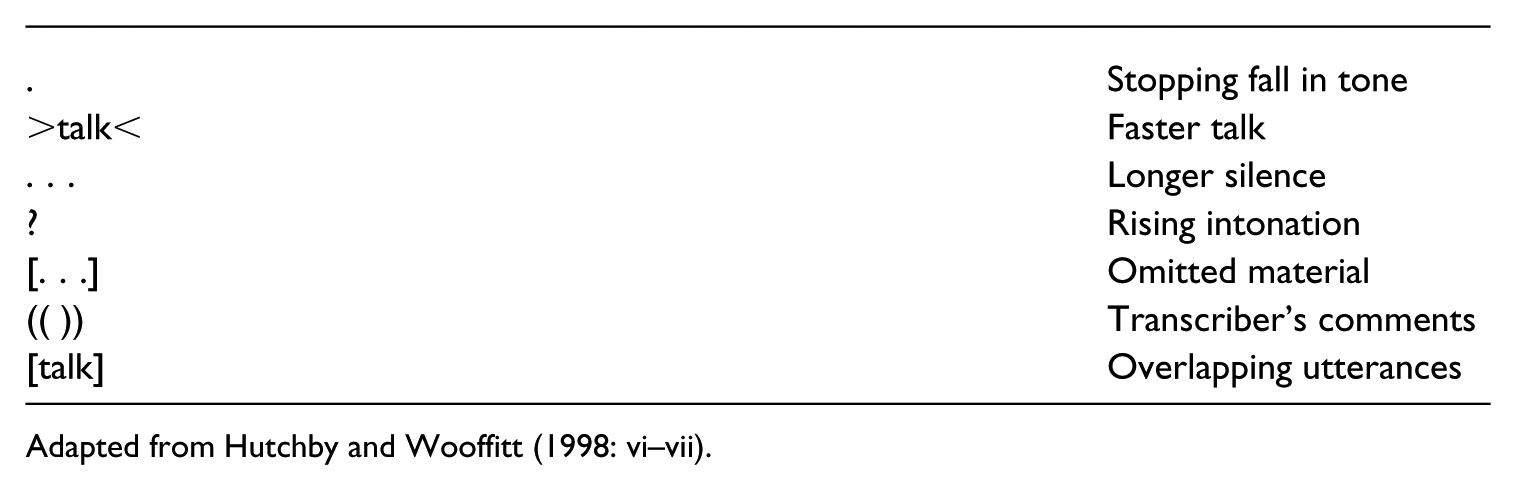
Adapted from Hutchby and Wooffitt (1998: vi–vii).
Footnotes
Declaration of conflicting interests
The author(s) declared no potential conflicts of interest with respect to the research, authorship and/or publication of this article.
Funding
The author(s) received no financial support for the research, authorship, and/or publication of this article.