




Abstract
By analysing 200 Tinder profiles of Spanish heterosexual men and 200 Grindr profiles of Spanish queer men, this article examines these men’s online gendered and sexualised self-representation strategies. More specifically, the study develops a discourse and feminist analysis of post-feminist media cultures which contrasts these men’s discursive representations. In so doing, the article attempts to cast light on the (d-)evaluating discursive strategies these Spanish heterosexual and queer men deploy when creating their profiles. Importantly, the analysis gives evidence of how occupying the masculine or the feminine position goes hand in hand with the devaluation and policing of femininity. Furthermore, the analysis calls attention to the contradictory gender ideas present in their personal profiles and this, in turn, sheds further light on the ways they construct multiple masculine identities to negotiate their sexual gendered identities.
Introduction
The study of the impact of new media on the way male and female adolescents relate has been an emerging field within social psychology and linguistics (Albury and Crawford, 2012; Brown, 2000; García-Gómez, 2017, 2019; Ringrose, 2006, 2010; Ringrose and Eriksson Barajas, 2011; among many others). Debates around understanding negative Internet practices have made this an important and fruitful area to research, highlighting the potential impacts of the Internet on teenagers’ development of gender roles and socialisation (García-Gómez, 2010; Hyde, 2007). In line with a feminist agenda, attention has been paid to understand young people’s online relations (Ringrose, 2010) in order to bridge the gap between young people’s online representations on social networks and the effects of such representations on their real lives (Evans, 2012; García-Gómez, 2014; Ringrose, 2008; Thomas-Jones, 2010).
Increasingly, the ways young adolescents navigate their own sexualities online are being researched from a range of perspectives (Davidson, 2014; Dobson, 2014a, 2014b; Salter, 2015), including a focus on the impact of the circulation of digital images of bodies online on both men and women (Hasinoff, 2015), the prevalence rates of sexting (Lounsbury et al., 2011) and the dangers and risks of sexting (Crofts and Lee, 2013) such as becoming victims of online sexual predators (Renfro, 2018), sextorsion (Agustina and Gómez-Durán, 2016) or non-consensual sexting (Dekker et al., 2019). However, while recent feminist research attempts to identify how social media facilitate the sexual objectification of girls (Dobson and Ringrose, 2016) and shed light on the emergence of new femininities (Dobson, 2015; Ringrose et al., 2013), the formation and enactment of masculinities in online contexts still remain largely neglected.
Responding to the growing interest in understanding different masculinities and the relationships among them, this study draws attention to the intersections of youth, gender relations, and power. Placing the discursive analysis of sexuality at its centre, this study attempts to analyse how Spanish young heterosexual and queer men self-present in their Tinder and Grindr profiles. More specifically, this study attempts to shed light on the way(s) these young heterosexual and queer men construct multiple masculine identities to negotiate their sexual gendered identities, navigate their sexual relationships, and make choices about their sexual embodiment.
The study begins by briefly mapping alternative constructions of masculinity. An intersectional theoretical framework is deployed to analyse how these young heterosexual and queer men enact masculinity discursively. In so doing, Hoskin’s concept of femmephobia is brought into focus to explore the complication of contradictory gender ideals present in their personal profiles. A brief discussion of methodology is followed by an analysis of these young men’s construction and negotiation of their masculine identities in an online context. This analysis aims to interrogate the way in which femininity and hegemonic and subordinate masculinities have been conceptualised in the gender literature. The concluding discussion assesses the broader implications of occupying the masculine/feminine position.
Rethinking the possibilities for performing masculinities
Conceptualising gender
Over the last decades, theories of gender have attempted to conceptualise gender in general and hegemonic and alternative gender performances in particular (Barber, 2014; Berg and Longhurst, 2003). These attempts have mainly revolved around (1) advancing critical geographies of masculinities (Hopkins and Noble, 2009; Miles, 2018); (2) understanding the multidimensional nature of masculinity and conceptualising femininity in relation to masculinities (Eguchi, 2011; Paechter, 2018; Schippers, 2007); and (3) highlighting the complementary nature of masculinity and femininity (Budgeon, 2014) and its hierarchical relationship (Schipper, 2007).
Although there is a wealth of scholarly research on documenting the conceptualisation of multiple masculinities (Budgeon, 2014; Connell, 1992, 1995, 2000; Dahl, 2012; among many others) hegemonic masculinities (Connell, 1987,1995, 2000; Connell and Messerschmidt, 2005; García-Gómez, 2019) and female masculinities (Halberstam, 2012; Levitt et al., 2003; Paechter, 2006, 2018), research has failed to explore femininity within patriarchal discourse domination in general and, more precisely, the intricacies of occupying the feminine position (Hoskin, 2019). In line with Serano (2007) and Hoskin (2013, 2017), I here argue that the impact of occupying the masculine or the feminine position on theorising social inequalities has received scant attention.
In this light, this study builds upon Schipper’s (2007), Blair and Hoskin’s (2015) and Hoskin’s (2019) rethinking of the possibilities for masculinity and femininity, and their role in gender hegemony. This study develops their argument further by (1) giving closer attention to the interplay of femininities and masculinities; (2) informing how heterosexual and queer men think about themselves in relation to their sexual identities as they construct and navigate their online social identity; and (3) showing discourse evidence of how heterosexual and queer men move through and produce masculinity and femininity by engaging in masculine/feminine practices. In so doing, this study contributes to the existing literature giving evidence of the ways these men discursively position themselves in relation to occupying the feminine/masculine position.
Gender hierarchy: enacting masculine/feminine practices
As Connell (2000) argues, hegemonic masculinity can be understood as a social position where both individual and collective relations of domination are established; that is, the enactment of a particular set of masculine practices regulates and subordinates femininity. Connell’s configuration of gender practice therefore highlights not only the dominant position of men, but also it exclusively concentrates on male gender practice. As Connell suggests, the configuration of gender practice does not apply to women. As a result, as Paechter (2018) points out, ‘all forms of femininity are constructed in the context of male domination’ (p. 122).
Importantly, hegemony not only determines the relations of dominance and subordination between men and women, but also places homosexual men ‘at the bottom of a gender hierarchy among men’ (Connell, 1995: 78). In addition, hegemonic masculinity regulates other subordinate and marginalised masculinities 1 where these masculinities act as the inferior ‘Other’ (Connell, 1987). In Schipper’s (2007) words, ‘gender hegemony is inextricably tied to heterosexual, middle-class, and white status’ (p. 88).
Given that Connell’s (1995) theory of masculinities and her conceptualisation of gender hegemony allows for multiple configurations, the twofold focus of the current study is (1) to analyse the self-presentation strategies heterosexual and queer men deploy to occupy the masculine or feminine position; and (2) to explore the effects occupying each position has not only on the ways these men experience their sense of self, but also on the ways societal gender norms legitimise their subject position, prescribe particular social behaviours, and determine social groups relationships. In so doing, the present study takes up the challenge of doing research involving men and masculinities while acknowledging the gender–power nexus that has often been ignored in the literature.
While there is a considerable body of work that focuses on the overarching theme of feminine devaluation within the enactment of alternative masculinities: queering femininity (McCann, 2017), anti-femininity (Hoskin, 2019; McCreary, 1994; Miller, 2015; Taywaditep, 2001), effeminate behaviour (Bergling, 2001), slut-shaming (Ringrose and Renold, 2012), and femi-negativity (Chamberland, 2018), Hoskin’s concept of femmephobia makes a recent and an important contribution to the literature insofar as it highlights ‘the containment strategies that function to maintain the proper boundaries of patriarchal femininity and, in turn, gender norms’ (Hoskin, 2019: 2); that is to say, the concept of femmephobia makes it possible to conceptualise (the devaluation of) femininity as an ‘overarching system of feminine-based oppression’ (Hoskin, 2019: 3). Even though femmephobia has exclusively been applied within lesbian, gay, bisexual, transgender and queer/questioning (LGBTQ) communities, it can also be applied beyond those communities as femmephobia is understood as ‘an oppressor that targets misuses of femininity and can therefore travel across sexes, genders and sexualities’ (Blair and Hoskin, 2015: 242).
Therefore, the present study contributes to the literature by answering some basic questions about what it means to occupy the feminine/masculine position in an online context. By studying how heterosexual and queer men embody alternative masculinities/femininities, the study will explore the characteristics and practices that are defined as masculine/feminine. Such exploration will not only reveal discrimination rooted in femininity in general, but also it will cast light on the complexities of the devaluation of femininity (Hoskin, 2019).
Method
The current study was designed to determine sexual identity and gender expression as an attempt to examine the multidimensional nature of masculinity within and beyond LGBTQ communities. I attempt to analyse the expressions and assess the implications of occupying the feminine/masculine position in the profiles Spanish heterosexual men create in Tinder and Spanish queer men create in Grindr.
Tinder and Grindr
Tinder and Grindr are two of the world’s most popular dating sites for meeting new people launched in 2012 and 2009, respectively. Tinder is geared towards heterosexual adult people, whereas Grindr is geared towards gay, bi, trans and queer adult people (i.e. 18+). Both applications are used for a range of reasons and users can specify whether they are interest in a serious relationship, casual dating or sexual hook-ups or, simply, those who are interested in making friends in cities where they know nobody. Users can filter results to display those who are interested in the same. Dating/Meeting somebody is a four-step procedure: (1) users swipe right to like someone or left to pass; (2) if the person selected likes you back because he or she shares a mutual interest, this is a match; (3) both people can start chatting online; and (4) people then decide whether or not they want to meet up in the real world.
In order to create a profile, people are free to upload pictures and add a description of who they are, what they like doing and what they are after. Pictures may range from photos that show the whole body (dressed or partly naked) or focus on specific parts of the body (i.e. breast, face or muscled arms/legs or six-packs). Written profiles may go from a compilation of key words to describe the user up to complete and very elaborated sentences to describe themselves and make sure the person who likes them are after the same.
Sample data and participants
A total of 400 profiles were gathered from Tinder and Grindr. Once a user registers, all the profiles are public and there are no restrictions to having access to pictures and any of the profile details. Given that the analysis restricts to the text profiles due to anonymity reasons, there was only one requirement to select the sample data: profiles must include information about their personality and sexual preferences. In this light, 200 Tinder Spanish heterosexual men’s profiles and 200 Grindr Spanish queer men’s profiles were selected and analysed. Even though personal pictures were not included, they were considered when analysing the text profiles as endorsing or contradicting the personal details given.
All the participants’ age ranges between 18 and 21, they self-identify as heterosexual or homosexual and all of them are white. As the application locates people geographically and shows possible candidates in terms of proximity, all the profiles chosen belong to men living in the region of Madrid (i.e. the capital city of Spain). It must be pointed out that that none of these applications give any information about the users’ class unless they voluntarily decide to include any piece of information, whether true or false, concerning their socio-economic status. As the profiles are then public for anyone who signs in, participants were not contacted for signing consent. The examples included in the analysis show that there is no reference to their personal names and it is not possible to recognise any of the participants by the personal details they provide.
The resulting data consisted of 9,524 utterances (i.e. Tinder personal profiles: 4,701 utterances and Grindr’s personal profiles: 4,823 utterances). First, a preliminary overview of all the written profiles was done in order to segment them into topically defined passages: (1) physical description of themselves; (2) psychological description of themselves; (3) activities they enjoy doing; and (4) what they are looking for (i.e. a serious relationship, casual dating, etc.). Second, all these utterances were classified into a consistent and manageable taxonomy of 5 principles for classifying the main discursive functions in the corpus. In general terms, all the utterances covered informative acts which provide information and, more specifically, acts ‘which report events or states of affairs, recount personal experience, and express beliefs, evaluative judgements, feelings and thoughts’ (Tsui, 1994: 135).
In particular, the following subclasses of informatives were identified: (1) Informative (affect: positive emotion): utterances concerned with positive emotional responses and dispositions (e.g. ‘I love sex’); (2) Informative (affect: negative emotion): utterances concerned with negative emotional responses and dispositions (e.g. ‘I’m scared of spiders’); (3) Informative (judgement: positive social self-evaluation): utterances concerned with evaluating own behaviour positively; (4) Informative (judgement: negative social self-evaluation): utterances concerned with evaluating own behaviour negatively; (5) Informative (judgement: social sanction): utterances concerned with evaluating other’s behaviour negatively. It is worth noting that the quantitative analysis will be offered as the qualitative analysis unfolds.
Analytical and ethical position
At the beginning stages of this research project, the intention of studying people’ personal profiles posed a moral question given that authors were not going to be informed or asked consent: ‘What are the potential ethical implications of analysing these profiles?’ These profiles may be considered a ‘private’ space as personal information and pictures are shown; however, people make them available for ‘public consumption’ as anyone who registers in the application can have access to all the personal details each user give to self-present and date somebody. Although profiles are ‘public’ documents and, therefore, no consent for their use in research is needed, we cannot deny our ethical responsibility as researchers. Needless to say, these men are not aware of the repercussions of their disclosure in the net spotlight. Two decisions were made to solve this moral dilemma. The first decision has to do with the anonymity procedures and the second one is concerned with my ethical position: (a) Anonymity procedures: All the profiles selected guarantee the privacy of their writers as they were selected on the basis of including no personal pictures or real names. All profiles selected for analysis did not reveal the author’s real name, rather a nickname was used to create the profile. This way the participants in the study cannot be identified and their anonymity is guaranteed. (b) Analytical and ethical position: In line with DiMaggio et al. (2001) and Meyer (2003), my focus is on writing’s implications for social change. Even though these personal profiles are an opportunity for reflection and for identity work, I decided to adopt a social constructionist orientation. Consistent with this orientation, personal profiles cannot be seen as a straight forward reflection of the behaviour or experience of the authors, rather the application provides a context for them to engage in a relationship talk, and tell us something about the cultural norms and possibly to community of practice norms – in this peer group of people that use these applications, that are attended to or challenged.
Analysis
Heterosexual men’s profiles in Tinder
In general terms, close inspection of these men’s profiles provides evidence of the multidimensional nature of masculine identity in this online context. More specifically, the discourse analysis of their profiles suggests that these men construct their social and sexual identity by either occupying the masculine position (i.e. endorsing hegemonic masculine practices and characteristics) or by occupying the feminine position (i.e. endorsing patriarchal feminine practices and characteristics). As the analysis reveal, these multiple configurations not only illustrate the voluntary enactment of (alternative) masculinities in the construction of their online social and sexual identity, but also call attention to the effect that the practices of occupying the masculine or the feminine position has on the subject position these Spanish heterosexual men attempt to legitimise. This, in turn, will illustrate how the enactment of these multiple masculinities goes hand in hand with the devaluation of femininity. Table 1 shows the linguistic realisations of the self-attribution process present in the construction of these multiple masculinities:
Principles of classification of utterances in heterosexual men’s profiles in Tinder.
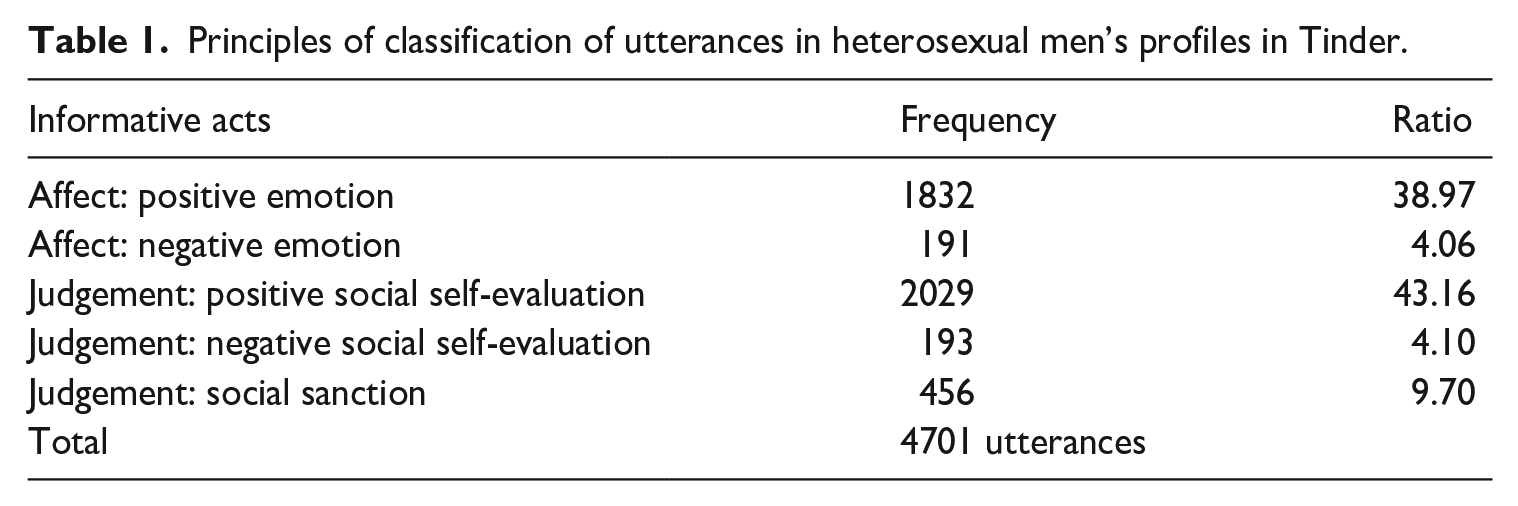
Out of the 200 profiles that were inspected, 34 profiles activate hegemonic masculinity practices; that is, these men navigate and construct their sexual identity by putting emphasis on four stereotypically masculine characteristics: physical strength, authority, sexual agency and choice. Linguistically speaking, these 34 profiles are built up by means of informative acts that may be classified into two main groups: (1) 18-year-old man. Profile pic: Naked chest and legs.
2
Alto, guapete, tal cual ves en la foto. Entrepierna generosa. Me gustan los deportes de contacto. Por eso, si buscas un buen empotador que te haga gemir ¡soy tu hombre! (‘Tall, pretty handsome, as you see in the pic. Generous trouser department. I like contact sports. That’s why, if you’re looking for a shagger that make you moan. I’m your man!’) (2) 19-year-old man. Profile pic: Face and naked chest. Ojos azules, cuerpo definido y 1,83 de hombre de pelo en pecho y muy activo. Me gusta el sexo por la mañana, por la tarde y toda la noche. Si me puedes seguir el ritmo y te gusta lo que ves. Altas, bajas, delgadas y gorditas. Todas me valen. No te vas a arrepentir. (‘Blue eyes. Muscled body and 1.83cm tall. A very sexually active man with hairy chest. I like having sex in the morning, in the afternoon and all night long. If you can keep up with my sexual needs and you like what you see. Tall, short, thin and fat women. All are welcome. You won’t regret it’)
As profiles 1 and 2 illustrate, the construction of these men’s identity is connected with the centrality of male sexuality; that is, this conceptualisation of sexual agency endorses one of the most common gender stereotypes: men have a constant desire to have sex. By means of informative acts, these two men evaluate themselves positively not only by boasting about how sexually active they are (e.g. ‘I like having sex in the morning, in the afternoon and all night long’), but also by bragging about their sexual skills (e.g. ‘If you’re looking for a shagger that make you moan’). Furthermore, this configuration of masculinity is therefore paired with the complementary and inferior feminine practices these men relate women to (e.g. ‘If you can keep up with my sexual needs’). Take the following profiles as an example: (3) 20-year-old man. Profile pic: wearing a tight swimming brief. Deportista, extrovertido y apasionado. Muy apasionado. Si buscas quien te proteja y te haga sentir mujer, no busques más. Con un polvo no me conformo, busco una hembra que me siga el ritmo. Una mujer femenina a la que hacer gozar como una perra. (‘I’m a sport, extroverted and passionate man. Very passionate. If you’re looking for somebody that protect you, make you feel a woman. Look no further. Fucking you once is not enough, I’m looking for a real woman who can keep up with me. A feminine woman to make her enjoy sex like a bitch’) (4) 18-year-old man. Profile pic: Face and naked chest in the sea. 1.72, delgado y atractivo. No busco complicaciones. Aventurero. Conmigo no te vas a aburrir. Con mucho carácter. Si buscas un hombre que sabe lo quiere, y te haga sudar de placer en la cama, no tardes mucho porque se me rifan. (‘1.72 cm tall, thin and attractive. I’m looking for no trouble. Adventurous. You’ll never get bored with me. I’m a strong character. If you’re looking for a man who knows what he wants and makes you sweat in bed, don’t spend too long as women compete for me’)
The enactment of hegemonic masculine practices and characteristics determines the social and sexual relationship between these men and the potential group of women that may date them. In addition, such enactment ensures, as Schipper (2007) points out, ‘the ascendancy and dominance of men’ (p. 91). More specifically, profiles 3 and 4, on one hand, illustrate how these men occupy the social location ‘man’ to activate positive features (e.g. they take the initiative, they are brake, sexually brazen and good lovers) and associate the social location ‘women’ with stereotypical feminine practices (i.e. physical vulnerability, an inability to show initiative and sexual desire, compliant and sexually submissive in the relationship) that prescribe a subordinate role for women.
As shown in these profiles, the purpose of femininity is to serve and please men; that is, these men seem to associate femininity with passivity and lack of choice (e.g. ‘If you’re looking for somebody that protect you, make you feel a woman. Look no further’, ‘A feminine woman to make her enjoy sex like a bitch’). This enactment of masculinity coexists with other configurations that seem to deviate from these practices and characteristics defined as ‘masculine’. In an attempt to have a match and date women, the remaining 166 profiles show a distinctive discursive strategy to self-present in an appealing way.
These profiles account for the ways these Spanish men occupy the feminine; that is, these profiles reveal how a positive social evaluation (i.e. judgement) is achieved by activating characteristics and practices defined as ‘womanly’. This positive self-evaluation is aimed at persuading potential women to date them. In so doing, they illustrate how, as Schipper (2007) suggests, ‘masculinity and femininity are conceptualized as produced, contested, and transformed through discursive processes, and therefore embedded within and productive of power relations’ (p. 94). Linguistically speaking, these 166 profiles are built up by means of informative acts that may be classified into four main groups: (5) 19-year-old man. Profile pic: Dressed man looking at the sea (taken from behind). Chico guapete, apasionado de los deportes. Busco amor de verdad no un polvo sin más. Alguien que guíe mis pasos y me descubra el mundo. No soy lanzado ni te voy a meter mano sin más. Se hará como tú quieras y cuando tú quieras. Romántico empedernido (‘A pretty handsome boy, a sports lover. I’m looking for true love and not a hook-up. Somebody to guide my steps and show me the world. I’m not bold and I won’t grope you straight away. Things will be done as you want and when you want. A hopeless romantic man’) (6) 18-year-old. Profile pic: Face with his eyes closed. Pues sí, soy un chico normal, nada del otro mundo. Prefiero una tarde de cine y palomitas que un revolcón en un coche con una extraña. Indeciso, sentimental, enamoradizo. Lo que cualquier mujer sueña. Mi compañera de viaje. Creo firmemente que la belleza está en el interior. (‘Yes, I’m an ordinary boy. I’m nothing special. I prefer spending an evening in the cinema eating popcorn than having a roll in the hay with a stranger. Indecisive, sensitive, easily infatuated. What any woman dreams of. My travel companion. I firmly believe beauty is within’)
These men seem to associate themselves, as profiles 5 and 6 illustrate, with what they consider to be ‘feminine characteristics’ in a bid to live up to traditional women’s expectations. In other words, they aim to achieve a positive social self-evaluation by presenting themselves as the perfect romantic partner every woman dreams of (i.e. an emotionally intelligent romantic partner that can satisfy women’s needs in a relationship). This enactment of masculinity can be understood as a devaluation of the feminine (i.e. femmephobia) since it is based on ascribing to themselves traditional patriarchal feminine characteristics (i.e. lack of agency, priority of feelings over actions, no promiscuous behaviour) that may persuade women, understood as a monolithic social group, to date them. This, in turn, maintains patriarchal femininity as complementary and subservient to masculinity (Hoskin, 2017) and keeps the socially acceptable boundaries of gender norms (Schipper, 2007). In so doing, these profiles offer a completely simplistic representation of womanhood.
These profiles commonly include contradictory discourses that show the tension between self-presenting positively in the eyes of women and prescribing patriarchal feminine behaviour. Consider the following profiles: (7) 19-year-old man. Profile pic: Whole body photo lying in the grass. Si quieres un chico normal, que no va al gym, que le gusta leer poesía, es sensible, cariñoso. Busco a alguien con ganas de hacerme feliz, compartir paseos y que me deje ser yo mismo. No busco una de esa mujeres modernas que se follan a todo lo que se menea y se baja al pilón sin más por si la relación va a más (‘If you want an ordinary boy, someone who doesn’t go to the gym, who enjoys reading poetry and is sensitive and affectionate. I’m looking for someone who wants to make me happy, somebody to stroll with and someone who will let me be myself. I’m not looking for one of these modern women who fuck or go down on any man they see, in case we start having a relationship’) (8)18-year-old man. Profile pic: Face and dressed upper body. Alto, guapete tal y como ves en la foto. Sincero, fiel, romántico al que las malas mujeres le han hecho mucho daño. No pido mucho, solo que me escuchen, que me den cariño. Soy muy sumiso y complaciente. No soy un picaflor ni soy de fulanas. busco una mujer que sea como yo que no se acueste en la primera cita ni haya pasado por todos los asientos de atrás de los coches (‘I’m tall, pretty handsome, just as you see in the pic. Sincere, faithful, romantic. Someone bad women have hurt. I’m not asking much, somebody that listens to me and gives me affection. I’m submissive and compliant. I’m not a womaniser and I don’t like hookers either. I’m looking for a women like me. Somebody who doesn’t have sex in the first date or had sex in each and every backseat car’)
These two profiles make it possible to exemplify and further explore the multidimensionality of masculinity in this online context. By occupying the feminine (i.e. showing a passive attitude, lack of agency and sexual desire), this self-presentation that apparently strays from the confines of hegemonic masculinity is also regulated by femmephobia. In other words, this configuration of masculinity can be regarded as a containment strategy that underlines the double standard; that is, sexually brazen women are good for a casual sexual encounter, but they are not potentially good for a stable relationship.
These men exacerbate love and its importance in their lives and self-evaluate positively (i.e. positive affect and judgement) by ascribing themselves to patriarchal feminine practices and characteristics (i.e. a romantic, submissive, compliant and faithful man). However, femmephobia can be identified insofar as these men regulate sexualities through coercive language (i.e. ‘I’m not looking for one of these modern women who fuck or go down on any man they see’) and other regulatory practices (i.e. social sanction) that draw a line between socially acceptable behaviour and other promiscuous sexual behaviour (e.g. ‘I’m looking for a women like me. Somebody who doesn’t have sex in the first date or had sex in each and every backseat car’).
By perpetuating the traditional enforcement of female morality, this discursive self-presentation serves as a form of gender policing (i.e. showing socially acceptable behaviour) rather than challenging normative masculinity since these men do not transgress patriarchal coordinates that determine gender hegemony (Hoskin and Hirschfeld, 2018). This idea is underlined in those profiles that seem to construct their sexual identity by challenging hegemonic masculinity, but still represent the claim of a superior position. In line with Hoskin (2017, 2019), these profiles give examples of ascribed femmephobia since they seem to homogenise femininities by denying its multidimensional nature. Consider the following profiles: (9) 18-year-old man. Profile pic: Face and dressed upper body. Me encanta ir de compras. Soy extrovertido, cariñoso, sensible, el amigo gay que siempre quisiste tener. (‘I love going shopping. I’m extroverted, affectionate, sensitive, the gay friend you always wanted to have’) (10) 21-year-old man. Profile pic: Face holding a rose in his mouth. Soy super detallista, romántico. Todos dicen que tengo alma de mujer y que no saben cómo estoy soltero. (‘I’m a super considerate, romantic man. Everybody says I’ve got a female soul and they don’t know why I’m still single’)
This enactment of masculinity is in constant dialogue with the negative assumptions projected onto challenging normative femininity. By occupying the feminine position, this self-presentation based on a lack of sexual agency, assertiveness and desire is not socially sanctioned when embodied by men (e.g. ‘I’m looking for someone who wants to make me happy’). In line with Hoskin (2017), the social sanction present in these men’s profiles upholds gender hegemony and serves to further devalue femininity by associating the feminine position with passivity and its complementary and subordinate nature (e.g. ‘I’m submissive and compliant’). The enactment of these feminine practices sometimes coexists with contradictory discourses that revolve around hegemonic masculine practices. Consider the following profiles: (11) 22-year-old man. Profile pic: face and naked chest. Soy muy sensible. Romántico. Me encantan las caricias los besos dulces, pero para rematar la faena soy un martillo. (‘I’m a very sensitive and romantic person. I love caressing, gentle kisses, but when it’s time to finish off the job I’m like a hammer’) (12) 21-year-old- man. Profile pic: Completely naked (photo taken from behind). Soy especialista en escuchar a las mujeres, te acompaño de compras y me preocupo porque lo pases bien, pero en la cama ahí te empotro para que disfrutes de un macho. (‘I’m an expert on listening to women, I go shopping with you and I make sure you have fun, but when we are in bed I will hammerfuck you so that you can enjoy sex with a real man’)
These profiles give evidence of the double standard. In a bid to maximise their chances of romantic success, these men occupy the feminine position by claiming a set of practices and characteristics associated with women. By underlining their empathy, sensibility and exacerbating expressions of affection, these men aim to achieve a positive social evaluation in the eyes of their potential dates. Interestingly, these practices contrast dramatically with direct associations with sex and these men’s sexual performances in bed. In so doing, they assert power and show unequal power relations. It can be argued then that this enactment of masculinity seems to legitimise and ensure the structure insofar as denotes the subordinated status of femininity maintains the ideology of monolithic femininity (Hoskin, 2017).
Queer men’s profiles in Grindr
The discourse analysis of these Spanish men’s profiles underlines, on one hand, the multidimensional nature of masculine identity in this online context and, on the other, casts light on the intricacies of occupying the masculine and feminine positions. In line with previous research on the construction of gay men’s identity that highlights that gay men tend to endorse the masculine norm ‘status’ and adhere to the antifemininity norms (see, for instance, Bergling, 2001; Miller, 2015), 68 profiles out of the 200 that were inspected navigate their sexual identity by occupying the masculine position. More precisely, they endorse hegemonic masculine practices and reject any effeminate behaviour; that is, they self-present as ‘real men’ and explicitly contrast themselves with inferior feminine others (Hennen, 2005; Underwood, 2003). Interestingly, the remaining 132 profiles reveal alternative self-presentation strategies that call attention to the presence of transgressing discourses. Table 2 shows the linguistic realisations of the self-attribution process present in the construction of these multiple masculinities:
Principles of classification of utterances in queer men’s profiles in Grindr.
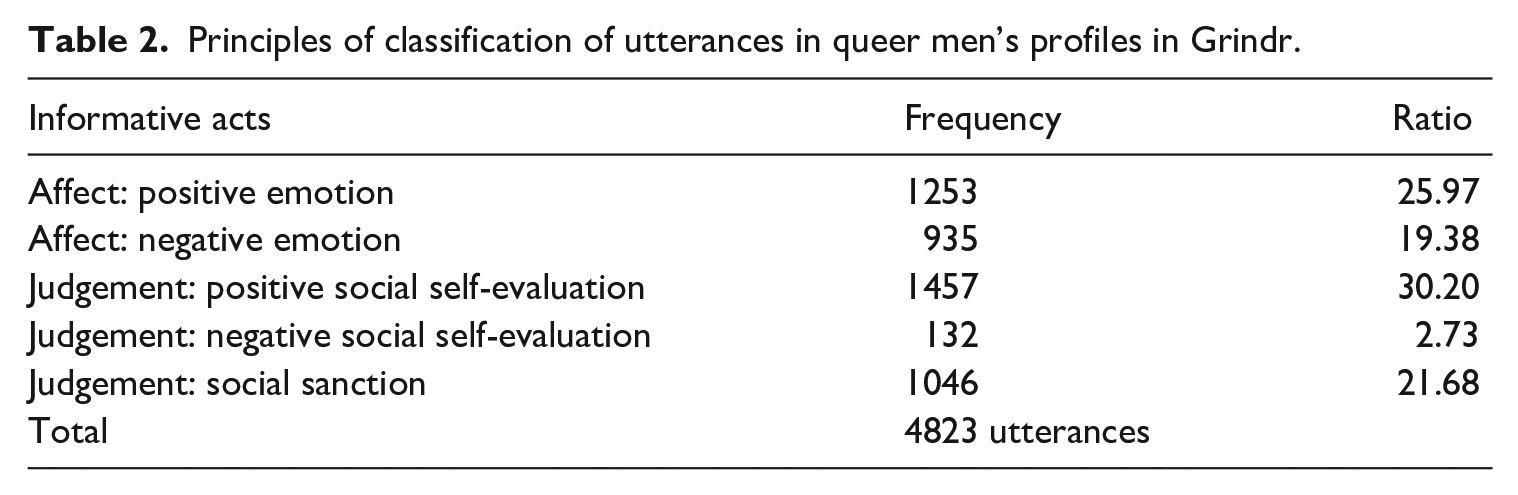
As mentioned above, 68 queer men fall on a spectrum of completely masculine; that is, they occupy the social location ‘man’ to activate positive features and reject any behaviour seen to be feminine. Linguistically speaking, these profiles are built up by means of informative acts that may be classified into three main groups: (13) 21-year-old man. Profile pic: Dressed full body. No soy un gay al uso. No me gusta ir de compras ni mariconear por la calle. Muy masculino, serio y con carácter fuerte. Busco similar. alguien fiel. Me gusta disfrutar de mi espacio. Nada de afeminados ni drags. (‘I’m not an ordinary gay man. I don’t like going shopping or camping it up in public. A masculine man, serious and a strong character. I’m looking for someone like me, someone faithful. I enjoy having my own space. No effeminate men or drags’) (14) 19-year-old man. Profile pic: Face and naked chest. 1,81 delgado. Un tío normal. Ni pluma ni amanerado. No me gusta el ambiente solo hay viciosos. No estoy para relaciones ni ralladuras. Machoxmacho y mucha leche! Totalmente activo. Nada de parejas libres ni promiscuos. (‘I’m a 1.81cm man. An ordinal guy. I’m not effeminate. I don’t like the gay scene it’s full of vicious men. I’m not looking for a relationship. Real man looking for real man. Totally active. No open couples or promiscuous men’)
In this type of profiles, these men endorse hegemonic masculine practices and characteristics (i.e. physical strength, agency and ability to make their choices). As profiles 13 and 14 illustrate, femmephobia here operates by regulating not only sexualities, but also sanctioning feminine social behaviour. By denying any feminine characteristics that may be traditionally associated with queer men (e.g. ‘I’m not an ordinary gay man. I don’t like going shopping or camping it up’), these men attempt to gain power by embracing the male position (i.e. judgement: positive self-evaluation). This configuration of masculinity maintains the ideology of hegemonic masculine practices as superior to any other alternative masculine practices (i.e. being effeminate, enjoying the gay scene). This overt femmephobia serves a form of gender policy against deviations from patriarchal masculine norms (i.e. criticism against promiscuous behaviour usually ascribed to queer men). This, in turn, gives evidence of the devaluation of femininity as the enactment of these masculine practices prescribes others’ behaviour and socially sanctions any deviation (e.g. ‘Real man looking for real man’).
These men’s positive social self-evaluations perpetuate the cultural enforcement of male physical strength, sexual desire, assertiveness and agency. Take the following profiles as an example: (15) 21-year-old man. Profile pic: Naked body covering genitals with one hand. Machoxmacho. Lechero. 1,83, delgado cuerpo fibrado y con una buena herramienta que uso a la perfección. Busco sumiso que sepa quien manda. Solo pasivos. Activo y muy sexual. Pasas por mi cama y si apruebas el examen entonces hablamos. (‘Real man looking for real man. Get a load of a hunk of spunk. A 1.83cm tall man, muscled body and a good “tool” that I know how to use. I’m looking for a sexually submissive man who knows I’m the boss here. Only passive men. Very sexually active. Come to my bed and try, if you pass the exam, then we’ll talk’) (16) 18-year-old man. Profile pic: Face and naked chest. Guapo a rabiar. Muy masculino nada de pluma. Si tienes pluma olvídalo. Sumiso en la cama y complaciente. Si tienes un rabogrande puedes hacer conmigo lo que quieras. Cariñoson y sensible que busca macho que le folle bien. (‘Extremely handsome. A very masculine man. I’m not effeminate whatsoever. If you’re effeminate, don’t even try. Sexually submissive and obedient. If you’ve got a big cock you can do me as you please. Affectionate and sensitive that is looking for a real man to be fucked’)
Independently from their sexual preference (i.e. active or passive partners), these two examples illustrate how the discursive construction of their sexual identity conflates the practices of men and women with masculinity and femininity (Schipper, 2007). These men’s social norms are accompanied by social sanctions insofar as these men openly show an anti-effeminacy attitude (e.g. ‘A very masculine man. I’m not effeminate whatsoever’). In addition, they achieve a positive social evaluation by ascribing themselves to patriarchal stereotypical behaviours; that is, they impose particular socially acceptable behaviours based on gender hegemony and sanction those who deviate from that behaviour (i.e. effeminate behaviours). Therefore, the self-attribution processes made for themselves and their potential dates underline the hierarchical relationship and power dynamics existing in occupying the masculine or the feminine position (e.g. ‘I’m looking for a sexually submissive man who knows I’m the boss here’, ‘If you’ve got a big cock you can do me as you please’).
Out of the 200 profiles analysed, 79 profiles included transgressing discourses that shed further light on the presence of new transforming enactments of masculinities/femininities. This enactment of identity can be said to be transgressing since the feminine characteristics they activate are not connected with being inferior. Linguistically speaking, these profiles are built up by means of informative acts that may be classified into four main groups:
This specific discourse construction can be argued to be new insofar as they revolve around fighting ascribed and perceived femmephobia; that is to say, these men construct their online identity and navigate their sexual identity by occupying the social location ‘woman’ to be assertive, claim their agency and make their choices. Consider the following examples: (17) 19-year-old man. Profile pic: Naked chest and made-up face. Tal cual ves en la foto. Sin retoques ni filtros. Paso de heteros curiosos. Con pluma y a mucha honra. Busco tio al que someter en mi cama. Quiero. Disfrutar de mi cuerpo y soltar leche. Soy marica, sí, me gusta que me follen pero no soy el trofeo de nadie. En la cama somos dos y yo soy el primero en opinar. (‘As you can see in the pic. No retouches or filters. No bicurious. I’m proud of being effeminate. I’m looking for a guy to subdue in my bed. I want to enjoy my body and cum. I’m a pussy, yes I am, I like to be fucked but I’m no-one’s trophy. We’re two in bed and I’m the one to say what I think’) (18) 20-year-old man. Profile pic: In underwear dancing on a table. Cuerpo 10. Soy queer. Nada de machos. Hasta el clítoris de comer rabos de machitos. Marica loca, segura de sí misma. Sé lo que quiero. Tengo dos ovarios y no consiento tonterías. Busco sexo, sí, pero con mis reglas. Soy una maricona que uso tu rabo para darme placer. Un solo rabo no me sirve. No esperes que sea fiel. (‘Perfect body. I’m queer. No masculine men. Having eaten so many real men’s cocks bursts my clit.
3
I’m a crazy sissy, but I’m self-confident. I know what I want. I’ve got two ovaries
4
and I cut the crap. One single cock is not good enough to satisfy my needs. Don’t think I’ll be faithful’)
Discourse analysis of these profiles reveals that these men occupy the feminine position. In so doing, they attempt to socially evaluate themselves in a positive manner by challenging normative masculinity and femininity on one hand, and by transgressing traditional socially acceptable coordinates of sex, gender and sexuality on the other (Hoskin and Hirschfeld, 2018). As profiles 17 and 18 show, these men seem to dignify their effeminate behaviour as a strategy to push against the ascribed subordination femininity and effeminate behaviours are associated with (e.g. ‘I’m a faggot but I use your cock to give me pleasure’). In so doing, they cast traditional deviations from patriarchal norms on a positive light; that is, they defend their right to be promiscuous (e.g. ‘only one cock is not enough to satisfy my needs. Don’t expect me to be faithful’), show unequal power relations (e.g. ‘I’m after sex, yes, but I set the rules for it’) and to make choices (e.g. ‘I know what I want’). Such discourse can therefore be claimed to fight against traditional ascribed and perceived femmephobia in the LGBT communities (Hoskin, 2017).
When occupying the social location ‘women’ who have a healthy self-esteem, 35 profiles present contradictory discourses. Take the following profiles as an example: (19) 22-year-old man. Profile pic: Face and naked chest. Soy muy hembra y quiero hombre, hombre que me empotre. Me da igual si tienes pluma si me das lo mio. Creo en el amor y los buenos polvazos que me hagan disfrutar de mi chichi jugoso. (‘I’m very female and I want a man, a man who hummerfucks me. I don’t care if you’re effeminate if you fuck me hard. I believe in love and I want to get laid in order to make my juicy cunt have fun’) (20) 20-year-old man. Profile pic: In underwear dancing on a table. 1.92. Alta y pies grandes. Con pluma. Mona y decida. Soy pasivo pero no te creas que vas a hacer conmigo lo que quieras. Sé muy bien lo que me gusta hacer. Cuando me enamoro soy tuya y me dejo hacer para darte placer al máximo. Si me meto en tu cama no vas a desear que me vaya nunca. (‘I’m 192 cm tall and have big feet. Effeminate. Pretty and determined. I’m passive but don’t you think you can do me as you please. I know what I like doing. When I fall in love, I’m completely yours and I’ll let you do me to satisfy all your needs. If I jump into your bed, you will never let me go’)
These two profiles illustrate the contradictory discourses these men activate when navigating their sexualities. On one hand, these men’s positive social self-evaluation can be seen in their attempt to gain power by embracing their female position (e.g. ‘I’m female’, ‘effeminate’) and showing their sexual agency and ability to make choice (e.g. ‘I want a real man to have sex with’). It is worth highlighting the use of female words in Spanish to define their personality, their body and bodily functions (e.g. ‘I want to get laid in order to make my juicy cunt have fun’). On the other hand, they self-present as compliant, submissive and passive when being in a relationship (e.g. ‘When I fall in love, I’m completely yours and you can do me as you want to please you as much as possible’).
This attribution process is aimed at recognising agency and empowerment. These contradictory discourses show the tension between maintaining gender hegemony and showing characteristics that are defined as feminine, contaminating and disruptive (Hoskin, 2019). However, this gives evidence of how occupying the feminine position is still stigmatised in the LGBT community. Although they deny being compliant and they redefine the use traditional derogatory terms to cast themselves in a positive light (e.g. ‘sissy, faggot’), they self-present as being the object of masculine desire which, in turn, underlines the devaluation of occupying this feminine position (e.g. ‘If I jump into your bed, you will never let me go’).
Conclusion
The present study has purported to explore the multidimensional nature of masculinity in an online context. In so doing, it has attempted to shed further light on the (d-)evaluating discursive strategies heterosexual and queer men deploy when creating their personal profiles in Tinder and Grindr, respectively. Importantly, the analysis has given evidence of how occupying the masculine or the feminine position goes hand in hand with the devaluation and policing of femininity. Although profiles were targeting different social groups (i.e. heterosexual women and other queer men), the self-attribution processes have revealed how the negative associations with femininity regulate both these men’s social and sexual behaviour.
Contributing to and expanding on this body of work, my intention has been to intervene in the debates on sexualisation, sexual agency and choice by illustrating these men’s perceptions, beliefs and implications of occupying different masculinities/femininities in their narratives. Furthermore, the discursive exploration of the ways in which the participants perform an ideology while constructing and negotiating their (sexual) gendered identity has made it possible to highlight the complexities and multidimensionality of occupying the social location ‘man’ or ‘woman’.
Interestingly, the analysis of these Spanish heterosexual men’s profiles has shown that they either endorse hegemonic masculine practices and characteristics or endorse patriarchal feminine practices in order to legitimise their subject position. By endorsing these feminine practices, they voluntarily adopt a subordinate role that is aimed at accommodating the interests and desires of their potential dates. However, the endorsement of patriarchal feminine practices can be understood as a regulatory force insofar as they regulate their potential date social and sexual behaviour; that is these men legitimise their subject position and superiority over women.
The inspection of queer men’s profiles has revealed the tension between the internalised and externalised negative associated with occupying the feminine position. In line with Hoskin (2017), the study has underlined that feminine enactments are ‘in constant dialogue with the negative assumptions projected onto femininity, challenging and disentangling the naturalised associations of patriarchal femininity’ (p. 100). Furthermore, the analysis has called attention to the presence of new transforming enactments of masculinities/femininities. The self-attribution processes relate the social location ‘feminine/femme’ to being assertive, claiming their agency and making their (sexual) choices.
Despite these strengths, the study was limited by the lack of racial diversity within the sample. Next steps in my future research will take the exploration of the intersections of gender, sexuality and race. Finally, further investigation is clearly needed to map these emerging arenas for the study of online identities. Natural directions for future research include a further interrogation of what it is about these online media that gives rise to transgressing discourses.
Footnotes
Declaration of conflicting interests
The author(s) declared no potential conflicts of interest with respect to the research, authorship, and/or publication of this article.
Funding
The author(s) disclosed receipt of the following financial support for the research, authorship, and/or publication of this article: The present study was financially supported by a grant from the Ministerio de Economía y Competitividad. This article is part of the long-term research: Persuasion in Promotional Discourse: Linguistic resources and communication strategies.