



Abstract
This study adopts critical discourse analysis (CDA) to examine the recontextualisation of Beijing’s voice in Hong Kong’s governance. Using Beijing’s interpretation of Article 104 of the Basic Law in 2016, which triggered a by-election in 2018, as the case, this article analyses two texts produced by two social actors: the press conference in response to Beijing’s interpretation by the Hong Kong government and an election flyer by a pro-democracy candidate, complemented by a corpus analysis of pro-Beijing newspapers reporting the incident. The findings show that the local government drew upon Beijing’s voice to help create a dominant representation of the Beijing–Hong Kong relations and thus hegemonised Hong Kong political discourse which influenced other social domains, such as newspapers and elections. The pro-democracy camp, as the resistance to the hegemony, drew upon Beijing’s voice to create an alternative representation to secure votes during the by-election. This article then proposes a model which could comprehend Beijing’s role in Hong Kong’s political events, of creating and perpetuating the tension between the hegemony and resistance in Hong Kong.
Keywords
Introduction
In the study of Hong Kong politics, the ‘China’ factor has been of interest to scholars who examine Beijing’s strategies and its role in Hong Kong’s governance. Some studies suggest that with Beijing’s incorporation strategies, the China factor has been more prominent across different social domains in Hong Kong, such as local elections, education, newspapers and social media (Fong, 2017a; Ma, 2017). Yet, Beijing’s increasing intervention has given rise to countermovements in Hong Kong, such as the Umbrella Movement. The very recent controversy over the China extradition bill in Hong Kong triggered two million Hongkongers to march on the streets. Although there have been studies on the role of Beijing in Hong Kong’s political events with detailed narratives and analyses (Fong, 2014; Loh, 2018; So, 2011), they do not explain in detail how Beijing’s voice is adopted and actualised in Hong Kong’s political events. This study attempts to complement existing research studies and fill the gap with the use of critical discourse analysis (CDA). This approach bridges language analysis and social analysis with the aim of revealing meaning-making in power relations and inequality within society through analysis of language use in texts in particular discourse (Fairclough, 2013).
Context of the study
According to the Basic Law, the constitutional document for Hong Kong, Beijing has the final right to interpret laws in Hong Kong. The interpretation of the Basic Law in 2016 dates back to the Legislative Council election in the same year. With the increasing intervention by the local and central government, in particular, oppressing candidates with a ‘localist background’, such as those considered not to be upholding the Basic Law, six localist candidates were disqualified by the Electoral Affairs Commission from standing for the Legislative Council election (Ng et al., 2016). The pro-Beijing camp won 43 seats out of 69 (62%) in total, while the pro-democracy camp and localists won 25 (36%); one seat was taken by an independent candidate. As per usual practice, on the first day of the 4-year term, each newly elected legislative member has to take an oath of allegiance to the ‘Hong Kong Special Administrative Region of the People’s Republic of China’, upholding the Basic Law and serving the government ‘conscientiously, dutifully, in full accordance with the law, honestly and with integrity’ (The Legislative Council of the HKSAR, 2016). Chen Wei-on, the then and current Secretary General of the Secretariat of LegCo, refused to re-administer oath-takings of three localist candidates, Yiu Chung-yim, Sixtus Baggio Leung Chung-hang and Yau Wai-ching, after they made ‘modifications’ to the oath, such as adding extra words which were insulting between the lines and deliberately mispronouncing ‘Republic of China’ as expletives. Their oaths were invalidated by Chen. On 5 November, the Standing Committee of the National People’s Congress (SCNPC) put forward a draft of the interpretation of Article 104 of the Basic Law.1,2 It was passed 2 days later with all 155 members of the SCNPC voting for the draft. The interpretation clearly articulates that the oath-takings by those LegCo members were considered invalid. The announcement of the interpretation triggered a wave of protests in Hong Kong where pro-democracy supporters were discontented about the interpretation. More than 2000 lawyers, dressed in black, marched on the street silently the day after the interpretation was released, showing resentment to Beijing’s intervention in Hong Kong’s judiciary (Cheung and Phillips, 2018). Referring to the interpretation, the High Court ruled that Leung and Yau, both from the localist party Youngspiration, were disqualified on 15 November. In December 2016, the government once again called upon the Higher Court for a judicial review of the qualifications of another four LegCo members whose oaths had been approved by the Secretary General. Almost 8 months later, the High Court adjudicated that the oaths of the four pro-democracy LegCo members were invalid, and hence were disqualified from office.
As six vacant seats resulted from the disqualifications, a by-election was held in March 2018 to fill four of the seats. The pro-democracy camp sent four candidates, after a pre-election within the camp, to the four constituencies, hoping to gain back the seats originally held by the disqualified pro-democracy LegCo members. The pro-establishment camp also fielded four candidates. Initially, the pro-democracy camp reached consensus and decided to let Agnes Chow-ting from Demosisto run for the seat of the Hong Kong Island constituency which had been held by her colleague from the same party. However, after she announced her candidacy, she was disqualified by the returning officer because of promoting ‘self-determination’ which contradicts the law which states that candidates should uphold the Basic Law and pledge allegiance to the HKSAR (The Legislative Council of the HKSAR, 2016). As a result, the pro-democracy camp sent Au Nok-hin to run for the seat on behalf of Chow. In the end, only two pro-democrats, Au Nok-hin and Gary Fan Kwok-wai, managed to win back two seats; the other two seats were taken by one candidate from a pro-Beijing party and one claimed to be independent but had affiliations with the pro-Beijing camp and government officials.
Using CDA as the approach, this study examines how the local government and the pro-democracy camp recontextualised Beijing’s voice in subsequent social events and their influence on other social domains. It then discusses the implications of the interplay between the three social actors for Hong Kong political discourse.
Literature review
CDA studies on hegemony and resistance in political discourse
In CDA, which is concerned with power and language use, ‘hegemony’ can be manifested discursively via dominating the order of discourse. As mentioned by Fairclough (2013), ‘some ways of making meaning are dominant or mainstream in a particular order of discourse, others are marginal, oppositional or “alternative”’ (p. 265). In terms of how a social actor can dominate a representation and become the hegemony in discourse, Keat and Abercrombie (as cited in Fairclough, 2013) propose one aspect of hegemony: ‘ethical engineering, the reshaping of subjectivities or “selves”’ (p. 128). Fairclough (2013) argues that ‘hegemonic practice and hegemonic struggle to a substantial extent take the form of discursive practice, in spoken and written interaction’ (p. 129). He suggests that a particular set of discourse conventions implies certain ideologies: (1) particular knowledge and beliefs, (2) particular positions for social subjects and (3) particular relations between social subjects (Fairclough, 2013: 129). A dominant discourse could reach out and ‘colonise’ other domains in other discourses. CDA is concerned with revealing hidden ideologies and power in texts and discourse practices. How governments and political leaders reproduce and perpetuate their discourses leading to hegemonic status is of CDA’s interest. It draws upon linguistic analysis to unpack political and communicative aims conveyed by political figures.
Resistance, on the other hand, has not been extensively researched in CDA, though Foucault (1979) mentions that ‘[W]here there is power, there is resistance’ (p. 95). Resistance exists when one does not agree with the hegemony or the dominated way of making meaning. Van Dijk (1993) admits that ‘we pay more attention to “top-down” relations of dominance than to “bottom-up” relations of resistance, compliance and acceptance’ (p. 250). It would be interesting to see how resistance reacts to hegemony at the discourse level. It is worth mentioning that resistance does not necessarily confront the hegemony discursively; it could be an act for marginalised groups to construct an identity, seeking legitimacy and ‘emancipation’ (Bhatia et al., 2008). CDA seeks ‘to clarify how semiosis figures in the establishment, reproduction and change of unequal power relations (domination, marginalisation, exclusion of some people by others)’ (Wodak and Meyer, 2015: 88). In this regard, this study aims to look into the Beijing–Hong Kong relations from both top-down hegemony and bottom-up resistance perspectives.
CDA studies on Hong Kong politics
CDA, as a relatively new approach emerging in the 1970s in Applied Linguistics, has expanded its franchise rapidly and been extensively adopted by scholars from different fields. In the context of Hong Kong, scholars have adopted CDA to study sociocultural and political issues. For example, Lee and Lin (2006) compared the discursive construction of the political reform by two newspapers and examined political self-censorship in newspaper editorial discourse. Cheng and Ho (2014) analysed two corpora consisting of news reports and government press releases about the introduction of Moral and National Education in 2012, which led to huge controversies and social cleavages, and explored the discursive strategies adopted by two very different voices, which failed to find common ground. John Flowerdew made notable contributions to the study of Hong Kong political discourse, such as his studies on the discursive construction of Hong Kong as a world-class city (2004b), the discourse of the first Chief Executive after the handover in 1997 (2004a) and the discursive construction of patriotism in political reform debates (Flowerdew and Leong, 2007). A Special Issue of Journal of Language and Politics published in 2016 was devoted to discourse studies on the Umbrella Movement in 2014 where Flowerdew (2016) explored the emergence of the movement and related arguments made by the participants using a historiographical approach.
In a non-CDA article, Fong (2017b) proposes that the Beijing–Hong Kong relations is of a centre-periphery one. He draws upon concepts of nationalism and suggests that the rise of peripheral nationalism (claiming greater regional autonomy) in Hong Kong is a form of resistance against state-building nationalism adopted by Beijing which strives to assimilate Hong Kong into the centre by employing a range of incorporation strategies (political, economic and ideological) (Fong, 2017b). If we put this research context under the lens of CDA, we could have a more concrete picture of how Beijing and Hong Kong act in relation to each other in Hong Kong politics through case studies and language analysis.
Methodology
This study adopts the case study approach through a critical lens to examine Beijing–Hong Kong relations. Specifically, the case selected is the interpretation of the Basic Law by the SCNPC in 2016, which led to the by-election in 2018. The main reason for choosing this case is, with the use of CDA, to demonstrate the relationship between the three social actors, Beijing, the Hong Kong government and the pro-democracy camp. Attention is given to how they interact with each other. Therefore, although the interpretation of the Basic Law and the by-election might be seen as two separate social events, they are closely related because of the latter being the result of the former. As Fairclough (2001a) defines, this can be seen as a ‘chain of events’. A relatively recent case was chosen to show the more recent dynamics of the relations, especially after the Umbrella Movement in 2014. It would be interesting to see how Hongkongers represented themselves in the by-election after the controversial interpretation and disqualifications.
This study adopts Fairclough’s three-dimensional framework, which comprises of ‘text’, ‘discourse practice’ and ‘social practice’ (Fairclough, 2001b). According to Fairclough, these should be seen as ‘dialectically related’ (Fairclough, 2001b). He proposes that these dimensions of CDA, although they could be differentiated from one another, should be closely connected during the analysis stage. In other words, analysis should not be done after a very detailed description of the whole text and then supplemented with an explanation which is outside the context of the text; the researcher should jump back and forth between these three dimensions during the analysis, though one could start by unpacking meanings from the text. Figure 1 shows Fairclough’s three-dimensional model applied to the context of this study.
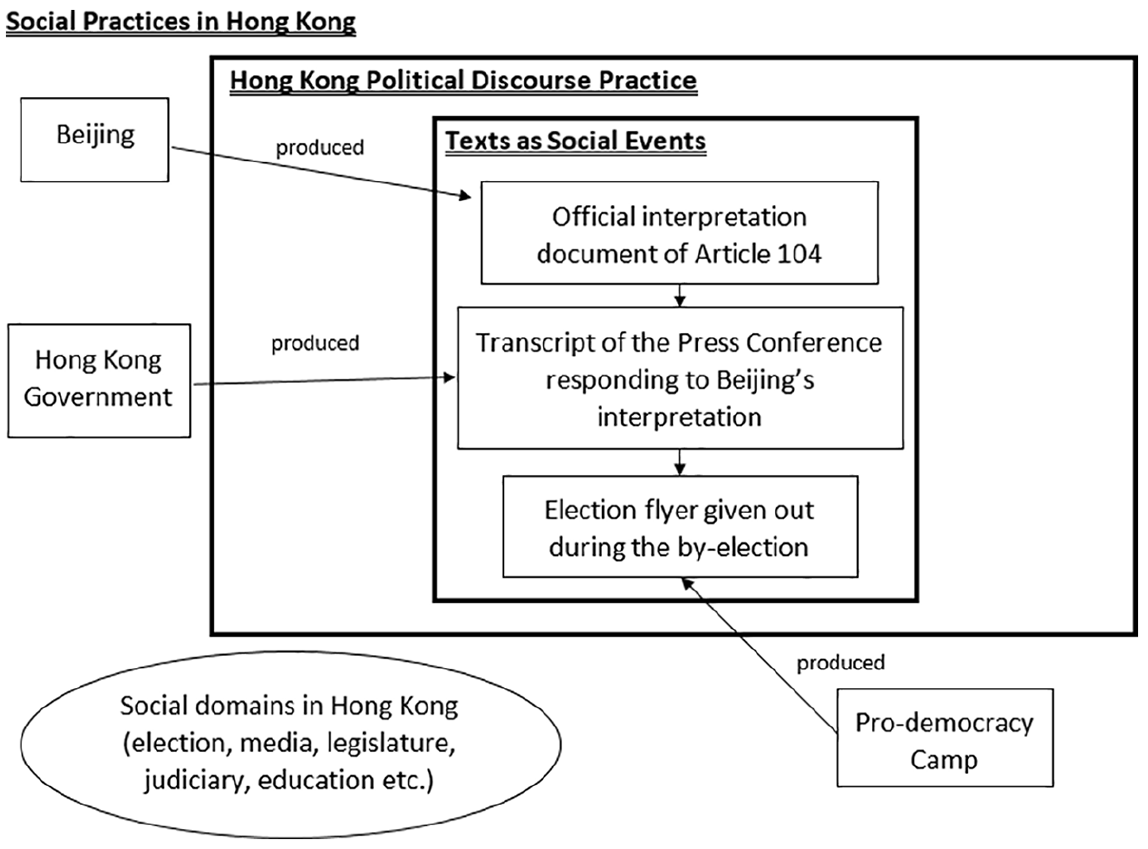
Fairclough’s three-dimensional model applied in Hong Kong political discourse.
Figure 1 shows the key social actors and key texts. Through systematic analysis of the texts with CDA, this study aims to discover the social roles of the three key actors, how the texts were drawn upon and shaped Hong Kong political discourse and how the discourses created by the actors shaped other social domains in Hong Kong. Specifically, the research questions of the study are as follows:
How did the local government recontextualise Beijing’s voice and achieve its political aim (i.e. create a dominant representation of Beijing–Hong Kong relations)?
How did the pro-democracy candidate recontextualise Beijing’s voice during the by-election and achieve its political aim (i.e. secure votes)?
How does Beijing’s voice contribute to the hegemony and resistance in Hong Kong political discourse?
The transcript of the press conference on the interpretation was first analysed 2 . The conference was held on the day of the interpretation by the then Chief Executive CY Leung and some principal officials. This text informs the study by revealing how local government officials reacted to the interpretation. It shows how officials recontextualised Beijing’s voice and used discursive strategies to achieve specific political aims at the local level. A corpus consisting of 177 news articles by ‘Beijing mouthpieces’, Wenweipo and Ta Kung, was employed 3 . The news articles were published within 10 days, after the interpretation (5 November 2016) and before the ruling of the High Court (15 November 2016). With frequency and concordance searches of keywords, the corpus analysis triangulated the findings in the press conference text. An election flyer, which was handed out by Au Nok-hin, a pro-democracy candidate, was also analysed. It provides useful visual and verbal cues of how the pro-democracy candidate drew upon Beijing’s voice and resisted the hegemonic voice in the by-election.
The four-page flyer was handed out by Au Nok-hin, a pro-democracy candidate in the by-election. It was compact with ample information about Au, his election platform and advocacy (Figure 2).
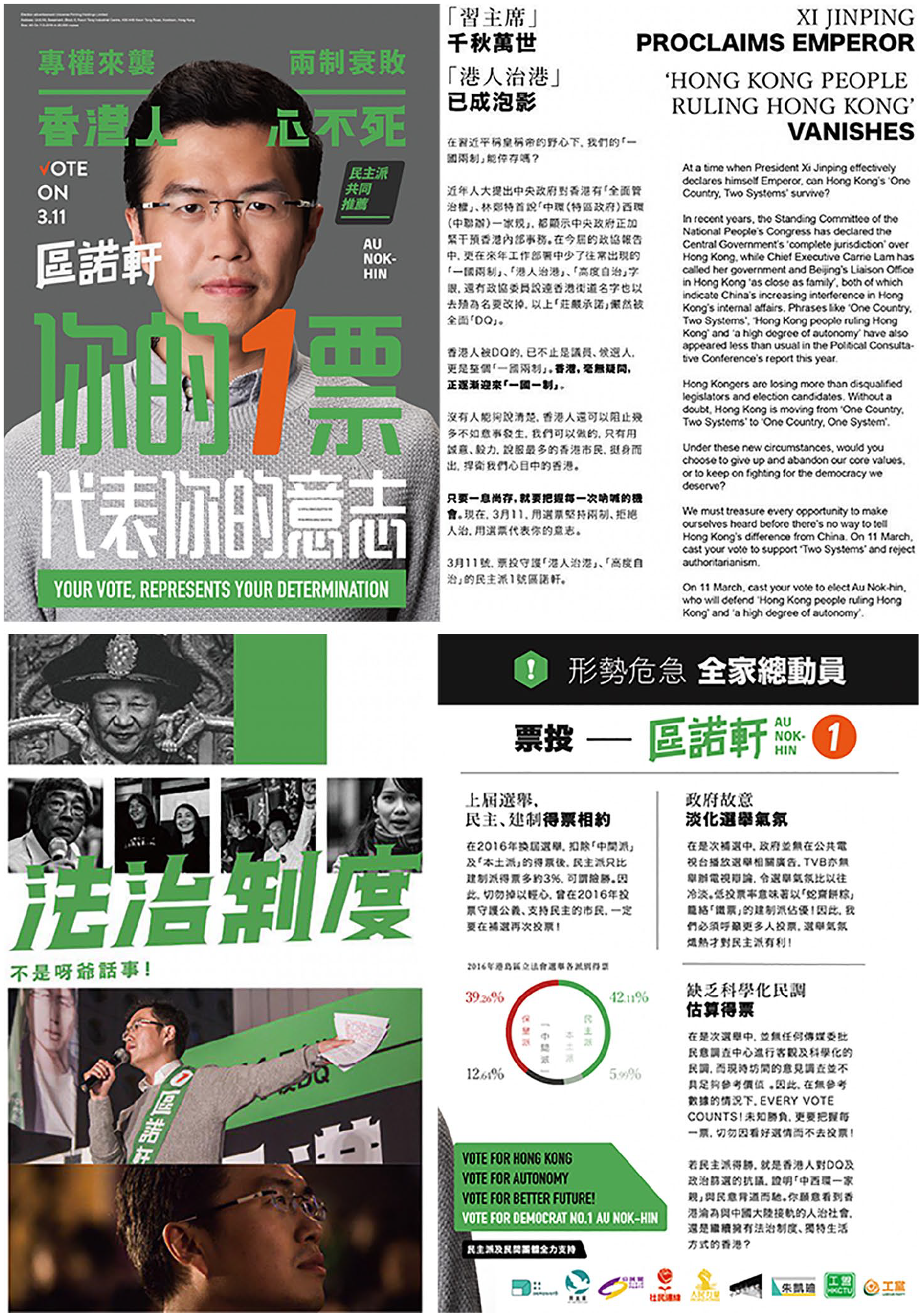
Four-page election flyer handed out by Au Nok-hin.
A text can be linked to another text produced in the past by recollecting a previous social event. This process of carrying established elements to new contexts is called ‘recontextualisation’ (Wodak and Meyer, 2015: 28). The previous text can be adapted or even manipulated, and new meanings can be generated. ‘Social actors within any practice produce representations of other practices, as well as (“reflexive”) representations of their own practice . . . different social actors will represent them differently according to how they are positioned within the practice’ (Fairclough, 2003: 206).
As this study focuses on the recontextualisation of Beijing’s voice, the analysis of the press conference transcript and the election flyer look into the discursive strategies employed by the producers and implications for Hong Kong politics. The linkage between one’s discursive strategies and social practices in Hong Kong reflects their own social power and shows how different representations of the Beijing–Hong Kong relations were created and perpetuated (Van Dijk, 1996). Finally, the two analyses were put together to create a broader picture of the roles of Beijing, local government and the pro-democracy camp in social practices in Hong Kong across social domains.
Research findings
The Hong Kong government’s response to Beijing’s interpretation
After Beijing released its interpretation of Article 104 on 7 November 2016, senior officials of the Hong Kong government held a press conference in response. The inclusion of other voices, compared to other genres such as a written press release where information exchange is not instant and interactive, can be seen as a way to ‘increase the government’s legitimacy and reduce the people’s feelings of alienation’ (Fairclough, 2003: 76).
The following discussion is organised according to the three discursive strategies identified in the press conference: (1) negative labelling and exclusion of the opposition, (2) advocating national security and integration and (3) portraying effective local governance differentiated from Beijing. The discussion is complemented by the analysis of the news corpus to show how the government’s representation influenced pro-Beijing newspapers’ portrayal of the interpretation.
Negative labelling and exclusion of the opposition
Labelling is a linguistic process of describing a particular person or group of people with positive or negative traits. These labels ‘are ascribed to people depending on the perceived social attitudes associated with the people or groups’ (Igwebuike, 2018: 157). The Chief Executive CY Leung gave different negative labels to Leung Chung-hang and Yau Wai-ching who were disqualified during the oath-taking incident, such as ‘deliberately violated the oath-taking procedure’ and ‘insulted the Country and the Chinese people’. Besides, Leung also labelled them as advocates of ‘Hong Kong independence’. He also amplified public and government reactions to their acts and brought them up to the national governance level by saying that ‘their conduct has caused widespread indignation in Hong Kong and across the Country’. The government made use of negative verbs and adjectives to set up an explicit protagonist–antagonist relation between the government and those who ‘seriously undermine the rule of law and deal a heavy blow to “one country, two systems”’ (Fairclough, 2003). In the Chinese text, the Chief Executive used ‘衝擊法治’ (to charge the rule of law), a conceptual metaphor where he tied ‘verbal abuse’ with ‘physical assault’. This framed the rest of the text by setting up a presupposition that all these interpretations and recent political events were caused by those who were violent and against the government and Beijing. The Hong Kong government portrayed itself as the victim in the oath-taking incident as its constitutional principle was ‘damaged’ by the opposition.
The voice of the opposition is absent in the whole text; there is no direct quotation or reported speech from Leung, Yau or the pro-democracy camp. When one social actor does not exist in the text at all, it is a manifestation of exclusion in discourse practice (Fairclough, 2003: 145). By excluding the voices of antagonists, the government, with its institutionalised voice, created an assumed consensus, contributing to the hegemonic voice.
The news corpus provides more details of how the opposition is, very often, associated with Hong Kong independence which they never claim to advocate. The corpus shows that there were 1544 mentions of ‘Hong Kong independence’ (港獨/獨). Both Leung and Yau are described as ‘the supporters of Hong Kong independence’ (港獨分子). They collocate with phrases, such as ‘insulting the country’ (辱國) (93), 4 ‘leading someone astray’ (誤導) (18) and ‘deliberately breaking the law’ (以身試法) (3). It is also a practice that pro-Beijing newspapers call the pro-democracy camp ‘the opposition’ (反對派) (175) as it makes people think of them ‘opposing anything the government does’.
There are other negative labels of the opposition found in the corpus, such as ‘spreading independence’ (播獨) (11). The corpus suggests that ‘promoting independence’ takes place in LegCo. The interpretation could stop ‘supporters of Hong Kong independence’ from entering LegCo to ‘promote independence’. A concordance search of ‘Hong Kong independence’ revealed that the mouthpieces depict the interpretation as a way to ‘suppress the growth and spread of Hong Kong independent forces’ (打擊和遏制「港獨」/遏「獨」/「港獨」勢力滋長蔓延) (46) in Hong Kong.
Interestingly, there are 12 instances of ‘Hong Kong independence’ and ‘Taiwan independence’ (台獨) appearing in the same sentence. The newspapers portrayed those ‘advocating Hong Kong independence’ as being supported or funded by ‘foreign forces’ (外國勢力) (16), such as Taiwan and the United States.
Advocating national security and integration
Throughout the text, the government draws upon nationalist and stability discourses to justify the need for Beijing’s interpretation.
The statement the Chief Executive made was authoritative. He first directly quoted Article 1 of the Basic Law, ‘Hong Kong is an inalienable part of the Country’. By referring to laws, he was legitimising declarative statements he made via authorisation (Van Leeuwen and Wodak, 1999). The next clause is a declarative statement: ‘The Hong Kong people have the duty to uphold national unity, territorial integrity and security, as well as the dignity and interests of the Chinese people’. The verb ‘have to’ has the modal meaning of obligation. It is Hong Kong people’s duty to ensure that Chinese territory, security and unity are well-preserved; they should have a national view that they are Chinese. ‘Hong Kong people’, as a collective noun, was used intentionally by Leung to refer to the whole population inclusive of all political views. It has the same effect as the inclusive pronoun ‘we’ which ‘reduces [social] hierarchy and distance’ (Fairclough, 2003: 76). The use of collective nouns could be seen as an example of power inequality as the government speaks on behalf of all Hong Kong people, especially when voices of others are not in the text (Fairclough, 2003; Wai and Foong, 2018).
Leung drew upon nationalist discourses by putting Beijing’s security and unity before Hong Kong’s governance. He mentioned that ‘this incident was not just about the behaviours of the LegCo members or against the Basic Law but the greater interests of our country’. The inclusive pronoun ‘our’ was used to construe the unity of all Chinese in China as a whole who have the responsibility to safeguard the interests of China. He hedged this by saying that ‘throughout the whole process [of interpretation], the SAR government, including myself, had adequate communication with the central government’. This is a discursive strategy to mitigate the initiation of the interpretation by Beijing, which was severely criticised by the pro-democracy camp because Beijing used it as a means to interfere in Hong Kong’s judicial independence (Huang and Huang, 2016). The portrayal of stability as a national interest is also found in the Chinese context. Sandby-Thomas (2014) looked into how stability is established via constructing positive values of the CCP and exclusion of others in media discourse in China.
The news articles in the corpus are aligned with the government by drawing upon security discourses. A concordance search shows that ‘security’ (安全), in the corpus, often exists together with ‘State sovereignty’ (國家主權) and ‘benefits of development’ (發展利益) and the verb ‘safeguard’ (維護) (17). The consistent existence of these phrases shows that the interpretation not only helps clarify the Basic Law but is also a means to protect China’s interests.
Portraying effective local governance aligned with One Country Two Systems (OCTS)
There have been instances where the government has positively reinforced its effective administration at the local level by pointing out that OCTS is effective in practice. Under OCTS, Hong Kong is differentiated from other cities in China and enjoys ‘a high degree of autonomy’. One journalist asked the officials whether local law enactment would be initiated based on the interpretation, such as amending the Legislative Council Ordinance to require LegCo members to prove that they ‘真誠效忠’ (sincerely pledge allegiance to) the Basic Law. In response to the question, the Secretary of Justice Rimsky Yuen denied that the interpretation would change the current law in Hong Kong. He added, using a conditional clause, that if there were divided views between the LegCo member and the person administrating the oath, ‘ultimately we would put forward the case to the Hong Kong Judiciary and our courts. Therefore, the power of the person administrating oaths has not been extended’. Here, he held a premise that the local Judiciary could make impartial judgements and handle controversial cases fairly. As the Secretary of Justice, he had great trust in the local judicial system and judges.
The Secretary of Justice was then asked whether the interpretation was necessary as he had once claimed that the local judiciary could handle the oath-taking incident without Beijing’s involvement. In his answer, he first said that ‘as the SCNPC has already made the decision on the interpretation of Article 104, I hope everyone can consider related matters with an objective and positive attitude’. He evaded commenting on Beijing’s deliberate interpretation. Instead of making evaluative statements, Yuen portrayed the interpretation in a highly abstract way using words like the nominalised ‘interpretation’, ‘hope’ and ‘matters’ in order to exclude concrete details which were controversial, such as the ‘over-interpretation’ of Article 104. He then switched to endorsing the local judiciary: ‘The SAR government has absolute confidence in the Hong Kong Judiciary and judicial officers’, ‘the Hong Kong Judiciary and judicial officers still perform their duties professionally and are recognised by the international community. This claim proves their expertise and quality. We are very confident that this will continue’. He created a positive and supportive image of the local judiciary and government. It is not surprising that the Secretary made very positive evaluations of the local judiciary and personnel, but his claim was indeed general and detached from the current context of the interpretation. The rule of law is one of the essential elements that differentiate Hong Kong from other cities in China, entitling Hong Kong to become a world-class city (Flowerdew, 2004b). Including endorsements from the international community beyond the national level, the government wanted to pacify local citizens’ apprehension about Beijing’s intervention in local governance, in particular.
Yuen made use of the discursive strategy of topic control by changing topics initiated by the journalist from a national–local topic to an international–local topic, turning possibly unfavourable questions into favourable ones, and thus placed emphasis on the effective local governance and international status (Mayr, 2003). Topic control with no follow-up questions allowed also suggests that the press conference was largely manipulated by the government.
Both the government and newspapers in the corpus stress the importance of upholding OCTS. The term as an object collocates with ‘safeguard’ (維護) (11), ‘ensure’ (確保) (10), ‘damage’ (破壞) (8), ‘charge’ (衝擊) (6), ‘carry through to the end’ (貫徹) (6) and so on. Unsurprisingly, positive verbs have ‘Beijing’ as the subject, while negative verbs have ‘Hong Kong independence’ advocates as the subject. Both Wenweipo and Ta Kung do not deny the fact that OCTS is essential to Hong Kong’s governance. They also add that ‘The central government has carried OCTS through to the end’ (釋法顯示中央堅持「一國兩制」的初心) (2). The interpretation incident is an example to show the central government upholding their original intention of implementing OCTS. The mouthpieces positively evaluate Beijing’s effort with which OCTS will ‘retain its shape’ (不變形、不走樣) (10).
Using ‘One Country’ as the keyword, the concordance lines reveal the newspaper’s view towards OCTS where ‘One Country’ should be above ‘Two Systems’. There are instances of ‘The base and prerequisite of OCTS is One Country. Without One Country, there is no Two Systems’ (「一國兩制」的基礎和前提是「一國」,沒有「一國」,就沒有「兩制」) (4) and ‘This SAR is under the PRC’s One Country’ (這個特別行政區是在「中華人民共和國」的「一國」之下) (1). Unlike the local government which stresses the positive local governance, the newspapers interpret OCTS as ‘One Country’ presupposes ‘Two Systems’, and thus blame those advocating independence for undermining ‘One Country’. Both actors adopt different strategies where the government reconfirms OCTS which gives Hong Kong a distinctive international status compared with other cities in China, while Beijing’s mouthpieces portray OCTS as a principle whereby Beijing should be above Hong Kong.
Hegemonising political discourse and its implications for local governance
In terms of the genre chain, including Beijing’s interpretation and Hong Kong’s press conference, since Beijing’s interpretation only explained a constitutional document, how it was implemented or followed would be the Hong Kong government’s call. Beijing played an ‘advisory’ role and released a non-legally binding document. The local government made attempts to hegemonise Hong Kong political discourse with different discursive strategies found in the text. Negative labelling of the opposition and the use of inclusive ‘Hong Kong people’ are the means to create ‘a universal status of a particular vision’ (Butler et al., 2000). The government excluded voices of the opposition and controlled the topics in the press conference, blaming ‘Hong Kong independence’ in an abstract way as the cause of the whole interpretation. Oppositional voices were not allowed. The universal, right representation towards the interpretation did not accommodate such view. Creating a negative opposition while excluding them in the genre could be seen as one of the political means the local government adopted to achieve hegemony in Hong Kong political discourse.
The domination of discourse practice thus influenced social practices (i.e. different social domains, such as media, elections, social movements and education) in Hong Kong. The chain of genres also caused effects on other genres in other social domains. ‘Genres of governance’ pay attention to how genres in certain social practices (such as policy documents) regulate and control other social practices (Fairclough, 2003: 141). Strategies and policies, in this case, Beijing’s voice and the Hong Kong government’s response, are ‘formed, disseminated and legitimised within complex chains and networks of events’ (Wodak and Meyer, 2015: 171). Recontextualisation is one of the ways to examine such process. It is perceptible that certain social domains were tightened to align with the government’s hegemonic representation. The corpus analysis of two Beijing mouthpieces reflected that their portrayal of the interpretation bore a resemblance to the government’s response to the interpretation. The government’s view towards ‘Hong Kong independence damaging OCTS’ was recontextualised in the news articles with similar discursive strategies. The voice of the newspapers was ‘patriotic’ with stronger emphasis on China as a nation where ‘One Country should be above Two Systems’, while the government stayed neutral and positioned Hong Kong as having a unique status in the international community. The corpus also shows that the Beijing mouthpieces made use of the interpretation issue and countermobilised readers to participate in the ‘fight against Hong Kong independence, support the interpretation’ assembly (反港獨撐釋法) (39) against those who ‘supported Hong Kong independence’ (Hong Kong Free Press, 2016). This is an example of how one social domain (i.e. pro-Beijing newspapers) triggered social actions in another domain (i.e. social movements). The newspapers provided an extra voice to the construction and consolidation of the hegemonic representation of Beijing–Hong Kong relations via recontextualisation.
The next section looks into one of the hegemonised social domains – elections where hegemony and resistance exist in Hong Kong.
The pro-democracy camp’s response in the by-election
This section explores how the pro-democracy camp, named ‘the opposition’ by the pro-Beijing parties, resisted the dominant voice in electoral discourse. The pro-democracy camp is positioned as the oppressed in this study as it has been facing oppression and exclusion induced by pro-Beijing forces who manipulated past elections via distributing spoils among voters, manoeuvring voter rolls, creating fake opposition and so on, (Fong, 2017a).
This analysis of an election flyer paid attention to its form of multimodality since it contains a substantial amount of visual in addition to verbal language. Sometimes, the marginalised are not allowed to express themselves openly with verbal language; multimodal gives access to marginalised voices to convey their versions of social reality with alternative routes (Wodak and Meyer, 2015). This way of analysis could prevent the risk of ‘overemphasising discourses of the powerful, therefore essentially reproducing their version of reality’ (Wodak and Meyer, 2015: 319).
The following analysis first looks at salient verbal elements in the flyer and then visual elements. The overall composition of the flyer is then discussed to examine how the verbal and visual elements reinforce one another to create a particular representation of Beijing–Hong Kong relations.
Verbal elements in the election flyer
Page 2 contains only a verbal text; it is a parallel (in both Chinese and English to embrace maximum readership), column-like text. Instead of using ‘Beijing’ or ‘mainland China’, Au used ‘Xi Jinping proclaims himself emperor’ to depict the current Chinese governance as one-man rule rather than unified, consensus-based administration. As article titles are often concise, the title implicitly suggests a causal link where Xi Jinping’s declaring himself Emperor leads to the vanishing of ‘Hong Kong people ruling Hong Kong’.
The use of both negative and positive lexical items sets the tone of the flyer; pessimistic wording comes first and then optimistic wording. The first three paragraphs point out that OCTS has been deteriorating in recent years, moving to ‘One Country One System’. The notion is supported by directly quoting Beijing’s and the current Chief Executive Carrie Lam’s words (‘The SCNPC has declared the Central Government’s “complete jurisdiction” over Hong Kong, whilst [the] Chief Executive Carrie Lam has called her government and Beijing’s Liaison Office in Hong Kong “as close as family”’). ‘Increasing interference in Hong Kong’s internal affairs’ suggests that Beijing’s recent political moves were disruptive and harmful to Hong Kong’s local governance. He ironically used the term ‘DQ’ (which means ‘disqualification’ in colloquial Hong Kong Cantonese), which Beijing and the Hong Kong government did after the interpretation incident, as a verb to show that the solemn promises made by Beijing and OCTS are ‘disqualified’ in addition to LegCo members and election candidates. The tone changes from negative to positive in the last three paragraphs. Au portrayed this by-election as a countermovement to Beijing’s intervention, using phrases like ‘keep on fighting for the democracy we deserve’, and ‘cast your vote to elect Au Nok-hin, who will defend “Hong Kong people ruling Hong Kong” and “a high degree of autonomy”’. He set up an antagonist–protagonist relation, urging Hong Kong people to vote for those who defend what Hong Kong is proud of and go against the tide. The sentence ‘We must treasure every opportunity to make ourselves heard before there’s no way to tell Hong Kong’s difference from China’ is a salient example to show Au’s resistance to the integration of Hong Kong and Beijing governance. He also pointed out the difference in regime between the two administrations (‘cast your vote to support “Two Systems” and reject authoritarianism’).
Au appealed that casting a vote in the by-election was important to defend the core values of Hong Kong, such as the slogans on Page 1 ‘your vote, represents your determination’ and ‘香港人心不死’ (literal meaning: Hong Kong people’s hearts don’t die). Two rhetorical questions contrasting the political practices in mainland China and Hong Kong provoked readers to think about the desperate political situation in Hong Kong: ‘at a time when President Xi Jinping effectively declares himself Emperor, can Hong Kong’s ‘One Country Two Systems’ survive?’ and ‘你願意看到香港淪為與中國大陸接軌的人治社會,還是繼續擁有法治制度、獨特生活方式的香港?’(English: Do you want to see Hong Kong fall and become a society like mainland China upholding the rule of man, or continue to enjoy its rule of law system and distinctive living style?).
On Page 3, the large Chinese slogan in the middle ‘法治制度不是呀爺話事!’ (English: The rule of law system is not the grandfather’s call!) is catchy in a way that it incorporates a metaphor in which Beijing is referred to as ‘the grandfather’. Flowerdew and Leong (2007: 283) suggested that it is a parental figure portrayed by pro-democracy newspapers sarcastically as old-fashioned and stubborn. The use of ‘timeless present tense’ (and the exclamation mark) also suggests that this notion should be permanent and sound under OCTS. Verbal language is also rich on Page 4. Titled as ‘形勢危急 全家總動員 票投區諾軒’ (literal meaning: Critical situation. Call out to the family to vote for Au Nok-hin in full force.), the text gives three reasons 5 why this by-election was different from previous elections and every vote counted. Unlike the last text discussed, which is more emotional, this text is persuasive with facts and statistics (e.g. votes obtained by the two camps are illustrated with a pie chart). The dominant voice of the government in Hong Kong political discourse is manifested as social actions in the second reason. Au gave examples of how the government diluted the atmosphere of the by-election: the government not running any advertisement on TV. Limiting the public sphere by denying access or imposing tight regulations could be seen as a contribution to hegemony (Fairclough, 2003). Throughout the text, there is no use of ‘I’ but only ‘the democracy-camp’ to represent Au. Similar to the effect of the inclusive ‘we’, it shows the unity of the pro-democracy camp, and this by-election was not just for Au but for democracy in Hong Kong.
Visual elements in the election flyer
There are plentiful visual elements in the flyer. On Page 1, Au’s countenance occupies nearly the whole cover page and becomes the backdrop behind the text. In front of the grey background, which is associated with the uncertain and pessimistic political outlook in Hong Kong, Au is directly looking into readers’ eyes, mouth closed without smiling. It creates a sense of seriousness and shows his determination to fight for democracy. The use of green and white for text colour is reminiscent of the logo of the Democratic Party of which Au was once a member. According to Au, he wanted to gain traditional pan-democrats’ support (Oriental Daily, 2018). On the top half of Page 3, there are college photos of prominent political figures in previous political events. The photo of Xi is sarcastic as it visualises his proclamation in readers’ minds. One resistance strategy can be found here where Au used the picture of Agnes Chow to remind readers of the recent disqualification. Rather than explicitly naming her or depicting the incident, he used visualisation to express voices that had been denied access to hegemonised electoral discourse. At the bottom of the page, there are two colour photos of Au, in one of which he is holding a microphone in a pep rally giving his speech to supporters. The other is Au tilting his head up and staring to the right. These photos of him indicate that Au was determined and had hope with the support from his allies and supporters with whom he had served as a member of the Southern District Council (Janks, 1997).
We can conclude from the above analysis that the verbal and visual elements reinforce each other, with verbal text bearing higher prominence. The verbal elements in the flyer create a narrative of Beijing–Hong Kong relations. With facts and examples, it informs readers that Beijing political moves and incidents in the past years indicate that Hong Kong’s OCTS has been eroded; however, if Hong Kong people are determined and treasure every opportunity to express their discontent, there is still hope. The visual elements in the flyer personalise the ideas expressed by creating a more tangible and serious atmosphere. Photos of disqualified LegCo members evoke readers’ recollections of Beijing’s recent political intervention, adding an ‘emotional’ side to the narrative. Nevertheless, it is noteworthy that because the verbal and visual elements are quite separated in the flyer (most of the texts are on Pages 2 and 4, while most of the photos are on Page 3), the relationship between different semiotics does not seem obvious without closer examination.
Implications for resistance in Hong Kong political discourse
The analysis of a pro-democracy candidate’s election flyer demonstrates how resistance is possible by providing an alternative representation of Beijing–Hong Kong relations in hegemonised Hong Kong political discourse. With the use of multimodality (such as photos and videos), marginal voices can be heard and formed.
As Foucault (1980) once said, ‘there are no relations of power without resistances’ (p. 142). From this case study, we can see that resistance does not stand on its own; it does not arise if there is no hegemony. Resistance can be manifested in one’s electoral strategies. From the perspective of political marketing, building a positive, competent image of candidates, such as showcasing their past contributions to the district and their political aspirations, is crucial. However, we should not ignore the fact that portraying oneself as marginalised or even oppressed could be a way of gaining ‘empathetic votes’. In the flyer we analysed, there are no bullet points or photos showcasing the candidate’s work and contributions. Although Au did mention his views on policies relevant to the Hong Kong Island constituency in other flyers, he had a strategy of ‘having different foci for different election flyers’. The conscious choice of focusing solely on ‘the deteriorating Beijing–Hong Kong relations’ reflects that he saw the recent political events as ‘advantageous’ to gaining votes from pro-democracy supporters. Critical issues raised by Beijing and the local government, who created the hegemony in discourse, could be ‘resources’ for marginal voices to resist, and in electoral discourse, secure votes from like-minded (i.e. pro-democracy) supporters. 6
Implications: Beijing’s voice, hegemony and resistance in Hong Kong political discourse
Given the complexity of the study where three social actors and a chain of events are examined under the lens of CDA, this study proposes a model that can synthesise the findings and provide a systematic view of the interplay between the three actors in Hong Kong political discourse (Figure 3).
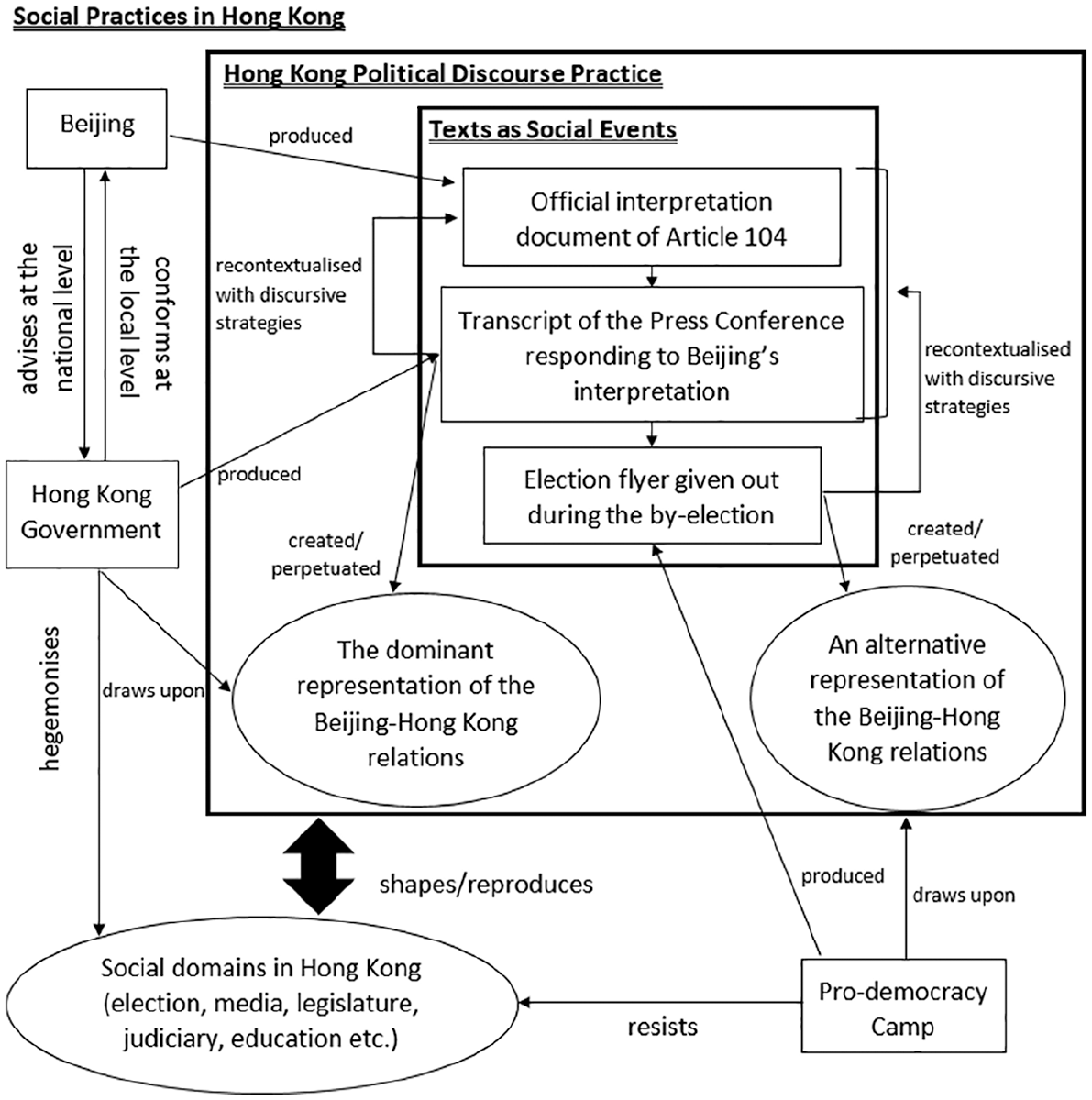
A proposed model explaining how Beijing’s voice is recontextualised and contributes to hegemony and resistance in Hong Kong political discourse.
Recontextualisation of Beijing’s voice and discursive strategies
We can see the recontextualisation of Beijing’s voice in the press conference and election flyer at the level of discourse practice. Beijing’s voice was appropriated differently in the two texts because the two authors had very different political aims. From the findings, we observe that the Hong Kong government recontextualised Beijing’s voice in the press conference with discursive strategies that facilitated its local governance. All the strategies we found led to the political aim of hegemonising political discourse practice by creating or perpetuating the dominant view of Beijing–Hong Kong relations (positive and mutual). We can see similar representation of the relations in the pro-Beijing news articles. As for the pro-democracy camp, they had the primary aim of securing as many votes as possible to win back the seats. They drew upon Beijing and the local government’s past social actions to create an alternative narrative (negative and pessimistic) of Beijing–Hong Kong relations.
Putting the analyses of the two texts together, the two social actors provided very different representations of Beijing–Hong Kong relations with different assumptions and ideologies. There is confrontation between the two discourses (or representations).
The dialectical relationship between political discourse practice and social practices
This leads to the question: how is the confrontation between the two discourses manifested in Hong Kong politics? This question can be addressed by looking at the dialectical relationship between political discourse and social practices in Hong Kong. Discourse practice is ‘an arena for ideological struggle’; if one representation wins over other representations, it becomes the hegemonic view with a universal status (or ‘the common sense’) (Butler et al., 2000). As illustrated in the model, the Hong Kong government created (or perpetuated if there had been one created before) the dominant representation of Beijing–Hong Kong relations. Discourse, as part of social practices, shapes social activities and how different social actors, such as the general public, view social reality, and is shaped by them. To perpetuate the dominant representation, the government of Hong Kong makes use of discursive strategies, such as those in this study, and arguably legitimation and alliance with different parties in Hong Kong in different social domains. For example, as seen in the corpus analysis, the political stance of pro-Beijing newspapers adopted and thus disseminated the hegemonic Beijing voice (Fung, 2007).
The dominated representation facilitated Beijing’s intervention in Hong Kong across social domains. Four more pro-democracy LegCo members were disqualified after the interpretation. In the subsequent district and legislative elections, there were instances where pro-democracy candidates were disqualified by returning officers, who are locally employed as civil servants but empowered with the right to disqualify anyone who is suspected of violating Article 104 from taking part in elections (Apple Daily, 2018). The disqualification cases are examples of political vetting and exclusion of other voices. The government is constricting the public sphere in electoral discourse. In education, in addition to the introduction of moral and national education which sparked massive controversy in 2012, the newest secondary curriculum guide published in 2017 requires local secondary schools to allocate 51 learning hours to Basic Law education and include more elements of Chinese history and culture education, in the hope of strengthening students’ national identity and value education (Ming Pao, 2017). These are arguably concrete examples of genres of governance manipulated by the local government as the result of hegemonising Hong Kong political discourse. Once the order of discourse is consolidated and operationalised, they will become the ‘convention and universal practice’ and spread across other elements of social practices (such as activities, social relations and dominant values) which will further internalise the hegemonic representation (Wodak and Meyer, 2015).
The marginal voice in political discourse (i.e. the pro-democracy camp) resisted the hegemonic voice in the by-election. The pro-democracy candidate drew upon and created an alternative representation to counteract the dominated representation in his campaign. We can see such representation in other domains as well, such as social movements organised by the pro-democracy camp and pro-democracy media (Cheng and Ho, 2014; Liu, 2015).
Social roles of Beijing, the Hong Kong government and the pro-democracy camp in Hong Kong political discourse
This model also suggests the social relations and roles of Beijing, the Hong Kong government and the pro-democracy camp in Hong Kong political discourse. In this case study, Beijing had an ‘advisory’ role in terms of Hong Kong’s governance. From the findings, we do not see any direct intervention by Beijing in Hong Kong political discourse but ‘action at a distance’; Beijing influences the local administration by giving ‘advice’ to local institutions, such as the executive and judiciary. This aligns with OCTS, which promises Hong Kong a high degree of autonomy. However, non-salient interventions can be observed when we combine the analyses of Beijing’s and the Hong Kong government’s texts. The local government conformed to Beijing’s voice and aligned with Beijing’s ideology, such as the emphasis on the integration between Beijing and Hong Kong. ‘Intervention’ shows that Beijing was the first to initiate the chain of events (and genres), and thus had control over the content to be recontextualised by the other two social actors. The government of Hong Kong transformed Beijing’s voice at the local level by making it the dominant voice in Hong Kong political discourse with the facilitation of Beijing’s interpretation. The local Beijing mouthpieces helped disseminate Beijing’s voice in society.
Sandby-Thomas (2014) suggests the use of ‘consequentialist arguments’ in Chinese media discourse which project the future of the country in both good and bad ways to attract attention from society. He argues that this approach could sustain and legitimise the regime but not in the long term. We can also observe similar arguments constructed by the government in the press conference concerning national security and integration. The Hong Kong government’s attempts to dominate political discourse in the name of national security could, in the long run, hamper local governance or even induce resistance.
Conclusion
This study adopted CDA and provided a possible account for the complex political situation based on textual and social analysis. Hong Kong, as a special administrative region of China, is a hybrid regime somewhere between full democracy and full authoritarianism; Hongkongers enjoy civil liberty and the rule of law, but at the same time have limited political rights such as no universal suffrage for the Chief Executive and all LegCo members (Cheng, 2016). Although Hong Kong has its own local administration, currency, legal system and so on, Beijing oversees Hong Kong’s security, foreign affairs and appointment of principal officials and so on; Beijing has its voice in Hong Kong’s governance. Using the interpretation case, this study attempted to provide a model to explain the role of Beijing and its voice in critical political events in Hong Kong. It argues that the tension between the hegemony (i.e. the Hong Kong government) and the resistance (such as the pro-democracy camp) is indeed created and perpetuated by Beijing. The dominant representation of Beijing–Hong Kong relations as positive, integrated at the discourse practice level, is sustained by the local government and influences different social practices in Hong Kong. It thus triggers resistance which creates alternative representations of such relations to challenge the hegemony in those domains. The focus of this study, that is, the recontextualisation of Beijing’s voice, sheds light on how hegemony and resistance are contested in Hong Kong political discourse. It suggests that Beijing has a significant influence on reproducing the hegemony at a distance, but at the same time reproducing and providing ‘ammunition’ to the resistance to counteract and challenge the hegemony, helping them achieve their political aims in society, such as securing votes in elections and mobilising supporters to protest. As a result, the tension between the government and the resistance is intensified. This study echoes Fong’s study (2017b) where he argues that Beijing’s incorporation strategies (e.g. stressing national unity) lead to a rise of counter-mobilisation by providing an in-depth case study and close text analysis.
With the proposed model, explorations of other social domains can be carried out in future to put together a comprehensive picture of the power struggle between hegemony and resistance in Hong Kong political discourse. The ‘Beijing factor’, or ‘China factor’ as used by other scholars, should not be neglected when studying Hong Kong politics (Ma, 2017). The framework could also be applied to the study of Beijing–Macau relations as both Hong Kong and Macau are special administration regions of China. This study also suggests a systematic examination of the contestation between an autonomous region (i.e. Hong Kong) and its national government (i.e. Beijing) manifested in discourse practice and social practice across social domains. It provides a new angle for researchers of political science who are interested in the study of ideological struggle, hegemony and resistance in autonomous regions.
The reciprocal effect contributes to the vicious cycle of ideological confrontation across social domains as each instance accumulates and internalises itself. It could create a deeper rift in society than ever and weaken the effectiveness of the local government caused by internal friction. With deliberate involvement in Hong Kong political events, Beijing has the upper hand over the other two actors by ‘setting the tone’ of the ‘appropriate’ discourse practice in Hong Kong. At the time of revising this article, the anti-extradition bill movement was in its sixth month. The District Council election held in November was seen as a ‘referendum’ by pro-democracy supporters (Cheng, 2019). The pro-democracy camp won over 380 out of 452 seats, more than triple they had won in the previous election. The turnout rate was at a record high since the handover. An editorial titled ‘Result of district council election skewed by intimidation, dirty tricks’ by a Beijing mouthpiece responded to the election results by saying ‘the results were skewed by the illegal activities of the opposition camp to the benefit of their candidates . . . Emboldened by such support, members of the opposition camp have been advocating and inciting illegal acts under the banner of democracy’ (China Daily, 2019). A lot of the elected pro-democracy candidates had no experience in district council work; most voters came out and voted for them because they belonged to the ‘yellow-ribbons’. After the by-election, the political ideology of a candidate once again outweighed their competency and work experience.
Meanwhile, Au Nok-hin and his colleague lost their LegCo seats by the Court of Final Appeal which upheld their decision that they were not duly elected. Au’s case was due to the overturning of the disqualification of Agnes Chow-ting. The disqualification issue has once again been raised in society. At this timely moment, this study claims that the role of the Hong Kong government is crucial when it comes to transforming Beijing’s voice in local practices. They have to strike a balance between Beijing’s expectations of Hong Kong’s governance and upholding Hong Kong’s freedoms and rights to maintain its positive image in the international community Hongkongers have been proud of.
Footnotes
Declaration of conflicting interests
The author(s) declared no potential conflicts of interest with respect to the research, authorship and/or publication of this article.
Funding
The author(s) received no financial support for the research, authorship and/or publication of this article.