



Abstract
Anaerobic digestion is a process to convert organic biomass into bio-methane. Plenty of produced waste in Pakistan is enough to compensate energy thirst of country and have potential to replace costly fossil fuels. The lignocellulosic biomass such as wheat straw, almond shell, sugarcane bagasse, maize straw and corn cob were subjected to bio-methane potential assay after proximate, ultimate and chemical analysis. These chemical fractions provide better understanding about theoretically predicating bio-methane potentials such as neutral detergent fibre, acid detergent fibre, acid detergent lignin, cellulose, hemicellulose, carbohydrates, proteins and elemental analysis. Experimental bio-methane potentials were found, 267.74 (wheat straw), 255.32 (almond shell), 222.23 (corn cob), 247.60 (sugar cane bagasse) and 293.12 ml/g (maize straw) volatile solids and was much less than predicted methane potential. The energy content on dry basis and methane potential has been assessed to find economic feasibility of biomass. The biodegradability and methane potential inversely related to the lignin content of biomass. Bioenergy production from biomass is economically favourable. The volatile fatty acids were produced in the percentage of 53–58% acetic acid, 30–35% butyric acids and 6–13% propionic acid and showed same metabolic pathway and types of bacteria involved in digestion.
Keywords
Introduction
First-generation biomethane are derived from food crops and lignocellulosic biomass. 1 Presently, Pakistan is facing energy crisis, and is producing plenty of wastes from agricultural fields and can be utilized to quench energy crisis. Major crop is cotton, sugarcane, wheat, maize and rice. Total sum of crop waste is ≈28m-ton/year (http://fp.brecorder.com/2013/12/201312071262105/). Technically and theoretically, all these agricultural waste substrates (AWSs) can be subjected to anaerobic digestion (AD) for biomethane production and also considered to be an ideal solution of wastes. AD is an anaerobic process for the conversion of organic materials into biogas via hydrolysis, acidogenesis, acetogenesis and methanogenesis. Initially higher organic compounds are converted to simple monomers products, progressively convert into volatile fatty acids (VFAs) and CO2/H2 via acetogenesis and methanogenesis. Ultimately in the last stage, it is converted to CH4. Main composition of biogas is 55–80% CH4 and 20–45% CO2, with other impurities such as H2 and H2S (traces) and provide as alternate, potential source of renewable energy, replaced biofuel, heat/electricity sources. 2
Agricultural waste substrates ( AWSs) have been recently got more attention due to its treasured aspects such as high yield, cheap energy sources. 2 Literature review provides immediate knowledge of bio-methane potential (BMP) of AWSs and are cited in the range of from 200 to 450 ml/g VS. 1 This anaerobic digestion (AD) product can be used without modification in power gas engines i.e. combined heat and power.2,3 Natural gas has a calorific value (CV) of 37.5 to 43.0 MJ/m3, but reported CV for bio-methane is 37.78 MJ/m3. 4 After understanding of AWSs digestion as renewable energy source, objective of this research is decided to explore the BMP and access the economic feasibility of substrates for small-sized digester. The wheat straw (WS), almond shell (AS), sugarcane bagasse (SB), maize straw (MS) and corn cob (CC) were subjected to pursue objectives.
Materials and methods
Analytical methods
Indigenous agricultural substrates such as WS, AS, SB, MS and CC were collected, dried and ground with a laboratory blender to fine powder. Total solids (TS), volatile solids (VS) and ash were determined by gravimetric method.
5
The elemental composition (C, H, O, N, and S) of substrates was analysed by an elemental analyser Carbon, Hydrogen, Nitrogen, Sulphur/Oxygen (CHNS/O) analyser, PE 2400 Series II, Perkin Elmer, USA. Neutral detergent fibre (NDF), acid detergent fibre (ADF), acid detergent lignin (ADL), hemicellulose (HC) and cellulose was determined by modified methods of Van Soest. Crude fibre content (CF) was determined by modified Maynard methods of food analysis.
6
Crude protein (CP) was calculated by multiplying nitrogen content (determined by CHNS/O analyzer) with 5.7 i.e. protein factor (N ×5.7).
7
Total carbohydrate was measured by anthrone method.
6
Theoretical CH4 yields have been calculated by using Buswell and Mueller equations 1 and 2.
8
Organic fraction composition (OFC) i.e. carbohydrate and CP values were used to calculate theoretical CH4 yields (BMPOFC) by using general equation 3.
9
Elemental anaerobic biodegradability (BDele) of the substrate has been calculated based on experimental BMPexp and BMPCHNO by equation 4.
10
Similar the experimental biodegradability (BDexp) by using equation 5 based on VS initial and final values.
11





BMP assay
For assessment of BMPexp, bottles of 250 ml volume (Schott Duran, Germany) were taken and added 100 ml prepared media in each bottles. Media was prepared according to Angelidaki and Sanders. 12 A calculated amount of substrate was added (2% VS) in bottles and 10 ml inoculum active and developed inoculum was taken from anaerobic pilot plant digester of NIBGE, Faisalabad, Pakistan) was added. Each bottle was flushed with N2 and CO2 mixture (80/20% by volume) for 5 min for ensuring maintaining anaerobic condition. These bottles were placed in incubator at 37°C for 35–40 days and vortexed twice a day. The methane production was measured on daily basis during first week, alternate days in second week and then after two or three days in third, fourth and fifth weeks of AD.
Biogas analysis
Biogas volume was measured through water displacement methods by using alkaline solution (2% w/v NaOH). A gas composition analysis was measured using gas analyser (GFM 4XX series). The individual VFAs after 6 days, 15 days and 30 days of incubation by APHA standards,
13
total VFAs (tVFAs) were determined by APHA standards
14
by equation 6 with regular interval of time.

here, A is volume of sample in ml, N is normality of acid used (0.1 N H2SO4) and V is volume of acid used in attaining end point pH=4.3.
Biodegradability
Lignin BD (BDLB) is calculated by modelled described by Chandler
15
using equation 7.

Statistical analyses
All statistical analysis was performed using excel of MS office 2016.
Results and discussion
Table 1 shows the ultimate and proximate analysis of AWSs. In proximate analysis, VS is more important because only VS fractions are digestible and found in the rage of 61.23 to 70.33% with the order of SB>WS>MS>CC>AS and these results supported by previous study. These results of proximate and ultimate analysis are in line and supported by literature,16,17 however, few variation was observed in literature might be because of biomass growth parameters variations like growing and environmental (soil, plant maturity stage and seasonal difference) conditions as reported variation parameters in literature. 18 These ultimate data are used for balancing C/N ratio and help in predicting BMPCHNO. The chemical composition was determined and presented in Table 2. The chemical compositions are best criteria to evaluate AWSs for bioenergy production and extent of biodegradability. As reported, CP, NDF, ADF, ADL, HC and cellulose of dry matter of AWSs are in the range of reported data. 17 Normally, chemical composition of agricultural crop residues’ substrates varies from species to species or even changes within species. MS and CC are components of same crops with a lot of variations in chemical compositions. The reason of variation in chemical composition is similar to variation as discussed for proximate and ultimate variations. 18 The BMPexp of AS and CC were not studied previously, however, its results 255.3 and 222.2 ml/g VS, respectively, can be compared with lignocellulosic biomass range of BMP and it is found in range of from 200 to 450 ml/g VS. 1 The BMPexp of MS WS and SB is found in the range of reported data shown in Table 3.
The proximate analyses of substrate along with physical properties.
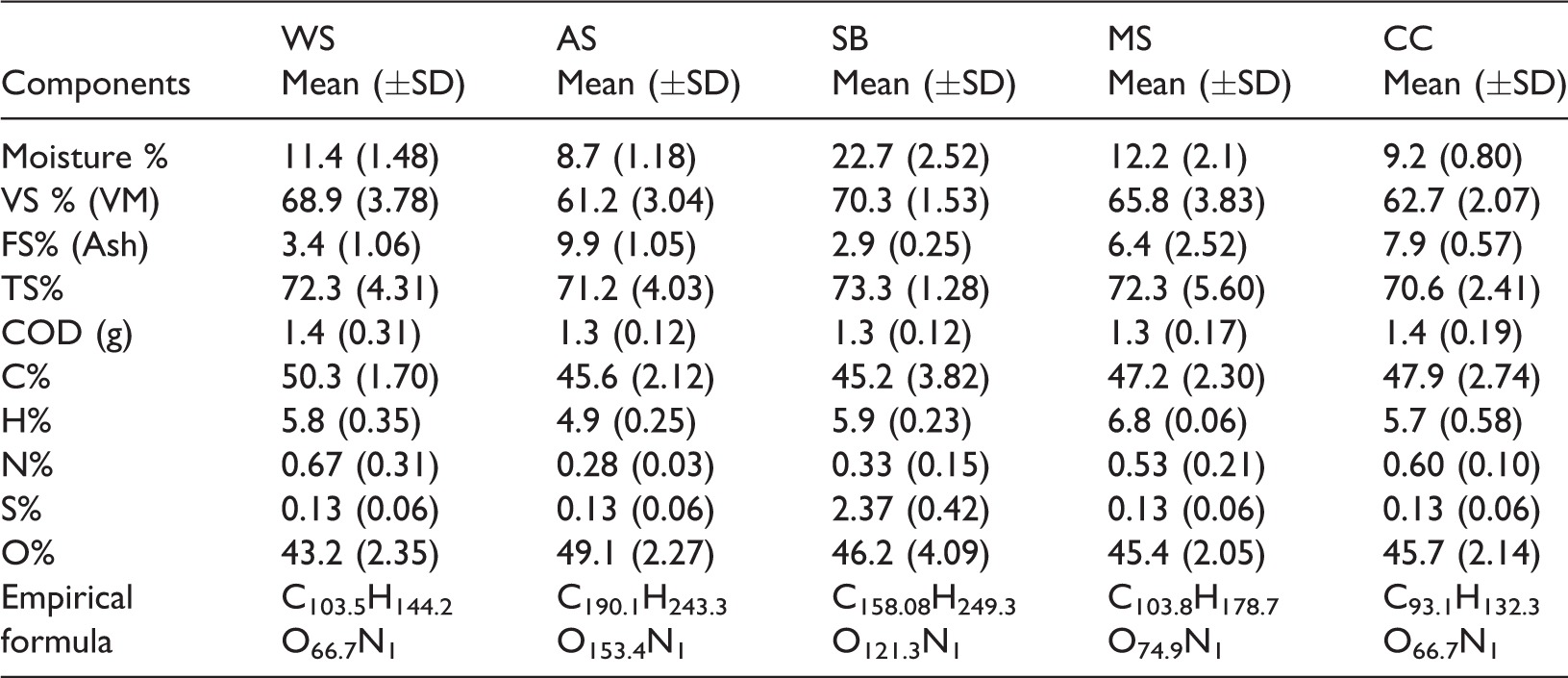
C: carbon; COD: chemical oxygen demand; FS: fixed solids; H: hydrogen; N: nitrogen; O: oxygen; S: sulphur; SD: standard deviation; TS: total solids; VS: volatile solids.
The chemical composition of AWSs.
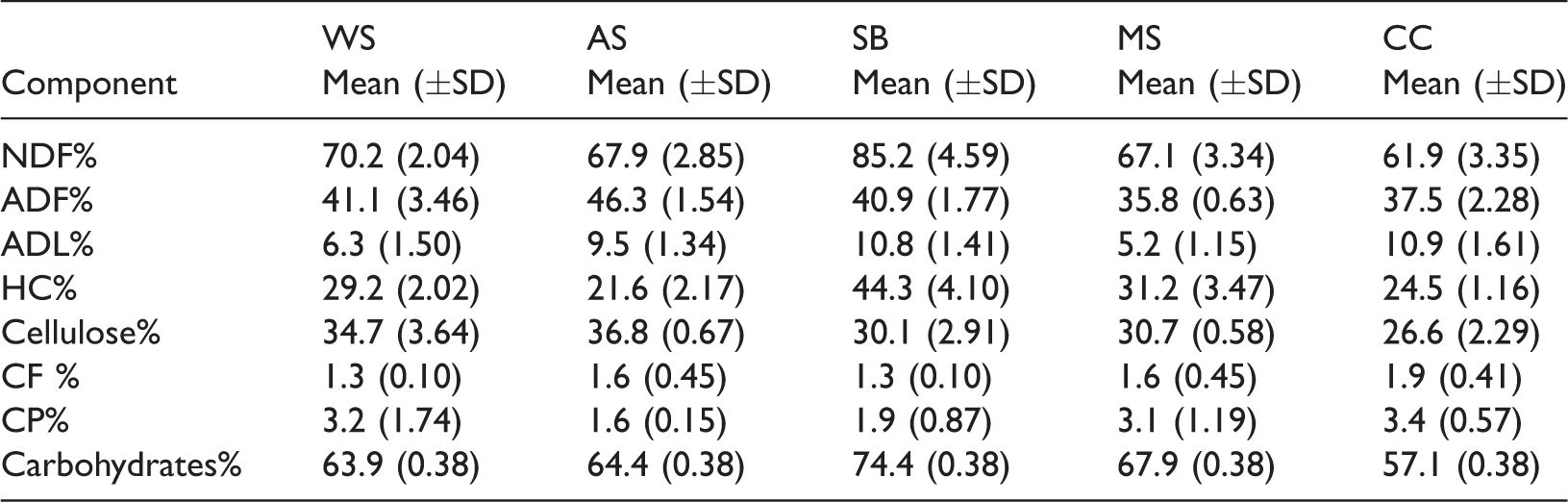
ADF: acid detergent fibre (which consists of cellulose and lignin); ADL: acid detergent lignin (consist only lignin); AS: almond shell; AWSs: agricultural waste substrates; CC: corn cob; CF: crude fibre; CP: crude protein; HC: hemicellulose; MS: maize straw; NDF: neutral detergent fibre (which consist of cellulose, hemicellulose and lignin); SB: sugarcane bagasse; WS: wheat straw.
Experimental and theoretical BMPs, biodegradability and energy contents.
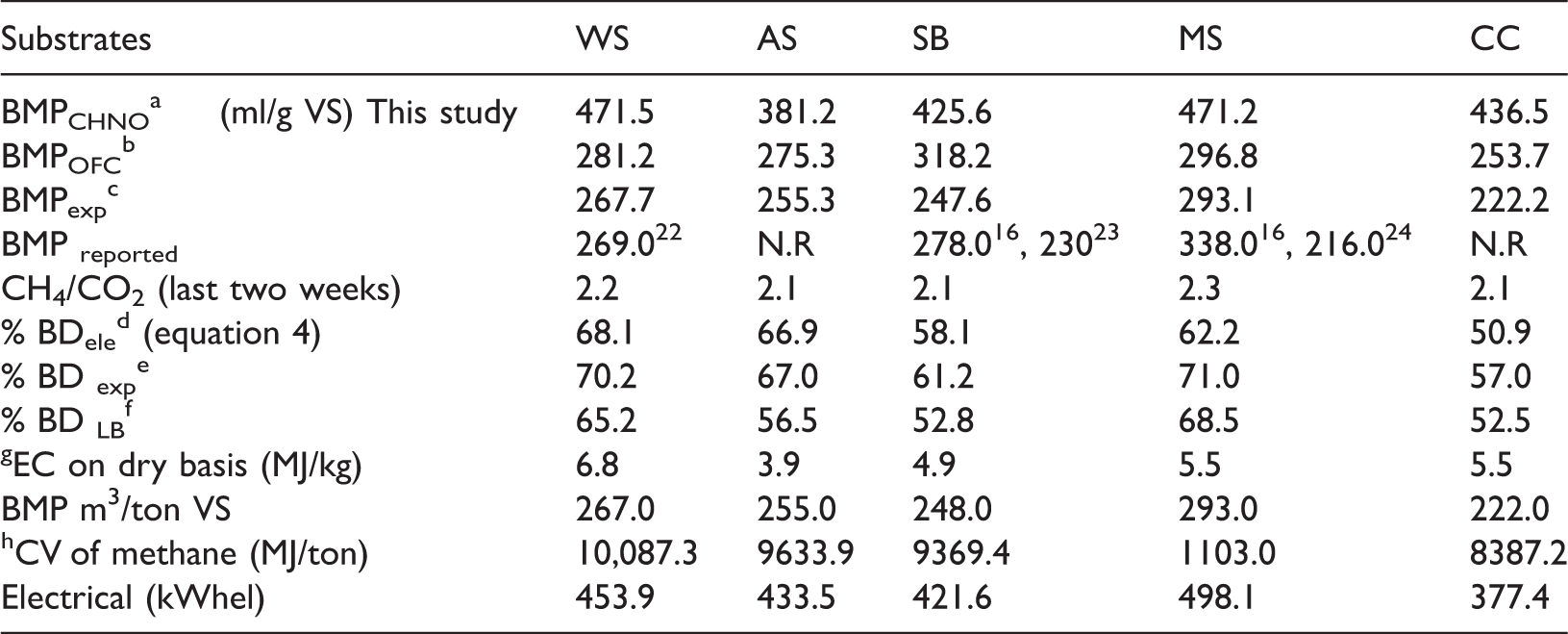
BMP: bio-methane potential; AS: almond shell; CC: corn cob; CV: calorific value; MS: maize straw; SB: sugarcane bagasse; WS: wheat straw;
aBMPCHNO was calculated from CHNO values determined from CHNS analyser.
bBMPOFC was calculated from carbohydrates and protein contents only.
cExperimentally determined BMP.
dElemental BD.
eExperimentally BD.
fLignin-based BD.
gEnergy content.
hCalorific values N.R not reported.
Biodegradability
BDele actually explains the extent of degradation of biomass and divided into biodegradable and non-biodegradable. The BDexp was measured from undigested VS and chemical oxygen demand. Similarly, lignin-based BDLB has shown least BDLB as compared to BDexp and BDele as listed in Table 3. The BD order was MS>WS>AS>SB>CC which interpreted indirectly relationship to lignin content. The recalcitrance nature of lignin defines the extent of BD and methane/biogas yields. It also means biodegradable components other than lignin directly related to methane/biogas production. As noticed, BDele was lower than BDexp and BDLB, higher BDexp is due to some part of digested VS also used for microbial growth and metabolism in addition to digestion for CH4. BD and lignin relationship has observed 1% lignin reduces about 3% degradability of biomass. It is also observed slight variations in BD and BMPs results, it can vary due to the use of dried samples in this study, different crop conditions suited for AD i.e. inoculum properties, operating temperature, headspace volume of flasks, substrate to inoculum ratio (S/I).9,16
Comparison of BMPexp and theoretical BMPs
In this study, theoretical methods have been used for the predication of BMPs (BMPCHNO, BMPOFC). The BMPexp was lower than theoretical BMPs, BMPOFC prediction values were lower as compared to BMPCHNO calculation as shown in Table 3. The less values of BMPexp are because of considering lignin as non-biodegradable part of biomass, and whereas theoretical BMPs based complete biodegradation i.e. no discrimination in non-biodegradable and biodegradable components. 1 However, another limitation of these methods is not considering the conversion of substrates into cell growth, metabolites and protoplasm synthesis of microbes and simply deals with stoichiometric calculation of BMPs and not converted into biogas. 10 However, these methods are useful for determination of BD extent and can’t be used as gauge of BMPs. 1
Composition of biogas
The cumulative methane graph as in Figure 1 did not show rate of methane production, actually about 80% VS was degraded in first 15 days of process with lower methane. The remaining VS was digested very slowly and completed in almost 40 days. The CH4 was increased gradually started from 40 to 45% in first week, 45 to 55% in second week and 55 to 68% in third and fourth week of biogas. The CH4 contents were raised up to 62–68% of biogas in last two weeks and CH4/CO2 was also reported in Table 3. Initially, the higher rate of biogas production with lower CH4 was due to large amount of digestible VS and low number of methanogens. As methanogens requires acclimated period for attaining sufficient number, CH4% increased after this period and remained constant until complete BD of substrates. This behaviour of percentage enhancement is in line with literature as reported. 4 The attaining stability of percentage after two weeks is in line with other researcher findings, who concluded that it stabilized after two weeks of AD. The variation of percentage composition is mainly because of chemical composition of substrate as generally observed in these study substrates which have high BD of substrates, have high percentage of methane in biogas.
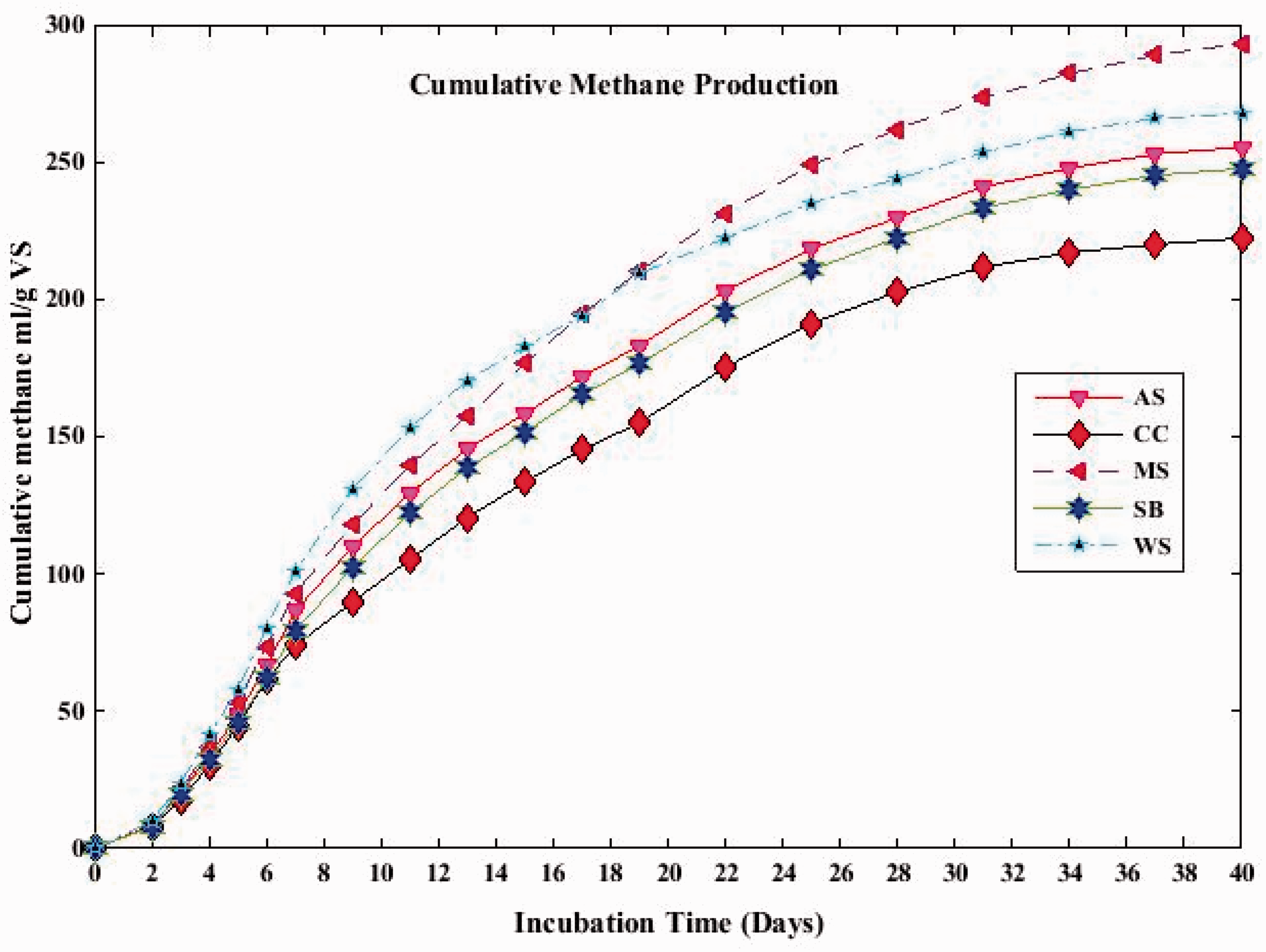
Cumulative CH4 ml/g VS of AWSs.
VFA analysis
Result of individual analysis of VFA has shown acetic acids (HAc), propionic acid (HPr), butyric acids (HBu) and iso-butyric acid (HiB) production. The concentration of acetic was 50% (53–58% of tVFA) of tVFAs, propionic acid (6–13%), butyric acids (30–35% of tVFA), the higher concentration of HAc is because of other VFAs are also converted to HAc as reported in literature. 19 The production of tVFAs is in the order of MS (2619) >CC (2450)>AS (2370) >BG (2326) >WS (1870) after the sixth day as shown in Figure 2. Actually individual acids are produced and consumed regularly and its concentration varied with time. Initially it is higher in production because of high rate of BD and sum of these VFAs was increased until methane forming started. It decreased with conversion of tVFAs into methane and also by decreasing the biodegradable components of substrates. The VFA production almost same for all digestion flasks it shows that all substrate was digested in similar pathways. Moreover, tVFAs were not produced to such extent that can inhibit the AD process e.g. tVFA concentration above 4000 mg/l inhibits AD process, 20 in this study, no such level of tVFA was observed as reported. In addition to controlled concentration of tVFAs, buffer (NaHCO3) was also added in digestion medium that can maintain the neutral pH and ensured the complete digestion of biodegradable components. These observations of concentration ratios are similar and supported to literature. 21
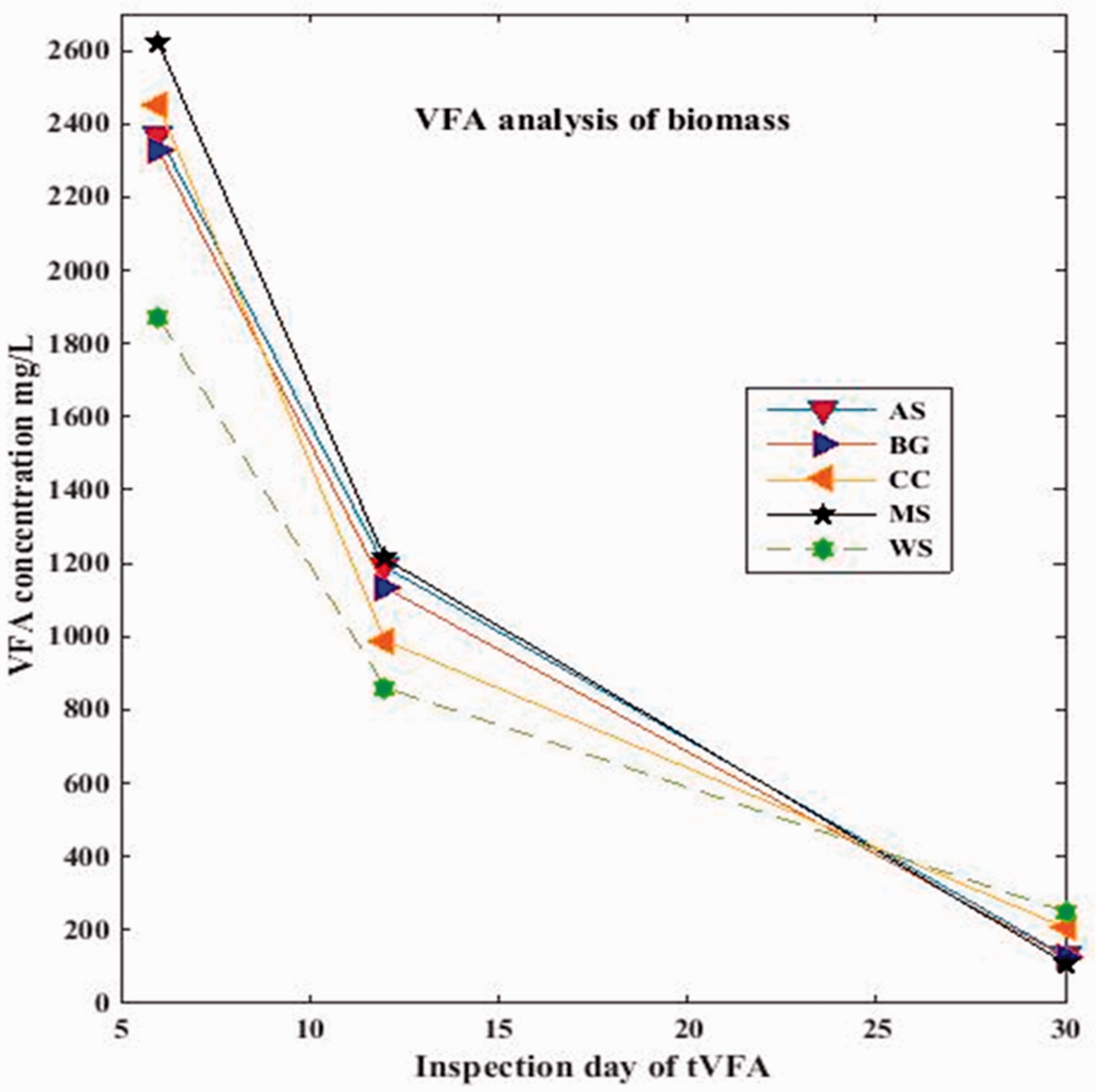
Volatile fatty acids analysis of AWSs digestion.
Assessment of biogas plant
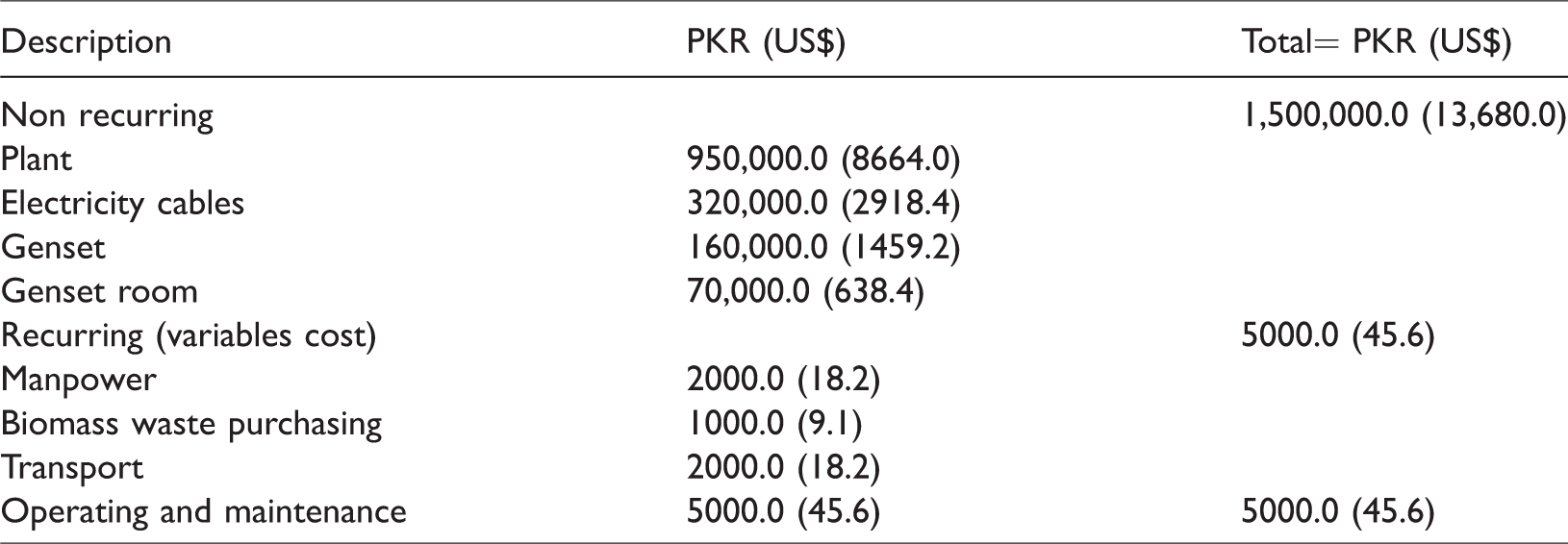
A model plant was assessed having capacity of 1 tonne of biomass waste daily as feeding material and able to generate electricity with genset. Approximate investment cost is divided into recurring (5000 PKR = Pakistani rupees) and non-recurring cost (1,500,000 PKR) indigenous estimations are given in Table 4. Recurring cost is variables due to transport distance and biomass weight and effort needs on collection of waste. The energy content calculated from Dulong modified formula, 4 CVs and electricity potential of methane are also in Table 3. Price of unit electricity is 18 PKR in Pakistan, and average generation cost per unit by is less than 1.5 PKR. Overall benefit of biogas and electricity generation in rural areas is reducing global warming, new job and investment opportunities. This is more recyclable and efficient alternative process for human environment than others.
Recurring and non-recurring cost value of digester (1 tonne capacity).
Conclusion
It is concluded from the study that BD and BMPs of AWSs are same and inversely proportional to lignin content. The methane contents in the biogas are directly proportional to number of methanogens in process. The theoretical calculation of BMPs doesn’t consider the lignin content as recalcitrance material and predicted yields were higher than BMPexp. These theoretical methods provide suitable knowledge about biodegradability extent and empirical potential of methane only. The VFAs analysis showed the same profile of individual VFAs in biogas analysis and indicated the same metabolic pathway for the production of CH4. Moreover, VFAs concentration was much lower to inhibit the process. BMPexp of AWSs is economically feasible as potential replacer of fossil fuel from electricity generation.
Footnotes
Declaration of conflicting interests
The author(s) declared no potential conflicts of interest with respect to the research, authorship, and/or publication of this article.
Funding
The author(s) disclosed receipt of the following financial support for the research, authorship, and/or publication of this article: The authors received financial support from PAK-US collaborative project for the research, authorship, and/or publication of this article.