



Abstract
In a growing body of environmental studies, the scholars have debated the relationship between democracy and the environmental quality. In this study, we empirically examine the impact of democratic factors on the environmental quality in high- and low-income countries. To do so, we use ordinary least squares (OLS) regression analysis on about 78 higher income countries and about 53 lower income countries in 2014. Our study finds that all factors of democracy, except for political participation, contribute positively to the environment. Also, the environment seems to improve monotonically as income grows. In lower income countries, most of the democratic factors do not have a positive impact on the environment, except for functioning of the government. This indicates that the government plays a critical role in improving the environmental quality in lower income countries. Income variables are not statistically significant in lower income countries. With respect to policy design, our findings suggest that it might be helpful for higher income countries to implement policies based on other successful democratic policies in countries with similar backgrounds. Lower income countries are recommended to strengthen their political institutions and promote well-functioning governance.
Introduction
In a globalizing world where the emphasis on the environmental issues is growing sharply, researchers from diverse fields have attempted to explain the factors that affect the environmental quality. In this paper, we focus on the important roles of democracy on the environment in the framework of environmental Kuznets curve (EKC).
Viewed in a historical light, democracy has played crucial roles in improving the environment. Well-known examples are German and Japanese participation against Chernobyl and Fukushima accidents. In Germany, the Chernobyl disaster resulted in public rage and new anxiety often known as “chemophobia.” a ,1 During this period, antinuclear grassroots activities were largely organized in metropolitan areas. The antinuclear movement reached its climax in Germany when a tsunami in Fukushima, Japan, triggered a severe nuclear power accident in 2011. On 26 March 2011, 260,000 participants organized the largest antinuclear demonstrations in Germany’s history, having more than 100,000 people protesting in Berlin alone. Their slogan was, “Look at Fukushima, shut down all nuclear power plants.” Such active participation of the civil society has dramatically influenced Germany’s energy and environmental policies. Meanwhile, in Japan, the Fukushima accident engaged the civil society with victim-centered perspectives so potent a force in promoting sustainable policies. Especially perfected by the Pollution Research Committee and antipollution groups, this post-Fukushima movement has resulted in a strong sense of victim-oriented environmentalism. 2 These two disasters have in common in that they both have triggered public distrust and collective fear. Moreover, civil society has started to exert their democratic rights by influencing the environmental policies, fostering a profound public discourse with active public protests and mobilizations.
The roles of democracy sometimes have led to heated debates in the academic fields. For instance, some experts with technocratic perspectives criticized democracy, claiming that it is impractical and ill-suited for the environmental issues. They argue that environmental improvement cannot be independent of technological and scientific expertise, which include detailed, axiomatic, and rigorous analysis. Traditional scholars have also pointed out the institutional limitations of democracy. In the late 1960s and the mid-1970s, scholars have championed the idea that democracy is not the best type of political system for the environment. These scholars include Ehrlich of 'Population Bomb', 3 Hardin of 'Tragedy of the Commons', 4 Heilbroner 5 and Ophuls 6 of the 1970s. They have argued that the authoritarian regime is the answer to prevent ecological destruction. Especially, Hardin has espoused a coercive way of policy implementation in which decisions can be made quickly, a feature critical for responding to the environmental crisis.
Amidst such theoretical conflicts, scholars with classical viewpoints have established the theory of national income affecting the environment, which is known as the EKC. This hypothesis states that the environment worsens until income reaches a certain turning point and then starts to improve beyond that point. Due to its importance, the EKC has served as the base for analytic research on the democracy and environment. 7
Given the wide range of academic opinions, the lesson we can learn from history is that democracy has shown its potential to improve the environment when all the rights of democracy are exercised. Particularly, its multifaceted features have stood out while solving environmental problems. In this context, our study is to analyze whether current democracy is beneficial to the environment, with highlighting the multifaceted aspects of democracy: electoral process and pluralism, the functioning of the government, the active political participation of the people, political culture, and civil rights of all individuals. Since income is regarded as a pivotal factor to explain the environmental issues, we integrate the EKC framework as an econometric model. Furthermore, assuming different environmental–democratic relations depending on national income levels, 131 countries are divided into two groups: 78 high-income countries and 53 low-income countries. Finally, as our research focuses on diagnosing the current state of democracy, we analyze the relatively recent period of 2014.
On the linkages between democracy and the environment
This section discusses theoretical arguments and empirical demonstrations. Extant theoretical literature has found that democracy usually improves the quality of the environment than autocracy does. The aspects of democracy beneficial to the environment include participation in policymaking, the system of the government, civil rights, and free access to the flow of information on environmental issues through media and open debates. For example, Fischer 1 validates the environmentalist emphasis on democracy by illustrating a case of a hazardous treatment facility in the Canadian province of Alberta to underscore the significance of democratic participation. Also, Payne 8 discusses how democratic environment creates a free market where ideas can flow freely, encouraging environmental movement. Freedom of speech and press and the ideal of transparency (i.e. “the public’s right to know”) directly and indirectly promote environmental objectives.
A body of empirical research has supported such theoretical discussions, in favor of the positive role of democracy. The studies summarized in Table 1 commonly estimate the effects of democracy within the framework of the extended EKC. Their dependent variable is the environmental index, and the explanatory variable is the democracy index. As with the EKC studies, income is used as a control variable. Such type of empirical research has addressed the role of democracy on the various areas of the environment. Some studies, for example, study the influence of democracy on land and forest,9–13 and air quality and greenhouse gas emissions.14–18 Others address the effects of democracy on overall environmental issues, including biodiversity.19–23 Although some mixed results exist, studies have mostly demonstrated that democracy contributes to the environment.
Summary of the literature on the relationship between democracy and the environment (in the framework of EKC).
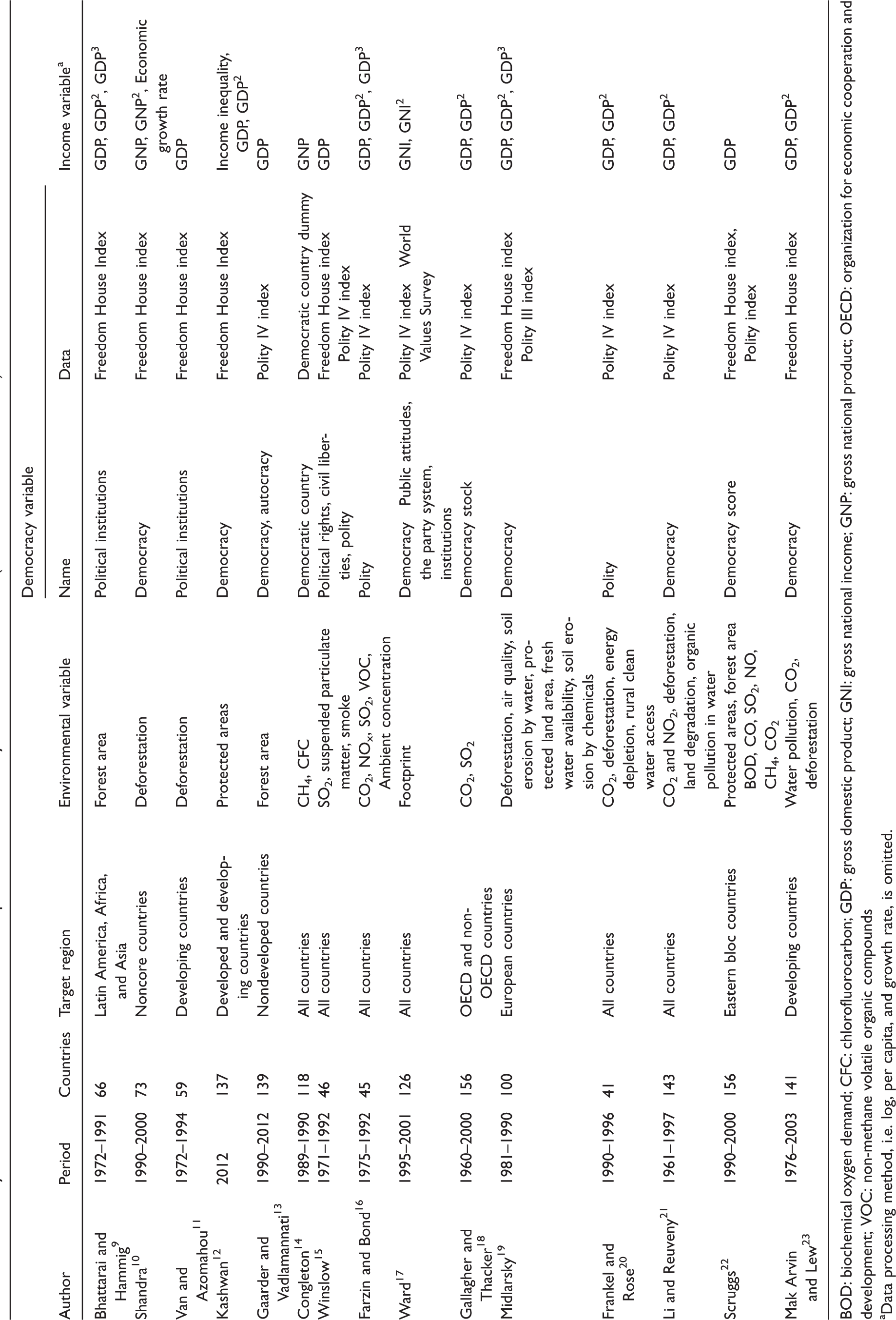
BOD: biochemical oxygen demand; CFC: chlorofluorocarbon; GDP: gross domestic product; GNI: gross national income; GNP: gross national product; OECD: organization for economic cooperation and development; VOC: non-methane volatile organic compounds
aData processing method, i.e. log, per capita, and growth rate, is omitted.
Despite the rich history of research, niches exist for the development of the environment–democracy research. First, existing research has a narrower sense of democracy, excluding its multifaceted aspects in the real environmental issues. This limitation is attributed to the democracy data, Freedom House index and Polity index. Freedom House organization provides democracy indices on political freedom and civil liberties. Due to its powerful features of covering all countries from the 1970s, it has been widely used in empirical studies. Polity index is another well-known measure to scale the nation’s regime type from autocracy to democracy. Both indices, however, are considered to be based on somewhat minimalist and “thin” definitions on democracy.24,25 Democracies in these indices are considered limited to electoral democracy such as the electoral process, competitiveness of political parties, and functioning of government. As such narrower democracy measures cannot encompass all substantive features of democracy, the Economist Intelligence Unit (EIU) has devised a new index of five categories to mirror the thick and wide concept of democracy. It consists of electoral process and pluralism, civil liberties, the functioning of government, political participation, and political culture. Thus, we adopt the ElU’s measure to sufficiently explore the effects of democracy in multifaceted ways and to overcome the limits of traditional data.
Second, the comparison between developed and developing countries needs to be conducted. Empirical studies typically focus on developing countries10,13,23 or specific regions9,11,19,22 because research is conducted on the epicenter of interest. Only a few studies12,18 have shown a balanced analysis between developed countries and developing countries. b However, the democratic apparatus works out differently based on their income levels due to the durational nature of both democracy and income. For instance, the countries with young democracies with low-income levels and those with prolonged democracies with high-income levels exhibit different aspects. 26 To draw implications suitable for each of the economy, we conduct comparison analysis based on income levels.
Furthermore, target period must be updated to diagnose the current status of democracy and the environment. As democracy in modern society is developing differently from the past, we need to keep track of its change by analyzing the recent period.
The empirical framework
This study analyzes whether the quality of the environment improves as the overall democracy and the parts of democracy develop. To overcome the limits of previous research, firstly, democracy indices with multifaceted aspects are adopted, secondly, the comparison between high- and low-income countries is conducted, and lastly, the period is updated to 2014.
In the analytical model of equation (1), the dependent variable is the environment, the explanatory variable is the democracy, and the control variable is the national income. Democratic elements for an explanatory variable include (1) overall score, (2) electoral process and pluralism, (3) functioning of government, (4) political participation, (5) political culture, and (6) civil liberties. The dependent variable is an environmental quality index, which measures how much an individual and society lead quality life within their environment. The national income is included as control variables following the EKC hypothesis. To reflect the U-shaped curve, income is included up to cubed term. The total number of 131 countries is divided into 78 high-income countries and 53 low-income countries. Detailed data for variables and income classifications for criteria are described in the next section

In equation (1), Ei represents the environmental quality of country i. Di represents the democracy index, which is composed of the electoral process and pluralism, functioning of government, political participation, political culture, and civil liberties. The coefficient
In a cross-sectional data like this study, homoscedasticity assumption is crucial. That is, the variance of the error terms is constant, and if not, the error terms are said to be heteroscedastic. In the presence of heteroscedasticity problem, which arises from inherent differences by countries, OLS estimates are no longer best linear unbiased estimator, even though heteroscedasticity does not result in biased parameter estimates. Also, standard errors are biased in the presence of heteroscedasticity, which in turn leads to bias in test statistics and p-values. This study uses the Breusch–Pagan test and White test, detecting heteroscedasticity in the model. To overcome the problem, therefore, heteroscedasticity-robust standard errors are used to correct heteroscedasticity issues. The use of robust standard errors does not change the coefficient estimates, but since it will adjust the standard errors, the test statistics will present reasonably accurate p-values. 28
Data
We analyze data for 2014 in 131 countries around the world. The data used in the paper are an environmental quality index for the dependent variable, democracy index for the explanatory variable, and national income for the control variable.
The environmental quality index is one from the Social Progress Index (SPI). 29 The SPI is designed to go beyond the limits of GDP which does not reflect the quality of life. Thus, one of the SPI, the environmental quality index, measures the quality of life given by the environment. It is scored on how much the environment provides for its people’s most essential needs, how much the environment serves as the building blocks in place for individuals and communities to enhance and sustain wellbeing, and whether there is an opportunity for all individuals to reach full potential. By using these data, therefore, we estimate how much democracy achieves environmentally quality life, not the pollution levels themselves, i.e. CO2 emissions, deforestation, etc., but covering air pollution, wastewater treatment, biodiversity, and greenhouse gas emissions.
The democracy variable is from the data published by the EIU. 30 This dataset evaluates democracy in a wider sense and in multifaceted ways. Its elements, electoral process and pluralism, the functioning of government, political participation, political culture, and civil liberties, have a rating on a 0–10 scale. Overall score is the simple average of the five indices. The critical difference against other democracy indices is that it is mainly based on public surveys, but the others are scored on experts’ assessment. The EIU’s sources are the World Value Survey, Latin American Barometer, Afro Barometer, and a national survey. d
National income is data presented by the World Bank. 31 As of World Bank 2014, countries with GNI of $4126 or more per capita are classified as high income and upper middle income, and countries with GNI less than $4126 are classified as low income and lower middle income. In our analysis, we refer to the countries with high income and upper middle income as higher income and the countries with low income and lower middle income as lower income.
Empirical results
Tables 2 to 4 show the empirical results of the effects of democracy and income on the environment. It must be noted that, because of high variations in the values of variables among the selected countries, the aggregate analysis of the democracy–environment nexus is likely to suffer from aggregation bias problem, raising questions about the validity of the results. Thus, equation (1) is estimated for the full sample and then separately for higher and lower income countries. Table 2 shows the results of the overall country analysis; Table 3 gives the results for the higher countries analysis; Table 4 presents the results for the lower income countries analysis.
Results of the overall country analysis.
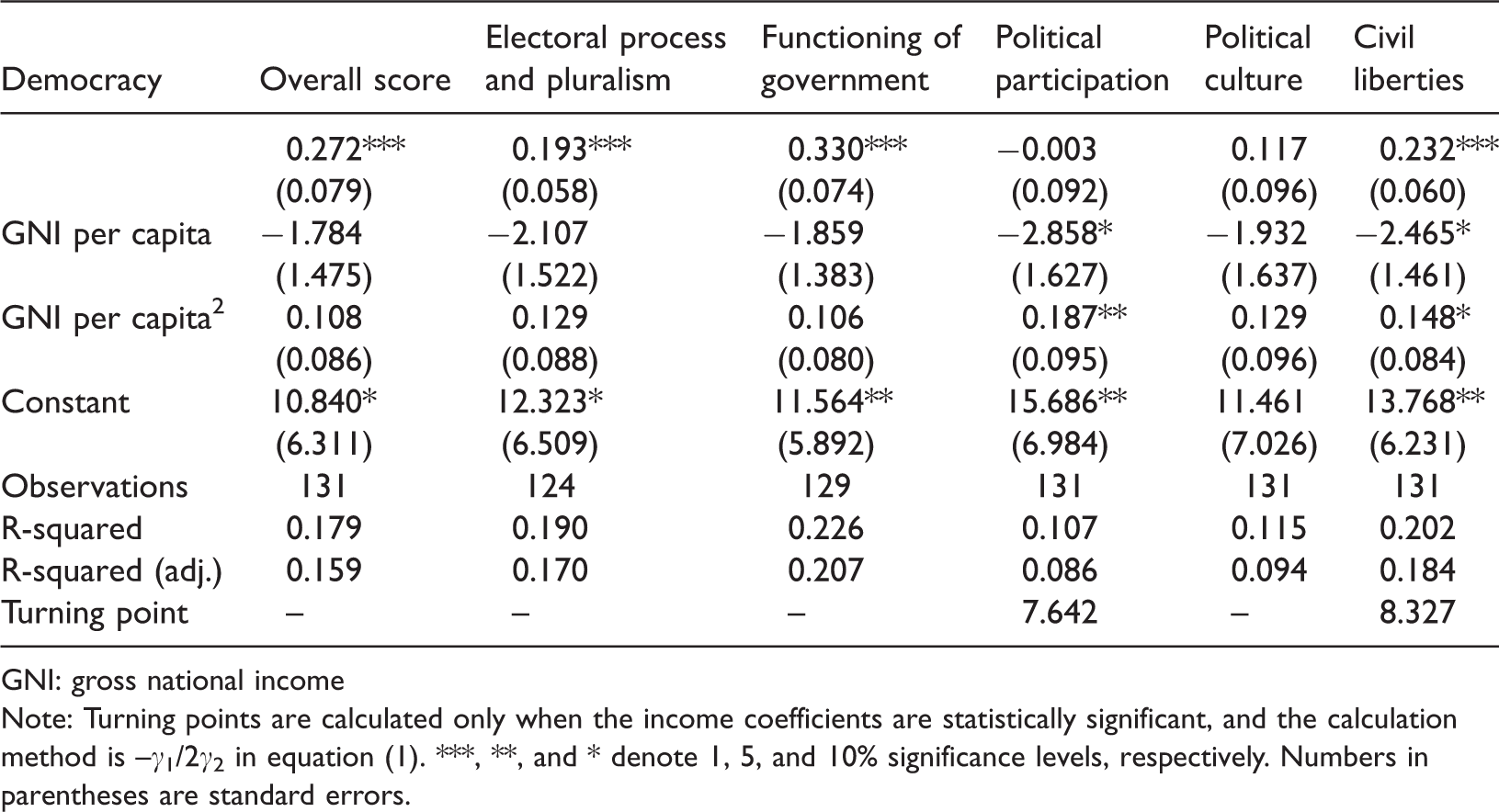
GNI: gross national income
Note: Turning points are calculated only when the income coefficients are statistically significant, and the calculation method is –γ1/2γ2 in equation (1). ***, **, and * denote 1, 5, and 10% significance levels, respectively. Numbers in parentheses are standard errors.
Results of higher income country analysis.
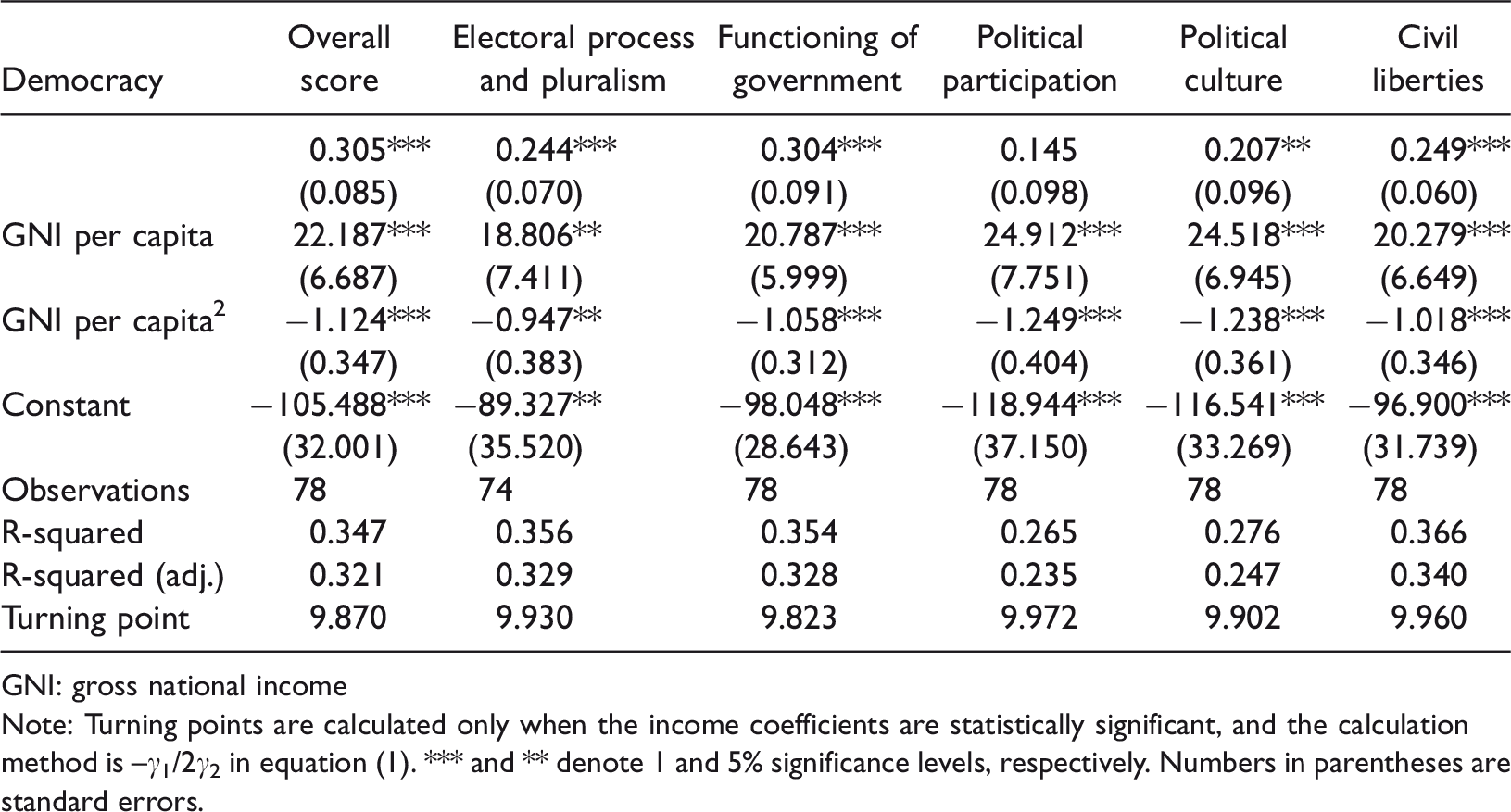
GNI: gross national income
Note: Turning points are calculated only when the income coefficients are statistically significant, and the calculation method is –γ1/2γ2 in equation (1). *** and ** denote 1 and 5% significance levels, respectively. Numbers in parentheses are standard errors.
Results of lower income country analysis.
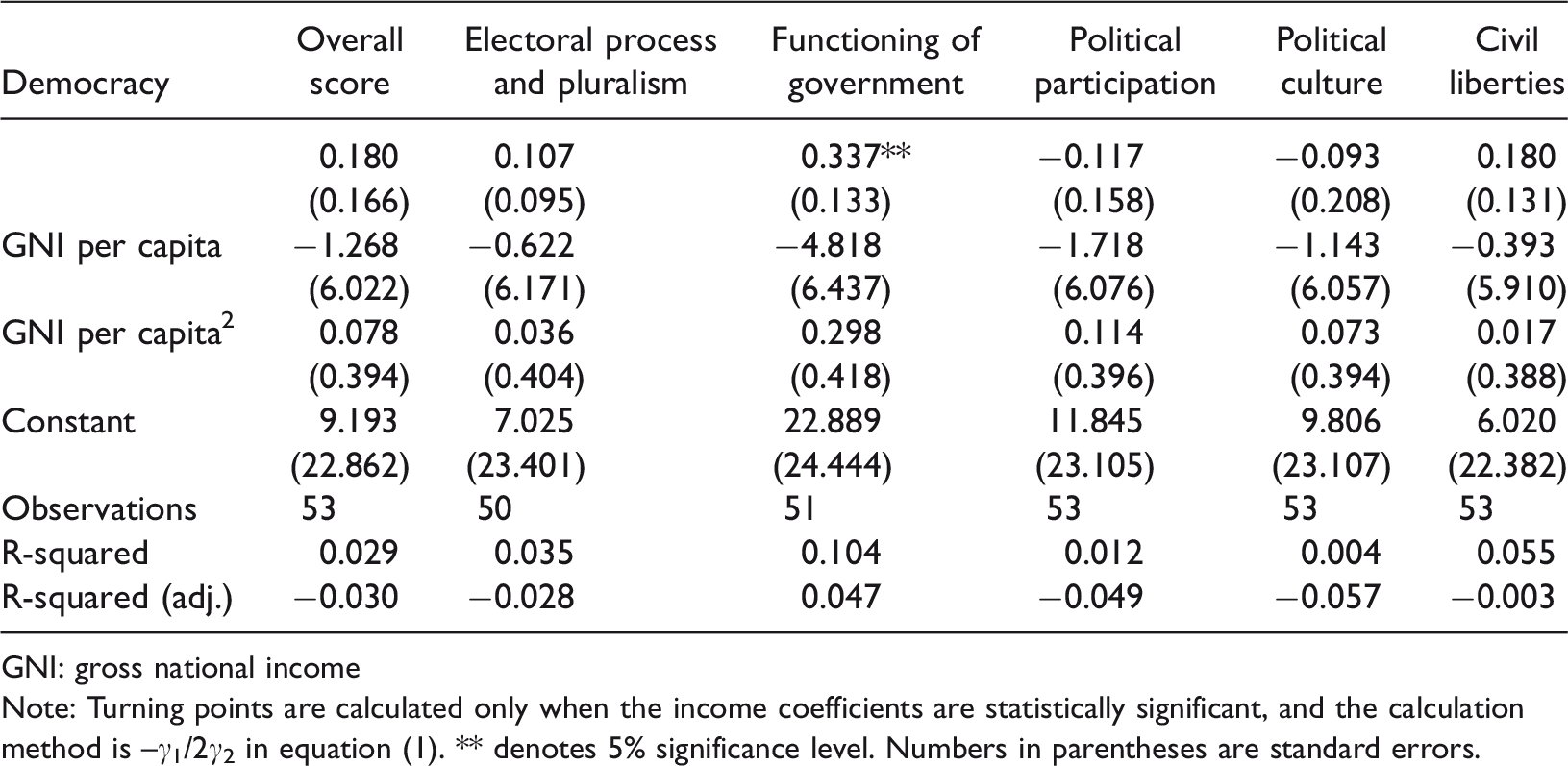
GNI: gross national income
Note: Turning points are calculated only when the income coefficients are statistically significant, and the calculation method is –γ1/2γ2 in equation (1). ** denotes 5% significance level. Numbers in parentheses are standard errors.
The results of the aggregated analysis of both higher income countries and lower income countries show that the overall score for democracy, which exhibits the general features of democracy, is positive, suggesting that improved democracy has a beneficial effect on the environment. Statistically, it is significant at the 1% level. However, each variable of democracy varies in detail (Table 2). The coefficients of electoral process and pluralism, the functioning of government, and civil liberties are positive and statistically significant at the 1% level, suggesting that improving these aspects prevents environmental degradation. On the other hand, the coefficients of political participation and political culture are not statistically significant. The aspects of political institutions (electoral process and pluralism) play a more prominent role in improving the environment than the aspects of civil society (political participation and political culture) in the overall country analysis. A control variable, GNI per capita, is considered to follow the EKC in our assumption. The results show that the coefficients of the income and the quadratic term are negative and positive, providing supportive evidence of the EKC: that is income worsens the environment at low levels and then improves it at high levels. Statistically, however, it is highly significant only in the case of political participation and civil liberties. The adjusted R-squared of the functioning of government variable is 0.207, which is the highest, and thus the model with it best fits among all the democracy variables.
The results of the segregated analysis of higher income countries show that the estimated effects of the democracy variables on the environment are always positive, implying that democracy indeed contributes positively to the environment in high-income countries (Table 3). Statistically, it is highly significant for all the cases except for political participation. The coefficients of the income and the quadratic term are positive and negative, which means that the environment improves at low levels of income but declines at high levels. When calculating the turning points for each case, however, they are found to be outside the sample period and hence the quadratic to the right of the value can be ignored. In higher income countries, therefore, the environment seems to improve monotonically as income grows. The adjusted R-squared is highest at 0.366 for the civil liberties variable.
The results of the segregated analysis of lower income countries present that democracy generally does not contribute positively to the environment (Table 4). Of all the democracy variables, only the coefficient of the functioning of government is 0.337, which is statistically significant at the 5% level. That is, in lower income countries, the government plays a critical role in improving the environmental quality. In lower income countries, the income variables are also not statistically significant in all cases, indicating that income does not contribute much to the environment. This finding thus explains why it is important to use disaggregated country data based on income when examining the democracy–environment nexus.
Conclusions and policy implications
The study has empirically analyzed the effects of democracy on the environmental quality, after controlling income levels in the framework of EKC. For specific analysis, the study has classified the elements of democracy into five major parts of the electoral process and pluralism, the functioning of the government, active political participation, political culture, and civil rights. To compare the roles of democracy, we have divided 131 countries into 87 high-income countries and 54 low-income countries.
We have achieved originality by improving the existing literature. First, in contrast to the previous studies with a limited view of democracy, we have utilized comprehensive democracy data to explore the multifaceted impacts of democracy. Second, our research has compared both high-income and low-income countries, in contrast to the previous studies which mainly have focused on the specific regions. Lastly, we have updated the analysis period from the outdated studies to relatively recent 2014.
In the analysis, we find the gap in the role of democracy between high- and low-income countries. The results confirm that democracy is positive for the environment in high-income countries. People in high-income countries politically utilize democracy to let their environment sustain essential needs and enhance their wellbeing. On the contrary, democracy in low-income countries is shown to be powerless in dealing with environmental conflicts. The most striking contrast is that in high-income countries, the power of democracy is exerted in multifaceted ways via elections, governments, institutions, and cultures; in low-income countries, democracy is effective only through a single channel, the government. As such, the results of our analysis apparently show that democracy in high- and low-income countries differs not only in potential but also in its function. However, it must be noted that public participation has not yet had a significant impact regardless of the income levels of countries.
Our research suggests that the environmental policies of high- and low-income countries must be tailored to each of the economies. First, high-income countries must insist on broadening the fields of democracy, which have already been functioning well, and second, they must encourage public participation. The insignificancy of participation presented from the results implies that those in high-income countries have a long way ahead for meaningful engagement. The wave of participation, which is confined to only a few countries such as Japan and Germany, must spread throughout all countries. Hence, people in high-income countries need to be more involved in neighborhood environmental issues; their governments must support the public participation, as well. On the other hand, despite the weak roles of democracy in low-income countries, the governments must take the lead to address the problems of environmental degradation. Some possible approaches can be establishing the well-functioning democratic institutions, devising regulatory systems for pollution control, and collaborating with other countries to ease the issues of pollution and climate change. Furthermore, it is necessary for them to push beyond the administrative boundaries by engaging in industry, academia, and civil society with integrated efforts.
Footnotes
Declaration of conflicting interests
The authors declared no potential conflicts of interest with respect to the research, authorship, and/or publication of this article.
Funding
The authors received no financial support for the research, authorship, and/or publication of this article.