



Abstract
The main objective of the present numerical investigation is to understand the effect of partially active thermal zones and density inversion on the buoyancy-driven convection of cold water near its maximum density under the influence of uniform magnetic field inside a square cavity. The partially heated or cooled zones are placed along the vertical sidewalls of the cavity while the other inactive portions of the walls are considered to be adiabatic and thermally insulated. The length of the partially active thermal zones is measured to be equal to half the length of the cavity’s height. When the locations of heating and cooling zones are placed in different positions, it provides a significant effect on flow pattern and the rate of heat transfer. To investigate this location effect, the thermally active zones are placed in a combination of five different relative positions along the vertical sidewalls. The modeled equations are solved using finite volume method with Semi-Implicit Method for Pressure Linked Equation algorithm. The numerical coding is done through the FORTRAN 95 programming for numerical simulation and the results attained are represented graphically in the form of flow field and temperature distribution for various values of density inversion parameter, Hartmann number, and for various positions of thermal zones. The results reveal that the heat transfer rate behaves nonlinearly on increasing the density inversion parameter values. The high transfer rate is perceived for the location middle–middle when
Introduction
Occurrence of natural convection in enclosures heated from its side walls is of rational interest to many researchers due to its versatile applications in many branches of science, engineering, and technology, specifically, in the study of energy conservation and built environment. Mostly in real-time applications like building insulations, home/industrial storage installations, cryogenics, electronic cooling, air-conditioning, etc. this mode of heat transfer remains common. Another important area focused by scientists, engineers, and researchers is magneto hydrodynamics (MHD), which involves the study of electrically conducting fluids in the presence of electromagnetic fields. The blend of natural convection and magnetic field includes widespread applications in various fields like liquid metal cooling of nuclear reactors, solar collectors, electromagnetic casting, material manufacturing technology.1,2 In all these analyses, the study on temperature distribution and the flow pattern of the fluid in the presence of magnetic field becomes crucial. Thus, owed to its significance and multipurpose applications, the study on free convection in enclosures with partially heated or cooled walls in the presence of magnetic field has gained special interest among researchers.3,4
Various studies regarding enclosures are extensively carried out both experimentally and numerically. Valencia and Frederick 5 numerically analyzed the heat transfer rate for five different positions of half heated and half insulated vertical walls in square cavities. They established that the heat transfer rate can be controlled by varying the positions of the partial active walls along the cavity. Yucel and Turkoglu 6 numerically analyzed the flow and heat transfer characteristics in partially heated and cooled rectangular cavities. They observed that the averaged Nusselt number declines as the heater size rises for a given cooler size and the averaged Nusselt number increases with increase in cooler size for a given heater size. Natural convection in a cubical enclosure with thermally active zones placed on the same wall was carried out by Frederick. 7 Based on the study of flow pattern and temperature distribution, they proposed an expression for heat transfer coefficient. A numerical and experimental investigation was carried on free convection in a square cavity with partially active sidewalls by Paroncini et al. 8 They noticed that there is an increase of Nusselt number with an increase of Rayleigh number. Cianfrini et al. 9 numerically studied the laminar natural convection inside rectangular cavities bounded below by partially heated wall and cooled sidewall. They found that the heat transfer increases inside the cavity by increasing the heater size and Rayleigh number.
Venkatachalappa and Subbaraya 10 numerically studied magneto-hydrodynamic convection in a two-dimensional rectangular enclosure filled with electrically conducting fluid, in which two side walls are maintained at uniform heat flux condition. They found that the magnetic field can be used effectively to control the convection inside the enclosure. Rudraiah et al. 11 evaluated a similar problem by differentially heated isothermal sidewalls. The numerical results showed that the effect of the magnetic field inside the cavity decreases the convective heat transfer. The application of magnetic field restrains the unavoidable convection current, which arises in an enclosure and thus upholding the controllability of the system. This effect has encouraged the study of laminar natural convection in tilted enclosure with transverse magnetic field by Al-Najeem et al. 12 It is established that the flow characteristics and heat transfer strongly depend on the magnetic field and the inclination angle of the cavity. Hossain et al. 13 analyzed the effects of heat generation and the combined effect of magnetic field and surface tension on unsteady laminar natural convection flow. They observed that the increase of heat generation within the cavity increases the flow rate and temperature of the fluid. Ece and Buyuk 14 explored the free convection in an inclined square differentially heated enclosure in the presence of magnetic field.
Study on effectiveness of steady laminar flow in the incidence of magnetic field on convection heat transfer in a tilted square enclosure was carried out by Pirmohammadi and Ghasemmi. 15 They observed that the mechanisms of heat transfer and the characteristics of fluid flow inside the enclosure strongly depend on the strength of magnetic field, its inclination angle, and the Rayleigh number. The impact of thermally active zones on hydro-magnetic convection in an enclosure in different directions of magnetic field was studied by Sivasankaran and Bhuvaneswari. 16 They observed that the heat transfer increases if the heater is located in the middle or bottom of the hot wall while the cooler is at the top or middle of the cold wall in the considered enclosure. Sivasankaran et al. 17 analyzed the rate of heat transfer and fluid flow under the effect of magnetic field in a partitioned enclosure. In the study, they found that the heat transfer increases when the partition is affixed in the adiabatic wall and the same decreases when the Hartmann number is increased. A computational study of convection in a square cavity in the presence of magnetic field was studied by Bhuvaneswari et al. 18 In the work, they had spatially varied sinusoidal temperature distributions in both the sidewalls and established the result as follows: the heat transfer rate increases first and then starts decreasing on increasing the phase deviation. Obayedullah and Chowdhury 19 made a study on steady natural convection flow in a rectangular enclosure filled with electrically conducting fluid. They observed that the temperature distribution, fluid flow, and heat transfer rate robustly depend on the Rayleigh number and Hartmann number. Heat transfer enhancement of Cu–water nanofluid in a square cavity with a circular disk under the magnetic field was studied by Kobra et al. 20 It was noted that the overall Nusselt number significantly decreases on increasing the Hartmann number and Rayleigh number. To study the effect of magnetic field on flow field, heat transfer, and entropy generation, Aghaei et al. 21 numerically investigated the effects of magnetic field on mixed convection and entropy generation of nanofluid in a trapezoidal enclosure.
Water has its maximum density at
An investigation related to unsteady laminar natural convection flow of water near its maximum density in a rectangular cavity, bounded by isothermal walls with internal heat generation was carried out by Hussain and Rees. 26 It is found that the temperature and flow of water are strongly influenced by internal heat generation parameter. They also observed the circulation of flow getting reversed when internal heat generation parameter becomes strong. Sivasankaran and Ho27–29 investigated the effect of temperature-dependent properties on natural convection of water near its maximum density. They observed that the fluid flow and heat transfer rate get strongly influenced by maximum density temperature of water due to the formation of bicellular structure. Sivasankaran et al. 30 explored the effect of variable fluid properties on magneto-convection of water near its maximum density in an enclosure. Numerical simulation on buoyancy-driven convection of water about its maximum density with partially active vertical walls along the sidewalls of the cavity was deliberated by Kandaswamy et al. 31 It has been identified that the heat transfer rate becomes less near the density maximum region. The same model problem on buoyancy-driven convection was studied with time periodic partially active vertical walls by Nithyadevi et al. 32 They found that density inversion of water has an effect on natural convection and hypothesized that the heat transfer rate enhances up to 80% when the heater is located in the middle of the wall.
Recently, due to the advancement of technology in industries, partially heated walls are widely used rather than enclosures with fully heated walls. This advancement of technology has attracted several researchers to learn more about the problems related to cavities with partially active thermal walls. This paper describes the behavior of cold water near its density maximum in the presence of magnetic field inside a square cavity with partially active thermal walls. The work illustrates the magnetic field’s effect on the nature of flow and subsequent temperature distribution inside the cavity while varying the location of the partially active thermal zones along the side walls of the cavity. All the related works cited above explain the buoyancy-driven convective flow of fluid for various geometry of cavity with partially heated/cooled walls either with or without magnetic field. However, the flow behavior and temperature distribution of buoyancy-driven flow of cold water near its density maximum in the influence of magnetic field in a cavity bounded with partial thermal walls are not dealt so far, and since this is a distinctive case of research, to observe the effect of magnetic field on cold water, the current study has been carried out.
Governing equations
A schematic representation of two-dimensional square cavity, taken for the present study is shown in Figure 1(a). The five different combinations of partially heating/cooling locations are depicted in Figure 1(b). The length of the square cavity is taken to be “L” and the two partially active thermal walls that are placed along the sidewalls measure “L/2.” The portion of heater along the left wall is maintained at temperature
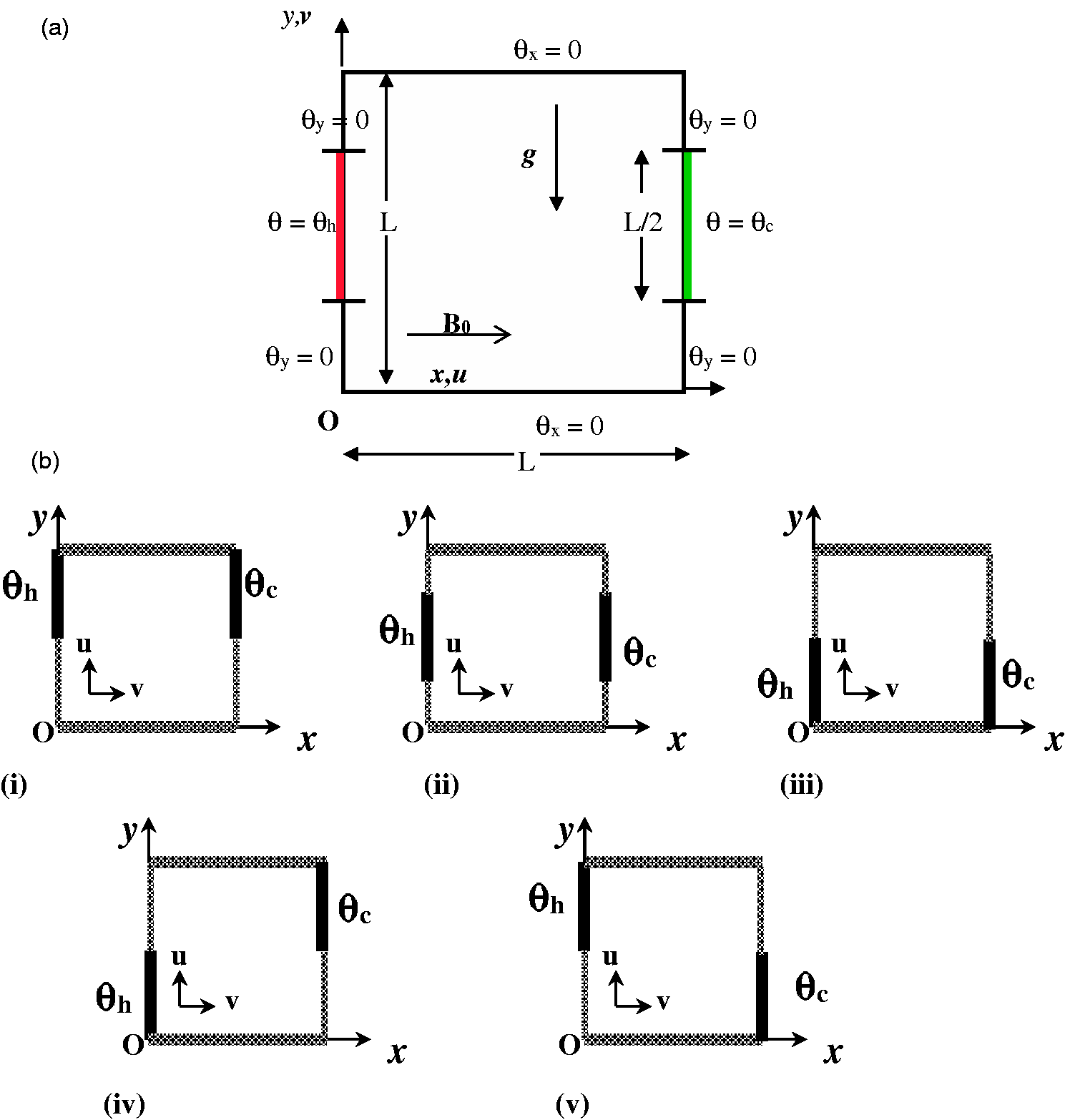
(a) Physical configuration and boundary conditions. (b) (i) TT, (ii) MM, (iii) BB, (iv) BT, (v) TB, and different thermally active locations.
The following assumptions are taken in the study:
The flow is assumed to be unsteady, laminar, and incompressible. All the fluid properties are constant except the density in buoyancy term. The Boussinesq approximation is valid. The viscous dissipation is assumed to be negligible. The induced magnetic field is neglected.
According to the above assumptions, the equations governing the conservation of mass, momentum, and energy for two-dimensional incompressible flow in Cartesian coordinate system are expressed as follows, (see appendix for nomenclature).




The appropriate initial and boundary conditions for the problem are defined as follows





Equations (1) to (4) are appropriately nondimensionalized for numerical study and are rewritten as



The dimensionless variables that appear in equations (6) to (9) are defined as follows

Then, the initial and boundary conditions become





The most important characteristic of heat transfer from engineering perspective is the measure of heat transfer rate across the cavity. Hence, Nusselt number computations are carried out by the expression

Accordingly, the nondimensional form of local Nusselt number on the left side wall is defined by

The averaged Nusselt number which measures the overall heat transfer is obtained by integrating the local Nusselt number over the partially active thermal walls, which is given by the formula

Numerical method
The governing equations (6) to (9) jointly with the boundary conditions (11) are discretized using finite volume method as explained by Patankar.
33
The discretization of convective terms is carried out by QUICK scheme and the diffusive terms are discretized through the central difference scheme as explained by Versteeg and Malalasekara.
34
An implicit scheme is employed for time marching with time step value chosen to be
The computational spatial domain is meshed with uniform grid on both directions. The grid size is calculated by
The validation of the present in-house code is very important in numerical study. In order to find the accuracy and validity of the in-house computer code using Fortran 95 programming for the present problem, different numerical simulations obtained from the code are compared with natural convection in a cavity with partially active thermal walls reported by Sankar et al. 3 and Valencia and Frederick. 5 The results are shown in Table 1. It can be observed from the table that the results of present simulation agreed well with the earlier investigation. It provides the confidence on our numerical procedure to be used here.
Comparison of averaged Nusselt number for different thermal locations with Tm = 0, Ha = 0.
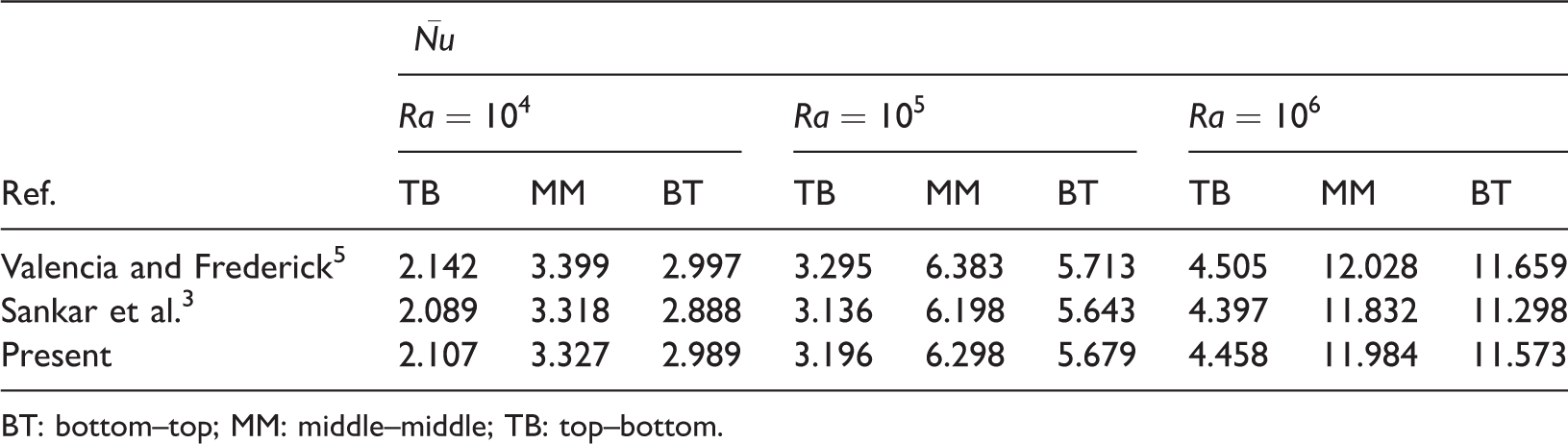
BT: bottom–top; MM: middle–middle; TB: top–bottom.
Results and discussions
Numerical investigations are carried out to study the effect of the partially thermally active zones and external uniform magnetic field on the buoyancy-driven convective flow of cold water near its density maximum inside a square cavity. Based on the arrangement of the partially active thermal walls, this study has been carried out for five different locations of partial heating and cooling zones. The heating and cooling regions are, respectively, kept at various positions on the left and right walls and are referred to as follows: (i) TT, (ii) MM, (iii) BB, (iv) BT, and (v) TB. The analysis is performed for different density inversion parameter values and Hartmann numbers. Hartmann number generally varies from 0 to 400. But for a wide range of Hartmann numbers, the flow can be laminar or turbulent with laminar core in it. Since this study deals with laminar flow of cold water Hartmann number is varied between 0 and 50. The study is carried out for the density inversion parameter
Effect of partial heating and density inversion parameter on flow fields
Figure 2 exhibits the flow pattern inside the cavity for the five different locations of thermally active zones with density inversion parameters,
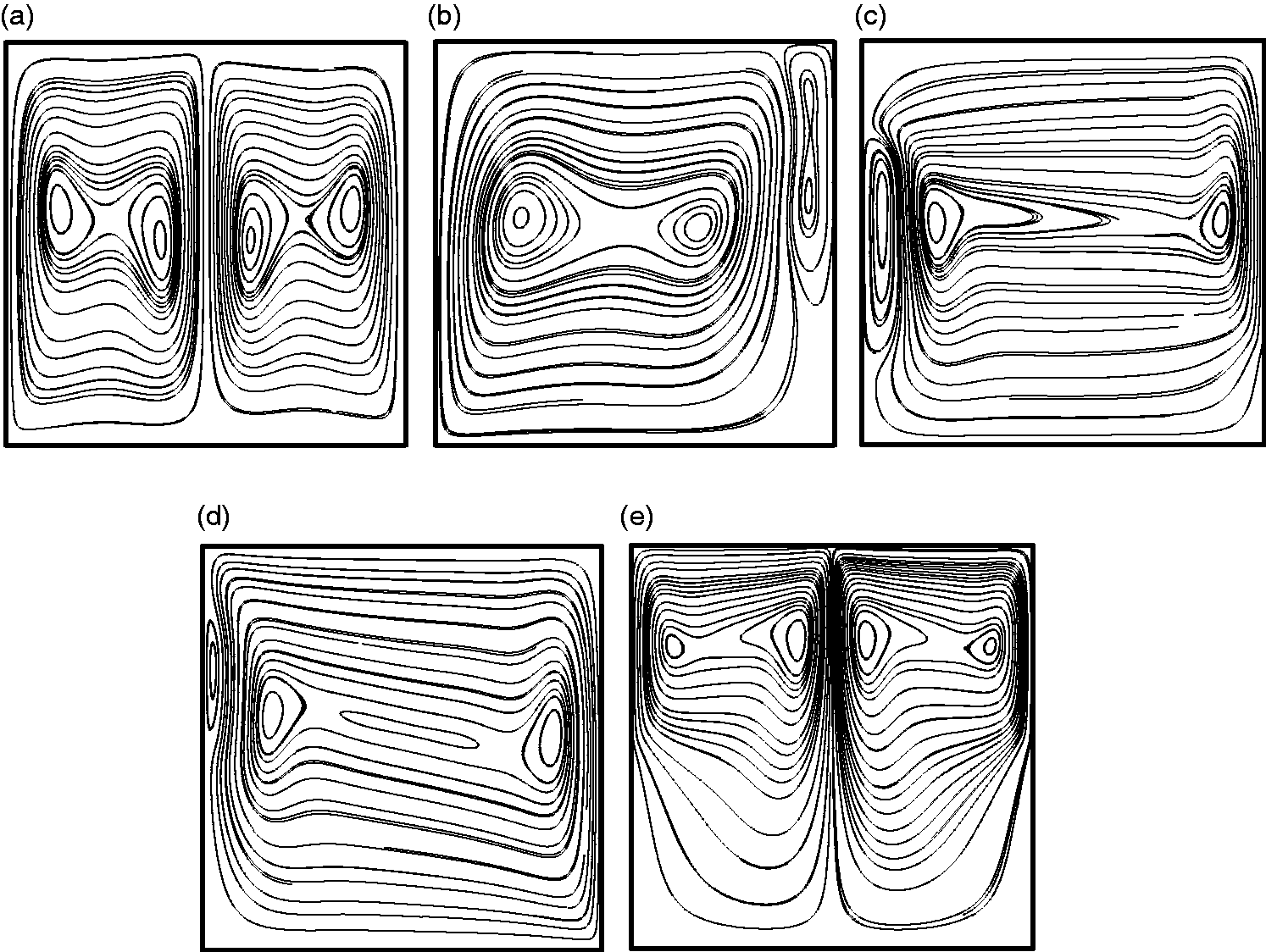
Streamlines for different thermally active zones with Ha = 25, Tm=0.5, and Gr = 106. (a) BB, (b) BT, (c) MM, (d) TB, and (e) TT.
Figure 3 illustrates the streamlines for the BB, MM, and TB thermal zones for various density inversion parameters under the existence of uniform magnetic field. For all the three positions of the partially active thermal walls, the density inversion parameter is varied from 0 to 1. When
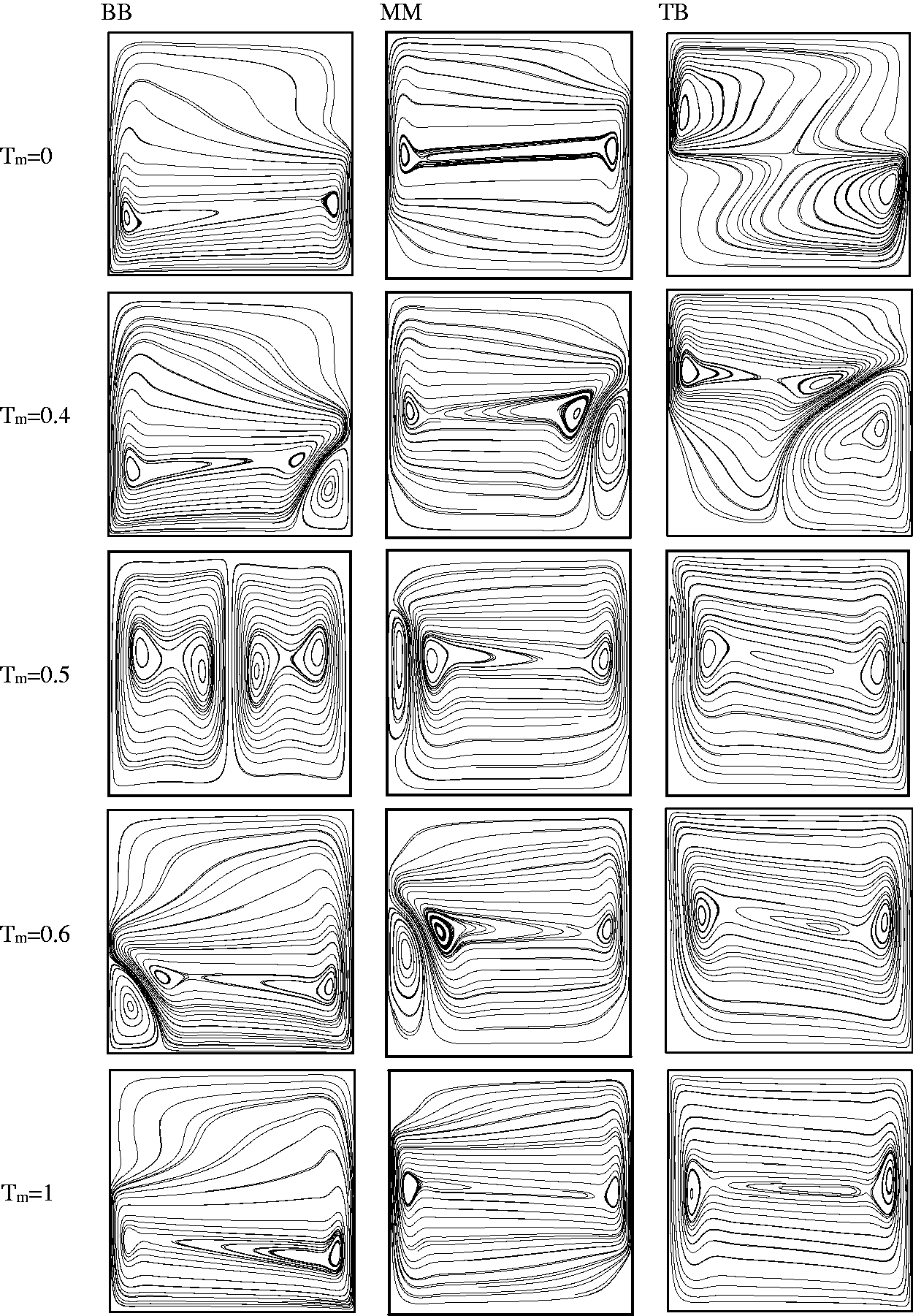
Streamlines for different density inversion parameters with Ha = 25 and Gr = 106. BB: bottom–bottom; MM: middle–middle; TB: top–bottom.
While analyzing the flow pattern for the MM location, symmetrical pattern is not exhibited here for
Effect of partial heating and density inversion parameter on temperature fields
Figure 4 displays the temperature distribution inside the cavity for various heating/cooling locations while

Isotherms for different thermally active zones with Ha = 25, Tm=0.5, and Gr = 106. (a) BB, (b) BT, (c) MM, (d) TB, and (e) TT.
Figure 5 displays the isotherms for BB, MM, and TB locations of partially thermally active walls and discussions are carried out for different density inversion parameters that vary from 0 to 1 with

Isotherms for different density inversion parameters with Ha = 25 and Gr = 106. BB: bottom–bottom; MM: middle–middle; TB: top–bottom.
Heat transfer rate
In heat transfer analysis, a significant quantity that measures the rate of heat dissipation is the determination of local Nusselt number and the average Nusselt number. The local Nusselt number for different density inversion parameters and thermally active zones with
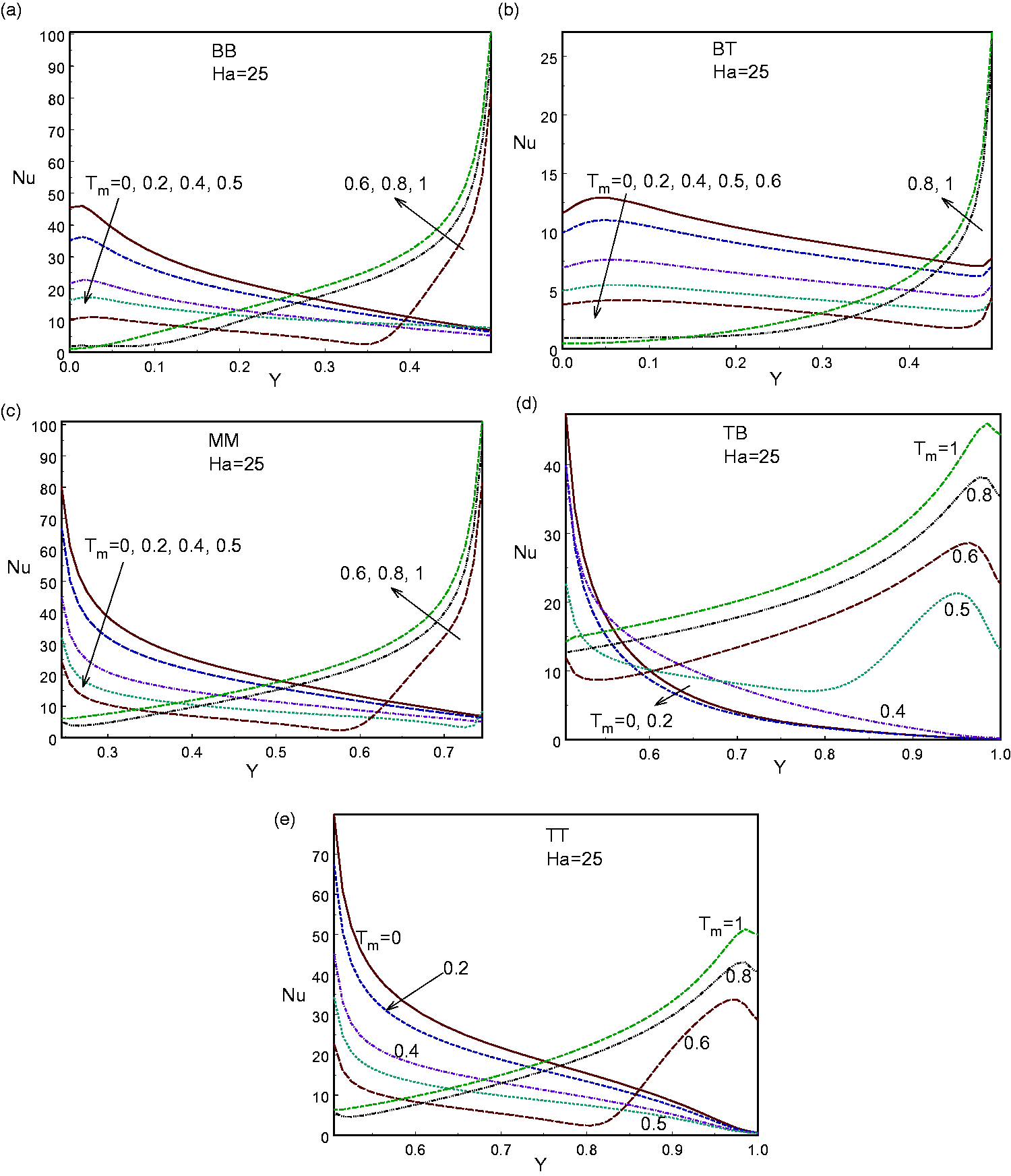
Local Nusselt number for different density inversion parameter and thermally active zones with Ha = 25. BB: bottom–bottom; BT: bottom–top; MM: middle–middle; TB: top–bottom; TT: top–top.
The effects of five thermally active zones on average heat transfer rate

Average Nusselt number versus density inversion parameter for different thermally active zones and Hartmann numbers. BB: bottom–bottom; BT: bottom–top; MM: middle–middle; TB: top–bottom; TT: top–top.
The averaged heat transfer rate is decreased 3, 58, 0.9% for BB, BT, TT thermal zones when changing density inversion parameter from 0 to 1.0 with Ha = 0. However, the averaged heat transfer rate is increased 1.6 and 292.8% for MM and TB thermal zones when changing density inversion parameter from 0 to 1.0 with Ha = 0. The averaged heat transfer rate is decreased 3.3 and 63.1% for BB and BT thermal zones when changing density inversion parameter from 0 to 1.0 with Ha = 50. But, the averaged heat transfer rate is increased 1.5, 8.6, 306.6% for MM, TT, TB thermal zone when changing density inversion parameter from 0 to 1.0 with Ha = 50. The averaged heat transfer rate is decreased 56.6, 49.7, 49.9, 58.2% for MM, BB, BT, TT thermal zones when changing density inversion parameter from 0 to 0.5 with Ha = 0. But, the averaged heat transfer rate is increased 87.5% for TB thermal zone when changing density inversion parameter from 0 to 0.5 with Ha = 0. The averaged heat transfer rate is decreased 50.2, 46.6, 61.4, 56.8% for MM, BB, BT, TT thermal zones when changing density inversion parameter from 0 to 0.5 with Ha = 50. But, the averaged heat transfer rate is increased 80.5% for TB thermal zone when changing density inversion parameter from 0 to 0.5 with Ha = 50.
Conclusion
The magneto-convection of cold water near its maximum density in a cavity with partially thermally active zones located at various positions is studied numerically. The analysis is mainly focused on the significant changes in flow pattern and temperature distribution inside the cavity when the thermal zones are altered to different positions under the presence of uniform magnetic field. The study is carried out for five different locations and the following observations are made from the analysis:
When the density inversion parameter is increased, it is seen that the formation of bicellular structure disappears and the cold cell occupies the entire cavity and this is due to the moving away of density inversion plane from the cooler toward the heater. The rate of heat transfer within the cavity is higher for MM thermal zone when It is observed that the heat transfer rate behaves nonlinearly when increasing the density inversion parameter. The poor heat transfer rate is found when the maximum density plane is at the center of the cavity. The convective heat transfer rate inside the cavity declines on increasing the Hartmann number significantly in the presence of maximum density.
Footnotes
Declaration of conflicting interests
The authors declared no potential conflicts of interest with respect to the research, authorship, and/or publication of this article.
Funding
The authors received no financial support for the research, authorship, and/or publication of this article.