



Abstract
Nowadays complex atrium design is becoming popular in city skylines that bring natural lighting to create more pleasant indoor environment. Atriums with complex skylight design and lack of knowledge in building thermal performance in relation to transmitted solar radiation through skylight contribute to greenhouse effect. This has imposed high-energy consumption for cooling load particularly in warm humid regions. In order to obtain good thermal performance of atrium with appropriate skylight design, scholars in atrium studies have suggested that designers should test, simulate and evaluate the thermal performance of atrium building at the early design stage. This paper aims to investigate thermal and solar performance of atrium skylight design in warm humid region. Three thermal analysis software with different capabilities in evaluating thermal and solar performance of skylight forms, positioning and orientation were utilized. Five types of atrium design were modelled and simulated using Ecotect, EnergyPlus and solar radiation simulation model. The results have revealed that different software has different capabilities in measuring thermal and solar performance in atrium skylight design. Each software was used sequentially to provide results in stages starting from verifying variables, identifying critical climatic regions, measuring initial and validating accurate energy use for heating and cooling load until amount of solar received on atrium roof surface, geometry and curvature been achieved. This research could guide designers and engineers to understand the capabilities and reliability of selected thermal and solar analysis software in simulating and evaluating atrium’s thermal and solar performance at early stage design in order to identify appropriate low energy atrium design.
Keywords
Introduction
Atrium is an attractive architectural element defined by its geometry and has a common feature in both ancient and contemporary buildings.
1
The Roman dwellings utilize atrium not only for lighting but also ventilate the interiors for as far back as the 19th century.
2
Today, the contemporary world appropriated the idea inform of skylight glazed in most cases but for aesthetics purposes.
3
These skylights contribute to urban heat island effect due to ‘greenhouse gases’ and various definitions of the phenomenon known as the ‘Atmospheric Radiative Greenhouse’.
4
Atrium’s traditional function for daylighting, passive heating and cooling is becoming of greater concern to the management of climatic heat stress practices.
5
Studies in the tropics show that complexity of atrium design of the contemporary world is dictated by spatial aesthetics rather than thermoregulatory mechanisms.3,6,7 Thus, the impact of skylight and the atrium physical parameters lead to excessive solar heat gains in summer and heat loss in winter,
8
if left unchecked. One of the requirements from architecture is comfortable, healthy and productive space for living and working with least capital and running cost.
9
Thus, energy utilization, economization and environmental consequences are becoming issues of serious concern.10–12 The problems become compounded by the dearth of knowledge about thermal performance at the early design stage of the atria.
8
Energy efficiency of the skylight as the main element of atrium is dependent on glazing, operation, use and its shape.
13
Adoption of practices borrowed from elsewhere without modification despite evidence of their inappropriateness is a well-known fact in the tropics.11,14,15 As an example, the excessive glare and heat problem recorded in warm humid climates of Malaysia was attributed to direct application of western top lighting borrowed without consideration for climatic variations.
16
Therefore, it is crucial to establish design guidelines for the selection of efficient atrium types2,17 for warm humid climate regions1,3,18 right from the design stage. Designers need to be aware of both positive and negative attributes of atrium design in responding to local climates, rather than physical appeal alone. In other words, both form and function of atrium could have a significant role as indoor thermal comfort regulators in tropical climate.
19
Malaysia is selected as the study area owing to its climatic character coupled with the recent motive to move green.
16
Designers become more competitive in designing atria and at the same time they should consider one important issue on how to optimize the use of the solar energy in the city areas.
22
Atrium study and design becomes rampant,6,8,13,18,23,26 where the analysis is not random; it is systematic, it involves analysis of several characteristics: roof geometrical forms and atrium shape, geographical location and skylight orientation relative to the sun, transmittance and reflectivity of the atrium roof surfaces.
23
As a result, the impact of skylight and atrium physical parameters, which leads to excessive solar heat gains in the summer and heat loss in winter, becomes more complex and challenging to manage. Glass is a popular material for skylight particularly in commercial buildings.
19
Its transparency and charming appeal made it a common feature of atrium in communal spaces and tall buildings around the world city skylines.
23
Atrium becomes a common feature not only in cold regions where it originated, but also hot and humid countries where it is less appropriate.
10
Thus, determining the appropriate atrium roof geometry and skylight positioning that received minimum amount of solar radiation intensities becomes very vital in warm-humid climatic regions. These happened due to lack of knowledge in tackling all the environmental aspects and thermal performances at early design stage of atria. Therefore, this paper aims to investigate thermal and solar performance of skylight design in warm humid region to guide the designers and engineers in selecting appropriate atrium type and design that consume low energy for cooling. In order to fulfil the aim, four research objectives were formulated:
To test influence of atrium types and roof geometries on atrium building thermal performance To measure the atrium’s thermal loads and energy consumption for heating and cooling To measure and calculate solar intensities on different roof geometries To measure and calculate solar intensities received on different skylight positioning.
For the past 50 years, a wide variety of building energy simulation programs have been developed, enhanced and are in use throughout the building energy community that could predict the thermal performance in building design. 24 Due to that, this research uses thermal analysis programs and mathematical modelling to simulate the thermal and solar performance of atrium designs in order to achieve the objectives above.
Literature review
Indoor thermal comfort is significantly influenced by outdoor environmental conditions. Thus, higher latitude regions benefitted more from heat gain particularly during the winter periods. 19 In the tropics, however, it is a story of woe to tell. Many researchers advocated that design guidelines in the hot and humid climates ought to be oriented towards reducing heat gain from the solar radiation through building envelope, particularly from the roof being the most exposed part.6,13,16,17,19,20 Disregard for cultural or climatic conditions it has been noticed and documented in the past and of recent.16,19,21 Many researches are being conducted on atrium design and even thermal performances in the cold regions. This could be attributable to physical and economic potentiality of atrium in increasing market value of a building. 24
With the advent of computer hardware and software, what was previously a mirage becomes easily attainable. Till date computer programs remain as enrichment tools rather than replacement of human, so they have their drawbacks. The number of available software in the market is much,27,28 each with a capability lacking in the others. 29 And if it is to be recommended that single software should be made to manage the complexity of atrium design alone, the cost and manageability of the program will be more difficult to handle. This presents a thrust for further studies in this regard. A comparative survey of literature by Crawley et al. 28 identified that most architects used design tools for usability and information management rather than calculation accuracy or empirical validation. The influence of atrium roof geometry is not only on fire test under natural ventilation conditions 30 but also on thermal comfort.11,17 Thus, the design and application of atrium is more than just a friendly cut and paste affair, it is a rigorous one with a lasting and implicative implication. Thus, the need for collaborative research is apparent in this domain.
Numerous thermal analysis software programs exist but differ in various ways because of their applicability, purpose of use and compatibility with other related energy analysis programs. Ecotect in Figure 1, EnergyPlus in Figure 2 and solar radiation simulation model (SRSM) are considered adequate enough to cover the scope of analysis for the purpose of attaining theoretical saturation in the data collection and analysis procedure. Ecotect was incorporated for its ability to present (in the form of animation) complex shadow and reflection with interactive sun path diagrams for the determination of monthly heat loads. 33 Ecotect was used in phase 1.
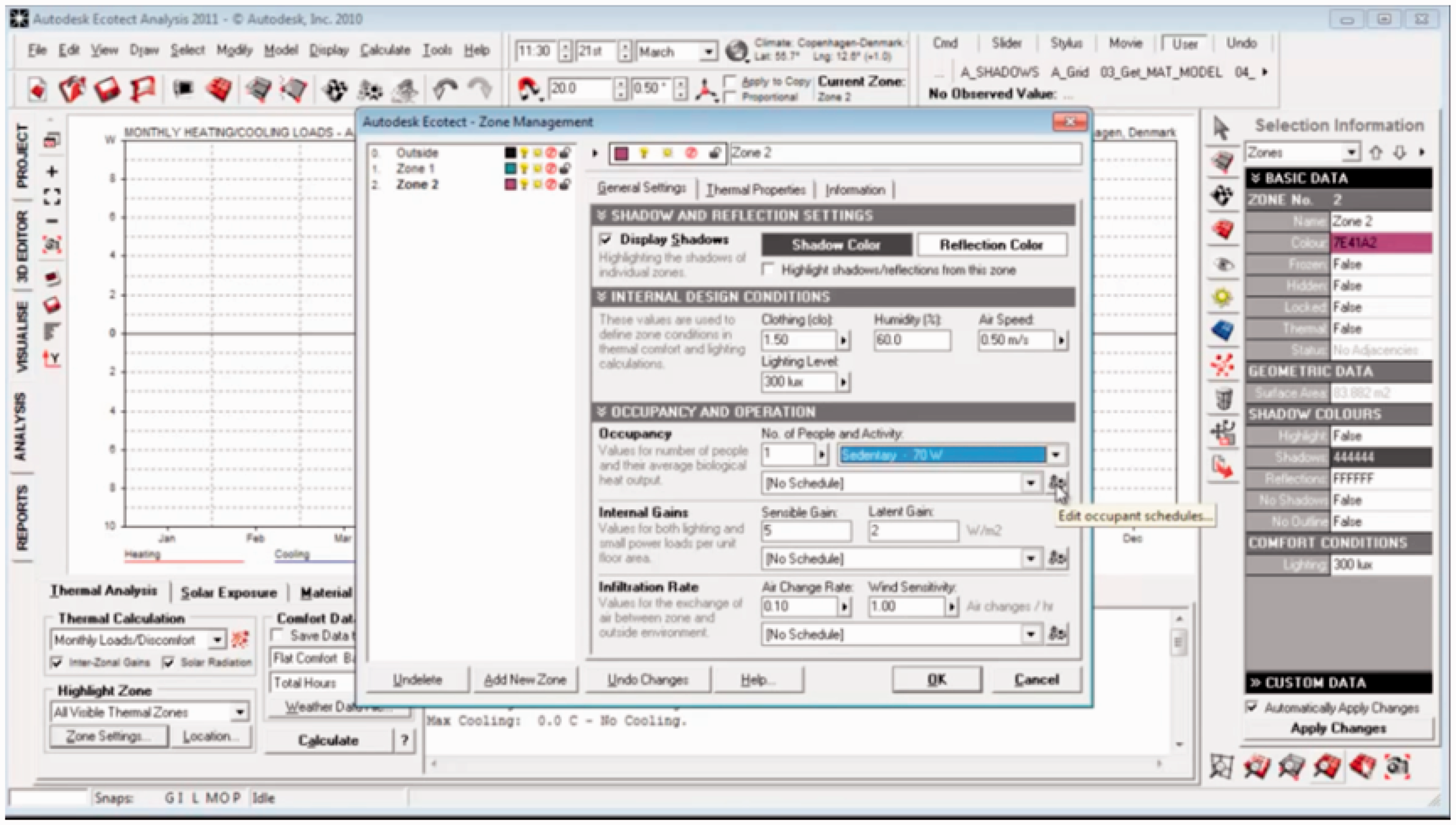
Screen image of Autodesk Ecotect. Source: Autodesk Ecotect.Please add a comment in caption and attach if any new image, for the service provider
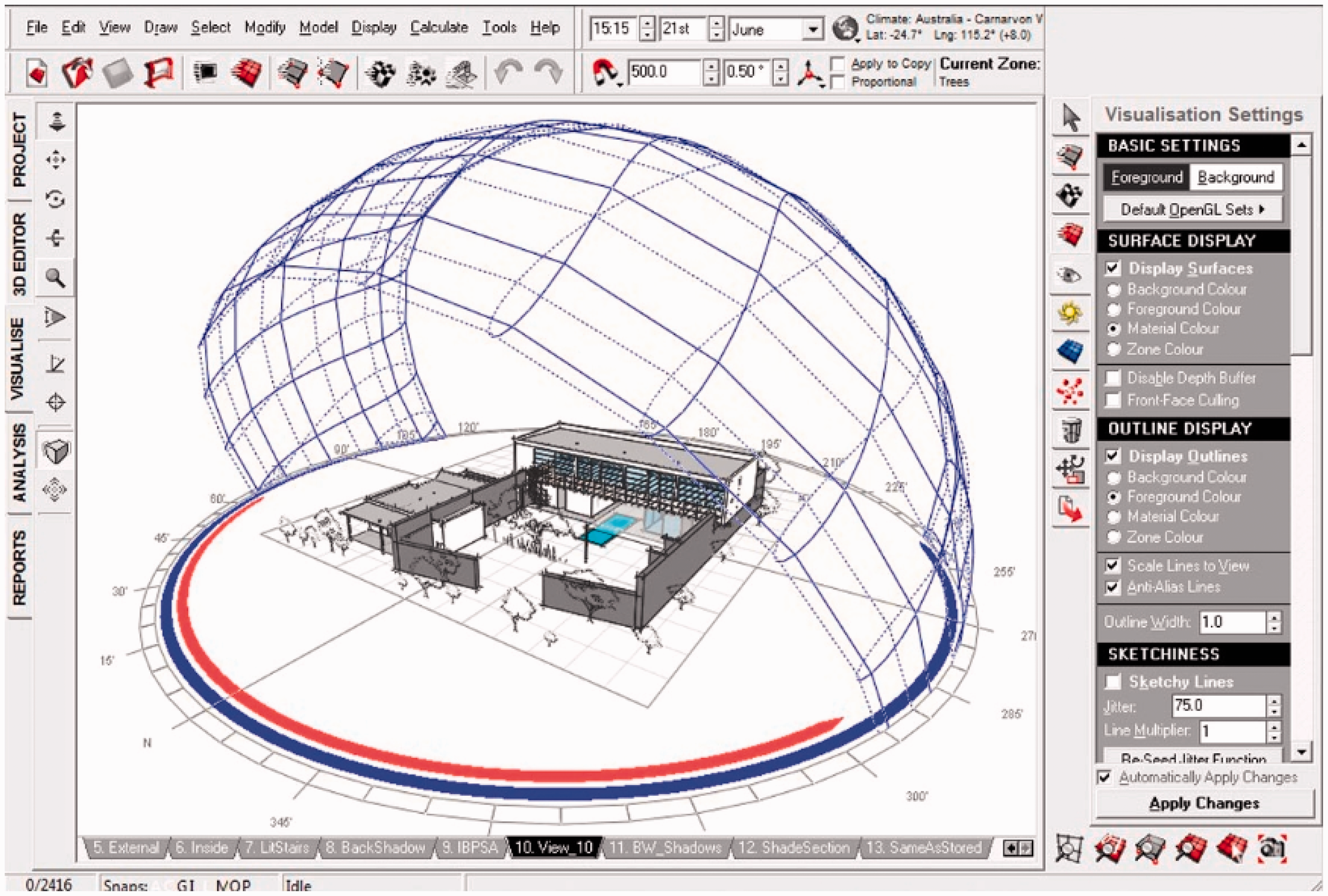
Screen image of EnergyPlus source. 31
Then EnergyPlus was used in the second phase to help in calculating thermal loads and energy consumption in a particular duration of time from a single day to extended period of time (Figure 2).14,33,34
In the third phase, SRSM was used to generate numerical data of solar radiation received on different surfaces specifically for tropical region (Figure 3). The input variables can be summarized into: (i) latitude in degrees given at ranges of 25° north and −25° south of the equator for greater accuracy, (ii) mean daily solar irradiation on horizontal surface in MJ/m2 for each month, (iii) surface slope angle (SSA), (iv) orientation of each tilted surface (planner segment); the azimuth (Figure 3) measured in deg W and (v) day of the year of the 364/5 days.
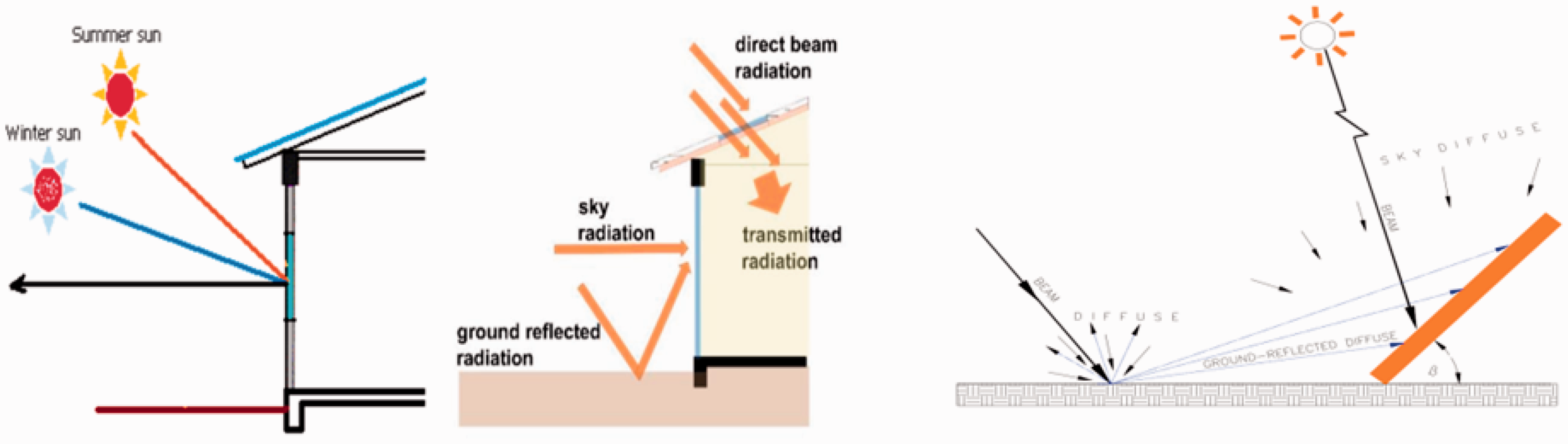
Angle of incidence during the summer and winter period and the solar radiation on tilted surfaces.
Based on the review, it can be hypothesized that a holistic relationship 35 between received solar radiation on atrium surfaces and sun altitude angle within related climatic regions (warm-humid, hot-dry, temperate or cold regions) is influencing atrium’s thermal performance. Each climatic region received different amount of solar radiation based on its location and latitude which influences sun’s geometry received directly on the roof surface. The roof geometrical and skylight positioning are the most influential elements that determine solar performance18,25 and affect energy consumption in atrium buildings. Other important variables for the determination of appropriate roof geometry and skylight positioning are location (latitude), time of the day, solar altitude (summer or winter), SSA and orientation, as illustrated in Figure 4.
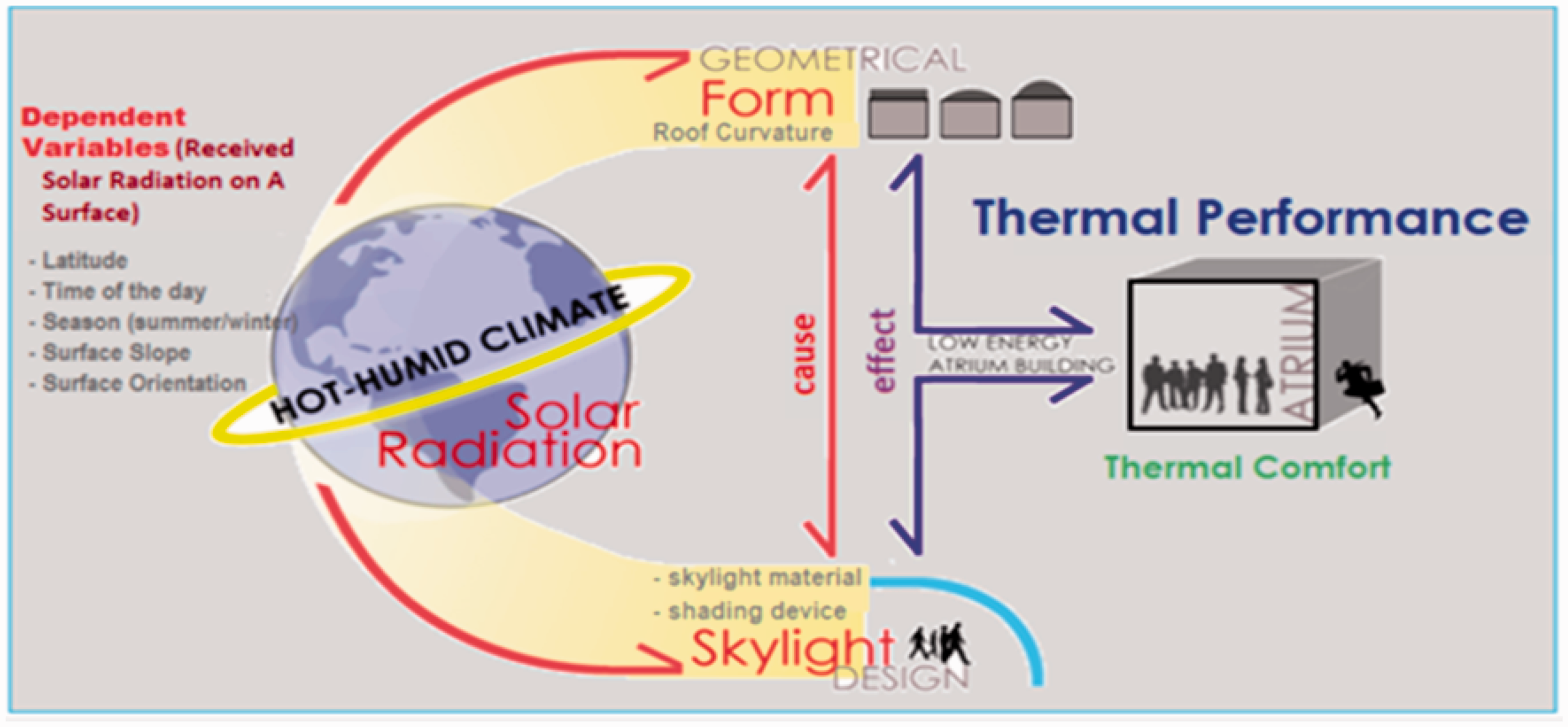
A holistic understanding of relationships between received solar radiation, roof for and skylight design in influencing atrium’s thermal performance.
Methodology
The methodology for this research was established based on the hypothesis and a premise that ‘atrium’s roof geometry and skylight design could contribute to low energy consumption in atrium building if the design consider the passive solar and bioclimatic architectural elements’. This is in line with the numerical relationship that exists between causality phenomenon of received solar radiation on a surface and sun altitude angle. Five common atrium types were selected for this research based on simple and complex atrium configurationee see Figure 5 known as one sided, two sided, three sided and four sided as well as linear to measure solar insolation and sun’s altitude angle within identified climatic regions.
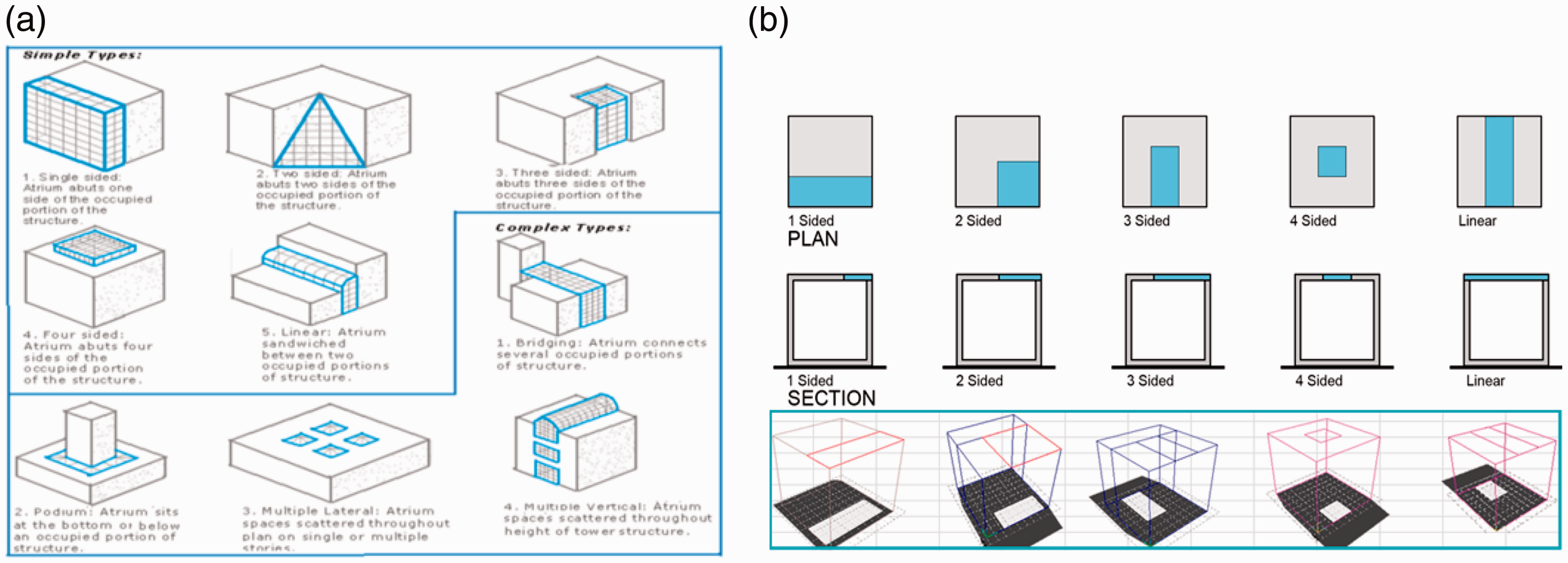
Five common atriums types tested in this research.
Justification of using sequential software for the purpose of validity
The principles of validity are to ensure that the research instrument is measuring what it is intended to measure and it also becomes an important criterion in construction research. 37 Accordingly, quality of indicators or instruments are to ensure precision, accuracy and relevance and is obtained in two ways: empirical validation and theoretical validation through the employment of internal and external validity measures. 35 The instruments employed for this study are presumed to be reliable in measuring what they are not designed to measure. In other words, they may be reliable but not accurate in measuring certain variable. Thus, knowledge of relevant variables at each phase of the research is pertinent in obtaining validity in research. The principles of reliability indicators were indicated by consistency between measurements output of different instruments. 38 The two instruments, Autodesk Ecotect and EnergyPlus, share common variables, likewise EnergyPlus with SRSM (see Table 1), thus, their sequential application ensures validation of the results.
The three software selected are meant to serve as instruments for testing processes in four sequential stages.
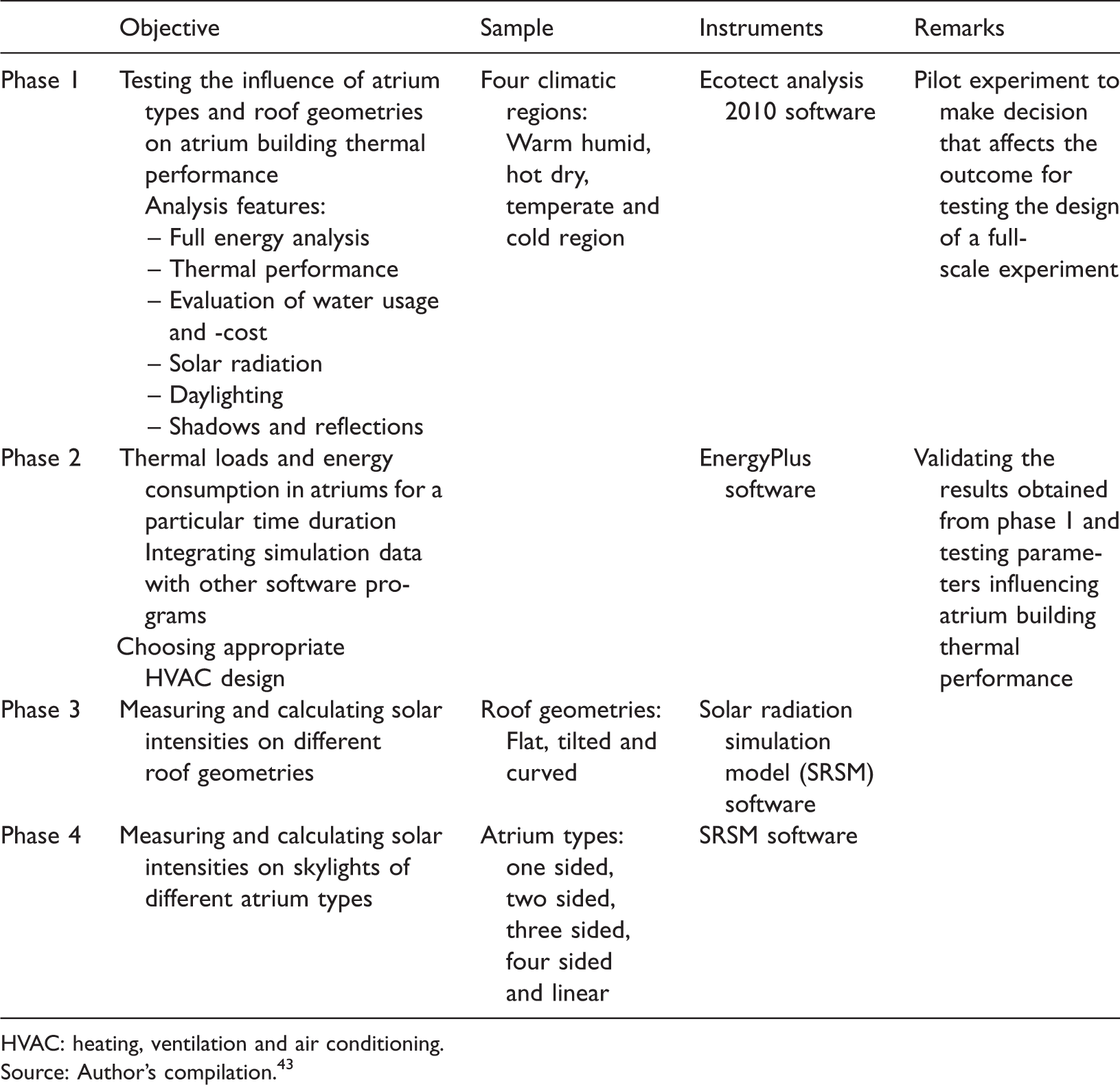
HVAC: heating, ventilation and air conditioning.
Source: Author’s compilation.43
Phase 1: Ecotect was used, the software helped to improve the performance of building design by providing a variety of simulations and analysis on building energy usage and functionality. It also helps in visualizing and simulating the performance of the building. Performance of these atrium buildings can be estimated by using the simulation tools. Computer simulation or computer modelling was used as they could see how things are likely to work if we include different elements allowing the researcher to see what happens in every situation. Simulation can be used to make a decision that affects the outcome, then go back and try something else.
11
It was used to test the design of a full-scale experiment, so that necessary adjustments can be made to full-scale experiments before they are launched. In the context of the current research, modelling the energy transfer between a building and its surroundings refers to the thermal performance of a building; once this has been modelled, an estimation of heating and cooling load can be made (Figure 1). This quantification could determine the effectiveness of the building design and improvements could be made at the preliminary design stage. The input data needed in measuring and calculating the atrium thermal performances are as follows:
Physical geometry of modelled atrium building (atrium types and roof geometries). Building materials for wall, floor, roof and skylight. Weather data that consist of temperature, solar radiation, rain, mean humidity, location elevation for specific location, latitude and longitude of specific location. Mechanical ventilation (type and time of the thermostat setting).
Ecotect experimental results could be reliable in assigning detail material properties to all objects as well as annual hourly operational schedules to occupancy, internal heat gains and infiltrations, but not valid for measuring real energy load for the purpose of heating, ventilation and air conditioning (HVAC) system recommendations. Ecotect is reliable in using admittance methods that are capable of calculating heating and cooling load models with varying number of zones or geometrical types.32,39 It is not the same as HVAC energy loads, which actually consume to generate the required loads. That was why the next phase was needed.
Phase 2: Internal validity was conducted using EnergyPlus, 18 another commercial computer model software, to measure actual energy consumption for HVAC system. Internal validity refers to the extent to which the research design impacts the research outcomes. Internal validity checks ensure that the findings of the research have not been affected by instruments or procedures, and that they are the results of the independent variable. EnergyPlus serves in the accomplishment of internal validity that suggests the extent at which the research design impacted on the research outcomes. 35 In this research, internal validity is to ensure that instruments or procedure has no effect on research findings.
Phase 3: SRSM software is used to measure and calculate solar intensities on different roof geometries: flat, tilted and curved roof. This research uses calculation of hourly total clear sky irradiance of all I(HTCS) W/m2 on a flat roof and curved-roof cross section (CCS).
42
This calculates I(HTCS) received by every planar segment along the CCS which is the sum of the received I(HTCS) on all planar segments along the CCS divided by their segment numbers (n). Equation (1) is based on the calculation method of the SRSM computer model that calculates I(HTCS) on each tilted planar segments where n is the segment number

CCS and curved-roof cross section ratio (CCSR) represent its height-to-span ratio (A:B). Curved roofs curvatures have 37 joint segments with different geometrical resemblance of three CCSR. Three types of CCS were tested (CCSR: A:0.5B, A:B and A:2B); each CCS has 37 segments. Half of them have resemblance of 18 joint segments with one horizontal at the top. The geographical latitude of Kuala Lumpur (3°9′N of the equator) has been chosen to represent the hot-humid regions. Figure 6 shows geometrical resemblance using joint segments for CCS1 with 37 planar segments of geometrical resemblance. It also illustrates every 5° segment’s slope angle for CCS1 facing principal directions (north–south or east–west) or secondary directions (northwest–northeast or northeast–southwest). Different roof curvatures with different orientations were calculated and compared.
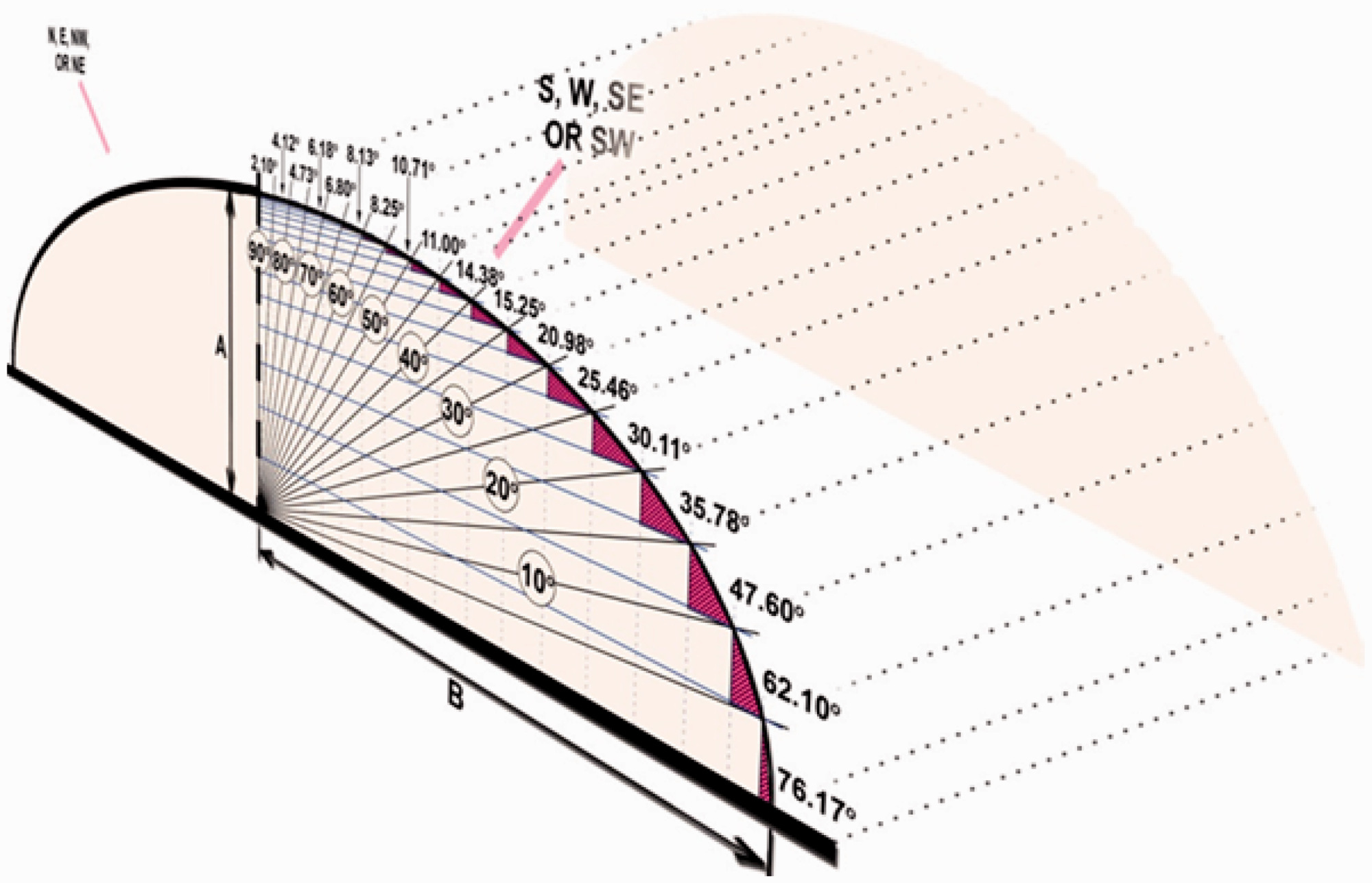
Calculation of curved roof (CCS1) CCSR: A = 0.5B.
Phase 4: Measuring and calculating solar intensities on five atrium types: 1-sided, 2-sided, 3-sided, 4-sided and linear by using SRSM software. The solar performance of all selected atrium types (1-sided, 2-sided, 3-sided, 4-sided and linear) was tested with different skylight positions on different roof curvature with varying orientations during summer and winter. SRSM software was used to measure received solar intensities (hourly clear sky irradiance (W/m2)) on different types of skylight surfaces which require these input data:
Latitude should be within −25°C to 25°C Mean daily solar irradiation on horizontal surface each month (Mj/m2) Orientation of the tilted surface Days of a year for which simulation is to be done. The atriums are categorized into the following types: Hourly clear sky irradiance (W/m2)
They were tested based on skylight position and orientation: 1-sided North, 1-sided South, 1-sided East-West, 2-sided North, 2-sided south, 3-sided North, 3-sided South, 3-sided East-West, 4-sided North, Linear North-South and Linear East-West as shown in (Figure 7). The output data from the building analysis simulation; Ecotect, Energy-Plus and SRSM are transferred into Microsoft Excel and tabulated in tables and graphs for the analysis.
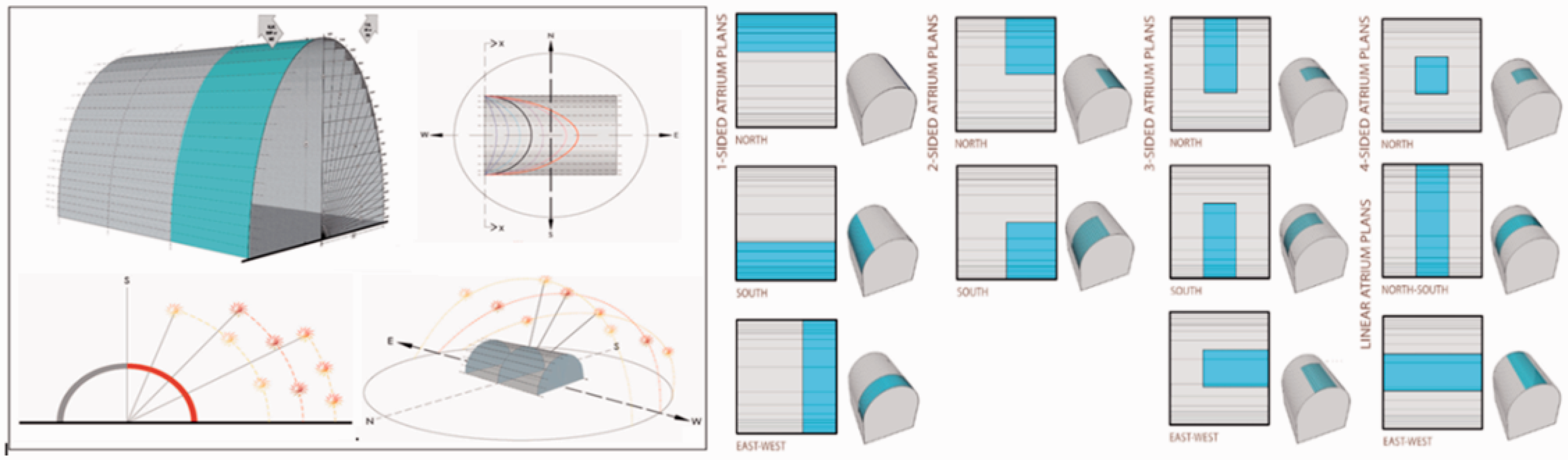
Selected and tested atrium types with curved roof and different skylight positioning.
Results and discussions
Thermal performance of atrium in different climatic regions had been tested at Kuala Lumpur (5°N hot humid) and New Delhi (30°N hot dry), London (45°N temperate) and Toronto (50°N cold) regions for the purpose of comparison.
Ecotect testing and simulation result:
Ecotect software was used in pilot study for testing the influence of atrium types and roof geometries on the atrium building thermal performance in four climatic regions (warm humid, hot dry, temperate and cold) in order to identify and confirm the variables deduced from the literature.
Thermal performance of different atrium types: one sided, two sided, three sided, four sided and linear in different climatic regions (different latitudes)
Ecotect was used in phase 1 where the mechanical ventilation input data were given to calculate heating and cooling load was based on mixed-mode HVAC load (either air conditioning or evaporative cooling system used in atrium’s thermal zones). Figure 8 shows Ecotect simulation results for total monthly cooling and heating loads in different atria types in different climatic regions. Different latitudes having different altitude angle which has an influence on the amount of solar insolation in a given surface at the same time will give different effect to the atrium building thermal performance. Different heating and cooling loads were simulated and calculated in each atrium building at different location or latitude, as it was influenced by the sun–earth geometry. Weather data from EnergyPlus were converted to Ecotect weather data. Ecotect space loads refer to heating and cooling loads and not energy loads. Results showed that atrium in Toronto consumed more energy in heating and cooling compared to atrium in London. On the other hand, atrium in New Delhi consumes the highest amount of energy for cooling while the atrium in Kuala Lumpur was consistently use high energy for cooling throughout the year.
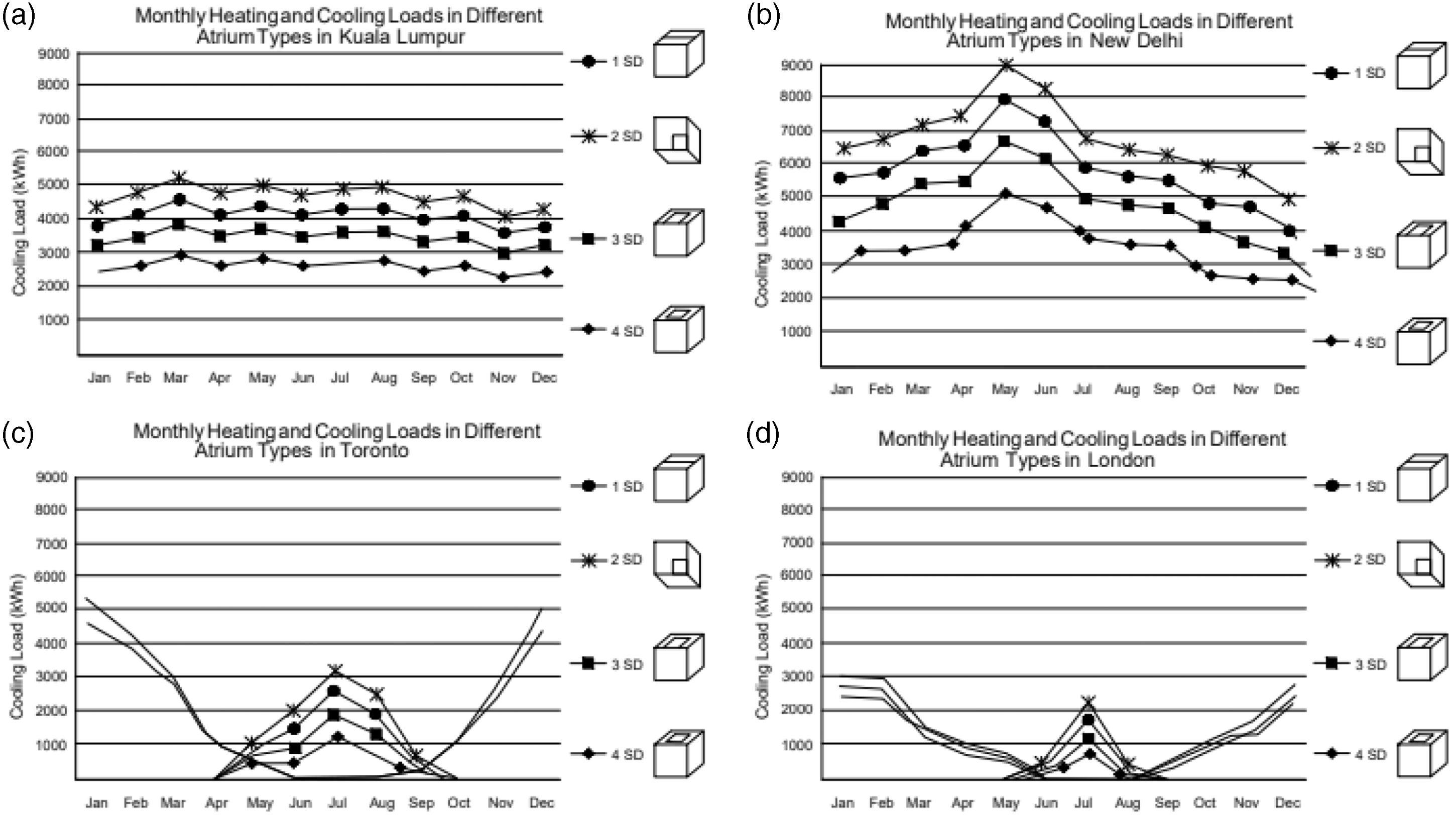
Monthly cooling and heating load of different atrium types (one sided, two sided, three sided, four sided and linear) at different latitudes or locations ((a) Kuala Lumpur, (b) New Delhi, (c) Toronto and (d) London).
Thermal performance of selected atrium types with different skylight orientations
Orientation has significant influence on atrium thermal performance as shown in Figure 9. The same type of atrium, namely a one sided, was tested in Kuala Lumpur. The south-facing atrium in Kuala Lumpur consumes the highest load for cooling, while the north-facing atrium used the lowest energy for cooling; east- and west-facing atria showed some similarity in energy use patterns, which were higher than north-facing atrium.
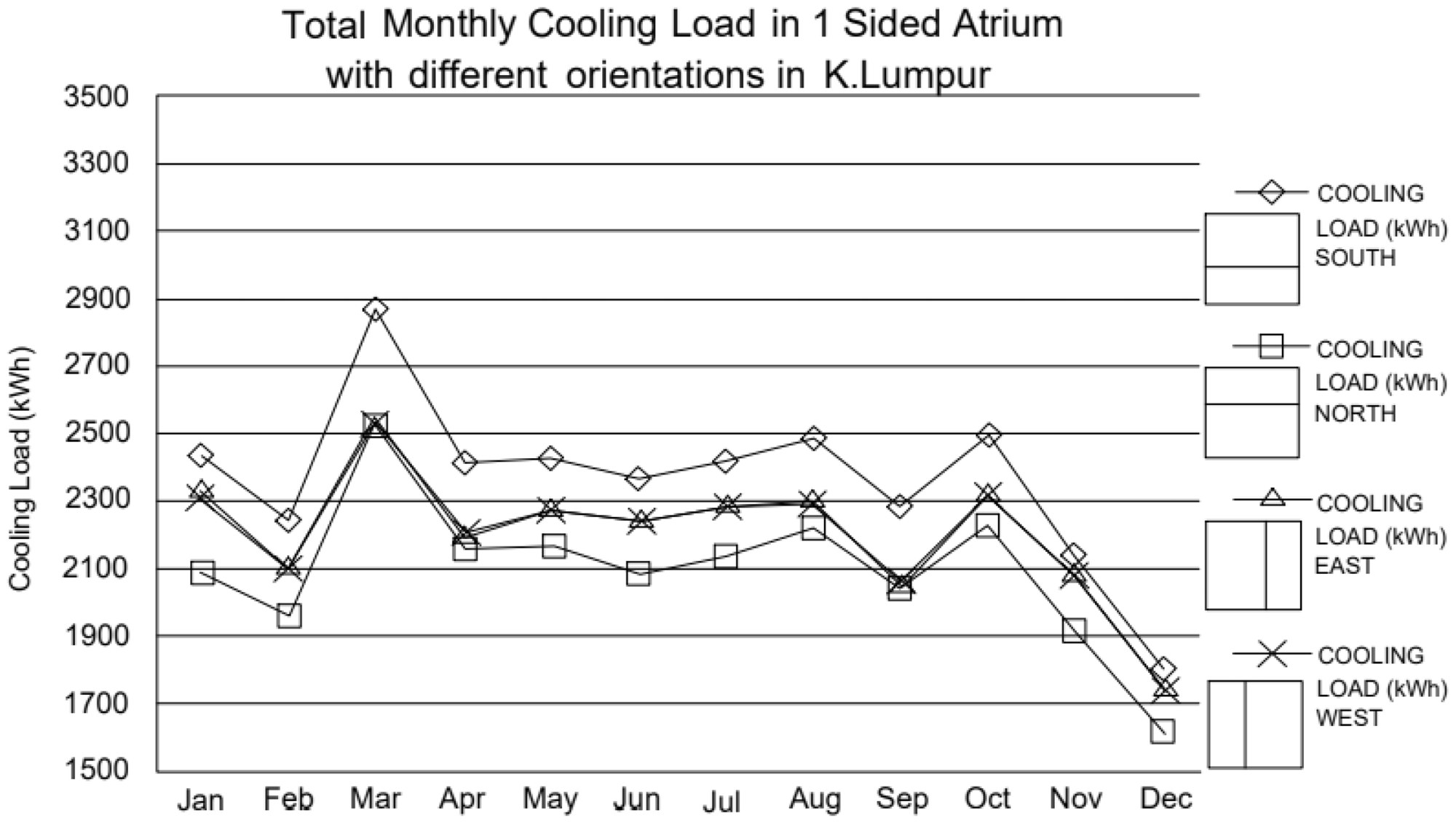
Cooling load in one-sided atrium at different orientations in Kuala Lumpur and London.
Thermal performance of atrium using different skylight position and tilted angles: one sided, two sided, three sided, four sided and linear
One-sided atrium’s skylight with different tilted angles in Kuala Lumpur was tested in order to observe how much the tilted skylight influences the thermal performance of an atrium as shown in Figure 10. The results revealed that the cooling loads used by the horizontal (0°) became the highest compared to other three tilted skylights and the one-sided 30° sloped skylight used the lowest energy for cooling. This experiment shows that the flat roof and skylight consumed the highest cooling load due to the amount of direct solar radiation falling on skylight surface, which is equal to direct normal radiation collected for the angle of incidence (θ) of the surface. It means that more tilted the skylight, the more efficient it performed. This proceeds to why the curve atriums had been investigated later.
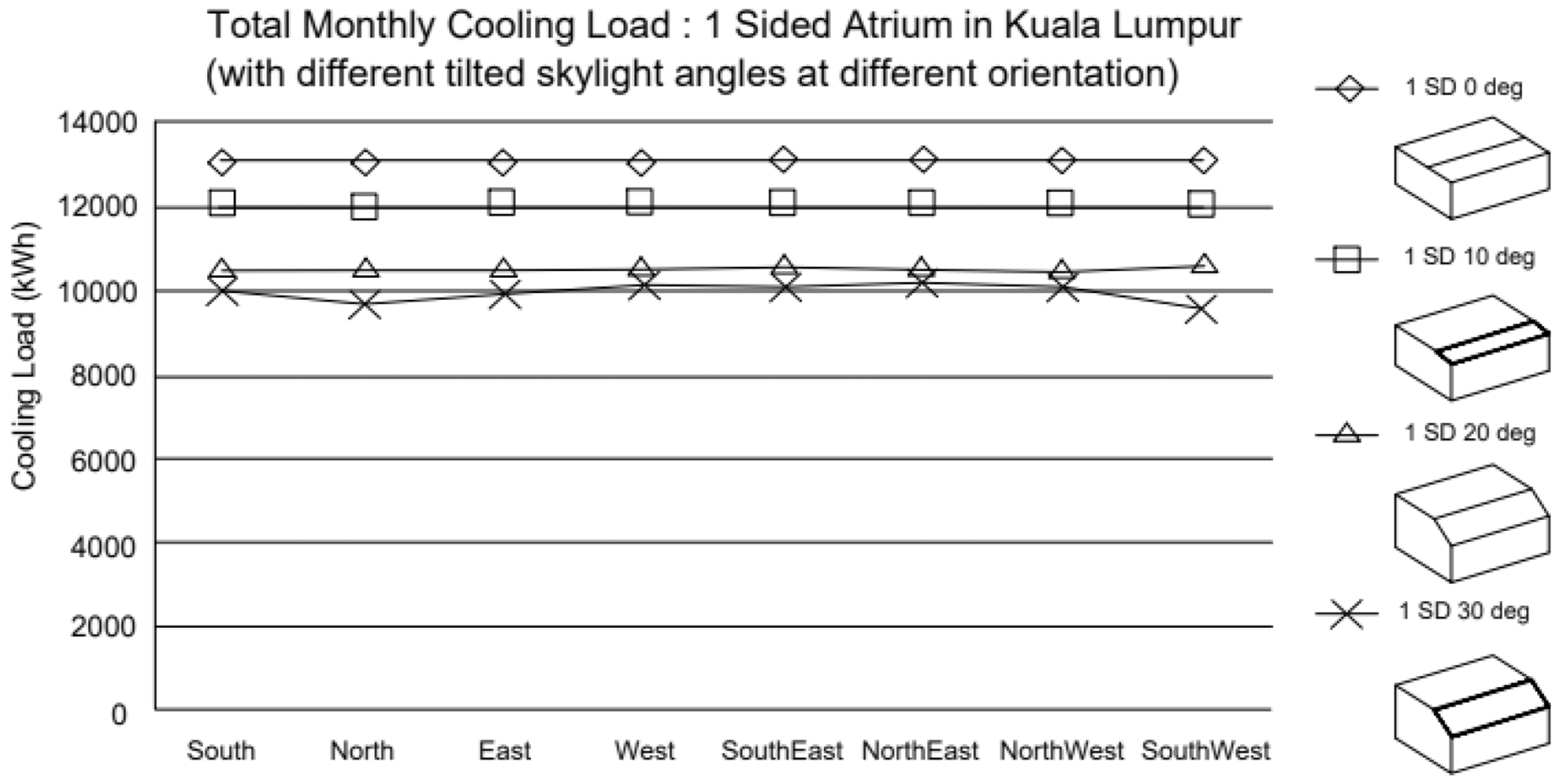
Cooling load in one-sided atrium with tilted skylight in Kuala Lumpur.
EnergyPlus testing and simulation result
Main data collections were carried out in two stages. In the first stage of data collection, EnergyPlus software was used for examining the variables and design parameters in achieving the optimum thermal performance in five atrium types.
Thermal performance of different types of atrium: one sided, two sided, three sided, four sided and linear
In phase 2, EnergyPlus was used to measure the cooling load of all studied atriums with southern orientation as presented in this simulation results constitute a preliminary approach to atrium design. This study tested thermal performance of five atrium types in Kuala Lumpur at different atrium orientations: one sided, two sided, three sided, four sided and linear. Figure 11 shows two-sided atrium at all orientations consumed the highest cooling load and the lowest is four-sided atrium at any direction as the skylight is located at the centre so it gives the same value of cooling load. Orientation was verified and validated by the Ecotect simulation results as one of important variables that strongly influence the atrium thermal performance.
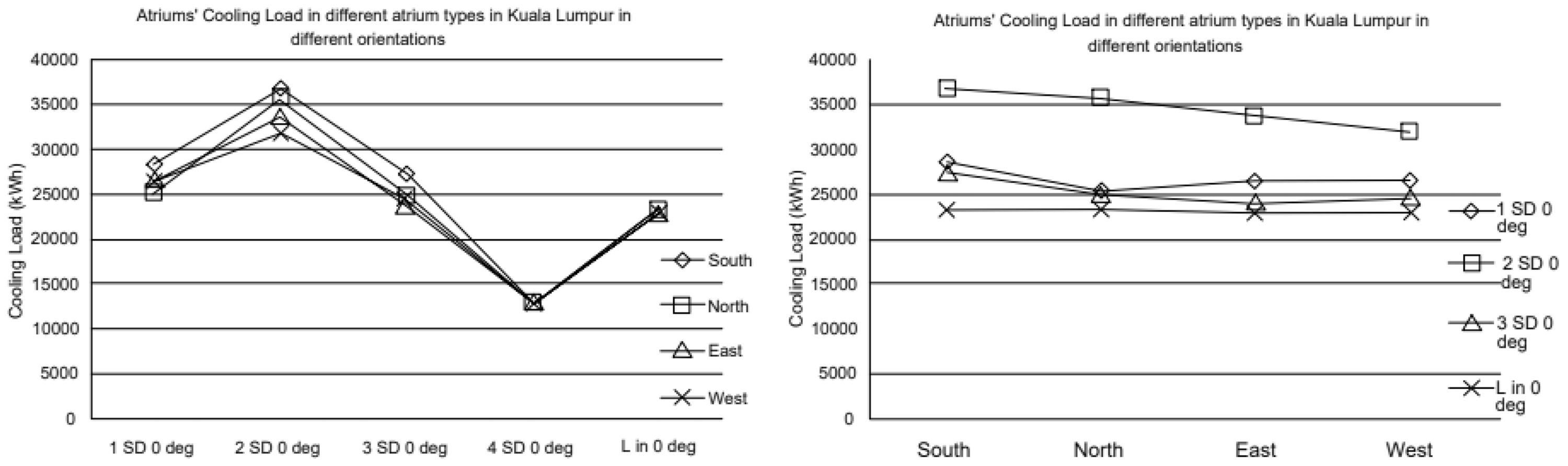
Monthly cooling load of different types of atrium in Kuala Lumpur as a function of orientation.
SRSM testing and simulation results
SRSM software is used to measure received solar intensities (hourly clear sky irradiance (W/m2) on different types of roof: flat and curved roof. Then the solar performance of atrium types based on the skylight positioning was simulated and calculated.
Measuring and calculating solar intensities on different roof geometries
In phase 3, SRSM was used to test the solar performance of CCS and CCSR represents its height-to-span ratio (A:B). Curved roofs curvatures have 37 joint segments with different geometrical resemblance of three CCSRs as shown in Figure 12(a). Three types of CCS had been tested (CCSR: A:0.5B, A:B and A:2B) and each CCS has 37 segments. Half of it has resemblance of 18 joint segments with one horizontal at the top. The geographical latitude of Kuala Lumpur (3°9′N of the equator) has been chosen to represent the hot-humid regions. Figure 12(b) shows geometrical resemblance using joint segments for CCS1, CCS2 and CCS3 with 37 planar segments of geometrical resemblance. It also illustrates every 5° segment’s slope angle for CCS1, CCS2 and CCS3 which facing principal directions (north–south or east–west) or secondary directions (northwest–northeast or northeast–southwest). Different roof curvatures with different orientations were calculated and compared. The most efficient curvature with summer-to-winter ratio nearest or equal to 100% will be selected for further study in phase 4.
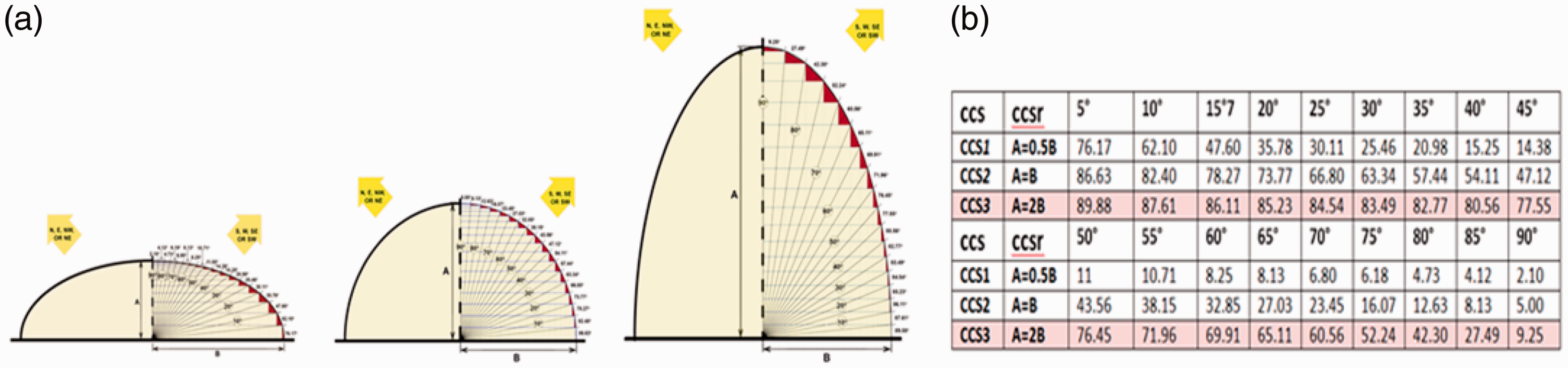
(a) The 37 generated segments and their slopes which have been used for the three curved roofs (CCS1, CCS2 and CCS3) and (b) radial slopes from horizontal and planar segment slopes.
One sample result has been chosen to represent the solar performance test that measured the amount of received I(HTCS) comparison between the flat roof and the CCS3(A = 2B) in Figure 13(a). At principal direction of northward–southward, in both roofs the values are mirrored equally before and after the midday (12.00) axis as shown in seven readings throughout a day. Figure 13(b) shows the CCS3 receives 49% more than the received I(HTCS) on the flat roof at the midday. The minimum ratios mean maximum solar efficiency and maximum ratios mean minimum solar efficiency happen in summer. Ratio at 7.00 and 17.00 the maximum ratio (66.7%) is recorded and the minimum ratio (44.4%) is recovered at 12.00 noon. The CCS3 receives 49.8% from the received I(HTCS) on the roof at midday on a daily basis.
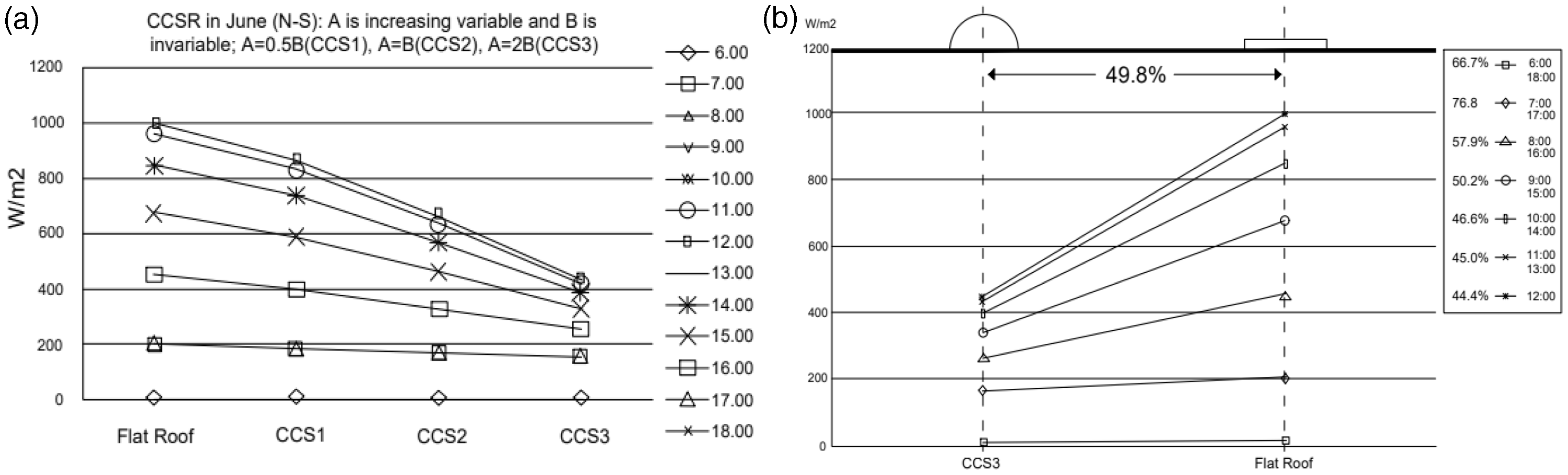
(a) Amount of received I(HTCS) comparison between the flat roof and the CCS3(A = 2B) and (b) min and max solar ratio of CCS3 compared to flat roof. CCSR: curved-roof cross section ratio.
SRSM testing and simulation results: Measuring and calculating solar intensities on five atrium types: one sided, two sided, three sided, four sided and linear by using SRSM software
Finally, SRSM was used in phase 4 to test the solar performance of all selected atrium types; one sided, two sided, three sided, four sided and linear were tested with different skylight position on the curved roof in different orientations during summer (21 June) and winter (21 December). One-sided atrium is categorized based on the skylight position and orientation; one-sided north, one-sided south, one-sided east–west, two-sided north, two-sided south, three-sided north, three-sided south, three-sided east–west, four-sided north, linear north–south and linear east–west as shown in Figure 14(a). Each atrium’s solar potential is considered based on the calculated I(HTCS) on the CCS external roof surfaces. It was calculated on the roof curvatures constructed with 37 joint segments: CCS1, CCS2 and CCS3 as illustrated in Figure 12(a). It shows together the 5° radial slopes for each planar which forms the vault surface. Table list in Figure 14(b) shows the radial angles for each CCS; it is easy to see and compare the different slope value. SRSM (1) computer model is used to calculate the I(HTCS) on the CCS external curved roof and skylight surfaces.
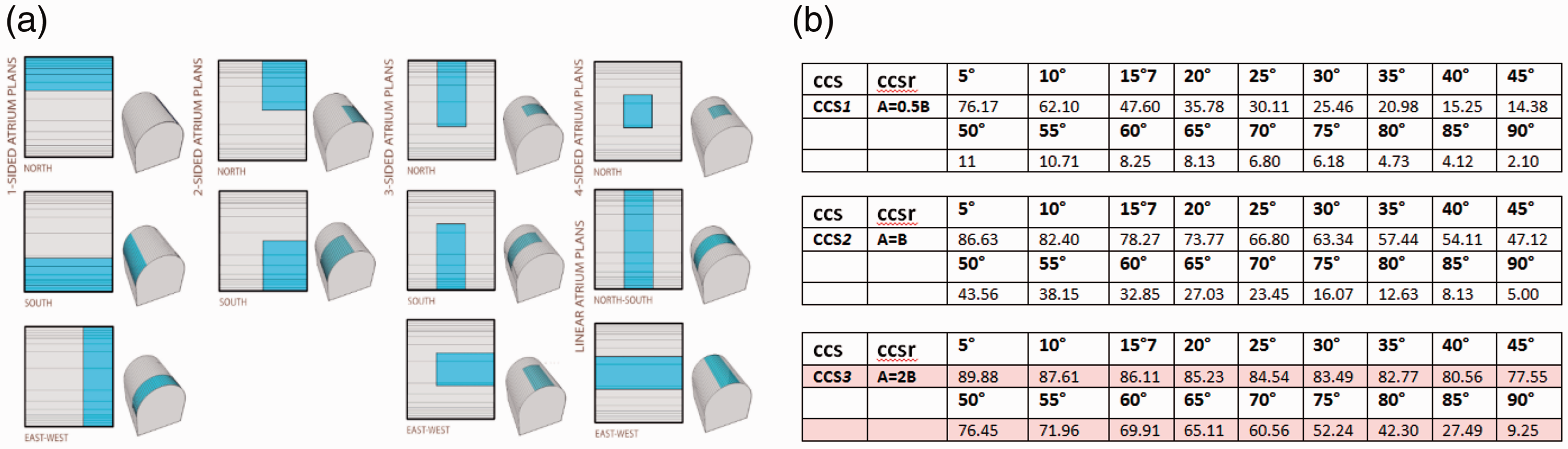
(a) Selected atrium types with curved roof and (b) table list of radial slopes’ angle from horizontal and planar segment slopes.
Figure 15(a) shows Atrium 1SDnorth and its solar performance was simulated as a sample. The results revealed the received
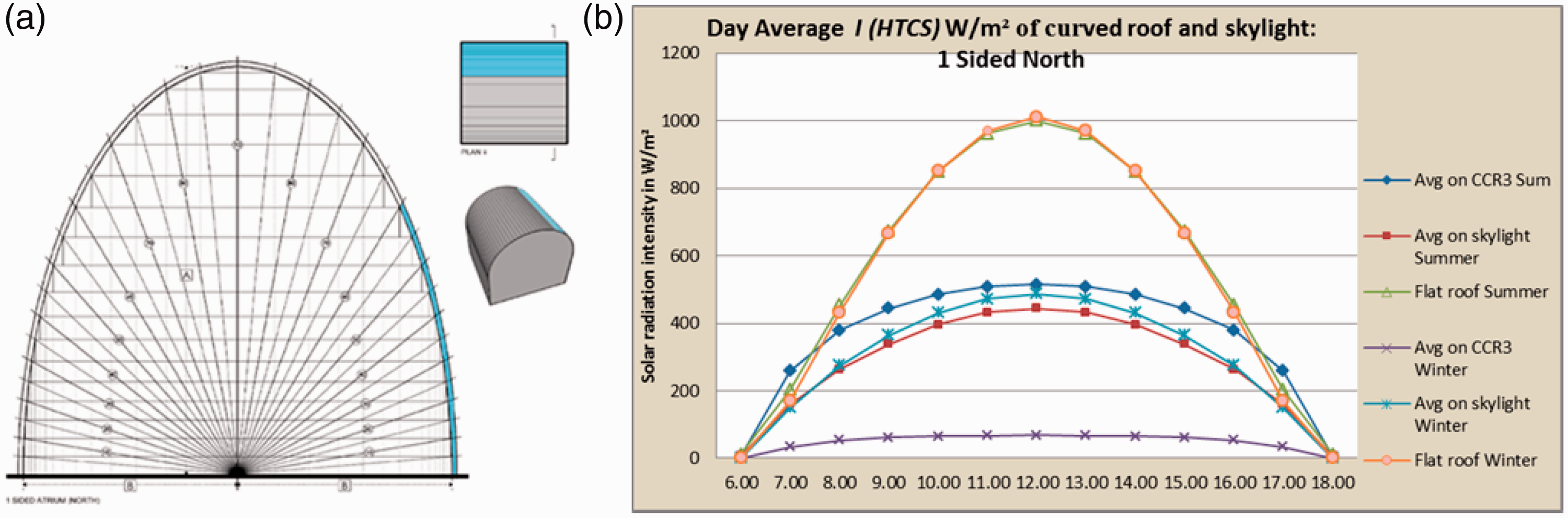
(a) Section of one-sided curved atrium with north skylight position (1SD north) and (b) solar intensities on curved roof and skylight of 1SD north atrium. HTCS: hourly total clear sky irradiance.
Next SRSM was used to calculate the average I(HTCS) on atrium roof with different skylight positions. One calculation sample is shown in Tables 2 and 3. The results show the day average on a full curved roof (CCS3) in summer is 280 W/m2 and in winter is 298 W/m2. The position of the one-sided north atrium skylight is one-third north of the full CCS as drawn in the section in Figure 15(a). Table 2 shows the SRSM calculation of the average I(HTCS) on the CCS3 (A = 2B) (with 37 joint segment planar angles) and on the one-sided atrium roof with skylight position at the north in summer and winter marked in shade. The ratio of the I(HTCS) on the skylight (Ʃ {I(HTCS) (1skl):I(HTCS) (nskl)}) to the I(HTCS) on the CCS3 (Ʃ {I(HTCS) (1):I(HTCS) (n)}). I(HTCS) on the skylight is calculated as the total of I(HTCS) on the first (planar sloped 69.91 at north direction) to the last (planar sloped 89.88 at north direction) skylight planar. The I(HTCS) on the CCS3 is the total of I(HTCS) from the first (planar sloped 89.88°S) to the last (planar sloped 89.88°N) roof planar (a complete roof curvature)



SRSM calculation of the average I(HTCS) on the CCS3 (A = 2B) on one-sided atrium roof with skylight position at the north (one-sided north) in summer marked in shade.
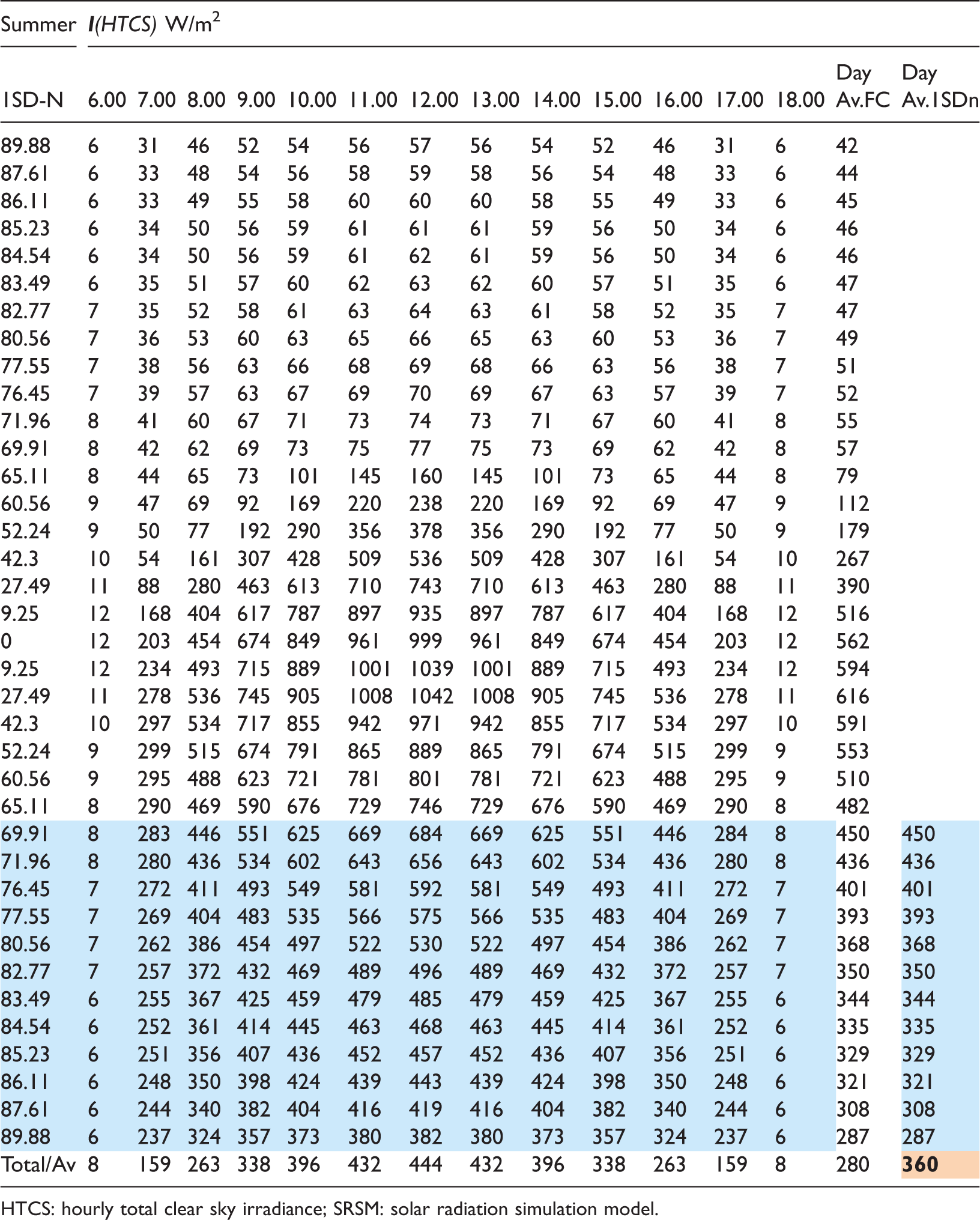
HTCS: hourly total clear sky irradiance; SRSM: solar radiation simulation model.
SRSM calculation of the average I(HTCS) on the CCS3 (A = 2B) on one-sided atrium roof with skylight position at the north in winter marked in shade.
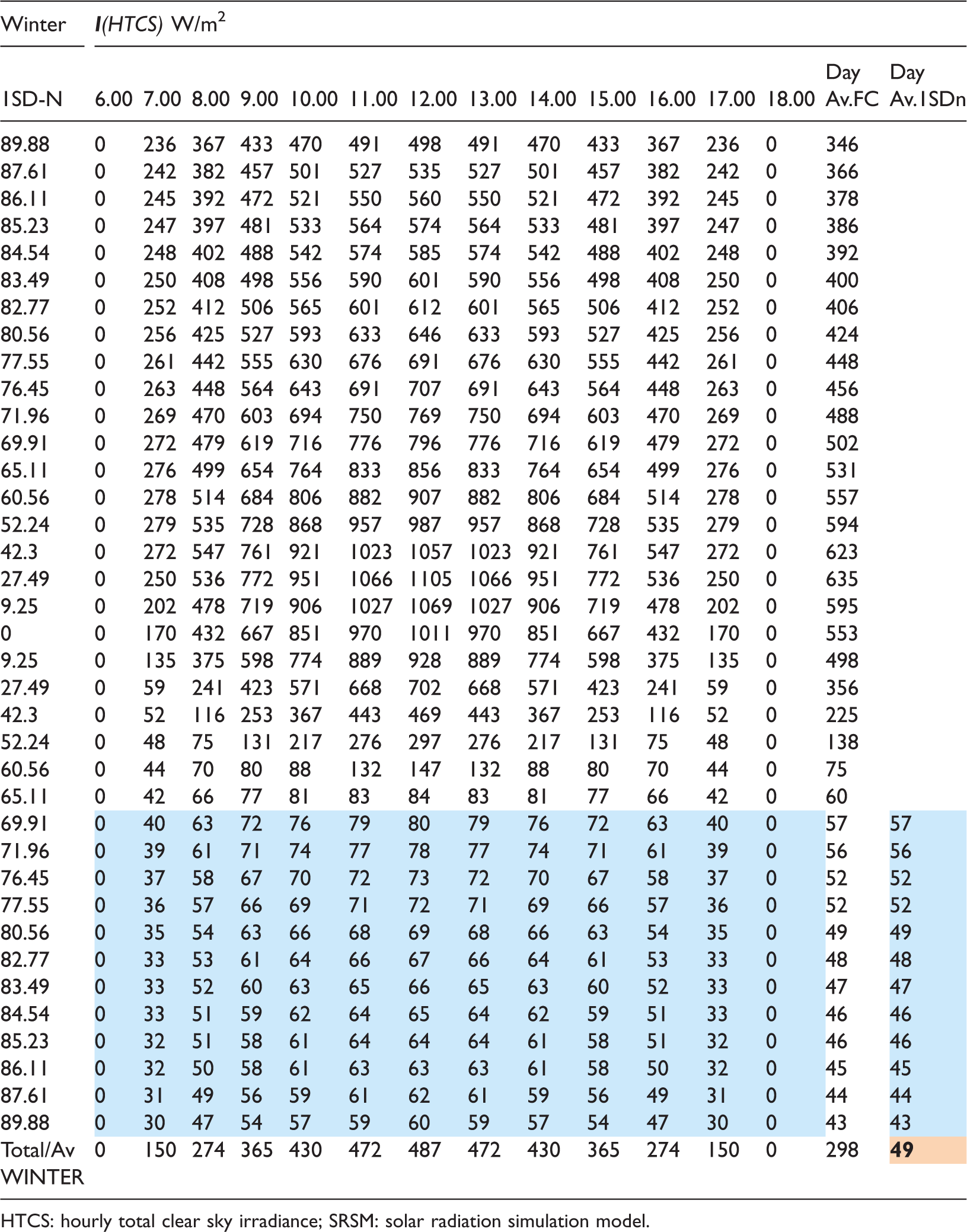
HTCS: hourly total clear sky irradiance; SRSM: solar radiation simulation model.
Ratio received formula is used to calculate the efficiency of atrium type related to skylight positioning in receiving solar intensities; if the value is nearer to 100%, it means the atrium type is more efficient.
Reliability and validity data achieved through sequential simulation
Choosing the right building orientation in hot-humid climate is important;37,40 it is more so in Malaysia and similar countries that experienced rain and intense solar radiation almost throughout the year round. In order to minimize heat gain and reduce the energy consumption associated with HVAC system, longest façade should be oriented at the design stage to be facing north and south cardinal directions. While building sides facing east and west should be designed in such a way that afternoon heat is blocked by applying horizontal sun-shading devices, application of soft landscaped materials such as trees, and building materials and colours on the façade that reflect heat should be applied. These measures when taken will ensure thermal comfort with least possible cost of maintenance. Also spaces that accommodate activities that are not frequented like the garages and stores can be placed along the east and west axis, while living spaces like bedrooms and living rooms can be placed along the longer axis. For efficient fenestrations and skylight design, climate type, physical properties of the glazing and framing materials should be given consideration with their solar heat gain coefficient and thermal conductance.
This research uses sequential software in four phases for the purpose of validity. In phase 1, Ecotect Analysis (2010) thermal analysis tool was used for pilot experiments for investigating the initial atrium’s thermal performance. Ecotect provides a range of thermal performance analysis options. Its core is the CIBSE admittance method used to determine internal temperatures and heat loads. This admittance method is widely used around the world and has been shown to be an extremely useful design tool. It is not as physically accurate as some of the more computationally intensive techniques such as the response factor or finite difference method; however, for the purpose of design decision-making, the admittance method is by far the best choice for an architect.
Phase 2: Energy efficiency is vital in atrium application in buildings. 38 Atrium shape and orientation angle should be selected based on the best possible configuration as informed by the calculation precision of several variables discussed. Several variables itemized and measured by Ecotect yield result that can be validated with EnergyPlus. EnergyPlus can be used in suggesting HVAC system for a building. It is also useful for the clients and users in preparing maintenance schedule and budget.
Phase 3: Atrium shape and sides may be adopted cognizant of the solar radiation intensity as measured by SRSM. Thus, one sided, two sided, three sided and four sided or linear sided may be adopted as appropriate, cognizant of the amount of solar radiation received in a particular region, location, latitude and construction materials. Although design and shapes of atrium may run into thousands of permutation and combinational configuration based on shapes, sizes and forms, the main issues to be prioritized regarding the design choice are safety, material, cost, location and context, and above all thermal performance.
Phase 4: SRSM was used to measure and evaluate the solar performance of all selected atrium types (one sided, two sided, three sided, four sided and linear). They were tested at different skylight positions on different roof curvature with varying orientations during summer and winter (only referring to sun position on 21 December).
Conclusion
This scientific research was conducted with a systematic data collection, interpretation and evaluation. The aim of the study was to investigate thermal and solar performance of skylight design in hot humid region with reference to Kuala Lumpur and it was achieved by applying sequential simulation using three thermal analysis software, namely Ecotect, EnergyPlus and SRSM. Thorough simulation results revealed that the phenomena of solar intensities received on the atrium surface have significantly influenced atrium’s roof geometry and skylight design. This research can be concluded that each software was capable and reliable in measuring, calculating and simulating building thermal performance; however, it has its own limitation as it could only measure what it need to be measured. In this research, these thermal analysis software were for validation purpose by employing internal and external validity in every phases sequentially;
Phase 1 – testing influence of atrium types and roof geometries on atrium building thermal performance using Ecotect was able to obtain initial results of heating and cooling load and identifying independent variables that influence the atrium building in four climatic regions (warm humid, hot dry, temperate and cold). In the fact that Ecotect is reliable but not valid in measuring the heating or cooling load due to its simplistic fundamentality of the software. Phase 2 – measuring the atrium’s thermal loads and energy consumption for heating and cooling in atrium buildings using EnergyPlus was able to validate the independent variables from phase 1 and provide the accuracy in calculating the real energy load in atrium building. This stage had achieved the stability and accuracy in addition to serving as internal validator of Ecotect software. Both Ecotect and EnergyPlus simulation results showed that atrium’s roof geometry (tilted roof and flat roof) and different types of atrium (with different location of skylight) scientifically present evidence for further exploration in phase 3. Phase 3 – measuring and calculating solar intensities on different roof geometries using SRSM mathematical model that is capable of providing detail amount of solar intensities received on every single surface segment of roof curvature (flat, tilted and curved roof). Phase 4 – measuring and calculating solar intensities received on different skylight positioning using SRSM that is capable of producing the ultimate results on the amount of solar intensities received on every single surface segment of different skylight surfaces on different roof curvature in specific case study, Kuala Lumpur. SRSM was used in phase 3 and 4 as it was scientifically proven able to produce accurate results for location that is situated within 25°N and 25°S.
This research also helps the practitioners such as designers and engineers in designing atrium buildings that is appropriate for the tropics by considering passive solar and bioclimatic architectural elements such as roof geometry and skylight design of an atrium at the early design stage that leads to low energy consumption atrium buildings.
The objectives of the study have been achieved; however, there are some limitations that have been encountered along the process. Understanding and mastering in using each software takes a long withstanding effort and time. Furthermore, limitation also occurs in visualizing the model such as Ecotect that allows the designer to draw the model which is easy and friendly while EnergyPlus needs a plug-in software in order to visualize the model. Since SRSM is a mathematical-based software it allows input and output data in text format only which is not interactive to the user. This research therefore recommends for a future research in establishing a software with good physical simulation image to make designers understand about the effect of excessive solar radiation in atrium building. It should contain several modules that are capable to model, test, measure, calculate and simulate the thermal performance and solar intensities which covers all climatic regions at all stages.
Footnotes
Declaration of conflicting interests
The authors declared no potential conflicts of interest with respect to the research, authorship, and/or publication of this article.
Funding
The authors received no financial support for the research, authorship, and/or publication of this article.