



Abstract
In this study, the optimal capacity of a battery and power conditioning system (PCS) of energy storage system were calculated. In addition, economic analysis was conducted to determine the optimal equipment standard, taking the government support plan into account. In addition, the changes in the power generation pattern were examined when the energy storage system and photovoltaic (PV) were connected to verify the power peak management efficiency of the energy storage system. Moreover, the effect of the energy storage system support policy was assessed by comparing the economic efficiency of single-PV equipment and energy storage system-connected equipment by the internal rate of return. Internal rate of return was analyzed by the change in cost of energy storage system equipment and the price of system marginal price/renewable energy certificate, which was a sales factor, and used for economic forecasting of the energy storage system. To accomplish this, the 2015 power generation output data (daily average 3.69 h power generation) of LG Hausys Ulsan station were converted to small-scale (3 MW) and large-scale (10 MW) solar power and a model that calculated the factor capacity of battery and the PCS capacity of the energy storage system was then constructed. Furthermore, the selected battery capacity and PCS capacity were analyzed separately by economic analysis to propose an energy storage system equipment standard, which could guarantee the optimal economic efficiency. Finally, based on the “Guideline for Management and Operation of Mandatory Supply for New and Renewable Energy” established by the Ministry of Commerce Industry and Energy, the profit model applied to the economic analysis was limited to an energy storage system charged from 10:00 to 16:00.
Keywords
Introduction
New and renewable energy (NRE) has become the common denominator in the time of global transition of energy policy. Despite its existing economic weakness, its several strengths have attracted increasing attention as an alternative energy source. First, it has the potential to cope with climate change, making the combustion process unnecessary through the use of natural energy, such as Sun, wind, and Earth power. Therefore, The Ministry of Trade, Industry and Energy (MTIE) in Korea announced the “Renewable Energy Plan 3020” to expand the percentage usage of NRE from 6% in 2015 to 20% in 2030. 1 Second, NRE can adopt a dispersed generation model, enabling small power stations to be located in the neighboring areas in demand, which is in contrast to the centralized generation model of coal or nuclear power, requiring huge power stations. As a member country of the “Paris Climate Change Agreement,” Korea aims to reduce greenhouse gas emissions by 37% in 2030. 2 Third, rapid technological developments have reduced the levelized cost of energy in solar energy by 25% and improved energy efficiency by increasing the output per area by 50% in 2018, compared to 2009. Natural power sources, however, are associated with some supply uncertainty, complicating the equipment management system.
The peak load is one of the key indicators for the stability of the power supply and is defined by the level of contribution during the peak hour in demand. “The 8th Master Plan for Electric Power Supply and Demand from 2015 to 2029” by MTIE forecasted the peak load of major power sources in 2030: 16.6% for nuclear energy, 38.6% for LNG, and 7.1% for new renewable energy, reflecting the high level of uncertainty by renewable energy.3,4 Energy storage system (ESS)-related technology, which is based on lithium batteries, has already proven its effectiveness in peak load management and become widespread as a solution to alleviate the supply instability of renewable energy. 5 An ESS is designed to optimize power management to normalize the power supply during the peak load time by storing power from a lower load time. Developed countries, such as United States and Japan, have already established and implemented related policies to nurture the ESS industry in order to stabilize the power supply and demand. The Korean government also planned to spread its ESS capacity up to a cumulative 2 million kW by 2020. Government effort, however, is highly likely to be constrained by uncertainty on the economic feasibility of an ESS, making it necessary to conduct empirical analysis to discover an effective ESS-connected mechanism. 6 In addition, it is necessary to examine the profit structure to determine the optimal capacity of ESS equipment, including comparative analysis of the economic feasibility between a single-PV model and ESS-connected PV model. 7
This study assessed the economic feasibility based on the profits from electricity sales and ESS-connected renewable energy certificate (REC). First, a capacity-calculation model with battery and power conditioning system (PCS) was simulated using the output data from a 3 MW PV station and 10 MW PV station to determine the optimal ESS usage rate. The effectiveness of the support policy for ESS was then examined by analyzing the economic feasibility of both the battery capacity and PCS with the optimal factor capacity, to compare the internal rate of return (IRR) of the single-PV equipment with that of the ESS-connected equipment. 8 In addition, the optimal level of investment was estimated by analyzing the economic sensitivity in investment cost of an ESS and the price fluctuations of system marginal price (SMP)/REC.9,10 Finally, the necessity for capacity expansion of ESS equipment was investigated to stabilize the demand and supply through a comparison of a 1-day generation pattern for each season between single-generation and ESS-connected generation.
Materials and methods
The 1-day generation pattern of a single-PV was analyzed using the hourly solar radiation from 2001 to 2010 in Jin-ju city, where the level of radiation is known to be fairly high in Korea. The hourly solar radiation data in Jin-ju city was used in order to analyze the 1-day generation pattern of a single-PV and expected change by ESS-connected PV generation system, investigating how to reduce power peak load. However, in our case, the power generation output data from Wool-san station was used because analysis of the economic feasibility was able to be accomplished by examining the PV output generated from the PV equipment. The expected amount of generation from the target PV equipment was calculated using the following equation

Despite the seasonal differences in the minimum and maximum amount, the average output chargeable by an ESS from 10:00 through 16:00 reached 70%–85% of the PV equipment capacity, as listed in Table 1.
Hourly analysis of 1-day generation based on the radiation output at Jin-ju.

The results show that productivity of capital cannot reach the peak when either the capacity of ESS is too high or too low. Therefore, it is important to select the optimal capacity of an ESS to maximize the effectiveness of investment in ESS-connected PV equipment. 11
To select the optimal effectiveness of ESS-connected PV equipment, the battery capacity was estimated by comparing the output of PV equipment from 10:00 to 16:00 to the amount of charge adjusted by discharge in an ESS battery
Battery depth of discharge (DOD): 4% assumed (charge 2%, discharge 2%) Loss rate of charge and discharge: 10% assumed (charge 5%, discharge 5%)
By transforming the data gathered from the Wool-san PV station of LG Hausys during 2015, an equipment capacity of 3-MW PV and 10 MW was acquired for the standard portions of REC. The range of battery capacity in ESS is limited to the extent to which the battery charge rate in 3-MW PV equipment and 10-MW PV equipment is no longer extended. The capacity of battery discharge was examined at an intervals between 50% and 300% (1,500–9,000 kW) by unit of 750 kW for 3-MW PV equipment between 50% and 175% (5,000–17,500 kW) by the unit of 2,500 kW for 10-MW PV equipment. The time zone for the battery charge was selected between 3 and 5 h out of 6 h (from 10:00 to 16:00) to minimize the time difference between charge and discharge considering the number of days for a complete charge. The amount of discharge was assumed to be consistent over 5 h from 16:00 to 21:00, during which the SMP fluctuation was minimized.
Finally, before analysis of the economic feasibility, the major items on sales and cost were assumed except for the hourly output of PV equipment and ESS equipment, the factor capacity of the ESS by capacity, and the portions of REC, as listed in Tables 2 and 3.
Major assumption for an analysis of the economic feasibility of PV.

REC: renewable energy certificate.
Major assumption for an analysis of the economic feasibility of ESS.

REC: renewable energy certificate; ESS: energy storage system.
Result and discussion
The power generated by single-PV 3-MW equipment at the Wool-san station of LG Housys was charged to an ESS battery through PCS. The amount of charge to the ESS was calculated at a 4% DOD and 10% charge-discharge loss rate, with a 166-kWh ESS capacity, which was the minimum unit for battery installment. The range of battery capacity in the ESS was limited to the extent to which the battery charge rate of the 3-MW PV equipment was no longer extended. To analyze the economic feasibility of the ESS battery with the factor capacity of more than 80%, the construction cost was changed according to the capacity. Table 4 lists comparative result on the IRR of single-PV equipment and ESS-connected equipment with a 2656-kWh battery and 500-kW PCS.
Comparison of the IRR of single-PV 3-MW equipment and ESS-connected equipment with the optimal capacity.

IRR: internal rate of return; NPV: net present value; REC: renewable energy certificate; ESS: energy storage system.
The power generated by the single-PV 10-MW equipment at the Wool-san station of LG Housys was also charged to an ESS battery through PCS. The amount of charge on the ESS was calculated at a 4% DOD and 10% charge-discharge loss rate, with a 166-kWh ESS capacity, which was the minimum unit for battery installment. The range of battery capacity in the ESS was limited to the extent to which the battery charge rate in the 3-MW PV equipment was no longer extended. To analyze the economic feasibility on an ESS battery with the factor capacity of more than 80%, the construction cost was changed depending on the capacity.12,13 The construction cost of the ESS by battery capacity has risen from 0.58 to 0.60 billion with decreasing rate. The IRR increased slightly in 68 installments with the ESS battery and PCS capacity, except for three installments. Two capacities with the highest IRR were chosen as the optimal amount: 8,798 kWh + PCS 1,750 kW and 11,620 kWh + PCS 2,250 kW. Table 5 compares the IRR of single-PV equipment and ESS-connected equipment with two optimal capacities, 8,798 kWh + PCS of 1,750 kW and 11,620 kWh + PCS 2,250 kW.
Comparison of the IRR of single-PV 10-MW equipment and ESS-connected equipment with the optimal capacity.
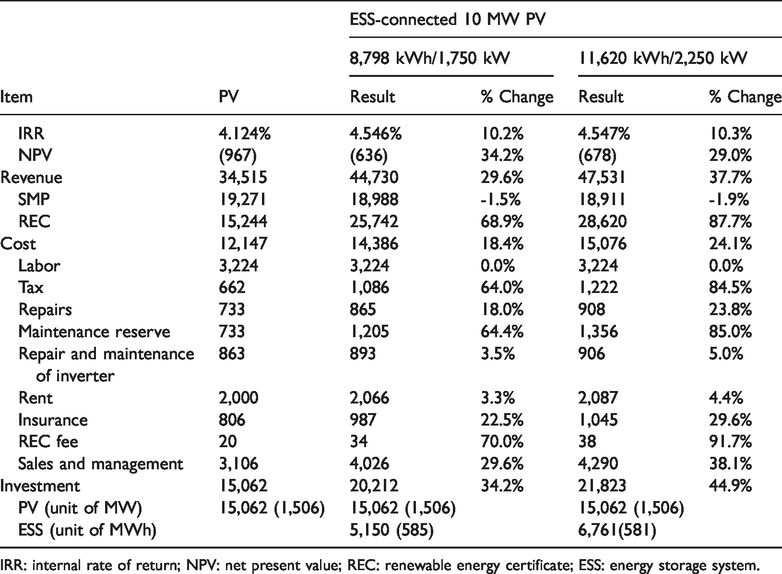
IRR: internal rate of return; NPV: net present value; REC: renewable energy certificate; ESS: energy storage system.
The economic sensitivity was higher in the ESS-connected equipment than the single-PV equipment except for the SMP, as shown in Figure 1.
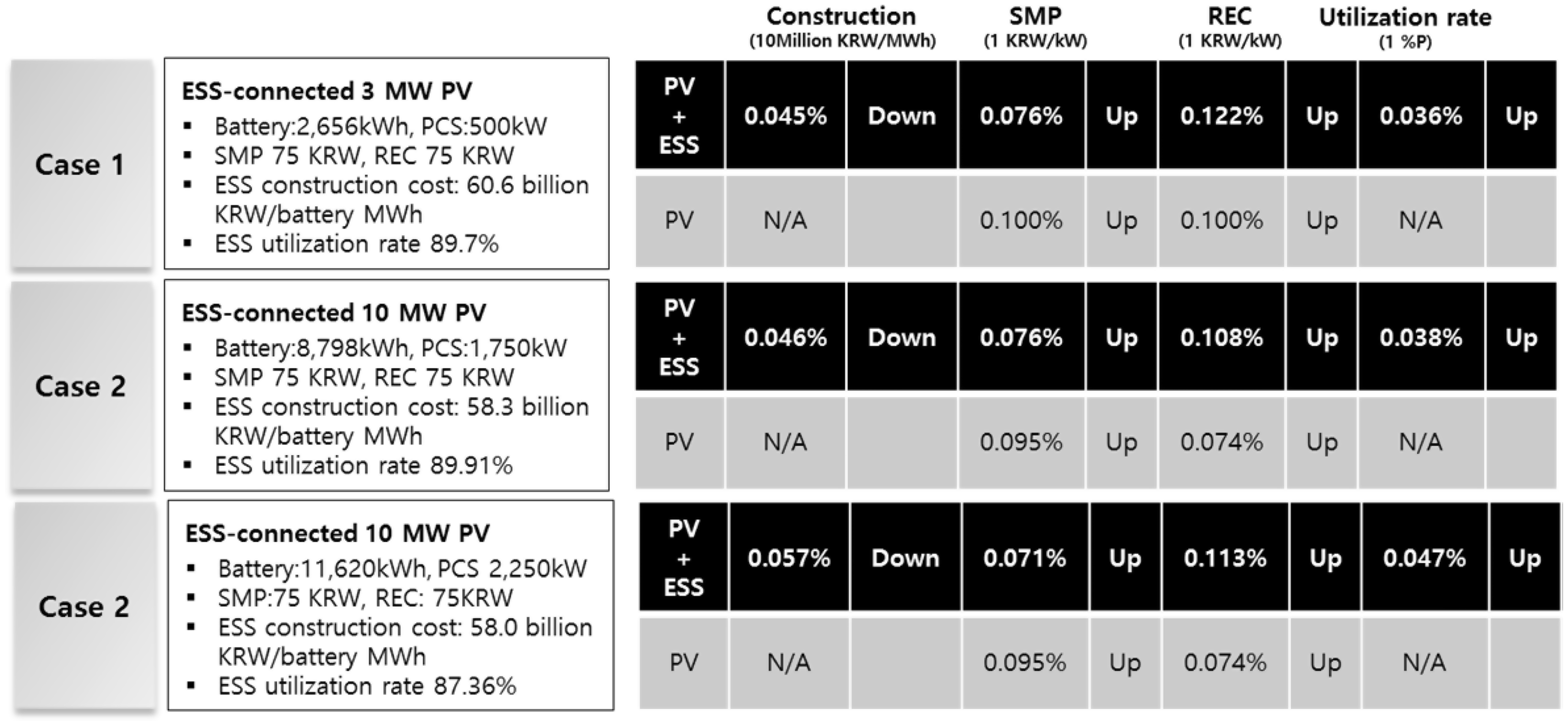
Comparison of the economic sensitivity of the single-PV and energy storage system-connected PV.
This suggests that the REC price of NRE is the most important factor in ESS-connected PV equipment and is useful for establishing the standard for the construction cost, SMP price, REC of NRE, and factor capacity of ESS.
14
This study also suggests the optimal use of equipment, allowing for a government support plan, by analyzing the optimal battery capacity of the ESS and PCS and their economic feasibility.15,16 The effectiveness of the ESS in peak load management was also confirmed by examining the generation pattern of PV equipment and ESS-connected equipment. The effectiveness of the government support policy for ESS was verified based on comparative analysis of the economic feasibility of the single-PV equipment and ESS-connected generation equipment in regard to the IRR.17–19 Finally, the standard for ESS business was analyzed in regard to the IRR sensitivity caused by the price fluctuations of SMP/REC.
By calculating the PCS capacity factor at a range between 50% and 300% of output from an ESS-connected 3-MW PV, 67 ESS-connected plans were drawn with 24 connection plans yielding a capacity factor of more than 80%. An analysis of the economic feasibility, reflecting the ESS battery, amount of equipment investment by installed capacity of PCS, and sales fluctuations of the SMP/REC to operating cost showed that the IRR increased slightly at four installment plans compared to single-PV generation, of which the IRR reached the top at the ESS equipment with the 2,656-kWh battery and 500-kW PCS. By analyzing the generation pattern of ESS-connected 3-MW PV equipment with the optimal capacity, the power peak load was decreased from 2,169 to 1,649 kWh with the hours of generation improved by 5 h. By calculating the PCS capacity factor within a range, where the power output from the ESS-connected 10-MW PV equipment has accounted for 50%–170% of the PV capacity, 71 ESS-connected plans were drawn with 69 connection plans yielding more than 80% in ESS capacity factor. An analysis of the economic feasibility reflecting the ESS battery, the amount of equipment investment by the installed PCS capacity, and the sales fluctuation of SMP/REC compared to the operating cost showed that the IRR increased slightly at the four installment plans, of which the IRR was highest at the ESS equipment with the 8,798-kWh battery+1,750-kW PCS and 11,620-kWh battery+ 2,250-kW PCS. An analysis of the generation pattern of ESS-connected 3MW PV equipment with optimal capacity revealed a decrease in power peak load from 7227 to 5547 kWh with the hour of generation improved by 5 h. This study confirmed that the optimal battery capacity for the ESS-connected equipment ranged from 50% to 150% of the single-PV equipment and the factor capacity of the battery reached more than 80%. The results also confirmed that the PCS capacity to maximize the IRR differed according to the generation pattern and the optimal battery capacity ranged from 20% to 30%, presuming that the PV output was affected by the weather condition. The range of optimal capacity to improve the IRR was wider for the large-scale ESS-connected PV equipment than the small-scale PV equipment. The IRR improved slightly for the ESS-connected 3 and 10-MW PV compared to the single-PV equipment, indicating that the government policy for the REC worked to some extent. The level of uncertainty for investment was determined because the net present value was not improved in the case of a 5% discount rate. For the ESS-connected PV equipment, the improvement in IRR and VPV would be sufficiently effective to produce a satisfactory outcome from the support policy when REC reaches at least 80 with 0.076 P%/KRW/kW for the SMP and 0.122 P%/KRW/kW for the REC.
Footnotes
Declaration of conflicting interests
The authors declared no potential conflicts of interest with respect to the research, authorship, and/or publication of this article.
Funding
The authors disclosed receipt of the following financial support for the research, authorship, and/or publication of this article: This study has been partially worked with the support of a research grant of Kangwon National University in 2018.