



Abstract
This study examines the impact of financial development on energy consumption for a wide array of countries. The estimators used for financial development are foreign direct investment, economic growth and urbanization. The study employed a panel data regression on 136 countries with time frame of years 1990 to 2019. The model in this study deploys system GMM technique to estimate the model. The results show that financial development has a significant negative impact on energy consumption overall. Foreign direct investment and urbanization has significant impact on energy consumption. Also, economic growth positive impact on energy consumption its mean that economic growth promotes energy consumption. When dividing further the sample into different groups of regions such as Asian, European, African, North/Latin American and Caribbean countries then mixed results related to the nexus between financial development and energy consumption with respect to economic growth, urbanization and foreign direct investment. The policymakers in these different groups of countries must balance the relationship between energy supply and demand to achieving the sustainable economic development.
Introduction
In twenty-first century, the economic activities expand with the passage of time. This expansion may increase demand for energy both in developing and developed countries. The importance of energy in the production of goods and services hence equally important for economic development of a country.1,2 Firstly, energy is an important element that enables economic development because the production of goods and services in any country depends on the provision and usage of energy services. 3 But too much pressure on energy development resulted in the shape of environmental hazards. Energy is vital source for production of almost all goods and services so with the passage of time developing countries need more energy to cope up with their needs. 4 According to the Energy Information Administration (EIA) the energy consumption globally will increase to 56 percent during the period of 2010–2040. The top ten primary energy consumers in the world are the United states, China, India, Canada, Russia, Germany, Japan, South Korea, Brazil and France. In some Asian countries such as India and China the energy consumption is expected to expend at annual growth rate more than 3% which accounts for more than 40% of the global increase in energy demand. 5 At the same time, excessiveincrease energy consumption could impair economic development.
Secondly financial development brings several changes within a country. For example, the cost of borrowing is quite low in countries with strong and progressed developed structure and, it provides better access to financial capital and raises transparency among borrowers and also creditors. Financial development gives rise to growth of industry and results in development of new infrastructure and results in usage of more energy. 6 Also, the development of financial sectors increases the diversification of asset allocation which generates a wealth effect that in opportunity to boosts business and consumer confidence. Even in some countries which have fewer financial resources usage with greater management results in more productivity with lesser resources. The financial development encourages industrial growth and helps create new infrastructure facilities on the behind of this situation it can affect energy consumption positively. Therefore a well develop and managed financial sector helps to allocate sufficient financial resources to energy sectors and to provide a balance between energy demand and supply. 7 Theoretically different schools of thoughts related the nexus between financial development and energy consumption. First on is related to the positive relationship between financial development and energy consumption. Furthermore, easy permission to debts, credits, or loans would lead to boost up confidence of investor for business development which increase demand of energy. Also, the lower debt rate that creates the opportunity for the peoples to use more financial resources.4,5,8–10 The second strand is related to the negative relationship between financial development and energy consumption.1,7,9,11 Thirdly, some of researchers identified no connection among energy consumption and financial development.10,12,13 Lastly, in another group of studies, found a non-linear connection among the financial development and also energy consumption.14–16 The financial development has two opposite impacts related the energy consumption according to the theoretical analysis, and its might be difficult to identified. However, the empirical studies strongly support the point of view of theoretical studies, such as empirical studies with different method used, samples period, countries selection and they deliver broadly different conclusions, which show that the result varies across countries related the effect of financial development and also the energy consumption.
For the help of above studies, it is underlined that the uncertain connection among energy consumption and financial development. Earlier researchers have employed different econometric techniques which avoid the problem of heterogeneity, endogenity and cross-sectional dependences. To ignore these issues to produce uncertain and bias estimates. So, financial development and energy consumption nexus need further investigation. To fill these gaps, this study aims to investigate the finance-energy nexus for worldwide perspective by using panel estimation methods robust to heterogeneity and endogenity problem.
This study had three main objectives: (1) to examine the nexus between financial development and energy consumption with the role of economic growth, urbanization and foreign direct investment based on the panel data of 136 countries, which provide us board level of macro perception on their relationship. (2) to investigate the impact of different indicators of financial development on energy consumption by dividing the financial development indicators into financial development of bank, private and financial sectors. (3) to investigate the financial development and energy consumption nexus through sample dividing into four different group of continents (Asian, European, African, North/Latin American and Caribbean countries).To best of our knowledge, this is the first study of its nature to investigate the nexuses between financial development and energy consumption estimating the role economic growth, foreign direct investment and urbanization. It would be beneficial to design a better environmental policy to move towards sustainable economic development and considerably add to better long-run environmental performance. Therefore, this study contributes in the body of knowledge is that the nexus between financial development and energy consumption from worldwide prospective across 136 countries and also dividing sample into four major groups of continents (Asian, European, African, North/Latin American and Caribbean countries). Conversely, although the research from worldwide perspective neglects the characteristics of different countries, it could provide us an “aggregate” view on this topic, which could assist with relevant energy and environmental policy making.
The rest of the study is structured as follows. The next section covers the literature reviews of the previous studies discussed. Then the data description and econometric methodology. In the next section covered the results and discussion. Finally, conclusions are provided.
Literature review
During the past few decades because of the increasing energy consumption for both developed and developing countries related finance-energy nexus, the researchers have paid much attention to this area. The literature review for this study is categorized into four sub sections.
Financial development and energy consumption
The First line of researches has examined the relationship between financial development and energy consumption. Mielnik and Goldemberg 17 study in twenty developing countries period selected 1987 to 1998 by using regression analysis and the findings indicate that negative connection among the financial development and the energy consumption also, significant. Sadorsky 4 studied in twenty-two developing countries and finding indicates that connection among finance-energy nexus is positive and also significant. The financial sectors offers cheapest loan for different producer also purchases innovative technology and tools these all related concern increases the energy demand. 18 The positive also longer run two-way connection among the financial development with consumption related energy. 19 Shahbaz and Lean 20 study in Tunisia by using time series data and his results explain that the longer term co-integrated connection concerning the financial-development and energy consumption also bidirectional relationship among these variables. Shahbaz, Khan 18 study in China by using annualized data and his finding indicates no causality link amongst the consumption for energy and financial development. Khan, Khan 21 study in 184 countries from the period 1990–2017 based on balance panel data to examine the impact of financial development and energy consumption on CO2 emissions using SUR, Sys-GMM and Diff-GMM methods and their finding indicates that financial development help to decline CO2 emissions using Sys-GMM and Diff-GMM and the results of SUR indicate that financial development positive impact on CO2 emissions.
Chtioui 22 study in Tunisia he found that both in long and short-term unidirectional causality run from financial development to energy consumption but in long run bidirectional causality beteen economic growth and energy consumption. Xu 23 study in China and the findings show that positively connection among utilization of energy and financial development. Coban and Topcu 12 study in European union and his findings indicate that when sample dividing into two categories old and new member so positive also significant relationship between financial development and energy consumption in old member of groups. Altay and Topcu 24 study in Turkey his finding indicates that there was no significant connection amongst finance-energy association. Komal and Abbas 25 study in Pakistan from the period of 1972 to 2012 and his findings show that positive and significant effect of financial development on economic growth and energy consumption. Saud, Baloch 26 study in eleven emerging countries and their finding indicates that positive direction also significant connection between energy-finance. Yang, Hui 27 studies in thirty-two Asia countries and their findings conclude that in Asian nations financial development are declining the energy consumption. Nkalu, Ugwu 28 study in SSA countries and their results tell us about that in the longer term positive significant but shorter term no effect financial development and energy consumption.[ 29 ] study in 120 countries based on panel data and the finding shows that world-wide financial development significant and positive influence with energy consumption.
Economic growth and energy Consumption
According to Kraft and Kraft 30 it was the first study in United State from the period of 1947 to 1974 to investigate the linkage between economic growth, energy consumption and carbon emission. Theresults showthat unidirectional causality run from GNP growth to energy use. Omri and Kahouli 31 study sixty-five countries from the period of 1990 to 2001 by using GMM estimator and his finding indicates that the significant and positive relationship between energy-growth nexus. Belke, Dobnik 32 study in twenty-five OECD countries and the findings show that bidirectional causality among economic growth and energy consumption. Saidi and Hammami 33 study in fifty-eight countries and his finding indicates that significantly and positively influence of economic growth and energy consumption in panel four only. Yuan, Kang 34 study from the period of 1963 to 2005 and their finding indicate that causality run for bidirectional relationship between economic growth and energy consumption. Noor and Siddiqi 35 study in five South Asian countries from the period of 1971 to 2006. In short run his finding shows that unidirectional causality relationship among economic growth to energy consumption but not vice versa. Apergis and Payne 36 they conclude that bidirectional in the long-term causality run from economic growth and energy-consumption but unidirectional run in the short-terminter connection among these variables. Mukhtarov, Humbatova 37 study in Kazakhstan from the period of 1994–2014 and they found that positive and significant effect of financial development and economic growth on energy consumption. Khan, Teng 38 study in Pakistan based on time series data from the period of 1965 to 2015 to examine the influence of energy consumption and economic growth on CO2 emission and his finding indicate that economic growth and energy consumption positive impact on environment deregulations for both long term and short term in Pakistan.
Foreign direct investment and energy consumption
Tang 39 they conclude that the FDI also encouraging utilization of energy over the expansion of transportation procedure, manufacturing and industrialization sector development while the energy required associate manufacturing method. 40 study in Malaysia from the period of 1971 to 2009 his finding indicates the causality link among the FDI and the energy consumption in long run. Lee 41 study in nineteen nations from the period of 1991 to 2009 based on the panel data the finding indicates that no gripping proof of FDI connection with clean energy use. He, Gao 42 study in Shanghai and his finding indicate that FDI inducing energy saving and bidirectional effect among FDI and energy consumption. Nasir and Hassan 43 study in South Asian nations and the results show that significant and positive relationship among FDI inflow and economic freedom South Asian countries. Abdouli and Hammami 44 study in seventeen MENA countries and his finding indicate that unidirectional causality among FDI to economic growth. Teng, Khan 45 study in ten different OECD economies with panel data from the period of 1985–2018 and their finding indicates that renewable energy consumption helps to reduce the environmental degradation while economic growth, FDI, electricity consumption and institutional quality positively affect the of environment degradation. Most of studies have found that FDI (inflow) encourage energy consumption over the expansion of manufacturing and transportation, industrialization sector the energy plays vital role to supports manufacturing procedure.4,17,31,39,40,46
Urbanization and energy consumption
In the early stage of urbanization, the people consume more electronic goods that enhance demand for energy.47–49 Urbanization is a natural process in which mass relocation move from rural areas to urban parts. Concerning the link among energy demand and urbanization the outcome explains the increase in urbanization stimulate energy consumption.11,50 Mishra, Smyth 51 study in Pacific Island countries and their finding indicates that mutual causality among energy consumption per capita and urbanization in short run. Abbasi, Parveen 52 study in eight Asian countries and their findings conclude bidirectional causality connection among the urbanization and energy consumption. Lenzen, Wier 53 their finding indicates that effect of urbanization on energy consumption were different the countries across in the period. In literature, numerous studies are conducted about the nexus between financial development, economic growth and the energy consumption.
Most of empirical study concentrated on specific countries or region with different income level, some researchers focus related this study from global point of view, few one focused on developed and developing countries but different methodology and sample size. This study is different from previous studies in various aspects. First, the previous studies were carried out on 17 MENA countries, 27 EU countries, 22 emerging countries, 30 SAA countries, 12 East Asia, 13 European and Oceania countries and 9 Central and Eastern Europe countries respectively, using different methodologies, while this study was conducted on 136 countries. Second, this study incorporated different explanatory variables into the model to investigate the relationship. Third, our study used different methodologies such as system GMM and sample dividing into different groups such as Asian, European, African and North/Latin American and Caribbean countries.
Data source and variable description
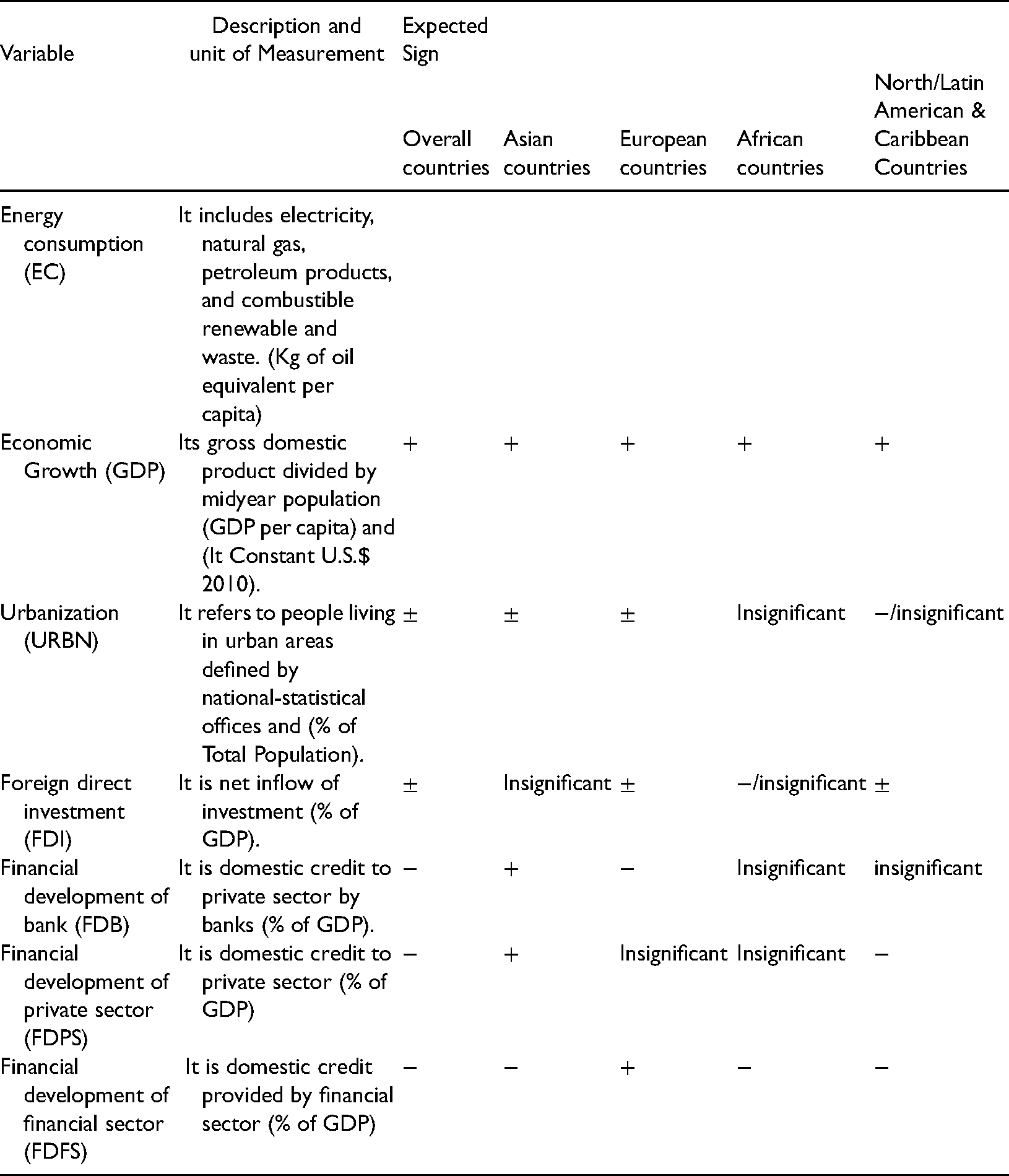
In this study, a balanced panel of 136 countries is selected out of the 195 countries by taking annual data from the year 1990 to 2019. The choice of sample selection and countries is based on the availability of data and then dividing sample into four different groups Asian, European, African, North & Latin American and Caribbean countries.The data for energy use kilo gram of oil equivalent per capita,4,26,54 economic growth as a proxy of GDP per-capita and its constant 2010 U.S.$8,11,31 urbanization % of total urban population11,50,51 foreign direct investment net inflow % of GDP4,17,31,39,40,46 and the three financial development indicators used in this study financial development of bank (% of GDP), financial development of private (% of GDP) and financial development of financial sector percentage of GDP.5,26,55 The data are collected from World Development Indicators, published by the World Bank (Table 1).
List of variables description and expected sign.
Descriptive Statistics of worldwide (N = 136) countries
Descriptive statistics captured the statistical behaviour of data. Descriptive statistics includes mean which provide the average of data, median which divide the data set into two equal segments and it is the mid value of data set, standard deviation provides the information that how much the spread of data from its mean value. The Table 2 shows that descriptive statistics of all variables used in this study. The mean value of energy consumption is 7.41 and its standard deviation is 0.96. The maximum and minimum values are 9.59 and 5.65 respectively. In energy consumption skewness is positive right tail and the value of kurtosis is less than three 1.96 < 3 it means platykurtic. The mean value of GDP is 8.46 with the maximum and minimum of 11.52 and 4.71 respectively. GDP is used as proxy of economic growth. Its standard deviation is 1.27. In GDP the skewness value is negative the curve left side. The value of kurtosis is more than three 3.35 > 3 it means leptokurtic. The mean value of URBN is 4.14 and its standard deviation is 0.34. It’s maximum and minimum are 4.51 and 2.57 respectively. In URBN the skewness value is negative and kurtosis is more than three 9.28 > 3 it shows that leptokurtic. The mean of FDI is 0.29 with maximum and minimum 2.86 and −7.18 respectively. Its standard deviation is 1.59. In FDI the skewness value is negative its curve left side. The value of kurtosis is more than three 5.7 > 3 it means leptokurtic. The mean value of FDB is 3.58 with the maximum and minimum value of 5.25 and 0.75 respectively. Its standard deviation is 0.71.In FDB the skewness value is negative, which show negative skewness. The value of kurtosis is less than three 2.97 < 3 and its platykurtic. The mean value of FDPS is 3.75 with maximum and minimum value of 5.40 and 0.75 respectively. Its standard deviation is 0.84. In FDFS the skewness value is negative and kurtosis value is less than three 2.41 < 3 it means that platykurtic. The mean value of FDFS is 4.08 with maximum and minimum value of 4.84 and 1.96 respectively. Its standard deviation is 0.76. FDFS is used as proxy of financial development. In FDFS the skewness value is positive skewness and right side. The value of kurtosis is less than three 2.53 < 3 it means that the curve of this variable has platykurtic.
Descriptive statistics of worldwide N = 136 countries.

Correlation Analysis
Correlation analysis deals the direction of relationship between variables. It indicates that positive and negative relationship among different variables. Table 3 depicts the correlation of different explanatory variable used in the empirical analysis. Correlation between GDP and energy consumption is positive. It means both variables move in same direction. Correlation shown connection among FDI and energy consumption is negative. Urbanization, financial development of bank FDB, private FDPS and financial sectors FDFS show positive relationship with energy consumption. Urbanization and GDP have positive relationship but FDI has negative relationship with GDP. The FDB, FDPS, and FDFS show positively connection with GDP. Also, the FDB, FDPS and FDFS show positive relationship but FDI shows the negatively connection with urbanization. The FDB, FDPS, and FDFS have a negative relationship with FDI. The FDPS and FDFS have a positive relationship with FDB. Also, the FDFS and FDPS have positive relationship with each other.
Correlation matrix.

Econometric model
This section figures out the explanation regarding the panel estimation approach to investigate the nexus between energy consumption and financial development and also panel data has been applied for their analysis. Based on previous studies in the relevant literature,18,26,56–58 we adopt paper adopts the following energy demand function:
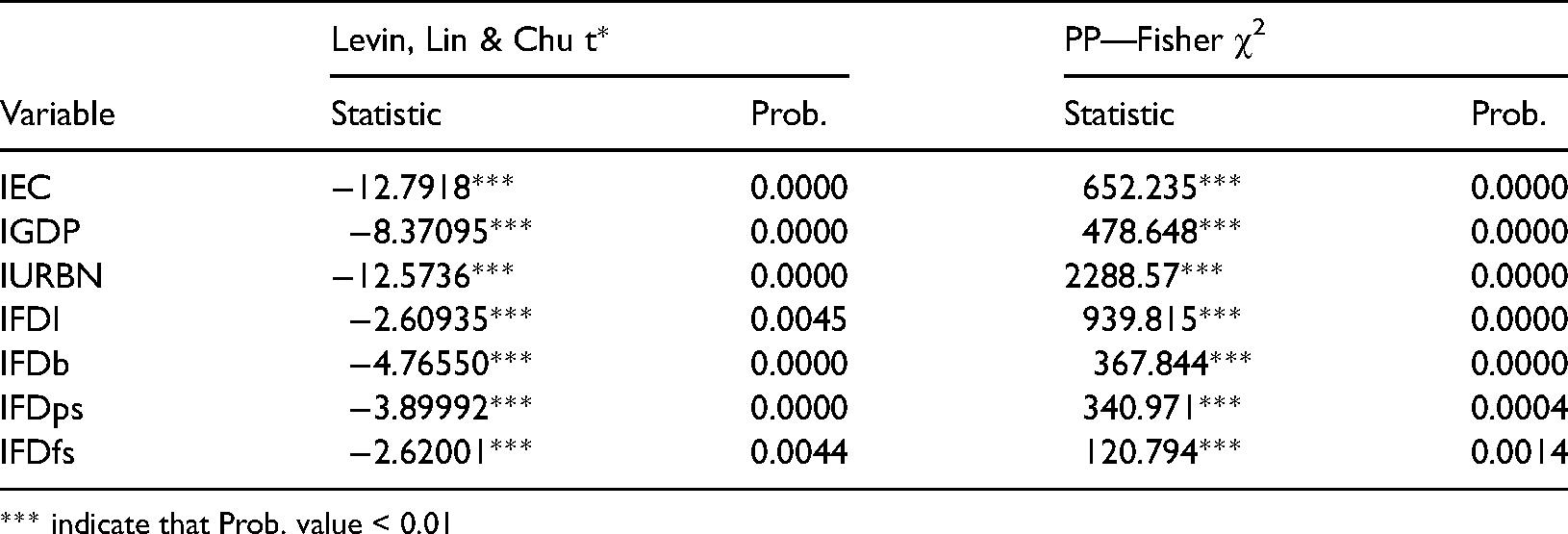
Panel unit root test
Panel unit root test has been applied to check the stationary properties in financial development indicators, energy consumption, urbanization, foreign direct investment and economic growth. Unit root test based on the assumption whether there is any restriction on data series or not. In this study we have used different measures to detect the unit root in the data set. Therefore, this paper relies on the LLC 60 and PP—Fisher Chi-square Phillips and Perron 1988these test robust cross sectional and heterogeneity. In the Table 4 show that the results of unit root test Result indicates that unit root does not exist in any of the variable or the series are stationary at level.
Panel Unit root test.
*** indicate that Prob. value < 0.01
Generalizedmethod of movement (Sys-GMM)
The main implication this study is to estimate the longer run connection among the financial development with energy consumption controlling the role of GDP, FDI and urbanization. Because of the presence of the lag term of the explained variable, we were unable to use the traditional methods for example random or fixed effect models, due to endogenity problem exist in data; then effective estimators couldn't be acquired. Consequently, the generalized method of moments (GMM) was adopted to estimate the results.61–63 GMM models in the regression are more consistent and efficient estimation techniques, which also check the robustness and realization of the errors that are correlated between past and present. So, for the handling the endogenity problem the GMM is best technique to manage these problems and GMM might successfully manage the issue of endogenity and omitted-variable biases. The GMM consists of Diff-GMM and Sys-GMM and as per the choice of various weight matrixes, every one of them can be split into 1-step and 2-step GMM. Mostly, the Sys-GMM performs better in improving the efficiency of estimation than the Diff-GMM. As the generally the 2-step GMM performs well in handling the autocorrelation, endogenity and heteroscedasticity as the compared with 1-step GMM. Therefore, this study two step Sys-GMM estimation technique has been applied for panel data analysis, which is robust to cross-sectional dependence and endogenity. Eviews software were used to conduct the estimation in this study.
Results and discussion
This chapter include the results of test that are applied to examines the financial development and energy consumption nexus from worldwide perspective and different groups of countries also interpret these results.
Impact of financial development on energy consumption for worldwide (N = 136) countries
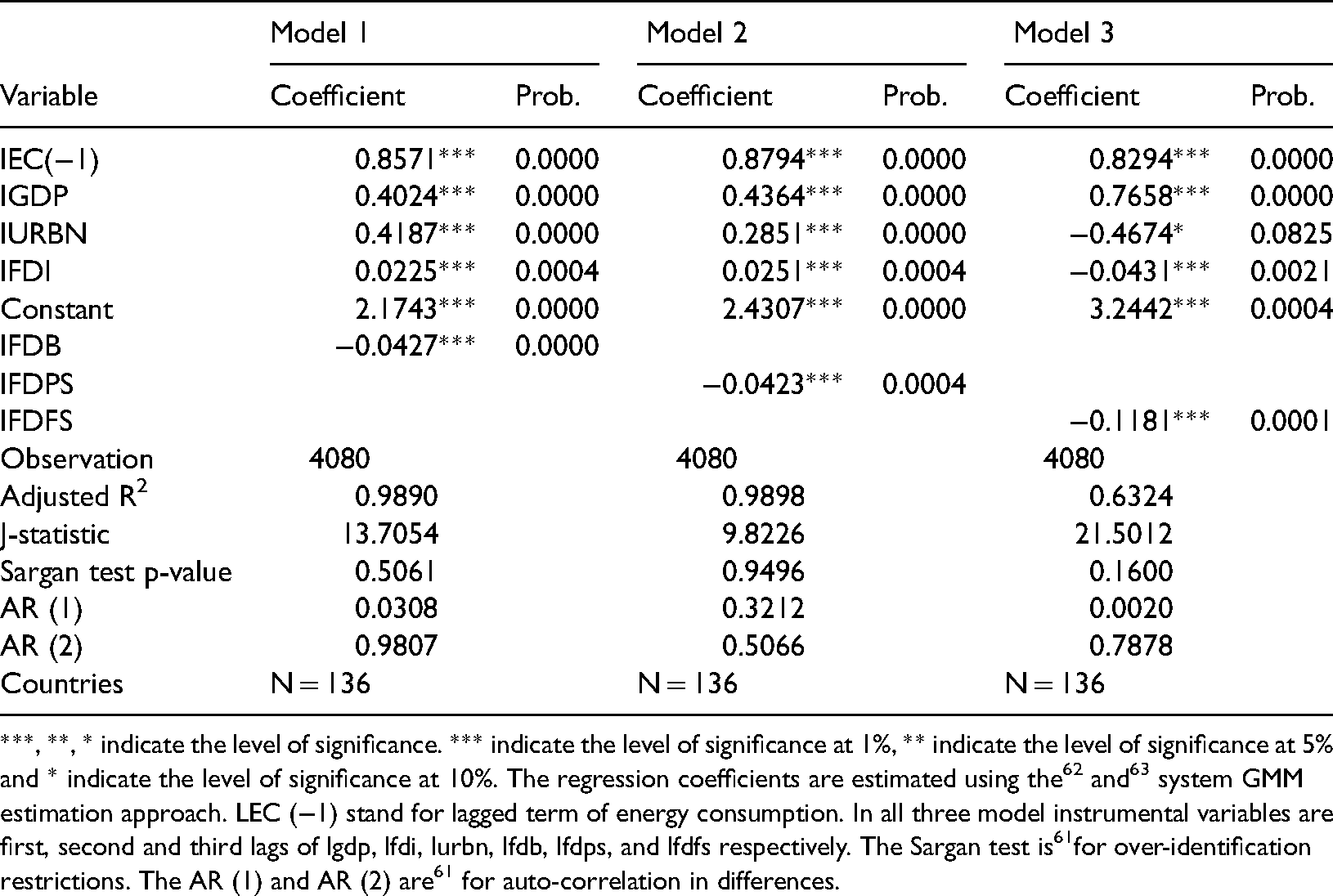
The results of worldwide (N = 136) countries are show in Table 5 with Sys-GMM applied. Because the balance panel data are taken as a natural logarithm, the long run coefficient estimate of GDP, FD, URBN, and FDI is statistically equal to elasticities of energy consumption concerning financial development, urbanization, economic growth and foreign direct investment, respectively. For each model, of worldwide perspective N = 136 countries the (ECit−1) the lagged term of energy consumption variable is highly persistent, positively and statistically one percent level of significant. It means that the energy consumption in one year as compare to previous year highly influence or in a certain year energy consumption strongly affected by its pervious value.
Impact Of financial development on energy consumption for worldwide (N = 136)countries.
***, **, * indicate the level of significance. *** indicate the level of significance at 1%, ** indicate the level of significance at 5% and * indicate the level of significance at 10%. The regression coefficients are estimated using the 62 and 63 system GMM estimation approach. LEC (−1) stand for lagged term of energy consumption. In all three model instrumental variables are first, second and third lags of lgdp, lfdi, lurbn, lfdb, lfdps, and lfdfs respectively. The Sargan test is 61 for over-identification restrictions. The AR (1) and AR (2) are 61 for auto-correlation in differences.
Concerning the impact of economic growth (GDP) on energy consumption, the result shows that 1% increase in GDP positively and significantly increase energy consumption by 0.40, 0.43 and 0.73% respectively in all three models. The result indicates that there is positive and significant relationship between GDP and energy consumption. Industrial growth increases the demand of energy there is another possible option and its vital contribution in the production procedure. Furthermore, these overall countries (N = 136) in trade for world-wide and contributing to world growth, which eventually raise the utilization of energy. They additionally improvement of economic activities like that purchases, investment and utilization increment the interest of energy. There are two basic reasons firstly when income increases people are interested to buy more products like televisions, laptops, refrigerators, computers and AC for their personal use or their family members so result indicates that these types of goods consume huge quantity of energy. Secondly, mostly the peoples change their travel opinion like that depending to private vehicles as compare to the public transport for their work use, personal consumption and transport so results indicate that growth in energy consumption in all over the world countries. Our result mark with.7,11,50,55
Concerning the link among urbanization and energy consumption, the result shows that increase in urbanization stimulate energy consumption. The result shows that 1% increase in urbanization significantly and positively increases energy consumption by 0.41 and 0.28% respectively. Urbanization is a natural process in which mass migration move from rural areas to urban areas. The purpose for this situation that peoples moves between rural parts to urban parts for observing better and the well-settle life style of living, the better job opportunities, and easily accessibility of other daily life resources. According to the results model 1 and model 2 indicates that positively and significantly relationship between urbanization and energy consumption but in the model 3 show that no connection among these variables. Our results are similar with.11,50,64,65
Concerning the impact of FDI on energy consumption, the result explains that increase in FDI 1% significant and also positive, then energy consumption increases by 0.022 and 0.0025% respectively. FDI allow cheaper businesses and easily entrée to monetary capital which can be utilize to expansion in present construct or operations, new factories and plants, all of these activities increase the demand of energy. In overall countries FDI encourages the production level through new investment which rises the energy consumption. 66 The result shows in model 1 and 2 model that there is positive connection among the FDI and energy consumption. But in the model 3 results also show that negative connection among these variables of overall N = 136 countries. It means that FDI one percent increase with decrease in the energy consumption by 0.04% in the model 3. Also, FDI could lead in the local firm by using innovation in technology that might be help to decline energy use. 67 Our results are similar with.4,17,68
Regarding the nexus between the financial development and energy consumption, the result delivers strong proof that there is significant and negative connection among energy consumption and financial development. The result shows that 1% increase in financial development to banking, private and financial sector will decrease energy consumption by 0.0427, 0.0432 and 0.1181% respectively. The financial development decline energy consumption as it supports enterprises to improve energy efficiency and manufacture advanced energy-saving products by updating production technologies and equipment and by increasing the amount of R & D investment. The N = 136 countries use efficiency of energy consuming equipment and energy productive innovation with efficient technology. To efficient use of technology can boost economic growth and reduce energy consumption. So, N = 136 countries should need to focus on efficient energy related projects, which will not only bring new method of energy consumption and production also bring advanced energy efficient technology. In this study results shows that financial development of bank, private and financial sector significantly and negatively impact on energy consumption. According to financial development the overall finding shows that all financial development measures used in different models deliver a significant and negative impact on energy consumption in overall N = 136 countries. It means that changing the measures of financial development there will be no effect of energy consumption and they provide similar significant and negative results. Our results are in similar with.1,3,7,9,11,69
Different diagnostic test used to ensure the validity of results, to check the instruments validity. The Sargan test for over-identification restrictions the probability value of these test show in Table 5. In all three models higher prob. value of test which show that validity of instrument under the null hypotheses of exogenous instruments. AR (1) and AR (2) are 61 tests for first and second order auto correlation in first difference error. For each models of N = 136 countries reported in Table 5 the AR (2) tests show that no evidence of auto correlation at conventional level of significance.
Impact of financial development on energy consumption for Asian countries:
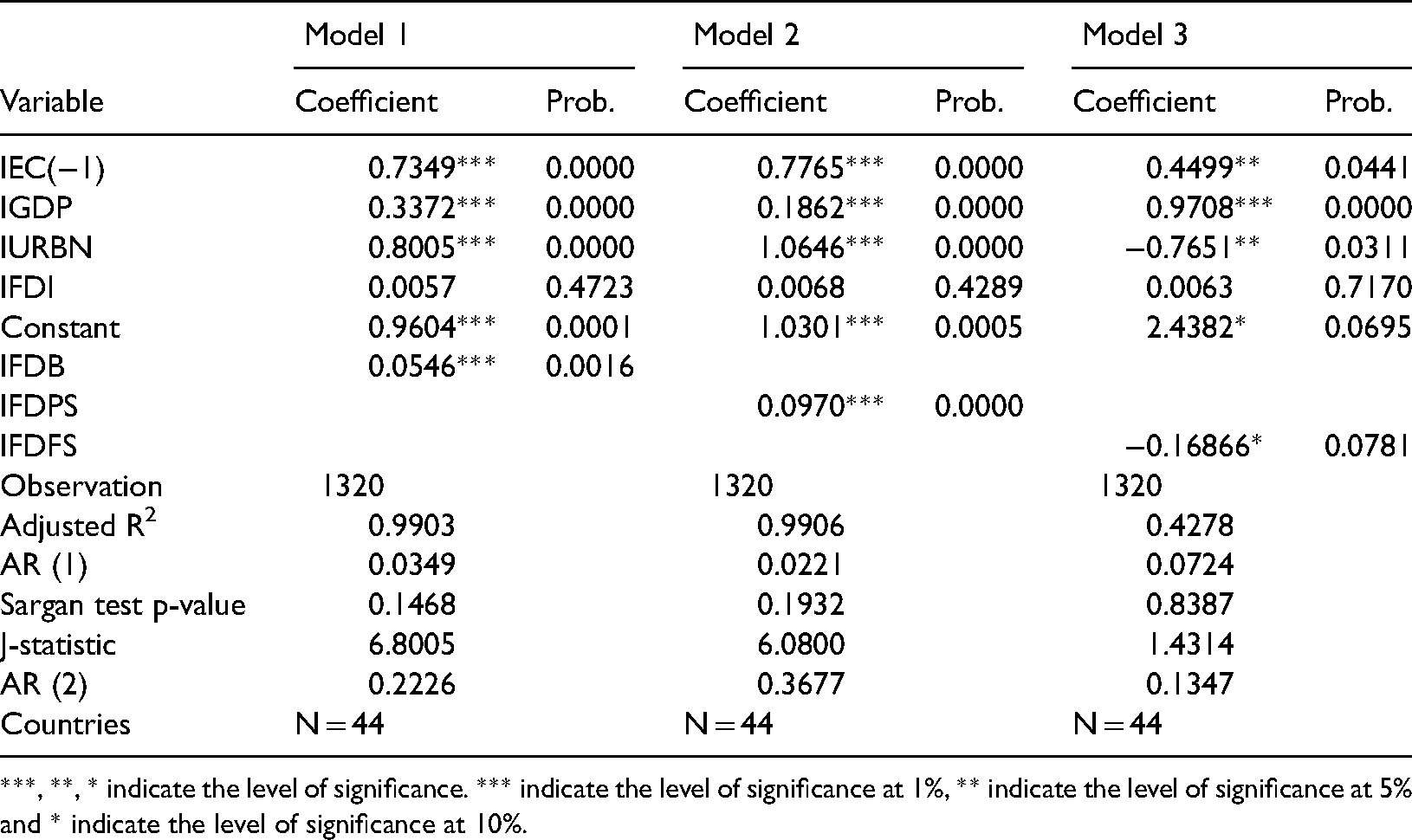
The results of Asian countries are show in Table 6 with Sys-GMM Panel regression applied. For each model, of Asian countries the lEC(−1) the lagged term of variable energy consumption is highly persistent, significant with positive at the level of 1%.
Impact of financial development on energy consumption for asian countries.
***, **, * indicate the level of significance. *** indicate the level of significance at 1%, ** indicate the level of significance at 5% and * indicate the level of significance at 10%.
Concerning the effect of economic growth (GDP) on energy consumption, the result indicates that increase in the GDP by 1%, significant and positive increase by 0.33, 0.18 also 0.97% energy consumption. In the economic growth and energy consumption results also delivers that positive connection among these variables. Also, these Asian countries also involve in international trade with contributing to world growth that eventually raise energy demand. Our result mark with.7,11,50,55
About the relationship among urbanization and energy consumption, the result shows that 1% increase in urbanization significant and positive increase energy consumption by 0.80%. The result shows that significant, positive link among urbanization and energy consumption. In model first and model second result conclude that positively association among urbanization and energy-consumption but model three founds that significant and negative association among urbanization with the consumption of energy. The result is similar with.11,50,64 Concerning the energy consumption and foreign direct investment FDI relationship, the result shows that statically insignificant connection among energy consumption and FDI.
Regarding the financial development and energy consumption nexus and the result delivers strong proof that positive also the significant connection among the financial development and energy consumption. The result shows that 1% increase in financial development increase energy consumption by 0.054%.The result shows that in Asian countries the financial development stimulates energy consumption. The finance is elastic to energy it means that increase in financial development, energy consumption also increases. Furthermore, easy permission to debts, credits, or loans would lead to boost up confidence of investor for business development which increase demand of energy. Also, the lower debt rate that creates the opportunity for the peoples to use more financial resources. This is chance, increases the buying power of consumers for sustainable items that cases higher consumption of energy. So Asian countries should essential to focus on well-organized energy projects, which will not only bring new method of energy consumption and production, also bring advanced energy efficient technology. In this study results shows that FDB and FDPS significantly and positively impact with the energy consumption. But the FDFS result indicates that negative impact on energy consumption. It shows that there is effect of energy consumption when different measure of financial development used and they provide not similar results for all models. Our results are in similar with.4,12,41,50,55,56,64,70,71
Impact of financial development on energy consumption for European countries:
The results of European countries are show in Table 7 with Sys-GMM estimation technique are applied based on panel date taking as natural logarithm of all variables. For first and second model, of European countries the lEC (−1) the lagged term of energy consumption is highly persistent, positive and also significant at the level of 1% and model third show that 5% level of significant. Concerning the effect of economic growth on the energy consumption, the result shows that 1% increase in GDP positively and significantly increase energy consumption by 0.25, 0.10 and 0.20% respectively. In all three models the result also indicates that positive relationship among the GDP and energy consumption its mean that economic growth promotes energy consumption. Also, these European countries involving in trade for world-wide and contributing to world growth, which eventually raise the utilization of energy. Our result mark with.7,11,50,55
Impact Of financial development on energy consumption for european countries.
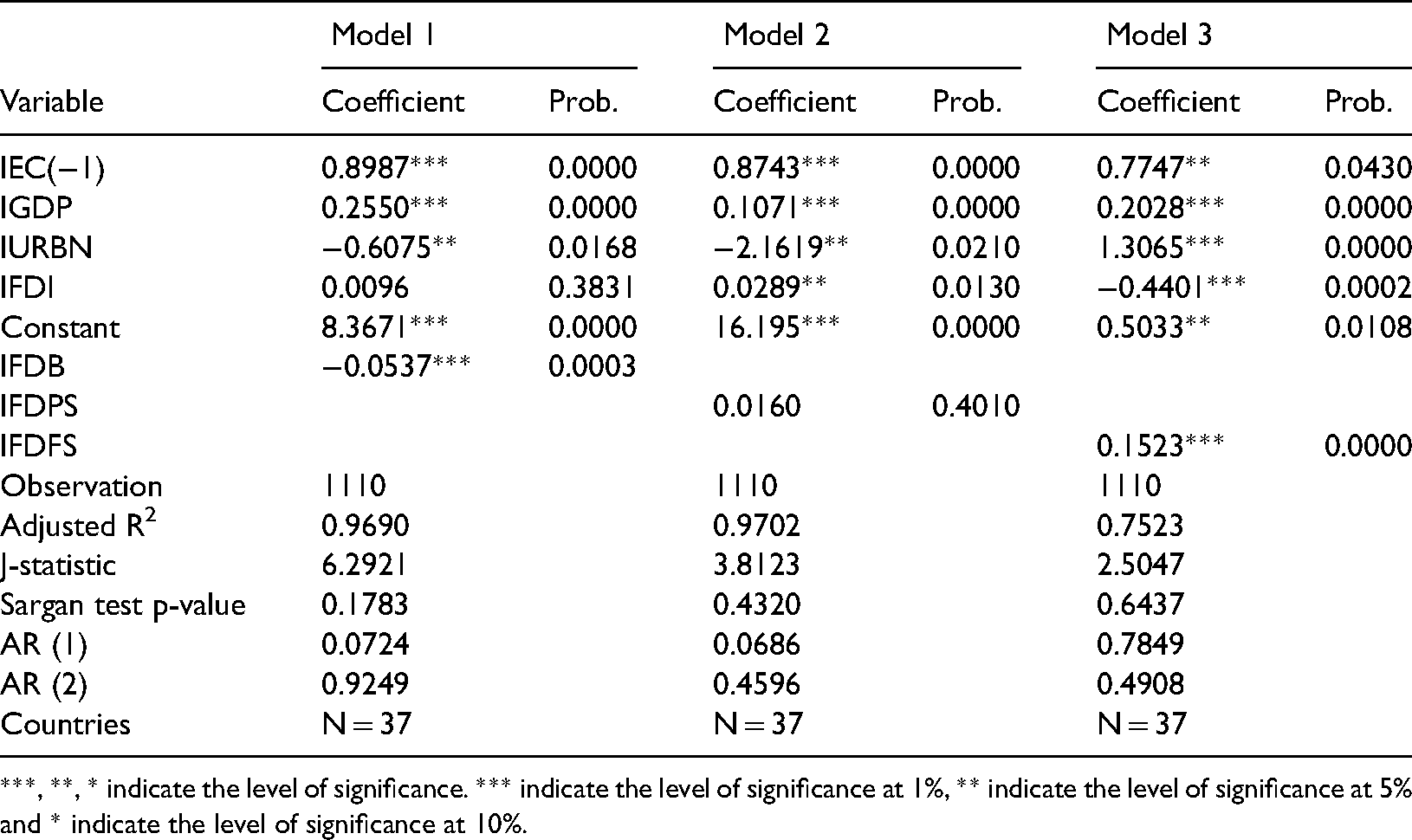
***, **, * indicate the level of significance. *** indicate the level of significance at 1%, ** indicate the level of significance at 5% and * indicate the level of significance at 10%.
Concerning the relationship between energy consumption and urbanization, the result shows that 1% increase in urbanization significant and negative decrease energy consumption by 0.60 and 2.16% respectively. In European countries result indicates that there is a negative and the significant connection among the urbanization with the energy consumption in 1 and 2 models it means that increase in 1% urbanization reduce energy consumption by 0.60 and 2.16%.The model 3 result shows that positive relationship among energy consumption and urbanization. In model 3 the result is similar through.11,50,64,65 Concerning the impact of foreign direct investment on energy consumption, the outcome explains that in all three models the mixed finding related energy consumption and FDI. In model 1 result shows that in European countries no impact of FDI on energy consumption. But in model 2 results explain that the FDI and energy consumption there is significant and positive relationship it means that FDI increase 1% then, the energy consumption increases by 0.02%. The model 3 result shows that FDI and energy consumption negative influences from each other.
Concerning the nexus between financial development and energy consumption. In European countries there is mixed result about financial development and energy consumption. In model 1 result indicates that1%increase FDB then energy consumption reduces by 0.05%. In model 1using proxy of financial development of bank has negative relationship with energy consumption and over result are similar with.1,3,7,9,11,69 But in model 2 resultshows that there is statistical insignificant relationship between financial development and energy consumptionit means that FDPS has no impact on energy consumption in European countries.10,12,13 So, in the model 3 result indicate that in FDFS has 1% increase then energy consumption also increases by the 0.15%.According to financial development the overall finding shows that all financial development measures used in different models deliver a significant, positive and no impact on energy consumption in European countries. It shows that there are strongly effects of energy consumption when changing a measure of financial development and they provide different results. The For each models of European countries reported in Table 7 the AR(2) shows that no evidence of auto correlation at the conventional-level of significance.
Impact of financial development on energy consumption for African countries
The results of African countries are show in Table 8 with Sys-GMM estimation technique are applied based on panel date taking as natural logarithm of all variables. For each model, of African countries the lEC(−1) the lagged term of energy consumption variable is extremely persistent, positive and statistically significant at the level of 1%. Concerning the effect of GDP on energy-consumption, the result shows that 1% increase in GDP positively and significantly increase energy consumption by 0.33, 0.30 and 0.64% respectively in all three models. Our result mark with.7,11,50,55
Impact Of financial development on energy consumption for african countries.
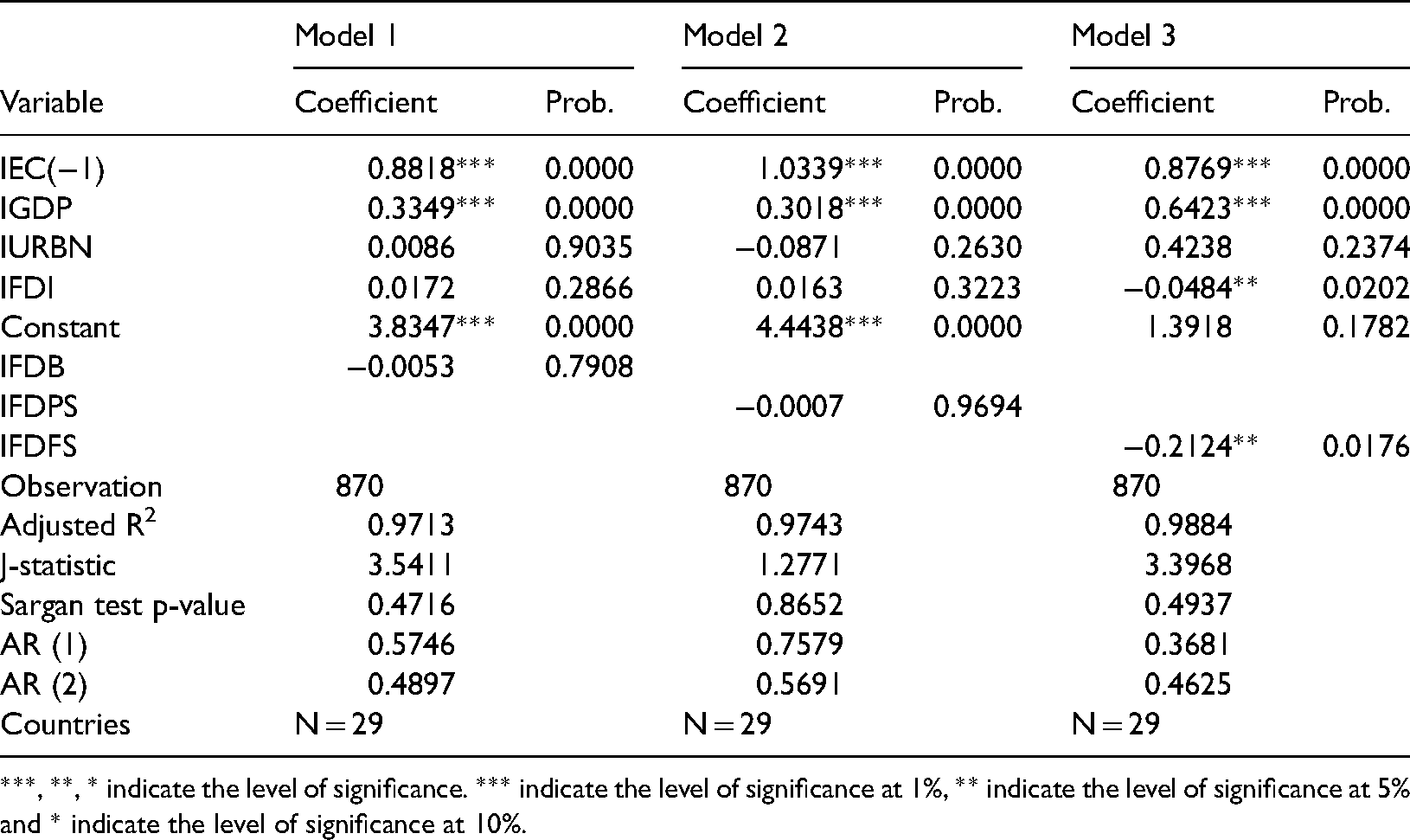
***, **, * indicate the level of significance. *** indicate the level of significance at 1%, ** indicate the level of significance at 5% and * indicate the level of significance at 10%.
Concerning the outcome related urbanization with energy consumption, the result shows that there is statically insignificant connection among urbanization and energy consumption in all three models. Concerning the impact of foreign direct investment on energy consumption, the result shows that 1% increase FDI positive and significant increase energy consumption by 0.02% in model 3. In model 1 and model 2 results indicate that no impact with energy consumption.
Regarding the nexus between financial development and energy consumption. The results show that in model 3 financial development increase 1% results decline energy consumption by 0.21% but in the model 1 and model 2 results show that there is statistical insignificant relationship betweenfinancial development and energy consumption. The African countries need to implements their energy saving projects, to expend their businesses with low debt rate, raise productivity related energy by improve energy conservation also efficiency and outsourcing to achieve its financial development with growth. According to financial development the overall finding shows that all financial development indicators used in different models deliver different results. It means that there is impact of financial development on energy consumption when changing the indicators of financial development. In model 3 results are in similar with.1,3,9,11,69 For each model of African countries reported in Table 8 the AR (2) tests show that no evidence of auto correlation at conventional level of significance.
Impact of financial development on energy consumption for North/Latin American and Caribbean countries
The results of North, Latin American and Caribbean countries are show in Table 9 with Sys-GMM estimation technique are applied based on panel date and taking natural logarithm of all variables. For each model, of North, Latin American and Caribbean the lEC(−1) the lagged term of energy consumption significant and positive it mean that in a specific year energy consumption strongly influenced by its pervious value.
Impact of financial development on energy consumption for north, latin american and Caribbean countries.
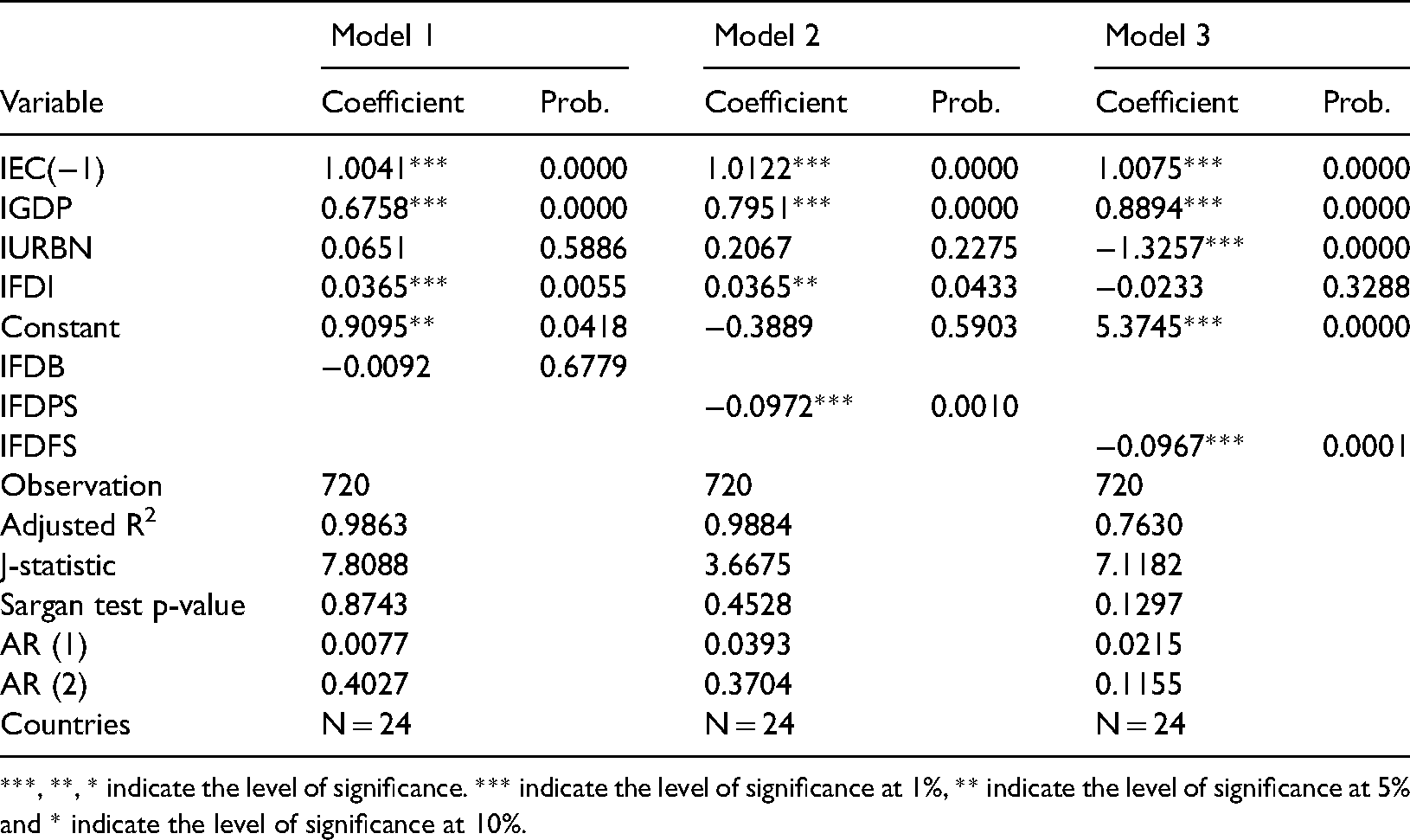
***, **, * indicate the level of significance. *** indicate the level of significance at 1%, ** indicate the level of significance at 5% and * indicate the level of significance at 10%.
Concerning the influence of economic growth on energy consumption, the result shows that 1% increase in GDP positively and significantly increase energy consumption by 0.67, 0.79 and 0.88% respectively. The result also indicates that in all three models significant and positive association among the growth-energy linkages. Our result mark with.7,11,50,55 Concerning the relationship between urbanization and energy consumption, the result shows that increase in urbanization stimulate energy consumption. The result shows that 1% increase in urbanization significantly and negative decrease energy consumption by 1.32% in model 3.In model 1 and model 2 outcomes indicate that urbanization and also the energy consumption has no connection its mean that statistical insignificant but in the model 3 results explain that negative and statistically significant connection among the urbanization with energy consumption. Concerning the connection among FDI and energy consumption, the result shows that 1% increase FDI positively and significantly increase energy consumption by 0.03, 0.036% respectively. The result indicates that positively and significantly the link among FDI and energy consumption, in the model 1 also model 2. The FDI allow cheaper businesses and easily availability to financial capital also used to expansion in existing construct or operations, new factories and plants, all of these activities energy demand increased. Our results are similar with.17,68 Regarding the nexus between energy consumption and financial development. The result delivers strong proof that there is significant and negative relationship between financial development and energy consumption in model 2 and model 3.The result shows in the 1 and 2 models that 1% increase in financial development decrease energy consumption by 0.097% and 0.096% respectively but model 1 show that no effect among these variables. The North, Latin American and Caribbean countries use energy efficient technology with efficient and effectiveness. According to the results of financial development it means that when changing the measure of financial development its effect on energy consumption and they provide different (significant, negative and no effect) results. Our results are in similar with.1,3,7,9,11,69
Conclusion and Policy Implication
In this study, we investigated the impact of financial development on the energy consumption estimating the role of economic growth, foreign direct investment and urbanization by using the Sys-GMM estimation technique and the panel data of 136 countries over the period from the year 1990 to 2019. Furthermore, we analyse financial development and its indicators when sample dividing into four groups Asian, European, African, North/Latin American and Caribbean countries. The main findings from the empirical analysis are as follows: On the base of overall countries the financial development indicator has significant and negative impact on energy consumption its mean that financial development cannot increase energy consumption from worldwide perspective. Also, GDP has significant and positive influences on energy consumption its mean that economic growth increase energy consumption. Foreign direct investment as significant influence with energy consumption and urbanization significant and positive influence on energy consumption. When sample dividing into different groups of countries then some interesting finding such as in Asian countries result indicate that financial development indicators increase energy consumption by using financial FDB and FDPS. In European countries shows mixed results about the indicators of financial development on energy consumption. The FDB reduce energy consumption and FDPS has statistical insignificant impact on energy consumption also the FDFS positive impact on energy consumption. In African countries FDB and FDPS has statistically insignificant but FDFS has negative influence on the energy consumption. Finally, in Latin North American and Caribbean countries result indicate that FDPS and FDFS significant and negative effect on energy consumption but FDB has no effect with the energy consumption. On the base of finding its means that changing the measure of financial development has impact on energy consumption in these different groups of countries they deliver different results.
Some following policy implication of this study based on empirical analysis. The development of the financial sector is broadly thought to be beneficial for several parts of the economy be that as it may, financial development probably won't control the expansion in energy consumption from the different groups of countries and worldwide. Therefore, policymakers should discretely analyse the effect of financial development on energy consumption based on the specific conditions and carefully scrutinize their connection in individual countries while formulating energy policies. In the Asian countries the finding also asks for the consideration of policymaker to build up a strategy to decline the results of energy utilization by boosting the financial sector to give more loan to highly technical advancement enterprises to prove energy proficiency, by accepting energy conservation policies and also controlling different resources, which is conducive to realizing sustainable development.
Footnotes
Declaration of Conflicting Interests
The authors declared no potential conflicts of interest with respect to the research, authorship, and/or publication of this article.
Funding
The authors received no financial support for the research, authorship and/or publication of this article.
