



Abstract
Since the reform of the tax-sharing system in 1994, the regulation of the central government to local governments has relied on the mean of intergovernmental fiscal transfers (IFTs) to a certain extent. However, the existing literature has not yet explored the influence of fiscal decentralization (FD) on energy consumption in the presence of IFTs. Thus, this study empirically examines the influences of FD and IFTs on energy consumption by using panel data for 30 Chinese provinces during the period of 1998–2019. Results indicate that FD and IFTs have positive effects on energy consumption. Moreover, the positive influence of FD on energy consumption is strengthened by the improvement in IFTs. In addition, FD and IFTs affect energy consumption through industrial structure upgrading. In terms of policy implications, this study suggests that China may further reduce energy consumption by appropriately reducing the degree of FD, optimizing the intergovernmental fiscal transfer system, and promoting the upgrading of industrial structure.
Keywords
Introduction
Since taking the reform and opening up policy, China has grown for over 40 years with considerable speed, becoming the world's second-largest economy, which is called the “China miracle.” However, this unprecedented growth has been accompanied by massive increases in energy consumption,1,2 because this economic growth depends on the consumption of carbon-intensive energy, such as coal and oil, and the path dependence effect of fossil energy is obvious.3,4 In 2018, China's total energy consumption was 3273.5 million tonnes oil equivalent, accounting for approximately 23.6% of global total energy consumption. 5 China recently has become the largest energy consumer and electricity producer in the world, and this is a major source of carbon dioxide emissions6,7 Even worse, fossil fuels are still the main types of increasing energy consumption in China, which leads to serious environmental pollution.8,9 These problems have severely harmed the healthy and stable development of the economy and have caused great concern at all levels of society in China. 10 Generally, one way to cut emissions is to reduce energy consumption. 11 Thus, for China, energy saving has become an increasingly urgent need to be addressed in its future economic development. The Chinese government, aware of how crucial energy consumption is for its economy and of its role in causing environmental damage, formulated a series of measures to reduce energy consumption. 12 In the “11th Five-year Plan,” China implemented the controlled target of reducing its unit GDP energy consumption by 20% by the end of 2010. In the “12th Five-year Plan,” the goal was further accentuated by an additional 16% reduction target. In the “13th Five-Year Plan,” China declared its goal to reduce its unit GDP energy consumption by 15% by 2020, compared with 2015.
In response, scholars have explored factors that cut energy consumption and the ways to reduce it. Particularly, without good institutional incentives, realizing the goal of energy saving and emission reduction is difficult.13,14 FD is regarded as part of a reform package to increase public sector efficiency, promote local government competition in providing public services, and foster economic growth.15,16 Despite its importance for scientific research and energy policy making, the effect of China's FD on energy consumption has received little attention. The only research available was conducted by Elheddad et al., 17 who used China's provincial panel data during the period of 2006–2015 and found that FD has a nonlinear effect on energy consumption. The estimated relationship thus reflects the correlation between FD and electricity consumption rather than the influence of FD on the aggregate energy consumption. Moreover, it ignores the combined effects of FD and intergovernmental fiscal transfers (IFTs) on energy consumption. In fact, since the reform of tax sharing system, the regulation of the central government to local governments has depended on the means of IFTs to a certain extent. The main goal of IFTs is the equalization of public services and to achieve the specific policy objectives of the central government, 18 including the reduction of energy consumption. Therefore, this study simultaneously focuses on the effects of FD and IFTs on energy consumption by using China's provincial panel data over the period of 1998–2019. Such study is important because from a theoretical viewpoint, the effects of FD and IFTs on energy consumption have never been systematically explored in previous works. From a managerial viewpoint, social planners should reduce energy consumption by realigning and optimizing the extent of FD and IFTs, thereby transforming the economic development mode. Therefore, encouraging local governments to cut energy consumption from the perspectives of FD and IFTs has become a crucial problem to be solved in China, beginning with the period of the “14th Five-year Plan.”
Given this problem, the contribution of this study lies in three aspects. First, the existing literature has not yet explored the problem of energy consumption under the joint action of FD and IFTs, and this study expands this field. Hence, this study provides an institutional understanding of energy saving, stressing the importance of FD and IFTs. Second, this study investigates the role of IFTs in energy consumption under the background of FD. Moreover, we also discuss the influence mechanisms of FD and IFTs and considers that the industrial structure effect is an important way that FD and IFTs affect energy consumption. Finally, this study proposes some targeted policy implications. The findings have practical value and significance for the reduction of China's energy consumption and provide policy implications for the development of high-quality economic transformation.
The remainder of this paper is structured as follows. Section 2 discusses the review of literature and the development of hypotheses. Section 3 introduces the analysis strategy and data explanation. Section 4 provides the empirical results. Section 5 summarizes the policy arguments.
Literature review and hypotheses development
Literature review
The literature on FD as a determinant of energy saving and emission reduction has been explored. However, limited studies are available on the role of FD as a possible determinant of energy saving. Zhou et al. 19 examined the influence of FD on energy ecological efficiency applying China's data at the provincial level from 2000 to 2016 and found that FD significantly contributes to improve the energy ecological efficiency. Elheddad et al. 17 investigated the influence of FD on energy consumption using China's data at the provincial level from 2006 to 2015 and showed that FD has a non-linear relationship with electricity consumption. Su et al. 20 investigated the relationship between FD and renewable energy consumption using data from 7 OECD countries over 1990–2018. They concluded that FD promotes renewable energy consumption and lowers non-renewable energy use. Lin and Zhou 14 analyzed the influence of FD on energy and environmental performance using China's data at the provincial level from 2000 to 2017. They reported that the divergence between revenue decentralization and spending decentralization leads to vertical fiscal imbalance, which significantly reduces energy and environmental performance.
To sum up, unlike the aforementioned studies, which ignore the role of FD in the aggregate energy consumption, and most importantly, the role of FD in determining the aggregate energy consumption in the presence of IFTs, this study aims to explore whether and how FD and IFTs affects energy consumption.
Hypotheses
Following Musgrave 21 and Oates, 22 local governments maximize the social welfare of local constituents as the behavioral goal. A decentralized system may match local preferences and needs.23,24 Su et al. 20 found that FD lowers nonrenewable energy consumption in OECD countries. Within the Chinese institutional context, China has established a regionally decentralized autocratic regime marked by the parallel of highly political centralization and economic decentralization. Local officials are not elected by local voters but are rather nominated by central officials. 25 which politically incentivize local officials’ accountability to the higher authorities. 26 To appraise and promote local officials, the central government may use the growth rates of the local economy27,28 or revenue collection. 29 Qian and Xu 30 and Maskin et al. 31 concluded that the reward mechanism is made possible by the multidivisional-form structure of the Chinese economic system. Therefore, spending fiscal resources on striving to develop high energy-consuming industries to pursue the short-term rapid growth of the local economy, rather than saving energy, is more rational for local officials. In this case, their chances of promotion may be maximized. The preference of China's local officials is less likely to meet the local needs. The Chinese federalism seems to positively affect energy consumption.
The fiscal transfer system is one of the significant contents of China's fiscal system reform. The main purpose of IFTs is to provide public services and correct interregional externalities. 32 Hence, reducing energy consumption is one of the important means to improve the environment. Thus, in theory, IFTs may reduce energy consumption. However, the short-term return function of local governments is not always consistent with the objective functions of the central government and the society, which leads to the positive effects of IFTs on energy consumption. The expanded local spending required for IFTs is higher than the local self-owned income; thus, IFTs can bring the flypaper effect of local fiscal spending.32,33 As a result, local governments may enhance tax effort to meet the increased spending. 34 In this case, local governments have high incentives to allocate fiscal resources to energy-intensive projects that boost fiscal revenues, which results in an increase in energy consumption. Thus, we propose the following hypotheses:
As an important fiscal reform, the 1994 tax sharing system reform has produced significant changes in China's FD policy. 35 This tax reform initiates a number of fiscal system reforms that centralize the tax revenues by the central government while devolving more spending responsibilities to local governments. 36 The inconsistent decentralization system in practice makes it difficult for local governments to completely unify their fiscal and administrative powers. Local governments must rely on IFTs to achieve the purpose of entrusted responsibility and fiscal equalization. Moreover, IFTs are influenced by bureaucrats in the implementation process and often used as a means for the central government to obtain political support.37,38 In this case, local officials have a stronger “bargaining power,” which will undoubtedly bring more fiscal transfer funds to their jurisdictions. In this process, under the role of promotion tournament, local governments use IFTs to invest in energy-intensive projects that bring rapid economic growth to accumulate political capital, resulting in an increase in energy consumption. In addition, FD creates the pressure on local governments to raise fiscal revenues. 39 With inadequate tax revenues, they may rely more on IFTs to cover their spending. The pressure to raise revenues and the incentive to obtain IFTs thus result in the active development of energy-intensive industries and may ultimately lead to the rise of energy consumption. Thus, we propose the following hypothesis:
Under the FD system, the only feasible way for local governments to obtain more fiscal revenues may be to expand their tax bases. For most regions, the secondary sector, especially the industrial sector, remains the main tax base of tax revenue. Moreover, the secondary sector is marked by short development cycles and quick effects. By contrast, the tertiary sector is marked by long development cycles and slow effects. Therefore, local governments may prioritize developing the secondary sector and relatively ignore the development of the tertiary sector under the role of political promotion tournament. This phenomenon is detrimental to the upgrading of industrial structure (UIS). Yang 35 found that the secondary sector is more responsive to changes in FD policy than other sectors. Industrial structure upgrading, in which the secondary sector unceasingly declines and the tertiary sector rises, leads to a decrease in energy consumption, because the secondary sector is by far the largest energy-consuming sector, accounting for approximately 70% of aggregate energy consumption. 40 Feng et al. 41 ) demonstrated that UIS negatively affects energy consumption. This case reflects that FD inhibits the UIS and indirectly increases energy consumption.
IFTs are an important incentive for the expansion of local fiscal spending.42,43 Within the Chinese institutional context, to increase opportunities for promotion, local governments may use IFTs to establish industrial parks to attract energy-intensive industries that speed up economic growth, indicating that they have the investment tendency of emphasizing the secondary sector and neglecting the tertiary sector. This phenomenon is not conducive to the UIS. In comparison with the developed countries whose tertiary sectors are highly developed, China's economy is more dependent on the secondary sector, which is energy-intensive. 44 Moreover, the greater the proportion of the tertiary sector is, the greater the proportion of clean energy consumption will be. 45 Therefore, industrial structure upgrading, in which the secondary sector unceasingly declines and the tertiary sector rises, results in a decline in energy consumption to a certain degree. This case reflects that IFTs inhibit the UIS and indirectly increases energy consumption. Thus, we propose the following hypothesis:
Given the above theoretical analysis and hypothesis development, Figure 1 shows the prediction of the relationships among the variables. In the follow-up research, this study performs empirical analysis based on the proposed research model.

Research model with constructs.
Empirical strategy and data explanation
Empirical models
First, to test Hypotheses 1 and 2, this study considers FD and IFTs as the independent variables, and energy consumption as the dependent variable. Other variables that affect energy consumption are used as control variables. The baseline model in logarithmic form
1
is given as follows:

Second, to test Hypothesis 3, this study introduces the interaction term of FD and IFTs for analysis. Following Equation (1), this study constructs Equation (2) to explore the influential mechanism of FD on energy consumption through IFTs. To avoid the influence of multicollinearity, this study makes centralized treatment for FD and IFTs and then constructs the interaction term to conduct an empirical test

Finally, to test Hypotheses 4 and 5, this study introduces the mediator variable (UIS) for analysis. Following Baron and Kenny,
46
this study further constructs Equations (3) and (4) to explore the influential mechanisms of FD and IFTs on energy consumption. Through the significance tests of coefficients


Variable specification
The dependent variable measures the provincial energy consumption in a given year. For the purpose of this analysis, energy consumption is defined by the aggregate energy consumption per capita. Notably, we use the population-adjusted energy consumption measures to avoid overestimating the level of energy consumption for large provinces.
The main variables of interest include the FD and IFTs variables. First, following Yang 35 and Liu and Li, 47 the FD variable is an indicator of the relative size of local budgetary fiscal revenue compared with the central budgetary fiscal revenue and is defined as local budgetary fiscal revenue per capita divided by the sum of local budgetary fiscal revenue per capita and central budgetary fiscal revenue per capita. We do not use spending decentralization here because local fiscal spending is partly financed by central fiscal transfers, and local governments may lack sufficient autonomy in its allocation. 39 Second, following Sun and He 48 and Zhang and Liu, 18 the IFTs variable is defined by the net fiscal transfers from the central government to provincial governments as a share of local budgetary fiscal spending, where a province's net fiscal transfers equal the difference between its subsidy from the central government and its remittance to the central government.
For the mediator variable, we choose the share of the added value of the tertiary sector in that of the secondary sector to measure the UIS. This measurement can clearly reflect the service tendency of economic structure and explicitly show whether the industrial structure is developing in the direction of “service;” thus, it is a better measurement. If this value is in a rising state, then the economy is advancing in the direction of service, and the industrial structure is upgrading.
A series of control variables are included in the econometric model, including the urbanization rate (URBAN), trade openness (OPEN), and financial development (FIND). First, following Elheddad et al.[ 17 ]), we control for the effect of population migration on energy consumption by using the urbanization rate variable, where the urbanization rate is expressed by urban population as a share of regional population. Second, we control for the effect of regional integration on energy consumption by using the trade openness variable, where trade openness is expressed as the share of total imports and exports in regional GDP. Finally, following Shahbaz and Lean, 49 we control for the effect of financial system on energy consumption by using the financial development variable, where financial development is represented by the financial value added as a share of regional GDP.
Data
This study uses the data of the Statistical Yearbook of China (SYC), Finance Yearbook of China (FYC), and China Energy Statistical Yearbook (CESY), and the research object is China's 30 provinces. Hence, we test these hypotheses using data from China's 30 provinces from 1998 to 2019. First, given the serious lack of Tibet, Hong Kong, Macao, and Taiwan data, this study eliminates them and only covers 30 provinces. Second, the tax sharing system began in 1994. However, Chongqing was separated from Sichuan in 1997. Thus, the starting year for this study is 1998. On this basis, we arrive at a balanced panel with 660 observations. Table 1 displays the descriptive analysis of each variable.
Statistical description of all the variables.

Empirical results
We initially investigate the effects of FD and IFTs on energy consumption according to Equation (1). We then examine whether these results are robust to the alternative definitions of FD and IFTs and other changes of the baseline regression model. Finally, we explore the influential mechanisms of FD and IFTs on energy consumption according to Equations (1) to (4).
Baseline regression results
Table 2 presents the estimated results. The results in the four models pertain to the energy consumption variable. Column [1] includes only the FD and IFTs variables. Columns [2]–[4] include the FD and IFTs variables and the control variables. Specifically, Columns [2] and [3] consist of the FD and IFTs variables and the partial control variables. Column [4] comprises the FD and IFTs variables and all the control variables. Given that the last column has the most complete specification, this study considers this to be our preferred model. On the basis of the results, the F test shows that the four regression equations are significant.
Main estimation results.

Notes: Standard errors are in parentheses.
*, **, and *** denote significance at the 10%, 5%, and 1% levels, respectively.
According to the results, whether control variables are added, the coefficient of FD on energy consumption is always significantly positive, indicating that if the level of FD increases by one percentage point, energy consumption would increase by 0.790 in Column [4], other conditions being equal. It provides support for Hypothesis 1 (see Section 2) that FD contributes positively to energy consumption. The reason may be that under the framework of FD, local governments have strong incentives in developing the local economy to accumulate political capital. In this case, they may use fiscal resources to invest in energy-intensive projects that are beneficial to local growth. However, these projects consume considerable energy, which is not beneficial to energy saving. Moreover, energy consumption has a strong negative externality. By contrast, energy saving has a strong positive externality. Therefore, local governments exhibit enthusiasm for free riding, which leads to the increase in energy consumption.
Another important finding is that the coefficient of IFTs is consistently significant and positive in all the four regressions. This result suggests that for the change of IFTs by one percentage point, energy consumption would increase by 0.411, which supports Hypothesis 2 (see Section 2) that IFTs increase energy consumption. The reason may be that to gain advantages in fierce regional competition, local governments tend to use IFTs to invest in energy-intensive projects that produce short-term economic benefits to promote economic growth, which leads to an increase in energy consumption. Moreover, to increase their chances of promotion, local governments may fail to have a strong enthusiasm for energy conservation under the role of promotion tournament, which limits the effective functioning of the incentive mechanism of IFTs.
Regarding the control variables, the estimated coefficient on the urbanization variable is significant and positive, indicating that the improvement of urbanization level leads to the increase in energy consumption. The reason may be that the expansion of urban scale has produced considerable infrastructure construction demand, which has driven the excessive growth of the heavy chemical industry with high energy consumption. The urbanization process is accompanied by the industrialization process dominated by heavy industry, causing considerable energy consumption. The estimated coefficient on the trade openness variable is significant and negative, suggesting that trade openness can cut energy consumption, thereby supporting the pollution halo hypothesis. The reason may be that trade opening can effectively accept the advanced energy-saving technology and management experiences of developed countries and regions to achieve the goal of energy conservation. The estimated coefficient on the financial development variable is significant and positive, suggesting that financial development increases energy consumption to a certain extent. This phenomenon is explained by the sufficient motivation of local governments to strengthen the control of financial resources and concentrate their funds on energy-intensive industries with high short-term output.
Robustness checks
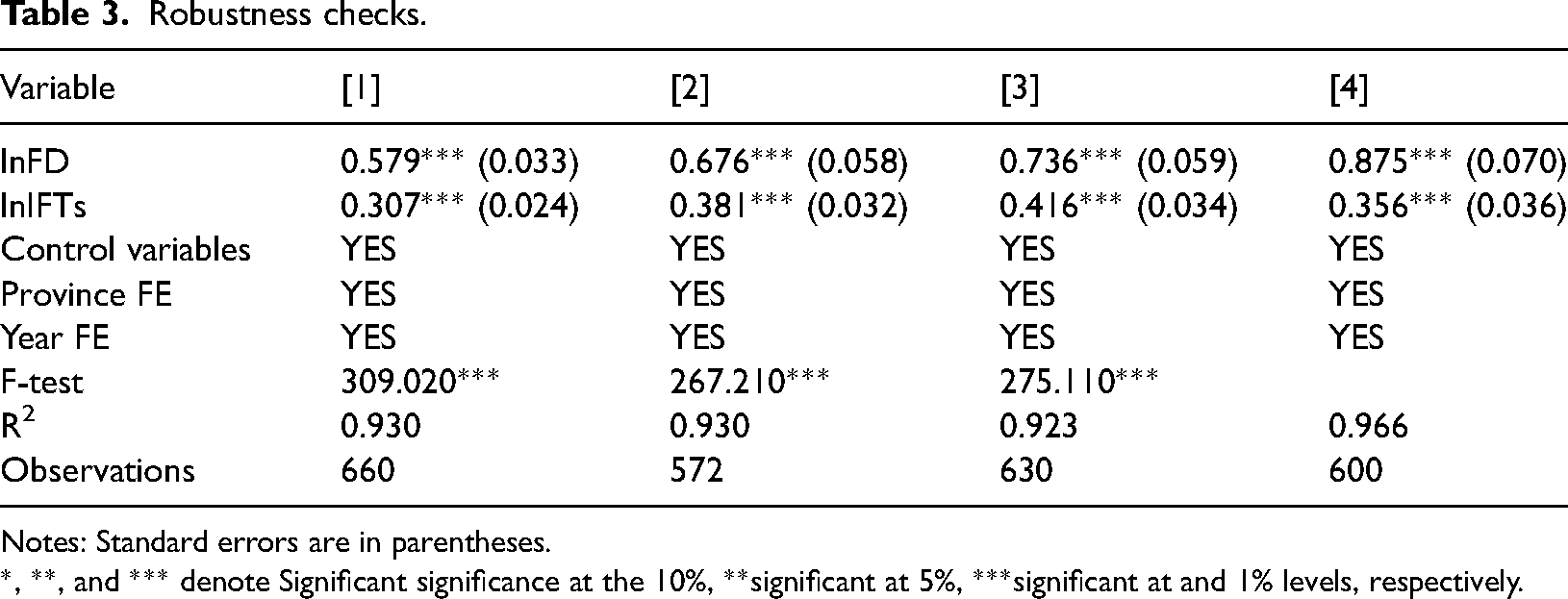
In this section, this study investigates the robustness of the results from the baseline models. Thus, this study conducts these robustness checks based on our preferred model (Column [4] in Table 2). Table 3 shows the estimated results. The results in the four models pertain to the energy consumption variable. The F test results show that the four regression equations are significant.
Robustness checks.
Notes: Standard errors are in parentheses.
*, **, and *** denote Significant significance at the 10%, **significant at 5%, ***significant at and 1% levels, respectively.
First, we estimate our preferred model, where we use the alternative measures of FD and IFTs. The new indicator of FD suggested by Zhang and Zou 50 is defined by the budgetary fiscal revenue at the local level as a share of the budgetary fiscal revenue at the national level. IFTs are defined by the net fiscal transfers from the central government to provincial governments as a share of local budgetary revenue. The findings (Column [1]) show that using different measures of FD and IFTs do not change the results of the FD and IFTs variables. They also confirm the results from our preferred model about the remaining control variables.
Second, the estimation of our preferred model without four national minority autonomous regions (i.e. Inner Mongolia, Guangxi, Ningxia, and Xinjiang) has the following results. In view of historical, geographical, and institutional reasons, national minority autonomous regions not only bear special administrative power but also enjoy special preferential and support policies. To eliminate the interference of this factor, this study retains the samples of non-national minority autonomous regions for regression analysis. However, we find that the results (Column [2]) do not differ from those for the baseline models.
Third, the estimation of our preferred model when the FD and IFTs variables are lagged one year has the following results. On the basis of the above analysis, in terms of the causal relationships among FD, IFTs, and energy consumption, FD and IFTs are the reason, and energy consumption is the result. To confirm the relationship among the three, we lag the FD and IFTs variables for a year 2 . Lagging the policy variable is reasonable, given that it takes time for the policy to affect the economy. 35 We find that the results (Column [4]) remain essentially the same, suggesting that FD and IFTs have a causal effect on energy consumption.
Finally, the estimation of our preferred model when potential endogenous problem is considered has the following results. Following Elheddad et al., 17 energy consumption may play a role in FD. If such feedback effect is present, the estimates obtained thus far may be biased. Thus, we consider the two-year lagged FD as an instrumental variable to deal with the potential endogeneity problem (reverse causality) by using the two-stage least squares estimator. According to the results (Column [4]), we still find that FD and IFTs have positive effects on energy consumption.
Overall, we find in this group of robustness checks that the results with regard to the FD and IFTs variables from our preferred model are confirmed. FD and IFTs have significant and positive effects on energy consumption.
Mechanism analysis
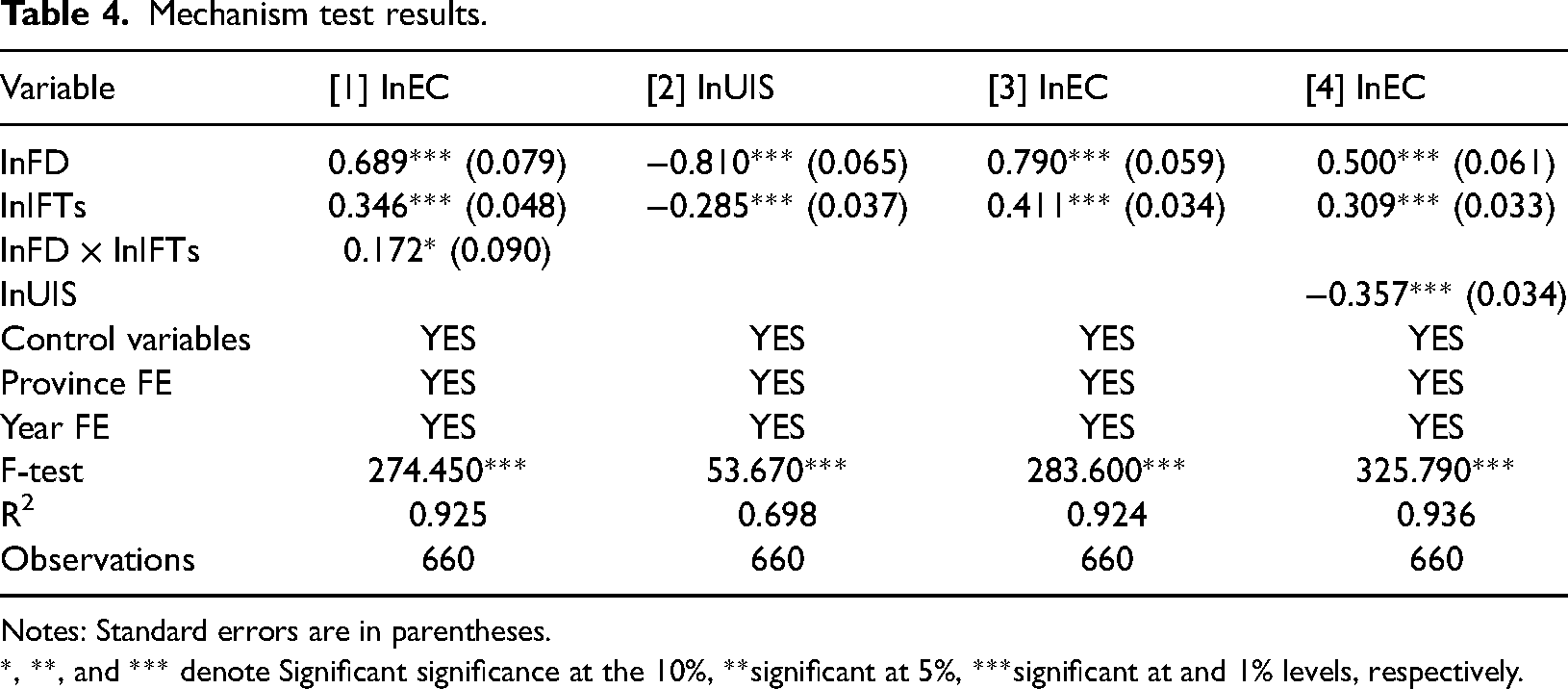
In this section, we explore the influential mechanisms of FD and IFTs on energy consumption. Table 4 presents the results. Column [1] displays the results for the moderating effect of FD on energy consumption through IFTs, and Columns [2]–[4] show the results for the mediating effects of FD and IFTs on energy consumption through the UIS. The F test results show that the four regression equations are significant.
Mechanism test results.
Notes: Standard errors are in parentheses.
*, **, and *** denote Significant significance at the 10%, **significant at 5%, ***significant at and 1% levels, respectively.
First, the estimated coefficients on FD and its interaction with IFTs are all significantly positive. This finding indicates that IFTs play a moderating role in the positive relationship between VFI and energy consumption. Such a finding confirms Hypothesis 3 (see Section 2). The separation of fiscal power and administrative power under the current FD system leads to the continuous increase of the structural deficit of local governments, which makes local governments rely too much on IFTs to finance spending. Thus, under the FD system, to increase their chances of promotion, local governments may use IFTs to invest in energy-intensive projects that can quickly produce short-term economic benefits through promotion tournament, thereby increasing energy consumption. Therefore, the positive relationship between FD and energy consumption strengthens with the increase of IFTs.
Second, controlling the influence of UIS results in the significant positive effect of FD on energy consumption
Finally, following Baron and Kenny, 46 the results also satisfy the three conditions of the mediator variable. Hence, UIS plays a mediating role in the positive relationship between IFTs and energy consumption. Such a finding confirms Hypothesis 5 (see Section 2). The reason may be that to accumulate political capital, local governments have strong power to use IFTs to invest in the secondary sector, which is energy-intensive, to obtain short-term economic benefits, which can restrain the UIS, thereby increasing the level of energy consumption. Following Mackinnon et al., 51 the proportion of this mediating effect is 24.771%. Thus, the mediating effect has also become one of the main channels by which IFTs affect energy consumption.
Conclusions and policy implications
Despite the growing literature that explores the link between FD and energy consumption, the knowledge on the effects of FD and IFTs on energy consumption is still at its infancy. In fact, since the reform of the tax-sharing system in 1994, the regulation of the central government to local governments has relied on the mean of IFTs to a certain extent. This phenomenon offers a great opportunity to examine the related issues of the effects of FD and IFTs on energy consumption. This study contributes to the extant literature by empirically testing the influences of FD and IFTs on energy consumption. Moreover, the study gauges the joint effect of FD and IFTs in affecting energy consumption. In addition to the direct impact, this study discusses the influence mechanisms of FD and IFTs and considers that the UIS is an important way that FD and IFTs affect energy consumption.
Using provincial panel data for 30 Chinese provinces from 1998 to 2019, this study is among the first to investigate the influences of FD and IFTs on energy consumption by applying several panel data regressions. The main conclusions are as follows. First, FD and IFTs are not conducive to reducing energy consumption. Second, IFTs strengthen the positive relationship between FD and energy consumption. Finally, FD and IFTs have significant positive influences on energy consumption by affecting UIS.
This study reveals the mystery of extensive economic growth by deeply analyzing the influences of FD and IFTs on energy consumption and its mechanism. The empirical results reflect the fact that under the role of promotion tournament, local governments may even limit and reduce the input on energy saving and invest more on the productive programs that are beneficial to local growth. 52 For example, Maskin et al. 31 found that economic development is regarded as the main indicator for measuring the performance of local governments in China; Blanchard and Shleifer 27 showed that local government officials in China pay much more attention to economic development compared with other developing countries. Based on this, China's rapid economic growth may be attributed to FD and IFTs to a certain degree. However, the rapid economic growth has been accompanied by a rise in energy consumption. 1 Thus, the increasing energy consumption may be a by-product of FD and also IFTs.
On the basis of the above results, this study proposes the following policy implications. First, FD is not conducive to reducing energy consumption, indicating that moderately reducing FD is beneficial. Social planners should continue to optimize the FD system and clarify the responsibilities at different levels of government to successfully achieve the target of energy-saving. Moreover, social planners should change the performance evaluation standard with GDP as the core index, guide local officials to set up a scientific concept of political achievements, and highlight the development goals related to high-quality economic development, such as green development. Second, IFTs lead to the increase in energy consumption. Social planners should continue to optimize the fiscal transfer system, establish a scientific and reasonable distribution mode, enhance the construction of relevant financial laws and regulations, and strengthen the supervision of the use of fiscal transfer funds, thereby cutting energy consumption. Third, with the increase of IFTs, the positive impact of FD on energy consumption is enhanced. Social planners should constantly deepen the reform of the fiscal system and improve the coordination of institutional arrangements (FD and IFTs) to resolve the shackles of related institutional friction on energy conservation, making it serve for energy saving and emission reduction. Finally, FD and IFTs have significant positive influences on energy consumption by UIS. Social planners should correct the investment bias of local governments, guide local governments to realize the free flow and efficient allocation of production factors between industries and regions, give full play to the role of the government in the UIS, and promote the UIS to achieve the purpose of reducing energy consumption.
This study provides new empirical evidence for understanding the problem of energy consumption from the perspectives of FD and IFTs. However, it still has some deficiencies, which future research should standardize further. First, this study explores the related issues of the effects of FD and IFTs on energy consumption only from an overall perspective and fails to analyze those relationships from the perspective of regional heterogeneity. Second, this study mainly explores how FD and IFTs affect energy consumption in China by the UIS. However, this study fails to examine other impact mechanisms of VFI on energy consumption. Finally, this study stays at the level of provincial panel data and does not involve panel data below the provincial level.
Footnotes
Acknowledgements
We express our genuine appreciation to the Natural Science Foundation of Jiangsu Province of China (BK20190792) and the Innovation and Entrepreneurship Doctoral Program of Jiangsu for supporting this study.
Declaration of Conflicting Interests
The author(s) declared no potential conflicts of interest with respect to the research, authorship, and/or publication of this article.
Funding
The author(s) disclosed receipt of the following financial support for the research, authorship, and/or publication of this article: This work was supported by the Natural Science Foundation of Jiangsu Province of China, (grant number BK20190792).
