



Abstract
Green growth is recognized as an adequate mechanism to decelerate environmental turmoil. However, empirical evidence on what determines sustainable economic growth is still underexplored. Apprehending the importance of financial liberalization, human capital, and militarization in the South Asian region, we investigate their short- and long-run effects on green growth using data from 1990 to 2017. To address the cross-sectional dependency (CD) and heterogeneity issue, second-generation cointegration estimation techniques are employed. The findings show a stable and long-run relationship between financial liberalization, human capital, military expenditures, and green growth. The results of CS-ARDL also show the positive long-run effect of financial liberalization and human capital while the negative effect of militarization on green growth. Nonetheless, the interaction effects show the darker side of human capital and the brighter side of militarization in the presence of more financial openness. Results were further validated using the Augmented Mean Group (AMG) and Dumitrescu-Hurlin Granger causality test, highlighting the need to optimally utilize military expenditures, financial liberalization, and human capital for the sustainable growth of the region.
Introduction
The notion of green growth is originated in the response to serious warnings about ecological breakdown and climate emergency. 1 Though still an amorphous concept, ‘green growth’ can be achieved by balancing environmental sustainability and income growth. The theory assumes that gross domestic product (GDP) needs to be decoupled from carbon emissions and resource use to scale down the rate of environmental degradation.2,3 Demand-based emissions are required for environmentally sustainable growth which is conceivable through green technologies, clean energy production, and eco-innovations in the supply chain4,5 to achieve sustainable development goals (SDGs). However, emerging economies need to attract foreign direct investment (FDI) providing them the opportunity to develop their financial institutions and utilize eco-friendly technologies leading to sustainable regional development.6,7 In order to stem technological spillover from high-tech FDI, financial markets need to be free from bureaucratic powers or administrative interference. 8 A liberalized or open financial environment attracts experimental development and scientific research which significantly mitigate pollutant emissions.9,10
Before financial and trade policy reforms in the mid-1980s, South Asian countries have faced several macroeconomic shocks and financial repression. There was unwarranted government intervention in fixing exchange and interest rates. After reforms, financial markets were allowed to determine the interest rates, and tariff barriers were largely reduced. 11 With the restructuring and integration of financial services, many foreign and private banks entered the market leading to an increase in the share of retail credit. 12 The efforts in liberalizing financial markets proved to be beneficial for the region as they enhance economic growth in both the short and long run. 13 Although economic and financial development facilitates emerging economies to alleviate poverty, build sophisticated infrastructures, and enhance the overall wellbeing of their citizens, the natural environment is substantially jeopardized.14,15
Particularly in the context of South Asia, environmental issues including land degradation, soil erosion, water depletion, atmospheric pollution, marine pollution, and other biodiversity losses are threatening the region's sustainability. On the one hand, the increased salinity in water has affected almost 90 million hectares of land and on the other hand, the Thar Desert is outspreading rapidly at a rate of 100 ha per year which is an indication of extreme geological catastrophism.16,17 Thus, the region is in the dire need of improving green development not only for their own sake but also for global sustainability. Despite a certain level of domestic market and capital account liberalization, the region is very vulnerable to territorial and domestic conflicts especially since the British ill-conceived and hasty colonial disengagement in the late 1940s exacerbate the ideological differences. 18
There is a long history of armed conflicts and secessionists movements based on religion, ethnicity, and culture that raised violent conflicts in the shape of the Sri Lankan civil war, 19 Afghanistan war, 20 separatists’ movement in Baluchistan (Pakistan), 21 Kashmir separation movement, 22 and Khalistan movement (India). 23 All of these conflicts destroyed infrastructure and created social trauma, misery, and deaths. The region has gone through severe impediments relating to militarization beyond political and ideological evangelization. The engagement of security forces widely spread across different communal, institutional, social, and political echelons leading to an equivocal increase in military expenditures. 24 Exclusively, the hostility between Pakistan and India has compelled them to import tanks, combat aircraft, and artillery. Both countries are atomic powers and spend a substantial percentage of their GDP on militarization. 25 Recognizing the threat to the socio-economic environmental sustainability of the region, other countries are making efforts for the peace process and stability between these countries. 26
In response to warmongering and environmental deterioration, ecologists have come forward to highlight the detrimental effect of military activities on ecological sustainability. The use of heavy equipment, testing of mass destruction weapons, and military mobility involve high energy consumption leading to an increase in carbon emissions 27 and destroying the bio-capacity of the country. 28 By occupying productive areas either in the presence of conflict or peace, military activities play a major role in water contamination, deforestation, radioactive contamination, and natural resource depletion.24,29 Besides the Pakistan-India conflicts, the war on terrorism in Afghanistan further deteriorated the environmental quality, making it an important region to assess the militarization-green growth nexus. On the other side of the coin, human capital (HC) is complimented as an important function of the production process which improves energy efficiency and reduces CO2 emissions.4,30 Human capital reduces ecological costs and brings eco-friendly technologies at both firm-level and industrial level. 31
Our contribution to sustainable development and green economics literature is novel in the following ways. First, this study seeks to answer how financial liberalization, military expenditures, and human capital and their interactions affect green growth in both the short and long run. The results can prove to be a considerable guide in the formation of economic and environmental policies to mitigate both poverty and environmental deterioration in South Asia. Second, bearing in the mind the destructive (militarization) and progressive (human capital) human activities in mind, we analyze how they impact green growth in more liberalized economies. Third, the estimations of prior studies are limited to first-generation techniques that provide spurious results in the cross-sectional dependence, and heterogeneity is detected.5,16 We took a step forward by using Cross-Sectionally Augmented Autoregressive Distributed Lag (CS-ARDL) estimations to account for the aforementioned statistical issues.
The rest of the study is organized as follows. Section 2 describes the potential links among financial liberalization, military expenditures, human capital, and green growth. The model and data set are introduced in Section 3. Section 4 depicts the methodology applied. The findings are demonstrated in Section 5. Section 6 provides the conclusion and policy implications.
Literature review
Green growth
The World Bank (2012) 32 defined green growth as “economic growth that is efficient in its use of natural resources, clean in that it minimizes pollution and environmental impacts, and resilient in that it accounts for natural hazards and the role of environmental management and natural capital in preventing physical disasters”. Although more definitions to support green growth theory are developed, none of the definitions is precise enough due to the ‘amorphous’ nature of the concept. 33 Nonetheless, considering the importance of green growth for rebuilding natural capital, researchers have empirically evaluated several determinants of green growth.
To date, studies have recognized financial development, institutional quality, 16 technological innovation,5,34 environmental policy stringency, 35 energy consumption, 36 inflation rate, natural resource rent, 37 natural resource dependence, 38 and energy poverty 39 as determinants of green growth. Although the link of financial liberalization, military expenditures, and human capital is developed with economic growth and environmental concerns in previous literature,27,40,41 their influence on green growth is unexplored, especially in the South Asian context.
Financial liberalization and green growth
The gravity of financial liberalization for developing economies is generally backed by McKinnon–Shaw's hypothesis that liberalization of interest rates spurs investments, increases savings, and ultimately improves economic growth. 42 The proponents argued that the process of financial liberalization eases financial constraints, enhances human capital, reduces income inequality, encourages entrepreneurship, efficiently allocates resources, and allows greater risk diversification through greater financial integration and deepening.43,44 On the other hand, opponents reveal greater macroeconomic shocks, competition, and excessive risk-taking in the free market, thereby exaggerating financial uncertainty and fragility.45–47 Owing to the existence of its empirical link with income inequality, the trick-down effects from growth gains interrelated with financial liberalization are being questioned.48,49
Albeit mixed empirical evidence, the link between financial liberalization and economic growth is well established.50,51 The perks of integrated and open financial markets for spurring growth in the South Asian perspective are also empirically scrutinized in the post reforms studies. For instance, using the error-correction mechanism and multivariate cointegration technique, Naveed and Mahmood 52 estimated a positive effect of financial liberalization on economic growth in the long run but a negative effect in the short run. Their findings suggest that a conducive environment is necessary for financial integration and deepening to stimulate growth in Pakistan. On the other hand, Adeel-Farooq, Bakar 13 explored the link in both India and Pakistan using the ARDL technique. They revealed a positive effect of financial liberalization on the economic growth in the long run in Pakistan but an insignificant effect in the short run. Nonetheless, the link was significant in both the short- and long-run for India.
Considering the strong association between economic growth and environmental issues, more liberalized financial markets may either invite financing in eco-friendly technologies at a lower cost of capital 53 or can further degrade the environment by increasing energy demands. 54 However, there is a dearth of empirical literature on the relationship between financial liberalization and environmental quality. Tamazian and Rao 53 employed a GMM estimator and analyzed 24 transition economies. They found the detrimental effect of financial liberalization on air quality if not companied with high institutional quality. In contrast, Hua and Boateng 10 utilized a larger sample (167 countries) and asserted a pollution alleviation effect of financial liberalization even after segregating the sample into North-South subpanels. You, Zhu 55 also consider a global sample but established no significant link between financial liberalization and carbon emissions. This largely inconclusive evidence calls for further study, especially to examine how financial liberalization contributes to green growth in the South Asian context.
Militarization and green growth
The existing empirical literature also does not shed sufficient light on the relationship between military expenditures and green growth. Nonetheless, previous studies have actively contributed to the role of militarization on economic growth and environmental sustainability. Grounded on the guns versus butter model, a wide range of studies show that guns (high military expenditures) are expropriating the level of butter (non-security goods that increase social welfare) from society. 56 Studies linked a high level of militarization with external debt, 57 income inequality,58,59 and impeding tourism. 60 The role of defense spending in South Asia is quite mixed. Using the ARDL bounds testing approach, Jalil, Abbasi 61 revealed that the positive association between military expenditures and economic growth turns negative after a certain level for both Pakistan and India. Similarly, Yildirim and Öcal 62 postulated the growth-stimulating effect of militarization in the short-run but the negative effect on economic growth in the long run. Wijeweera and Webb 63 argued that the growth promoting effect of military spending is negligible in South Asian region.
After recognizing militarization as a destructive human endeavor, 64 its relation with environmental degradation is recognized by many recent studies. Arms conflicts give rise to air pollution, intensify climatic changes, threaten land productivity, increase soil erosion, and significantly contribute to water contamination.65–67 Bildirici 68 analyzed the positive effect of militarization on environmental degradation in G7 countries using panel cointegration and trivariate causality approaches. Similar results were purported by Solarin, Al-Mulali 29 for the United States. They argued that military activities rely profoundly on fossil fuel consumption for their mobility and testing of heavy weapons. Ahmed, Alam 27 and Gokmenoglu, Taspinar 69 also asserted pollution promotes the effect of defense burden in Myanmar and Turkey respectively.
Qayyum, Anjum 24 investigated the effect of military expenditures on ecological footprints in South Asia using the panel ARDL method. They advanced their argument against defense expenditures as hazardous military operations especially between India and Pakistan are soiling the environment. Ahmed, Zafar 70 also analyze this effect using the bootstrap causality test and combined co-integration test for Pakistan and found a positive link between military expenditures and ecological footprints. On the contrary, Ullah, Andlib 41 estimated asymmetric effects of militarization on economic growth and environmental degradation using NARDL. Surprisingly, they revealed a positive effect of military expenditures on economic growth and a negative effect on environmental degradation in both India and Pakistan. In the presence of mixed empirical findings, we based our argument in the favor of the “treadmill of destruction theory” that the expansionary aspects of militarization have profound ecological imprints 71 leading to green devaluation.
Human capital and green growth
The endogenous growth theory holds that investment in human capital spurs innovation which has a spillover effect on economic growth. To name a few, human capital contribute to greater democratic participation, lower crime rates, better health, and higher labor productivity.40,72,73 A healthier and more educated workforce can adapt to new technologies, optimally utilize natural resources, and be more likely to opt for modern financial services compared to unskilled and illiterate individuals.74,75 A substantial strand of empirical evidence is in favor of explicitly incorporating human capital as an additional variable driving the multi-factor productivity in the Solow 76 residual with a little variation due to “institutional view” versus “human capital view”. 77
Nonetheless, the nexus between human capital and economic growth is not quite straightforward. Siddiqui and Rehman 78 posited the positive impact of human capital on economic growth in the South Asian region while Nwani 79 asserted a negative relationship using the system GMM estimator. The resource curse hypothesis can better explain this ambiguity. By substantiating the crowding-out effect, studies reveal that the general population in resource-rich countries may lose interest in education after failing to realize desired income growth despite investment in human capital investment. 80 Even though the HC-growth link is weaker in the short run, it has the potential to transform the “resource curse” into “resource blessings” in the long run for sustainable development. 81 Thus, a certain level of consensus is developed among researchers that human capital decreases pollutant emissions as education aware masses of eco-friendly technology utilization.82–84
At the micro or firm level, more literate employees may facilitate the diffusion of abatement technology, expedite sustainability-oriented innovation, be more likely to be engaged in recycling activities, use cleaner energy, and less likely to infringe environmental regulations.85–88 At the macro level, human capital influences carbon emissions through different channels. Grounded on endogenous growth theory, human capital rigorously drives technological progress especially to shift cleaner energy efficiency, thereby mitigating air pollution.82,89 Another channel between the HC-environment nexus is physical capital investment through which abating energy intensity and shifting energy consumption patterns is possible. 90 However, if technological progress and physical capital investment are retracted to commercializing non-renewable energy such as the development of hydraulic fracturing technologies and horizontal drilling, CO2 emissions are further exacerbated. 82
Most of the recent empirical evidence from micro- and macro-panels endorse the pollution-reduction effect of human capital. Using the common correlated effects mean group and augmented mean group (AMG) technique, Nathaniel, Nwulu 91 found the positive long-run effect of human capital on environmental quality in Latin American and the Caribbean countries (LACCs). Similar results were posited by Rahman, Nepal 84 who analyzed the HC-environment link in newly industrialized countries using Dynamic Ordinary Least Squares (DOLS), Fully Modified Ordinary Least Squares (FMOLS), and Pooled Mean Group (PMG) estimation method. Ahmed, Zafar 92 used more advanced panel data techniques (CUP-FM and CUP-BC) to examine the HC-environment link in G7 countries. The outcome suggests the negative impact of human capital on environmental degradation. Bano, Zhao 93 investigated the long-run and short-run effects of human capital on carbon emissions in Pakistan using VECM and ARDL models. Their findings suggest that human capital improves environmental quality in the long run only without compromising human capital. Since empirical evidence proposes high-yielding economic gains with environmental sustainability, we advance our argument in favor of positive human capital and green growth nexus.
Interactions among financial liberalization, militarization, and human capital
The answers in economics and finance are not always straightforward due to different theoretical perspectives and econometric techniques. A strong short-run relationship between two variables may not exist in the long run or a negative short-run relationship may yield a strong positive relationship in the long run. Additionally, the interaction effect may change the direction of a relationship in both the short and long run. Motivated by previous studies that employed interaction terms in environmental economics studies,94–96 we tend to explain if the role of human capital or military expenditures alters after their interaction with financial liberalization. Previous studies suggest that the effect of financial liberalization improves when it interacts with strong regulatory quality.97,98 Similarly, human capital interacts with FDI 99 or urbanization 40 to mitigate their detrimental effect on the environment.
In the same way, while studies discuss the only dark side of military expenditures, Aziz and Asadullah 100 attempt to interact defense spending with internal conflicts to yield positive economic gains. Considering the significance of interaction effects, 101 we explore if the effect of human capital and militarization on green growth is altered when interacted with high financial liberalization. In the absence of strong institutions, financial liberalization can be considered a substitute. 102 The openness of an economy improves the allocation of the economy and thereby military spending can be utilized for the country's best interests. 103 Even the autocracies that extensively spend their budget on militarization, 104 stimulate financial liberalization to reinforce economic development and mitigate redistribution in anticipation of democratization. 105 Military expenditures can act as a guardian of openness and liberalization. Although a financially liberalized economy encourages foreign banks to enter the market, 106 foreign investors avoid investing in a host country where internal conflicts or terror attacks are high. 107 Thus, we presume that sustaining financial liberalization in a region where conflicts are very high, militarization plays an imperative role. Accordingly, the detrimental effects of defense spending on sustainable economic growth can be altered when the economy is financially more open.
One strand of studies has highlighted the dark side of financial liberalization. They associated the opening up of markets with financial crises, information asymmetry, and misallocation of resources. 46 While following the “quantity effect” of financial openness, some countries have ignored its “quality effect”. Evidence also emerged related to corruption encouraging the effect of financial liberalization. Corrupt officials perpetuate new channels through which they can expropriate public wealth in the liberalized economy. 108 In more open economies, the negative effect of corruption on economic development is stronger.109,110 Owing to the misallocation of resources in more open economies, human capital in these countries tend to engage in rent-seeking behavior. An unjust reward structure emerged from corrupt systems that support less efficient labor, leading to the depletion of knowledge and skills accumulation. 111 The corrupt rent-seeking systems not only deteriorate economic growth but also threaten environmental sustainability. 112 To empirically test these assertions, we explore the moderating role of financial liberalization on the relationship between human capital and green growth in South Asia.
Data and model construction
This study has examined the short- and long-run effects of financial liberalization, military expenditures, and human capital on green growth in 5 South Asian economies. The sample countries include Bangladesh, Sri Lanka, Nepal, Pakistan, and India and cover the period of 28 years (1990–2017). The complete data for the desired period was not available for Maldives, Bhutan, and Afghanistan. We measure green growth using adjusted net saving (ANS) based on previous studies.16,37,113 Based on standard national accounting concepts, ANS can be measured as:


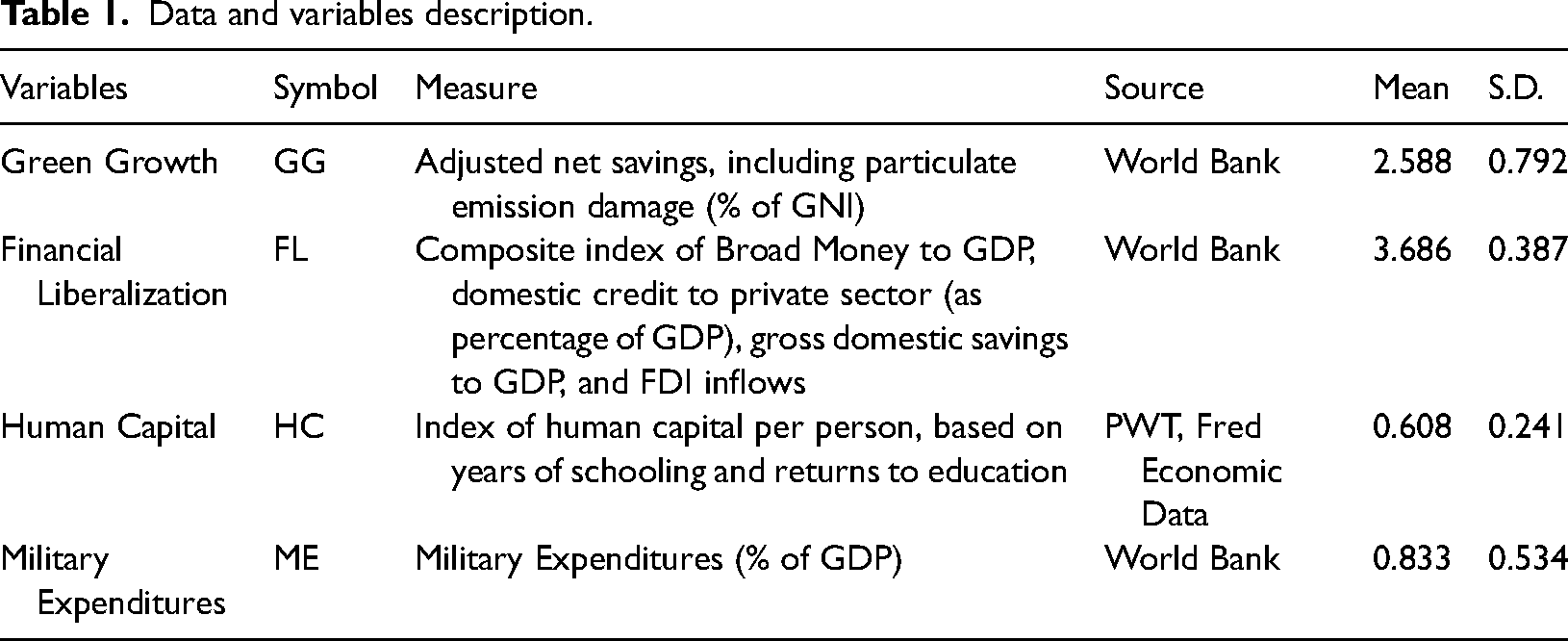
Previously, financial liberalization is measured with both de jure and de facto measures. The de facto measures consider actual capital flow and stock of capital such as portfolio flows and FDI flows. To assess financial sector liberalization in developing countries, the de facto measures are favored over de jure measures in previous studies Bumann et al., 2012; Kose et al., 2006. Based on the study of Adeel-Farooq, Bakar, 13 we have developed the composite index of Broad Money to GDP, domestic credit to the private sector (as a percentage of GDP), gross domestic savings to GDP, and FDI inflows. Lastly, militarization is measured by the military expenditures to GDP data provided by the World Bank database. To deal with the non-normality issue, we log-transformed all the variables. The summary of variables, sources, measurements, and descriptive statistics is given in Table 1. The average green growth of the South Asian region is 2.59 with a minimum value of −1.41 (Pakistan in the year 2008) and a maximum value of 3.71 (Nepal in the year 2014). India was least financially liberalized in the year 2009 while Sri Lanka had the highest financial liberalization in the region in the year 2000. Sri Lanka is also rich in terms of human capital with the highest HC index in the year 2005 while Nepal is lagging in this race. The average military spending of the region is 0.833 with the highest expenditures by Pakistan (in the year 1992) and the lowest by Nepal (in the year 1997).
Data and variables description.
In the light of aforementioned empirical evidence and theoretical justification, following model is developed:

Econometric methodology
Likewise previous studies,117,118 follow certain steps before analyzing CS-ARDL. Firstly, we have utilized the cross-sectional dependency (CD) test by Pesaran 119 to identify common shock effects. In the presence of inadequate CD testing, unbiased cointegration and unit root tests cannot be evaluated. 120 Secondly, we test whether the parameter of the slope is heterogeneous or homogeneity using Pesaran and Yamagata 121 test Failing to account for this may lead to biased estimates in panel data. 122 Thirdly, the stationarity of the underlying variables is investigated using second-generation unit root tests, i.e. CADF and CIPS developed by Pesaran. 123 These tests are more appropriate in the presence of CD and heterogeneous panels. Fourthly, the panel cointegration test of Westerlund 124 is utilized to test the equilibrium relationship among the underlying variables. Fifthly, the short- and long-run estimations are assessed using CS-ARDL 125 while the findings are reconfirmed with the augmented mean group. 126 Lastly, the directional flow among variables is determined through Dumitrescu and Hurlin 127 granger causality test Details of the econometric tools used in the study are given in subsequent sections.
Cross-sectional dependency test
Especially in panel datasets, the identification of CD is important to justify the use of second-generation unit root tests. For instance, Westerlund cointegration and CIPS were primarily designed to deal with heterogeneity and dependency across units. The CD test by Pesaran
119
is widely used in previous similar studies as it eliminates the mean values during the calculation of correlation factors. This test can be demonstrated as:


Where
Slope homogeneity test
In order to evaluate slope homogeneity/heterogeneity between cross-sections, the test by Pesaran and Yamagata
121
is utilized. The earlier tests such as Swamy's test of slope homogeneity
128
assume regressors to be strictly exogenous and the test works efficiently in the case of micro-panels (N > T) only. On the other hand, the test of Pesaran and Yamagata
121
is applicable for dynamic and long-panels (N < T). The equations. (8) and (9) signify the slope homogeneity test employed in the study:

Panel unit root tests
To date, two generations of unit root tests are developed. The first-generation unit root tests presume cross-section units to be cross-sectionally independent. Thus, in the case of CD, the first-generation tests cannot produce unbiased estimates.
129
To account for this issue, second-generation tests such as CIPS and CADF by Pesaran
123
can be utilized. The equation for estimating CIPS is presented below:


Panel cointegration test
Likewise unit root tests, first-generation cointegration tests also presume cross-sectional independence. The two first-generation cointegration tests developed by Pedroni
130
and Kao
131
respectively are widely used in previous literature. Nonetheless, in the presence of CD, the cointegration test by Westerlund
124
is favored in comparison to first-generation tests. Westerlund
124
advanced an error correction-based panel cointegration test that is robust when CD is detected. The test identifies the error correction among individual cross-sections (Gt) and whole panel (Pt) to assess the absence of cointegration. The empirical model to test Westerlund cointegration is given below:
In equation (13), αi represents the vector of cointegration between dependent and independent variables while βi denotes the coefficient for the correction of errors. The statistic for Westerlund
124
can be generated as:



Long-run estimations
Concerning the study's main objective, we examine the long-run relationship between green growth military expenditures and human capital in the presence of financial liberalization. To determine long-run estimations, various first-generation techniques (e.g. ARDL, FMOLS, DOLS, etc.) are developed but they are not capable of dealing with CD and heterogeneity among panels. Considering this issue, we have utilized the CS-ARDL estimator developed by Chudik and Pesaran.
125
Accordingly, the following equation is developed:
For the robustness check, we have employed the Augmented Mean Group (AMG) technique developed by Eberhardt.
126
This estimation technique can produce unbiased estimates in the presence of heterogeneity, CD, non-stationarity, and endogeneity. The AMG model can be written as:


Dumitrescu and hurlin causality test
The panel estimation methods such as AMG and CS-ARDL provide long-run parameters but offer no guidance for directional flow among underlying variables. In the seminal work of Granger,
132
a causality test was developed for time-series data. Nonetheless, for panel data models, Dumitrescu and Hurlin
127
provide an extension of the Granger causality test to evaluate the causal relationship among variables. The test assumes the null hypothesis of no causal relationship. The panel causality test equation can be articulated as:
Results
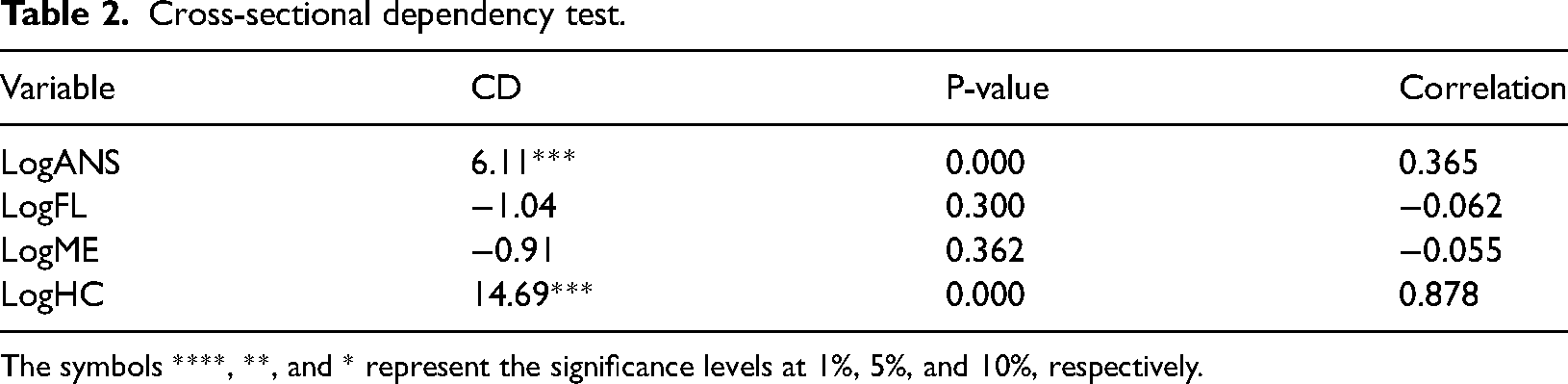
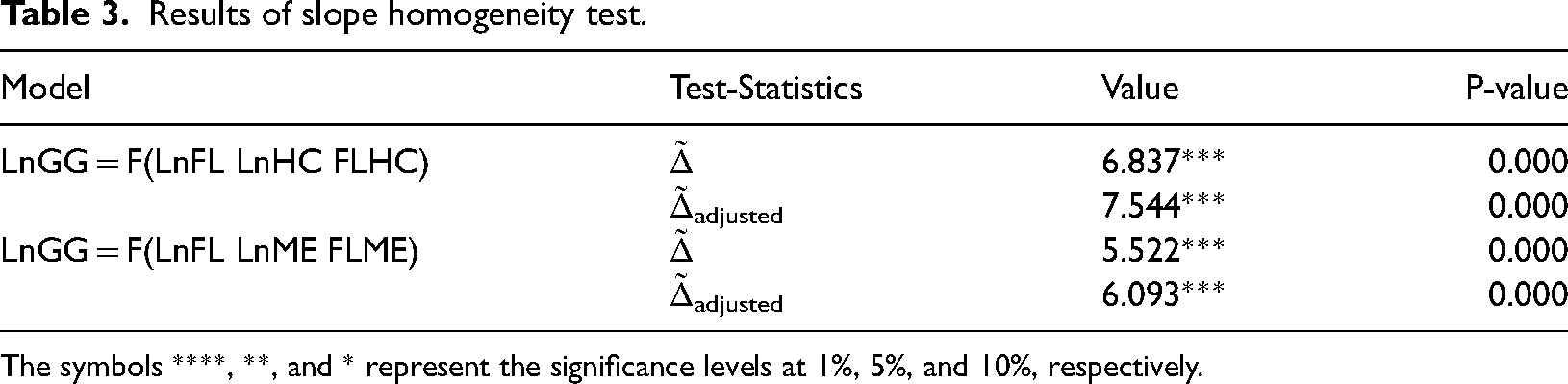
We initiated our data analysis by investigating CD in the variables. Owing to liberalization and globalization, socio-economic and environmental aspects of one country may affect the other country in the same region. Thus, examining CD is vital to estimate unbiased cointegration and unit root results. 124 The Pesaran 119 CD test results (in Table 2) show the presence of CD in two out of four variables. Especially green growth and human capital have a ripple effect across countries. The socio-economic shocks and environmental pollution may spread across the whole South Asian region. On the other hand, our results of slope homogeneity expressed in Table 2 also found the presence of slope heterogeneity for both models. Since the difference exists across units, it can be asserted that the political, social, economic, or technological structures vary across South Asian countries. The detection of heterogeneity and CD confirms the application of second-generation cointegration and unit root tools.
Cross-sectional dependency test.
The symbols ****, **, and * represent the significance levels at 1%, 5%, and 10%, respectively.
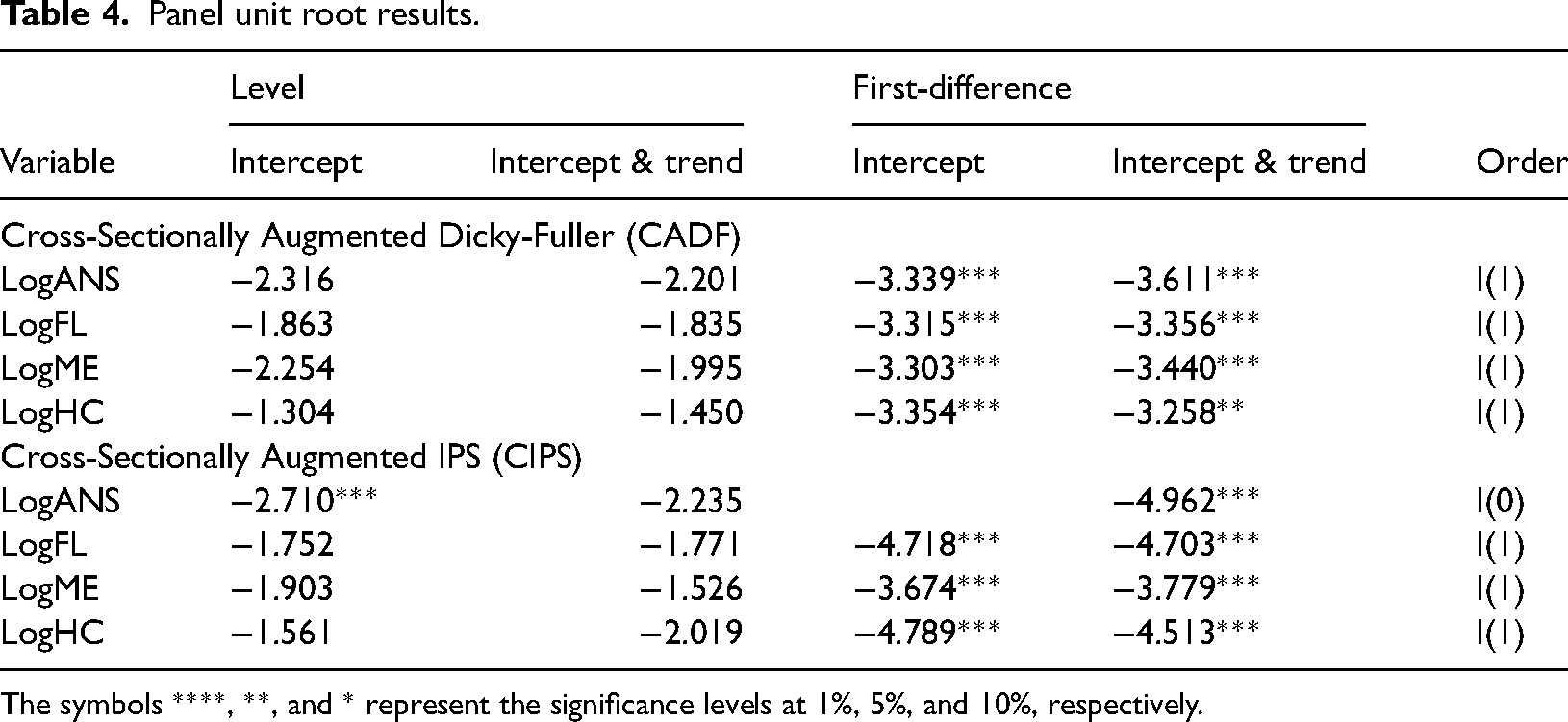
The identification order of time series is important to avoid spurious regression estimates. 133 The second-generation panel unit roots (CIPS and CADF) provide unbiased estimates when heterogeneity and CD are present in data. Table 4 shows that most of our variables are non-stationary at level but integrated in the first order. Green growth has an order of I(1) through CADF estimates but it is stationary at the level by CIPS estimations. Since there is a slight difference between the results of CADF and CIPS, the results of CIPS can be considered more robust in the presence of CD and heterogeneity. The mixed order of integration assists us to apply Westerlund 124 cointegration and CS-ARDL technique.
Results of slope homogeneity test.
The symbols ****, **, and * represent the significance levels at 1%, 5%, and 10%, respectively.
Panel unit root results.
The symbols ****, **, and * represent the significance levels at 1%, 5%, and 10%, respectively.
The results of Westerlund 124 indicate the existence of cointegration for both models specified in Table 5. All parameters are significant except Ga. Generally, Ga cannot reject the null hypothesis of no cointegration with small T. 134 However, based on the results of other parameters, it can be purported that the long-term relationship and cointegration exist among green growth, human capital, military expenditures, and financial liberalization. The error correction parameter, i.e. α' = Pa/T is 0.41 for first and 0.52 for second model respectively. This indicates the disequilibrium in the short run needs to be attuned in the long run as around >41% and >52% error between green growth and its determinants are correlated every year.
Westerlund panel cointegration tests.
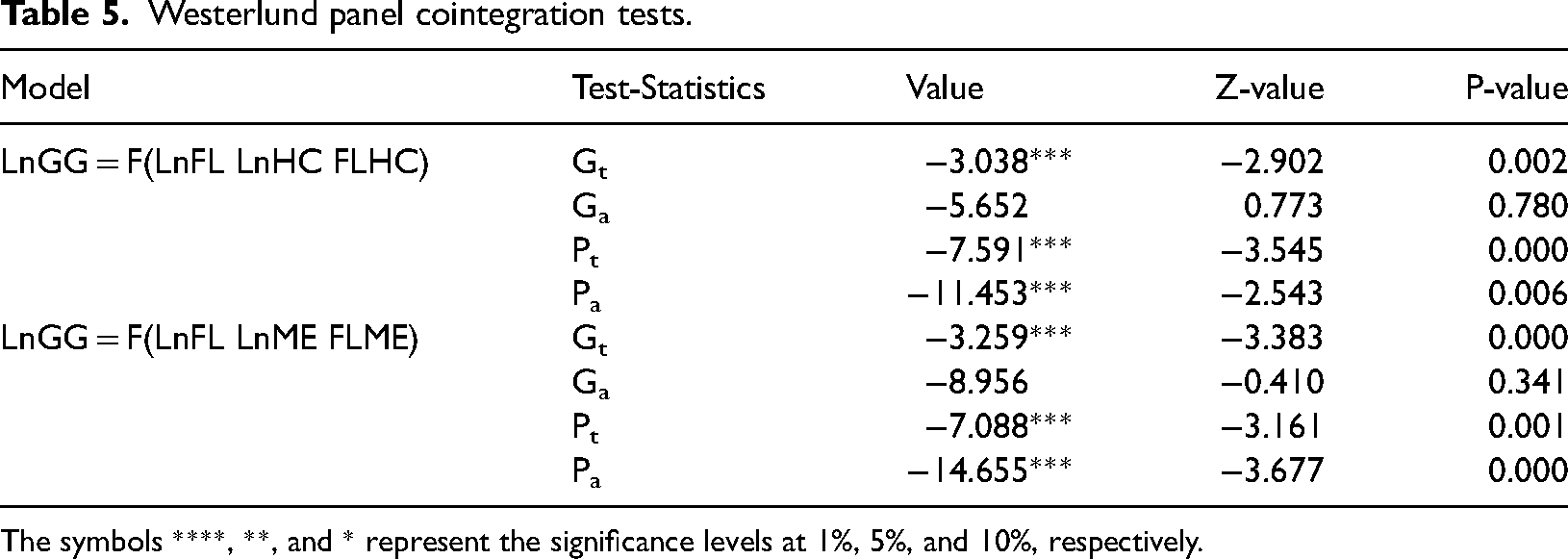
The symbols ****, **, and * represent the significance levels at 1%, 5%, and 10%, respectively.
The cointegration vectors can be evaluated through the CS-ARDL technique after the confirmation of cointegration among nonstationary underlying variables. The short-run and long-run estimates by CS-ARDL are given in Table 6. Concerning long-run relationships, the association between financial liberalization and green growth. The coefficient value indicates that a 1% increase in financial liberalization gives rise to green growth by 0.74% in the first model. The coefficient value increase by 0.25% when military expenditure is incorporated with financial liberalization. Especially, in the long run, liberalization of financial market and institutions spur economic growth 52 and mitigate environmental degradation 10 leading to an increase in green growth. Similarly, human capital is also positively and significantly associated with sustainable economic growth. Around 3.2% change in green growth is due to human capital which is a substantively large change compared to other underlying variables. On the other hand, the interaction effect between HC and FL is negative and significant indicating rent-seeking behavior of human capital when financial system is liberalized.
CS-ARDL panel data estimation results.

The symbols ****, **, and * represent the significance levels at 1%, 5%, and 10%, respectively.
As expected, the effect of militarization on green growth is significant and negative in the long run. Our results are consistent with the guns-versus-butter model that high defense spending is a major threat to sustainable development.24,68 In contrast, the positive and significant interaction terms of FL and ME. In more financially open economies, military expenditures are allocated to eradicate internal conflicts that allow foreign investment in cleaner technologies, resulting in better ecological and economic gains. 100 With reference to short-run estimations, results of CS-ARDL show no significant effect of any variable except financial liberalization. In both the short- and long-run, financial liberalization has the ability to improve green growth in South Asia. The error correction terms (ECT) expressed in Table 6 demonstrate a considerable convergence (i.e. −0.61 and −0.74) towards the long-run equilibrium in both models. Around 61% disequilibrium for the human capital model and 74% for the militarization model, need to be adjusted every year.
The causal relationships among green growth, financial liberalization, human capital, and military expenditures analyzed through Dumitrescu and Hurlin 127 causality test are presented in Table 7. The empirical findings suggest bidirectional causality between FL and GG as well as between HC and GG. For example, any change in FL and HC shall accelerate green growth. Nonetheless, unidirectional causality runs from military expenditures to green growth. There is also bidirectional causality between HC and ME but unidirectional causality runs from FL to HC. Lastly, the estimates of the causality test show no causal relationship between FL and ME.
Dumitrescu-Hurlin panel causality test.
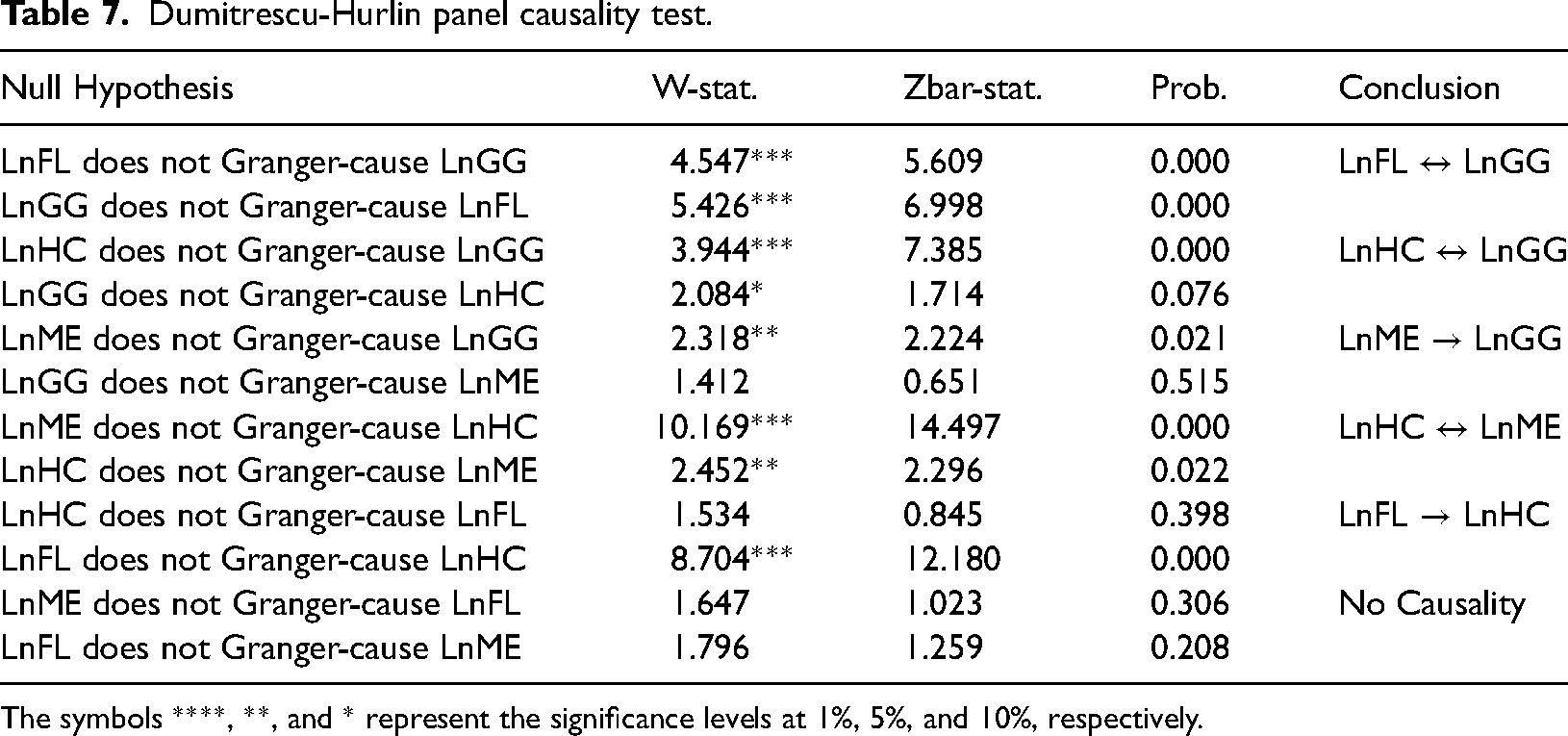
The symbols ****, **, and * represent the significance levels at 1%, 5%, and 10%, respectively.
Robustness checks
The Augmented Mean Group estimator (AMG) is utilized for robustness check. It was developed by Eberhardt and Teal 135 as an alternative to the Common Correlated Effects Mean Group estimator (CCEMG). This method is also allowed for heterogeneous slope coefficients and robust to CD in panel data estimation by including the common dynamic effect parameter. The results of the AMG estimator are given in Table 8. With a slight difference in coefficient values, our main results remain unchanged in AMG estimations. The results of long-run elasticities in the AMG model are strongly aligned with the CS-ARDL estimates.
Augmented mean group (AMG) - robustness test.

The symbols ****, **, and * represent the significance levels at 1%, 5%, and 10%, respectively.
Discussion
Although our study is the first attempt to empirically study the short- and long-run relationship between financial liberalization and green growth, the findings can be partially supported by the results of Adeel-Farooq, Bakar, 13 Hua and Boateng, 10 and Tamazian, Chousa. 9 After the post-reform period, the South Asian region embark on a way of gaining momentum toward economic and financial development. Grounded on the McKinnon-Shaw hypothesis, we believe that openness of their financial system attracts human capital, encourages entrepreneurial activity, improves resource allocation, and boosts investment in green innovation that not only spur economic growth but also support ecological sustainability.10,43,44
Human capital also plays a crucial role in augmenting sustainable development in the long run. Similar to the proponents of investment in human capital, we postulate that individuals with better knowledge, skills, and education shall optimize natural resource utilization, and are more likely to become accustomed to the latest technology leading to cleaner production at the macro-level.40,75 In tandem with the suggestions of Zaidi, Wei, 81 we favor investment in human capital despite its negligible effect on sustainable growth in the short run to weaken the “resource curse hypothesis” in the long run. The progressive consequences of human capital only in the long run are plausible as educated masses sense the need to bring eco-friendly technologies for sustainable growth once they achieve a certain level of economic development.83,84,93 This phenomenon can also be explained by the environmental Kuznets curve (EKC). 136
Surprisingly, when we allow human capital to interact with financial liberalization, their impact on sustainable development turns deleterious. This evidence can be rationalized by three arguments. First, financial liberalization also gives rise to corruption which induces rent-seeking behavior in skilled and educated individuals. Accordingly, their focus tends to increase wealth without employing any pollution abatement policy.110,111 In the presence of a weak rule of law and bureaucratic quality, resource-rich regions (like South Asia) are less likely to improve their genuine saving or sustainable development, despite the investment in human capital 137 and financial openness. 138 Since South Asia is considered notorious for bribe-dispensing entrepreneurs, money-seeking bureaucrats, and influence-peddling politicians, 139 more financial openness provides these individuals a certain cushion for wealth expropriation confining the financial liberalization to only “quantity effect”. 46 Owing to the promotion of less productive labor under rent-seeking structures, less likely to build or adapt cleaner energy resources for sustainable development.8,112,140 Second, the South Asian region does not comprise high-income countries where the turning point of EKC cannot be practically observed. Human capital may further exaggerate environmental pollution during the initial level of economic growth. 83 Third, population healthiness is considered a more appropriate measure of human capital development compared to education, especially in case of fragile democratic systems 141 such as South Asian economies. 142 Replacing the measure may provide different results.
The long-run effect of military expenditures on green growth is negative and significant supporting the theoretical premises of the “treadmill of destruction theory” 71 and the “guns vs butter” model. 56 A higher level of military spending may deprive the general population of social welfare in the long run.61,62 Our findings are also in accordance with the results of Ahmed, Alam 27 Bildirici 68 Gokmenoglu, Taspinar, 69 and Solarin, Al-Mulali 29 that militarization is a menace to environmental quality. Particularly, arms conflicts and relentless rivalry between India and Pakistan are a source of ecological stress in the region. Mobility and sustentation of military activities increase energy demands coercing legislative forces to employ non-renewable energy resources leading to air, soil, and water pollution.24,70
In comparison to the negative direct effect, the positive interaction term supports neoclassical thoughts and supply-side spillover effects of defense spending on green growth when financial openness is high.41,143 One possible explanation of this effect can be supported by the study of Aziz and Asadullah 100 that financially liberalized economies efficiently allocate their resources to eradicate internal conflicts to sustain FDI and technological inflow. Foreign investors are less likely to invest in the presence of radicalism and violence. 107 Thus, financial liberalization enhances the spin-off effect of military expenditures to allow knowledge and technological spillovers in a society. 144 Our evidence is consistent with the study of Ullah, Andlib 41 that militarization improves economic growth and decreases environmental pollution in Pakistan and India which are more financially open and developed compared to other countries in the region. Over the period, terrorism within the region has stagnated the economic growth and trade openness. 145 Thus, efficient allocation of militarization will improve the efficiency of national systems 146 and allow technologically advanced FDI inflow in the region.
Conclusion and policy implications
Conclusion
Global warming and continuous environmental stress have drawn the attention of governments and multilateral organizations to execute green growth policies. Despite the important issue, the determinants of sustainable economic growth are underexplored. With an eye to probing into the issue, we investigate the short- and long-run effects of financial liberalization, human capital, military expenditures, and their interactions on green growth in South Asian countries over the period spanning from 1990 to 2017. After detecting the cross-sectional dependency and heterogeneity using the tests of Pesaran 119 and Pesaran and Yamagata 121 respectively, the second-generation techniques are employed. The non-stationarity of all variables at levels except green growth also motivates us to utilize CS-ARDL and Westerlund 124 cointegration techniques.
The findings show that financial liberalization, human capital, military expenditures, and green growth have a long-run and stable relationship among each other. The results also indicate a positive effect of financial liberalization and human capital while the negative effect of military expenditures on green growth in the long run. However, the interaction effects suggest that a higher level of financial liberalization highlights the darker side of human capital and the brighter side of militarization. In the short run, only financial liberalization has a significant effect which calls for the investigation of other factors that shall affect sustainable development in the short run. Our empirical findings are robust through the AMG model. The causal relationships between underlying variables further confirmed the significant role of military expenditures, human capital, and financial liberalization in formulating green growth policies.
Our study highlighted the importance of interaction effects in environmental economics empirical studies. The direct relationships between variables may not provide a holistic view without the inclusion of interaction terms. Without the interaction effects, we may have made erroneous conclusions by underestimating the effect of defense spending and overstating the effect of human capital on sustainable economic growth. Nonetheless, we acknowledge that our results related to interaction effects lack theoretical support due to the omissions of certain variables, i.e. FDI, institutional quality, and technology advancement. Our rent-seeking perspective provided for the interaction effect of financial liberalization and human capital can be further robust by including institutional quality or corruption in the model. On the other hand, the bright side or spin-off effect of military expenditures in the presence of more financial openness can be tested by disaggregating internal and external conflicts in the empirical model.
Policy implications
Important clues can be derived by policymakers from the empirical results of this study. First, the findings highlight the need to promote human capital and financial liberalization for sustainable development. Nonetheless, countries should include environmental education when training their skilled population and foreign migrants to make them aware of environmental functions, ecosystems, and sustainable development. Incorporating environmental education in the development of human capital may mitigate rent-seeking behavior among individuals when the economy is fully open and liberalized. Investing in human capital along with environmental awareness can prove to be a less distortionary alternative to addressing climatic issues. Furthermore, financial liberalization needs to be accompanied by carbon taxes so that investors will initiate eco-friendly projects in order to avoid these taxes.
Second, it is high time for Pakistan and India to engage proactively in dialogues to address the extremism, ethnic issues, and regional border conflicts or it will remain the most environmentally vulnerable region. As a peace stimulating mechanism, countries need to free their financial markets to expedite economic growth. Our findings suggest that more financially open economies effectively utilize their military forces to enhance their green growth. Still, most of the children in the region are out of school because governments are allocating more budget to their defense expenditures compared to education. Especially if non-combat expenditures will be shifted to the education system, an efficient and peaceful stock of human capital can be accumulated by the region. Defense expenditures are supportive toward human capital development 147 only when they are efficiently allocated to eradicate civil conflicts and terrorist activities On the other hand if military expenditures are associated with increasing income inequality, it reduces the incentives to accumulate productive human capital. When rent-seeking rewards become more lucrative to educated individuals, sustainability-oriented rewards cannot be reaped from financial liberalization.
Data constraints related to Afghanistan, Bhutan, and the Maldives were one of the major limitations which restrained us to enhance the robustness of the findings. Additionally, the study is able to incorporate only the post-reform period, i.e. from 1990. Expanding the time span may provide more valid estimates. Future studies can also investigate the interaction of military expenditures with internal/external conflicts as well as the interaction between financial liberalization and corruption to reconfirm our findings. Lastly, we have considered only education-based measurement for human capital. Despite its wide usage and easy accessibility, it ignores many facets of advanced human capital such as healthiness, work experience, learnings-by-doing, on-the-job training benefits, etc. Thus, a better measurement should be formulated and analyzed with the underlying variables in the future.
Footnotes
Availability of data and materials
All data used in this paper are downloaded from online resources. The data is readily available for the researchers willing to use it.
Authors’ contributions
CL: Conceptualization, Writing-Original Draft. FY: Conceptualization, Writing—Original Draft. AR: Methodology, Data, Software, Formal analysis and Visualization. All authors read and approved the final manuscript.
Competing interests
The authors declare that they have no competing interest
Declaration of conflicting interests
The author(s) declared no potential conflicts of interest with respect to the research, authorship, and/or publication of this article.
Funding
The authors disclosed receipt of the following financial support for the research, authorship, and/or publication of this article: Chien-Chiang Lee is grateful to the Social Science Foundation of Jiangxi Province of China for financial support through Grant No: 21JL02.
