



Abstract
Due to the rapid increase in industrialization, environmental degradation has recently grown into a serious problem. The existing literature has mostly focused on the reduction of CO2 emissions and ignored PM2.5 emissions, which have a direct impact on the environment through air quality. Therefore, this study attempts to look into the effectiveness of environmental policies in determining environmental sustainability by lowering PM2.5 emissions in the Organization for Economic Cooperation and Development (OECD) countries. These are categorized as fiscal (green taxes), economic incentives, and research and development (R&D) investment policies. The second-generation panel co-integration method and Cross-Sectionally Autoregressive Distributed Lag (CS-ARDL) are employed for the period 1990–2019 to estimate the results. The Westerlund cointegration results confirmed a stable, long-run relationship between all the variables. The study shows that not all environmental regulations are equally successful in lowering PM2.5 emissions. According to the findings, R&D and fiscal policy help reduce PM2.5 emissions, whereas economic incentive strategies and population increase them. This shows that establishing green taxes on these emissions and developing green R&D policies will facilitate environmental sustainability. The overall findings let us classify some good performances in the OECD countries regarding the design of environmental policies, even though we should also keep in mind that there isn’t a solution that works for everyone. Policy makers should modify their plans in accordance with the nature and unique features of their country or region.
Introduction
Environmental pollution and its regulation have grown to be a major global issue as a result of industrialization. 1 Due to this, rapid action and legislative measures are required to address the issue. In this regard, over the past few decades, the Organization for Economic Cooperation and Development (OECD) has been working toward a low-carbon economy. As part of this effort, measures to raise awareness about climate change have been prioritized. Actually, the two fundamental driving reasons behind climate change policies on carbon abatement are encouraging green innovation and decreasing emissions through a carbon price.2–12 However, some empirical studies have evaluated the effectiveness of these policies in reducing emission levels when a particular pollution charge is imposed by environmental legislation.5,11,13–20
Regardless of the existing literature, which focuses on CO2 emissions, the present study uses PM2.5 (or particulate matter of less than 2.5 m). It is a fact that CO2 and PM2.5 are produced by the same sources. 21 But because they are produced in various ways, multiple sources, primarily the burning of fossil fuels in the transportation, industrial, residential, and agricultural sectors, are responsible for the majority of CO2 and PM2.5 releases. While CO2 is a polluting gas in and of itself, PM2.5 is made up of a number of liquid and solid components that are released by various sectors in varying amounts. Therefore, even if the main sources are the same, the chemical reactions linked to their emissions result in variable amounts of the various components of PM2.5, changing the ultimate ratio of PM2.5 emissions to CO2 emissions. Despite the fact that CO2 emissions are a minor component of harmful gas emissions and have no direct impact on human health, most research has focused on them.21–23 Due to this reason, studies on the impact of carbon-focused environmental policies have proliferated. Studies on how environmental regulations affect those exposed to PM2.5, however, are few and far between.
As seen in Figure 1, PM2.5 emission levels have been continuously declining in the OECD countries since 2000. The reduction of solid fuels (like coal) in the energy mix, improved combustion technologies (used in industry and residential heating), and reduced emissions from transportation and agriculture are all responsible for these gains. Moreover, in the OECD region, taxes on air pollution generated USD 683 billion in revenue in 2020, or 80% of all taxes related to the environment. 1 However, major building sites, unpaved roads, fields, smokestacks, and fires continue to contribute significantly to high emissions in developed countries (such as Canada and the United States). Power plants, industries, and autos emit the majority of the particles that are formed in the atmosphere as a result of complicated reactions. This shows that it is crucial to lower residents’ exposure to air pollution in these countries.
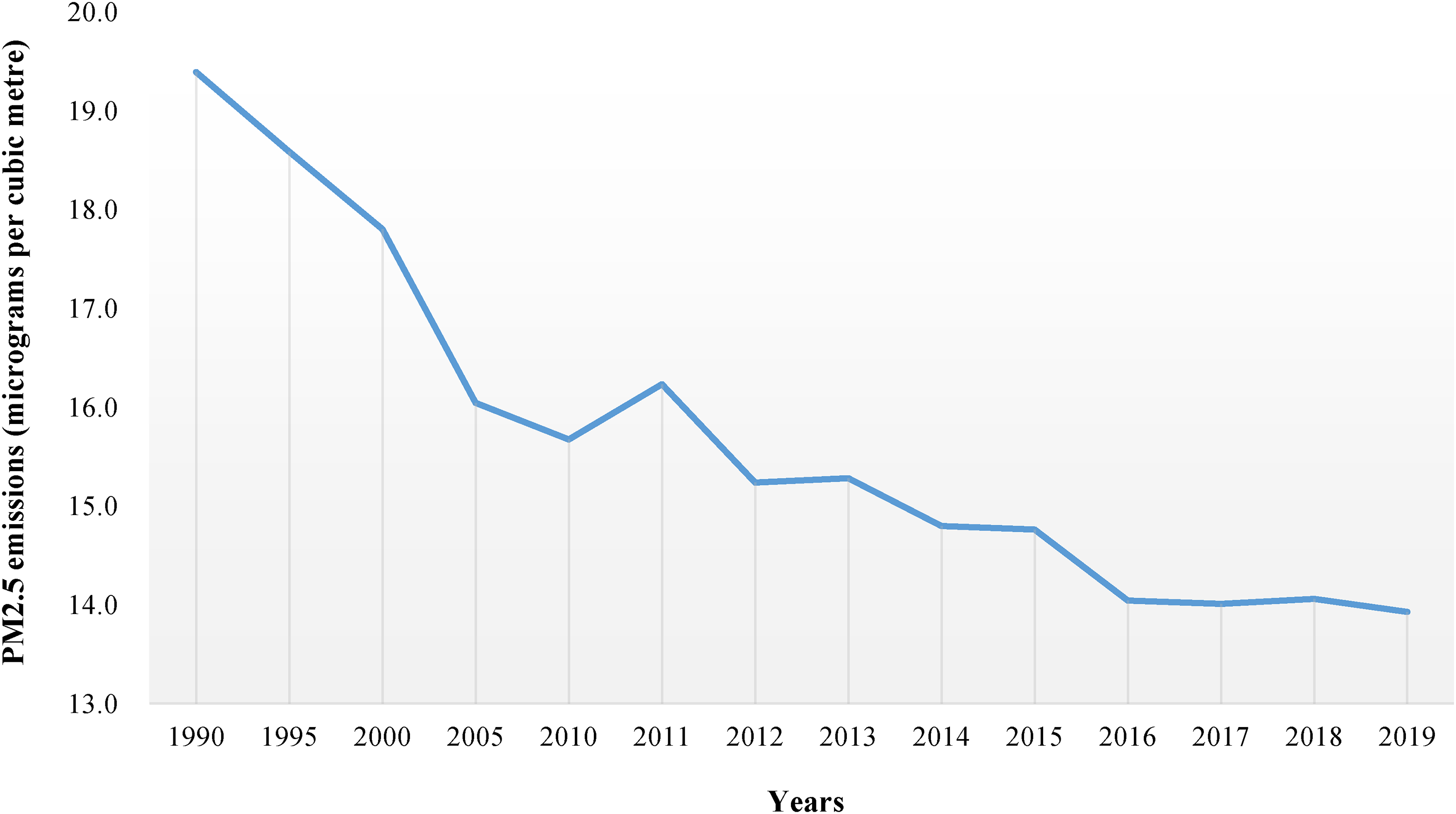
PM2.5 emissions in the Organization for Economic Cooperation and Development (OECD) countries.
The International Energy Outlook (2013) projects that between 2010 and 2040, energy consumption in the OECD countries will increase by 17%. Though not as swiftly as in non-OECD countries, it is nonetheless rising. Figure 1 shows that there is a prominent decline in exposure to PM2.5 emissions in the OECD countries. Therefore, there is a need to examine the role of environmental policies on PM2.5 emission levels in the OECD countries. Moreover, to identify the best environmental policy for tackling the environmental problem in OECD countries. Hence, figuring out how these policies can be implemented in a way that addresses climate change and minimizes the health problems associated with pollution in other countries is just as important. The traditional CO2 reduction strategies do not necessarily result in the same reductions in carbon as they do in microparticles. Therefore, a specific study on the effectiveness of these regulations is required.
The present study contributes to the existing body of literature by adding new aspects on various grounds. To our best knowledge, this study is unique in that it investigates the effectiveness of environmental policies in determining environmental sustainability (PE). For this purpose, the policies under investigation are fiscal policy, which is used to control the consumption of non-renewable energy sources by imposing taxes; an economic incentive program for the use of clean energy; and an investment policy for innovation and research and development (R&D). Second, most of the studies found in the literature are mostly focused on CO2 emissions. Despite this, this study examines the effectiveness of environmental policies against the main cause of pollution, PM2.5 emissions. Third, the countries under study are OECD countries, which have a large portion of fossil fuel energy consumption in their energy mix. This allows us to assess a larger group of economies and determine which policies are helping these countries lower PM2.5 emissions. Fourth, this study employs advanced econometric estimation techniques such as the second-generation co-integration proposed by Westerlund 24 as well as the Cross-Sectionally Autoregressive Distributed Lag (CS-ARDL) approach to account for the cross-section dependency problem that exists among the countries. This will also help to investigate the effectiveness of these policies in the long run as well as in the short run. At last, this study is unique in terms of empirical findings on OECD countries.
The rest of the article is divided into the following sections: An overview of the literature pertaining to earlier research on how environmental regulations affect emissions is provided in Existing literature section. The methodology of the study is described in Theoretical background and methodology section, followed by Empirical findings section, which presents the empirical findings. Lastly, Conclusion section provides the conclusion of the study and summarizes actionable recommendations for policy makers.
Existing literature
The purpose of the study is to identify the most effective regulatory policy for a viable environment. To date, only a few empirical studies have been conducted to determine how well these environmental instruments work to reduce emission levels, with mixed results (Hashmi and Alam; Niedertscheider et al.; Wenbo and Yan; Ma et al.; Albulescu et al.5,13–16; Feng et al.; Wang et al.; Zhao and Yang.1,18; and Wolde-Rufael and Mulat-Weldemeskel 11 ). According to some studies, environmental policies are generally intended to prevent polluting emissions and their effects. These studies include.25–33 Scholars have typically used primary argument strands to address concerns about the policy's effectiveness in lowering emissions. First, as the primary fundamental strategy for reducing emissions, the efficacy of technological advancement and government R&D spending is emphasized. The second takes into account fiscal policies as well as renewable energy and energy efficiency.
Economic policies must place maximum emphasis on technological advancement and innovation in order to combat climate change and promote sustainable development. 3 The authors who support innovation regarding process efficiency have recommended the implementation of these novel strategies for lowering emissions.29,31–34 The studies also indicated that even though these low long-term costs are associated with greater short- to medium-term expenses, the technical advances emerging from R&D and future costs of climate change alleviation, including their repercussions, would be significantly less. Interesting results from previous research demonstrated the failure of investments in R&D to lower pollution.35,36 Some authors contend that even if innovation strategies could support the development of new environmentally friendly technologies and thereby reduce emissions. But this tool is rendered ineffective because it does not promote collaboration and innovation. 37 These researchers found that policies like fiscal or economic incentives can determine the effectiveness of programs. 38 The last argument is supported by an empirical model developed by Fischer and Newell 28 that a structure in place to encourage sector adoption can be effective for government investment in clean technology. For instance, Bosetti et al. 29 showed that carbon taxes are essential to the effectiveness of R&D expenditure. Hence, R&D investments alone are inadequate to stabilize CO2 emissions.
With regard to the second strategy, academics concentrate on how well economic incentives and restrictions might cut emissions. According to one school of thought, economic inducements and fiscal strategies can lower emissions indirectly by encouraging or discouraging the use of specific resources39,40 and directly by increasing innovation. 41 In any event, there is disagreement in the literature about the efficacy of innovation policies. Economic and fiscal policies, according to some researchers, aid in the reduction of emissions.25,34,42 Using the concept of induced innovation, Lanjouw and Mody 39 showed that the macroeconomic costs imposed by governments on pollution led to a rise in patents, which in turn led to the development of greener technology and reduced emission levels. Similar to this, Hao et al. 19 claimed that government taxation and incentives play a substantial influence on the opportunity cost of natural resources since markets typically do not reflect their true worth. Therefore, stronger incentives to minimize emissions will result from increased opportunity costs brought about by taxes or restrictions.
According to Schneider and Goulder, 26 subsidies on technology have little effect on reducing emissions, even though technology has become more affordable unless they are combined with fiscal measures or other economic inducements that specifically target the unfavorable outwardness of industrial production. According to some studies, the imposition of emissions prices is the most effective policy, as surveyed by technological performance on emissions, fossil fuel taxes, renewable energy subsidies, and finally, R&D investment, even though policy efficacy is influenced by national environmental goals and metrics.27,28 These ideas have frequently been criticized for being developed mostly conceptually without any practical testing. In response to these arguments, some scholars have asserted that practically speaking, financial and economic incentives do not work to reduce emissions and may potentially raise pollution levels. Since this might result in disincentives for the adoption of new technology, Hart 43 demonstrated that taxes on emissions that are higher than the budget required to reduce them are ineffective. Later, Bosetti et al. 29 used empirical evidence to show that policies that emphasize economic and fiscal incentives for induced innovation are insufficient on their own to stabilize greenhouse gas levels and must be supplemented by parallel measures. In a similar vein, Grafton et al. 30 examined how grants for technical development and biodiesel in the United States influenced CO2 emissions. The study found that the subsidies caused both an increase in emissions and a rise in the use of fossil fuels. The term “rebound effect” was given to this occurrence, which happens when tax incentives have little impact on lowering energy use because of decreased energy prices linked to subsidies for renewable energy sources.
Most of the existing literature on environmental issues has focused on carbon emissions only. In particular, Shahbaz et al., 3 Machado and Silva, 6 Xu et al, Ike et al. 7 Khan et al., 9 Li et al., 10 Wolde-Rufael and Mulat-Weldemeskel, 11 Wang and Zhang, 44 Zhang et al., 21 and Wang et al. 45 have checked the impact of different factors like nonrenewable energy, renewable energy, trade, urbanization, income inequality and R&D expenditures on carbon emissions. But CO2 emissions are a minor component hazardous to gas emissions.21–23 However, PM2.5 emissions are made up of a variety of liquid and solid components that are emitted in diverse quantities by different industries. As a consequence, the chemical processes that lead to their emissions produce varying quantities of the different PM2.5 components, affecting the final ratio of PM2.5 emissions to CO2 emissions. Due to this reason, studies on the impact of carbon-focused environmental policies have proliferated. Studies on how environmental regulations affect those exposed to PM2.5 are rare.
Although the existing literature has examined the effectiveness of environmental policies, there is still disagreement in this area. There are proponents and opponents of the success of fiscal and economic incentive programs as well as innovation initiatives. Furthermore, the existing literature mostly focuses on emission reduction from a carbon-centered perspective. Therefore, the goal of this study is to evaluate how well all of these environmental regulations are working to reduce PM2.5 emissions.
Theoretical background and methodology
This study looks at which environmental policies are more successful in determining PE in the OECD countries between 1990 and 2019. For this purpose, 33 OECD countries have been selected because they have in common the same levels of modernization as well as some degree of environmental regulation. The model of the study is based on the STIRPAT
2
model, which explains the environmental impact of factors like population, affluence, and technology.
46
STIRPAT is the modified form of the Integrated Population, Affluence, and Technology (IPAT) model. The general form of the STIRPAT model is as follows:


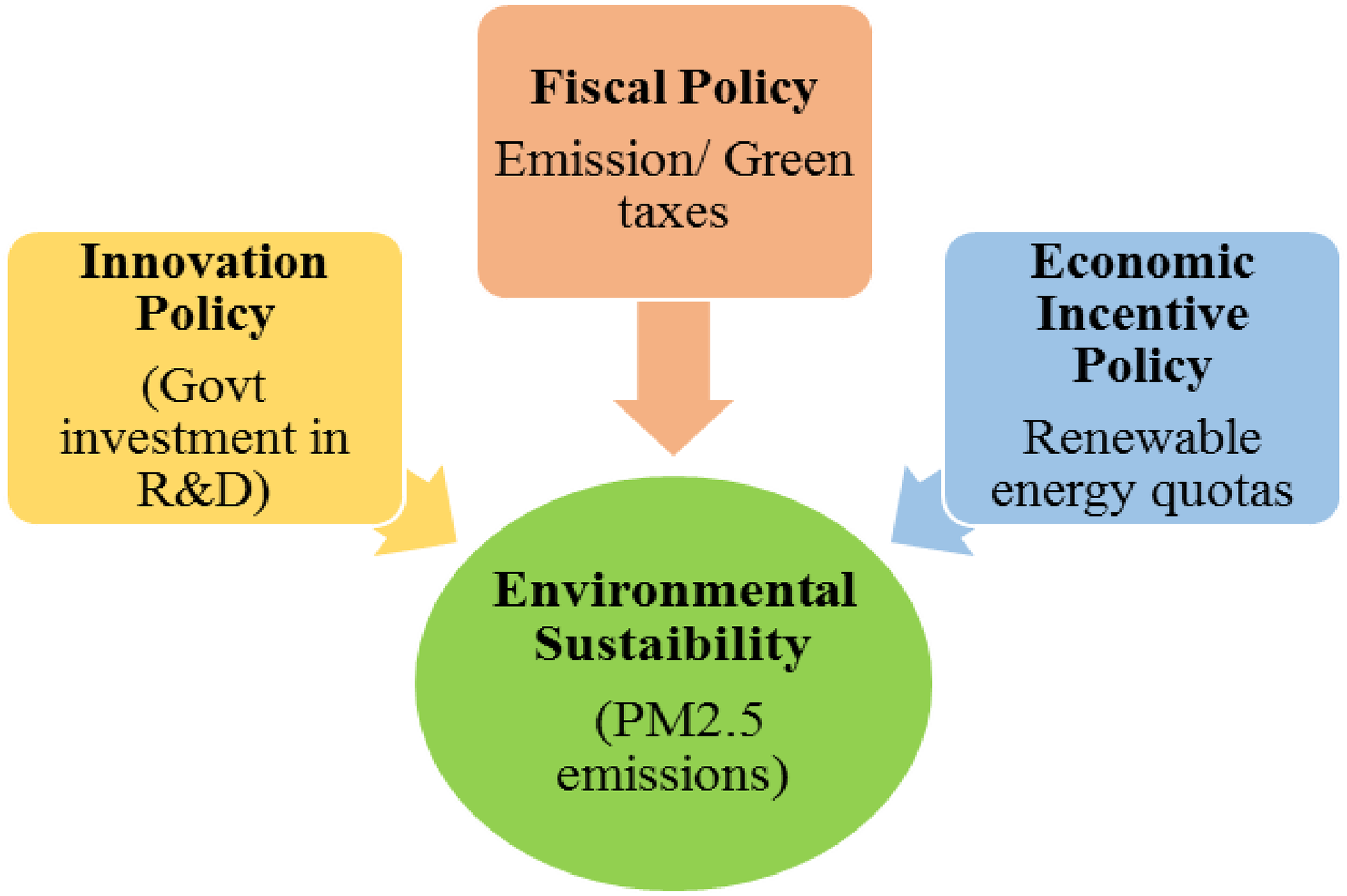
Impact of environmental policies on environmental sustainability.
where
Description of variables.

OECD: Organization for Economic Cooperation and Development; PE: environmental sustainability; R&D: research and development.
Estimation procedure
This study takes into account sophisticated econometric measures when generating the empirical results. The estimation process starts with the inspection of cross-sectional dependence (CD) and heterogeneity problem in the panel data. For this purpose, the Pesaran CD test 47 and the slope homogeneity test 48 are employed. To check the order of integration of the variables, the study employs Cross-sectionally Augmented Dicky–Fuller (CADF) and Cross-sectionally Augmented IPS (CIPS) unit root tests. 49 Furthermore, the cointegration among the variables is tested using second-generation panel cointegration test. 24 After this, long-term and short-term coefficients are measured through CS-ARDL 50 followed by robustness test to confirm the results. The methodology used in the study is explained step by step as follows:
Cross-sectional dependency test by Pesaran et al. 47
The main procedure in the panel data study is the CD analysis. Because the second-generation cointegration method relies on CD and heterogeneity in the sample data. Therefore, it is critical to verify CD in the data. In order to identify cross-sectional reliance, the Pesaran CD test
47
is employed. The H0 of the test is that there is no CD in the data, and the alternative (H1) shows the presence of a CD. The CD test appears as follows:


Slope homogeneity test
The study uses the slope homogeneity test that Pesaran and Yamagata
48
suggested. To ascertain if the slope coefficients of the cointegration equation are homogeneous across cross-sections, Swamy
51
devised the slope homogeneity test. Swamy's slope homogeneity test was improved even further by Pesaran and Yamagata
48
who created the following two test statistics.
Westerlund 24 panel cointegration test
This study inspects the cointegration between environmental policies and PM2.5 emissions in the OECD countries. Therefore, we employed the second-generation cointegration test introduced by Westerlund
24
for panel data. The main advantage of this cointegration is that it incorporates the problem of CD. The error correction model of Westerlund
24
assumes that all variables are I (1) and it is written as follows:


Long-run estimation
The present study employs the CS-ARDL estimation technique proposed by Chudik and Pesaran.
50
The main advantage of CS-ARDL is that it incorporates heterogeneity and CD while providing consistent results. The lagged dependent variables in this framework enable the development of an error correction framework and weak exogenous regression to capture dynamic behavior. This helps both in the short-term as well as in the long-term in addressing the CD bias. The CS-ARDL regression equation is as follows:
Robustness check—panel causality test
For panels with different compositions, Dumitrescu and Hurlin
52
proposed a non-casual testing technique. There are several advantages of using this method. First, this panel causality test can be used for both balanced and unbalanced panel data. Second, the Dumitrescu–Hurlin causality also explains the heterogeneity of the model used and the variability of causal relationships.53–55 In addition, it is important to understand the direction of a causal relationship between the variables. Therefore, the pairwise Dumitrescu–Hurlin panel causality test is applied. The general form of Dumitrescu–Hurlin panel causality test is as follows:
Empirical findings
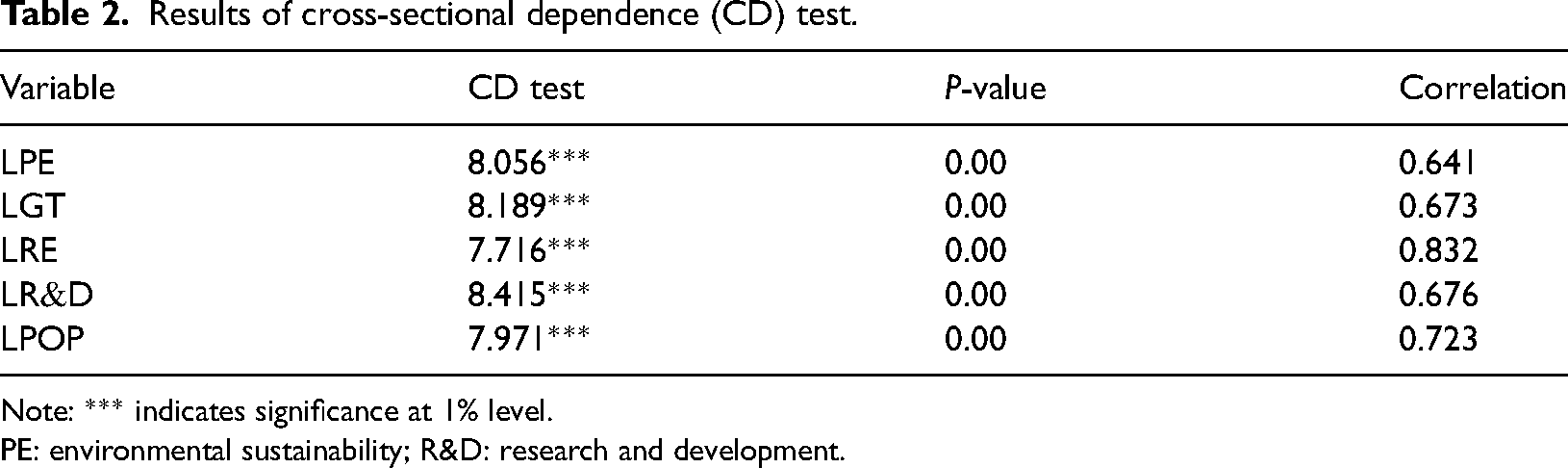
This study uses annual data from 1990 to 2019 for OECD countries. At first, the study applied the CD test developed by Pesaran et al. 47 to verify the CD, and the results are shown in Table 2.
Results of cross-sectional dependence (CD) test.
Note: *** indicates significance at 1% level.
PE: environmental sustainability; R&D: research and development.
The findings of the CD test show that there is significant cross-sectional reliance between countries at 1% level of significance. Thus, it demonstrates how closely tied these OECD are to one another and how one country's economy can have an impact on those of other countries. Table 3 presents the results of the slope homogeneity test. The p-value for both statistics is 0.00, indicating that the test's null hypothesis is firmly rejected. As a result, it suggests that there is heterogeneity among the sample countries, and we should use the second-generation co-integration technique.
Results of slope homogeneity test.

Note: *** indicates significance at 1% level.
It is required to look for the unit root before proceeding with cointegration analysis. When analyzing panel data, CD must be taken into account. As, cross-section dependence exists between the cross-sections and applying the first-generation unit root tests can provide unreliable results. The order of integration of the variables is therefore examined in this study using the CADF and CIPS unit root tests for panel data. The outcomes of both unit root tests at the level and first difference are shown in Table 4. The findings lead us to the conclusion that every variable is stationary at the first difference I (1). We can therefore continue to use the Westerlund 24 cointegration method now.
Results of panel unit root tests.

Note: *** and ** indicates significance at 1% and 5% levels, respectively.
CADF: Cross-sectionally Augmented Dicky–Fuller; CIPS: Cross-sectionally Augmented IPS; PE: environmental sustainability; R&D: research and development.
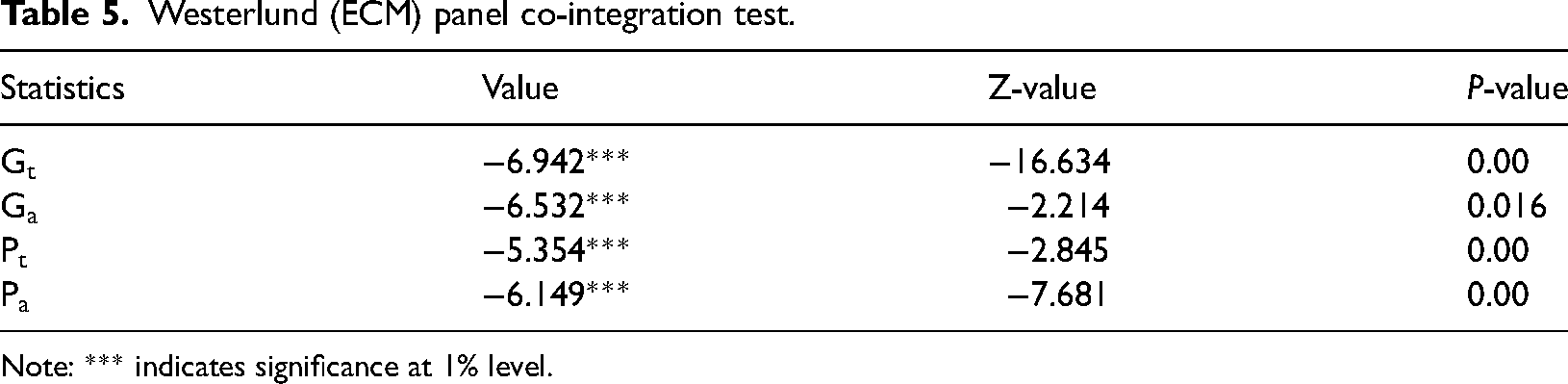
The following stage is to determine whether or not the variables have a long-term relationship once the order of integration has been determined. Table 5 shows the results of the Westerlund panel co-integration test. The test statistics confirm the existence of cointegration by rejecting the null hypothesis at the 1% significance level. As a result, we can conclude that all of the variables have a long-run relationship. The error correction parameter (
Westerlund (ECM) panel co-integration test.
Note: *** indicates significance at 1% level.
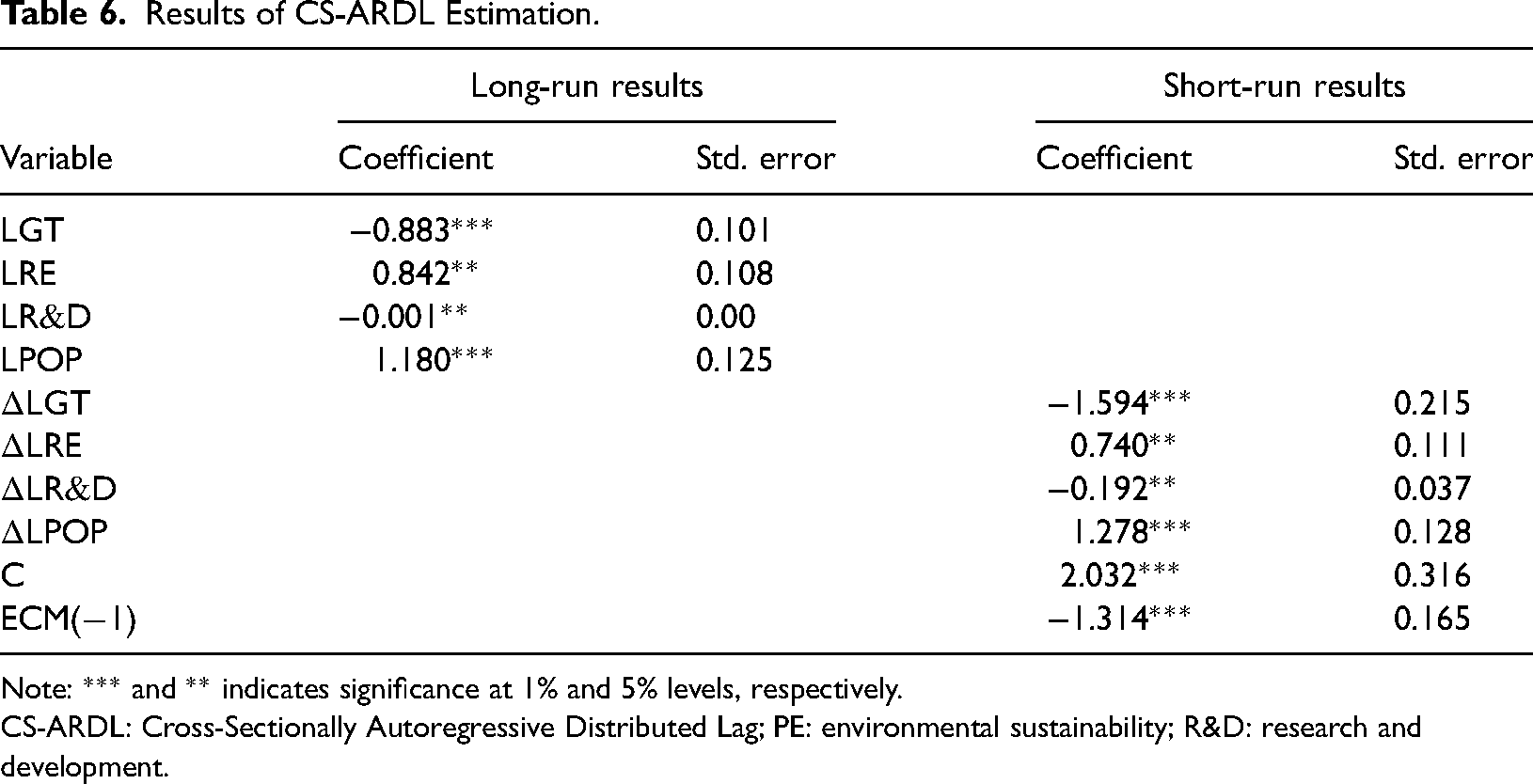
After the confirmation of the presence of cointegration among the variables, the next step is to evaluate the long-run and short-run relationships using CS-ARDL. Table 6 shows how GT, RE, R&D, and POP affect PE in the long and short run. At the 1% significance level, the long-run impact of GT on PE is found to be negative and significant. This results in a 1% increase in GT and will lower the PE emission levels by 0.883% and 1.594% in the long run as well as in the short run. These results are in line with the earlier findings and have a number of plausible explanations. First, the costs of prohibitions, fines, and levies are sometimes insufficient to deter the usage of harmful resources.56,57 Second, further energy conversion measures might have a rebound effect, such as economic incentive programs, 30 which might be significant. As a result, the combination of the two can negate the impact of the fiscal measures. The consequences of such economic measures can sustain the stability of the price of energy by offsetting the pressure that fiscal policy places on it.
Results of CS-ARDL Estimation.
Note: *** and ** indicates significance at 1% and 5% levels, respectively.
CS-ARDL: Cross-Sectionally Autoregressive Distributed Lag; PE: environmental sustainability; R&D: research and development.
The influence of RE is found to be positive and significant at the 5% significance level. A 1% increase in RE will lead to an increase in PE levels by 0.84 and 0.74%. This demonstrates that, rather than being associated with a decrease in air pollution exposure levels, energy efficiency certifications appear to have the opposite effect. A favorable association between the proportion and the degree of a citizen's contact to air pollution was anticipated to be connected with improved energy efficiency and reduced levels of PM2.5 emissions. This would suggest that among the several financial incentives offered, the release of production certificates with energy efficiency is not a practical method of lowering the PM2.5 emissions. These data support the claims made by authors like Hart 43 and Bosetti et al. 29 It's probable that these financial incentives were insufficient to soothe or lower the stages of discharges of dangerous gases on their own because of phenomena like the rebound effect and the decreased energy prices, which are supported by Grafton et al. 30
Moreover, the coefficient of R&D is negative and significant at the 5% significance level. This indicates that a 1% increase in government investment in R&D will lower levels of PE by 0.001% and 0.192%. As the results are consistent with earlier research on CO2 and other greenhouse gases23,28,32,34,58 that R&D supports PE. The typical PM2.5 concentration in the OECD countries ranges from 6 to 30 g/m3. Therefore, it is clear how innovation has an impact. To reduce the amount of air pollution that residents are exposed to, governments in the OECD countries invest more in R&D and innovation by encouraging it in educational and industrial systems. The impact of POP on PM2.5 emissions is found to be positive and significant at a 1% significance level and also consistent with the findings of Shahbaz et al. 3 and Wang and Zhang. 44 The results of the long run and short run show that a 1% increase in POP leads to an increase the PM2.5 emissions by 1.18% and 1.278%. The error correction statistic is negative and significant with a value of −1.314, which indicates the convergence toward the long-run equilibrium.
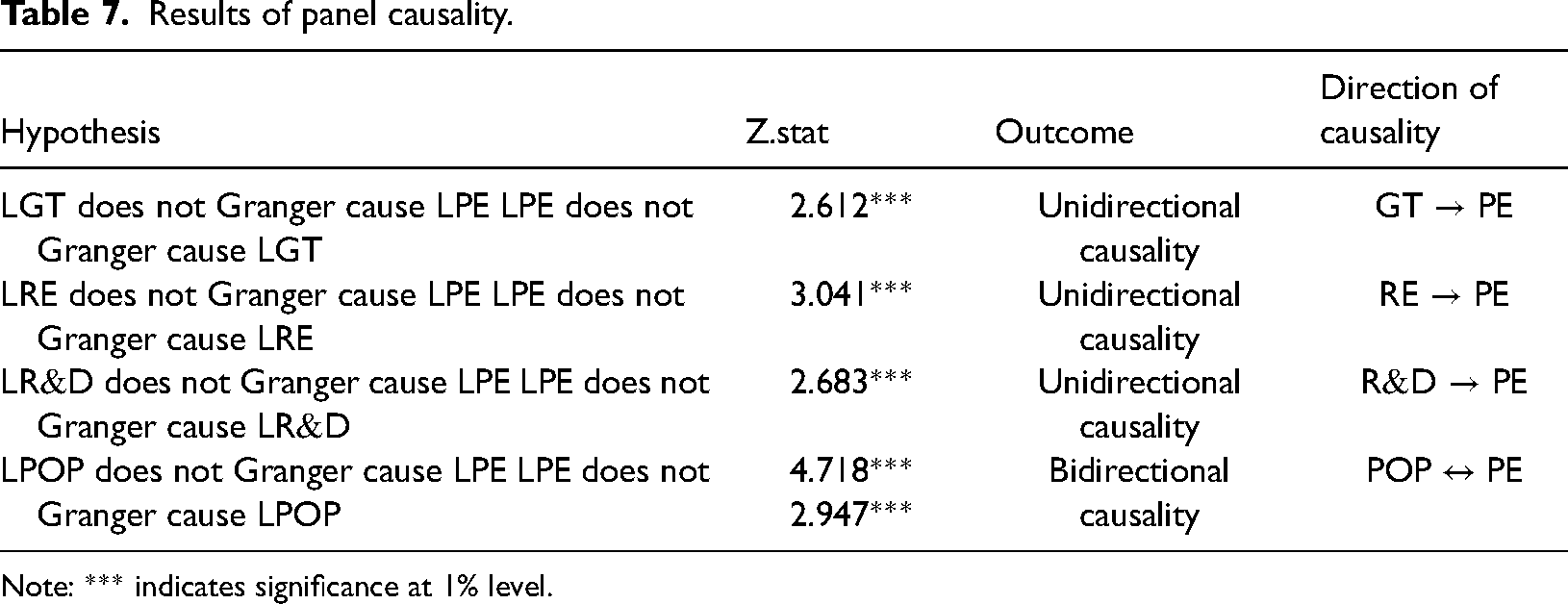
The present study applies panel causality proposed by Dumitrescu and Hurlin
52
to confirm the results. Table 7 confirms that the results of the causality test are similar to the outcomes of the CS-ARDL. The null hypothesis of the Dumitrescu and Hurlin causality test indicates that each specific variable (
Results of panel causality.
Note: *** indicates significance at 1% level.
Conclusion
The present study examines the efficacy of environmental policies to achieve environmental sustainability by employing advanced panel data estimation techniques for OECD countries. It is driven by the need to expand research on emission reduction and to lessen the negative effects that PM2.5 emissions have on the environment. This study demonstrates that all environmental policies are not effective at reducing PM2.5 emissions and that among them, R&D investment policies and green taxes through fiscal policy have a decreasing effect and are effective at reducing PM2.5 emissions. Fiscal policy seems to be effective in the case of OECD countries in reducing PM2.5 emissions as well as determining environmental sustainability. It seems adequate to establish emission taxes (green taxes) on these emissions. It is found to be more effective, in terms of emission reduction, to strengthen research rather than invest directly in particular technologies. However, while trying to lessen exposure to air pollution and its effects, economic incentive policies seem to be the least successful policy tactic.
This present study provides a significant impetus for other countries to develop emissions legislation using PM2.5 monitoring, necessitating an evaluation of the efficacy of environmental policies. As a result, this research adds to the empirical examination of environmental policies on polluting emissions by concentrating on PM2.5 rather than the more traditional scope of CO2 emissions, which introduces the additional problem of public exposure to pollution. By going beyond conventional policy research on climate change, this study broadens the field and provides decision makers with an important chance to select the most effective path of action.
Despite the fact that there isn’t a one-size-fits-all approach, the results allow us to categorize certain effective techniques in the OECD countries with regard to the creation of environmental legislation. Policy makers should modify their plans in accordance with the nature and unique features of their countries. However, this research can be used to draw some broad conclusions and suggestions. First, the effect is typically linked to the economic potency of the restrictions and the potential for distortions at the nexus of fiscal and economic incentive policies. Policies that offer incentives to a variety of businesses and customers (such as energy or pollution levies) are typically more cost-effective than those that focus on a single product, fuel, or technology (e.g. subsidies for electric cars).
The OECD countries should focus more on developing green technology investment policies, as this will facilitate the dissemination of green technology. Additionally, putting an emphasis on the creation of cleaner industries, lowering consumption of harmful items, and using cleaner technology change in behavior and ways of life are also crucial. Second, it appears that energy quotas or feed-in tariffs are the least successful strategy for lowering exposure to air pollution and its effects. Consumers must be guaranteed that the price of clean energy feed-in tariffs will remain constant for a set period of time. As a result, investing in renewable energy will be less expensive and risk-free for the energy conversion process.
Footnotes
Declaration of conflicting interests
The authors declared no potential conflicts of interest with respect to the research, authorship, and/or publication of this article.
Funding
The authors received no financial support for the research, authorship, and/or publication of this article.
