




Abstract
Few studies explored the interaction effect between policy instruments and the policy environment on environmental governance. Based on policy instrument theory, this paper conducts fuzzy set qualitative comparative analysis (fsQCA) to explore the combined effect of policy instruments and the policy environment on the environmental governance efficiency of local governance. This study found four effective configurations of local government environmental governance, which can be summarized as the mandatory mode and the cooperative mode, and three inefficient configurations that can be summarized as the out-of-control mode. The results show that the regions adopting the mandatory mode are economically underdeveloped, while the regions using the cooperative mode are developed. Besides, local government competition leads to the softening of policy instruments, while government-enterprise collusion exacerbates the failure of environmental policy instruments. This paper summarizes the effective modes and reveals the reasons for the low efficiency of local government environmental governance in China. The conclusions provide not only empirical evidence for the study of policy instrument theory but also beneficial insights for the selection of environmental policy instruments and environmental governance practice.
Keywords
Introduction
Since the promulgation of the environmental protection law of the People's Republic of China in 1989, environmental regulations have been strengthened. By 2019, 162,800 administrative penalties had been imposed, with fines of 11.88 billion yuan. 1 However, in 2020, China's Environmental Performance Index (EPI) score was 37.3, ranking 120th among 180 participating countries and regions. 2 Some studies also point out that China's environmental governance efficiency is generally low.1,2 It is worth exploring why environmental quality has not been effectively improved while environmental regulation has been increasing. What affects the environmental governance efficiency of local government? The purpose of this paper is to answer this question.
Collaboration is a common rallying cry when making decisions about the environment. 3 The report of the 19th National Congress of the Communist Party of China explicitly expressed an aim to “build an environmental governance system that is government-led and enterprise-dominated and that includes social organizations and public participation”. Collaboration is also one of the focuses of environmental governance research. 4 China's governance processes blur the distinction between the state and other actors, and the “shadow of the state” is a major factor in all efforts to address environmental issues. 5 That is, China's government plays a key role in all sectors of society, the government takes the lead in environmental governance, and its choice of policy instruments determines the degree of participation of other actors. Policy instruments are an indispensable means for governments to achieve specific policy goals, and sensible choices of policy instruments help achieve policy goals. 6 Previous studies have paid much attention to examining the effects of different policy instruments on environmental governance.7–9 However, research on the combined effects of policy instruments has been insufficient, and less attention has been given to the policy environment.
Environmental governance is a complex issue with “multiple concurrent causal relationships”. If only a certain policy instrument is focused on or the policy environment is ignored, then this will inevitably lead to one-sidedness or fragmentation of the interpretation of the results. Traditional statistical methods are mainly used to identify the effect of a single factor, and their ability to explain complex social problems seems weak. 10 Qualitative comparative analysis (QCA) is based on a holistic perspective; it uses the idea of set theory to discover the universal characteristics of multiple cases, focuses on the impacts of multiple factors on the results, and clarifies the complex issue of causality. 11
This paper focused on the overall perspective of the government, business and society, based on policy instrument theory, and used fuzzy set qualitative comparative analysis (fsQCA) to explore the combined effect of policy instruments and the policy environment on the environmental governance efficiency.The contributions of this paper as follows. First, previous studies have focused on only one policy instrument or ignored the policy environment, while this study explores the multiple interaction effects between policy instruments and the policy environment. Second, few studies used QCA to explore the combined effect of different policy instruments, we introduces QCA into the research field of policy instruments combination earlier. Third, this study not only provides a new explanation for the inconsistent conclusions on policy instrument effects but also useful implications for the selection of policy instruments and environmental governance practices in China.
This paper proceeds as follows. The next section covers the literature review. Then research design is developed, including research method, variable measurement, variable calibration and truth table construction. The research results are given next, including necessity analysis of individual conditions, sufficiency analysis of condition combination and robustness test Then the results are discussed. Finally, the conclusion and enlightenment are provided.
Literature review
Environmental regulations continue to increase in China, but their policy goals have not been effectively achieved, resulting in the dilemma of low environmental governance efficiency. Policy instruments include all types of means used to achieve specific policy goals, and their sensible selection helps achieve policy goals. 6 Therefore, the optimal choice of environmental policy instruments is helpful to improve environmental governance efficiency. The key to the selection of policy instruments is whether they match the policy environment on which they depend. 12 That is, policy instruments and the policy environment jointly determine the achievement of environmental governance goals. Next, a literature review will be conducted from the two aspects of environmental policy instruments and the policy environment, and the analysis framework of this study will be constructed.
Environmental policy instruments
Environmental policy instruments are various means to achieve environmental governance goals. At present, environmental policy instruments can be divided into three main categories: command-and-control instruments (CCIs), market-based instruments (MBIs) and information-based instruments (IBIs). 13 CCIs are a series of environmental laws and regulations promulgated by the state to intervene in relevant production activities directly and constantly, ultimately affecting the behaviour of polluters; MBIs internalize the externalities of environmental pollution and control and govern environmental pollution through market means; IBIs are informal environmental regulations that are created on the basis that the government, enterprises, and the public will voluntarily participate in implementation. 13 Regarding CCIs, Peng asserted that controlling regulation has a more significant influence on green innovation intention, 14 while Zhao's study showed that command-and-control regulations have neither improved environmental efficiency nor reduced CO2 emissions. 15 Regarding MBIs, Gao suggested that increasing pollution charges has a significant and positive effect on controlling industrial waste SO2, 16 while Luo asserted that market-based regulation negatively affects green innovation in China. 17 Regarding IBIs, Peng's study showed that informal regulation has a significant “Porter's effect” on green innovation, 18 while Walter suggested that the popularized use of information-based policy shifts costs to consumers and yields only minor environmental benefits. 19 In addition, some studies concluded that a single separate policy instrument will likely fail to achieve the expected results and that coordination between two or more policy instruments is essential to achieve success. 20 Milhorance et al. 21 analysed the patterns of coordination of a set of policy instruments promoted by Brazil's National Adaptation Plan. Liu et al. 22 pointed out that there is widespread consensus that policy mixes can effectively drive the diffusion of new energy vehicles. Focusing on research on environmental policy instruments, there are clearly many studies on their effects, but the conclusions are not consistent.
Policy environment
The policy environment refers to complex factors that affect the selection of policy instruments by the government. Policy instruments are not predetermined but are bounded by government capacity and contextual complexity. 23 The key to policy instrument selection is to match the policy environment. 12 The policy network approach in policy instrument theory states that the selection of policy instruments is not conducted in a vacuum but rather depends on the policy environment. 24 A policy network is a network that connects the government and other stakeholders to participate in the policy process; its essence is the interaction of stakeholders to find solutions to policy problems and achieve common goals and values. 25 For the government, government competition (GC), including growth competition, fiscal competition and investment competition of the local government, all have a significant inhibitory effect on the efficiency of green development. 26 For the market, marketization requires firms to increase energy efficiency and improve environmental quality. Zhang identified that marketization degree (MD) and environmental regulation both significantly facilitate green productivity. 27 Social and public attention (PA) is conducive to assisting the government in strengthening the control of air pollution. 28 Besides, studies have shown that government-enterprise collision (GEC) is the main reason for challenges in environmental governance. 29 The stronger public appeals for environmental issues are, the greater the government's control over the handling of environmental pollution is, and government-citizen interaction (GCI) will help achieve environmental governance goals. 30 Accordingly, GC, MD, PA, GEC and GCI are important factors in the policy environment that affect the realization of environmental governance goals, while the policy environment is often ignored in the study of the policy instruments.
Analysis framework
The existing researches have showed that different environmental policy instruments and policy environments will affect the realization of environmental governance goals. It provides ideas for this paper, while still have some problems. First, most studies mainly focus on the impact of different policy instruments or policy environments on environmental governance, and few focus on their synergistic effect. Second, no consensus conclusions have been reached on the impact of policy instruments on environmental governance, due to neglect of the role of the combination of policy instruments or the policy environment. Third, few studies have used QCA to study the combined effects of different policy instrument.
To make up for the deficiencies of previous research, this study explores the multiple interaction effects between policy instruments and the policy environment based on policy instrument theory by using the fsQCA method. Specifically, this study mainly explores the synergistic effect of eight conditional variables (CCIs, MBIs, IBIs, GC, MD, PA, GEC and GCI) on environmental governance efficiency (EGE). The analysis framework is shown in Figure 1.
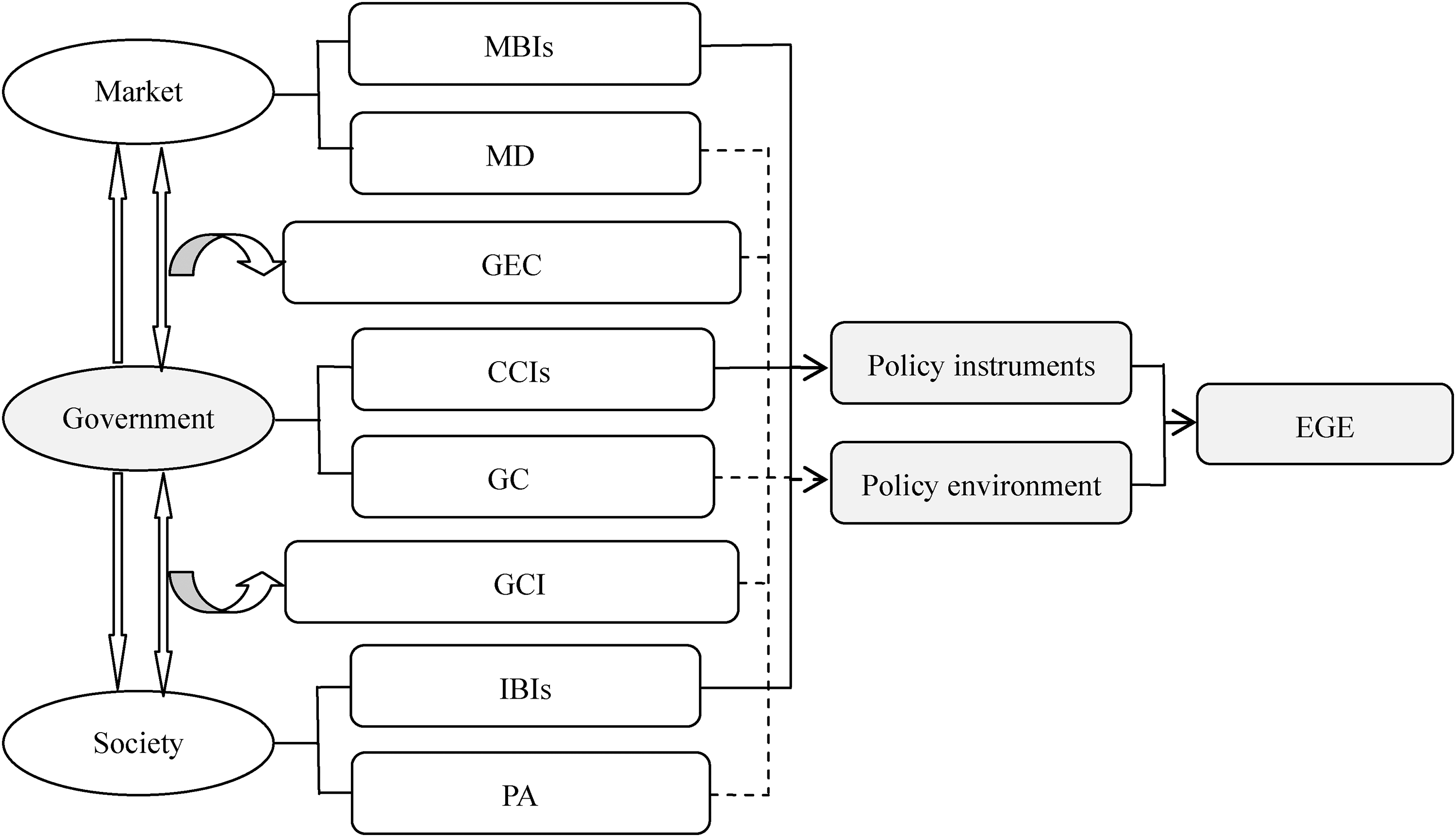
Impact mechanism of environmental governance efficiency.
Research design
In this paper, Chinese provincial governments are the units of analysis. Due to the serious lack of data on Hainan Province and the Tibet Autonomous Region, 29 provinces (cities and districts) were selected as the research sample. The research design of this paper includes four main parts, namely, research method selection, variable measurement, variable calibration and truth table construction.
Research method
QCA is a multicase comparative analysis method that integrates qualitative and quantitative research. 10 It is suitable for small and medium-sized samples and aims to examine the most typical and streamlined causal pathways to the outcome variables. 31 This paper uses the QCA method to explore the impact of complex factors on EGE, mainly based on the following advantages: (1) EGE has an issue with “multiple concurrent causality”. Regression analysis emphasizes the net effect of a single variable and cannot explain the interactions of complex factors, which is the advantage of QCA. (2) There are many ways that environmental governance efficiency can be affected. QCA emphasizes “result equivalence”, and different paths play the role of “reaching the same goal”. (3) There is asymmetry in environmental governance, and QCA advocates asymmetry. For example, public participation can help improve environmental governance efficiency. Traditional statistical methods consider that the absence of public participation will result in inefficient environmental governance. In fact, without public participation, government environmental regulation can also improve environmental governance efficiency.
QCA mainly includes crisp set QCA (csQCA), fuzzy set QCA (fsQCA) and multivalue QCA (mvQCA). 10 This paper use of fsQCA is based on the following considerations: (1) csQCA is used to address variables of two categories, mvQCA is a method to expand csQCA to deal with variables of multiple categories; fsQCA introduces the degree of membership to reflect different degrees of some attributes in cases, and its value can be any number in the range of 0 to 1. (2) fsQCA overcomes the defect that csQCA and mvQCA require all variables to be classified variables and can reasonably explain the real situation of the case. (3) The variables in this paper are mostly continuous variables; therefore, fsQCA is most suitable.
Variable measurement
Command-and-control instruments (CCIs)
China is an authoritative country, and the government's administrative punishment of enterprises that violate environmental policy is an important CCI. Referring to previous studies, CCIs are represented by the number of enterprises that receive administrative punishment for violating environmental policy as a percentage of the total number of regional industrial enterprises. 32 The number of administrative punishments of enterprises for violating environmental policy comes from the environmental supervision records of the Public Environmental Research Center. The number of industrial enterprises comes from the China City Statistical Yearbook.
Government competition (Gc)
The number of promotions for government officials is basically fixed in China. Empirical studies have shown that the more counties a city contains, the more intense the competition for county officials is. 33 According to the results of empirical research, this study uses the number of cities in a province to reflect government competition. The number of cities in a province is from the China City Statistical Yearbook.
Market-based instruments (MBIs)
Punitive fees and incentive subsidies are important ways to regulate the sewage behaviour of enterprises based on market function. The data on subsidy incentives are difficult to obtain, while pollution charges were early MBIs of environmental governance. Therefore, based on existing research, MBIs are measured by the ratio of pollution charges to the number of industrial enterprises. 32 The pollution charge data come from the China Environmental Yearbook.
Marketization degree (Md)
MD refers to the extent to which the market plays a role in resource allocation. According to the mainstream measurement methods at present, the marketization index is used to measure MD, and the data come from China's Province Marketization Index Report (2018). 34
Information-based instruments (IBIs)
Environmental information disclosure is a new instrument of environmental governance in the big data era. As an important IBI method, environmental information disclosure can incentivize polluting enterprises and environmental protection departments and encourage more interest groups to actively participate in environmental governance. 9 The Pollution Information Transparency Index (PITI) is the most objective and comprehensive evaluation of government environmental information disclosure in China. 35 Based on existing research, this study uses the average PITI value of the cities that belong to the same province to reflect IBIs. 36 The data come from the Annual Report of the PITI for 120 cities (2017–2018). 35
Public attention (Pa)
Public attention can reduce environmental pollution. 28 There are many ways in which the public pays attention to the environment. The impact of new media channels such as Weibo, WeChat and internet searches about environmental governance is significantly higher than that of traditional participation methods such as letters, petitions and NGOs, and internet searches work best with new media. 37 Drawing on existing research, this study entered the keyword “environmental pollution” in the Baidu index, counted its daily search averages and controlled the number of internet users to reflect PA. 30
Government-enterprise collusion (GEC)
GEC is a hidden action that is difficult to directly observe. Existing studies have mainly looked for alternative variables based on the personal characteristics of officials, such as their tenure, whether they are locally promoted and whether they are locals. 38 This study uses officials’ term and local promotion as a proxy for GEC. The data come from the Personal Characteristics Database of the China Stock Market & Accounting Research Database (CSMAR).
Government-citizen interaction (GCI)
In a unique step, people.cn created a Local Leader Message Board for the public to express demands. Internet messages also received considerable attention from government agencies at all levels. Twenty-six provinces have established a fixed working mechanism for replying to messages, which provides a system guarantee for timely responses to public demands. Drawing on existing research, this paper uses “reply” messages from the public to the provincial party secretary and governor on environmental protection to reflect GCI. 39
Environmental governance efficiency (EGE)
Data envelopment analysis (DEA) is an ideal evaluation method that is increasingly popular for assessing efficiency. 40 DEA consists of three main core elements, specifically, the evaluation unit, evaluation index (input and output index), and linear equation. 41 It has many models, and based on existing research, this paper uses the improved Super-SBM to measure environmental governance efficiency. 39 The input indicators selected are water conservancy, environmental and public facility management personnel and investment in environmental governance. The expected outputs selected are the green area and comprehensive utilization rate of general industrial solid waste. The unexpected outputs include industrial wastewater discharge and industrial sulphur dioxide discharge. The data are from the China City Statistical Yearbook and China Environmental Statistics Yearbook. Table 1 reports the descriptive statistics and correlation coefficient matrices for all the variables.
Descriptive statistics and correlations.
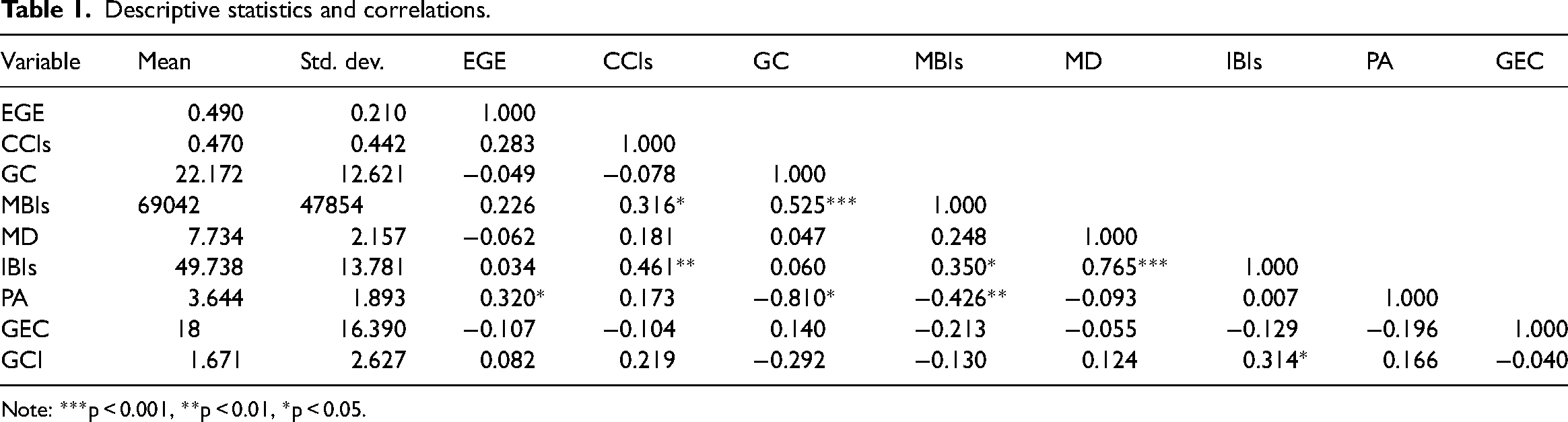
Note: ***p < 0.001, **p < 0.01, *p < 0.05.
Variable calibration
The most significant difference between QCA and traditional quantitative analysis is that QCA recalibrates the original variables and transforms them into set membership. That is, QCA measures whether a case belongs to a set. The use of fuzzy sets to transform variables into membership generally requires setting three thresholds: full nonmembership, the crossover point and full membership. 42
GEC is measured by the term of locally promoted officials. If an individual is not a locally promoted official, then they cannot easily collude with an enterprise in the short term. Therefore, the full nonmembership threshold is set at 0. Studies have shown that the average term of officials is 3 years, 43 so the crossover point threshold is set at 36 months. In a five-year term, officials need the first few years to build relationships, and it is relatively easy to have a collusive relationship near the fifth year, 38 so the full membership threshold is set at 60 months.
Since other variables are continuous variables, to prevent subjectivity during the calibration process, following existing studies, this study sets the upper quartile (the 75th percentile), median (the 50th percentile) and lower quartile (the 25th percentile) of each variable as full membership, the crossover point and full nonmembership, respectively.10,44 The specific thresholds for calibration are shown in Table 2.
Thresholds for calibration.
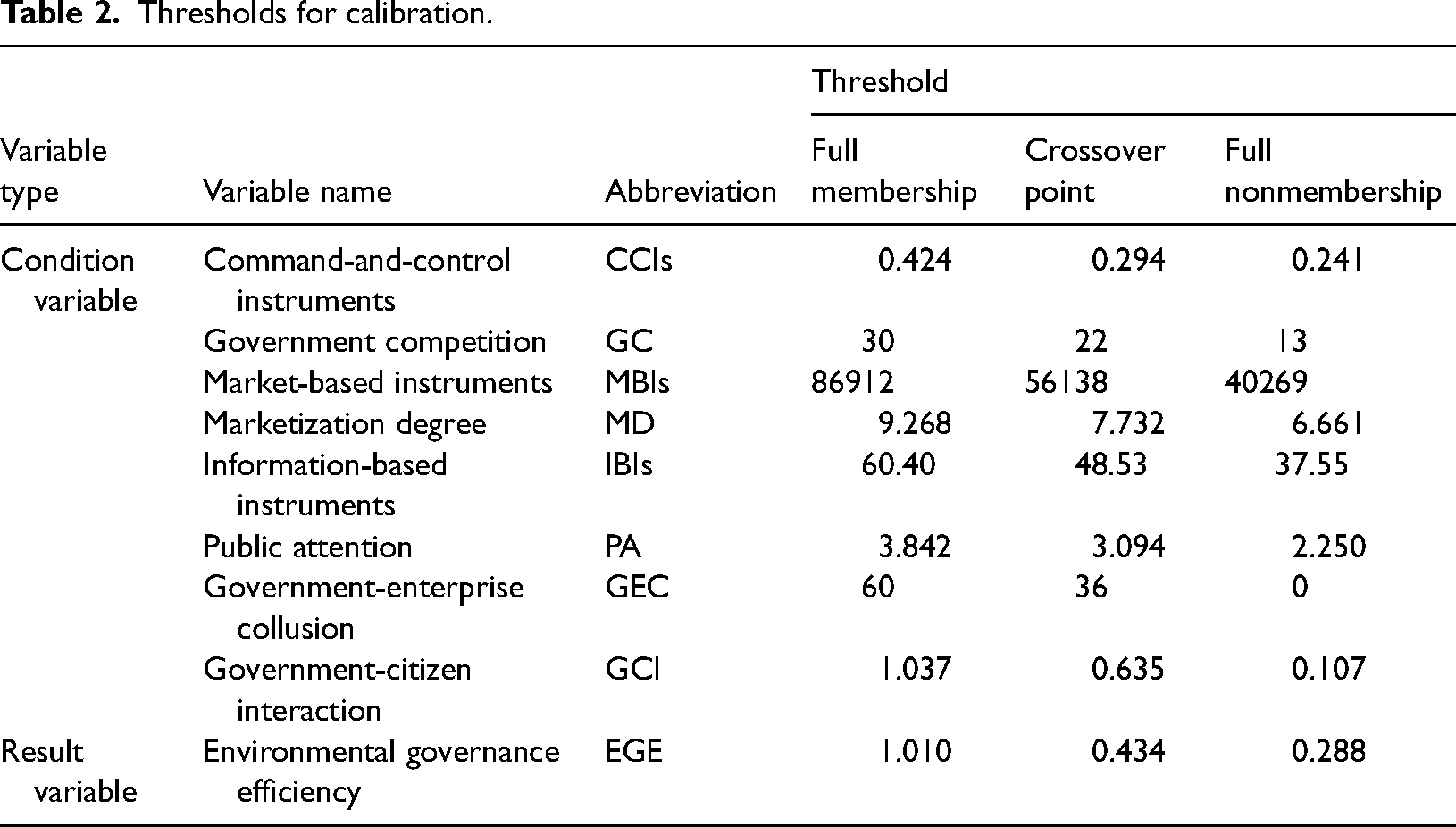
Last, to examine what causes lead to the absence of high EGE, we also create measures of membership in the sets of cases with low EGE. Low EGE is simply coded as the negation of the calibration of EGE described in Table 2, which are an EGE of 0.288 = full membership, EGE of 1.010 = full nonmembership, and the crossover set at 0.434.
Truth table construction
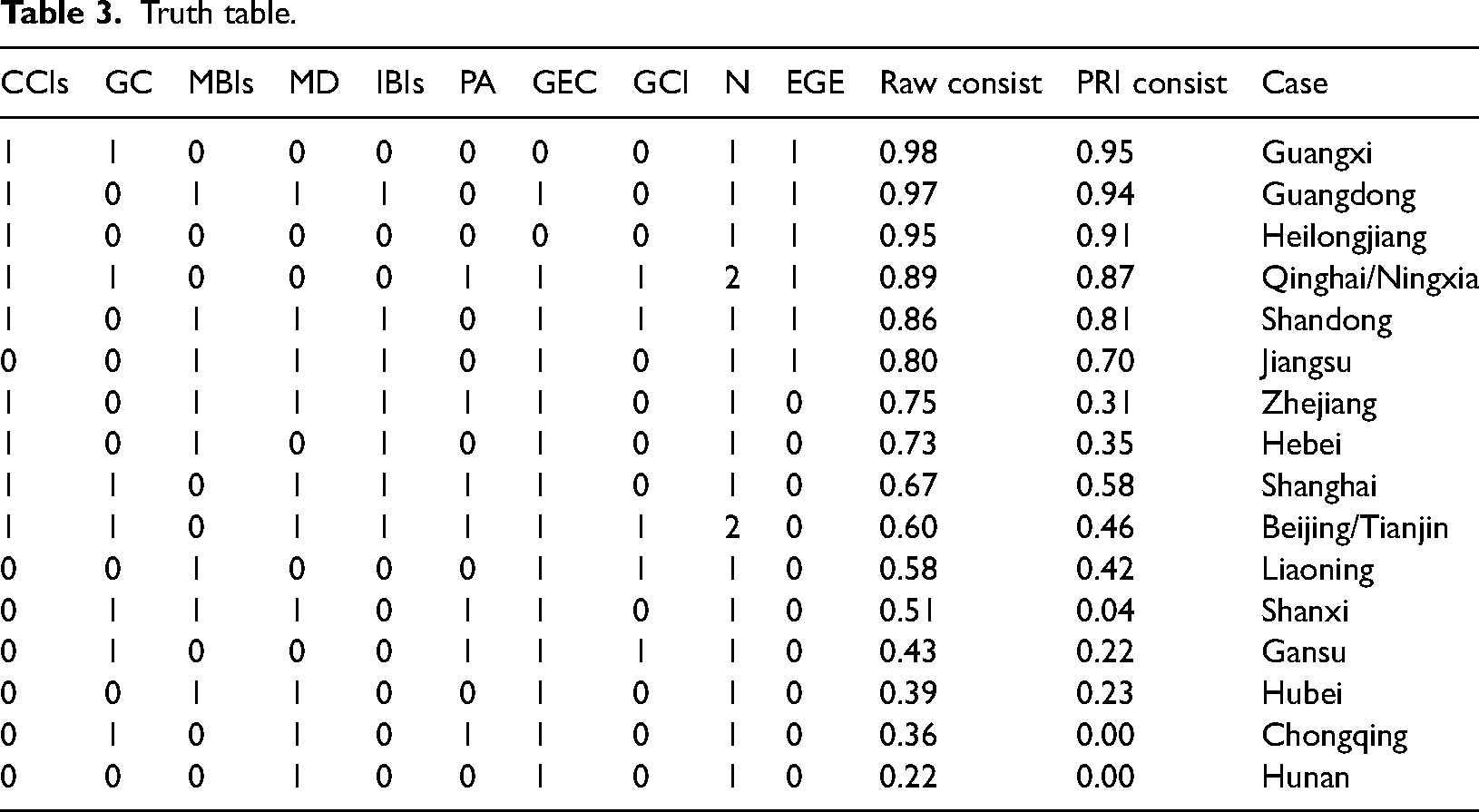
A truth table is a combination of all the antecedent conditions that can lead to a result. If there are k condition variables, then theoretically, there are 2k configurations that lead to the result. 42 QCA screens out the configurations that explain the results by setting case frequency thresholds and consistency thresholds. Following existing research, the case frequency threshold of this study is set at 1, and the consistency threshold is set at 0.8. 10 The truth table is seen in Table 3 for details.
Truth table.
Research results
Necessity analysis of individual conditions
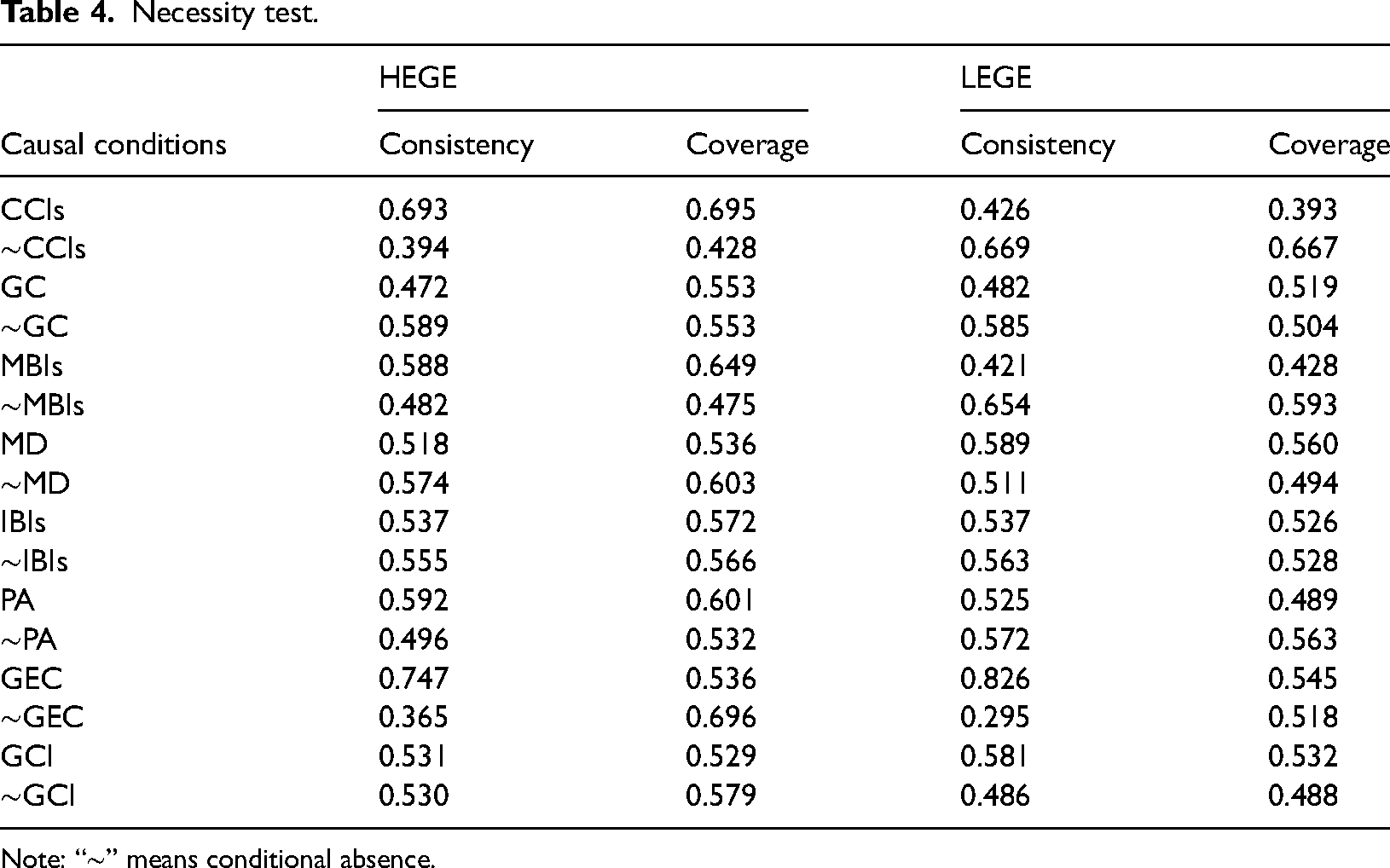
Necessary condition analysis examines whether the result variable set is a subset of the condition variable set, and consistency is key to measuring the necessary conditions. 45 In general, when the consistency is above 0.9, a condition variable is a necessary condition of the result variable. Table 4 presents the results of the necessity test The consistency of each condition variable is below 0.9, which indicates that the high EGE (HEGE) and low EGE (LEGE) cannot be determined individually by CCIs, GC, MBIs, MD, IBIs, PA, GEC or GCI. This result reflects that the impact of each condition variable on the efficiency of local government environmental governance is interdependent, and the impact of the combination of condition variables needs further examination.
Necessity test.
Note: “∼” means conditional absence.
Condition combination sufficiency analysis
Following mainstream research, this article mainly reports intermediate solutions and adds parsimonious solutions.10,46 If an antecedent condition appears in both the parsimonious solutions and intermediate solutions, then it is a central condition; if an antecedent condition appears only in the intermediate solutions, then it is a peripheral condition. 10 The following is the analysis of the configurations of HEGE; later, the configurations of LEGE are analysed.
Configurations of high environmental governance efficiency (HEGE)
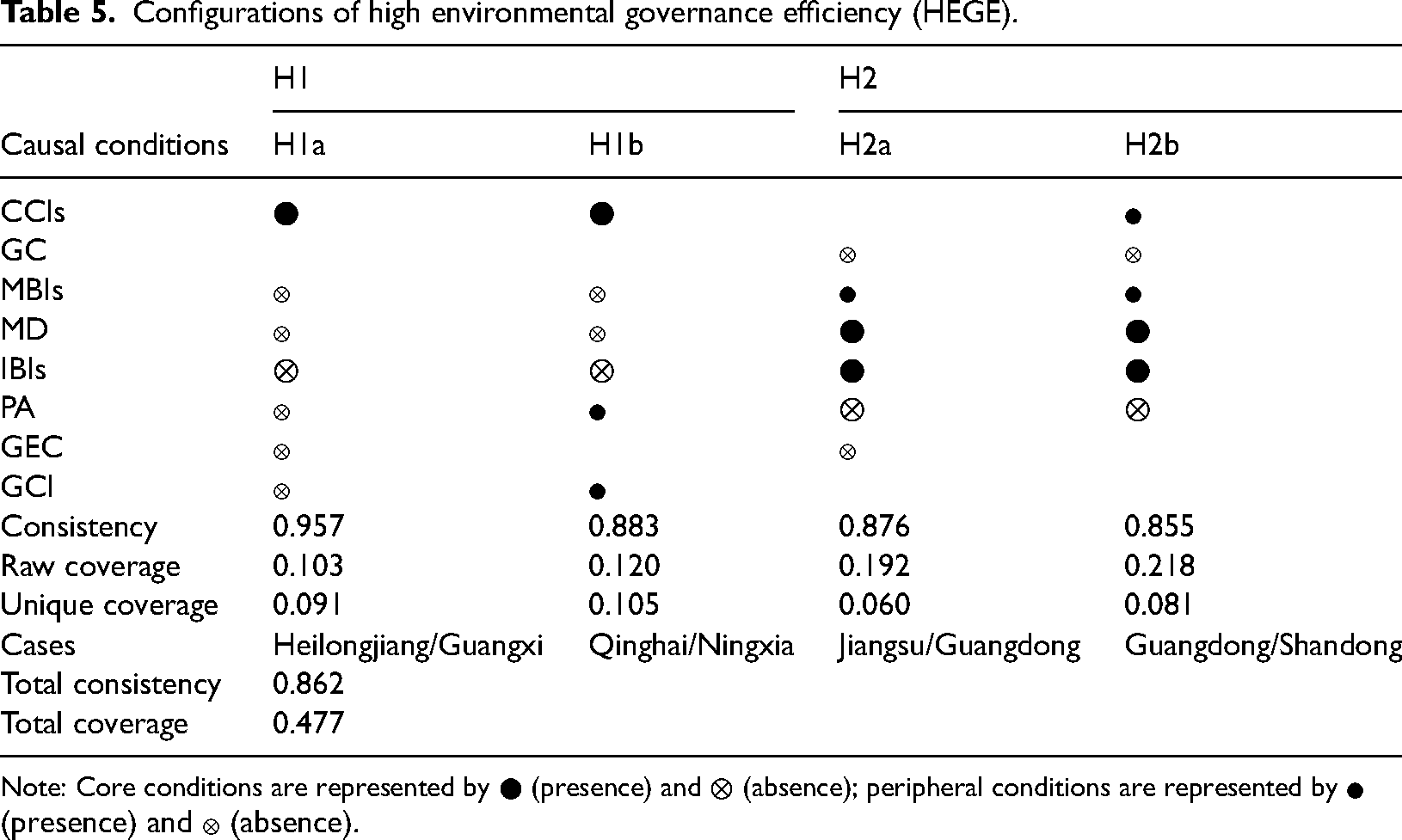
There are four types of efficient configurations of local government environmental governance, as shown in Table 5 for H1a, H1b, H2a and H2b. We see that the overall consistency is 0.862, which reaches the theoretical threshold of 0.8. The overall coverage reaches 0.477, which indicates that these four configurations can adequately explain 47.7% of all actual cases. That is, these four configurations are sufficient conditions for local government EGE. In addition, the two paths in H1 have higher consistency and unique coverage, which means that H1 makes the largest contribution to the model solution.
Configurations of high environmental governance efficiency (HEGE).
Note: Core conditions are represented by ● (presence) and ⊗ (absence); peripheral conditions are represented by ● (presence) and ⊗ (absence).
From the perspective of each configuration, H1 reflects the importance of CCIs on EGE when IBIs are weak, and H2 reflects the synergistic effect of MBIs and IBIs on EGE, which is based on a high degree of marketization. Specifically, in H1a, CCI presence and IBI absence are the core conditions; the peripheral condition is that MBIs, MD, PA, GEC and GCI are not present, and GC presence or absence does not affect the results. The cases that explain H1a are Heilongjiang and Guangxi. H1b differs from H1a in that peripheral conditions PA and GCI do not present, and GEC does not play a role. The cases that explain H1b are Qinghai and the Ningxia Hui Autonomous Region. In H2a, the presence of MBIs and MD and the absence of PA are the core conditions, while the peripheral conditions are the presence of MBIs and the absence of GC and GEC. The cases that explain H2a are Jiangsu and Guangdong. Path H2b differs from H2a in that the absence of GEC changes to the presence of CCIs, which indicates that these two conditions have a substitutive relationship.
From the perspective of all the configurations, CCIs are presented most often, and they are presented in paths H1a, H1b, and H2b. This reflects that CCIs play an important role in environmental governance in China. MBIs and IBIs have synergistic effects, which depend on high MD, as shown in H2a and H2b. GC and GEC do not appear or play a role in all pathways, indicating that the absence of GC and GEC is beneficial to EGE.
Configurations of low environmental governance efficiency (LEGE)
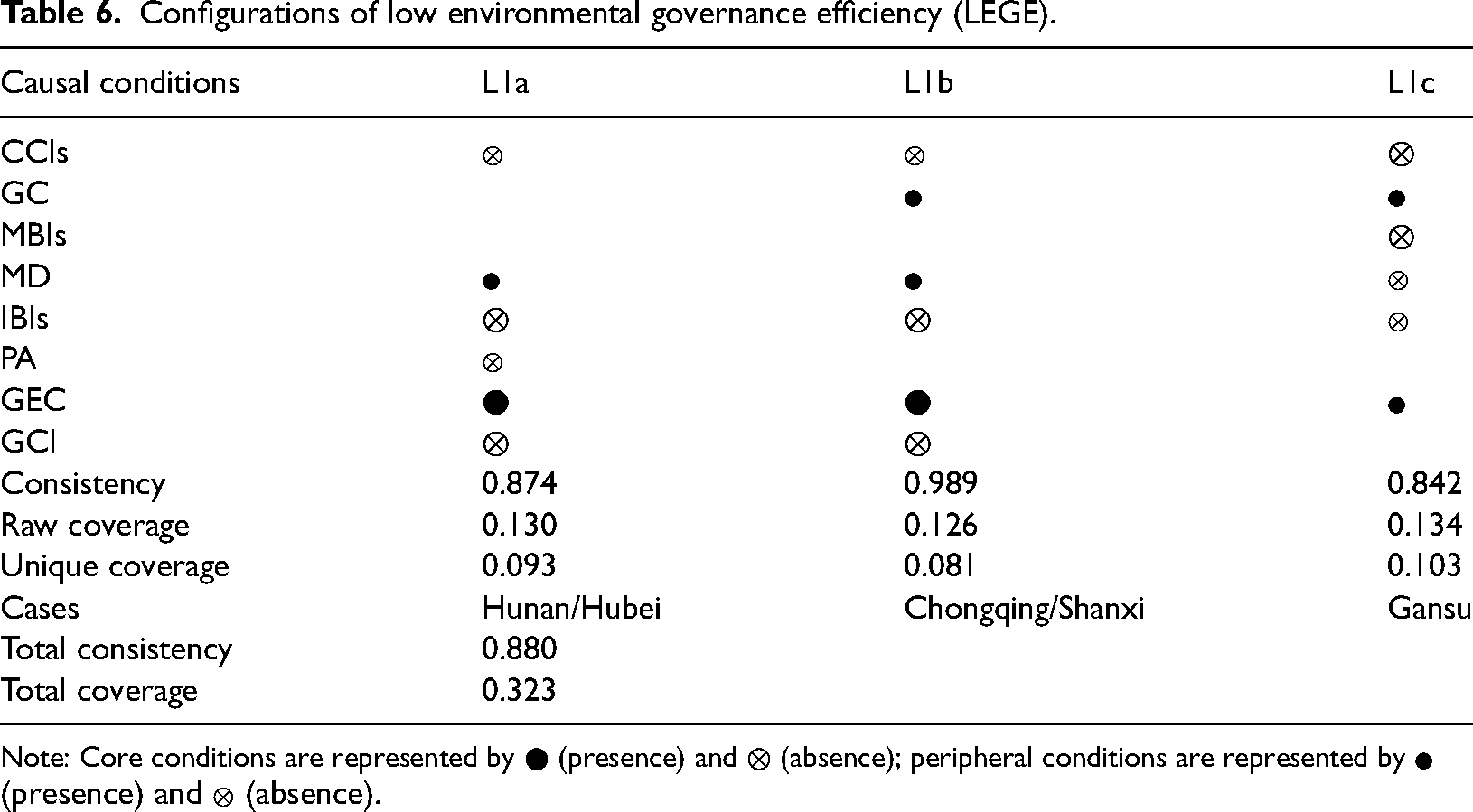
There are three configurations for inefficient local government environmental governance, as shown in Table 6. The overall consistency is 0.88, which is above the theoretical threshold of 0.8, and the overall coverage rate is 0.323, which indicates that these three paths can explain 32.3% of all actual cases. That is, these three paths can be regarded as sufficient conditions for inefficient local government environmental governance.
Configurations of low environmental governance efficiency (LEGE).
Note: Core conditions are represented by ● (presence) and ⊗ (absence); peripheral conditions are represented by ● (presence) and ⊗ (absence).
From the perspective of each configuration, it is seen in L1a that the presence of GEC and the absence of IBIs and GCI are the core conditions, while the peripheral conditions are the presence of MD and the absence of CCIs and PA. The cases that can explain L1a are Hainan and Hubei. The difference between L1a and L1b is that the absence of PA in path L1a changes to the presence of GC in path L1b, which implies that these two conditions have a substitutive relationship. The cases that can explain L1b are Chongqing and Shaanxi. In path L1c, the absence of CCIs and MBIs are the core conditions, while the peripheral conditions are the presence of GC and GEC and the absence of MD and IBIs. The case that can explain L1c is Gansu Province.
From the perspective of all the configurations, we see that CCIs, MBIs and IBIs are absent from or do not work in all the configurations. In addition, GC and GEC present more frequently. All the configurations reflect that LEGE is caused by the failure of policy instruments and the presence of GC and GEC.
Robustness test
Drawing on the existing research, a robustness test is performed mainly by adjusting the consistency level and changing the calibration parameters.47,48
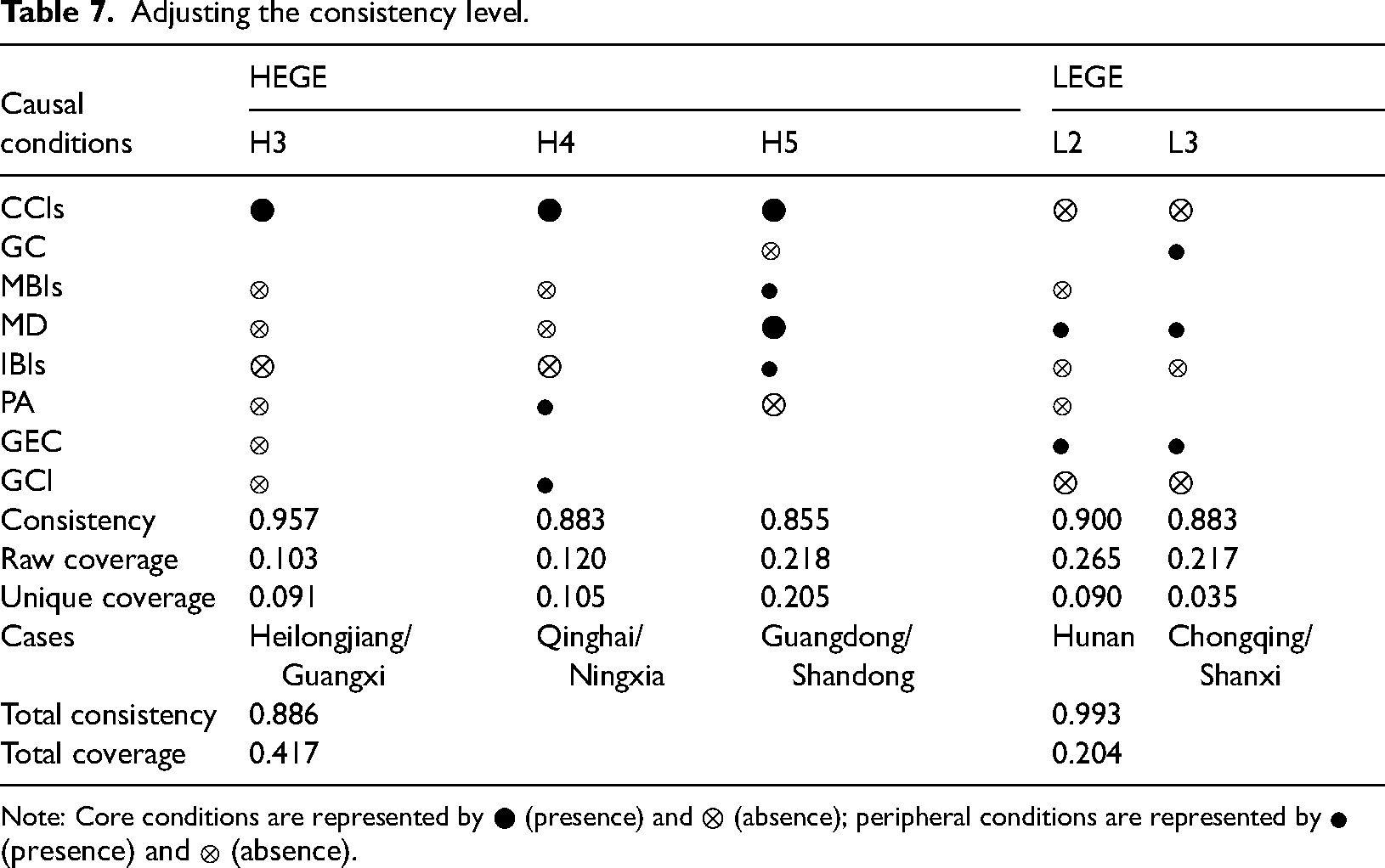
We increase the consistency level from 0.80 to 0.85. The test results are shown in Table 7. Compared with the original configurations, the effective configurations of local government environmental governance screen out H2a, and the inefficient configurations of local government environmental governance screen out L2. The main explanations and the overall coverage and consistency do not change significantly. Therefore, the research results are reliable.
Adjusting the consistency level.
Note: Core conditions are represented by ● (presence) and ⊗ (absence); peripheral conditions are represented by ● (presence) and ⊗ (absence).
For the variable calibration, the full nonmembership and full membership thresholds of the calibration parameters are changed from 25% and 75% to 10% and 90%, respectively. The threshold is reduced by 15% and recalibrated for robustness testing. The test results are shown in Table 8. The interpretation of the main configuration and the overall coverage and consistency do not change significantly. Therefore, the research results are robust and credible.
Changing the calibration parameters.
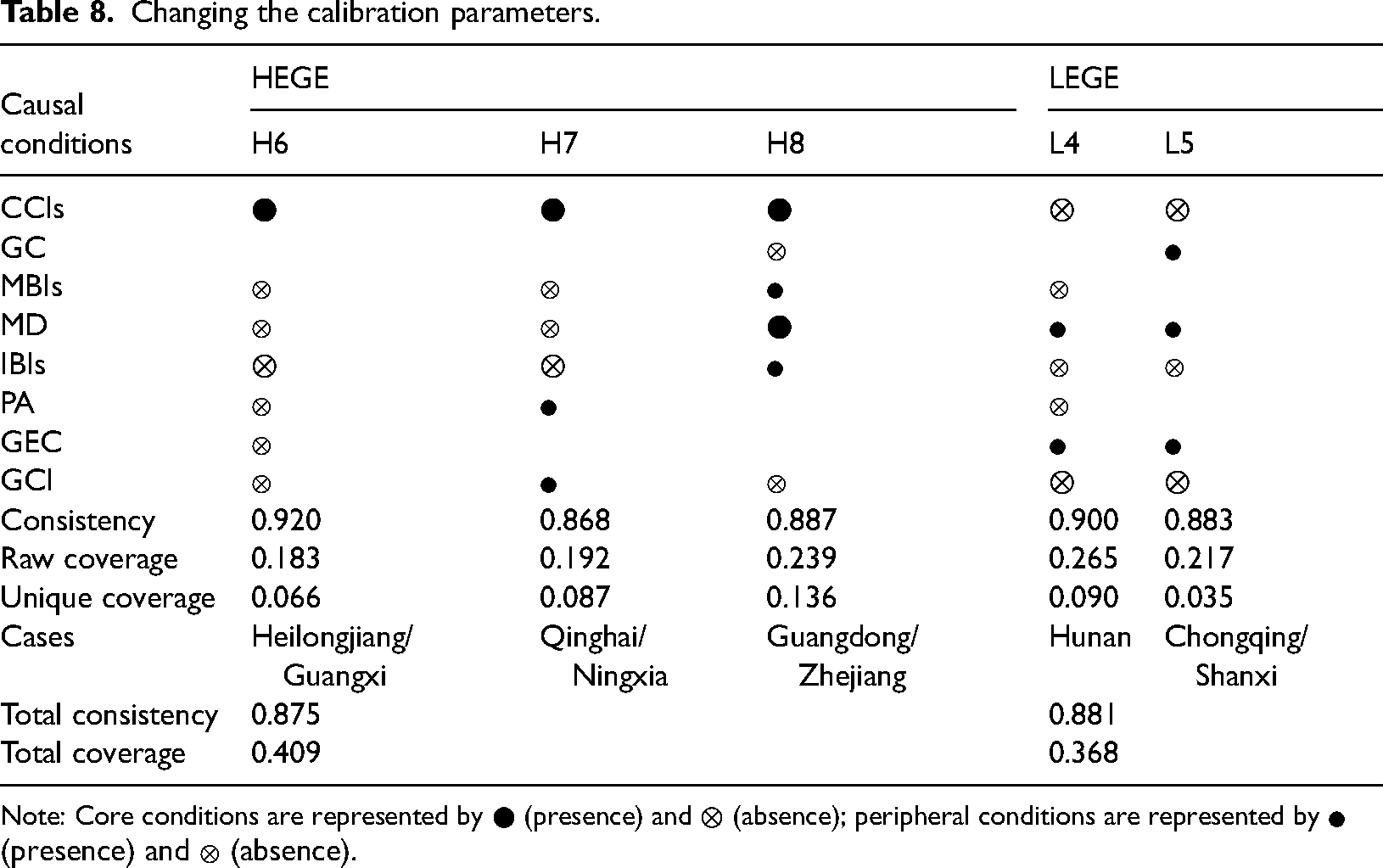
Note: Core conditions are represented by ● (presence) and ⊗ (absence); peripheral conditions are represented by ● (presence) and ⊗ (absence).
Discussion
The results show that there are four effective configurations and three inefficient configurations for local government environmental governance, which reflects that multiple concurrent factors affect the EGE of local government. According to the configurations and the underlying explanatory logic, this paper summarizes two modes of HEGE (mandatory mode, cooperative mode) and one mode (out-of-control mode) of LEGE. Based on the research results, further discussion is presented below.
Mandatory mode (H1a, H1b)
The mandatory mode mainly refers to the dominance of CCIs in achieving environmental governance goals. In this study, H1a and H1b are generalized as the mandatory mode. H1a, in particular, directly reflects the leading role of CCIs. We see that CCIs appear to be a core condition, and other conditions are absent. That is, CCIs can effectively improve EGE without relying on the other conditions. In H1b, CCIs still appear to be a core condition, while PA and GCI appear to be peripheral conditions. In addition, the unique coverage of H1b is greater than that of H1a. This suggests that the dominant role of CCIs, combined with high PA and frequent GCI, contributes more to the improvement of EGE. Because public concern about environmental issues and active expression of environmental demands attract government attention, a good GCI is more conducive to improving EGE. The cases that can explain the mandatory mode are Heilongjiang, Guangxi, Qinghai and Ningxia. The economy of these areas is relatively underdeveloped. That is, CCIs, as a traditional policy tool, play an irreplaceable role in areas with low MD. The policy implication is that although the current environmental governance in economically underdeveloped areas is dominated by CCIs, it is necessary to improve the policy environment and optimize policy instruments to achieve environmental governance goals.
Cooperative mode (H2a, H2b)
The cooperative mode refers to the participation of multiple actors in environmental governance, such as governments, enterprises, and the public. H2a and H2b can be summarized as the cooperative mode. In H2a, MBIs and IBIs are present together, and MD is present as a core condition. This suggests that MBIs and IBIs play a synergistic role in improving EGE, which depends on higher MD. H2b differs from H2a by increasing the presence of CCIs, and the unique coverage of H2b is higher than that of H2a. This suggests that the synergy of CCIs, MBIs and IBIs is more conducive to improving EGE. That is, the combination of CCIs, MBIs and IBIs can promote collaborative governance among government, business and the public to achieve the goals of environmental governance. The cases that can explain the cooperative mode are Jiangsu, Guangdong and Shandong. These provinces are located in the eastern region, where the economy is doing relatively well. That is, areas with better economic development mainly achieve environmental governance goals through cooperation. This is consistent with the result that MD is present in both H2a and H2b and is a core condition. The policy implication of this conclusion is that a combination of policy instruments should be used in environmental governance, which cannot be separated from a good policy environment.
Out-of-control mode
The out-of-control mode refers to the failure of policy instruments resulting in inefficient environmental governance. L1a, L1b and L1c can be summarized as out-of-control mode. It is seen that in these three configurations, CCIs, MBIs and IBIs are all absent, and GC and GEC are more present. L1c has the highest unique coverage, indicating that this configuration can best explain LEGE. Specifically, in L1c, CCI and MBI absences are core conditions, while IBI absence and GC and GEC presence are peripheral conditions. This shows that CCIs, MBIs and IBIs are not well used in local government environmental governance, which leads to LEGE, while GC and GEC exacerbate LEGE. Existing studies have also shown that the race to the bottom of local government environmental regulations is an important reason for the failure of environmental governance. 49 Local governments shield enterprises from punishment for environmental pollution, and enterprises contribute fiscal revenue to local government, which leads to GEC and makes environmental governance difficult. 50 The cases that can explain the out-of-control mode are Hunan, Hubei, Chongqing, Shanxi and Gansu. These provinces are mainly distributed in the central or western regions. These areas have low environmental regulation. The policy implication is that environmental regulation should be strengthened and a good policy environment created to prevent the failure of policy instruments.
Conclusions and implications
Based on policy instrument theory, this study uses fsQCA to explore the combined effect of policy instruments and the policy environment on the environmental governance efficiency of local governance. The research conclusions and implications are as follows.
Conclusions
First, multiple concurrent factors affect EGE. No single condition variable is a sufficient or necessary condition that affects EGE. That is, HEGE and LEGE are not caused by a single factor but are the results of multiple factors. This paper identified four configurations (H1a, H2a, H1b, and H2b) for HEGE, which are summarized as the mandatory mode and the cooperative mode. At the same time, three configurations (L1a, L1b and L1c) were found for LEGE, which are summarized as the out-of-control mode. Therefore, both the effective and inefficient configurations of local government environmental governance reflect that all roads lead to Rome.
Second, policy instruments need to be optimized. CCIs still play a dominant role in local government environmental governance. This study found that CCIs are present in all three (H1a, H1b, H2a) configurations of HEGE. H1a directly reflects that CCIs can effectively improve EGE without relying on any conditions. This study named this the mandatory mode. CCIs’ authoritativeness, pertinence, and fast execution allow them to achieve environmental governance goals in the short term. However, they also lack flexibility and generally do not have long-term effects and even increase the possibility of rent-seeking, which results in government failure. In addition, this study found that the regions adopting the mandatory mode are relatively economically underdeveloped, while the regions using the cooperative mode are relatively developed. Therefore, policy instruments need to be optimized, and with the development of the economy, there is a trend of environmental governance shifting from the mandatory mode to the cooperative mode.
Third, the policy environment cannot be ignored. The function of policy instruments depends on the specific policy environment. PA and GCI can help CCIs improve EGE, and MBIs and IBIs to improve EGE require a higher MD. GC and GEC will invalidate policy instruments and make environmental governance inefficient. Therefore, the policy environment is crucial to the functioning of policy instruments. Existing studies ignore the policy environment, resulting in inconsistent research conclusions on the effects of policy instruments.
Implications
First, it is important to build a policy network system. It is necessary to construct the optimal policy network system of interaction between the policy environment and policy instruments. The government should create a platform for continuous communication, interaction and consultation among various subjects to form a well-developed policy environment. In this way, all interest groups can reach value consensus and achieve environmental policy goals through cooperation. At the same time, the combination of policy instruments should be optimized to prevent the defects of using a single policy instrument and should maximize the synergistic effect of using multiple policy instruments. The construction of a policy network system of “external coordination, internal synergism” will help improve EGE.
Second, the combination of policy instruments is important. At present, amidst insufficient changes in government functions, insufficient market maturity, and the underdevelopment of civil society, the use of traditional compulsory policy instruments to curb environmental degradation has legitimacy and inevitability. Indeed, CCIs even need to be strengthened at times. However, the new era must also keep up with the new situation, change the current pattern of China's overreliance on CCIs for environmental governance, and take advantage of the synergies of different policy instruments to complement one another. The new era also requires innovation in policy instruments. For example, big data governance is a new type of highly integrated policy instrument that requires not only the follow-up of supporting measures such as policies and resources of government departments but also cooperation with enterprises to improve big data technology and management and the participation and supervision of social forces. The optimal combination of environmental policy instruments can maximize the effectiveness of environmental resource allocation and efficiently achieve the goal of environmental governance through cooperative governance.
Third, it is important to shape the right policy environment. Regarding the government, it is necessary to improve the status of performance evaluations, breaking the “GDP-only” performance view. To avoid environmental regulation, the race to the bottom results in the softening of policy instruments. Regarding the market, it is necessary to ensure that it plays a fundamental regulatory role, promotes environmental protection marketization, internalizes the external effects of the environment, and creates a good institutional environment to prevent market failure. Regarding society, it is necessary to establish a healthy and harmonious public opinion ecology and for society to effectively play an external supervisory role in environmental governance. This depends on the extent of environmental information disclosure and guarantees citizens’ right to know. For the relationships among these subjects, as the leader, the government must improve its capabilities. On the one hand, it must maintain independence and avoid being captured by interest groups and entering into collusive relationships; on the other hand, it must actively respond to public environmental demands and create a healthy state of GCI. A good policy environment can improve the efficiency of environmental policy instruments and has great significance for the construction of environmental governance systems.
Limitations
This study also has some shortcomings, which need to be addressed in future research. First, the data sources are mainly secondhand data, and in-depth interviews and field surveys should be used to increase the data types in future studies. Second, policy changes over time are not considered, and further studies should focus on the impact of dynamic changes by supplementing the latest data. In addition, a variety of methods should be used to test robustness in future studies, such as different time periods and adding or removing conditions.
Footnotes
Acknowledgements
No.
Declaration of conflicting interests
The author declared no potential conflicts of interest with respect to the research, authorship, and/or publication of this article.
Funding
The author disclosed receipt of the following financial support for the research, authorship, and/or publication of this article: This work was supported by the National Natural Science Foundation of China, Fundamental Research Funds for the Central Universities, (grant number 71472078, 2020jbkyxs022).
