



Abstract
This study contributes to the existing body of knowledge by examining the nonlinear impact of remittance inflow on green growth. To analyze the short and long-run estimates, we have relied on the nonlinear autoregressive distributed lag and quantile autoregressive distributed lag models. The use of nonlinear autoregressive distributed lag and quantile autoregressive distributed lag models to analyze the impact of remittance inflow on green growth is an innovative approach that adds to the existing body of knowledge on this topic. The long-run results from the nonlinear autoregressive distributed lag suggest that a positive shock in remittance inflow improves green growth, while a negative shock reduces green growth. Moreover, foreign direct investment, research and development activities, environmental technology, and financial development encourage green growth. In the short run, the remittance inflow improves the green in the nonlinear model only, and foreign direct investment promotes green growth in linear and nonlinear models. The nonlinear quantile autoregressive distributed lag results show that, in the long run, green growth exhibits an asymmetric response to both positive and negative changes in remittance inflow, particularly at higher quantiles. Our findings will suggest appropriate policies to policymakers regarding the effective utilization of remittances to enhance green growth.
Introduction
The concept of green growth as a substitute growth model for the traditional growth model has gained considerable acceptance within the realm of international development. An obvious green economy idea was given by United Nations Environment Programme (UNEP). 1 According to this report, a green economy points out human and natural factors and can therefore create high-paying opportunities. Similarly, UNEP 2 broadened the green concept to include an economy that is resource-capable, low-carbon, and socially contained. So many discussions are taking place in the worldwide community regarding policy aims to encourage evolution to green growth. 3 Green growth is defined as promoting growth and development while maintaining the sources and environmental services on which well-being is dependent. 3 Income and employment growth in the case of a green economy should be established by public and private investments which decrease carbon emissions, enhance energy and resource effectiveness, and hinder biodiversity along with loss of ecosystem services.4,5
In recent years, the share of remittance sent home by emigrant workers has augmented dramatically. The inflow of remittance has increased from 50 Billion USD to 600 billion USD during 1970–2018. 6 Remittance inflows are significant due to their volume being three times greater than foreign aid worldwide. In low-income economies, remittance inflows constitute almost 6%–20% share of gross domestic product (GDP). Remittance inflows are proposed to give funding for small to medium-sized enterprises which would not be obtainable or, if obtainable, will be provided at an unaffordable interest rate. Remittance inflows can promote investment and, in this manner, encourage future economic growth. 7 If remittance inflows finance education as well as enhances human capital formation rates, then it can have a comparable positive impact in the medium to long term. 8 On the other hand, if the highly qualified workforce emigrates (brain drain), the latter influence will be invalid to some level. In the same way, as remittance inflows are employed to finance current consumption, this can result in more rapid inflation, along with a boost in the relative price of non-tradable. 9 The consequential increase in the real exchange rate can, in that case, hinder exports and have a negative economic growth influence.10,11 If remittance inflows promote individuals to substitute leisure for work, a harmful effect might also be exercised. Otherwise, if remittances crowd out private sector saving more than proportionately, it pursues as the remittance inflows effects on economic growth would be dissimilar on various timeframes.
Studies highlight various transmission channels through which remittance inflows influence the economy of receiving country.8,12 Remittance inflows are a fundamental source of foreign financing for the receiving economy that alleviates credit constraints, spurs investment, and thus contributes significantly to enhancing economic growth.13,14 Remittance inflows also help the economy during recessions as they assist as insurance apparatus, boost consumption, and increase disposable income. 15 Conversely, remittance inflows are attached with some negative effects, such as it decreases the labor supply in the domestic economy.16,17 Remittance inflows can influence environmental performance via the aggregate demand channel. Previous studies denoted that an upsurge in remittance inflows significantly enhances disposable income, consumption, and level of saving in the domestic economy. An upsurge in the level of consumption could trigger aggregate demand and an upsurge in saving can increase the level of investment in the economy. Thus, an increase in remittance inflows may increase economic growth. 7 Moreover, remittance inflows provide financial support to the domestic economy that contributes significantly to increasing economic growth.18,19
Despite the significant importance of remittance inflows for the environment and green growth, the existing literature is found silent on the nexus between remittance inflows and green growth. However, a bulk of studies are there exploring the impact of remittance inflows on economic growth.20,21 Existing studies on the nexus between remittance inflows and economic growth provide ambiguous results both in terms of size and sign of estimated coefficients.22,23 Some studies report a positive linkage between remittance inflows and economic growth. 24 Giuliano and Ruiz-Arranz 25 reported that remittance inflows can enhance economic growth through the channel of financial sector growth. The study further added that remittance inflows can help in improving the financial sector through the removal of possible credit constraints. Remittance inflows in developing economies can be used as a fundamental source of funding growth-oriented activities. 25 However, some studies report a negative association between remittance inflows and economic growth. For instance, Bettin and Zazzaro 26 reported a negative impact of remittance inflows on the growth-enhancing activities of receiving country. The study explains that remittance inflows can be considered a substitute for financial investment, thus reducing the investment and ultimately economic growth of the domestic country. Barajas et al. 27 also report the negative impact of remittance inflows on economic growth.
From the above discussion, it is obvious that the impact of remittance inflows on economic growth has been explored extensively. However, no literature regarding the impact of remittance inflows on green growth is found. The rising trend of remittances in the current era has led our attention to research the linkage between remittance inflows and green growth in the Chines economy. In this regard, the study fills the gap in this field. Our study intends to explore the impact of remittance inflows on green growth in the case of China for the period 1991–2020. The study makes some novel contributions to the literature. Firstly, to our limited knowledge, this is the first-ever effort to examine the influence of remittance inflows on green growth in China. Secondly, the novel contribution of the analysis is its reliance on asymmetric effects. Previously, the literature on the influence of remittance inflows on various economic factors relies on the symmetric analysis; however, most of the macroeconomic variables are asymmetric, 28 particularly the ones connected to business cycles. 29 Hence, asymmetric analysis is more appropriate in economics and social sciences due to the involvement of human behavior. Thirdly, the study applied the linear and nonlinear autoregressive distributed lag (ARDL) models that can provide short and long-run estimates compared to the previous studies that only focused on the long-run estimates. Additionally, the study employs a nonlinear quantile ARDL (QARDL) approach to confirm the robustness of the results. Fourthly, our study has highlighted the significance of remittance inflows for green growth and thus contributes economic and environmental sustainability of China by providing important policy suggestions.
Literature review
Many economists and analysts have conducted large-scale empirical research on a variety of remittance-related topics, including the reasons behind the remittance inflow. A large body of literature has analyzed the relationship between remittance inflows on traditional economic growth; however, the literature on the influence of remittance inflows on green economic growth is scant. Green growth is a type of economic growth that does not hurt the ecosystem as it is carbon adjusted version of economic growth. 30 Since the literature on the influence of remittance inflow on green growth is not large enough; hence, we have first reviewed some studies on the remittance inflow-economic growth nexus and then some reflections on the relationship between the remittance inflow-sustainability nexus.
Remittance inflows boost economic growth while ignoring the use of natural assets via mechanisms including consumption, financial expansion, investment, and institutions. For instance, a review of the most recent literature reveals several contradictory results that are likely caused by variations in procedural emphasis and research locations. Much theoretical and empirical support exists for the idea that remittance inflows boost economic development. Using data from over 100 emerging economies between 1975 and 2002, Giuliano and Ruiz-Arranz 25 came to the conclusion that remittance inflows boost economic development in less economically developed nations. Similarly, Sobiech 8 concludes that remittance inflows only benefit growth when the banking industry is not developed utilizing data from 203 economies between 1960 and 2011 using the generalized method of moments (GMM). The benefits of global remittance inflows highlight the important multiplier effects of usage and the improvement of banking institutions that employ remittance inflows as foreign exchange and debt which eases individual credit constraints in nations without microfinancing. Utilizing the GMM estimate method, Adams and Klobodu 31 showed no correlation between remittance inflows and economic development for 33 sub-Saharan African nations between 1970 and 2012. By examining the combined impact of remittance inflows, regime stability, and democratic governance on economic prosperity, the research demonstrates how remittance inflows increase growth with a stable government.
Similarly, Peprah et al. 32 examine the impact of remittance inflows and financial progress on growth using macro data from 1984 to 2015. Utilizing the ARDL estimate method, they came to the conclusion that the overall influence of financial growth and remittance inflow is bigger than their individual impacts. Eggoh et al. 24 observed a positive correlation between remittance inflows and growth from 2001 to 2013 in 49 emerging economies by employing GMM. Similarly, by employing the panel cointegration approach in Asian nations, from 1993 to 2017, Dutta and Saikia 33 observed a positive connection between remittance inflows and growth.
On the other hand, remittance inflows have an innate effect on consumer behavior that has implications for sustainable development in terms of buying and consumption. Amongst them, remittance inflows are frequently employed either directly to buy energy (a sort of unofficial subsidy) or through indirect means for operations that enhance energy consumption or other forms of adverse environmental impact. Mills 34 found that poorer families used up to 25% of what they received in remittance inflow on energy. Comprehensive examinations of how remittance inflows are used are uncommon. As a result, there is a connection between remittance inflows, rising energy consumption, and the release of greenhouse gases.35,36
Rahman et al. 37 examined how the environment and remittance inflows indirectly affected six Asian countries. According to their findings, remittance inflows had a long-term positive correlation with CO2 discharges in four out of six selected Asian economies. Likewise, Ahmad et al. 38 looked at the impact of remittance inflow on the Chinese economy between 1980 and 2014. Their findings adopting the nonlinear ARDL (NARDL) technique further support that remittance inflows do increase ecological damage. Sharma et al. 39 also examined the association between CO2 emissions and foreign assistance, economic development, and remittance inflows for the Nepalese economy. The research discovered that remittances aid Nepal in lowering its CO2 emissions, which opposes the majority of literature results. It is proposed that foreign funding to Nepal promoted the spread and adoption of “energy-efficient and low-carbon” technology as a rationale for this result. At the same time, the arrival of remittance inflow has probably assisted families in switching to more environmentally friendly energy sources and in buying products that consume less energy.
Others have discovered that acquiring renewable energy sources may gradually reduce pollution due to remittance inflows.40,41 Remittance inflows invested in energy-efficient or renewable energy technology also help offset energy expenditures, reducing poverty. According to Das et al., 42 Bangladesh (the ninth biggest receiver of remittances, receiving $4.2 billion in remittances in 2021) identified a causal association between remittance inflows and a rise in the usage of renewable energy by individuals. Similar connections were discovered by Zafar et al. 43 in 22 of the top remittance-receiving nations. Since several studies have examined the influence of remittance inflows on economic growth and other various indicators of sustainability, such as CO2 emissions, renewable energy, etc., but none have studied the role of remittance inflows in promoting green growth. Hence, an in-depth analysis of the relationship between remittance inflows on green growth is required.
Model and methods
Remittance inflows are fundamental sources of alleviating the financial constraints of the receiver's economy. Remittance inflows improve the economy of the receiving country through various channels. Remittance inflows boost investment levels and enhance green growth-oriented activities in the country.44,45 Remittance inflows enable financial development, increase renewable energy demand, and which in turn positively increases green growth. Remittance inflows can be used to invest in renewable energy sources, which can reduce reliance on fossil fuels and promote sustainable economic growth. Similarly, remittance inflows can be used to fund the development of green infrastructure, such as public transportation systems, that promote sustainable economic growth. Therefore, we have embraced the green growth model of Hallegatte et al.
46
and modified it accordingly. The long-run green growth model is given below:





By utilizing NARDL and nonlinear QARDL models, the study is able to capture potential nonlinearities in the relationship between remittance inflows and green growth, which could not be captured by traditional linear models. This approach is particularly relevant in the context of green growth, where the impact of remittance inflows on environmental outcomes may not be linear. For example, it is possible that small amounts of remittance inflows may have little impact on environmental outcomes, while larger amounts may lead to more significant environmental improvements. Nonlinear models can help capture these complex relationships and provide a more accurate picture of the impact of remittance inflows on green growth. The NARDL and nonlinear QARDL methods represent an improvement over traditional linear models by allowing for more flexible modeling of the long-run and short-run relationship between variables.
Data and descriptive analysis
The study has collected time-series data for China for the period 1991–2020 and detailed data information is given in Table 1. The dependent variable is green growth, which is determined through the pollution-adjusted growth of GDP (%). Our main focused variable is remittance inflows that are measured by personally received remittances as % of GDP. We have added some control variables to our model. It is expected that these control variables influence green growth. The control variables are foreign direct investment (FDI), research and development (RD) expenditures as % of GDP, environmental technologies (ETs) measured by the development of environment-related technologies as % of worldwide innovation, and financial development (FD) measured through domestic credit provision to the private sector as % of GDP. The data series for GG and ET are collected from the OECD; however, the data series for REM, FDI, RD, and FD are obtained from the WDI. A summary of descriptive statistics is also given in Table 1. The mean values for all variables are found positive. Skewness test results show that all series are positively skewed except the RD series. RD series is negatively skewed. The J-B test results show that only FDI and FD series are normally distributed in our model.
Definitions and descriptive statistics.
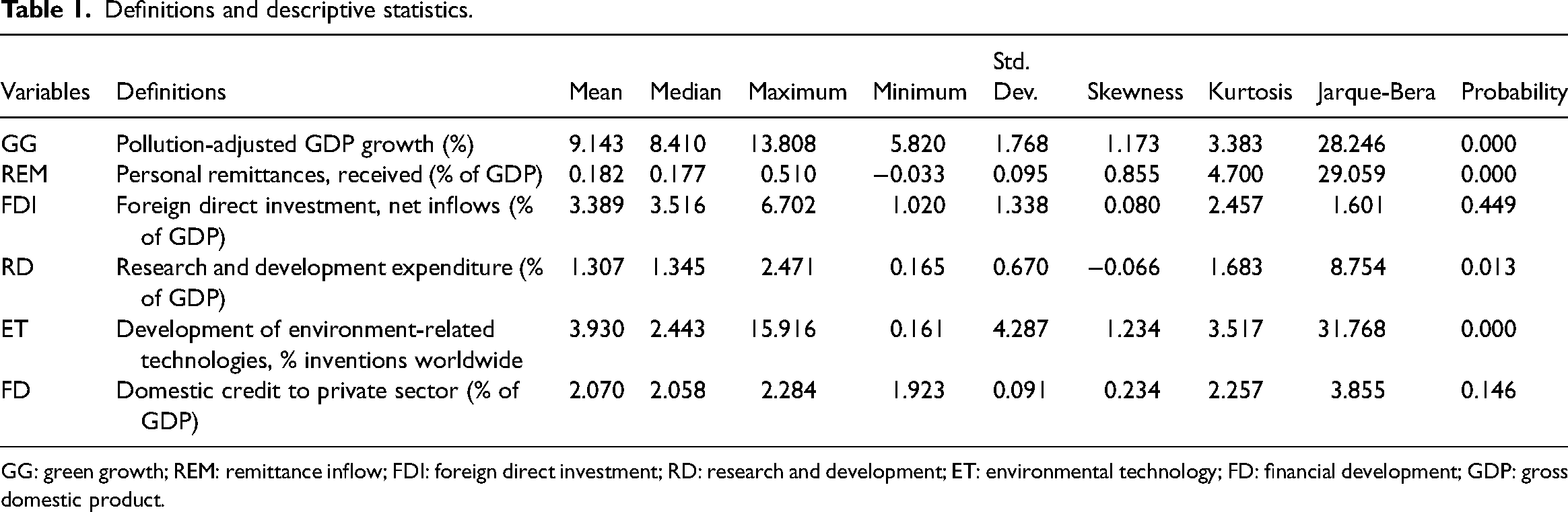
GG: green growth; REM: remittance inflow; FDI: foreign direct investment; RD: research and development; ET: environmental technology; FD: financial development; GDP: gross domestic product.
Empirical results and discussion
Before using the ARDL, NARDL, and nonlinear QARDL models with time-series variables, it is important to confirm the order of integration. Therefore, Zivot and Andrews (ZA) unit root tests are carried out, and it also has the benefit of taking structural breaks in the dataset into consideration. The results show that some variables, including GG, FDI, RD, and FD, are not stationary at their level form. First differences of the parameters are therefore captured in order to make the series stationary. Additionally, the Augmented Dickey-Fuller (ADF) and Dickey-Fuller (DF) tests are also used in Table 2. The statistics of the unit-root tests are provided in Table 2, which confirm that the variables included in the analysis are either stationary at level, that is, I(0), or become stationary after taking the first difference, that is, I(1). Therefore, in this situation, ARDL is the appropriate method of investigation for this study. According to Broock et al., 49 Brock–Dechert–Scheinkman (BDS) test is used to determine nonlinearity in variables. Table 3 shows the findings of the BDS test. The alternative hypothesis of nonlinearities for GG and REM variables is accepted whereas the null hypothesis of linearity is rejected. The results suggest nonlinearities in remittance inflow and green growth variables.
Results of unit root tests.
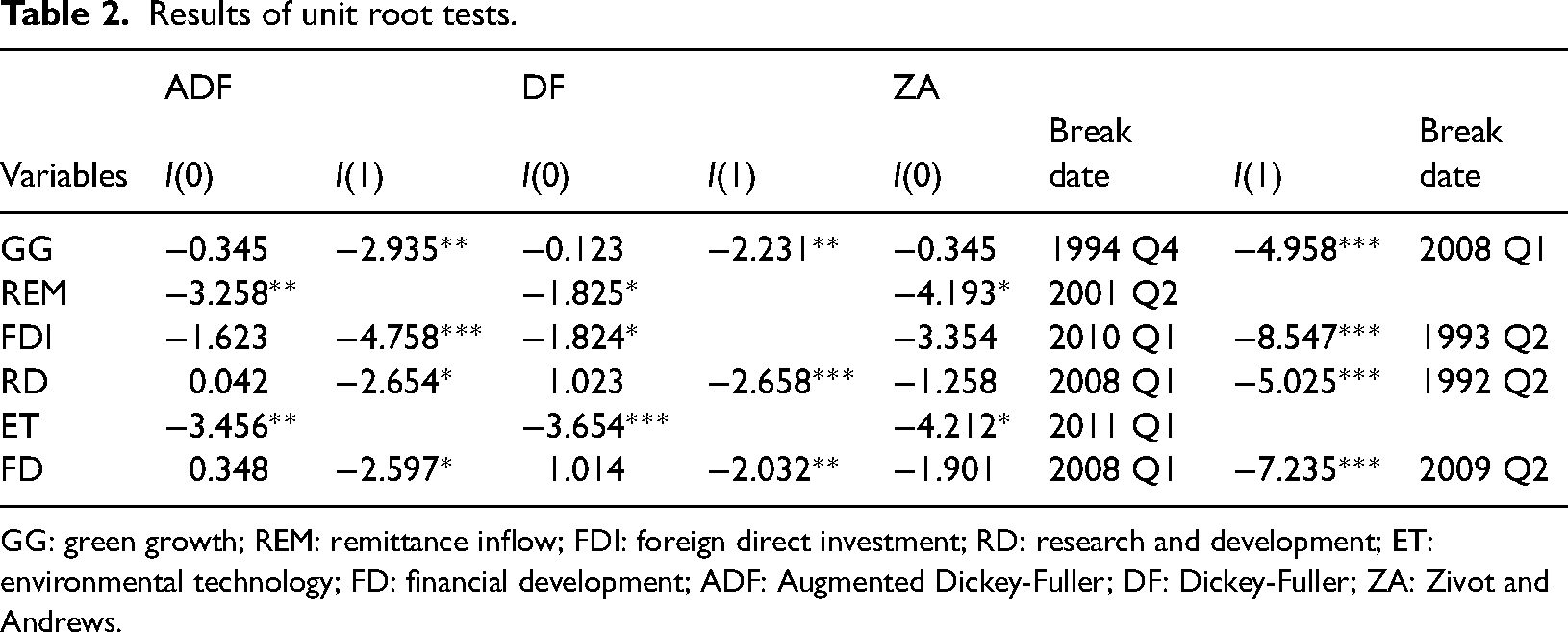
GG: green growth; REM: remittance inflow; FDI: foreign direct investment; RD: research and development; ET: environmental technology; FD: financial development; ADF: Augmented Dickey-Fuller; DF: Dickey-Fuller; ZA: Zivot and Andrews.
Results of BDS test.
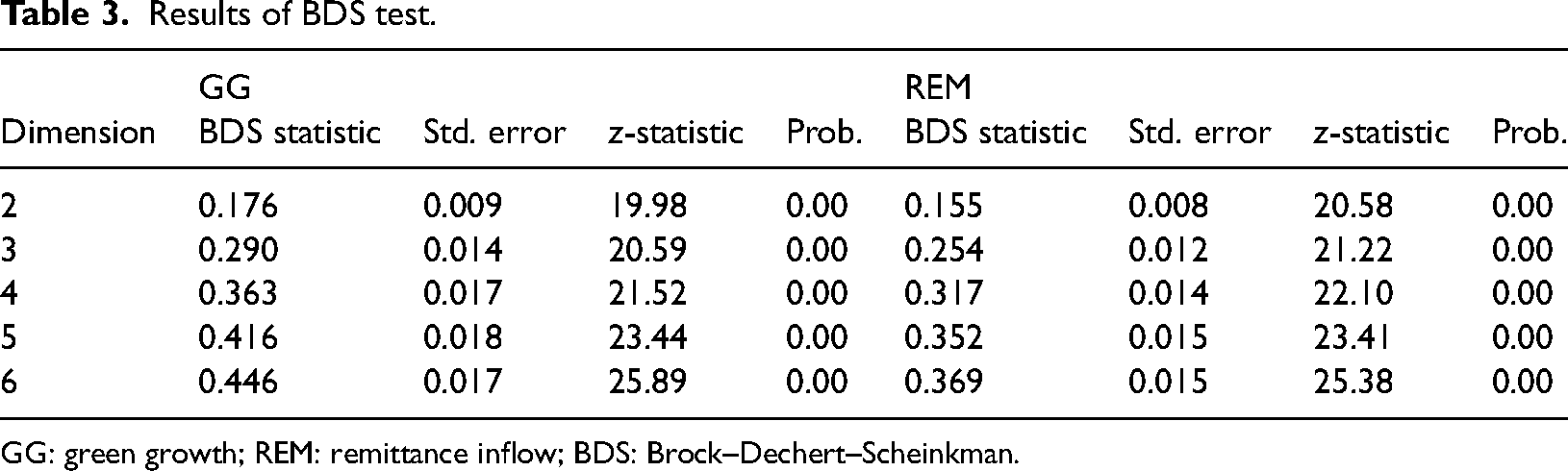
GG: green growth; REM: remittance inflow; BDS: Brock–Dechert–Scheinkman.
The findings of the ARDL and NARDL estimations are shown in Table 4. First of all, ARDL results are discussed. The findings indicate that green growth considerably rises with an increase in remittance inflow. According to the REM coefficient, a 1% rise of REM over the long run considerably raises GG by 2.119%, while having no impact in the short run. In this study, four control variables are employed. The coefficient of R&D illustrates that green growth considerably rises with more R&D activities. In the long run, a 1% rise in RD results in a 1.716% increase in GG, while in the short run, it has no impact. The findings show that when environmental technology increases, green growth increases over the long run despite having no short-run effect. The coefficient suggests that a 1% raise in ET causes a 0.721% rise in GG. While increasing FDI has no long-run effects, it significantly boosts green growth in the short run. In accordance with the coefficient, a 1% raises in FDI causes a 0.233% rise in GG. Long-run financial development benefits green growth, but it has no short-run effect.GG increases by 2.018% with a 1% rise in FD.
ARDL and NARDL estimates.

Note: GG: green growth; REM: remittance inflow; FDI: foreign direct investment; RD: research and development; ET: environmental technology; FD: financial development; ARDL: autoregressive distributed lag; NARDL: nonlinear autoregressive distributed lag; ECM: error-correction mechanism.
*** p < 0.01, ** p < 0.05, * p < 0.1.
In Table 4, the findings of the NARDL are also depicted. The findings indicate that green growth rises considerably with an increase in remittance inflow. The coefficient of REM-POS reveals that a 1% increase in REM-POS raises GG by 1.493% considerably in the long run as well as 0.289% in the short run. However, REM-NEG indicates that due to nonlinearity, green growth decreases significantly with an increase in labor remittance inflow. A 1% rise in REM-NEG results in a 1.005% decrease in GG, but it has no short-run effect. Remittance inflows are the main source of global financial resources, which sometimes contribute to a growth in foreign direct investment. In addition to being a recent financial phenomenon, remittance inflow is also seen as a substantial source of revenue owing to its global economic significance. 15 Remittance inflows have a greater influence on human well-being and growth than formal development aid, being three times as big in volume. Remittance inflow is reducing poverty and gives poor people money. This implies that remittance inflows are also an important factor in fostering financial growth. When people save money or transfer money, the growth in remittance inflow increases the need for financial services. Additionally, it serves as a source of funding for businesses that are unable to get loans from commercial banks at favorable rates. 50 Remittance inflows boost small businesses by giving funds and encouraging domestic investment, which advances a nation's financial growth. Remittance inflows are primary drivers of financial development in the economy, which are vital in providing financial resources for fostering technological development, increasing the share of renewable energy sources, and promoting research and development activities.51,52 This infers that remittance inflow indirectly increases green growth. On one side, these factors play an important role in the long-term green growth of a nation; on the other side, they help mitigate the environmental effects of economic development. In other words, the remittance inflows help achieve green growth through income and financial development channels.
In support of our findings, Abdul et al. 53 inferred that remittance inflows provide financial resources that can be invested in environmentally friendly sectors, such as renewable energy, sustainable agriculture, and environmental protection. Remittance-receiving households and communities use these funds to invest in green technologies, infrastructure, and practices, thereby promoting green growth. A study by Mohamed Sghaier 54 described that remittance inflows enhance human capital and promote knowledge transfer, which can lead to improved environmental management practices and technology adoption. Remittance recipients use these funds to invest in education, training, and capacity building, which enables them to better understand and manage environmental challenges. Additionally, migrants who return to their home countries with new skills, knowledge, and experiences gained abroad transfer these assets to their communities, leading to positive green growth. Ofori et al. 55 revealed that remittance inflows stimulate local economies and create employment opportunities, which can indirectly contribute to green growth by reducing poverty and improving livelihoods. Remittance inflows lead to increased demand for goods and services, which can stimulate local production and trade, thereby promoting green growth.
The diagnostic test ECM (−1) verifies the long-run cointegration of all variables. The negative sign associated with ECM validates the converging trend toward stability. The findings of the LM test show that there is no serial correlation issue. Ramsey RESET test verifies that models are specified correctly. The stability condition is confirmed by the CUSUM test findings. The REM has exerted only an asymmetric impact on the GG in the long run in Panel C.
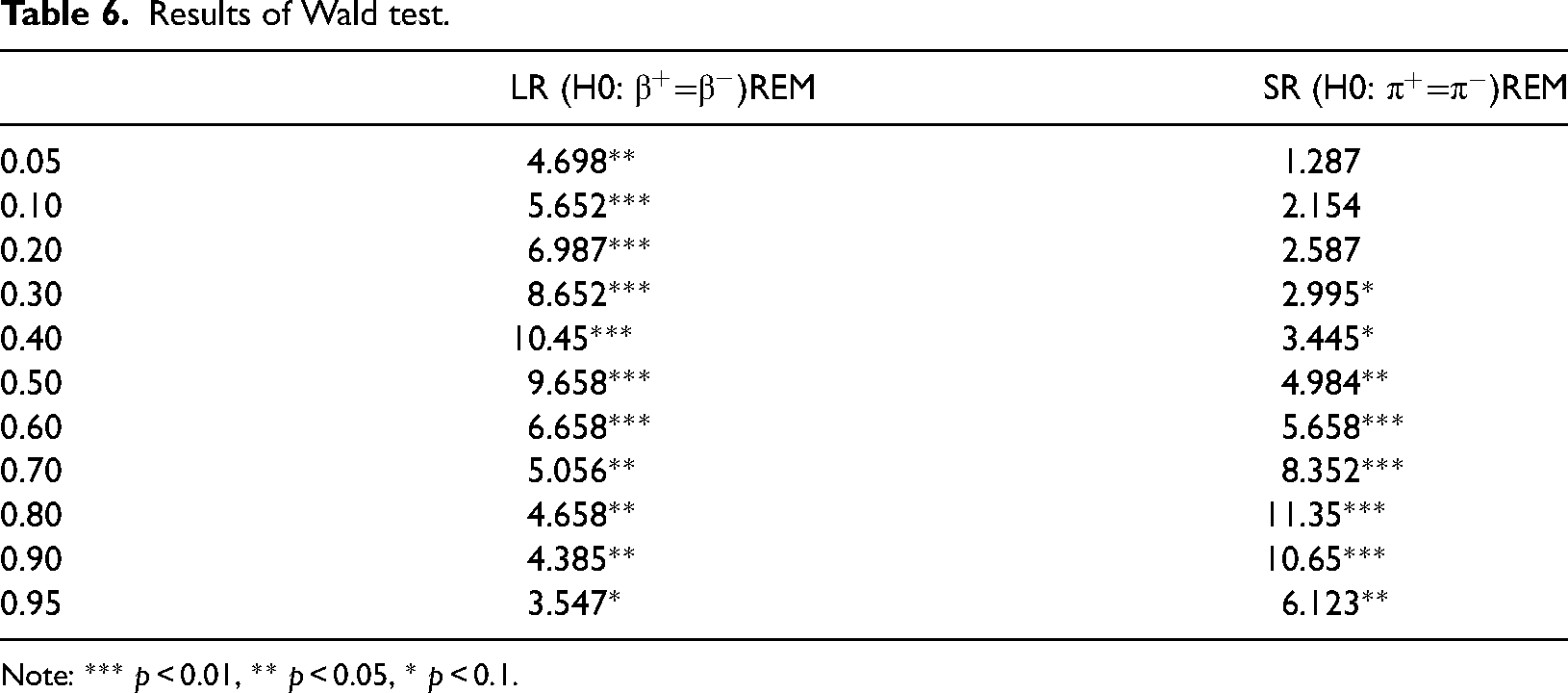
Table 5 reports the nonlinear QARDL results. The long-term coefficient results indicate that positive shock of REM (REM+) has a significant influence on green growth (GG) from the 60th to 95th quantiles, while it has no impact in the short run. However, because of nonlinearity, the negative shock of REM (REM−) has a considerable negative effect on GG over the long run (20th–95th quantiles) and in the short run (5th–95th quantile). The relevant Wald statistic results show that in the long run, the null hypotheses for nonlinearity are rejected for all quantiles, which confirms the validity of the coefficients’ asymmetry. Although the fundamental nature of short-term asymmetric links is rejected from the 5th to 20th quantiles as the null hypothesis is accepted for the instantaneous and lagged effects of labor remittance inflow on green growth. The Wald test statistic suggests that the long-term association between labor remittance inflow and green growth finds asymmetries (Table 6).
Nonlinear QARDL estimates of green growth.
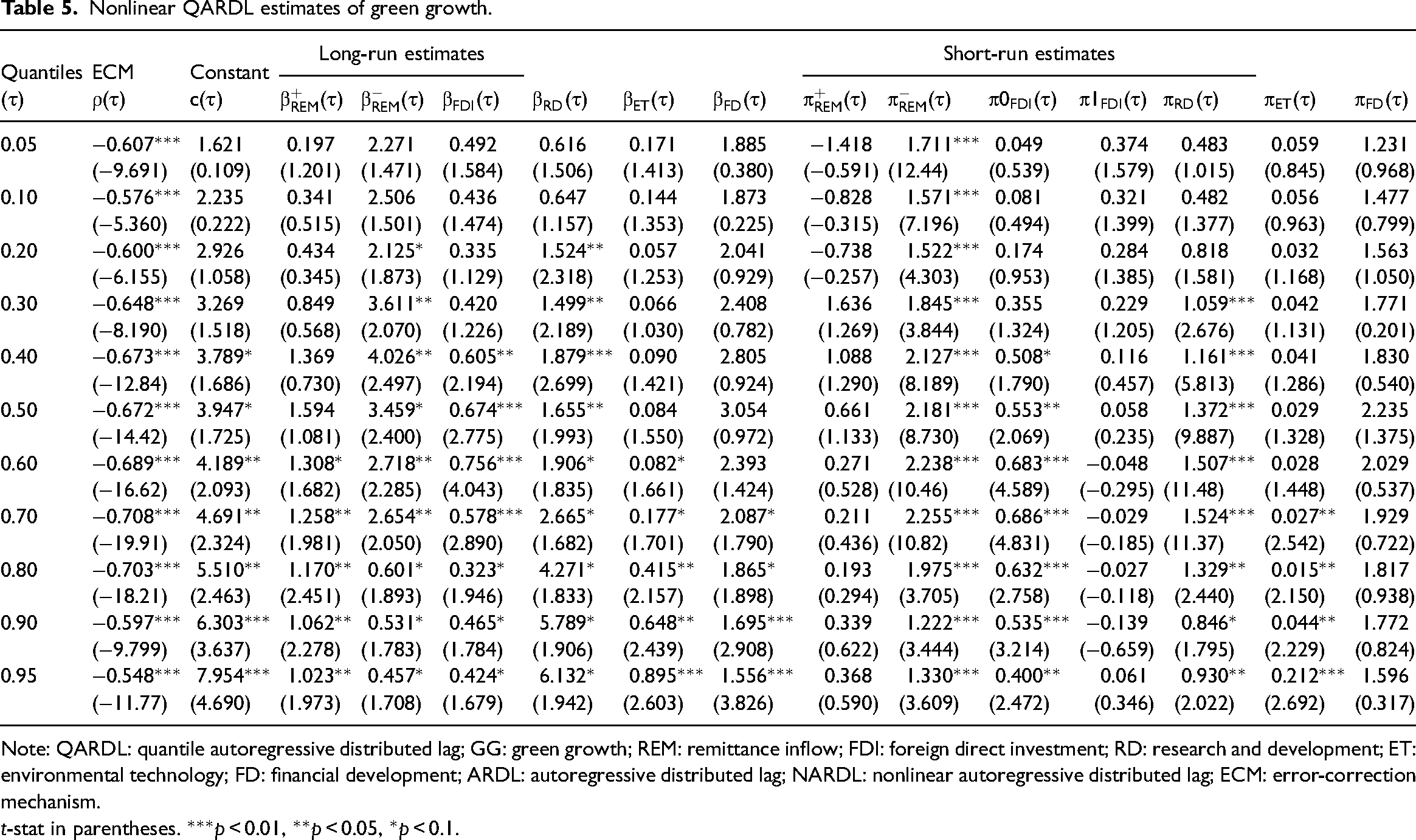
Note: QARDL: quantile autoregressive distributed lag; GG: green growth; REM: remittance inflow; FDI: foreign direct investment; RD: research and development; ET: environmental technology; FD: financial development; ARDL: autoregressive distributed lag; NARDL: nonlinear autoregressive distributed lag; ECM: error-correction mechanism.
t-stat in parentheses. ***p < 0.01, **p < 0.05, *p < 0.1.
Results of Wald test.
Note: *** p < 0.01, ** p < 0.05, * p < 0.1.
Conclusion and implications
Today's most pressing concern is global warming. Countries tend to use increasing amounts of natural capital and energy from various sources in order to reach the ideal level of economic growth, which has a remarkable impact on the emission of polluting gases. Recurrent rainfall, severe weather conditions, and shifting sea levels are all effects of global warming and environmental deterioration. These changes significantly impact the viability of people, animals, and ecological design. The rising concerns regarding environmental and global warming have attracted the attention of researchers and academia to dig up the best methods to minimize CO2 emissions without affecting the speed of economic expansion. Green growth is one of the possible options that the world can avail to tackle the issue of global warming without compromising on economic targets. Ever since green growth has gained popularity, empirics have tried to find the factors that can impact green growth. Remittance inflows are widely recognized as an essential source of a nation's earnings; however, none of the past studies have estimated the impact of remittance inflows on green growth. This study contributes to the existing body of knowledge by examining the nonlinear impact of remittance inflows on green growth by employing NARDL and QARDL methods. The innovative point of the analysis is its reliance on asymmetric effects.
The empirical investigation of the analysis follows the following steps. Firstly, we have employed the unit root tests such as ADF, DF, and ZA to check the stationary properties. Secondly, to confirm the non-linearity in the series BDS test is employed. Thirdly, we have relied on the linear and NARDL models to get the short and long-run estimates. The findings of the study are as follows: (1) unit root test suggests that variables are either I(0) or I(1). (2) BDS test confirms that the remittance inflow series follows the nonlinear trend. (3) Findings of the linear ARDL model confirm the positive impact of remittance inflows, R&D activities, environmental technology, and financial development on green growth in the long run. (4) The long-run results from the NARDL suggest that a positive shock in remittance inflows improves green growth, while a negative shock reduces green growth. Moreover, foreign direct investment, research, development activities, environmental technology, and financial development encourage green growth. In the short run, the remittance inflows improve the green in the nonlinear model only, and foreign direct investment promotes green growth in linear and nonlinear models. (5) The nonlinear QARDL results show that green growth exhibits an asymmetric response to positive and negative changes in remittance inflows in the long run at higher quantiles. In general, our findings imply that an increase in remittance inflows, research and development spending, environment-related technologies, and financial development are vital in promoting green production and manufacturing activities and boosting green consumption behavior, thus contributing to green growth in China. Regarding asymmetric findings, the positive shock or increase in remittance inflows contributes significantly to decoupling CO2 emissions from economic growth; however, a decrease in remittance inflows further compromises the environment while achieving economic targets.
Significant policy suggestions might be derived from these results. To begin, estimations of remittance inflow show nonlinear implications on green growth. As a result, while taking into consideration the impact of remittance inflows on green growth, authorities should differentiate between positive and negative shocks in the remittance inflows. Since the positive shock in remittance inflows promotes green growth; therefore authorities must utilize the remittance inflows to support the economy's green and renewable energy use, which would be helpful in separating economic growth and carbon footprints. By integrating policies related to the environment and foreign financial resources, the authorities can utilize such funds to promote pro-environmental practices and renewable energy technologies, which are crucial in achieving sustainable and green growth. Policymakers should consider policies that promote the use of remittance inflows for green investments, such as providing incentives or subsidies for renewable energy projects, sustainable agriculture practices, and other environmentally-friendly sectors. This can include financial literacy programs to educate remittance recipients on the benefits of investing in green technologies and practices and facilitating access to green financing options. Policymakers should take into account the potential positive effects of remittance inflows when designing policies to promote sustainable development. The government should provide more support and protection for migrant workers’ rights, such as better working conditions, fair wages, and access to social services.
This analysis has certain limitations. Firstly, the availability of data on remittance inflows and green growth indicators at the provincial level in China is challenging to obtain, which could affect the accuracy of the findings. Future studies could put effort into collecting provincial-level data to provide more precise policy implications tailored to specific provinces in China. Secondly, the limitations of the study include its reliance on a limited time frame of data collection (1991–2020) due to a lack of available data for many of the variables under analysis. Future studies should expand the data period in analysis. Thirdly, remittance inflows and green growth are influenced by various other factors, such as macroeconomic policies, technological changes, and external shocks, which are not accounted for in the study. Future research could consider incorporating these factors to better understand the complex dynamics between remittance inflows and green growth. Fourthly, the study focuses on China only, and the findings may not be directly applicable to other countries or regions with different economic, environmental, and policy contexts. Replicating the study in other countries or regions could help in gaining a broader understanding of the impact of remittance inflows on green growth worldwide.
Footnotes
Declaration of conflicting interests
The authors declared no potential conflicts of interest with respect to the research, authorship, and/or publication of this article.
Funding
The authors received no financial support for the research, authorship, and/or publication of this article.
