



Abstract
This study examines the triboelectric behavior of fibers that are readily available and were obtained from the bombax ceiba tree (BOM) and the calotropis plant (CALO). A triboelectric nanogenerator (TENG) is fabricated from these fibers as charge-generating layers that produce a charge by contact electrification. The properties of these fibers which include surface morphology and crystallographic nature are examined using different characterization techniques. Scanning electron microscopy images reflect more roughness in CALO as compared to BOM whereas both materials show an almost amorphous nature in X-ray diffraction data. Further, both materials show tribopositive nature when tested against polytetrafluoroethylene (PTFE) and nylon. While examining their electrical performance, the CALO–PTFE pair produced 11.1 V while 10.7 V is generated from the BOM–PTFE pair. These combinations are capable of illuminating multiple light-emitting diodes of the green spectrum and can derive one digital calculator. Lastly, the dependency of TENG performance on the contact area of active layers is analyzed. From the results obtained, it is concluded that these materials can potentially power small electronic gadgets and can contribute to the growth of a sustainable civilization.
Keywords
Introduction
In this era of technology, where Internet of Things networks and smart appliances are transforming day-to-day life, energy has become a fundamental necessity. At the rate at which both urbanization and industrialization are multi-folding, the world is going to witness the depletion of conventional energy resources very soon. 1 As the energy demand has increased tremendously in the past few decades, there is a time need to look forward to more options beyond petroleum, coal, etc. Humanity continuously uses a variety of energy sources, including power generated from water, sun, and wind. However, these resources fulfill a very small proportion of the demand. Of the 17 major goals of “The 2030 Agenda for Sustainable Development” by the United Nations, sustainable and affordable energy is the most important one for meeting the energy demands of the population by 2030. 2 In light of facts and figures, this research work compares the triboelectric behavior of two waste biomaterials that can be utilized as potential green energy resources and can provide energy using triboelectric nanogenerators (TENGs). In the last few decades, nanogenerators have emerged as one of the prominent sources of energy. But, in the absence of eco-friendly materials having the potential to develop sufficient energy, this technique has not been fully utilized till now. Material selection is an important aspect of designing the TENG. A large number of inorganic polymers have been utilized as active materials in TENG. 3 But their non-biodegradable nature and fabrication cost result in the application of organic materials in TENG. In implanted devices tested on rats, Zheng et al. 4 initiated the idea of eco-friendly plant-based TENG by using synthetic degradable material. Thereafter, plant-based and animal-based TENGs are fabricated using different combinations of extracts which are obtained from plants and animals such as cellulose, chitin, etc.5,6 In plants, different textures of surfaces are available that are used in active layer formation such as leaves and flower petals. 7 Feng et al. 8 fabricated a TENG from leaves in a hybrid mode that can harvest wind energy. The output of TENG was then enhanced by adding polylysine to dry leaf powder which resulted in the production of a 60 µA Isc and Voc of 1000 V. 8 In addition, new material which is flexible and porous having tribonegative nature was created using cellulose acetate. The polymer blended method was utilized to prepare biocomposite with catechol (CA)–polyethyleneimine (PEI) and silicone rubber which is vulcanized at low temperatures. 9 Moreover, TENG was designed using lignin, chitosan-like biomass materials which are tribopositive in nature against polydimethylsiloxane as electronegative material. Various active layers were fabricated using these materials by applying polyethylene and polyamide utilizing fused deposition modeling. This designed nanogenerator has 78% conversion efficiency and generated 308 V open circuit voltage. 10 In recent work, paper-based TENG is fabricated in combination with PTFE which has the capability to detect salt ions. The addition of NaCl ionic droplets onto a paper-based active layer elevated the output of TENG. 11 Another research group made use of natural waste onion tunic which is tested to be electropositive in nature that can produce 12.7 V voltage on a tapping frequency of ∼4 Hz. This performance of TENG is improved to 1.32 µW with a load of 500 MΩ range due to the addition of nanoparticles of SnO2/SnO on the surface of the tunic. 12 Similarly, different natural materials such as silk fibroin, 13 eggshell membrane, 14 hosta leaves, 15 dog hair, 16 orange peel, 17 and many more.
Graham et al. 18 synthesized the biocompatible triboelectric fibrous films (polyvinyl alcohol and polycaprolactone) using an electrospinning method. To design a nanogenerator for energy generation and real-time applications using contact electrification, fibrous tribofilms were used as triboelectric energy havester and sensor (TEHS). The substrate and triboelectric films (positive and negative nature) designed using electrospun were subjected to biocompatible research, which showed that the films were non-hazardous and biologically compatible. With a 1.7 ms response time, the suggested TENG offered a great benefit in monitoring health applications. To interact with the medical monitoring system, many TEHS devices were manufactured. In another research, an effective method for improving the triboelectric performance of a nanogenerator designed using velvet fabric (available commercially) was developed by chemically grafting carbon nanotubes and PEI onto the fiber surface using a polyamidation reaction. This TENG readily delivered improvements in output voltage and current by 10 times with <1 wt% of low modifier content. The modified-fabric-based TENG had exceptional robustness and long-term stability, and it was completely machine washable. The designed TENG was able to provide power for different small devices, including pedometers, digital watches, calculators, and digital timers, having 3.2 W/m2 of maximum power density attained on a resistance of 5×10⁶ Ω used externally. 19 Bairagi et al. 20 designed a TENG based utilizing widely used commercially available materials silk and polyester (PET). A coating of poly(vinylidene difluoride) was employed for raising the tribonegative nature of PET, tribopositive behavior of silk was improved using nanofibers of electrospun nylon 66. In comparison to the Silk/PET baseline, the adjustments resulted in increases in output voltage from 5.85 to 100 volts and Isc density to 24.5 from 1.6 mA/m2, respectively. At a 4 MΩ resistance, the greatest power density was 280 mW/m2. Another research based on fish scales as a frictional layer for TENG was demonstrated by Sun et al. 21 They created a generic technique to build a fish gelatin-based TENG that is flexible, transparent, entirely sustainable, and high performing. The active layers were fabricated from films of fish gelatin films collected from leftover scales of fish (kitchen waste). In the soil, these coatings can disappear in 30 days. These layers were further modified using dopamine and fluorinated silane and obtained TENG displayed an impressive output performance having a power density of 100 W/cm2. To enhance the output of the designed TENG optimizing the dimensions and structuralization of the surface can be utilized. Moreover, used textile waste was employed to track human motions throughout different sporting activities. 22 According to these investigations, biomaterials or waste materials are potential substitutes for the dielectric material that would be utilized to make TENG. From the literature review, we have concluded that a wide range of biomaterials has been employed in the fabrication of frictional layers of TENG. However, these biomaterials such as leaves or cellulose are not the waste products of the plants. Also, to extract cellulose from the plants, sophisticated instruments are required that further raise the manufacturing cost of TENG. So, the basic objective of our study is to use these fibers as it without any processing to make a cost-effective design. Moreover, these fibers are shed by plants and are total waste products of the bombax ceiba tree and calotropis plant.
This work investigates the triboelectric behavior of naturally available fibers from the bombax ceiba tree and calotropis plant. These fibers are used in the fabrication of active layers of TENG that produce charge through electrification. These fibers are also tested for their electropositive or electronegative nature as per the triboseries. This TENG is capable of producing enough voltage to power green light-emitting diodes (LEDs) and small portable electrical devices.
Materials and methods
The waste biomaterials namely BOM from the Bombax ceiba tree and CALO from Calotropis plant (ARK), used in this research work are collected from nature. Bombax ceiba fibers are obtained from Bombax ceiba trees, which are usually grown in tropical and subtropical parts of India. This tree can grow up to 40 m in height and belongs to the Bombacaceae. 23 It bears flowers from January to March which convert to fruit in April. This fruit is of ovary shape that has five valves and contains fibers in it. These fibers have a very smooth surface like silk as shown in Figure 1; hence this tree is also known as the cotton tree. 24 Figure 2 shows another material used is fibers of the calotropis plant, also known as giant milkweed and ARK. The fibers present in the flower of this has many medicinal properties and have a light white or brown color. 25 Both these fibers are utilized as active material in the fabrication of TENG. Initially, these fibers are washed with deionized water to remove any impurities present in them. These fibers are then applied on aluminum tape after drying. The aluminum tape acts as an electrode that collects charge from these materials through electrostatic induction. A connecting lead is attached to an electrode for further connections with electrical appliances for electrical measurements. Two more reference materials, polytetrafluoroethylene (PTFE) and nylon are used for investigating the triboelectric behavior of waste materials used in this work. PTFE is a highly electronegative material, while nylon is considered an electropositive material. Further, TENG is fabricated from active layers by placing them in a vertical contact–separation mode (Supplemental Figure S1). The original layers designed from these fibers are described in Supplemental Figure S2. All the measurements are performed using a digital storage oscilloscope Keysight EDUX 1002G. A DII-29030SCTR smart coater is utilized that coats the sample with gold for performing the analysis and a JOEL-JSM 7610F model is used for scanning electron microscopy (SEM) and EDX examination. A RIGAKU MINI FLEX II model of an X-ray diffraction device is used for testing.

Bombax ceiba tree also known as the cotton tree and silk-like fibers collected from trees.
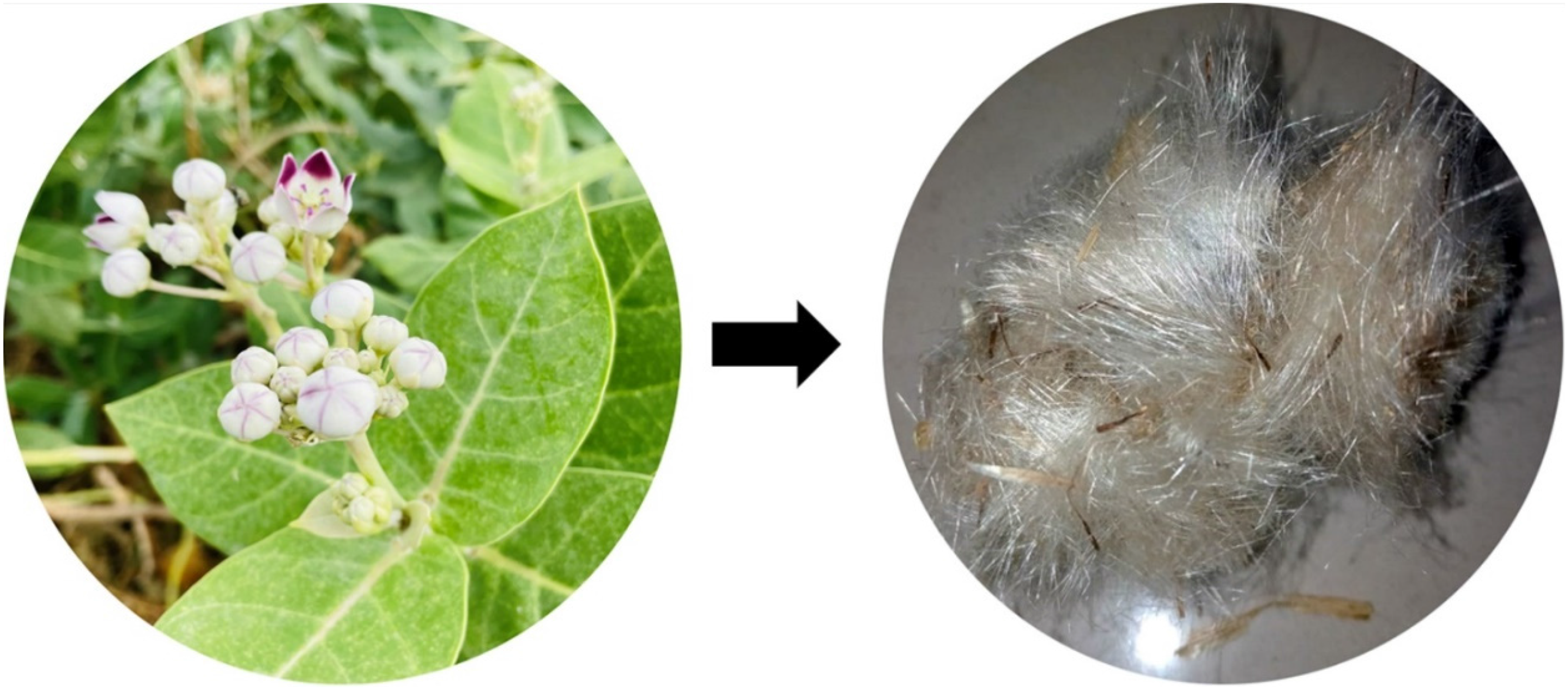
Calotropis plant commonly known as ARK and fibers collected from it.
In the working mechanism of this TENG, bombax ceiba fibers are used as active layer 1, and nylon is used as active layer 2 as shown in Figure 3. Firstly, both layers are placed in contact–separation mode and brought into contact by applying a compressive force on these two layers. Because these materials have differing electron affinities, charge density is created on their surfaces. This charge density has opposite nature on both layers but in equal amounts, therefore, no change in potential between the two layers is formed. The release of this pressure leads to the formation of charge (potential) difference in the circuit due to which current flows in the circuit. When the charge reaches electrical equilibrium, the current flow in the circuit stops. On the application of force again, a difference in potential is created but with opposite polarity, and the flow of current is in the reverse path. This results in a single cycle of alternating output of TENG with one pressing and releasing process.

Contact separation mode working of BOM–nylon triboelectric nanogenerator (TENG).
Results and discussion
Initially, SEM analysis is utilized to examine the structural patterns/behavior of BOM and CALO. From Figure 4a, SEM images of BOM describe smooth and fine fibers of bombax ceiba fruit. It is visible that these fibers have no roughness and appear like silk threads. Because of these characteristics of fibers, this tree is also known as a cotton tree. The diameter of fibers is in the range of 15 to 24 m. In the case of CALO (Figure 4b), there is a very rough texture of fibers. The diameter of these fibers is around 48μm which is almost double that of BOM. Growth of very thin fibers there having a diameter in a range of 7 μm is also seen. This shows that the surface roughness of the frictional layer fabricated from calotropis fibers is high in comparison to bombax ceiba fibers. Further, to investigate the composition of these fibers, EDX analysis is performed. In the case of BOM and CALO, the occurrence of carbon (C) and oxygen (O) is due to the formation of carbonyl and carboxyl groups of cellulose. Figure 4c and d also depicts the presence of K and Ca in CALO.

SEM images of (a) Bombax ceiba fibers, (b) calotropis fibers, EDX analysis of (c) BOM, (d) CALO, XRD analysis of (e) BOM, and (f) CALO.
Further, the X-ray diffraction (XRD) technique, which depicts the graph between intensity and diffraction angle, is used to identify compounds. The biomaterials used in this work have been characterized using XRD in scan mode of continuous nature having 0.02 step size. In Figure 4c and d, BOM and CALO reflect amorphous nature by showing a broad but sharp peak at ≈20○. The peak in the proximity of 20o signifies the existence of amines, and groups of carboxylic acid in these fibers.
Thereafter, the triboelectric nature of BOM and CALO fibers is tested against reference materials (PTFE and nylon) and each other. For this, the connecting wires attached to electrodes are attached to digital storage oscilloscope (DSO) , and the nature of the output peak produced is analyzed. First of all, to collect output from BOM and CALO, the combination with PTFE is tested and the output obtained from these pairs is represented in Figure 5. In all figures, ‘p’ represents pressing (contact formation), and ‘r’ represents releasing (contact removal). To make these observations, PTFE is connected to the negative probe while BOM and CALO materials are to the positive probe of DSO one by one. During the process of manual tapping, it is observed that a positive peak appears at the time of contact removal. It means that these biomaterials show a higher tendency to lose electrons when compared to PTFE. In other words, we can say that biomaterials possess a charge of positive polarity whereas a negative charge is acquired by PTFE when brought in contact. While pressing (contact formation), the electrons move from the layer designed using biomaterials (BOM/CALO) toward the PTFE side, and current drifts in a reverse manner (PTFE to biomaterials), resulting in a negative peak. From these results, it is deduced that all biomaterials are electropositive in nature as compared to PTFE. Furthermore, nylon (highly electropositive in nature) is used as a reference layer to check the tribo behavior of biomaterials. For this purpose, the positive terminal of the DSO probe is attached to BOM/CALO layer and the negative terminal to nylon. As shown in Figure 5, all biomaterials show similar behavior to nylon as shown with PTFE.
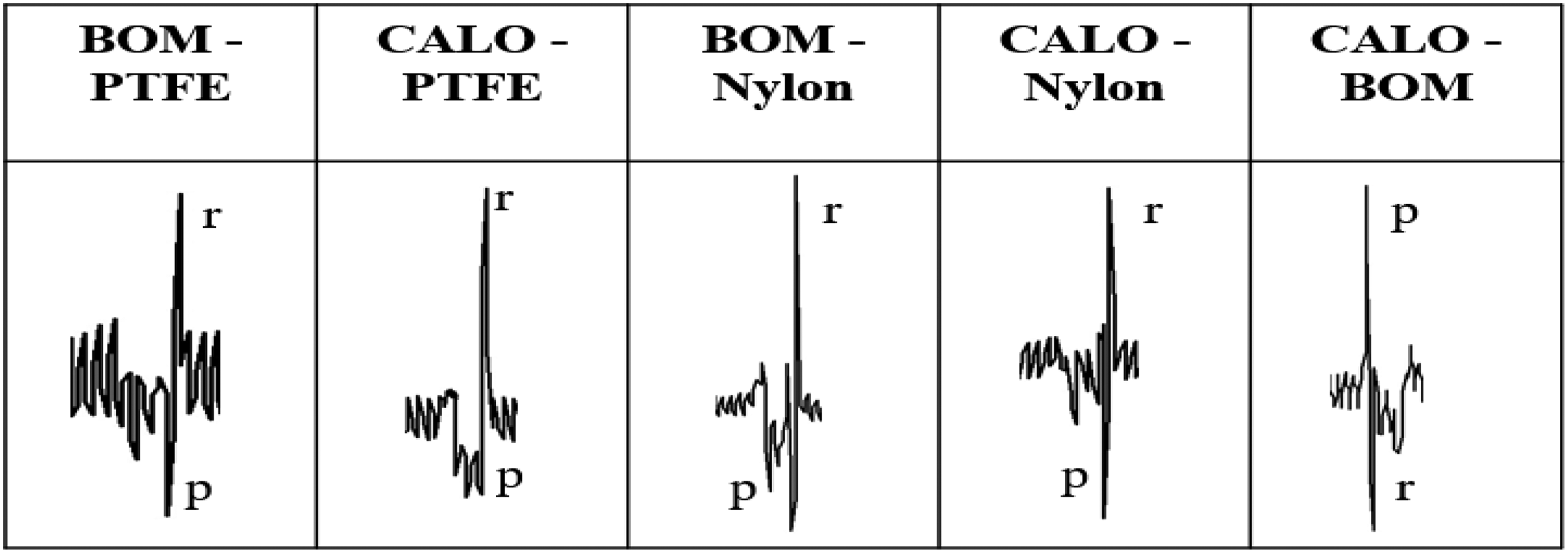
Triboelectric behavior of BOM and CALO with respect to polytetrafluoroethylene (PTFE) and nylon.
From the figure, it is clear that during contact formation, nylon exhibits a charge of negative polarity while biomaterials possess an opposite charge (positive) on them. Due to this, a peak in negative cycle form appears due to the flow of charge from biomaterial to nylon and current from nylon electrode to biomaterial electrode. An opposite peak (positive) is observed during releasing process. These results reflect that all biomaterials under consideration have electropositive nature than nylon.
After that, the nature of BOM and CALO is studied by connecting CALO to the negative probe and BOM to a positive probe of DSO. From the graphs, it is deduced that CALO is more electropositive as compared to BOM as it produces a positive peak during pressing (Figure 5).
After studying the triboelectric behavior of BOM and CALO, their electrical performance against PTFE and amongst each other is inspected. The active area of fabricated TENG is 3 cm×6 cm and the tapping frequency is ∼4 Hz. The voltages produced by CALO–PTFE TENG and BOM–PTFE TENG are 11.1 V and 10.7 V, respectively (Figure 6a and b). It is observed that CALO produced higher voltage as compared to BOM due to more surface roughness in the active layer. This is due to the rough texture of CALO fibers as compared to BOM as discussed in SEM analysis. As roughness increases the contact area of layers increases which results in the production of more charge density on the surface and hence higher output. 26 When both these biomaterials are used against each other, it generated 1.79 V (Figure 6c). Further, load analysis is done using BOM and CALO layers in combination with PTFE against different loads. The power generated from these layers is shown in Figure 6d. From the results, it is observed that CALO–PTFE TENG and BOM–PTFE TENG have generated 0.42 µW and 0.36 µW power, respectively. The results of our proposed work are also compared with some work from the literature (Supplemental Table T1). The results from the TENG are validated by using reversing the connections with DSO. From the observations, it is concluded that the nature of output peaks also followed the same pattern (i.e. the output also reversed), when the connections of TENG with DSO are reversed. This validated that the output is produced by the triboelectric effect occurring between two materials (Supplemental Video V1).
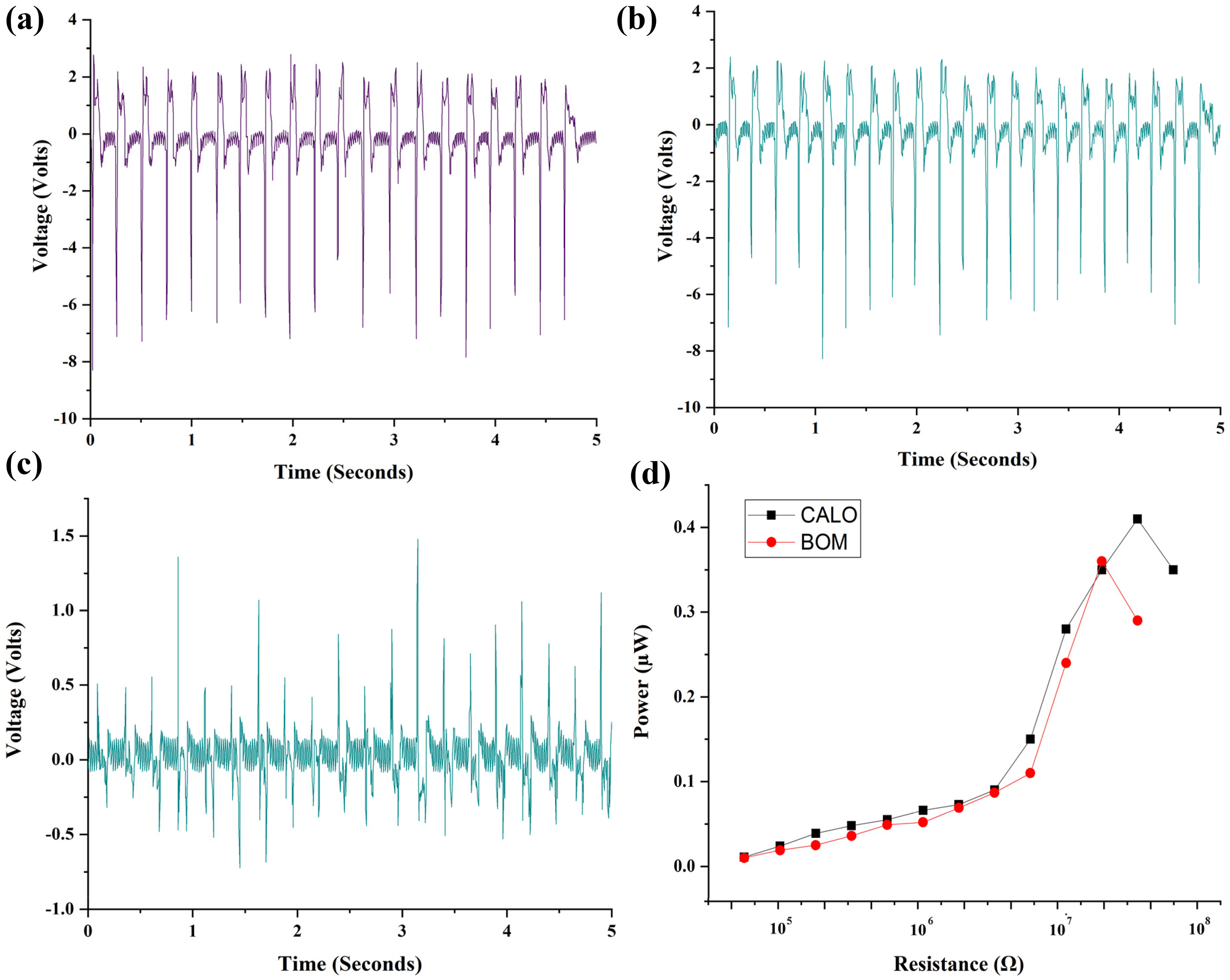
Electrical output performance of (a) CALO–PTFE TENG, (b) BOM–PTFE TENG, (c) CALO–BOM TENG, and (d) power curve against different resistances for BOM and CALO with PTFE.
In the next stage, the performance of output generated from TENG is analyzed by changing the contact area of designed active layers and results are shown in Figure 7a. It is concluded from the graph that with an increase in the contact area, enhancement in the output production is also seen due to intensification in charge density produced on the surface. Following this, CALO–PTFE TENG shows that output level upsurges from 9.1 to 15 V as the area increases from 16 to 20 cm2. Similar behavior of output with an increase in the contact area is also observed in BOM–PTFE TENG. This can be concluded from this behavior that TENGs size can be designed according to the application.
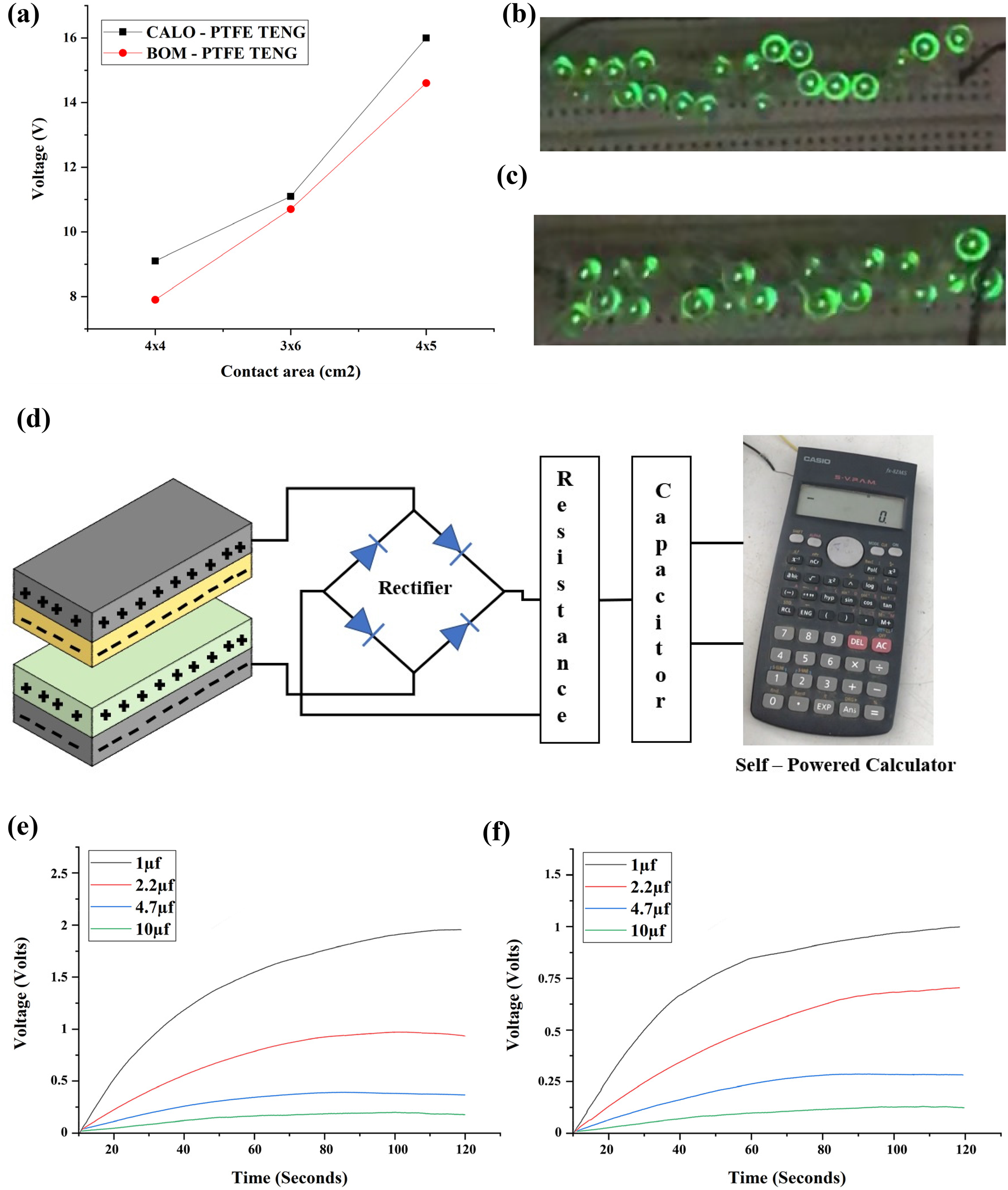
(a) Graph representing the variation in TENG output under change of effective contact area, (b) 19 green LEDs illuminated by CALO–PTFE TENG, (c) 18 green LEDs illuminated by BOM–PTFE TENG, (d) real-time setup used for designing self-powered calculator, (e) capacitor charging profile using CALO–PTFE TENG, and (f) BOM–PTFE TENG tested for four different capacitors 1, 2.2, 4.7, and 10 µF.
Further, the voltage collected from BOM–PTFE TENG and CALO–PTFE TENG, is utilized to derive the green LED. For this, an array of LEDs is attached to the output wires of TENG and powered on using the voltage generated by TENGs. It is observed that CALO–PTFE TENG has the capability to illuminate 19 LEDs, whereas BOM–PTFE TENG illuminates 18 LEDs as shown in Figure 7b and c.
In the next real-time application, the self-powered calculator is designed using TENG in combination with a bridge rectifier. As to derive any electronic gadget the constant source is required, so a rectifier (bridge form) for changing the alternating voltage of TENG to direct form is revealed in Figure 7d. This direct current output is further stored in a capacitor to derive a calculator. Now, to decide the capacitor to use for charge storage, the charging profile of four capacitors having different capacities (1 µF, 2.2 µF, 4.7 µF, and 10 µF) are analyzed (Figure 7e and f). From the graph, the highest rate of charging and discharging is observed when a 1 µF capacitor is used while in the case of 10 µF, it is very slow. Thus, both these capacitors are not suitable for designing the circuit. When 2.2 µF and 4.7 µF capacitors are tested, these show sufficient charge storage rate to power a calculator (Supplemental Video V2). It is also observed from the graphs that the charge storing and releasing capability of the capacitor is totally dependent on manual tapping. Because with the start of tapping, the capacitor starts charge storing immediately and stopped with tapping as it discharges at the same instant (Supplemental Video V3).
Thus, from these experimental results, it is clear that these waste materials have the potential that can power small electronic devices.
Conclusion
In this research work, TENG is fabricated from waste materials (BOM and CALO), which are available abundantly in nature. BOM is a fiber collected from the fruit of the Bombax ceiba tree while CALO is a fiber obtained from the Calotropis plant. These materials show an almost amorphous nature as studied from XRD analysis. BOM fibers are very smooth and fine in nature as compared to CALO which shows the growth of small fibers. Both materials have natural cellulose and show highly electropositive behavior when compared with PTFE and nylon. When tested against each other, CALO shows more tribopositive behavior than BOM due to their rough texture. Moreover, CALO–PTFE TENG generated 11.1 V while BOM–PTFE TENG produced 10.7 V on subsequent tapping at 4 Hz. More output is generated by CALO fibers due to an increase in surface charge density because of high surface roughness. Load analysis is also performed and the power of 0.42 µW and 0.36 µW is collected against the MΩ range resistance. The TENG output has shown enhancement when the contact area is increased. The TENGs fabricated from these waste materials have the capability to illuminate 19 green LEDs. A self-powered calculator setup is also designed with the help of a bridge rectifier and a capacitor circuit. Thus, it can be concluded from these results that the proposed materials have the potential to power small electronic devices. These materials can be a good substitute for lithium-based batteries and a source of renewable energy.
Supplemental Material
Supplemental Material
Supplemental Material
Supplemental Material
sj-docx-1-eae-10.1177_0958305X231193873 - Supplemental material for Comparative analysis of triboelectric behavior of natural waste biomaterials and green energy harvesting
Supplemental material, sj-docx-1-eae-10.1177_0958305X231193873 for Comparative analysis of triboelectric behavior of natural waste biomaterials and green energy harvesting by Jaspreet Kaur, Ravinder Singh Sawhney, Harminder Singh, Manjit Sandhu and Rajdeep Singh Sohal, Amandeep Singh, Maninder Singh, Sandeep Kaur in Energy & Environment
Footnotes
Declaration of conflicting interests
The author(s) declared no potential conflicts of interest with respect to the research, authorship, and/or publication of this article.
Funding
The author(s) received no financial support for the research, authorship, and/or publication of this article.
Supplemental material
Supplemental material for this article is available online.

References
Supplementary Material
Please find the following supplemental material available below.
For Open Access articles published under a Creative Commons License, all supplemental material carries the same license as the article it is associated with.
For non-Open Access articles published, all supplemental material carries a non-exclusive license, and permission requests for re-use of supplemental material or any part of supplemental material shall be sent directly to the copyright owner as specified in the copyright notice associated with the article.
