



Abstract
The development of electric vehicles incurs the consumer's variety seeking in the sharing economy. In addition to being passengers on the sharing platform, customers can rent electric vehicles from the rental company as ride-hailing drivers, rather than purchasing from the manufacturing firm. In this article, we set up a game-theoretic model to study the customer's variety-seeking behavior in the new frenemy partnership and solve the equilibrium pricing strategy and quality decision for the rental company and the sharing platform. The numerical experiments show that the rental company's price is less influenced by the valuation heterogeneity, but the sharing platform's price is the opposite. Given some real-world examples of product ownership and product usage in sustainable transportation, we discuss the consumer's variety seeking and the company/platform's pricing strategy from both the passenger and driver sides.
Introduction
With the globalization of sustainable transportation, the carbon footprint in daily traffic has been a primary focus for all inhabitants around the world. 1 To cope with the crisis of fossil fuels (e.g. crude oil), electric vehicles have taken a step forward to fight against the climate change 2 and made great efforts to stimulate green consumption in transportation, such as electric vehicle charging, 3 electric vehicle subsidies, 4 and electric vehicle sharing. 5
Through short-time rental (e.g. Hertz and Avis) and ride-hailing services (e.g. Uber and Lyft), the eco-friendly electric vehicle becomes a fuel-efficient alternative to the traditional gasoline vehicle for private car drivers and public transportation passengers, 6 which leads to different product ownership or product usage in the sharing economy (in Figure 1). As a result, the rental company and the sharing platform can significantly reduce greenhouse gas emissions 7 and quickly occupy the traffic market in many European countries.
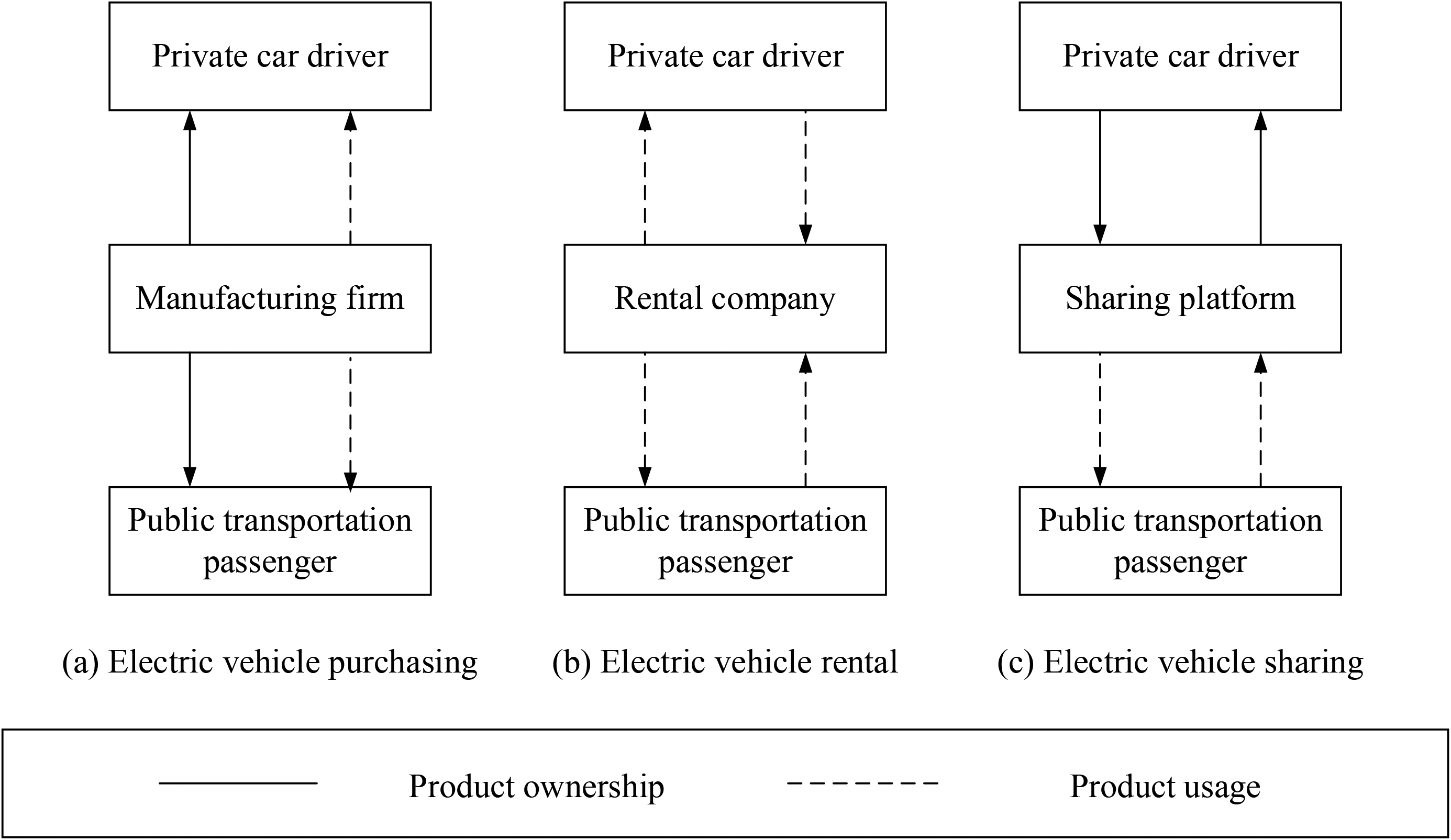
Product ownership and product usage in the sharing economy.
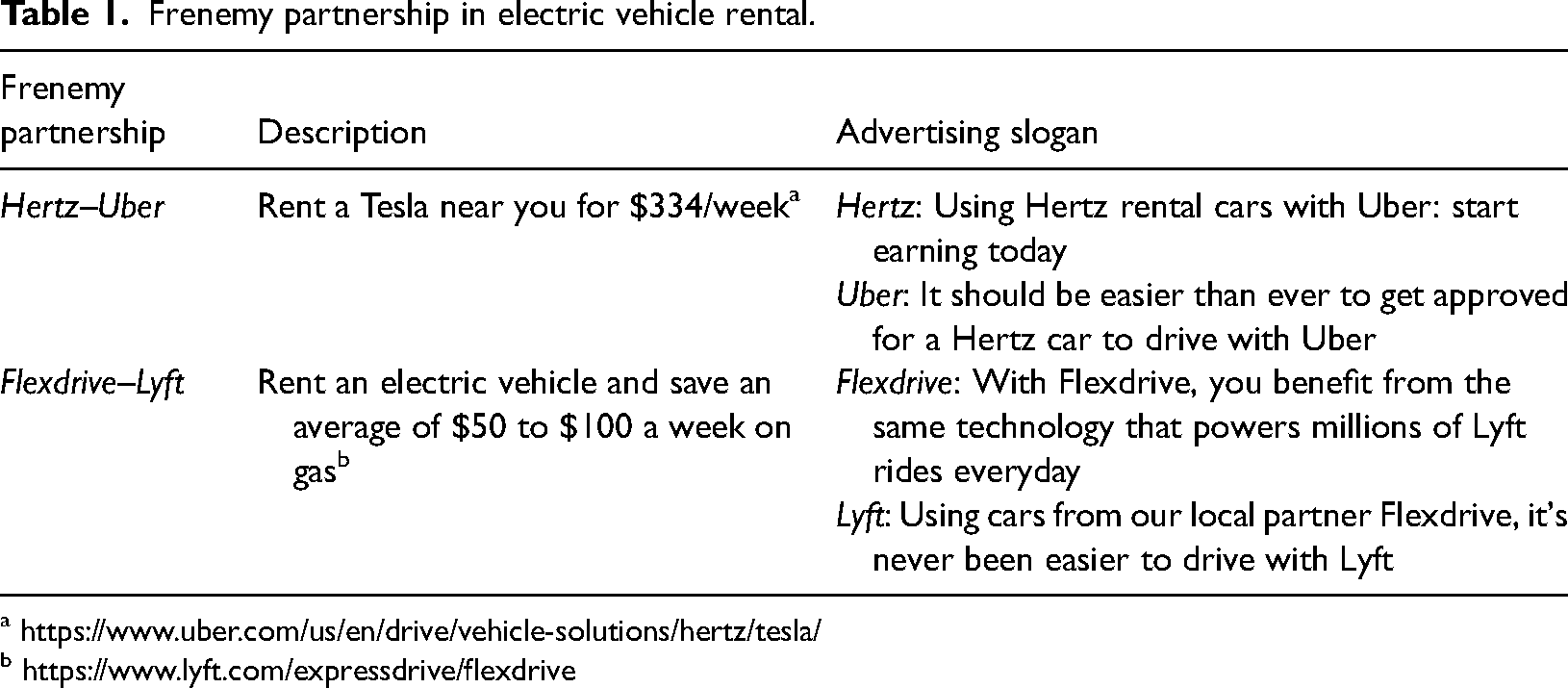
However, the rapid expansion of electric vehicles incurs a series of e-business issues on both the supply side and the demand side. When traditional consumers and manufacturing firms are incentivized by subsidy programs like federal tax credits, 4 the introduction of electric vehicles changes the competition between the rental company and the sharing platform into cooperation, which leads to a new frenemy partnership in the sharing economy. In traditional electric vehicle purchasing, the rental company and the sharing platform have a competitive partnership, so the customer can only choose to buy the electric vehicle from the manufacturing firm to offer a ride-hailing service. However, in the electric vehicle rental (e.g. Hertz–Uber and Flexdrive–Lyft), the rental company and the sharing platform have a cooperative partnership, so the customer who signs up with the rental company can utilize the third-party electric vehicle as a part-time driver on the sharing platform (in Table 1). Therefore, the electric vehicle rental may incur a stronger switching intention between different product ownership or product usage over multiple stages,8,9 and the pay-per-use mechanism further lowers the consumer's involvement in using a vehicle than owning a vehicle, which leads to the consumer's variety seeking in sustainable transportation, such as the crowdsourcing for freelancers 10 and the slugging for commuters. 11 The reason for this phenomenon is usually that consumers have a satiation effect with the same product attribute in intertemporal consumption.12–14
Frenemy partnership in electric vehicle rental.
The main contribution of our study is that it is the first theoretical paper to focus on the frenemy platform competition against the background of peer-to-peer sharing in sustainable transportation. Firstly, this study takes electric vehicles as the object and analyzes the frenemy partnership between the rental company and the sharing platform. Secondly, comparing the customer's variety-seeking behavior in electric vehicle purchasing and electric vehicle rental, this study solves the equilibrium pricing strategy and quality decision over two ownership and usage stages. Finally, this study discusses the impact of the customer's valuation heterogeneity on the rental company and the sharing platform's pricing. Our findings show that the company's rental price is less influenced by the valuation heterogeneity, but the platform's sharing price is the opposite. Moreover, several managerial insights about the separation of ownership and usage are obtained for both passengers and drivers in sustainable transportation.
The remainder of the article is structured as follows. A literature review is presented in the “Literature review” section. In the “Modeling” section, we make a comparison between electric vehicle rental and electric vehicle purchasing with an analytical model. The “Numerical experiment” section gives a sensitivity analysis of the customer's valuation heterogeneity. The last section discusses the results and points out some future directions.
Literature review
In this section, we give a literature review of the customer's choice behavior in sustainable transportation. From the perspective of operations management, the academic research about electric vehicles is categorized into three groups (in Table 2), and we focus on the two most related fields as variety seeking and sharing economy.
Three literature streams about electric vehicles (operations management).

Customer's variety seeking
Many academic papers have focused on the diversity of customer choices in sustainable transportation, which is the first topic close to our study. In urban transportation, the passenger-side behavior is more complex and caused by many traffic scenarios, including time-dependent behaviors,19,20 location-dependent behaviors, 21 and other non-subjective behaviors.
On the one hand, the time of one trip is the key factor for the customer's choice behavior in daily traffic. In the context of shared parking, Jiang and Fan 20 found that some passengers had unpunctual behavior on the parking platform. Although the shared parking slots were reserved by some passengers, the actual parking time was unpredictable and encountered with many uncertainties. To maximize the time efficiency in public transit, Luo et al. 19 considered the passenger's waiting behavior in the bus transportation system. On the other hand, the travel location is another factor affecting the customer's option of transportation facilities. From the view of the passenger's geographical position in the traveling system, Luo et al. 21 gave an analysis of the passenger's congestion behavior in the location dimension. During the national holidays, many passengers preferred to go sightseeing for one specific resort, which led to an instant overload in the urban transportation system. Besides, traffic safety has an impact on the customer's decision-making for driving oneself or taking a ride. Considering the risk-aversion behavior among private car drivers, Li et al. 22 evaluated the benefit of the usage-based insurance service in daily traffic. Based on a methodology framework, they solved the optimal insuring strategy for preventing the driver's driving risk.
Sharing economy
The second topic relevant to our study is the cooperative relationship in urban transportation, which is defined as ‘‘picking up and delivering customers to the airport” (PDCA). Considering the scheduled trip with different preferred locations, Yu et al. 23 first conceptualized the transportation company cooperation in the PDCA, and more and more scholars are paying attention to the research field of ridesharing.
Environmental impact
One stream of literature gives a comprehensive analysis of the environmental benefits of ridesharing. As an extension of Yu et al., 23 Sun et al. 24 introduced the heterogeneous fleets into picking up or delivering passengers. Moreover, they examined the impact of carbon emissions on transportation suitability. As a joint analysis of the time window and vehicle routing, Yu et al. 25 integrated the capacity-constrained fleets into the vehicle routing problem. To test the environmental benefit of the passenger's sequential riding behavior, the experimental analysis showed how the carbon emissions were reduced by the transportation coordination between the passenger and the vehicle. Obviously, the research object in these papers is gasoline vehicles, and the eco-friendly impact of electric vehicles in sustainable transportation is understudied in this literature.
Vehicle heterogeneity
Another stream of literature throws light on vehicle heterogeneity in ridesharing, which is regarded as evidence of consumer's valuation heterogeneity in our study. Yu et al. 23 set up a cooperative game model to solve the optimal profit distribution for different companies by minimizing the operational cost. According to Sun et al., 24 the numerical result with the real-world dataset validated that the heterogeneous fleets performed better than the homogeneous fleets with the aim of promoting green traffic. All the above-mentioned studies have explored the cooperation problem among one type of transportation company rather than different types of logistics service providers. However, the cooperative and competitive partnership between the rental company and the sharing platform has received little attention in academic papers, which can be further interpreted as the peer-to-peer sharing mechanism for transport policymakers.
In summary, our study is the first to establish a game-theoretic model of the consumer's variety-seeking behavior in the sharing economy. Table 3 shows the overall contribution of our study compared with the related literature.
The overall contribution of our study.

Modeling
Preliminaries
In the context of sustainable transportation, we set up a game-theoretic model to solve the equilibrium pricing strategy and quality decision in the frenemy competition between the rental company and the sharing platform. 27 From the view of variety seeking, we study the impact of consumer's valuation heterogeneity on the equilibrium profit, and Table 4 shows the definition of all symbols and variables in the analytical modeling.
Definition of symbols.

Thus, we propose a two-stage game model, and the decision sequence is as follows:
Stage 1 (ownership stage). In the ownership stage, a number of customers choose to sign up with the rental company or not (registered customer/ordinary customer). The registered customer chooses to drive himself or not (driver/seeker),
28
Stage 2 (usage stage). In the usage stage, the sharing platform joins. During the electric vehicle rental, the seeker in registered customers can offer a ride successfully or not (sharer/seeker),
28
and the ordinary customer chooses to walk himself or not (pedestrian/seeker),

and the seeker in ordinary customers can take a ride successfully or not (renter/seeker),
29


By using the backward induction, the profit optimization of the company in the ownership stage and the platform in the usage stage is


Electric vehicle rental in the sharing economy
In this section, we make a comparison between electric vehicle rental and electric vehicle purchasing, where the latter allows the customers to purchase the product from the original equipment manufacturer in the ownership stage and then share it through the e-commerce platform in the usage stage. Compared to the competition between manufacturing firms,
32
the coefficient
When the sharing platform has a low pricing strategy, the price strategy and the quality decision between electric vehicle rental and electric vehicle purchasing are as follows
Scenario (a): if the equilibrium qualities in electric vehicle rental and electric vehicle purchasing are non-existent, the price ratio will be null. Scenario (b): if the equilibrium qualities in electric vehicle rental and electric vehicle purchasing are Scenario (c): if the equilibrium qualities in electric vehicle rental and electric vehicle purchasing are Scenario (d): if the equilibrium qualities in electric vehicle rental and electric vehicle purchasing are Scenario (e): if the equilibrium qualities in electric vehicle rental and electric vehicle purchasing are
From the view of the low sharing price, Proposition 1 shows the difference between electric vehicle rental and electric vehicle purchasing. We take Scenarios (d) and (e) as a pair of examples. In the electric vehicle rental, if the sharing price is low and the rental price is in Scenario (d), H signs up with the company in the ownership stage and offers a ride to L in the usage stage, and L signs up with the company in the ownership stage and offers a ride to H in the usage stage. If the sharing price is low and the rental price is in Scenario (e), H doesn’t sign up with the company in the ownership stage and takes a ride from L in the usage stage, and L signs up with the company in the ownership stage and offers a ride to H in the usage stage. In the electric vehicle purchasing, the original equipment manufacturer's price is several times the rental company's price in the ownership stage, but the heterogeneous customers may have the same variety-seeking behavior in the usage stage. Therefore, two kinds of sharing markets fail in Scenarios (d) and (e), and the positive surplus at the end of the market makes a different price ratio in Scenario (d).
When the sharing platform has a high pricing strategy, the price strategy and the quality decision between electric vehicle rental and electric vehicle purchasing are as follows
Scenario (a): if the equilibrium qualities in electric vehicle rental and electric vehicle purchasing are non-existent, the price ratio will be null. Scenario (b): if the equilibrium qualities in electric vehicle rental and electric vehicle purchasing are Scenario (c): if the equilibrium qualities in electric vehicle rental and electric vehicle purchasing are Scenario (d): if the equilibrium qualities in electric vehicle rental and electric vehicle purchasing are Scenario (e): if the equilibrium qualities in electric vehicle rental and electric vehicle purchasing are
In Proposition 2, we make a comparison between electric vehicle rental and electric vehicle purchasing from the view of the high sharing price. Like Proposition 1, we assume Scenarios (d) and (e) are two lower price scenarios. In the electric vehicle rental, if the sharing price is high and the rental price is in Scenario (e), H signs up with the company in the ownership stage and offers a ride to L in the usage stage, and L signs up with the company in the ownership stage and offers a ride to H in the usage stage. If the sharing price is high and the rental price is in Scenario (d), H signs up with the company in the ownership stage and offers a ride to L in the usage stage, and L doesn’t sign up with the company in the ownership stage and takes a ride from H in the usage stage. In electric vehicle purchasing, although the product sold by the original equipment manufacturer is more valuable than that offered by the rental company, the customers will not change their behaviors for variety seeking in the two-stage market. Therefore, two kinds of sharing markets fail in Scenarios (d) and (e), and the negative surplus at the end of the market makes the same price ratio in Scenario (e).
Numerical experiment
In this section, we study the impact of market parameters on the rental price and the sharing price. Comparing the customer's valuation heterogeneity in different pricing scenarios, we show the managerial implications for the company, platform, and customers in the sharing market. The numerical experiments presented in this section were carried out on a Surface Pro 6 computer with Intel (R) Core (TM) i5-8250U CPU @1.60 GHz and 8 GB RAM. The experiments were implemented with the software MATLAB R2012b (8.0.0.783). Given the single product
Rental price
The first group of experiments aims to test the correlation between the consumer's variety-seeking and the company's rental price. In Figures 2 and 3, when the sharer's sharing price changes, we show how the rental price varies with the consumer heterogeneity in the electric vehicle rental. No matter whether the sharer sets the low or the high sharing price, the rental price

Rental price in the electric vehicle rental (e.g. when the sharing price is low).
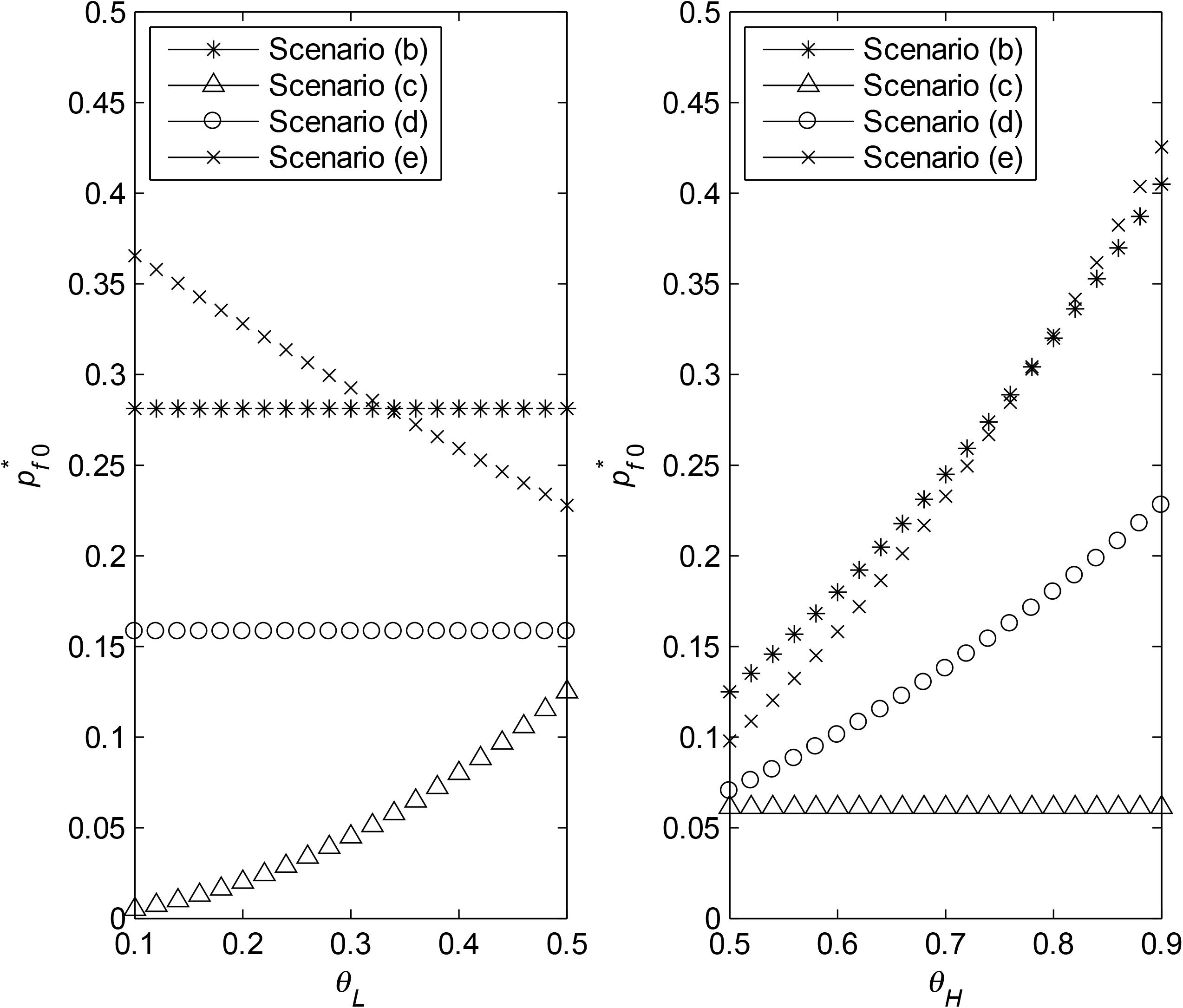
Rental price in the electric vehicle rental (e.g. when the sharing price is high).
In contrast to the first group, the second group of experiments is performed to identify the correlation in Scenarios (d) and (e). When the sharing price is low, the rental price
When the sharing price is low, the company ignores H and values L in Scenario (e), so the rental price in the ownership stage aims at L. The company intends to offer the product to L in the ownership stage by extracting the surpluses from L as many as possible, and the losing surpluses are only correlated with L, so the company's quality decision in the ownership stage is dependent on the quality sensitivity of L (
Sharing price
As a comparative experiment of Figures 2 and 3, the third group analyzes the relationship between the consumer's variety seeking and the platform's sharing price, and Figures 4 and 5 show how the sharing price varies with the consumer heterogeneity in the electric vehicle rental. When the sharing price is low, the sharing price (
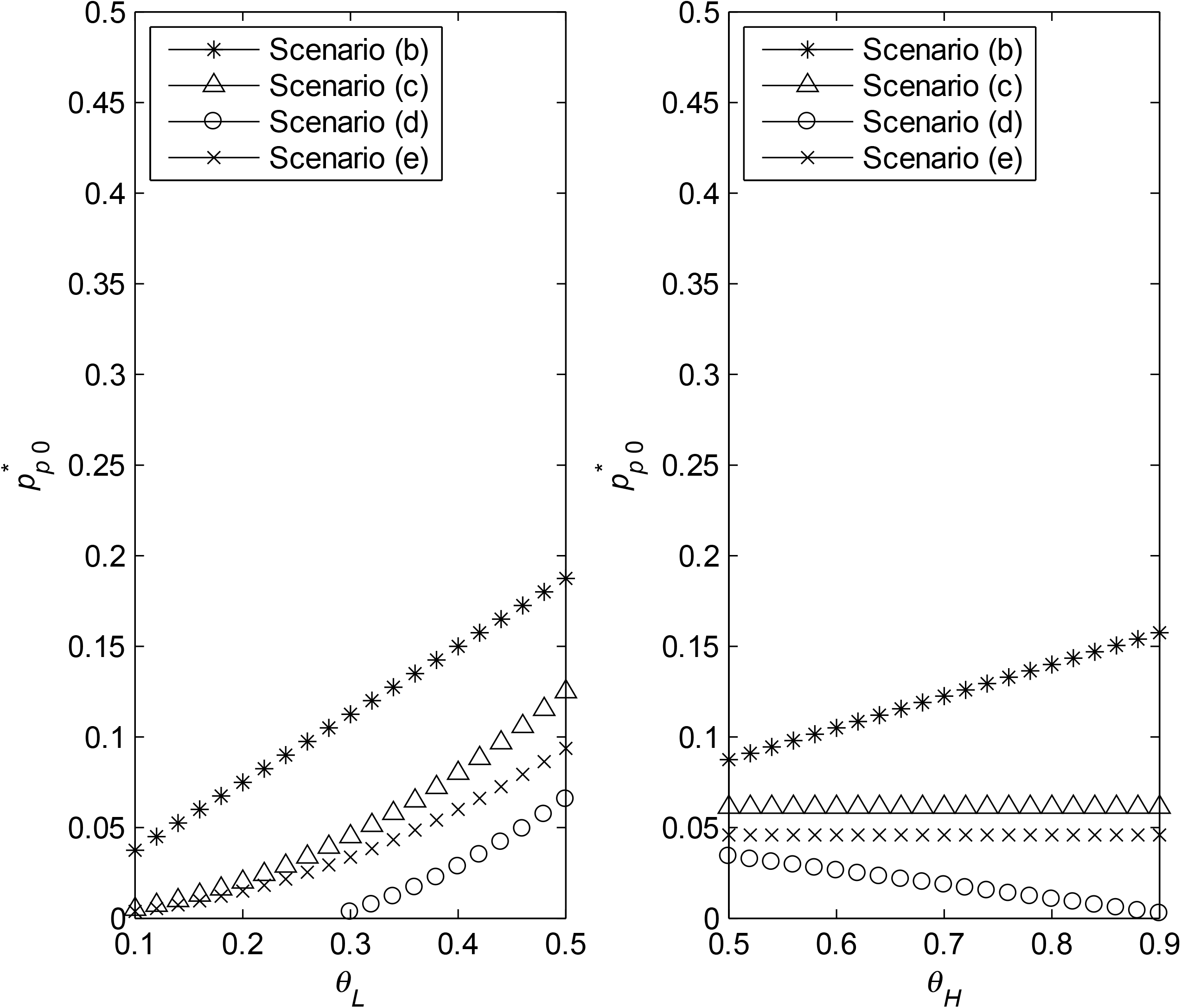
Sharing price in the electric vehicle rental (e.g. when the sharing price is low).

Sharing price in the electric vehicle rental (e.g. when the sharing price is high).
Interestingly, the final group of experiments manifests some different impacts of the valuation heterogeneity on the sharing price. In Figures 4 and 5, the low sharing price (
Conclusion
Discussion
In this section, we discuss the main finding of the consumer's valuation heterogeneity and variety-seeking behavior from the passenger side and the driver side. The numerical experiments examine the impact of the high-end and low-end customers’ valuation heterogeneity on the rental price and the sharing price. We find out that if there is a single product in the sharing market, the company's rental price is more independent of the valuation heterogeneity than the platform's sharing price.
For passengers on the demand side, online trading in sharing markets diversifies product usage, so the customer will play different roles over the ownership stage and usage stage. Some customers who sign up in the ownership stage can rent it out at the beginning of sharing, 33 while some customers who don’t own the goods by the end of rental can make it available in the usage stage. 27 As the world's famous car-rental company, Hertz provides hybrid or electric vehicles for gig workers who want to be part-time drivers and successfully has the largest electric vehicle rental fleet in North America. a Using Uber's mobile application, many gasoline vehicle owners begin to turn to the ride-hailing service of Uber Green for a zero-emissions trip, because each trip with plug-in electric-powered vehicles will produce at least 55% less air pollution than the trip with gasoline vehicles. b Some scholars have divided customers into different segments and studied their choice behaviors according to individual tastes, such as patient or impatient customers, 34 loyal or switching customers, 35 and experienced or new customers. 36 However, the customer's choice behavior is prone to be variety-seeking in the sharing market, because the decision-making process not only depends on whether to sign up with the rental company, but also whether to join the sharing platform. After the ownership stage, the registered customer can be further differentiated into a sharer or a renter, which is contingent on the platform's two-sided property in the usage stage.
For drivers on the supply side, the personalized need in sharing markets reshapes the market structure, so the vehicle supplier will undertake different product ownership in electric vehicle rental and electric vehicle purchasing. Some suppliers act as wholesalers in industrial chains and earn from the gap between the package price for subscribers and the procurement price for manufacturers. 37 As an example of business-to-customer sharing, Hertz procures vehicles from upstream producers and then rents them weekly to downstream passengers through the self-support online shop. On the other hand, some suppliers act as the agent in contract theory and earn a proportion of pay-per-use commissions from the third-party user. 28 The drivers and passengers on Uber can make a ride-hailing deal through smartphone applications, and the customer-to-customer platform charges some service fees for each fare that is paid to the driver. Some scholars have integrated the platform business into different scenarios and studied pricing strategies according to marketing factors, such as surge pricing, 38 two-sided pricing, 39 and intertemporal pricing. 40 However, the platform's peer-to-peer pricing is more influenced by the frenemy partnership with short-time rental, because the equilibrium profit not only depends on the vehicle supplied from a competitive partner, but also from a cooperative partner. Observing the rental price and vehicle quality in a rental company, the sharing platform can optimize the supplying mode and sharing price in the two-stage matching between sharers and renters.
Future direction
In this study, we focus on the customer's variety-seeking behavior in electric vehicle rental. We establish an analytical framework to study the equilibrium pricing strategy and quality decision in the frenemy platform competition, and the experimental analysis shows the impact of the valuation heterogeneity in the sharing market. The results conclude that given the single product, the rental company's pricing strategy is less influenced by the valuation heterogeneity, and the sharing platform's pricing strategy is more influenced by the valuation heterogeneity. Based on the variety-seeking behavior and frenemy platform competition, our study can be extended to many research fields. One future direction should be the customer's various choice behaviors for sales promotions in the sharing economy, such as referral programs or bounded rationality. In addition, the government's industrial policy will play an important role in affecting the adoption of electric vehicles,41,42 and thus the platform can adopt different marketing strategies for profit maximization as personalized pricing or dynamic pricing, which is also regarded as a future direction in the sharing economy.
Footnotes
Acknowledgements
The authors thank the editor and the anonymous reviewers for their helpful comments, which significantly improved the overall quality of this study. This work was supported by the National Natural Science Foundation of China [grant number 71901153] and the Shenyang Aerospace University [grant number 18YB29].
Declaration of conflicting interests
The author(s) declared no potential conflicts of interest with respect to the research, authorship, and/or publication of this article.
Funding
The author(s) disclosed receipt of the following financial support for the research, authorship, and/or publication of this article: This work was supported by National Natural Science Foundation of China, the Shenyang Aerospace University (grant number 71901153, 18YB29).
