




Abstract
While renewable energy deployment is essential to mitigate climate change, the interplay between renewable energy consumption and environmental degradation may not be linear. The environmental aspect of renewable energy consumption may change over time, depending on the scale and technique effects. This may be due to asymmetry in the relationship. Nonetheless, most current literature either assumes linearity, or ignores the turning point of the behavioral change. This results in inconclusive empirical findings at the disaggregated level of renewable energy consumption. This paper utilizes threshold estimation technique to capture the asymmetry in the renewable energy-CO2 emissions relation in the top ten renewable energy consumers covering the period 1990–2020. The literature gap is addressed by deriving the threshold effect at the aggregate and disaggregated levels to prevent aggregation bias. Understanding the thresholds of different renewable energy sources would improve policy effectiveness and resource allocation at different consumption levels to better curb climate change. The threshold estimation technique measures total renewables, hydro, solar, wind, and others (bioenergy and geothermal) as threshold variables. The findings indicate that total renewables and solar consumptions have stronger mitigating effects on CO2 emissions beyond the consumption levels of 4363.37 and 43.58 kWh, respectively. The advantageous environmental effect of wind consumption only manifests above the consumption level of 657.40 kWh. For policy implication, this study recommends an increase in the weightage of renewables in the energy mix by formulating energy-specific policies, in order to optimize the environmental benefits of renewable energy adoption.
Keywords
Introduction
Extreme weather events are recurring at an alarming rate, and pose a significant risk to the world. Of 504 of these events in the past 20 years, 71% may be attributed to human-caused climate change. 1 The net anthropogenic carbon dioxide (CO2) emissions surged by 43% between 1990 and 2015. 2 To address climate change, the global community has turned to renewable energy, in order to achieve sustainability in economic growth and environment.
Renewable energy refers to a sustainable energy source that is highly accessible and replenishable. 3 Such sources typically produce 20 times less greenhouse gas than fossil fuels on a life-cycle basis, 4 and renewable power plants can achieve 100% of efficiency compared to fossil power plants. 5 Thus, the role of renewable energy is profoundly important to reduce fossil fuel consumption, lower CO2 emissions, improve energy efficiency, decrease production costs, and enable sustainable growth. 6
Renewable energy investment has increased by 50% in the past five years, reaching USD 1.8 trillion in 2023. 7 Concurrently, renewable energy deployment has avoided 2.2 gigatons of emissions annually. Solar and wind energies are the two fastest growing renewable technologies, with annual incremental growth reaching 85% and 60%, respectively. Hydroelectricity remains the most reliable renewable option for power generation, while solar energy is poised to spearhead the energy transition process.
In energy and environmental economics, the correlation between output and environmental degradation can be elucidated by the environmental Kuznets curve (EKC) hypothesis. However, there is a dearth of consensus in this strand of work. For instance, the EKC hypothesis has been found present in various country-specific and cross-country analyses including Germany, 8 the BRICS economies, 9 and a panel of 38 countries. 10 In juxtaposition, opposite findings have been unveiled in Africa, 11 Europe, 12 and the Middle East. 13
Notably, the core idea of composition and technique effects in the EKC hypothesis emphasizes the crucial role of energy transition in contributing to the quadratic output-environment relation. 14 There is an increasing trend of empirical works that incorporate renewable energy consumption in the EKC literature. Aggregate renewable energy consumption is generally substantiated to be negatively related to CO2 emissions in the literature concerning diverse country panels such as Africa, 15 Asia, 16 the Association of Southeast Asian Nations (ASEAN), 17 Europe, 18 and Gulf Cooperation Council (GCC). 19 Nevertheless, the sophisticated association between renewable energy consumption and CO2 emissions has not been sufficiently explained at the disaggregated level. There is a potential presence of aggregation bias if the study does not account for the disaggregated effects of different renewable sources. Wang et al. 20 underlined that each renewable energy technology is distinctive in terms of natural attributes, applications, and operations. Thus, the individual environmental impact of renewable energy consumption may be different.
The empirical findings pertinent to renewable energy-environmental literature at the disaggregated level are profoundly inconsistent. While some studies like Zhang et al. 21 and Adebayo et al. 22 have highlighted the harmful effects of hydro and geothermal consumptions on the environment, other scholars like Udeagha and Ngepah 23 and Bashir et al. 24 have reached contradictory conclusions. Similarly, the environmental impacts of solar, wind, and bioenergy consumptions vary widely across different research findings. Al-Mulali et al. 25 and Wang et al. 20 reported deleterious yet insignificant effects of these renewable energy sources on the environment, whereas Destek and Aslan 26 and Pata et al. 27 reached opposing conclusions.
The subtlety in the renewable energy-environment interplay is further explored in the non-linear analyses. Salem et al. 28 have suggested a U-shaped relationship between wind and solar consumption and CO2 emissions, while the association between hydro consumption and CO2 emissions exhibits an inverted U-shaped trend. Additionally, recent studies including Yu et al. 29 and Kuşkaya et al. 30 have highlighted the importance of long-term effects, indicating that solar energy consumption may only yield benign effects to the environment over time.
Chen et al. 31 and Horvey and Odei-Mensah 32 are the only empirical papers that scrutinized the threshold effect of renewable energy consumption. Chen et al. 31 found that renewable energy consumption will only benefit the environment after reaching a certain threshold, especially in the developed nations. Horvey and Odei-Mensah 32 estimated a threshold of 56% for renewable energy consumption in Africa. In view of these arguments, renewable energy sources may contribute to carbon reduction only after a threshold point. However, focusing solely on total consumption may be insufficient, as industrial practices and technologies differ for each renewable energy source. Therefore, there is a critical need to examine the threshold effects of disaggregated renewable energy consumption, as each renewable energy source may contribute to carbon reduction differently.
Each renewable energy source may have varying degrees of detrimental effects on the environment, depending on factors such as technological maturity and resource exploitation approach. 3 Consequently, there is a lag effect to realizing the positive impacts of renewable energy during the early stages of renewable energy development. 31 The advantageous effects of renewable energy consumption on the environment are expected to unfold gradually in the long run, as scale and technique effects come into play. For example, the production and disposal of solar photovoltaics (PV) can lead to an escalation in non-biodegradable solar e-waste in the early adoption period. 33 Innovative recovery and recycling techniques for end-of-life solar PV can significantly reduce the amount of solar e-waste over time. These techniques require time to be developed and disseminated among all solar PV manufacturers, highlighting the importance of a long-term perspective in assessing the environmental impacts of renewable energy.
While recent environmental studies have explored the asymmetry between ecological quality and various underlying variables, a critical gap remains unaddressed. None have examined the threshold effects of disaggregated renewable energy consumption on environmental degradation. This literature gap is apparent, considering the inconclusive findings in the literature concerning the environmental behaviors of renewable energy consumption at disaggregated level. This could be due to the fact that every country has different consumption levels of diverse renewable energy sources depending on the country's technological capacity, resources’ availability, and policy initiatives. These factors could contribute to the behavioral change of each renewable energy source on the environment, hinting at a non-linear relationship in the long run. 34
Therefore, this study hypothesizes the presence of a threshold effect between renewable energy consumption and CO2 emissions in the context of the ten largest renewable energy users. The first objective of this paper is to investigate the threshold effect of renewable energy consumption on CO2 emissions. The panel threshold estimation technique, introduced by Hansen, 35 has been performed to capture the threshold effect. Achieving this objective would facilitate better understanding of the erratic environmental behaviors of renewable energy at different consumption levels. The second objective compares the potential threshold effects of renewable energy consumption between aggregate and disaggregated levels on CO2 emissions. This objective accounts for the heterogeneous natures of different renewable energy sources and avoids aggregation bias. This is essential to provide straightforward and unambiguous energy-specific policy implications for optimizing decarbonization efforts.
The contributions of this paper are presented as follows:
This paper distinguishes itself from the literature by capturing the turning points and distinct regime changes in the environmental behaviors of disaggregated renewable energy consumption. Studies that look beyond general linear assumptions, such as Adebayo et al.
22
and Kuşkaya et al.,
30
merely focus on the behavioral change of renewable energy across different time frequencies. Bashir et al.
24
and Awosusi et al.
36
describe the relationship between renewable energy consumption and environmental degradation at different quantiles of the environmental degradation's distribution. These studies ignore the turning point in the consumption level of a specific renewable energy source necessary for the behavioral change to occur. Understanding the turning points would improve the monitoring process on the behavioral change of renewable energy consumption and facilitate flexible policy adjustments via resources reallocation. This can help optimizing renewable energy investments in order to achieve the best environmental outcomes. This is the first known empirical paper that uses disaggregated renewable energy consumption as the threshold variables. This differs from Chen et al.
31
and Horvey and Odei-Mensah,
32
who focused on aggregate renewable energy consumption. These papers may potentially suffer from aggregation bias because the environmental effect of aggregate renewable energy consumption is attributable to the most dominant renewable energy type in the renewable energy mix. Information about renewable energy sources’ different environmental dynamics is not reflected. This is because certain renewable energy sources account for a significantly smaller share of the renewable energy composition. This might lead to confusion among policymakers in resource planning especially in terms of setting a priority for specific types of renewable energy development. Understanding the behavioral change of each renewable energy source could help the formulation of energy-specific policies flexible at different stages of energy transition. This study explores the scope of the top ten renewable energy consuming nations, which have not been thoroughly investigated in the renewable energy-environmental literature. They are the leading renewable energy players in the world, accounting for about 61% of the global CO2 emissions.
37
The outcomes of this paper will serve as pivotal references for these countries and the rest of the world in the global pursuit of energy transition.
Materials and methods
This study applies the augmented EKC model that is designed to probe the renewable energy-CO2 emissions nexus. As suggested by Ali et al.
38
and Uche et al.,
39
urbanization and technological innovation have been employed as the control variables to mitigate omitted variable bias in the estimation. Thus, our base model is presented as follows:

GDP is the primary variable in the prevailing EKC framework. The EKC model hypothesizes a non-linear output-environment nexus in the long run, resulting from the combination of scale, composition, and technique effects. 40 A scale effect takes place during the industrialization of an economy and promotes pollution. Composition and technique effects are relevant during the sustainability-oriented transition of an economy, and mitigate pollution. Thus, the output-environment relationship forms an inverted U-shaped trend.
The theoretical underpinning for a non-linear renewable energy-environment relation is that positive environmental return of renewable energy consumption is insignificant during early stage of adoption due to small fraction of renewable energy in energy mix, high up-front cost, low renewable energy storage capacity, low energy efficiency, and low cost-effectiveness as compared to fossil fuels. 41 During this period, the production of renewable energy materials is mainly reliant upon fossil fuels. 42 Renewable energy consumption tends to only show mitigating effect on environmental degradation when both scale and technique effects take place. 43
When economies of scale happen as more renewable energy is consumed, more investment is injected into research and development of environmentally friendly renewable energy production practices. This will make renewable energy cheaper, more efficient, and more effective in alleviating environmental degradation over time. Therefore, aggregate renewable energy consumption is expected to be negatively related to CO2 emissions. At the disaggregated level, the expected relationships between different renewable energy sources and CO2 emissions are uncertain, due to the inconclusive empirical evidence in the literature.
Based on the urban transition theory, more CO2 will be emitted as a byproduct of increased energy consumption in urban areas. 44 However, this may not be the case if the urban cities that have proper renewable energy facilities to keep carbon emissions under control. Hence, the environmental impact of urbanization also relies on urban policies related to carbon reduction and energy mix. Considering that the selected panel countries are the ten highest renewable consumers, with established renewable energy infrastructure, urbanization is expected to be negatively related to CO2 emissions.
On the other hand, technological advancement enhances renewable energy conservation and efficiency, thus improving the overall feasibility of renewable energy to replace fossil fuels. 45 Nonetheless, technological innovation can also cause damage to the environment, especially in countries rich in fossil fuels. This is attributable to the tendency of resource-rich countries to invest in environmentally exploitative technology to leverage their key resources to gain income. 46 In this study, technological innovation is projected to reduce CO2 emissions, since the ten selected countries are the top renewable energy players and employ advanced renewables technologies.
Empirical method
We employed the fixed-effect panel threshold estimation technique introduced by Hansen. 35 This model assumes varying slope coefficients, by allowing relationship between the regressor and response variables to change when the regressor crosses a threshold. In other words, the threshold regression model captures turning points to present mathematically the behavioral change of a regressor on the response variable. The advantage of using this technique is its ability to assess the impact of thresholds on the dependent variable by integrating regime-dependent factors. This model allows the threshold effect to capture the relationship between these variables, while the other control variables remain linear.
This approach safeguards against potential distortions stemming from threshold variables that are determined externally, outside the model framework. 47 Since the panel threshold model of Hansen 35 assumes individual-specific fixed effects, it also accounts for individual heterogeneity across cross-sectional units. 48 The individual effect is eliminated by removing the individual-specific means from the model. Additionally, this model captures the threshold effect without splitting observations, avoiding both insufficient degrees of freedom in certain regimes and biased estimation.
The threshold regression model is highlighted below:

The panel threshold technique requires the examination of the fundamental assumption that there is threshold effect in the model. In order to validate the presence of threshold effect in the model, the F-test has been employed as follows:

When the existence of threshold effect is testified, the next step involves the testing of consistency between the estimated threshold value


Data sources
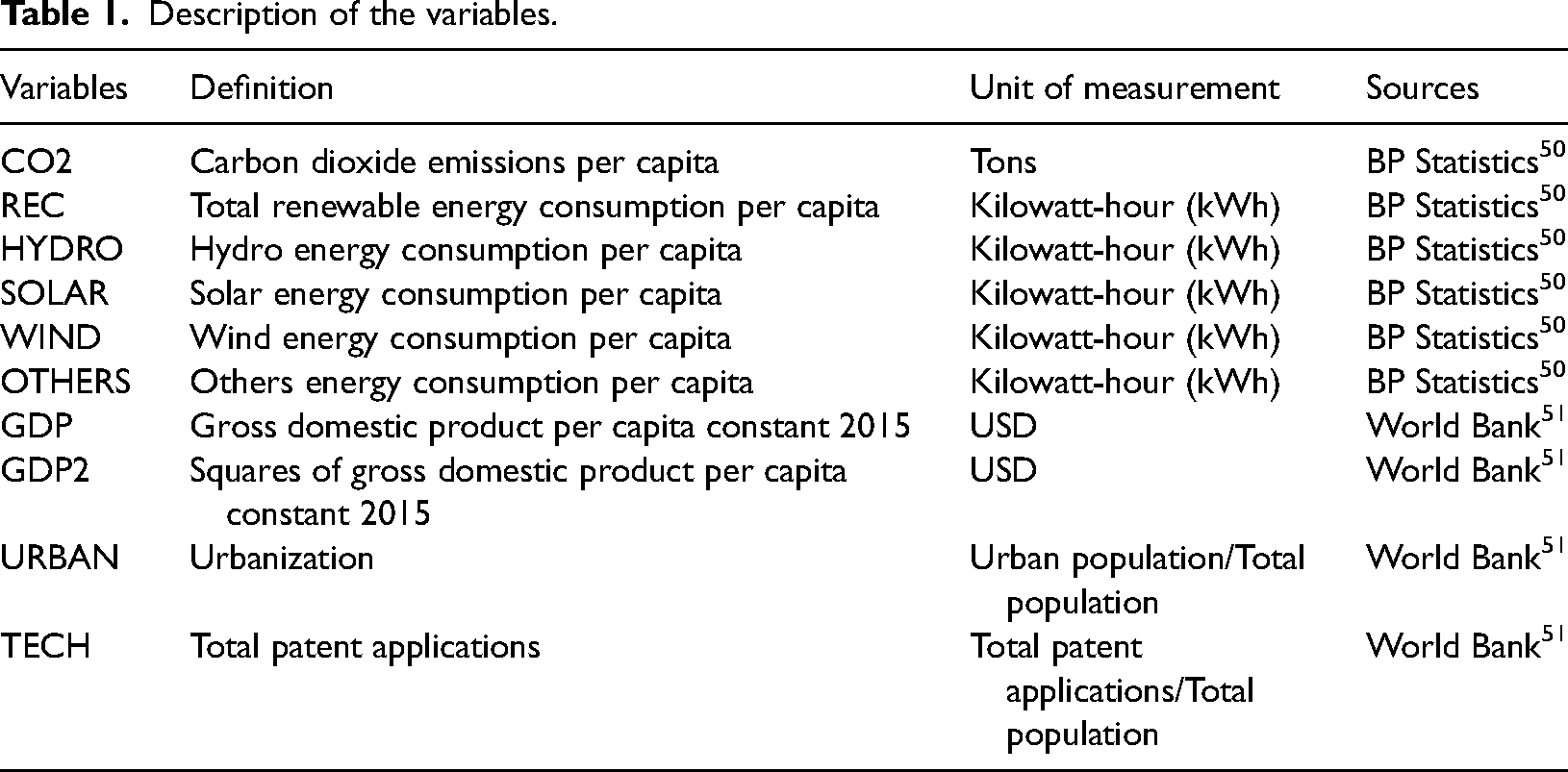
This paper chose a panel of ten largest renewable energy consuming nations, namely China, the USA, Brazil, Germany, India, Japan, the UK, Spain, Italy, and France for the period 1990–2020. These ten countries have been selected because they are the most established renewable energy players in the world and have access to the most diverse renewable technologies. They serve the best reference to the whole world in comprehending the potential behavioral change in the long-term consumption of different renewable energy sources. Detailed definitions, units of measurement, and sources of data are tabulated in Table 1.
CO2, REC, HYDRO, SOLAR, WIND, OTHERS, GDP, and GDP2 are expressed in per capita term, because there is a significant difference in the sizes and patterns of these variables in the ten panel countries. Converting to per capita term will relax the heterogeneity across the panel sample (Husaini & Lean, 2022). All the variables are converted into natural logarithmic form.
Description of the variables.
Results and discussion
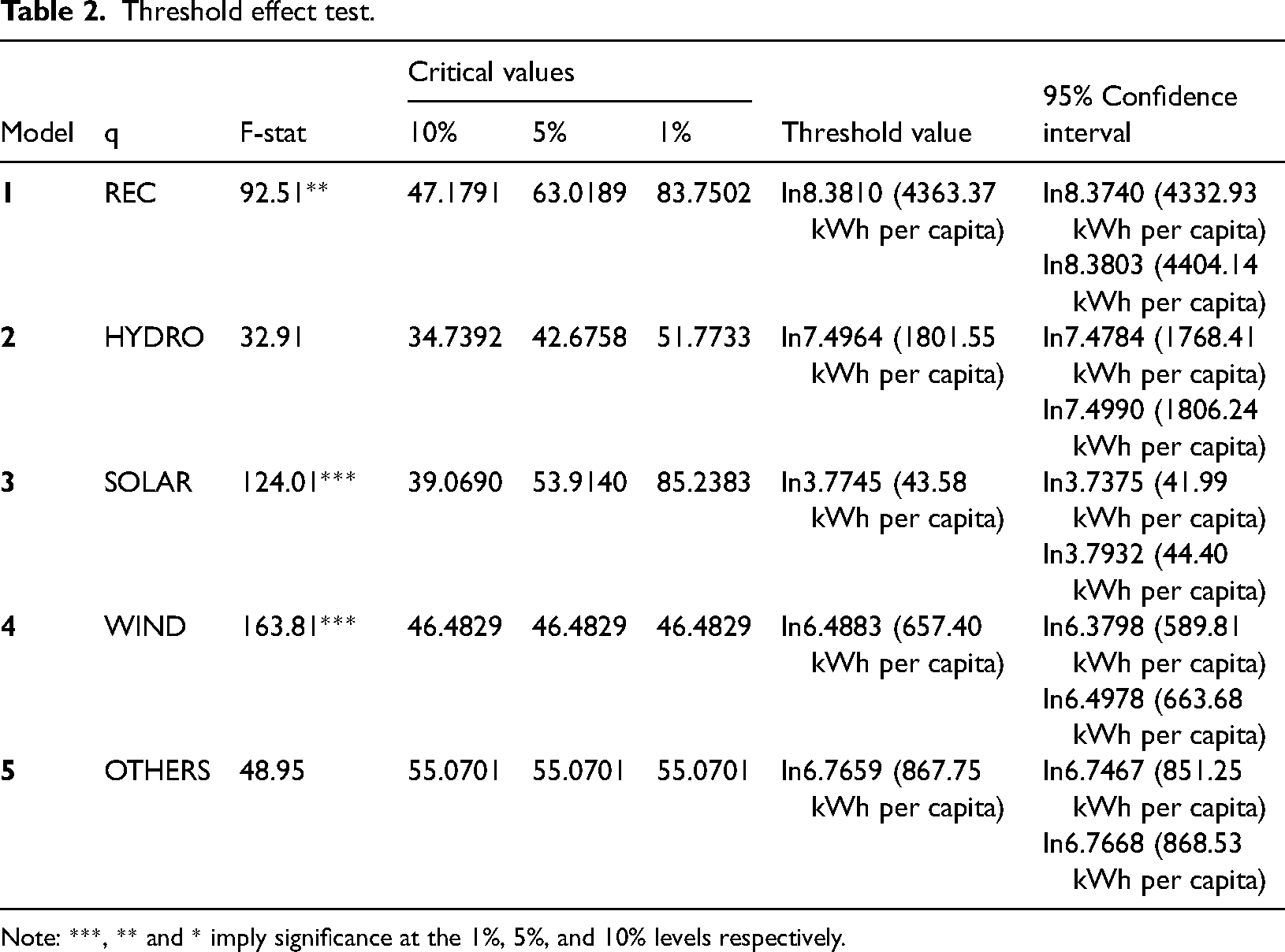
The threshold effect of each renewable energy source in the respective models has been determined. Table 2 presents the results of threshold effect test for every model. Based on Table 2, the presence of a threshold effect is confirmed for Models 1, 3, and 4, while Models 2 and 5 do not have threshold effect. The fixed-effect threshold estimation is conducted for Models 1, 3, and 4 to identify the non-linear coefficients. Since threshold effect is absent in Models 2 and 5, the linear fixed-effect model has been used. The possible existence of within-cluster is considered by estimating the model with robust standard errors. 52 Additionally, diagnostic checks, including the Chow test, Breusch-Pagan LM test, Hausman test, heteroscedasticity test, autocorrelation test and VIF, have been performed.
Threshold effect test.
Note: ***, ** and * imply significance at the 1%, 5%, and 10% levels respectively.
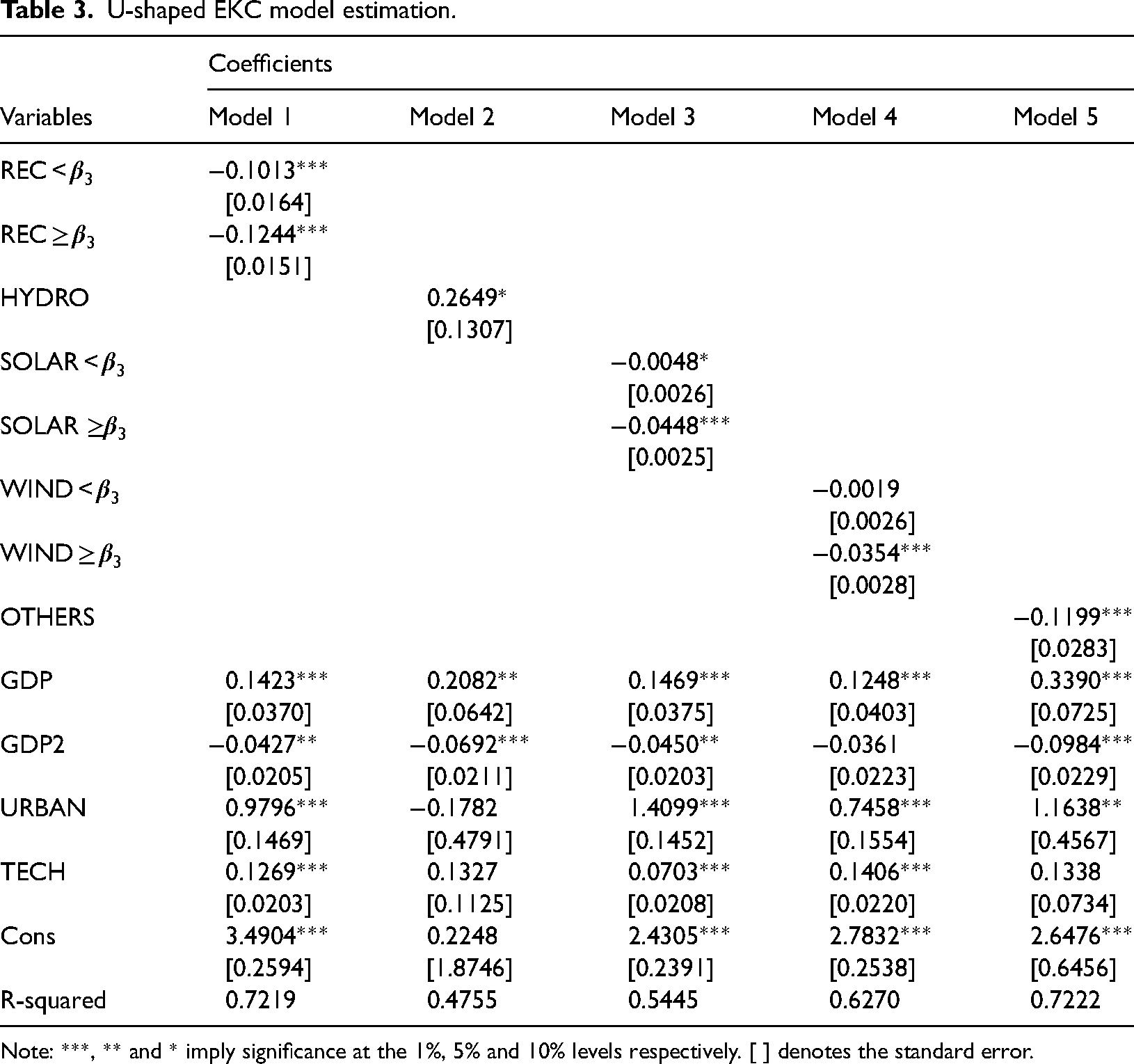
The results of the non-linear threshold estimation of each model are tabulated in Table 3. The finding suggests that the impact of REC on CO2 is consistently negative in both regimes. The magnitude of the negative impact increases from regime 1 to regime 2, indicating that REC reduces CO2 more significantly after the threshold. This outcome contradicts the results of Chen et al. 31 and Horvey and Odei-Mensah 32 which showed that renewable energy consumption is only effective in reducing CO2 emissions above the threshold level, but consistent with the conventional finding that renewable energy consumption benefits the environment both in the short and long run. 53 This inconsistency is either due to short and obsolete sample period, or because subject countries like the African economies selected by Horvey and Odei-Mensah 32 lack scale and technological advancements in renewable energy deployment. These factors could delay the materialization of environmental benefits in renewable energy consumption.
U-shaped EKC model estimation.
Note: ***, ** and * imply significance at the 1%, 5% and 10% levels respectively. [ ] denotes the standard error.
Renewable energy sources are significantly less pollutive than fossil fuels. On a life-cycle basis, CO2 equivalent per kilowatt-hour produced by renewable energy generated electricity is around 12 times lower than that of fossil fuels. 54 The environmentally clean properties and high energy efficiency of renewables can potentially reduce CO2 emissions by 70% when fossil fuels are replaced. 5 The substitution of fossil fuels with renewable energy diversifies energy composition, reduces fossil fuel consumption, enhances energy efficiency, and promotes sustainability. 55 Developed nations generally have greater economic capacity to obtain scale and technique effects in renewable energy development. 43 The expansion of renewable installation capacity and advancement of renewable technologies progressively exhibit the environmental advantages of renewable energy in these countries. Tellingly, seven out of the ten panel countries in this study are the top economies in the world and possess the most sophisticated renewable technologies.
Table 3 shows that HYDRO promotes the growth of CO2 emissions, which is consistent with Zhang et al. 21 and Adebayo et al. 22 Similarly, these two studies include both China and Brazil, which are the two largest hydropower users in the world. The positive environmental impact is only present when the hydropower plants are well-planned. 44 Poorly planned construction of hydropower infrastructure usually leads to large-scale flooding and deforestation, which is devastating to the ecosystem. 3 Additionally, the operation of hydroelectric facilities can also cause changes in temperature and precipitation, which are responsible for climate change. 56 Evidently, most of the hydropower infrastructure in the large hydropower consumers like China and Brazil may not have been built and operated in an eco-friendly manner, exerting considerable pressure on the environment. 57
Based on Table 3, there is a consistent negative relationship between SOLAR and CO2 in regime 1 and 2. The negative impact of SOLAR on CO2 is stronger in regime 2. This implies that SOLAR reduces CO2 emissions more substantially after the threshold. This result highly matches those from Yu et al., 29 who found that the negative effect of solar energy consumption on CO2 emissions is stronger in the long run for the top ten solar energy users.
Solar energy is arguably the most sustainable and environmentally friendly renewable energy source. Solar energy also shows strong technological potential to be developed into the cleanest energy source by 2050, projected to only emit between 3.5 and 12 g of CO2 equivalent per kilowatt-hour of life-cycle emissions. 58 Long-term consumption of solar energy promotes solar technological advancement that improves energy efficiency and solar e-wastes treatment through recycling technique. 59 Ultimately, increased solar energy consumption reduces fossil fuel utilization, enhances energy efficiency, improves solar byproducts handling techniques, and limits CO2 emissions growth. In the context of the ten panel countries in this study, solar energy consumption shows positive environment effect even at low consumption level due to its limited adverse environmental effect. Nonetheless, the beneficial effects grow stronger as more solar energy is consumed over time, due to improved energy efficiency and solar e-wastes recycling technology.
The negative effect of WIND on CO2 is only significant in regime 2. This implies that the expansion of wind energy consumption will only begin to show advantage to the environment after the threshold. This corroborates the empirical evidence from Chen et al. 60 that the mitigating effect of wind energy consumption on environmental degradation is generally stronger at later adoption stage. In line with the argument from Kuşkaya and Bilgili 61 that early wind consumption increased pollution in the USA, our findings reveal that wind energy consumption does not help with the improvement of environmental quality before the threshold.
Technically, wind energy consumption is insignificant in terms of positive environmental effects at the early stage of deployment, owing to higher short-term environmental costs. The behavioral change of wind consumption occurs when the marginal benefit outweighs the marginal cost in the long run. The short-term habitat loss required to produce a unit of wind energy is greater than that of oil and gas. 62 However, placing new wind turbines on an already-built pad poses no additional impacts, resulting in greater environmental benefits in the long run. In terms of manufacturing, producing wind turbines from fossil fuels and disposal of non-biodegradable wind turbines can also cause pollution. Nevertheless, technological improvements in the thermoplastic resin system allows recycling of wind turbines, which considerably reduce the adverse environmental effect of wind energy. 63 Ji and Chen 64 have also found that technological advancements in the smelting and pressing of metals can lead to greener production of wind turbines.
Considering that wind energy has lifecycle emissions of merely 10.8 g of CO2 equivalent for every kilowatt-hour of electricity produced, 65 low lifecycle emission of wind energy nullifies the environmental costs from habitat loss and production-driven pollution in the short run. With the advancement of wind technologies over time, the top ten renewable energy users do not only have the adequate scale in wind capacities, but also the capability to fine-tune the manufacturing process, especially in terms of waste treatment, to yield net environmental benefits for wind energy.
According to Table 3, there is a significant inverse relationship between OTHERS and CO2. This result conflicts with Shahzad et al. 66 and Ramzan et al. 67 who revealed that biomass and geothermal consumptions are detrimental to the environment for the case of China and the G7 economies. This contradiction may be attributed to the inclusion of biofuel in the OTHERS for this analysis, which was not considered in the other two studies. This is further supported by Waris et al., 68 who discovered a negative relationship between biofuel and CO2 emissions.
Bioenergy can improve the environmental quality by replacing fossil fuels and making use of unproductive resources like wastes. 69 Replacing coal with biomass produced from crops can potentially decrease emissions by 29 million tons of CO2 equivalent per year. 70 Bioenergy can also foster ecofriendly wastes management by converting municipal and agricultural wastes, and even construction debris to biomass. 71 On the other hand, geothermal power plants release 99% less CO2 and 97% less sulfur dioxide than fossil fuel power plants of the same size. 72
The ten countries in this study each has strong regulatory frameworks and advanced technological foundations to optimize the environmental benefits of bioenergy and geothermal energy by ensuring stringent industrial and operational procedures. 73 This provides a sustainable solution for the countries to continue building their economy by ensuring better energy efficiency, more environmentally harmonious renewable energy utilization, smoother energy transition, and lower pollution levels.
Robustness test
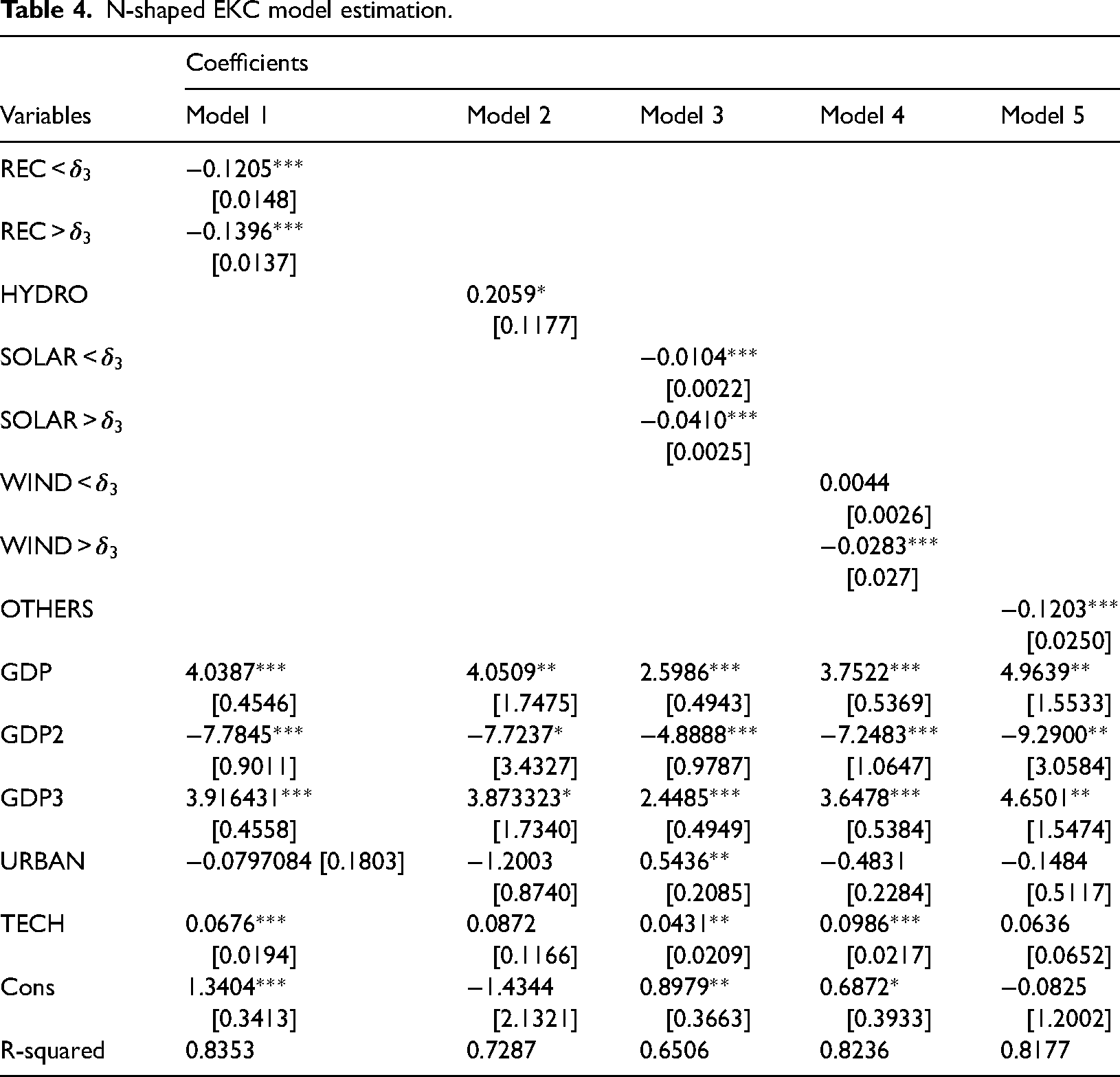
For a robustness check, GDP3 is added in the models to verify the presence of an N-shaped EKC. According to Allard et al., 74 the trajectory of the output-CO2 emissions can go beyond the conventional inverted U-shaped EKC and eventually return to a positive relationship. The results in Table 4 show that the threshold effects of the total and disaggregated renewable energy consumptions on CO2 emissions are consistent with our primary findings. Overall, the direction and magnitude of the robustness results are also in line with the primary results.
N-shaped EKC model estimation.
Conclusions and policy implications
This paper examines the turning points of behavioral changes in renewable energy consumption in the context of the environment of the top ten renewable energy consumers by employing threshold regression. This research contributes to the literature by accounting for the aggregate and disaggregated aspects of renewable energy consumption to avoid aggregation bias. Furthermore, this study addresses the literature gap by exploring the asymmetric relationship between disaggregated renewable energy consumption and environmental degradation. These contributions have important energy-specific and overarching policy implications to improve decarbonization efforts throughout the energy transition process.
Our findings indicate that all renewable energy types improve environmental sustainability, except hydro. Firstly, we conclude that consumption of each renewable energy source affects CO2 emissions differently, hence, substantiating the presence of aggregation bias. Secondly, the effectiveness of total renewables and solar consumptions in carbon reduction is stronger after the threshold. Thirdly, wind consumption is only significant to decrease CO2 emissions after the threshold. Fourthly, hydro and others consumptions do not have asymmetric effects on CO2 emissions. The former is significantly positive on CO2 emissions, whereas the latter is significantly negative. Next, the EKC hypothesis has been validated in all models except Model 4. Furthermore, urbanization and technological innovation have been found to be generally deleterious to environmental sustainability.
In terms of policy implications, proportion of renewable energy in the energy mix should be increased. Solar, wind, bioenergy, and geothermal should be prioritized in order to optimize renewable energy investment at early development stage when resources are scarce. Policies such as feed-in tariffs, tax allowances, and soft loans should be implemented to incentivize renewable energy investment. This is especially important to countries with massive populations, such as China and India. These countries need to ensure their renewable energy capacity growth can keep up with the rapidly growing energy demand and avoid reliance on fossil fuels.
Policymakers should be aware of the construction and operation of hydropower facilities in the countries as the harmful effect of hydro energy consumption is most likely attributable to the unsustainable industrial practices. Brazil should give this issue extra attention, because hydro energy makes up to more than 30% of total energy consumption in the country, making it the most hydro-reliant economy among the ten nations. However, mega hydroelectric plants such as the Belo Monte dam have seen controversial disputes over its devastating effects on the environment. Therefore, the government should implement stringent policies to ensure eco-friendly industrial practices in the building and operation of hydroelectric dams on one hand, and encourage more research and development of hydro technology to reduce its adverse impacts on the environment on the other hand.
Nevertheless, this study has certain limitations. The variable, others energy consumption combines bioenergy and geothermal due to the pre-grouped raw dataset. Thus, the specific impact of each type of renewable energy in this combined variable has on CO2 emissions remains unclear. Besides, the outcomes of this study are based on panel data analysis which is unable to capture the information at the country-specific level. This ignores the specific differences between these ten countries and does not facilitate comparison. This paper does not include the newest renewable technologies such as ocean and hydrogen energies due to data unavailability.
Concerning these limitations, we recommend several directions for future study. First, future research may classify renewable energy consumption according to distinct energy sources to reflect their individual impacts on environmental degradation. Second, future research may also use multiple threshold nonlinear autoregressive distributed lag (MTNARDL) to better elicit country-specific information and include a scientific comparative analysis. Country-specific information offers more nuanced insights that allow direct comparison between countries which offers more informative evidence. More considerations can be given to the investigation into advanced renewable technologies such as hydrogen and ocean energies. This kind of study focuses more on the environmental behaviors of new renewable technologies that are likely to set trend for future renewable deployments.
Footnotes
Acknowledgement
The second and third authors thank the Ministry of Higher Education (MOHE) for Fundamental Research Grants (FRGS/1/2023/SS06/UNIMAS/03/1) awarded. The second author acknowledges Universiti Malaysia Sarawak (UNIMAS) for providing additional financial support and research facilities.
Declaration of conflicting interests
The authors declared no potential conflicts of interest with respect to the research, authorship, and/or publication of this article.
Funding
The authors received no financial support for the research, authorship, and/or publication of this article.
