




Abstract
Welfare state typologies are generally based on the institutional design of welfare policies. In this paper we analyse whether such typologies also persist when they are applied to effective redistributive outcomes of welfare states’ tax and transfer policies. In contrast to the widespread use of macro indicators, our empirical analysis relies on internationally comparable microdata in order to account for the distribution of resources across households. We perform a hierarchical cluster analysis and check whether the classical typology for Western European welfare states reproduces the typical patterns when it comes to effective economic outcomes. We find that the established welfare regimes not only differ in their welfare state institutions as is known, but also in their economic outcomes. In particular, we identify the social-democratic, conservative, liberal and southern welfare regimes. Belgium and the Netherlands emerge as hybrid cases lying between the social-democratic and conservative model.
Since the seminal work of Esping-Andersen (1990) on the typologies of welfare regimes, there have been numerous related articles on the systematization of welfare state research. The majority of studies extend or criticize the categorization of welfare regimes on qualitative grounds. Other studies empirically test proposed typologies, usually based on available macrodata. 1 This approach, however, prevents researchers from capturing the effective distribution and redistribution of resources across households. In the welfare state literature it is a common finding that welfare regimes differ in their welfare state institutions. However, it is less clear whether these differences systematically translate into specific patterns in distributional outcomes. Therefore, in this paper, we empirically test whether the microeconomic outcomes of welfare state institutions still cluster among the established welfare states typologies.
The institutional theory of comparative political economy suggests that institutions shape political output and accordingly the distribution of economic outcomes. Based on this, we formulate expectations concerning the redistributive capacities of different welfare regimes depending on their typical welfare state institutions. We then empirically test the suggested patterns on a broad set of distributional outcome variables. Contrary to the existing empirical literature, we use internationally comparable microdata for the EU-15 countries to take into account the allocation and distribution of resources within each country instead of relying on macro-level characteristics. Using various distributional measures, we can provide detailed insight into the structure of fiscal policies, their relative importance and the resulting redistribution of income. By means of cluster analyses, we test whether welfare state institutions translate into the politico-economically expected redistributive outcomes and whether traditional welfare state typologies can also be identified when analysing the effective distributional outcomes of welfare state policies.
There have already been a few studies that analyse the effective economic outcomes of welfare policies. Bradley et al. (2003) provide comprehensive evidence on the distributive and redistributive processes in modern welfare states. However, comparative insight on the magnitude of redistribution as well as the relative importance of individual policy instruments is missing. The same holds for Kenworthy and Pontusson’s (2005) analysis, which offers evidence on overall redistribution based on microdata. A comprehensive disaggregation of redistributive effects by tax and transfer instruments and additionally disaggregation by the size and target efficiency of fiscal policies is offered by Mahler and Jesuit (2006). While they estimate regression models to test the impact of political-economic institutions as well as other political and structural variables on redistributive outcomes, we conduct a cluster analysis to identify (dis)similarities between different welfare state regimes.
The aim of our paper is also comparable to the research question of Goodin et al. (1999), who studied whether the characteristics from the welfare state typologies translate into specific economic outcomes. Their evidence is based on national microdata for three typical countries. However, we argue that the small number of cases, as well as the missing decomposition of redistributive effects into the different fiscal instruments, does not provide sufficient insight into the relation between welfare state institutions and effective economic outcomes. Within our empirical analysis we seek to identify ideal-typical patterns in the relative importance and redistributive effects of different welfare policies. To adequately assess the effective redistributive impact of different tax and transfer instruments, the empirical analysis partly builds on and extends the analysis of Fuest et al. (2010). However, whereas the former analysis extensively discusses different methodologies of measuring redistributive effects, here we (theoretically) discuss and empirically test whether redistributive outcomes of welfare states cluster within the ideal-types of the established welfare state typology literature.
Our empirical analysis validates the common expectation of overall redistribution according to the welfare state typology (high in Nordic and Continental, lower in southern and Anglo-Saxon countries). Our results further suggest that the distributional outcomes of Western European welfare states do indeed cluster within the established regimes that became known as the social-democratic, conservative, liberal and southern model (Esping-Andersen, 1990, 1996; Ferrera, 1996; Bonoli, 1997). When taking a closer look at the different groups, we identify Belgium and the Netherlands to form a hybrid case between the northern and conservative model, characterized by social-democratic type redistributive benefits – largely financed by social insurance contributions as typical for the conservative model. In addition, our findings are compatible with Esping-Andersen’s view that the southern welfare states are a rudimentary version of the conservative model as both models are relatively similar in the structure of welfare states whereas the difference in overall redistribution is still quite substantial.
The article is organized as follows: we begin with establishing the link between welfare state institutions and distributional outcomes, and subsequently postulate typical distributional outcomes of different welfare regimes. The next section deals with the description of the data, concepts and methodologies used throughout the analysis. Several measures of distributional outcomes are presented, followed by the results of the hierarchical cluster analysis. We conclude with a summary of the main results and discuss their implications.
Welfare state designs and the capacity for distributive politics
Our definition of the welfare state follows Esping-Andersen’s concept of decommodification and summarizes the entity of social policies and institutions that guarantee a person the maintenance of a ‘livelihood without reliance on the market’ (Esping-Andersen, 1990: 22). Our research interest is limited to the economic dimension and includes policies that affect the distribution and redistribution of income – essentially, wage policies, taxation, transfer payments and pension systems. Esping-Andersen’s welfare typology has a second dimension that considers the welfare state as a system of stratification, which describes how welfare policies structure societies into socioeconomic groups. We neglect this dimension as its theoretical implications – which point to the political process – are of lower rank importance for the research question of this paper. 2 However, some of Esping-Andersen’s original indicators, which he used to capture stratification, are considered in the description of welfare state ideal-types insofar as they imply statements about redistributive economic outcomes (for example, eligibility rules for benefits).
The objective of this paper is to analyse whether welfare state institutions translate into distributional outcomes, which consistently picture the typical patterns of welfare regimes. The theoretical link between institutions and economic outcome is established in the political economy literature of welfare states. For instance, it is argued that welfare state institutions define socio-political groups of individuals being included in or excluded from social programmes and additionally profiting or losing from the benefit principle and the governance of the welfare state (Korpi and Palme, 1998; Iversen and Soskice, 2006; Manow, 2009). This affects the formation of political coalitions and the support for welfare state programmes. With respect to the redistributive capacities of social programmes, Korpi and Palme argue that there is a trade-off between the size and coverage on the one side and the structure of welfare policies on the other side. In this process, a narrowly targeted transfer payment towards the poorest, which might be adequate for effectively fighting poverty, leads to a loss of solidarity and broad political support. This eventually leads to a restriction of the social budget and to highly targeted redistributive policies that are limited in size. Korpi and Palme suggest that high target efficiency even has a negative impact on redistribution, which motivates them to formulate their influential paradox of redistribution (1998: 681), which implies that the most targeted benefits are least likely to redistribute income. They then identify the size of benefit programmes to be the most important factor for the redistributive performance of the welfare state.
Even though the logic of the political trade-off between size and target efficiency is convincing, we argue that the distributive arithmetic of the entire welfare state is much more complex and not as comprehensible as the conclusion based on Korpi and Palme’s analysis of old age pensions and sickness benefits suggests. Obviously, other major parts of the welfare state also have significant redistributive effects and consequently, we argue that the size of welfare (spending) programmes does not provide a sufficient explanation for high levels of redistribution. Rather, as described in the methodological literature (Lambert, 2001), redistribution is the result of an interaction between the size and the structure of a fiscal instrument. The structure as well as the absolute levels of taxes is as important as the target efficiency and size of major transfer programmes (see also Castles and Mitchell, 1992).
Although the institutional theories of the political economy literature provide a sound approach to study the impact of welfare state institutions on economic outcomes, we come to the conclusion that available theory is not yet sufficiently developed to capture the complex political processes within the welfare state that lead to redistributive outcomes. We therefore suggest that the relation between the welfare state as a multiplicity of welfare state institutions and the profile of redistributive outcomes should be analysed on empirical grounds. However, we follow the theoretical argument of Korpi and Palme in so far that we assume that welfare state institutions and the design of welfare state policies shape the capacity for redistributing income (also Palme, 2006). We actually modify the scope of the institutional argument and claim that welfare state institutions even affect the redistributive capacity of individual welfare state instruments as well as the emergence of a complementary fiscal policy mix. The profile of economic outcomes should then be consistent with the characteristics of welfare regime institutions.
Thus, we stay within the boundaries of typological research and aim at a systematization of empirical patterns in distributional outcomes consistent with institutional welfare state regimes. In the subsequent sections, we review the characteristics of different types of welfare regimes by briefly recapturing common dimensions and indicators of their policies. Modern welfare state typology goes back to Esping-Andersen (1990), who distinguishes welfare state arrangements by means of their eligibility rules, the level of income replacement and the range of entitlement. His empirical results established a widely used threefold cluster typology among advanced industrial societies: conservative (Continental Europe), social-democratic (Nordic Europe) and liberal (Anglo-Saxon). Several authors criticized the trichotomy as arbitrary and called for the addition of at least a fourth category: the southern (Mediterranean) regime (Ferrera, 1996; Bonoli, 1997; Castles and Obinger, 2008). Even though there are still objections to this fourfold typology, we argue that this typology has proven its analytical practicability and is stable over time. Moreover, it also fits our research design as it perfectly exhausts the current EU-15 sample. The present literature on welfare state typologies offers broad evidence on qualitative or macro indicators that classify welfare state institutions. This allows us to derive falsifiable hypotheses on welfare state performance in distributive and redistributive policies, which we will then evaluate by analysing microdata. The aim of this paper is to show that besides the known differences of welfare state institutions, welfare regime types produce distinct patterns in their redistributive outcomes. Figure 1 graphically distinguishes our research design from the traditional research on welfare state typologies, which is commonly based on macro indicators. We consider wage policies, taxation, transfer payments and the pension systems as the most relevant policies that affect distribution and redistribution of income.
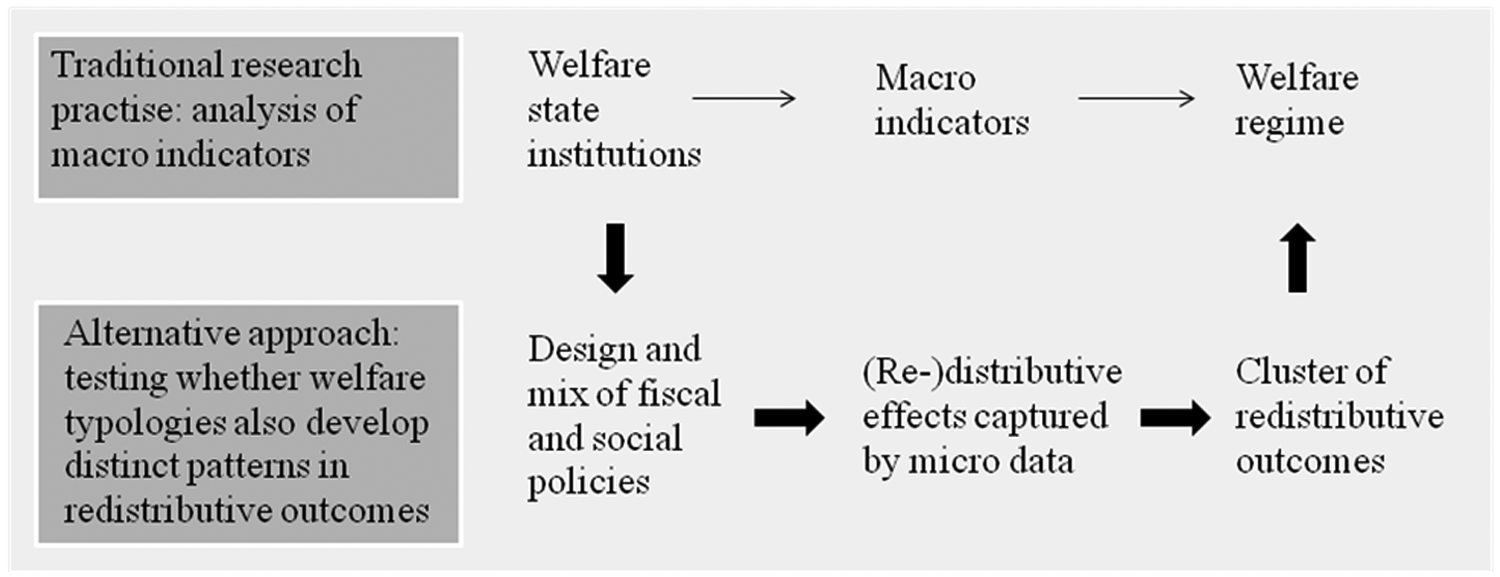
Research design: macro- vs micro-level approaches to welfare regimes.
Market income inequality
Since the 1960s de-industrialization (Atkinson, 2003; Iversen, 2005), increasing international competition and a rising education wage gap have created a tendency toward increasing gross income inequalities in developed countries. However, this development is significantly contingent on welfare state policies. National labour market regulations, for example, implement minimum wages and regulate wage bargaining processes in order to withhold excessive wage dispersion. Theories in the tradition of the power resources approach argue that centralized and coordinated wage bargaining as well as strong unions are crucial factors in promoting income equality (Kenworthy and Pontusson, 2005). Further, high (public sector) employment rates increase demand for workforce, which prevents high wage differentials (Rueda and Pontusson, 2000). In addition, unemployment benefits play a central role in shaping the distribution of wages, as they provide an implicit reservation wage. When these features are compared, there is a clear difference between liberal welfare states, where wage bargaining is left to decentralized market action, and social-democratic welfare states, which possess significantly higher levels of labour market standards; their characteristic high public sector results in high pre-government income equality (Nickell and Layard, 1999). The strictest and rigid standards of labour market regulation are actually in place in the southern states (Nickell and Layard, 1999). These, however, primarily protect the employed and function as an obstacle to labour mobility and high employment rates, which are held responsible for resulting in high inequalities of market income. The social standards in southern welfare states appear highly fragmented, with no articulated minimum social protection (Arts and Gelissen, 2002). In addition, uncoordinated wage bargaining leads to high income inequality in the southern European states. The conservative welfare states range along a middle level. Wages are negotiated in highly coordinated corporatist labour relations, which push towards high equality. However, sectoral unions, moderate general employment and medium public sector employment lead to medium levels of income inequality. 3
Taxes
Before enacting any social programmes, the welfare state is dependent on the levy of financial resources. Tax systems are not only created to raise tax revenues, but also to achieve a desired distribution of tax burdens among different socioeconomic groups (Swank and Steinmo, 2002). The revenue raising sides of welfare states differ in the design of the tax schedule, the definition of the tax base and the tax mix, which consequently determines the redistributive outcome of welfare states. Tax systems of liberal welfare states are commonly ascribed to low redistributive effects in order to avoid disincentives for economic action and to facilitate economic growth (Goodin et al., 1999). However, their public budget is usually financed to a large extent by income taxes and their tax composition mostly neglects proportional social insurance contributions (SIC). Therefore, the tax mix is promising a fair level of redistribution via taxes, which does not conform to the common picture of laissez-faire economic order. 4 The conservative welfare states, however, show an ambivalent picture. Whilst the top statutory income tax rates and the large overall tax ratio suggest a fair level of redistribution through taxation, the tax composition, with relatively low revenue from income taxation and the high importance of proportional SIC, dampens this assessment (Kemmerling, 2005). A review of the same indicators in southern states does not allow for a sufficiently clear categorization. Total tax revenues from income taxes are lower than in conservative welfare states, whereas SIC are fairly high, which is used to label the southern welfare state as a rudimentary version of the conservative welfare system (Esping-Andersen, 1990). The Nordic states show extremely high figures in the total tax ratio and income tax ratio, while having lower shares of SIC. In addition, the top personal income tax rates remain high, which makes their tax systems fairly redistributive.
Transfers
Welfare state social programmes differ fundamentally in the size and mode of providing social assistance (Korpi and Palme, 1998; Moene and Wallerstein, 2001; Conde-Ruiz and Profeta, 2007). Means-tested assistance, social insurance and universalistic benefit systems are the elementary alternatives in protection against social risk and achieving decommodification. The liberal welfare state developed out of liberal work-ethic norms, which put forward the market as the main source of welfare (Esping-Andersen, 1990). Therefore, social entitlements are often associated with social stigma. Their fairly egalitarian approach of a mix of flat-rate universal and means-tested benefits is rather thwarted by the lean size of social assistance. Therefore the overall redistributive capacities of transfer payments remain rather limited in liberal welfare states.
The conservative regime developed from a corporatist-static tradition, which emphasizes traditional family patterns and occupational status for the provision of welfare. Replacement rates of unemployment benefits are determined by previous earnings-related payments of public insurance contributions. The fact that social insurance programmes are usually directed to distinct socio-political groups and mainly financed by insurance contributions limits the political support for extensive cross-class redistribution through transfer payments (Moene and Wallerstein, 2001). In line with the status-preserving aim of social security the redistributive capacities of corporatist social insurances in conservative welfare states range across a medium-low level. The southern European states follow this Bismarckian social insurance model. Welfare provision is influenced by a strong corporatist tradition and also the importance of the family suggests parallels with the conservative welfare states. However, the southern states do indeed offer universal healthcare, but they rarely provide national minimum income schemes for individuals (Ferrera, 1996), which suggests a comparatively less comprehensive and less developed welfare system and therefore low performance in redistribution by transfer policies.
The social-democratic welfare states offer the most generous social programmes. A high level of social security is guaranteed to all citizens with the provision of universal social programmes. Besides the defined level of social standards, earnings-related private insurance schemes are integrated into the universal egalitarian structures. This effectively prevents public social insurance solidarity from breaking apart and leads to the highest effective redistribution in social-democratic welfare states (Korpi and Palme, 1998).
Pensions
The demand for an old-age pension is an inherent part of working life (Busemeyer et al., 2009). Pension systems have a two-dimensional redistribution function. On the one hand, they possess an inter-generational redistribution that shifts resources from the young to the old, and on the other hand, an intra-generational redistribution that benefits the old who are poor (Mahler and Jesuit, 2010). The overall redistributive effects of a pension system basically follow from three constitutional characteristics, which distinguish pension systems according to the eligibility, the level of pension payments and the standards of regulation (Korpi and Palme, 1998).
Conservative welfares states have generous pension schemes with high replacement rates (Scruggs and Allan, 2006). As entitlements for pension payments are linked to previous contributions, the redistributive effect of pensions systems in conservative welfare states is rather low (Conde-Ruiz and Profeta, 2007). Similarly, in southern European states the level of pension benefits is also wage-related and determined by the contributions paid. In contrast, liberal and social-democratic welfare states feature universal Beveridge-type pension schemes with tax-financed public pensions. In liberal welfare states, people may have additional private insurance or employee pensions above the basic pension level, whereas in social-democratic regimes extensive pension insurances are also provided by public social security pensions (Korpi and Palme, 1998). The considerably higher replacement rates and the comprehensive public provision of social security pensions in social-democratic welfare states, however, leads to remarkable higher redistribution than in liberal welfare states.
Data
EU-SILC provides harmonized and comparable multidimensional microdata of households and individuals in European countries. Since 2005 the dataset has covered the EU-25 member states (except Malta) and is the largest comparative survey of European income and living conditions. Our analysis is based on the 2007 EU-Statistics on Income and Living Conditions (SILC) wave, which is the first to include gross income information for all EU-15 countries. The sample size varies from 3,885 households in Luxembourg to 20,982 households in Italy. The survey is representative for the whole population in each country due to the construction of population weights.
We measure economic outcomes in terms of the inequality in pre- and post-government incomes. Equivalent post-government household income (that is, disposable income (DPI)) is separated into its household equivalent components: pre-government income (wages and salaries, income from self-employment and capital), personal income taxes (PIT), social insurance contributions from the employee and employer (SIC), social benefits and public pensions, based on the following identity:

We use household equivalent incomes to compensate for different household structures and possible economies of scale within households. Note that our concept of pre-government income includes SIC paid by the employer, as they can differ widely across countries. The analysis only allocates those taxes and benefits that can be reasonably attributed to households. Therefore, corporate taxes as well as some types of government expenditures on public goods such as defence are not considered. Due to data limitations, indirect taxes and in-kind benefits cannot be taken into account either. Thus, in the remainder of the article we exclusively refer to cash benefits when speaking of social benefits and to PIT in the cases of taxes.
To operationalize welfare regime outcomes, we compute several distributional measures. We first consider the inequality in pre-government incomes as an indicator for the (dis)equalizing forces of markets. Second, as a measure of welfare state generosity, we use the amount of effective redistribution measured by the difference in the Gini coefficients between pre- and the post-government incomes (Reynolds and Smolensky, 1977). In contrast to macro indicators of welfare state institutions used in comparable studies, the Reynolds–Smolensky index of redistribution explicitly takes into account the distribution of social benefits along the income scale. In addition to an evaluation of the welfare state’s overall redistribution, we examine the importance of discrete welfare state instruments in redistributing income (Fuest et al., 2010). We thus determine the importance of PIT, SIC, benefits and public pensions for the redistribution of income for each country. 5
Distributional outcomes
Income distribution and redistribution
In this section, we examine the income distribution and redistribution as an outcome of the welfare states. Figure 2 illustrates the variation in income inequality and redistribution across EU-15 member states. Countries are divided into the established clusters from the welfare state typology literature (in particular Ferrera, 1996) and within clusters, countries are arranged in ascending order of the inequality of post-government incomes.
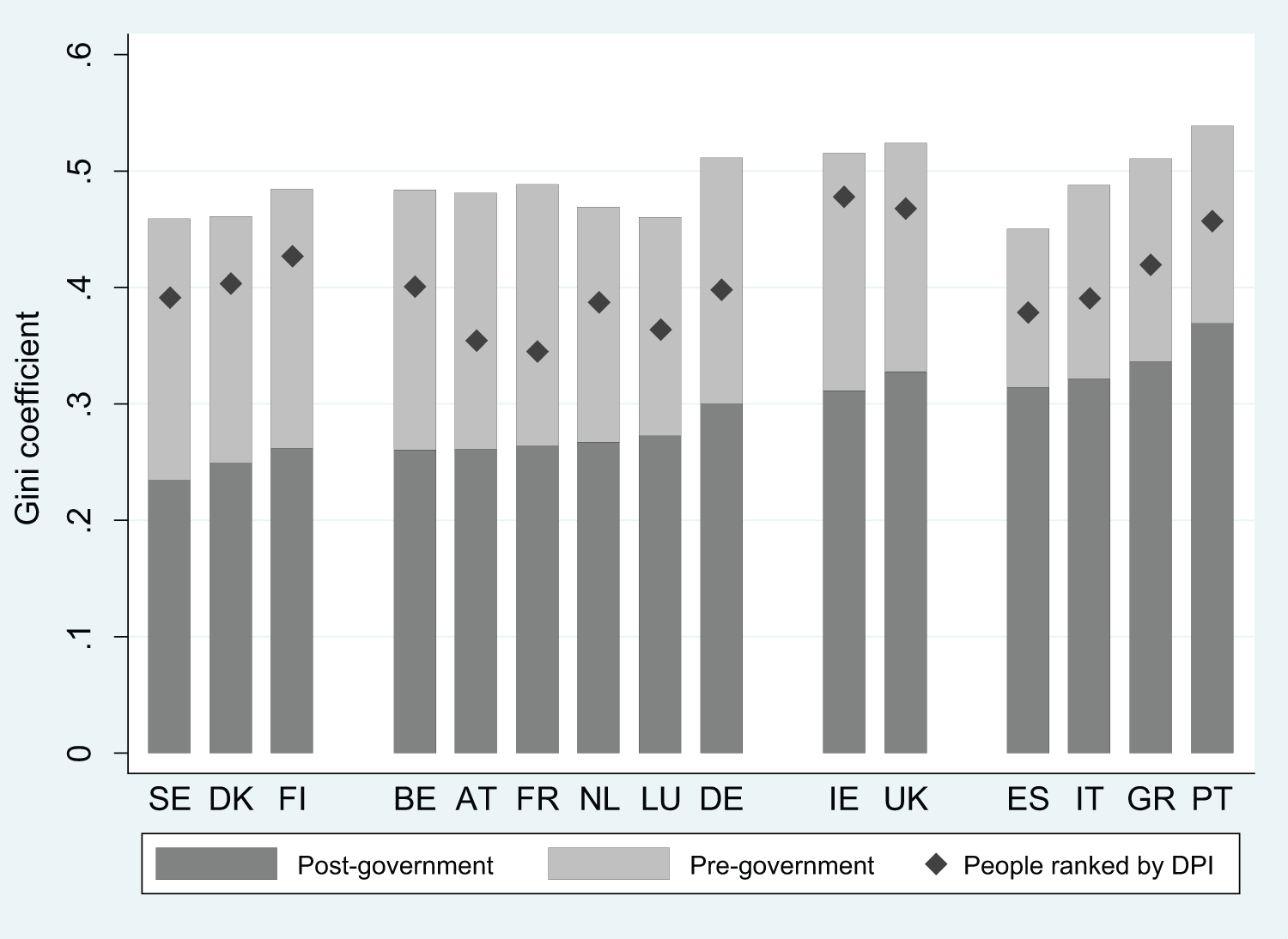
Gini income inequality and absolute redistribution. Source: authors’ calculations based on EU-SILC.
Inequality in pre-government incomes, which is illustrated by the light grey bars in Figure 2, can be regarded as a proxy for the (dis)equalizing forces of markets within a given country. Figure 2 reveals some variation among EU member states in the inequality in pre-government incomes – with Gini coefficients ranging from 0.45 in Spain to 0.54 in Portugal. Pre-government income inequality is especially high in Anglo-Saxon and southern European countries (except Spain), as well as in Germany. We do interpret high pre-government inequality in Anglo-Saxon and southern European countries as a sign of the low importance of labour market institutions in these countries, whereas the low inequality levels of the northern welfare states are associated with high levels of active labour market policies. In addition, in the majority of Continental countries we observe comparatively low pre-government income inequality.
Post-government inequality is significantly lower than pre-government inequality, which indicates a substantial degree of redistribution in all countries. Again the Nordic states can be identified as a group with the lowest post-government inequalities. However, with France, Belgium, Austria and the Netherlands, some Continental states also belong to this ‘low inequality’ group. This indicates that for the final distribution of incomes, not only pre- government distribution matters, but also the degree of intervention (via effective redistribution) by the government. In contrast, the distribution of post-government incomes is comparatively unequal in the southern and Anglo-Saxon states.
The distance between the inequality in pre- government incomes and the inequality in post- government incomes indicates the very different extent of redistribution schemes across EU member states. Effective overall redistribution is especially high in Nordic states but also in some Continental states, such as France, Germany, Belgium and Austria. Looking at relative redistribution (the percentage change in Gini coefficients) only slightly changes the results. These findings indicate that particularly the Continental states achieve substantially better equality rankings in post-government incomes compared with pre-government incomes.
With regard to inequality and effective redistribution levels, we obtain a very similar country clustering for the EU-15 states, as suggested by the traditional welfare state typology literature. Whereas the Nordic, Continental and Anglo-Saxon country groups appear to be relatively homogenous in terms of income inequality and overall redistribution, there is rather a large variation in the southern countries, which is mainly driven by differences in pre-government income inequality. However, relative redistribution levels are very similar within all groups.
One problem associated with our accounting approach of measuring redistribution is the abstraction from any behavioural effects on the pre- government distribution of income that might lead to an exaggeration of the redistributive effects of the welfare state. The problem is especially evident in the case of public pensions. In countries with generous (earnings-related) public pensions the majority of pensioners are assigned zero market incomes. Large parts of the redistributive effects of public pensions are then only due to a pure re- ranking effect to restore the pre-retirement ranking (Whiteford, 2008). To control for this, we also compute a second measure of overall redistribution where the Gini coefficient of pre-government income is based on households ranked by their post-government income, ‘i.e. individuals are ranked by where they end up “after” redistribution, rather than where they were placed “before” redistribution’ (Whiteford, 2008: 109). The results are shown by the diamonds in Figure 2. Using this second measure implies substantially lower redistribution in all countries, and the decrease is especially pronounced in the Continental and Southern European countries. Interestingly, based on this measure, the Anglo-Saxon countries achieve higher redistribution than the Continental and southern countries. 6
Welfare state instruments
In the following step we investigate the importance and distributional impact of different components of the redistributive system. Figure 3 illustrates the relative importance of PIT, SIC (employer and employee), cash benefits and public pensions in total post-government income according to the identity in equation 1. Thus, benefits reveal positive shares in disposable incomes, taxes and contributions negative shares. The share of taxes and contributions is higher than the sum of benefits and pensions in almost all cases, as we also consider the contributions of the employer as the total SIC (note that employer SIC equally increases the household’s pre-government income, which is not illustrated here). The length of the single bars can be regarded as a proxy for the overall government intervention into household incomes via the respective instrument.
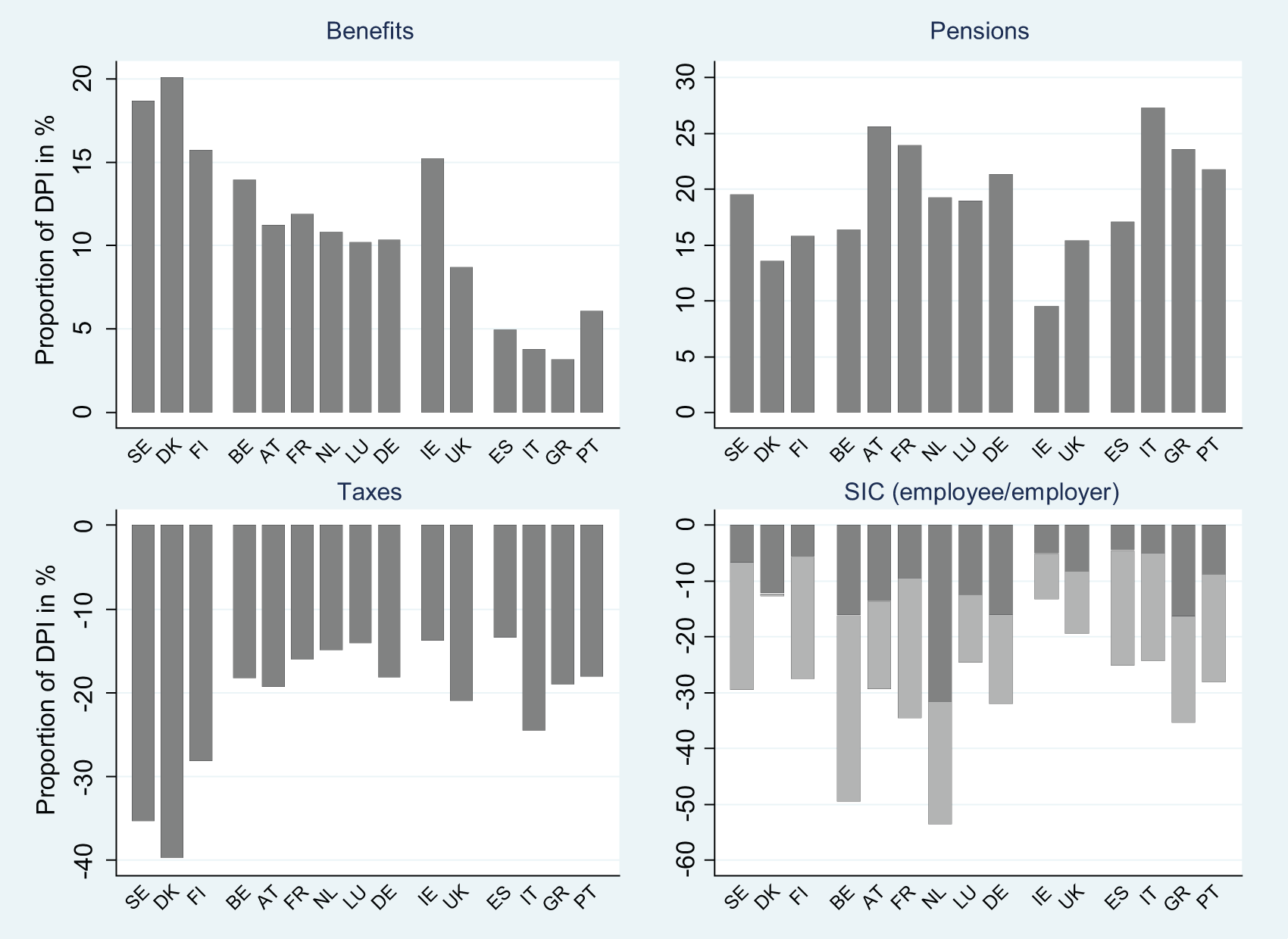
Relative importance of welfare instruments. Source: authors’ calculations based on EU-SILC. Each graph presents the proportion of the particular income component in household DPI. In the case of SIC, the upper bars illustrate the proportion of SIC paid by the employee whereas the lower bars represent the fraction of contributions paid by the employer.
The relative importance of social benefits is exceptionally high in Ireland, as well as in the Nordic states. The southern European states emerge with particularly low social benefit shares. With respect of public pensions, their share is especially large in all southern European and Continental states. PIT plays an extraordinarily important role in Denmark and also has above-average importance for household post-government incomes in the other Nordic countries. In contrast, their share in post-government income is low in Italy and Ireland as well as in some Continental states. As expected from the theory, the shares of SIC are comparatively high in Continental and southern countries and rather low in Anglo-Saxon countries. However, we also reveal comparatively important SIC shares in Sweden and Finland. This can merely be ascribed to the contributions paid by the employer, which are rarely considered in comparable micro studies.
Overall, the importance of different tax–benefit components, as measured by the micro-composition of disposable income, again suggests a similar clustering for the EU-15 states – as suggested by the political and social science welfare state typologies. These average between-group differences are especially evident in the case of benefits and pensions. On the other hand, we observe considerable variation in the importance of SIC in most country clusters. However, these measures only consider the economic importance of tax-benefit instruments in disposable income, as did the previous literature on welfare state typologies. However, with the help of microdata, we can also take into account their specific distribution across households and therefore their effective redistributive impact on the distribution of incomes.
After having measured the redistributive effect of the tax–benefit system as a whole, we now look at the redistributive impact of each single tax–benefit instrument. We follow Immervoll et al. (2006) and start from a situation without the instrument in question (disposable income minus the particular instrument) and ask to what extent inequality is reduced by putting it into place. Figure 4 illustrates the redistributive effects of different fiscal instruments, such as PIT, SIC, social benefits and public pensions. First, the positive coefficients for all fiscal instruments suggest that the exclusion of any policy instrument would result in increased inequality in all countries. It also emerges that in almost all countries, public pensions entail larger redistributive effects than the sum of other social benefits. The only exceptions are Denmark and Ireland. In addition, social benefits play a more important redistributive role than taxes or contributions in the majority of states – however, taxes redistribute more income than contributions. This indicates that the redistributive importance of instruments across countries does not fully correspond to the economic weight of these instruments, as for most countries contributions make up a larger share of disposable income than taxes. Thus, by also taking into account the distribution of fiscal components along the income scale, we can capture the more regressive structure of contributions in the majority of states. However, in the Continental states as well as in Greece, contributions still achieve higher redistributive effects than PIT. Again, we find some indication of country clustering. The Nordic states can be identified with comparatively high redistribution via benefits, but also with above average redistributive effects of taxes. The Continental states stand out with rather high redistributive effects of taxes and benefits, but contributions also play a substantial role for redistribution. In the liberal welfare states contributions do not play a significant role either and redistribution is mainly achieved via social benefits and the comparatively high redistributive effects of taxes. On the contrary, in the southern welfare states, benefits only entail negligible redistributive effects.
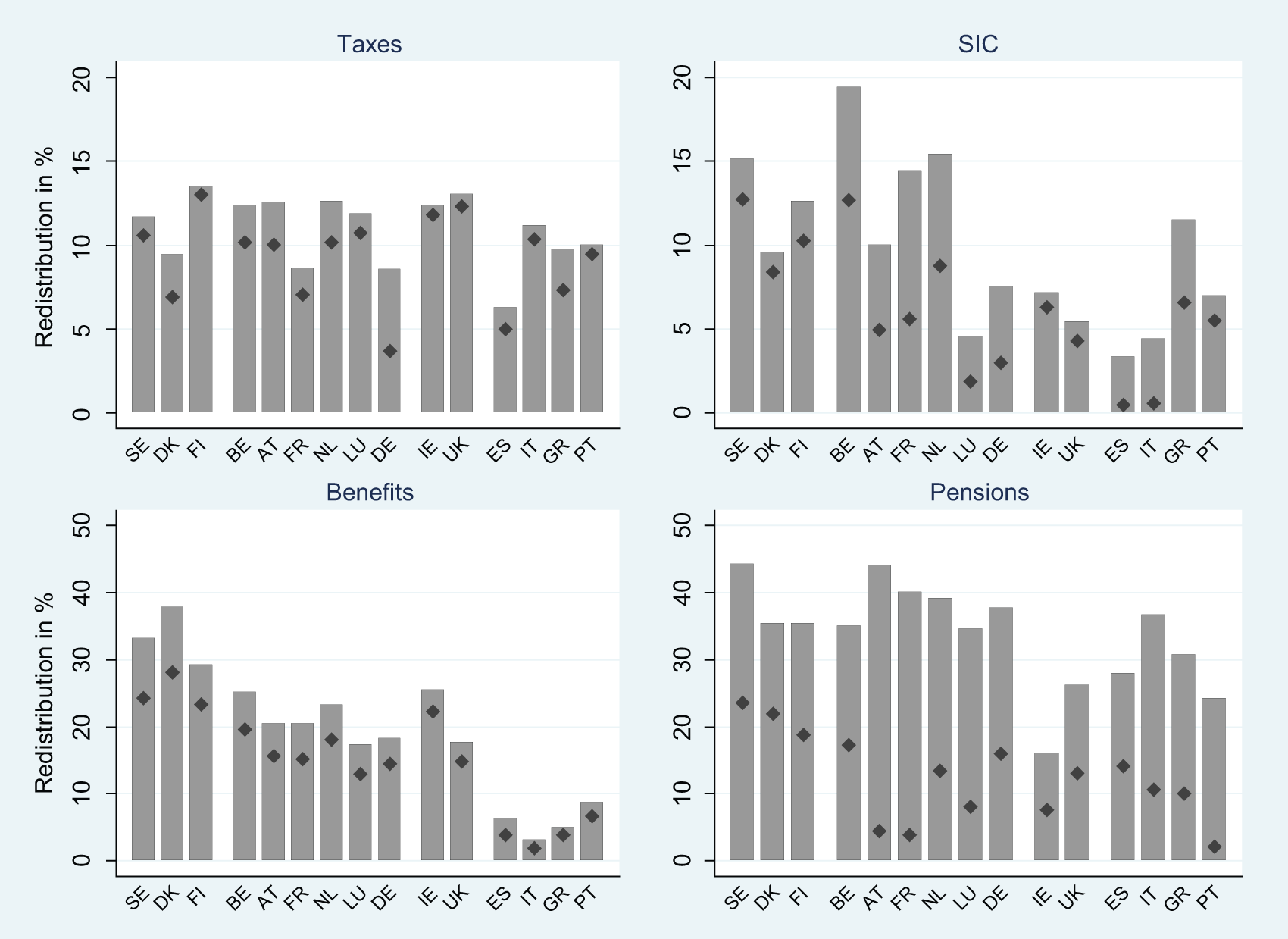
Redistributive effects of welfare instruments. Source: authors’ calculations based on EU-SILC. The question here is: ‘Starting from the situation without the instrument in question (disposable income less instrument), how much inequality is reduced by introducing it (Immervoll et al., 2006)?’ Diamonds show the resulting redistributive effects if the people are ranked by DPI.
The high redistributive effect of pension schemes in Continental countries is initially somewhat confusing, as we predicted that redistributive effects of pensions would be rather low in the conservative states. The huge shift of resources from the current young to the current old overlaps with the rather low redistribution from rich to poor, which creates these high redistributive figures for the conservative welfare state pensions. In the Anglo-Saxon states, in contrast to all other states, public pensions show comparatively small redistributive effects. Here, the high redistributive characteristics of universal pension schemes are not apparent because the figures are driven downwards by the low level of pension payments. Thus, again, we also compute a second measure for the redistributive effect of welfare instruments by ranking people by their disposable income (abstracting from the pure re-ranking effect). Indeed, we find substantially lower redistributive effects of public pensions. Especially in some Continental countries (Austria and France) and Portugal the redistributive capacity of pensions almost vanishes. In addition, now the redistributive effect of benefits is higher than those of pensions in almost all countries. Furthermore, the difference across Continental and Anglo-Saxon countries diminishes and partly reverses. We also see that the re-ranking makes up large parts of the redistributive effects of SIC and strengthens the redistributive importance of taxes versus SIC. 7
Cluster analysis
As outlined above, we are particularly interested in whether the typology of welfare regimes can be confirmed when focusing on distributional outcome variables and redistributive effects of different tax–benefit instruments. Therefore, we conduct a hierarchical cluster analysis to group states that have similar characteristics across a set of variables. 8 Our method of grouping countries is the Ward’s linkage, which joins countries into a cluster such that the variance within a cluster is minimized. Our results will be illustrated in dendrograms, which graphically present the information of which observations are grouped together at various levels of (dis)similarity. The height of the vertical lines and the range of the (dis)similarity axis give visual clues about the strength of the clustering. In our study the measure for the distance between cases is the squared Euclidean which represents the squared geometric distance over all variables between two countries. Since this measure is heavily influenced by outliers, all variables have been standardized from 0 to 1 using z-scores. Generally, long vertical lines indicate more distinct separation between groups – and short lines, greater similarity. 9
A crucial point of any cluster analysis is the selection of variables on which the analysis is performed. In contrast to previous studies, we exclusively base our analysis on microdata. As described in the data section, this approach allows us to capture the distributive effects of measures along the income scale in addition to the (effective) size of programmes. Instead of institutional settings, we include effective distributional outcomes in our analysis. Thus, we perform our cluster analysis on all indicators described above: pre-government income inequality, importance of taxes, contributions, benefits and pensions as well as the redistributive effect of each fiscal component. The resulting dendrogram is illustrated in Figure 5. On the left of the dendrogram the Nordic states form a distinct group. Belgium and the Netherlands then join this group. Further to the right are Austria, Luxembourg, Germany and France – which could be regarded as classical conservative states. The southern cluster of Greece, Portugal, Italy and Spain join this group later. On the right side of the dendrogram are the Anglo-Saxon states – Ireland and the UK.
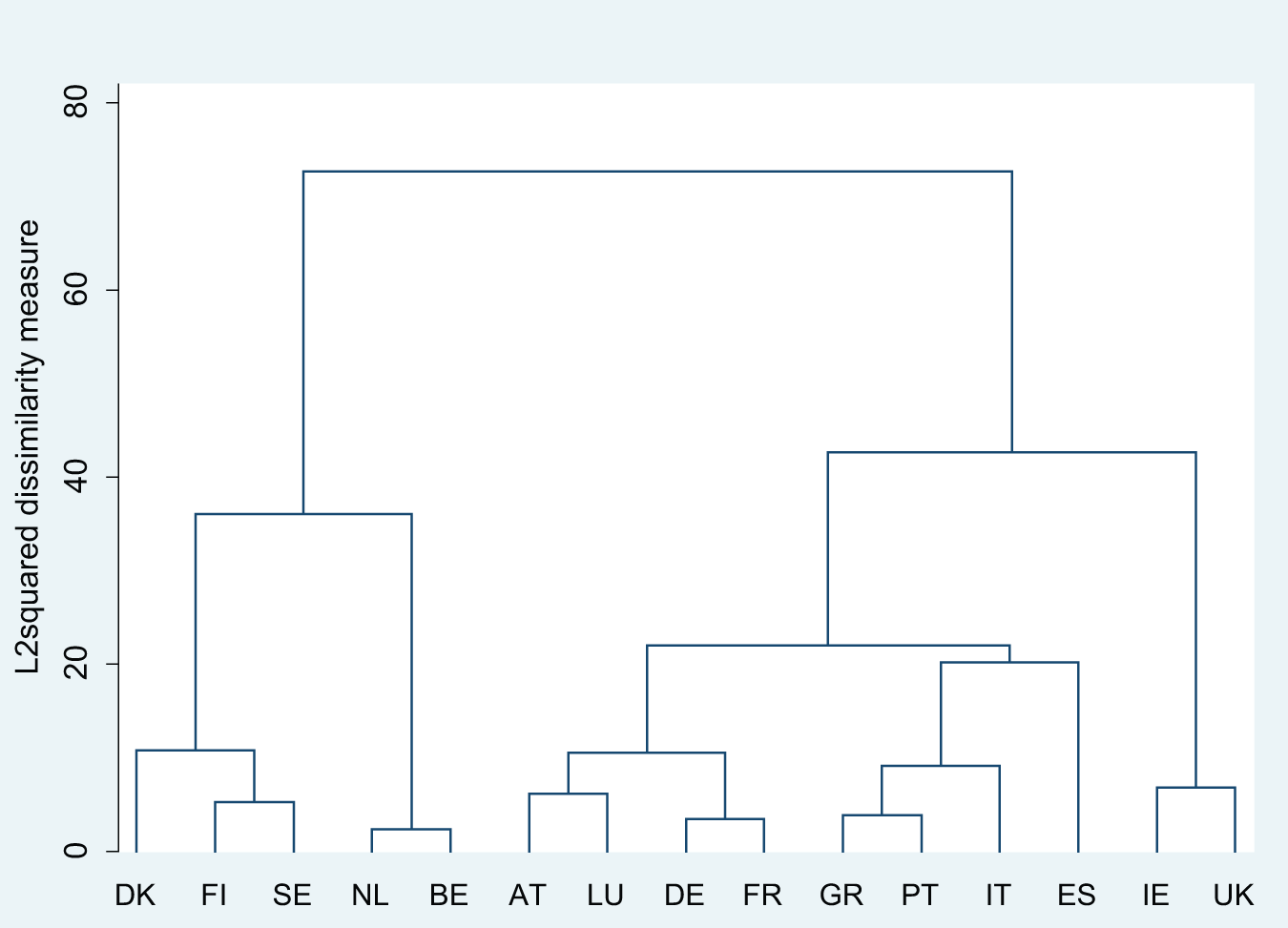
Hierarchical cluster analysis. Source: authors’ calculations based on EU-SILC.
Considering the theoretical reflections above, our hierarchical cluster analysis identifies four ideal-types of welfare regimes, each representing distinct patterns of distributive and redistributive welfare state outcomes. However, the Netherlands and Belgium do not unambiguously fit into these ideal-types but rather classify as hybrid forms, situated between the social-democratic and conservative model. It should be noted that the clear distinction from the conservative model is mainly driven by their difference to the southern and Anglo-Saxon countries and they are still fairly close to the conservative cluster centre. Although the cluster analysis reveals the conservative and southern model as distinct groups, the comparatively low dissimilarity measure indicates that these regimes share many similarities. As suggested by an additional analysis of variance, the overall groupings are particularly driven by the redistributive effects of benefits as well as the importance of taxes and SIC.
However, given the fact that our approach might exaggerate the redistributive effects of public pensions, we also repeated the cluster analysis with our second measure of redistribution, which abstracts from re-ranking. 10 Since this measure increases the relative redistributive importance of benefits and pensions in the Anglo-Saxon countries, it brings them closer to the Nordic countries. Belgium and the Netherlands become more distinct from the Continental countries, which now group closer together with the southern countries. Spain and Germany now take an outlier position that is driven by the large decrease in the redistributive effects of taxes and pensions in Germany when controlling for the re-ranking effect. Apart from this, the general clustering into northern, liberal, conservative and southern welfare states remains robust. 11
In the following we describe the characteristics of the five different welfare state groups. Table 1 presents the average values of each of the variables used in the cluster analysis, and the level of post-government income inequality and overall redistribution to distinguish the redistributive characteristics of the different welfare state types. The table clearly shows how pre-government income inequality continuously increases from the social-democratic welfare state type towards the group of the liberal welfare states. This is in line with theory, since social-democratic market economies are generally regarded as being highly coordinated. The liberal and the southern models reveal high market inequalities, which is in line with previous findings. In addition, as expected overall redistribution is highest in social-democratic welfare states and lowest in southern and liberal states. Correspondingly, the social- democratic, hybrid and conservative welfare states achieve substantially lower inequalities in post- government incomes than the other welfare regimes.
Characteristics of the different welfare state types
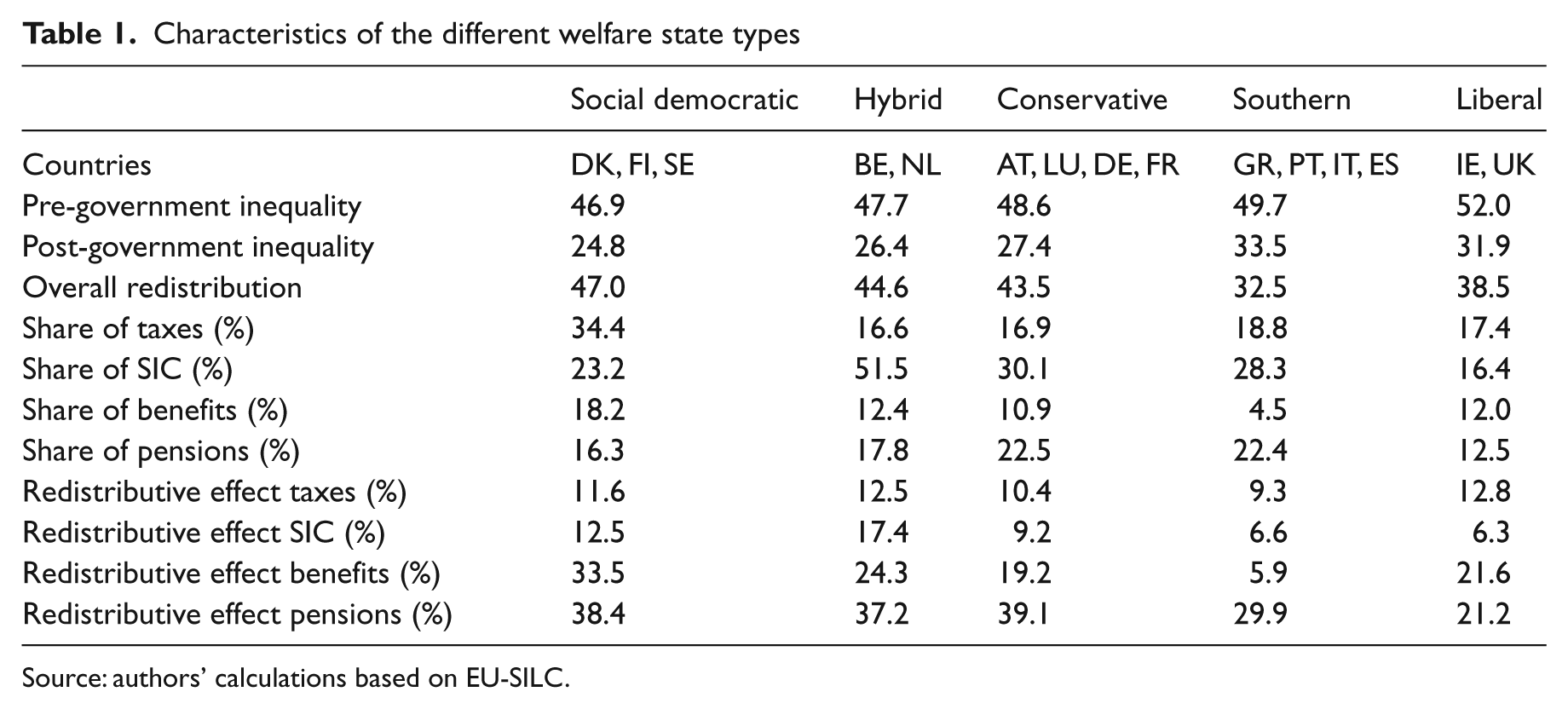
Source: authors’ calculations based on EU-SILC.
With respect to the relative importance of different financing and spending components, the five groups reveal distinct features. In line with the institutionally hypothesized levels of taxes and contributions, the social-democratic states show very high shares of PIT, whereas these shares are substantially lower in the other regimes. Contributions are highest in the hybrid and the conservative welfare state type, medium in the southern and social-democratic, and lowest in the liberal states. Benefits are most important in the social-democratic states and public pensions in the southern and conservative model. The relative share of social benefits is especially low in the southern welfare states. In the Nordic welfare states, benefits achieve substantially more redistribution than their average economic weight would suggest. In general, the redistributive effect of SIC is smaller than their economic weight – suggesting a regressive structure compared to PIT. The redistributive effects of taxes and benefits in the liberal model are relatively high compared with their economic weight illustrating their emphasis on targeting. The redistributive effects of benefits, taxes and contributions are generally low in the southern model.
Looking at the redistributive characteristics of the different EU-15 welfare states shows that Belgium and the Netherlands score high on both conservative and social-democratic characteristics. With respect to the financing side they reveal the corporatist importance of SIC in financing social security. However, on the spending side we find slightly less important public pension generosity and significantly higher redistributive effects of taxes, SIC and, in particular, benefits compared with the conservative model – which is more in line with the suggested distributional patterns of the Nordic regime. For the Netherlands, the classification as a hybrid case is not new. As Arts and Gelissen state, the attributes considered determines to which type it is classified (2002: 151). Belgium joins the Netherlands as a hybrid case because it scores very similarly in all distributional characteristics considered in this analysis.
The results in Table 1 also emphasize the similarity between the southern and conservative model, with the only huge difference being in the benefit generosity and its low redistributive effects. 12 Interestingly, when we replicate our findings with comparable macro data on similar characteristics, Belgium and the Netherlands clearly group together with the Continental countries. In addition, the southern and conservative models become more distinct. This affirms the gains from using microdata and from taking into account the distinct patterns of welfare states’ distributional outcomes.
Conclusion
Analyses of welfare state typologies have generally been based on macrodata. In this study we test whether such typologies are also robust with respect to distributional outcomes of welfare states. By using microdata, we take into account not only the importance of different welfare policy elements across states, but also their distribution across households. We perform a hierarchical cluster analysis to investigate how the EU-15 states group together with respect to the distributional outcomes of their welfare policies.
Our results reveal that we are generally able to replicate the established welfare typology when focusing on effective distributional outcomes. In particular, we identify the Nordic welfare regime, the conservative, the liberal and the southern model, as suggested by Esping-Andersen (1990) and Ferrera (1996). In line with most of the empirical literature on welfare state typologies, we find that the conservative and the southern model are relatively similar, which is particularly due to similarities in the structure of welfare states whereas the difference in overall redistribution is quite substantial. Insofar as this cross-sectional analysis allows for conclusions in this respect, these results provide evidence for Esping-Andersen’s view that the southern welfare states are a rudimentary version of the conservative model. Furthermore, we identify Belgium and the Netherlands as countries that do not fit into either of the models but which lie between the northern and conservative model. This is in line with the findings in the review by Arts and Gelissen (2002) who argue that the ‘real world is likely to exhibit hybrid forms’ (p. 139). Note that in contrast to the majority of subsequent studies, Esping-Andersen (1990) also classified Belgium and the Netherlands in the social-democratic model – at least in terms of the de- commodification index.
Our analysis therefore confirms the link between institutional theories of comparative political economy – which suggest that (welfare state) institutions shape economic outcomes – and the literature on welfare state typologies. We are able to validate the common expectations of overall redistribution according to welfare state typology and confirm the typologies of welfare regimes also on the basis of their redistributive outcomes. Hence, welfare state regimes resemble a typical mix of institutions that translate into distinct patterns of economic outcomes. This allows us to conclude that the microdata on distributional outcomes of different welfare states fit surprisingly well the welfare state typology developed by Esping-Andersen more than two decades ago.
Footnotes
Acknowledgements
Judith Niehues is grateful for financial support by the Research Training Group SOCLIFE, funded by Deutsche Forschungsgemeinschaft DFG (GRK1461), Andreas Peichl is grateful for financial support by Deutsche Forschungsgemeinschaft DFG (PE1675). We would like to thank André Kaiser, Marius Busemeyer, Frieder Neumann, Andreas Lichter and two anonymous referees for helpful comments and suggestions.