



Abstract
Recent findings about the electoral cost of welfare state retrenchment challenge the view of the ‘New Politics’ literature that cutting welfare state entitlements is electorally risky. In fact, there seems to be no systematic punishment for governments retrenching the welfare state. At the same time, however, studies show that governments use numerous blame avoidance strategies when cutting welfare. Reflecting on this apparent contradiction we put forward two points. First, qualitative evidence from interviews with political leaders suggests that it is not the actual risk of being punished that entices politicians to use blame avoidance but the perception of this risk. This explains why blame avoidance strategies are widely used. Second, the existing studies showing that governments are not systematically punished for cutting the welfare state suffer from the lack of control for blame avoidance effects. We show that an experimental design could be a remedy for this problem.
Introduction
Studies about welfare state retrenchment have for a long time assumed that governments are reluctant to cut entitlements because they fear to be punished at the ballot box. This thesis lies at the heart of Paul Pierson’s claim about the ‘New Politics’ of the welfare state: ‘Frontal assaults on the welfare states carry tremendous electoral risks. … Governments confronting the electoral imperative of modern democracies will undertake retrenchment only when they discover ways to minimize the political costs involved’ (Pierson, 1996: 179). Empirically, a vast body of case studies shows that governments indeed use – as theorized by Pierson – different blame avoidance strategies in order to avoid electoral punishment (Vis, 2009a; Weaver, 1986; Wenzelburger, 2011; Zohlnhöfer, 2007). In a review of the welfare retrenchment literature, Starke therefore arrives at the conclusion: ‘There is now a consensus that these [retrenchment] policies are unpopular and that the “politics of blame avoidance” are a powerful causal mechanism which helps us understand its political dynamics’ (Starke, 2006: 115).
Quite surprisingly, however, the basic claim about the riskiness of cutting social entitlements that underlies the blame avoidance argument has been taken for granted for many years and not been tested empirically. Only recently, several studies have devoted their interest to this point (Armingeon and Giger, 2008; Giger and Nelson, 2011, 2012). Unexpectedly, the results of these studies question the view that welfare state retrenchment will (always) have disastrous electoral consequences. Instead, the overall result can be summarized as follows: ‘No party systematically loses votes for retrenching social policy’ (Giger and Nelson, 2011). Moreover, some parties even win votes, if they retrench the welfare state. In addition, the studies have shown that there are important moderating variables interfering in the relationship between welfare retrenchment and electoral punishment (Armingeon and Giger, 2008; Giger and Nelson, 2012). 1
This new evidence comes as a puzzle – especially because many studies have shown convincingly how governments used different blame avoidance strategies and did not claim credit for cutting the welfare state (Vis, 2009b; Vis and Van Kersbergen, 2007; Weaver, 1986; Zohlnhöfer, 2007). Our paper aims at shedding some light on this apparent contradiction. We raise two points that help us clarify the puzzle. First, we argue that we have to focus on the risk perceptions of political actors, if we want to investigate the reasons for the use of blame avoidance strategies. This focus is rooted in the theoretical foundations of blame avoidance in prospect theory (Vis and Van Kersbergen, 2007). In our view, it is not enough to conclude that blame avoidance does not matter, because we find empirically that governments are not punished for cutting welfare. Instead, blame avoidance is used by political actors who feel a risk of being punished – and this feeling can be justified or not.
Second, we show that existing studies that question the relationship between welfare retrenchment and electoral punishment suffer from the problem that they do not include the possible effect of successful blame avoidance in their analyses. Hence, the ‘missing link’ between cuts in the welfare state and electoral punishment could well be explained by the fact that politicians did indeed successfully use blame avoidance strategies. Of course, researchers are well aware of this problem (Giger and Nelson, 2011: footnote 1) – and the reason for not accounting for blame avoidance is that there is no easy way of measuring ‘successful blame avoidance’ and including it in a regression equation. Thus, we have to think of other research designs in order to test the causal link between blame avoidance strategies and electoral backlash. We suggest that experiments could help us test the effect of blame avoidance in a more straightforward and direct manner and provide some empirical evidence corroborating the hypothesis that blame avoidance does indeed matter.
Our research note is organized as follows. The following section discusses the theoretical points that have been raised in this introduction more systematically. It links it to the state of the art of welfare state research and carves out the causal relationships that underlie the apparent puzzle. In the third section, we give qualitative evidence indicating that it is the way in which a political leader perceives a situation that drives him/her to employ political strategies aimed at avoiding blame. Section four shows how experiments can be used to examine the relationship between welfare cuts, blame avoidance and electoral punishment more clearly. The final section concludes and discusses possible future venues for research in this area.
Welfare cuts, blame avoidance and electoral punishment – theoretical considerations and the state of the art
Theoretically, the discussion about the electoral consequences of welfare state retrenchment and the use of blame avoidance strategies goes back to Paul Pierson (1996), although Kent Weaver (1986) had already discussed blame avoidance strategies in a more general context at the end of the 1980s. Pierson’s ‘New Politics’ argument makes two important points with regard to welfare state retrenchment and blame avoidance. First, radical retrenchment per se is rather unlikely because of institutional stickiness and the popular support for welfare states. Second, if radical retrenchment is implemented in spite of possible punishment at the ballot box (Pierson argues that in case of budgetary crisis or sufficient electoral slack, retrenchment could occur nonetheless), blame avoidance strategies are highly probable. Hence, two causal relationships are to be distinguished: the first links radical retrenchment to the risk of electoral punishment. The second expects that governments should either refrain from retrenching the welfare state or use blame avoidance strategies if welfare cuts are enacted (see Figure 1).

The (simplified) theoretical model according to Pierson.
The existing literature on retrenchment and blame avoidance can be organized according to these two causal relationships. However, whereas studies investigating how political actors use blame avoidance strategies when implementing electorally risky reforms are numerous (Lindbom, 2007; Vis, 2009a,b; Wenzelburger, 2011; Zohlnhöfer, 2007), only a few analyses have focused on the first above-mentioned relationship between electoral punishment and welfare cuts (Armingeon and Giger, 2008; Giger and Nelson, 2011, 2012; Schumacher et al., 2013). Unfortunately, these studies do not precisely focus on the risk of electoral punishment, but on the impact of welfare cuts on individual voting behaviour in actual elections. Giger and Nelson (2011), for instance, approach the question from an economic-voting-perspective and show convincingly that people do not systematically punish governments for retrenching the welfare state. While the results of these studies are indeed very intriguing, they do not test the causal relationship that underlies the ‘New Politics’ argument in a precise way: Pierson’s basic claim is not that governments are punished for cutting welfare, but that the political leaders perceive a risk of losing votes which makes them either abstain from retrenching social programmes or using blame avoidance strategies to cushion the expected negative consequences.
Clearly, the perceptions of political leaders about the risk of being punished have to be based on something. How do politicians make up their mind in this situation where a decision has to be made under risk? Very probably, actors in such a situation that is characterized by bounded rationality try to collect information about the associated risks and base their decision on this information. Here, prospective and retrospective considerations play a role. On the one hand, politicians may draw on past experience with electoral behaviour. On the other hand, politicians should try to use information on the current opinion within the electorate – as indicated by the media or in polls.
However, there are (at least) two reasons why the perceptions might well be biased in a way that inflates the perceived risk. First, we know from prospect theory that in situations where political actors have to decide under risk, they tend to overestimate the negative consequences (Kahneman and Tversky, 1979; Vis and Van Kersbergen, 2007). Second, we know that the information used to make a decision might well be biased, too. Media reports, one of the major resources for politicians in order to evaluate public opinion, are written or produced by editors whose decision about what news to select is influenced by criteria as negativity or conflict (Galtung and Ruge, 1965; Sande, 1971). Besides these two theoretical considerations, several studies (often from the US) have also shown empirically that the politicians’ perceptions of public opinion were seriously distorted (Broockman and Skovron, 2013; Miller and Stokes, 1963). Hence, to sum this point up, if we want to test the first above-mentioned causal relationship of the ‘New Politics’ thesis precisely, we have to focus on the political actors and their perceptions.
Still, the actual electoral outcome is not completely irrelevant when testing the causal relationships that Pierson assumes. Indeed, the extent of electoral punishment for welfare cuts does matter, because Pierson’s theory suggests that blame avoidance ought to influence the degree to which governments are punished: governments using blame avoidance strategies should exhibit a smaller electoral backlash than governments that don’t use such strategies. Models of economic voting could be very helpful here if they integrated a variable accounting for the extent of blame avoidance strategies used by governments. Regrettably, the existing literature linking welfare cuts to electoral punishment does not examine this factor – most probably because it is very difficult to measure ex post if a government used blame avoidance and to include this measure in a quantitative analysis. 2 This is unfortunate because it leaves the central question unanswered, namely if blame avoidance strategies impact on the electoral fate of governments.
Figure 2 visualizes the arguments presented in this section. It connects the relationships expected in the theoretical model (Figure 1) with the two main strands of the literature. Figure 2a summarizes the two main approaches scholars have used to examine Pierson’s New Politics thesis: first, there are numerous studies analysing the relationship between retrenchment policies and blame avoidance strategies (A); second, there is a growing literature which relates the impact of retrenchment on electoral outcomes (B). Figure 2b integrates the two strands of the literature into initial theoretical model that underlies the ‘New Politics’ argument. It shows that there are two main points (indicated by the numbers 1 and 2 in the figure) where the initial theoretical model has not yet been scrutinized properly: on the one hand, we do not know enough about how political actors perceive the risk of being punished at the ballot box for retrenchment policies (1). On the other hand, there is a lack of studies that carve out the impact of blame avoidance strategies on the electoral outcome in cases of welfare state retrenchment (2). The following sections will shed some light on these two relationships.

Causal models examined in existing studies.
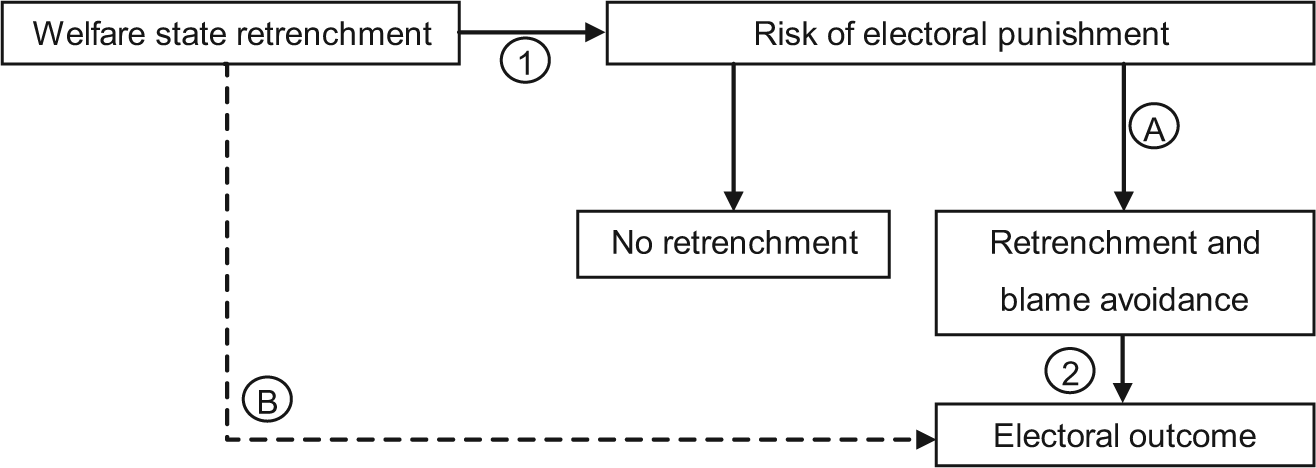
Exanded model of retrenchment dynamics.
Public opinion, political leaders and the risk of being punished
In the last section, we have argued that the main causal relationship underlying the ‘New Politics’ debate links up welfare state retrenchment and the risk of electoral punishment as perceived by the political actors. Hence, the most straightforward test of this association is to investigate the risk perceptions of political actors. Admittedly, this is a challenging endeavour as risk perceptions of political leaders who have to make a decision (either cut welfare or not) under uncertainty are difficult to measure. One promising way of approaching this question is to use qualitative interviews with political actors and to ask them to describe how they remember the discussions about the pros and cons of retrenchment decisions (or non-decisions). In this way, the causal relationship about risk perceptions that is assumed in the ‘New Politics’ literature can be examined more precisely. As in leadership research, where the method of oral history interviews is seen as a possible remedy for the lack of direct data about leadership in governments (Riley, 2009), qualitative interviews are in this case the only way to access information about our main causal relationship between retrenchment and risk perceptions.
Some methodological considerations
Methodologically, qualitative elite interviews need to be handled particularly carefully. The main reason for this is that political actors who are asked to remember a certain situation several years later and to talk about it, interpret the facts ex-post and from their personal perspective. Therefore, as a researcher, it is important to differentiate between storytelling (and ex-post justifications) and actual facts. Hence, statements should be double-checked with evidence from more ‘objective’ sources (such as governmental documentation for instance). 3 Furthermore, talking to politicians who can give insights on a problem from different angles (for example, members of different parties) has proven to be extremely helpful in carving out the ‘core story’ from the interviews. Handled in this way, the evidence from interviews generates extremely valuable insights if one wants to understand the reasoning that lies behind political decisions.
A further methodological challenge of elite interviews is how to approach the question one is interested in without giving too much information about the answers one would expect. In our case, we used semi-structured interviews where we tried to let the political actors describe in their terms how they experienced the period of welfare retrenchment. In many cases, we did not need to actually pose the specific question on the risk perceptions, but the interviewees just ‘came along’ this point during their elaborations on the ins and outs of retrenchment policy. This is reflected in the answers (see below), where the risk perceptions are often mentioned in broader contexts of how the adjustment packages were designed or communicated.
In order to scrutinize the causal relationship between welfare state retrenchment and the perceived risk of electoral punishment (causal arrow (1) in Figure 2b), we have conducted 15 interviews with high-level politicians and civil servants 4 from four countries (Belgium, Canada, France, Sweden) who were in office in the first half of the 1990s when the world economic crisis (in the beginning of the 1990s) forced them to introduce austerity programmes. They agreed to talk rather openly about their past decisions. Their statements about how they perceived the electoral risk associated with the introduction of austerity programmes in the 1990s show that Pierson’s claim about the perceptions of political actors seems to hold. In order to assess the trustworthiness of the interviews, we checked the facts from the interviews with the information from the public policy literature on the four countries. Although we could not directly assess if the information on the perceived riskiness was correct, we nevertheless got the impression that overall the evidence from the interviews was quite close to what the relevant literature on the welfare state retrenchment in these countries indicated (for instance: Anderson, 1998; Arcq, 1993; Beaupain and Blaise, 1995; Bonoli, 1997; Courchene, 2002; Egle, 2009; Isaksson, 1995; Jefferys, 1996; Kautto, 2000; Little, 2008; Maslove, 1996; Persson, 2007; Schmidt, 2002). Moreover, we checked the interpretation of the situation as given by the politicians by interviewing at least one person outside government (other party, civil servants) in every country. 5
How actors perceive the risk of electoral punishment: evidence from case studies
After having discussed several methodological issues related to elite interviewing, we now turn to the analysis of retrenchment politics in four countries in order to assess the question of how political leaders perceived the risk of electoral punishment. One of the most important fiscal adjustments during the 1990s in the Organisation for Economic Co-operation and Development (OECD) world took place in Canada (Wagschal and Wenzelburger, 2012). Paul Martin, Minister of Finance from 1993 to 2002 and architect of the 1995 ‘landmark’ (austerity) budget, describes his reasoning behind the austerity packages as follows: This is not the kind of thing that you can do half-way through your mandate or at the end. You have to do it at the beginning when you hope and you can expect that you will be able to overcome the negative fallout. So you take the very tough actions in the first couple of years and then you hope that in the last couple of years of your mandate that you can essentially bring those who were against what you did on your side.
6
The statement shows very clearly that Paul Martin expected to be punished by the voters for the implemented austerity measures (‘negative fallout’). Moreover it demonstrates how closely blame avoidance strategies are connected to the fear of being punished: for Martin (as a Finance Minister), renouncing from the austerity measures was not an option – that’s why he thought about how to implement the cuts strategically in order to minimize electoral costs.
Very similarly, Jean-Luc Dehaene, former Prime Minister of Belgium (1992–1999) – a country with a record-level debt ratio in the beginning of the 1990s and a substantial fiscal adjustment in the subsequent years – explained in the interview that his government adjusted the profile of welfare cuts according to the election date and that they tried to implement cuts which are not felt directly: Well, the most important thing is not to wait. If you do this [implement an austerity package] just before the elections, this is not the best thing to do. You have to implement this at the beginning of a mandate and then you can hope that the fruits of your effort are already visible at the moment of the next election. In addition, there are different psychological techniques. … For instance, if you take measures that they [the voters] do not feel directly, this is tolerated much more easily.
7
In Sweden, the first half of the 1990s was characterized not only by huge public deficits but also by a financial crisis that concerned the banking system. After having stabilized the banking system, a social-democratic government took office in 1994 and implemented rather harsh cuts to the welfare system (Lindbom, 2007). From the interviews with political actors, it becomes clear that the government did indeed expect to be punished by the voters – but implemented the cuts nevertheless, because the problem load as well as the pressure from the financial markets and the ballooning public deficits and debt were too high. Göran Perrson, the Swedish Finance Minister (and later Prime Minister) who was responsible for the adjustment programme and the welfare retrenchment during the 1990s, is very open about his reasoning in connection with the austerity measures: We were completely sure that we should be punished. We never doubted that. But, that was the point, when we fulfilled the re-enforcement programme [the several austerity packages] with the Center party, that gave the Left Party room for manoeuvre and they were able to attract those social democrats who disliked the re-enforcement programme. So together with the Left Party in the 94-election, we had 48 percent. Together with the Left Party in the 98-election, we had 48 percent. So we lost almost 8 percent and they took it. And that was important: continuing governing also after the 98-election.
8
Persson clearly acknowledges that the government perceived a major risk of being punished at the ballot box for the retrenchment measures that they implemented. However, the citation from the interview also shows that the strategic position of the social democrats within the partisan competition was favourable to retrenchment: as the Social democratic minority government implemented the most painful measures of the re-enforcement programme with the support of the Agrarian Party (Centerparti), the government calculated (quite correctly) that disappointed voters would very probably turn to the Left Party (Vänsterparti). However, the Vänsterparti was the traditional supporting party of the Social democrats in parliament and Persson’s government could hope to stay in power even after an electoral backlash by negotiating support from the Left Party. This is very much in line with the argument of Herbert Kitschelt (2001) about why Social democratic governments are more likely to implement welfare state retrenchment than right-wing parties.
In France, Christian Sautter, former Minister of Finance from 1999 to 2000 (and secretary of state from 1997 to 1999), explained how the perceived risk of being punished at the upcoming Presidential election made Lionel Jospin as Prime Minister abandoning budgetary discipline. This is one of the reasons why France did not succeed in sustainably balancing the budget in the 1990s. During the late 1990s when the world economy was booming, Finance Minister Christian Sautter tried to ‘hide’ (and, in this way, save) higher tax receipts (this affair was named ‘la cagnotte’) in order to reduce public deficits and debt. However, his plan leaked to the public and at this crucial point in the debate, the Prime Minister did not back Sautter’s strategy. The reason was, as Sautter explains in the interview, that Jospin and his advisors were ‘very sensitive to the opinion polls’ and ‘considered that this was not the right time for budgetary virtue’. 9 The reason was obvious: Jospin planned to present himself at the Presidential election against the acting President Jacques Chirac and did not want to disappoint the voters. Thus not only seem political leaders to perceive a risk of being punished by the voters for cutting the welfare state. If elections approach, they also seem to abstain from hoarding unexpected tax receipts in order to reduce deficits – at least in the case of France, where a special ‘culture of public spending’ is said to exist. 10
Summing up the evidence from our interviews with former high-level politicians who took part in major adjustment processes, the causal relationship between welfare state retrenchment and the perceived risk of electoral punishment as suggested by the theoretical model (and the ‘New Politics’ literature) seems to hold (relationship 1 in Figure 2b): political leaders clearly perceive welfare state retrenchment as being electorally risky. Furthermore, the evidence from the interviews points to a major relevance of blame avoidance strategies. Thinking about how to avoid blame for the possible punishment seems to be quasi-automatic: once political leaders have decided that retrenchment is necessary, they very quickly move on to think about strategies how to dampen the expected negative electoral outcome of the retrenchment. Here, blame avoidance (see for instance the citation of Dehaene and Martin) and party competition (see the statement of Persson) are major issues. This finding supports (again) the hypothesis that blame avoidance strategies are of prime importance if governments set out to retrench the welfare state (relationship A in Figure 2).
Welfare state retrenchment, blame avoidance and electoral outcomes
The existing literature on the electoral consequences of welfare state retrenchment suffers from the deficit that blame avoidance strategies are not systematically tested (see above). The reason for this deficiency is that blame avoidance strategies are difficult to measure cross-nationally (and over time) and cannot be tested quantitatively in an easy way. Therefore, scholars have to think about alternative research design to assess the impact of blame avoidance on the voting behaviour of individuals (or, at least, on their attitudes).
One rather straightforward way to test the influence of blame avoidance on attitudes is to use an experimental design. Many of the blame avoidance strategies have to do with the question how retrenchment measures are communicated. 11 In an experimental design, it is possible to assess how the communicative framing of a retrenchment measure or an austerity package impacts on the attitudes of individuals. We have used such a design in a sample of 153 German undergraduate students who were divided in two groups. 12 Both groups were given a short fictional newspaper article that reported in a newspaper style that the Canadian government had decided to cut social benefits by 15 percent. 13 However, the arguments that accompanied the factual information were very different depending on the two groups. The first text just named the cuts and gave some information about the expected development of economic growth and some restructuring of the ministry of social affairs. Moreover, in order to make the text more realistic, a short rather technical explication of the effect of the cuts on the budget balance was included. In the second article, however, several blame avoidance messages were included. The first blame avoidance strategy used falls under the category named ‘find a scapegoat’ (Weaver, 1986: 385): the government (by means of a fictive citation of Prime Minister Stephen Harper) blamed the global financial crisis for forcing them to take the drastic measures. The second strategy included was one of ‘circling the wagons’, as the article indicated that the opposition parties as well as the trade unions and the employer associations had been consulted. The third strategy can be subsumed under the headline of ‘stop me before I kill again’: here, the newspaper article indicated that the government planned to introduce an automatic debt-reduction mechanism which would make future spending decisions dependent on the budgetary situation. 14
After having read the text, the respondents were asked to give their opinion to the following three statements on a four-point Likert-scale (strongly agree – agree – disagree – strongly disagree), where higher values indicate stronger disagreement:
The austerity measures of the Canadian government are justified.
In order to balance the budget in the medium-term, one has to accept spending cuts in the short term.
Stephen Harper does a good job as Prime Minister.
Such a research design makes a straightforward test of blame avoidance strategies possible. The expectation is clear: on the basis of blame avoidance theory, we would expect a significant difference between the control group (no (or very mild) 15 blame avoidance stimulus) and the experimental group (strong blame avoidance stimulus): the opinions towards the government should be more positive in the experimental group.
On average, the results for the experiment strongly confirm our hypothesis (see Table 1). Respondents who have read the article including the blame avoidance messages evaluate the performance of the Prime Minister much more positively than respondents who belonged to the alternative group. The result for the first item points in the same direction: if blame avoidance messages are included in the government communication, people consider the measures to be much more justified than if blame avoidance strategies are not used at all. However, it is very intriguing that the agreement on a much more technical statement about short-term pain and medium-term success is not significantly different between the groups. Hence, blame avoidance strategies seem to be much more related to evaluative issues than to technical information.
Results of the experiment.
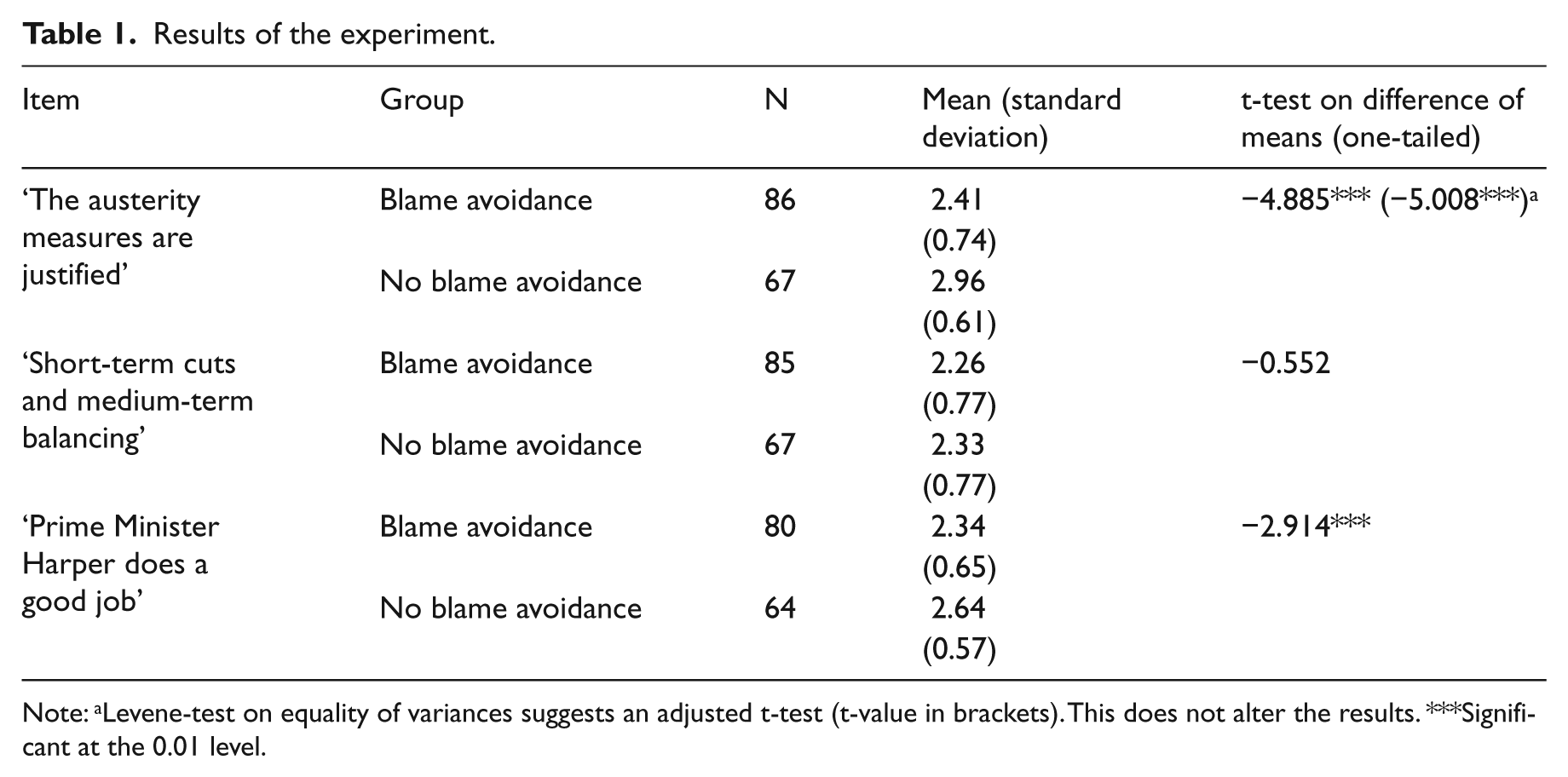
Note: aLevene-test on equality of variances suggests an adjusted t-test (t-value in brackets). This does not alter the results. ***Significant at the 0.01 level.
With regard to the second relationship specified above – namely that blame avoidance strategies matter for the extent of electoral punishment – the results of the experiment indicate that blame avoidance indeed affects the overall evaluation of a government positively. Admittedly, attitudes towards governments are not identical with votes in a general election where many other factors, such as party identification, play a major role. However, findings from voting behaviour (Fiorina, 1981) as well as economic voting theories indicate that retrospective evaluations of governmental performance have an impact on individual’s decision at the ballot box. Therefore, the results of the experiment are a clear indication that blame avoidance may well influence the extent to which governments are punished for welfare state retrenchment.
Conclusion and discussion
The starting point of this research note was an apparent puzzle in research on welfare state retrenchment. On the one hand, following Paul Pierson (1996) an influential strand of the literature suggests that welfare state retrenchment is electorally risky and politicians therefore abstain from cutting welfare at all or use blame avoidance strategies extensively. On the other hand, recent studies find that governments retrenching the welfare state are not systematically punished at the ballot box. Our research adds to this literature by proposing a more nuanced view. We put forward two main arguments.
The first argument makes a clear distinction between actual electoral punishment and the perceived risk of such a punishment. We show that the risk perceptions of political actors who have to decide whether to implement welfare cuts are the key factors which matter for the question why blame avoidance strategies are used or why retrenchment is put on hold. Therefore, although the recent economic voting models investigating the impact of retrenchment on electoral outcomes yield interesting findings, they do not really test Paul Pierson’s claim – simply because their dependent variable is actual election outcome, and not the perceived risk of politicians. If we focus on the perceived risk, empirical evidence from qualitative interviews with high-level politicians suggests that political actors do indeed care about possible electoral punishment and that this perceived risk leads to the use of blame avoidance strategies.
Our second argument suggests that the absence of electoral punishment for retrenchment policies might well be explained by successful blame avoidance. As it is rather difficult to include a variable for blame avoidance in economic voting regression analysis, we propose an experimental research design. Drawing on evidence from a small experiment with 150 undergraduate students, we show that governmental retrenchment policies as well as the overall performance of the government are indeed evaluated much more positively, if blame avoidance strategies are used in the governmental communication. This is a clear indication that effective blame avoidance may be a major reason for the puzzling finding that voters do not systematically punish governments for retrenching the welfare state.
In this research note, we have carved out two important points that add to our understanding of the nexus between welfare state retrenchment, blame avoidance and electoral punishment. Clearly, more research in this area is of prime importance. We think that some of the proposed research designs – elite interviewing and experiments – could add significantly to our understanding of the underlying causal mechanisms. Especially for the impact of blame avoidance strategies on individual attitudes, experiments are a very promising path for future research. If the experimental stimulus is designed more specifically, it might well be possible to test how the different blame avoidance strategies identified in the respective literature (Hood, 2002; Vis and Van Kersbergen, 2007; Weaver, 1986) have an impact on public attitudes. Moreover, this could be brought together with characteristics of the individuals such as class, income or party identification. Finally, the link between other policy fields, welfare state retrenchment and electoral punishment could be analysed more thoroughly. Recent studies have shown that this link may be of prime importance if we want to understand why governments are actually punished for welfare state retrenchment or not: Bonoli (2012: 107) argues that ‘affordable credit-claiming’ might still be possible in other social policy fields, such as family policy, reducing electoral punishment; and Giger and Nelson (2012) show that peoples perceptions’ about the impact of social policies on economic performance also seem to influence the likelihood of electoral punishment. Such scenarios could be combined in an experimental design. These sketches for future research show that deeper insights into the relationships between welfare retrenchment, electoral behaviour and blame avoidance is badly needed if we want to explain in more detail, why and how political actors set out to implement risky reforms (Stiller, 2010; Vis, 2009a).
Footnotes
Funding
This research received no specific grant from any funding agency in the public, commercial or not-for-profit sectors.