



Abstract
Does government partisanship still matter in the era of welfare retrenchment? The comprehensive quantitative research on this question offers contradicting answers. Our meta-analysis demonstrates that the results of published empirical studies depend on a number of the studies’ characteristics. Focusing on studies on retrenchment-prone ‘old social policies’, we show that the single most important factor affecting the results on partisanship is the choice of the dependent variable. In general, studies using entitlements are four times more likely to find partisan effects than studies based on social spending. Furthermore, partisan effects are more pronounced in class-related programmes like unemployment benefits and sick pay than in lifecourse-related welfare programmes such as pensions. Finally, we show a clear decline of partisanship over time. Some recent studies, however, indicate that innovations in terms of operationalisation and measurement of the independent variable may bring new life to the debate on the persistence of partisanship.
Keywords
Introduction
Does government partisanship matter when it comes to the size and generosity of the welfare state? While the answer to this question is clearly positive for the ‘golden age’ of the welfare state (e.g. Hicks and Swank, 1992; Huber et al., 1993; Huber and Stephens, 2001) which came to an end in the 1970s, there is no clear-cut answer regarding the subsequent ‘silver age of permanent austerity’ in which we live. On the theoretical level, proponents of the ‘new politics school’ have challenged traditional partisan theory and argued that welfare retrenchment is different from welfare expansion, pointing to globalisation, permanent fiscal pressures and the transformation from industrial to post-industrial societies (Pierson, 1996, 1998). Based on this debate, a substantial number of quantitative studies have addressed the question on the persistence of partisanship in the retrenchment era, with some studies showing that parties still matter (e.g. Allan and Scruggs, 2004; Finseraas and Vernby, 2011; Korpi and Palme, 2003; Schmitt, 2016) but others reaching the opposite conclusion (e.g. Castles, 2001; Huber and Stephens, 2001; Potrafke, 2009; Stephens, 2015).
A meta-analysis by Imbeau et al. (2001) as well as more recent reviews of the field (Potrafke, 2017; Schmitt, 2016; Zohlnhöfer et al., 2018) indicate that the impact of partisanship has indeed declined over the past decades. Horn (2017: 83–91), however, questions this general assessment by highlighting the relevance of study characteristics such as the operationalisation of partisanship and welfare retrenchment and suggests that the conflicting findings are driven by respective research design choices. Accordingly, we have to turn to these characteristics to arrive at a more sophisticated answer to the question on the impact of partisanship on welfare retrenchment.
Based on our reading of the welfare state literature, the following parameters can be expected to influence empirical findings. First and foremost, as demonstrated by the lively debate on the appropriate dependent variable to measure welfare retrenchment (Clasen and Siegel, 2007; Green-Pedersen, 2004), the choice of the dependent variable is presumed to have a substantial influence on results. More recently, welfare scholars have also pointed to the relevance of the conceptualisation and measurement of the independent variable, that is, government partisanship (Döring and Schwander, 2015; Horn, 2017; Schmitt, 2016). Results may also vary across welfare programmes. Based on Esping-Andersen’s (1999) distinction of class and lifecourse risks, Jensen (2012) argues that the nature of welfare programmes is a crucial factor when testing for the role of partisanship. Finally, time should be an important factor as proponents of the ‘new politics school’ emphasise that the socioeconomic changes affecting policy-makers of all colours are slow-moving but irresistible processes (Pierson, 1998).
Most of the resulting hypotheses have been tested on the basis of individual studies; but given the large amount of research in the field, empirical evidence can be presented to support or refute each of them. Thus, instead of merely presenting the competing evidence, we construct a dataset capturing the aforementioned characteristics and conduct a meta-regression to evaluate the impact of researchers’ choices on finding partisan effects. Meta-regression is a quantitative technique for conducting systematic literature reviews (Littell et al., 2008: 95–100). It is implemented by conducting multiple regression analysis with statistical tests as the unit of analysis, study characteristics as independent variables and estimation results as the dependent variable. The researcher can subsequently assess how empirical findings depend on research design choices. Systematic reviews have been neglected in social science research, but they are a valuable tool that enables a concise synthesis of empirical findings (see Dacombe, 2018, for an overview of the few applications in political science).
Based on 63 empirical studies included in our analysis, the key findings are as follows. (1) The most crucial factor affecting the results on partisanship is the choice of the dependent variable, with studies using entitlements being four times more likely to find partisan effects than studies based on social spending. (2) While this finding holds for all welfare programmes included in our analysis, partisan effects seem to be more prevalent in class-related programmes like unemployment benefits and sick pay than in lifecourse-related welfare programmes such as pensions. (3) Concerning time effects, we can see that the impact of partisanship is shrinking as the retrenchment era advances, which points to an ongoing process of declining partisan effects as expected by the ‘new politics’ school. However, the results of individual studies indicate that methodological innovations concerning the operationalisation and measurement of the independent variable may bring new life to the debate on the impact of partisanship on welfare retrenchment.
The article is structured as follows. The first section outlines the selection process and presents some cursory results. Based on the welfare state literature, we then formulate several hypotheses on partisan effects in the retrenchment era, which are tested in the subsequent section. The concluding section wraps up the findings and discusses the limitations of our study.
Selection process and cursory results
In order to identify as many studies as possible which are comparable but at the same time diverse enough to test the hypotheses formulated in the next section, we proceeded in a two-stage process. First, empirical studies including macro-quantitative analyses on partisanship and the welfare state published from 2000 to 2016 were isolated from the large amount of welfare state literature by (1) an extensive literature search via ‘web of science’ 1 and (2) utilising the thus identified literature and the aforementioned reviews as a starting point for a bibliographical search applying cross-referencing techniques. In the second step, all studies that failed to meet at least one of the following criteria were excluded:
The study has been published in a peer-reviewed English-language journal, thus excluding monographs and contributions to edited volumes.
The period under investigation starts no earlier than 1973 (first oil shock as starting point of the retrenchment era) or contains separate analyses for the post-1973 period. In addition, the analysed period reaches at least until the mid-1990s and thus covers a sufficient part of the retrenchment era.
The analysis includes at least 12 countries and focuses on, or contains separate analyses focusing on, advanced western welfare states, thus excluding studies that focus exclusively on regions such as Latin America or East Asia. Thus, we ensure that all studies cover at least one-third of the advanced welfare states of the OECD world.
The analysis centres on social spending (and not public spending as a proxy) and/or some indicator of welfare generosity as dependent variable. In doing so, the study covers the welfare state on the aggregate level or at least one of the ‘classical’ welfare programmes which account for the lion’s share of social spending: unemployment protection, healthcare or pensions. In contrast to the ‘new social policies’, these ‘old social policies’ have matured in the golden age and are thus the main targets of welfare retrenchment.
The analysis actually tests for partisan effects after the golden age and not for ‘legacy effects’, that is, cumulative cabinet/seat/vote shares after the Second World War. 2
The application of this filtering process reduces the number of studies to 63, with 29 of those studies treating partisanship as their main or one of their main explanatory factors (for a detailed overview of the included studies as well as a list of excluded studies, see Supplemental Appendix, Tables A1 and A5). Accounting for studies offering more than one finding, for example, presenting results for more than one welfare programme, we arrive at a total of 106 tests on partisan effects. Out of these 106 tests, 35 (33.0%) find significant partisan effects in the expected direction, whereas 64 tests (60.4%) show no partisan effects. A minority of seven statistical tests (6.6%) even identifies reverse partisan effects, that is, welfare retrenchment by left parties rather than their right-wing opponents, pointing to a ‘Nixon goes to China’ logic (Ross, 2000). Restricting the analysis to the studies with a more or less explicit focus on partisanship alters the picture in favour of the ‘parties matter’ hypothesis. In this case, 22 out of 47 tests (46.8%) find the expected partisan effects, with the same number of tests finding no partisan effects and three tests diagnosing reverse partisan effects (6.4%).
Reviewing the welfare state literature: why do studies differ on partisanship?
While the studies’ findings appear to be rather inconclusive at first sight, the welfare state literature provides us with a number of explanations of the differing findings on partisan effects. The goal of this section is to review this literature and formulate hypotheses about the factors that influence the studies’ results.
Partisanship and the dependent variable
One factor that looms large in the retrenchment literature is the dependent variable, a fact that is reflected in the extensive debate on the ‘dependent variable problem’ (Clasen and Siegel, 2007; Green-Pedersen, 2004). The general question of this debate is which quantitative indicator, social spending or welfare entitlements, is best suited to measure welfare retrenchment. While we agree with Green-Pedersen (2004) that the answer to this question depends on ‘one’s theoretical perspective and research question’ (p. 12), the key question for our purpose is if one of the two indicators is more sensitive to the impact of partisanship than the other.
The answer to this latter question is unanimous. Indicators of welfare generosity such as replacement rates and more general generosity indices obtained from the Comparative Welfare Entitlements Dataset (CWED; Scruggs et al., 2017) or the Social Insurance Entitlements Dataset (SIED; SOFI, 2019) 3 are directly influenced by political decisions, that is, changes are generally the product of reforms. 4 In contrast, social spending levels, generally derived from the Organisation for Economic Co-operation and Development (OECD) data, are determined to a much lesser extent by purely political factors since the demand for welfare benefits also depends on economic as well as demographic factors (Green-Pedersen, 2004; Siegel, 2007). To give one example, spending on unemployment benefits will generally increase during economic crises whereas nominal replacement rates will not be affected unless the government implements changes. What is more, social spending is generally measured as a percentage of gross domestic product (GDP) which is itself affected by economic trends. In the face of those considerations, it does not come as a surprise that there is a positive and significant relationship between spending and entitlements but that the relationship is far from perfect (Kangas and Palme, 2007). All of this implies that partisan effects on the generosity of welfare programmes do not necessarily translate into similar effects on spending levels. In other words, welfare entitlements are much more sensitive to partisan effects than social spending. From this, we can derive Hypothesis 1: Partisanship is more likely to matter regarding welfare entitlements than social spending.
Partisanship and welfare programmes
While classical studies on partisan effects in the golden age mainly focused on aggregate social spending, disaggregated expenditure data as well as entitlement data allow for more differentiated analyses on the level of individual welfare programmes. Although left-wing parties are generally supposed to be more welfare-friendly than their right-wing counterparts, it is questionable whether partisan effects are equally pronounced across all social policy domains. The reason is that different welfare programmes are designed to cover different kinds of social risks. The most prominent distinction in this regard is between class risks and lifecourse risks (Esping-Andersen, 1999: 40–42). The former are risks like unemployment that are distributed unevenly among social classes, that is, low income-earners face a higher risk than high income-earners, whereas lifecourse risks like old age affect all members of society in a similar way. Based on the assumption that left-wing parties are more reliant on working-class voters than right-wing parties, the former will be more reluctant to cut corresponding welfare programmes than the latter, resulting in significant partisan effects (Jensen, 2012). Accordingly, those effects will be absent regarding lifecourse-related social policies since voters of all parties are affected by cuts to such programmes. Thus, we arrive at Hypothesis 2: Partisanship matters when it comes to class-related welfare programmes but not when it comes to lifecourse-related welfare programmes.
Partisanship and the independent variable
While the ‘dependent variable problem’ has been at the centre of theoretical and methodological debates for a long time, more recently the focus of welfare scholars has shifted to the conceptualisation and measurement of the independent variable, that is, government partisanship (Döring and Schwander, 2015; Horn, 2017). The conventional approach is based on party labels and cabinet shares, with the cabinet share of social democratic parties being the most prominent measure. More comprehensive measures of left party power include the shares of other left parties like post-communist and green parties. On the right, conservative and market-liberal parties are generally distinguished from more welfare-friendly centre-right parties like Christian democrats (Schmidt, 1996). As a result, most studies in this camp are based on a left–right dichotomy or a left–centre–right trichotomy.
The alternative ‘centre of gravity’ approach positions whole cabinets on the left–right scale. This is done by identifying individual parties’ left–right positions and by then weighting the parties’ positions according to their cabinet shares. Regarding the estimation of party positions, studies based on (time-invariant) expert surveys can be distinguished from studies based on time-variant manifesto data (Benoit and Laver, 2007). The expected impact of the two competing measures on finding partisan effects is less clear than the influence of the dependent variable. But given that ‘centre of gravity’ measures contain more information on government partisanship than left and right parties’ cabinet shares, we formulate Hypothesis 3: Partisanship is more likely to matter when it is measured in terms of cabinets’ positions on the left–right scale than in terms of cabinet shares of left and/or right parties.
Partisanship and time effects
Proponents of the ‘new politics of the welfare state’ proclaim that partisanship has been losing its once strong explanatory power in the era of welfare retrenchment (Pierson, 1996, 1998). Accordingly, partisan effects dissolve in the face of the ‘irresistible forces’ of socioeconomic change on the one hand and the ‘immovable objects’ of popular welfare programmes on the other. The irresistible socioeconomic forces encompass long-term processes like globalisation, deindustrialisation and demographic changes (e.g. Iversen and Wren, 1998; Scharpf, 2000). Since these forces do not take effect overnight but unfold over longer periods of time, partisan effects should also decline gradually in the advance of the retrenchment era. The seminal work by Huber and Stephens (2001) provides us with first empirical evidence of such gradual decline. If the decline of partisan effects is indeed a gradual process, the period under investigation should affect the studies’ results. This leads us to Hypothesis 4: Partisanship is less likely to matter the more the period of observation tends towards the present.
Method
In order to test the outlined hypotheses, we construct a dataset including variables that capture the studies’ main characteristics. We use this data to present descriptive evidence as well as to estimate probability estimates of finding partisan effects with meta-regression techniques. Meta-regression allows researchers to pool studies and analyse the impact of research design choices such as concept measurement on estimates and hypothesis evaluation. It involves running multiple regression with individual studies or statistical tests as the unit of analysis, study characteristics as independent variables and point estimates as the dependent variable (taking their variance into account). Just as meta-analysis, it crucially relies on the assumption that individual studies are independent, that is, they analyse independent samples. This assumption allows the researcher to conduct generalisable hypothesis tests on the impact of research design characteristics on estimation results (Littell et al., 2008: 95–100).
Unfortunately, the crucial assumption of independent samples is severely violated in our case because the studies on partisanship analyse mostly the same sample, that is, advanced western welfare states with strong temporal autocorrelation. This invalidates hypothesis testing in the conventional meta-regression framework that would allow us to infer from the analysed studies to the association between partisanship and welfare states in general. 5 Thus, we conduct a simplified meta-regression from which we only derive statements about the included studies. We depart from the conventional approach by using a dummy variable as the dependent variable that indicates whether a researcher reports a significantly positive effect of partisanship or not. This allows us to derive concise and readily comprehensible statements about the analysed studies. 6 The unit of analysis is statistical tests, with each study representing at least one test, that is, a study’s main finding on partisanship. When a study presents varying results with regard to our parameters, for example, containing statistical tests on more than one welfare programme, the number of tests related to this study rises accordingly. As a result, there are, on average, 1.7 statistical tests per study.
For our independent variables, we construct variables on (1) the operationalisation of the studies’ dependent variable: spending or entitlements; (2) the operationalisation of the independent variable: party labels or governments’ centre of gravity on a left–right scale; (3) the analysed policy field: pensions, health, unemployment or aggregate; and (4) the average year of the samples analysed by the studies. In addition, we construct two further variables which might influence the probability estimates: first, a dummy variable which indicates whether the respective study focuses on partisanship. The rationale is that publication bias favours partisanship-specific studies with positive findings, which implies that studies with no or negative findings are underrepresented in our sample of studies. The dummy aims to remove this bias from the estimates. Second, we add a variable broadly categorising the underlying data structure into cross-sectional and pooled time-series data.
Our approach is as follows: in a first step, we estimate a probit model using our partisan effect dummy and the outlined explanatory variables. We also include an interaction effect between the selected dependent variable and the average sample year. 7 Based on the results, we predict marginal effects which capture the probability that the analysed studies corroborate partisan theory conditional on the researchers’ choices captured by our variables. This allows us to identify the influence of the research design on statistical inferences while controlling for potential confounders.
We depict relevant conditional probabilities in tables and graphs in the following section. The full results of our probit regression are depicted in the Supplemental Appendix. We report significance tests and confidence intervals but treat them with caution in our interpretation because the underlying assumption of independence does not hold. Our analysis necessarily says more about the sample of studies than the true data generating process. The statistical results are, where possible, supplemented by a short discussion of individual studies which either confirm or question the general findings or yield additional insights not captured by the statistical analysis.
The determinants of researchers’ findings on partisanship
Table 1 offers descriptive evidence about the distribution of the studies’ findings. The most obvious finding concerns the dependent variable. In line with Hypothesis 1, more than 60 percent of tests find significant partisan effects when using entitlements as the dependent variable while the share drops below 15 percent when using social spending. Concerning welfare programmes, the table also offers first support for our hypothesis on class-related and lifecourse-related welfare programmes. A majority of tests on unemployment protection, the prototype of a class-related programme, finds partisan effects. Tests on pensions, a classical lifecourse-related programme, show a completely different pattern. Only 4 out of 19 tests find partisan effects in line with partisan theory and, what is more, exactly the same number of tests shows significant reverse partisan effects. Finally, while the frequencies on the independent variable do not show the expected pattern, the numbers on the average year of the covered period lend first support for the hypothesis on the gradually declining impact of partisanship.
Distribution of statistical tests.
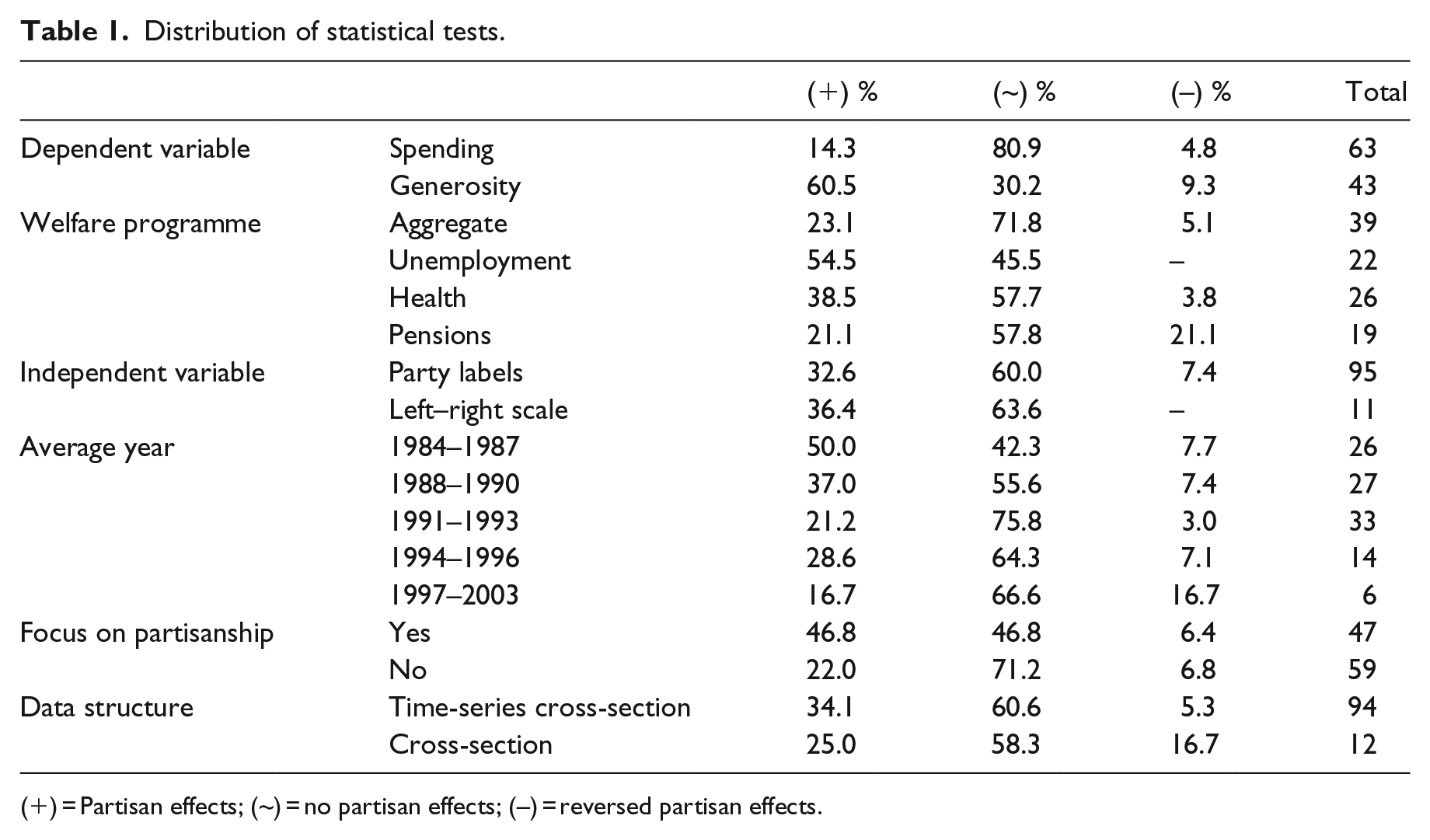
(+) = Partisan effects; (~) = no partisan effects; (–) = reversed partisan effects.
While Table 1 offers valuable first insights, the relative frequencies might be misleading as they do not provide any information on how strong the studies’ findings are influenced by the other parameters. For example, we do not learn if the observed distributional pattern among welfare programmes is driven by an uneven distribution of the dependent variable or other factors. For a more thorough test of the hypotheses, we thus have to go beyond descriptive statistics and turn to conditional probability estimates, where necessary supplemented by a closer look at selected studies.
Starting with the dependent variable, the extraordinarily strong impact of the choice of using spending or entitlements on the findings is confirmed by the predicted probabilities presented in Figure 1. In line with Hypothesis 1, the tests based on entitlements (64.2%) are much more prone to find partisan effects than tests based on social spending (13.5%). Taking a look at individual studies applying both measures, this pattern is confirmed by Amable et al. (2006) and Jensen (2011a, 2012). Among all studies, only the results presented by Stephens (2015) 8 are at odds with the general pattern. Given the strong impact of the chosen dependent variable, we present the impact of the remaining parameters for entitlements and spending separately.
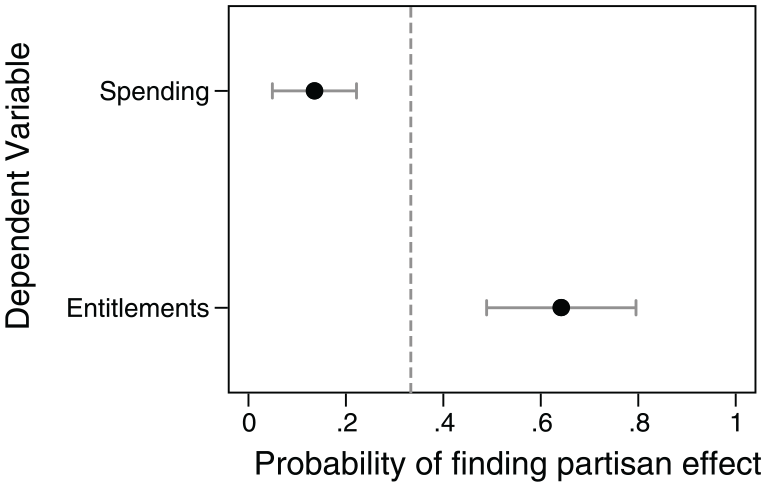
Probability of partisan effects for competing dependent variables.
As can be seen in Figure 2, the general pattern concerning the dependent variable holds for the three welfare programmes as well as the aggregate level – measuring the dependent variable in terms of entitlements substantially increases positive findings. However, Figure 2 also shows that the probability of a positive finding is substantially lower for pensions than for the other welfare programmes, especially regarding entitlements. Given the clear lifecourse-related character of old-age pensions, this finding is in line with Hypothesis 2, but it should be noted that the difference between pensions and health (p = 0.07) as well as pensions and unemployment (p = 0.16) is not or only weakly statistically significant. What is notable is that the class relatedness of the chosen indicator also matters when focusing on pensions alone. Hicks and Freeman (2009) show that reverse partisan effects identified for standard pensions disappear when turning to minimum pensions, while Huber and Stephens (2014) show that left governments are less generous than other governments when it comes to standard pensions but more generous when it comes to minimum pensions (though both results are not statistically significant).
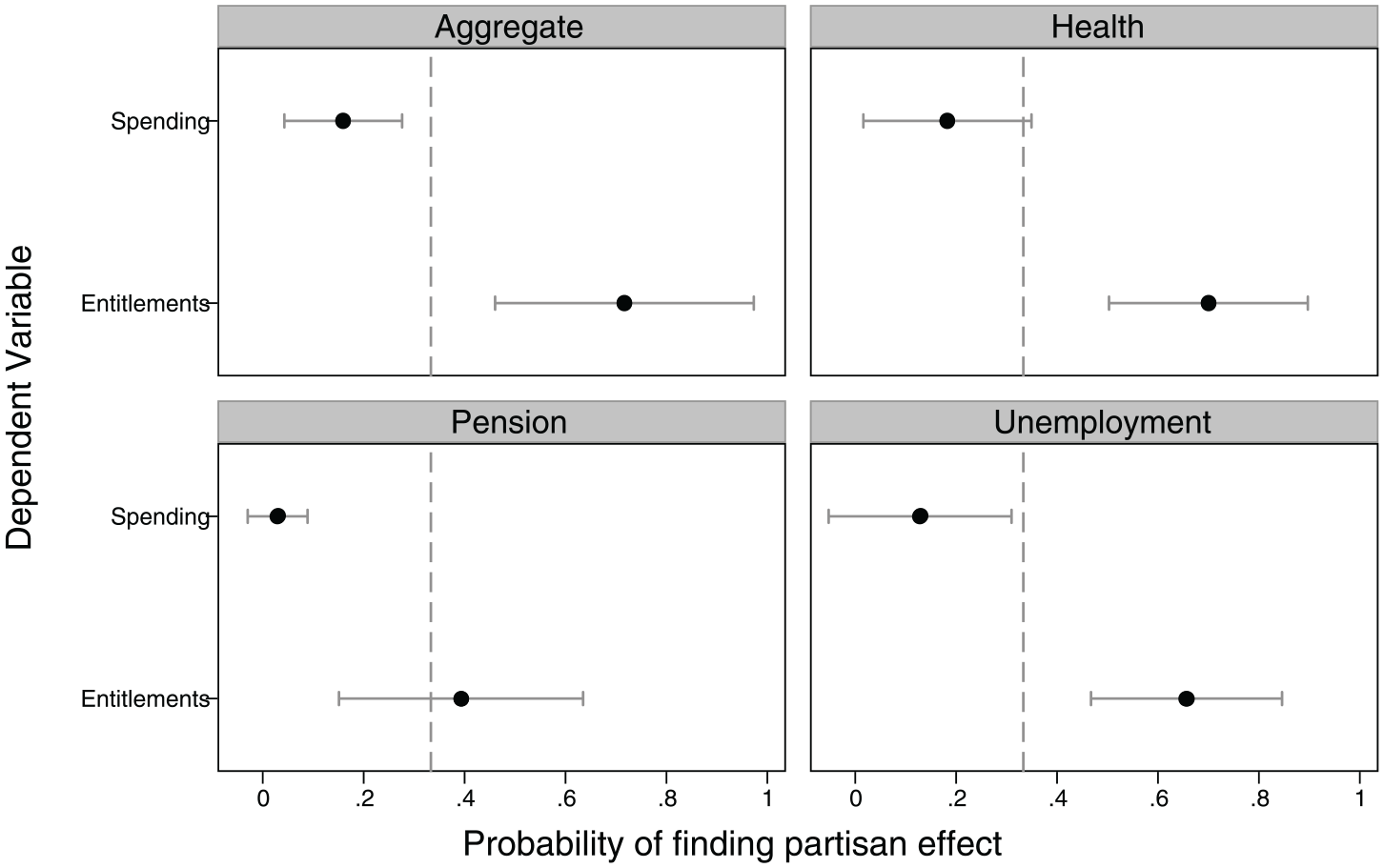
Probability of partisan effects for different welfare programmes.
The results on unemployment protection as a clearly class-related programme are in line with theoretical expectations. But what about the even higher probabilities of finding partisan effects with regard to health entitlements (70% compared to 65.7% for unemployment benefits)? This might come as a surprise given Jensen’s (2012) classification of healthcare as a lifecourse-related programme. However, while this might be correct when it comes to health spending, the common indicator on health entitlements is sick pay which, like unemployment benefits, is class-related, being more relevant for blue-collar than for white-collar workers (e.g. Hansen and Ingebrigtsen, 2008; Piha et al., 2009). The differences between unemployment benefits and sick pay on the one side and pension entitlements on the other are highlighted by Wolf et al. (2014), who find partisan effects for the former but reverse partisan effects for the latter. Notably, significant reverse partisan effects on standard pensions are also found by Hicks and Freeman (2009), Danforth and Stephens (2013) as well as Wenzelburger et al. (2013). 9 In other words, the findings on pensions are clearly at odds with traditional partisan theory, with several studies pointing to a ‘Nixon goes to China’ logic, at least when it comes to standard pensions. Finally, while the results on the aggregate level correspond to the results on health and unemployment, they have to be taken with caution as 90 percent of the corresponding studies fall into the spending category.
In order to test our hypothesis on time effects, we predict conditional probabilities for the average year of the period covered in the studies. As shown in Figure 3, the average sample year has the expected effect on the findings. 10 The closer the average year moves towards the present, the lower the probability of finding partisan effects. However, this result is much more distinct for entitlements. The probability of corroborating partisan theory decreases from 88 to merely 9 percent across the whole range of sample years. The predictions for studies using spending only decrease from 17 to 11 percent, encompassed by large confidence intervals. Overall, the results are in line with Hypothesis 4, according to which the impact of partisanship declines gradually over the retrenchment era. This is supported by individual studies. Out of the 63 studies, 12 include some kind of test on time effects, with 10 of these 12 studies showing a decline in the impact of partisanship over time (see Supplemental Appendix, Table A2). What is more, individual studies lend further support to the hypothesis on time effects by showing that partisan effects tend to shrink with higher levels of globalisation 11 and lower levels of union strength as well as corporatism (Jensen, 2011b, 2012; Kwon and Pontusson, 2010). In sum, the findings support the notion of a gradual decline of partisanship.
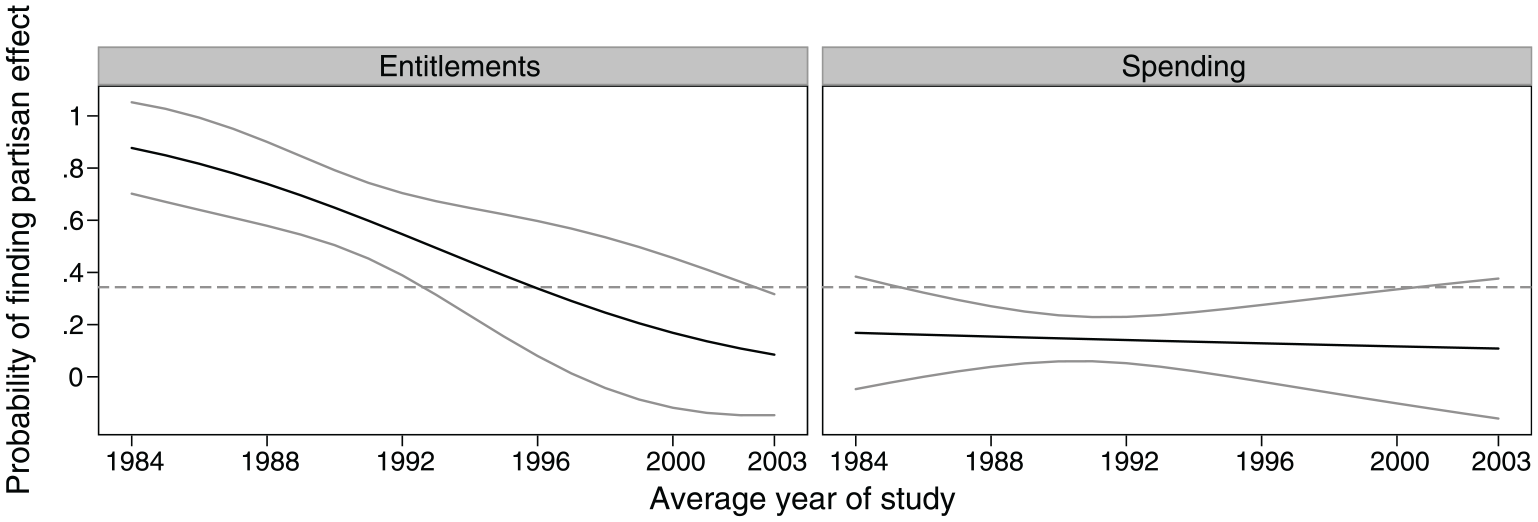
Probability of partisan effects for average years of covered period.
Finally, we turn to the independent variable, that is, the measurement of partisanship. In this case, the empirical evidence clearly contradicts our hypothesis, as the estimated probabilities for party labels (34.4%) are higher than the ones for left–right positions of cabinets (23.2%). However, given the prominence of manifesto data in the literature but the surprisingly small number of applications, a closer look at the studies using this kind of time-variant measure seems justified. All four related studies are based on data from the Comparative Manifesto Project (CMP), with three studies applying the CMP’s right–left index (RILE). Immergut and Abou-Chadi (2014) find partisan effects on pension entitlements, whereas Tromborg (2014) finds no such effects regarding spending on pensions and unemployment benefits. The study by Döring and Schwander (2015) stands out as it discusses and uses party labels as well as time-invariant and time-variant left–right scales. The authors conclude that the government’s position on the left–right scale matters but their partisan effects for RILE are not statistically significant. As discussed in the literature, the use of disaggregated indices focusing on socioeconomic manifesto items might be better suited than RILE to capture the relevant ideological differences (e.g. Benoit and Laver, 2007; Horn, 2017). Among our studies, only Finseraas and Vernby (2011) proceed in this way, demonstrating that ideological polarisation between left and right parties results in partisan effects regarding welfare generosity (see also Horn, 2017: 151–205).
Concerning the two additional variables, theoretical focus on partisanship and data structure, the results are as follows: studies with a focus on partisanship have a higher probability of finding partisan effects (39.6%) than studies which treat parties as one factor among others (27.7%). This finding is hardly surprising, given different model specifications and publication bias as well as ‘disciplinary bias’, that is, the supposed tendency of political scientists to focus on political factors like parties and to emphasise evidence in support of those factors. 12 Note, however, that the difference does not conform to conventional significance thresholds (p = 0.13). Regarding data structure, the probabilities for tests based on pooled time-series data (35.2%) are higher than for the substantially fewer tests using cross-sectional data (21.1%), but the difference is again not significant (p = 0.23). While splitting the former group along the lines of analysing welfare state levels or changes does not yield substantial results, there is some evidence that replacing country-years by cabinets as the unit of analysis makes a difference. Based on the argument that standard panel data analysis discriminates against partisan variables, Schmitt (2016) presents several models which find partisan effects on social spending but only when replacing country-years by cabinets. The only other study using cabinets also finds partisan effects, which is noteworthy as this study is among the few that find an impact of partisanship on pensions (Immergut and Abou-Chadi, 2014).
Conclusion
This meta-analysis advances our knowledge on the impact of partisanship in the retrenchment era by showing how studies’ characteristics influence their findings. In contrast to existing overviews, which generally proclaim the decline of partisanship, we show that results are highly dependent on researchers’ choices. The single most important factor affecting the results on partisanship is the dependent variable, with studies using entitlements being four times more likely to find partisan effects than studies based on social spending. This result confirms the expectation that partisan effects on the generosity of welfare programmes do not necessarily translate into similar effects on social spending, which is significantly driven by non-political factors. While this finding is far from surprising, our study is the first to reveal the substantial impact the choice of the dependent variable makes. Furthermore, we show that studies’ findings differ according to the welfare programme. In line with the literature on class-related and lifecourse-related risks, the impact of partisanship is pronounced in welfare programmes directed at the former risk type, indicating that parties’ class background still matters. In contrast, parties do not make a difference when it comes to pensions, at least as long as studies focus on standard pensions. Finally, our results clearly show a decline of partisan effects over time, especially when the studies use entitlements as the dependent variable. The further the retrenchment era advances, the smaller the impact of government partisanship. According to the ‘new politics school’, this can be explained by an ever more restricted policy space in the face of mounting economic pressure for austerity on the one hand and the persisting popularity of welfare programmes on the other.
Concerning the impact of the independent variable, our findings are less clear-cut. While the respective hypothesis is rejected by our statistical analysis, some recent studies indicate that researchers’ choices regarding the measurement of partisanship are not without consequences. First, the use of manifesto data promises to allow for a more time-sensitive assessment of the influence of government ideology on retrenchment. While there is, as we have shown, some evidence that this kind of measurement affects the results on partisanship, this evidence remains inconclusive due to the small number of studies using this kind of data. This points to a more general problem of welfare state research as most studies rely on the traditional measure of party labels, widely neglecting other popular ways to measure parties’ policy positions such as manifestos and different kinds of surveys (compare Laver, 2014). While the field has profited massively from the debate about the ‘dependent variable problem’, a similar debate about the ‘independent variable problem’, that is, the appropriate conceptualisation and measurement of partisanship, is still in its early stages (Horn, 2017: 95–139). Second, there is limited but consistent evidence that the use of cabinets instead of country-years as the unit of analysis has a substantial effect on the results. Here, further research is essential to verify the argument that standard panel data analysis based on country-years indeed discriminates against partisan variables, as this might call into question the results on the fading impact of partisanship on social spending.
Turning to the limits of our study, it is important to note that our findings do not necessarily apply to welfare programmes, regions and even political parties outside of our scope of analysis. First, the analysis concentrated on ‘old social policies’ since the corresponding welfare programmes are supposed to be the main targets of welfare state retrenchment. But at the same time, as these programmes are under pressure, the emergence of ‘new social risks’ in post-industrial societies poses new challenges for advanced welfare states that demand the creation and expansion of social investment policies such as childcare and activation policies (Hemerijck, 2013). Given the special nature of these ‘new social policies’, the related politics should differ considerably from the old ones (Häusermann, 2012). In order to test this argument, the analysis at hand should be expanded to studies which test for the impact of partisanship on welfare programmes like active labour market policies (e.g. Nelson, 2013; Rueda, 2006; Vlandas, 2013) and childcare (e.g. Bonoli and Reber, 2010; Hieda, 2013). Second, we focused on advanced western welfare states. Some welfare scholars have started to expand the view to welfare states in Latin America (Huber et al., 2008; Noy, 2011), Eastern Europe (Careja and Emmenegger, 2009; Lipsmeyer, 2002; Schmidt, 2012) and the less developed world in general (Ha, 2015). A comprehensive review of this kind of research is needed to understand if our findings are restricted to advanced welfare states or if they represent a broader historical pattern. Finally, the welfare state literature covered by our analysis is based on traditional partisan theory, which is based on the assumption that left parties are more welfare-friendly than their opponents on the right. This assumption is called into question by the emergence of populist radical right parties as these parties are competing for the votes of traditionally left-leaning blue-collar workers (Oesch and Rennwald, 2018). Since there is first evidence that populist radical right parties indeed soften retrenchment efforts when being part of right-wing governments (Röth et al., 2018), future research will have to take the role of those parties into account.
Supplemental Material
Bandau_Appendix – Supplemental material for The impact of partisanship in the era of retrenchment: Insights from quantitative welfare state research
Supplemental material, Bandau_Appendix for The impact of partisanship in the era of retrenchment: Insights from quantitative welfare state research by Frank Bandau and Leo Ahrens in Journal of European Social Policy
Footnotes
Funding
The author(s) received no financial support for the research, authorship and/or publication of this article.
Supplemental material
Supplemental material for this article is available online.
Notes
References
Supplementary Material
Please find the following supplemental material available below.
For Open Access articles published under a Creative Commons License, all supplemental material carries the same license as the article it is associated with.
For non-Open Access articles published, all supplemental material carries a non-exclusive license, and permission requests for re-use of supplemental material or any part of supplemental material shall be sent directly to the copyright owner as specified in the copyright notice associated with the article.
