



Abstract
Women negotiate gendered discourses of reproductive agency in resolving unplanned pregnancies. Invoking an intersectional lens, this paper examines how these discursive dynamics differentiate across social class in the Global South context of the Philippines. Utilizing a novel mixed methods strategy, we triangulate quantitative findings from a Q sort task and qualitative accounts of pregnancy resolution to identify classed discourses of reproductive agency as (a) reclaiming maternal virtue and (b) asserting autonomous choice. Statistical analysis reveals significant discursive divergence across class, wherein working-class women primarily adopt maternal virtue discourses while middle-class women disproportionately subscribe to autonomous choice. Interpretative analysis of women’s accounts complicates this bifurcated characterization by surfacing the diverse ways by which women negotiate both discourses in narratives of abortion and carrying to term. We discuss our contributions to the literature in terms of multilevel theoretical engagement with classed complexity in gendered issues like reproductive agency as well as innovating mixed methods in intersectional research. We conclude with reflections on advancing reproductive justice, especially in Global South societies like the Philippines.
Feminist scholarship elucidates how discourses of reproductive agency normatively shape women’s decisions to abort or carry to term in the context of unplanned pregnancies (Beckman, 2017; Marecek et al., 2017). However, while such discourses are well-studied across cultures, their dynamics within local and global contexts of inequality remain an active area of inquiry (Bose, 2015). Past studies obscure how classed influences, such as education and access to care, differentiate how women resolve unplanned pregnancies even within the same culture (Morris & Munt, 2019; Ridgeway & Kricheli-Katz, 2013). Postcolonial feminist scholars likewise expose how transnational and historical hierarchies are ignored in analyzing the complexities of reproductive agency in the Global South. For instance, neoliberal feminisms espoused by the Global North may unwittingly reproduce neo-colonial or imperialist relations through discourses of development and women empowerment which eclipse local and indigenous meanings of reproductive health and well-being (Dosekun, 2015; Roberts & Connell, 2016; Suh, 2018).
We echo intersectionality’s claim that gendered experiences are inextricable from the interlocking “matrices of domination” within which they are nested (Cho et al., 2013; Collins, 1991). Specifically, we posit that discourses of reproductive agency are not equally available or deployed by women across class boundaries, which we conceptualize as constituted within both local and global inequalities. We investigate this proposition among women in the Philippines, which exemplifies the classed stratification of many Global South societies (Dosekun, 2015; Schulz, 2015).
We accomplish this analysis utilizing a novel mixed methods strategy (Teddlie & Tashakkori, 2009), uniquely engaging women’s fluid processes of discursive construction as enabled and constrained within rigid classed differences (Choo & Ferree, 2010). We conclude with critical reflections on how this multilevel view of classed discourses illustrates key insights in line with intersectionally advancing reproductive justice (Macleod et al., 2017) especially in Global South settings. This paper thus aims to make theoretical, methodological, and practical contributions to the scholarship on reproductive agency in the context of unplanned pregnancies. Therefore, we ask: How do Filipina women construct reproductive agency in resolving unplanned pregnancies? How are discourses of reproductive agency shaped at the nexus of local and global inequalities?
Unplanned pregnancies and reproductive agency
Feminist scholars robustly document the influence of gendered discourses on how society views and treats women with unplanned pregnancies (Jones et al., 2019; Marecek et al., 2017). While adolescents are normatively expected to obtain formal educations and become productive adults (Macleod, 2010), many cultures further tie young women’s personal value to their virginity (Delgado-Infante & Ofreneo, 2014). Unplanned pregnancies disrupt both expectations of purity and productivity, which impact the valuation of women’s morality and responsibility (Cockrill & Nack, 2013) as well as their interpersonal relationships and career prospects (Jacobs & Mollborn, 2012). Women thus navigate hazardous cultural fields in resolving unplanned pregnancies.
Many cultures worldwide idealize motherhood and equate abortion to killing (Hoggart, 2017; Sevón, 2012; Sjöberg & Bertilsdotter-Rosqvist, 2018). Gray (2015) found that some women carry to term to align with cultural definitions of maternal maturity and responsibility. By assuming maternal identities, they redirect stigmatized constructions of their unplanned pregnancies as mistakes into moments of growth and transformation. In such contexts, shame is countered by emotions of happiness and pride which attend the motherhood role (White et al., 2018).
Conversely, as Gipson et al. (2011) noted, a “second stigma” can attend the decision to terminate unplanned pregnancies. Such stigma can manifest in fears of moral retribution for women who believe they may be shirking societally imposed reproductive duties (Lee et al., 2014; Molek-Kozakowska & Wanke, 2019). However, as Izugbara et al. (2011) showed, motherhood discourses may also be negotiated to justify decisions to terminate unplanned pregnancies, as an abortion now is reasoned to help women prepare for motherhood when they are ready in the future. Discourses of motherhood can provide diverse meanings of reproductive agency for women across various cultures.
In the Global North, growing scholarship also documents the rise of neoliberal, “postfeminist” discourses (Meenagh, 2017; Riley & Scharff, 2013). Recognizing the debated status of postfeminism, Gill (2007) provisionally defines the concept as sensibilities of female autonomy which “interpellate [women] as the monitors of all sexual and emotional relationships” (p. 151). Postfeminist discourses impact reproductive decision-making through their contention that women are masters of their own bodies, thus justifying abortion decisions independent of maternal desires (Thoma, 2009). However, because women are assumed to be “empowered” with knowledge and access to contraception, unplanned pregnancies may also be more harshly stigmatized (Ekstrand et al., 2009). By fixating on women’s autonomy, postfeminist discourses assign strict individual obligations for women to disclaim shame and “claim volition” as individuals supposedly in control of their material circumstances (Beynon-Jones, 2017).
Reproductive agency and intersecting inequalities
Past studies extensively characterized women’s diverse constructions of reproductive agency across cultures, but they may also homogenize such processes within a society. Some scholars, for instance, speak of “abortion cultures” where pregnancy termination is relatively normalized; others point to more conservative cultures that value motherhood above individual autonomy (Budds et al., 2016; Marecek et al., 2017). Less is known about how women’s meaning-making diverges across unequal social locations in the same cultural space. Classed forces, however, are known to powerfully structure women’s experiences of sex and childbearing (Bose, 2015; Morris & Munt, 2019). Reproductive health surveys show that negative health outcomes are systematically worse for women from low-income and rural households, which report more unplanned pregnancies, maternal deaths, and post-abortion complications (Sedgh et al., 2014). We propose that classed analysis of reproductive agency may shed crucial light into the discursive dynamics which perpetuate women’s unequal experiences of pregnancy resolution.
This paper conceptualizes class as encompassing not only economic affordances (e.g. income) but also the discursive milieus of middle-class and working-class life (Bourdieu, 1984). McDermott (2011) explains a “generative” model of class in terms of the Bourdieusian concept of habitus, whereby social structures are “created and reformulated within the individual, which reflect their position in social space”, and thereby “influence how an individual perceives the world and acts” (p. 67). In the context of unplanned pregnancies, class affects the educational opportunities shaping how young adults develop knowledge and beliefs about sex, contraception, and childbearing (Brubaker, 2016; Fine, 2012). Material access to services like maternity care and abortive procedures likewise influence how young adults perceive what options are possible, accessible, or moral for them to pursue (Jacobs & Mollborn, 2012; Le Grice & Braun, 2017).
More broadly, postcolonial scholars point out how little work situates classed bifurcations in gendered meaning-making within wider global structures (Roberts & Connell, 2016; Tolhurst et al., 2012). For instance, Dosekun (2015) shows that, while conventionally linked to nations in the Global North, postfeminist discourses may be adopted by upper-class women in Global South societies, often due to their increased mobility, access to foreign media, and higher levels of formal education. Suh (2018), on the other hand, provocatively unpacks how transnational discourses of development assign differential value to the bodies of middle-class versus low-income women in regulating their right to post-abortive care services. We therefore use social class as a nuanced lens through which we scrutinize not only local inequalities but also the uneven impacts of global forces which shape women’s discourses of reproductive agency (Appadurai, 1990).
Intersectional discourses in the Philippines
We embrace this theoretically rich view of class in examining classed discourses of reproductive agency in the Philippines. The Philippines features notable rates of unplanned pregnancy, with an estimated 14 percent of total pregnancies each year resulting in unwanted births, 17 percent in induced abortions, and 3 percent in hospitalizations for post-abortion complications (Darroch et al., 2009). Explicitly informed by conservative Roman Catholic views, local legislative dialogue favors a heteronomous view of women’s bodies, marginalizing decisions to abort as “sinful” or “selfish” (Gipson et al., 2011). The state thus totally outlaws abortion in the Philippines, thereby proliferating unsafe, clandestine practices and virtually non-existent post-abortion care (Upreti & Jacob, 2018). Furthermore, though contraception is legal and ostensibly guaranteed by a 2012 Reproductive Health Law, judiciary challenges to its constitutionality have choked funding and limited access for most members of the population (Melgar et al., 2018).
Against this structural backdrop, local scholarship on gendered agency looks back to the nation’s colonial history under Spanish rule, which propagated Catholic-inflected, patriarchal tropes of pure virgins, submissive wives, and devoted mothers (Estrada-Claudio, 2015). Such cultural representations persist in moral imperatives to self-police sexual desire outside marriage (Delgado-Infante & Ofreneo, 2014), or self-sacrifice in the context of familial economic hardship (Ofreneo & Canoy, 2017). In recent years, however, Tanyag (2015) and Montiel et al. (2016) also showed the salience of liberal discussions of women’s rights in opposition to religious discourses of morality in congressional debates surrounding women’s issues. Illustrating the multiplicity of meanings of reproductive agency within a culture, these evolving findings affirm our hypothesis that gendered discourses in the Global South cannot be seen monolithically (Kerner, 2017).
Do such macro-level contestations influence micro-level formulations of reproductive agency among Filipina women? What role do local and global inequalities play in shaping the adoption, rejection, or negotiation of such discourses? These are open, empirical questions. We argue that these correspondences may be explained by complex classed divides in Philippine society.
Intersectionality: The process-oriented model
To analyze social class in this research, we invoke intersectional theory. Intersectionality posits that individuals are not defined by single identities, but are rather socially located within “matrices of domination” (Collins, 1991). The key insight of intersectionality lies in examining how overlapping systems of privilege and marginalization jointly shape possibilities for meaning-making and action (Cho et al., 2013). Intersectional feminist scholarship shows how gendered inequalities are constituted within multiple axes of inequality, spanning class, race, sexuality, religion, among others (e.g. Bilge, 2010; Collins, 1991; Crenshaw, 1989). Thus, whereas the foregoing studies deal with how women engage with cultural discourses as gendered agents (Gray, 2015; Sevón, 2012), an intersectional framework explicitly fleshes out how such engagements may be complicated by social class.
We specify our approach in terms of what Choo and Ferree (2010) refer to as a “process-oriented” model of intersectional research. Thus, we view gender and class not as static categories with determined effects on individuals, but as complex, dynamic, and contextualized processes which organize power in society (McCall, 2005; Yuval-Davis, 2006). Methodologically, this translates to “capturing both the agency of individuals in making the world they inhabit and the enabling and constraining forces of the world as it has been produced” (Choo & Ferree, 2010, p. 134). In this paper, we analyze how class impinges on women’s gendered discourses of reproductive agency, and how such processes shape resolutions of unplanned pregnancy in the Global South context of the Philippines.
Methods
To examine classed discourses of reproductive agency, we employed a novel mixed methods strategy. Implementing a convergent parallel design, we concurrently conducted quantitative and qualitative data analyses and triangulated them in a final synthesis step (Teddlie & Tashakkori, 2009). By integrating findings from a Q sort task and in-depth semi-structured interviews, we produced a multilevel, process-oriented mapping of women’s discursive constructions as enabled and constrained within systematic classed inequalities.
Q sort task
For the quantitative phase, we recruited middle-class (N = 41) and working-class (N = 40) Filipina women. These class categories correspond to local socio-economic categories as adopted by past studies in the Philippines (Canoy, 2015; Ofreneo & Canoy, 2017). We specifically focused on women aged 16–24 as prior research finds that unplanned pregnancies and their associated stigmatization are disproportionate among these demographics (Sedgh et al., 2014). Private university students were recruited as middle-class participants. Working-class participants were recruited at a local shopping mall and four visits to urban poor communities located in Metro Manila over a month. Affiliated with a university social outreach office, the latter sites were introduced by community guides who initiated interactions with participants during data collection. Following prior research (McDermott, 2011), class labels in this study were validated by identifying the educational attainment of participants’ parents. By using this measure, we account for both the cultural dimensions of class beyond economic factors as well as practical considerations for participants who may not be explicitly familiar with their financial status (Canoy, 2015). Tertiary education was the cut-off for middle-class assignments.
Q methodology refers to a semi-qualitative framework for analyzing diversity in meaning-making, valuable for potentially taboo topics like unplanned pregnancy (Watts & Stenner, 2005). Table 1 lists our prepared concourse of 18 statements on reproductive agency in the context of unplanned pregnancy. Pilot interviews with medical professionals (N = 2), clergy (N = 1), as well as working-class and middle-class young women and parents (N = 8) were conducted to iteratively refine the selected statements. English and Filipino versions were produced. After providing informed consent, each participant sorted the statements into three categories: six they agreed with, six they disagreed with, and six about which they felt neutral.
Items for Q sort.
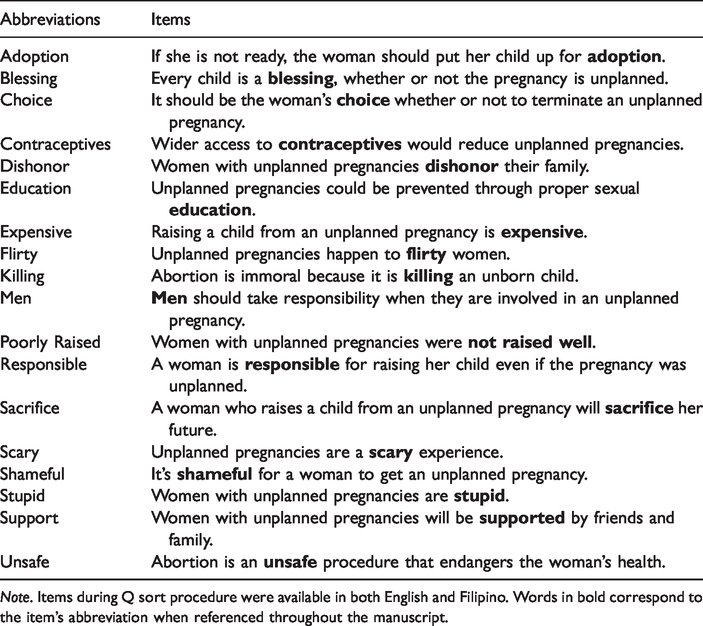
Note. Items during Q sort procedure were available in both English and Filipino. Words in bold correspond to the item’s abbreviation when referenced throughout the manuscript.
Analysis of Q sorts generated two outputs: (a) clusters of items corresponding to discourses of reproductive agency, and (b) quantitative assignments for each participant to each discourse. Horn’s parallel analysis (Dinno, 2009) provided statistical basis for the number of factors to extract via principal components analysis (PCA) with varimax rotation. PCA projected our data onto latent factors corresponding to discourses of reproductive agency. Within each factor, individual items were assigned z-scores. Positive z-scores corresponded to items directly correlated with the associated discourse, while negative z-scores indicated discursive rejection of a given meaning. Nonparametric testing quantified statistically significant differences in the distribution of discourses adopted by middle-class and working-class Filipina women.
In-depth interviews
In a concurrent qualitative phase, we conducted in-depth semi-structured interviews with middle-class (N = 4) and working-class (N = 4) Filipina women who had resolved unplanned pregnancies. Across each class, two women carried their pregnancies to term and raised their children, while two had abortions. Through purposive snowball sampling (Robinson, 2014), we recruited heterosexual-identifying women also aged 16–24 at the time of the pregnancy, likewise validating class assignments using parents’ educational attainment (Canoy, 2015). After obtaining informed consent, we asked participants to narrate their experiences of pregnancy resolution. Approval from institutional review was obtained before holding interviews. Contact details for counselling services were prepared in case additional debriefing was necessary. Participants were explicitly reminded that they could withdraw from the study at any time. All quotes included in the succeeding analysis were anonymized.
We analyzed interview transcripts using the reflexive thematic analysis procedure outlined by Braun and Clarke (2006). We took a “theoretical” and “latent” approach to themes which entailed seeking out shared patterns of meaning corresponding to women’s discursive construction of reproductive agency in resolving their unplanned pregnancy. We performed independent, inductive readings and iterative coding of meaningful patterns in the transcripts. Group consensus sharpened the final identification of women’s discursive construction of reproductive agency (Creswell & Miller, 2000). Special analytic attention was afforded to the ways by which class shaped women’s social constructions across narrative junctures in the pregnancy resolution process. Whereas quantitative results surfaced systematic patterns in classed discourses of reproductive agency, qualitative findings demonstrated how such patterns were adopted, resisted, and transformed in women’s experiences of resolving unplanned pregnancies.
Results
Integrative analysis of quantitative and qualitative findings surfaced two classed discourses of reproductive agency, namely: (a) reclaiming maternal virtue and (b) asserting autonomous choice. We developed these discursive labels through triangulated engagement with item scores from the Q sort task and women’s accounts of pregnancy resolution. In the succeeding sections, we present a broad overview of the two discourses in terms of their item-level content and classed divergence among participants in our quantitative study. We follow this up with qualitative analysis of how these classed discourses emerged in Filipina women’s accounts of resolving unplanned pregnancy.
Mapping classed discourses of reproductive agency
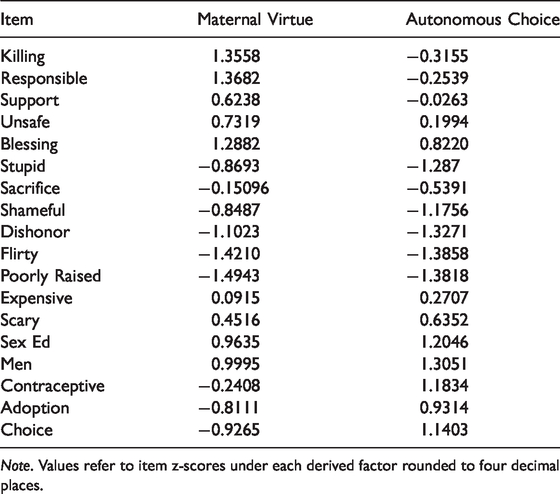
Table 2 summarizes the results of principal component analysis, which quantitatively produced two item clusters. Figure 1 plots items on a map to visualize the relationships of individual items to their overarching discourses. The horizontal axis corresponds to items’ z-scores in the first discourse, while the vertical axis measures z-scores on the second discourse.
Q analysis of Filipina women’s constructions of reproductive agency (N = 81).
Note. Values refer to item z-scores under each derived factor rounded to four decimal places.
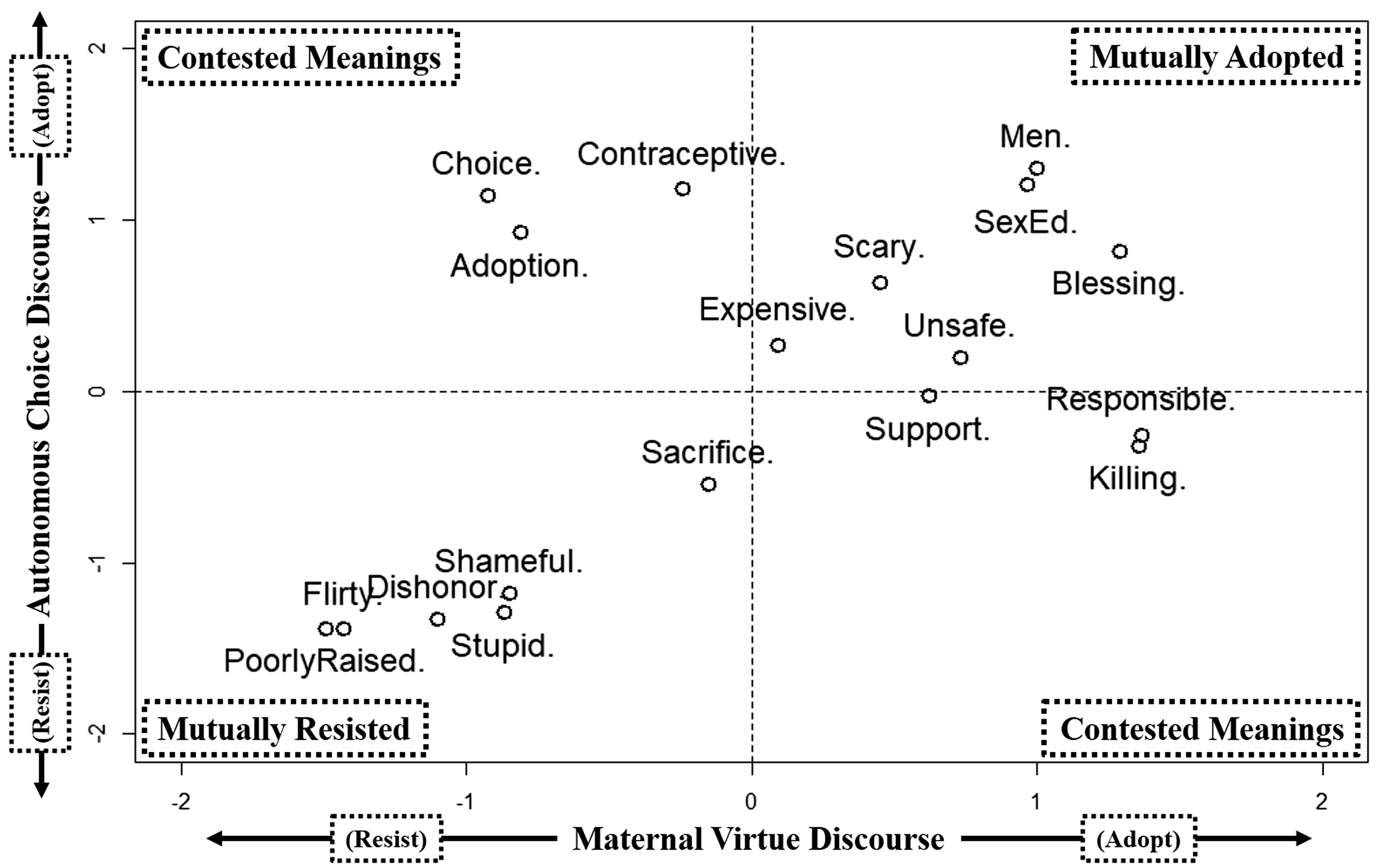
Coordinates on two-dimensional map refer to item z-scores by discourse. Mutually adopted and resisted items have z-scores which are both positive or both negative across discourses. Contested meanings have positive scores in one discourse but negative scores in another.
Figure 1 depicts mutually adopted meanings across discourses in the top-right quadrant, where items have positive z-scores on both axes. Mutually resisted constructions cluster in the bottom-right quadrant, where items are assigned negative z-scores on both axes. Finally, contested constructions belong to the top-left and bottom-right quadrants, as items here have positive z-scores in one discourse but negative z-scores in the other.
Mutually adopted and resisted constructions. Multiple sets of mutually adopted meanings of reproductive agency cluster in the top-right quadrant of Figure 1. Near the center of the diagram, several items indicate recognition of the financial burdens of raising a child, while also viewing abortions in the Philippines as scary and unsafe. This highlights the “double jeopardy” Filipina women face in resolving unplanned pregnancies (Gipson et al., 2011). Against the backdrop of these contextual realities, a second set of mutually adopted meanings assigns high z-scores to men’s shared responsibility and the value of proper sex education. Thus, for both discourses, agency affirms the value of informed decision-making but also relies on support from interpersonal relationships. Finally, the idea that children are blessings also receives high z-scores in the two axes. As we show later, this presents a source of emotional fulfilment but also moral ambiguity for women subscribing to either discourse in resolving their unplanned pregnancies.
Mutually resisted meanings (bottom-left quadrant) of reproductive agency showcase a strong rejection of negative representations of women with unplanned pregnancies, which all obtain highly negative z-scores. Unplanned pregnancies are not attributed to women’s flirtiness, stupidity, or poor upbringing. Nor should they result in shame or dishonor for the woman or her family. Interestingly, this finding contrasts with prevailing characterizations of gendered stigma against unplanned pregnancies in the Philippines (Delgado-Infante & Ofreneo, 2014; Estrada-Claudio, 2015), suggesting that for women across social class, agency entails a deflection of culturally embedded scripts for sexual purity and the recovery of women’s dignity amid societal impositions of shame. We return to and probe this insight further in the succeeding discussion.
Contested constructions. Contested constructions of reproductive agency capture meaningful rifts between discourses. The farthest items on the bottom-right quadrant suggest that a crucial point of contention is whether abortion is killing and subsequently whether mothers must raise the child no matter the circumstance. The first discourse’s positive evaluations of these items correspond to constructions of motherhood as a duty for women despite the hardships of unplanned pregnancy. As later evidence suggests, this discourse positions women as fulfilling cultural notions of maternal virtue when they choose to carry to term.
For the second discourse, however, such duties are renounced. The farthest item on the top-left quadrant suggests the salient divergence between discourses with respect to the primacy of women’s choice in resolving an unplanned pregnancy. By affirming this claim, this latter set of meanings rejects the notion that abortion is killing or that a woman’s maternal responsibilities are absolute. Instead, by promoting contraception and possibilities for putting up their children for adoption, this discourse asserts women’s autonomous right to choose what happens to their bodies.
Discursive divergence by class. The two derived clusters mirror the macro-level discourses recently employed in local reproductive health debates (Montiel et al., 2016; Tanyag, 2015). However, as Figure 2 depicts, the micro-level adoption of these two discourses bifurcates discernibly between working-class and middle-class participants. Working-class women predominantly adopt the first identified discourse of maternal virtue (92.69%) while middle-class women mainly subscribe to discourses of autonomous choice (67.50%). Fisher’s test of exact differences provides evidence for women’s unequal adoption of such discourses across class boundaries (odds ratio = 24.9747, p = 1.043 × 10⁻⁸). Thus, while some middle-class participants may indeed subscribe to the first discourse (32.50%), and few working-class participants may identify with the second (7.31%), overarching patterns in the data suggest that the availability and deployment of such social constructions remains distinctly classed.
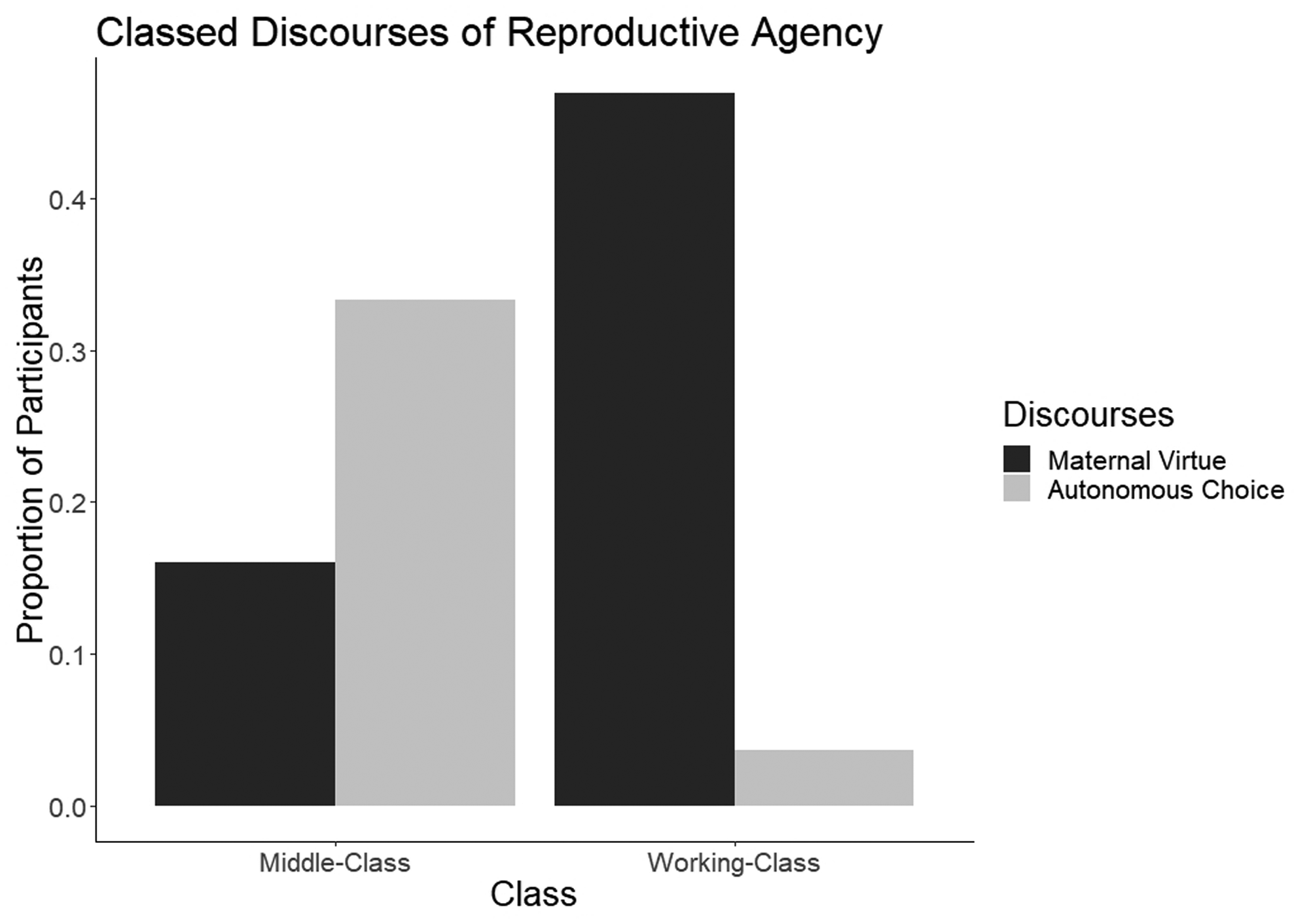
Fisher’s exact test gives a sample estimate of 24.9747 for the odds ratio (95% CI: [6.233244, 149.952094], p = 1.043 x 10⁻⁸).
Women’s narratives of resolving unplanned pregnancies
We now seek to complicate our characterization of the derived discourses by integratively drawing upon computational outputs and women’s narratives. Exemplar quotes from women’s accounts show how classed forces impinge upon the constitutive meanings of each discourse as well as their enactment in pregnancy resolution.
Reclaiming maternal virtue: Working-class discourses of reproductive agency. The first discourse in our analysis anchors reproductive agency in culturally idealized maternal virtues. Adopted by 92.69 percent of working-class participants in the Q sort task, maternal discourses in the Philippines define powerful moral imperatives rooted in Roman Catholicism. Amidst harsh stigma directed toward their pregnancies, women may reclaim reproductive agency by carrying to term as dutiful mothers. As Angelica and Christina narrate: I didn’t want to be pregnant, but it’s given. Right, it came. Why would you kill the child just for your own happiness? It’s inside your body, God gave it to you. It’s an angel, you’re not allowed to – whatever your sin is, you can’t give it to your child. Own up to your sin, but let the child come out. (Angelica, working-class, carried to term) I called to the Lord, what should I do? Help me. I know this is a big sin in my life. But I said, if you gave me this, even if I’m a kid, you have a plan for me, Lord. You’ve planned this. So I accept it, Lord. Because you gave this to me. (Christina, working-class, carried to term)
In the context of poverty in the Philippines (Ofreneo & Canoy, 2017), the moral imperative to become virtuous mothers can weigh heavily upon the daily lives of working-class women who carry to term. But as Christina and Angelica further explain: Both of us are grinding our bones, I’m doing all I can, doing extra … especially now that there’s so much to spend for … But that’s doable. The Lord is there to help you. He never gives people what they can’t get through. That’s what I learned in my life, never give up. Fight. Any challenges that come are given by God. The Lord never gives you challenges you can’t conquer. (Christina, working-class, carried to term) There are times that you will regret it. It gets difficult. But there are also times when you won’t, especially when you see your children, no matter what problems you have, you see them and you’re okay. You’re happy. And you’re together. (Angelica, working-class, carried to term)
Not all working-class women, however, carry their unplanned pregnancies to term. But in choosing to have abortions, some women also negotiate meanings of maternal virtue, as Esther articulates: I had just had my second child less than a year ago. The hilot said to me, it was still blood, she said … so I decided to do it. So that’s why I decided to abort, my husband and I decided. We just kept having children back then, so it was okay. Also for my husband. By the mercy of God, I already have a third child now, but back then, it was just too soon after. That’s why it was okay. (Esther, working-class, aborted) I was thinking: Why am I like this? Why wasn’t I taken care of by a man? Yes, I said that if they’re just going to treat me like this, like kuluwanan sang kalipayan, that’s what it’s called. Yes, I was just used then abandoned. That’s why I decided to drop it. I felt like a whore. Like a bad woman. (Greta, working-class, aborted)
On the other hand, Greta laments her abandonment by her male partner, invoking the virgin-whore dichotomy (Delgado-Infante & Ofreneo, 2014) as evidence of her perceived “unfitness” to become a mother. Treated as kuluwanan sang kalipayan, or “vessel of men’s pleasure”, Greta terminated her unplanned pregnancy as she felt like a “bad woman”. Hence, while some working-class women may reconfigure constructions of “sin” as a “challenge” or a “blessing”, intersecting pressures of poverty and lack of a partner may materially and symbolically overwhelm attempts to negotiate identities in line with cultural meanings of being a “good woman”. Filipina women’s abortions may thus also be enabled by discourses of maternal virtue. Like Esther, they may construct abortions as a fulfilment of maternal ideals; on the other hand, like Greta, they may position abortions as a last resort if such ideals are framed as materially beyond reach.
Asserting autonomous choice: Middle-class discourses of reproductive agency. The second discourse prevalent in our findings locates reproductive agency in women’s individual choice (z = 1.1403). Expressed dominantly by 67.50 percent of middle-class participants in the Q sort task, this discourse resonates with postfeminist sensibilities of women’s bodily autonomy (Gill, 2007; Riley & Scharff, 2013). Against the backdrop of total prohibition for abortive procedures in the Philippines, Irene narrates how she asserts her freedom to terminate her unplanned pregnancy: My period was late, and I was like, oh I’m pregnant, and my boyfriend was like okay, and then we ordered the pill online. That’s it. It was super simple. We’re both on the same page that we didn’t want it … We were both like sort of, like we knew our way, and okay, so we’ve got to do something about this. The real question was how. (Irene, middle-class, aborted)
Deeply resonant with postfeminist discourses, Irene’s assertion of reproductive agency is facilitated by her middle-class affordances, as she and Kendra explicitly elaborate below. Expressing the value of access to education (z = 1.2046) and contraceptive services (z = 1.1834), they share: You know I had the support of my partner, I was able to get a procedure, I was able to afford it, and it was safe. I didn’t have to put myself or my health in jeopardy you know. And it’s expensive, that’s why it’s scary. But other than that, we saw that the medication was sealed, and it was professional, and I found a great gynecologist right after who is supportive of birth control. (Irene, middle-class, aborted) Of course, religious people are arguing it’s like this or like that … but I don’t know why there’s a debate regarding the RH Bill. Yeah, I mean it’s just prevention. Sex. Everyone has sex. And you can get pregnant from having sex. But if you don’t want a baby, and you can’t support the baby, and you know that if you do keep the baby, that you won’t be able to give it a good life, just go for prevention. As they say, prevention is always better than cure. (Kendra, middle-class, aborted)
A similar sense of autonomy is central to the pregnancy resolution decisions of middle-class women who carry to term. As Opal and Miriam disclose: He wanted to abort the child, but I was like no, no. I’m like, for me, anyway, so … Later, he kept insisting to abort but then I said if you’re insisting to abort, then we should break up. And then I said never mind, just stop insisting it. It’s my family who provides for the child. He can’t do anything. (Opal, middle-class, carried to term) Honestly, when we planned to go the US, I didn’t care. I didn’t care because this is my life. Can they do anything? What they do, they can keep their opinions to themselves. Let them alone to spread their rumors. I’m still happy. (Miriam, middle-class, carried to term)
Discussion
Utilizing an intersectional lens, our results resonate with and extend previous scholarship by highlighting how classed inequalities shape Filipina women’s discursive constructions of reproductive agency. Employing a novel mixed methods approach, our quantitative findings revealed systematic differences across rigid classed boundaries, while qualitative analysis underscored women’s fluid negotiation of meanings against the backdrop of intersecting inequalities. In the succeeding sections, we flesh out these theoretical and methodological insights and link them to practical directions for advancing reproductive justice especially in the Global South.
Classed complexity of reproductive agency in the Philippines
Discourses of autonomy underscore not just women’s choice, but also their freedom to decide what choice means in motherhood or abortion. In contrast, maternal virtue is predicated on women’s successful compliance to essentialized ideals grounded in local configurations of religion. Both discourses affirm the personal and societal restrictions women encounter in the context of unplanned pregnancy. Yet while they each reconfigure harsh cultural stigma toward a dignified resolution of women’s pregnancies, the meanings such dignity assumes diverge significantly. Our intersectional analysis exposes how maternal virtue and autonomous choice exert cultural imperatives on women’s lives with distinct material stakes for women embedded in the biting contexts of classed inequalities and brittle reproductive legislation.
Both discourses offer meanings of agency for Filipina women, yet also reproduce marginalization (Canoy, 2015; McDermott, 2011). Though maternal virtue attempts to transcend material hardship through spiritual fulfilment, it exerts exacting demands of labor for women in poverty, while alienating women unable to meet rigid maternal ideals. On the other hand, autonomous choice relies exclusively upon individual options irrespective of state support, thereby exposing women to unregulated procedures (“pills”) under a false assumption of safety (Thoma, 2009). While validating Dosekun’s (2015) claim that postfeminist sensibilities are available to middle-class women in the Global South, we also illustrate how access to the transnational economy enabled by local privilege remains stunted within wider contexts of global marginalization. From a relational standpoint, both discourses likewise amplify women’s inequitable gendered relations with men in class-specific ways. Maternal virtue conditions working-class women’s maternal value on men’s commitment to them, while autonomous choice nearly absolves men of accountability given middle-class imperatives of self-sufficiency.
Invoking intersectionality’s critical foundations (Collins & Bilge, 2016), we locate these classed meanings in women’s unequal material conditions. Middle-class women’s narratives, for instance, featured significant mobility in escaping societal scrutiny of their pregnant bodies, as well as unique digital access to otherwise illegal services facilitating relatively “simple” clandestine abortions. Without such affordances, working-class women were limited to cruel “regimes of visibility” in tight community spaces (Caillol, 2018). From a temporal standpoint, such asymmetries further extend to women’s longer-term trajectories in carrying to term, as autonomous choice is nested within middle-class familial resources facilitating women’s continued education and professional development (Ringrose, 2007). Conversely, working-class women do not possess the same economic safety nets when plunged into motherhood. In such cases, heterosexual relations with men may alleviate or exacerbate their classed precarity, which becomes contingent on their participation as co-providers (Gallagher, 2007). Working-class women are thus disproportionately disadvantaged within intimate milieus relative to their middle-class counterparts, even as all Filipina women are subject to inequitable material conditions. Our intersectional approach renders visible this mutual constitution of gendered and classed inequalities in women’s meaning-making and action on individual, relational, and societal levels.
Innovating mixed methods for intersectional research
Our work is not the first to tackle questions of reproductive agency through an intersectional framework, nor gendered issues through the lens of class. However, significant insights were uncovered through the novel and critical use of mixed methods. While debated in the intersectional literature, quantitative analysis in our research offered rich perspectives into distributions of cultural meanings across class, including their interrelationships and relative influence on women’s meaning-making. Qualitative analysis thickened our interpretation of these differences, showing how relatively stable discursive systems may be dynamically adopted and resisted in lived contexts. This synergy between quantitative and qualitative methods corresponds precisely with Choo and Ferree’s (2010) process-oriented model of intersectionality, empirically surfacing the rigid and fluid processes engendered by multiple inequalities in women’s lives.
Previous scholarship on unplanned pregnancy, teenage motherhood, abortion, and reproductive agency also featured methodological limitations our study sought to overcome. The shift from quantitative to qualitative methods in much recent work did away with deterministic decision-making models (Kelly & Grant, 2007) in favor of contextualized views of women’s complex engagement with cultural discourses (Chiweshe et al., 2017; Ekstrand et al., 2009; Lee et al., 2014). Our methodological design preserves such idiographic nuance while also validating the identification of themes with numerical measures, quantifying consensus and contestation between plural discourses, and recovering statistical generalizability in analysis of systematic classed differences.
We offer our mixed methodological design as a novel framework for understanding the interplay between systematic inequalities and individual negotiations of agency in stratified societies. Such critical sensitivities may fruitfully inform both theory and praxis in vital contexts of gendered well-being.
Multilevel analysis for advancing reproductive justice
Especially in Global South societies like the Philippines, our findings highlight the need for systemic responses which sensitively account for the cultural complexities of classed differences. We affirm the importance of strengthening access to reproductive services as a choice for all Filipina women. However, echoing scholarship on reproductive justice (Macleod, 2019), our research shows that overcoming symbolic and material inequities exceeds the mere procurement of services and embraces the range of women’s experiences before and after pregnancy resolution. For instance, the Reproductive Health Law has suffered stunted implementation beneath the weight of widespread fundamentalist Catholic discourses adamant in their rejection of contraceptives as inherently wrong (Melgar et al., 2018) while promoting “self-sacrificing” ideals of motherhood (Tanyag, 2017).
Our multilevel analytic framework offers a valuable empirical touchstone for feminist praxis and reproductive health advocates in the Philippines, as well as other Global South contexts with variegated cultural landscapes which perpetuate ecologies of shame and risk for women across social class (Bose, 2015; Roberts & Connell, 2016). By mapping the dominant constructions of reproductive agency, we identified consensual meanings as well as classed points of divergence. Such results may guide strategies for shifting public constructions of health toward productive rather than prohibitive dialogue with personal and indigenous religious beliefs (Bonifacio, 2018). Grassroots efforts may be well-poised to promote women’s well-being in a manner which widens community participation (especially with men and families), and embraces intersectional sensitivity to local classed milieus without re-inscribing colonial discourses of development and surveillance (Bloomer et al., 2017; Suh, 2018; Terry & Braun, 2011).
We also showed, through in-depth interviews, how relatively stable discourses are unequally negotiated in women’s accounts of pregnancy resolution. These findings suggest that the amplified presence of women’s diverse voices in public debate may be fruitful to bring to light the complexities of pregnancy resolution at the intersection of multiple inequalities. Advocating reproductive health as a matter of rights and justice, as argued by feminist Alicia Yamin (2008), may be strengthened precisely by such attention to these lived intersections of suffering, resistance, and resilience in women’s experiences toward undoing discursive deadlocks and precipitating meaningful and inclusive change.
Limitations and future work
At this juncture, we note several limitations which qualify the conclusions to be drawn from this research. While we focused on social class, other factors are also known to impact women’s reproductive experiences (Sedgh et al., 2014). Age, religion, and sexuality—all of which we held constant in our samples—may also be examined in a Philippine context. Expanded notions of class could likewise be explored. Furthermore, as in past scholarship (Gray, 2015; Jacobs & Mollborn, 2012; Sevón, 2012), our findings echoed the salience of women’s intimate partners and their families in the pregnancy resolution process. However, intersectional theorizing and analysis of dyadic discursive meaning-making remains scant and therefore urgent for future work. Finally, considering our analysis of postcolonial and transnational influences on gendered meaning-making, we note that numerous indigenous groups in the Philippines may experience these global and historical impacts differently than the urban, Christian majority populations we engaged. Deeper work into local indigenous constructions of reproductive agency may therefore be fruitful for decolonizing feminist research.
Footnotes
Acknowledgements
The authors are grateful for the valuable feedback of the journal editors and several anonymous reviewers in revising this manuscript. We also appreciatively acknowledge Cristina Jayme Montiel and Anne Marie Topacio for their insightful comments during the early stages of this paper. Finally, we thank Emma Guanco for her assistance during data collection.
Declaration of conflicting interests
The author(s) declared no potential conflicts of interest with respect to the research, authorship, and/or publication of this article.
Funding
The author(s) received no financial support for the research, authorship, and/or publication of this article.
