



Abstract
The historicity of psychological phenomena plays a key role in Vygotsky’s developmental theory. However, we rarely realize what historicity means to Vygotsky, and what implications the notions about the nature of historical change bring to his theory. We suggest, based on dialogue with authors from the social sciences, that Vygotsky worked with different notions of the nature of historical changes in each developmental plane (phylogenetic, ontogenetic, and historical-cultural). Our investigation on this topic showed that, for Vygotsky, each timescale studied behaved differently: for instance, teleological in civilizational scale, semi-open in ontogenetic time. Due to the great influence exerted by the author’s work on the fields of developmental and cultural psychology, we understand that this kind of investigation can be useful to clarify and enrich both scholarly knowledge about his works and contemporary claims about the role of historical change on the developmental processes in psychology.
Keywords
Vygotsky brought an original set of ideas, concepts, and theories about human mental functioning and change to developmental psychology. The centrality of social interaction for human development, in which the role of mediational tools and the zone of proximal development are core explanatory concepts, are only an example of his influential and well-known contribution to the field. Not so widely recognized, but nevertheless relevant, are his contributions concerning the necessity of broadening the timescales used by those who desire to fully understand human psychological development.
“Behavior is only intelligible as the history of behavior”—this formula, inherited from his soviet colleague Blonsky, is like a mantra in many of Vygotsky’s works (Van der Veer, 2007, p. 41). As Vygotsky himself and many of his contemporary commentators explain to us, its meaning is clear: to properly understand human psychology, one must go beyond the directly exhibited behavior and search for its roots. Usually, developmental psychologists look for these roots solely in the individual lifespan (ontogenetic plane), dealing mainly with those changes taking place from birth to adolescence. For Vygotsky, this procedure is mandatory, but not sufficient: we should go deeper in our search. Our studies must encompass phylogenetic as well as historical-cultural timescales if we want to glimpse the origins and nature of changes in psychological phenomena.
Nevertheless, splitting the study of development in many planes generates unintended and sometimes unnoticed consequences. A few authors, such as Scribner (1986), dealt with this problem in depth. In the following, we will touch on other aspects of this issue, aiming to allow a new understanding of its implications for human development studies.
According to our research, in Vygotsky’s works, each timescale operates under its own internal logic. In each of them, a different type of law regulates the changing processes occurring in it. The main heuristic tool used in our research is a model for classifying societal laws proposed by Mandelbaum (1957). Although it would seem to be an outdated model, it will be argued that it has kept its relevance throughout the years.
Since the concept of microgenesis is a current topic in Vygotsky-inspired works, we will devote a few lines to it. We argue, contrary to a significant portion of the specialized literature (e.g., Wertsch, 1985) that in Vygotsky’s works, microgenesis isn’t treated as an independent timescale, but mainly as a methodological device for the analysis of change in psychological phenomena, following the steps of influential German authors of his time, such as Werner (1948). 1
The kind of work we are proposing can be profitable to the contemporary discussion on the relationship between historical and psychological changes as it flourishes in many psychological fields, such as Historical Psychology (Pizarroso, 2013; Smith, 2005); Developmental Psychology (Burman, 2008); History of Psychology (Danziger, 2008); and Cultural Psychology (Abbey, 2015; Marsico, 2015; Tateo, 2015).
Differing times
Wertsch (1996) calls our attention to Vygotsky’s innovative perspective, taking into consideration the different timescales for an improved understanding of developmental processes in their integrality. Besides ontogeny, phylogeny and historical-cultural dimensions should be considered.
Probably the book in which Vygotsky’s ideas on this subject are more explicitly exposed is Studies on the History of Behavior: Ape, Primitive, and Child, co-authored by Luria (1930/1996). The subtitle of the book points to the three examples taken by them to clarify the meaning of each plane of development: a comparison of apes’ and humans’ psychological functioning could shed light on the study of phylogenetic changes that led to the appearance of the inferior mental functions in humans; contrasting the mental capabilities of modern and “primitive” humans could make clearer the discrepancies brought by culture along historical time; finally, the study of children’s ontogenetic development shows us the intersection of phylogenetic and historical-cultural planes, in other words, how the child, initially a “biological-natural” being, develops a second “cultural nature” through social exchanges.
Many authors call our attention to this topic and give us their testimony on how innovative the Vygotskian approach sounded to them. For instance, Cole and Scribner (1978) state: When Vygotsky speaks of his approach as “developmental” this is not to be confused with a theory of child development. The developmental method, in Vygotsky’s view, is the central method of psychological science. (p. 7)
Wertsch does the same, in the preface of Vygotsky and Luria’s book (1930/1996) and in Vygotsky and the Social Formation of Mind (1985), from which we take this excerpt: Vygotsky’s claims about genetic analysis do not end with the general assertion that psychological processes must be studied in transition. In addition, he had some specific ideas about the nature of development … he defined development primarily in terms of fundamental “revolutionary” shifts rather than steady quantitative increments. At these points of revolutionary dislocation, he argued, the very nature of development changes … he claimed that the explanation of psychological phenomena must rely on an analysis of several different types of development, or what I shall term “genetic domains.” Whereas genetic analysis is often limited to ontogenetic comparisons, Vygotsky included other types of comparisons, such as phylogenetic and sociohistorical, as well. (p. 19)
It is also important for the purposes of this article to emphasize that, even though Vygotsky’s point of view about the importance of history and phylogeny was very impactful on the study of psychological development, as highlighted by Wertsch, many authors influential to Vygotsky, who have been read and quoted by him several times, like Karl Bühler (1949) and Heinz Werner (1948), had already made such claims. Yet, as we will stress below, his proposals differ from those above-mentioned, mainly when we consider the role played by Marxist 2 thought in his account of historical change.
To understand the specificity of Vygotsky’s proposal, we need not confine ourselves to the intellectual debate on developmental psychology, but to look closer to the broader social context in which he was developing his theory. The most important aspect of his context was, no doubt, the Revolution. As many (Kozulin, 1994; Newman & Holzman, 2002; Van der Veer & Valsiner, 1999) have observed throughout the years, Vygotsky was deeply engaged in the revolutionary process occurring in the Russia and the Soviet Republics during the first decades of the 20th century. This fact has many implications for his understanding of the nature of psychological changing processes. Gueorgi Plekhanov (1856–1918), for instance, a historian who took part in the revolution, was an often-quoted source to Vygotsky in what concerns the Philosophy of History, who seems to have deeply influenced him, as we will later discuss.
Vygotsky was not only interested in understanding how people develop cognitively, he was also (and maybe mainly) concerned with provoking psychological change in people. This intention is clearly recognizable in his commitment to the socialist revolutionary project of creating a “new man,” (Vygotsky, 1930/1994a) or even a “superman,” in a Nietzschean/Trotskyian sense (Van der Veer & Yasnitsky, 2011). Besides the theoretical and programmatic nature of the essay mentioned above, we can perceive at least three concrete “fronts” 3 to his commitment to the “new man” project: his involvement with the pedagogical movement (Vygotsky, 1997); his efforts in studying illiterate people in Uzbekistan in the process of national delimitation in the Soviet Union (Vygotsky & Luria, 1930/1996); and the development of the genetic experimental method (a variation of Sander’s aktualgenesis method; Valsiner & Van der Veer, 2000).
In believing that a new social structure would transform the psychological configuration of humankind, Vygotsky is not only attending to revolutionary ideals; this view also brings about major theoretical consequences for the understanding of psychological phenomena, once it clearly breaks with the traditional view on “soul faculties,” which sees them as immutable characteristics of the human “soul” (in Vygotskyan phrasing, an “idealist view”).
But he was also denying a contemporary view of his time (labelled by himself as “ingenuous materialism”) that transfers to the brain the role played by the soul, just transposing the problem to biological phrasing, re-baptizing the soul faculties as “brain functions” but considering them as immutable as were the properties of the soul (Danziger, 2008; Pizarroso, 2013; Smith, 2005). Nevertheless, as a dialectical materialist he needed to deal with a real and enormous problem: how to conciliate the evidences and beliefs on mind transformation over historical time (historical plane) with the neurological data about an anatomically unchanging brain (phylogenetic plane)? The answer is on the intersection of the two previous planes, ontogeny.
Dual nature of human psyche: Ontogeny, complex functional systems, and superior psychological functions
In ontogeny, we can find the key to integrating historical and phylogenetic time. Ontogeny testifies the transformation of the human being from a biological being to a socio-historical one. The process is twofold: in the psychological plane, we can describe it as the emergence of the superior (or higher) 4 psychological functions by the reorganization of the inferior (or lower) functions through symbolic mediation; on the neurophysiological level, we can notice changes in cerebral architecture by the construction of new functional relations between diverse anatomical regions producing new neuronal systems (complex and dynamic functional systems, in Vygotsky’s phrasing).
With this approach to the problem, Vygotsky (and Luria after him) could create a plausible explanation for the changes in human psychological functioning despite the apparent fixity of anatomical brain structures in the species’ history. In other words, they could deal with the historicity of human psychological functions without denying the materiality of the phenomena, on the contrary. The changes had a material substratum, dynamic changes in the interconnection of cerebral centers.
This was a great achievement and a powerful theoretical tool. With it, Vygotsky and his colleagues were able to unfold a series of theoretical and applied consequences, for instance, neuropsychological rehabilitation programs could be based on the dynamic properties (we would call it plasticity nowadays) of the complex functional systems. Taking advantage of uncompromised anatomical centers, new relations could be established in order to emulate lost functions in damaged cerebral areas. Also, historical differences in discrete functions could be considered without the need for fossil evidence of a different anatomical constitution of primitive man and contemporary man. Nor would this kind of evidence be needed with respect to distinct ethnic groups. All the differences shown by documental or physical evidence could be explained by these mechanics.
A contemporary example of an application of this approach can be found in recent neuropsychological investigations (Kurismaa & Pavlova, 2016) based on Vygotsky’s and Ukhtomsky’s traditions. According to Kurisma & Pavlova (2016, p. 142), “regardless of external similarity, activities can have psychologically and physiologically different internal structure both across individuals and within the same individual over time. This makes chronogenetic, i.e., developmental and intrapersonal analyses, inevitable parts of human cognitive science”.
However, building a bridge between history and nature does not mean that the laws ruling the territory in one of the extremities are the same prevailing in the other, or even on the very bridge. We will argue the opposite, that each of the temporal planes discussed by Vygotsky is subject to different kinds of historical laws.
Vygotsky’s uses of history
As Scribner (1986) pointed out in an article whose title we borrow to name this section, history has many meanings in Vygotskian works. In our analysis, we suggest that this polysemy lies on the multifaceted understanding of the kinds of laws regulating change in each of the planes of development found in Vygotsky’s writings. We will begin by presenting and developing a few aspects of Scribner’s 5 original analysis, namely: Vygotsky’s ideas on general history, and the negation of recapitulationism in his works. After that, we will return to interpret these aspects in the light of Mandelbaum’s model mentioned previously.
General history
In Vygotsky’s theory, history appears as a single unidirectional course of sociocultural change. It is a world process that informs us of the genesis of specifically human forms of behavior and their changing structures and functions in the past. (Scribner, 1986, p. 139)
This viewpoint is absolutely in accordance with certain Marxist traditions regarding history, one very influential in Vygotsky’s work, that sees history as an inevitable and global one-way civilizational movement. In Scribner’s reading we can see how this dimension is influential: “For Vygotsky’s model-building purposes, it might have been sufficient to look back at history and view it in this way as one stream of development” (1986, p. 139).
Stressing the relevance of looking to the past in order to interpret the meaning of the present, Scribner points to an important characteristic of historical reasoning in Vygotsky: it allows him to see history as a great stream flowing towards the present, and the ruptures in the flow, channeling the stream in the “right direction,” as crucial moments in history, such as the appearance of the cultural human, when humans discovered and constructed their second nature for the first time (and every repetition of this phenomena in particular ethnic groups as well). In few words, history is directional and progressive (at least on a civilizational scale): Changes in social activities that occur in history have a directionality. … This movement is expressed in the concept of historic development in contrast to the generic concept of historic change, and its reflection in human mental life is expressed as mental development. (Scribner, 1986, pp. 122–123)
This characteristic should not be underestimated, for it has some non-trivial practical and theoretical consequences. Knox (1996) and Wertsch (1985) present arguments to this effect: they call our attention to how Vygotsky, analyzing the data brought by Luria and his research companions from the Uzbekistan mission, treats them as clues to the historical investigation of psychological changes found among literate and illiterate people. They go beyond this, saying that Vygotsky treated transcultural evidence as if it was transhistorical. With this, we are one step from considering the place of a culture in the historical stream as an index of cultural and psychological development.
However, in their analyses, Knox, Scribner, and Wertsch miss an important characteristic of the revolutionary historical thought as present in Vygotsky: the role played by the future understood in its macrosocial dimension. If the cultural human can be seen as a point of rupture in the flow of the historical stream, the construction of the “new socialist man” by the revolutionaries is another and perhaps even more decisive one.
In this respect, it seems that Vygotsky was deeply influenced by leading currents in Marxist historiography and philosophy of history. Several quotes of Plekhanov’s works in his books (Vigotski, 1999; Vygotsky, 1930/1994a) testify to this.
A brief excerpt from one of Plekhanov’s main works should be enough to clarify the essence of his thought: A great man is precisely a beginner because he sees further than others, and desires things more strongly than others. He solves the scientific problems brought up by the preceding process of intellectual development of society; he points to the new social needs created by the preceding development of social relationships; he takes the initiative in satisfying these needs. He is a hero. But he is not a hero in the sense that he can stop, or change, the natural course of things, but in the sense that his activities are the conscious and free expression of this inevitable and unconscious course. (Plekhanov, 1898, Section VII, para. 8)
Marx’s inverse method
We can see how deeply Vygotsky has incorporated this kind of reasoning via his methodological writings. Trying to understand the specificities of the human psyche, he finds it useful to adopt the “inverse method” principle, taken from Marx, in which the researcher need not necessarily follow the path of nature; sometimes following the opposite direction is more advantageous: We can only thoroughly understand a determined stage in the process of development—or even the process itself—if we know the result towards which the development leads, the final form it adopts and the way it does so. (Vigotski, 1927/1996, p. 207)
Therefore it would be necessary, in order to properly understand a given developmental process, to trace the way back from the result of development to its beginning.
The zone of proximal development (ZPD) can be seen as an example of the role played by future states in the guidance of development in a microscale. The concept illustrates very well how, with the lead of a most skillful peer, a person can open an entire new set of potential developmental paths (potential level of development) from a previous state of development in a given function (actual level of development).
We should stress here that, in the original formulation of the concept by Vygotsky, there is a presupposed asymmetry 6 between partners, in the sense that one already masters the cultural form of the function and the other does not. The cultural stabilized form assumes a teleological role in the ontological development.
In Vygotsky’s thinking, the “inverse method” is not only a condition for studying ontogenetic development; it is also true (perhaps mainly) of historical development. In this sense, we could say that in the study of historical-cultural development we should know (at least theoretically) the end of the civilizational development. According to certain interpretations of Hegelian-Marxist theory (Fukuyama, 1992; Plekhanov, 1898) this end could be known beforehand and teleologically guide cultural development.
Recapitulationism
Curiously, it does not imply that Vygotsky believed in an absolute determination of ontogenetic development by general historical progress. In other words, he does not fall into a new version of recapitulationism, 7 once there is no repetition of history’s developmental stages in children’s development. This is how Vygotsky (1994b) explains it: “In child development that which it is possible to achieve at the end and as the result of the developmental process is already available in the environment from the very beginning” (pp. 347–348). So, the development of a child raised in a given cultural context could never be compared with the development of an adult in a “primitive” context.
Scribner adds one more reason to deny a recapitulationist bias in the Vygotskyan approach. According to her, we should make a distinction between assimilative and creative processes. The first deal with the appropriation dynamics of already culturally developed sign systems (i.e., new superior mental functions), the second cope with the invention of these systems: The child is an assimilator of sign systems and develops high function through processes of internalization. Adults in the course of history are inventors and elaborators of sign systems, as well as users. Assimilative and creative processes are not psychologically the same. (Scribner, 1986, p. 130)
More than this, the social environment offers possibilities that will be internalized and processed in an idiosyncratic fashion: The influence of environment on child development will, along with other types of influences, also have to be assessed by taking the degree of understanding, awareness and insight of what is going on in the environment into account. (Vygotsky, 1994b, p. 343)
We should stress that Vygotsky is not dealing with a pure cognitive/computational dimension of human development, as the use of the words “understanding, awareness, and insight” would suggest. Here, he refers to a global sense of experience (encompassing emotional and motivational dimensions) expressed by the Russian word perezhivanie. 8
Perezhivanie is a key element in the denial of recapitulationism in a Vygotskyan account of psychological developmental processes: “it is a theoretical tool for the analysis of dialectical character of development as the path along which the social becomes the individual” (Veresov, 2016, p. 135). On one hand, the possibilities of a given perezhivanie (understood both as a conscious act and its content) are constrained by the mediational tools provided in the socio-cultural context; on the other hand, the experiential/phenomenological dimension of this tool contributes to the potentialization of the singularity of the cultural appropriations made by the subject.
Differing measures
In this section, we will examine Mandelbaum’s classification of social laws. His proposal was developed in the middle of the heated controversy involving methodological holists and individualists. In the next section we will try to apply this model to the Vygotskyan approach to developmental temporal scales in developmental psychology.
Holism–individualism controversy
The controversy between methodological holists and individualists inspired a vivid debate in the social sciences 9 during the mid-1950s. Many influential authors, such as Popper (1987, 1957/2012), have chosen a party to side with. Entire volumes of important periodicals, for example, The British Journal for the Philosophy of Science, were dedicated to discussing the matter. Mandelbaum (1957), who will be our main reference in this section, was part of this volume and authored a series of papers on the topic (Mandelbaum, 1955, 1965, 1977).
To put it briefly: individualists defend the idea that the social phenomenon is reducible to the sum of its individual components, of which it would be a sub-product; the holists, inversely, believe that the social phenomenon is irreducible, that it has a reality of its own, and that this same social dimension determines individual behavior. 10
Farr (1998) and Ferreira (2010) observe that the polemic between individualists and holists generates, still today, controversy in social psychology. The authors call attention to two very different traditions that still coexist in this sub-discipline, an individualist one (“Psychological Social Psychology”) and a holist one (“Sociological Social Psychology”). Valsiner and Van der Veer (2000), in turn, show us how this split reverberates in the field of Cultural Psychology.
The situation was not so different at the time Vygotsky was developing his theory. Atomist (reflexology, behaviorism, etc.) and holist (Gestalt theory in its many forms) schools were competing to create a unifying general psychology that would pacify a “psychology in crisis.” Even though it was not the focus of “The Historical Meaning of the Crisis of Psychology” (Vigotski, 1927/1996), Vygotsky dealt in depth with the issue in this work and afterwards in his unfinished theoretical efforts to propose “a cultural historical theory that opens up new perspectives for the rethinking and overcoming of the crisis in psychology … inspired by Hegelian and Marxist accounts of dialectics” (Dafermos, 2015, p. 21).
Vygotsky and Mandelbaum, in different and separate contexts, and with different problems in mind, shared the task of making sense of how one could bring together in a theoretically consistent model the actual and practical results of knowledge generated in different branches of scientific inquiry (respectively from the diverse psychological “schools” and from the social sciences) that departed from distinct conceptions of the nature of social phenomena and historical change.
Both arrived at different solutions, of course, because they were not trying to solve the same problem. Nevertheless, both solutions have an important feature in common: they acknowledge that the individual and the social do not oppose each other in a dichotomic fashion, neither functional nor directional explanations do so.
We believe that putting these two theories in dialogue can help the development of both, although we are clearly assuming a psychological perspective as vantage point, hence making a modest use of Mandelbaum’s model as a tool to interpret aspects of Vygotskyan theory without any ambition to compare more broadly both perspectives concerning history.
Mandelbaum’s “Societal laws”
Maurice Mandelbaum’s paper “Societal Laws” was published in 1957 as an attempt to clarify that the opposition between methodological individualists and holists was a false dichotomy, in the sense that these two perspectives are not the only two possibilities to explain socio-historical changes. In his model, Mandelbaum tries to demonstrate how both perspectives fall into reductionist presuppositions, becoming blind to other ways of understanding the nature of change. Moreover, he tries to show how they are not exhaustive, in the sense that they do not cover all the possible or factual forms that laws in the social sciences can assume.
Functional relations vs. directional change
In order to show how individualism and holism cannot deal with all the possibilities of explanation in the Social Sciences, Mandelbaum proposed a model in which two sets of dichotomic kinds of laws are grouped.
The first group would oppose the Laws of Functional Relations with the Laws of Directional Change. Mandelbaum employs an analogy that makes the idea intuitively intelligible, establishing that the functional laws are the “laws concerning history” and the laws of directional change are the “laws of history.” In other words, while the laws of functional relations apply to processes that remain stable in spite of their content’s variation, the laws of directional change apply to changes in the processes of historical transformation themselves.
The distinction between these two types of laws carries with it different conceptions about the predictability of social/historical events. Although both allow us to make predictions, there are significant differences between the types of predictions each one allows us to make: a functional law would only enable us to predict immediately subsequent events, and each further prediction would have to rest upon knowledge of the initial and boundary conditions obtaining at that time. The second type of law would not demand a knowledge of subsequent initial conditions, for if there were a law of directional change which could be discovered in any segment of history we could extrapolate to the past and to the future without needing to gather knowledge of the initial conditions obtaining at each successive point in the historical process. (Mandelbaum, 1957, p. 216)
Abstractive laws vs. global laws
The second group of dichotomies would oppose Abstractive Laws with Global Laws. Abstractive laws and global laws are antagonistic with one another because they are founded on different aspects of reality. The former are formulated from specific components of a state of things. They aim to understand how this state of things transforms or not as a consequence of the characteristics of the abstracted component itself, or even as a result of the relations between different components in interaction. The latter, on the other hand, are formulated in terms of the difference of nature found in specific systems. These are laws that concern the properties of the systems, understood as systems, and not in terms of the properties of their constituent parts. Taken individually, or even in reciprocal interaction, these may have, or not, something relevant to say about the characteristics of the system, to the extent that they could be substituted by other completely different properties, without loss to the systemic functioning.
It is important to say that there is no necessary connection (although there is a typical connection) between the proposal of global laws and methodological holism. Mandelbaum argues that admitting to the existence of laws that govern systems is not necessarily denying that these laws could be reduced to or derived from laws governing the elements of these systems. In other words, even if they were reducible to one another, these laws would be capable of explaining the functioning of a given system without referring to its specific components.
Crossing perspectives
We must now refer to Mandelbaum’s proposal of “crossing” these axes for a more detailed view of the theoretical field of the social sciences. From this crossing, we obtain the Table 1 below, which presents four possibilities of thought change in the scope of the sciences that deal with socio-cultural phenomena.
Classification of the types of societal laws proposed by Mandelbaum.

It is not difficult to realize that the Directional Global Laws would come closer than the others to a “pure” holist methodological approach. They focus on changes in organized wholes, in the synchronic as well as diachronic sense, that is, the group aspect maintains itself not only when we view the object at a determined moment in time, but also throughout historical time. In fact, we could speculate that it is only because the systemic characteristics also pervade the temporal properties of the phenomena that it is possible to make laws about their temporal dimension. In other words, this type of law presupposes systems that maintain their properties both in the synchronic and diachronic planes.
Functional Abstractive Laws, on the other hand, would come closer than the others to methodological individualism, since they focus on characteristics of the individual elements that compose a state of things. They do not presuppose (but neither do they deny the possibility of) any systemic properties of these states, not even if we understand the temporal projection of the state of things. Functional Abstractive Laws are not concerned with totalities, be they synchronic or diachronic. The regularities they are concerned with are purely contingent on the given state of things and the elements directly involved in them.
Intertwining Vygotsky’s and Mandelbaum’s perspectives
In this section, our aim is to propose an application of Mandelbaum’s model to Vygotskian theory. According to our present interpretation, each line of development (Vygotsky & Luria, 1930/1996) can be interpreted as being ruled by one or more types of laws described by Mandelbaum (see Table 2), as follows:
Application of Mandelbaum’s model to Vygotsky’s planes of psychological development in current civilizational stage.
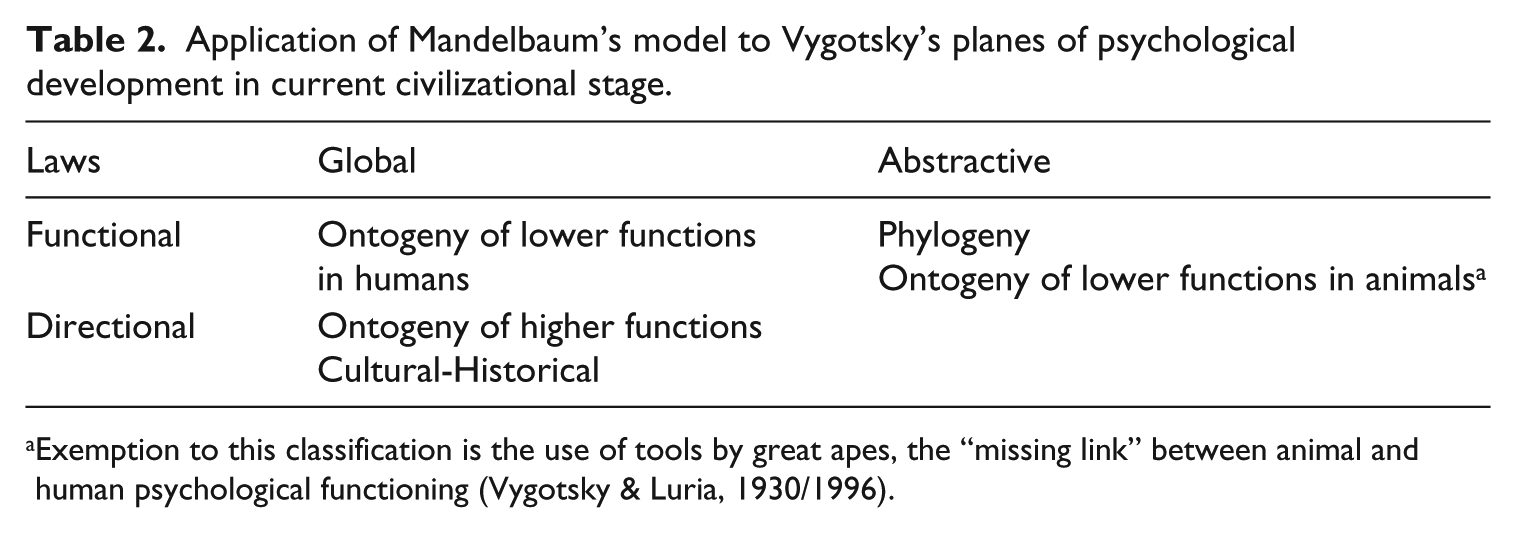
Exemption to this classification is the use of tools by great apes, the “missing link” between animal and human psychological functioning (Vygotsky & Luria, 1930/1996).
The phylogenetic line of development is ruled by abstractive functional laws. Once in this level, we cannot properly speak of historical transformations, only biological ones. All changes are derived from the natural contingencies and ahistorical changes (although, in a Vygotskyan perspective, this situation changes once the historical level is introduced in the species’ history, with the appearance of homo sapiens—the reflex of these changes can be noticed in ontogeny—see below).
Historical-Cultural changes in psychological processes and functions are ruled by directional global laws. Based on the previous considerations about Vygotsky’s understandings of general history, this approximation seems almost direct. This is reinforced by Mandelbaum’s identification of Marxist approaches as holistic ones. It is relevant to stress our concern with the denial of recapitulationism of any kind in here, the determinism that marks the flow of history does not imply a repetition of the same steps on the individual level.
Ontogeny, in its turn, should be considered as a special case. Once it takes place in the intersection of the two preceding lines, some transformations occurring in the ontogeny of the human psyche are governed by different types of laws:
Lower-functions are ruled by global functional laws. Since these functions are a product of phylogenetic development, they keep their functional aspect. However, these functions are transformed during ontogeny by their systemic relation to the higher-functions. 11
Higher-functions are ruled by the same kind of laws ruling historical-cultural changes (directional global laws), once they are, by their very nature, cultural functions dependent on semiotic mediation through culturally created sign systems. The changes in this kind of function are guided, modulated, and constrained by the tools developed in the history of the culture in which they are made available, converging in the direction of culturally constructed forms in a macrosocial scale, although great individual variance could appear in each singular case.
But this is just one step in the application of Mandelbaum’s model to the Vygotskian approach. We could also speculate what a Vygotskian view of psychological functioning and change would look like in a post-socialist society after the inevitable victory (in Plekhanov’s thought) of the revolutionary forces on a global scale.
We believe there would be a dramatic transformation of the frame presented above under these hypothetical new circumstances. As we can read in “The Materialist Alteration of Man” (1930/1994a), Vygotsky believed that the cultural development achieved through the social changes brought by the revolutionary process would lead to transformation in the very biological organization of humans: Having mastered the processes which determine his own nature, man, who is struggling with old age and disease, will undoubtedly rise to a higher level and transform the very biological organization of human beings. But this is the source of the greatest historical paradox of human development, that this biological transformation of the human type, which is mainly achieved through science, social education and the rationalization of the ways of life, does not represent a prerequisite but is instead a result of the liberation of man. (p. 336)
If we assume that these alterations represent the pinnacle of human history, beyond which no actual qualitative change would take place, then we would have reached the “end of history” and no more directional changes would take place, only functional changes, inserted in a global system of mutual and reciprocal determinations. In such a scenario, all the lines of psychological development would converge in a single line ruled by functional global laws.
On microgenesis in a Vygotskyan approach
Vygotsky has never used the term “microgenesis” in his works. Nevertheless, there is some dispute about the presence or not of this plane of temporal analysis in the conduct of his experiments. We will assume here the position advocated by Catán (1986), who argues against the assumption of microgenesis as a temporal scale of time in Vygotsky’s theory of psychological development.
Accordingly, we sustain that there is no claim in Vygotsky’s work about any special nature of microdevelopmental 12 phenomena per se, only the use of microgenetic methodology following Werner’s and Sander’s steps, i.e., the microgenetic method is used in the sense of the aktualgenesis method introduced by the Second Leipizig School—Geinzheitpsychologie tradition (Valsiner & Van der Veer, 2000). As Catán (1986) points out, even if we consider that aktualgenesis and microgenetic methodology could not be understood as perfect synonyms, it is only in later developments of Werner’s works (after Vygotsky’s death) that the differentiation is made clear.
In this sense we could think about at least two different possible interpretations of the real meaning of the microgenetic analysis found in Vygotsky’s writings: (a) when we try to approximate it to a timescale it is confounded with ontogeny itself (i.e., the total sum of discrete and “infinitesimally small” microgenetical transformations is ontogenesis) or (b) when we look to it as a methodological tool, it shows itself as a way to observe developmental processes while they “actually” occur (i.e., in the sense of aktualgenesis) it includes the confluence of phenomena of diverse timescales in ontogenetical concrete transformations (in this sense we can recall the Vygotskyan claim that ontogenesis is an intersection between phylogenetical and historical-cultural planes of development).
In both cases, Vygotsky does not consider microgenesis to be a different temporal plane of psychological development, so there is no parallel to be traced between the use of microgenetic investigation in Vygotsky’s work and Mandelbaum’s model. Yet, as this subject became very popular in post-Vygotskyan studies, it may be interesting to bring it to a more contemporary scenario, where the presence of Vygotsky’s ideas, among others, are at the basis of temporality in the context of the contemporary semiotic-cultural psychology.
On microgenesis in a contemporary approach—Some limits and potentialities of the previous discussion
In recent years, the role played by time and temporality in psychological theorization has received considerable attention from authors connected to the semiotic cultural approach (e.g., Simão, Guimarães, & Valsiner, 2015; Tateo & Valsiner, 2015; Valsiner, 2006).
Tateo and Valsiner (2015) present a metatheoretical perspective on time in psychological theorization. As the authors argue, dealing with “time” in psychology can be a tricky task, once the word is polysemic: If one assumes a metaphysical stance, then time can be understood as an irreversible flow of existence, something that exists outside living organisms, an external force that rules over everyone’s life. From a phenomenological point of view, instead, time is nothing but the epiphenomenon of our subjective experiencing of temporality, that is the agentic connection between sequences of experienced “nows” … In contrast a rationalist perspective would consider time as a representation of a causal chain … Finally, there are teleological or idealistic conceptions of time, that can take two different forms, the cyclical time … or the Hegelian conception of the dialectical—helical—development. (Tateo & Valsiner, 2015, p. 358)
The different conceptions or perspectives on the nature of time presented in the quotation above clearly have parallels with those mentioned throughout our work. More than this, Tateo and Valsiner are also concerned about how “psychology must be able to establish a relationship between the uniqueness of temporality experience and the need for generalizing knowledge about psychological processes in irreversible time” (2015, p. 362).
We believe our present work is part of this same effort, and in a sense present results that are complementary to those achieved in the work aforementioned. We, along with these authors (Tateo, 2015; Tateo & Valsiner, 2015) are developing metatheoretical tools to better understand how different time dimensions and conceptions intertwine in the study of psychological processes. While Tateo (2015) is explicitly more concerned with “temporality” understood as the experience of time in a phenomenological sense, we are here more focused on the historical dimension of time in a “rationalist” and “Hegelian” sense, when we are examining the work of an author to whom those aspects are fundamental.
Nevertheless, we believe that both perspectives could greatly benefit if we try to find ways to articulate them. What follows is a sketch of this attempt.
In a volume edited by Simão et al. (2015), Tateo (2015) introduces a theoretical model of time as the ecological context of development, inspired by the works of Bronfenbrenner and Doise. The model aims to represent how different layers of time create the context for the experience of temporality. In Tateo’s proposal, four temporal levels are identified (see Figure 1): (a) macro-time: the time of natural, historical, and phylogenetic phenomena; (b) eso-time: the social and consensual time; (c) meso-time: the intersubjective and communicable experience of time; and (d) micro-time: the individual and psychological experience of time.

In this image, the author illustrates a theoretical model of temporal niches of development derived from Bronfenbrenner’s proposal. When we compare Tateo’s model to Vygotsky’s ideas, we notice some marked differences, as the undifferentiation between phylogenetic and historical-cultural time, both encompassed in the “macro-time” (adapted from Tateo, 2015).
Believing in this model’s usefulness, seeing that it has already been used to analyze some phenomena related to the subject (Abbey, 2015; Marsico, 2015), and even understanding that it undertakes a task different from the one we have dealt with up to this point, we also believe that our results may be useful to further develop such a proposal and, inversely, that some considerations from Tateo’s model can be useful to expand some of our results. Aiming at this dialogue, in what follows, we will try to explain how our previous discussion can reverberate on Tateo’s model, bringing up new aspects for the issue here in focus.
An initial consideration, in this sense, concerns the indistinction of phylogenetic and historical-cultural temporal dimensions in Tateo’s model, condensed under the heading “macro-time.” According to our results, this condensation raises a relevant issue about the relationship between time and development. If we understand, according to our explanation, that the two temporal planes are governed by different types of laws, grouping them into a single level could impair the use of the model for understanding the processes of generalization of psychological knowledge, as is the author’s intention.
Additionally, the representation of the levels concentrically arranged, having the personal experience at the center, suggests, even if implicitly, a pattern of interaction in which direct interactions between levels could only occur between adjacent levels, so that the more distant levels could only exert influence over the others in a mediated fashion (see Figure 2): the subjective experience of microtime is shaped and shapes in return the intersubjective sharing and synchronization of psychological experience, to the extent that semiotizing the experience of temporality to make it communicable for instance constructs a new experience of temporality for the both the “I” and the “other.” In this sense mesotime co-constitutes the context of temporality experience. Furthermore, the societal esotime sets the frame for experiencing the intersubjective experience of temporality, providing constraints and affordances for the development of the psychological experience. (Tateo, 2015, p. 478)
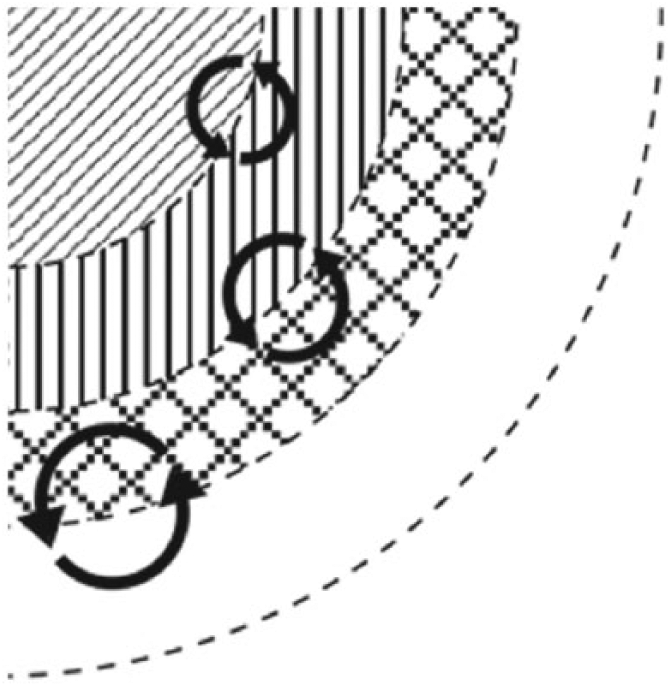
A “zoom-in” in Tateo’s model showing the interactions between the different levels. Even if this is not explicit in Tateo’s model (neither in Abbey’s, 2015, and Marsico’s, 2015, use of it), it seems to assume that each level interacts only with the immediately adjacent levels. The interactions between more distant levels would be mediated by level-to-level interactions (adapted from Tateo, 2015).
On the one hand, according to Vygotsky’s assumption, the line of ontogenetic development would be understood as an “intersection” of the historical-cultural and phylogenetic lines, under the meta-psychological frame we discussed here. But it does not focus on how, from a phenomenological standpoint, the subject lives and constructs its own sense of temporality and historicity.
On the other hand, Tateo’s assumption can briefly be characterized under a phenomenological approach to temporality, and as a mereotopological perspective (see also Marsico, 2015), where the notions of edge and frontier play an important role in the mediational articulation across the layers.
In such a way, the issue of how the mediational process happens in psychological-historical development seems to regain its footing.
Conclusions
We believe the work of analysis performed above may contribute to supply tools that help to develop perspectives that incorporate temporality, on different levels, to the study of human development, such as those presented by Tateo (2015) and Tateo and Valsiner (2015), and also to evaluate the implications of the introduction of new historical “planes” in alternative interpretations of Vygotsky’s contributions (e.g., Scribner, 1986).
Tateo’s (2015) and Tateo and Valsiner’s (2015) analyses can provide us with enriching insights into the model we have developed until now in two ways:
First, by the complexification of the ontogenetic line of development, once we can identify different aspects in which it can be decomposed: micro, meso, and eso elements of time. This shows that we might review our model in future works by aggregating the investigation of the potential application of different types of laws to each new “modality” of ontogeny. Although we will not follow this trend in the current paper, we think this should be at least highlighted as a potential development.
Second, the distinction between “the immediate synthetic experience of temporality and the intersubjective analytic experience of ordinary time” (Tateo & Valsiner, 2015, p. 359) can help us to better understand the role played by the previously discussed concepts of perezhivanie and microgenesis (taken as an independent timescale) in Vygotskyan theorization on timescales and lines of development. The following paragraphs will be dedicated to this issue.
Due to its phenomenological and singular character, perezhivanie cannot be described as a law-like process, hence it has no place in the tables and schematizations presented above. Nevertheless, it can’t be discarded or cast aside once it assumes important roles in Vygotsky’s theory as pointed above. The important task here is to show how the law-like processes and singular events can be integrated with theoretical explanation in Vygotskian writings.
This issue is an old dilemma in scientific psychology that can be traced back at least to 1894 (philosophically speaking it is much older), in Windelband’s (1894/1998) speech on the occasion of the assumption of the Rectorship of Kaiser-Wilhelm University of Strassburg, when he introduced the neologisms “nomothetic” and “idiographic.” According to the author both kinds of investigations focus on distinct aspects of the same objective reality, so they can’t be contradictory, and must be complementary. In the following analogy he presents an intuitive and fruitful way to understand the complementarity of nomothetic and idiographic knowledge: viewed causally, each case takes the form of a syllogism whose major premise is a natural law or, as the case may be, a number of lawful necessities, whose minor premise is a temporally given condition or set of such conditions and whose conclusion is then the actual particular event. But just as, logically, the conclusion requires those two premises, so also does the event require two kinds of causes: on one side the timeless necessity, in which the eternal essence of things is expressed; and on the other side the particular conditions which surface at a particular moment in time. The cause of an explosion is, according to one meaning—the nomothetic—in the nature of the explosive material, which we express as chemico-physical laws; according to the other meaning—the idiographic—it is a spark, a disturbance, or something of the sort. Only the two together cause and explain the event, but neither of the two is the consequence of the other; they are not in and of themselves bound to one another. Just as, in syllogistic subsumption, the inserted minor premise is not a consequence of the major premise. (Windelband, 1894/1998, p. 20)
In our case, we would add to the syllogism analogy the following: “major premise is a natural law or, as the case may be, a number of lawful necessities” of any combination of the different kinds pointed out in Table 2 (usually more than one combined); “minor premise is a temporally given condition or set of such conditions” of which the perezhivanie processes and/or contents are the analysis unity in Vygotsky’s approach.
At least since the mid-1990s, it is common among psychologists (Berry, Poortinga, Segall, & Dasen, 1992; Cole, 1996; Toomela, 2003) 13 to think that any form of cultural hierarchy intended as absolute is an idea that: (a) is not consistent with the facts found in empirical research and (b) is not a necessary requirement of the classical psychological theories. Sharing this opinion, Scribner (1986), for example, is driven to postulate another historical level not initially foreseen by Vygotsky, the level of individual societies.
We believe that the insertion of this new level of historicity will not substantially transform the approaches proposed throughout this article. Even if we consider the existence of a plurality of cultural lines of development (commensurable or not), each one of them would still act as a guideline for the transformations happening on the ontogenetic level. It would, however, be necessary to relativize the observations concerning the role of general history in post-Vygotskyan theorizations that adopt this level.
That is one more reason that an analysis of the sort performed by Mandelbaum is important: we maintain the idea of a global directional law without compromising general history, what allows us to maintain the “theoretical structure” even when denying an accessory hypothesis represented by the belief of a general-civilizational history. This being the case, we would only have to discard the idea of a general history, in the Hegelian-Marxist sense, present in Vygotsky’s oeuvre. This would give way to the consideration of many coexisting sets of global directional laws, each one corresponding to one of the existing cultural lines (theoretically speaking), or the “individual societies” (more concretely speaking).
Even if we admit the reality of the contemporary phenomenon of globalization, that signals a convergence and possible “fusion” of cultures (Moghaddam, 2006) with similar effects to those proposed in a model of general history, such convergence would not be necessarily credited to the inexorable march of the general history of civilization towards its highest point. It could be explained by a historical contingency of uncertain duration.
In other words, although we can find in Vygotsky a strong teleological tendency, due to his allegiance with a deterministic interpretation of Marx’s works, one who does not share this credo can easily discard it without losing theoretical consistency. “Mechanically,” everything continues to operate in the same way, following the same kind of laws. This sounds like a relevant achievement once representative authors from cultural psychology stress the importance of abandoning the teleologic and teleonomic aspects of Vygotsky’s works in favor of a teleogenetic interpretation, for example, Valsiner (1997): The human capacity for practice of generating goals and acting toward attainment of such self-constructed goal. This perspective contrasts with the teleonomic (goal-seeking) view of action, as well as with the rich behavioristic traditions in psychology that have attempted to eliminate the notion of future-oriented purposeful behavior from the realm of scientifically studied phenomena. (p. 212)
And Simão (2010), following him: In Valsiner’s conception, intersubjectivity’s meta-processual character is not teleonomic, i.e., it is not directed for the achievement of consensus by itself, instead it is teleogenetic, i.e., the consensus is a medium to the generation of new goals in the I–other relationships. (p. 93)
In sum, our discussion showed that a departure from a Vygotskian perspective can still bring innovative insights to the issue of the relationship between time and development. It allowed us to treat microgenesis as an independent time frame, maybe one to which different kinds of laws should be applied (if compared to ontogenesis). We hope that future works on historicity and temporality of psychological phenomena deal with this. As well, we hope that this kind of discussion could be fruitful to the metapsychological and epistemological grounding of semiotic-cultural psychology.
Footnotes
Declaration of conflicting interests
The author(s) declared no potential conflicts of interest with respect to the research, authorship, and/or publication of this article.
Funding
The author(s) received no financial support for the research, authorship, and/or publication of this article.
