



Abstract
Information and communication technologies can provide an important contribution to revitalizing trade unions, since the internet is faster, cheaper and more far-reaching than traditional communication methods. We propose a typology for analysing trade union websites, and apply this by comparing two national cases. The empirical research is limited to the websites of Portuguese and British civil service trade unions. We find that British unions take more advantage of the internet than those in Portugal; not only do they enable interactivity but above all promote the website as a space for sociability. We believe this typology opens up enhanced capacity to monitor, diachronically and synchronically, the relationship between trade unions and the internet.
Introduction
The ways in which trade unions utilize information and communication technologies (ICTs), and in particular their use of the internet, has been widely discussed in the past two decades. However, this discussion has been largely restricted to anglophone countries (Lee, 1997; Shostak, 1999) and has rarely been based on systematic empirical research. Countries like Portugal have not only remained outside the focus of this debate, but their trade unions have in general been the subject of very few studies. As far as we are aware, there are no published studies of the communication structures or strategies of Portuguese trade unions, despite the recognized importance of communication (Correia et al., 2012; Rosa, 2005) and recent interest in its impact (Rebelo and Brites, 2012).
The primary objective of our research was to provide a tool that allows us to monitor unions’ internet usage. A literature review revealed that instruments are available but with some heuristic limitations. A second objective was to test the typology by analysing the websites of unions in two countries. As an exploratory study, our approach was limited to one sector: we selected the websites of unions representing civil service employees, excluding both public agencies and local authorities, in Portugal and the UK. We isolated the sector of activity variable to bring out more easily any differences between national patterns.
As expected, the lack of reliable data on the number of active trade unions in Portugal was the first obstacle facing the study. Although the Ministério do Trabalho has a register, as required by law, this information is not updated. This means, for instance, that when working with official data we may be considering unions that no longer exist. To avoid this problem, we sourced our data from a recent PhD dissertation (Alves, 2009) that presents a more accurate catalogue of trade unions existing in the mid-2009 since the author consulted Ministry sources from 1975 until mid-2009. In contrast, the UK has a public register of active trade unions on the Certification Officer website. Therefore, we collected data from two different years: the Portuguese list of trade unions is from 2009, while the more recent list of British trade unions is for 2012.
Although this use of different years raises some data limitations, we had the opportunity to make an initial comparison between a country whose industrial relations have long been studied, and a peripheral country like Portugal, usually overlooked in comparative studies. These countries belong not only to different patterns of industrial relations but also return differing performances as regards the level of internet access. The level of household access in 2011 was 58 percent for Portugal and 83 percent for the UK (Eurostat, 2012). We should however note that since at least 2002, Portugal has almost quadrupled its rate of access while the UK has not even doubled, which would seem to indicate that Portugal is catching up. When considering e-government usage by individuals, which may serve as an indicator of the depth of internet adoption by each government, Portugal (23%) again comes well below the UK average (40%) (Eurostat, 2012).
We begin with a brief review of the literature on the decline in trade union membership; and the role of ICTs, and notably the internet, in efforts at revitalization by fostering more and different forms of worker participation. We then assess previous proposals with regard to websites and their limitations before presenting our typology. After explaining how we conceive the three dimensions of our typology and its categories, we then operationalize it through the analysis of 160 websites. We conclude by discussing the main findings.
The contribution of ICT to trade union revitalization
For the past three decades, trade unions have experienced difficult times almost everywhere, but particularly in the industrialized countries (Ebbinghaus and Visser, 2001), in most of which there has been a serious decline in union density. This has been attributed to a set of factors that are both external and internal to trade unions, and while some represent global tendencies, others derive from national specificities. Unions have developed a diversified set of strategies to reverse membership decline and loss of influence; internet usage is one of these.
Here it is relevant that some categories of worker, such as young people or those working in the ICT sectors, are often very weakly unionized but regularly use the internet as a space of expression, mobilization and even job-hunting. Some authors regard these virtual communities as signalling the erosion of commitment while others view them as a source of social capital needed for the revitalization of trade unions (Saundry et al., 2007). The literature focusing on the potential ICT contribution to union revitalization is, in general, optimistic (the only exceptions seems to be Chaison, 2002, and Troy, 2001), emphasizing that ICTs are faster, cheaper and more far-reaching than traditional means of trade union communication so they can overcome problems of time, space and distance. For instance, workers may employ home access to the internet for training purposes, allowing unions to reach workers with time limitations and other constraints, especially women who are often overburdened with domestic tasks (Greene and Kirton, 2003), and spread their standpoints freely without mediation or constraint (Ad Hoc Committee, 1999). The internet also has an important impact on internal communications within trade unions, promoting access to more information, offering new services to members such as e-learning, and stimulating debate even among less confident members. As seen in other social movements, the internet can also contribute not only to the recruitment, organization and mobilization of union members but also aid workers during industrial disputes (Ad Hoc Committee, 1999; Darlington, 2000; Diamond and Freeman, 2002; Greene et al., 2003; Lee, 1997; Shostak, 1999).
Creative use of the internet by unions might prove very important on occasions when employers take an aggressive attitude and it becomes difficult or impossible to organize workers in their workplaces. In these cases, solutions may involve launching virtual unions (Diamond and Freeman, 2002; Dølvik, 2002) which exist only on the internet and aim to unionize technology workers, precisely those who do not suffer from the ‘digital divide’. The internet can also help foster better contact with the mass media or other organizations nationally and internationally. In this sense, small trade unions may be particularly empowered by ICTs (Greene et al., 2003). Lee (1997, 2000) was a pioneer in his insistence that the internet is fundamental to strengthening international labour organizations and their cooperation processes, creating what Waterman (2001) calls a ‘new internationalism’. Some websites have been set up with this as an explicit goal.
However, we still lack the tools to monitor appropriately the relationship between trade unions and ICTs. Diamond and Freeman (2002: 591) took a very optimistic view, suggesting that in a decade trade unions in the UK and USA would be ‘potentially morphing into a new “e-union” organizational form that will differ as much from current union organization as industrial unions differed from their craft union predecessors’. Ten years after this claim, it is possible to assess whether or not the predictions of these authors have been realized. For this purpose, it is necessary to develop instruments to enable the systematic collection and analysis of information about trade union use of ICTs. Our aim is to make a contribution to this goal.
Previous proposals
We noted above that although the anglophone literature has focused on trade union recourse to the internet, few authors have presented systematic empirical data. However, Ward and Lusoli (2002) have presented a typology which they used for content analysis of British union websites. It comprises four main categories: information provision, which includes the reference to updating; participation and interactivity, from email provision to online recruitment; networking, especially important being links to other websites; and services provision, involving commercial and other services provided by unions. In our opinion, there are some limitations to this typology for content analysis of trade union websites. First of all, it involves duplication. For example, both ‘information’ and ‘services’ may relate to the same type of benefit offered by trade unions. Moreover, the classification scheme seems to underestimate the democratic potential of internet participation; though interactivity is mentioned, it receives little attention. The possibility of two-way communication, thereby gaining prompt feedback, is one of the distinctive attributes of the internet. Finally, it neglects formal aspects like multimedia supports, which are one of the most attractive features of this channel for communication.
This typology was later adapted by Freeman (2005) in his comparison of UK and US trade unions. He proposed a simplified, three-category schema: information, participation and benefits. The main difference from Ward and Lusoli is the elimination of networking as a category. We believe that the same problems apply: the categories are still neither exhaustive nor mutually exclusive. Other proposals have been made for website analysis. Lowery and Beadles (2006), for instance, draw on a study by Hassan and Li (2005) to argue that it is inadequate to focus only on the subject content of union websites; what is also important is ‘usability’. In order for unions to draw full advantage from the internet, websites must be easy to use and provide useful contents. They apply a seven-point benchmarking schema comprising screen appearance, media use, interactivity, accessibility, navigation, consistency and content usefulness, and applied this to four American trade unions in different sectors. However, they neither question what is meant by ease of use is in terms of the user profile, nor do they discuss what useful content may actually represent in each case, nor do they encounter regularity among those seven variables, with each then subdivided again into several categories. In addition, some features are quickly rendered outdated because of the rapid evolution of computers; for example, they mention download delay, which has been a non-problem since the advent of broadband. Furthermore, others categories are simply too subjective, such as the ‘non-excessive use of colour for text’.
A new typology of union websites
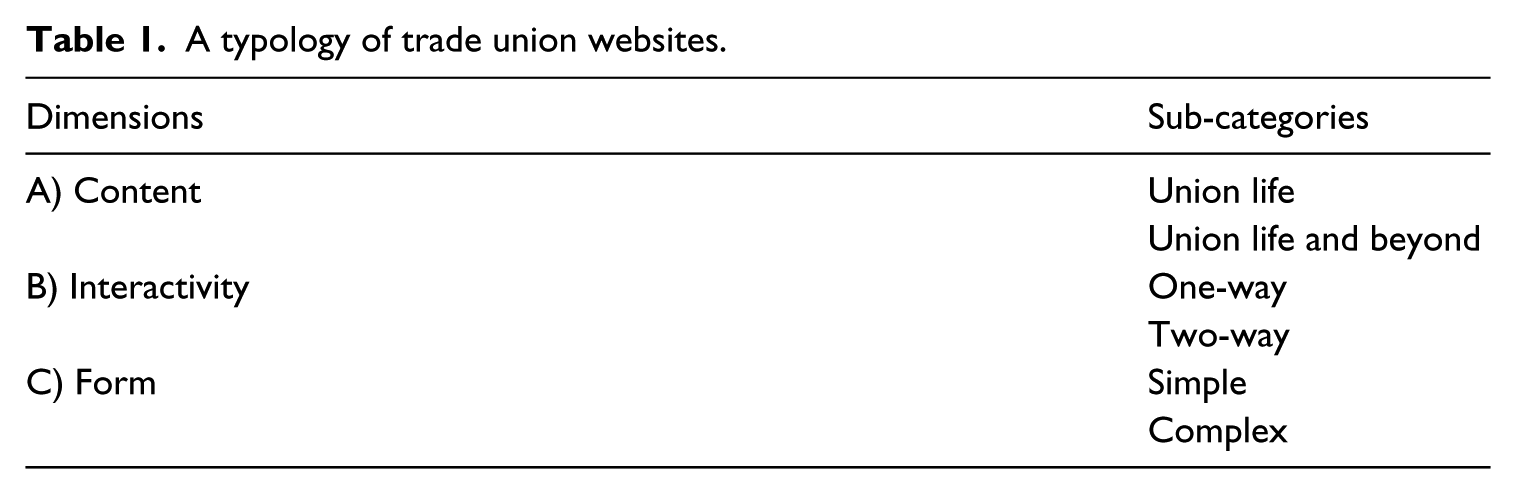
After making a preliminary analysis of trade union websites to establish the framework for our model, we offer a three-part typology. In addition to incorporating two dimensions already identified in previous proposals, information (content) and interactivity, we feel the need to include form as a third dimension. This groups innovative aspects, related to our consumer society, especially concerning image and sound that have thus far been overlooked in the literature. The three dimensions are summarized in Table 1. Each has dichotomous and mutually exclusive sub-categories.
A typology of trade union websites.
Content
Although the content observed in websites is diverse, the information available does not always correspond to what is announced. A website may present a menu featuring a board composition yet the link does not work, for instance. One must be aware of such system failures. In the same sense, one must take into account how websites change, even if some are apparently not updated for a long time. This may also explain some of the incoherence when readers do come to consult them.
Some websites are restricted to providing a limited amount of basic information concerning the union, as a kind of showcase. This is true of the Portuguese Sindicato Nacional dos Engenheiros (National Union of Engineers, http://www.sne.pt/site/index.php), apart from the function of downloading professional software; or the British Association of Principal Fire Officers (http://www.apfo.org.uk), since both are centred on presenting the union and its members.
Other websites contain more information, referring to services provided by the union, its current officers, announcements of meetings, press releases, information on union history, collective bargaining agreements, notification of strikes, or affiliations. In all these cases, we have information focused on union life. This is the first sub-category of the first element of our typology, the content dimension.
However, other union websites do not focus exclusively on union matters. Other subjects are also included, such as a selection of daily news, job announcements or useful links. This may be a sign that the website is used as a source of information beyond the union’s own activity and therefore plays a broader sociability role. We assume that members and other users who turn to the union website to find information beyond the scope of its own actions, will correspondingly be more exposed to union socialization. This is the case of the Sindicato dos Enfermeiros Portugueses (Portuguese Nurses’ Union, http://www.sep.org.pt), which has a press centre which collects daily health news, among other issues. We can also find examples among British unions, such as the Fire Brigades Union, which also contains media links (http://www.fbu.org.uk). Such websites represent a second sub-category, proving information on union life and beyond.
Interactivity
A second dimension concerns the interactivity potential of the internet. The functionality of some options, like forums or chats, could not be verified where these were exclusive member services to which we did not have access. Therefore, these data may be underestimated. In this dimension, a first sub-category corresponds to a unilateral, top-down website: the one-way category. Communication is one-sided: thus the website may only provide a postal or email address to be used for possible contact. Users are no more than passive receivers. The one-way website may include forms to be downloaded; for example, many unions provide a facility for membership applications, usually by downloading a form to be completed and sent to the union by post. This is the case of the Associação Nacional de Bombeiros Profissionais (National Association of Professional Fire Fighters, http://www.anbp.pt) whose website includes a form to print.
On the other hand, there exist two-way websites which offer the possibility of interactive communication, as in a discussion forum. Another type of two-way interactivity provides the feasibility of posting in blogs or updating personal data through the website. This possibility is available on the websites of SINAPOL (the Portuguese National Police Union, http://www.sinapol.net) and the British Dietetic Association (http://www.bda.uk.com), since both provide a link to their respective Facebook pages.
Form
The third dimension of our typology is form, which may be either simple or complex. In the first sub-category, websites do not make use of multimedia effects or special solutions for disabled people. Websites may have sound, but only for decorative purposes. There may also be some movement, but very inexpressive, for example the use of moving text on the webpage header. This is noticeable in the cases of SERS (an independent Portuguese Engineers Union, http://www.sers.pt) and the Independent Federation of Nursing in Scotland (http://ifonscotland.org).
In the second sub-category, the websites contain user-friendly aspects. These include videos, audio interviews and other innovative solutions like Feeds, RSS, Facebook pages or Skype contacts. FENPROF (the Madeira Teachers’ Union, http://www.spm-ram.org) and Unison in Britain (http://www.unison.org.uk), with the latter extending to a link to its television channel, are examples of the complex form.
Methodology
We chose one specific sector to make an exploratory test of our typology. This is the first study to take an entire sector as a sample, which increases the interest and relevance of the new data. Confining the trade unions to one sector facilitates testing the typology and the comparison of data between countries with major social and political differences (Pulignano, 2009). We chose the civil and public services, which comprise state departments and agencies where individuals work under an employment relationship ruled by public law, for several reasons. First of all, we assumed that in both countries the internet is more frequently used in these services. Second, public services have been hit by recent neoliberal policies in both countries, even if this restructuring began earlier in the UK during the Thatcher period, and became more evident in Portugal since the beginning of the present century. Moreover, in terms of employment, there is now considerable pressure to move towards a ‘leaner state’ (Hall, 2010; Lima, 2010).
There are different reasons underlying our choice of the two countries, in particular the fact that they belong to different industrial relations patterns (Crouch, 1996; Visser, 2006). In contrast to the UK, Portugal belongs to a southern European pattern of industrial relations where we may stress organizational fragmentation, low union density, centralized collective bargaining and high collective bargaining coverage, at least until very recently. (Following the demands of the Troika, extension procedures have now been suspended and bargaining coverage has fallen sharply; Campos Lima, 2013.) We therefore compared the websites of all Portuguese and British trade unions in the sector in accordance with our typology. We aimed to see whether or not these differences were also reflected through usage of the internet. The empirical exercise is based on the analysis of 96 Portuguese and 64 British union websites.
Findings and discussion
To ascertain whether the countries and websites are distinctive in terms of the dimensions specified, we drew a chi-square test of association. The findings indicate that the Portuguese and British trade union websites are different in terms of the content dimension. For Portuguese union websites, content is predominantly (72%) connected to the life of the union, while 59 percent of British union sites focus their content on union life and beyond. As this difference is statistically significant [χ2 (1) = 15.55, p = 0.001], there is an association between the country and the content dimension.
We should also take into account the composition of these sub-samples by national affiliation, since this may correspond to different strategies. For the Portuguese list, we observe that websites with the content dimension centred on union life and beyond are much more numerous in the case of unions affiliated to the largest confederation, Confederação Geral dos Trabalhadores Portugueses, CGTP (18 of the 27 sites in this sub-category). The sub-category union life does not display such an important difference between the two main confederations (CGTP 11; União Geral de Trabalhadores 16) but is dominated by unions not affiliated to either (42 sites). On the British side, TUC affiliates unions and non-TUC unions have equal numbers (19 each) with a focus on union life and beyond; but the majority of websites focused only on union life belong to non-TUC unions (19, as against seven TUC affiliates). In sum, we find a more important difference between the different affiliations in the Portuguese case, which seems consistent with the ideological fragmentation of the main confederations.
Differences are also found between the Portuguese and British union websites on the interactivity dimension. Portuguese union websites are primarily unidirectional (62%), while the proportion is lower for British trade unions (47%). This means that the websites of most Portuguese unions privilege information for members and other users rather than establishing a two-way communication process; while the websites of British unions are more likely to allow users to give feedback. Nevertheless, this association is not statistically significant [χ2(1) = 3.31, p = 0.076].
Finally, the countries differ in terms of the form dimension of the websites. The majority (56%) of Portuguese union websites have a complex form, but only 42 percent of British union websites. Despite the difference in this dimension, we find that there is no statistically significant association between the form of union websites and country. In other words, websites in the present sample are not simpler or more complex depending on the country [χ2 (1) = 3.04, p = 0.106]. Again, we cannot generalize data concerning this dimension with sufficient statistical reliability.
Figure 1 presents the analysis of trade union websites in the two countries according to our typology. We find that British trade unions seem to take more advantage of the internet as a special means of communication than do their Portuguese counterparts, although the difference are not statistically significantly. Indeed, about a third of British websites analysed (33%) are simultaneously complex in form, have two-way interactivity and provide content on union life and beyond, while a mere 5 percent of Portuguese websites combine these three categories. Looking at the reverse end of the spectrum, findings show a smaller difference between the countries: slightly more British trade unions than Portuguese have websites that are simple, unidirectional and only focused on union life (27 as against 21%). The earlier and more extensive penetration of the internet in the UK may be one of the factors explaining these findings. However, further research is needed, especially of an in-depth approach, to understand the phenomena behind the numbers.

Distributions of Portuguese and British trade union websites (%).
Concluding remarks
The anglophone countries in particular have seen a lively debate in recent decades on trade unions’ use of ICTs, and notably of the internet. In this debate, authors have mainly taken optimistic positions. Nevertheless, this debate is geographically limited and lacks systematic empirical analysis. The analytical instruments provided are scarce, and, from our perspective, have limitations. As a result, trade union usage of the internet has not been adequately monitored. The main objective of this research note was to provide a tool for the analysis of trade union websites. This provides a general overview of coverage and usage of the websites, and we are henceforth able to develop a qualitative approach and analyse forum content, for instance, one of the most important signs of effective bidirectional communication.
Websites combining all the more developed categories – union life and beyond content, two-way interactivity and complex form – result in a more ‘modern’ use of the internet, while those only using the basic categories present a profile of internet underutilization. Our findings have shown that many unions in both countries do not seem to invest clearly in the potential of ICTs. Nevertheless, as expected, as Portugal displays a development gap when compared with the UK: Portuguese trade unions benefit even less than their British counterparts from the potential offered by ICTs. The major confederations, CGTP-IN and TUC, seem more aware of the advantages of websites, but our sub-samples are too small to confirm this perception statistically.
We underline that the proposed typology provides a set of indicators, but is not enough to allow firm conclusions on the effective usage of the internet. More research is needed in order to identify the effectiveness of website usage and to understand why unions are not investing more in the internet, in addition to identifying who is leading and who is being left behind.
Footnotes
Acknowledgements
The selection of British trade unions was made with the help of Lewis Emery, researcher at the Labour Research Department. The authors thank him for his generous collaboration.
Funding
This research received no specific grant from any funding agency in the public, commercial or not-for-profit sectors.