



Abstract
This article analyses challenges in organising Polish workers by Unison (UK) and Unia (Switzerland). Using case studies of projects delivered by those unions with the aim to enhancing inclusion of Polish workers, the article argues that the internal union dynamics, such as union identity and structures are instrumental for a sustainable organisation of migrant members. Furthermore, the example of Unia demonstrates that an important factor for successful organising of Polish workers was the recognition of their collective agency and their contribution to union revitalisation. Finally, the research demonstrates that previous membership in Polish trade unions was not a significant factor influencing their involvement in British and Swiss workers’ movements.
Keywords
Introduction
The article analyses the challenges that the biggest trade unions in the UK (Unison) and in Switzerland (Unia) have met in organising Polish workers. The unions were chosen because they are at the forefront of advocating for the rights of migrant and ethnic minority workers in their respective countries. They were the first unions which allowed self-organisation of those workers and, importantly, their predecessors were in the vanguard of unions that created dedicated groups for specific groups and minorities, for example on gender identity (Colgan and Ledwith, 2000). Furthermore, these unions developed similar projects (Unison: Migrant Workers Participation Project, 2008–2010 and Unia: CEE project, 2012–2014), which implemented in practice their policies to integrate and recruit Polish and other Central Eastern European (CEE) workers. The research examines the factors responsible for different outcomes of these projects.
Trade union approaches to migrant workers are best understood by combining comparative migration studies applied to labour (Marino et al., 2017; Penninx and Roosblad’s, 2000) with studies of trade union revitalisation strategies (Frege and Kelly, 2003), in order to consider both the specificities of challenges stemming from migration for organised labour, and the broader context of trade unions as organisations under pressure to revitalise.
In particular, this study shows that the internal dynamics of unions, such as union identity and structures (Hyman, 2001; Frege and Kelly, 2003), were instrumental for successful organisation of Polish workers. Unlike Unison, Unia had structures in place that supported the inclusion of Polish members and deployed resources to continue its organising efforts past the end of the project. Furthermore, Unia recognised the agency of Polish workers and their contribution to the union’s revitalisation. Unia was also able to better accommodate the expectations of Polish workers and as such the ‘goal displacement’ (Zald and Ash, 1966) between their expectations and the union’s formal structures was lower than in Unison. Importantly, Unia used the social dumping discourse to organise workers and reduce the risks of stigmatisation that have occurred more in Britain (Ince et al., 2015). In relation to unions’ renewal, following mobilisation-theory inspired insights (Frege and Kelly, 2004) the paper argues that the motivation of Polish members to become involved in British and Swiss workers’ movements was predominantly influenced by the need for social justice as well as employment protection.
The research contributes to the literature on organisation and inclusion of migrants by Western European trade unions after the 2004 EU enlargement (Connolly et al., 2014; Holgate, 2005; Lucio and Perrett, 2009; Marino, 2012; Marino et al., 2017; Penninx and Roosblad, 2000; Wrench, 2004). The specific case of Polish and CEE workers has received distinct attention (Fitzgerald and Hardy, 2010; Meardi, 2007, 2012), as well as the active role of migrants in labour movements revitalisation (Gumbrell–McCormick and Hyman, 2013; Jiang and Korczynski, 2016; Milkman, 2006). The literature on the case of Central Eastern European workers in western Europe has so far been mostly from the perspective of trade unions (Frangi et al., 2021; Fitzgerald and Hardy, 2010; James and Karmowska 2010; Lillie et al., 2020) rather than from that of migrants’ agency (for an exception: Alberti, 2014).
This article starts instead from the experiences of Polish workers within trade unions, which is particularly neglected in the literature on continental European. Notably, in the Swiss context, academic research on Polish migrants’ participation in trade unions is scant, given their relatively recent arrival. The focus on migrants’ perspectives help advancing the understanding of the reasons for success of failures of unions’ organising methods.
The article begins with an analysis of historical context for industrial relations in the UK and Switzerland, moving on to a comparison of trade union strategies and challenges in organising Polish workers. This is followed by an analysis of members’ experiences in trade unions and the displacement goal between workers and union structures. The conclusion focuses on the role of unions’ identities, structures and framing processes as instrumental in accommodating migrants’ agency, which in turn is essential for successful organising efforts.
Unions and CEE workers
Migrant workers have always represented a challenge for trade unions Castles and Kosack (1973). Penninx and Roosblad (2000) and later with Marino (Marino et al., 2017) divided those challenges into three sets of dilemmas: resistance versus support of migration policies, inclusion versus exclusion of migrants within trade unions and special versus equal to local members’ treatment within their structures. They also argue that there are four sets of factors, which influence differences in union response to migration, that is : power and structure of trade unions, economic and labour market situation, factors connected with the society and with characteristics of migrants.
Alberti et al. (2013) present two approaches in their overview of British trade unions’ efforts to organise migrants. Drawing on the intersectionality theory (Crenshaw, 1993), authors depict these efforts as based on universalistic and particularistic methods where the former is ‘based on a supposedly homogeneous worker identity, while the latter targets migrant workers as members of specific ethnic communities, or as migrants with specific social and workplace needs’ (Alberti et al., 2013: 4140).
Since the UK was one of the first countries which opened its labour market to CEE citizens, British trade unions have considerable experience of dealing with this migrant group. Fitzgerald and Hardy (2010) distinguished two sets of union approaches to CEE workers. The first set focuses on recruitment and organising methods; the second one relies on the development of local, national and international connections. The organising approach, in their view, quickly run into structural challenges as many potential members were employed in non-unionised, fragmented workplaces.
Connolly et al. (2014) argue that many trade union activities related to organising migrant workers depended on strong and committed branches, dedicated union officers or external funding. Tapia (2014) adds that migrant workers’ projects were undertaken by a small number of union officers, separating migrant worker issues from broader union strategies. Similarly, James and Karnowska (2010) state that these projects were not embedded within union structures and were not adequately funded. Ciupijus et al. (2020) argue that acknowledgement of diasporic particularities of Polish migrants not only supported organising activities but shaped the migrant worker organisation from within. Similarly, Frangi et al. (2021) in relation to migrant workers (predominantly Romanian and Egyptian) in the Milan construction sector recommend that unions develop and apply special ethnic strategies to tackle labour market segregation and empower migrants.
Other Western European trade unions had similar experiences. For example, Dutch unions set up a dedicated unit of Polish organisers (Marino et al., 2017), German agricultural and construction union IG BAU formed an association for mobile workers (Greer et al., 2013), and the Irish Congress Trade Unions initiated the Polish members network. These initiatives were short-lived and struggled to attract members.
The fragmentation of the labour market, especially in the case of posted workers, provided significant challenges for unions trying to organise these precarious migrants (Berntsen, 2016; Lillie et al., 2020; Wagner and Lillie, 2014). Lillie et al. (2020) compared the approaches of Dutch, German and Finnish unions to organise construction posted workers and concluded that unions largely failed to recruit and keep these members, despite committing significant resources to initiatives including migrant worker engagement (as distinct from organising), political and legal action, collective agreement extension and specific site-level structures.
Given the comparative focus of my research, I rely on broad definitions of organising and inclusion. Organising is an approach ‘to recruit new workers, empower union members and encourage worker self-organisation as well as a strategic opportunity for renewal and revitalisation in the context of declining union density and institutional power bases’ (Frege and Kelly, 2004; Gumbrell–McCormick and Hyman, 2013; as quoted in Connolly et al., 2017: 321). Inclusion is described as: ‘full recognition of such workers as union members, with equal social, employment, political and organisational rights and participation in both internal debates and the formation of general union strategies’ (Marino, 2012: 8).
Inclusion and organisation are seen in this paper from both union and migrant perspectives, which sheds light to possible differences between them, which are often overlooked by the literature. Goal displacement is a concept that helps examining and comparing the interests of Polish members and those of the unions. Goal displacement, according to Zald and Ash, appears when formalised mechanisms of organisational sustainability and self reproduction take priority over the original substantive goals of articulating the interest and representation of a particular group (in Alberti and Però, 2018: 697), as was the case of Latin American migrants involved in the organising campaigns of British trade unions (Unite and Unison). The concept derives from the ‘iron law of oligarchy’ developed by Robert Michels (1911), who argued that all organisations including trade unions, through bureaucratisation processes, will always move towards oligarchy, where the ‘leadership class’, rather than members, dominates.
Research methods
The research is based on a qualitative approach, combining interviews and participant observation alongside an analytic auto-ethnographic approach (Anderson, 2006). I was previously employed as policy officer and had direct involvement with projects focused on organising CEE migrants in both unions. I conducted my research from 2013 to 2018 as part of my doctoral degree after the projects finished, with firstly focussing on Unison and later Unia. The auto-ethnographic approach is characterised by analytic reflexivity, narrative visibility, dialogue with informants and, finally, commitment to theoretical analysis. I chose the case study method as this allows the retention of the holistic and meaningful characteristic of real-life events, including organisational processes (Yin, 2009).
As an inside researcher, I benefitted from easier access to information and enhanced trust from research participants. When interviewing Polish workers, I noticed they appeared very open with me, as a fellow Polish national. My positionality had its challenges, especially when I was talking to my previous union colleagues and asking them what they thought of projects in which I had been personally involved. Nevertheless, the lack of power or constraint from my side guaranteed a degree of honesty and openness. I kept a fieldwork diary to help me deepen my reflection on the process of research and analysis
Given that the information shared during the interviews could be confidential, I gave all informants the opportunity to review interview transcripts, which the majority of them did. Informants made only minor amendments related mainly to details of names and numbers.
I conducted 45 interviews with informants during 2014–2016 (see Figure 1) who represented a broad spectrum of trade unionists from the top level, such as general and deputy secretaries, to regional managers and organisers; all the way down to Polish activists and rank and file members. I conducted the interviews mostly in person (5 were online), in the native language of informants (Polish, English and German). I prioritised interviews with Polish members (24) to help me understand their perspectives of policy implementation. I also considered issues of intersectionality by paying attention in particular to gender composition and implications (Crenshaw, 1993; Danieli, 2006; Holgate et al., 2006). Type and position of informants within union structures.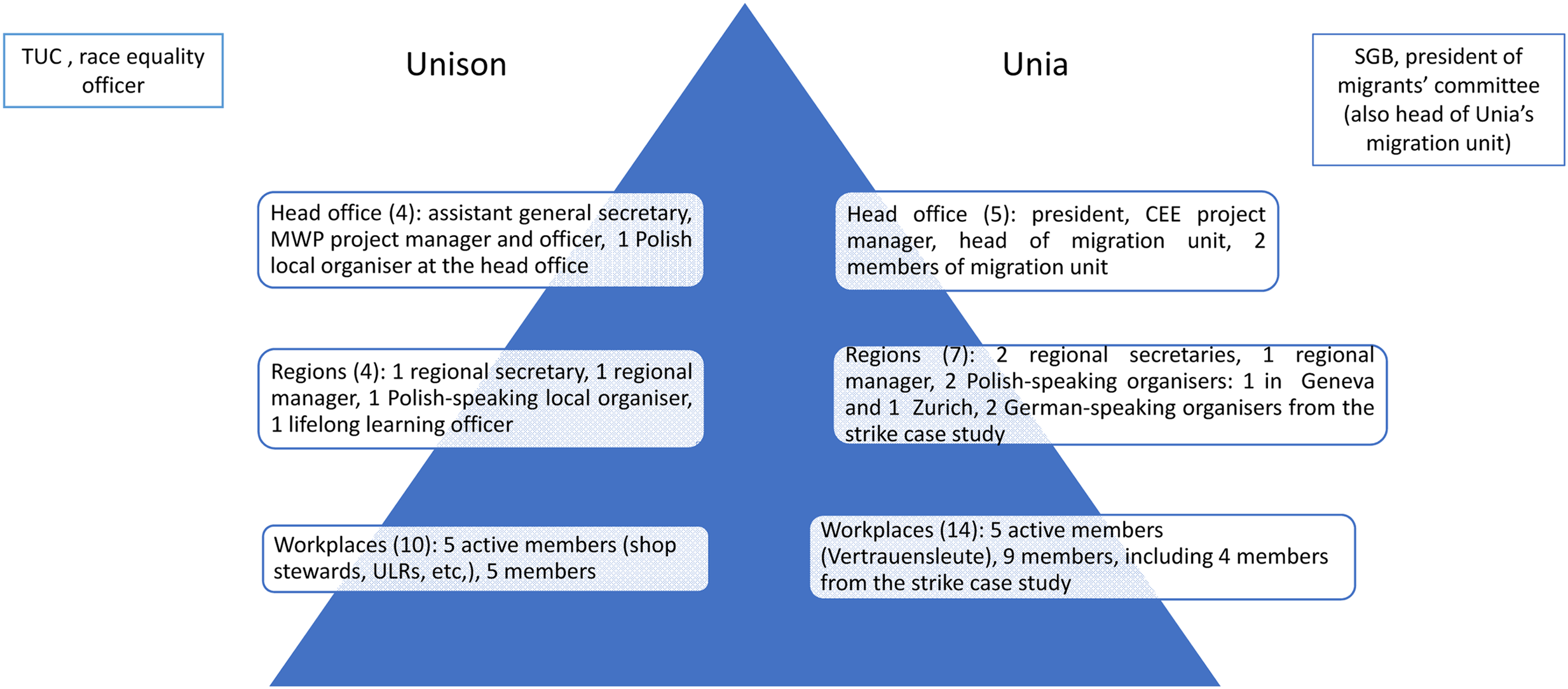
From the total number of 24 Polish members who were interviewed, 13 were women. In Unison, 5 out of 10 informants were women and 8 out of 14 Unia members were women. In terms of active members (i.e. union representatives), the breakdown was as follows: 2 women and 3 men in Unison and 2 men and 3 women in Unia. Looking at the distribution of informants by sector, in Unison 4 interviewees were care workers working for the local government sector, 4 worked for hospitals (both public and private sector), 1 worked for the community sector and 1 was in higher education working as a security officer. In Unia, 8 informants were care workers, 5 worked in the construction sector and 1 was a cycling courier. In terms of the age of Polish Unison and Unia members, 1 was between 20 and 30 years old, 8 were aged between 30 and 40, 9 between 40 and 50, 2 between 50 and 60 and 4 between 60 and 70 years old. Informants were spread across all regions of Unison and Unia. The informants were accessed through the network of Polish Members in Unison and Unia, that had been established during the projects.
I used a qualitative, inductive approach, with data collection determined primarily through ongoing interpretation rather than pre-existing hypotheses or presumptions. I analysed interview transcripts using qualitative research software Nvivo.
Historical and industrial relations context of Unison’s and Unia’s approach to Polish workers
Comparison of industrial relations systems in Switzerland and the UK.

Both countries offer different levels of protection for union representatives. British employment law protects active members from unfair dismissal on the ground of trade union activism and the burden of evidence is on the employer. In Swiss legislation, active members have less protection against dismissal and so some aspects of the Swiss industrial relations system are more neoliberal than it is the case in the UK.
The UK lifted the majority of restrictions on access to its labour market for CEE citizens in 2004 (all in 2011). Although Switzerland is not a member of the EU, it did accept free movement in its bilateral agreements with the EU. For CEE workers, the majority of restrictions were lifted in 2011 with all were removed in 2014.
Opening up the labour market to CEE workers significantly changed the configuration of migrant and ethnic workers in the UK. Within a short period of time, the number of CEE migrants increased in an unprecedented way. According to the 2011 census, the largest non-UK-born ethnic minority group became white other (2.1 million), with the majority of this group (71%) arriving in the UK between 2001 and 2011 (ONS, 2015). According to Okólski and Salt (2014) Polish workers who arrived in the UK between 2001 and 2011 were predominantly employed in distribution and hospitality (27%), manufacturing (19.2%) and business services; including agency employment (16.5%). The percentage of Polish workers in industries where Unison operates (public services) was as follows: 11.6% in public administration, education and the health industry and 1.4% in energy and water.
Data on the number of Poles arriving in Switzerland suggest that there was a steady increase between 2004 and 2015, similar to the pattern observed in the UK. In 2004, the number of registered workers from CEE countries was 19,402, including 5084 Polish citizens, while in 2014, the number of Polish workers rose to 21,421; the number of CEE workers rose to 63,779 (SECO, 2019) 1 .
According to the data on Polish migration from the Federal Statistical Office (2019) between 2012 to 2014 the majority of workers without Swiss permanent residency were employed in the service sector (including hospitality and care sector): 44.61% followed by agriculture: 44.28% and then industry and craft (including construction): 11.1%. Unia represents workers in industry, craft and service sectors.
In 2004, the TUC did not resist the opening up of the British labour market to workers from accession countries. In fact, it opposed any restrictions on their employment and social rights within the seven-year transitional period. The TUC argued that accepting the free movement of workers was important as otherwise those citizens could be forced to take on irregular work (Clark and Hardy, 2011).
One aspect of British trade unions’ inclusion strategy regarding post-2004 migrants involved strengthening bilateral co-operation with Polish trade unions (Fitzgerald and Hardy, 2010). In 2008, the TUC and Polish unions OPZZ and NSZZ Solidarność signed a 4-year co-operation agreement that committed both parties to supporting each other’s members (TUC, OPZZ, NSZZ Solidarność, 2008). Commitments on the part of British trade unions included the provision of training and information for Polish members and organising Anglo-Polish cultural and trade union events. Furthermore, in 2005 the Labour government established the Union Modernisation Fund (UMF), and this provided funding for initiatives discussed in my research.
The attitude of Swiss trade unions towards CEE migrant workers was more cautious in comparison with UK unions. Free movement of workers put an end to the highly exploitative working conditions related to the seasonal worker’s status, which did not allow workers to change employer or bring their family over. However, Swiss trade unions were concerned that free movement of European workers might contribute to social dumping, and exacerbate the labour conditions of local workers in Switzerland. Therefore, Swiss unions used the political leverage of direct democracy system and only approved the bilateral agreements with the EU under the condition of introducing special accompanying measures (flanking measures) to protect all workers from wage undercutting (Erne and Imboden, 2015). The measures came into force in 2004. These measures extended the coverage of collective agreements to posted workers. The threshold for collective agreements to be universally binding was lowered. In sectors without collective agreements, tripartite committees were established. These measures helped guard against possible wage undercutting by migrant workers given that at the time, unlike the UK, Switzerland did not have a minimum wage.
It is worth noting that both UK and Swiss political systems have been marked by strong anti-EU, anti-free movement sentiments, even before the accession of CEE countries. As a result, EU integration and free movement featured strongly in referendum debates in Switzerland in 2014 and in the UK in 2016 and in both countries anti-migrant votes were in the majority. As mentioned by Meardi (2017) anti-migration vote in Switzerland was similar to the British one, but Swiss policies on free movement are unique in terms of its restrictions and ‘while they have not prevented anti-EU votes similar to the UK referendum, they remain the default response by all main actors, including employers and trade unions, to popular demands for control’ (Meardi, 2017: 18).
According to Hyman’s (2001) trade unions’ identity framework, historically Unison could be seen as having a business union identity because it focused more on the labour market, whereas Unia could be described as a more class-oriented trade union, with a stronger commitment to collective mobilisation as this research will show. Such identities are not exclusive, though, and there are class aspects in Unison (focus on organising) and a focus on the labour market situation in Unia due to a better-developed social dialogue. Both unions are left-wing oriented.
Both unions were at the forefront of organising ethnic minorities and migrant workers. For instance, NALGO, the funding union of Unison organised its first Black members’ conference in 1986 (Ironside and Seifert, 2000) and GBI (predecessor of Unia) created a special interest groups of migrant workers in the mid-1970s (Alleva, 2001).
Comparing Unison and Unia organising strategies
The key trigger for both unions to develop projects targeting Polish workers (in 2008 by Unison and in 2012 by Unia) was the increase in the number of Polish migrants following Poland’s accession to the EU. The Unia project started later, given that Switzerland restrictions were only lifted in 2011. Importantly, both unions had a long tradition of employing organisers on a like-recruits-like principle and so decided to employ an organiser fluent in Polish, the language of the largest CEE migrant group. As such, the projects were deeply rooted in the identities and practices of Unison and Unia and their historical commitment to supporting ethnic minority and migrant workers through self-organisation. When the projects started, the economic and labour market situation both countries were fairly stable (with very low unemployment rates of 3.6% in Switzerland and 4.7% in the UK) which, according to Penninx and Roosblad (2000), constitutes one of the four factors determining the pro-migrant approach of trade unions.
The strategies of Unison and Unia focused on the organisation of Polish workers through recruitment and supporting their active participation in trade union structures by encouraging them to become union representatives. They also deployed community-organising techniques and closely co-operated with Polish community organisations.
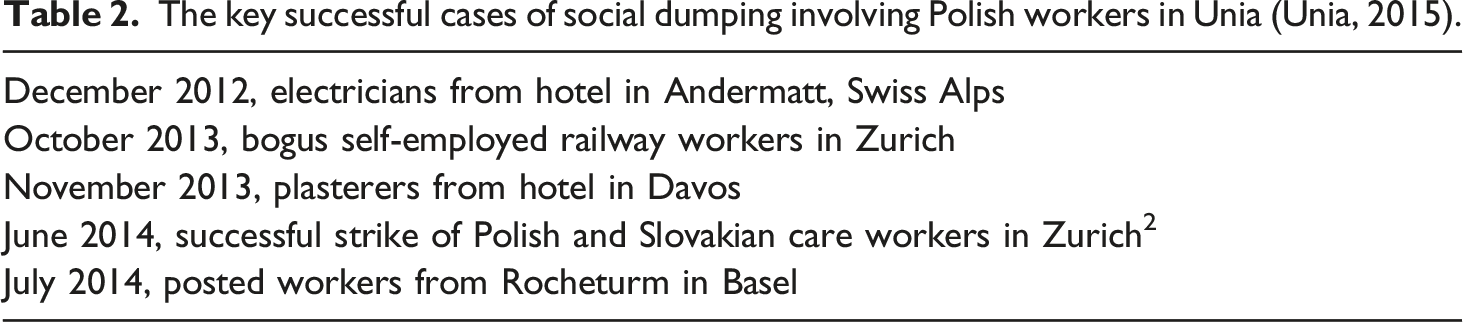
When it comes to key differences between the unions’ policies, Unia focused on identifying cases of social dumping and supporting collective mobilisation of Polish workers, which in some instances led to industrial action and protests in the pursuit of equal pay (Table 2). Highlighting cases of social dumping was important for Unia to enhance its power through the legislative framework of flanking measures (Rogalewski, 2018).
Unison had a different approach which involved encouraging Polish and other migrant workers to join the union and become active. Unison focused more on the education aspect of its strategy by organising training courses to encourage active participation of migrants in union structures. Both strategies were implemented through time-limited projects. After the Unia project finished, the union decided to employ the Polish-speaking organiser (myself) on a permanent basis.
The next part discusses the following main challenges identified by the research.
Fragmentation of the workforce
Although workforce fragmentation is not only related to Polish workers or migrant workers but represents a general problem for trade unions, migrants are particularly affected (Gumbrell–McCormick and Hyman, 2013). For instance, Frangi et al. (2021) show that Egyptian and Romanian immigrants are deeply segregated in the Milan construction sector, through subcontracting practices and employment practices that lead to de-skilling and declining employability.
In practical terms, Unison faced difficulties when representing members employed by private contractors, which did not recognise the union or when collective agreements with those companies provided worse conditions that those with the public employers. In Switzerland, fragmentation was particularly visible in the construction and long-term care sectors and many construction workers are being temporarily posted with the limitation of the posting period of 90 days within a year.
Language barrier
Informants had different views on whether language constituted a barrier to the inclusion of Polish members. Officials in Unia suggested that Poles had good knowledge of languages spoken in Switzerland (German, French and Italian) and language did not represent a significant barrier to integration. Nonetheless they felt it was important to employ Polish-speaking organisers to build trust in the union. Unison officials stated that language represented a key challenge, just like the Yorkshire union branch analysed by Ciupijus et al. (2020) but their efforts to resolve the issue failed.
Autonomy of the regions
In both organisations, the projects were managed from within the head office which led to resistance within regions. Unison established a special department of migrant workers for the duration of the project. In Unia, the project worker was a member of the migrant workers’ department. As such, the projects were in general not a priority for regional officers and reflected mostly a high-level and abstract commitment at central level. Unions attempted to solve this problem by creating parallel informal structures in the form of the Polish Networks in Unison and Unia. However, in case of Unison, the network disintegrated after the project closed and support from the Polish-speaking officer was no longer in place. In Unia, the network was integrated within the migrants’ committee.
Lack of special structures for Polish workers
An important difference between Unia and Unison structures at the national and regional level was the lack of migrant workers’ committees in Unison. Unia had in place informal language groups at national and regional levels alongside formal regional and national committees. In contrast, Unison only had Black members’ committee on both levels. Even though the term Black was defined as a political and not an ethnic term, these committees were not accessible for white migrants; furthermore, Polish workers would not identify themselves as Black. In 2007, Unison attempted to solve this structural problem hindering representation of CEE migrants when a motion was tabled for Unison’s National Delegate conference calling for reconsideration of the name of the Black Members Self Organised Group suggesting that ‘the title Black Members Self Organised Group was no longer adequate to reflect the ethnic diversity of our membership and could even prevent workers from Eastern European backgrounds from becoming active or even joining Unison’ (Unison, 2008). This line of argument was contested by the Black members conference, which argued: ‘Black workers’ issues in the workplace go beyond discriminative practices experienced by the A8 Nationals and cover a load of issues from immigration to housing and this negates the view that both groups should be organised under the same banner’ (Unison, 2008)
During interviews, senior officials were aware that the lack of special structures could hinder integration of CEE workers, however, they did not specify how and under which banner they should be organised. This suggests that Unison chose the universalistic methods approach (Alberti et al., 2013).
Recording members’ nationality
The lack of special structures for non-Black migrants was reflected by the design of the membership database in Unison. The union did not record members’ nationality or country of origin and it was therefore impossible to find out how many Polish members were recruited. 3 More importantly, the lack of data on CEE workers contradicted Unison’s principle of proportional representation within its decision-making structures. Among senior officers in Unison only the project manager considered this to be an issue. Conversely, Unia recorded the members’ country of origin and nationality and recruited 763 Polish members during the project, reaching 1354 when it had finished, by which time there were a number of members in the decision-making structures at national and regional levels. Nevertheless, the union did not record the ethnicity of workers.
Project based approach
Finally, both initiatives were based on short-term projects, which made long lasting inclusion processes challenging for the unions. Even though the unions set up networks for Polish workers to support participation, the network in Unison was dismantled shortly after the departure of the Polish organiser employed by the project. In contrast, the Filipino Members Network, which was managed by a permanently employed officer, was able to sustain its activities. As mentioned by Artur
4
, the Polish organiser who briefly took over the network, when I left Unison it turned out that there is nobody to take over. (…) We also had [planned] another meeting of the Network, in 3 months, the meeting didn’t happen, and people began feeling disaffected, some of them gave up their roles, some of them left Unison completely (Artur- Polish organiser, Unison, Interview nr. 15).
Polish members’ experience in trade unions and goal displacement
Interviews with Polish members in Switzerland and the UK support the findings of Anderson et al. (2008), who suggested that CEE workers in the UK had an overall positive attitude towards trade unions. Many members explained that their motivation for being more active in Unia was mainly for reasons related to social solidarity and willingness to help others, which confirmed the mobilization-theory used by Frege and Kelly (2003). A small minority joined the union for instrumental reasons to be protected at work. Even though some Polish members believed that the overall perception of trade unions in Poland was generally negative or different than in the UK or Switzerland, this did not discourage them from joining workers’ movement in both countries. This was the case of Anna, a trade union representative in Switzerland. I never belonged to a trade union in Poland, but I think this may be connected with what is happening in the country. I mean with the general political situation in Poland. And I think there is a negative association with trade unions [in Poland] (Anna – Polish worker, Unia, Interview nr. 24).
The fact that Anna did not belong to the trade union is not unusual given that Poland has one of the lowest union densities in the EU of 14% (ETUI, 2016). Only three Polish informants were previously union members in Poland.
Members in both countries had quite a deep sense of labour agency and trade union consciousness, even though formal awareness may have been lacking, as mentioned by this Polish-speaking organiser in Unia: Poles have a high level of trade union awareness without consciously knowing that this is the case. I don’t know if I am explaining this well, but Poles know what they can demand as employees, what should be the work conditions (…) as such, Poles have expectations and a high level of awareness as employees but low awareness as unionists (Kacper- Polish organiser, Unia, Interview nr.34)
However, a number of informants felt that the unions failed to recognise their willingness to become a union representative, especially within Unison.
This lack of fulfilment of the expectations of Polish members by union officials both could be classified as goal displacement (Zald and Ash, 1966), where unions formalised mechanisms of organisational sustainability take priority over the interests of a particular group. As mentioned previously, this happened in Unison where the union was not willing to continue the permanent support for the Polish Members Network by employing a dedicated organiser.
One of the most visible examples of not using Polish workers’ agency in Unison came from Marcin. Similar to Anna, his level of English was better than that of his Polish colleagues, and he quickly become the leader of Polish members in his workplace. After the union approached his workplace within the framework of an organising campaign, he become involved and convinced a lot of CEE and local workers to go on strike. The strike concluded with a partial victory for workers, whose terms and conditions became partially aligned with those of NHS employees. However, the Unison branch was not interested in continuing the campaign. Feeling that his potential was not recognised, he decided to reduce his involvement: If the whole idea is that I should pay membership fees and just be there as a member, great, just let somebody tell me that and this is what I will do. And if they want me to be very active, absolutely, I can do that, I would like to know that my activity has some sort of direction, that we are creating something great, something that will be beneficial to me as well and in some way will fulfil my dreams (...) and will be good for the union (Marcin – Polish worker, Unison, Interview nr. 5).
This reflects the experience of Latino workers organised by Unison branch at the University of London who did not feel welcome to be active members and left the union, with one activist similarly arguing that ‘[I] became a member and that was it, that was the end, no one told me anything, at the meetings’ (Alberti and Pero, 2018: 707).
However, another informant, a construction worker from Switzerland, had more positive experiences: I came to one meeting, then another, then that gave me some information, I learnt about my own rights, for instance about what I should be getting paid, and then every meeting means that there is something new, a new topic and knowledge is definitely power (Tadeusz- Polish worker, Unia, Interview nr. 28).
A Polish worker from Linconshire provided a more in-depth explanation of why Polish workers found it difficult to become active in Unison: I guess, maybe, I have this feeling that if they [the union] need you then they will find you and ask you for things but then if the situation is reversed where you are waiting for some input at their end, then this is worse (Bozena- Polish worker, Unison, Interview nr. 10).
Many workers in Unison mentioned that their branches were too nice and diplomatic and too weak in representing their cases to their employers, as suggested by this member from London: There is this issue of personality, of being brave and having the courage to talk about what is really going on if there are any issues and something is not right. Unison tries to sort things out in a very mild and meek manner and we would like something more (Zofia- Polish worker, Unison, Interview nr.8).
Some Polish members mentioned that the suggestions they made, such as for instance in blocking the pedestrian crossing during a strike were too radical for branch officers, as described by a Polish hospital porter: The process of trying to get anything sorted in England, as you know perfectly well is very time and labour intensive. It’s not like, a couple of shrewd guys get together, write things up, stop the work, say there is a strike, then go to the boss and chuck things on his desk and try and enforce something. Unfortunately here things are different. Before you get to any strikes you have a few good months of negotiations (Andrzej- Polish worker, Unison, Interview nr. 9).
Similarly, in Unia some Polish workers felt that their potential is being underutilised. I feel like I am one of the smallest cog wheels in that massive machine. Sure, the machine wouldn’t keep going without these small cogs, but whether I can influence anything... no one talks to me or takes me seriously (...) even though I have more time and I have the experience. (...) In theory you could be thinking ‘right, this person has more time, wants to be more engaged, now can be engaged’ but they are deaf to that (Romuald- Polish worker, Unia, Interview nr. 21).
The key issue here is related to the unwillingness of branches to be more proactive, rather than merely cultural differences. This is what a member of a Unison branch in Scotland commented on when talking about a project focused on recruiting young workers: We had this meeting in November and we were talking about how to recruit young people and increase their awareness about trade unions. I mean, the issue was, we had this idea to talk to the college [...] it was a really good idea, we could do something but nothing happened since (Łukasz- Polish worker, Unison, Interview nr. 1).
Generally, the experiences of Polish members in Unia were better, particularly in the French speaking region, for instance according to the union representative: Every time we have an issue, straight away, a couple of days later there is a meeting with the directors [of the region] and the issue is addressed so we are listened to (Rafał- Polish worker, Unia, Interview nr. 20)
The key successful cases of social dumping involving Polish workers in Unia (Unia, 2015).
However, many members mentioned that in their opinion, Unia was primarily interested in collective cases that could enhance the union’s media profile. When it came to individual cases, Polish members felt that the local structures focused on organisational stability.
Concluding remarks explaining why Unia approach was more successful
Both unions faced similar challenges of fragmented labour market, language barriers and the autonomy of the regions, given that the projects were initiated and delivered by the head offices. Unions also deployed similar strategies focussing on inclusion of Polish workers, at least initially, where they established organising projects, employed a Polish-speaking organisers and co-operated with Polish unions and community organisations. They also established informal networks of Polish members.
However, the analysis of differences helps understand why Unia’s strategy was more successful in terms of achieving a lower implementation gap and lower goal displacement between expectations of migrants and union policies.
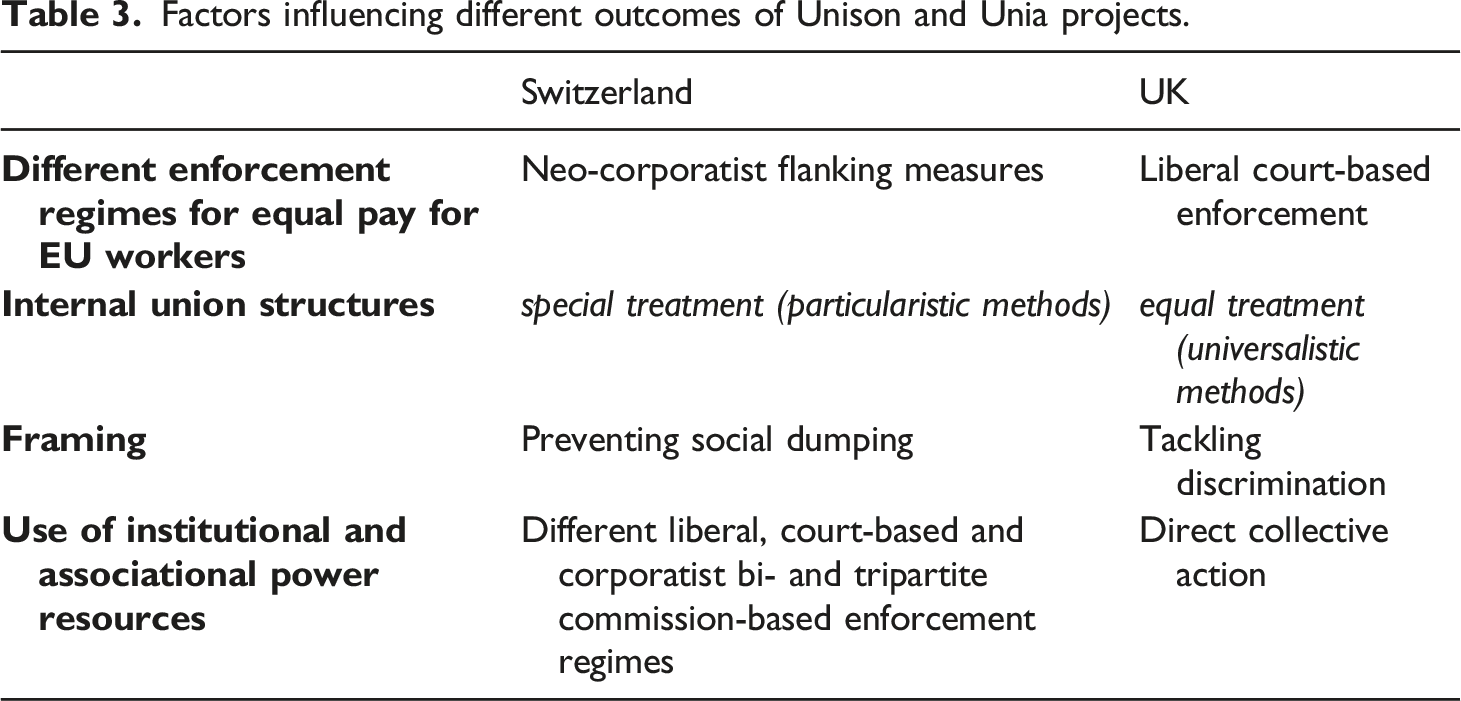
To start with, Unia adopted the special treatment approach (Penninx and Roosbland, 2000) and used particularistic methods (Alberti et al., 2013) towards Polish migrants, where the existing committee for migrant workers was able to include workers from the CEE countries and to create a permanent officer position. Conversely, Unison chose the equal treatment approach with universalistic methods, by not creating a non-Black migrants committee when the Black members committee opted not to extend its representation to CEE workers. The intention to go beyond the formal structures and set up an informal network of Polish workers was initially successful but failed long-term without a dedicated officer.
Unia’ identity as more class oriented (Hyman, 2001), with stronger alignment to collective mobilisation was better suited to using the agency of Polish workers, who were eager to campaign for their rights in cases of social dumping, for instance in the case of a care workers’ strike (Rogalewski, 2018). This was not the experience of workers in the UK who felt underutilised.
Furthermore, goal displacement in Unia was narrower because it could accommodate the expectations and agency of Polish workers who wanted to improve their working conditions. Unia predominantly focused on collective cases (social dumping), neglecting individual cases. Similarly, according to many Unison members, the union did not deal well with individual cases, especially for members in outsourced services.
The lower goal displacement was also possible because Unia chose the special treatment approach (particularistic methods) and its structures allowed members to use their agency and fight for better rights. Unia perceived Polish migrants as source of trade union power and Polish migrants were more important for Unia’s revitalisation, in line with the strategic choice theory of Frege and Kelly (2003). Successful social dumping actions and the emphasis placed on collective cases, undoubtedly helped to increase the union’s bargaining power. This explained why Unia, in contrast to Unison, was keen to continue the organising project even though Polish workers constituted a low percentage of migrant workers in Switzerland overall, unlike in the UK.
Both Unia and Unison were at the forefront of establishing self-organised structures for migrant workers and were committed to promoting equality and tackling discrimination. However, Unia adopted a more practical strategy of focussing on cases of social dumping as one of the successful methods of supporting migrants. In turn, social dumping cases contributed to strengthening the union’s position in the Swiss industrial relation model. In contrast to British unions (see Ince et al., 2015), Unia successfully used the social dumping discourse to organise rather than to stigmatise migrant workers.
Factors influencing different outcomes of Unison and Unia projects.
Finally, this research demonstrates that workers’ prior trade union membership in Poland was not an important factor influencing their involvement and instead, their motivations were based on the need for social justice (Frege and Kelly, 2003), with Unia better at taking advantage of this situation.
Footnotes
Declaration of conflicting interests
The author(s) declared no potential conflicts of interest with respect to the research, authorship, and/or publication of this article.
Funding
The author(s) received no financial support for the research, authorship, and/or publication of this article.
