



Abstract
This article contributes to the growing debate on minimum wage coordination at European Union (EU) level. We consider the introduction of a hypothetical EU-wide minimum set at 60 percent of the median wage in each European country; we compare the diverse minimum wage-setting systems across Europe and discuss how they could be affected by such policy. The institutional impact of this European common threshold would be larger in those countries where minimum wages are currently collectively agreed by social partners than in those countries where they are set by statutory regulation. But according to our statistical analysis, such EU-wide minimum wage would affect a larger proportion of the workforce in those countries with statutory minimum wages, since they tend to have a larger low-paid segment of employment.
Introduction
Minimum wage systems vary considerably across the European Union (EU). In some countries, they are statutory while in others they are collectively agreed by social partners; some are cross-sectoral while others are sector-specific; some are relatively generous while others are comparatively low. But despite such diversity, in all member states they play a very important role in the regulation of employment. In this respect, minimum wages can be considered an integral part of the European Social Model, but also as an embodiment of its contradictions: on the one hand, their mere existence across Europe reflects a common understanding of the need to combine economic growth with social fairness; on the other hand, the wide diversity in minimum wage systems and levels reflects the difficulties in generalizing beyond a common broad understanding.
This diversity explains why, perhaps surprisingly, though minimum wages are a key element of labour regulation in all member states they are excluded from the competences of European institutions in the existing treaties. But there have always been voices arguing for some form of coordination of minimum wage policies around Europe, an argument that has gained more traction with the recent economic crisis. We contribute to this debate by discussing the difficulties and potential implications of such a coordination of European minimum wage policies.
In this article, we first discuss the theoretical and policy considerations around a coordinated EU minimum wage policy (EUMW from now on), reviewing the institutional difficulties that such a proposal would have to confront. We then use statistical data to evaluate the proportion of workers that would be affected by a hypothetical coordination of minimum wage policy in the different countries, using a baseline scenario of a floor of 60 percent of the median national wages. We end with some remarks about the feasibility of a coordinated European minimum wage policy.
Policy considerations
Wage-setting systems in Europe and the debate on an EUMW
Trade unions have long tried to introduce (and raise) wage floors, but established these extensively only in the second half of the 20th century. Where unions were strong, minimum wages were often established through collective bargaining, usually sector-specific. Where they were weaker, governments often prescribed statutory minima or extended by law collectively agreed wage floors, in most cases with a single national threshold and no exclusions. Of course, the historical origins of minimum wage systems in Eastern Europe were different, but although they were established much later and in very different circumstances, the fact that they all opted for a statutory system is probably related to the weakness of their industrial relations systems. These different origins are reflected in the complex pattern of minimum wage setting in Europe, shown in Table 1.
Different systems of minimum wage setting in Europe.
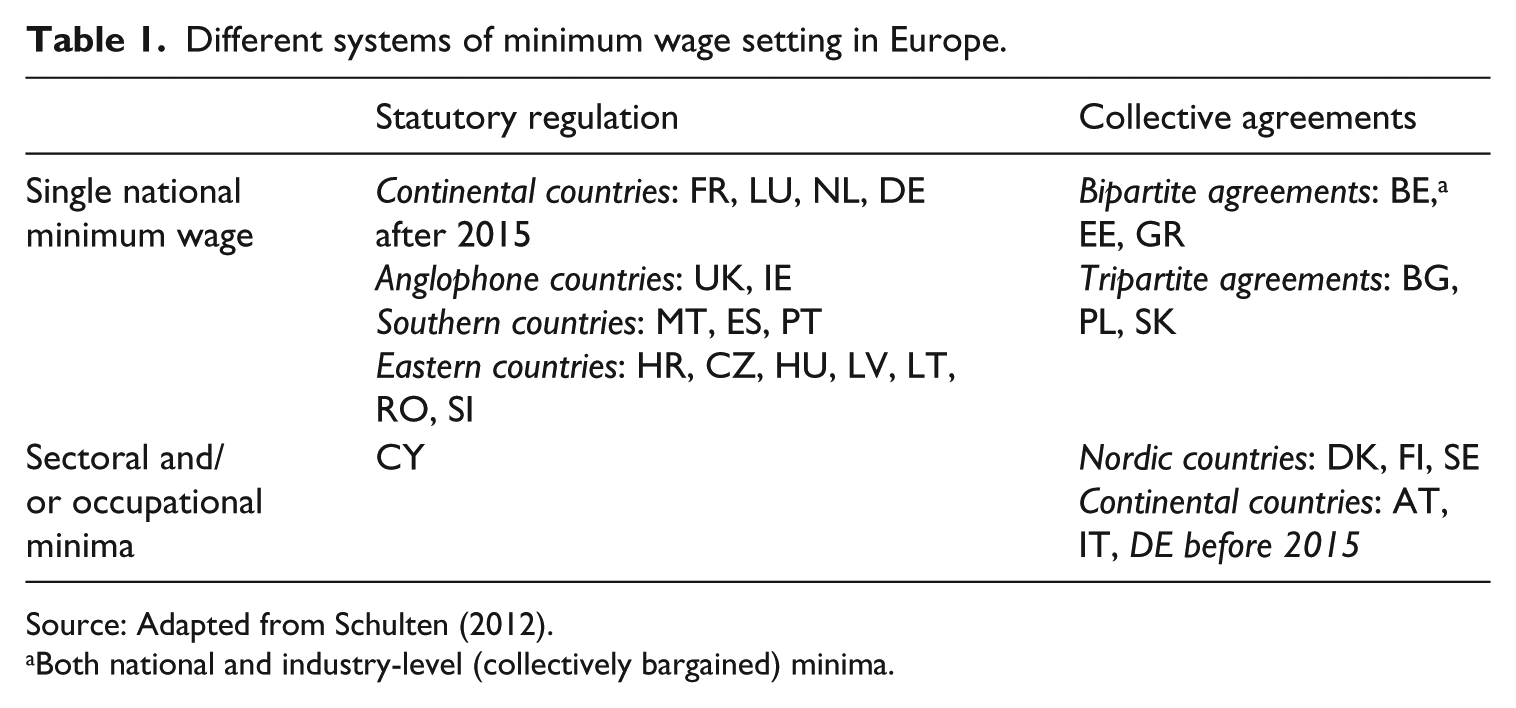
Source: Adapted from Schulten (2012).
Both national and industry-level (collectively bargained) minima.
However, this institutional diversity has been considerably reduced in recent years, as most EU member states now have statutory national minima. Such convergence could facilitate considerably the design and implementation of a hypothetical common minimum wage policy across the EU. In principle, the EU has no competence with respect to wage levels or wage formation mechanisms: article 153 of the Lisbon Treaty, dealing with work and employment, states that ‘the provisions of this article shall not apply to pay’. Nevertheless, the 1961 European Social Charter of the Council of Europe established the right of workers to a fair remuneration for a decent standard of living, and the Council of Europe has asked member states to ensure that minimum wage levels reach at least a certain percentage of the average or median national wages (normally, 50% or 60%).
Against the background of the economic crisis, European institutions (most importantly, the Commission and the Central Bank) have increasingly intervened in wage formation mechanisms. The Memoranda of Understanding applied to countries receiving EU bailouts often included reductions in minimum wage levels and public pay and decentralization of collective bargaining systems (Busch et al., 2013). Recent agreements such as the Euro Plus Pact and the Six Pack provide for the enforcement of wage austerity and bargaining decentralization. This is surely one reason why the debate on establishing more explicit mechanisms of wage coordination, in particular with respect to minimum wage levels, is currently re-emerging in European policy circles (Eldring and Alsos, 2012; Schulten, 2012).
However, key actors still resist such coordination. Nordic member states, and more generally countries where minimum wages are set up by collective bargaining, have traditionally opposed the idea, considering that it may undermine their existing national mechanisms. Germany belonged to this group until growing dissatisfaction with the results of the existing mechanisms led to the recent adoption of a statutory model. European social partners have also often opposed the idea of an EUMW, defending the need to respect national specificities in wage-setting mechanisms as well as national and social partner sovereignty. However, the European Trade Union Confederation (ETUC, 2012), after stressing that negotiations between social partners at the relevant level are the best means to good wages and working conditions, has called for a substantial increase in the statutory minima in countries where trade unions consider this necessary, stressing that ‘in any event, all wage floors should respect Council of Europe standards on fair wages’.
Why coordinate minimum wages?
The implications of minimum wages are intensely debated in labour economics and employment policy. On the one hand, they ensure that nobody works for a salary below what is considered minimally acceptable or decent, which is particularly important for the most disadvantaged groups in the labour market (Freeman, 1996); they are often also defended as a source of demand stimulation and stabilization (Herr and Kazandziska, 2011). On the other hand, critics often argue that they damage the employment opportunities of lower-skilled workers and the international competitiveness of low-skilled sectors (Abbott, 2012; Brown et al., 1982).
Yet, since wage minima are well established as part of European social protection systems, the issue is not their existence or even their level, but rather the potential benefits and drawbacks of their coordination at European level (Eurofound, 2014; Schulten, 2008, 2012). Perhaps the most important argument in favour is that minimum wage coordination could be an important complement to economic integration, creating a level playing field for competition; in a wider sense, it could advance European economic integration and the idea of European Social Model. On the negative side, the main arguments are that coordination at EU level would undermine the existing national institutions and traditions, and that a single policy would simply not fit the needs and specificities of each national economy. A further argument against a coordinated EU minimum wage is that it might damage the competitive position of EU countries, especially for goods and services requiring low-skilled labour.
It is important to note that the force of some criticisms depends on how such coordination is implemented. For instance, the governments and social partners of countries (notably the Nordic ones) where minimum wages are traditionally set by collective bargaining have often opposed EU minimum wage coordination as entailing the generalization of a statutory system, and perhaps also prescribing lower wage levels than they currently enjoy (Eldring and Alsos, 2012). But as explained below, minimum wage coordination can be implemented in a variety of ways, some of which in principle respect national wage-setting systems.
What type of coordination?
There are many possible ways to coordinate European minimum wage policies. We can differentiate three potential axes of coordination. The first issue is the mode of regulation. Several proponents of an EUMW have argued that coordination could be achieved using the mechanisms of ‘soft law’ familiar from the ‘open method of coordination’ (OMC) (Schulten, 2008). Some have argued, though, that the OMC has delivered few results in terms of actual policy coordination and harmonization (Borrás and Radaelli, 2010). But ‘hard’ forms of EU coordination of minimum wages seem extremely unlikely except perhaps in the long run, since pay is currently explicitly excluded from the Treaties; indeed, it is unclear whether they would even allow the type of soft coordination associated with OMC. Probably, other options for voluntary coordination would have to be explored, such as autonomous agreements concluded by the EU social partners.
The second axis is the extent of coordination. If minimum wage levels were defined by each country according to its own institutional and industrial relations traditions, those where minima are set by collective agreement could maintain such systems, only adopting the compromise that the minimum is at least as high as the common target. But a minimum wage system purely established by collective bargaining (as in Sweden or Denmark) leaves unprotected those workers not covered by collective agreements. If the common target level is defined as a minimum for all workers, it may require the extension of collective agreements or the establishment of some kind of second-level statutory floor. This would imply an important change in existing industrial relations practices, with a higher degree of state intervention.
Taking this a step further, EU coordination could aim at harmonizing not only levels, but also systems, requiring that below the collectively agreed minima (which are generally higher) there would be a statutory threshold corresponding to the EU target. In countries which currently have statutory minima, only the level would change, not the system; where they are collectively agreed, the system itself would have to change, and therefore, the institutional impact would be more significant. It is important to note that even in the latter case, the statutory minimum wage would not (necessarily) replace the collectively bargained level, but supplement it by setting an absolute minimum covering the whole workforce.
The third question is the target levels for wage minima. Most frequently mentioned is a proportion of median or average wages, normally 50 or 60 percent. Other proposals anchor the target to Gross National Product (GNP) per capita (or per worker) rather than to wages (Rasmussen and Delors, 2006). The choice of the target level is obviously not trivial. Anchoring the minimum to the median wage makes it insensitive to developments at the upper end of the wage distribution; a massive growth in higher incomes raises the average but not the median. Using the average as the anchor would solve this problem. Using as the reference GNP per capita or per worker, on the other hand, has the advantage of linking the minimum wage to the growth of overall productivity, although in the context of economic crisis and rising unemployment this could lead to increases in minimum wage levels which are difficult to defend. Furthermore, if we assume that productivity growth is lower at the bottom of the wage distribution, this might be detrimental for low-wage employment. A final option would be to have no fixed target level, but some type of EU-level body (similar to the UK Low Pay Commission) that would adjust the target on a yearly basis, depending on their own evaluation of the economic and social situation.
The difficulties of minimum wage coordination across European countries
The main difficulty for minimum wage coordination is the wide diversity of existing systems, particularly between countries where minima are set by government regulation (the statutory model) and those where they are set by collective bargaining. We can summarize this diversity across a number of elements of differentiation.
The first is the degree of social partner involvement, which varies considerably between countries. The highest level is in countries where minimum wages are set exclusively by sectoral collective bargaining (Nordic countries, Germany before 2015, Austria and Italy), with government intervention in some cases either to extend the coverage of collective agreements (Finland and Germany before 2015) or to establish a statutory minimum in particular cases (Austria and Italy). There is less involvement in countries with minima set by peak-level collective agreements, bipartite (Belgium, Estonia and Greece) or tripartite (Bulgaria, Poland and Slovakia). This category is really a hybrid: as in the statutory model, there is a single minimum wage level, and government intervention is crucial for transforming what has been agreed into binding regulation (and often, the government can have the final word in if the social partners cannot reach an agreement), as in the collectively bargained model, the agreement of the social partners determines the threshold. Belgium is a particularly hybrid case because it has both economy-wide and industry-level (collectively bargained) minimum wages. Countries with statutory minima have the lowest level of involvement, though in most cases social partners are consulted (often, they are formally part of some type of advisory body which recommends adjustments to the minimum wage on a regular basis, such as the UK Low Pay Commission).
Second, there is a distinction between universal and segmented wage floors. Although in most cases this is linked to the previous differentiation, it is conceptually distinct. In countries with collectively agreed minimum wages, they tend to be sector- or even company-specific, whereas most of those with statutory systems tend to have a single universal wage floor (though some have regional differentiation), whether the result of pure government action or following collective agreements at national level. Cyprus is a somewhat hybrid case, because it has an occupation-specific statutory minimum wage underpinning the collectively agreed levels (Soumeli, 2011). As far as we know, none of the proposals of EU minimum wage coordination mentions the possibility of differentiating by sector or occupation, and therefore, we can assume that there would be a universal threshold within each country.
The third distinction is the scope of coverage. Even in the countries with statutory national minima, there are often provisions allowing sub-minima for specific groups, or even exclusions. But again, the most important difference in the scope of minimum wages links to the divide between the statutory and sectoral collectively bargained models. In the latter, only workers covered by collective agreements are affected by the minima, although most of these countries have very high levels of coverage (above 80%), in some cases (such as Germany until 2015) it is much lower, which leaves many workers unprotected. Some countries with the sectoral bargaining model solve this problem (at least partly) by different means, such as extending the collective agreement if half of the industry is covered or making it an obligation to be member of an employer organization (Martins, 2014). In statutory systems, on the other hand, coverage tends to be comprehensive but often allows sub-minima for specific categories, typically young workers and/or apprentices. There are other types of differentiation in particular cases, such as for disability in France or Portugal, for unskilled workers in Luxembourg or for managers and unmarried workers in Greece (Eldring and Alsos, 2012).
A fourth difference concerns enforcement: if this differs significantly across countries, the institutional difficulties of EU-wide coordination increase considerably. Although some relatively well-known facts (the differences in the size of the informal sector or the existence of bogus self-employment) do point to differences in enforcement across Europe, there is no reliable source of comparable data, so it is difficult to evaluate in this context.
In summary, we can divide countries into three categories. First, there are those where EU-wide coordination would involve a high degree of institutional impact: Denmark, Sweden, Finland, Austria and Italy. These countries have collectively agreed minimum wages, and there are superimposed difficulties across most of the axes previously mentioned: the proposed policy could disrupt national industrial relations traditions or require a high degree of coordination from all economic actors, would probably eliminate existing sector and company differentials with respect to minimum wage levels and would expand coverage to make it universal.
Second, some countries would experience an intermediate degree of institutional impact: Belgium, Estonia, Poland, Bulgaria, Slovakia, Greece and Cyprus. Most also have collectively agreed minimum wages, although at economy-wide level and with universal coverage. Cyprus is a peculiar case, with an underlying occupation-specific statutory minimum wage for some cases and collectively agreed minimum wages.
A third group would experience a low degree of institutional impact: France, Spain, Portugal, Netherlands, Lithuania, Latvia, Romania, the United Kingdom, Ireland, Hungary, Czech Republic, Luxembourg, Slovenia and Malta. In these countries, minimum wages are set by government regulation and have more or less universal coverage, and therefore, EU coordination would be considerably simpler than in the previous cases. After the establishment of a statutory national minimum wage, Germany belongs to this group too.
Evaluating the quantitative impact of a common EU minimum wage threshold
Methodology
In the rest of the article, our key objective is to quantify the number of employees currently below a threshold established by a hypothetical common EUMW. For this exercise, we use the two main EU-wide surveys on income and wages, the 2010 European Survey on Income and Living Conditions (EU-SILC) and the 2010 European Union Structure of Earnings Survey (SES). Our main variable is the monthly full-time equivalent (FTE) gross wage. We here document the main methodological decisions that we had to make in order to carry out our analysis, and the limitations imposed by the data.
Normally, the threshold established by minimum wages refers to gross earnings before taxes or other statutory deductions, and including not only the base salary but also premia and bonuses (unless these relate to non-standard work hours or overtime), and excluding payments in kind (OECD, 2002). It is usually defined in terms of an hourly rate, or monthly earnings adjusted for hours worked (so that equivalents for different working hours can be computed). These are the attributes that should characterize our target measure on which a common EU threshold could be defined. But our analysis is constrained by the characteristics of the data available, and the actual measures of wages we use are not identical to this definition.
The key element of all our analysis in this article is the identification of the wage level that corresponds to 60 percent of the median in each country, and of the workers that fall below such threshold. In this respect, we simply use the most commonly used threshold in the literature, which roughly corresponds as well with one of the most widely used definitions of low-paid workers. For instance, the OECD defines low pay as two-thirds of the median. So we can say that establishing such a threshold would mean the statutory elimination of what is commonly defined as low-paid work in Europe. The use of the median rather than the mean is normally justified by the excessive sensitivity of the latter to outliers in the distribution of income. For a discussion of some alternative thresholds (one based on 50% of average wages, the other on sector-specific minimum wage levels), see Eurofound (2014: 112–116).
The EU-SILC is a cross-sectional and longitudinal database on income, poverty, social exclusion and living conditions in the EU. It is a very rich source of information, but the main problem for our purposes is that it is not aimed at measuring wages as such, but income coming from employment at the individual and household levels. We cannot therefore construct a measure of wages that fully matches the definition above, but only an approximation that requires making some non-trivial assumptions. The EU-SILC variable on labour income of employees refers to gross overall income from work in the previous calendar year. Since we use the latest available cross-sectional wave from 2010, the income variable actually refers to 2009. To calculate the monthly FTE gross wage, we apply the following formula (based on Brandolini et al., 2010)

That is, our main variable equals the EU-SILC measure of annual cash gross labour earnings (last year) divided by the number of months in full-time jobs of the respondent over the same year plus the number of months in part-time jobs multiplied by a country sex-specific ratio of median hours of work in part-time jobs to median hours of work in full-time jobs. This adjustment for part-time work can produce some minor bias in countries with a wide spread in the hours of part-time work (such as the United Kingdom), but it is unlikely to change the overall picture. We also introduce a further adjustment for those workers that hold more than one job (for more details, see Eurofound, 2014: 101–104).
The SES collects representative and harmonized data on wages. Although the method for collecting the information differs considerably across countries (between specific surveys and administrative registers), in all cases it is collected at company level and based on payroll data (rather than on workers’ responses as in EU-SILC). The main advantage of SES is that it is explicitly aimed at measuring wages with a high degree of detail, and our target variable can be constructed in a much more direct and precise way. But on the other hand, it has the important problem of providing only a limited coverage of our target population (EU employees), since data are not available for Germany, the United Kingdom, Austria, Malta, Bulgaria, Greece, Denmark and Belgium. Furthermore, for some countries the SES does not include enterprises with fewer than 10 employees, nor many important sectors of the economy (such as agriculture and public administration). The exclusion of small enterprises is especially problematic (affecting 7 of the 19 countries for which we have data), because we know that low-paid workers are overrepresented in such companies.
The measure of wages that serves as basis for our analysis is in this case very precise and corresponds more or less exactly with our target variable, according to the following formula

Although it complicates the picture, the use of two sources is necessary in order to make an adequate evaluation of the potential quantitative impact of minimum wage coordination.
The hypothetical common minimum wage versus existing minimum wage levels
It is important to contextualize the hypothetical EUMW with the existing arrangements in each member state, as we do in Table 2. This contains two panels, one with data from EU-SILC (for 2009) and one from SES (for 2010). The first column of both panels shows the existing monthly minimum wage. In the case of countries with statutory minimum wages, this information was obtained from Eurostat, while in the countries with collectively agreed minimum wages, the figures shown are an approximation that we use for comparative purposes. In strict terms, there is no national minimum in those countries, but rather different minima in different sectors and/or occupations which do not necessarily apply to the whole working population. In the majority of literature on this issue, the effective levels of minimum wages in those countries are thus simply unknown, even if they do exist. A recent study (Garnero et al., 2013) gathers data from sectoral minimum wages for those countries and estimates an average effective minimum wage level for the workers covered by collective bargaining, which in most cases is higher than in countries with statutory systems, even if they do not apply to the full labour force. According to their estimates, the coverage is 76 percent in Austria, 56 percent in Germany, 52 percent in Denmark, 79 percent in Finland and 82 percent in Italy; they provide no estimation for Sweden. The values shown for these countries are not strictly comparable with the rest, so they have to be taken with special care. In particular, the estimate of the gap between existing minima and the hypothetical EUMW level are likely to understate the impact of a common threshold, especially if the share of uncovered workers is large.
Basic data from EU-SILC (2009 wages in Euros) and SES (2010 wages in Euros).
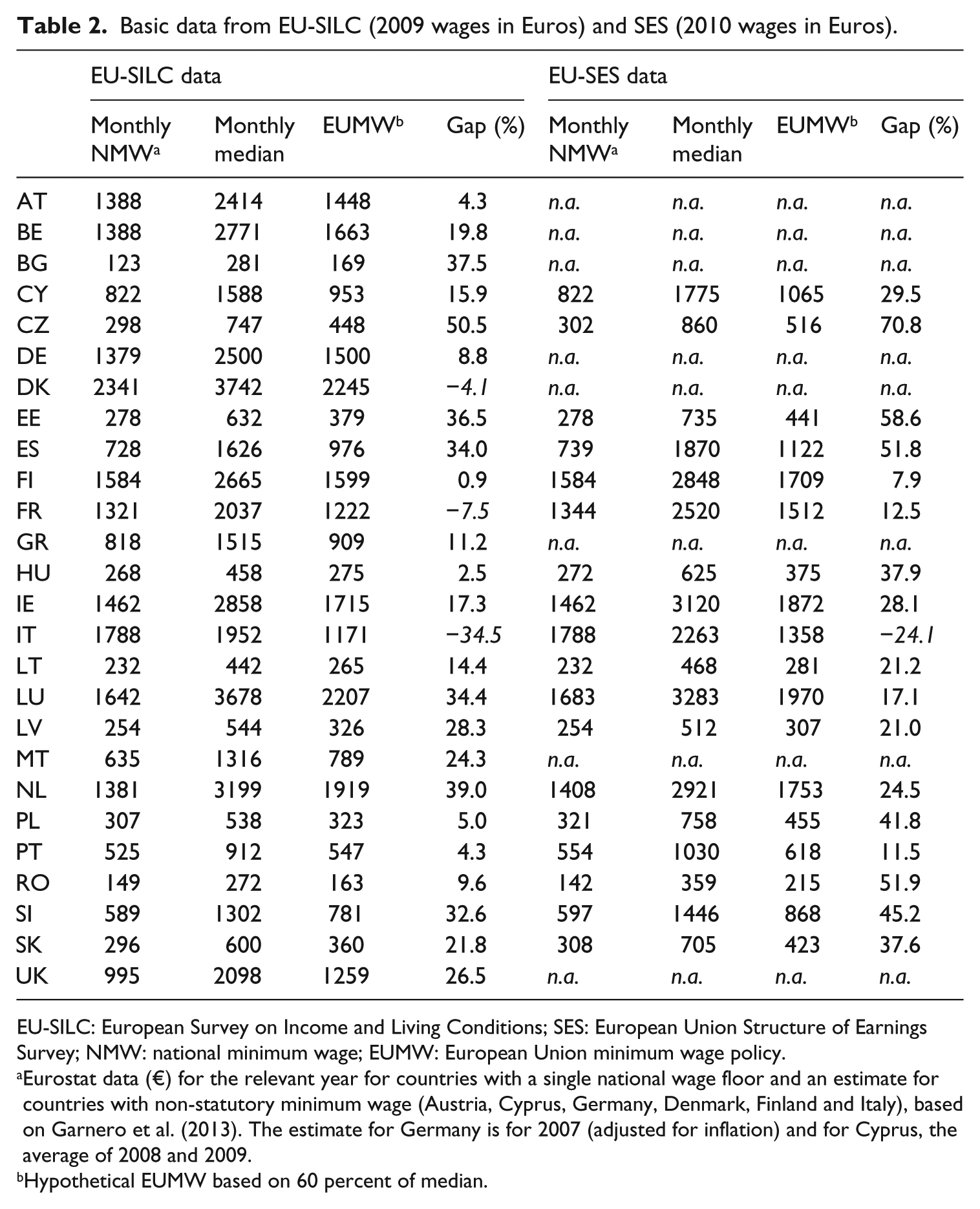
EU-SILC: European Survey on Income and Living Conditions; SES: European Union Structure of Earnings Survey; NMW: national minimum wage; EUMW: European Union minimum wage policy.
Eurostat data (€) for the relevant year for countries with a single national wage floor and an estimate for countries with non-statutory minimum wage (Austria, Cyprus, Germany, Denmark, Finland and Italy), based on Garnero et al. (2013). The estimate for Germany is for 2007 (adjusted for inflation) and for Cyprus, the average of 2008 and 2009.
Hypothetical EUMW based on 60 percent of median.
The third column of both panels shows the value (for 2009 and 2010 respectively) of the hypothetical common EUMW threshold of 60 percent of the median. Comparing this with the existing minima (column 4) illustrates the impact such coordination would have in practice. Figure 1 shows this comparison graphically, with the hypothetical EUMW on the horizontal axis and the existing level on the vertical axis, and a diagonal where both values are the same. The distance below the diagonal reflects the increase that would be required by a hypothetical EUMW. To remind the reader of the difference between countries with and without statutory minimum wages, the latter are indicated by an asterisk. These figures clearly show that the introduction of a common target of 60 percent of the median would entail an increase in the existing levels for many European countries, quite significant in a few cases (the Netherlands, Luxembourg, Spain, the United Kingdom and Ireland, and most Eastern member states). There are some exceptions, though: the clearest is Italy, where the average collectively agreed minimum wage level estimated is so high that a common EU threshold of 60 percent of the median would be considerably lower. We must remember, though, that such a minimum wage is just an average and that it does not cover the whole Italian labour force; so the coordination of minimum wage policy would also lead to a significant increase of wages at the bottom, as we will see later. The other two countries that are above the diagonal (France and Denmark) are so close that we can only say that the establishment of a common EU threshold of 60 percent of the median would have very little or no impact, as would be also the case in other countries such as Finland, Austria, Portugal, Hungary, Poland, Romania and Greece.

Existing minimum wage (in Euros) versus hypothetical EUMW (in Euros), 2009.
How many workers would be affected?
Figure 2 below shows the proportion of workers below 60 percent of the median wage in each country according to the two sources, including different SES specifications. As mentioned above, the SES is a better measure of wages and has a larger sample size, but it does not cover the whole economy, and we could not get access to data for all countries. In Figure 2, the countries have been sorted according to the base figure of SES (excluding establishments with less than 10 employees and public administration), identified by a black square marker; the countries for which we do not have SES data are shown separately at the right-hand side of the chart, sorted by the proportion of workers below the EUMW threshold according to EU-SILC. The EU-SILC figure is indicated by a diamond in the chart. The next two markers correspond to different specifications of the SES dataset, which are available only for some countries. The star shows the proportion of workers below the EUMW threshold according to the SES for establishments of all sizes (for the countries that provide such data); the line marker identifies the proportion of workers below the EUMW according to SES including public administration (again, where such data are available). Finally, the circle symbol is used only for the countries for which we did not have access to SES data, but for which Eurostat itself has published a figure which is similar to ours: the percentage of workers below two-thirds of the median in each country (for establishments with more than 10 employees, excluding public administration). We include such data to be able to evaluate roughly the consistency between our two sources for those countries as well.
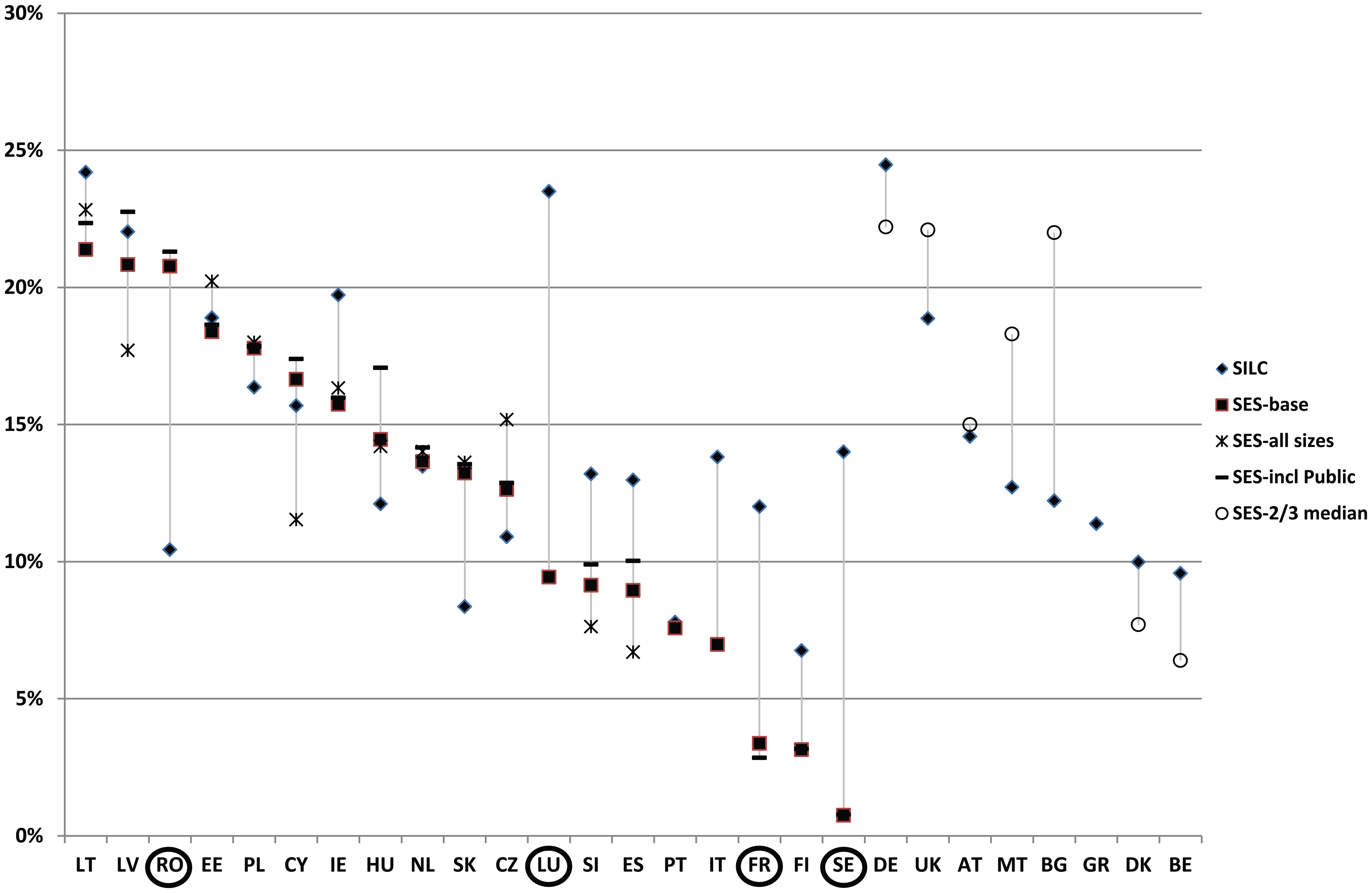
Proportion of workers below the hypothetical EUMW threshold, different sources and specifications.
In general terms, the consistency between the different specifications of the SES data is higher than between SES and EU-SILC. What this suggests is that the differences between both sources are not so much the result of their differences in coverage (EU-SILC covering the whole economy and SES generally not), but the result of differences in the measurement and specification of wages. That said, the inconsistency between SES and EU-SILC seems to be concentrated in a few countries (Romania, Luxembourg, France and Sweden), suggesting some problems with at least one of the sources; for a detailed discussion, see Eurofound (2014). In the majority of countries, the inconsistency is small and seems reasonably within the boundaries of what we would expect according to the different specification of variables. This will be useful for the classification of countries in terms of the scale of the impact of a hypothetical EUMW, because in most cases the choice of source would make little difference.
The distribution of wages below the threshold
Although the proportion of employees currently under the EUMW threshold is a useful measure of its potential impact, this does not take into account the intensity of the effect on each individual case. The distance between the current wage and the hypothetical minimum wage, and consequently the actual impact for different affected workers, can vary considerably.
We have constructed estimates of the cumulative distribution of relative wages below the median in each country (full details available from the authors). We group countries according to the three main categories of minimum wage systems previously identified. The countries with statutory national minima tend to have a discontinuous distribution of wages below the median, with few workers below the minimum wage threshold and an abrupt increase just above; countries with collectively agreed sector-specific minimum wages, on the other hand, show a much smoother and continuous distribution of wages below the median, and the estimated average agreed minimum wage is not associated with any discontinuity in the cumulative distribution of wages (though there may be discontinuities at sector level). Nevertheless, according to our analysis, there are exceptions to this general pattern in both groups of countries: Finland and Sweden show a relatively abrupt distribution of wages (with the curve turning upwards at around 50% and 55% of the median, respectively): in the case of Finland, coinciding with the effective average agreed minimum wage estimated by Garnero et al. (2013); on the other hand, Greece, Belgium, the United Kingdom and Ireland show a rather smooth distribution, with workers more or less equally distributed below and above the minimum wage line (quite similar, in fact, to the countries without statutory minimum wages). To some extent, this may be the result of data problems, since for three of those four countries (the exception is Ireland) we only have data from EU-SILC. In fact, the countries for which we have SES data tend to show more clearly the effect of existing minimum wages than the countries for which we only have EU-SILC.
The most important point, though, is that in some countries where the share of workers below the EUMW threshold is relatively large, most of these workers are close to it. This is the case of Lithuania, Latvia, Luxembourg, Spain and Slovenia. This may be an effect of existing minimum wages (in Lithuania, Latvia and Luxembourg, where nobody is below the existing minimum wage line) or other factors (in Spain or Slovenia, the existing minimum wage is considerably below the threshold). The wage gap is larger in Germany (before the introduction of the statutory minimum wage), Estonia, the United Kingdom and Ireland, Cyprus, Austria and Romania.
An evaluation of the potential overall impact of an EUMW across countries
We can summarize the potential impact of an EUMW in each country by combining the institutional and quantitative impacts that were explained in previous sections, as shown in Table 3.
An assessment of the potential impact of a hypothetical common EUMW threshold across the EU.
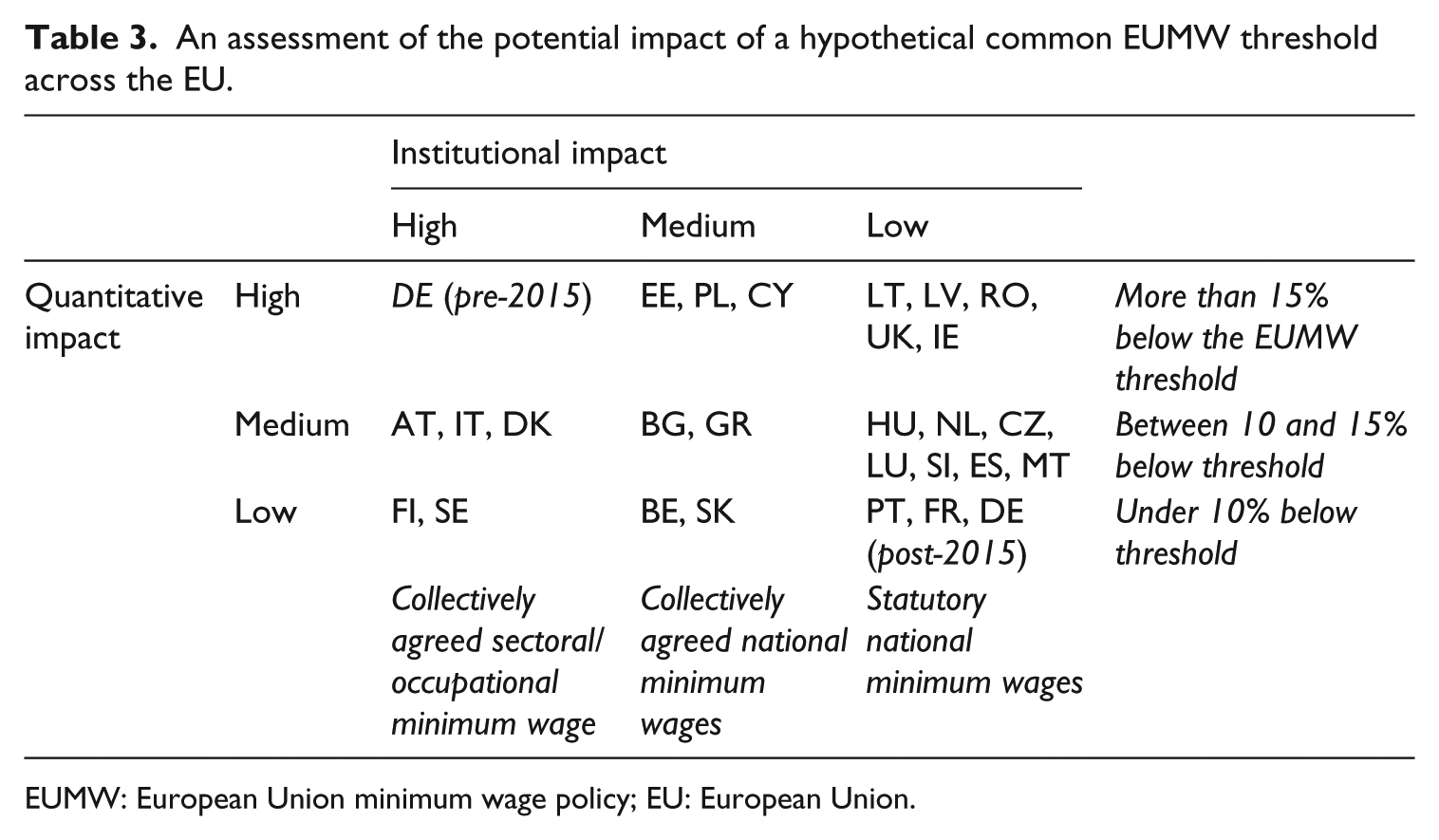
EUMW: European Union minimum wage policy; EU: European Union.
The most salient country is Germany. Strikingly, it appears in the two extremes of our assessment: as the country where the institutional and quantitative impact of an EU coordination of minimum wages would have been highest (before 2015) and as one of the countries where it would be lowest (after 2015). The reason is, of course, the large-scale institutional transformation currently occurring with the national minimum wage legislation. The level of €8.50 per hour being introduced is very similar (when adjusted for inflation) to the level corresponding to 60 percent of the median in our hypothetical exercise, and therefore it immediately eliminates the proportion of workers below such level. This is a very significant development: our own analysis shows that Germany had the largest share of low-paid workers (relative to German pay levels) in Europe, and therefore a very significant proportion of employees would have been directly affected. The change obviously reduces the institutional difficulty of EU minimum wage coordination in Germany.
In the other countries with collectively agreed sector-specific minima, the quantitative impact of a threshold at 60 percent of the median would be considerably smaller because of the lower incidence of low pay. This is particularly the case in the Nordic countries, where the share of workers below this threshold is well below EU average. This is one of the reasons why, in practice, Nordic countries are likely to be the most reluctant to the introduction of such a common EU threshold. Unlike in Germany before 2015 (where this system did not prevent the expansion of a large low-paid segment), the sector-specific-bargaining model seems to be producing good economic and social outcomes in these countries, and it is widely supported by social partners and governments.
In an intermediate group, we have put the countries where minimum wage levels are currently set by social partners but at a cross-sectoral level: the establishment of a common threshold of 60 percent of the median would simply change the level, not the structure and coverage, of minimum wages. However, it could imply a significant change in the type of involvement of social partners in setting the threshold, which involves at least a medium level of institutional impact. In Estonia, Poland and Cyprus, between 15 and 20 percent of workers would be affected by such change, which is quite significant; in Bulgaria and Greece, the quantitative impact would be medium; and in Belgium and Slovakia, it would be low because of the limited current incidence of low pay.
Finally, we group all countries where minimum wages are statutory and national. In Lithuania, Latvia, Romania, the United Kingdom and Ireland, because of their relatively low statutory minima, there is a significant share of the labour force under the hypothetical threshold, and therefore the quantitative impact would be largest. Slightly less but still important would be the impact in Hungary, the Netherlands, Czech Republic, Luxembourg, Slovenia, Spain and Malta. Both types of impact would be low in Portugal, France and Germany (following the introduction of its statutory minimum): these would be the countries where a common EU threshold of 60 percent would be easier, because such arrangement would imply little change with respect to current wage levels.
Two final comments on Table 3. First, it is interesting to note that the institutional and quantitative impacts seem to go in opposite directions: most of the countries where the quantitative impact would be high (many workers would be affected) would experience low institutional impact, and vice versa. This is because (perhaps paradoxically) countries with statutory national minima generally have a larger low-pay segment of employment and therefore would be more affected by a common higher threshold, whereas the opposite is true of countries with collectively agreed sectoral minima. There are, of course, important exceptions: Germany before 2015 had collectively agreed minimum wages and a very large low-pay segment, whereas the opposite is the case in France. A second point to note is that European regions are associated with specific positions in Table 3: in particular, Nordic countries are associated with low quantitative and high institutional impact; the United Kingdom and Ireland, as well as the Baltics, with a high quantitative and low institutional impact; and most other Eastern and Southern member states with medium quantitative and/or institutional impact. The only group of countries with no clear position in Table 3 comprises the Continental European countries, which are scattered throughout all categories. Of course, this association is to be expected, since these European regions are associated with similar institutional structures, and such structures affect both the minimum wage systems and the incidence of low pay, but such association is important for the debate about the possibility of establishing a common minimum wage policy in Europe, because it highlights that it would imply some degree of institutional convergence.
Conclusion
The Treaty on the Functioning of the European Union explicitly excludes pay from the competences of the European institutions, but for some decades statements and recommendations on wages and wage-related policies have been issued by institutions such as the European Commission, the European Council and the European Central Bank. The economic crisis has resulted in renewed attention to wage levels and wage-setting mechanisms, and the idea of policy coordination of minimum wage levels across European countries has re-emerged in both policy and academic fora. In order to contribute to the debate, we have mapped minimum wage systems and wage distributions across European countries, and discussed the possibility of their coordination against the background of a hypothetical scenario of an EU-wide minimum wage set at 60 percent of the median national wage in each Member State.
All EU countries have minimum wages in place, although there are wide differences in levels and setting mechanisms, which partially explain the varying extent of low-paid employment across countries. The most important dividing line is between countries with statutory minima where a single national threshold applies (whether the result of pure government intervention or following collective agreement at national level), and those where several minima agreed at sectoral level coexist and apply to specific groups within the workforce. Given this heterogeneity of systems, the impact of minimum wage coordination at the EU level would vary considerably across countries, as well depending on the type of coordination chosen, which could go from some form of voluntary soft coordination by governments and/or social partners, to deeper forms of coordination that would require changes in the Treaties.
In any case, whatever the form of coordination, the institutional impact would be lower in countries with statutory minimum wage systems and in countries where minimum wages are collectively agreed but where a single wage floor exists at national level, while it would be specially challenging in those countries where minimum wages are collectively agreed at sectoral level and therefore the national industrial relations systems could be significantly affected.
We have calculated the quantitative impact of a hypothetical EUMW represented by a common threshold set at 60 percent of the national median in each country, measured by the proportion of workers and the wages below that level, using EU-SILC and SES data. Measured against such a threshold, the low-pay segment would be largest in the Baltic countries, Germany (before 2015), Ireland, Poland, Romania and the United Kingdom, and smallest in Belgium, France, the Nordic countries, Portugal and Slovakia.
Putting together our evaluation of both types of impact of a hypothetical coordinated minimum wage policy in Europe, we conclude that the institutional impact would in general be largest in those countries where the quantitative impact would be lowest, and vice versa. The reason is that those countries with wages negotiated by social partners at sectoral level generally possess higher levels of minimum wages than countries with national wage floors, and therefore have lower shares of low-paid employees in the workforce. This is mainly the case in Scandinavian countries and Austria, and Italy to a lesser extent. The main exception was Germany before 2015, where collectively agreed sectoral minimum wages did not prevent the existence of a very large proportion of low-paid workers. Partly because of dissatisfaction with this situation, Germany has now introduced a statutory minimum wage set at a relatively high level (€8.50 per hour). As a result, it is now one of the countries where a hypothetical European coordination of minimum wage policy would have a smaller impact. This might facilitate the development of an EUMW in the future, to the extent that there is political will to do so.
Footnotes
Acknowledgements
We would like to thank Kristin Alsos, Christine Aumayr, Line Eldring, Andrea Garnero, Damian Grimshaw, Stephen Kampelmann, Rafael Muñoz de Bustillo Llorente, Mark Smith, Donald Storrie and Christian Welz for their very useful input, as well as Richard Hyman and the anonymous referees of European Journal of Industrial Relations. We would also like to thank the Eurostat team dealing with the European Union Structure of Earnings Survey (SES) for their support, and to Andrea Garnero, Stephan Kampelmann and François Rycx for providing us with their estimations of minimum wage levels.
Declaration of Conflicting Interests
The author(s) declared no potential conflicts of interest with respect to the research, authorship, and/or publication of this article.
Funding
The author(s) disclosed receipt of the following financial support for the research, authorship, and/or publication of this article: The research was conducted within the European Foundation for the Improvement of Living and Working Conditions (EUROFOUND). The views expressed in this article are those of the authors and do not necessarily reflect those of the European Foundation.