



Abstract
Since 2010 European economic governance has not only had an impact on the framework for collective bargaining but also, subsequently, on the power and legitimacy of the unions. European unions, under attack, are seeking to react through a relaunch of their earlier European initiatives in favour of a European coordination of national collective bargaining. They are also formulating a new demand for a European minimum wage. This article argues, however, that in order to achieve these euro-demands an additional step is needed: transnational social mobilization. On the basis of the 14N case (14 November 2012 general strike), it analyses how transnational social mobilization has been increasing in pace and intensity since the onset of the crisis. The article concludes on the crucial link between transnational mobilization and wage coordination. Both constitute the first steps in the process of Euro-unionism representative functions on the road towards a genuine European collective bargaining system, refounded above the institutionalized social dialogue process.
What is happening now is a silent revolution – a silent revolution, moving step by step towards stronger economic governance. The Member States have accepted – and I hope they have understood this – to grant the European institutions considerable supervisory powers.
José Manuel Barroso, at the European University Institute, Florence, 18 June 2010
Introduction
In 2010, under pressure from the financial markets, the EU and its Member States introduced a new set of regulations, procedures and institutions that have been called the ‘new European economic governance’. 1 Set up to ensure the effective implementation of austerity policies, this new system has increasingly shifted decision-making powers from national to European level. This transition was overseen by the European Council and influenced by the most powerful actors in the inter-governmental system, in particular the German government. In this article, we will focus on wages, an issue at the heart of trade union identity and for which the new economic governance system has created an important paradigm shift, moving ‘from the acceptance of free collective bargaining to direct political intervention in national bargaining outcomes and procedures’ (Schulten and Müller, 2013: 181).
In a first section, we will analyse how the new system of economic governance, with its monitoring mechanisms and penalties, has an impact not only on the framework for collective bargaining but also on union power and legitimacy. The Commission makes no attempt to conceal this, underlining the necessity to promote measures ‘which result in an overall reduction in the wage-setting power of trade unions’ (European Commission, 2012: 103–104).
In this ‘austerity-driven’ context, trade union movements are attempting to respond to changes undermining the conditions under which they exercise their representative functions. Looking at the new challenges facing the Union from both a practical and perceptual perspective, we examine the ongoing ‘tectonic’ shifts and possibilities for European convergence in response to these new policies. In Section 2, we will analyse how European unions are seeking to react through (re)launching their earlier European initiatives in favour of European coordination of national collective bargaining and, more recently, through formulating a new demand for a European minimum wage. Reviewing various initiatives undertaken since the 1990s, the idea is better to understand what instruments can be developed to limit anti-cooperative wage strategies.
Finally, we can confirm today what Gajewska concluded some years ago: ‘prospects for a collective bargaining at the European level are rather weak for the near future; but this does not preclude the possibility that unions will engage in contentious actions at European level’ (Gajewska, 2008: 117). Referring to the 14 November 2012 general strike (14N) 2 as a very specific moment in the history of European actions, Section 3 will analyse how transnational social mobilization has increased in pace and intensity since the outset of the crisis. The article’s conclusion highlights the crucial link between transnational mobilization and wage coordination. Both constitute the first steps in the Euro-unionism representative functions on the road towards a genuine European collective bargaining system refounded over and above the institutionalized social dialogue process.
European economic governance interventionism in wage policy: an attack on the cornerstones of national collective bargaining systems
The past 40 years have seen a massive redistribution of income away from wages and towards capital, raising the question of what can be done to promote a more equitable redistribution of wealth. In other words, what kind of trade union strategies need to be developed at national and supranational levels to counter the policy of wage restraint enforced in Europe?
Wage bargaining in Europe underwent a fundamental turnaround in the 1980s, switching from productivity-oriented to competition-oriented bargaining. Under pressure from restructuring measures and the emergence of mass unemployment, many European trade unions have lowered their wage claims. Bargaining under the threat of endangering national competitiveness, they have switched their priority from increasing wages to safeguarding jobs. Finally, within the EU, monetarism and competitiveness dogmas have exerted strong political pressure on the concept of ‘wages’, affecting their very nature. How indeed can a wage – a quintessentially political topic – be reduced to a simple indicator of ‘labour costs’ 3 , i.e. to no more than a factor for reducing inflationary pressure or improving competitiveness?
Following several decades of wage restraint, today’s European economic governance policy amplifies this shift to ‘denature wages’. In line with the Economic and Monetary Union (EMU) policy framework and using the financial crisis as an excuse, European governments have, for the first time with the emergence of the European economic governance, decided to allow EU institutions to intervene in the field of wages at national level. The European Semester, an annual European economic coordination cycle introduced in 2010, sees the European Commission analysing EU Member States’ economic and structural reform programmes in detail and providing them with a set of recommendations. Via ‘national reform programmes’, EU Member States have then to align their policies with the objectives agreed at EU level and in line with the targets defined by the so-called ‘Europe 2020 strategy’ in 2010.
Economic coordination was further developed in November 2011 with the ‘Six-Pack’, an ‘economic governance’ package made up of five Regulations and one Directive adopted by the European Parliament and the Council upon a proposal by the European Commission. This package, supervised by the Commission’s Directorate General for Economic and Financial Affairs, the national Ministers of Economy and Finance and the ECB, has not only further strengthened budgetary orthodoxy, but also extends the European system of constraints to social and wage policies. The Six-Pack contains an early warning system made up of three elements: an indicator-based scoreboard, thresholds and in-depth analysis. Member State economies are monitored on the basis of a scoreboard identifying countries ‘guilty’ of ‘macroeconomic imbalances’ and/or ‘gaps in competitiveness’. As of 2011, the Commission annually monitors each country through ‘economic and financial indicators’, checking compliance with indicative thresholds. In particular, where wages are concerned, an indicator showing the percentage change in nominal unit labour cost (ULC) is used as a measure of cost competitiveness. All eurozone countries are allowed a maximum 9 per cent ULC increase within a three-year period (12 per cent for non-eurozone Member States). Should a ‘guilty’ country then fail to comply with the EU recommendations issued at the end of the monitoring process, it has to pay a financial penalty amounting to 0.1 per cent of GDP. Wages are thus evaluated for each country using the yardstick of a single criterion, that of competitiveness, i.e. unit labour costs exclusively reflect developments in competitiveness.
To understand better EU interventionism over wage policy, it is important to distinguish three categories of EU Member States 4 : the first category covers six countries (Greece, Hungary, Ireland, Latvia, Portugal and Romania) under international bailout programmes, whose governments have concluded a Memorandum of Understanding with the troika (European Commission, European Central Bank and International Monetary Fund). 5 In these six cases, EU interventions affected both the current development of wages as well as the structure of collective bargaining. The troika has demanded significant cuts and subsequent freezes of public sector wages as a way of reducing public deficits, as well as cuts or freezes of national minimum wages. Finally, supranational institutions have pushed for major changes in national wage-setting systems with the aim of radically decentralizing collective bargaining and greatly restricting the criteria for extending collective agreements.
For the second category of countries (France, Belgium, Bulgaria, Finland, Italy and Slovenia), EU attempts to influence national wage policies have up to now been limited to (non-binding) country-specific recommendations within the context of the European Semester. Even though these recommendations are not legally binding, they can become increasingly compelling when combined with the ‘Six-Pack’ alert mechanism, which includes an automatic procedure for imposing financial sanctions.
The third category covers those Member States at the ‘top of the class’ (Germany and Sweden in particular), for whom recommendations are softer.
Even when apparently moderate, the recommendations issued to governments explicitly aim to undermine collective bargaining, particularly in countries belonging to the first category, under the tutelage of international money lenders.
As stated by Clauwaert and Schömann (2012: 14), ‘These reforms of collective labour law will definitely weaken trade union representation and action at all bargaining levels (…). They affect the very structure of trade unions as well as their institutional means of protecting and representing workers.’ Increased European economic integration, further boosted by the pretext of the crisis, appears to have led to a convergence in national collective bargaining methods, resulting in a model in which the role played by unions is increasingly restricted.
One reason for this is that, under the Treaty, no possibility is foreseen for creating a legal framework at EU level for European collective bargaining or an upward harmonization of wages. In the Maastricht Treaty, the question of pay was totally excluded from EU competence under Article 137(6) (now Article 153(5) TFEU), as if it would be out of the question to imagine that demands for higher wages – the unions’ prime tool for redistributing wealth – could be coordinated at European level. Nonetheless, this is precisely what a number of unions have been striving to achieve over the last 20 years, as we will see in the next section when we look at specific initiatives and demands to create a more forceful European wage policy model.
Wage policy, at the heart of Euro-unionism
Historically, trade unions’ raison d’être has always been the struggle for better pay, even if this obviously sees them taking action on many other issues (such as hiring, qualifications or working conditions). Their specific role, then, is to prevent real wages from falling while imposing limits on working hours. At European Union (EU) level, however, the topic of wage claims has long remained a blind spot, Euro-unions 6 being fully engaged in the consultation and negotiation procedures of European social dialogue, which specifically include not being able to raise the question of pay.
Since the advent of the European economic governance and the ‘new European wages norm’ imposed by the Commission and the ECB, the ETUC has faced a dilemma: either to Europeanize wage policy to avoid a downward spiral or to stick to Article 153(5) and prevent the economic actors of the EU using the opportunity to drive a downwards European wage policy.
An important question is contained within the first part of the dilemma: after decades of wage restraint and more recently the EU attack on wages, could European trade unionists invent new strategies to revive their traditional role of defending wages? Is it possible for them to free themselves from the battery of constraints imposed by the EU?
I will again be providing a historical perspective to examine the transnational construction of wage claims: from the coordination of collective bargaining to the European minimum wage.
Coordination of national-level collective bargaining
The starting point for wage coordination initiatives dates back to the launching of the EMU in 1993, and the growth of international competition. The various initiatives all share an overall ideological function, i.e. the short-term goal of fighting wage dumping, and the longer-term goal of building up sufficiently robust coordination between the unions to negotiate European collective agreements. However, motivation for these initiatives differed greatly, depending on the level concerned (cross-border or EU-wide, sectoral or cross-sectoral) and the particular period in which they were launched 7 .
At sectoral level, the Europeanization of collective bargaining follows two paths: union initiatives can be either cross-border (launched for instance by three- or four-country interregional union networks), or at Community level within European Industry Federations (EIFs). The focus in this article will be on the latter, and more specifically on the European Metalworkers’ Federation (EMF), a pioneer in this respect. 8
The method of coordination used by the EMF is based on a policy process linking the national and EU levels to implement common standards. It can be broken down into the following three phases:
a) Once a formal structure (coordination committee) has been set up, the first phase consists of an exchange of information with a view to comparing national collective bargaining systems (on wages and working time in particular), and establishing personal contacts between union staff from the different Member States.
b) Then, once a strategy has been developed, the second, tricky phase focuses on drawing up common criteria to be formalized in policy documents (wage norms and/or minimum social standards). The EMF has led the way by establishing the following wage norm:
The criteria for determining claims for pay increases and improving ‘qualitative’ aspects are inflation and productivity (the ‘redistribution of profits’ component and the emphasis on the autonomy of collective bargaining at national level disappeared between the first and the second drafts of the proposal, i.e. between 1993 and 1998). It can be seen that the advocated wage policy is based on productivity and is neutral in terms of competition and costs, and thus in terms of redistribution. The policy explicitly refrains from action on wage discrepancies between countries within Europe, with its primary goal being to avoid ‘a wage policy oriented towards further redistribution of income in favour of capital gains’ (EMF, 1998: 3). It thus clearly diverges from the standard proposed in the recent Pact for the Euro, which requires the signatory governments to adopt measures ensuring that increases in nominal wages be consistent with productivity gains: here, inflation ceases to be a wage determinant, thereby encouraging redistribution in favour of capital.
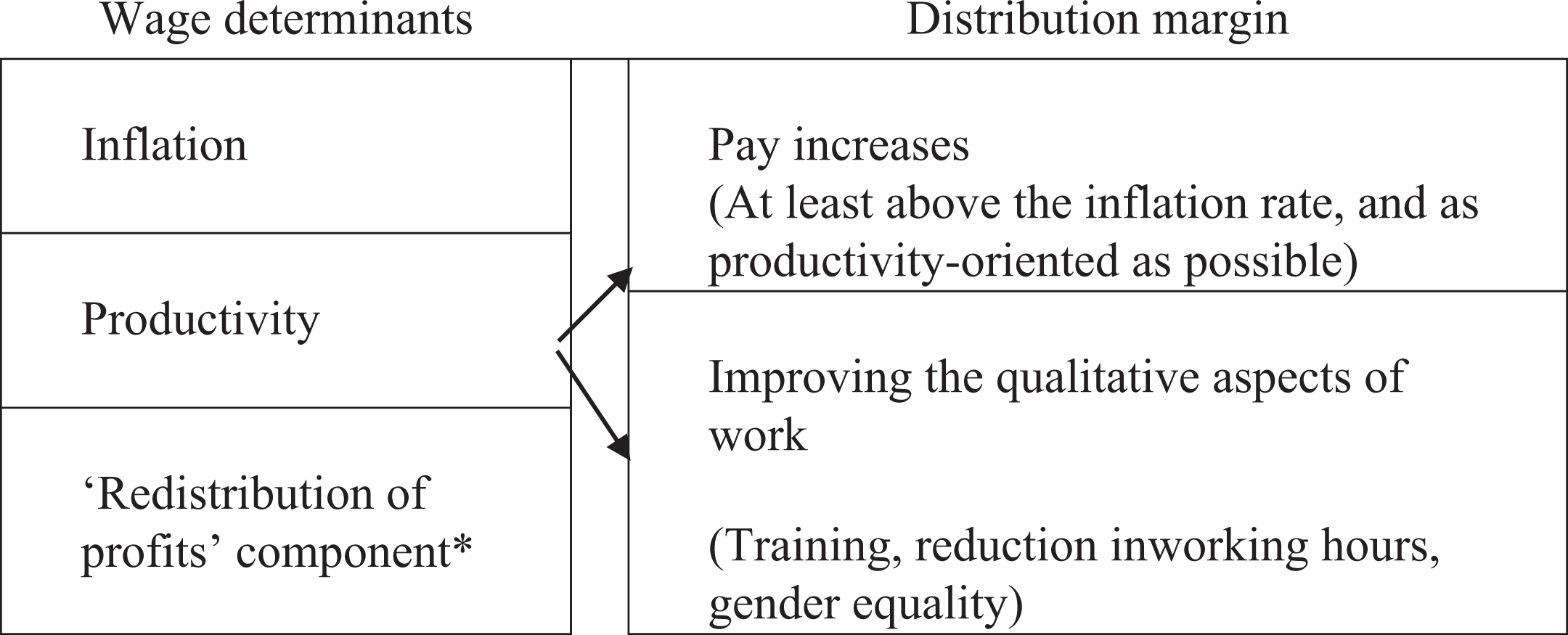
EMF proposal for a wage norm.
c) The third and final phase of the process is connected to the first two phases (comparison of national collective bargaining systems and definition of common criteria – leading to proposed wage norms) and consists of an ex post assessment of the outcomes of national bargaining rounds on the basis of these common criteria. The wage ‘norm’ is thus intended to be used as a tool for monitoring the actual results obtained at national level and not as a tool for guiding ex ante wage bargaining.
However, a detailed analysis of the process launched by the EMF reveals an interesting contradiction, which appears also across the different sectors following such a process. Though some EIF-affiliated unions follow a bottom-up approach, working together to draft common declarations in their collective bargaining coordination committees (CBCCs), these declarations have no explicit effect on their respective national bargaining rounds. For the most part, the documents they produce appear to remain mere declarations of intent. Why are they not put to use? And why are the rules developed used more for analytical purposes than as a political tool? In other words, what are the obstacles to wage coordination?
Obstacles to wage coordination
Most of the literature identifies the attachment of trade unions to the national sphere, based on established access to decision-making at this level. This attachment has been considered an obstacle to genuine engagement at European level (Martin and Ross, 2001). Decisions regarding common objectives require a de facto delegation of sovereignty from national organizations to a European-level coordination committee. An essential element for stabilizing and developing a connection between union organizations at both national and Community levels therefore relates to the confidence that each of the national organizations has in its supranational union structure (EIFs or ETUC). The creation of a strong inter-union fabric would enable national branches and confederations gradually to agree to hand over their sovereignty to supranational bodies in exchange for a European mandate.
In addition to the sovereignty issue, the question of heterogeneity also comes to the fore. In their Europeanization, trade unions seem unable to get beyond a stage of ‘regulating diversity’ (Gollbach, 2000) with regard to both bargaining levels and topics. For example, in multi-employer collective bargaining systems, negotiations are essentially conducted by unions and employer organizations, whereas in single-employer systems, they take place between unions, staff representatives or individual workers and the company. In the central and eastern European countries (CEECs), collective bargaining structures are weak and decentralized, limiting union control over wage formation processes. The topics addressed and the duration of collective agreements also vary widely between countries. These structural differences make data collection and comparison difficult.
Furthermore, if the heterogeneity of bargaining systems and practices in the various Member States undoubtedly constitutes an obstacle to their coordination, another important barrier is currently deterring their evolution. The macroeconomic framework imposed by the EMU and intensified by the European economic governance has contributed to the erosion of national collective bargaining systems. The expansion of the low-wage sector has similarly led to a decline in union bargaining power with regard to overall wage determination, while the strong trend towards decentralizing wage formation has become even more pronounced since the onset of the crisis (Glassner and Keune, 2010), making a comparison of the wage increases obtained in sectoral agreements all the more difficult (Glassner and Pochet, 2011). All these changes have had an impact on unions’ ability to coordinate collective bargaining systems at a transnational level. The trends described here are particularly marked in Germany, where a decade of German wage restraint (2000–2010) 9 prevented any attempt to coordinate wage increases in Europe during this period.
Since 2011, however, the wages strategy followed in Germany has allowed for the idea of an upward wages coordination policy to emerge. 10 Decentralized seminars were organized in this connection in 2011–2012 by the ETUC collective bargaining committee coordinator in the different Member States. The national trade union organizations, however, do not appear to have been receptive to the message of union coordination being even more of an imperative when faced with the takeover of wage-related issues by European economic governance. Trade union strategies initiated 20 years ago and coordinated around accepted wage norms have not always proved conducive to developing a ‘solidaristic’ wage policy. Euro-unionism has not managed to provide itself with a united strategy for strengthening the institutions responsible for collective bargaining in the specific national contexts.
Last but not least, the failure of wage bargaining coordination policy can also be ascribed to its technocratic nature. The coordination initiatives take place in working groups where representatives from various countries and experts specialized in European matters prepare EIF/ETUC positions. These actors act as constant mediators between the national and European levels: the Europeanization of union structures is thus limited to a small group of people passing information back and forth. The members of this small circle often know each other and have long experience of European institutions and a good knowledge of European social issues and networks (Wagner, 2005; Dufresne and Wagner, 2015). As a result of their trajectories and positions, trade unionists involved in these groups often tend to lose touch with grass-roots activism. In fact, one of the reasons why the wage coordination rule did not work as a mobilization tool was that it was never – apart from a few exceptions – mentioned in any national bargaining rounds (Erne, 2008). 11 This seems to be in line with a trend characterizing contemporary polities; namely a preference for technocratization to the detriment of distinctive political stances. Nevertheless, in the face of authoritarian control being exercised by economic actors over EU wages, the union debate is now focusing on devising a rule for establishing a European minimum wage.
The European minimum wage: better than nothing? Or a dangerous option?
Could the European minimum wage, as a second-best or better as a complementary option for the coordination of collective bargaining, be a starting point for defining wage trend norms within the EU? Or would it, instead, be a dangerous option with the potential to lower existing minimum wage levels? 12 We will quickly go through the history of the European minimum wage.
German trade unionists, campaigning for a cross-sectoral minimum wage in their own country since 2004, have been the driving force behind the European minimum wage. This European-level demand first appeared as a promising issue at the Seville ETUC Congress of May 2007, receiving support from delegates from two other major countries, France and the UK, as well as from the European Federation of Public Service Unions (EPSU). But the delegations from Italy and Scandinavia, where minimum wages are negotiated at sectoral level, categorically refused to follow this path, fearing that it would mean handing over union power – which is based on unions’ bargaining capacity – to the state. They vetoed any demand for a European minimum wage. 13 More generally speaking, the opposition front feared generating downward pressure on wages.
Given these numerous differences of opinion, the ETUC’s May 2011 Athens Congress saw little progress being made on this issue, with the same unions sticking to their initial positions. The ETUC decided to propose a wage floor in each Member State (without specifying the conventional or statutory status of this floor). In the context of the crisis and under pressure from EU authorities, a restrictive minimum wage policy became part of the package in the overall austerity programmes adopted by Member State governments (see Schulten, 2012). 14
This context led trade union organizations finally to take a decision on a specific wage floor. In its ‘Social compact for Europe’ (June 2012), the ETUC declared not only that ‘the statutory minimum wage, in those countries where trade unions consider it necessary, should be increased substantially’ but also that, ‘all wage floors should respect Council of Europe standards on fair wages’. These rules define a minimum wage as being between 50 per cent and 60 per cent of the national median wage. 15 Now that this principle is on the table, each affiliate can decide how it uses it.
Given that current legal minimum wage levels range from 36 per cent to 62 per cent of the median wage – corresponding respectively to €1.95 in the Czech Republic and €9.50 in France – this European rule would produce a relative pay rise in the former but could present a threat to national minimum wage levels by promoting a downward harmonization in France for instance. With the introduction of a floor of €8.50, the German level will constitute 51 per cent of the median wage, at the bottom limit of the new European rule, but below the ‘low wage’ threshold (€9.14). 16
The introduction of a statutory minimum wage in Germany has a highly symbolic value in Europe. Even if its effects are still difficult to estimate, the new German minimum wage creates an important paradox: ‘although, in principle, collective bargaining autonomy prevents state intervention in areas of trade union and employer organization responsibility, the sustainability or consolidation of the system no longer appears possible without state intervention’ (Bahnmüller, 2011, in Hege, 2012). The way in which the role of the state is evolving in Germany’s collective bargaining system will have broader repercussions in terms of reconfiguring power between the different parties. This will obviously be the case in Germany but also in neighbouring countries and on a European scale.
Though there is a tendency towards standardizing national collective bargaining systems, creating a model where the role of trade unions is increasingly reduced, the articulation between bargaining (monitored today at EU level) and collective mobilization has to be revisited. To apply political pressure at the appropriate level, new forms of transnational mobilization will be needed.
An impetus for transnational mobilization
Given the above-mentioned reconfiguration of power, collective transnational mobilization is essential for constructing a forceful wage policy. Indeed, the whole point of European-level coordination is to promote the creation of a European industrial relations system in which collective bargaining is based on the recognition of the autonomy of bargaining parties. This autonomy is an absolute prerequisite for any negotiations. Lowell Turner (1996) has shown that transnational cooperation develops via networks (the CBCCs in this instance) and new institutions (in this case, the ETUC and EIFs) set up by structures belonging to already existing organizations. But he noted that, in the long term, the effectiveness of such structures is dependent on popular mass demands or protests.
Austerity as an accelerator of European actions
Although cruelly lacking in the last decades, transnational social mobilization has somewhat increased in pace and intensity since the onset of the crisis. On 5 April 2008, the ETUC mobilized 30,000 unionists from all over Europe, staging a Euro-demonstration in Ljubljana (Slovenia) in support of two demands: improved pay and purchasing power, and a more equitable distribution of profits. It was the first Euro-demonstration concerning wages.
ETUC Secretary General, John Monks, subsequently forcefully asserted that ‘anger and real determination are guiding this demonstration. The ETUC’s absolute priority is to obtain fairer wages for workers throughout Europe’. This demand marks a clear reorientation away from the previous ETUC list of demands focused mainly on employment and appeals for a Social Europe and/or references to European citizenship.
In addition to this thematic reorientation, the pace of European trade union action gained further momentum from autumn 2010 onwards, with the ETUC responding to the various introductory stages of European economic governance. Whereas ETUC’s previous ‘cruising speed’ had been one or perhaps two European actions a year, nine were organized between September 2010 and November 2012. Every new austerity measure introduced was met by a series of European actions. A decentralized European Day of Action (24 March 2011) followed the conclusion of the Pact for the Euro, a Franco-German initiative of Nicolas Sarkozy and Angela Merkel in March 2011; a joint Franco-German trade union statement was published on 22 March, and, at a European level, a number of Euro-demonstrations took place over several weeks: Budapest (9 April), Luxemburg (21 June) and Wroclaw (17 September).
The ETUC Athens Congress (May 2011) can also be seen as an important moment in the rising awareness of the shift occurring in the EU. Congress contributions and its final text highlight a perception of the dangers and a new determination to fight in the European trade union movement. John Monks, the outgoing Secretary General, described the Pact for the Euro as ‘unacceptable’, whilst an official resolution rejected the ‘Six-Pack’ being prepared at the time (ETUC, 2011a). Congress contributions revealed the existence of a widely shared rejection of permanent austerity and the governance institutions established to enforce it. These heated declarations, however, were not accompanied by any protracted or enhanced coordination, and the strategic debate was paralyzed by persisting differences regarding demands for a European minimum wage (see above, for an example). The ETUC was aware that the protests undertaken were clearly not enough to meet the challenges it faced. This is why it stated it had to ‘strengthen its ability to take action at a transnational level, so that it can meet the challenges created by economic governance. We will fight to include the concept of the “transnational strike” in European legislation’ (ETUC, 2011a). As concerns the Treaty on Stability, Coordination and Governance (TSCG), an ETUC statement of 25 January 2012 stated that ‘the ETUC opposes the new treaty’. This is historically unprecedented and illustrates a very strong shift within the ETUC to demonstrate its autonomy vis-à-vis European institutions. It breaks with the previously held opinion that any kind of progress towards integration is inherently positive. Since then, the ETUC has adopted a more aggressive approach, moving closer to exploring a position in which the balance of power is influenced by collective action. This ability to take joint action would experience a qualitative leap forward with the European Day of Action called for 14 November 2012 (Dufresne and Gobin, 2013; Helle, 2015).
14N 2012, a new form of transnational collective action?
Euro-unionism distinguishes three types of European actions: Euro-demonstrations in one specific place (mainly in Brussels); Euro-strikes, simultaneous work stoppages in various countries; and, last but not least, European action days, where events are organized in all EU Member States on the same date. The substance and scale of these events are left up to the respective national trade union confederations, as was the case on 14 November 2012.
14N was a very specific moment in the history of European actions, being the first time that such a day of action was transformed into a transnational strike covering different sectors. The day saw simultaneous strike action in six EU countries. Although this kind of transnational strike had already occurred at sectoral level 17 , it was unprecedented at a cross-sectoral level.
The action taken that day took different forms and was carried out to significantly varying degrees in around 20 of the countries involved. The action advocated matched the respective national trade union and socio-economic contexts, as well as the stringency of the measures adopted in the austerity plans. In this context, three categories of countries can be identified according to the kind of action used by their trade union organizations: a general strike; mass demonstrations or symbolic action and/or messages of solidarity.
The first category consisted of trade unions from southern Europe (Spain, Greece, Italy and Portugal), which, for the first time in their history, simultaneously called a general strike 18 : a 24-hour general strike in Spain and Portugal, where the level of support for the action was the highest since the advent of democracy, and three four-hour strikes in Greece and Italy. In Greece, the GSE and ADEDY call focused on a three-hour strike, since a 48- hour general strike had been called the previous week (Karakioulafis, 2013). In Italy, the CGIL called a four-hour strike involving 50 per cent of workers. All these strikes were backed up by decentralized demonstrations and actions in many cities in the countries involved.
In the second category of countries, including France and central and eastern European countries, demonstrations took place. In France, five trade union confederations (CFDT, CGT, FSU, Solidaires and UNSA) organized about 100 rallies and demonstrations. In central and eastern Europe, demonstrations were organized in major cities in Poland, the Czech Republic, Romania and Slovenia.
Finally, the commitment of trade union confederations to this European Day of Action in major northern European countries such as Germany, the Netherlands, the United Kingdom and Sweden was smaller in terms of the numbers mobilized and was restricted to rallies and/or messages of solidarity with southern European countries while, as in the case of Germany, denouncing the social regression in their country.
The organizations involved made extensive use of the material provided by the ETUC, helping to promote unifying pan-European slogans on the common theme of austerity and its social repercussions. Despite the varying degrees of action taken in the different European countries, 14N was important as it constituted a specific stage in the development of common transnational trade union perceptions and identities. Nevertheless, despite the importance of the 14N transnational mobilization, it remains a fact that more generally the increasingly large mobilizations were mainly organized at a national level and took little account of the planned ETUC programme of action. Though the protests targeted the effects of European-level policies at national level, for the most part they did not involve a transnational dimension. In Greece, for example, the many strikes called in the country accorded only secondary importance to the European Days of Action, the subject of only collective protests or brief rallies. This was also the case in Romania, where many demonstrations were organized in autumn 2012 but where N14 went unmentioned.
Conclusion: transnational mobilization and wage coordination, first steps towards genuine European collective bargaining
The trade union movement in Europe is certainly at a turning point in its history, faced by a barrage of unbridled economic neoliberalism. European economic integration appears to have effectively led to a tendency towards a significant weakening of national collective bargaining systems (especially, but not only, in southern, central and eastern European countries) and a minimalist model in which the role of unions is shrinking. This in turn requires a rethink of trade union representation at European level with regard to autonomy and integration.
Generally, the approach used in generating trade unions’ representative functions can be broken down into four stages. Drawing up demands is the starting point as this allows for identification with the group’s objectives of ‘taking collective action’. The second stage involves generating support (for the demands) and encompasses all forms of mobilization. The following stage, the actual bargaining, is even more intense because the previous phases (demands and generating support) are already under way. The final stage, the result, concludes a cycle of trade union practice and begins the next stage. The first two phases stem from the trade union’s autonomous function and the two last stages, from putting the integration process to the test. The need to control all aspects of the process encapsulates this combination of autonomy and integration, with the ‘dialectic’ translating the fundamental ambivalence of trade unionism.
Rethinking the approach to generating European trade union representative functions at a European level also involves an examination of the conditions involved in creating a European system of industrial relations with collective bargaining based on the political recognition of the different parties’ autonomy. This system will have to be recast outside the social dialogue carried out at institutional level since the Maastricht Social Protocol, which specifically excludes the right to strike and freedom of association at a transnational level from the Community’s scope (today’s Article 153(5) TFEU). In the current legal context, the Euro-unions, transformed into ‘co-legislators’, are effectively left without either legal or practical means (the ability to mobilize) to support their claims.
The first stage in drawing up European-level demands can take place in the collective bargaining coordinating committees, which provide a space for expounding union ideology; an autonomous space that could provide the environment for activating mobilization. European-level demands should consist both of those already elaborated in previous collective bargaining rounds – i.e. a European minimum wage or a European wage norm for use in coordinating collective bargaining – and new ones, such as European-level wage indexation or the strengthening of collective bargaining. This strengthening could be rooted in specific national traditions and extended to a number of other countries.
Introducing such rules could provide an important incentive for collective European-scale mobilization and reciprocity. Indeed, the second stage of the representative process (the generation of support, in this case transnational mobilization) is not a linear consequence of developing demands as it can also be a part thereof. In this connection, two trade union challenges subsequently appear: on the one hand, the Europeanization of mobilizations involving national and European scale, and on the other, a broader alliance with other elements in social movements. With regard to the second challenge, collective transnational mobilizations have already existed for a number of years, in alliance with the social movements (Bieler and Lindberg, 2010) in different national areas as well as at European level. 20 The goals of these movements can be compatible with or indeed combined with those of the trade union movement.

The approach to generating representative functions of trade unions.19
The effectiveness of European trade unionism is dependent on its ability to combine two dimensions: the dynamics provided by the social movement and a presence in institutional arenas. This does not involve counterbalancing these two rationales but instead combining them to build the conditions for genuine European collective bargaining. This would involve coordinating collective action initiated at a European level with action conducted nationally. This scenario would boost unions’ legitimacy as regards supranational wage setting and avoid a situation in which wages are left in the hands of European economic actors (ECB, European Commission, IMF).
Footnotes
Funding
This work was supported by the Fonds National de la Recherche Scientifique (FNRS).