



Abstract
The European Works Council Directive was adopted over 20 years ago, and a voluminous body of research has developed on this relatively new institution. This article reviews the most cited literature in order to consider our state of understanding of this research field and to identify gaps in our knowledge. Most research has focused on a limited number of European Works Councils, mainly in manufacturing, and on labour actors. We still know little about the interplay between European Works Councils and other levels of employment relations, the role of management in their working and their effects on substantive employment relations outcomes. By taking stock of current knowledge, we aim to advance future directions and possibilities for research on this theme.
Keywords
Introduction
European Works Councils (EWCs) have been the focus of research for over 20 years. The 1994 EWC Directive promoted the establishment of the first mandatory transnational industrial relations institution within multinational companies (MNCs). Since then, the context of employment relations in the EU has changed significantly. The adoption of additional EU social and employment relations legislation, the European Company Statute (2001) and the Information and Consultation Directive (2002), the EWC Recast Directive (2009), the eastward expansion of the EU and the financial crisis of 2007–2008 mean that the circumstances within which EWCs operate have changed substantially. It is now apposite to take stock of our understanding of EWCs.
This article takes as its point of departure two key findings from existing research. First, EWCs are an institution in process, and this process is contested by the parties involved (Waddington, 2006a; Waddington and Kerckhofs, 2003). The pattern of development of this institution is not fixed and the range of options available is broad (Lecher et al., 1999, 2001; Weiler, 2004). Furthermore, the absence of specificity in many terms introduced in the Directive opens the door to a range of interpretations, ensuring that EWCs exhibit marked variation. Second, analyses of the Directive and relationships between EWCs, other institutions of labour representation and management initially fell into two camps: optimism that EWCs offer the potential to articulate across different levels of European representation (Martínez Lucio and Weston, 1995) and pessimism about the capacity of EWCs to enhance European industrial relations and fears that EWCs would have adverse effects on national-level participation (Streeck, 1997b). These propositions are examined here in the light of two decades of EWC practice.
We provide a systematic review of the literature on EWCs, focussing on the most cited articles published between 1992 and 2015. Four broad, interrelated themes arise. First, initial research focused on the history and content of the Directive, including the politics within the European Commission resulting in a long gestation period. Second, research assessed the variations in implementation and functioning of the Directive at company level (Gilman and Marginson, 2002). Third, studies examined the role and views of the different actors, primarily focusing on labour representatives (Lecher et al., 1999, 2001), while employers’ organizations and management have been considered much less. Fourth, a growing literature examines the evolving practices of EWCs, ranging from the information and consultation agenda, the wider negotiation role undertaken by an increasing number of EWCs, the development of transnational worker coordination and mobilization through to management’s attempt to organize coercive comparisons or whipsawing (Greer and Hauptmeier, 2016; Telljohann et al., 2009; Weiler, 2004).
Our aim is to help shape a future research agenda. To this end, two questions are raised: how has research on EWCs evolved over the past two decades and what are the shortfalls in the current understanding? We suggest that while a broad understanding of the functioning of EWCs has been established, shortfalls remain. Below we first present the schema used to assess the literature, then examine the different research methods employed in EWC research, and conclude with some of the substantive themes of EWC research, including historical and legal studies, EWC practice and the actors in EWCs.
Methods
We analyse the most cited publications produced during the 20 years after the adoption of the Directive. As there is no single, standard instrument to identify the most cited publications, research output was cross-checked in a range of databases by searching ‘European Works Council(s)’ within titles, abstracts and keywords. Studies included in the sample had three or more citations within either the Web of Science, Scopus, Business Source Premier or EBSCO databases. Ten citations were required from Google Scholar, as its citation count is based on a much wider range of sources. The citation count was relaxed for the literature published after 2009 when the Recast was adopted, as citations take time to accumulate: publications with two citations, or five if cited by Google Scholar, were accepted. Publications referring to EWCs only in passing were manually excluded. After filtering, 115 publications were included in the sample.
The sample comprised primarily journal articles (92%; all percentage figures throughout the article refer to our sample), although it also included some books, book chapters, working papers and research reports. For simplicity we use the terms ‘article’ or ‘paper’ to refer to any of these publications. Figure 1 shows the number of publications in each year from 1992 to 2014. It is apparent that articles on EWCs were most frequently published around the turn of the century. The plot declines sharply after 2013, perhaps reflecting the ‘lag’ in published articles being cited.
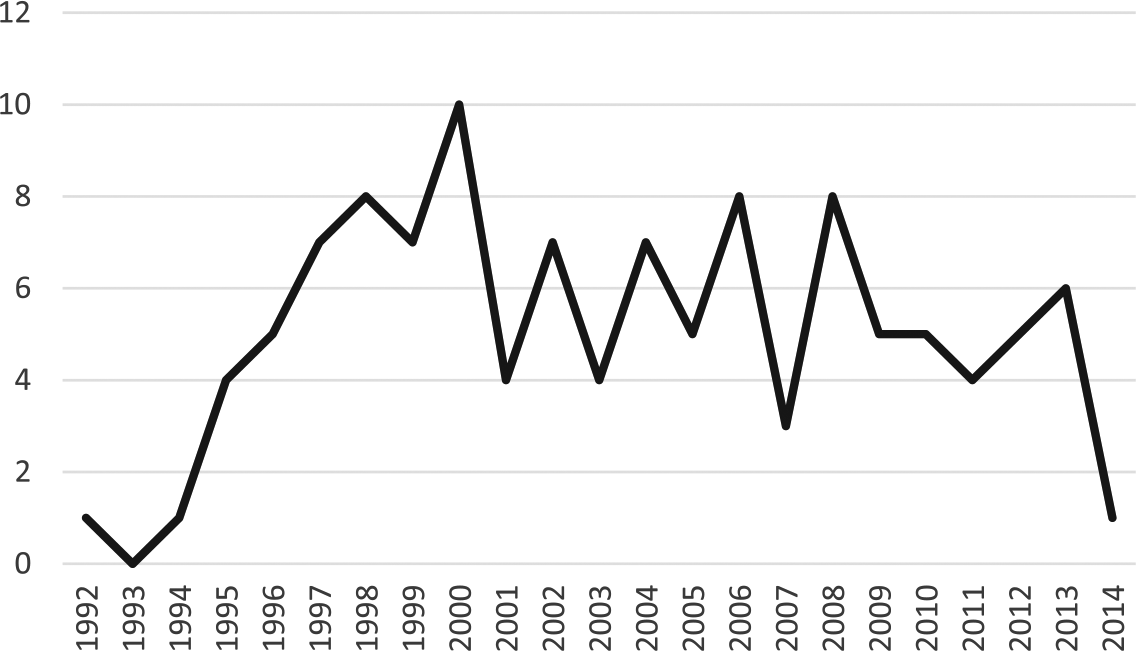
Number of articles in the sample published each year.
We acknowledge two limitations of the sample. First, the vast majority of articles included in these databases are written in English. This bias is mitigated insofar as many writers for whom this is not their native language publish in English, and their work is included in the database (e.g. Da Costa and Rehfeldt, 2008; Lecher et al., 1999; Streeck, 1997a). Thus, the sample does not only cover the opinions of Anglophone world but is, indeed, skewed towards this world. Second, citation databases focus on research articles published in academic journals and tend to under-report books, book chapters and working papers. Influential texts published in these forms were picked up through the Google Scholar search. Furthermore, authors who publish research as books or reports may also publish the same material as journal articles.
EWC analyses: methods and focus
We first examine the focus and methods deployed in the study of EWCs. Original empirical research has been mainly based on documentary analysis and case study research, with fewer quantitative analyses.
Documentary approaches have examined the content of EWC agreements and compared different clauses on specific topics. These studies have identified the impact of contextual factors, such as the home country or sector of operation of the MNC, whether the agreement was based on Article 6 or 13 of the Directive, structural features such as the composition of EWC representatives, the content of the agenda and the presence or absence of a select committee (Krieger and Bonneton, 1995; Marginson, 1999; Weiler, 2004). Qualitative case studies have mainly relied on interviews to examine the operation of EWCs (Lecher et al., 1999, 2001); a very small number have employed observation (Bailey, 2009), and a single researcher used an ethnographic approach (Timming, 2006, 2010). A prominent finding of case study research is that EWCs are at different stages of development, with some remaining rudimentary or symbolic and others becoming collective actors with sophisticated transnational procedures (Lecher et al., 1999). The use of quantitative methods is infrequent, and a quarter of the articles using such methods have the same author (Waddington, 2003, 2006a, 2006b). The contribution to this Special Issue by De Spiegelaere and Waddington follows this approach.
Research on EWCs is restricted in its contextual focus, for example, focusing on relatively few countries. Thirty-four papers concentrated on a particular country or countries, with the majority (19) considering only one country. Seven compared two countries, one considered three countries, five considered four countries and two considered six countries. Nineteen countries are examined within the sample. Of the 34 articles that have a specific country focus, 16 consider the United Kingdom, in part because of its distinctive industrial relations system (Wills, 1999) and the initial United Kingdom opt-out from the Maastricht social chapter (Gold and Hall, 1994). Germany is also ‘over-represented’ with eight articles addressing specific German issues, particularly the establishment of voluntary/pre-Directive EWCs (Rivest, 1996) and the distinctive nature of German industrial relations (Weston and Martínez Lucio, 1997). Since about 2002, however, there has been a broadening of national focus with the new Member States figuring more prominently in the literature (Bernaciak, 2010; Meardi, 2004).
Thirty articles had a sectoral focus, and here too there is a restricted coverage. All these articles focused on the private sector. Twenty-four articles examined manufacturing exclusively (85% of sectoral studies), especially car manufacturing (35%), of which more than half consider the General Motors (GM) EWC (Fetzer, 2008; Greer and Hauptmeier, 2012). EWCs in the automobile industry have been particularly innovative and, thus, present opportunities to study advanced EWC relationships and practices (Whittall, 2000). In addition, metalworking and chemicals (Müller et al., 2011) figure prominently. Two studies look exclusively at services, and two compare the manufacturing and services sectors. Hence, most research has been undertaken in sectors where union presence is pronounced. Less is known about practices in sectors where trade union organization is sparse, such as hospitality and textiles and clothing. Furthermore, the little that is known about these industries suggests that experiences are notably different from those in manufacturing, with EWCs facing significant obstacles (Royle, 1999). In short, research has developed a deep understanding of a segment of the population, but relatively little work has been undertaken elsewhere.
To a degree, it is understandable why research has focused on EWCs where institutional development is in process: it is easier to secure funding and research access, and publish on what is happening rather than explain why nothing has taken place. A consequence, however, is that research portrays EWCs as more developed than most are in practice. It is as if only the optimists have conducted research on EWC practices, while the pessimists have decided not to pursue their enquiries empirically.
Substantive themes
We now examine the substantive focus of EWC research, considering three broad themes in the literature: historical and legal analyses, EWC practice and the role of actors. Although there is overlap, evaluating them separately helps assess how the functioning of EWCs and related academic knowledge have evolved over time.
Historical and legal analyses
Historical and legal analyses initially focused on the complex negotiation of the Directive (Hall, 1992), and more recently the Recast (Jagodzinski, 2008; Laulom, 2010). The authors noted the importance of the political breakthrough constituted by the Directive and the potential for the participation of worker representatives in the decision-making processes of MNCs. They also discussed the form that EWCs might take, the terms on which they were to operate and the range of political objections to such a measure. These analyses, however, were far from unanimous in assessing whether effective participation would be achieved through the Directive and highlighted the ambiguity surrounding many of its terms (Streeck, 1997b). Those considering the potential for participation evaluated EWCs by reference to industrial citizenship and industrial relations practices within MNCs, with a particular emphasis on the relationship between EWCs and collective bargaining, as well as the development of a European system of industrial relations (Marginson and Sisson, 2004). This research points to the increased role of social actors, in particular the development of European activity by unions, and the complex interaction between EWCs and varied national systems of industrial relations. The authors disagreed on the potential for outcomes. Optimists saw EWCs leading to a European system of industrial relations by offering the potential to develop pan-European policies and networking (Martínez Lucio and Weston, 2000). Pessimists argued that EWCs were likely to weaken and undermine existing national industrial relations systems and to promote social dumping (Streeck, 1997b). Evaluation of the Directive was, thus, contested from the outset.
Three observations are apposite at this juncture. First, although trade unionists have repeatedly expressed concerns with aspects of the Directive, there has not been a set of concerted and coordinated legal challenges. Second, legal studies have not established whether or why managers select one national transposition to underpin an EWC in preference to another. Third, there are several national studies of judicial decisions reached on EWC practices (Blanke, 2010; Lorber, 2010), but comparative analyses intended to establish whether there is an overall direction across Member States are rare; one exception is Dorssemont (2010).
EWC practice
A wealth of literature, primarily case studies, considers the establishment of EWCs and their functioning at company level, with a focus on the impact of the terms of founding agreements (Cressey, 1998). These studies explore the costs and benefits of different approaches to EWCs. The impact of negotiating EWC agreements in ‘the shadow of the law’ (Bercusson, 1992) is noted throughout the early phase, but is not the only influence on EWC development: for example, the country of origin of MNCs, sector and ‘learning effects’ are shown to be influential (Gilman and Marginson, 2002; Hall et al., 2003). Similar updated findings are identified in the article by De Spiegelaere and Waddington in this Special Issue, where they not only discuss the importance of the law for EWCs as an institution in process but also note the importance of the learning effect generated by the negotiation of agreements. The level of importance of the different influences, they argue, is dependent on the topic being discussed.
Information and consultation are core functions of EWCs. Analyses of their practices have, thus, focused attention on these procedures. Some EWCs have developed sophisticated procedures, often combined with extensive communication systems and mechanisms to articulate EWCs with other institutions of labour representation within and outside the company. Research also demonstrates that many long-standing EWCs have remained at a rudimentary stage of development (Marginson et al., 2013). Two points arise from these observations. First, there is no certainty regarding the distribution of EWCs along any continuum of development. Second, EWCs tend to engage in information rather than consultation, and have a limited capacity to influence corporate restructuring (Lecher et al., 2001; Telljohann et al., 2009). Surveys confirm that EWC representatives are largely excluded from strategic corporate decision-making (Waddington, 2011). European policy-makers acknowledged this point and used it to underpin arguments supporting the Recast.
Recognition of the failure of many EWCs to develop beyond rudimentary forms led to investigation of the obstacles to their development. These arose from a range of national, sectoral and company factors, such as the lack of common traditions, cultures and language, limited access to training and resource availability (Fulton, 1995; Miller and Stirling, 1998). While in some cases management is reluctant to engage meaningfully with EWCs, in others their contested nature may limit their advancement, as the parties wish to pursue different courses of development (Marginson et al., 2004; Waddington, 2006b).
While there are limitations in the extent to which the formal information and consultation agenda is being realized, some EWCs have negotiated transnational company agreements (Wills, 2002). Engagement of management in such agreements indicates willingness by some companies to negotiate at European level (Greer and Hauptmeier, 2008, 2012), although BusinessEurope opposes the adoption of legislation to regulate such negotiations. Where management is unwilling to conclude transnational company agreements, the EWC and/or unions cannot force these through (Platzer and Rüb, 2014).
Actors
We now consider the role of the different actors from negotiation of the Directive to the operation of EWCs: employee representatives, unions and management.
Initial research on employee representatives examined the facilities required to undertake this innovative supranational role (Marginson, 1999). These included resources for representatives to maintain contact outside of formal meetings and to engage with those they represent (Weston and Martínez Lucio, 1997; Wills, 1998b). Researchers have examined information sharing between EWC representatives, regarding this as challenging, in that geographical separation coupled with the absence of shared traditions and language limit informal exchanges (Fulton, 1995; Miller, 1999), which, in turn, impinges on power relations among EWC representatives (Bartmann and Blum-Greenen, 2006).
The regulatory approach taken by policy-makers towards EWCs offered opportunities to move beyond information sharing. Hence, research emphasis shifted towards transnational labour solidarity and networking among EWC representatives (Martínez Lucio and Weston, 2000). It is now generally agreed that transnational coordination is essential for EWCs to exert an influence within MNCs (Whittall et al., 2009). The generation of transnational solidarity is more complex than the establishment of solidarity at national level (Wills, 2000), not least because of language barriers, differences in culture and the absence of a single national system of industrial relations, all of which may inhibit the development of trust (Knudsen et al., 2007; Timming, 2006). Elements of the constitutions of EWCs also inhibit transnational labour coordination: for example, annual meetings with little communication between them, formal agendas allowing few opportunities for informal exchanges and in some cases the dominance of representatives from the home country of the MNC (Hürtgen, 2011).
Despite these obstacles, EWC research identifies a number of successful cases of transnational coordination. An initial necessary condition seems to be the development of shared ideas and interests, as in GM’s case. This required the development of close relationship and trust between EWC representatives, often facilitated by an active select committee and regular exchanges/meetings (Platzer and Rüb, 2014). Dense relationships between EWC representatives further facilitated shared interpretation of problems and helped to develop joint responses, including European action days with parallel protests and stoppages. In the context of adverse economic conditions and company losses, the GM EWC also developed the strategy ‘to share the pain’, jointly negotiating concessions with European headquarters for all European plants (Fetzer, 2008; Greer and Hauptmeier, 2012; Pulignano, 2006). The paper by Mählmeyer in this Special Issue re-examines ‘successful’ EWCs since the economic crisis. She finds that amidst dire economic conditions, personal relationships break down relatively easily and what were once effective EWCs have become less integrated and less successful. Thus, the development of close relationships is essential but not easy to maintain.
Some researchers argue that transnational solidarity requires specific resources such as training and technology (Miller and Stirling, 1998; Whittall et al., 2009), while others highlight the role unions can play in both the provision of resources and articulating the EWC with other institutions of labour representation (Telljohann, 2007; Wills, 1998a). The article by Föhrer and Erne in this Special Issue further examines the role of training in the development of transnational networks. While they do not challenge earlier assertions that training can be vitally important for transnational solidarity, they find that the reality of existing training programmes is such that they are not equipped to offer opportunities for action.
This stream of EWC research recognizes that structural factors also impinge on transnational labour coordination. In a number of ‘Euro-companies’, management decision-making is centralized at the European level, and production sites are interconnected through production platforms, which enables management to shift production volumes and allocation between different plants and to play different workforces off against each other (Greer and Hauptmeier, 2016; Marginson et al., 2004). Labour representatives learnt that countering such transnational coercive comparisons and whipsawing was futile within a national context. The paper by Pulignano in this Special Issue questions whether countering these challenges is in fact futile impossible and points to the importance of articulation between institutions and actors at different levels. She finds that where such articulation exists, framework agreements can be developed, which can, in turn, constrain managerial choice.
Research suggests that solidarity among EWC representatives is not commonplace, and thus many EWC representatives do not think they are able to influence managerial decision-making. EWC representatives view the quality of information and, particularly, consultation as inadequate for this task (Waddington, 2006b, 2011). They report that management releases huge volumes of information, much of which is irrelevant, immediately prior to the meeting, but that information on key issues is often not made available (Telljohann et al., 2009). Similarly, they report that consultation does not necessarily accompany information, that the time available for consultation is limited and that when it takes place decisions are already finalized (Waddington, 2011; Weiler, 2004). These shortfalls are viewed as particularly damaging in the context of corporate-restructuring decisions, an area where European policy-makers envisaged EWCs would exert an influence as companies adjusted to the demands of the single market. In short, EWC representatives do not generally think that the objectives in terms of information and consultation are being met in practice.
Trade unions campaigned for more than 25 years for transnational participation, yet when the Directive was adopted the term ‘union’ was excluded. Unions’ support for transnational participation reflected a long-standing concern about the limited influence they could bring to bear on MNCs (Levinson, 1972). Their initial response to the Directive was one of cautious support while acknowledging limitations (Fulton, 1995). Research on the presence of unions in EWC research occurs at a similar frequency to that on employee representatives. About 65 percent of the articles consider their role in some way. Sources examining unions are split between those that focus on national unions (Hancké, 2000) and those focusing on the European Trade Union Federations (ETUFs) (Turner, 1996), with a few analysing the interrelationship between the two (Pulignano, 2005). Five interrelated issues are central to the understanding of the role of union organizations and EWCs: networking and articulation, unions as suppliers of resources, the division of labour between the European Trade Union Confederation (ETUC), ETUFs and the ratification of transnational company agreements, and unions and the coverage rate of EWCs.
Networking requires articulation between different levels of labour representation within the company and between countries. Kerckhofs, in this Special Issue, highlights the complexities in ensuring representativeness of employee representatives in geographically dispersed networking. He identifies a ‘maximum authority and minimum guidance’ in terms of the internal legitimacy of EWCs, balancing the ability and willingness of employee representatives to manage an independent agenda with the need to articulate with national bodies. Such networking and articulation are, in part, dependent on unions having access to contacts in other countries, to material resources, to personnel and to expertise (Miller, 1999). The terms of early EWC founding agreements, for example, were often inferior when union organizations were not formally involved in their negotiation (Waddington, 2011). The requirement in the Recast to inform unions of the commencement of negotiations to establish an EWC should facilitate early union engagement and the imparting of expertise. Union organizations are also in a position to provide resources to support the operation of EWCs in the form of personnel to act as coordinators, training and information on ‘best practice’. The generation of solidarity among EWC representatives is dependent on unions identifying unifying interests (Da Costa and Rehfeldt, 2008).
While evidence suggests that EWCs assist employees in developing cross-border collaboration (Bernaciak, 2010), it also indicates that the role of unions is currently insufficient (Pulignano, 2006). Without their support, it is unlikely that solidarity will develop among EWC representatives (Platzer et al., 2001). The role of active local unions is fundamental (Wills, 2002), but often local unionists appear to be passive or unclear as to the intended role of EWCs (Knudsen, 2004). There are also differences in emphasis between unions regarding EWC development. UNI Europa, for example, pursues a policy based on establishing permanent union alliances, whereas IndustriAll has opted for ad hoc alliances when circumstances demand. Union movements from different countries, industrial relations traditions and ideological backgrounds debate policies towards EWCs (Miller, 1999) and local unions sometimes even use transnational information to compete with and undermine workers in other countries (Hancké, 2000).
Following decisions at the ETUC Congress in 1999, responsibility for the operational coordination of EWCs was allocated to the ETUFs, while the ETUC pursued campaigns within the European polity to revise the Directive. Within the ETUFs, differences between national systems of industrial relations and union policies ensure a tension surrounding the mandate of the different parties (Müller et al., 2011). Awareness of their role is often not high within companies (Müller et al., 2011), so in practice they often leave the day-to-day operation of EWCs to national affiliates with an oversight role undertaken at European level through the appointment of a coordinator who acts on their behalf (Lecher and Rüb, 1999). Research has yet to examine in detail the consequences of this approach.
The growing number of transnational company agreements and the role of EWCs in their negotiation present another issue for ETUFs (Müller et al., 2011). All insist that unions are responsible for reaching agreements with employers’ organizations and managements. The initiative for the negotiation of some transnational company agreements, however, comes from the EWC. To accommodate these developments, ETUFs have arranged for an appropriate committee to ratify an agreement before it is recognized as valid. This approach ensures that a union organization rather than the EWC is the ratifying signatory. It remains to be seen whether the ETUFs have the material and political resources to sustain the additional roles they have assumed. Conchon and Triangle, in their contribution to this Special Issue, explore the experiences of ETUFs to date, identifying that while progress has been made much still remains to be done.
A further role assumed by ETUFs concerns increasing the number of EWCs. While estimation of the coverage rate of EWCs is difficult because of extensive company restructuring that changes the number of MNCs within the scope of the legislation, it is thought to be about 40 percent (Waddington, 2011). The onus is thus on the ETUFs and affiliated unions to increase this number, particularly as BusinessEurope repeatedly cites low coverage as an indicator of a lack of interest in the establishment of EWCs. Research has yet to elaborate how such an increase might be achieved, and the role that unions could undertake in this process. The characteristics of MNCs with no EWC are becoming clearer: they tend to be smaller and with operations in private sector services (De Spiegelaere and Jagodzinski, 2015). Employee representatives based in the home country of some MNCs have rejected requests from their counterparts in foreign subsidiaries to establish an EWC, on the grounds that it would dilute existing relationships with central management (Whittall et al., 2008, 2015). A further task for research is, thus, be to examine if or how union organizations have responded to such situations.
Research with a primary focus on management and employers’ organizations remains rare. About a quarter of the papers examine in some form their role in the context of EWCs. These observations, however, mostly occur in papers with a primary focus on labour representatives and unions. Research on employers’ organizations has tended to focus on their engagement with politics, while that on management has focused on the operation of EWCs.
BusinessEurope (until 2006, UNICE) has been the primary focus of research on employers’ organizations. Claiming support from national employers’ associations, it opposed the adoption of the Directive and its subsequent revision, arguing that legislation would create a ‘one-size-fits-all’ legal straitjacket that ran counter to the dominant trend of managerial decentralization. It favoured voluntary arrangements for transnational information and consultation (Gold and Hall, 1994). At a pragmatic level, BusinessEurope has argued that EWCs slow managerial decision-making, impose high costs on companies and provide limited benefits to MNCs (Waddington, 2011).
Research has failed to substantiate these claims. First, it remains obscure how the national employers’ associations affiliated to BusinessEurope contribute to the positions which it voices: do they all share the same position or are there any differences in emphasis, as among unions? Of course, research on this topic is not straightforward, as decision-making within BusinessEurope is far from transparent. Second, as yet there has been no systematic analysis of whether the substantive concerns expressed by BusinessEurope are well grounded. However, case study research confirms that there is a huge variation between EWCs in practice; the Directive, far from generating a ‘one-size-fits-all’ institution, is drafted to allow maximum flexibility to the actors involved at company level (Marginson et al., 2013). Similarly, data on the costs of EWCs demonstrate that only a minority of managers highlight these as problematic (ORC, 2007; Weber et al., 2000); moreover, these costs vary greatly, reflecting not so much the number of delegates or the frequency of meetings as the purposes allocated by managers themselves to EWCs (Waddington et al., 2016).
Research on managers and EWCs has tended to focus on operational matters. Four wide-ranging findings characterize the literature. First, managers implement a vast range of approaches, in part reflecting the breadth of purpose which they envisage for their EWCs (Lecher et al., 2001). Strategic variation is also apparent in managerial approaches, with some adopting minimalist stances and others being more inclusive (Telljohann, 2005). In combination, these points illustrate the flexibility afforded to managers by the legislation. Second, managers tend to involve EWC representatives in decision-making at the implementation rather than the strategic phase (Pulignano et al., 2016). Managers and EWC members, thus, agree that employee representatives are largely excluded from strategic corporate decision-making, contrary to the intentions of European policy-makers. Third, managerial practice is on a ‘learning curve’, as new policies are conceived and implemented (Marginson et al., 2013). Development along this learning curve has resulted in improved outcomes for MNCs, particularly in communications (Addison and Belfield, 2002), in mechanisms to control EWCs (Ramsay, 1997), in restricting union attempts to develop bottom-up coordination (Wills, 1999) and in the introduction of more effective coercive comparisons (Greer and Hauptmeier, 2016; Pulignano, 2006). Fourth, managers have in some cases used EWCs as a means to add value. This practice emerged early in the development of MNCs (Lamers, 1998), but over time has become more widely apparent and embraces a wider range of practices, prominently top-down and bottom-up communication systems, the generation of employee commitment to corporate decision-making, the reinforcement of corporate identity and assistance in corporate restructuring (Pulignano and Turk, 2016).
In summary, managers have adapted to the introduction of EWCs, ensuring benefits accrue to their companies. Managerial practice is, however, uneven, with structural and industrial relations factors being influential (De Spiegelaere and Jagodzinski, 2015; Marginson et al., 2013).
Conclusion
Our review confirms three points highlighted in the literature. First, EWCs are an institution in process, as demonstrated by the evolution in the policies of the parties involved and by the amendments to the underpinning legislation. Second, they are contested institutions, insofar as the legislation necessitates negotiation of many of the parameters of their operation and the parties involved, including the ETUC and BusinessEurope, have different objectives. Third, the debate between the optimists and pessimists remains active. It is possible to identify participative EWCs that meet many of the expectations of the optimists regarding solidarity, networking and the initiation of transnational campaigns. Similarly, the pessimists could cite the absence of EWCs in the majority of MNCs covered by the legislation and the rudimentary form of many that do exist, as well as their frequent isolation from other institutions of labour representation within the MNC and their subordination to the influence of management.
Over the past two decades, the study of EWCs has become established as a vibrant research area, generating many insights into their evolution and functioning. As our review indicates, however, there are also shortcomings, which should be addressed as part of a future research agenda. First, EWCs operate within a multi-level context, whereby different levels – local, national, European and global – influence their working. Researchers have grappled with the problem of multi-level governance in the EU (Marginson and Sisson, 2004), and these approaches might provide inroads for future research on EWCs in order to address the interplay between plant-level representation, national unions, ETUFs and Global Union Federations. Second, no EWC has yet been established in a significant proportion of European MNCs covered by the Directive. Little is known about the factors that explain successes or failures in establishing EWCs. The union organizing literature which investigates how unions successfully organize new members and companies at national level (Heery et al., 2000; Milkman and Voss, 2004) offers a potential approach to identify strategies that contribute to the successful establishment of EWCs. Third, EWC literature has often focused on ‘types’ of EWCs, but much less is known about industrial relations outcomes and how these are affected by EWCs. Some have negotiated transnational agreements in the context of corporate restructuring, and these outcomes are well documented, but future research could go further to explore whether and how EWCs affect the character and outcomes of national- and plant-level industrial relations within MNCs. Fourth, EWC research tends to focus on certain segments of the economy. Manufacturing and, in particular, automobiles, figure prominently. Future research will have to widen the scope and move beyond these highly developed EWCs. Finally, research is too narrowly focused on the labour side: only a few studies investigate management and employers’ organizations. Future research could give more attention to the varying attitudes of employers, particularly the differences between managers and BusinessEurope, and also explore how managers use EWCs in practice.
Research illustrates the breadth of policies implemented towards EWCs and the limitations of the legislation. Managers and employee representatives agree, however, that EWCs are principally institutions of information rather than consultation, let alone negotiation, and that they are excluded from strategic corporate decision-making. The intentions of European policy-makers in regard to information and consultation have thus not been realized. The latter point raises a series of research questions about European policy-making. In particular, what is the appropriate relationship between enforcement, flexibility and compliance in industrial relations legislation? In the case of the Directive and the Recast, it is apparent that the flexibility inherent in the legislation facilitates the pursuit of a wide range of policy options, but where there is no compliance there is no mechanism whereby the intentions of European policy-makers can be enforced.
Footnotes
Declaration of Conflicting Interests
The author(s) declared no potential conflicts of interest with respect to the research, authorship, and/or publication of this article.
Funding
The author(s) received no financial support for the research, authorship and/or publication of this article.