



Abstract
Trade unions are often said to be hostile to a universal basic income (UBI). Their judgement may be affected by factors such as their work ethic, perceptions of the unemployed and preferences for labour decommodification. Yet, most studies fail to sketch out the reasons for which unions oppose or support a UBI from a normative standpoint. To understand the impact of ideology on unions’ appreciation for a UBI, I integrate results from 62 questionnaires with 27 in-depth qualitative interviews. This study illustrates that unions’ preferences for a UBI are associated with their theoretical understanding of labour, diverging substantially across welfare regimes. Whereas unions from Bismarckian and Nordic countries are generally opposed to a UBI, organizations from Liberal and Mediterranean countries tend to see UBI as a legitimate policy option. However, in some circumstances they set aside the policy for pragmatic reasons, thus disconnecting their normative orientations from perceptions of its concrete viability.
Introduction
Trade unions have been generally regarded as staunch opponents to a universal basic income (UBI). The Basic Income Earth Network (BIEN) defines the policy as a ‘periodic cash payment unconditionally delivered to all on an individual basis, without means-test or work requirement’ (BIEN, 2021). Strategic and organizational factors are often mentioned as primary reasons for unions’ hostility (Van Parijs and Vanderborght, 2017). Unions have few incentives to endorse a scheme that targets the ‘outsiders’ of the labour market, as these people rarely coincide with union members (Standing, 2014; Vanderborght, 2006). Likewise, labour organizations might be averse to radical welfare reforms that threaten their power resources, institutional position and legitimacy (Henderson and Quiggin, 2019). For instance, a universal income floor could undermine unions’ position in collective wage negotiations vis à vis the employers, and deprive them of key administrative responsibilities (Birnbaum and De Wispelaere, 2016).
While most accounts on trade unions’ positions towards a UBI focus on instrumental reasons, the scholarly literature tends to overlook ideological and cultural justifications on which unions’ preferences are based. In most countries, unions’ organizational cultures and legacies have a significant impact on their strategies (Gumbrell-McCormick and Hyman, 2013; Meardi, 2011). As Hyman (2001) posits, unions’ identity locates at the intersection between ‘market’, ‘class’ and ‘society’, with each union reflecting a peculiar combination of at least two of these elements. Whereas unions tend to be described as lobbies or rent-seeking actors, culture and ideology are likely to exert a significant influence on their attitudes towards path-breaking policy changes such as an unconditional income floor. In other words, unions’ strategies need not be rational or interest-driven, as long as they are consistent with normative orientations and positioning in the political spectrum.
At first glance, unions have good reasons to endorse a basic income. First, a UBI would shield workers from market vagaries, reviving the old goal of labour decommodification (Polanyi, 1944). A basic income would give people the power to say ‘no’ to badly paid, demeaning jobs and adverse working conditions (Standing, 2011). Some unions could regard a UBI as a chance to do away with conditionality in welfare provision, that is, linking benefit eligibility to a set of stringent obligations (for instance the duty to find a job). On the other hand, a number of features may discourage trade unions from supporting a UBI. Traditionally, unions have embraced the idea of paid work as the foundation of the post-war social contract (Offe, 2009). An income detached from work could be seen as an unfair reward to the idle and a disincentive to labour market participation. Moreover, in several countries trade unions have not opposed ‘activation’ measures designed to ‘make work pay’, which goes against the principle of unconditionality underlying a basic income (Clegg and Van Wijnbergen, 2011; Emmenegger et al., 2012).
Research on trade unions’ positions for a basic income has been scant and inconclusive. Apart from Vanderborght (2006) and Standing (2005; 2014), few authors have systematically navigated this domain. As a result, trade unions’ opposition to a UBI tends to be dismissed as common knowledge. This assumption is problematic, as it suggests that all unions disavow basic income. In fact, empirical evidence demonstrates that several trade unions have endorsed or still endorse a UBI. More importantly, instances of unions’ support have been motivated on normative grounds. In South Africa and India, workers’ organizations have publicly backed a basic income as a means to advance equality, freedom and individual empowerment (Standing, 2013; Van Parijs and Vanderborght, 2017). Likewise, unions from Quebec (Canada) and Switzerland have advocated for a UBI to free workers from market constraints and allow them to take on jobs they like (Syna 2012; Wernerus, 2004).
While actors’ preferences are often identified at ‘face value’ and associated with official positions (Scharpf, 1997; Durazzi et al., 2018), research should not underestimate the process by which ‘policy-relevant ideas, their cognitive contents and normative underpinnings, are created, selected, modified, disseminated, and sometimes ignored in the policy process’ (Hemerijck, 2013). The process of internal preference composition, aggregation and deliberation precedes and affects positions taken in the public sphere. In the case of a UBI, the existence of a voiced demand for income security may be left unheard if unions were not ready to incorporate these requests into their platforms. While instrumental objectives are important and should not be disregarded, trade unions’ strategies are likely to reflect their theoretical understanding of labour, as well as the normative goals and orientations that give shape to their trajectories. Why should trade unions embrace a universal basic income, and what makes this policy salient or attractive in the eyes of union leaders?
To answer this question, I combine results from 62 survey responses with 27 qualitative, semi-structured interviews. This article demonstrates that trade unions’ preferences for a UBI are associated with their organizational cultures and positions on the two principles of unconditionality and universality. Unions that cultivate a strong work ethic, rejecting the theoretical separation of income security from wage, have a harder time to conceive a UBI as a legitimate policy option. In Nordic and Continental welfare regimes, unions place great emphasis on waged labour, employment and conditionality, thus rejecting a UBI on normative grounds. Conversely, unions from Liberal and Mediterranean countries are more open towards a UBI. Trade unionists in these two groups rarely think that a UBI would make paid work less attractive; on the contrary, they believe that a UBI would de-commodify labour and update the idea of work to the new ‘realities’ in the labour market. However, external constraints and pragmatic factors may discourage them from explicitly supporting a basic income in the public debate.
The rest of this article is divided into four sections. In the next section, I shortly review the reasons why unions may accept, or vice versa dismiss, a basic income on ideological grounds. After that, I illustrate the data and methodology used. In the subsequent sections, I examine evidence from the survey and the interviews, highlighting how attitudes towards a UBI vary across different union cultures and preferences for conditionality and universality. Finally, I summarize the main trends and conclude.
Ideological justifications: Decommodification and the labour contract
The aim of this study is to delve into the cultural and philosophical pre-conditions for unions’ support for a UBI. In a recent book, Van Parijs and Vanderborght (2017) recall that for a basic income ‘political feasibility is intimately linked to ethical justifiability’. Therefore, the admissibility of UBI within trade union platforms depends on the degree to which their élites perceive the policy as a good fit with their cultural legacies and long-term normative orientations. In this sense, and differently from much of the recent Comparative Political Economy (CPE) literature, I interpret unions’ preference formation as primarily pre-strategic and internal to the organization.
There is no consensus on what a ‘basic income’ is, and definitions of a UBI vary across political leanings. According to the BIEN, a UBI has five main characteristics: it is paid at regular intervals; it is a cash transfer; it is paid to every individual; it is given to all; it is obligation-free, and thus unrelated to labour market participation (BIEN, 2021). Among the reasons that justify a basic income, the values of liberty, equality, social justice and sustainable development are most cited. The goal of fighting income insecurity has recently gained ground, especially after the onset of the Covid-19 pandemic (Nettle et al., 2021). In the context of the Covid-19 crisis, UBI proponents have seconded the idea of an ‘emergency basic income’ to ensure an income floor to those who are in need or lose their job due to market disruptions (Kildal, 2021). Crucial differences in policy settings relate to the generosity of the transfer and its relationship with existing schemes. While neoliberal advocates call for a cheap UBI as a sort of income supplement (Widerquist et al., 2013), others think it should be fixed at least at the poverty line (Standing, 2017). Another distinction is between a basic income that substitutes the current services and transfers system, and one that complements current welfare provision. The 2016 BIEN Congress in Seoul has adopted a motion in favour of the latter, clarifying that residual versions of a UBI should be considered with extreme caution (Yamamori, 2016).
From an ideological standpoint, one might expect some degree of alignment between unions and basic income advocates. In principle, ‘the idea of providing a stipend to every person in a given country […] seems like it would be a project that socialists would love’ (Sculos, 2018). We might identify three main tangency points between trade unions and basic income proponents: the principle of ‘decommodification’; the goal to fight precariousness; the ambition to incorporate different forms of labour, such as unpaid or informal work, into their platforms. For one, a basic income could respond to the goal of liberating workers from market constraints and create a society based on fairness, social justice and equality. Drawing from Polanyi (1944), Esping-Andersen (1990) defines decommodification as the situation in which ‘citizens can freely, and without potential loss of job, income, or general welfare, opt out of work when they themselves consider it necessary’. It goes without saying that ensuring that ‘a person can maintain livelihood without reliance on the market’, as theorized by Esping-Andersen, is broadly in line with trade unions’ perspective. According to UBI proponents, a basic income would give people the power to say ‘no’ to adverse working conditions, freeing them from the obligation of selling their labour power (Van Parijs, 1997).
Secondly, in the last decades, unions have made some efforts to expand their base and cater to the ‘precariat’, people overrepresented in alienating, demeaning and underpaid positions (Standing, 2011, 2014). A UBI could provide a strong protection against precarious work, which per se is no guarantee of a decent living, and bridge divides between the ‘haves’ and ‘have-nots’ in the labour market. This contrasts with a purely labourist perspective, according to which creating jobs is more important than giving a basic income. As Standing notes, ‘Giving more people the right to dig holes in the road while the exhaust fumes of passing cars fill the lungs is scarcely a right worth having’ (Standing, 2005). By contrast, a basic income would ‘give people the opportunity to do what they want to do’ (Standing, 2017), and liberate them from the obligation to accept precarious positions. Facing a dire crisis of membership and legitimacy, unions could embrace a basic income to act as a ‘sword of justice’ for the most vulnerable and cater to the outsiders (Flanders, 1970).
Finally, a UBI can be seen as a means to reconsider the idea of labour in advanced capitalist economies. A basic income would reward activities that cannot be compensated for in the formal market, including voluntary, family, domestic and care work, which are mostly performed by women (Elgarte, 2008; Pateman, 2004). According to some authors, in the current phase of ‘Cognitive Capitalism’, the production of value happens both inside and outside the workplace, and wages compensate only for a fraction of the value created (Lucarelli and Fumagalli, 2008). A basic income would allow the full enjoyment of citizenship rights, without them being embedded in a ‘hierarchical model of production’ (Fumagalli, 1998). The UBI should hence be thought as a primary income – a way of recompensing all forms of ‘invisible’ labour we perform during our lifetime. Unions that cultivate a broad conception of labour, encompassing informal and care activities, could endorse a UBI to break the chain of exploitation and guarantee a fair reward to different forms of work.
Despite few exceptions, however, unions have generally been reluctant to the idea of a universal basic income (Standing, 2005; Van Parijs and Vanderborght, 2017; Vanderborght, 2006). Unions’ hostility emerges from two main sticking points: first, UBI advocates and trade unions have different work ethics and conceptions of ‘reciprocity’; second, unions are first and foremost workers’ organizations, and thus prefer work-based forms of welfare support. To begin, where the perspectives of unions and UBI proponents clearly diverge is on the principle of reciprocity, that is, the idea that one’s income should correspond to human effort (Offe, 2009). According to Vanderborght (2006), trade unionists believe that a basic income would jeopardize the importance of waged labour in capitalist economies. A UBI is paid for with the activity of those who sell their labour in the market; nonetheless, it is given to everyone, regardless of need, income or employment conditions. Unions seem to be wary about the idea of an income detached from work, suggesting that it would unnecessarily reward the ‘lazy’ and discourage labour market participation.
Secondly, in several countries unions are seen as the guardians of the ‘insurance principle’, that links waged work with the functions of income replacement or security in the welfare state (Gumbrell-McCormick and Hyman, 2013). European social protection systems are generally based on an insurance logic, for which workers pay social contributions to pool social risks across individuals and over the life course (Esping-Andersen, 1990). According to some authors, UBI rests on the rather different tradition of ‘redistributive market liberalism’, for which tax-financed cash transfers can best alleviate poverty and inequality (Sloman, 2018; Vicherat, 2015). As a result, trade unions may perceive a contradiction between their attachment to the insurance principle and the introduction of a universal income support (Henderson and Quiggin, 2019).
According to its proponents, a basic income would pursue the goal of labour decommodification and liberate workers from market chains. Unions’ likelihood to support a basic income may be associated with the strength of such ambition among the union élites, and the centrality of this long-term goal in the agenda. Nevertheless, most unions conceive work – and not income – as a driver of freedom, solidarity and social inclusion. Those who do not work despite being able to do so might be seen as ‘idle’ and undeserving of an unconditional cash allowance. Trade unions that cultivate a robust work ethic and attachment to the insurance principle may reject a basic income on normative grounds as it gives ‘money for nothing’, breaking the social contract of a fair wage for a decent job. On the other hand, some unions could be more open to the idea of a cash transfer disconnected from work. In particular, trade unions with an orientation towards the broader working class (including the ‘precariat’) may embrace a basic income to bridge labour market divides, revive social solidarity and reward different forms of work. This helps me to formulate the following hypothesis: H1: Unions’ opinions towards a UBI are associated with different welfare state traditions and ideological orientations.
Data and methods
To test this hypothesis, I adopt a mixed-methods approach that combines survey data with semi-structured interviews. From January to April 2019, I sent a self-completion questionnaire to 270 trade unions affiliated to the International Trade Unions Confederation (ITUC). The questionnaire was directed to union officials or representatives within peak-level unions and national confederations (therefore excluding other sectoral or lower-level unions). The email address book is available online at the ITUC website 1 . Email contacts indicated on the address book refer either to the unions’ general address or the international offices within the same organization. Officers who received the e-mail were asked to forward the questionnaire to their colleagues that were responsible on social policy issues. In other words, the survey target group was union officers who deal with these areas of expertise, usually working in the social protection, labour market, employment or wage policy departments. While questionnaires were anonymous and I could not verify the interviewees’ identity, e-mail respondents guaranteed that the survey would be filled by someone who is expert or in charge of these policy areas. At the end of the process, I collected 62 responses from 49 countries (for more details, see the Supplementary Online Annex).
The survey listed a set of questions on the ethical justifiability and political feasibility of a UBI. In the first part, union leaders were asked to provide their personal and their unions’ position on this policy. In the second part, they were asked to declare their level of agreement or disagreement with a set of statements on issues such as work disincentives, decommodification and degree of income protection offered by a UBI (the full list of questions is in the Supplementary Annex). I deliberately chose to contact members of the administrative body instead of elected or political leaders to obtain a more reliable ‘estimate’ of unions’ positions. In the case their union did not take an explicit stance, respondents were invited to provide their ‘best guess’. While this approach might be clearly prone to an ecological fallacy (extending a person’s opinion to the whole organization), I assume that survey responses can best approximate union preferences. In all cases but one, the person’s and the organization’s stated positions corresponded, implying that union officers are unlikely to express a stance that is inconsistent with their organization. Where possible, survey answers were triangulated with any other information available (policy papers, congress documents and press releases).
Before proceeding, some further caveats are in order. First, the objective of the survey was not to create a random sample of union officers, but rather to estimate unions’ preferences on a single policy issue and compare them across countries. Whereas the response rate was rather low (22%), this should be less problematic since there is no ambition to extend these explanations to the whole population. Secondly, since the survey was available exclusively via email and in two languages (English and French), some potential respondents may have met technical barriers. This approach may discourage older people and respondents with lower levels of IT and language skills, leading to biased estimates. Since younger and more skilled people are also more likely to endorse a basic income, this strategy may exaggerate trade unions’ appreciation for a UBI. While begging caution on the generalizability of these results, the sample achieves a fair level of internal heterogeneity. Indeed, only a minority of the respondents (10.7%) are under 30 years old, while 42.9% are between 45 and 64.
In the second phase, I conducted 27 in-depth, semi-structured interviews with trade union officers and researchers from 23 different organizations. 22 interviews involved country-level personnel, while five were made with staff members belonging to international confederations. To arrange the interviews, I sent invitations via email to get me in touch with the person I wished to talk with. Also in this case, I complemented this data with the analysis of available documents, congress proceedings, reports and press releases. As we shall see later, interviews were crucial to explore unions’ normative orientations and illustrate potential links with their positions towards a UBI. However, respondents’ views may not necessarily fit with the union’s platform. On the other hand, the fact that respondents were policy experts speaking on behalf of their organization may act as a guarantee on the reliability of this data.
Both the survey and the interviews were designed to map out unions’ positions and verify how normative justifications translate into diverse preferences for a basic income. While potential biases could arise, the approach intended to give a reliable estimate of unions’ positions on this policy. The next section describes survey results and illustrates union preferences across countries and welfare systems.
Union positions on a UBI and preferences across welfare regimes
In the first part of the survey, union representatives were asked to express their level of appreciation for a universal basic income as defined by the Basic Income Earth Network (2021): ‘a periodic cash payment unconditionally delivered to all on an individual basis, without means-test or work requirement’. Responses were given on a 1–5 scale and ranged from ‘strongly against’ to ‘strongly in favour’.
Trade unionists’ responses to the first part of the questionnaire.

When discussing UBI, a major problem is that different versions of a basic income have been designed. UBI proposals cover the full political spectrum, ranging from the neoliberal idea of a fiscally neutral benefit, to the socialist one of a generous income floor. In the survey, officers were asked if a UBI should replace or complement existing welfare schemes. The vast majority of respondents declare that a basic income should complement, and not substitute, current welfare provision, consistently with the progressive idea of a universal safety net. Among high- and middle-income countries, only a small group of seven officers (Argentina, Brazil, Estonia, France, Montenegro, Portugal and Turkey) say that it should replace current welfare provision.
To identify possible drivers of unions’ support for a UBI, and observe differences across welfare systems, I narrow down the scope to a group of 44 unions from 31 middle- and high-income countries. Selected countries are OECD members, plus a group of middle-income countries for which data is available (Albania, Argentina, Brazil, Bulgaria, Macedonia, Moldova, Montenegro, Romania and Russia).
In the second part of the survey, trade unionists were asked to indicate their level of agreement with a set of eleven statements (the full list is available in the Supplementary Annex). Responses were on a 1–5 scale, ranging from ‘strongly in favour’ to ‘strongly against’. Themes in the survey broadly retraced the discussion in the first part of this article, touching upon three possible tangency points (decommodification, need to address the outsiders and desire to include different forms of labour), and two potential points of controversy (conditionality and attachment to work-related welfare provision). This thematic mapping was meant to ‘dissect’ the concept of a UBI into analyzable features, and see whether preferences for or against a basic income are associated with specific positions on themes such as the precariat, income security, risk of liberalization, satisfaction with existing welfare provision, etc.
One of the statements focused on the de-commodifying power of a basic income: ‘With a UBI, human activity (labour) would be freed from market constraints’. Most trade unionists agree that a UBI would enhance individual economic freedom: out of 35 available responses, 15 officers (42.8%) are in favour or strongly in favour, and 10 (28.5%) are indifferent. Another statement was on unconditionality and the adverse effects of UBI on employment: ‘A UBI would create a disincentive to work, rewarding who sits on the sofa’. Out of 38 answers, 28.9% think that a basic income would discourage labour participation; 50% are against or strongly against this statement; 21% are indifferent. On the other hand, the sample seems divided on whether a UBI should be used to include less unionized groups (23.7% in favour, 36.8% indifferent, 39.4% against or strongly against). When it comes to the relationship with existing welfare provision, most respondents prefer what is already in place. 50% of the interviewees suggest that the UBI proposal is financially costly, unfeasible or ineffective vis à vis existing benefits (36.1% are against this statement). Similarly, 45.9% of the sample fears that a UBI could make the economy more flexible or deregulated, opening the doors to welfare state retrenchment (while 32.4% disagree with this statement).
Differences across countries and welfare regimes
So far, two survey findings stand out, matching with my theoretical expectations. First, union officers appreciate the idea of decommodification underpinning a basic income (almost 43% in favour or strongly in favour). Decommodification constitutes a strong point of alignment between the two perspectives, as both trade unionists and UBI proponents look forward to a world where workers are less dependent on market forces. Secondly, when it comes to the relationship between UBI and existing welfare systems, union officers seem to prioritize current welfare provision. They fear that a basic income could make the economy more flexible and deregulated or become a ‘Trojan horse’ for liberalization. Perhaps more counterintuitively, however, a relative majority of the interviewees think that a UBI would not disincentivize work and that it would not serve as a strategy to include less unionized groups.
To answer to this conundrum, I proceed by clustering responses in welfare regime groupings. Rather than taking union responses as a monolithic block, it is likely that variation in positions towards a UBI corresponds to variation across trade union traditions and welfare systems. Therefore, the following part explores relevant trends and possible explanations for union divergence on UBI preferences. The objective is to check whether belonging to a certain country or welfare system provides some degree of variation in the cultural and social legitimization of a UBI among union élites. Different welfare systems are indeed characterized by distinct conceptions of the work-income nexus, trade union positions in the institutional framework and functioning of social policy schemes (Esping-Andersen, 1990; Gumbrell-McCormick and Hyman, 2013). To group countries in welfare clusters, I adopt the conventional typology of Nordic, Continental, Liberal and Mediterranean countries (Ferragina and Seleeib-Kaiser, 2011).
Trade union responses vary significantly across welfare regimes. Unions from Liberal and Mediterranean countries tend to approve a UBI, considering it as a driver of economic freedom and a protection from market distortions. Liberal respondents (Canada, Ireland, Israel, New Zealand and United Kingdom) are mostly in favour of this policy (four over six), and only two declare to be ‘indifferent’. In this same group, five respondents over six disagree that a UBI would create a disincentive to work. Mediterranean trade unionists (Greece, Italy, Portugal and Spain) are also in favour of a UBI, as three respondents over four endorse this policy. In addition, all of them think that a basic income would protect people from market vagaries (three over three available responses). On the contrary, Nordic and Continental trade unionists are overwhelmingly against a UBI. In the Nordic cluster (Denmark, Finland, Iceland and Sweden), six respondents over seven disapprove a basic income; in the Continental group (Belgium, France, Germany and Switzerland), four are against and only one is in favour. A majority of Nordic and Continental respondents think that the proposal is unfeasible or ineffective, that it would not benefit the outsiders and that it would contribute to dismantle the welfare state. All Continental respondents also think that a UBI would not liberate human activity from market constraints. Moreover, it is worth noting that theoretical approval of a UBI is not necessarily associated with actual support. Despite showing interest in the policy, all Liberal respondents concur that a basic income would be costly or less effective vis à vis other schemes.
At first glance, attitudes towards UBI seem to reflect different work ethics as well as conceptions of how to guarantee income security. Trade unionists from Liberal and Mediterranean countries stand in favour of a UBI and see it as a guarantee against market distortions. These respondents are not opposed to a basic income on the grounds that it would discourage work participation, implying that the issue of unconditionality is not a theoretical deterrent for their approval. The picture seems completely different as one moves to Nordic and Continental Europe. Almost all of these respondents stand against a UBI, whose introduction is seen as a threat to welfare provision and as less desirable than existing employment-based forms of income support. In the next section, I use the interviews to sharpen these theoretical links and analyze how different conceptions of deservingness and universality translate into diverse preferences for a UBI.
Unions’ interpretations of labour, conditionality and universality
In the previous part, I found substantial variation in the level of UBI support among union leaders. Against the theoretical predicament of trade unions’ hostility to a UBI, unions from Liberal and Mediterranean countries seem to perceive no ideological or cultural dissonance with a basic income. On the contrary, Nordic and Continental trade unionists reject a UBI from a normative perspective; in most cases, they seem path dependent to employment-based forms of income security and supportive of existing welfare schemes. To clarify the determinants of such diverse positions, this section examines qualitative evidence from 27 interviews conducted between January and April 2019. First, I give an overview of unions’ understanding of a UBI, illustrating how these stances mirror distinct conceptions of waged work and welfare provision. Second, I explore unions’ attitudes towards a UBI based on their ideas on universality and conditionality.
UBI, union cultures and theoretical links between income and wage
As expected, the reason for which some trade unionists seem to dismiss a UBI is that it hardly fits with their organizational tradition. For several interviewees, a UBI would be ‘not a union issue’ (Germany and Finland), or not in line with the unions’ agenda (Ireland and Italy). An officer from Italy suggests that to imagine an income detached from work is an ‘enormous cultural effort’, which motivates a delay in adjusting their strategies. A German trade unionist puts it even more bluntly: The point is, what is the relevance of this for the daily work of trade unions? In my view, it doesn’t exist. […] We can discuss about everything, but it is not a point that is relevant for our work. It’s not on the table. It’s like thinking about socialism. I think it would be good to think more about socialism again, but that’s a more difficult question. […] If you want to think about an alternative to capitalist production, you have to think a bit deeper than that.
Four respondents from Conservative welfare regimes (Belgium, Germany, Switzerland and France) defend the role of labour as a driver of dignity and freedom. This result is consistent with the survey findings, as Continental trade unionists record among the lowest levels of appreciation for a UBI. In countries where people tend to ‘glorify employment as a signifier of identity and status’ (Sage, 2018), and unions are seen as guardians of the ‘insurance principle’, union officers may be more reluctant to sever the ties between wage and income. For the Belgian interviewee, work ‘is the means for the individual to succeed, to fulfill a social coherence, to develop yourself as a person. […] It is an element of social evolution’. In such a framework, a UBI would be a ‘pretext for eroding the right to work’. An interviewee from Switzerland takes a similar stance, arguing that work is ‘a factor of social integration in society, participation, rights’. However, not all interviewees from Continental welfare regimes are of this view. Two respondents (Netherlands and Switzerland) stress that work is not necessarily a synonym of well-being. Notably, the Swiss trade union Syna has never made a secret of its favourable views for a UBI, seen as a protection against degrading or humiliating jobs (Syna, 2012). This is made clear by the words of a Swiss officer: Work is not the only source of dignity and freedom, but it can be also the reverse. We talk about modern slavery. In Switzerland, we have some domestic workers, such as migrants from Slovenia, staying always at home; they never get out. […] Work should not be sanctified, there are also these cases. It would be nice if all jobs were equivalent to dignity and freedom, but they aren’t.
Three interviewees (Ireland, Netherlands and Switzerland) deviate from a work-centred perspective, arguing that a UBI could stimulate a broader redefinition of labour and its role in society. According to a Dutch officer, a UBI would allow people to work for shorter hours, move from one job to another and take care of their ‘loved ones’. For the interviewee, a basic income would help ‘many people [who] struggle with work, study and caring responsibilities’. In like manner, an international officer clarifies that a UBI would reward other forms of work, not necessarily recognized in the labour market: ‘If a housewife is taking care of their children, that’s labour! Of if you do like painting, or anything else that is good for society – all these good things are not paid’.
Attitudes towards unconditionality and universality
To further unpack ideological justifications towards a UBI, experts were asked to express their attitudes towards universality and unconditionality. These two principles are considered as the main normative tenets of a UBI, and the characteristics that distinguish it from traditional cash transfers. With the term universality, UBI proponents mean universal allocation of a benefit to a given population regardless of any economic, social or personal characteristic (simply put, ‘money for all’). With unconditionality, they refer to freedom from any form of obligation preceding or following the reception of a certain benefit (or ‘no strings attached’). Whereas a UBI may be dismissed for pragmatic reasons, union leaders could still share universality and unconditionality as long-term goals within their platforms.
Trade unions’ preferences for universality and unconditionality. No data for Argentina, Canada and Denmark.
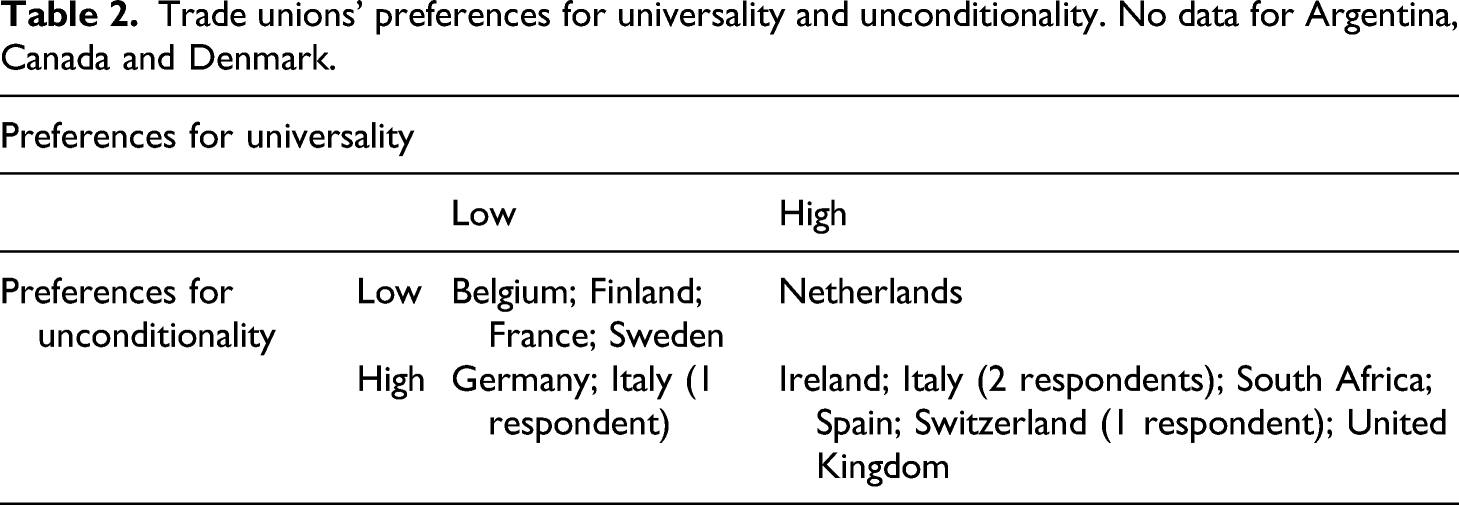
On the other side of the spectrum, six trade unionists are in favour of universality in policy settings (two from Italy, Ireland, South Africa, Spain and UK). Interviewees from Ireland and South Africa consider universality as a long-term ambition that should be pursued. For an Irish respondent, both universality and unconditionality are desirable, and to some extent they already characterize the Irish system. However, consistently with the previous findings, not always theoretical appreciation for a UBI corresponds with actual endorsement. Notably, a group of three trade unionists from Italy, Spain and the UK share universality as a principle, but renounce to it for pragmatic reasons. The British interviewee points out that: it is well known that take-up rates are higher for universal benefits than means-tested; but we are also conscious that there is a limit about the money that can be spent. Our possible orientation to universality mismatches with our British pragmatism.
Likewise, a Spanish expert contends that a universal benefit could be desirable in the long-term; however, given the government’s under-investment in social expenditure, Spanish unions cannot ask for more than a means-tested benefit. A similar position is taken by an Italian expert: ‘In a country like ours, where there is no adequate labour market policy nor public services [...] and a great part of the population is in hardship, a universal benefit is not a priority on the agenda’. Interviews with Liberal and Mediterranean unions show a clear disconnection between ideal and pragmatic objectives, as originally anticipated by Vanderborght (2006).
Trade unions’ positions towards unconditionality are less straightforward. The only group that is distinguishable from the others is the Nordic one, whose respondents are strongly opposed to unconditionality. For a Swedish officer, ‘benefits should come with requirements. And from that perspective, a basic income is problematic. […] If you start giving money for nothing, you start giving up with people’. The respondent suggests that a UBI could lead people out of the labour force, that is good ‘neither for society, nor for the individual’. The result would be that of fostering the dangerous perception of the ‘undeserving poor, who don’t like to have a job, because they’re not required to’. Danish and Finnish trade unionists share this view, prioritizing activation programmes over unconditional cash transfers. For a Finnish officer, a UBI would discourage people from work and undermine a social contract based on high taxes, high employment and high levels of trust in society. On the other hand, some respondents favour unconditionality as a long-term goal and oppose restrictions or activation requirements (Ireland, South Africa, Switzerland, Spain, UK, Germany, and Italy). For these officers, the issue of unconditionality is less problematic or should not discourage the adoption of a basic income. A Swiss interviewee points out that ‘people would still have jobs because they like doing something, because they benefit from social networks, and from the social status related to work’. For an Irish officer, past evidence of UBI trials shows that such policies do not necessarily decrease employment, because ‘you know – people want to work’.
Discussion
Survey and interview findings suggest that unions’ openness to UBI reflects different conceptions of labour, employment and income security. Continental and Nordic respondents are strongly opposed to a UBI on both theoretical and pragmatic grounds. For these officers, a basic income is no panacea for including labour market outsiders, would increase the chances of liberalization and seems less desirable than existing forms of welfare support. These positions are at odds with more positive attitudes from Liberal and Mediterranean unions. For these interviewees, a UBI could liberate workers from market constraints (in line with the idea of decommodification), protect them from economic distortions and foster social inclusion.
Secondly, trade unionists differ in their conceptions of who should access welfare support (universality), and what should be the obligations attached to income receipt (unconditionality). Nordic and Continental trade unionists are critical about the idea of universality enshrined in a UBI. These interviewees place strong emphasis upon the insurance principle, according to which one’s income should be linked to work and social contributions. In addition, Nordic unions display a clear aversion to the idea of unconditionality. These respondents prioritize measures to fight inactivity. By contrast, unions from Liberal (Ireland and UK) and Mediterranean countries (Italy and Spain) have a more nuanced understanding of the ‘labour contract’. Their appreciation for an income detached from work is associated with positive attitudes towards both unconditionality and universality. Trade unionists from these countries believe that a UBI would not discourage labour participation and that people should be free of any form of monitoring.
Third, the analysis shows a mismatch between theoretical positions and actual strategies for Mediterranean and Liberal respondents. Some trade unionists identify a UBI as a long-term ambition which is consistent with ideals of social justice and solidarity. However, these views must come to terms with the hard reality of unions’ declining power resources, political trade-offs and tight fiscal budgets. Despite approving UBI from a theoretical standpoint, interviewees from Italy, Spain and the UK stress that they cannot afford to endorse a basic income because of political and organizational constraints.
Conclusion
In the recent CPE literature, unions have been generally described as rent-seeking actors, shielded in core industrial sectors, and uninterested in radical welfare reforms that address the outsiders (Emmenegger et al., 2012; Palier and Thelen, 2010). Despite this perception, however, unions’ logics of action result from a complex interplay of organizational self-interest, identities and normative orientations that structure their trajectories in the medium and long term (Scharpf, 1997). This study had the objective to investigate whether and why would unions accept a universal basic income from an ideological standpoint. Contrarily to mainstream expectations, unions may be willing to support a UBI if this is seen as consistent with their positions on work and income security. Cultural and normative factors significantly affect union strategies, framing the way union élites discuss, select and promote social policies in the public domain.
This article has illustrated that union attitudes towards a UBI emerge from different cultures, work ethics and normative understandings of labour. Findings can be summarized in three main points. First, preferences in UBI support vary across welfare regime types. Continental (in particular France and Germany) and Nordic (Denmark, Finland and Sweden) unions experience the highest level of ideological friction with a UBI. These unions are likely to regard UBI as a disincentive to work, a Trojan horse for liberalization and a less desirable measure vis à vis current welfare provision. Union officers from these countries seem path dependent to the social insurance system, according to which income replacement should be employment-based and benefits earmarked to previous contributions. On the other hand, unions from Mediterranean and Liberal countries seem much more open to a UBI from a theoretical standpoint. In these organizations, a basic income is seen as a shelter from market vagaries, a protection from income insecurity and a means to bridge divides in (and out of) the labour market.
Secondly, different conceptions of income security mirror diverse attitudes towards the two UBI principles of unconditionality and universality. Nordic and Continental trade unionists are averse to the idea of universality in welfare provision, emphasizing the insurance principle and the need to provide support only to those who really need it. In addition, Nordic trade unionists seem particularly wary of the idea of unconditionality. According to these respondents, an unconditional cash allowance would encourage inactivity and undermine a model based on high levels of trust, taxes and labour participation. Conversely, Liberal and Mediterranean trade unions share the two goals of unconditionality and universality. UBI is seen as a way to overcome a fragmented or residual welfare state, reward different forms of work and guarantee income security to everyone, without necessarily jeopardizing labour market participation.
Lastly, not always theoretical attitudes reflect pragmatic policy choices. In some cases, the huge costs of a UBI and political difficulties attached to its implementation discourage union élites from supporting it in the public space. Whilst approving a UBI on theoretical grounds, Liberal and Mediterranean unions fail to include this policy in their platforms because they consider it unfeasible, too costly or not politically convenient in the current context.
Supplemental Material
sj-pdf-1-ejd-10.1177_09596801211043094 – Supplemental Material for Looking for a North Star? Ideological justifications and trade unions’ preferences for a universal basic income
Supplemental Material, sj-pdf-1-ejd-10.1177_09596801211043094 for Looking for a North Star? Ideological justifications and trade unions’ preferences for a universal basic income by Luca Michele Cigna in European Journal of Industrial Relations
Footnotes
Acknowledgements
I would like to thank the editor and the two anonymous reviewers for their valuable comments. I am also grateful to the Sciences Po School of Public Affairs, as this publication is based on a previous Master’s Thesis project. Finally, I would like to thank Bruno Palier for his superb supervision and feedback throughout the development of this project.
Declaration of conflicting interests
The author(s) declared no potential conflicts of interest with respect to the research, authorship, and/or publication of this article.
Funding
The author(s) received no financial support for the research, authorship, and/or publication of this article.

Supplemental material
Supplemental material for this article is available online.
Note
Author biography
References
Supplementary Material
Please find the following supplemental material available below.
For Open Access articles published under a Creative Commons License, all supplemental material carries the same license as the article it is associated with.
For non-Open Access articles published, all supplemental material carries a non-exclusive license, and permission requests for re-use of supplemental material or any part of supplemental material shall be sent directly to the copyright owner as specified in the copyright notice associated with the article.
