



Abstract
During the Holocene, Florida experienced major changes in precipitation and runoff. To better understand these processes, shallow marine sediment cores from Charlotte Harbor (southwest Florida) were studied, covering approximately the past 9000 years. Whole core XRF scanning was applied to correlate different sediment cores on a river to sea transect. Biomarkers were used to identify periods with increased runoff and primary productivity. The mid-Holocene sediments are characterized by a relatively large input of terrestrially derived organic matter, with a maximum in precipitation and runoff around 5 kyr BP. This maximum can be linked to large-scale changes in the hydrological cycle involving shifts of the ITCZ, Bermuda-Azores High and Polar Front. Around 3.5 kyr BP, Charlotte Harbor changed from a runoff-dominated environment to a more oligotrophic and marine setting. Although other studies suggest that, around this time, precipitation in Florida increased, this is not reflected by the Charlotte Harbor records. Possibly, wetter conditions in Florida due to gradual, ongoing, sea level rise in combination with increased precipitation, resulted in accumulation of organic matter on land. Increased sedimentation rates, terrestrial input and primary productivity observed in the upper part of the record are likely a consequence of human impact during the past century. Throughout the record, indications for storm activity can be recognized as coarser grained layers consisting of quartz sands or shell debris. These layers are rare during the mid Holocene, but between 3.2 and 2 kyr BP, their numbers increase, suggesting an increase in tropical cyclone activity in the Gulf of Mexico.
Introduction
The Holocene is generally considered as a period of relatively stable climate, gradually recovering towards milder conditions since the last ice age. It is, however, becoming increasingly clear that large-scale variations occurred on millennial to decadal timescales (Mayewski et al., 2004). Whereas at high latitudes primarily temperature varied (e.g. Kaplan and Wolfe, 2006), low latitudes experienced mainly changes in hydrology (LoDico et al., 2006). It is, however, not clear to what extent these changes were linked. The tropics and subtropics play an important role in global climate because they absorb most solar radiation (heat), which is subsequently transported to higher latitudes. Studies in the Gulf of Mexico and the Caribbean indicate large variability in precipitation patterns and moisture transport during the early and mid Holocene (Montero-Serrano et al., 2010; Poore et al., 2003). Proxy and model studies suggest that shifts in the Inter Tropical Convergence Zone (ITCZ) played an important role in the observed changes (Haug et al., 2001; Poore et al., 2003).
The Florida peninsula is positioned between the (sub)tropical and higher North Atlantic climate systems. Currently, the climate in Florida is characterized by a strong seasonal contrast in the hydrological cycle, with wet summers and dry winters. During the Northern Hemisphere summer, thunderstorms develop as cool, humid air from the Gulf of Mexico or Atlantic Ocean collides with the warmer air above Florida, resulting in large amounts of precipitation. Also hurricanes, which are most frequent in late summer (September), supply a large part of the summer precipitation. In winter the air is colder and more stable resulting in less raincloud development. The amount of winter precipitation in Florida is affected by the El Niño Southern Oscillation (ENSO) with higher amounts of rainfall during El Niño events (Cronin et al., 2002; Schmidt et al., 2001).
Sea-level rise played a major role in the development of the Florida coastal system, which includes many bays and estuaries. Submergence and sea-level curves for Florida and the Gulf Coast region indicate fast sea-level rise following the last deglaciation, and decelerating rates towards the present (Scholl et al., 1969; Törnqvist et al., 2004; Toscano and Macintyre, 2003) This rise in sea-level was responsible for environmental changes throughout the Holocene (Brooks, 2011; van Soelen et al., 2010).
To better understand the environmental changes that resulted from sea-level rise and climate change during the mid and late Holocene, coastal sediments of the Charlotte Harbor estuarine-lagoon system in Florida were studied. Whole core XRF scanning was used to correlate sediment cores across Charlotte Harbor, providing a stratigraphical framework. Subsequently, biomarker analyses were used to reconstruct past changes in runoff and primary productivity. The records were compared against existing climate records to put the data set in a larger perspective.
Material and methods
Setting
The Charlotte Harbor estuarine-lagoon system is located in the south of Florida, west of the Florida Platform which consists dominantly of carbonates of Cretaceous to Tertiary age (Mitchum, 1978). Extensive karstifcation as a result of subaerial exposure of the carbonates caused the formation of sinkholes and basins. The shape and position of Charlotte Harbor is probably linked to such sinkholes (Evans and Hine, 1991). Charlotte Harbor consists of two lagoons (Gasparilla and Pine Island Sound), an intra-estuary lagoon (Matlacha Pass) and an estuary in central Charlotte Harbor (Figure 1). A small hypoxic sub-basin exists in the somewhat deeper part of the estuary, where, during periods of increased runoff, vertical stratification leads to hypoxic or even anoxic bottom water conditions (Pierce et al., 2004). Freshwater is supplied mainly by the Myakka, Peace and Caloosahatchee Rivers. Water and sediment supply via these rivers are considered to be low, about 136 m3/s and 330,000 ton/yr, respectively (Isphording et al., 1989). The southwest of Florida is characterized by a subtropical to tropical climate with an annual rainfall of about 120 cm. Freshwater discharges from the major rivers correlate closely with seasonal rainfall, which is highest during the summer season (June–October) (Taylor, 1974). The low-energy west coast of Florida experiences average wave heights of about 30–50 cm (Hine et al., 1987; Tanner, 1960) and tidal waves of less than 1 m (NOAA: http://tidesandcurrents.noaa.gov/). Tropical cyclones can temporarily increase the energy by increasing wind speeds (Powell and Houston, 1996) and precipitation (Miller, 1958) and due to waves and storm surges during which large amounts of sediment can be eroded and re-deposited (Sedgwick and Davis, 2003).

Map of Charlotte Harbor (modified from Evans et al., 1989), showing the locations of cores CH1, CH3, CH7 and CH15.
Sampling and core description
Four sediment cores (CH1, CH3, CH7 and CH15) were retrieved from Charlotte Harbor (Figure 1), during spring 2008, with a vibracorer deployed from the USGS R/V G.K. Gilbert. A push core was collected parallel to core CH1 in order to retrieve undisturbed top-sediments. Visual correlation between shell fragment layers in the push core and vibracorer at the location of CH1, indicate little or no compaction of the sediments during vibracoring. Cores were split longitudinally, described visually and photographed. An image of the full split core surface was obtained using an optical line camera. One half of core CH1 was sampled in 0.5 to 1 cm thick intervals; the other half was stored as reference. The water content was determined at different intervals and interpolated to all depths to allow for the calculation of mass accumulation rates in the sediment core.
XRF scanning
Archive core sections were run through the Avaatech x-ray fluorescence (XRF) core scanner, located at the Royal Netherlands Institute for Sea Research (NIOZ), Texel, Netherlands. XRF measurements were performed along the longitudinal axis of split sediment cores, with a step size between 0.5 and 1 cm and a sampling time of 30 s. To avoid desiccation of the sediment, the split core surface was covered with 4 µm Ultralene film. Two runs were performed; a first run with an excitation voltage of 10 kV, allowing for the detection of light elements (Al to Fe) and a second run at 30 kV, allowing for the detection of heavier elements (Co to Zr) (see Richter et al., 2006, for details). In this study, only the elements Ti, Si, Zr, Ca and Br are considered.
Chronology
AMS 14C measurements were performed on shell (fragment) samples (bivalves and gastropods) of core CH1 and CH3, at the Centre for Isotope Research at Rijksuniversiteit Groningen and Poznan Radiocarbon Laboratory in Poland. Radiocarbon ages were converted into calendar years before present (BP) with the program Calib 6.0 (Stuiver et al., 2010) using the marine calibration curve (which uses a time-varying correction for the carbon reservoir age of about 400 years).
Short-lived radioisotope analyses (Pb-210) were performed by gamma ray spectroscopy on push core sediments, at 0.5 cm intervals over the upper 22 cm of the core, at the Eckerd College Short-Lived Isotope Lab, St Petersburg, Florida.
The age-model for core CH1 combines the radiocarbon and Pb-210 data. For depths >42 cm, a third order polynomial age model was based on radiocarbon ages only (r2=0.999). For depth <42 cm, the age model was based on 210Pb ages and one radiocarbon age (r2=0.999). To combine the upper and lower core age models, the radiocarbon age at a depth of 42 cm was included in both models.
Organic carbon and nitrogen content
Organic carbon and total nitrogen content were analyzed at 2 cm resolution in core CH1. Approximately 0.3 g of freeze-dried material was treated with 7.5 ml 1 M HCl to remove carbonates. Samples were shaken for 4 h, after which samples were centrifuged and the supernatant was decanted. This procedure was repeated a second time, but now samples were shaken for 12 h. Samples were subsequently rinsed three times with demineralised water to remove CaCl and dried. Total organic carbon (TOC) and nitrogen content was determined on the carbonate-free residue using a NCS analyzer (Fison Instrument NA1500). Relative accuracy and precision of the analyses, based on the standards and duplicate analyses, is better than 3%. Percentages were corrected for weight loss during the carbonate removal step and C/N ratios were calculated based on weight percentages organic C and N.
Biomarker analyses
Biomarkers were analyzed on 41 freeze-dried sediment samples, weighing between 2 and 10 g (dry weight). Extracts were obtained by Accelerated Solvent Extraction (ASE) using a solvent mixture of dichloromethane (DCM) and methanol (MeOH) (9:1 v/v). Total extracts were treated with activated copper to remove elemental sulfur and with sodium sulfate to remove traces of water. An aliquot of each sample was split into fractions with different polarity, using small (3 cm × 0.5 cm) columns filled with activated aluminium oxide. Three different eluents were used: (1) hexane:DCM (9:1 v/v), (2) DCM and (3) DCM:MeOH (1:1 v/v), resulting in a hydrocarbon fraction, a ketone fraction and a polar fraction, respectively. All fractions were analyzed using gas chromatography (GC) and mass spectrometry (GCMS). Two samples from deepest part of the core had low concentrations of total lipid extracts and were therefore not split into different fractions, for sediments from this unit the hydrocarbon content is therefore not known.
GC was performed using an HP Gas Chromatograph fitted with a CP-Sil 5CB fused silica capillary column (30 m, 0.32 mm i.d.) and a flame ionization detector (FID). A flame photometric detector (FPD) was used to check for elemental and organically bound sulfur. Samples were injected on-column, with helium as carrier gas set at constant pressure (100 KPa). The oven was programmed starting at 70°C, heating by 20°C/min up to 130°C, by 4°C/min up to 320°C and then kept at this temperature for 20 min. Mass spectrometry was performed using a ThermoFinnigan Trace GCMS with the same type of column and oven program as used for the GC, but using constant flow of the carrier gas. Compounds were identified based on retention times and mass spectra. Quantification of compounds was performed by peak area integration in FID chromatograms relative to a co-injected standard. An aliquot of each of the polar fractions was dried under N2 flow and dissolved in hexane/propanol 99:1 (v/v) at a concentration of about 2 mg/ml. Extracts were then filtered through a 0.45 µm PTFE filter. The samples were analyzed by high performance liquid chromatography/atmospheric pressure chemical ionization mass spectrometry (HPLC/APCI-MS) at NIOZ, using methods described in Schouten et al. (2007). The branched isoprenoid index (BIT) and a methylation index and cyclisation ratio of branched tetraethers (MBT/CBT) was calculated based on integrated peak areas of selected branched and isoprenoid glycerol dialkyl glycerol tetraethers (GDGTs) as described by Hopmans et al. (2004) and Weijers et al. (2007), respectively. Mean air temperature (MAT) was calculated based on the MBT/CBT ratios, using the calibration by Weijers et al. (2007). Aanalytical errors in BIT, MBT and CBT are <0.01 units (Weijers et al., 2007).
Results
Core descriptions
Core images and XRF data of the cores CH1, CH3, CH7 and CH15 are presented in Figure 2. XRF counts of Si, Zr and Ca are normalized to Ti to correct for a varying input of clays and aluminosilicates (this is the terrestrial component). More details about normalizing can be found in Van der Weijden (2002). The remaining variability can be interpreted as relative changes in the amount of quartz-sand (Si/Ti), carbonates (Ca/Ti) and in Zircon (Zr/Ti), a naturally occurring heavy mineral which is common in Florida beach sands (Miller, 1945). Based on the XRF data, core images and visual inspection of the sediments, the cores were divided into three units (Figure 2). In Unit 1 (upper Unit), the quartz and heavy mineral contents are relatively high. TOC levels in core CH1 are between 0.2 and 2% (Figure 3) in this interval, and C/N ratios show a decrease upcore (see Figure 5). In core CH1 and CH3 high Ca/Ti ratios in Unit 1 are associated with shell debris layers. In Unit 2 quartz and carbonate values are lower, indicating a relatively higher abundance of clay. In core CH1, the TOC content is high between 2 and 10.6 % (Figure 3), while C/N values vary between 10 and 21 in core CH1 with a gradual decreasing up-core trend throughout Unit 2 and Unit 1 (see Figure 5). Some quartz-sand layers are present in Unit 2, especially in the lower part of the core. Unit 3 consists mainly of quartz-sands and heavy minerals. In core CH1, several intact shells of the bivalve species Tagelus plebeius (stout razor clam) were found at the top of Unit 3.

Core images and normalized XRF data, are plotted on a transect from the Peace River (left) to central Charlotte Harbor (right). The data are plotted as counts ratios. Black lines represent the subdivision into Units (see main text for details). Grey lines indicate high energy layers, correlated between different sediment cores.

The lithology of core CH1, plotted against depth. Left of the lithology is presented an optical image of the core and % TOC (total organic carbon). On the right an age-model is plotted based on C-14 and Pb-210 ages, fitted with two third order polynomial plots. Depth and calibrated radiocarbon ages are indicated in the figure.
The two age models indicate a total age span of about 8.5 to 9 kyr for the complete sediment core. Sedimentation rates up core, are 0.02 cm/yr around 8.5 kyr BP, increasing to 0.16 cm/yr around 5 kyr BP, and decreasing back to 0.02 cm/yr followed by another increase during the past approximately 100 years up to 0.74 cm/yr.
Cores CH1 and CH3, which were both recovered from the same hypoxic basin in the central part of Charlotte Harbor, have comparable sediment accumulation rates based on radiocarbon ages of both cores. Also, the XRF based elemental records (Figure 2) show similarities, although the base of Unit 3 in core CH3 is more variable and has higher carbonate content. Furthermore, the transition from Unit 2 into Unit 1 seems more abrupt in core CH3. In Core CH7 Unit 3 is missing, whereas Unit 1 is much thicker suggesting higher sedimentation rates in this interval. Core CH15 was recovered from the mouth of Peace River (Figure 1), which is reflected by a higher Si/Ti (quartz) and Zr/Ti (heavy mineral) ratio and a smaller contribution of carbonate (Ca/Ti).
Biomarkers
Abundant biomarkers in the total lipid fraction are long-chain n-alcohols (C22-C30) with a strong even-over-odd carbon number predominance, taraxerol, dinosterol, friedelan-3-one, C30 and C32 1,15-diols, C32 alkane-15-one-1-ol and long-chain alkenones (C36-C38). In the hydrocarbon fraction mostly long-chain n-alkanes (C23-C31) with a strong odd-over-even carbon number predominance and hopanes are present.
Biomarkers accumulation rate profiles for n-alkanes, n-alcohols, taraxerol, friedelan-3-one, dinosterol, C30 and C32 1,15 diols, tetrahymanol and C36, C37 and C38 alkenones, are presented in Figure 4. Highest accumulation rates are found for taraxerol and n-alcohols. Accumulation rates of n-alkanes and n-alcohols, taraxerol, friedelan-3-one, dinosterol, C30 and C32 diols and C36 alkenones increase between 9 and 5 kyr BP and decrease between 5 and 3 kyr BP. Tetrahymanol shows increased fluxes between 6.5 and 4.5 kyr BP. C37 and C38 alkenones are present throughout the core, however, concentrations are too low to allow quantification between 9 and 3.5 kyr BP. After

Accumulation rates of TOC and biomarkers. Grey bars indicate two periods with increased accumulation rates. Sedimentological units are indicated on the left and with horizontal lines. Note in the C37+C38 alkenones the point extended up to 1.85 g/cm2 per yr (see x-axis).
Ratios of C25 and C27 alkan-2-ones vary between 0.15 and 0.65, with a general increasing trend up core (Figure 5). BIT index values vary between 0.5 and 0.9 (Figure 5). Between 6.5 and 5.5 kyr BP values are relatively high (0.65–0.8) and after 3.5 kyr BP, there is a decreasing trend from 0.85 to 0.5. Reconstructed mean air temperatures (MAT) based on the MBT/CBT index are between 21 and 25°C (Figure 5). From 7 to 3.5 kyr BP values gradually increase from 21 to 25°C. After 3.5 kyr BP values decrease to around 22°C.

Summary figure for core CH1 based on both XRF data (left) and organic proxies. The different Units are indicated by black vertical lines; also the depositional environment per Unit is indicated. Grey bars indicate high energy layers.
Discussion
Regional setting
The different sediment cores recovered from Charlotte Harbor show good agreement in lithology and in the succession of units, which suggests that the cores are affected by the same regional processes. Based on XRF data and the detailed study of core CH1, the different units can be interpreted in terms of environment. Unit 3 consists of fine quartz sands with low amounts of organic matter and is present at the base of each core, except for CH7. The presence of bivalve species Tagelus plebeius in core CH1 indicates euryhaline conditions and tidal influence (Gutierrez and Iribarne, 1999), characteristic for, amongst others, estuarine sandbanks or tidal flats. The clams were found in an upright (life) position directly underlying the laminated clays of unit 2. Because adult species are capable of burying up to a depth of about 70 cm (Holland and Dean, 1977), it is possible that the top of the sediment in which the clams lived was eroded. Such erosion is probably associated with the constant movement of the sandbanks inhabited by this species. The eroded sandbank itself was buried during the subsequent sea level rise. Based on the age model of core CH1, the transition from Unit 3 into Unit 2 occurred between 8.5 and 7 kyr BP.
Unit 2 consists of organic-rich clays, indicating a large input and good preservation of organic matter. In this shallow marine setting, organic matter can be both locally produced (brackish marine) and terrestrially derived. Shifts between terrestrial and marine organic matter may help to understand environmental changes in terms of sea level rise and changes in runoff. For this purpose, three proxies are used: the BIT index and C/N and Br/TOC ratios. Generally, terrestrial organic matter has a higher C/N ratio compared with marine organic matter, although there are exceptions (e.g. Sahrawat, 1995). The Br/TOC ratio was introduced by Ziegler et al. (2008) as a tracer for marine-derived organic matter. The BIT index gives a ratio between terrestrial- and marine-derived GDGTs (see method section) (Hopmans et al., 2004). The isoprenoid GDGT crenarcheol is thought to derive predominantly from marine Thaumarcheota (Spang et al., 2010). The origin of the terrestrial GDGTs is, at this time, not exactly known, although their presence has been linked to acidobacteria (Sinninghe Damsté et al., 2011). Whereas the BIT index specifically targets soil and aquatic derived compounds, the Br/TOC and C/N values reflect differences in all terrestrial and marine derived organic inputs. An increase in the organic matter input from mangroves, for example, would affect Br/TOC and C/N values, whereas the BIT index would be unaffected, as no additional soil-derived organic matter would be added to the system. The three proxies for marine versus terrestrial organic matter thus all have different constraints. Combining these proxies from the same core in a multiproxy approach hence makes the interpretation more robust. The relatively high C/N ratio and BIT index values in Unit 2 together indicate a dominant terrestrial- (soil) derived origin of the organic matter. Overall, the C/N ratio shows a decreasing trend throughout Unit 2 and also Unit 1, which is in line with a gradual shift towards more marine conditions, related to a gradual, continuous sea level rise (Figure 5). Also accumulation rates of biomarkers, both of terrestrial and aquatic origin, reach their highest values in Unit 2. The presence of tetrahymanol in the sediments suggests that stratification of the water column occurred at least periodically. Bacterivorous ciliates are thought to be an important source for tetrahymanol in marine sediments, and only produce tetrahymanol under dysoxic conditions when their main food source consists of prokaryotes (Harvey and McManus, 1991; Sinninghe Damsté et al., 1995). The large input of terrestrial organic matter, eutrophic water column conditions and (periodic) stratification of the water column are typical for estuarine conditions.
In Unit 1, quartz sand content, heavy minerals and carbonate content show a relative increase. However, this could be a consequence of a decreased input of clay and organic material as sedimentation rates decrease in this part of the core. After 5 kyr BP, the amount of terrestrial input decreases, at first gradually, but in Unit 1 (after 3.5 yr BP) accumulation rates of nearly all biomarkers become close to zero. In contrast, C37 and C38 alkenone accumulation rates slightly increase. In coastal areas, long-chain C37 and C38 alkenones are produced by haptophytes like Isochrysis spp. (Marlowe et al., 1990). The lower amount of total organic matter accumulation rates, decreased runoff and increase in C37 and C38 alkenones suggests more marine and oligotrophic conditions compared to Unit 2. A general increase in C25/C27 alkan-2-one-levels throughout the record suggests an increase in the amount of seagrass in the estuary (Hernandez et al., 2001). Currently seagrass is common in the shallow parts of Charlotte Harbor, near the coastline and in the lagoons behind the barrier islands, and an increase could indicate a shift towards clearer waters and more oligotrophic conditions and relative higher salinity (Hernandez et al., 2001; Tomasko and Hall, 1999). In the upper 20 cm of the record, accumulation rates of biomarkers and sedimentation rates show a strong increase. This period corresponds to the last approximately 100 years (
Between the different sediment cores, highest quartz sand and heavy mineral content were found in cores CH15 and CH3 and lowest content in core CH7. Core CH15, on the other hand, has the lowest carbonate content, which suggests that quartz sand and heavy minerals are supplied by, amongst others, Peace River, while carbonates have an estuarine or marine origin. Currently, quartz sand is also present at the marine side of the estuary as barrier islands and transport of sands upstream can take place during storms.
Mid Holocene
Unit 2 (approximately 8–3.5 kyr BP) is characterized by high accumulation rates of biomarkers from terrestrial sources, such as long chain n-alkanes, n-alcohols and friedelan-3-one, which all derive from higher plants (Chandler and Hooper, 1979; Eglinton and Hamilton, 1967; Versteegh et al., 2004 and references therein). Also taraxerol, which is produced in large quantities by various mangrove species (Dodd et al., 1995; Versteegh et al., 1997), is abundantly present. Aquatic biomarkers, such as dinosterol, C30 and C32 1,15-diols and C36 alkenones, also show high accumulation rates during this period. Dinosterol is produced by many dinoflagellate species (Alam et al., 1979; Boon et al., 1979; Robinson et al., 1984) and in small amounts also by diatoms (Volkman et al., 1993). C30 and C32 1,15-diols likely derive from eustigmatophytes (eukaryotic algae) (Rampen et al., 2007; Versteegh et al., 1997; Volkman et al., 1992). Based on mass spectra comparison the C36 alkenones appear similar to those found in sediments of the Black Sea (with position of double bonds at ω15,20) (Xu et al., 2001). This compound has a so far unknown origin, but their presence has been suggested to be indicative of low salinity surface water conditions (Fujine et al., 2006; Xu et al., 2001).
Since CH1 was recovered from the center of a small hypoxic basin within Charlotte Harbor, preservation of biomarkers throughout Unit 2 is expected to be excellent. The increased biomarker accumulation rates between 5.5 and 4.5 kyr BP are, are therefore interpreted to reflect a period of enhanced runoff, related to increased precipitation. The resulting increased runoff enhanced the flux of terrestrial biomarkers into Charlotte Harbor and, at the same time, increased the input of nutrients to the shallow marine basin. The consequently higher primary productivity is reflected by the increased accumulation rates of aquatic phytoplankton biomarkers. Because both terrestrial and marine organic matter accumulation rates increased, BIT index and C/N and Br/TOC ratio were unaffected. Tetrahymanol indicates that stratification is most severe between 6.5 and 4.5 kyr BP. Sustained dysoxia could result from increased runoff and associated water column stratification.
Together, the inferred maximum in precipitation between 5.5 and 4.5 kyr PB, which coincides with the last part of the Holocene Thermal Maximum (HTM) (10.5–5.4 kyr BP). The HTM was a warm period with enhanced Northern Hemisphere summer insolation (Hodell et al., 1991) and a maximum in northward shift of the ITCZ in summer (Haug et al., 2001). The more extensive migration of the precipitation belt in summer resulted in increased rainfall in, amongst others, Venezuela (Haug et al., 2001) and Haiti (Hodell et al., 1991). Also records from the Greenland and Iceland shelf show (delayed) warming in response to the HTM between 8 and 3.5 kyr BP (Jennings et al., 2011; Ólafsdóttir et al., 2010). This warming is reflected in maximum ice sheet retreat and a more northward penetration of the Irminger Current towards Greenland (Jennings et al., 2011). The large-scale changes in mid-Holocene climate in the northern Atlantic can hence not be explained by shifts in the ITCZ alone, and probably reflect the complex interaction of ITCZ, Polar Front and the Bermuda-Azores High (Montero-Serrano et al., 2010). At the end of the HTM, the ITCZ and Polar Front retreated southwards again (Andersen et al., 2001; Haug et al., 2001) . Likely, this also affected the position of the Bermuda-Azores High, which, in a more southwards position, enhances moisture transport from the Atlantic Ocean to the Gulf of Mexico (Forman et al., 1995). A stronger temperature gradient between the relatively warm Gulf of Mexico and the cold North Atlantic also increases late summer precipitation over Florida (Donders et al., 2011). In addition, winter precipitation Florida might have been enhanced by increased ENSO variability around 5 kyr BP (Moy et al., 2002; Riedinger et al., 2002).
The reconstructed mean annual terrestrial air temperature does not show a maximum during the HTM, but rather shows increases in temperature between 7 kyr BP and 3.5 kyr BP. Reconstructed sea surface temperatures in the Gulf of Mexico (Nürnberg et al., 2008) indicate a decreasing trend during the past 8 kyr (Figure 6) and shows little similarities with the reconstructed air temperatures. Since the MBT/CBT proxy reflects soil temperatures, changes in vegetation might affect the record (Weijers et al., 2007). The drop in temperature around 3.5 kyr BP could be due to a change from grassland- to forest-derived soils. Whereas these effects might not be substantial for large drainage basins, the Peace River represents a rather limited catchment which might be susceptible to such changes. When the MBT/CBT proxy is reflecting true continental temperatures this implies that there has been no direct coupling between local precipitation and temperature on land. This is in line with a dominant effect of sea water temperatures on precipitation in this setting (Donders et al., 2011).
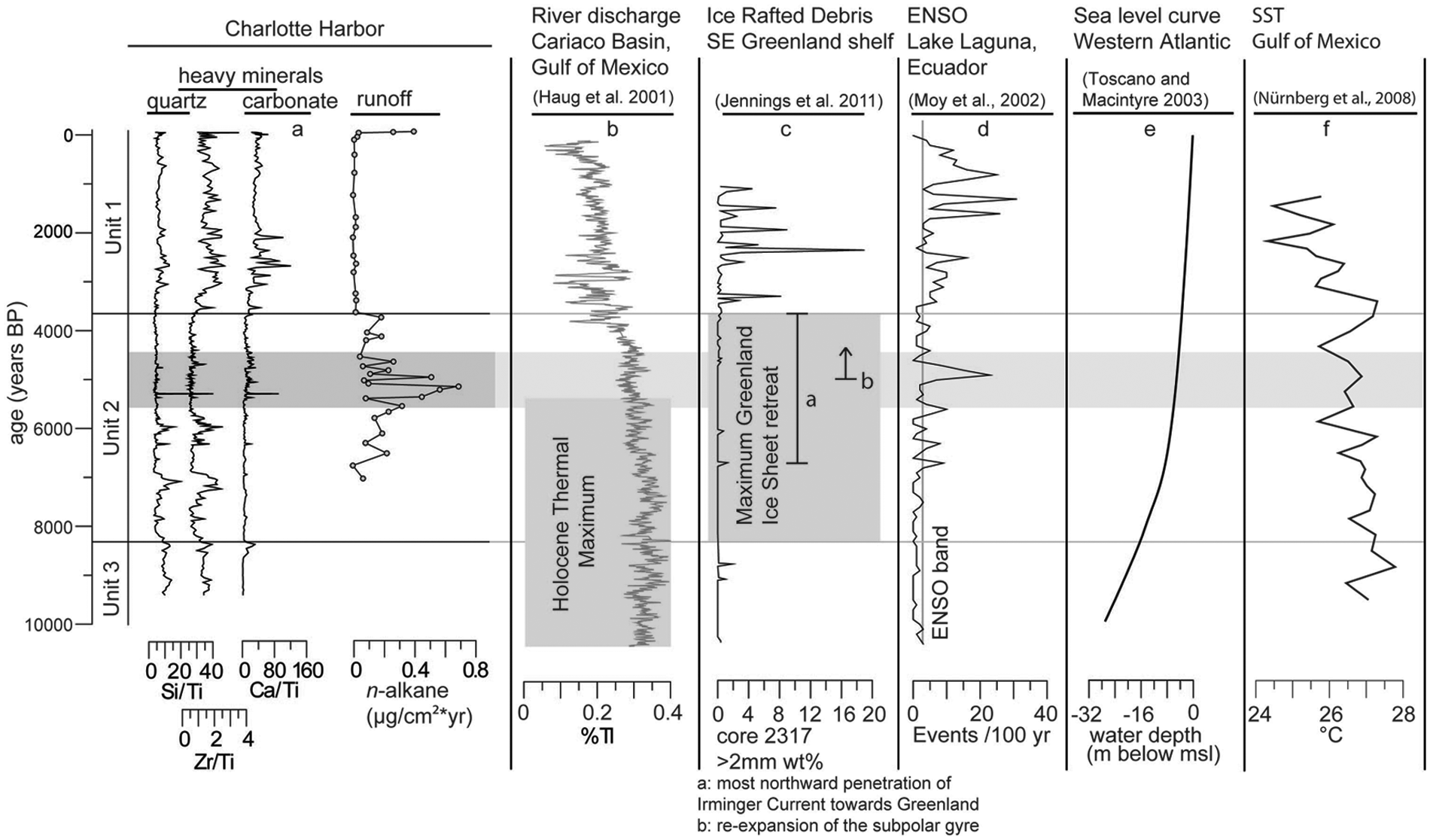
Comparison between Charlotte Harbor and other records. (a) Charlotte Harbor data including XRF records and runoff as indicated by changes in the n-alkane accumulation rates, (b) %Ti in Cariaco basin (Haug et al., 2001), (c) ice rafted debris on the Greenland shelf (Jennings et al., 2011), (d) ENSO reconstruction (Moy et al., 2002), (e) relative sea level (Toscano and Macintyre, 2003) and (f) SST in the Gulf of Mexico (Nürnberg et al., 2008). Also indicated are the different lithological units in the Charlotte Harbor sediments (horizontal lines) and the period of increase runoff around 5 kyr BP (horizontal bar).
Late Holocene
Simultaneous with the decrease in terrestrial organic matter input around 3.5 kyr PB, increased wetness is observed in other records from Florida: in Belle Glade peat formation started between 4 and 3.5 kyr BP (McDowell et al., 1969), a reconstruction in Mud Lake indicates increasing lake levels starting around 4 kyr BP (Filley et al., 2001), and in Fakahatchee vegetation shows a transition from wet prairie to swamp forest with the main phase starting 3.5 kyr BP (Donders et al., 2005). A precipitation reconstruction for Florida, based on vegetation changes in Lake Tulane and Lake Annie indicate increasing precipitation rates towards the late Holocene (Donders et al., 2011). Increased rainfall in Florida can for example be a consequence of increased ENSO activity (Donders et al., 2005) or increased hurricane activity (Lane et al., 2011; Liu and Fearn, 2000).
However, the inferred increase in wetness in Florida seems in contrast with the decrease in terrestrial organic matter input observed in the Charlotte Harbor sediments. Initial sea-level reconstructions (Scholl and Stuiver, 1967; Scholl et al., 1969) suggested decelerating rates of sea level rise around 3.5 kyr BP. However, more recent sea-level curves (Törnqvist et al., 2004; Toscano and Macintyre, 2003) rather indicate a continuing gradual increase in sea-level during mid and late Holocene. Such a gradual rise in sea level might have contributed to the observed apparent decoupling of terrestrial biomarker input and rainfall. A higher sea level increased the inland water-table and at the same time reduced the gradient of the rivers and hence erosion. At the same time, the combined effect of ongoing, gradual, sea level rise and increased rainfall might have triggered peat formation. Increased accumulation of terrestrial organic matter on land can explain reduced transport of organic matter to Charlotte Harbor. The increased soil humidity and subsequently higher evaporation also give an alternative explanation for the observed drop in mean annual temperature around 3.5 kyr BP.
Higher sedimentation and biomarker accumulation rates during the past century are likely a consequence of enhanced anthropogenic activity in southwest Florida. Higher sedimentation rates in the core top are partly due to lack of compaction, but likely also reflect increased erosion due to deforestation and canalization activities in the past century (Donders et al., 2008). The increase in marine biomarker accumulation rates is much bigger than in terrestrial organic matter input, and probably a consequence of increased nutrient loading into Charlotte Harbor which increased primary productivity.
Storm deposits
In the organic rich clays of Unit 2, distinct intervals can be recognized which represent higher energetic depositional conditions based on relative high quartz and heavy mineral contributions. Some of these high-energy deposits can be recognized in different sediment cores (Figure 2), which suggests that they represent the same event affecting a large part of Charlotte Harbor. These sand layers coincide with lower C/N, and higher Br/TOC ratios, indicating a relative larger contribution of marine organic matter and thus are likely deposited by the landward surge of marine waters during major storm events like tropical cyclones (Liu and Fearn, 2000). XRF data show relative higher abundance of Si rich material more upstream (core CH15), suggesting that the quartz sands were transported during increased river transport. The higher concentrations of marine organic matter in these layers, however, suggest a marine origin for the layers. However, these layers are unlikely to be overwash deposits because the sediments were recovered from the middle of the estuary, where no barrier islands existed. Rather, organic-rich material was transported into the estuary during a storm. Sediments were enriched with coarser material resulting from winnowing and/or transport of quartz sand from nearby beaches or sandbanks. Shell debris layers, between 3.2 and 2 kyr BP, also suggest periodically enhanced storm activity. Both higher Br/TOC ratios and lower C/N ratios again indicate a relative larger input of marine organic matter. These layers could be wave-generated lag deposits as might occur during tropical cyclones. The observed increase in tropical cyclone activity between 3.2 and 2 kyr BP is in line with the studies of Liu and Fearn (2000) and Lane et al. (2011), who find increased tropical cyclone landfall events in Florida between 3800 and 1000 yr BP and between 2800 and 2300 yr BP, respectively.
Several studies have shown that El Niño events decrease the number of tropical cyclones or hurricanes in the North Atlantic (Bove et al., 1998; Gray, 1984). Proposed mechanisms for this negative correlation are increased wind shear or increased air column instability in the Tropical Atlantic during El Niño events, which inhibits hurricane formation (Goldenberg and Shapiro, 1996; Gray, 1984; Tang and Neelin, 2004). This negative correlation has also been observed in a 5000 year record of hurricane activity in Puerto Rico (Donnelly and Woodruff, 2007). The increased tropical cyclone activity in mid to northern Florida simultaneous with enhanced El Niño activity might be due to a change in the preferential path of hurricanes, and it has been suggested that the position of the jet stream and Bermuda-Azores High play an important role in steering tropical cyclones which develop over the Atlantic Ocean (Liu and Fearn, 2000). This suggests that both precipitation and tropical cyclone activity in Florida during the mid and late Holocene are affected by large-scale shifts in the hydrological cycle. The complex interaction of multi-annual climate oscillations (e.g. Kirov and Georgieva, 2002) makes it difficult to predict hurricane intensity on longer timescales.
Conclusions
The reconstructed environmental changes in Charlotte Harbor reflect both the influence of sea-level rise following after the last deglaciation and changes in climate during the mid and late Holocene. As a response to the rising sea level, Charlotte Harbor developed from a quartz-sand dominated environment in the early Holocene, into an estuary, dominated by runoff and terrestrial organic matter input during the mid Holocene. A maximum in runoff around 5 kyr BP increased the terrestrial input and primary productivity in the estuary. During this period precipitation in Florida was higher, because of large-scale shifts in the hydrological cycle that involve the ITCZ, Bermuda-Azores High, the Polar Front and possibly ENSO activity. Around 3.5 kyr BP, Charlotte Harbor changed from a runoff-dominated environment to a more oligotrophic and marine setting. Although different studies suggest that precipitation in Florida increased, this is not reflected by the Charlotte Harbor sediments. Instead, a rise in sea level can explain the observed decrease in runoff. During the past century input of terrestrial organic matter increased probably as a result of human activities like deforestation and canalization, resulting in higher biomarker accumulation rates and sedimentation rates in Charlotte Harbor. Throughout the sedimentary record deposits consisting of relatively coarser material like quartz sand or shell debris indicate storm events. During the mid Holocene, these events are rare, but an increase between 3 and 2.5 kyr BP indicate that tropical cyclones more frequently acted on the Florida Gulf Coast.
Footnotes
Acknowledgements
Thanks to Rineke Gieles, Jort Ossebaar, Arnold van Dijk, Dineke van de Meent, Jan Kubiak, Anita van Leeuwen-Tolboom, Diederik Liebrand, Emmy Lammertsma, Hugo de Boer and Marie-Louise Goudeau for technical support. We would also like to acknowledge two anonymous referees for helpful suggestions.
Funding
This work was funded by a Utrecht University HIPO grant to Friederike Wagner-Cremer, Stefan Dekker and Gert-Jan Reichart.