



Abstract
Establishing the future trajectories of coastal wetlands, especially the nature of their disturbance, response and recovery regimes, is of critical importance for a wide range of stakeholders and environmental managers. Reconstructing meso-scale behaviour in coastal environments can serve to attune coastal resource management strategies to natural scales of system operations, thus fostering genuine sustainability. Sediments from Pescadero Marsh, a back-barrier coastal wetland in California, were analysed down-core for their particle size distribution in consecutive 2-mm sections. The particle size data reflect changing hydrodynamics in the back-barrier area driven by past variations in barrier coherence. When considered together, the down-core mean particle size trend and particle size distribution curve styles provide considerable insight into meso-scale system behaviour, revealing barrier/back-barrier disturbance–response–recovery regimes, regime shifts and the role of aperiodic high-energy events in disturbing these regimes. Over sub-annual and multi-annual time periods, the behaviour of the Pescadero system was consistently characterised by both dynamic response to disturbance and recovery through negative feedback. Furthermore, over the duration of the analysed core section, that is, 1200–2300 years, the system was determined to have adopted a series of static equilibrium states. The barrier estuary behaviour reconstructed from the Pescadero sediment record is indicative of innate environmental resilience.
Keywords
Introduction
Over the coming centuries, coastal environments will be subject to a number of factors that will compromise their resource value and provision of ecosystem goods and services (cf. Millennium Ecosystem Assessment, 2005). Particular threats include changes in climate, sea level and increasing human population. Establishing the future trajectories of coastal wetlands, especially the likely nature of their disturbance, response and recovery, is of critical importance for a wide range of stakeholders and environmental managers. In this regard, behaviour over the meso-scale (100–102 years) has become a critical timescale of interest (Cooper, 2009; Cooper and McKenna, 2008; McKenna et al., 2008) and is the focus of this study on barrier and back-barrier wetland environments.
With respect to these back-barrier and barrier estuary wetlands, their future is closely tied to barrier system behaviour. Cooper (1994) lists tectonic setting, basement topography, lagoon orientation, climate, sea-level, barrier morphology, barrier grain size, wave energy, tidal range and sediment supply as the main factors determining the long-term development of barrier estuarine and lagoonal environments. Rapidly rising sea levels characterised the early Holocene until around 6000 BP, after which global sea level largely stabilised (e.g. Goodwin, 2003). Following this Holocene marine transgression, barrier and barrier estuary environments began to occupy locations close to those of the present day (Woodroffe, 2002). Subsequent changes in sea level, closely linked to glacio-isostatic adjustment (Shennan, 2007) or tectonic activity (Pirazolli, 1994), have also been influential – playing a key role in morphodynamic evolution (Roy et al., 1994), in essence controlling the transgressive or regressive nature of barrier environments and the critical balance between accommodation space and sediment supply (Nichols, 1989). If the rate of sedimentation is not in equilibrium with sea-level rise, then the volume and shape of the basin will change. This, in turn, has impacts on tidal prism, tidal range and morphodynamic evolution (Cooper, 1994; Fitzgerald et al., 2008). The role of antecedent topography in barrier/barrier estuary location and development is almost as critical as that of sea level. Antecedent topography continues to dictate the shape and volume of a basin as relative sea-level changes and is therefore closely linked to the morphodynamic and sedimentary evolution (Dalrymple and Zaitlin, 1994).
Changes in climate factors may prompt reorganisation or evolution in barrier and barrier estuary environments. Climate factors include wave, water level and currents along with precipitation and temperature regimes. Although wave or tide dominance is often used as the primary basis for description of coastal inlets (Dalrymple et al., 1992), precipitation and temperature play a key role in determining salinity, which then impacts water density, stratification and, in turn, sedimentation. The rate of freshwater supply also impacts sediment delivery and the maintenance of communication of the inlet with the ocean (Reading and Collinson, 1996). Indeed, waves, tides, currents, precipitation and temperature all play a role, to a greater or lesser extent, in determining how ‘open’ an estuarine system is by facilitating or removing accumulations of clastic material at the mouth (Dalrymple et al., 1992; Woodroffe, 2002). Over multi-annual and longer timescales, climatic cycles may be an important control on barrier opening regime, for example, the El Niño Southern Oscillation (ENSO; Masters and Aiello, 2007).
High-magnitude/low-frequency events such as storms, hurricanes and tsunamis are known to affect the evolution of coastal environments (Smith et al., 2004). This is especially true of back-barrier lagoon and barrier estuary environments where barrier dynamics are heavily influenced by such extreme events (Woodroffe, 2002). The aperiodic switching of dynamic forcing, prevailing sediment transport pathways and coastal morphology associated with events of high magnitude and low frequency means that coastal change over timescales of decades to centuries can be considered in terms of erosion during storms and recovery during the inter-storm period if other boundary conditions are unchanged (Plater and Kirby, 2011).
Human activity can directly impact barrier and barrier estuary systems through the modification of morphology and hydrology while also indirectly impacting boundary conditions such as river flow and sediment delivery through activity in the catchment area (Woodroffe, 2002). Human activity has become a more prominent factor over recent centuries as human impacts on the coastal zone have generally intensified with proximity to the present (French, 1997). Many human impacts on the evolution of coastal wetlands may not yet be fully realised due to complex feedbacks and thresholds within these systems (cf. Wolanski, 2006).
At the decadal scale, barrier regimes, and thus barrier estuary and back-barrier lagoon environments, may appear to exhibit a high level of stability characterised by variation between end-member attractor states (Cooper et al., 2007). However, over longer timescales, that is, centuries and millennia, shifts in barrier regime are more likely to be observed; such system reorganisations can be considered environmental evolution. At the meso-scale (years to centuries), barrier system behaviour is poorly understood (Cooper et al., 2007). Indeed, improving our limited understanding of meso-scale system behaviour has been identified as a challenge in coastal geomorphology more generally (French and Burningham, 2009).
Resistance is the ability of a system to prevent or resist change (Klein and Nicholls, 1999). Management of coastal systems is often focused on attempting to engineer resistance (French, 2001). Conversely, resilience is becoming an increasingly prominent concept in the theoretical consideration of coastal environments. Resilience is the innate ability of systems to adjust to, and persist despite, changing inputs. Resilience is a desirable attribute of coastal systems, more so when uncertain future changes in coastal processes are considered (Klein et al., 1998), as resilient coastal environments respond sensitively to, as opposed to resisting, change (Nicholls and Branson, 1998). Direct physical demonstration of resilient behaviour in coastal environments is rare, particularly at the meso-scale. Obtaining evidence on system resilience over the meso-scale (and even the longer term) is far from straightforward and requires a level of interpretation that can characterise both high-frequency process-based understanding and long-term coastal evolutionary trends. In this respect, obtaining empirical evidence of system equilibrium, the nature of response to system disturbance and thresholds or ‘tipping points’ in system behaviour is essential. For example, following the terminology of Woodroffe (2007: 48–49), a system in ‘dynamic equilibrium’ may be seen to fluctuate over the short term but displays a progressive environmental trajectory over the medium term or meso-scale. A system in ‘static equilibrium’ fluctuates above and below, but remains close to, an environmental base level, while a ‘metastable equilibrium’ comprises a series of different static equilibria.
This study is conducted on a barrier estuary and back-barrier lagoon located at Pescadero in San Mateo County, California. The Pescadero site incorporates an intermittently open sand barrier, a back-barrier lagoon, a barrier estuary and extensive wetlands ranging from salt marsh to freshwater reed swamp. Over the late Holocene, sea level, climate (rainfall/runoff), sediment supply, storms, tsunami and tectonic activity have probably been the more significant influences on barrier dynamics, disturbance, response and recovery. Following European occupation, land use and hydrology in and around the site, as well as in the Pescadero and Butano Creek catchments, have been significantly altered and sedimentation rates have changed accordingly (Environmental Science Associates (ESA), 2004; Williams, 1990). Hence, barrier/back-barrier equilibria and disturbance–response–recovery regimes are highly likely to have changed over the period of time preserved in the sediment record.
Aims
By investigating down-core trends in particle size distribution, specifically the mean particle size (MPS) and the shape of characteristic particle size distribution curves (PSDCs), this paper seeks to demonstrate environmental change in a barrier estuary and back-barrier wetland at sub- and inter-annual timescales over a period of several centuries. Environmental interpretations are made in relation to the varying prominence of different depositional processes as preserved in the PSDCs of consecutive core samples and by the down-core trend of MPS. Through this procedure, given an appropriate core location, a sufficient sedimentation rate and an appropriately fine sampling resolution, meso-scale behaviour may be reconstructed, barrier inlet opening regimes characterised and the role of low-frequency/high-magnitude events appraised. Reconstructing such meso-scale disturbance–response–recovery behaviour in coastal environments can serve to better attune coastal resource management strategies to natural scales of system equilibria and resilience, thus fostering genuine sustainability by incorporating empirical data on the underlying resilience in coastal systems (i.e. Klein et al., 1998; Nicholls and Branson, 1998; Woodroffe, 2007).
Study area and system behaviour
Physiography and barrier regime
Pescadero Marsh Natural Preserve is located in San Mateo County, California, ~40 km south of San Francisco on the west coast of the United States (Figure 1). The site includes the largest wetland area on the central coast of California between San Francisco Bay and Elkhorn Slough (Griggs et al., 2005b). The wetlands are found in the back-barrier area of a barrier estuary formed where the confluence of the Pescadero and Butano Creeks meet the Pacific Ocean.
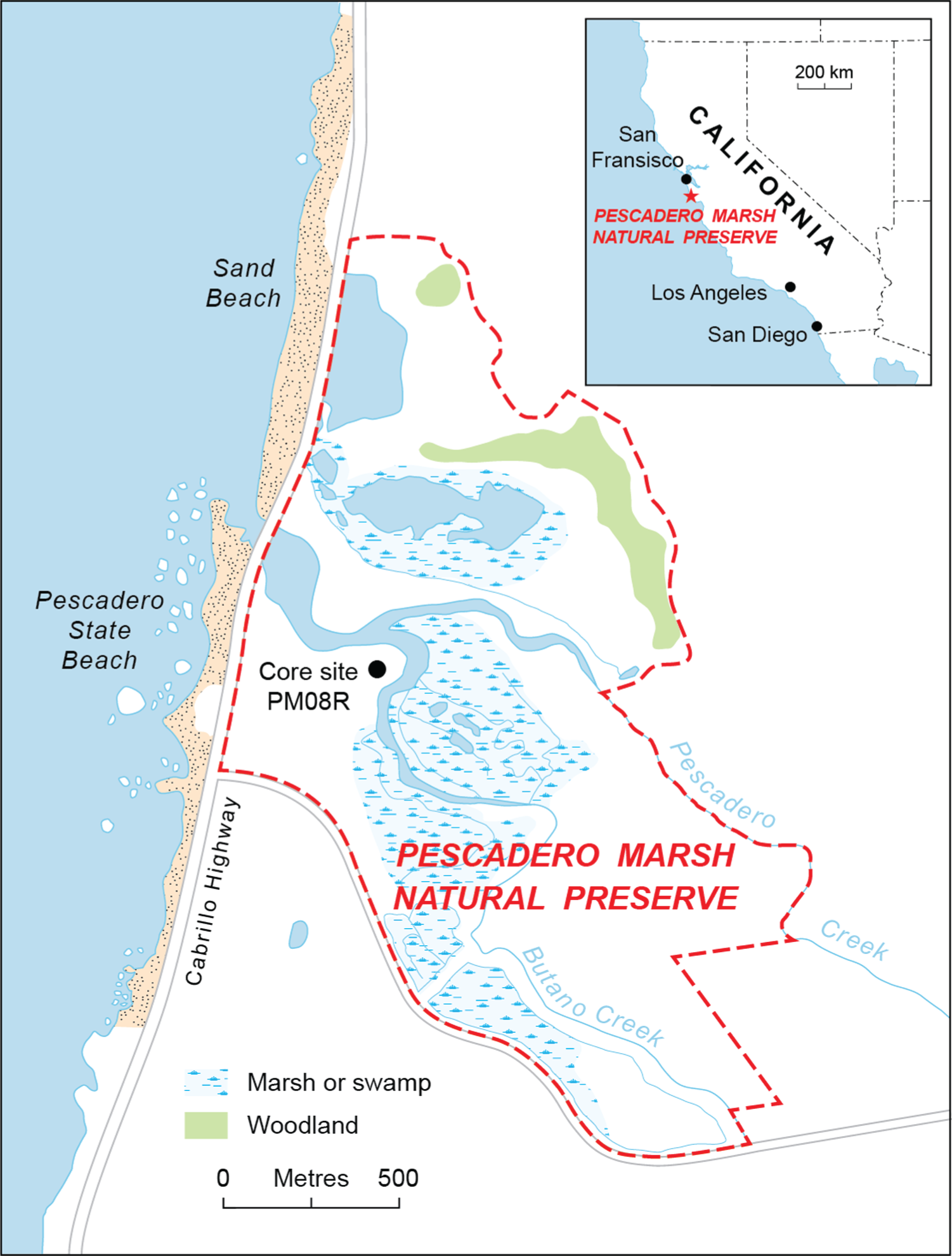
Map of Pescadero Marsh Natural Preserve and location in California. The high-resolution core (PM08R) location is marked.
The Pescadero–Butano watershed drains an area of approximately 210 km2 with elevation ranging from sea level to over 750 m. The Pescadero–Butano watershed is bisected by two tectonic fault lines, the San Gregorio Fault and the Butano Fault. A small anastomosing branch of the San Gregorio Fault, the Frijoles Fault, runs directly through the area of Pescadero Marsh Natural Preserve (ESA, 2004, 2008).
The watershed experiences a Mediterranean climate. Mean annual temperature for the region is 12°C with a mild, wet winter season from November to March and a warm, very dry, summer season from June to September (ESA, 2004). Annual average precipitation is ~1000 mm, almost all of which falls during the wet season and often during intense storm events (Hedlund et al., 2003). Precipitation can also vary greatly between years, with the ENSO phenomenon being an important driver of inter-annual variability in central California (Cayan et al., 1999).
Barrier regime along the California coast is closely related to trends in precipitation and wave climate (Emmett et al., 2000; O’Doherty and Rutten, 2007). During the 20th century, the barrier inlet at Pescadero has generally been observed to close in early summer when rainfall and stream flow are limited and wave action is constructive. After sandbar closure, freshwater inflow raises the level, increases the size and reduces the salinity of the back-barrier lagoon. Inlet opening has primarily occurred in late autumn, driven by increased rainfall, stream flow, storm activity and destructive high-energy waves, resulting in a tidal marsh (TM) back-barrier environment (ESA, 2004; Sloan, 2006; Smith, 1990).
Environmental history
Sea-level rise and sediment supply have had an important influence on the long-term environmental history of Pescadero. At the time of the last glacial maximum, the shoreline of California was between 15 and 30 km west of its present location (Griggs et al., 2005a). By c. 5000 years ago, global post-glacial sea-level rise had largely stabilised, but a gradual overall rising trend, with small-scale embedded fluctuations, continued on the American Pacific Coast (Coe, 2003; Williams, 1990). Located in a pre-Holocene river cut valley, the present-day site of Pescadero Marsh was flooded during the Holocene marine transgression (Viollis, 1979). Over the mid- and late Holocene, the drowned estuary infilled with sediment and a sand barrier formed across the mouth (Williams, 1990). By c. 3000 years ago, the back-barrier complex at Pescadero had begun to approximate its current form at a location close to that of the present day (Williams, 1990).
The Pescadero–Butano watershed may have experienced human occupation for over 10,000 years. Shell and bone middens found at analogous local wetland sites (Gordon, 1996; Patch and Jones, 1984) suggest that Pescadero Marsh supported plentiful hunting and gathering by local Native Americans. European land-use practices were first introduced after 1791 when the site came under the jurisdiction of the Spanish Mission at Santa Cruz. Small-scale grazing of livestock and agriculture were practised in the area until Spain abandoned the Mission system in 1822 (ESA, 2004). In 1833 and 1838, the Mexican government awarded land grants in the watershed. Cattle ranching was revived but remained small in scale due to the physical isolation of the watershed (ESA, 2004).
The European American era in California began in earnest with the discovery of gold in 1848 and was legitimised by statehood in 1850. The town of Pescadero was established in 1856. Through the mid- to late 19th century, the Pescadero–Butano watershed experienced dramatic changes due to the onset of commercial logging, and the rapid intensification of agriculture and animal husbandry (Curry et al., 1985). Structural engineering of catchment and marsh hydrology have also been features of the European American era (ESA, 2004; Viollis, 1979). Agriculture and logging continue in the catchment to the present day with both having declined from respective peaks in the 1950s and 1970s (ESA, 2004).
In 1958, California State Parks began purchasing tracts of wetland and wetland marginal agricultural fields. State Parks have since been active in the subsequent management of the wider Pescadero wetland and beach complex (ESA, 2004).
Methodology
Site selection and sampling
A 185-cm-long sediment core was retrieved from the back-barrier area of Pescadero Marsh (see Figure 1) using a hand-driven gouge corer. The core sampling location was identified using a time series of maps and aerial photographs, which dated from 1854 to 2003, together with stratigraphic ground-truthing (Clarke, 2011). Since at least 1854, the selected sampling location has remained a salt marsh subject to inundation by the higher tides and submergence in the seasonal lagoon pool while also being remote from direct fluvial influence. Furthermore, the core location has not been directly altered by recent human activity (ESA, 2004). The selected core location allows for sedimentation, since at least 1854, and probably longer, to be adequately characterised according to the changing nature of barrier opening regime through time.
Sub-sampling resolution
Published sedimentation rates from analogous environments in the region (e.g. Mudie and Byrne, 1980; Schwartz et al., 1986) suggested that 2-mm-thick sub-samples from the core would likely correspond to sub-decadal time periods in ‘pre-impact’ sediments and to sub-annual time periods following the onset of intense European American land-use practice in the watershed. Indeed, further support for this estimate is provided by chronological markers in the upper part of the Pescadero sediment record which include a 137Cs profile, identifying a ~1963 peak of atmospheric fallout from nuclear weapons testing at 22.6–22.8 cm, and a stable Pb pollution trend related to the rise of motor vehicle use and the development of the road network in the local area (Clarke, 2011). Furthermore, sampling at a 2-mm resolution approaches the limit of practicality without the use of specialist cutting equipment.
Particle size analysis
Particle size analysis was performed on all sub-samples using a Coulter LS200 laser granulometer. The laser granulometer determined the percentages of different particle sizes in a range of size classes. Using these data, the GRADISTAT computer program (Pye and Blott, 2001) calculated summary statistics and plotted PSDCs for each sample. Prior to analysis, extraneous plant material was removed from each sample by hand-picking. Following Allen and Thornley (2004), consistently low loss-on-ignition percentage values negated the need for hydrogen peroxide treatment to remove co-deposited organic matter. Full details of the particle size analysis techniques are given in Clarke (2011).
Particle size analysis has been used successfully to identify sub-annual variation in the hydrodynamic processes of estuarine environments (Allen, 1990, 2004; Allen and Dark, 2008; Allen and Haslett, 2002, 2006, 2007; Dark and Allen, 2005; Mohd-Lokman and Pethick, 2001; Plater et al., 2007, 2009; Stupples and Plater, 2007). In this paper, high-resolution particle size analysis is applied as a proxy for investigating regime shifts, equilibria and overall system resilience in the back-barrier lagoon and barrier estuary environment of Pescadero Marsh. Particular attention is given to PSDCs, the shapes of which contain a wealth of sensitive information regarding the depositional environment of a sample. It is demonstrated that given a sufficiently large sample population from a suitable location, the changing prominence of different depositional processes in the back-barrier through time can be interpreted by considering the relative shapes of PSDCs in the context of the down-core MPS trends.
Interpretive framework
The core sampling location allows for the assumption that down-core variation in MPS represents changes in the prevailing ‘openness’ of the barrier system, that is, overall depositional energy. In order to support the down-core MPS trend as an indicator of barrier openness and to allow more sensitive environmental interpretation of the particle size data, the shapes of PSDCs are considered. PSDC shape is interpreted in context of the anticipated range of back-barrier depositional environments (TM, tidal lagoon (TL) and closed lagoon (CL)) with respect to barrier openness, water level and flow velocity at the core site and to the variable deposition of suspension and saltation loads.
The relative proportion and modal particle size of discrete saltation and suspension loads are dictated by the coherence or integrity of the barrier system which moderates water level and the degree and strength of tidal action in the back-barrier area. In the case of a fully developed barrier, this would inhibit tidal action in the back-barrier area and see the core site submerged given sufficient lagoon water level. As the barrier reduces in size, tidal flow peaks increase in velocity and the relative significance of calm water deposition is reduced. In response, the saltation (and, in turn, traction) load becomes more prominent in the deposited sediment. These principles enable the interpretation of CL, TL, TM and open estuary (OE) environments as a function of barrier integrity, as well as the hydrodynamic properties of end-member environments that characterise different barrier regimes.
Results
Down-core MPS trend
The down-core MPS trend (expressed in φ) for all 925 samples of PM08R core is presented in Figure 2. A high degree of fluctuation in MPS is notable, even between successive samples. Large-scale coarsening and fining trends can also be observed over sequences of multiple samples and, in some sections, several centimetres. The down-core MPS trend features a number of sections in which this larger order fluctuation centres on a relatively consistent ‘mean particle size base level’ (MPSBL), that is, ~185–162, ~118–102 and 75–15 cm. Within these core sections, while MPS is not constant, no overall increase or decrease up-core is observed in either the general MPS or the fine and coarse end-members. Each of these sections therefore has a subtly different MPSBL and characteristic range of MPS fluctuation. Above 15 cm depth, the trend line does not appear to fluctuate around a MPSBL.
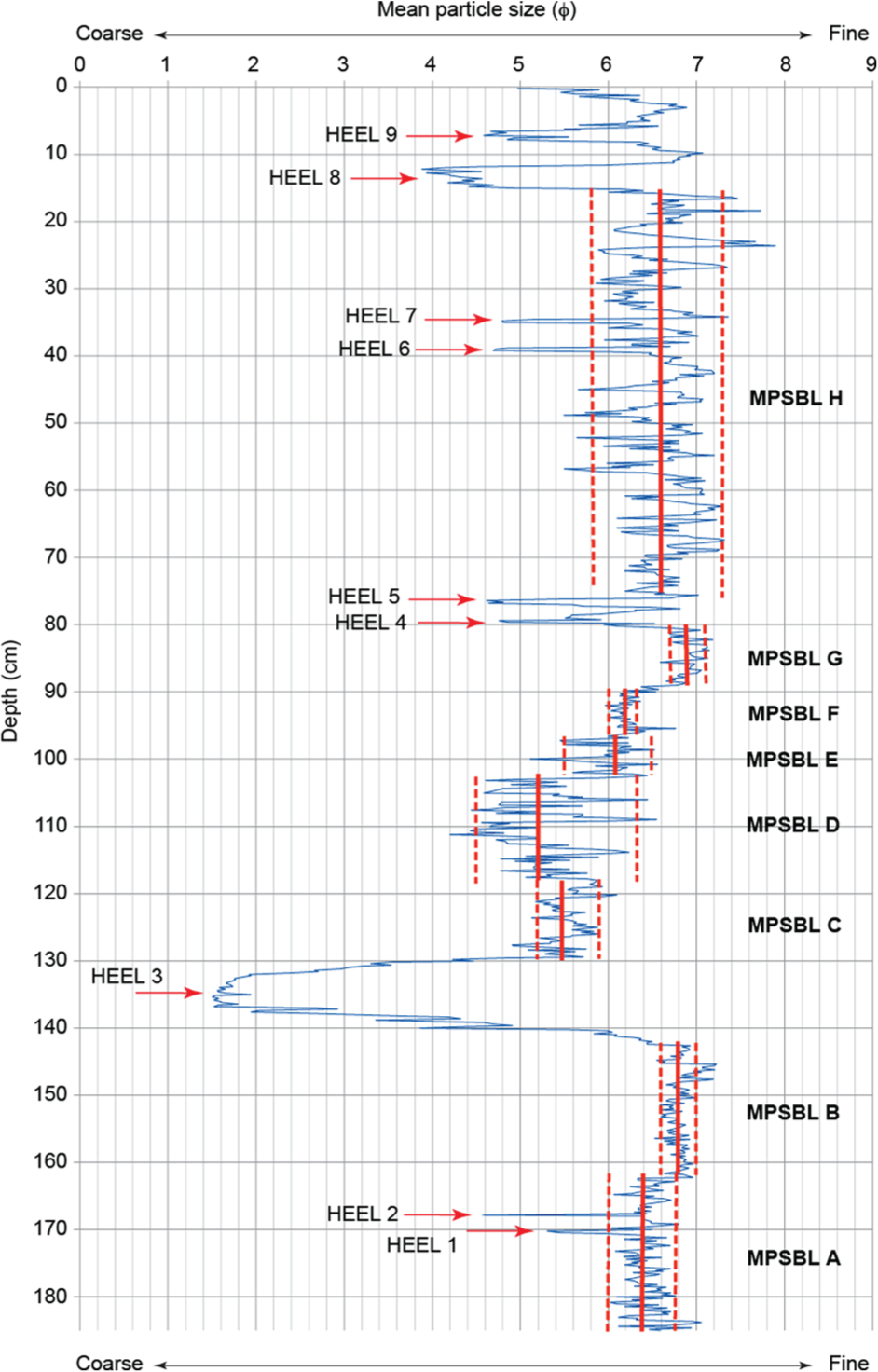
Down-core trend of mean particle size (ϕ) 0–185 cm with mean particle size base level (MPSBL) sections and high-energy event layers (HEEL) illustrated.
Both within and between the MPSBL sections described are layers which appear coarse in context of the under- and overlying sediment. Thin coarse layers (<6 mm in thickness) are found at depths of ~170, 168, 80, 76, 39 and 35 cm; thicker layers are found at depths of ~15–12 and 8–6 cm. The largest magnitude coarse layer in the core, both in thickness and coarsest MPS, is found at ~142–130 cm. These coarse layers are identified as ‘high-energy event layers’ (HEELs), being high-energy departures relative to the background MPSBL fluctuation at the depth that they occur. HEEL 3 (Figure 2) merits further description as both MPs fluctuation and larger order trends are observed within this event layer. Initially, HEEL 3 is inversely graded, coarsening upwards from ~142 to ~136 cm before subsequently fining upwards to ~130 cm depth. In all, eight MPSBL sections and nine HEELs are illustrated in Figure 2.
PSDCs
PSDCs were grouped into eight distinctive reoccurring ‘styles’: CL1, CL2, TL1, TL2, TM1, TM2, OE1 and HE1 (Figure 3). Distinctions between styles were made on the basis of percentage weighting in six fixed particle size windows. The particle size windows used were dictated by multiple modal peaks which occurred with a high level of consistency throughout the sample set and by published estimates of the particle size ranges deposited through settling, saltation and traction processes (Clarke, 2011).
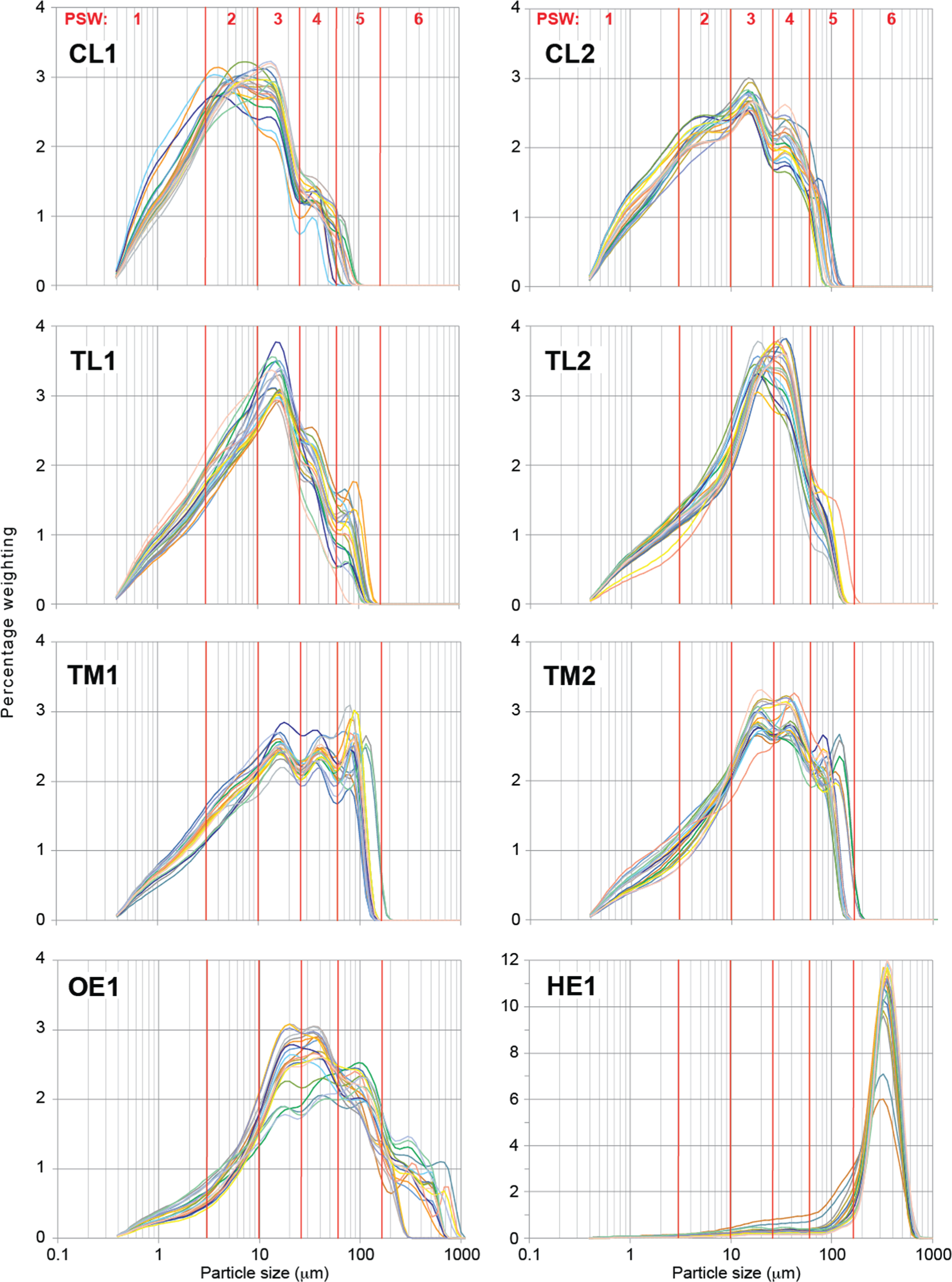
Characteristic PSDC styles of the PM08R core (ordered from ‘fine’ to ‘coarse’, informed by the average MPS for good examples of particle size distributions for each style). For each particle size distribution style, a selection of overlaid examples is shown to demonstrate the range of variability.
All samples were assigned to one of the eight styles; as such a degree of variation existed within each style group, yet fundamental similarities outweighed any differences. The examples shown and the descriptions provided (Figure 3 and Table 1) capture the representative characteristics of each style.
Description of PSDC styles.
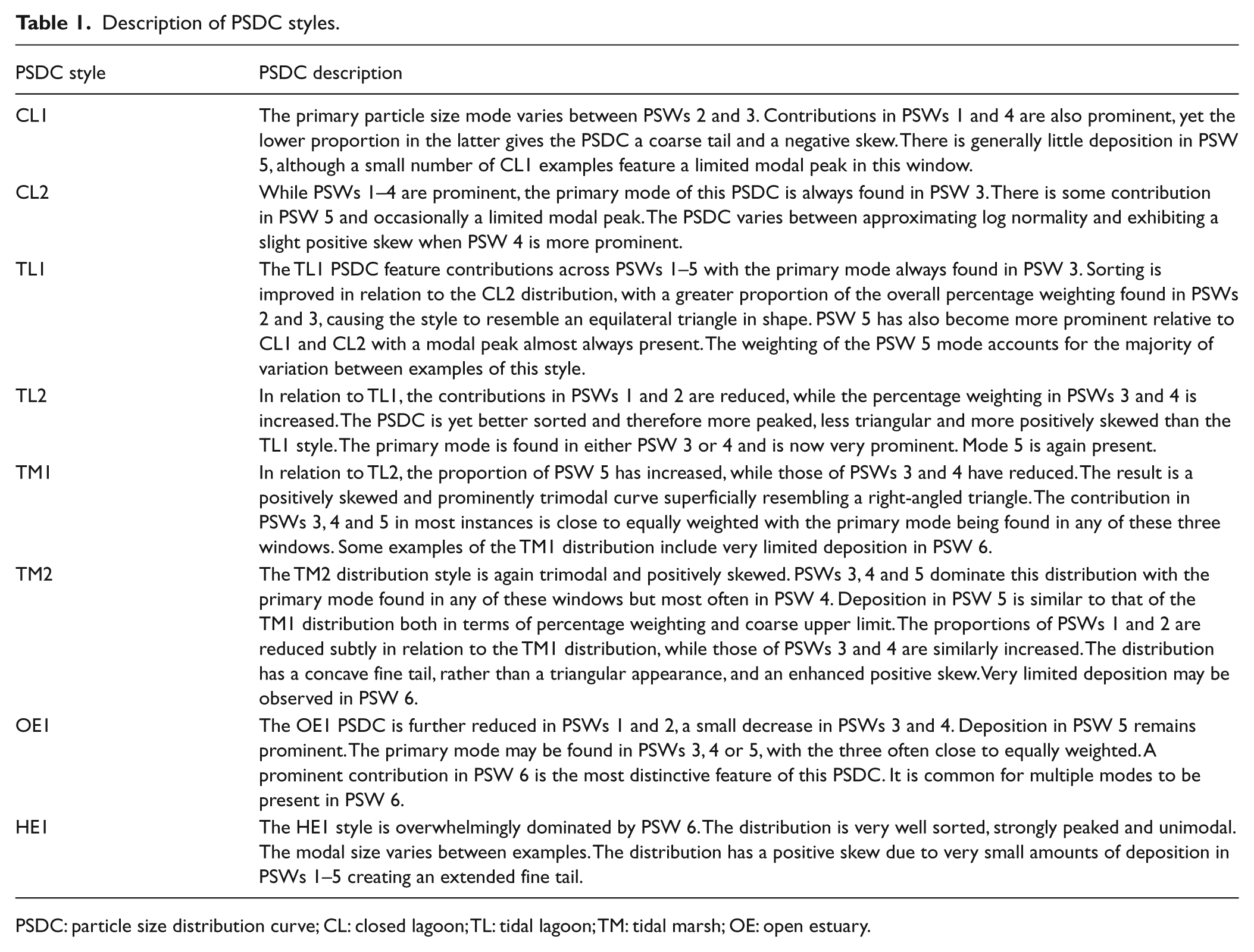
PSDC: particle size distribution curve; CL: closed lagoon; TL: tidal lagoon; TM: tidal marsh; OE: open estuary.
MPS and PSDC associations
There are clear associations between MPSBL sections and different PSDC styles; each MPSBL features reoccurring PSDC styles associated with the coarse and fine limits of their regular particle size variation range. These PSDC styles can be described as high- and low-energy end-member PSDCs and used to describe the prevailing depositional environment of the core section they are associated with.
It is important to stress that the end-member PSDCs identified here are not those of the absolute coarsest or finest mean particle–sized samples in each MPSBL section, rather they are the PSDC styles that characterise the upper and lower limits of ‘regular’ MPS fluctuation within each MPSBL section. The coarse and fine end-member PSDCs of each MPSBL section are listed in Table 2 along with the depth and particle size details of each section. End-member distributions are illustrated for MPSBLs A, E, F and H in Figure 4.
Details of MPSBL sections, including coarse and fine end-member distribution styles.
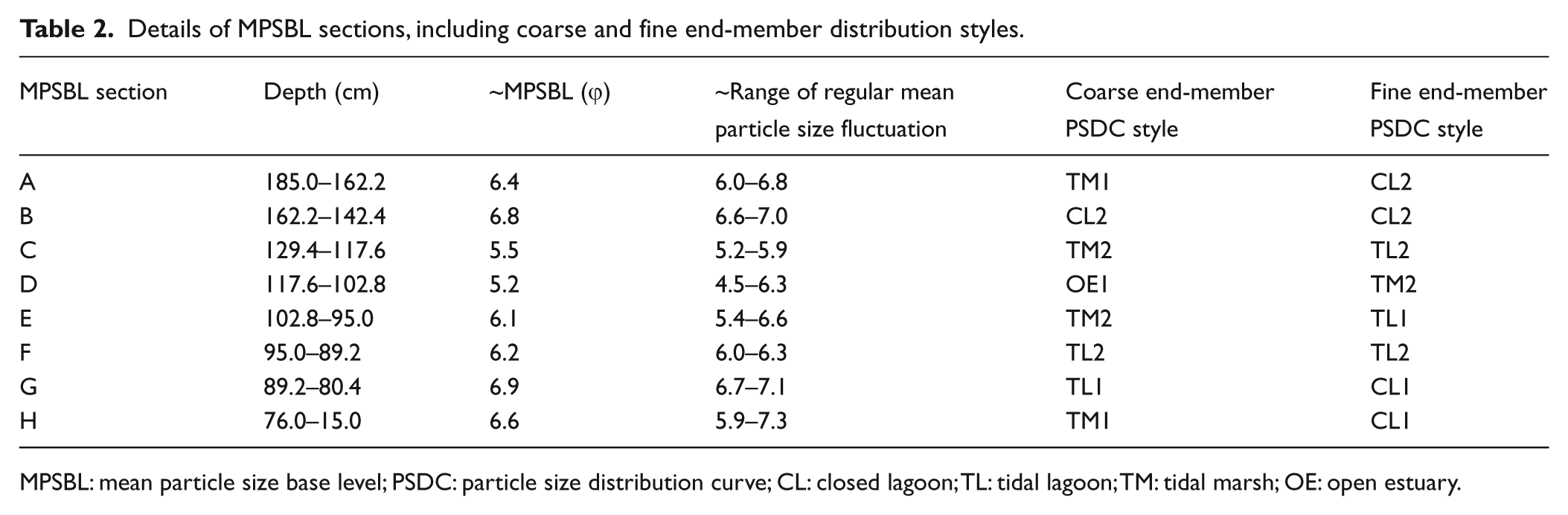
MPSBL: mean particle size base level; PSDC: particle size distribution curve; CL: closed lagoon; TL: tidal lagoon; TM: tidal marsh; OE: open estuary.
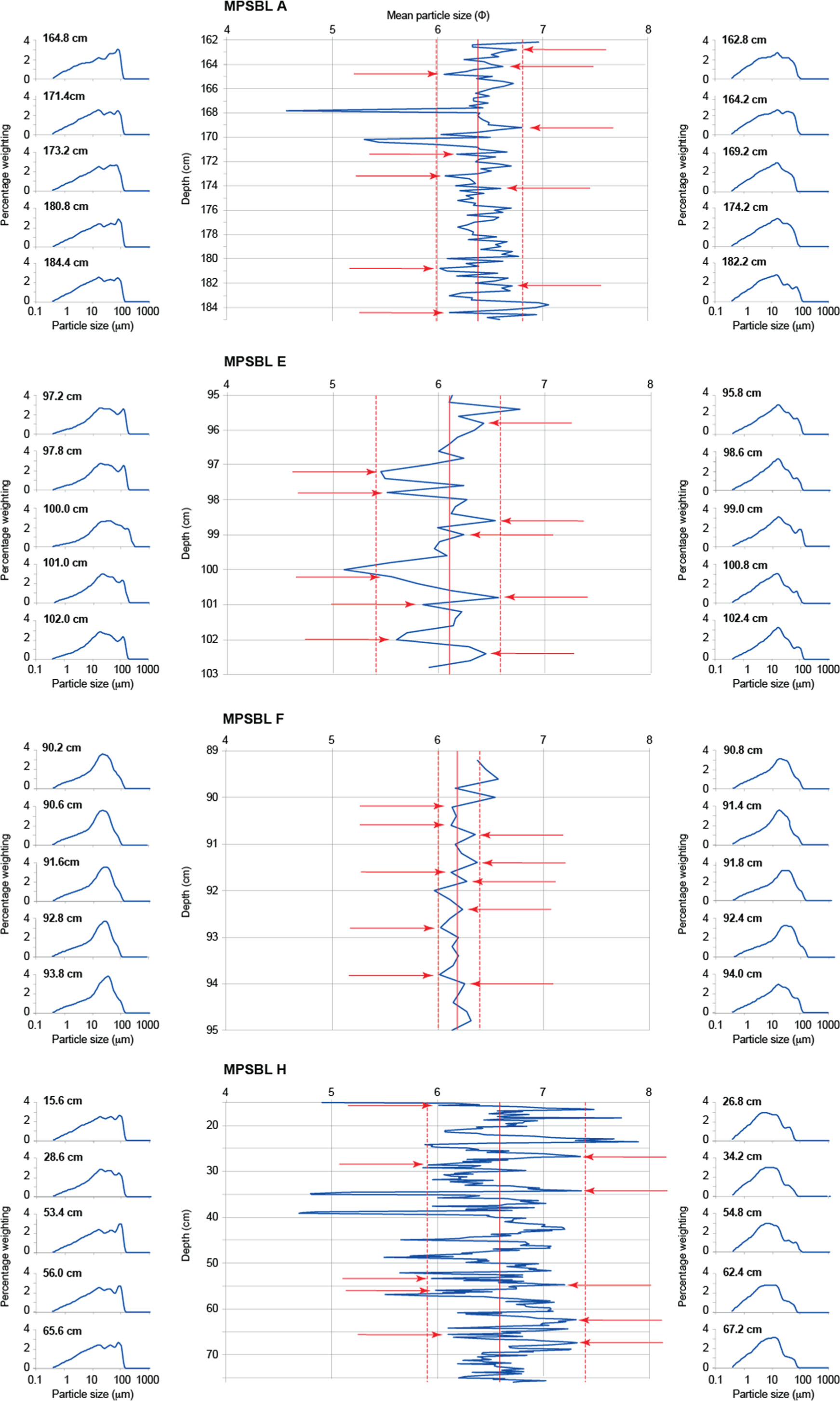
Down-core MPS (ϕ) trend for MPSBLs A, E, F and H, with approximate MPSBLs and regular fluctuation ranges illustrated. Examples of high- and low-energy end-member particle size distribution styles are included to the left and right of each curve. Arrows indicate the depths at which these samples are found.
Subtle variations of the OE1 PSDC style are found in those samples with the coarsest MPS of each HEEL. An exception to this is HEEL 3, which is the only section of the core to feature HE1 style PSDCs. In HEEL 3, HE1 PSDCs dominate between 137 and 132 cm. Lower energy PSDCs are also present in HEEL 3, between ~142 and 137 cm and again between 132 and 130 cm, which include a significant saltation and suspended load contributions to the particle size distributions in addition to a dominant traction component. These distributions are strongly negatively skewed resembling the HE1 style but with the addition of a pronounced fine tail. Between 142 and 138 cm, HEEL 3 features numerous thin mud laminations in which the PSDCs resembled the OE1 style PSDC.
Interpretation
Down-core MPS
Following Cooper et al. (2007), the range of environmental configurations in each MPSBL section can be said to exist between opposing, more open and more closed barrier, end-member attractor states. The environments represented by end-member PSDCs differ between MPSBL sections. Contrasting end-member environments between MPSBL sections reveals a series of persistent barrier regimes. Within each MPSBL section, interplay between perturbations and negative feedback processes is responsible for maintaining the Pescadero barrier system between the high- and low-energy end-member configurations. At Pescadero, winter storms provide a common example of a perturbation. Winter storms, characterised by high rainfall, river flow and an energetic coastal wave climate, drive barrier inlet opening which is then redressed by negative feedback processes, that is, fair weather wave and current action, which gradually return the barrier to a more closed state (Smith, 1990). While the balance of geomorphological work done on a system by processes of differing magnitude and frequency can maintain a persistent environmental range (e.g. Wolman and Miller, 1960), events of sufficient magnitude and frequency may result in the crossing of an intrinsic system threshold prompting the adoption of a new environmental range in response (Woodroffe, 2007). The HEELs found in PM08R are likely associated with low-frequency, high-magnitude events (e.g. extreme storms and/or tsunami) which were effective in markedly diminishing the integrity of the barrier system.
Some of the HEELs correspond to shifts in MPSBL fluctuation; in fact, two MPSBL shifts are strongly associated with HEELs. A couplet of HEELs is found at the transition from MPSBL G to H. MPSBL H has a coarser MPSBL than that of MPSBL G. These HEELs may have been deposited by high-energy events which served to diminish barrier integrity to a degree that a more open barrier regime was established. HEEL 3 also appears to be associated with a more fundamental reduction in barrier integrity. MPSBL sections C, D, E and F can all be interpreted as part of a prolonged and staggered recovery sequence following the HEEL 3 event. Indeed, it is only in MPSBL G that the MPSBL again becomes as fine as it had been in MPSBL B prior to the HEEL 3 event. When the down-core MPS trend is considered in this manner, a significant proportion of the PM08R record is dominated by disturbance arising from the high-energy event responsible for HEEL 3 and the subsequent recovery sequence.
PSDCs
Using the interpretive framework described, seven of the PSDC styles of the PM08R core were related to a range of back-barrier depositional environments. These environments are CL, TL, TM and OE. Because of the seasonal barrier regime at Pescadero, most styles were interpreted to represent deposition under more than one barrier configuration, that is, a more open winter and more closed summer environment (see Table 3).
Summary of the depositional environments interpreted from each of the characteristic PSDC styles.
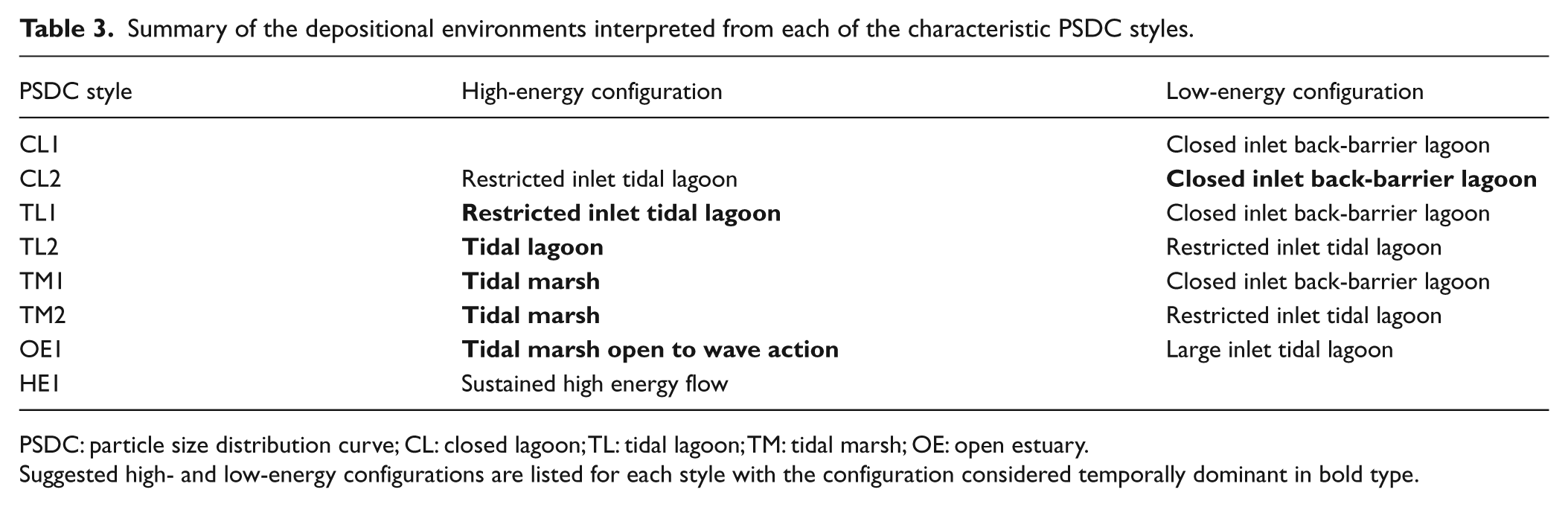
PSDC: particle size distribution curve; CL: closed lagoon; TL: tidal lagoon; TM: tidal marsh; OE: open estuary.
Suggested high- and low-energy configurations are listed for each style with the configuration considered temporally dominant in bold type.
Being dominated by deposition through saltation and traction, the HE1 or ‘high-energy’ style does not represent an environment within the envisaged back-barrier range. Indeed, the HE1 PSDC style was only found in the core section designated as HEEL 3, and most likely represents a low-frequency, high-magnitude event.
MPS and PSDC associations
MPSBL sections
Environmental interpretations of the eight characteristic PSDC styles coupled with the identification of end-member PSDCs allows for the characteristic environmental range of each MPSBL section to be diagnosed. The environmental range of each MPSBL section is best constrained by the highest and lowest energy coastal configurations of the associated end-member PSDCs. These configurations along with their interpretations are given for each MPSBL in Table 4.
Environmental range of MPSBL sections.
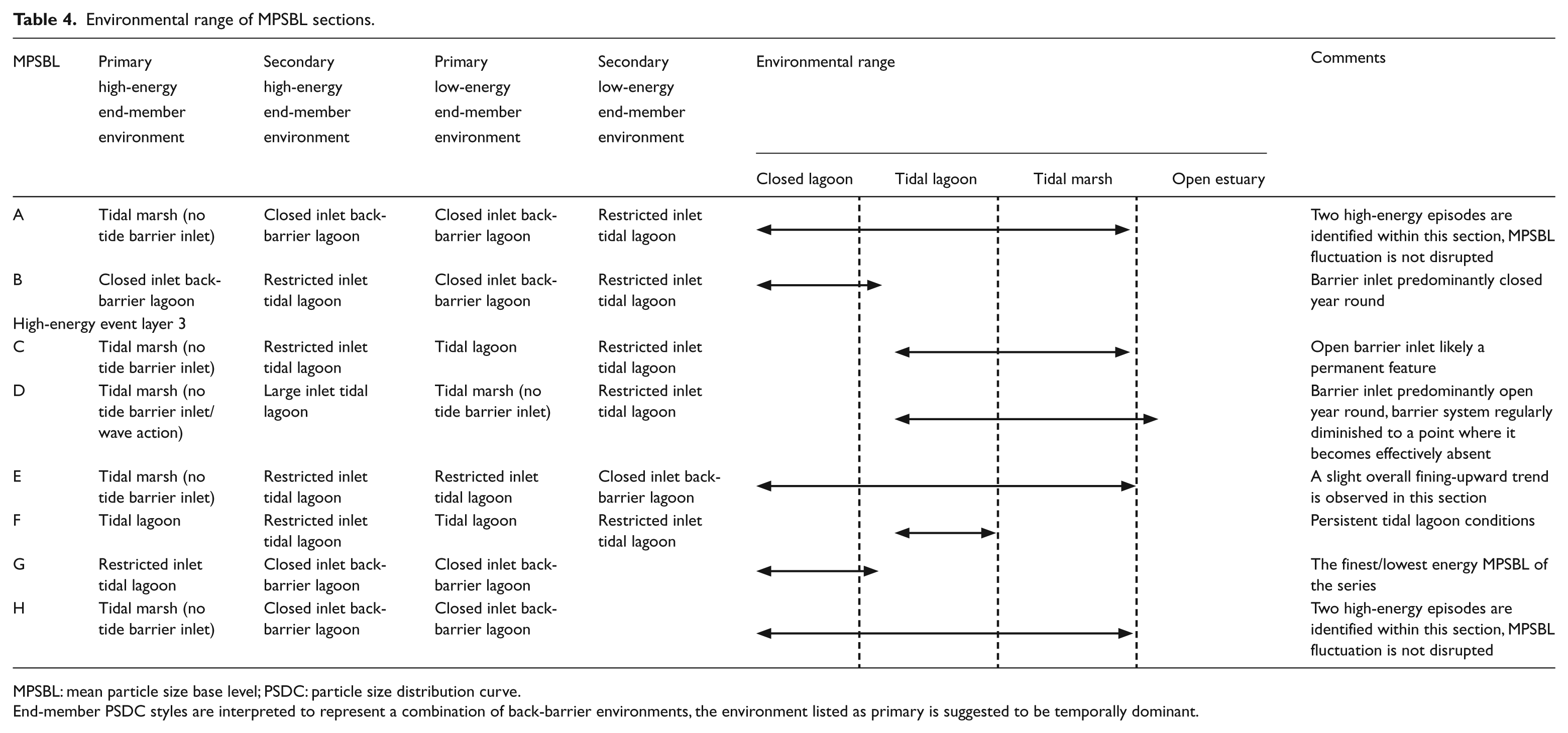
MPSBL: mean particle size base level; PSDC: particle size distribution curve.
End-member PSDC styles are interpreted to represent a combination of back-barrier environments, the environment listed as primary is suggested to be temporally dominant.
HEELs
The causes of the individual HEELs cannot be diagnosed confidently on the basis of the information available here, the exception being HEEL 3. The prominence of the HE1 PSDC style in HEEL 3 is indicative of conditions of high energy flow when deposition through saltation/traction processes dominated. HEEL 3 has many characteristics of a tsunami deposit. The inverse grading observed in the lowermost part of the layer is likely caused by initial maximum inundation sheet flow followed by a period of waning flow velocity which accounts for the above fining-upward sequence (Switzer et al., 2005, 2012). Furthermore, the coarse sand layer of HEEL 3 has been mapped across a significant area of the marsh surface at Pescadero, extending for tens of metres inland from the ocean, and no analogous HEELs were identified during an extensive survey of the sites deeper late-Holocene stratigraphy (Clarke, 2011). Being a single, coarse, spatially extensive layer with a consistent depth of less than 25 cm and mud laminations towards the base, a tsunami event is the most favourable explanation for the deposition of HEEL 3 (Jaffe and Gelfenbaum, 2007; Morton et al., 2007; Smith et al., 2004).
Discussion
The site selection, methodology and interpretive models applied to the PM08R core allow a high-resolution reconstruction of the changing barrier regime at Pescadero throughout the European American era and for several preceding centuries (Clarke, 2011). Over this time, the Pescadero barrier system is characterised by the prevalence of subtly different disturbance–response–recovery regimes. A number of shifts between more open and more closed barrier regimes are interpreted down-core; many of these shifts can be related to disturbance from high-magnitude/low-frequency events at the site. Indeed, several of the barrier regime shifts observed in the deeper core are interpreted as stages of a recovery sequence following the HEEL 3 tsunami.
From the pollution markers present in the upper section of PM08R, along with geochemical trends implying sub-soil erosion related to catchment clearance (Clarke, 2011), the transition from MPSBL G to H, at ~75 cm, likely dates to ~1850 and therefore marks the onset of intensive European American impact at the site (Clarke, 2011). In the upper 75 cm of the core, the sedimentation rate appears highly consistent with each 2-mm sample representing an average time period of just under 5 months.
No ‘pre-impact’ chronological markers were identified in the PM08R core. However, using sedimentation rates from the upper core, 14C dates from other Pescadero cores (Clarke, 2011), and published rates from analogous local systems (see section ‘PSDCs’), a rate of between 0.5 and 1 mm/yr can be suggested for the deeper core. The bottom of the PM08R core, at a depth of 185 cm, would then date to between ~1200 and 2300 yr BP, while the ~140 cm lower limit of HEEL 3 would occur somewhere between 800 and 1500 yr BP. It must be stressed that the dates suggested for the deeper core are highly speculative. For example, it is probable that the HEEL 3 tsunami was initially erosive, increasing accommodation space and sedimentation rate for an unconstrained period at the core site.
From the above, it is evident that each of the MPSBL sections persisted for multiple decades and in many cases several centuries. The tendency for multi-decadal and centennial duration MPSBL fluctuation in the PM08R core provides significant insight into the meso-scale behaviour and long-term evolution of the barrier system at Pescadero Marsh. Sub-annual and inter-annual fluctuations in back-barrier environmental configuration, represented by individual PSDCs, are linked to long-term quasi-stable environmental regimes which begin to correspond to the timescales of Holocene environmental change. In this respect, the gap between the micro-scale and macro-scale, or the process and evolution knowledge bases, is successfully bridged. Furthermore, the MPSBL fluctuation of the PM08R core can be directly related to the concepts of equilibrium in coastal environments discussed by Woodroffe (2007).
The Pescadero barrier system has had a tendency to exist in states of static equilibrium. Each MPSBL section represents a static equilibrium state in which the barrier disturbance–response–recovery regime had become adjusted to the contemporary boundary conditions resulting in either a more open or more closed back-barrier environmental range, depending on the prevailing barrier integrity. Moreover, the environmental transition recorded by the whole PM08R core may be interpreted as a barrier estuary metastable equilibrium. Contrasts in barrier regime, both in terms of end-member attractor states and characteristic fluctuation between these states, were identified between MPSBL sections, yet the barrier system is a resilient feature of the environment. The sequence of static equilibria identified in PM08R often driven by detectable disturbances (i.e. HEELs) serves to demonstrate an innate morphological resilience in the system over the period of deposition in terms of recovery from environmental perturbation.
Barrier resilience (cf. Long et al., 2006), and the associated environmental persistence, can be seen on two temporal (and spatial) scales in the PM08R record. The environmental fluctuation recorded within each static equilibrium section is the first of these scales of resilience. This presumably results from seasonal and inter-annual forcing by climate factors and negative feedback processes which maintain the system at or close to a quasi-stable state. Second, the shifts to subtly different static equilibria within the barrier estuary metastable equilibrium reveal an ability to respond to perturbation, recover and persist despite changing boundary conditions, that is, long-term climate trends, or high-magnitude/low-frequency perturbations like the HEEL 3 tsunami. Any loss of this resilience is undesirable for management, as sustainable systems are required to survive unanticipated as well as anticipated circumstances (Nicholls and Branson, 1998). A major issue at Pescadero is the extent to which human modification of the catchment, marsh and barrier beach has perhaps already impacted the system’s behaviour and, hence, compromised innate resilience.
Some observations relating to human impacts on the resilience of the site can be made. Prior to the HEEL 3 tsunami, MPSBLs A and B are indicative of several centuries of relative stability with the transition from MPSBL A to B simply suggesting a shift to a slightly drier climate. Following MPSBL B, the occurrence of the event depositing HEEL 3 and the subsequent recovery dominate the PM08R record. With the onset of MPSBL G, the Pescadero barrier regime appears to regain a state that is comparable with that in operation prior to the HEEL 3 tsunami. Following HEELs 4 and 5, and indeed being interrupted by HEELs 6 and 7, MPSBL H also suggests a back-barrier regime that is comparable with those of MPSBLs A and B. Therefore, it seems that despite the onset of intense human impact on the Pescadero–Butano watershed and, indeed, the aperiodic disturbance by high-energy events, the system continued to operate in static equilibrium for the majority of the European American era. This suggests that the innate resilience of the Pescadero barrier–barrier estuary environment had not been critically compromised beyond its long-term pattern of dynamic response behaviour.
System behaviour cannot be interpreted from the upper 15 cm of the PM08R core in terms of MPSBL fluctuation as this section is dominated by HEELs 8 and 9. Coincidentally, well-documented problems (i.e. flooding of neighbouring land, channel sedimentation, annual fish kill events) emerged and intensified at Pescadero during the later part of the 20th century (ESA, 2004). It is likely that the HEELs found in the upper 15 cm relate to erosional events which removed sections of the recent record and replaced them with rapidly deposited coarse material. Written and observational accounts of the site behaviour over recent decades describe a system much like that interpreted as being represented by MPSBL H (e.g. Kerbavaz, Senior Ecologist for Pescadero Marsh Natural Preserve, California State Parks, personal communication, 2007; Sloan, 2006; Smith, 1990), that is, seasonal variation between a TM and a lagoonal environment. While the system still operates in a manner comparable with that of MPSBL H, it is possible that the cumulative impact of European American land-use practices has resulted in functionality being compromised, the emergent issues at the site being observable symptoms. In this case, even though the sedimentary record of past change would imply continued dynamic resilience, the long-term outcome of such recent reorganisation cannot be suggested with any confidence. It can, however, be stated confidently that attempting to preserve the environment by engineering resistance is not a sustainable solution.
At Pescadero, there is pressure on State Parks to promote certain habitats and aspects of the environment through direct intervention, with barrier breaching and structural adaptation (i.e. dykes and levees) being the only methods available. By demonstrating the resilience of the Pescadero Marsh system during a period of the late Holocene, it can be seen that the environment has responded, reorganised and reconfigured when prompted but has maintained the barrier and back-barrier area in an overall metastable equilibrium. Any attempt to increase the resistance of the present-day configuration of Pescadero Marsh at the expense of the long-term resilience of the unmodified system must be considered short-sighted. Facilitating inherent morphological resilience, as evidenced in this study, is the key to genuine long-term sustainability over the coming decades, centuries and millennia.
Promoting the ability of the system to respond to changing inputs without undergoing fundamental reorganisation must be the most efficient and effective way to meet the principal management goals of fostering a natural system in a long-term low-cost manner (Kerbavaz, Senior Ecologist for Pescadero Marsh Natural Preserve, California State Parks, personal communication, 2007), particularly as issues such as sea-level rise and climate change will likely intensify during the 21st century (Allison et al., 2009). The PM08R record suggests that, unmodified, the Pescadero Marsh system would likely respond in a resilient fashion to, for example, a marked sea-level rise, a change in storm climate or a shift in ENSO cyclicity by adopting a subtly different barrier estuarine static equilibrium. Alternatively, attempting to engineer resistance to such trends would likely preserve the system over the ‘engineering’ timescale (Cowell and Thom, 1994) but risk the impacts of ‘coastal squeeze’ and require a high level of expensive maintenance to prevent eventual failure and a massive reorganisation of the system (Klein et al., 1998; Nicholls and Klien, 2005; Woodroffe, 2007), thus defeating the most fundamental management goals for the site.
The Pescadero dataset furthers our understanding of meso-scale processes in barrier estuary and back-barrier lagoon environments during the late Holocene by confirming that these environments can attain a ‘maturity’ during which they persist by reorganising in response to changing boundary conditions, recover at different rates following perturbations of different magnitudes and vary year on year due to inter-annual climate variability (cf. Wolanski, 2006).
Conclusion
At a 2-mm resolution, the particle size data primarily reflect changing hydrodynamics in the back-barrier area, offering significant insight into the meso-scale behaviour of the barrier estuary system over the 185 cm of sediment record. A number of distinct barrier/back-barrier disturbance-response-recovery regimes are illustrated, as is the role of periodic and aperiodic high-energy events in driving, disturbing and establishing these regimes. As such, the value of the data generated is clearly demonstrated with regard to bridging the (long-term, stratigraphic) evolution and (short-term, geomorphic) process knowledge bases. With regard to coastal resilience, the results presented link direct physical observations to theoretical concepts of the behaviour of coastal environments over the meso-scale and thus contribute to our understanding of barrier estuarine environments and their persistence through dynamic response and recovery over the late Holocene.
The late-Holocene meso-scale behaviour of the Pescadero system was characterised by both static equilibrium and aperiodic rapid reorganisations. The static equilibria, or persistent barrier regimes, likely correspond to periods of decades or centuries. During periods of static equilibrium, the back-barrier environment changed frequently but did not display a progressive environmental trajectory. Indeed, each equilibrium state was characterised by a distinct environmental range and a distinct degree of environmental fluctuation. The equilibrium shifts were generally abrupt as opposed to progressive change. The majority of equilibrium shifts within this overall metastable equilibrium condition were either forced by high-energy events or were features of an extended (and punctuated) recovery sequence following a putative tsunami event. The presence of abrupt behavioural shifts in the absence of any sedimentary evidence of external perturbation points to the existence and importance of intrinsic system thresholds or ‘tipping points’ which prompt rapid reorganisation when crossed.
The observed series of intermittently shifting static equilibria (or metastable equilibrium) reveals the resilient meso-scale behaviour of the Pescadero system to be driven by both sensitive response to disturbance and recovery through negative feedback. This is apparent over sub-annual and multi-annual time periods. By providing particle size evidence that demonstrates the innate meso-scale resilience of barrier estuary environments, the PM08R record also demonstrates the need for decision makers to consider facilitating these properties when planning for the long-term sustainable management of barrier estuarine resources.
Footnotes
Acknowledgements
The authors would like to acknowledge the University of California, Santa Cruz, for access to their special collection of aerial photographs, Tim Hyland at California State Parks, Joanne Kerbavaz, State Parks Senior Environmental Scientist for Pescadero Marsh Natural Preserve, Sandra Mather for her assistance with the final figures, Jason Kirby, Richard Chiverrell and two very helpful anonymous reviewers.
Funding
This research was funded by the John Lennon Memorial Scholarship.