



Abstract
Precise timing of natural and cultural events provides a foundation for understanding how past natural phenomena have driven changes in population and culture. In this study, we used high-resolution Bayesian chronology to describe an event sequence of a massive and abrupt water level decline of a large lake and the contemporaneous cultural changes that occurred in eastern Fennoscandia during the mid-Holocene. The study provides the first transdisciplinary analysis of the causes and effects of the events by using a combination of archaeological, geological and ecological data. Nearly 6000 years ago, ancient Lake Saimaa, estimated to cover nearly 9000 km2at the time, was abruptly discharged through a new outlet. The event created thousands of square kilometres of new residual wetlands. The archaeological record shows a profound cultural replacement and a subsequent sharp human population maximum in the area during the decades after the decline in water level. During the population maximum, the proportion of Alces alces (moose) in the diet rapidly increased and became prominent as a dietary resource. The eventual population decline in the area coincided with ecological development towards old boreal conifer forests, along with the colonization of a new species of tree Picea abies (Norway spruce). The new ecosystem was less suitable for moose to forage in, and this attenuated the dietary role of moose and thus contributed towards the eventual population and cultural decline. The methodological approach described in this paper allowed the reconstruction of past natural and cultural events and demonstrated how they can be causally intertwined.
Introduction
Our present environmental and cultural landscapes have essentially been formed during the Holocene. The global rise of the oceanic sea level because of glacial melting waters is still being partly compensated by gradual process of post-glacial rebound within the Northern Hemisphere, in particular. Throughout this hemisphere, the land uplift has tilted earth surfaces, thereby exposing new land, which has caused the melting glacial waters to flow via new routes, and all these events were closely followed by the formation of pioneering cultural landscapes. The assessment of past environment–human interactions and their involved causalities facilitate the understanding of how environmental changes have contributed in shaping the cultural evolution of prehistoric human populations.
‘The cause must be prior to the effect’ (Hume, 1740). Therefore, determining the timing and sequencing of environmental and cultural changes provides the foundation for investigating the causal relationship between environmental and cultural evolution. The recent development of Bayesian chronological tools (Bronk Ramsey, 2009; Buck et al., 1996) has enabled the analyses of cultural phases as a reflection of recent human history (Bronk Ramsey et al., 2010; Manning et al., 2006). Environmental changes and the resulting environment–human interactions generate more complexity and thus transdisciplinary approaches are needed to establish a holistic view on the causes and effects within the sequences of environmental and cultural events.
Multiple environmental anomalies on both the global and the local scales have occurred in the Holocenic aftermath of the last glacial period. The cold event of 8200 BP was caused by the drainage of the Laurentide Ice Sheet melting waters of two North American glacial lakes Agassiz and Ojibway into the Labrador Sea and the North Atlantic (Barber et al., 1999). The Storegga Slide tsunami happened immediately after the drainage of those glacial lakes as a part of the aftermath of events in northern Europe (Bondevik et al., 2012), and this, in turn, possibly contributed in the final inundation of Doggerland (Weninger et al., 2008). This development has not yet come to an end, and more recent examples include glacial lake outburst floods in nearly all high mountain ranges of the world (Vilímek et al., 2014) and particularly a series of disasters causing the deaths of several 10,000s of people in the Peruvian Andes (Carey, 2010).
The consequences of the end of the glacial era, that is, melting waters and large post-glacial rebound, also resulted in the largest catastrophic Holocenic environmental event within eastern Fennoscandia. The extensive spatially overlapping archaeological record and the nearly contemporaneous cultural change allow for the detailed analysis of the temporal ordering of these events and the associated environmental–cultural interactions within the event sequence. Besides the disastrous aspects of the event, we also highlight the advantages human beings are able to draw for their own survival and progress from such environmental change.
In this work, we used radiocarbon dating data obtained from archaeological and geological sites and contextualized them within a Bayesian chronological model to establish an event sequence of a sudden ancient water level decline of a large lake and the nearly contemporaneous cultural change that occurred in eastern Fennoscandia during the mid-Holocene period. In particular, the chronological modelling of 118 separate radiocarbon dates within a Bayesian statistical framework suggests the most probable order of events. Any discontinuity of the material culture traditions was examined through elemental analyses of pottery by using scanning electron microscopy (SEM). Changes in the subsistence strategies of the human population were addressed by the analysis of faunal assemblages of the respective archaeological sites. These analyses were considered to reflect an increase in biodiversity that were triggered by the water level decline. A comprehensive synthesis on the effects of this major environmental change that significantly shaped the human population within the biologically diversified study area is proposed.
Background
Following the deglaciation of the Scandinavian Ice Sheet, the Great Lake of Central Finland, which contained huge quantities of freshwater, formed around 6500 cal.
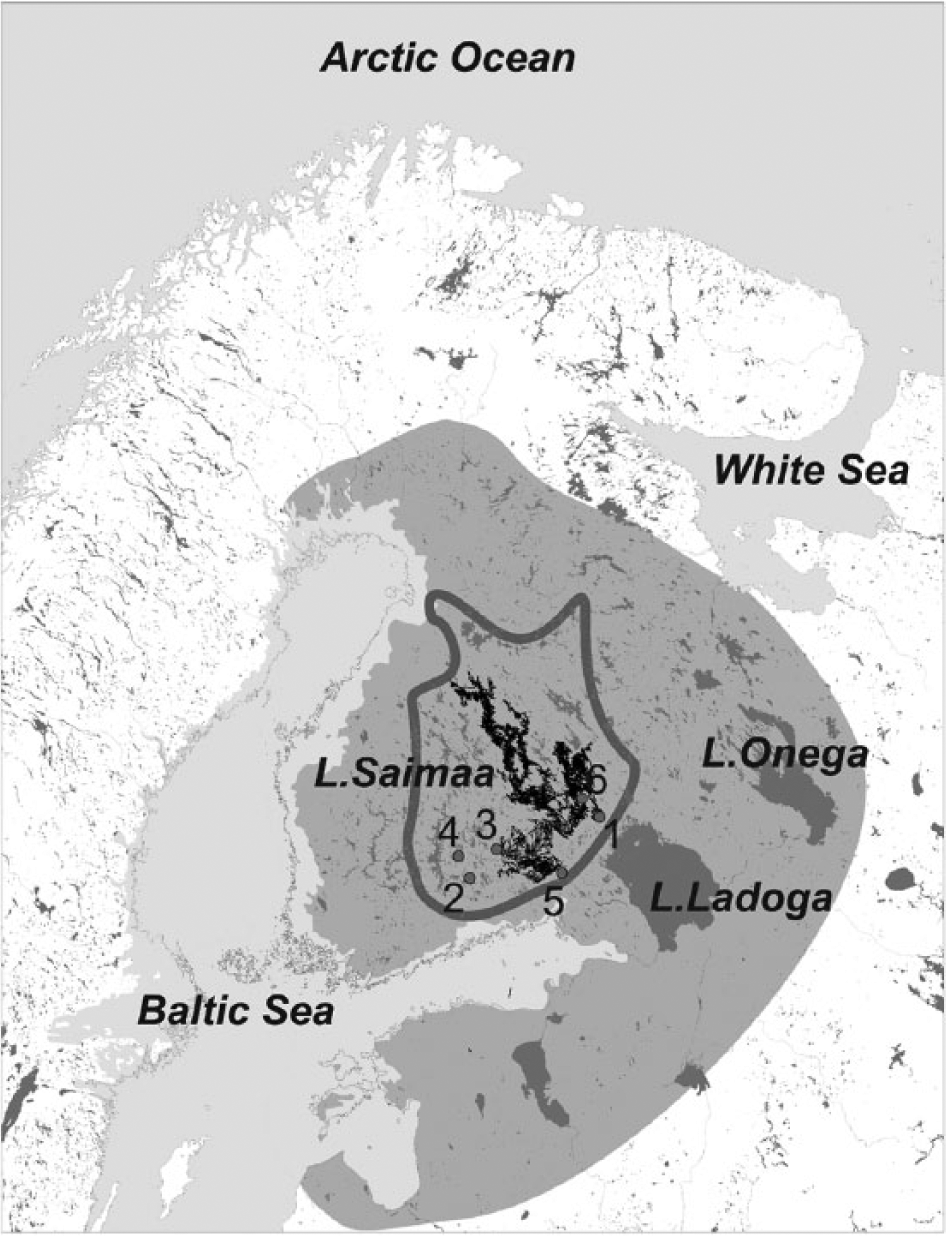
Map of eastern Fennoscandia with the location of the sites mentioned in the text: (1) Lake Kirkkolampi, (2) Lake Huhdasjärvi, (3) Lake Orijärvi, (4) Lake Laihalampi, (5) the site of Vuoksi breakthrough and (6) Rääkkylä. The distribution area of Early Asbestos Ware sites is shown with green outline and that of Typical Comb Ware in brown shading. The shoreline of the Baltic Sea approximates the situation at c. 4000 cal.
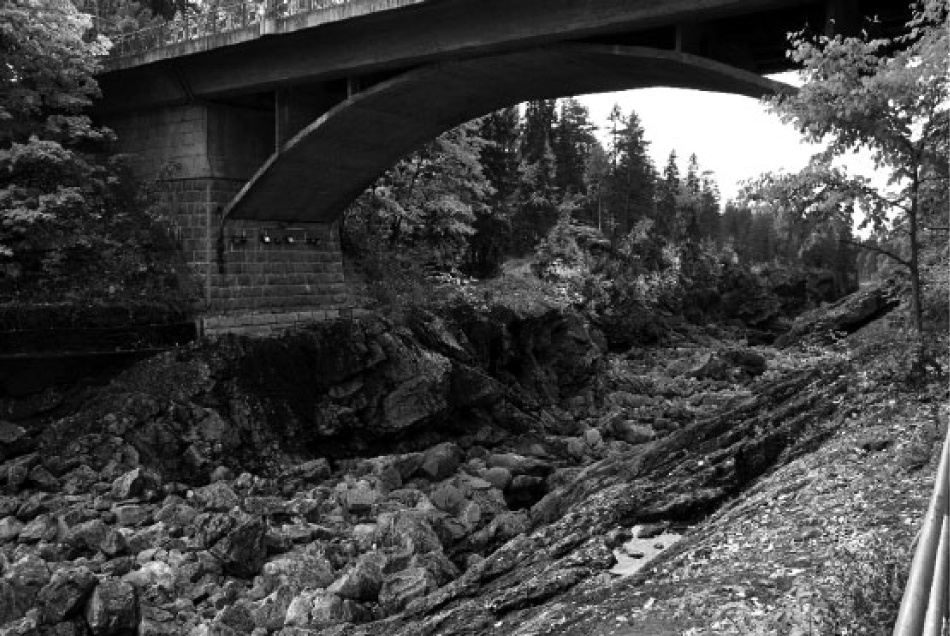
The River Vuoksi broke through the moraine and rocks of the Salpausselkä I end moraine. The strength of the stream is harnessed today by a dam and a power plant, revealing the eroded canyon.
The water level of Lake Saimaa lowered immediately by 2–2.5 m, and this event was followed by a more gradual decline, which eventually totalled 4 m (Saarnisto, 1970). The decline in the water level halved the lake area (Saarnisto, 1970) to the present 4380 km2 owing to the shallowness of ancient Lake Saimaa. Thus, drastic changes to the shoreline occurred, including shallow bays, shallow lakes and rivers that dried up. Moreover, new smaller lakes became isolated from the main body of water, and thousands of square kilometres of new land emerged as the lake waters receded. This new patchy habitat was soon populated by pioneer flora and fauna, in a process that increased the local biodiversity (Mökkönen, 2002). Downstream of the flood, the level of Lake Ladoga rose by 1–2 m (Saarnisto, 1970), which altered the shoreline ecosystem and even buried several prehistoric settlement sites (Ailio, 1915; Saarnisto and Siiriäinen, 1970).
The VB occurred towards the end of the Holocene climatic optimum (Heikkilä and Seppä, 2003; Wanner et al., 2008) at a time of another major ecological change. Picea abies (Norway spruce) first colonized the eastern extremity of Finland around the mid-5th millennium
These environmental changes occurred simultaneously with cultural transitions among hunter-gatherer populations who lived in the area. The first pottery appeared around ancient Lake Saimaa basin c. 5100 cal.
Chronological order of the VB along with that of the associated or coincidental changes to ecosystems, human population dynamics and cultural changes in human populations has been poorly understood until now. In the following, we describe a comprehensive synthesis on the event sequence associated with the VB based on high-resolution Bayesian chronology and transdisciplinary reasoning. The nearly contemporaneous environmental and cultural changes enabled us to quantify the ordering probabilities of the events to form the basis for addressing their causal relationships.
Materials and methods
Radiocarbon data
The dataset includes 118 radiocarbon dates for the EAW (23) and the TCW (79) cultures in addition to radiocarbon data for the VB (61; Table S1, available online). The dataset is therefore statistically sufficient. The radiocarbon data were gathered from the area of the Eastern Finnish Lake District and the Karelian Isthmus, which covers the central part of eastern Fennoscandia of Finland and Russia (Figure 3). In addition to the 105 radiocarbon dates obtained during the last four decades (conventional and accelerator mass spectrometric (AMS)), we have conducted 13 new radiocarbon analyses (AMS). These analyses were carried out on charred crust and birch bark tar adhesions on EAW and TCW pottery sherds and burnt bone fragments from the EAW culture (Table S1, available online). The new samples were dated by the Laboratory of Chronology at the Finnish Museum of Natural History, LUOMUS. The charred crust and birch bark tar samples were subjected to an acid–alkali–acid method (De Vries and Barendsen, 1954) and successively combusted to extract CO2. The burnt bone samples were prepared according to the method described by Lanting et al. (2001). After measuring the sample δ13C value using an IRMS (Thermo Finnigan Delta Plus XL, Thermo Fisher Scientific Inc., Waltham, Massachusetts, USA), the CO2 samples were converted to graphite targets (Slota et al., 1986) for AMS radiocarbon measurements. The AMS measurements were carried out by the Uppsala Tandem Laboratory (Possnert, 1984) on these graphite targets.
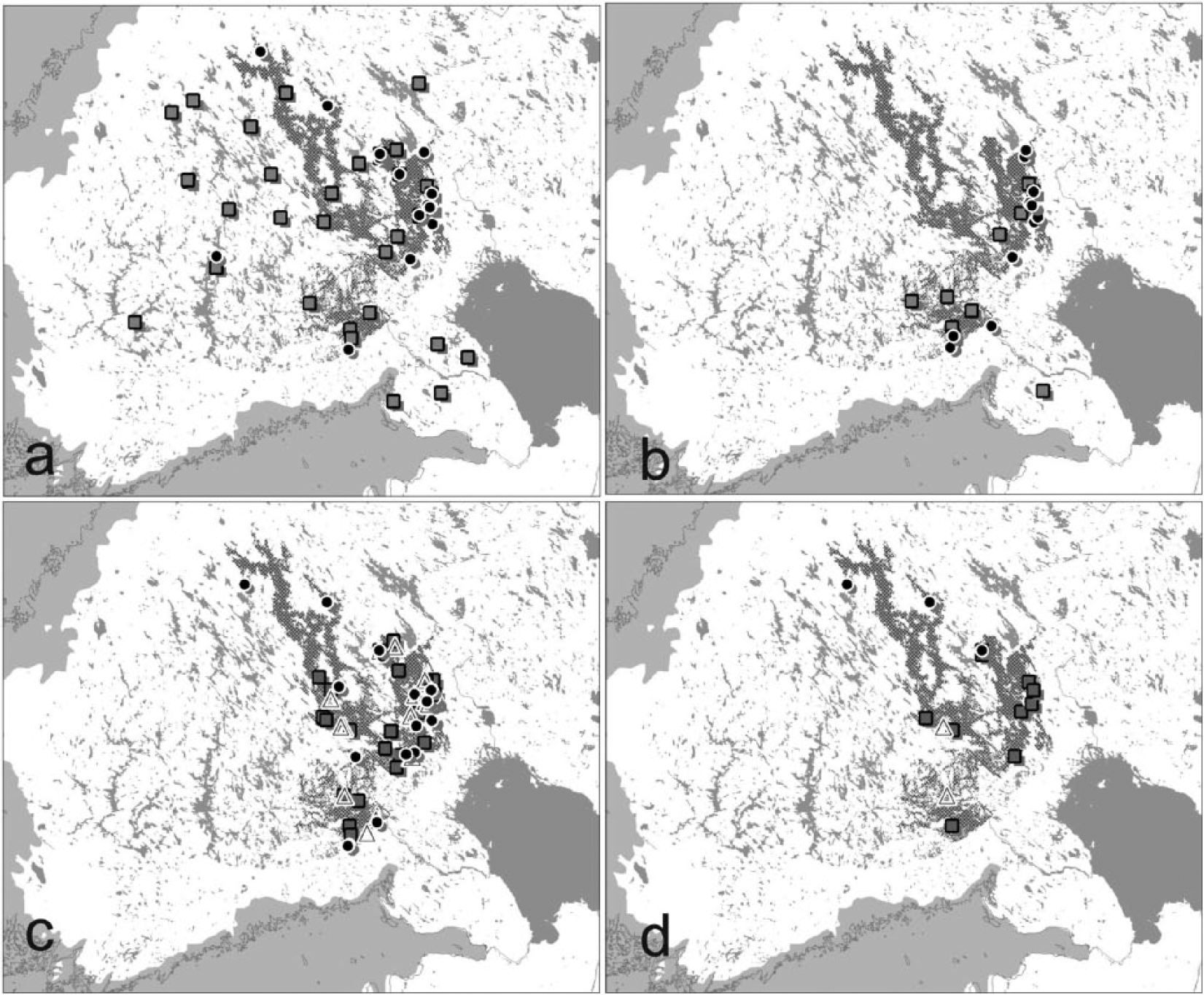
The geographical location of the radiocarbon-dated sites (a) and (b) and the sites with osteological analyses (c) and (d): (a) sites with EAW dates (circle) and TCW dates (square); (b) sites pre-dating the Vuoksi breakthrough (VB; circle) and post-dating the VB (square); (c) osteological analyses from an EAW context (circle), a TCW context (square) and later contexts (triangle); and (d) moose in an EAW context (circle), a TCW context (square) and later contexts (triangle). Shorelines of the Baltic Sea as reconstructed for c. 4000 cal.
Radiocarbon dating models
The radiocarbon dates that represent the time before the VB (pre-VB) consist of three particular sets. The first set of samples for dating were taken from the Imatra Linnansuo bog, where samples of wood of the top layer of the peat were found immediately underlying the transgression sediments to determine the dates of geological events (Delusin and Donner, 1995; Saarnisto, 1970). The second set of samples for dating were taken from archaeological sites on the shore formations (Jussila, 1999; Siiriäinen, 1973) above the maximum level of ancient Lake Saimaa in southeastern Saimaa. The third set of samples was taken from archaeological sites submerged in the transgression in the same area. The sites that were identified as having been established on the residual wetlands after the VB, and therefore below the maximum shoreline, were considered as post-VB. Stratigraphically ordered geological and archaeological radiocarbon dating data used in the former dating schemes were also included in the model (Delusin and Donner, 1995; Saarnisto, 1970; Takala and Sirviö, 2003). In total, there were 23 pre-VB dates and 38 post-VB dates.
We utilized the Bayesian approach in our analysis, which was run on Oxcal 4.1 software (Bronk Ramsey, 2009) to obtain the event chronologies. We also assumed independent chronological phases and a uniform a priori calendar year probability distribution for the model (e.g. Figure S1, available online). This was subsequently converted to an a posteriori distribution by using the IntCal09 calibration curve (Reimer et al., 2009). The analysis resulted in phase boundaries that were interpreted as the moment of the VB, the end of Early Asbestos Ware (eEAW) and the start of Typical Comb Ware (sTCW) cultures (Table 1). The order of the events and its sensitivity to various subsets of data were assessed by using the quantitative ordering probabilities (P1–5) that were generated by the model. Sensitivity analyses were performed by comparing the ordering probabilities resulting from all the 118 dates (P1) to those obtained after excluding the dates common to the studied events (P2), after excluding the wood and charcoal samples prone to potential own-age effect (P3), and after excluding both common, and wood and charcoal dates (P4). Eventually, the effects of dates with considerably large uncertainties (≥70 radiocarbon years) were also studied by excluding them from the data (P5).
Calendar year ranges (in cal.

sEAW: start of Early Asbestos Ware; eEAW: end of Early Asbestos Ware; VB: Vuoksi breakthrough, that is, the lake drainage; sTCW: start of Typical Comb Ware; eTCW: end of Typical Comb Ware; CI: credibility interval.
SEM-EDX
A high-resolution field emission SEM (Hitachi S-4800 FE-SEM, Hitachi High-Technologies Corporation, Tokyo, Japan) was used for backscatter (BSE) and secondary electron (SE) imaging polished blocks of the ceramic cross sections. The SEM was equipped with an energy-dispersive x-ray microanalysis system (Oxford INCA 350 SEM-EDX, Oxford Instruments plc, Abingdon, Oxfordshire, England) for elemental analysis. In total, 16 pottery sherds of EAW (4600–3850 cal.
The composition of the exploited clay source (Tite, 2008), and the elemental concentrations of the ceramic matrices (three areas of 250 µm × 250 µm) were measured under the following conditions: working distance, 15 mm; accelerating voltage, 20 kV; process time, 5; dead time, c. 30%; and time of acquisition, 180 s. The results were stoichiometrically recalculated as oxides and reported as mean weight percentages (Table S2; available online).
Osteological data
The osteological data (Table S3, available online; Figure 3) consist of published data (Ukkonen, 1996) complemented by new data obtained from recent excavations in the southeastern Saimaa area. The original analysis reports are archived in the National Board of Antiquities, Helsinki, Finland. The samples were divided into three time periods: EAW, TCW and LNAW ceramic types and analysed as a function of these time periods.
Results
Water level decline predates the cultural change
Our results show that the water level decline because of the VB appeared earlier than the cultural change from the EAW to the TCW cultures. The new timing for the breakthrough has a 95.4% credibility interval (CI) of 3955–3810 cal.
We compared the calendar year posterior probability distributions of the events. The VB and the end of the EAW culture were nearly contemporary, whereas the emergence of the TCW culture occurred somewhat later than VB (Figure 4a and b). Quantitatively, the VB predates the cultural events with probabilities P(VB > eEAW) = 0.70 and P(VB > sTCW) = 0.92, respectively. The most probable sequence of events is VB > eEAW > sTCW which has a probability of P(VB > eEAW > sTCW) = 0.38 (Table 2). This is nearly twice the probability of the next most likely sequence (VB > sTCW > eEAW). Both these sequences indicate that the water level decline predated the cultural change. Our sensitivity analysis of differently partitioned materials (Table 2) shows that the selection of the dataset does not significantly affect the final outcome: the VB remains the earliest event for every combination.
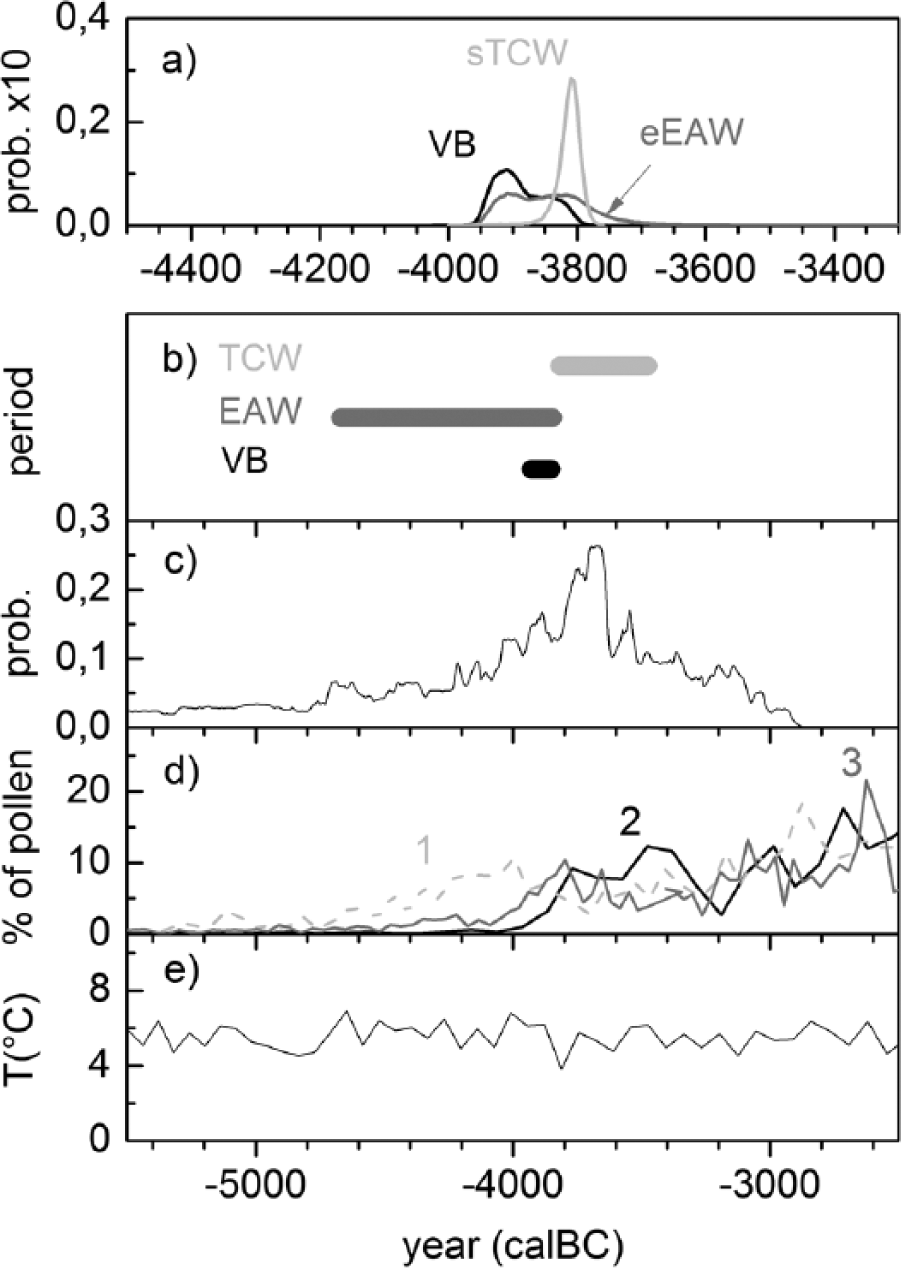
(a) Posterior calendar year probabilities of the events studied: Vuoksi breakthrough (VB), end of Early Asbestos Ware (eEAW) and start of Typical Comb Ware (sTCW). (b) Time periods for VB, EAW and TCW based on the boundary mean values (see Table 1). (c) Summed calendar year probability distribution of the archaeological dates for the region of interest. Reproduced from Tallavaara et al. (2010). (d) Picea pollen expressed as percentages of total land pollen in the Eastern Finnish Lake District: (1) Kirkkolampi, (2) Huhdasjärvi and (3) Orijärvi (Alenius et al., 2008, 2013; Alenius and Laakso, 2006). (e) Climate reconstruction (annual mean temperature) for southern Finland (Heikkilä and Seppä, 2003). Note the different x-axis scale in (a).
Posterior probabilities of the chronological ordering of the events studied.

VB: Vuoksi breakthrough; eEAW: end of Early Asbestos Ware; sTCW: start of Typical Comb Ware; P1: all dates included; P2: common dates excluded; P3: charcoal and wood dates excluded; P4: common dates, and charcoal and wood dates excluded; P5: dates with σ ≥ 70 radiocarbon years excluded.
The vast majority of the TCW sites were located on shore levels below the maximum level of ancient Lake Saimaa, specifically on the residual wetlands. Therefore, they could not have been there before the VB event. The few TCW sites that were reported above the maximum water level yielded dates that were clearly younger than that of the VB, which indicates that these particular sites were not shore-bound (Jussila, 1999; Saarnisto, 1970). Moreover, these sites were also found to be younger than those of the end boundary of the EAW culture.
Temporal overlap between EAW and TCW can be determined quantitatively by studying the time difference of the eEAW and the sTCW. The oldest individual TCW dating from the region is 5070 ± 40 BP (Poz-5978, 3965–3775 cal.
Ceramic technologies suggest discontinuity in material traditions
Sherds from three typo-chronological categories (EAW, TCW, LNAW) were subjected to clay matrix and mineral characterization by SEM/EDX (Figure S2, Table S2, available online). The purpose was to investigate the continuity of ceramic traditions within the study area and to determine any changes in the ceramic technologies and raw material acquisition. The SEM analysis found three distinct ceramic recipes that reflected the aforementioned cultural phases, which categorized the typo-chronological assignments (Lavento and Hornytzkyj, 1996) of the analysed sherds.
The EAW pots were extensively anthophyllite asbestos-tempered, and fine fibres were embedded in the clay body matrix, which gave high MgO values. The TCW pots had slightly higher Al2O3 and FeO values than the EAW pottery. A few TCW pots also had abundant talc inclusions and very rare tremolitic–actinolitic asbestos or anthophyllite asbestos, although it should be emphasized that the asbestos tempering in this group was marginal. The LNAW sherds differed most distinctively from the two earlier groups by their matrix composition, which was characterized by significantly lower Al2O3 and higher SiO2 (Table S2, available online).
In addition to their stylistic differences (Figure S2, available online), sweeping technological changes can be recognized between the EAW and TCW ceramic traditions. These changes are highlighted by the different tempering practices and variation in the clay composition that indicate different raw material exploitation patterns.
Increased relevance of moose as a food source
Osteological material obtained from the Lake Saimaa area by Ukkonen (1996) and in this study (Figure 3) provides definitive evidence of a change in subsistence strategies, that is, from EAW to the TCW culture. Significantly, the percentage of Alces alces (moose) fragments of the total mammal bone fragments increased from 2.5% in the EAW phase to 23.8% in the TCW period and then fell back to 4.8% for later periods (Figure 5). We suppressed the skewing statistical effects of the usage of moose in single sites that have been studied more extensively (Table S3, available online). This was accomplished by analysing the percentage of sites from which the moose bone fragments were found. The fraction of TCW sites with moose fragment finds was twice that of the EAW sites (Figure 5). Consequently, moose was used in significantly larger amounts within the Lake Saimaa district during the post-VB TCW period compared with the pre-VB EAW period.
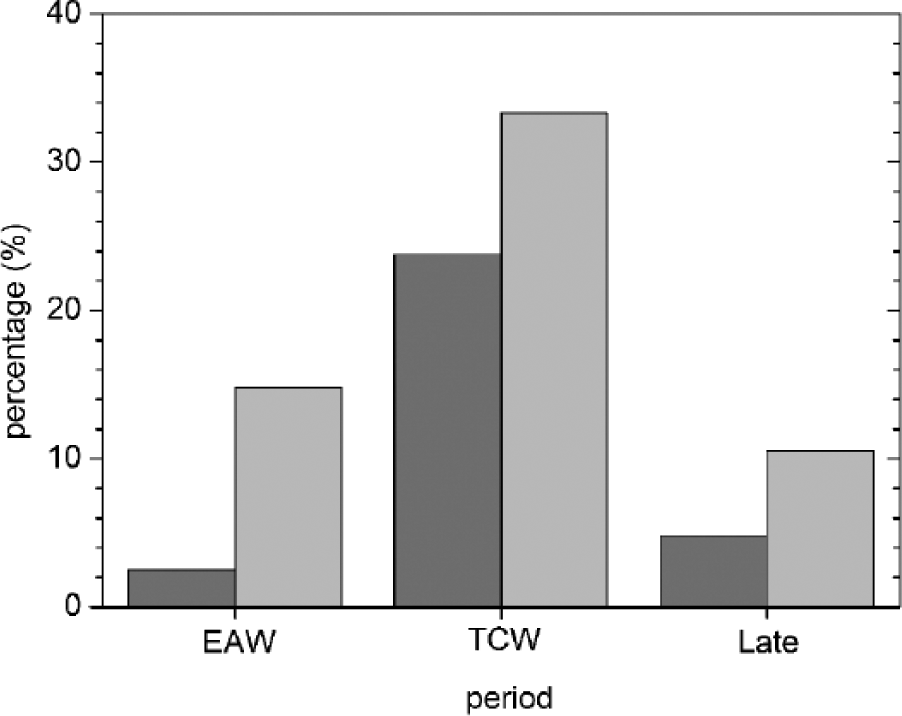
Appearance of moose in the osteological mammal fauna in ancient Lake Saimaa sites during the studied time periods. Dark grey: percentage of moose bone fragments in the total mammal bone fragments. Light grey: Percentage of sites at which moose bone fragments were found (see Table S3, available online, for the full dataset).
Other important mammal resources were Castor fiber (beaver), Rangifer tarandus (forest reindeer) and Pusa hispida saimensis (Saimaa ranged seal). No clear change in seal or forest reindeer proportions could be seen in the osteological materials (Table S3, available online). There was a slight decline from EAW to later cultures for beaver, which was possibly because of inherent reduction of the water ways. However, fishing remained important during the entire studied time period.
Discussion
Our study is the first Bayesian model analysis to provide quantitative calendar year probability distributions of all the events studied. We have shown that the VB exposed new land just before the most profound hunter-gatherer cultural change occurred within the study area. Additionally, we demonstrated that the elemental characteristics of the pottery and also the osteological data for moose bone fragments are markedly different for the post-VB TCW sites compared with pre-VB EAW. In the following, we address the causality of the events by discussing the effects of the lowering water level on broader environmental development.
Environment after the VB
Even though the VB would have begun slowly, it is very probable that the major decline was rapid. There is a noticeable river delta in the Jääski, Karelian Isthmus (Hellaakoski, 1938), and even more importantly, there was flooding of TCW settlements in the southeastern parts of Lake Ladoga dating to this specific time (Ailio, 1915; Saarnisto, 1970). This evidence shows that the rapidly rising water level led to difficult living conditions downstream, which forced the inhabitants to abandon their settlements and move to new areas. One possible direction of the new settlement was in the Karelian Isthmus and the Lake Saimaa region, which was upstream of the new river. A complementary phenomenon to the flooding events at Lake Ladoga was that several thousand square kilometres of residual wetlands became exposed within the Lake Saimaa region at the time of the VB. This promoted habitat patchiness (Cornell and Lawton, 1992), which increased the diversity of flora and fauna (Mökkönen, 2002). Pollen diagrams unambiguously show that the first pioneer species to enter the newly exposed lands were sedges and pioneer tree species such as Salix (willow) and Betula (birch; Alenius et al., 2008; Alenius and Laakso, 2006).
Such gradually drying wetlands create extraordinarily rich grazing lands for large ruminants such as the moose (Geist, 1998; Hjeljord et al., 1990). Osteological material in the Lake Saimaa area shows that the percentage of moose fragments in the total mammal bone fragment assemblages substantially increased in the post-VB TCW period. This supports the idea of a moose population explosion. Analogous to the situation described for the Lake Saimaa area of prehistory, there is abundant evidence that modern commercial forestry has enabled a massive increase in the current moose populations by radically rejuvenating forests and thereby creating optimal food sources for large ruminants (Hörnberg, 2001; Lavsund et al., 2003; Nygrén, 1987). Moose is a colonizing species (Geist, 1998), and a very efficient breeder, especially in favourable conditions with an abundance of forage to eat and moderate and controlled predation that keeps the population age structure favourable for reproduction. The current annual mean increase of the moose population in southern Finland was reported to be more than 60% (Nygrén, 2009).
The period of abundant moose populations may not have lasted long. After the VB at 3890 ± 40 cal.
Human population after the water level decline
The study area contains practically the whole area that encompasses the EAW sites. The dwelling sites were typically located on the shores of ancient Lake Saimaa, thus the rapidly lowering water level probably presented a huge challenge for the whole EAW culture. The EAW people definitely had to adapt to new and gradually disappearing shorelines and the consequences of which possibly led to changes in how to obtain daily nourishment. The subsequent disturbances to the livelihoods of the EAW people may have played a role in the disappearance of that culture. However, our data do not reveal clear reasons for the EAW decline, and because of the absence of more detailed studies, such reasons remain unknown.
Chronologically, the EAW culture ended slightly earlier than the TCW started, although quantitative evidence suggest that temporally overlapping cultures cannot be ruled out. The chemical composition of the ceramic matrices and their mineralogical tempering revealed by SEM analyses are indicative of the technological differences between the EAW and TCW cultures. Although we cannot exclude the possibility of these differences being linked with environmental or social factors (e.g. newly emerged clay sources, fewer contacts for material exchange, cultural diffusion), such comprehensive differences may be linked to the disruptions in the pottery manufacturing traditions, which may subsequently reflect the occupational history of the area. Importantly, there are no known sites with intermediate cultural features (Pesonen, 1996), which indicates that the two cultures did not merge. Moreover, asbestos fibres improved the durability and heat resistance of the pots, and it is unclear why this advantageous technology was not used by the TCW culture unless it was unknown to the TCW potters. An almost total lack of parallels and intermediate forms in several aspects of the common material usage between the EAW and TCW cultures supports the idea that no significant interaction occurred between these two groups of potters.
The innovative and expansive TCW culture rapidly spread all the way to the Polar Circle (Meinander, 1984). In the coastal areas, the TCW hunter-gatherers were maritime and concentrated on seal hunting and fishing (Nuñez, 1991). However, the TCW settlement of the inland regions and especially that of the Lake Saimaa basin shows a different pattern of adaptation. Although seal was also hunted in the Saimaa area (Table S3, available online), the stock was never abundant (Ukkonen, 1996, 2001). Thus, fishing still formed a large part of the diet. However, the osteological data also indicate that a significant moose population provided another rich resource for the new culture. It has been suggested that based on the travellers-processors model, an increasing population would drive people to adopt the so-called high-cost subsistence strategies (Bettinger and Baumhoff, 1982) such as fishing. Fishing remained important throughout the whole time period covered by our study; therefore, travellers-processors hypothesis appears valid. An alternative low-cost strategy such as moose hunting, which requires large areas, would lose its advantages for an increasing population. However, the maximum population density within the area was probably so low that the TCW people were able to adopt both high- and low-cost subsistence strategies simultaneously.
Moose is by far the largest game in boreal ecosystems because an average-sized moose yields c. 140 kg of meat (Nygrén and Pesonen, 1989). Assuming moose population densities of 0.4–1.3 animals/km2 (Messier, 1994), adult meat consumption by humans of 650 g/day (Cordain et al., 2000; Eaton and Konner, 1985), a moose productivity of 60% (Nygrén, 2009) and a hunting allotment of winter population as 60%, then moose hunting would have supported the nourishment of c. 10–40 adults/100 km2, depending on the initial moose population density (Text S1, available online). This is in accordance with the estimated population density of hunter-gatherers of around 30–40 persons/100 km2 for the period of mid-Holocene climatic optimum that was reported by Tallavaara and Seppä (2011, Figure 2b), based on the model proposed by Binford (2001). The body size–return rate relationship of large mammals indicates that the hierarchical ranking of moose as prey must have been high (Broughton et al., 2011; Kelly, 2007). In addition to the value of the meat as nourishment, other parts of the moose were utilized effectively and were vitally important. These included the skins for warmth and protection, the ligaments for sewing, and bone and antlers for tools. Accordingly, moose hunting may have indeed had a strong role in providing yearly subsistence within the Lake Saimaa region after the VB. The increased share of moose bone fragments during the TCW period confirms this. Furthermore, the Stone Age population maximum (Oinonen et al., 2010; Tallavaara et al., 2010; Figure 4c) within the area is almost solely because of radiocarbon-dated TCW finds, which emphasizes the importance of the TCW population after the VB. Hence, it is very reasonable to suggest the nearly contemporaneous (a) development of an ecosystem that favoured increased nourishment for moose that promoted increased moose populations, (b) an increase in the amounts of moose bone fragments in refuse deposits on TCW sites as a result of increases in the hunting of moose and (c) the human population maximum during and because of the TCW culture.
The population maximum lasted for approximately two centuries (3800–3600 cal.
The Stone Age hunter-gatherer population maximum has been interpreted as a population boom-and-bust cycle that was related to environmental factors such as changes in mean temperature, changes in forest composition and alterations in bio-productivity of terrestrial, marine and lacustrine ecosystems (Tallavaara et al., 2010; Tallavaara and Seppä, 2011). Our study complements the findings of previous studies by suggesting a detailed causal chain of events that was triggered by the VB to explain the terrestrial productivity changes within the study area. We also emphasize that in addition to the long-term climatic and environmental drivers that affected the ecological and cultural evolution in the long run, the sudden anomalous event of the VB may have acted as an ultimate trigger and catalyst for abrupt changes in ecological, cultural and demographic landscapes.
Conclusion
We conducted a comprehensive synthesis on the effects of a sudden environmental change on the ecological, cultural and demographic landscapes of mid-Holocene hunter-gatherers in eastern Fennoscandia. We emphasized that a massive and sudden water level decline of Lake Saimaa took place just before and thus heralded the appearance of the most prominent culture of eastern Fennoscandian prehistory: the TCW culture. We suggest that the sudden decline in the lake level triggered ecological change and facilitated the increase of the moose population in the area, and this encouraged the TCW hunter-gatherers to settle in the area. This hypothesis of human population replacement is supported by the different cultural artefact profiles found and also by elemental analyses of pottery that indicate a discontinuity between the cultures. The period of flourishing of the TCW culture corresponds broadly to the time of increased nourishment for moose, followed by an ecological succession to old growth boreal conifer forests in which the availability and quality of moose forage became suboptimal.
The abrupt VB created thousands of square kilometres of residual wetlands that supported thriving pioneer vegetation species and was inhabited by rich game. It was possibly a disaster for earlier human populations, but definitely presented opportunities for newcomers and provided a framework for ecological and cultural change in the Eastern Finnish Lake District. Event sequences triggered by the glacial or post-glacial environmental changes have been common throughout the past. Hence, we suggest that a transdisciplinary approach that is based on event sequencing could give new insights into many old paradigms.
Footnotes
Acknowledgements
The authors wish to thank the following individuals for their invaluable contributions throughout the project: Anne-Maija Forss, Petri Halinen, Ilkka Hanski, Esa Hertell, Seppo Hornytzkyj, Päivi Kankkunen, Taisto Karjalainen, Kaarlo Katiskoski, Marianna Kemell, Kreetta Lesell, Sirpa Leskinen, Kristiina Mannermaa, Teemu Mökkönen, Katariina Nurminen, Kati Salo, Igor Shevchuk, Eeva-Liisa Schulz, Tapani Tolvanen, Pirkko Ukkonen and Simo Vanhatalo. In addition, we want to thank Caitlin Buck for her inspirational examples of using Bayesian statistical framework in Archaeology and Christopher Ramsey for building confidence on the used dating models. Finally, we would like to thank the two anonymous reviewers for their competent and constructive comments on the manuscript.
Funding
The study was partially funded by the Academy of Finland (funding decision no. 133056).
References
Supplementary Material
Please find the following supplemental material available below.
For Open Access articles published under a Creative Commons License, all supplemental material carries the same license as the article it is associated with.
For non-Open Access articles published, all supplemental material carries a non-exclusive license, and permission requests for re-use of supplemental material or any part of supplemental material shall be sent directly to the copyright owner as specified in the copyright notice associated with the article.
