



Abstract
Chronological precision is a pre-requisite for all palaeoecological analyses, especially in more recent Holocene deposits such as small hollow peat and mor humus in woodlands. Here, tephrochronology was employed to improve the chronological control of such deposits to aid subsequent sub-fossil insect analyses from three sites in western and southwestern Ireland. Six tephra layers were detected from the three small hollows but only one from the mor humus sites. Four of the layers were matched to known tephra horizons regularly recorded in Ireland while two new tephras of possible Azores and Grímsvötn origin were recorded. The latter tephra may be the first definitive record of Laki 1783-4 from Ireland and is potentially an important new chronological marker for Irish palaeoecological investigations of late Holocene deposits. Results suggest that tephrochronology is a successful additional chronological tool for small hollow palaeoecological studies but is less helpful in mor humus deposits.
Introduction
Small hollows and mor humus deposits have been identified as important potential sources of local pollen, plant macrofossil and insect assemblages, providing a clearer picture of drivers of Holocene woodland composition change including climate, topography, human impact (fire, grazing) and local edaphic factors (Bradshaw, 2007; Mitchell, 2013; Overballe-Petersen and Bradshaw, 2011; Reilly, 2008). Establishing a robust chronology for such deposits is critical to understanding the timing and duration of changes noted within pollen, plant macrofossil and insect assemblages.
Dating of small woodland hollows, which usually comprise organic muds and peat formed over thousands of years, has generally relied on radiocarbon dating alone (e.g. Bjune et al., 2009; Lindbladh et al., 2007; Little et al., 1996; Mitchell, 1988). However, the occasionally slow sedimentation rates and often wide calibrated date ranges in some hollows means that short-lived vegetational and sedimentation changes can be masked. Root contamination in these sediments can also be an issue for radiocarbon dates.
Mor humus, which generally comprises acidic, dry, partly decomposed leaf litter, quite shallow in depth, is even more problematic to radiocarbon date. This is because of the potential movement of material through the profile because of invertebrate action and the ‘older humus’ effect at the base of many profiles (Cruickshank and Cruickshank, 1981; Hannon and Bradshaw, 1989; Mitchell, 1990a, 1990b). In the past, other proxy methods have been used to date mor humus deposits including, for example, constant pollen influx method, charcoal horizons from known historical events and the reintroduction or local planting of pine in Ireland (Aaby, 1983; Bradshaw, 1988; Bradshaw and Hannon, 1992; Dodson and Bradshaw, 1987; Iversen, 1969; Mitchell, 1990a, 1990b; Stockmarr, 1975).
Tephrochronology works on the principle that volcanic ash layers can be used to date and correlate sediments from which they are extracted (Dugmore et al., 1995; Hall and Pilcher, 2002). Some recent tephras can be assigned very precise historical dates from documentary records, while others have been dated via high-resolution wiggle-matching of radiocarbon dates (e.g. Barber et al., 2008; Plunkett et al., 2004). Despite being a widely used technique in Holocene peat and lake sequences, tephrochronology has had very limited application to date in small hollow and mor humus deposits (e.g. Bradshaw and Zackrisson, 1990). In this paper, we describe the application of tephrochronology to develop chronologies in small hollow and mor humus deposits in western Ireland. In so doing, we also describe some tephras hitherto unreported from Ireland (see Swindles et al. (2011) and Lawson et al. (2012) for the most recent summary of all distal tephras found in Ireland and western Europe dating from the last 7000 years).
The study sites
Three small hollow sites paired with three mor humus sites from three Irish woodlands were selected for tephra analysis (Figure 1). Two of the woods, Derrycunihy and Camillan, lie in the southwest of Ireland, in Killarney National Park, Co. Kerry. The third site, Brackloon, lies further north in Co. Mayo. All three woodlands are examples of Atlantic oakwoods that fall within the Blechno–Quercetum association (Kelly and Moore, 1975; White and Doyle, 1982), equating to the WN1 Irish habitat classification (Fossitt, 2000), the Quercus petraea–Luzula sylvatica woodland group (Perrin et al., 2006), and matching the W11 and W17 classification of British plant communities (Rodwell, 1991). Brackloon Wood differs from the two Kerry woodlands in that it is part-native woodland and part-plantation woodland (for detailed descriptions of all three sites, see Reilly, 2008).

Location map of Ireland showing sites.
The Derrycunihy hollow chosen for analysis was the same one analysed for pollen by Mitchell (1988). It is located at the northwestern limit of the wood (NGR: 090177/081390) and is a small steep-sided hollow 10 m wide × 30 m long. The mor humus sampling site is located in the same basin 19.5 m to the southeast of the small hollow sampling location, on a slightly elevated rocky outcrop (NGR: 090189/081383).
The Camillan small hollow sampling site lies 50 m to the southeast of the hollow used by Mitchell (1988). It is a shallow, swampy basin 40 m wide × 30 m long, lying 400 m west of Doo Lough (NGR: 094625/086083). The mor humus sampling location lies 21.9 m west of the coring site, on a slightly elevated rocky outcrop, at the foot of a clump of holly trees (NGR: 094603/086103). Three mor humus sites were sampled by Mitchell (1988, 1990b) on this and neighbouring ridges.
The Brackloon small hollow sampling site was a long, narrow hollow 15 m wide × 30 m long, 24 m east of the forest road running approximately northeast–southwest through the wood and 70 m west of a meander of the Owenwee River, in the southeast corner of the woodland (NGR: 097484/279959). The sampling site is approximately 15 m southeast of a site sampled by Von Engelbrechten et al. (2000). The mor humus sampling site (NGR: 097455/279904), which lies approximately 31 m west and 55 m south of the small hollow sampling site, was elevated compared with the hollow site and ground conditions were very shaded. The mor humus was extracted at the base of a holly tree.
Materials and methods
Sampling methods
The small hollow basins were probed to find their deepest points. A monolith was extracted using a Wardenaar (1987) corer. Sampling for mor humus involved the digging of a pit and lifting intact blocks of material. The lithology of the monoliths and mor humus blocks was described using the Troels-Smith system of sediment description and classification (Reilly, 2008; Troels-Smith, 1955).
Tephra analysis
The tephras detected in Irish peat deposits, known as ‘cryptotephra’ (sensu Lowe and Hunt, 2001), are not visible to the naked eye (Dugmore, 1989). Layers of cryptotephra can be isolated from waterlogged deposits where they have settled using a variety of methods. Detection is the first stage in the process, and the methodology used here was that described by Pilcher and Hall (1992) involving the combustion of peat samples. The sediments were sub-sampled at 2-cm intervals as the final resolution for subsequent insect analysis was at this interval (Reilly and Mitchell, in preparation). An Olympus BX 40 binocular microscope at 200× magnification was used to examine the prepared slides. Plane polarized light was also used to distinguish between the tephra shards and other mineral matter. The number of tephra shards on each slide was counted, and the colour, shape and condition of the shards were noted.
Extraction of tephra was carried out using the ‘Acid Digestion’ method, first outlined by Dugmore (1989). The procedure used for this project followed that outlined for extraction from peat deposits on Tephrabase, the web-based tephra database hosted by the Geosciences Department, Edinburgh University (Newton, 2007).
One problem encountered during processing of the mor humus samples was the presence of a waxy precipitate during the acid digestion process. This is thought to be as a result of the release of vegetable waxes from plant fragments in peat during acid digestion (Gillian Plunkett, personal communication, 2005). Removal of these waxes involved repeating the acid digestion process on the final sediment after decanting the acid/water mixture but before initial sieving over the coarse 80-µm sieve to remove any larger particles of organic or inorganic matter, then continuing to the finer sieve of 25-µm to collect the tephra shards.
Identification of tephra shards was carried out using an electron microprobe, the Cameca SX100, at the Tephrochronology Analytical Unit, School of Geosciences, University of Edinburgh. Instrument calibration was carried out regularly by analysing reference-materials with known compositions. Analysis conditions are included in the Supplementary Data (available online). In considering the data from microprobe analysis, only percentage values exceeding 95% of total oxides are considered (Hunt and Hill, 1993), and generally 15–20 valid analyses are required for a definite tephra layer (Hall and Pilcher, 2002), although see exceptions described in ‘Results’ section. Detected tephra layers were identified by comparison of oxide abundances against known reference material using similarity coefficients (Borchardt et al., 1972) (see Table 1 and 4; Supplementary Data, available online). Comparisons of proportions of key oxides are illustrated in Figures 2 and 3.


Plot of SiO2 against total alkalis (Na2O + K2O) for all Derrycunihy, Camillan and Brackloon tephras against a range of known Irish and European tephras (source data: see Table 1).

Plot of TiO2 versus FeO (total) for BRACSH-1 and a range of basaltic tephras, including three reference mean values from the Laki eruption.
Radiocarbon dating
Samples for radiocarbon dating of approximately 100 mg weight of wet peat were extracted from selected levels in the three small hollow cores. As these samples were intended for dating of the whole peat, they were sorted under the microscope to remove loose plant material, such as leaf fragments, wood fragments and rootlets, to reduce potential contamination. Samples were then placed in glass tubes and sent to the 14Chrono Centre, Queen’s University Belfast for accelerated mass spectrometry (AMS) dating. The program CALIB version 5.0.2, using the IntCal09 calibration curve, was used to calibrate radiocarbon age determinations from BP results to equivalent calendar age ranges (Table 2; Reimer et al., 2004; Stuiver and Reimer, 1993).
Results of the radiocarbon dating determinations for Derrycunihy, Camillan and Brackloon small hollows calibrated using CALIB 5.0.2, IntCal09 calibration curve (Reimer et al. 2004).

Chronologies
Chronologies for each small hollow profile were developed using the Bayesian modelling technique Bchron (version 3.1.4 using the IntCal09 calibration curve), which uses a stochastic linear interpolation process (Haslett and Parnell, 2008). The Bchron package was also used to predict the date of a tephra from Brackloon.
Results
The results of the radiocarbon dating are outlined in Table 2.
In total, seven tephra layers were identified: six from the three small hollows and one from the mor humus sites (Table 3). Of these, four were definitively identified, and for three, postulated dating was assigned. No identifiable tephras were detected from the mor humus sites at Camillan and Brackloon.
Postulated identification/dating for tephra layers from all small hollow and mor humus sites, Derrycunihy, Camillan and Brackloon Woods (SH = small hollow; MH = mor humus).

Derrycunihy Wood
Two identifiable tephra layers were found in the small hollow cores from Derrycunihy Wood (Tables 1 and 3) (for full geochemical analysis of individual shards, see Supplementary Data, available online). Figure 2 plots mean SiO2 against mean total alkalis (Na2O + K2O) for all the small hollow and mor humus tephras and a range of known tephras (Table 1). Similarity coefficients show that DCSH-1 is a good match to the Hekla 1104 tephra found in many other locations in Ireland (Table 4, and Supplementary Data, available online).
Similarity coefficients between small hollow/mor humus tephras and known tephras.

Values of 95% and above represent good correlations (shown in bold). A value of 94% may also represent a match (shown in italics).
In Figure 2, DCSH-2 sits alongside a number of tephras thought to have originated from Jan Mayen Island in the Arctic Sea, 600 km north of Iceland and 500 km east of Greenland, on the North Atlantic Ridge (Chambers et al., 2004; Hunt, 2004; Imsland, 1978, 1984, 1986). Four separate possible ‘Jan Mayen’ tephras were recorded from An Loch Mór, Inis Oírr, in the west of Ireland and dated stratigraphically to c.
Only five valid analyses were obtained during geochemical analysis of DCSH-2, but many more shards were identified during the initial detection phase (Table 3). The highly vesicular nature of the shards rendered them difficult to analyse as the microprobe tended to burn through them. Despite this, the small number of analyses is still regarded as a valid tephra layer.
One definite tephra layer was identified from the mor humus block in Derrycunihy (Table 3). The number of shards analysed was small, due partly to the presence of a waxy deposit from the acid digestion process that could not be successfully removed at the time. The vesicular nature of the shards also meant that many of them were ‘burnt through’ by the microprobe beam. Nevertheless, the initial detection count was almost 100 shards and six good analyses were obtained (see Supplementary Data, available online). Similarity coefficients confirm that it is most similar to Hekla 1510/Hekla 1947 (Table 4). Both these tephras are very similar geochemically and are generally only separated on their stratigraphic position in palaeoecological sequences (Rea et al., 2012) (Figure 2). The depth at which this tephra was recorded in the mor humus from Derrycunihy (16–18 cm) and the fact that shallower mor humus deposits (<14 cm) in Killarney are up to 300 years old would indicate that this tephra is more likely to be 1510 than 1947 (Mitchell, 1990a, 1990b; O’Sullivan and Kelly, 2006).
Camillan Wood
Three identifiable tephra layers were found in the small hollow at Camillan Wood (Table 3, and Supplementary Data, available online). Figure 2 shows CMSH-1 in the Hekla 1510/1947 group, CMSH-2 in the Hekla 1104 group and CMSH-3 close to BMR-190, which has a similar SiO2 versus total alkalis ratio as Hekla 1510/1947. Similarity coefficients confirm the affinities of each of these tephras (Table 4, and Supplementary Data, available online).
BMR-190 was first identified in peat at Barnsmore Gap, Co. Donegal (Hall and Pilcher, 2002). It was subsequently identified in eight more sites across Ireland (Doyle, 1996; Hall and Pilcher, 2002; Plunkett, 1999; Plunkett et al., 2004). It is not certain which Hekla eruption event produced the BMR-190 ash; however, it is often closely associated with two other readily identified older tephras – OMH-185 and GB4-150 (Plunkett et al., 2004).
At Glen West, Co. Fermanagh, all three tephras were found in close association and were AMS14C wiggle-matched to 705–585 cal
Brackloon Wood
One identifiable tephra layer, made up of brown vesicular and plated shards, was found in Brackloon small hollow (Tables 3; Supplementary Data, available online).
Figure 2 shows BRACSH-1 alongside a range of ‘basaltic’ tephras, such as MOR T-1, from Veidivötn (c.
The Grímsvötn and Bárdarbunga/Veidivötn volcanoes, together with their fissure swarms, are among the most active volcanoes in Iceland with estimates of upwards of 70 eruptions in this zone between
Stray shards of basaltic tephra of Grímsvötn origin are regularly encountered in other tephra layers; however, definite layers of basaltic tephras of recent origin are not currently reported in the literature for Ireland. BRACSH-1 is a definite layer with nine good identifications and no outliers indicating mixture with another tephra layer. It occurs towards the top of the Brackloon small hollow core and is clearly quite recent. Therefore, it is possible that BRACSH-1 is from the Laki 1783-4 eruption. Figure 3 also shows three reference mean values of shards from the Laki eruption – from the Svalbard ice-core (Kekonen et al., 2005), the GIPS2 ice-core (Fiacco et al., 1994) and Iceland (Thordarson et al., 1996) – the latter is included in Table 4 and shows a good correlation with BRACSH-1. The Svalbard shards show slightly lower TiO2 values than the others; nevertheless, this tephra is currently attributed to the Laki 1783 eruption (Kekonen et al., 2005). As Laki 1783 is perhaps one of the only Grímsvötn tephras in the modern era to have potentially reached Ireland and Britain and be deposited as a coherent tephra horizon, it seems reasonable to conclude that BRACSH-1 is Laki 1783.
Building the chronologies
The radiocarbon dates and known tephra horizons were used to explore the age–depth relationships for Derrycunihy and Camillan small hollows using Bchron (Figures 4 and 5). Bchron was also used to estimate the date of the Brackloon tephra, postulated as Laki 1783-4. The interpolated date for tephra BRACSH-1 found at 13 cm is


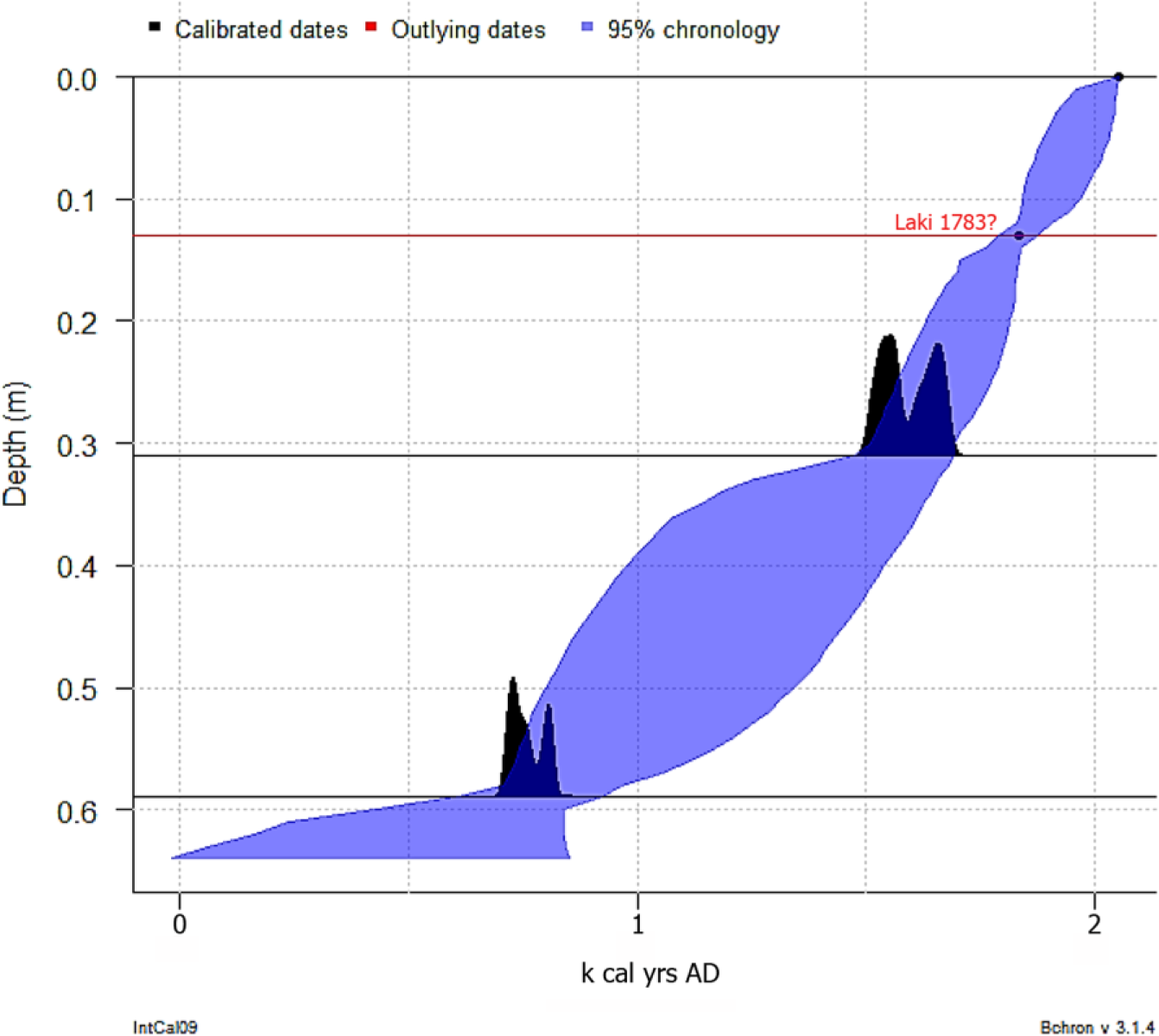
The chronologies for the three small hollow profiles all display reasonably uniform sedimentation (Figures 4–6). The mean sediment accumulation rates (± standard error) were 0.21 ± 0.002, 0.16 ± 0.009 and 0.50 ± 0.018 mm yr−1 for Derrycunihy, Camillan and Brackloon, respectively. The precision of these chronologies is illustrated by the 95% confidence intervals (Figures 4–6), which is clearly influenced by the density and precision of the dates.
Discussion
Six tephra layers from small hollow deposits were detected, four of which are well-known and well-dated isochrones in tephrochronology. Hekla 1104 was found at two sites, Derrycunihy and Camillan, allowing for potential correlation of proxy evidence between these woodlands. Hekla 1104 is one of the most widely distributed and recognized tephra layers from Ireland, making it an important dating marker for understanding late Holocene landscape change across the country (Cole and Mitchell, 2003; Hall, 2000, 2003, 2005). A recent review of ash cloud events across Europe in the last 7000 years suggests that tephra from Hekla eruptions are among the most commonly encountered outside of Iceland, with at least six major eruptions identified regularly in peat and lake deposits (Swindles et al., 2011). Tephra from the Hekla eruption of 1510 was also identified from Camillan small hollow and Derrycunihy mor humus.
An exciting outcome of the review of this research paper is the confirmation that DCSH-2 originates from the Azores, not Jan Mayen, as previously thought (Johansson et al., in press). The high correlations between this tephra and tephras previously attributed to Jan Mayen from An Loch Mór and Portmagee (Table 4) suggest that ash from volcanic events in the Azores regularly reached Ireland during the late Holocene. The most likely origin of the Derrycunihy tephra is the Furnas volcano on the main island of São Miguel. The Azores consists of nine volcanic islands located at the junction of the Eurasian, North American and African plates, with many associated fractures and faults (Beier et al., 2007). Furnas, one of three volcanic centres on São Miguel, is thought to have erupted up to nine times in the last 2500 years (Cole et al., 1999; Jones et al., 1999). In general, these volcanoes are thought to have been sub-Plinian in nature, with column heights estimated between 9 and 16 km (Cole et al., 1999). Publication of historical tephra geochemistry from the Azores should facilitate more detailed correlation with all the putative Azores tephras found in Ireland (Johansson et al., in press).
The postulated identification of the Brackloon tephra as Laki 1783-4 is a potentially important new dating isochrone for late Holocene deposits in Ireland. To date, no definitive identification of this tephra in either Ireland or Britain has been reported. As previously noted, the ‘Laki’ eruption of 1783-4 was considered one of the most violent and prolonged volcanic events in Northern Europe in the modern era (Grattan and Brayshay, 1995). In addition, the sulphuric and hydrofluoric acid produced by the eruption is thought to be responsible for widespread loss of livestock in Iceland, high human mortality figures in Britain between 1783 and 1784, as well as possible atmospheric cooling, ‘dry fogs’ and other climatic effects of varying magnitudes in the northern hemisphere (Grattan and Brayshay, 1995; Grattan and Pyatt, 1999; Stevenson et al., 2003; Thordarson and Self, 1993, 2003; Witham and Oppenheimer, 2005).
The reasons why this tephra has not been previously identified on these islands are not clear; however, Lawson et al. (2012) note that basaltic tephras are generally scarcer in the record than rhyolitic tephras. They speculate that basaltic tephras may dissolve and hydrate more readily in particular soils and sediments. Woodland peats, including mor humus, tend to be slightly less acidic than ombrotrophic peats, with average pH between 4 and 6 compared with an average 3.4–4.2 for the latter (Hammond, 1981; Handley, 1954; Kelly, 1981). This might explain why Laki 1783-4 was preserved in the Brackloon small hollow. Eruption type might also be a factor. Basaltic eruptions may be explosive and violent but they can be more effusive than Plinian, with less material ejected high into the atmosphere and thus carried further (Lawson et al., 2012). While the number of shards for which clear geochemical signatures were obtained here was small (9), the number of shards counted in this sampling interval was high (81), suggesting that this tephra should be recognizable in other similarly aged deposits in Ireland and perhaps elsewhere.
Conclusion
We have demonstrated that tephra can be found and identified within small hollow deposits where it can contribute to building chronologies with finer precision than using radiocarbon dating alone. Tephra analysis of mor humus deposits was less successful. Geochemical analyses were compromised by the presence of waxy deposits and the vertical spread of shards in the looser soil matrix of the mor humus appeared to be more significant that in the small hollows. Taphonomic factors, especially recent land use and sedimentation history, can cause re-working or movement of tephra shards through deposits, making tephra horizons less reliable in these instances in the absence of other dating frameworks (Swindles et al., 2013).
Further finds of well-known tephras such as Hekla 1104 and 1510 are added to the Irish tephrochronology record through this research. Camillan Wood yielded the most southerly location to date of BMR-190. In addition, the confirmation of tephras from the Azores in Irish lake, bog and small woodland hollow sites in southern Ireland is an exciting new development for Irish tephrochronology. Ongoing work on historic and older tephras from the Azores should help to further refine the age range of the distal tephras found in Ireland. Finally, the identification of tephra from the Laki 1783-4 eruption in Brackloon Wood will provide a further valuable chronological marker for investigation of late Holocene deposits.
Footnotes
Acknowledgements
Tephra analysis was carried out at the Tephrochronology Analytical Unit, School of Geosciences, Edinburgh University, and we would like to acknowledge the help and guidance of the late Dr Peter G. Hill, Dr Anthony Newton and Dr David Steele.
Thanks to Dr Bettina Stefanini, Dr Philip Perrin and Rónán O’Brien for help with the fieldwork in Kerry and Mayo. Thanks to the late Paudie O’Leary (ranger) and Paddy O’Sullivan (manager) of Killarney National Park for access and transport support during fieldwork in Derrycunihy and Camillan. Dr Deirdre Cunningham (Heritage Officer, Mayo County Council) was extremely helpful with background information on Brackloon Wood, Co. Mayo. Thanks to Professor Valerie Hall and Dr Gillian Plunkett for introducing ER to the world of tephrochronology during her year in Queen’s, generously funded by the Harold Hyam Wingate Foundation. Thanks to Dr Graeme Swindles and Dr Gillian Plunkett for extremely constructive reviews of this paper and helpful follow up comments. Particular thanks to Professor Stefan Wastegård and Hans Johansson, Stockholm University, for comparing the DCSH-2 tephra to Hans’ Azores data.
Funding
This work was co-funded through The Trinity Trust travel grant scheme and a Quaternary Research Association New Researcher’s Award. The Royal Irish Academy Radiocarbon Grant scheme funded two of the four radiocarbon dates submitted to Queen’s University Belfast.