



Abstract
We present a Holocene summer air temperature reconstruction based on fossil chironomids from Lake Brazi (1740 m.a.s.l.), a shallow mountain lake in the South Carpathians. Summer air temperature reconstruction was performed using transfer functions based on the Swiss (Sw-TF) and the merged Norwegian–Swiss calibration data set (NS-TF). Our results suggest that summer air temperatures increased rapidly from the onset of the early Holocene onwards (ca. 11,500–10,200 cal. yr BP), reaching close to present July air temperatures (~11.2°C). Between ca. 10,200 and 8500 cal. yr BP mean reconstructed temperatures increased further by 1.5–2.0°C. Later on, from ca. 8500 cal. yr BP, chironomid-based summer temperatures started to decrease, although mean values were still above present-day temperatures. The next time period (ca. 6000–3000 cal. yr BP) was cooler and with less variable temperature conditions than earlier. Afterwards (ca. 3000–2000 cal. yr BP), a sharp decrease occurred in inferred temperatures with values under present-day conditions by 1.8°C. Finally, in the last 2000 years, reconstructed temperatures showed again an increasing trend at Lake Brazi. Short-term temperature declines of 0.6–1.2°C were observed between ca. 10,350–10,190, 9750–9500, 8700–8500, 7600–7300, 7100–6900 and 4400–4000 cal. yr BP. These temperature declines are, however, within the estimated error of prediction of the chironomid-based inferences. Generally, our reconstructed temperatures complied with the summer insolation curve at 45°N, with other proxy-records (i.e. pollen and diatoms) from the same sediment and with other records from the Carpathians and from Western Europe.
Introduction
The Holocene (from ca. 11,600 cal. yr BP to present; Blockley et al., 2012) is widely regarded as a warm period with relatively stable climatic conditions. Nevertheless, a series of high-resolution ice, marine and terrestrial sediment records demonstrated that in Europe, the climate of the Holocene was quite variable, although with smaller amplitude changes than observed for the climatic reversals of the late Pleistocene period. Several abrupt short-term warm and cold (or arid and humid) oscillations are described during the Holocene (e.g. Alley et al., 2003; Bond et al., 1997; Magny et al., 2003; Mayewski et al., 2004; Wanner et al., 2011). These short-term oscillations are believed to be related to changes in solar activity (e.g. Bond et al., 2001; Wanner et al., 2008) or variations in the North Atlantic thermohaline circulation (e.g. Alley et al., 2003; Wiersma and Renssen, 2006). In addition, the last remnants of the northern ice sheets likely had an important cooling effect also during the early Holocene, at least regionally (Renssen et al., 2009). Most of our knowledge about major Holocene climatic changes comes from Northern and Central Europe, while from the eastern part of the continent only few quantitative climate reconstructions are available (e.g. Mayewski et al., 2004). However, for a better understanding of the past climatic changes and their spatial variability across Europe, it is essential to gain more information on this less known area (Feurdean et al., 2014).
Recently, quantitative climate reconstructions covering the Holocene have become available from the Carpathian Mountains. These records are based on pollen analysis (e.g. Feurdean et al., 2008), stable oxygen and carbon isotopes from stalagmite records (e.g. Constantin et al., 2007; Onac et al., 2002; Tămaş et al., 2005) and tree-ring analysis (Popa and Kern, 2009).
Within an intensive multi-proxy palaeoecological investigation, the PROLONG project (Magyari et al., 2009b), we focused on developing proxy records from sediment sequences of mountain lakes formed during the last glaciation in the Retezat Mountains of the South Carpathians (Figure 1). First, studies concentrated mainly on the late glacial and the early Holocene sediment of Lake Brazi (e.g. Braun et al., 2012; Buczkó et al., 2012; Korponai et al., 2011; Magyari et al., 2009b, 2013; Tóth et al., 2012), while sections of the sequences covering the middle and late Holocene are currently being analysed (e.g. Buczkó et al., 2013; Finsinger et al., 2014; Magyari et al., 2013). As a part of this project, subfossil chironomid (Diptera: Chironomidae) assemblages have already been used for temperature reconstructions of July air temperature during the late glacial (Tóth et al., 2012).
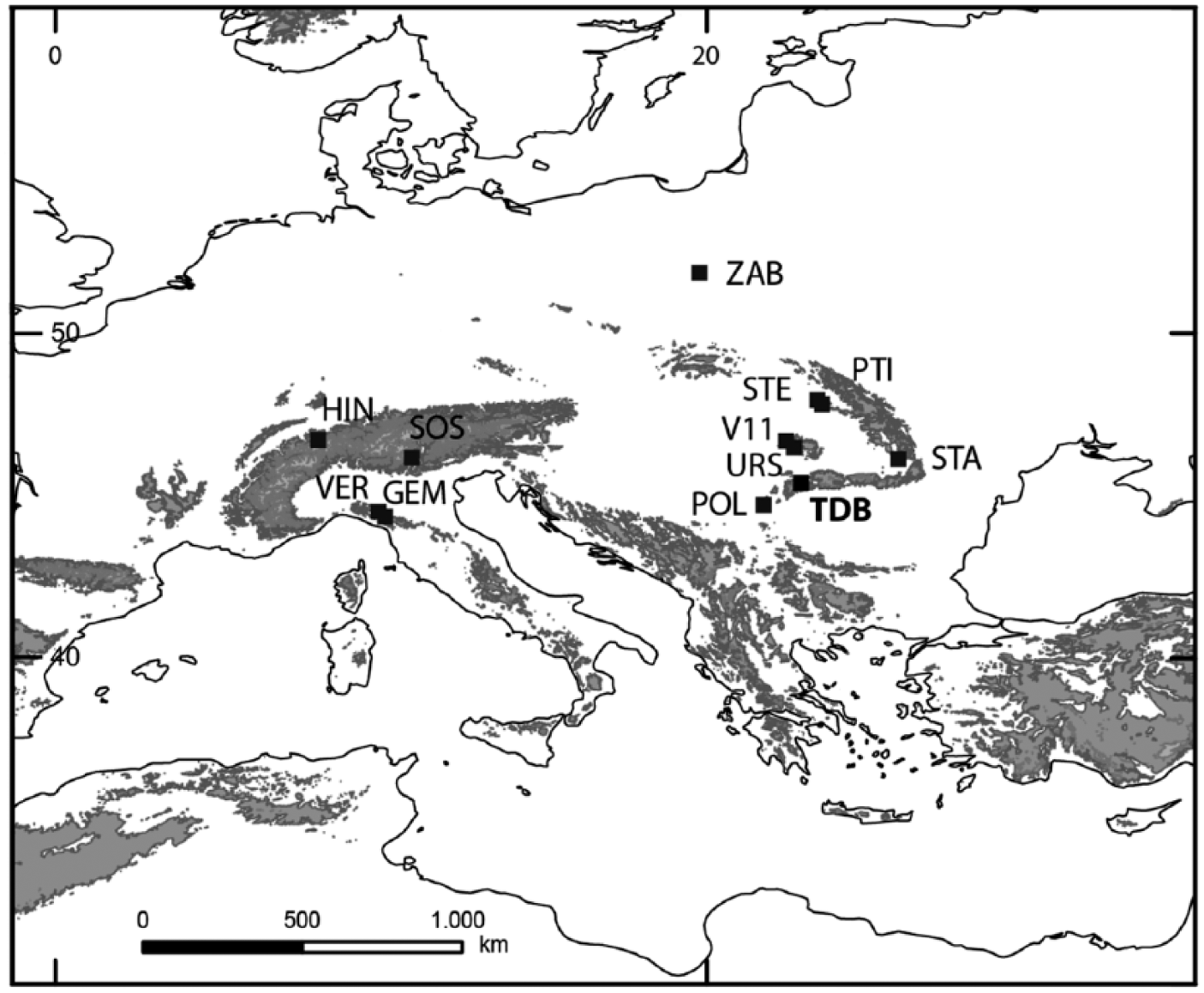
Location of Lake Brazi (Tăul dintre Brazi) in the South Carpathians and the selected records used for comparisons. Romania: TDB = Lake Brazi (this study); STA = Lake Saint Ana (Magyari et al., 2009a); STE = Steregoiu and PTI = Precula Tiganului (Feurdean et al., 2008); V11 = V11 Cave (Tămaş et al., 2005); URS = Usilor Cave (Onac et al., 2002); POL = Poleva Cave (Constantin et al., 2007). Poland: ZAB = Zabienic bog (Płóciennik et al., 2011). Austria: SOS = Schwarzsee ob Sölden (Ilyashuk et al., 2011). Italy: VER = Lago Verdarolo and GEM = Lago Gemini, Italy (Samartin, 2011). Switzerland: HIN = Hinterburgsee (Heiri et al., 2003).
Based on the strong relationship between chironomid distribution and temperature (e.g. Brooks, 2006; Eggermont and Heiri, 2012), chironomid-temperature transfer functions have been developed for several geographical regions (e.g. Heiri et al., 2011; Larocque et al., 2001; Self et al., 2011) and have been used successfully to reconstruct past temperature changes during the late glacial and the Holocene (e.g. Brooks and Birks, 2000; Heiri et al., 2003, 2014; Ilyashuk et al., 2009, 2011; Larocque-Tobler et al., 2010; Płóciennik et al., 2011). Nevertheless, since temperature changes during the Holocene are characterized by smaller amplitude than during the late glacial, other environmental factors (e.g. pH, trophic conditions and water depth) may influence a temperature reconstruction within the Holocene (e.g. Brodersen and Anderson, 2002; Brooks, 2006; Heiri and Lotter, 2005; Velle et al., 2005, 2010).
Here, we present a high-resolution Holocene chironomid record from the Retezat Mountains, which together with the already described late glacial part of the same sediment sequence (Tóth et al., 2012) provides the first complete (late glacial and Holocene) chironomid record from the South Carpathians. The objectives of the present article are (1) to describe the main compositional trends of subfossil chironomid assemblages during the Holocene, (2) to reconstruct Holocene mean July air temperature trends using the Swiss and the merged Norwegian–Swiss transfer function, and, finally, (3) to compare the inferred temperature trends with those obtained in other regional and European records. Our results provide a valuable addition to the available temperature records from Eastern Europe that can be used to evaluate climate model results for the Holocene and to understand ecosystem responses to abrupt climate changes.
Study site
The Retezat Mountains, located in the South Carpathians, are among the wettest massifs (annual rainfall 1400 mm yr−1 at 1500–1600 m.a.s.l.) in Romania due to vapour supply by both Mediterranean and Atlantic air masses (Jancsik, 2001; Magyari et al., 2009b). The climate of the Retezat is temperate continental. The mean annual temperature is around +6°C in the foothill zone and −2°C at the top of the mountain (2500 m.a.s.l.). At present, January is the coldest and July is the warmest month characterized with mean temperatures of 6.6°C and +11.2°C at 1740 m.a.s.l., at the elevation of Lake Brazi (estimated by linear interpolation from the five nearest meteorological stations; Bogdan, 2008; Magyari et al., 2013).
In this study, a glacial lake called Lake Brazi (Tăul dintre Brazi, 45°23′47″N, 22°54′06″E; Figure 1) was investigated. The lake is situated in the subalpine belt at 1740 m.a.s.l. on the western marginal side of the Galeş glacial valley, in a mixed Norway spruce (Picea abies) – stone pine (Pinus cembra) forest. Lake Brazi is a small shallow lake with maximum water depth of 1.1 m and a surface area of 0.4 ha (Magyari et al., 2009b).
Pollen data from Lake Brazi (E. Magyari, unpublished data) suggest that human impact likely occurred in the vicinity of the lake in the last 1500 years, with occasional cutting of the nearby spruce forests. This is similar to other high mountain pollen records in the Carpathians that suggested also significant human activities in other parts of the Romanian Carpathians in the last 1500 years (Feurdean and Astaloş, 2005). Additionally, minor impact by grazing animals (sheep, cattle and horse) that were shepherded to the summer mountain pastures in the nearby Galeş River valley is also reported (Maderspach, 1986).
Chronology
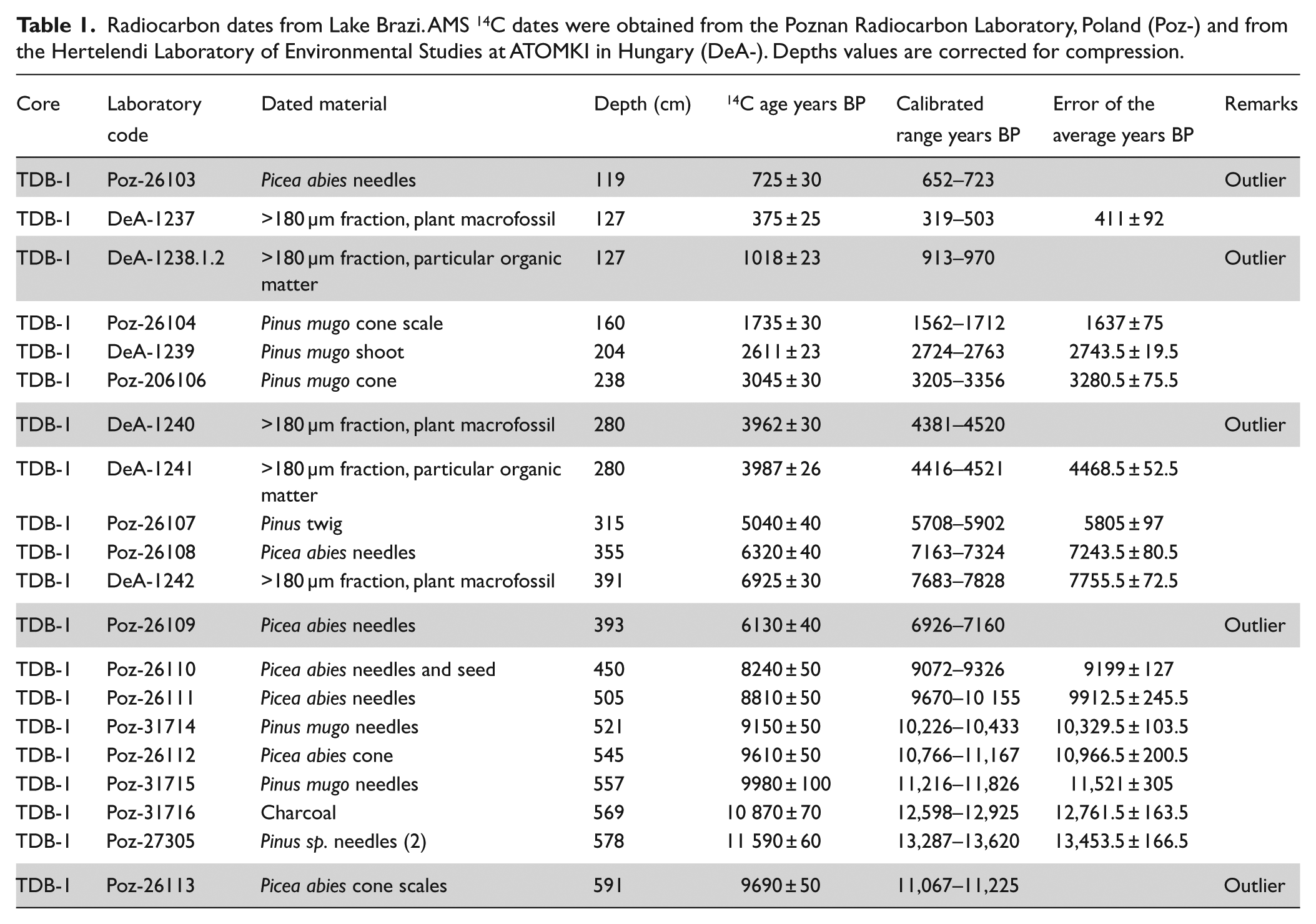
A chronological framework of the sediment was established using 21 AMS 14C dates (Table 1). Radiocarbon dates suggest that sediment accumulation started at around 15,750 cal. yr BP and was continuous throughout the late glacial and the Holocene. The age–depth relationship of the sediment was assessed using two models: (1) a weighted non-linear polynomial regression model below 502 cm sediment depth, for the late glacial and early Holocene (see more details in Magyari et al., 2009b) and (2) a smooth spline function in CLAM v2.1 (Blaauw, 2010) between 502 and 111 cm, for the Holocene sediment (Figure 2). This latter section had considerably larger sediment accumulation rates, which justifies the application of separate age–depth models for the two sections. Overall, we excluded five dates from the age–depth modelling because they were stratigraphically inconsistent with the majority of the 14C dates (shown in grey bands in Table 1).
Radiocarbon dates from Lake Brazi. AMS 14C dates were obtained from the Poznan Radiocarbon Laboratory, Poland (Poz-) and from the Hertelendi Laboratory of Environmental Studies at ATOMKI in Hungary (DeA-). Depths values are corrected for compression.
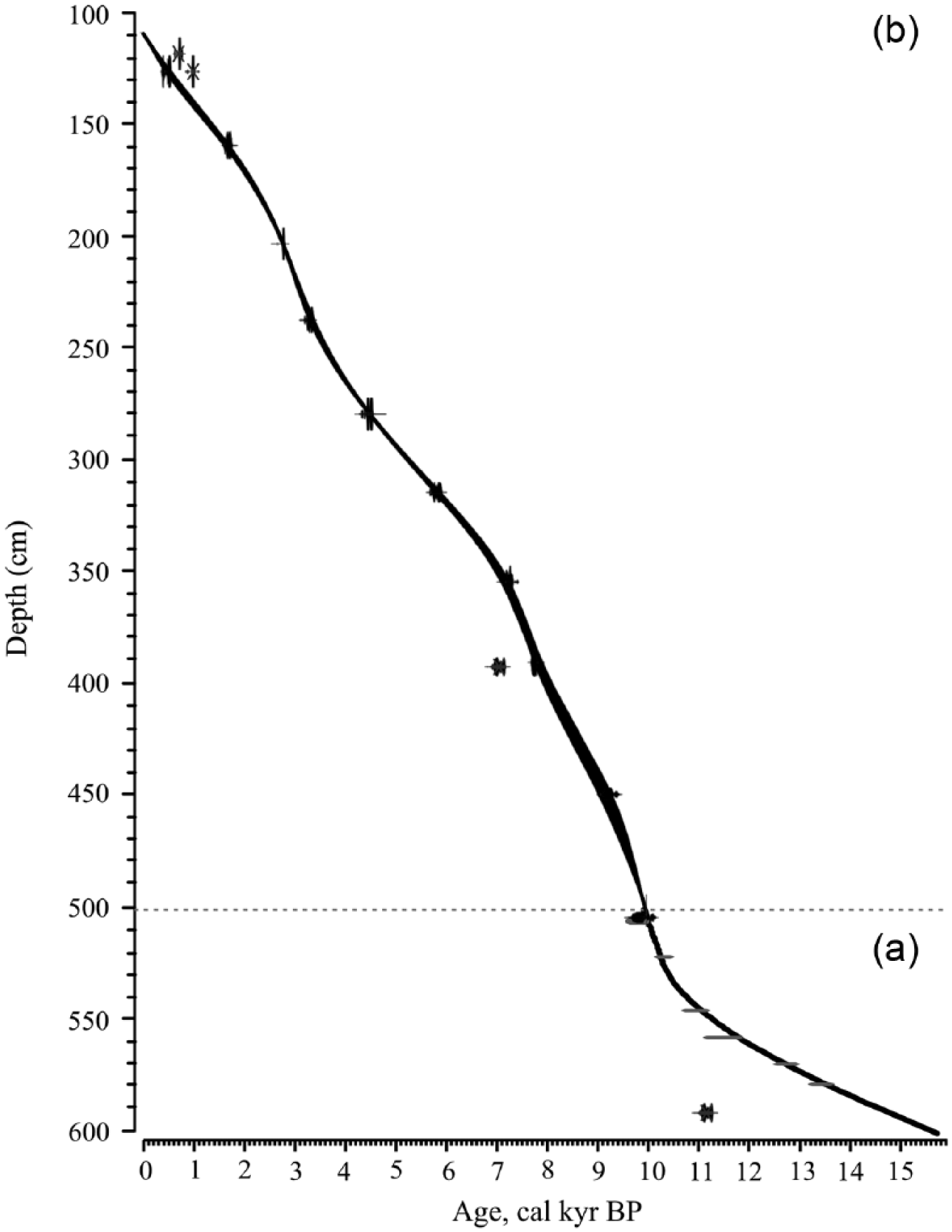
Age–depth models: (a) weighted non-linear polynominal regression for modelling the age–depth relationship in the late glacial and early Holocene part of the sediment record (600–502 cm) and (b) a smoothing spline function in the Holocene part (505–111.14 cm) of the sediment record of Lake Brazi (Retezat Mountains, South Carpathians).
Methods
Fieldwork and laboratory analyses
A 490-cm -long sediment core (TDB-1; 111–600 cm) was taken from the central part of the lake (water depth: 111 cm) in August 2007 with a modified Livingstone piston corer (diameter: 7 cm). Here, we concentrate on the upper Holocene part (111–552 cm) of this core. The sediment stratigraphy and organic content record were described in detail in Magyari et al. (2009b) and Buczkó et al. (2013).
For chironomid analysis, 0.56–1.5 cm3 sediment was investigated at 2-cm intervals between 552 and 502 cm and at 4-cm intervals between 500 and 111 cm. Sub-samples were deflocculated in 10% KOH and heated at 60°C for 20 min. Afterwards, the sediment was sieved with a 100-µm mesh. Chironomid larval head capsules were picked from a Bogorov-counting tray (Gannon, 1971) under stereomicroscope at 40× magnification. Larval head capsules were mounted on microscope slides in Euparal® mounting medium for microscopic identification. At least 47–50 head capsules were identified from each sub-sample, so they provided a representative count for quantitative analysis (Heiri and Lotter, 2001). Identification of chironomid head capsules followed Wiederholm (1983), Rieradevall and Brooks (2001) and Brooks et al. (2007).
Plotting, numerical analyses and temperature reconstruction
The chironomid relative abundance diagram was plotted using the program Psimpoll 4.27, and zonation was based on optimal splitting by information content (Bennett, 2007). To summarize major changes in subfossil chironomid assemblages, detrended correspondence analysis (DCA) was performed using CANOCO version 4.5 (Ter Braak and Šmilauer, 1998). Before the ordination, percentage chironomid species data were square-root transformed, and rare taxa were down-weighted. The gradient length of the longest DCA axis (axis 1) was 2.15 SD units.
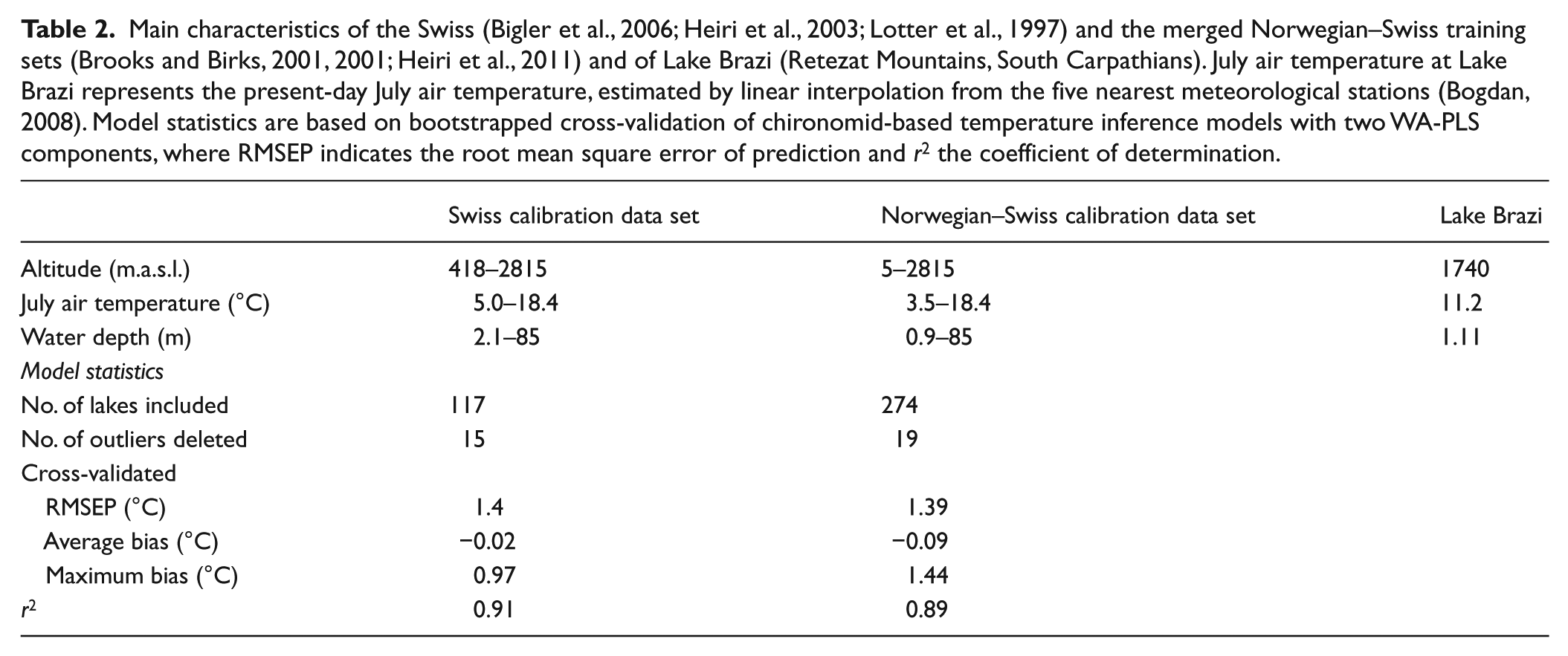
Since calibration data sets are not available from the Carpathian region, we used calibration sets from other regions for summer air temperature reconstruction. Chironomid-inferred mean July air temperature (TVII) reconstructions were performed using weighted averaging partial least squares regression (WA-PLS; Ter Braak and Juggins, 1993) based on both the Swiss and the merged Norwegian–Swiss chironomid-temperature calibration training sets (Table 2). The Swiss training set includes altogether 117 lakes situated in the Jura Mountains, the Swiss Plateau and the Swiss Alps (Bigler et al., 2006; Heiri et al., 2003; Lotter et al., 1997). The composition of the subfossil chironomid assemblages from Lake Brazi is very similar to the ones known from the Alps; therefore, the application of the Swiss transfer function seemed to be reasonable. On the other hand, the merged Norwegian–Swiss training set – based on surface sediment samples from 274 lakes (including the Swiss training set and data from Norway and Svalbard) – covered wider altitudinal, latitudinal and lake water pH ranges, and wider temperature gradients than the Swiss or the Norway models individually (Brooks and Birks, 2000, 2001; Heiri et al., 2011). Furthermore, it has been used before to reconstruct temperatures based on chironomid assemblages in the late glacial part of the Lake Brazi record (Tóth et al., 2012). Before the analyses, 15 lakes from the Swiss data set and altogether 19 lakes from the Norwegian–Swiss data set were excluded as outliers. These lakes are characterized by unusual hydrological conditions; their chironomid assemblages were influenced by running waters, glacier meltwater or extensive snow meltwater (Norwegian lakes), or they were distinctly larger than the remaining training set lakes (for more details, see Heiri et al., 2011). Prior to temperature reconstruction, percentage chironomid data were square-root transformed. The summer air temperature reconstructions and sample-specific errors of prediction (SSPEs) based on bootstrapping (999 bootstrap cycles) were calculated using the program C2 (Juggins, 2007).
Main characteristics of the Swiss (Bigler et al., 2006; Heiri et al., 2003; Lotter et al., 1997) and the merged Norwegian–Swiss training sets (Brooks and Birks, 2001, 2001; Heiri et al., 2011) and of Lake Brazi (Retezat Mountains, South Carpathians). July air temperature at Lake Brazi represents the present-day July air temperature, estimated by linear interpolation from the five nearest meteorological stations (Bogdan, 2008). Model statistics are based on bootstrapped cross-validation of chironomid-based temperature inference models with two WA-PLS components, where RMSEP indicates the root mean square error of prediction and r2 the coefficient of determination.
Reconstruction diagnostic statistics
In order to evaluate the reliability of the chironomid-inferred temperature reconstructions, we estimated the cross-validated root mean square error of prediction (RMSEP), the chi square distance to the closest modern analogue, the percentage of rare taxa in the training set with the C2 (Juggins, 2007) and goodness-of-fit measures using CANOCO version 4.5 (Ter Braak and Šmilauer, 1998). All calculations were based on square-root transformed percentage abundances.
Fossil assemblages with a chi square distance to the most similar assemblage in the modern calibration data set larger than the second and the fifth percentile of all squared chi square distances in the modern data were identified as samples with ‘no close’ and ‘no good’ analogue, respectively (Birks et al., 1990; Heiri et al., 2003). Fossil samples with a residual distance to the first CCA axis larger than the 90th and 95th percentile of the residual distances of all the modern samples were identified as samples with ‘poor fit’ and ‘very poor fit’ with temperature, respectively (Birks et al., 1990). Chironomid taxa with a Hill’s N2 (Hill, 1973) below 5 in the calibration data were considered to be rare in the modern data set (Heiri et al., 2003).
Results
Chironomid assemblages
Altogether, 22 chironomid taxa (overall 10,960 head capsules) were identified from the sediment, and out of these, 17 taxa were present in the late glacial sediment section as well (Tóth et al., 2012). Based on the relative abundances, six chironomid assemblage zones were distinguished (Figure 3). Zone boundaries are mainly associated with abundance shifts of the most dominant taxa Tanytarsus mendax-type, Psectrocladius sordidellus-type, Zavrelimyia type A and Tanytarsus lugens-type. The first zone (Zone-1; 552–542 cm; ca. 11,500–10,900 cal. yr BP) was dominated by T. lugens-type and Micropsectra insignilobus-type. Both taxa disappeared by ca. 11,000–10,900 cal. yr BP, and the abundance of Zavrelimyia type A and Paratanytarsus austriacus-type started to increase in the second part of the zone. At the onset of the second zone (Zone-2; 542–518 cm; ca. 10,900–10,200 cal. yr BP), relative abundances of C. anthracinus-type (23–38%), Tanytarsus pallidicornis-type 2 and Procladius reached maximum values. Later on, from ca. 10,400 cal. yr BP, P. austriacus-type and P. sordidellus-type became dominant. The third zone (Zone-3; 518–330 cm; ca. 10,200–6300 cal. yr BP) was dominated by T. mendax-type with a broad thermal tolerance. In the fourth zone (Zone-4; 330–230 cm; ca. 6300–3200 cal. yr BP), P. sordidellus-type became dominant, while the abundance of T. mendax-type decreased sharply. The fifth zone (Zone-5; 230–160 cm; ca. 3200–1550 cal. yr BP) was marked by the dominance of T. lugens-type, while relative abundances of P. sordidellus-type and T. mendax-type decreased further. Finally, in the sixth zone (Zone-6; 160–111 cm; ca. 1550 cal. yr BP–present), T. lugens-type started to decrease but still dominated together with the increasing T. mendax-type and Zavrelimyia type A. The chironomid relative abundance diagram, presenting all of the chironomid taxa as percentage abundances, is shown in Figure 3.
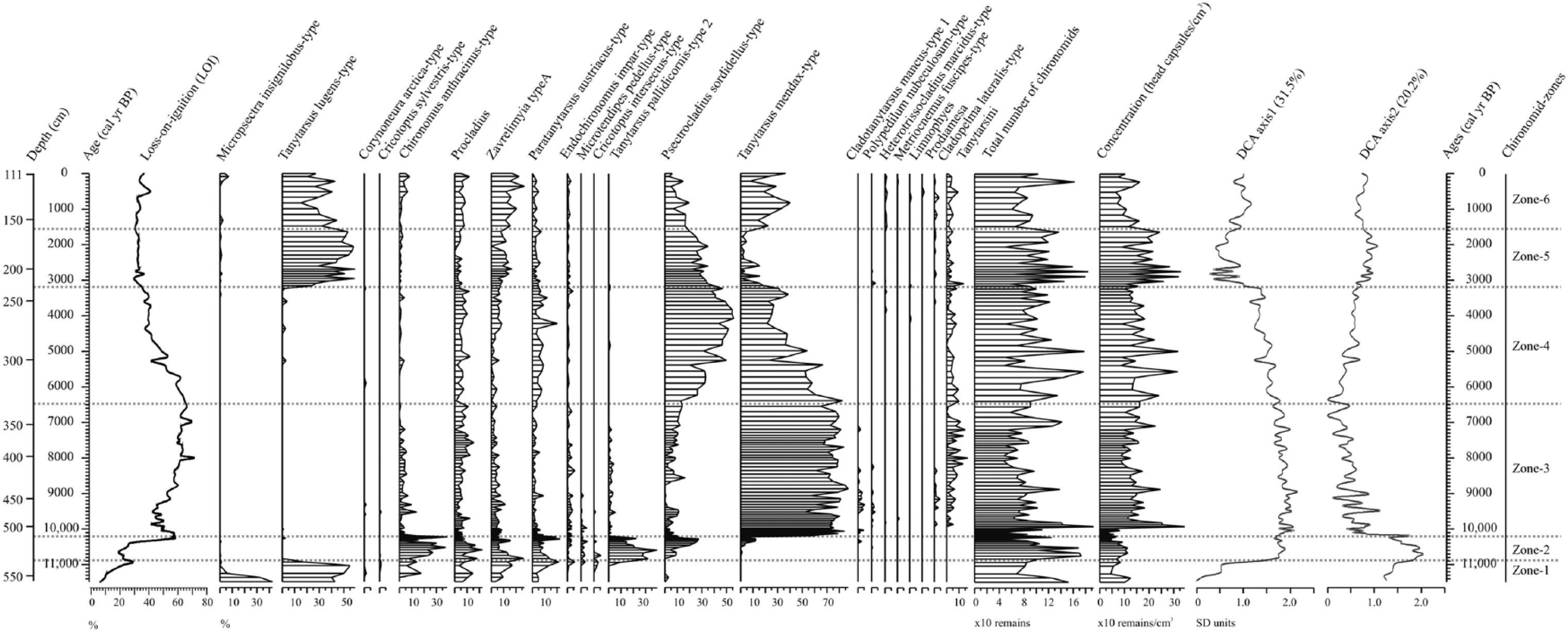
Chironomid relative abundance diagram including all chironomid taxa with detrended correspondence analysis axes (DCA axes 1 and 2, with percentage variance explained by axes), loss-on-ignition (LOI) changes and zones for the chironomid stratigraphy from Lake Brazi (Retezat Mountains, South Carpathians).
Ordination of the chironomid record
The first two DCA axes explained 51.7% (31.5% and 20.2%, respectively) of the variance in the chironomid data set. Along the first DCA axis, notable changes of about 1.8 and 0.7 SD units were observed at the transition from Zone-1 to Zone-2 (at ca. 10,900 cal. yr BP) and from Zone-4 to Zone-5 (ca. 3200 cal. yr BP), respectively. Generally, the first DCA axis separated Zone-1 and Zone-5 based on the higher relative abundance of T. lugens-type and M. insignilobus-type. These taxa had negative values on the first DCA axis, while others (i.e. Tanytarsus pallidicornis-type 2, T. mendax-type, Chironomus anthracinus-type and Endochironomus impar-type) had strong positive values on the same axis (Figure 3).
On the second DCA axis, Zone-2 was separated clearly from the other sediment layers. This axis represented a gradient mostly characterized with relative abundance changes of T. pallidicornis-type 2 and C. anthracinus-type (Figure 3).
Summer air temperature reconstructions
The reconstructed July air temperatures (TVII) ranged from 8.1°C to 14.2°C with the merged Norway–Swiss (NS-TF) and from 8.3°C to 15.2°C with the Swiss transfer function (Sw-TF). For samples older than ca. 5000 cal. yr BP, the reconstructed temperature values were consequently higher with the Sw-TF than with the NS-TF. At the same time, the reconstructed summer air temperature trends based on the two transfer functions were highly consistent (Figure 4).
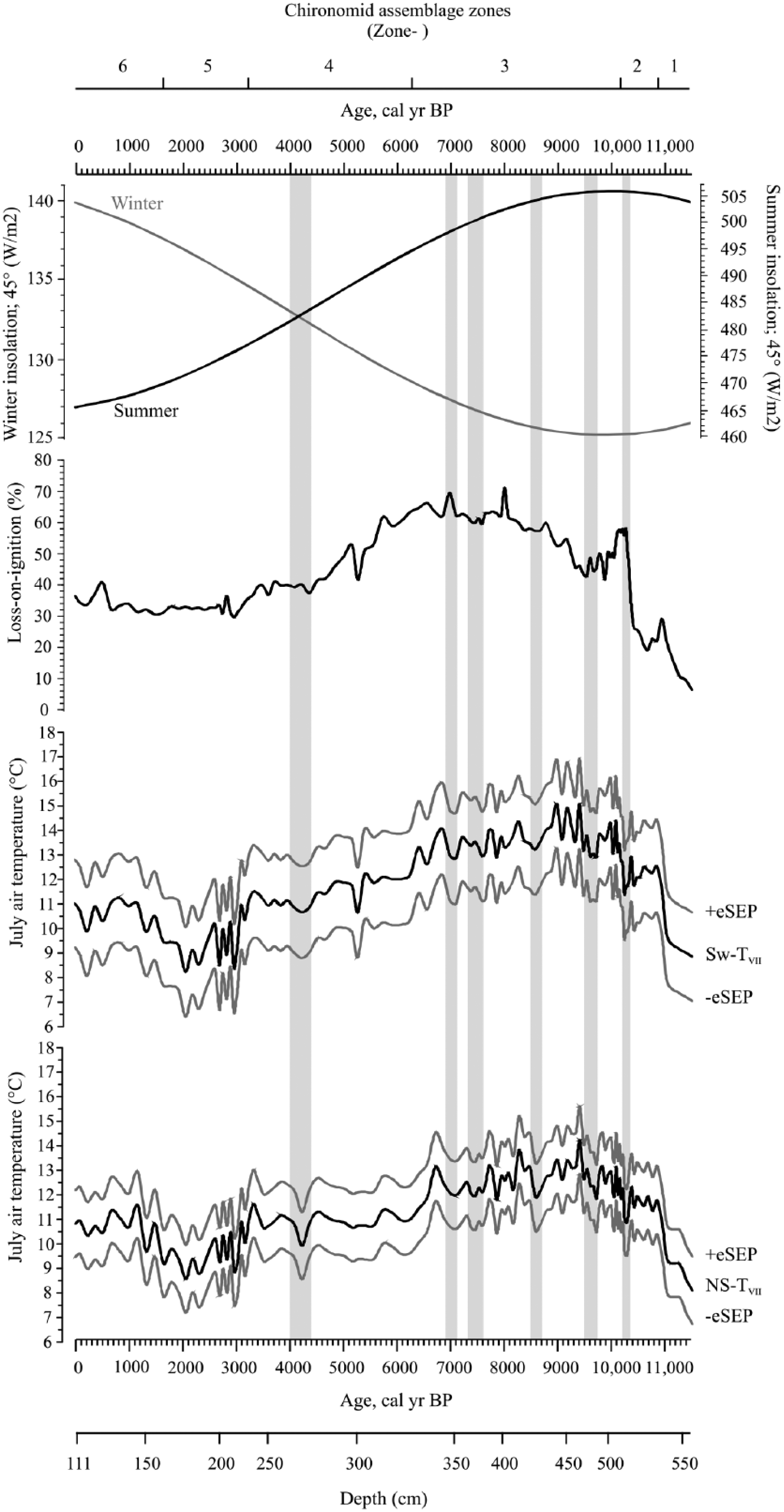
Chironomid-inferred July temperature estimates (black lines) based on the merged Norwegian–Swiss (NS-TVII) and on the Swiss (Sw-TVII) calibration data sets; with their sample-specific standard errors (eSEP; grey lines), loss-on-ignition values (%) from Lake Brazi (Retezat Mountains, South Carpathians) as well as summer and winter insolation at 45°N (W m−2; Laskar et al., 2004) and zones for the chironomid stratigraphy (Zone-). Grey bands correspond to the discussed temperature declines during the Holocene.
Between ca. 11,500 and 10,980 cal. yr BP (552–543 cm), inferred temperatures increased rapidly by about 1.2°C and 0.8°C (until ca. 9.3–9.7°C) based on the NS-TF and Sw-TF, respectively. It was followed by a further temperature increase by ca. 2.2–2.5°C until 10.8–12.3°C (NS-TF) and 11.5–12.9°C (Sw-TF) between ca. 10,980 and 10,220 cal. yr BP (543–518 cm). Later on, from ca. 10,220 cal. yr BP (518–330 cm), inferred temperatures fluctuated strongly above present-day TVII (~11.2°C) by ca. 1.4°C (NS-TF) and ca. 2.5°C (Sw-TF). Then, TVII started to decrease by ca. 1.6–1.7°C between ca. 6300 and 3300 cal. yr BP (330–235 cm). It was followed by a further decrease until chironomid-inferred TVII fell below present-day values by ca. 1.6°C between ca. 3300 and 2000 cal. yr BP (235–170 cm). Finally, in samples younger than ca. 1500 cal. yr BP (170–111 cm), reconstructed temperatures fluctuated strongly between ca. 9.7 and 11.6°C, close to the modern TVII (Figure 4).
Besides numerous single-sample temperature drops and rises, we found six short periods (covering at least 2–3 samples and at least 150 years based on both of the TFs applied) with temperature declines of 0.6–1.2°C: between ca. 10,350–10,190, 9750–9500, 8700–8500, 7600–7300, 7100–6900 and 4400–4000 cal. yr BP (Figure 4). All of these declines were, however, within the estimated error of prediction of the chironomid-based inferences.
Reliability of the inferred temperatures
The chironomid-inferred July air temperature reconstruction from Lake Brazi revealed a RMSEP of 1.39°C and 1.40°C based on the NS-TF and the Sw-TF, respectively. We found ‘no close’ analogue situation in 22% and 41% of the samples based on NS-TF and Sw-TF, respectively. Additionally, 10% of all samples had ‘no good’ analogue in the modern data based on Sw-TF. Generally, the samples older than 7000 cal. yr BP are affected by analogue problems based on both transfer functions (Figure 5).
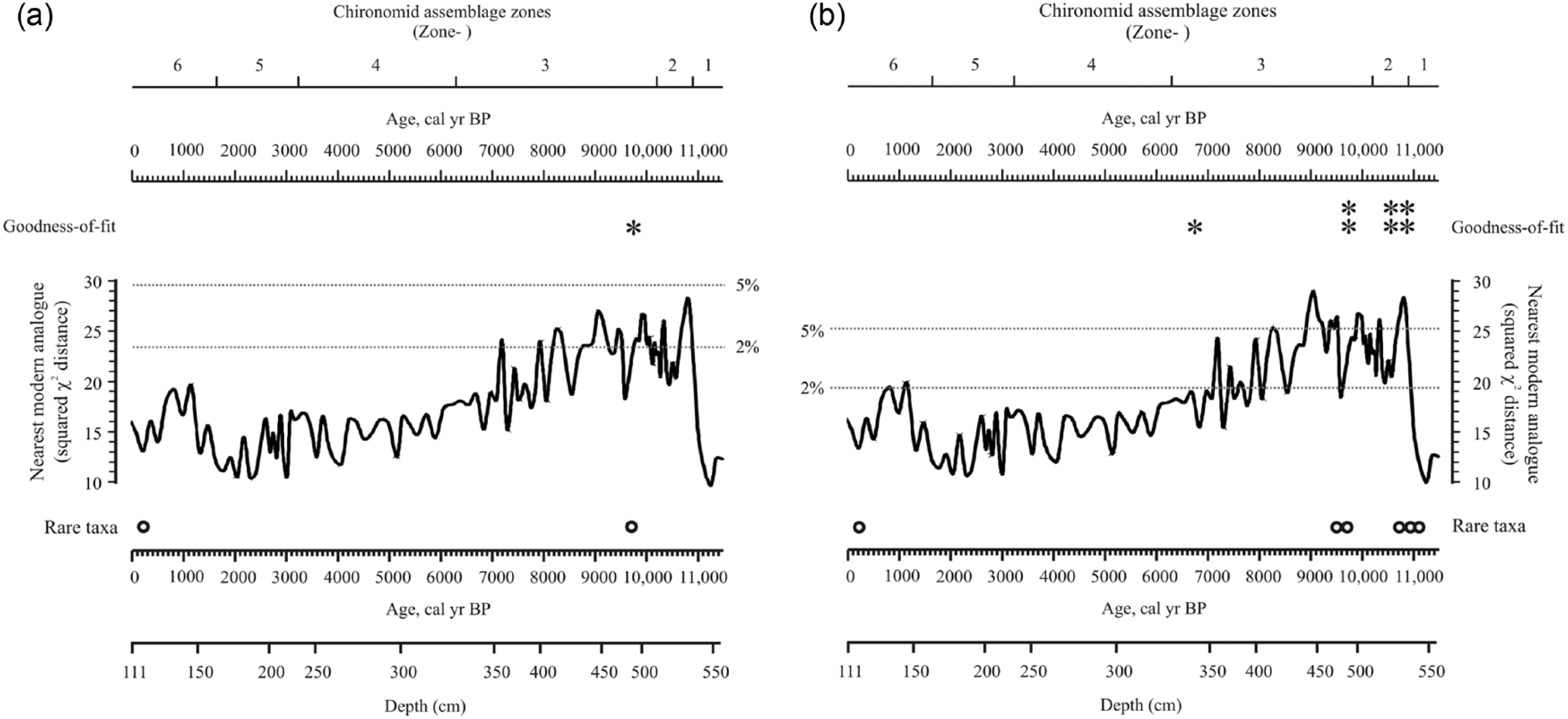
Reconstruction diagnostic statistics of the chironomid-inferred July air temperature reconstructions from Lake Brazi (Retezat Mountains, South Carpathians) based on the (a) the merged Norwegian–Swiss (NS-TVII) and (b) Swiss (SW-TVII) transfer functions, plotted together with zones for the chironomid stratigraphy (Zone-). Diagnostic statistics include nearest modern analogues for the fossil samples in the calibration data set, goodness-of-fit statistics of the fossil samples with temperatures (single asterisk indicates ‘poor fit’ and double asterisks indicate ‘very poor fit’ with temperature) and samples with rare taxa (Hill’s N2 < 5; open circles).
Goodness-of-fit statistic showed that only 0.9% and 3.4% of the samples have ‘poor fit’ with temperature based on NS-TF and Sw-TF, respectively. Further 2.5% of the samples have ‘very poor fit’ with temperature based on the Sw-TF (Figure 5). All of the chironomid taxa encountered in the sediment of Lake Brazi occurred in both modern training sets. Furthermore, the taxa that are considered to be rare (Hill’s N2 < 5) in the merged Norwegian–Swiss (Metriocnemus fuscipes-type) and Swiss (Cricotopus sylvestris-type, M. fuscipes-type) training sets were present with maximum relative abundances less than 2% (Figure 5).
Discussion
Ecological interpretation of changes in the subfossil chironomid assemblages
During the early Holocene (ca. 11,500–11,000 cal. yr BP), dominant chironomid taxa (T. lugens-type, M. insignilobus-type; Zavrelimyia type A and P. austriacus-type) indicate relatively cold and oligotrophic conditions (Boggero et al., 2006; Brodersen and Anderson, 2002; Tátosová et al., 2006). At the same time, increasing number of C. anthracinus-type and increasing loss-on-ignition (LOI) values support the onset of warming in the early Holocene (Figure 3). Later on, from ca. 11,000 cal. yr BP, Chironomini taxa (C. anthracinus-type and E. impar-type) reach their maximum abundance and indicate generally higher temperatures than before (e.g. Heiri et al., 2011; Larocque et al., 2001; Velle et al., 2005). Moreover, C. anthracinus-type indicates slightly eutrophic conditions as well (Kansanen, 1986; Velle et al., 2005). Next to Chironomini, T. pallidicornis-type 2, typical for littoral sediments of mesotrophic, temperate or warmer lakes (Heiri et al., 2003, 2011; Luoto, 2010; Sæther, 1979), occurs in high relative abundance. The dominant taxa suggest warming summer air temperatures with meso- to eutrophic lake conditions at Lake Brazi in the second part of the early Holocene (Figure 3 and Table 3).
Comparison of chironomid-inferred temperatures (TVII = July air temperature) and assemblage changes from Lake Brazi (Retezat Mountains, South Carpathians) with other proxies from the Carpathians.

Between ca. 10,200 and 6300 cal. yr BP, T. mendax-type became the most dominant taxon, including several chironomid species with different ecological optima (Brooks et al., 2007). Generally, they occur under relatively warm climatic conditions (Engels and Cwynar, 2011). Based on Fjellheim et al. (2009), Tanytarsus gregarius Kieffer 1909 is the only known species belonging to the T. mendax-type from the Retezat Mountains (the species was found in Taul Negru and Taul Gemenele). In the Northern Carpathians (Tatra Mountains), T. gregarius occurs mainly in lakes with relatively high productivity and sometimes with acidic conditions (Bitušík et al., 2006, 2010; Kubovčík and Bitušík, 2006). Therefore, between ca. 10,200 and 6300 cal. yr BP, chironomid assemblages suggest warm summer temperatures and moderately high nutrient levels, which are also supported by the increasing LOI values (Figure 3 and Table 3).
Later on, between ca. 6300 and 3300 cal. yr BP, relative abundance of T. mendax-type decreases (Figure 3), and the dominant taxa (P. sordidellus-type and P. austriacus-type) are characterized by lower temperature optima than in the previous time period (e.g. Heiri et al., 2011; Velle et al., 2005), even though P. sordidellus-type occurs in temperate climatic conditions in European lowlands as well (e.g. Brooks and Birks, 2000). Additionally, both taxa tolerate (but not necessary indicate) periodic acidification (Brooks et al., 2007; Tátosová et al., 2006; Velle et al., 2005) and are frequently associated with macrophytes (e.g. Brodersen et al., 2001; Engels and Cwynar, 2011; Luoto, 2010). Therefore, chironomid assemblages suggest lower temperatures but still warm summers at Lake Brazi between ca. 6300 and 3300 cal. yr BP (Table 3).
Between ca. 3300 and 1500 cal. yr BP, T. lugens-type became the most dominant taxon, and together with the reappearing M. insignilobus-type (Figure 3) indicates cold and mainly oligotrophic conditions (e.g. Brodersen and Anderson, 2002; Heiri et al., 2011; Larocque et al., 2001; Tátosová et al., 2006; Velle et al., 2005). Additionally, T. lugens-type is described from the deeper parts of shallow lakes or from the profundal zone of deep lakes (Engels and Cwynar, 2011; Luoto, 2010). In summary, from ca. 3300 cal. yr BP, the chironomid fauna suggests increasing water level and decreasing nutrient status with summer cooling at Lake Brazi (Table 3).
Finally, during the last ca. 1500 years, the previously dominant taxa (T. lugens-type, P. sordidellus-type, T. mendax-type and Zavrelimyia type A), formed a diverse assemblage that also included Chironomini taxa in very low number (Figure 3 and Table 3). As discussed above, these taxa indicate very diverse environmental conditions, since they occur in a wide range of summer air temperatures, trophic states and water depth gradients. Furthermore, the last 2000 years are characterized by an abrupt increase in diatom-inferred total epilimnetic phosphorous (DI-TP) values that suggests increased eutrophication in Lake Brazi (Buczkó et al., 2013). Additionally, pollen data from Lake Brazi show a clear decrease in the relative abundance of trees (by ca. 14–15%), primarily driven by a decline in relative abundances and accumulation rates of Picea abies, and an increase of relative abundance (by about 6%) of Poaceae from ca. 1600 cal. yr BP (E. Magyari, unpublished data). These data suggest intensifying human impact (most likely forest management) in the South Carpathians, similar to other parts of the Romanian Carpathians from about 1500 cal. yr BP (Feurdean and Astaloş, 2005) and from ca. 2000 cal. yr BP in the South Balkans (e.g. Panagiotopoulos et al., 2013). Therefore, it is challenging to assess whether climate or increasing human impact were driving changes in the chironomid assemblages in the last 1500 years.
At the same time, corresponding to the ordination results, we assume that the most influential factor on observed assemblage changes is summer air temperature (Table 3). The first DCA axis clearly separated two time periods (between ca. 10,900–10,200 and 3200–1550 cal. yr BP) in the Brazi chironomid stratigraphy. These periods are characterized by chironomid taxa (i.e. T. lugens-type and M. insignilobus-type) living in subalpine and alpine regions and mainly in cold lakes (Brooks et al., 2007; Heiri et al., 2011). These taxa have negative values on the first DCA axis, while others present in the sequence (i.e. T. pallidicornis-type 2, T. mendax-type, C. anthracinus-type and E. impar-type) are typical for warmer climatic conditions (Samartin et al., 2012; Velle et al., 2005) and have strongly positive values on the same axis. Therefore, it is very likely that the first DCA axis represents a temperature gradient and thus supports the marked influence of temperature changes on the Holocene chironomid assemblages.
Comparison of chironomid-inferred temperatures with other proxies from the region and Western Europe
At the onset of the Holocene (at ca. 11,500 cal. yr BP), chironomid-based reconstructions show a marked two-step increase in July air temperatures by ca. 3.8°C in Lake Brazi (Tóth et al., 2012). Rising temperatures are inferred also by pollen and plant macrofossil data from the same sediment sequence (Magyari et al., 2012), by pollen data from the Eastern Carpathians (Feurdean et al., 2008) and by increasing δ18O values of stalagmites from both the Western (Tămaş et al., 2005) and the Southern Carpathians (Constantin et al., 2007). The amplitude of the reconstructed increase at Lake Brazi is similar to other chironomid records from the Southern and Central Swiss Alps, as well as from the Northern Apennines (ca. 3.8–4°C; Ilyashuk et al., 2009; Samartin, 2011; Samartin et al., 2012). At the same time, smaller chironomid-based temperature changes are reported from Northern Italy by ca. 2.5°C (Larocque and Finsinger, 2008) and from the Northern Swiss Alps and the French Jura Mountains by ca. 1.5°C (Heiri et al., 2003; Heiri and Millet, 2005). A short-term temperature drop is indicated by chironomids at Lake Brazi between ca. 10,350 and 10,190 cal. yr BP. This cool period may coincide with the 10.2 ka cold event described from the same sediment sequence (Buczkó et al., 2009; Magyari et al., 2012) and other records of the Carpathians (e.g. Feurdean et al., 2008; Tămaş et al., 2005).
Later on, between ca. 10,200 and 8500 cal. yr BP, generally high summer air temperatures are detected at Lake Brazi with mean reconstructed values above the present-day temperature (~11.2°C) by about 1.5–2.5°C. These results coincide with decreasing lake levels associated with higher than present summer temperatures as indicated by diatoms and pollen from the same sediment (Buczkó et al., 2013), and probably with higher summer insolation (Figure 4) from ca. 9500 cal. yr BP. A similarly warm climate and shallow lake conditions were reported from the Eastern Carpathians (Feurdean et al., 2008; Magyari et al., 2009a) based on pollen (from ca. 10,200 cal. yr BP) and multi-proxy data (between ca. 9300 and 8900 cal. yr BP), as well based on stalagmite records from the Western and Southern Carpathians (Constantin et al., 2007; Tămaş et al., 2005). Moreover, from ca. 10,200 cal. yr BP, our chironomid inferences comply with summer insolation at 45°N (Laskar et al., 2004; Figure 4).
Largely associated with the summer insolation maximum, a relatively warm climate (Holocene Thermal Maximum; HTM) during the early and mid-Holocene is described in middle and high latitudes of the Northern Hemisphere (Renssen et al., 2009; Wanner et al., 2008). Model simulations suggest that the HTM took place between ca. 8000 and 6000 cal. yr BP in most parts of Europe, followed by a marked cooling in the late Holocene (Renssen et al., 2009). The warmest period of our temperature reconstructions at Lake Brazi (45°N, 22°E) dates between ca. 9400 and 8900 cal. yr BP when summer air temperatures were 2–3°C higher than at present. This temperature pattern coincides with the summer insolation maximum at 45°N (Laskar et al., 2004; Figure 4) and a recently published charcoal record from the Transylvanian Plain (46°N, 23°E; Feurdean et al., 2013) where the highest mean fire interval is detected between 10,100 and 7100 cal. yr BP. The authors suggested that the observed trends in fire activity are associated strongly with high summer insolation, which led to higher temperatures (of about 4°C) and lower available moisture in this time interval than at present (Feurdean et al., 2013). Similarly, an earlier HTM was reported from the Central Eastern Alps (46°N, 10°E) between ca. 10,000 and 8600 cal. yr BP (Ilyashuk et al., 2011) than suggested by the climate model simulations of Renssen et al. (2009). The HTM is mainly associated with the orbitally forced summer insolation maximum; however, the presence of the last remnants of the northern ice sheets may have produced cold surface ocean conditions in the North Atlantic, which in turn influenced early Holocene temperatures in NW Europe (Renssen et al., 2009; Wanner et al., 2008, 2011). Lake Brazi is in sheltered position by the Eastern and Northern Carpathians against westerly air masses, and this continental interior region was less affected by cooling events of the North Atlantic, which could explain why the temperatures at Lake Brazi closely followed the Holocene insolation changes (Feurdean et al., 2014).
Between ca. 10,200 and 8500 cal. yr BP, two short-term temperature declines were indicated at Lake Brazi. The first decline appeared between ca. 9700 and 9500 cal. yr BP and coincided with episodic high lake level and decreasing DI-TP values in the diatom record (Buczkó et al., 2013) and with decreasing LOI values (Figure 4). Additionally, decreased δ18O values of a stalagmite denote a temperature decline also at around 9300 cal. yr BP in the Western Carpathians (Tămaş et al., 2005). This temperature drop is synchronous with a temperature decrease observed in the chironomid-based temperature reconstructions from Northern and Southern Europe at ca. 9350–9200 cal. yr BP as well (Korhola et al., 2002; Samartin, 2011). The second decline was dated between ca. 8700 and 8500 cal. yr BP. A diatom-based δ18O-record form Lake Brazi showed a distinct decline also between ca. 9000 and 8500 cal. yr BP, likely associated with increased winter precipitation in the South Carpathians (Magyari et al., 2013).
During the mid-Holocene, chironomid-inferred TVII started to decrease slightly at Lake Brazi from ca. 8500 cal. yr BP, but mean summer temperatures were still above present-day values by 0.5–1.3°C. Based on diatoms from the same sediment sequence, a distinct lake-level rise occurred after ca. 8400 cal. yr BP (Buczkó et al., 2013), most likely related to the well-defined 8.2 ka event (Alley et al., 2003). Otherwise, pollen data and increased microcharcoal accumulation rates indicated still high summer temperatures between ca. 8300 and 8100 cal. yr BP, likely associated with summer droughts, but overall macrocharcoal-inferred local fire frequencies decreased in this period (Finsinger et al., 2014). The 8.2 ka cooling event is well documented in the Carpathian and Balkan region (e.g. Buczkó et al., 2013; Feurdean et al., 2013; Panagiotopoulos et al., 2013); however, in this region, it had the greatest influence on the winter and spring climate, while summer temperatures remained high (Feurdean et al., 2008, 2014). This latter assumption coincides with the lack of a clear 8.2 ka cooling in our chironomid record. On the other hand, this cooling is also well detected in chironomid-inferred summer temperature records in the Alps (Heiri et al., 2003; Ilyashuk et al., 2011; Samartin, 2011) and in Fennoscandia (Korhola et al., 2002).
Between ca. 8500 and 6500 cal. yr BP, two distinct short-term temperature declines are noted at Lake Brazi. The first is dated between ca. 7600 and 7300 cal. yr BP and coincides with a distinct decline in the diatom-based δ18O values measured from the same sediment sequence (ca. 7800–7300 cal. yr BP) and is likely associated with increased winter precipitation (Magyari et al., 2013) as well as with a distinct decline in LOI (Figure 4). Similarly, cooler and wetter climatic conditions are noted based on a stalagmite δ18O-record from the Western Carpathians (Tămaş et al., 2005) and based on pollen data from the Eastern Carpathians (Magyari et al., 2009a). The second cooling occurred between ca. 7100 and 6900 cal. yr BP. Decreasing δ18O-values from the Western and the Southern Carpathian speleotherms (Constantin et al., 2007; Onac et al., 2002) also suggest a temperature decline at around 7100–7000 cal. yr BP.
From ca. 6500 cal. yr BP onwards, the chironomid record suggests a further decrease in TVII until reconstructed temperatures fluctuate close to modern summer air temperature value at Lake Brazi. Moreover, LOI showed a clear decline at the same time (Figure 4). Similarly, a stalagmite record from the Western Carpathians (Onac et al., 2002) indicated lower annual temperatures reaching modern values as well from ca. 6800 cal. yr BP. Diatoms suggest higher lake levels at Lake Brazi from ca. 6000 cal. yr BP (Buczkó et al., 2013), which seems to comply with summer cooling and increasing precipitation (Magyari et al., 2009b). Similarly, increasing lake levels and cooling climate are noted from the Eastern, the Western and other parts of the Southern Carpathians (Constantin et al., 2007; Magyari et al., 2009a; Onac et al., 2002) between ca. 5500 and 4200 cal. yr BP. A short-term temperature decline was noted between ca. 4500 and 4000 cal. yr BP, followed by a slight temperature rise. This temperature drop is concomitant with a decline in the diatom δ18O-record and LOI values from Lake Brazi (Figure 4) and is most likely associated with increased winter precipitation (Magyari et al., 2013). Similarly, a stalagmite record from the Southern Carpathians and pollen-inferred temperatures from the Eastern Carpathians show a temperature decline around ca. 4000 cal. yr BP (Constantin et al., 2007; Feurdean et al., 2008). A distinct temperature drop is also reconstructed based on chironomids from the Northern Apennines between ca. 4900 and 4050 cal. yr BP (Samartin, 2011) and from the Finnish Lapland around 4200 cal. yr BP (Korhola et al., 2002).
Generally, chironomid-inferred summer air temperature reconstructions from Western Europe suggest warmer summers during the early and mid-Holocene than during the late Holocene (Wanner et al., 2008). According to most studies, this marked temperature decline took place around ca. 4900–3900 cal. yr BP (e.g. Heiri et al., 2003; Ilyashuk et al., 2011; Larocque-Tobler et al., 2010), while our chironomid record shows this temperature drop with a delay, from ca. 3300 cal. yr BP onwards, and in parallel with a marked decrease in organic content (Figure 4). This seems to be in agreement with a stalagmite record published also from the Southern Carpathians, which suggests a ‘mid-Holocene peak’ at ca. 3300 cal. yr BP followed by a temperature decrease (Constantin et al., 2007).
From ca. 3000 cal. yr BP onwards, chironomid-inferred TVII remained under modern values by ca. 1.8–1.9°C and fluctuated strongly at Lake Brazi. This time period is characterized by the highest lake level during the Holocene, which are inferred from the Brazi diatom record at ca. 2800 cal. yr BP (Buczkó et al., 2013). Similarly, a cool climate and lake-level rise with maximum precipitation at ca. 2800 cal. yr BP was indicated by multi-proxy data (Magyari et al., 2009a) and a testate amoebae record (Schnitchen et al., 2006) from the Eastern Carpathians and from the Carpathian Basin at around 3000 cal. yr BP (Jakab and Sümegi, 2007). This late Holocene period, characterized by gradual cooling of summer air temperatures, is also indicated in Western European chironomid records but differs in its amplitude among sites. At Lake Brazi, reconstructed summer air temperatures declined by 1.8–1.9°C (at ca. 3300 cal. yr BP), which is in accordance with the 1.8–2°C decrease published from the northern Swiss Prealps (Larocque-Tobler et al., 2010) and Central Eastern Alps (Ilyashuk et al., 2011) starting at ca. 4900–3900 cal. yr BP. At the same time, a smaller decrease (~0.4–1.0°C) was recorded in the Bernese Alps (Heiri et al., 2003) and Northern Apennines (Samartin, 2011).
Finally, chironomid-inferred TVII showed an increasing trend again until present-day values in the last 2000 years at Lake Brazi. The diatom record from the same sediment sequence suggests a gradual increase in the trophic status of the lake associated with gradual shallowing (Buczkó et al., 2013). During the last 2400 years, the pollen records suggest increased precipitation and cooler summers from the Southern Carpathians, while trends are less consistent in the last 1500 years because of intensified human impact (e.g. Feurdean et al., 2008; Magyari et al., 2009a).
Overall, the compliance of our temperature reconstruction with other proxy-records (i.e. pollen, macrofossil, stalagmite, charcoal and diatoms) from the region corroborates the reliability of the long-term summer air temperature trends (Table 3) during the Holocene at Lake Brazi. The reconstruction diagnostic statistics, however, showed better reliability of inferred temperatures with NS-TF than with Sw-TF. The latter calibration data set was characterized by a weaker analogue situation and weaker fit with reconstructed temperature during the early to mid-Holocene (Figure 5). Therefore, for samples older than 5000 cal. yr BP, inferred temperatures are probably overestimated (ca. 0.5–1°C) by the Sw-TF.
Conclusion
We present the first chironomid-based summer air temperature reconstruction from the South Carpathians (Lake Brazi, Retezat Mountains) for the entire Holocene. Our results denote that temperature is likely the most important driver of the chironomid assemblage changes during the time period investigated.
Summer air temperature inferences (using the Swiss and the merged Norwegian–Swiss transfer function) suggest a two-step rise at the onset of the early Holocene: an initial rise from ca. 11,500 cal. yr BP, followed by a further increase between ca. 10,200 and 8500 cal. yr BP until reconstructed temperatures reached higher than present values. During the mid-Holocene, from ca. 8500 cal. yr BP, chironomid-inferred temperatures decreased slightly; however, mean values were still above present-day temperatures. Between ca. 6000 and 3000 cal. yr BP, cooler summers were inferred. Although, during the late Holocene, between ca. 3000 and 2000 cal. yr BP, a distinct decrease in July air temperatures occurred with reconstructed summer air temperatures under modern values. Finally, in the last 2000 years, reconstructed temperatures showed an increasing trend at Lake Brazi.
The most distinct climatic changes in our reconstructions are the HTM, which occurred earlier (between ca. 9400 and 8900 cal. yr BP), and the late Holocene summer temperature decline, which occurred with a delay (between ca. 3000 and 2000 cal. yr BP) at Lake Brazi (South Carpathians) than in the Western European chironomid records. We conclude that Holocene summer temperatures at Lake Brazi closely followed summer insolation changes during the Holocene, which might be explained by the high altitude of the study site and its distance from the North Atlantic region, where short-term climatic perturbations strongly influence the trend of the chironomid-inferred Holocene summer temperature changes.
Short-term declines (within the estimated error of prediction of the chironomid-based inferences) of ca. 0.6–1.4°C in reconstructed temperatures were detected between ca. 10,350–10,190; 9750–9500; 8700–8500; 7600–7300; 7100–6900 and 4400–4000 cal. yr BP. These intervals agree well with other proxy-records (diatom, pollen and stalagmite) from the Carpathian region and with chironomid records from Central and Western Europe. Generally, our reconstructed temperatures complied with other proxy records from the same sediment sequence and with other records from the Carpathian region and Western Europe.
Footnotes
Acknowledgements
We would like to thank two anonymous reviewers for helpful comments on the manuscript and are grateful to Stephen Brooks for providing access to calibration data. This article is part of the PROLONG project (Providing long-term environmental records of Late Quaternary climatic oscillations in the Retezat Mountains). We thank the fieldwork assistance of the Retezat National Park.
Funding
We thank the support of the Bolyai Scholarship (BO/00518/07, BO/00713/12/10) and the OTKA Research Fund (NF 101362). OH acknowledges support by the European Research Council (ERC Starting Grant Project RECONMET Nr. 239858) and MT from the INTIMATE EU COST Action (COST-ES0907) in the form of a Short-Term Scientific Mission. EM acknowledges the support of the Humboldt Foundation. This research was supported by the European Union and the State of Hungary, co-financed by the European Social Fund in the framework of TÁMOP 4.2.4. A/2-11-1-2012-0001 ‘National Excellence Program’. This is MTA-MTM-ELTE Paleo Contribution No. 207.