



Abstract
The Brazil Current (BC) is a relevant feature in the Atlantic Meridional Overturning Circulation (AMOC). Its behavior during slowdown or intense AMOC remains poorly known because of the lack of paleoceanographic records, especially for the Holocene. Here, we investigate changes in a western boundary upwelling system (Cabo Frio, off Southeastern Brazil) which are driven by variations in the BC and NE winds during the last 9 kyr. To assess the variability of the BC, we used δ18O, Mg/Ca, and assemblages of planktonic foraminifera. Our results indicate five oceanographic phases during the last 9 kyr. During Phase I (from 9.0 to 7.0 cal kyr BP), the BC diverged offshore from the modern upwelling area because of the low sea level, increasing the influence of shelf waters and coastal upwelling plumes on foraminifera assemblages. Phase II (7.0–5.0 kyr BP) was marked by the approach of the internal front of the BC with low intensity and episodes of strong productivity that were linked primarily to the upwelling of the South Atlantic Central Water (SACW) and/or Subpolar Shelf Waters (SPSWs) (cold). Phase III (5.0–3.5 kyr BP) was a transition, marking a large oceanographic and climatic change from the weakening of the AMOC. The internal front of the BC became warm and subsurface SACW upwelling was stronger. In Phase IV (3.5–2.5 kyr BP), the BC acquired its modern dynamics, but weak NE winds weakened the SACW’s contribution to upwelling events. Finally, in Phase V (last 2.5 kyr BP), the NE winds reintensified, promoting frequent episodes of upwelling and intrusion by SPSWs during the Medieval Climate Anomaly.
Keywords
Introduction
Insolation variations through the Holocene influenced the dynamics of the Atlantic Meridional Overturning Circulation (AMOC), although this variation was not as intense as that during the last termination. Evidence on a smaller scale within the Holocene was identified in both the North Atlantic Ocean (Andrews et al., 1997; Delworth and Zeng, 2012; Hoogakker et al., 2011) and the South Atlantic Ocean (Chiessi et al., 2014). The AMOC flow depends on wind-driven upwelling/downwelling and vertical mixture in both the Sub-Antarctic and Sub-Arctic Atlantic (Kuhlbrodt et al., 2007). Intense freshwater discharges south of Greenland have disturbed the circulation pattern reducing the AMOC strength for the last 14 kyr. It favored the southward advance of cold currents from Greenland and Nordic Seas decreasing the sea surface temperature (SST) of the North Atlantic and the formation of new polar ice caps (Andrews et al., 1997). In the South Atlantic, change occurs from the distribution of heat that is transported by the South Equatorial Current (SEC) following AMOC variations since the deglacial period. When the AMOC is strong, more heat is transferred from the North Brazil Current (NBC) to the Caribbean Sea. By contrast, when the AMOC is weak, more heat is directed from the SEC to the Brazil Current (BC) and the North Equatorial Countercurrent (NECC), gradually warming the Southwest Atlantic (Chiessi et al., 2015). Records showed changes in the circulation of the AMOC between 7.0 and 4.0 kyr BP, when the production of North Atlantic Deep Water (NADW) weakened in the northeastern portion of the subpolar North Atlantic (Andrews et al., 1997; Hall et al., 2004; Hoogakker et al., 2011; Kissel et al., 2013; Thornalley et al., 2013). Despite the broad time range, these studies pointed to a general intensity change since 6.0 kyr BP, with a more drastic reduction between 5.0 and 4.0 kyr BP. These changes were also seen in the Western Equatorial Atlantic (NBC domain), where warmer and saltier waters were observed in the photic zone between 5.0 and 4.0 kyr BP (Arz et al., 1999; Santos et al., 2013), which means that more heat was diverged to the Equatorial current system and BC instead of being diverged toward the Caribbean Sea.
After 5.0 kyr BP, various climatic changes were recorded in South America. Absy et al. (1991) reported an expansion of the Amazon rainforest, suggesting increased rainfall. Cordeiro et al. (2008) observed that the South American monsoon intensified after 5.0 kyr BP. Prado et al. (2013) showed more intense rainfall over Midwestern, Southeastern, and Southern Brazil that was related to an intensification of the South Atlantic Convergence Zone (SACZ). The SACZ is a convective system that represents one of the most important features of the monsoon systems in South America; this zone consists of a corridor that links the Central Amazon to the SW subtropical Atlantic Ocean, passing through southeast Brazil during the austral summer (Carvalho et al., 2004). Seasonal variations in the SST along the SE Brazilian continental margin have already been appointed to determine the dynamics of this monsoon system and therefore on the climate of southeastern South America (e.g. Chaves and Nobre, 2004; Robertson and Mechoso, 2000).
Several studies have discussed paleoceanography in the SW Subtropical Atlantic during the Pleistocene (Bergue et al., 2007; Ericson and Wollin, 1968; MARGO, 2009; Toledo et al., 2007a, 2007b, 2008) and reported the occurrence of cold water during the Last Glacial Maximum and toward the beginning of the Holocene period. However, other studies (Arz et al., 1999; Toledo et al., 2008) reported warm waters during the Heinrich 1 event (17.0–15.5 kyr BP). The rarity of studies for the Holocene with sufficient time resolution leads to uncertainties on the SW subtropical Atlantic evolution producing many uncertainties about which Holocene events were better printed in this region.
Among the western boundary upwelling spots in the subtropical SW Atlantic, the Cabo Frio Upwelling System (CFUS) is the most intense and frequent (Albuquerque et al., 2014). The South Atlantic Central Water (SACW) occurs in the photic zone from the coast (where it reaches the surface under favorable conditions) to the uppermost continental slope, and the two types of upwelling (wind-driven and current-driven) are present (Albuquerque et al., 2014; Belem et al., 2013; Campos et al., 2000). Previous paleoceanographic studies have identified the influences of NE winds on the CFUS’ dynamics during the last 1000 years (Mahiques et al., 2005; Souto et al., 2011) and during the Holocene (Nagai et al., 2009). However, sea-level fluctuations play a very important role on the sediment variability before 7000 yr BP. Lessa et al. (2014) used the biofacies modeling of planktonic foraminifera to identify the role of the BC in the CFUS’ dynamics over the course of the Holocene. However, this study lacks Holocene records on the CFUS’ mid-shelf (where upwelling events are more intense), and data that identify the characteristics of the BC and the indicators of its intensity in the SW Atlantic are still scarce. The present study aims to reconstruct the paleoceanography of the continental shelf of the CFUS over the past 9000 years through a multiproxy approach that uses planktonic foraminifera. To address this aim, two gravity cores (CF10-09A and CF10-01B) that were collected in the mid-shelf and outer shelf were analyzed in terms of their foraminiferal assemblages, stable oxygen isotopes, and Mg/Ca to obtain records of the main water masses that influenced the CFUS. Initial interpretations regarding the influence of the water masses from Lessa et al. (2014) with these new data will contribute to a better understanding of the CFUS’ Holocene history.
Oceanographic settings
The originates from about 10°S, where it separates from the SEC (Peterson and Stramma, 1991), which only contains tropical water (TW) (Stramma and England, 1999). However, the Brazilian continental margin becomes very irregular from 16°S (Abrolhos Bank), with constant changes in the orientation. Passing through the Vitória-Trindade Chain at 20°S, the BC is influenced by the SACW at thermocline depths and the flow intensifies. From Cabo de São Tomé at 22°S, the BC flow is disturbed by changes in the orientation of the Brazilian Bight and often meanders and forms long-term vortices, especially between Cabo de São Tomé and Cabo Frio (23°S) (Calado et al., 2010). In addition, changes in the orientation of the continental margin between Cabo de São Tomé (22°S) and Cabo de Santa Marta (28°S) favor the intrusion of SACW, with occasional upwelling spots observed in various areas along the coast (Aguiar et al., 2014; Calado et al., 2010; Campos et al., 2013; Castelao and Barth, 2006; Valentin, 1984).
The intrusions of SACW may occur through BC flow instabilities that generate low pressure (current-driven upwelling) or wind through the Ekman system (wind-driven upwelling). Current-driven upwelling is common on the shelf break and the uppermost slope, where the low pressure that forms from the BC instabilities pumps SACW into the photic zone (Campos et al., 2000). Wind-driven upwelling is caused by winds in the NE quadrant and, more importantly, in the mid and inner shelves, given that the most significant offshore Ekman transport occurs on the coast and the wind stress curl event (Ekman pumping) occurs on the mid-shelf. Along the Southern Brazilian continental shelf, wind stress curls are the main agent that promotes the upwelling of SACW that is distributed by the mid-continental shelf (Aguiar et al., 2014; Castelao and Barth, 2006; Cerda and Castro, 2014).
Oligotrophic TW is observed in the first 200 m of the water column of the BC, with a temperature above 22°C and salinity above 37 (Silveira et al., 2000). The cold, nutrient-rich SACW occupies the layer between 200 and 800 m, with a temperature below 18°C and salinity between 35 and 36 (Silveira et al., 2000). The SACW is brought to the coast of the CFUS because of various peculiarities in the region, especially the drastic change in the orientation of the coast, depths greater than 100 m near the coast, the varying intensity of the BC, which influences the SACW’s position, and frequent episodes of NE winds (Belem et al., 2013; Campos et al., 2000; Castelao and Barth, 2006; Rodrigues and Lorenzzetti, 2001). Episodes of coastal upwelling on the inner shelf are more common during the austral summer, when the NE winds increase and few frontal systems occur. The combined action of the NE winds and the changing orientation of the coast favor the formation of the Ekman spiral, pulling the SACW toward the coast. During the austral winter, the more frequent passage of frontal systems pushes TW toward the inner shelf, inhibiting coastal upwelling (Cerda and Castro, 2014). Upwelling also occurs on the mid-shelf and outer shelf, but it is independent of the coastal event (intermittent rather than seasonal) and confined to the lower layer of the photic zone. The wind stress curl and the instability of the BC flow are the main mechanisms that promote such intrusions of SACW (Albuquerque et al., 2014; Belem et al., 2013; Castelao and Barth, 2006). The CFUS continental shelf is also influenced by the Subtropical Shelf Water (SSW), which has low salinity (<36) and high temperature (>20°C). The SSW comes from the mixture of coastal and oceanic contributions from the SACW, which includes the continental shelf of SE and South Brazil (Piola et al., 2000). Because of the high productivity in the CFUS, the sediments that are deposited on the continental shelf exhibit mud accumulation that is mainly composed of autochthonous marine organic matter (Mendoza et al., 2014; Yoshinaga et al., 2008).
The CFUS is located on the border between the Santos and Campos Basins (Figure 1). The Santos Basin is located to the south and is characterized by a deep continental shelf and gentle slope, where the sedimentary composition is typically clay. The Campos Basin is located on the north face of Cabo Frio, which has a shallow platform and steep embankment slopes with predominantly carbonate sediments (Mahiques et al., 2004).

(a) Oceanographic and topographic characteristics of the continental margin of SE Brazil and the CFUS, with a theoretical model (b, modified from Venâncio et al., 2014) of the CFUS’ vertical structure (black transect in a) and the location of the studied cores and other published records that were used for comparisons. (1) Records from Weldeab et al. (2006), (2) records from Santos et al. (2013), (3) records from Arz et al. (1999), (4) records from Pivel et al. (2013), and (5) records from Chiessi et al. (2014). The current scheme at (a) was based on Peterson and Stramma (1991).
In addition to the main water masses, a boundary of cold–warm coastal waters known as the Subpolar Shelf Front (SPSF) is present. The SPSF contains the Subpolar Shelf Water (SPSW), which has low temperature (<12°C) and salinity (between 33 and 34) (Piola et al., 2000) which sometimes is found near the CFUS during the winter. The SPSW on the Brazilian shelf is characterized by a mixture of cold waters from the Malvinas Current and Patagonian shelf water and warm-fresh waters from river discharges along the shore (Piola et al., 2000, 2008). River discharges and interactions with the SSW and TW make the SPSW lose its original T-S (temperature–salinity) characteristics along the Brazilian coast, but the presence of typical SPSW dwelling organisms indicates its influence (Stevenson et al., 1998). Currently, the SPSW is observed from the Subtropical Convergence at 38°S up to the coast of São Paulo (25°S) in the winter. However, in years with exceptional passages of frontal systems, the SPSW reaches the coast of Rio de Janeiro State (23°S) (Piola et al., 2008; Stevenson et al., 1998). As such, the SPSW could have reached or intruded into the CFUS in the past.
Material and methods
Geochronology and micropaleontological analysis
The CF10-09A and CF10-01B cores were collected in the mid and outer portions of the continental shelf of the CFUS off southeastern Brazil (Figure1; Table 1) using the Ocean Surveyor vessel in January 2010. The chronology was based on the 14C dating of organic matter from 33 samples by accelerator mass spectrometry (AMS) at the Arizona AMS Facility, University of Arizona. The choice of organic carbon for dating occurred was because of the lack of enough planktonic foraminifera tests, and the organic matter CFUS mud facies is predominantly autochthonous (Yoshinaga et al., 2008). The 14C AMS dating was calibrated using the Clam software (Blaauw, 2010), the Marine09 curve (Reimer et al., 2009), and a reservoir effect (ΔR) of 8 ± 17 years (Angulo et al., 2005). The time series models were built using a smoothing spline function. Only the upper 230 cm from CF10-01B core was used in this manuscript because of inverted ages, which are discussed in Lessa et al. (2014). The dating results are summarized in Table 2.
Environmental data from two gravity cores that were collected from the CFUS. The latitude and longitude values are in decimal degrees.

CFUS: Cabo Frio Upwelling System.
Radiocarbon dating results and calendar ages that were calibrated by the Clam software for the CF10-09A and CF10-01B cores.

The planktonic foraminiferal assemblages for the CF10-01B and CF10-09A cores were quantified in 10 cm3 of wet sediment that was washed in a 125-µm sieve and dried to 50°C for 24–48 h. The residual sediment was dry-sieved in 125, 150, and 250 µm meshes. Approximately 300 specimens per sample were identified to the species level according to Loeblich and Tappan (1988). The morphotypes of Globigerinoides sacculifer with and without sacs were treated as a single species, and the species Globorotalia menardii, Globorotalia tumida, and Globorotalia ungulata were considered as one group called the G. menardii plexus. The total absolute abundance (specimens/cm3) and relative abundance (%) were calculated for each species. The stages of assemblage change were derived from a stratigraphically constrained cluster analysis known as CONISS (Grimm, 1987), which stands for the ‘constrained incremental sum of squares’ (also known as Ward’s method) of the relative abundances. The interpretations and ecological considerations for the main species were based on Lessa et al. (2014).
Geochemical analysis
The stable isotope of oxygen (δ18O) was determined in specimens of Globigerinoides ruber (white) (sensu stricto) and Globigerina bulloides with a size between 250 and 350 µm in both cores. These species were chosen because they dwell in the surface layer of the BC (G. ruber) and the SACW upwelling (G. bulloides); the former records the variation in the surface BC, whereas the latter records the dynamics of SACW intrusion onto the shelf (Lessa et al., 2014). The stable isotopes were analyzed in an elemental mass spectrometer at the Laboratoire de Géochimie Isotopique of LOCEAN (Laboratoire d’Océanographie – Expérimentation et Approches Numériques et du Climat, Université Pierre et Marie Currie, Paris, France). The quality of the isotopic results was based on an internal carbonate standard from the Marceau marble (δ18O = −1.80 ± 0.15‰). The analytical uncertainty of the δ18O results was 0.07‰. We refer to the stable isotope results throughout the manuscript as δ18ORUB and δ18OBUL for the isotopic ratio of oxygen that was measured in G. ruber (RUB) and G. bulloides (BUL).
The Mg/Ca ratio was determined in G. ruber (pink) (sensu stricto) specimens >250 µm from the core CF10-01B only. Approximately 30 specimens were gently broken between two glass slides and subjected to the oxidative cleaning protocol that was proposed by Barker et al. (2003) to remove clays, organic material, and traces of Fe-Mg coating. The specimens were then dissolved in 0.1 M HNO3, and 200 µL of the solution was diluted for element measurement on an Agilent ICP-MS at the Institut de Recherche pour le Développement (IRD, Bondy, France). Element concentrations were obtained in ppm and converted into units of mol. Finally, the Mg/Ca ratio was calculated as mmol/mol with an analytical uncertainty of 0.60% (0.060 ± 0.007 mmol/mol). The effectiveness of the cleaning process was measured by comparing the Mg/Ca values with Al/Ca and Fe/Ca values. High Mg/Ca values associated with high Al/Ca or Fe/Ca values were considered to be contaminated and were not used.
Calculation and adjustment of the paleotemperatures
The paleotemperatures for the CFUS were estimated using the calibration equation of Anand et al. (2003) for G. ruber (pink) with sizes of 250–350 µm (TMg/Ca):

The uncertainty of the reconstruction was calculated according to Weldeab et al. (2006), summing the analytical uncertainty (0.06 mmol/mol) equivalent to 0.21°C and the equation uncertainty which is 1.13°C, resulting in a total of 1.34°C.
Since there is no local Mg/Ca × SST calibration equation for G. ruber (pink) in the SW Atlantic, reconstructed paleotemperatures tended to be shifted from the expected values for our study site. Thus, we calculated the shift value using our core top value and the recent temperature obtained from the World Ocean Atlas (WOA) 2013 for the nearest site from the CF10-01B site (i.e. 23.60 ± 0.10°C at 23.5°S/41.5°W). We found a shift of 6.51°C between the core top (30.11°C) and recent WOA 2013 temperature. All our paleotemperatures were subtracted by the shift to force values to expected CFUS values with no effect on the temporal variation.
Salinity reconstructions were not performed because of the low correlations that were observed between the seawater δ18O and salinity in the CFUS (Venâncio et al., 2014). These authors explained that the low seawater δ18O value came from the strong influence of 18O-depleted shelf waters and other water masses with different δ18O signatures but not necessarily different salinity. The influence of multiple sources of shelf water on the CFUS produced a poor correlation with salinity, which was not seen offshore, where a well-defined vertical T-S structure ensured a strong correlation between δ18Ow and salinity (Pierre et al., 1991). Thus, seawater δ18O reconstructions would present high level of uncertainties, in special, when shelf waters contributions were important.
Results
The radiocarbon dating revealed that the CF10-09A core covers the time range 1100–7100 years with uncertainties between 150 and 330 years. The upper 230 cm from the CF10-01B core encompasses the time between 880 and 9300 years with uncertainties between 190 and 290 years (Table 2 and Figure 2). The CF10-01B core showed a high incidence of reversed dates in the samples from the lower 150 cm (between 382 and 230 cm) (more details in Lessa et al., 2014). Thus, this section of the core is not discussed in this manuscript. The interpolated sedimentation rates varied between approximately 20 and 40 cm/kyr in the upper 230 cm of core and between 40 and 100 cm/kyr in the CF10-09A core (Figure 2).
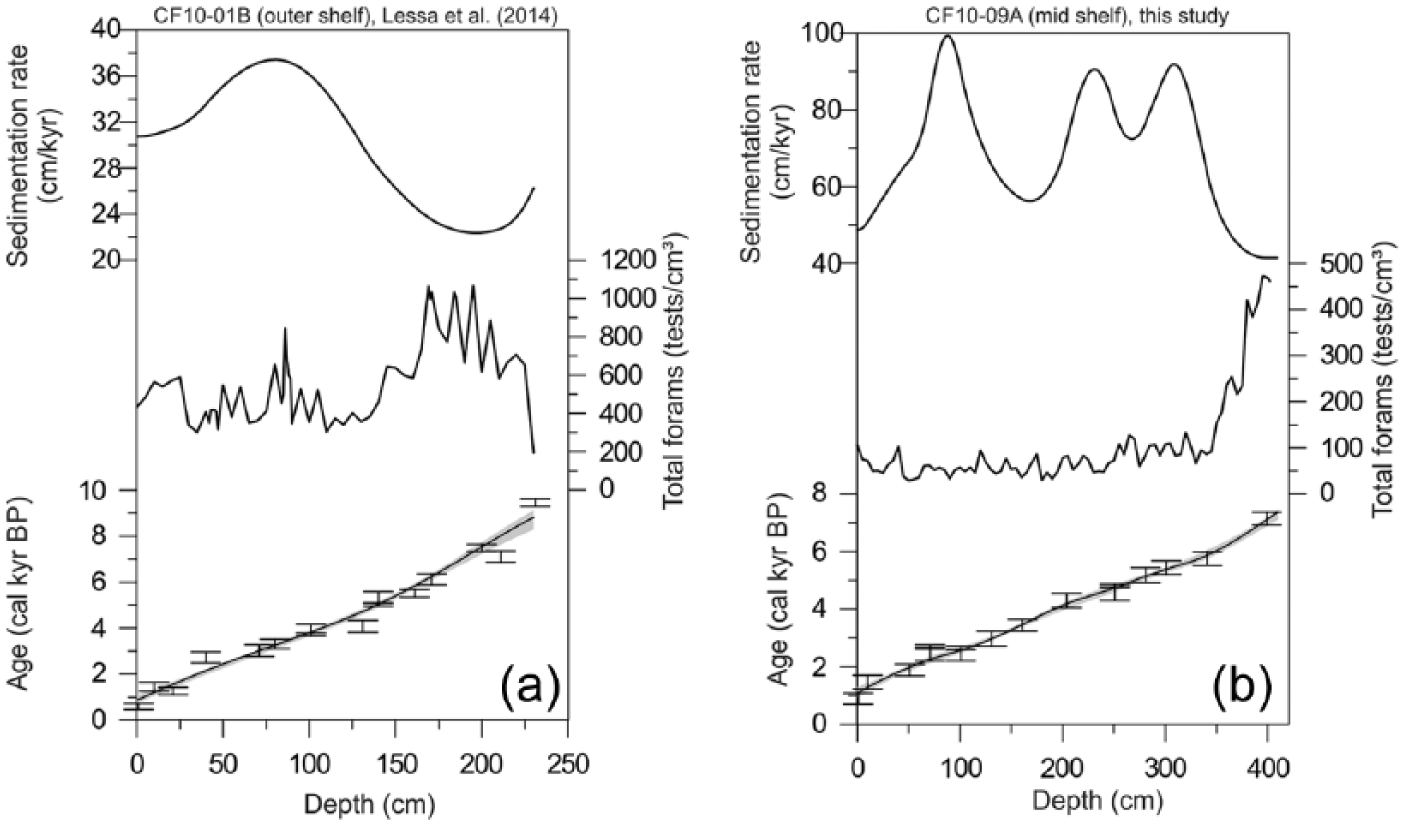
Sedimentation rate, total planktonic foraminiferal density, and geochronological models for the (a) CF10-01B and (b) CF10-09A cores. The gray shading and error bars in the geochronological models represent the 2σ age uncertainty.
The CF10-09A core is considered to be mid-shelf, and the CF10-01B core is treated as outer shelf. The δ18O of G. ruber (δ18ORUB) varied between −1.2‰ and −0.4‰ in the outer shelf and between −1.6‰ and −0.1‰ in the mid-shelf, featuring three main phases in the CFUS: high values in the early and middle Holocene, a transition phase between 5.0 and 4.0 kyr BP, and lower values after 4.0 kyr BP (Figure 3). The δ18O of G. bulloides (δ18OBUL) varied between −0.8‰ and 0‰ in the outer shelf and between −1.1‰ and 0.2‰ in the mid-shelf (Figure 3), with generally higher values than δ18ORUB, but one exception was present in the mid-shelf during the middle Holocene (Figure 3). The three stages that were revealed by δ18ORUB are only seen in δ18OBUL in the mid-shelf, but with an opposite trend in relation to the δ18ORUB data. On the outer shelf, no Δδ18OBUL − RUB trend was observed once the δ18OBUL variation did not present a meaningful trend (Figure 3), whereas on the mid-shelf, values that trended toward 0‰ were observed during the early and middle Holocene, with a gradual increase between 5.0 and 4.0 kyr BP (transition phase) and larger differences after 4.0 kyr BP.

Variation in the Globigerinoides ruber and Globigerina bulloides δ18O along the CF10-01B (outer shelf) and CF10-09A (mid-shelf) cores. The upper part of the graphic shows the geochemical (gray shading) and foraminiferal assemblage (roman numbers) phases.
The Mg/Ca ratio of G. ruber ranged between 4.0 and 7.0 mmol/mol, with lower values before 5.0 kyr BP and higher values after this age (Figure 4a). The reconstructed temperature (TMg/Ca) in the outer shelf from Figure 4b indicated two steps of SST variations that accompanied the variations in the δ18ORUB in both studied portions of the continental shelf. Low temperatures were observed between 9.0 and 5.0 kyr BP (variable between 9.0 and 6.5 kyr and stable between 6.5 and 5.0 kyr), followed by high temperatures after 5.0 kyr BP.

Variation of the Globigerinoides ruber (pink) Mg/Ca and reconstructed paleotemperatures (SST proxy) along the CF10-01B core (outer shelf). Temperature values were forced to CFUS range by subtracting them by a factor of 6.50°C. The gray error bars represent the total uncertainty of reconstruction (i.e. 1.34°C). The upper part of the graphic shows the phases reported by geochemical proxies (gray shading) and the foraminiferal assemblage (roman numbers).
The grouping of the relative abundance of the planktonic foraminifera according to CONISS identified five main stages of assemblage variations during the Holocene (Figure 5). The phases corroborate δ18O and Mg/Ca results but detail important changes after 5.0 kyr BP that are not perfectly displayed in geochemical records. The relative abundance of G. ruber and G. bulloides changed in opposite fashions throughout the record (Figure 5), except between 9.0 and 4.0 kyr BP in the outer shelf. G. ruber was the most abundant species in the entire record, with a relative abundance that ranged from 35% to 60% (Figure 5). The relative abundance of G. bulloides ranged from 7% to 25%, usually being higher in the mid-shelf compared with the outer shelf. The relative abundance of the G. menardii plexus varied between 0% and 3% and was higher in the outer shelf. The relative abundance of G. sacculifer varied between 0.5% and 5% and was higher in the mid-shelf (Figure 5). The relative abundance of Turborotalita quinqueloba ranged from 2% to 12% and was higher in the mid-shelf during the middle Holocene and in both regions after 1.5 kyr BP. The relative abundance of Globigerinita glutinata ranged between 6% and 20% and was higher in the mid-shelf. The relative abundance of Globoturborotalita rubescens ranged from 8% to 25%, with higher values observed in the outer shelf (Figure 5).
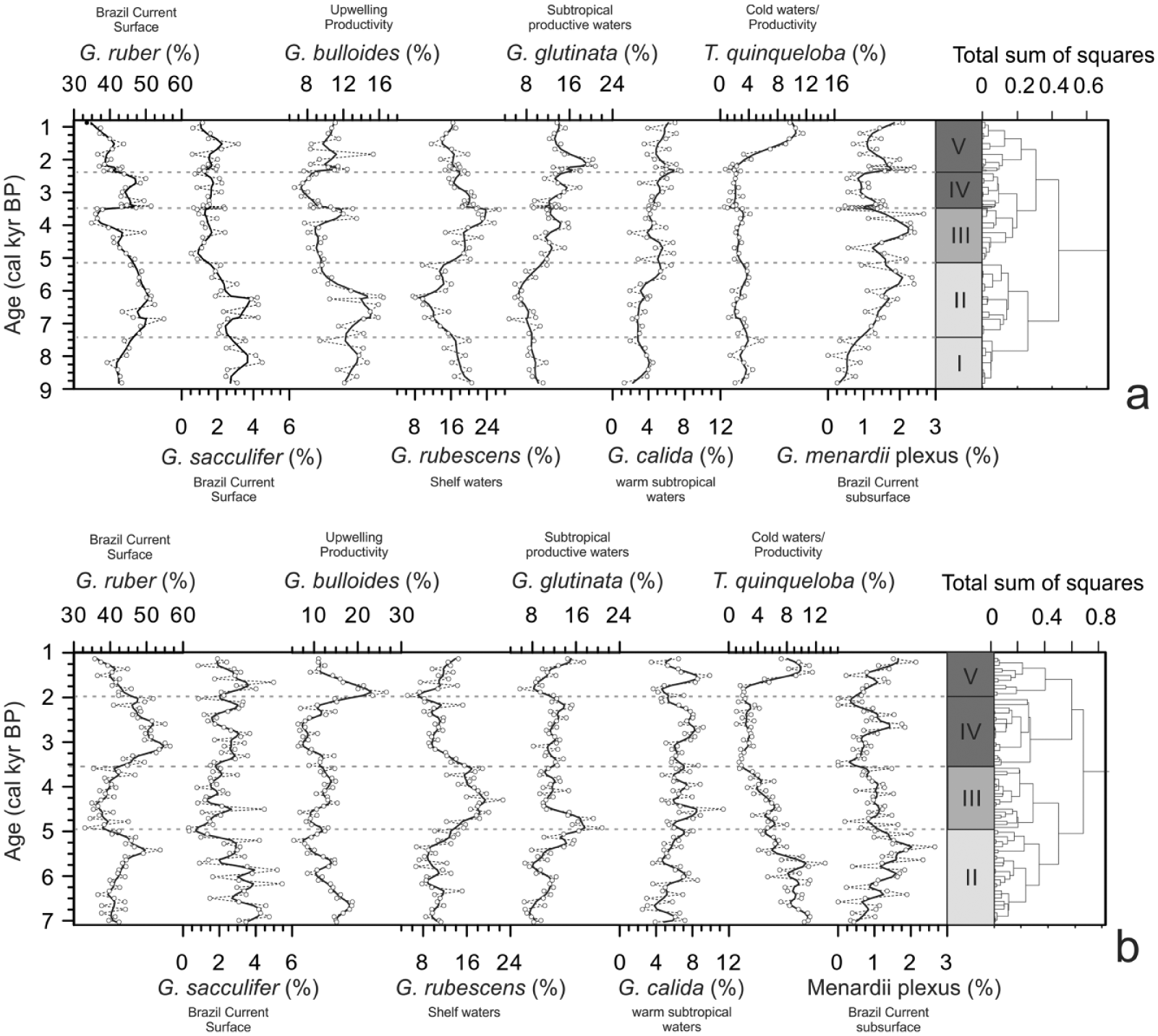
Variation in the relative abundance of main planktonic foraminifera species along the (a) CF10-01B (outer shelf) (modified from Lessa et al., 2014) and (b) CF10-09A (mid-shelf) cores (this study). Only Globigerina bulloides and vertical (age) axis were not scaled to preserve the view of the variations on the outer shelf and mid-shelf high resolution, respectively. The thick lines represent a 5-point smoothing from the raw data. The dashed lines represent the CONISS tree groups, which define the assemblage variation phases. The gray scale shows the correspondence with the δ18O and Mg/Ca results.
Discussion
BC dynamics during the last 9000 years
Reconstructions that were based on stable isotopes and the Mg/Ca ratio of G. ruber from the CF10-01B core (outer shelf, Figures 4a and 5) reflect primarily variations in the SST of the BC passing the continental margin of Rio de Janeiro (23°S). According to Matano (1993) and Locarnini et al. (2010), changes in the SST of the BC can be positively correlated to the intensity. Belem et al. (2013) through modeling reported intensification of the upwelling with intense BC episodes for the CFUS. These considerations allow us to assume that this relationship may have also been true in the past. A comparison was made between our results for TMg/Ca (equivalent to SST) and other records on the western margin of the tropical South Atlantic, including BC and NBC (Figure 6).
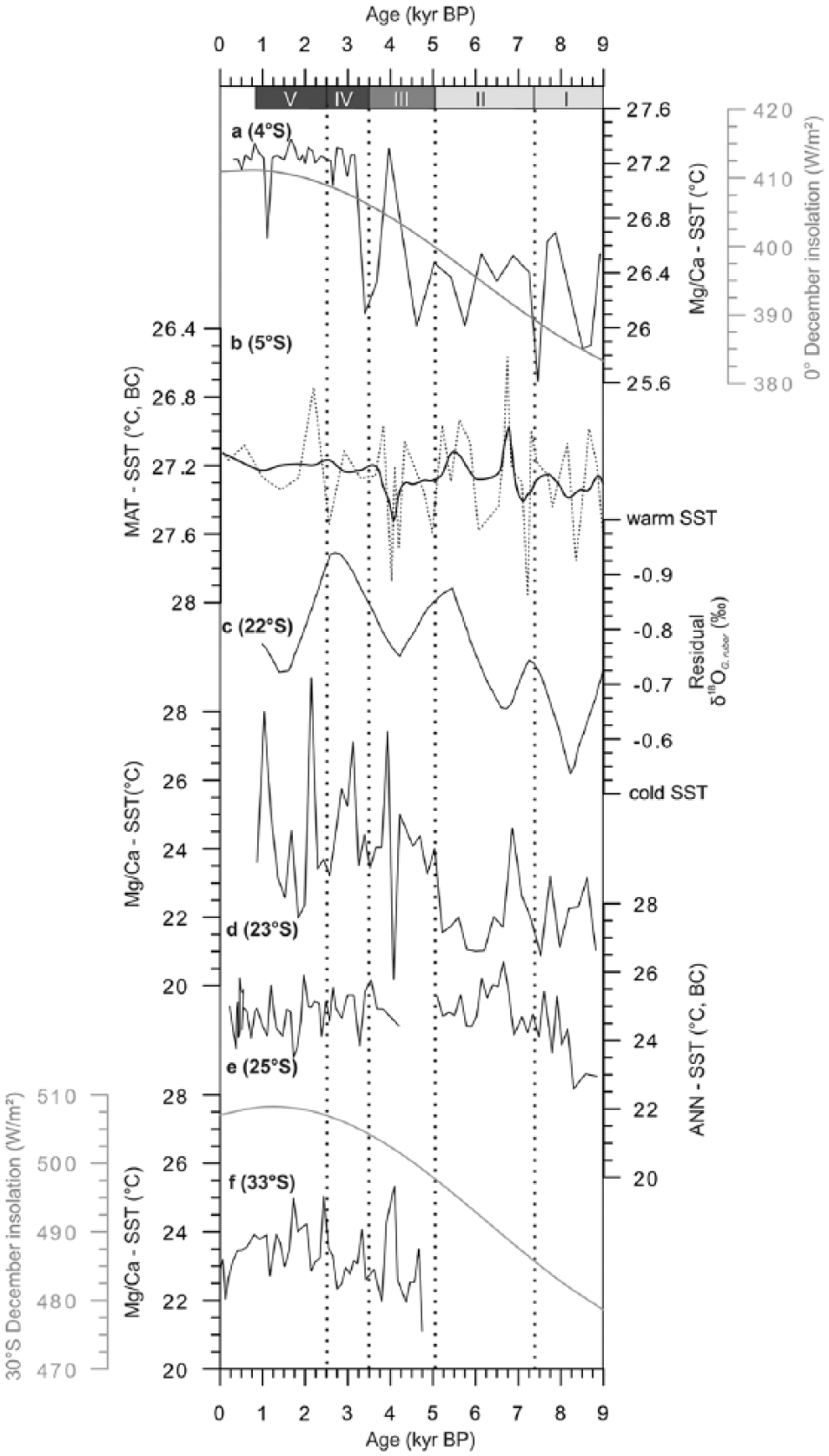
Comparison between equatorial and subtropical southwestern Atlantic SST proxies and December insolation from Berger (1978) during the last 9000 years, with the records placed in latitudinal order: (a) and (b) NBC SST reconstructions from Santos et al. (2013) and Weldeab et al. (2006), respectively; (c) reconstruction of the BC’ SST between 20 and 22°S from Arz et al. (1999); (d) our adjusted Mg/Ca-SST reconstruction from CFUS (23°S); and (e) and (f) SST reconstructions of the BC south of the CFUS by Pivel et al. (2013) and Chiessi et al. (2014), respectively. The five phases are indicated at the top by roman numerals (assemblages), gray scale (geochemical proxies), and vertical dashed lines.
Along the last 9 kyr of the marine records, the SST tended to follow different trends in the NBC and BC domains.
In the NBC domain, a different variation pattern is seen between the Modern Analog Technique (MAT)-SST from Santos et al. (2013) and Mg/Ca-SST from Weldeab et al. (2006) (Figure 6a and b). This difference is probably because the MAT-SST reconstruction includes contributions from surface and subsurface species, whereas the G. ruber Mg/Ca values are linked to the uppermost surface SST. Thus, the two data register SST with different depth length and highlight the importance of the subsurface layer as an indicator of the NBC’s intensity (and therefore of the equatorial sector of the surface AMOC) along the Holocene. The trend change to warmer waters at approximately 4.0 kyr BP (Figure 6c and b, respectively) coincides with the decrease in the AMOC activity in the Sub-Arctic sector (Hall et al., 2004; Kissel et al., 2013; Thornalley et al., 2013). Santos et al.’s (2013) planktonic foraminifera assemblage revealed that the 4.0 kyr BP warming was caused by an increase in subsurface warm and saltier waters species (G. sacculifer, G. menardii plexus, Pulleniatina obliquiloculata, and Neogloboquadrina dutertrei) and a decrease in G. ruber and less abundant warm water species (Globigerinella siphonifera and Globorotalia truncatulinoides). These observations indicate a deeper mixture layer and therefore more heat concentration in the equatorial current system and less export to the North Atlantic.
In the BC domain, an increasing trend is observed from 9.0 to 7.0 kyr BP. Low and stable SST values were observed between 7.0 and 4.5 ± 0.5 kyr BP and high values after 4.0 kyr BP, except at 26°S. Such trends can be best viewed in the low-resolution record of Arz et al. (1999) for the BC at 22°S, which indicates responses to increased summer insolation in the Southern Hemisphere. This pattern would suggest a different behavior of the BC to the north and south of Cabo Frio, but the low resolution of the record in Arz et al. (1999) limits this interpretation. Different BC positions close to or far from the continental shelf break and the stability of the flux may explain the different SST variations that are observed in the subtropical SW Atlantic. Based on these characteristics, we discuss the major phases of the variation in the BC’s dynamics when passing along the continental margin of Rio de Janeiro and how it could have influenced the CFUS. A summary of the scenarios for each phase is found in Table 3, and the CFUS oceanographic model is represented in Figure 7.
Summary of the identified phases in the CFUS along the studied time.
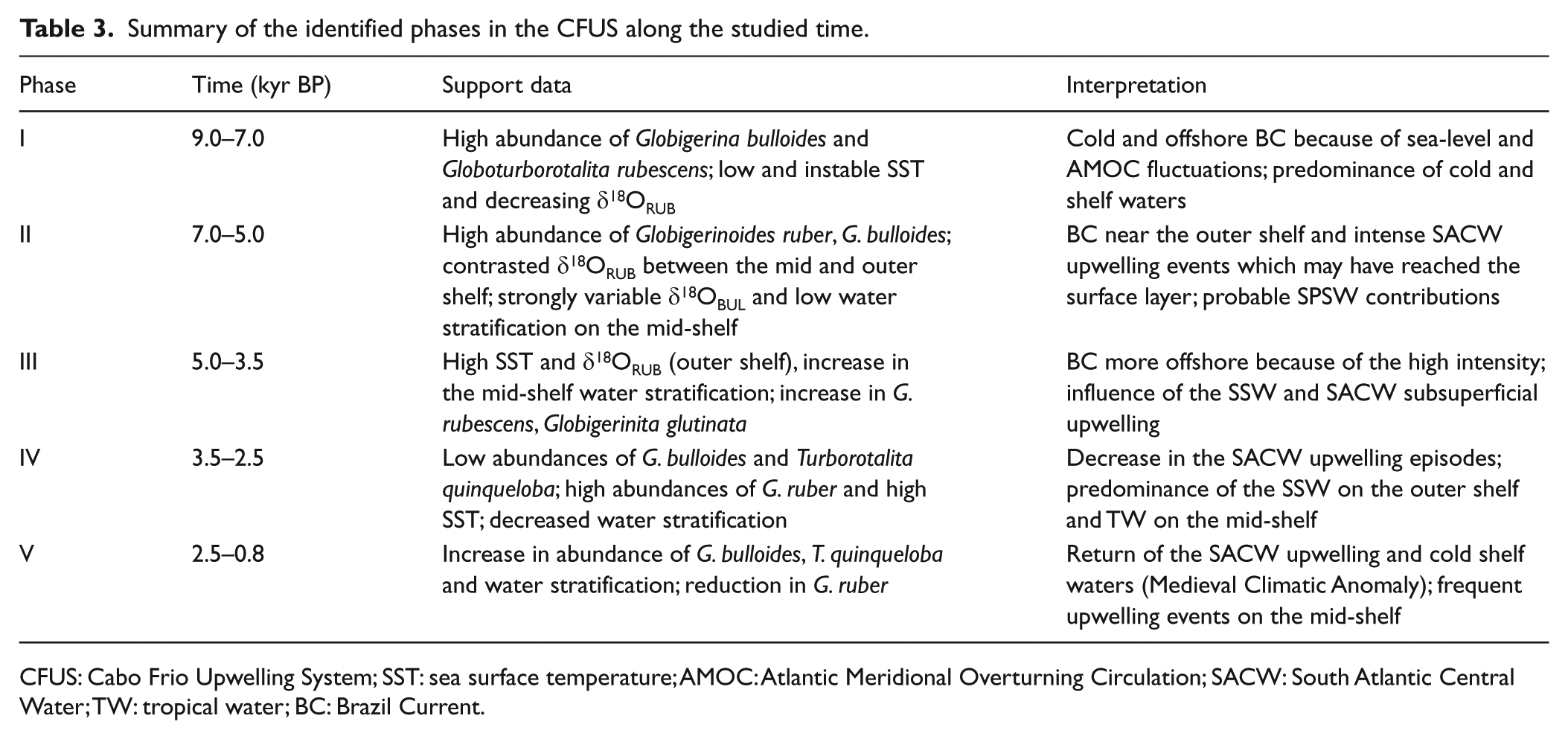
CFUS: Cabo Frio Upwelling System; SST: sea surface temperature; AMOC: Atlantic Meridional Overturning Circulation; SACW: South Atlantic Central Water; TW: tropical water; BC: Brazil Current.

Main Holocene oceanographic scenarios for the CFUS continental shelf (a–e), which were reconstructed by ecological and geochemical planktonic foraminifera proxies (a–e) represent the described phases I–V, respectively.
Early and middle Holocene
Phase I, which refers to the early Holocene (9.0–7.0 kyr BP, Figure 7a), describes the outer shelf of the CFUS during marine transgression. The high relative abundance of G. bulloides and G. rubescens indicates the influence of cold shelf waters, with little influence of TW on the CFUS. During this phase, the sea level ranged between −45 and 0 m (Corrêa, 1996), indicating that the BC should have been offshore at 9.0 kyr BP, and the BC gradually approached toward the end of the transgressive event (Toledo et al., 2007b). Because of the offshore location of the BC, the influences of the SSW and coastal upwelling plumes were important, influencing the assemblage composition to more cold-water species. In addition, the observed low SST values may be related to a colder BC, where G. ruber is distributed, a consequence of the intensified AMOC during the early Holocene (Arz et al., 1999; Hoogakker et al., 2011; Kissel et al., 2013; Thornalley et al., 2013).
Phase II, which concerns the beginning of the middle Holocene (between 7.2 and 5.0 kyr BP, Figure 7b), was marked by an increase in the influence of TW. The δ18ORUB data indicate a gradual approach of the BC because the values are more negative in the outer shelf than in the mid-shelf, but the values follow the same trend over time. The high relative abundance of G. ruber and the G. menardii plexus (Figure 5), combined with the high density of planktonic foraminifera (Figure 2) in both study sites, indicates that there was an increase in the supply of foraminifera from offshore waters to the CFUS, corroborating the approach of the BC that was observed by Lessa et al. (2014) on the outer shelf. The high relative abundance of G. bulloides and T. quinqueloba, with the low abundance of G. glutinata (Figure 5), suggests the occurrence of frequent subsurface upwelling events in both study sites, particularly in the mid-shelf (Figure 5b). Furthermore, the large dispersion of δ18OBUL values and the low level of stratification given by Δδ18OBUL-RUB (Figure 3) indicate that the nuclei of productivity from the strong upwelling of the SACW may have reached the surface layer in the mid-shelf. The contact between cold subsurface waters and warm surface waters may have contributed to the lower δ18OBUL. This pattern indicates that the area with the greatest intensity of upwelling that was driven by the wind stress curl (maximum of mid-shelf upwelling in Figure 1) would be located near the mid-shelf core site, from which the productivity nuclei originated. This evidence characterizes the expected scenario in the middle Holocene for the CFUS without the influence of sea level. In this scenario, the decreased intensity of the BC (explained by a low SST) would be attributed to the high activity of the AMOC, where peaks of NADW production were observed in the NE Sub-Arctic Atlantic between 7.0 and 5.5 kyr BP (Hall et al., 2004; Hoogakker et al., 2011; Kissel et al., 2013; Thornalley et al., 2013).
The SST at 26°S (Figure 6f) remained high between 7.0 and 6.0 kyr BP, whereas the high SST in the CFUS was restricted to a peak at 7.0 kyr BP (Figure 6d). This paradox could be explained by the local BC instabilities near the coast at 23°S (Rio de Janeiro continental margin) because of the bottom topographic structure, which favors SACW upwelling, whereas the more stable flux of the BC at the offshore Santos Basin (26°S) favors the prevalence of warm waters. These warm waters at 26°S could have been contributed from the Agulhas Current to Atlantic Subtropical Gyre and its westward leakages once the 7.0–6.0 kyr SST peak coincided with the G. menardii plexus maximum (Pivel et al., 2013, Figure 4). The relationship between the G. menardii plexus and the Agulhas system is explained by their high abundance in the Indian Ocean and Eastern Tropical Atlantic (Bé, 1977) and their disappearance in the Atlantic during the glacial period (Portilho-Ramos et al., 2014). It suggests that the plexus reached the SW Atlantic sector through the surface AMOC taking advantage of a less ventilated thermocline which characterizes the Agulhas realm (Broecker and Pena, 2014; Sexton and Norris, 2011). However, upwelling indicator species (e.g. G. bulloides and G. glutinata) and species that would help to understand the ANN SST variation (e.g. G. ruber) were not shown in Pivel et al. (2013) (Figure 4), which limits our ability to comprehend the offshore SACW upwelling dynamics. However, results from a core that was sampled on the slope near the Rio de Janeiro continental margin registered variations in the G. menardii plexus and G. bulloides relative abundances (Toledo et al., 2007a) and SST (by MAT) (Toledo et al., 2007b) that seem similar to the CFUS’ variations. However, the Holocene has low resolution, which limits interpretations; therefore, high-resolution studies in this area are necessary.
Transition phase (5.0–3.5 kyr BP)
The post–5 kyr phases can be related to a change in the meridional overturning flow (Figure 6).
Phase III includes the end of the middle Holocene and beginning of the late Holocene (between 5.0 and 3.5 kyr BP; Figure 7c) and is a transition phase when the BC gained intensity and displaced offshore. Thus, the CFUS received more influence from the SSW, and the SACW upwelling was limited to the subsurface. In this phase, the isotopic signatures of the analyzed species differed spatially (Figure 3). The higher reconstructed SST indicated a warmer BC, and the δ18O of both species tended to diverge in the mid-shelf, indicating a greater stratification of the photic zone, thus isolating the cold water in the subsurface. The increase in the TMg/Ca − SST suggests an increase in the intensity of the BC in the CFUS. However, the abrupt increases in the relative abundance of G. glutinata and G. rubescens in the mid-shelf and gradual increases in the outer shelf (Figure 5, Lessa et al., 2014) indicate more contributions from the SSW and therefore the displacing offshore of the BC. Certain aspects of the strong influence from SSW can be addressed as follows.
The time interval of Phase III corresponds to the maximum transgressive event of the Holocene (Angulo et al., 2006), and a possible erosive increase in flooded areas could have enhanced the productivity of the SSW. Likewise, the main habitat of the BC species, such as the G. menardii plexus, tended to approach the CFUS.
Phase III also coincides with a period of great changes in the oceanographic (Figure 6) and continental domains (section ‘Paleoclimate implications’), which were driven by the high summer insolation. At 5.0 kyr BP, the values of δ18ORUB decreased in the mid-shelf, while the outer shelf δ18O values remained high, decreasing only at 4.0 kyr BP, along with the mid-shelf (Figure 3). The similarity between the trends of the SST records of the BC (except at 26°S, Figure 6f) and the NBC (Figure 6b and c) indicates that the increase in the SST of the BC likely responded to the decrease in the AMOC (Andrews et al., 1997; Thornalley et al., 2013), with more heat being distributed toward the BC system.
Late Holocene (after 3.5 kyr BP)
In Phases IV and V (late Holocene), the δ18ORUB values acquired their present range, indicating that the BC had reached its modern dynamics, which exhibit an intense flow offshore below 23°S. However, the variations in the relative abundance of cold and warm water species (Figure 5) indicated large local variations in the CFUS. Because oceanographic variations in the BC became stable, upwelling variations in the CFUS were associated with the atmospheric component (NE winds).
Phase IV (between 3.5 and 2.5 kyr BP, Figure 7e) is marked by greatly weakened upwelling. During this period, a higher SST (between 25°C and 27°C, Figure 4) and lower δ18OBUL were present in the outer shelf, along with a drop in the relative abundances of cold and productive water species (G. bulloides and T. quinqueloba) and an increase in the relative abundance of G. ruber, G. menardii plexus, and G. glutinata. These results suggest a more frequent prevalence of TW and warm subsurface waters throughout the record in the mid-shelf. Because the NE winds were unable to generate wind stress curl phenomena, shelf waters from the Santos Basin could more easily reach the CFUS, favoring the increase in G. glutinata and G. rubescens, which are abundant in that area (Lessa et al., 2014). Because the zone of the maximum wind stress curl is located in the mid-shelf, the cold-water signature that is given by δ18OBUL indicates that the upwelling reached the lower layer of the photic zone, but this phenomenon was rare in the outer shelf, where a decrease in δ18OBULwas observed. This situation suggests that G. bulloides, similar to the biota that adapted to the productivity of the upwelling, migrated to the deeper layers in the photic zone (Bé, 1960; Peeters et al., 2002). Considering that the relative abundances of species in the mid-shelf that were linked to the BC increased (Figure 5b), the incursions of TW could have resulted in the deepening of the photic zone through increased transparency. This deepening may not have occurred in the outer shelf, which remained more strongly influenced by SSW (richer in nutrients than TW) than the mid-shelf.
Phase V, which corresponds to the interval 2.5–0.8 kyr BP (Figure 7f), marks the establishment of the current CFUS oceanographic configuration. The increase in the relative abundance of species from cold and productive waters (G. bulloides and T. quinqueloba) in the outer shelf and mid-shelf at 2.5 and 2.1 kyr BP, respectively, indicated a gradual return of SACW intrusion into the platform. However, G. bulloides and T. quinqueloba tended to vary in opposite ways, suggesting a competition between the two species. The periods between 2.5 and 1.5 kyr BP and between 1.5 and 0.8 kyr BP were marked by an increase in G. bulloides and T. quinqueloba, respectively. These changes could be associated with variations in salinity because T. quinqueloba prefers lower salinities than G. bulloides (Tolderlund and Be, 1971). The differences between the associations of both species are discussed in greater detail in section ‘Influence of subpolar shelf waters in the middle Holocene and Medieval Climatic Anomaly’.
Paleoclimate implications
Atlantic and South American atmospheric teleconnections
Changes in oceanographic and atmospheric conditions were observed at the end of the middle Holocene (±5.0 kyr BP) within the Atlantic Ocean (Figure 6) and along the South American and African continents (Cruz et al., 2009; DeMenocal et al., 2000). These changes coincide with the start of Phase III (5.0–3.5 kyr BP), when an oceanographic transition toward the present configuration of the CFUS began (Figures 4 and 5). The reconstructions of atmospheric systems indicated a change in the hydrological regime along the African and South American continents at approximately 5.0 kyr BP. The mid-Holocene was marked by a humid climate in the Sahara and NE Brazil (Cruz et al., 2009; DeMenocal et al., 2000), while the climate in the Amazon was dry, with high records of pollen from savanna grasses and micro-charcoals from fires (Absy et al., 1991). These studies have linked such climatic conditions to the Intertropical Convergence Zone (ITCZ), which distributed moisture before 5.0 kyr BP and therefore was not frequent in the Amazon (Cruz et al., 2009; Haug et al., 2001). The period of wide ITCZ migration coincides with Phase II of the CFUS and may suggest a seasonal extreme intensification, but higher resolution data would be required for a more rigorous confirmation. Such atmospheric conditions also suggest that the SE region of Brazil also featured a drier climate, as the decreased moisture in the Amazon in the middle Holocene prevented and/or deflected the formation of a humidity corridor from the SACZ in the summer because of the greater intensity of the South Atlantic Subtropical High (SASH).
The shorter ITCZ seasonal migration after 5.0 kyr BP (in average displaced to the south) favored the desertification of the Sahara (DeMenocal et al., 2000) and allowed the expansion of the semiarid climate in NE Brazil (Cruz et al., 2009). This pattern favored the increased presence of low-pressure areas over the Amazon, causing the intensification of the South American monsoon and expanding the tropical rainforest vegetation (Absy et al., 1991; Cordeiro et al., 2008; Cruz et al., 2009; Sifeddine et al., 2001; Turcq et al., 2002). Thus, an increase in the rainforest caused a rise in humidity, allowing the formation and intensification of the SACZ. Therefore, the climate that was dry in the CFUS region before 5.0 kyr BP (Laslandes et al., 2006) became humid after 4.5 kyr BP, indicating that this factor may have contributed to the advancement of the SSW into the CFUS, as mentioned in section ‘Brazil Current dynamics during the last 9000 years’. After 5.0 kyr BP, the upwelling in the CFUS became limited to the subsurface (Figure 3), indicating that the zone of the maximum wind stress curl shifted away, causing upwelling episodes in the SACW to be barely evident in the outer shelf, as shown by the assemblage and δ18Odata (Figures 3 and 6). The high SST in the SW Subtropical Atlantic also suggests a strengthening of the oceanic component of the SACZ because this component tends to intensify during episodes of high SST (Prado et al., 2013), suggesting that the climate in SE Brazil became humid. Since Prado et al. (2013) emphasized that the SST decreased because of the formation of an oceanic SACZ, such an event could have been most intense between 25°S and 23°S, as shown in Figure 6.
Influence of SPSWs in the middle Holocene and Medieval Climatic Anomaly
The occurrence of SPSW in the CFUS during the winter is supported by the atmospheric conditions that were described in Piola et al. (2008). The weakening of subtropical atmospheric systems allows the intrusion of subpolar atmospheric systems, such as cold fronts (associated with SW winds). An increased frequency of SW winds displaces SPSFs northward, currently making the SPSW reach 25°S in the winter, as mentioned previously. Despite the loss of the physical and chemical characteristics of the mid-shelf because of river or lake discharges, organisms that had adapted to cold waters could survive and settle in favorable locations. The CFUS favors the establishment of these species because of the occurrence of a shallow thermocline. Thus, the SPSW could have influenced the present and past communities in the subsurface water column and sediment of the CFUS.
A high relative abundance of T. quinqueloba, either occurring alone or in association with G. bulloides (Figure 5), could reflect an influence of SPSW once other studies have also shown abundant species of the Malvinas Current at 23°S (Stevenson et al., 1998). As mentioned in section ‘Brazil Current dynamics during the last 9000 years’, the replacement of G. bulloides by T. quinqueloba in the assemblage can occur with a decrease in the salinity of cold waters. This pattern can reinforce the idea of possible penetrations by SPSW. A higher relative abundance of T. quinqueloba in our study area (Figure 5) occurs during Phase II (7.0–5.0 kyr BP) in the mid-shelf and after 1.8 kyr BP throughout the CFUS, with the maximum occurring at approximately 1.0 kyr BP, which corresponds to the Medieval Climate Anomaly (MCA). This interpretation suggests that an event that was associated with the middle Holocene was repeated during the MCA on a larger scale because other studies (Lessa et al., 2014; Souto et al., 2011) showed a higher relative abundance of T. quinqueloba from 1.8 kyr BP, with a maximum abundance during the MCA. Based on the climatic and oceanographic conditions, both Phase II (middle Holocene) and the MCA were marked by frequent passages of cold fronts in the winter. During Phase II, the passages may have occurred because of the northward migration of polar atmospheric systems from weaker insolation. During the MCA, the increase in cold fronts could be explained by La Niña–like conditions (Makou et al., 2010) that favored cold fronts to pass rapidly through the region and often reach latitudes as low as 10°S on the Brazilian coast.
NE winds weakening between 3.5 and 2.5 kyr BP
The return of cold water from the SACW, which was observed after 4.0 kyr BP, is supported by other studies that were conducted in the region (Laslandes et al., 2006; Mahiques et al., 2005; Nagai et al., 2009; Sylvestre et al., 2005). During this period, high SSTs were present along the western edge of the South Atlantic (Figure 7), thus strengthening the subtropical gyre and associated weather systems (Kim and Schneider, 2003). Conditions for weakening SACW intrusions into the CFUS between 3.5 and 2.5 kyr BP are not clear in records outside of the CFUS, which indicate a very active BC (favorable for intrusions by SACW). One possible explanation would be a decrease in the occurrence of NE winds, causing the subtropical waters of the Santos Basin to be more common during this stage, given the high relative abundance of G. rubescens, G. glutinata, and G. ruber. The passage of shelf waters from the SSW in the outer shelf would serve as a barrier to SACW entry and help transport TW to the mid-shelf through the meandering BC. The presence of particulate-free TW in the mid-shelf could also have facilitated the maintenance of a degree of productivity at greater depths because the TW may have allowed a lower layer of the photic zone to reach areas under the influence of the SACW (Figure 3, δ18OBUL). Braconnot et al. (2007) showed changes in wind patterns at low atmospheric levels after 3.0 kyr BP through global modeling, which indicate the reintensification of NE winds after 3.0 kyr BP because of a southward shift of the ITCZ. This displacement of the ITCZ favored the approaching and intensification of the Subtropical South Atlantic high-pressure system intensifying the NE winds and promoting the return of SACW intrusions (Phase V) into the CFUS.
Conclusion
Oxygen stable isotopes, Mg/Ca ratio, and assemblage records of planktonic foraminifera assisted in the paleoceanographic reconstruction of the CFUS during the Holocene, during which five main phases were summarized. The first phase (9.0–7.0 kyr BP) was influenced primarily by sea-level variations, which kept the BC away from our study area. The second phase (7.0–5.0 kyr BP) was influenced by a relatively wide BC migration onshore and offshore, favoring the alternation of strong upwelling, the possible influence of SPSW, and the strong presence of TW. The third phase (5.0–3.5 kyr BP) was influenced by oceanographic and climatic transitions from the middle Holocene to late Holocene, during which an intensification of the BC front caused its offshore displacement, favoring a greater SSW influence and the restriction of SACW upwelling to subsurface layers. The fourth (3.5–2.5 kyr BP) and fifth phases (after 2.5 kyr BP) were basically influenced by weak and intense NE winds, respectively. Low (High) intensity of the NE winds was responsible for the prevalence of TW and SSW (SACW upwelling) in the fourth (fifth) phase. Regional and global events were identified by our indicators, such as the transitions between phases II and III (5.0 kyr BP), which are connected with reduced strength of AMOC and the high influence of SPSW during the MCA (approximately 1.0 kyr BP).
Footnotes
Acknowledgements
We also thank LMI PALEOTRACES from Institut de Recherche pour le Développement (IRD, France) and the valuable analytical assistance of Florence le Cornec and Magloire Mandeng-Yogo. D Lessa and ALS Albuquerque were PhD scholar and senior scholar, respectively, from Conselho Nacional de Desenvolvimento Científico e Tecnológico-CNPq (Grant 306385/2013-9). The authors thank Catia Fernandes Barbosa and Rodrigo Portilho-Ramos for their contributions in the identification of planktonic foraminifera species, ecological remarks, and picking of tests for geochemical analysis. We also thank Aline Govin and an anonymous reviewer for their contributions, which improved the manuscript.
Funding
This study was partially funded by Coordenação de Aperfeiçoamento de Pessoal de Nível Superior (CAPES) through the Projeto PALEOCEANO (Grant: 23038.00141/2014-71), the Geochemistry Network from PETROBRAS/CENPES, and the National Petroleum Agency (ANP) of Brazil (Grant 0050.004388.08.9).