




Abstract
A number of informal terms (e.g. Anthropocene, Anthropozoic, Psychozoic, Noozoic, and Technogene) have been used to designate the rock unit and time interval where the impact of collective human action on the Earth system is clearly recognizable (called here the Humanized Earth System (HES)). Presently, Anthropocene is the most commonly used, and the International Commission on Stratigraphy is considering its acceptance as a formal stratigraphic unit. Despite their informal character, all of these terms contain suffixes (i.e. -cene, -zoic, or -gene) that define formal chronostratigraphic/geochronologic (C/G) units (e.g. series/epoch, erathem/era, and system/period), which is misleading. In addition, the use of these terms involves unsupported evolutionary assumptions and may lead to conflicting stratigraphic settings. Therefore, it is recommended that these terms are avoided until there is sufficient scientific support to unequivocally define its C/G rank, which is not expected to occur in the near future.
Keywords
Introduction
Almost a century and a half ago, the Italian geologist Antonio Stoppani (1873) coined the term ‘Anthropozoic’ to designate a new era characterized by the global impact of human activities on the Earth. Stoppani argued that humankind had become ‘a new element, a new telluric force that for its strength and universality does not pale in the face of the greatest forces of the globe’. The Anthropozoic was proposed as a geological era following the Cenozoic (Figure 1). Stoppani’s proposal was ignored until the beginning of the 21th century, when Crutzen (2002) and Crutzen and Stoermer (2000) used the same anthropogenic argument to define the Anthropocene. This time, the Anthropocene was proposed as a Cenozoic epoch following the Holocene, the onset of which was situated at the beginning of the Industrial Revolution when the atmospheric concentration of greenhouse gasses, notably CO2 and CH4, catalyzed the increase that has resulted in present-day values. However, the particular time of onset is still debated, with dates ranging from several millennia ago to AD 1964 (Lewis and Maslin, 2015b; Ruddiman, 2003; Zalasiewicz et al., 2011). The Anthropocene has been a successful term and is widely used; the International Commission on Stratigraphy (ICS) is discussing its official recognition as a formal geochronologic unit through the Anthropocene Working Group (AWG, 2015). Recently, the Anthropocene biosphere has been defined as a third stage in the evolution of the biosphere after the microbial stage (Archaean to Proterozoic) and the metazoan stage (Phanerozoic) (Williams et al., 2015) (Figure 1). These authors considered that human influence of the Earth ‘may herald a new era in the planet’s history that could persist over geological timescales’; this coincides with Stoppani’s idea of a new Anthropozoic era, although this is not explicitly stated. Other terms used to refer to the stratigraphic unit or the time interval characterized by the ‘impact of collective human action on biological, physical and chemical processes of the Earth system’ (Zalasiewicz et al., 2011), referred here as the humanized Earth system (HES), include Psychozoic, Noozoic, and Technogene (Oliveira and Peloggia, 2014). Some have used Technogene as a synonym for Quinary, the period following the Quaternary, which would be restricted to the Pleistocene (Ter-Stepanian, 1988) (Figure 1). Despite terminological similarities, the term ‘Anthropogene’ is different from the above names, as it was introduced as a synonym for Quaternary (Gerasimov, 1979). At present, there is a vivid debate about whether the definition of a new stratigraphic unit is necessary and also about the onset of the Anthropocene (e.g. Hamilton, 2015; Lewis and Maslin, 2015a, 2015b; Maslin and Lewis, 2015; Ruddiman, 2013; Ruddiman et al., 2015); however, these topics are beyond the scope of this paper, whose main interest is conceptual and terminological.
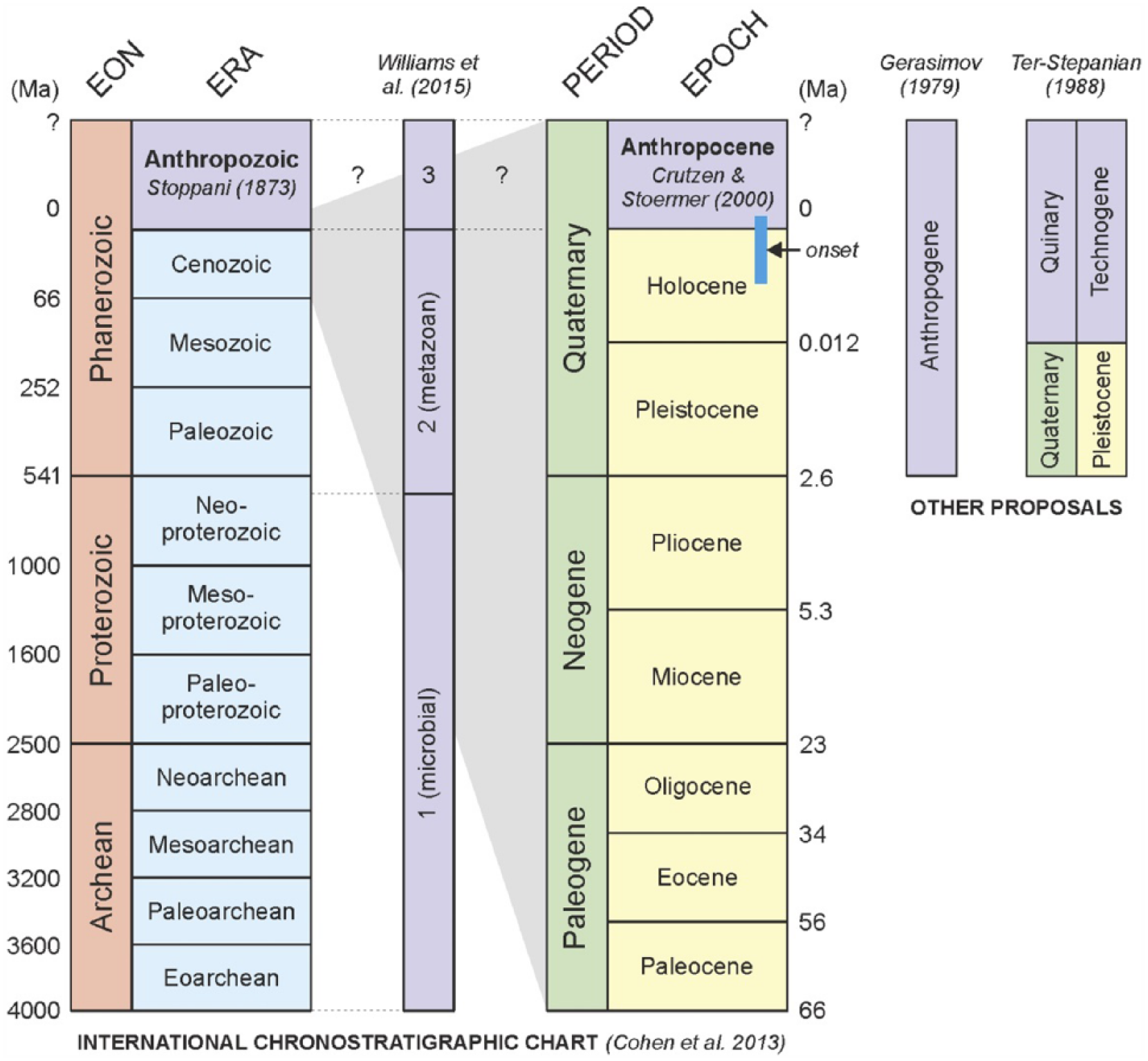
Chronostratigraphic proposals discussed in this paper using the International Chronostratigraphic Chart (Cohen et al., 2013) as a reference (informal units are in cian). The blue bar represents the approximate range for the onset of the ‘Anthropocene’ (Lewis and Maslin, 2015b; Ruddiman, 2003; Zalasiewicz et al., 2011).
All terms mentioned above involve implicitly defined chronostratigraphic/geochronologic (C/G) units. In the currently accepted terminology, compiled in the International Stratigraphic Guide (ISG) (Murphy and Salvador, 1999), the suffix -zoic is used to designate an era/erathem or an eon/eonothem, whereas the suffix -cene characterizes the Cenozoic epochs/series, which are grouped into larger units, the periods/systems, which are characterized by the suffix -gene. Clearly, the terms used thus far to designate the HES not only invoke specific C/G categories but also disagree in the C/G rank assigned to the unit under scrutiny. To designate the HES correctly is not merely a terminological issue, as the choice of any term may have relevant geological, environmental, and evolutionary implications. In addition, the geological time scale has been considered one of the major achievements of humanity in scientific terms, comparable to the periodic table of elements (Monastersky, 2015), and any further development should be analyzed with strict criteria. Here, I briefly discuss some relevant stratigraphic and evolutionary implications regarding the existing proposals for the HES as a C/G entity and argue that there is no sound support for any of these proposals.
The problem
From a stratigraphic perspective, whether the HES is considered an epoch or an era makes a fundamental difference. If it is considered an epoch, the Anthropocene would be comparable to the other Cenozoic epochs and will finish when the next epoch begins. The duration of the Cenozoic epochs ranges from 2.6 (Pleistocene) to 22 Ma (Eocene). Assuming a similar temporal magnitude for the Anthropocene implies that human impact on the biogeosphere would cease in the next millions of years. If the HES is considered an era, the Anthropozoic would last for hundreds or thousands of million years and would involve the almost indefinite persistence of our species on earth. This situation has never been observed in the geological record, where continuous species turnover, maintained by evolutionary origination and extinction, is the norm. Therefore, choosing a term not only impacts the further development of the current stratigraphic framework but also involves implicit hypotheses on the future of human evolution. The key questions are for how much time will our species persist on earth, for how much time will we maintain the capacity to significantly impact the biogeochemical state of the planet, and for how much time will humans use the current chronostratigraphic framework or even have interest in stratigraphy (Rull, 2013)?
The future of humankind
Humans will likely disappear from the Earth as have all species since the origin of life. Future world projections, including those involving the Anthropocene, rarely contemplate such a possibility, probably because it is believed that a biosphere without humans falls within the domain of fiction (Holmes, 2006; Pimm, 2008). However, the purported immortality of our species is a religious perception, which runs against current evolutionary knowledge (Rull, 2009). Theoretically, our species could leave the earth by catastrophic (phyletic) extinction, migration to other planets, or evolution to other species. The first two possibilities imply the abrupt termination of the HES; however, this is overly speculative. The evolutionary (i.e. non-catastrophic or non-phyletic) extinction of a species can occur by three main processes (Figure 2): (1) hybridization, when two interfertile species disappear because they produce a new hybrid species; (2) anagenesis, when a species is modified into another with the extinction of the first; and (3) cladogenesis, when a species diverges into two or more daughter species by allopatric speciation, rendering the original extinct (Delord, 2007). These processes have occurred in our own phylogeny, and there is no scientific reason to believe that they will not continue to occur. The timing of such extinctions is variable, but it has been documented that, for example, the passage from our extinct quadruped ancestors to bipedal hominids, certainly a paramount evolutionary change, required only a few million years (Tattersall and Schwartz, 2009). Therefore, the evolutionary change we might experience during the coming millions of years could lead to a very different species from which we currently call human (Rull, 2009). In this scenario, anthropogenic forcing could disappear within a few million years, a timing similar to the Cenozoic epochs. In this case, the term ‘Anthropocene’ would be appropriate. Conversely, if our species skips all the evolutionary laws known thus far and manages to persist on Earth almost indefinitely, then the term ‘Anthropozoic’ would be a better choice. Clearly, the use of a specific C/G term has relevant evolutionary connotations. The possibility of biological evolution being stopped and replaced by cultural evolution has been suggested, but this lacks scientific support (Klüwer, 2008; Stock, 2008). Equally speculative is the possibility of humans controlling our own evolution through technology (Chan, 2008; Pearson, 2008). Predictions regarding the nature and characteristics of eventual future species descending from us constitute a fascinating issue, but it is, at this point, a fictional, rather than a scientific, subject. The scientific knowledge available is not enough to solve the enigma of our evolutionary future, and as a result, the issue of the HES as an epoch or as an era remains open.
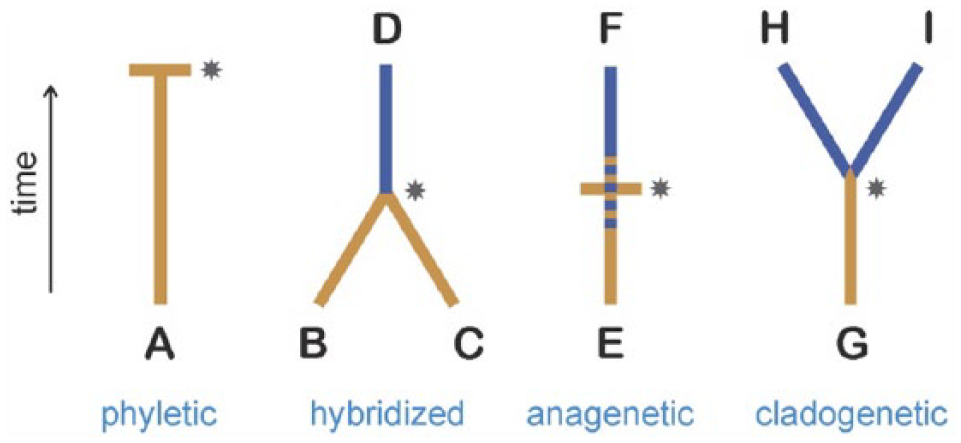
Extinction modes discussed in this paper. Species that disappear are shown in the lower part of the diagram (A, B, C, E, and G) and emerging species are in the upper part (D, F, H, and I). Extinction events are marked with an asterisk. Redrawn from Delord (2007).
The future of anthropogenic forcing
External forces
Another possibility behind minimizing or halting human impact on the biogeosphere is the development of a more powerful external force. Some of these forces, such as volcanism, are rather stochastic, and predictions about their potential occurrence and impacts are speculative. A glaciation is a more predictable force, which could impact humanity in two ways. First, habitats suitable for human life would be drastically reduced by the southward spreading of boreal ice sheets and the associated bioclimatic reorganizations. This would substantially reduce Earth’s population and, therefore, anthropogenic forcing. Second, during a glaciation, the atmospheric concentration of greenhouse gases is depleted significantly (Raynaud et al., 2003), which could contribute to significant reductions in global warming. Based on the study of Pleistocene glacial–interglacial cycles, the onset of the next glaciation has been estimated to occur during the next 10,000 years, with full glacial conditions in approximately 60,000 years (Crucifix and Rougier, 2009; Hao et al., 2012; Tzedakis et al., 2012; Vettoretti and Peltier, 2011). In this case, the HES would coincide with an interglacial cycle, and the definition of a new C/G unit would not be necessary. Whether anthropogenic forcing is causing a delay in glacial inception is actively debated (Claussen et al., 2005; Ruddiman, 2003). Some climatic models predict that the anthropogenic emissions of greenhouse gases could cause a significant delay in the next glacial inception or even the cessation of glacial–interglacial cycles for roughly a million years (Haqq-Misra, 2014; Herrero et al., 2014). In such a scenario, the Anthropocene epoch would make sense. However, if the glacial disruption is of a larger extent, for example, on the order of 108 years, it could attain the magnitude of a ‘greenhouse-earth’ phase (Fischer, 1982); this would result in timing that is between an epoch and an era. With this knowledge, it is not possible to decide between these two options.
Internal feedbacks
The possibility a species-wide change in mind-set and the resulting adoption of necessary measures to significantly reduce our influence on Earth’s biogeosphere can also be considered. In this case, the response of the biogeochemical systems is not expected to be immediate due to inertia. For example, in the case of ongoing global warming, it has been estimated that the lifetime of carbon in the atmosphere is long, and a substantial fraction of anthropogenic CO2 will persist for several millennia (Archer, 2005; Montenegro et al., 2007). Therefore, warming due to anthropogenic CO2 is irreversible on human timescales, and an eventual stabilization of greenhouse gas emissions would not be enough for temperature stabilization. To stop global warming, a near-zero emission scenario is required, and even in this case, warming is expected to continue for several centuries after the cessation of emissions (Matthews and Caldeira, 2008). Such timing (i.e. centuries to millennia) would be consistent with the Anthropocene as a Cenozoic epoch. However, in the current global economic and socio-political status quo, where economic growth is a priority and attempts to reduce emissions (e.g. the Kyoto Protocol) commonly fail due to the active opposition of major economies (Rosen, 2015), the cessation of greenhouse gas emissions is still utopian. In the long run, if our species and the consequences our existence on Earth perpetuate over geological timescales, as Stoppani (1873) and Williams et al. (2015) propose, the Anthropozoic era would be an appropriate terminology. It is also possible that continued anthropogenic forcing would reach a critical tipping point, leading to a global collapse of the human population or even our catastrophic extinction, an endogenous mechanism that has been proposed in fictional literature as a possible cause for human disappearance from the surface of the Earth (e.g. Weisman, 2007). As in the case of external forces, we have no scientific arguments to support any of the possibilities mentioned or a stratigraphic decision.
Conclusion and final remarks
Based on current knowledge, deciding whether the HES should be an epoch, an era, or any other formal chronostratigraphic unit is still largely speculative because there is no scientific argument to support any option. Indeed, the degree of uncertainty regarding the future of mankind and our potential impact on the biosphere is still too high to make an accurate decision. Therefore, the use of either Anthropocene or Anthropozoic is discouraged. The eventual acceptance of the term ‘Anthropocene’ by the ICS as a formal unit would not solve the problem because the extent of the HES, whose end will be determined by human extinction or by the termination of human influence on global systems, cannot yet be anticipated. Furthermore, such formalization would fix a term whose stratigraphic category is still unwarranted. It could be argued that the Holocene was in a similar situation prior to its formalization. Indeed, the Holocene was defined on the basis of its beginning, as the end was also unknown and could not be predicted with the available knowledge (Walker et al., 2009). However, the Holocene retains two decisive advantages over the HES: (1) the availability of a millennial sedimentary record as a factual basis and (2) the prefix holo- (meaning whole) does not involve any causal relationship, as is the case of anthropo-, which refers unequivocally to human affairs. In the case of the HES, finding a correct C/G term would require a more extended sedimentary record than is presently available, which would be a matter of millennia (Rull, 2013). Coining a new informal term for the HES seems not a useful solution as the eventual proliferation of new names would add confusion. Using HES itself would be enough, as this name can be applied to the stratigraphic unit, the time interval, or the new biogeochemical status of Earth characterized by collective human impact.
Footnotes
Funding
The author(s) received no financial support for the research, authorship, and/or publication of this article.