



Abstract
The chronology of the extinction of the Balearic fossil bovid Myotragus balearicus in Mallorca and Menorca has been under discussion since its discovery in 1909, and especially in the last decades, thanks to the radiocarbon dates that have been obtained from several deposits of the island of Mallorca. Here, we present new radiocarbon dates of M. balearicus bones (including the most recent date ever obtained for the species, 4035 ± 32 BP, 2830–2470 cal. BC) that together with a newly published radiocarbon date for the evidence of the first human presence in the island (introduced Caprinae bone, 3884 ± 36 BP; 2470–2210 cal. BC) allow us to reduce the uncertainty period for the Myotragus extinction (UPME) in Mallorca from 1660 to 620 years (p > 95%) or even to 350 years (p > 90%) and to reject the hypotheses suggesting a climate change–driven (i.e. non-human) extinction of the species. This new scenario points to the causal relationship between the first human arrival and the M. balearicus extinction. The chronological gap between the earliest documented M. balearicus and the first documented human presence represents one of the shortest time periods documented between endemic megafauna and humans on any Mediterranean island.
Introduction
The causes of the extinction of endemic island mammals are a widely debated topic. The first arrival of humans onto the islands is usually considered a key factor to understand island extinctions. On some islands (e.g. Madagascar, West Indies, Sardinia), archaeological evidence exists of the contact between the first human settlers and endemic mammals (e.g. Van der Geer et al., 2010), while on other islands the evidence remains elusive. On the Mediterranean Islands, all the endemic insular mammals found in the fossil record have become extinct, except Crocidura zimmermanni in Crete (Reumer, 1996), Crocidura sicula in Sicily (Hutterer, 1991) and Mus cypriacus in Cyprus (Cucchi et al., 2006). Although there is a solid archaeological record documenting the survival of different small mammals until historical times (e.g. Prolagus sardus, Microtus henseli, Rhagamys orthodon on Sardinia; Vigne, 1992, 1999; Vigne and Alcover, 1985), no evidence of the contact between humans and the large autochthonous endemic mammals exists on the Mediterranean Islands, although it has been repeatedly claimed (e.g. Myotragus in Mallorca (Waldren, 1982), Phanourios in Cyprus (Simmons, 1999, 2013) and Megaloceros in Sardinia (Sondaar et al., 1986; Sondaar and Van der Geer, 2000)).
The extinction of Myotragus has been analysed by Burleigh and Clutton-Brock (1980) and Bover and Alcover (2003). Ramis and Alcover (2004) critically reviewed the 14C available data and applied ‘hygienic’ protocols (sensu Anderson, 1991; Spriggs, 1989; Spriggs and Anderson, 1993) to the chronology and documentation available and established that the existing gap between the last documented presence of the endemic large mammals and the first documented presence of humans was c. 2400 years in Cyprus, c. 7550 in Crete, at least 5250 in Sardinia and c. 1660 in Mallorca. The latter was derived from the 14C ages BM-1408 (documenting the last known presence of Myotragus after 3700 cal. BC; Burleigh and Clutton-Brock, 1980) and KIA-17389 (documenting the earliest human presence, prior to 2040 cal. BC; Calvo and Guerrero, 2002). This gap (3700–2040 cal. BC) represented the so-called ‘uncertainty period for the Myotragus extinction (UPME)’ on this island (Bover and Alcover, 2003).
Recent research on the chronology of the extinction of large mammals on other Mediterranean islands reduced the gap presented by Ramis and Alcover (2004) between the last documented presence of the endemic large mammals (e.g. Benzi et al., 2007; Zazzo et al., 2015) and the first documented presence of humans (e.g. Dawson, 2013; Phoca-Cosmetatou, 2011; Phoca-Cosmetatou and Rabett, 2014; Vigne, 2015; Vigne et al., 2009; Zazzo et al., 2015). Excluding charcoal-based radiocarbon dates – as recommended by different authorities and as we are proceeding here – and using 2σ intervals for calibrate dates, the gap between first humans and last representatives of the Mediterranean insular megafauna exceeds currently one millennium in all cases.
With the gap between the last evidence of Myotragus presence and the first evidence for human presence established by Bover and Alcover (2003), the causes for the Myotragus extinction have been subject to debate. While some authors concluded that both events were causally related (e.g. Bover and Alcover, 2003), others considered that the extinction of Myotragus was related to some ecological changes of climatic – non-anthropic – origin that took place slightly after 3700 BC (e.g. Lull et al., 1999, 2008: 13, 2013; Micó, 2005: 550) or even after 3000 BC (Welker et al., 2014).
Based on new radiocarbon ages and cultural documentation, Alcover (2008) proposed that the first human arrival to Mallorca probably occurred within the time frame 2350–2150 cal. BC. Other proposals place the first human arrival between 2500 and 2250 cal. BC (Lull et al., 2004; Micó, 2005) or even previous to 2800 cal. BC, possibly in the fourth millennium BC (Guerrero, 2007; Guerrero et al., 2006).
During the last decade, several studies have tried to narrow the chronological gap between these two milestones (the last Myotragus and the first human documentation) through new 14C dates. Nevertheless, the ages obtained until 2015 did not substantially change the scenario about Myotragus extinction. The goal of this paper is to present the updated chronological information currently available for both late Myotragus and early human evidence on Mallorca.
Material and methods
Up to 13 samples of Myotragus balearicus from different Mallorcan caves have been accelerator mass spectrometry (AMS) dated at the Koninklijk Instituut voor Het Kunstpatrimonium (Brussels). The samples were pre-treated in laboratory premises following a modified Longin (1971) method. They were then combusted to carbon dioxide (Vandeputte et al., 1996), graphitized (Slota et al., 1987) and measured by AMS (Xu et al., 2004). No difficulties in obtaining the 14C dates were reported, except in samples RICH-21981 and RICH-21982 in which a second test was necessary to be performed avoiding the NaOH wash step in the collagen pre-treatment (first test did not furnish enough collagen to be dated) (M Boudin, personal communication, 2014).
The AMS radiocarbon dates are presented in yr BP (i.e. before present) following the standard reporting procedures. Radiocarbon calibration of both new and previously published ages was processed using the software OxCal v. 4.2.4 (Bronk Ramsey, 2009) and the IntCal13 curve (Reimer et al., 2013). The calibrated dates are expressed as 2σ and 1σ intervals (95.4% and 68.2% of confidence, respectively) and given as ‘cal. BC’. As the magnitude of the standard error determines the rounding off (Stuiver and Polach, 1977), we rounded the values of the 2σ intervals to the nearest multiple of 10 when the standard error was less than 100 and to the nearest multiple of 100 when it was greater than 100.
Results
The new radiocarbon dates more recent than 7000 yr BP from Myotragus samples are listed in Table 1, together with additional dates in this time frame published elsewhere (Burleigh et al., 1982; Encinas and Alcover, 1997; Ramis and Alcover, 2001; Rivera et al., 2014; Waldren, 1982; Welker et al., 2014). The available C:N ratios (2.9–3.6) of the samples suggest that bone preservation was good enough to lend confidence to the radiocarbon determinations (DeNiro, 1985; Masters, 1987; Tuross et al., 1988).
New and published radiocarbon datings of Myotragus bones posterior to 7000 yr BP and the radiocarbon dating of the evidence of the first human presence in Mallorca (introduced Caprinae bone). All Myotragus samples come from paleontological levels in speleological sites (‘Cova’ and ‘Avenc’) and rocksheleters (‘Balma’), whereas the introduced caprine sample comes from a deposit (Cova de Son Pellisser) that is purely archaeological. Cova de Moleta and Balma de son Matge are sites where archaeological remains postdating 2300 cal BC have been also obtained (see Alcover, 2008).
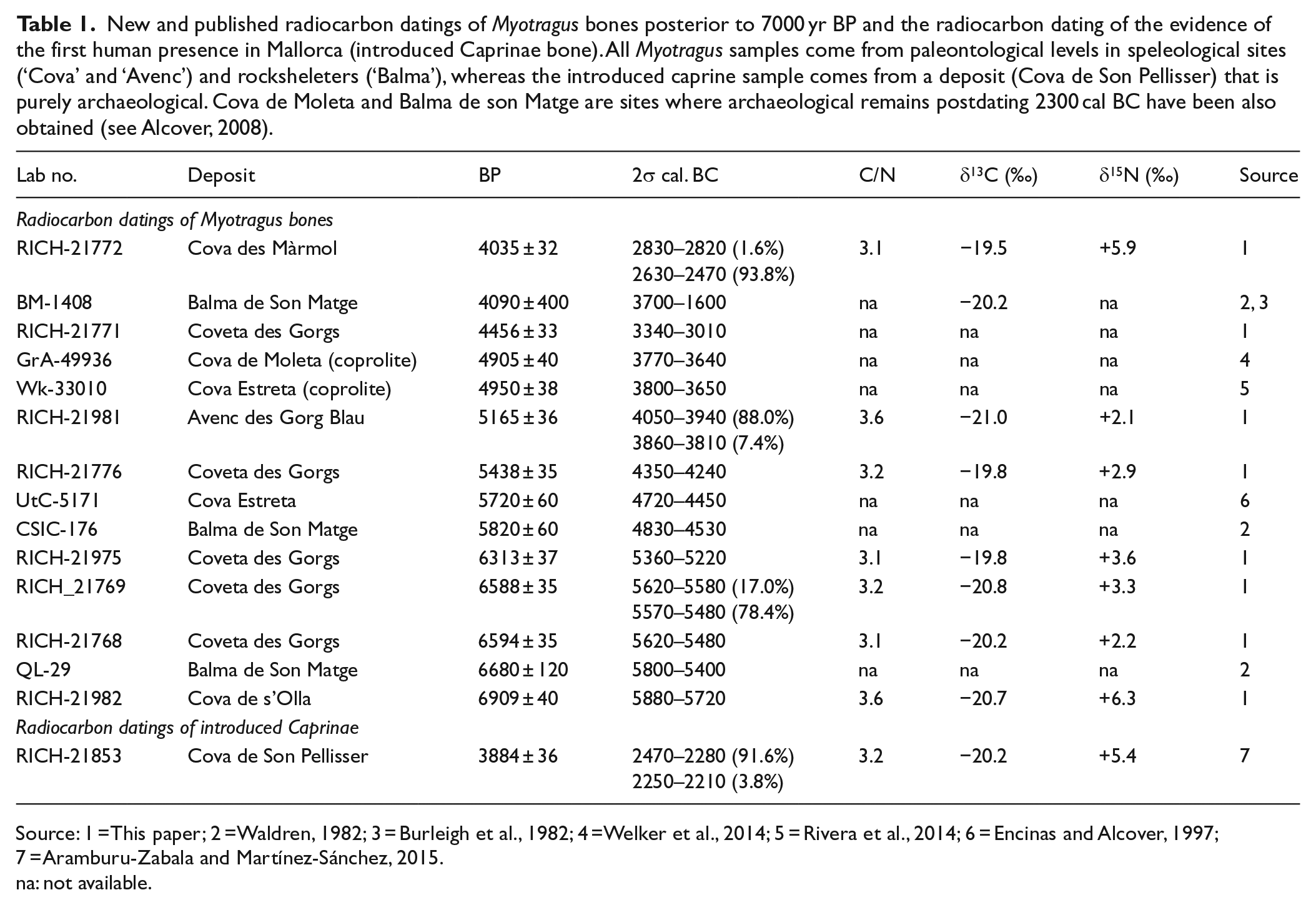
Source: 1 = This paper; 2 = Waldren, 1982; 3 = Burleigh et al., 1982; 4 = Welker et al., 2014; 5 = Rivera et al., 2014; 6 = Encinas and Alcover, 1997; 7 = Aramburu-Zabala and Martínez-Sánchez, 2015.
na: not available.
The chronological evidence of human arrival to Mallorca derived from the radiocarbon age of a bone from an introduced caprine obtained by Aramburu-Zabala and Martínez-Sánchez (2015) has been included in Table 1. This sample came from a cave that did not furnish remains of the extinct Mallorcan fossil vertebrates, an exclusive archaeological site (for more information, see http://www.arqueobalear.net/static/pdf/INFERIOR.pdf). It was submitted to the same 14C laboratory (Koninklijk Instituut voor Het Kunstpatrimonium in Brussels). All the analytical procedures were the same as previously indicated for the Myotragus samples, and no difficulties in obtaining the 14C dates were reported. The C:N ratio (3.2) is consistent with good preservation.
Some of the new dates of Myotragus bones presented in Table 1 fall close to previous dates documenting the last presence of the species in Mallorca (i.e. UtC-6517). Two of the new dates, RICH-21771 and RICH 21772, furnished values that are the most recent obtained so far. Using the value of RICH-21772 (4035 ± 32 BP, 2830–2470 cal. BC), we can establish that the survival of Myotragus in Mallorca post-dated to 2830 cal. BC with a p > 95.4%.
On the other hand, the date obtained by Aramburu-Zabala and Martínez-Sánchez (2015) on collagen from a domesticated caprine bone excavated in Cova de Son Pellisser (RICH-21853, 3884 ± 36 BP; 2470–2210 cal. BC) can be considered as the earliest evidence of human presence in Mallorca. It came from the lowermost archaeological level found at the cave and it documents human presence prior to 2210 cal. BC with a p > 95.4%. No remains of Myotragus balearicus were obtained at Cova de Son Pellisser (Aramburu-Zabala and Martínez-Sánchez, 2015), and it can be reasonably assumed that Myotragus was already extinct – or at least it was very close to the extinction – during the deposition of the human-related remains at this cave.
On the basis of these new dates, the UPME has been reduced to 620 years (i.e. between 2830 and 2210 cal. BC).
Discussion
The conservative figure of 620 years for the UPME represents a considerable improvement for the chronology of the extinction of Myotragus, reducing the previous available UPME from 1660 to 620 years (i.e. over 60%). It should be noted that this is a conservative interpretation of the obtained ages, based on the 2σ extremes of the calibrated radiocarbon dates (see Figure 1).
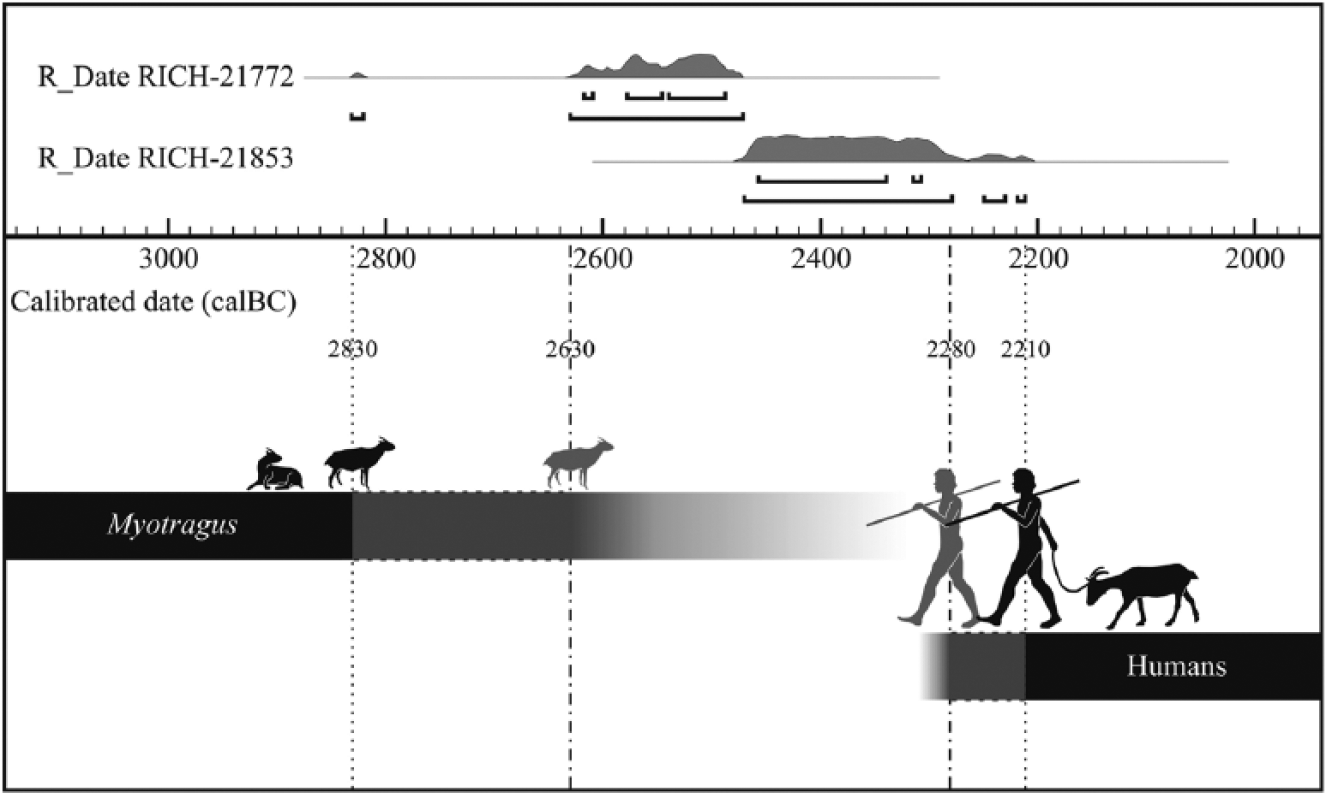
Graphical representation of the UPME limits using radiocarbon dates RICH-21772 (Myotragus bone) and RICH-21853 (introduced Caprinae bone as evidence of first human presence) in the island of Mallorca. Dotted lines represent the UPME limits at p > 95% (i.e. 630 years), whereas dash-dotted lines indicate UPME limits at p > 90% (i.e. 360 years). Calibration using OxCal v4.2.4 (Bronk Ramsey, 2009); r:5 IntCal13 atmospheric curve (Reimer et al., 2013). See text for further information.
A slightly less conservative UPME can be obtained using the RICH-21772 and RICH-21853 age probabilities (see Figure 1). The probability of human presence in Mallorca before 2280 cal. BC is >91.6, and before 2310 cal. BC is >68.2%. The probability of Myotragus presence in Mallorca after 2630 cal. BC is >93.8% and after 2580 cal. BC is >65.6%. Using 2630 cal. BC as terminus post quem for the last Myotragus presence (i.e. the Myotragus presence post-dates this age) and 2280 cal. BC as terminus ante quem for the first human presence (i.e. the human presence pre-dates this age), both supported by p > 90%, an UPME of 350 years is obtained.
These new dates allow us to reject the hypotheses that the extinction of Myotragus occurred 1000 years before the human arrival to Mallorca (Lull et al., 1999, 2008, 2013; Micó, 2005). The current gap between the last Myotragus and the first human evidence is less than 620 years and highly probably less than 350 years. This chronological gap can be considered as one of the shortest time periods documented between the first human and the last endemic megafaunal presence on any Mediterranean island. Although currently no evidence of the direct contact between humans and Myotragus has been recorded, this lack of evidence does not imply that it did not occur, and it probably reflects the short duration of their coexistence in Mallorca (Bover and Alcover, 2003). We can expect that future radiocarbon dates will further close the gap as it is unlikely that the dated material belongs to the last living specimen of Myotragus and to the first goat/sheep introduced by humans to the island. The available dates for both late Myotragus and early human presence are so close that few doubts remain about a causal relationship between human arrival and Myotragus extinction. In fact, the upper value of the 2σ interval of RICH-21772 and the lower value of the 2σ interval of RICH-21853 are the same (2470 cal. BC). The new dates definitively exclude a Myotragus extinction close to 3600 cal. BC, as suggested in several papers (Guerrero, 2000; Lull et al., 2008, 2013; for criticism, see Alcover, 2004).
Some authors (e.g. Lull et al., 1999; Micó, 2005; Welker et al., 2014; Yll et al., 2001) have suggested that the extinction of Myotragus could be related to climatic change (specifically to a drying process) affecting the Balearic Islands. These authors suggest that a climate crisis could have produced the extinction of the Balearic box (Buxus balearica) in Menorca and its decrease in Mallorca. These authors consider Myotragus as a box-eating specialist, an assumption coming from a misreading of Alcover et al. (1999) (see Alcover, 2004). Lull et al. (2008: 13, 2013: 619–620) exclude a human-related extinction of Myotragus and propose ‘[the Myotragus] extinction was caused by purely ecological factors and a thousand years before the first stable human settlements’. Similarly, Welker et al. (2014) consider that ‘the extinction of M. balearicus can be related to the decline and regional extinction of a plant species (the Balearic box) that formed a major component of its diet’, although they situated the extinction between 3000 and 2000 BC. The analysis of the content of Holocene coprolites of Myotragus from Cova des Moro (Yll et al., 2001) documents a population of Myotragus feeding on a plant assemblage that did not include the Balearic box. Consequently, the hypotheses of a box depending diet of Myotragus should be discarded. The palynological analyses of Burjachs (2006) suggest that the only putative aridification event during this period (that could have been involved in driving Myotragus to extinction) occurred on Menorca between 4770 ± 60 BP (3650–3380 cal. BC) and 4440 ± 70 BP (3340–2920 cal. BC), thus previous to 2920 cal. BC. Therefore, the new RICH-21772 date is posterior to this assumed Holocene climatic drying and it allows us to reasonably exclude a climatic cause for the Myotragus extinction.
Further evidence argues against the relevance of this putative climatic change in the Balearics. As mentioned, the event has been inferred from a vegetation change that apparently affected Menorca (Burjachs, 2006) and the nearby Mallorca. Nevertheless, it did not strongly affect the close and drier island of Eivissa, where the mesophytic vegetation persisted well into the first millennium BP (Yll et al., 2009). If the vegetation change on Menorca and Mallorca was derived from a climatic event, Eivissa should have been also affected, and this was not the case. The Balearic box currently also lives on Cabrera, a very dry island south of Mallorca (Lázaro and Traveset, 2009; Palau Ferrer, 1976). Additionally, it should be remarked that although currently the Balearic box is a relict plant in Mallorca, in 1850 there were important box forests containing very large specimens (Marès and Vigineux, 1880). Thus, the presumed extinction of Myotragus as derived from the box disappearance in Menorca and its decline in Mallorca as a result of an aridification process can be also questioned by the persistence of important box forests until the 19th century.
The information presented here brings closer the last evidence of the Myotragus presence and the first evidence of human presence on Mallorca, improving the knowledge on the timing and process of the Myotragus extinction. The new dates strongly reinforce the exclusion of a climatic deterioration as the cause for the Myotragus extinction. The footprint of humans as causing this extinction is now more evident.
Footnotes
Acknowledgements
Thanks are due to Dr Javier Aramburu (Spain) for allowing us to have access to the excavation report of the Cova de Son Pellisser deposit and to Drs Mark van Strydonck and Mathieu Boudin (Belgium) for the radiocarbon datings and advice. The paper benefited from the suggestions and comments from two anonymous referees.
Funding
This paper is included in the Research Project CGL2012-38087 (Dirección General de Investigación Científica y Técnica of the Spanish Ministerio de Economía y Competitividad). This research was supported by a Marie Curie International Outgoing Fellowship (P. Bover) within the 7th European Community Framework Programme (project MEDITADNA, PIOF-GA-2011-300854, FP7-PEOPLE).