



Abstract
The early and middle Holocene of North Africa was a time of dramatic climatic and social change, including rapid shifts in vegetation communities and the introduction of domesticated plants and animals. Recent research from the Fayum basin of Egypt, which holds archaeological evidence for early use of domesticates, aims to place inhabitants of that region within their contemporary environmental setting. We present here results of wood charcoal analysis from three early- and middle-Holocene deposits on the north shore of the Fayum and reconstruct both contemporary woodland ecology and patterns of anthropogenic wood use. In total, three woodland communities likely existed in the area, but inhabitants of this region made heavy use of only the local lakeshore woodland, emphasizing tamarisk (Tamarix sp.) for fuel. While seasonally watered wadi woodlands were not harvested for fuel, more arid locations on the landscape were, evidencing regional mobility between ecological zones. Results indicate that wood was locally abundant and that inhabitants were able to select only preferred species for fuel. This study provides further evidence for low-level food production in the Fayum that preserved critical ecosystem services, rather than dramatic niche construction to promote agriculture as seen elsewhere in middle-Holocene Southwest Asia.
Keywords
Introduction
Human exploitation of woody plants for fuel and construction material is one mechanism through which human populations interact with surrounding botanical landscapes and create environmental change. Carbonized wood from archaeological deposits provides a unique form of evidence recording human acquisition and combustion of woody plants and allows both the reconstruction of past botanical communities and the identification of human wood foraging strategies (Asouti and Austin, 2005; Marston, 2009; Smart and Hoffman, 1988; Théry-Parisot et al., 2010). In particular, studying human wood use during periods of environmental and social change offers new insights into human adaptation to climate change and environmental responses to societal transformation.
The Holocene of North Africa offers one excellent example of coincident transformations in both landscapes and social systems. Egypt, in particular, was dramatically affected by the early-Holocene African Humid Period (AHP) and subsequent mid-Holocene aridification of the Sahara (deMenocal et al., 2000; Kröpelin et al., 2008; Shanahan et al., 2015), which led to depopulation of much of the Sahara (Manning and Timpson, 2014). The apparently episodic introduction of domestic animals and plants to Africa from Southwest Asia during the early and middle Holocene (Linseele et al., 2014, 2016) enabled new subsistence economies, alongside which increases in social complexity in the Nile Valley ultimately led to the creation of the Egyptian state (Wengrow, 2006). The Fayum basin, located in the eastern Sahara and hydrologically connected with the Nile River (Figure 1), includes evidence for mobile populations of the early and middle Holocene (Caton-Thompson and Gardner, 1934; Holdaway et al., 2016; Wendorf and Schild, 1976). The investigation of archaeological wood charcoal from the Fayum represents a new opportunity to explore woodland ecology and wood acquisition strategies during the AHP and subsequent mid-Holocene aridification and to evaluate the effect of these climatic changes on lake dynamics and shoreline ecology.
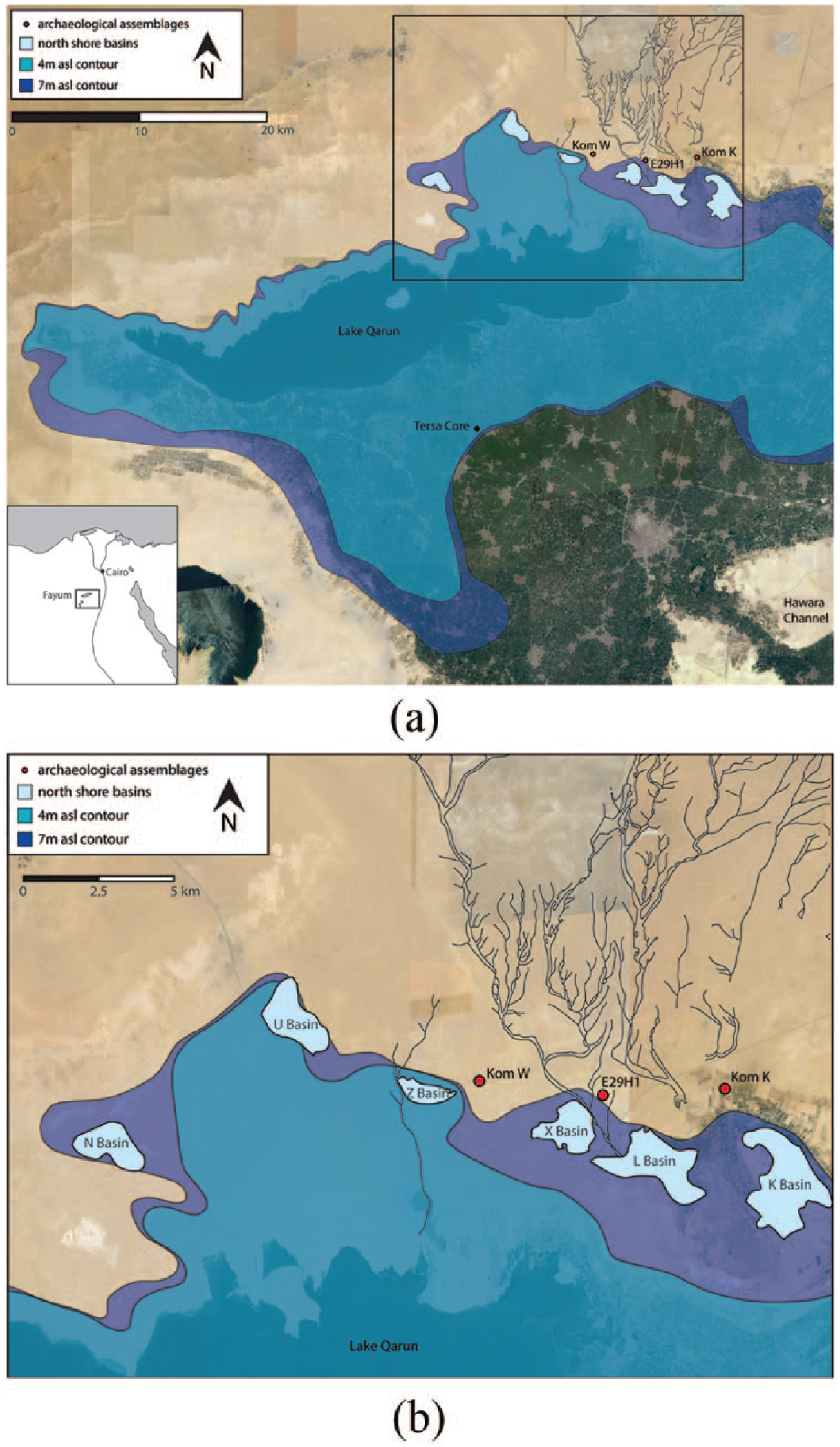
(a) Map of the Fayum basin with early- and middle-Holocene locations mentioned in text highlighted, as well as location of Tersa core. Lake contours represent hypothetical levels consistent with seasonal fluctuations in paleolake levels (after Phillipps et al., 2016: 8). (b) Close-up of north shore, with named basins labeled and wadis highlighted (after Phillipps et al., 2016: 6).
In total, three locations along the northern shore of the Fayum basin, known as Kom K, Kom W, and E29H1, were recently excavated and yielded a number of hearth features containing wood charcoal, dated between 9200 and 5700 cal. BP (Holdaway and Wendrich, 2017; Holdaway et al., 2016). In this article, we present the results of identifications of these charcoal assemblages and their implications for woodland ecology, wood acquisition strategies, human mobility, and agriculture in the Fayum across the early and middle Holocene.
Geography and ecology of the Fayum basin
Hydrology and paleoclimate
The Fayum basin is a depression of primarily Eocene and Oligocene shales, limestones, and sandstones located in the Western Desert of Egypt just beyond the Nile Valley (Said, 1990). Since the Pleistocene, a portion of Nile flows have come through the Hawara (or Bahr Yussef) Channel, creating a series of paleolakes in the lowest part of the Fayum depression (Said, 1993). The present Lake Qarun represents only a remnant footprint of the much larger extent of a reconstructed early-Holocene water body. The dating of the various lake levels is problematic (Phillipps et al., 2016), but early and middle Holocene lake stands have been estimated at 10–20 m a.s.l., much higher than present levels of 44 m b.s.l. (Caton-Thompson and Gardner, 1934; Hassan, 1986; Hassan et al., 2006; Kozlowski and Ginter, 1993; Wendorf and Schild, 1976).
The climate of the Fayum in the early and middle Holocene was dramatically different than that of the present. The AHP is a complex and regionally variable climatic event in North Africa that brought summer monsoon rainfall significantly further north than at present, ‘greening’ large areas of the Sahara (deMenocal and Tierney, 2012; Kutzbach and Liu, 1997). The magnitude and timing of the AHP in the Fayum remain the subject of debate (Shanahan et al., 2015), but one of the few robust paleoclimatic records in the eastern Sahara indicates an abrupt termination of the AHP by 5500 BP (Liu et al., 2007: 1833; Ritchie, 1994; Ritchie et al., 1985).
It has been recently argued that the northward movement of the summer monsoon during the AHP did not reach the Fayum, but instead that mid-Holocene rainfall increases were the result of increasing winter precipitation stretching south from the Mediterranean (Phillipps et al., 2012). Although it cannot be determined to what extent early- and middle-Holocene precipitation in the Fayum exceeded present levels, the presence of now-dry wadi systems along the north shore of the Fayum depression (Figure 1b) confirms significantly greater rainfall at some point earlier in the Holocene (Phillipps et al., 2012, 2016). At this time, we do not have firm evidence whether a northward shift in the summer monsoon or a southward shift in the Mediterranean winter rains was responsible for this increase in precipitation.
Limnology and paleoecology of Lake Qarun
The limnology of Lake Qarun and its paleolakes has been the subject of detailed geological study since the 19th century (e.g. Baioumy et al., 2010; Hassan, 1986; Kozlowski and Ginter, 1993; Schweinfurth, 1886). Scholars agree that multiple fluctuations in lake levels occurred during the early and middle Holocene, but datasets disagree on the precise timing and magnitude of these transitions (Kozlowski and Ginter, 1993: 332). Of particular relevance to this study, several currently dry basins along the northern shore of the lake, named Z, X, L, and K basins (Caton-Thompson and Gardner, 1934; see Figure 1b), were inundated during much of the prehistoric period. Recent reanalysis of these basins has indicated that the K, L, and X basins are much shallower and were possibly unconnected from the lake at various ancient lake stands, while Z basin would have remained connected with the greater lake at all times (Phillipps et al., 2016). Seasonal fluctuations in lake depth would have dramatically affected the extent of the lake along more gently sloping shores of these basins. It is possible to explore how different lake levels would have created variable lacustrine geographies, resulting in different ecologies for both plants and animals, along the basin shore adjacent to the archaeological deposits explored here (Koopman et al., 2016; Linseele et al., 2016; Phillipps et al., 2016).
A challenge for paleoecological reconstruction of the vegetation community of the Fayum is the small number of lake cores extending to the early Holocene, most of which have been analyzed only for sediments and diatoms (Baioumy et al., 2010; Flower et al., 2012; Foster et al., 2008), giving insight into limnology but only a limited perspective on lakeshore ecology. The exception is the recent Tersa core (Figure 1a), which records 26 m of sediment estimated to date between c. 10000 and 4000 BP but only dated by stratigraphic comparison with previously dated cores and a single optically stimulated luminescence (OSL) date of 6320 ± 515 BP at a depth of 9.2 m (Hamdan et al., 2016: 4). Despite this limitation, it is likely that the Tersa core does record much of the early and middle Holocene. The pollen data have been presented only partially, and the presence of the woody taxa Acacia, Chenopodiaceae, and Poaceae is noted, but Tamarix is not mentioned (Hamdan et al., 2016: 5–8) despite its frequency in the archaeological data presented below, a more recent core (Mehringer et al., 1979: 244), and lakeshore vegetation today. Tersa core data indicate that terrestrial mesophytic and marshland pollen were common early in the core (before c. 8500 BP), with grasses and Acacia declining prior to 6320 ± 515 BP, after which marshland pollen and terrestrial mesophytic pollen declined, resulting in a semi-arid desert landscape by the end of the core c. 4000 BP (Hamdan et al., 2016).
Woodland ecology of the Fayum
In the contemporary Fayum, native woody taxa are generally restricted to canal banks, the lakeshore, and the desert. The shores of Lake Qarun today are dominated by tamarisk (Tamarix nilotica), reeds (Phragmites australis), and the salt-tolerant herb Sarcocornia (Figure 2). Both tamarisk and reeds are found along (and within) canal banks as well. The hyperarid sandy and stony deserts north of Lake Qarun contain only the chenopodiaceous woody shrub Haloxylon salicornicum (Figure 3). A pollen core from Lake Qarun spanning the modern period (c. AD 1650–1976) indicates that Chenopodiaceae/Amaranthaceae and tamarisk are the primary terrestrial taxa contributing to the pollen assemblage of Lake Qarun, accounting for 60–85% of the total pollen count, with introduced fruit and shade trees comprising the remaining woody taxa (Mehringer et al., 1979: 244). Tamarisk (Tamarix nilotica) is the dominant native tree in the Fayum today (Figure 4) and grows densely along watercourses, including canal banks and the shores of Lake Qarun, and in disturbed habitats.
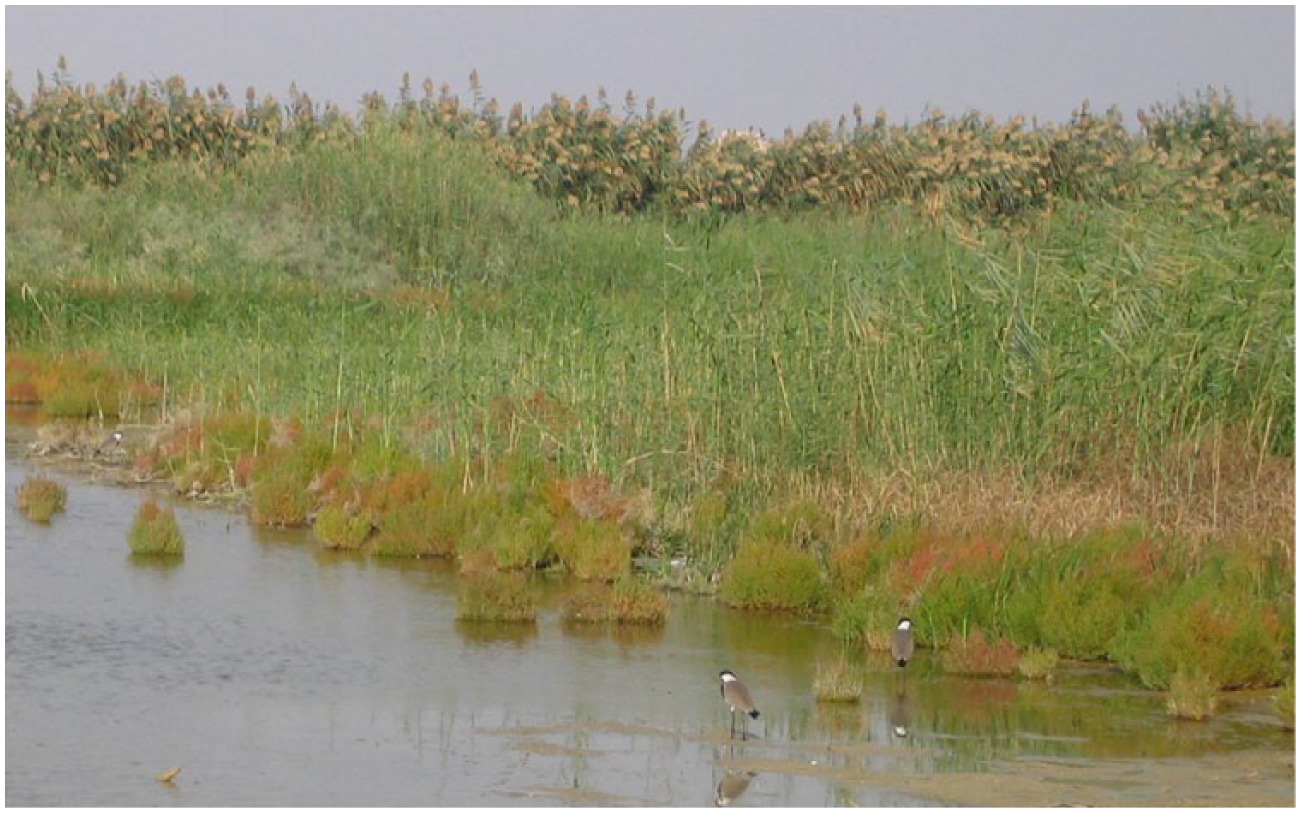
Present vegetation community on south lakeshore of Lake Qarun, with Sarcocornia spp. in foreground, Phragmites australis and Tamarix nilotica in midground, and Phragmites australis in background.

Haloxylon salicornicum in hyperarid desert near E29H1.
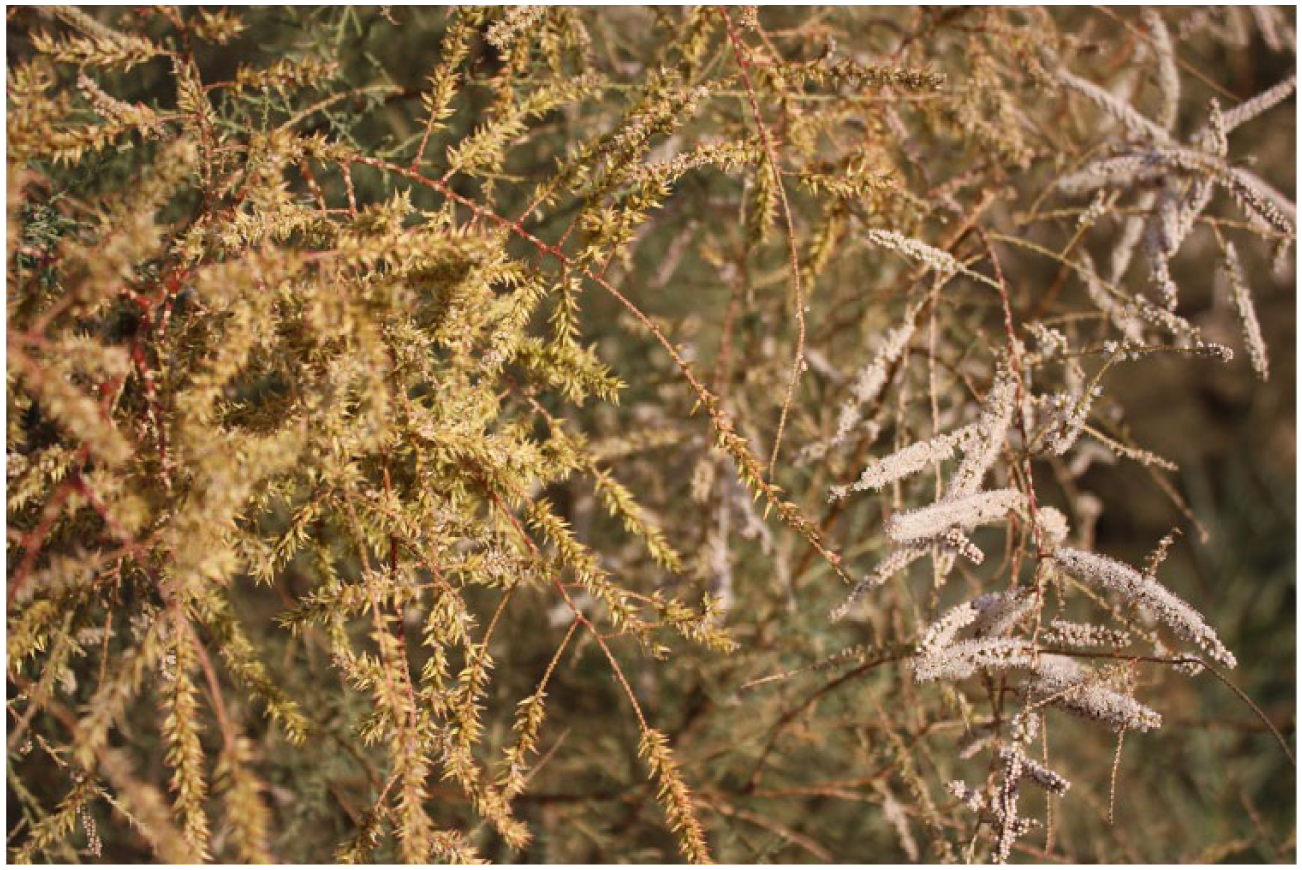
Tamarix nilotica in flower.
The degree to which the woodland ecology of the Fayum today reflects that of the early and middle Holocene remains an open question. The presence of considerable sedge (Cyperaceae), cattail (Typhaceae), and grass (Poaceae) pollen in the Tersa core suggests that marshlands were considerable in size (Hamdan et al., 2016). Given the strong likelihood of higher rainfall in the early Holocene, an increased density and diversity of woody taxa in the Fayum is likely. Acacia is especially likely to have been more common, as it is in wood charcoal assemblages in areas of northwestern Egypt that are today hyperarid and devoid of woody plants (Cottini and Castelletti, 2014; Neumann, 1989a: 103; Zahran and Willis, 2009).
Other native woody species that today thrive on canal banks in the Nile Valley may also have been present within the early- and middle-Holocene Fayum. These include woody taxa identified in archaeological charcoal assemblages from Predynastic contexts in the Nile Valley, such as willow (Salix), castor (Ricinus communis), Christ’s thorn (Ziziphus spina-christi), Salvadora persica, Suaeda, Capparis, and Faidherbia albida (Newton, 2005; Newton and Midant-Reynes, 2007). Of these, the families Capparaceae (Capparis), Chenopodiaceae (Suaeda), Euphorbiaceae (Ricinus), Fabaceae (Faidherbia), and Salicaceae (Salix) pollen were identified in the Tersa core, while Rhamnaceae (Ziziphus) is not mentioned (Hamdan et al., 2016). Thus, available paleoecological data indicate the potential presence of Nile vegetation types in the early- and middle-Holocene Fayum. The likely diversity of woody plant resources available to early inhabitants of the Fayum contrasts strongly with the limited range of wood charcoal taxa identified in the archaeological deposits described below.
Early- and middle-Holocene occupation of the Fayum
The north shore of modern Lake Qarun is a continuous cultural landscape dating from the early Holocene to the middle Holocene (Caton-Thompson and Gardner, 1934; Holdaway and Wendrich, 2017; Wendorf and Schild, 1976). Traditionally divided between the early-Holocene ‘Epipaleolithic’ or ‘Terminal Paleolithic’ (c. 9200–9000 cal. BP) and the middle-Holocene ‘Neolithic’ (c. 6500–6000 cal. BP), recent redating with accelerator mass spectrometry (AMS) radiocarbon methods on a broader range of samples from additional archaeological contexts has resulted in a more continuous distribution of archaeological material from c. 9500 to c. 6000 cal. BP (Holdaway et al., 2016) and new terminology to describe the chronology of human settlement in the Fayum (Holdaway et al., 2016; Linseele et al., 2016).
Prehistoric human activity in the Fayum differs considerably from contemporary sites elsewhere in Southwest Asia. There is no evidence for sedentary settlement; most archaeological deposits consist entirely of lithics, ceramics, and hearths, with animal bones and ostrich eggshell scattered across deflated surfaces (Caton-Thompson and Gardner, 1934; Holdaway and Wendrich, 2017; Wendorf and Schild, 1976). Limited numbers of pottery sherds and grinding stones accompany numerous flaked stone artifacts, all made from imported flint cobbles, while a number of basket-lined pits formed grain storage areas (Caton-Thompson and Gardner, 1934; Holdaway et al., 2016; Wendrich and Cappers, 2005). Diet consisted of large numbers of fish, limited numbers of domestic caprids (and, in the middle Holocene, cattle and pigs), and likely a variety of wild plant resources, in addition to cereal (emmer wheat (Triticum dicoccum) and six-row barley (Hordeum vulgare)) cultivation in the middle Holocene (Cappers, 2013; Caton-Thompson and Gardner, 1934; Holdaway et al., 2016; Linseele et al., 2014, 2016; Wendrich and Cappers, 2005).
Archaeological locations investigated
The stratified, mounded sites of Kom K and Kom W (Figure 1b) were excavated by Gertrude Caton-Thompson in the 1920s (Caton-Thompson and Gardner, 1934). The URU Fayum Project reinvestigated these two locations in 2006–2010. At Kom K, test excavations and magnetometry in 2006 uncovered the presence of additional surviving remains, although the area had been under cultivation for 50 years. At Kom W, test excavations in 2006 identified the presence of stratified archaeological deposits surviving in the baulks left by Caton-Thompson, which were targeted in subsequent seasons. Kom K was excavated in 2006 and 2007; Kom W in 2006, 2008, 2009, and 2010. The data presented here combine results of these five field seasons. Wood charcoal was recovered from all identified features and from systematic sieving. Radiocarbon dates from these locations indicate solely middle-Holocene occupation, c. 6570–6300 cal. BP for Kom K and 6560–6405 cal. BP for Kom W (Wendrich et al., 2010).
E29H1 was identified by Wendorf and Schild (1976: 182–199), who placed a series of short trenches across the location. The URU Fayum Project conducted intensive survey and emergency salvage excavations at E29H1 in 2009 in advance of destructive plowing of the area (Holdaway and Wendrich, 2017). The area includes a number of shallowly buried hearths and a continuous surface scatter of lithics and bones (Koopman et al., 2016; Linseele et al., 2016). All charcoal encountered during excavation was recovered, and hearth features were sampled for carbonized plant remains, several of which included abundant and well-preserved wood charcoal. Recent radiocarbon dates from multiple hearths give early-Holocene dates of 9315–8035 cal. BP, although dates from only one unit postdate 8900 cal. BP (Koopman et al., 2016).
Methods
Sample collection
A full coverage (or blanket) strategy for charcoal sampling was employed during excavation with the aim of recovering all charcoal present (d’Alpoim Guedes and Spengler, 2014). Samples include a combination of hand-picked charcoal samples (i.e. large fragments identified as charcoal during excavation) and charcoal fragments recovered from systematic screening of cultural deposits. All excavated deposits were screened through 2-mm mesh, and any carbon recovered was taken as a sample.
Laboratory processing and identification
In the field laboratory, charcoal fragments were weighed in aggregate on an electronic balance with 0.01 g precision, although during one season of analysis, a portable balance with 0.1 g precision had to be used instead, and Kom K samples from 2007 were so accreted with sand that total sample weights were meaningless and not recorded. Due to the minute size (barely >2 mm) of the vast majority of fragments, it was not possible to follow standard practice to break a fresh transverse, radial, and tangential section of every fragment. Indeed, many fragments could not be broken without crumbling, resulting in a high frequency of unidentifiable charcoal pieces, although many did allow examination of the transverse section due to prior breakage during excavation. When fragments were sufficiently large and rings were evident, original wood diameter was estimated based on ring curvature, although as there is considerable error associated with this approach due to the small fragment size, the results were only recorded as general impressions rather than as a quantitative dataset.
When fragment size and condition permitted, each piece of charcoal was broken to reveal a fresh transverse section for identification and each wood fragment present was examined at 7–45× under a stereomicroscope to note characteristics of the transverse section. At least 10 fragments of charcoal were observed for each sample, if that number was present, with a preference for larger, more intact, and more identifiable fragments given the poor quality of the charcoal. Among samples with more than 10 fragments (mainly from E29H1), a greater number of fragments were analyzed, with the general goal of identifying all fragments if practicable, given the limitations of the field laboratory and time pressures during the rescue excavation of E29H1. Samples that were monotypic and appeared to reflect the breakage of a single larger charcoal fragment were sampled less intensively, though we acknowledge that rare taxa may have been missed due to this subsampling method. A flexible number of specimens per sample were used to account for differences in diversity and sample size between samples. Although only 54% of the total charcoal assemblage for Kom W and 21% for E29H1, by weight, was examined (Table 1), these results are more representative on a sample-by-sample basis as a greater number of fragments were identified when more fragments were present in a sample, following the logic of saturation curves (Asouti and Austin, 2005: 6–7; Chabal et al., 1999: 67; Delhon, 2006; Lepofsky and Lertzman, 2005; Marston, 2017; Scheel-Ybert, 2002; Scheel-Ybert and Dias, 2007; Smart and Hoffman, 1988: 176). For each sample, both the count and weight of each charcoal taxon present in the sample were recorded.
Summary data on charcoal examined and radiocarbon date range, by location.

This is the weight of examined fragments divided by total sample weight. As total sample weight for Kom K samples excavated in 2007 was not recorded, the total proportion of charcoal examined cannot be calculated (nc).
These measurements include accreted sand weight, so overestimate true charcoal weight.
Full range of 2σ radiocarbon dates from Koopman et al. (2016: 21; E29H1) and Wendrich et al. (2010: 1001; Kom K and Kom W).
Identification of charcoal remains was primarily accomplished by the use of the stereomicroscope, but a modified transmission microscope using an incident light source and capable of magnification up to 400× was used for examination of the tangential and radial sections for the identification of well-preserved fragments of sufficient size. Fragments were identified by comparison with a local comparative collection carbonized experimentally, four published wood atlases (Fahn et al., 1986; Neumann, 1989b; Neumann et al., 2001; Schweingruber, 1990), and two wood anatomy websites (InsideWood, 2004; Schoch et al., 2004; Wheeler, 2011). Taxonomic names were assigned following the Flora of Egypt (Boulos, 1999–2005), rather than using the more recent Angiosperm Phylogeny Group (1998) taxonomic designations. Given the limitations of laboratory work on site, microscopic photography was not available. The anatomical characteristics used to identify each taxon are described in detail in Supplemental Material 1 (available online).
Results
Kom K and Kom W
Overall, the quality of the charcoal from these locations is poor, especially at Kom K; the pieces are small, soft, fragile, and apparently chemically degraded, perhaps by the same processes that gave rise to the hard, concreted sands of the Koms. Fragments from Kom W are better preserved but are still small and friable. The combination of small size, friability, and degraded cell structure (in some cases) makes identification difficult, and many samples that may have been discrete pieces of charcoal during excavation were returned to the laboratory as merely a fine black powder. It appears that taphonomic processes likely played a major role in the degradation and fragmentation of charcoal at both locations, but especially Kom K, leading to a greater proportion of that charcoal being unidentifiable: by weight, 40% was unidentifiable at Kom K versus 28% for Kom W, although this proportion was more similar by count (25% unidentifiable at Kom K and 24% at Kom W). Kom K has been under cultivation for roughly 50 years, and irrigation associated with contemporary desert agriculture is likely to have led to some of this destruction. It should be noted, however, that Kom W (which remains in uncultivated desert) has similarly concreted and amorphous charcoal remains, while the earlier assemblage of E29H1 does not, indicating that other aspects of assemblage formation and taphonomy have had a greater influence on charcoal preservation and condition.
The total mass of charcoal excavated (Table 1) is an overestimate as it includes accreted sand, especially from the Kom K 2007 and Kom W 2008 seasons. Nevertheless, the total charcoal weight from each location is minute compared to the extent of burning evident at Kom K and Kom W, which have many hearth features, and the amount of sediment excavated at both locations. Sample-by-sample results from these locations are provided in Supplemental Material 2 (available online).
At both locations, the predominant taxon is tamarisk (Tamarix sp.); at Kom W, also present are Acacia nilotica and one or more woods of the Chenopodiaceae family, the best preserved fragments of which from Kom W are consistent with the wood anatomy of Haloxylon salicornicum but are grouped with other Chenopodiaceae in the summary data presented here (Table 2). Tamarisk is present in more than 70% of all charcoal samples and the only wood type identified at Kom K, save one fragment of A. nilotica, although due to the significant number of unidentifiable fragments it is not possible to rule out the rare presence of other taxa, especially if they are less durable than tamarisk. In total, 15% of identified wood fragments from Kom W were chenopodiaceous. As noted by Neumann (1989b: 66–69; Neumann et al., 2001: 207), there is no suitably comprehensive wood identification guide for the Chenopodiaceae of the Sahara, and wood anatomy is variable within the family, rendering identification within this family uncertain. In total, 11 well-preserved fragments excavated from Kom W in 2009 are consistent with the observed wood morphology of Haloxylon salicornicum (now reclassified as Hammada salicornica (Moq.) Iljin, also equated with Hammada elegans by Zahran and Willis, 2009). In the full dataset presented as Supplemental Material 2 (available online), we term these ‘Haloxylon salicornicum-type’. See Supplemental Material 1 (available online) for additional detail on the identification of this taxon. Finally, a single fragment of acacia wood was identified at both Kom K and Kom W; the presence of vasicentric paratracheal parenchyma and thin rays is diagnostic of the species A. nilotica (Neumann et al., 2001: 286–287).
Ubiquity, count, and weight of examined charcoal fragments, by taxon and by location. Weights in grams. Ubiquity is calculated out of the total number of samples containing charcoal >2 mm.
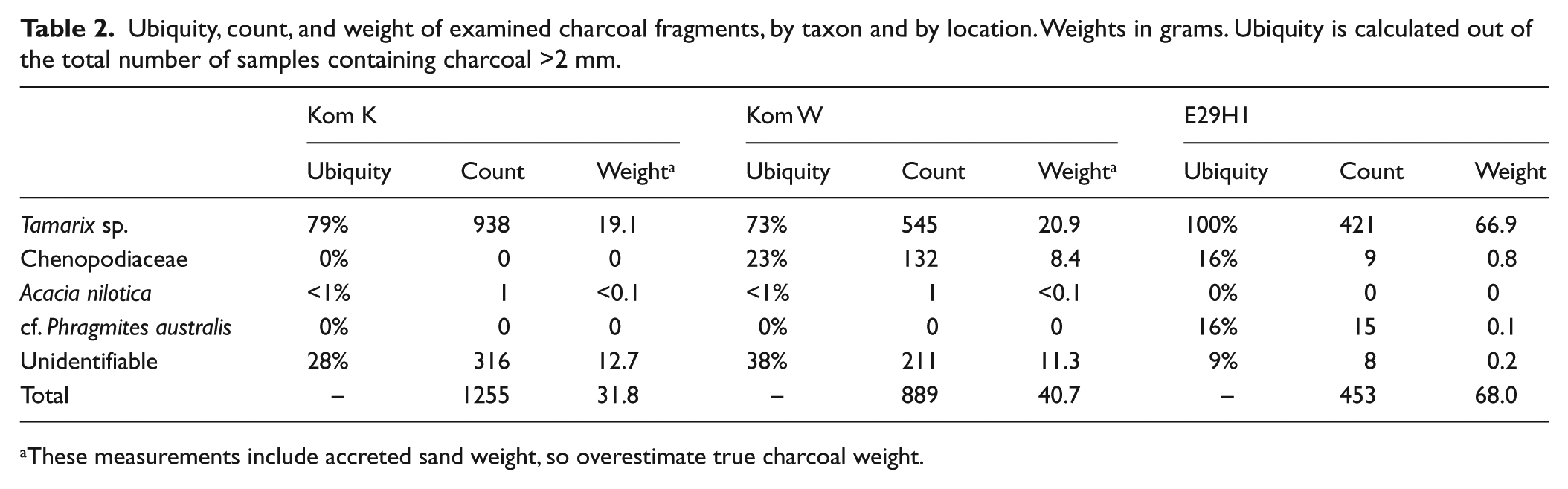
These measurements include accreted sand weight, so overestimate true charcoal weight.
E29H1
E29H1 excavations produced 32 samples that contained at least one fragment of wood charcoal >2 mm, with a total weight of 319.4 g (Table 1). The quality of the charcoal was good, much better than the more recent charcoal from Kom K and Kom W identified above. Notably, much less of the charcoal could not be identified: less than 1% by weight and 2% by count. Some hearth samples also produced large quantities of charcoal far surpassing those at Kom K and Kom W, with four samples weighing more than 10 g and one more than 150 g. These five samples alone account for more than 88% of the total charcoal by weight from E29H1, and each contained only a single taxon: tamarisk. Sample-by-sample results from E29H1 are provided in Supplemental Material 2 (available online).
Tamarisk was identified in every charcoal sample from E29H1. Two other taxa were also identified at E29H1 in 16% of samples: Chenopodiaceae and a monocotyledon wood with a hollow stem approximately 1 cm in diameter consistent with the size and anatomy of Phragmites australis. Total sample weights are biased toward tamarisk (Table 2) because it is the sole taxon in the large samples, as well as generally more common throughout. It appears that tamarisk was the most common fuel wood at E29H1 as in the later Kom assemblages.
One difference in these tamarisk fragments, however, is fragment size and original wood diameter. Unlike the minute fragments recovered from Kom K and Kom W, large pieces of charcoal were found at E29H1, particularly in one large hearth that contained 155.4 g of charcoal. Although wood diameter was not recorded systematically, due to the minute size of most fragments, some pieces from E29H1 were from large branches or even trunks of smaller trees, with diameters approaching 3 cm. In contrast, many of the Kom W tamarisk fragments clearly came from small-diameter twigs and branchlets.
Discussion
Reconstructing woodland ecology and wood use in the early- and middle-Holocene Fayum
One common approach for modeling the gathering of wood for fuel is the Principle of Least Effort, which argues that wood is gathered in direct proportion to its frequency in the landscape, resulting in fuel charcoal assemblages representative of the ecological frequency of taxa at the time of harvesting (Shackleton and Prins, 1992). This model, however, only applies under constraints on the availability of the most preferred wood types: if dry, deadwood is plentiful then selection of only preferred types is expected (Shackleton and Prins, 1992). This assumption is in keeping with the literature on prey selection in behavioral ecology, which generally predicts a focus on the most preferred prey type when encountered (Marston, 2009; Stephens and Krebs, 1986). Thus, an archaeological assemblage that contains only (or predominantly) one wood taxon can be interpreted from the above logic either as reflecting use of a preferred type in conditions of abundance, or as a landscape with one dominant woody taxon that constrains forager choice, although these options are not mutually exclusive. We explore these scenarios below.
Tamarisk was the primary wood fuel during the early and middle Holocene in the Fayum, with other woody taxa comprising only a small portion of the wood used. The question then becomes whether tamarisk was preferentially selected as a high-value wood or whether it was selected because it was the predominant wood type available, following the Principle of Least Effort. It is likely to have been common during the early and middle Holocene, as it is both a common contributor to archaeological charcoal assemblages of this period throughout the Western Desert (Neumann, 1989a) and a remarkably versatile woody plant capable of rapid growth in wet and dry conditions (Boulos, 2000). Some species, such as Tamarix nilotica, grow spontaneously and densely along watercourses, as is the case today (Figure 2). Tamarisk also has several advantages as a wood source. Tamarisk regrows rapidly, so it can be harvested sustainably over long periods of time, and burns well (Marston, 2009: 2195; Newton, 2005: 363; Zahran and Willis, 2009: 115). The combination of density, accessibility, growth rate, and fuel value suggests why tamarisk was the primary fuel source at all three locations over a span of 3000 years. Tamarisk is additionally the most common wood type among many prehistoric and Predynastic charcoal assemblages from archaeological assemblages in Egypt, including the Western (Barakat, 1996; Briois et al., 2012; Cottini and Castelletti, 2014; Neumann, 1989a, 1989b; Tomczynska, 1989) and Eastern Deserts (Marinova et al., 2008; Vermeersch et al., 2015), as well as the Predynastic Nile Valley (Newton, 2005; Newton and Midant-Reynes, 2007). It continued to be a common fuel wood in the Fayum through the Roman era (Marston, unpublished data).
Since tamarisk was likely both locally abundant and highly valued for fuel, in order to distinguish the circumstances of its collection, it is necessary to assess the frequency of other woody plants to assess whether tamarisk was collected preferentially from among a more diverse woodland community. Acacia is the most relevant of these. The two fragments of A. nilotica charcoal represent a species with a broad range of environmental tolerances. While many acacias are desert adapted (Neumann, 1989b; Zahran and Willis, 2009), A. nilotica is found along watercourses (Boulos, 1999), although it is also a component of desert shrubland communities around oases (Zahran and Willis, 2009: 87). The tree is common in the Fayum as a widely planted shade tree. It may have formed part of the natural lakeshore vegetation in the middle Holocene prior to the recent salinization of the lake (Abu-Zied et al., 2011; Fathi and Flower, 2005; Flower et al., 2006; Keatings et al., 2010). Acacia wood, including A. nilotica, is common in archaeological charcoal assemblages of the early- and middle-Holocene Western Desert and Nile Valley (Barakat, 1996; Cottini and Castelletti, 2014; Gatto et al., 2009; Neumann, 1989a, 1989b; Newton, 2005; Newton and Midant-Reynes, 2007). Acacia pollen is said to have been identified in the Tersa core (Hamdan et al., 2016: 5) and acacia wood, including a significant percentage definitively identified as A. nilotica, is common in Roman period charcoal assemblages of the Fayum (Marston, unpublished data). Acacia was clearly present in the Fayum during the early and middle Holocene, but it was rarely utilized for fuel. It is possible that acacias were deliberately avoided for cutting due to the value of its fruit for fodder as well as medicinal purposes (Zahran and Willis, 2009: 361; cf. shea nut trees in west Africa, Gallagher, 2014: 30), but a more likely explanation is that tamarisk was both more accessible and preferred for fuel.
The tamarisk and acacia wood may have come from two different ecological communities: riparian communities along lakes and watercourses, or arid scrublands. Both tamarisks and acacias (including A. nilotica) are found in dry zones fed by groundwater and channeled rainfall, such as the desert zones surrounding oasis depressions in the Western Desert (Zahran and Willis, 2009: 86–87) and wadis (Zahran and Willis, 2009: 96), including relict wadis to the north of the site (Figure 1b). However, a number of other woody taxa would have been present in these areas and are found archaeologically in other areas of the Western Desert (Neumann, 1989b), but are completely absent from the Fayum charcoal assemblages. Given the lack of other distinct shrubland or wadi taxa, and the frequency with which both tamarisk and A. nilotica grow in riparian and lakeshore habitats, the most likely source of the tamarisk and acacia wood found in the Fayum assemblages is the periphery of the lake located close to the archaeological deposits.
Such an interpretation is further supported by the presence of reed fragments at E29H1, which indicate that at least some shallow, marshy wetlands existed in the region, as Phragmites australis grows only in saturated soils (Boulos, 2005). The shallow sloping eastern basins of the north shore (K, L, and X basins) would be the most likely locations of reed thickets given (at least seasonal) paleolake levels of approximately 7 m a.s.l. (Phillipps et al., 2016: 7–8; Figure 1b). The charcoal data suggest that such plant communities existed during the early Holocene coincident with the occupation of E29H1, as reed fragments are relatively abundant at that site (16% ubiquity) while absent at Kom K and Kom W. As E29H1 is the assemblage closest to X basin, the most shallowly sloping of the lake basins (Phillipps et al., 2016: 7), it seems likely that X basin contained a reed marsh environment during the early Holocene. In contrast, during the middle Holocene when Kom K and Kom W were inhabited, no reeds are present in the archaeological charcoal assemblage, suggesting that reed thickets may not have been a common plant community at that time; perhaps, lake levels were low enough (4 m a.s.l. or below) that K and L basins were disconnected from the paleolake and dry, while the margin of Z basin, close to Kom W, was too steep to support a meaningful zone of marshy vegetation.
Additional lines of evidence supporting the presence of reed marshes in the greater Fayum during the middle Holocene come from paleoenvironmental data and analog vegetation communities in modern Egypt. Grass pollen is a significant contributor to the total pollen assemblage in the Tersa core (Hamdan et al., 2016: 7), a category that includes Phragmites, the pollen of which cannot be reliably distinguished from that of other grasses (Hall, 1991). Reed marshes may have been limited in extent given the paucity of fish remains characteristic of vegetated marshes (Polypterus, cf. Linseele et al., 2014: 11, 2016: 6–7) and reed charcoal, but reeds are less likely to survive in an archaeological context than wood due to their hollow center and thin diameter, rendering an assessment of their original extent uncertain but suggesting it may have been wider than its limited contribution to the charcoal assemblage. Furthermore, a riparian plant community that includes reeds, tamarisk, and A. nilotica is common in Egypt today, especially in the Nile Valley (Zahran and Willis, 2009: 293–294); we can infer its presence in the Fayum as well given the co-occurrence of acacia and tamarisk in the charcoal assemblage of the Fayum assemblages.
Wood charcoal, paleoenvironmental records, and ecological analogy suggest that the inhabitants of E29H1, Kom K, and Kom W lived among a diverse riparian community of woody plants but preferentially selected tamarisk wood for fuel, due to its relative abundance and its suitability as a sustainable and highly ranked fuel source. The use of marsh reeds also represents the use of a basin- or lakeshore ecological zone. The lack of wadi and shrubland taxa suggests that these areas were not frequented for fuel collection. The putative presence of Haloxylon salicornicum, potentially among other chenopodiaceous shrubs, however, provides the best indication that the inhabitants of Kom W and E29H1 accessed wood from an ecological zone away from the well-watered shores. Haloxylon grows today throughout the Western Desert, including hyperarid regions of the Fayum basin, and is often the only plant visible in the desert landscape (Figure 3). The distribution of Haloxylon in the wetter landscape of the early and middle Holocene is uncertain, but it is a xerophyte, as are many other chenopodiaceous shrubs, so it would only have been obtainable in drier areas within the Fayum region (Zahran and Willis, 2009). It is an inviting source of fuel in the desert, despite being low and prickly, as large parts of the plant are dead, and this dry wood burns well. Haloxylon would have provided a valuable fuel resource in arid landscapes. The presence of Haloxylon, or another chenopodiaceous shrub, at Kom W and E29H1 suggests that the residents of these areas visited arid regions regularly enough to bring back this wood and occasionally burn it closer to the lake basins.
Haloxylon is a primary component of archaeological charcoal assemblages in Central Asia, for example, Anau (Miller, 2003), but has not been previously identified archaeologically in Egypt; however, unidentified chenopodiaceous wood is present in early-Holocene assemblages from the northwestern Western Desert of Egypt (Cottini and Castelletti, 2014; Neumann, 1989a: 103), and the reconstructed mid-Holocene climate of this area is analogous to that of parts of Saudi Arabia where Haloxylon forms a component of the present vegetation (Neumann, 1989b: 110). Notably, chenopodiaceous charcoal is uncommon at later Predynastic sites in the Nile Valley, while tamarisk, acacia (including A. nilotica), and other hydrophilic taxa are numerous, suggesting that although desert wood sources were not a primary fuel source, they were consistently utilized on a low level as fuel in the Nile Valley by 5500 BP (Newton, 2005; Newton and Midant-Reynes, 2007: 103). In the later, and certainly drier, Roman period, both tamarisk and acacia (including A. nilotica among other species) are common in the charcoal assemblage of Karanis in the northeastern Fayum, while only three fragments of chenopodiaceous wood have been found among >6500 examined fragments, none of the Haloxylon type (Marston, unpublished data). This shift in fuel use likely reflects different wood procurement priorities and strategies in an urban Roman setting, as late-Holocene drying of the Fayum certainly expanded the habitat of chenopodiaceous shrubs in the basin.
To summarize, three woodland communities appear to have been available to residents of the early- and middle-Holocene Fayum: riparian trees and marshland along basin- and lakeshores, shrublands away from the lake and along the northern wadis, and an arid plant community of chenopodiaceous shrubs likely somewhat further from the lake, perhaps near the escarpment north of the lake where coarse indurated sandstone occurs that has been identified as the source of grinding stones found in Fayum archaeological assemblages (Holdaway and Wendrich, 2017). The immediate riparian community was most heavily accessed with tamarisk the preferred wood type, but reeds and acacia were also burned on occasion. There is no definitive evidence for fuel collection within the shrublands or wadis, although some tamarisk may have come from these zones. Surprisingly, however, chenopodiaceous wood from arid landscapes was brought nearer to the lake and burned during both the early and middle Holocene. The use of this ecological zone provides a direct indicator of human mobility in the archaeological charcoal record of the Fayum.
Implications for mobility
Recent analysis of large numbers of lithic artifacts from the early- and middle-Holocene Fayum has used new methods to identify mobility in the archaeological record (Holdaway et al., 2010; Phillipps and Holdaway, 2016). By measuring the surface area and volume of lithic artifacts, as well as the frequency of cores and flakes, it is possible to determine whether the original volume and surface of a reduced cobble remains within an area and whether artifacts were either exported or imported into that area. As a result, mobility of people can be assessed using the mobility of lithic artifacts as a proxy (Dibble et al., 2005; Douglass et al., 2008; Phillipps and Holdaway, 2016). The analysis of lithic artifacts from the Fayum indicates that cores were removed from Kom K and Kom W, while cores were left at E29H1, but flakes were removed instead (Phillipps and Holdaway, 2016: 16). As flakes are immediately useful and lighter weight, their absence at E29H1 indicates increased mobility during the early Holocene in comparison with the middle Holocene. Decreasing mobility, or at least mobility of a different form, in the middle Holocene may be related to changing subsistence strategies, as the (albeit limited) introduction of cereal agriculture and pigs could have led to increased residence times at the Kom sites (Holdaway and Wendrich, 2017; Holdaway et al., 2010; Linseele et al., 2014; Phillipps and Holdaway, 2016).
Charcoal data inform questions of mobility in two ways: first, the use of woody taxa from different ecological zones provides direct evidence for movement between those zones, and second, changes in wood harvesting patterns over time may indicate different pressures on woodland resources as a result of shifting population densities, over both space and time. The presence of both riparian wood taxa indicative of local wood use (tamarisk and reeds) and more distant arid taxa (Chenopodiaceae) provides direct evidence for movement between these ecological zones and the occasional transport of wood from dry areas to both E29H1 and Kom W. Notably, the use of arid wood taxa is substantially more common at Kom W than at E29H1, and entirely absent from Kom K. Although taphonomic differences between these assemblages make any comparisons necessarily tentative, we suggest that the regular patterns of mobility practiced by users of Kom W and E29H1 may have more frequently included dry areas than those of Kom K, perhaps related to differences in availability of local wood resources given distinct local basin- and lakeshore topographies (Phillipps et al., 2016). This matches partially the lithic analysis that indicates greater mobility at E29H1, while providing an additional perspective on mobility differences between Kom W and Kom K.
Any changes in wood harvesting pressure over time, such as the use of progressively smaller and younger trees suggestive of a pattern of resource depression (e.g. Broughton et al., 2010; Gremillion, 2014; Zeder, 2012), may indicate relative differences in the size of regional populations, and thus mobility patterns, between the early and middle Holocene. In other areas of Southwest Asia, increasing sedentism has been linked to increased wood collection and pressure on local woodland communities (Asouti and Kabukcu, 2014; Asouti et al., 2015; Miller, 2013), although in some cases, it has not (Kimiaie and McCorriston, 2014). Small branches can be easily broken off from tamarisk trees when dry, while harvesting large branches takes more effort and is often argued to reflect increased human pressure on local wood resources (Dufraisse, 2008, 2012; Out et al., 2013). Increased pressure on woodland resources does typically result in the harvesting of larger diameter wood as trees are deliberately cut for wood. Ethnographic studies have demonstrated that when trees are cleared, large-diameter wood pieces are preferred fuel (Picornell Gelabert et al., 2011). The condition of wood, however, is also critical to its value, with well-dried pieces preferred for most uses (Henry and Théry-Parisot, 2014; Théry-Parisot and Henry, 2012).
We see incidental evidence for the use of some large-diameter wood at E29H1, while reconstructed wood diameters are small at Kom K and Kom W, although diameter was not systematically recorded as it could not be identified for most fragments due to their small size and poor condition. It is possible that residence at E29H1 took place over a longer continuous duration or that a greater number of people used the area, resulting in the need to invest more effort in wood harvesting. These data are suggestive of differences in mobility and seasonal residence between the early- and middle-Holocene populations of the Fayum but do not provide definitive evidence and need to be considered in concert with other markers of seasonality and mobility.
Implications for agriculture
Agriculture during the middle Holocene in Egypt includes cereal macroremains that represent one of the earliest finds in Africa, dated securely to 6500–6000 cal. BP by AMS dates on basket linings from the grain storage K pits adjacent to Kom K (Wendrich et al., 2017: Figure 5.47). The cereals identified in the K pits, emmer wheat (Triticum dicoccum) and six-row barley (Hordeum vulgare), are dry adapted and capable of being grown with limited rainfall, although it is unclear whether precipitation sufficient for rainfall agriculture would have been present in the Fayum even during the early and middle Holocene (Hassan, 1986: 494; Phillipps et al., 2012; Wendrich et al., 2017). As a result, it has been suggested that agriculture in the Fayum took place either at the lakeshore following seasonal recession of the Nile-flood-fed high lake stand (Caton-Thompson and Gardner, 1934; Wenke and Casini, 1989: 147–148; Wenke et al., 1988) or in wadis that channeled winter rains to strategically planted areas (Holdaway et al., 2016: 6), analogous to desert production strategies for maize and other crops in the American Southwest (Fish and Fish, 1992; Fish et al., 1985; Sullivan, 2000; Sullivan et al., 2015). Wood charcoal can distinguish whether basin- or lakeshore thickets were cleared for agriculture, suggesting an agricultural strategy in seasonally inundated soils or whether wood from wadis was cleared and brought to settled locations for fuel, indicating a rainfed agricultural strategy.
Several proxies have been identified in archaeological charcoal assemblages that suggest clearance of land for agriculture, although no single one is definitive, and multiple markers provide the best indication of land clearance. The first is the presence of larger diameter pieces of wood resulting from large branches or trunks (Dufraisse, 2008, 2012). Second, increasing diversity of wood taxa characteristic of secondary successional phases suggests the clearance of primary forest communities (Scheel-Ybert et al., 2014; Smith, 2011). Third, the removal of specific plant communities located in particularly desirable agricultural soils can indicate deliberate clearance for agriculture (Marston, 2017). As discussed above, larger diameter wood fragments were noted at early-Holocene E29H1, while only small branch sizes can be reconstructed at the middle-Holocene Koms, suggesting that the introduction of cereal agriculture did not result in clearance of lakeshore woody plant communities on a significant scale. The diversity of the wood assemblage at Kom K and W is similar to that of E29H1, with more chenopodiaceous wood at Kom W than E29H1 but less at Kom K (Table 2). Again, these data do not indicate a change in woody plant community resulting from landscape clearance. Finally, if agriculture were practiced through décrue sowing behind seasonally receding waters within basins or lakeshores (Phillipps et al., 2016: 9–10), we might expect to see clearance of marsh grasses, such as Phragmites, and if agriculture took place in wadi channels or fans, we might see clearance of distinctive wadi vegetation types (e.g. acacia, Salvadora persica, Balanites aegyptiaca, and Ziziphus spina-christi). Neither is evident in the Kom charcoal assemblages, providing no support for landscape clearance nor a distinction between the two proposed models for middle-Holocene cereal agriculture in the Fayum.
Conclusion
Wood charcoal from the Fayum basin provides a proxy record of wood fuel use and woodland ecology during the early and middle Holocene of Egypt. Analysis of charcoal from three assemblages indicates focused wood fuel use, with an emphasis on tamarisk, likely gathered from easily accessible riparian environments along the shores of nearby lake basins. This focus on a high-quality wood fuel suggests abundant wood resources and low-effort harvesting of wood, focusing on dry deadwood. Additionally, however, chenopodiaceous wood was gathered from an arid vegetation community, likely a further distance inland. The presence of this nonlocal wood at both early-Holocene E29H1 and middle-Holocene Kom W indicates mobility of local inhabitants among ecological zones, but no definitive evidence for wood acquisition from shrublands or wadi communities is present. Evidence of middle-Holocene woodland clearance for cereal agriculture is absent, demonstrating a continuity of landscape use between the early and middle Holocene despite the introduction of cereals, cattle, and pigs in the later assemblages. This is in keeping with earlier arguments for low-level food production in the Fayum (Holdaway et al., 2010) and indicates the enduring importance of local ecosystem services, such as fish and riparian woodlands, rather than extensive niche construction to promote a novel agricultural system (cf. Matthews, 2016; Smith, 2011, 2014; Sullivan and Forste, 2014).
These results reinforce the value of integrating multiple lines of evidence to understand subsistence, mobility, and environmental change in the past. While paleoclimatic and geoarchaeological studies suggest substantial changes in rainfall and hydrology between the early and middle Holocene, both subsistence practices and woodland exploitation strategies appear to remain relatively consistent between these periods. The abandonment of the Fayum by 6000 cal. BP, however, may mark a sudden change in lifeways in response to a climatic threshold being crossed that rendered the Fayum no longer a viable place for settlement (Holdaway et al., 2016). Whether that change was an abrupt shift in rainfall (deMenocal, 2015) and local vegetation communities (Hamdan et al., 2016), and/or lake level and location (Hassan, 1986; Hassan et al., 2012; Kozlowski and Ginter, 1993; Williams, 2009), is still unclear due to limited precision in the chronology and spatial representativeness of such changes in the paleoenvironmental record of the Fayum. Accordingly, the analysis of additional high-resolution paleoenvironmental datasets, including wood charcoal assemblages, from the region is much needed and will refine current interpretations regarding the timing and sequence of events that resulted in the abandonment of the Fayum.
Footnotes
Acknowledgements
We thank the Egyptian Supreme Council of Antiquities and the Ministry of State for Antiquities (MSA) for research permission granted to the UCLA, Rijksuniversiteit Groningen, and the University of Auckland Fayum Project (URU). We thank associate editor Giles Young and four anonymous reviewers for detailed comments that greatly improved the presentation and interpretation of these data.
Funding
Excavations reported here were funded by the Royal Society of New Zealand through a Marsden grant (UOA1106), by the National Geographic Society, the Apache Oil Company, the University of Auckland, UCLA, and several private donors among whom we would like to thank especially Deborah Arnold and Harris Bass. Marston’s charcoal research was funded by two grants from the UCLA Cotsen Institute of Archaeology, a Multi-Country Research Fellowship from the Council of American Overseas Research Centers (CAORC), and a Peter Paul Career Development Professorship at Boston University.
References
Supplementary Material
Please find the following supplemental material available below.
For Open Access articles published under a Creative Commons License, all supplemental material carries the same license as the article it is associated with.
For non-Open Access articles published, all supplemental material carries a non-exclusive license, and permission requests for re-use of supplemental material or any part of supplemental material shall be sent directly to the copyright owner as specified in the copyright notice associated with the article.
