



Abstract
Olive (Olea europaea L.) was one of the most important fruit trees in the ancient Mediterranean region and a founder species of horticulture in the Mediterranean Basin. Different views have been expressed regarding the geographical origins and timing of olive cultivation. Since genetic studies and macro-botanical remains point in different directions, we turn to another proxy – the palynological evidence. This study uses pollen records to shed new light on the history of olive cultivation and large-scale olive management. We employ a fossil pollen dataset composed of high-resolution pollen records obtained across the Mediterranean Basin covering most of the Holocene. Human activity is indicated when Olea pollen percentages rise fairly suddenly, are not accompanied by an increase of other Mediterranean sclerophyllous trees, and when the rise occurs in combination with consistent archaeological and archaeobotanical evidence. Based on these criteria, our results show that the southern Levant served as the locus of primary olive cultivation as early as ~6500 years BP (yBP), and that a later, early/mid 6th millennium BP cultivation process occurred in the Aegean (Crete) – whether as an independent large-scale management event or as a result of knowledge and/or seedling transfer from the southern Levant. Thus, the early management of olive trees corresponds to the establishment of the Mediterranean village economy and the completion of the ‘secondary products revolution’, rather than urbanization or state formation. From these two areas of origin, the southern Levant and the Aegean olive cultivation spread across the Mediterranean, with the beginning of olive horticulture in the northern Levant dated to ~4800 yBP. In Anatolia, large-scale olive horticulture was palynologically recorded by ~3200 yBP, in mainland Italy at ~3400 yBP, and in the Iberian Peninsula at mid/late 3rd millennium BP.
Keywords
Introduction
Olive (Olea europaea L.) is regarded as the most prominent and probably the most economically important fruit tree of the Mediterranean Basin, providing edible fruits and, more importantly, storable oil. In antiquity, olive oil was used for cooking, lighting, as well as for cultic and medical purposes (Kaniewski et al., 2012; Mercuri et al., 2013; Valamoti et al., 2018; Zohary et al., 2012). Currently, olive orchards constitute a significant component of food production in the countries bordering the Mediterranean Sea. In the wild, olive (Olea europaea L. subsp. europaea var. sylvestris (Mill) Lehr) grows in habitats characterized by a typical Mediterranean climate (Figure 1), usually in hilly areas as part of the garrigue and maquis, generally among the evergreen vegetation associations (Zohary, 1973). Whereas the wild olive is considered a sensitive bioindicator for the Mediterranean bioclimatic zone (Moriondo et al., 2013; Zohary, 1973), cultivation has caused the species (Olea europaea subsp. europaea var. sativa) to surpass its natural bioclimatic limits and to be grown at higher altitudes and latitudes as well as in areas that are more arid than its wild habitats (Figure 1).

Geographical distribution of wild olive (Olea europaea subsp. oleaster) and cultivated olive in the Mediterranean Basin (redrawn from Carrión et al. (2010) and Lavee and Zohary (2011)). Numbers represent the sites used in the palynological diagrams (Figures 3–5): (1) Dead Sea, (2) Sea of Galilee, (3) Lake Hula, (4) Al Jourd, (5) Eski Acigöl, (6) Gölhisar Gölü, (7) Lake Iznik, (8) Lake Voulkaria, (9) Lake Gramousti, (10) Lago Preola, (11) Gorgo Basso, (12) Albano, (13) Nemi, (14) Accesa (center), (15) Accesa (edge), (16) Lago Padule, (17) San Rafael, (18) Baza, (19) Villaverde, (20) Siles, (21) Laguna Negra, (22) Saldropo, and (23) Charco da Candieira. The pollen data primarily derive from collaborators (Table 1) as well as the European Pollen Database (EPD, Leydet, 2007–2017).
The importance of olive manipulation was highlighted by Renfrew (1972), who suggested that the emergence of the Mycenaean and Minoan civilizations was linked to the development of a polycultural triad of wheat, vine, and olive. In his view, olive was cultivated on marginal agricultural land, allowing the production of surplus, population growth and socio-economic changes, advances in technology, and the expansion of exchange. Although this suggestion has been criticized (e.g. Hamilakis, 1996; Runnels and Hansen, 1986), it demonstrates the far-reaching importance ascribed to olive exploitation.
Olive domestication was most probably characterized by the vegetative propagation of the most valuable trees, such as those with high fruit set, bigger fruits, and higher oil content. Wild olives reproduce via pollen and spread via seeds (Zohary and Spiegel-Roy, 1975). The long history and the widespread distribution of olive culture have resulted in a mixture of wild and feral forms in many Mediterranean habitats (e.g. Barazani et al., 2014). Gene flow regularly took place between the wild types and the orchards, and vice versa, especially after the orchards became larger than the natural wild populations (Figure 1; Besnard et al., 2013; Zohary and Spiegel-Roy, 1975), resulting in complex populations composed of various genetic mixtures of domesticated, feral, and wild trees. This situation is further complicated because oleaster plants were, and continue to be, used extensively as stock material onto which cultivated clones are grafted (Barazani et al., 2014, 2016; De Candolle, 1884; Zinger, 1985; Zohary and Spiegel-Roy, 1975). The spread of olive clones by humans in antiquity, their seeds that germinated in various habitats, as well as their pollen that pollinated both wild and domesticated trees created additional confusion in the cultivar’s identity. This might at least partly explain why different genetic studies have reached different conclusions regarding the geographic origin of olive domestication, as well as the number of domestication events. While several studies estimated that up to nine separate domestication events may have taken place (Besnard and Bervillé, 2000; Besnard et al., 2001; Breton et al., 2009), a more recent study (Besnard et al., 2013) identified only one dominant event, ascribed to the northern Levant. Diez et al. (2015) favor, though not with certainty, two parallel domestication events – one in the Eastern Mediterranean and another in the Central Mediterranean. The archaeobotanical evidence also allows for varying interpretations: the first modern proposal concerning the date and geographic origin of large-scale olive management, based on archaeobotanical remains and natural distribution, was that of Zohary and Spiegel-Roy (1975), who suggested that the olive tree was already cultivated (and consequently domesticated) at Chalcolithic Ghassul in the southern Levant, ca. 6000 years BP (yBP). Later archaeobotanical studies (Liphschitz and Bonani, 2000; Liphschitz et al., 1991) also proposed the southern Levant as the area of primary olive domestication, though they dated it more than a millennium later, to the Early Bronze Age. Kaniewski et al. (2012) suggested that primary olive domestication was not limited to the southern Levant (the Jordan Valley), but also took place in the northern regions. A 5th millennium BP autochthonous olive cultivation in north-western Mediterranean areas was suggested by Terral and others, based on changes in both olive stone morphology and wood anatomy (Terral, 1996, 2000; Terral and Arnold-Simard, 1996; Terral et al., 2004a).
The archaeobotanical data and the genetic evidence cannot be easily reconciled, probably because of multi-factor secondary domestication processes, with hybridization between local wild, feral, and domesticated genotypes and introduced domesticated olive trees, followed by repeated local selection events. While DNA data can depict areas of potential genetic contributions to the domesticated gene pool, it lacks information on the timing of such events. We therefore turn to another proxy – the palynological evidence. This study uses fossil pollen records to shed new light on the history of olive cultivation around the Mediterranean. One of the advantages of using the palynological method is its capacity to track, both in space and time, the occurrence of a plant species – the spread, regression, or extinction of olive populations in the case of this study – and to compare the patterns between different areas during the Holocene and throughout the Mediterranean. Yet, one should bear in mind that fossil pollen cannot be used to trace the beginning of olive domestication, which is a genetic process, but can only be used to expose its history of cultivation. In the case of the olive tree, early manipulation (= proto-cultivation) probably included collection of fruit from wild olive trees and pruning of branches for fodder, which most likely led over long periods of time to large-scale olive management. One way to detect the intensive cultivation of olives, in addition to the archaeological record, is to identify landscape transformation. Such environmental change can be revealed by increased olive pollen ratios (Margaritis, 2013; Mercuri et al., 2013). This study aims to explore the introduction of olive cultivation across the Mediterranean based on the following criteria: a rise in Olea pollen percentages not accompanied by an increase of other Mediterranean sclerophyllous trees, and the correlation of such increases with consistent archaeological and archaeobotanical evidence.
Given the cultural and economic significance of the olive tree, tracing the origin of its large-scale management is a worthwhile task. By studying its cultivation history, insights may be gained into important issues such as its response to anthropogenic and environmental pressure, enabling researchers to predict the impact of future global changes and improve the design of breeding programs. In this study, we have selected a reduced set of very reliable fossil pollen records from the Mediterranean Basin in order to detect when and where the wild olive was first brought under cultivation in each region.
The history of Olea europaea in the Mediterranean Basin during the Pleistocene
The earliest olive remains found in an archaeological context are from the middle Pleistocene/Lower Paleolithic Acheulian site of Gesher Benot Ya’aqov, in the Upper Jordan Valley (southern Levant). At this site, 780,000-year-old deposits were excavated, proffering well-preserved organic material in situ, including olive seeds (Goren-Inbar et al., 2000; Melamed et al., 2016), olive wood (Goren-Inbar et al., 2002), and olive pollen (Van Zeist and Bottema, 2009). The olive continued to be part of the Levantine wild flora in later stages of the Pleistocene, as evidenced by several palynological sequences (Aharonovich et al., 2014; Cheddadi and Khater, 2016; Cheddadi and Rossignol-Strick, 1995; Chen and Litt, 2018; Horowitz, 1979; Langgut, 2008; Langgut et al., 2011; Weinstein, 1976; Weinstein-Evron, 1983; Weinstein-Evron et al., 2015). These studies demonstrate that olive pollen was usually present, though in low quantities, during the late Pleistocene at Marine Isotope Stages (MIS) 6–2, indicating that the olive was always a minor component of the natural Levantine environment. The palynological evidence is corroborated by the presence of olive wood remains and olive stones in Middle-Upper and Epipaleolithic sites (e.g. Kislev et al., 1992; Liphschitz and Waisel, 1977; Weiss et al., 2008). These types of remains are considered reflective of olive gathering from the wild by the inhabitants of these sites (e.g. Asouti, 2003; Asouti and Austin, 2005; Carrión Marco et al., 2013). Archaeobotanical evidence of olive is also present during the Late Pleistocene, at MIS 3 and MIS 2, in more westerly regions. Botanical remains have been recovered from Middle, Upper, and Epipaleolithic sites located at the thermo-Mediterranean bioclimatic level of the coastal areas of the Mediterranean Basin, below latitude 41°/39° N′ (Figure 1), as one moves from west to east (see review by Carrión et al., 2010). The palynological evidence from the Central and Western Mediterranean Basin during the Last Glacial period points to short episodes of Olea expansion, which would have left hardly any trace in the wood-charcoal archaeological assemblages. The increase in olive pollen might have been related to warmer and wetter intervals during the last glaciation (e.g. during the early stage of MIS 3; Langgut et al., 2018; Margari et al., 2009). Wild olive populations would have been constrained to refugia in lowland areas and it is probably for this reason that olive is not detected in Late Pleniglacial pollen records from locations at higher altitudes (Carrión et al., 2010). The palynological evidence emphasizes that Olea persisted in thermophilous refugia during the Last Glacial not only in the Levant but also in the central and Western Mediterranean Basin (Carrión et al., 1999, 2003, 2008; Cortés-Sánchez et al., 2008; Galanidou et al., 2000; Margari et al., 2009; Pantaléon-Cano et al., 2003; Tzedakis et al., 2002), as well as along the western coast of North Africa (e.g. Wengler and Vernet, 1992). The Last Glacial Maximum (ca. 22–18 ka cal. BP) probably reduced the distribution of olive within these refugia (Carrión et al., 2010; Figueiral and Terral, 2002; Terral et al., 2004b; and references therein). The survival of Olea in some Pleniglacial refugia throughout the Mediterranean Basin would have favored their early expansion in the Holocene, as will be emphasized in this study.
Material and methods
Palynology
As wild and domesticated olive pollen grains are palynologically indistinguishable (Figure 2a and b; Bottema and Sarpaki, 2003; Langgut et al., 2014; Liphschitz et al., 1991; Mercuri et al., 2013; Messora et al., 2016), they are hardly able to contribute to the discussion regarding olive domestication. Therefore, in this study, periods of sudden and profound increases in olive pollen percentages within different pollen records along the Mediterranean Basin have been used as an indicator of large-scale olive management. This approach has already been proven useful for several regional case studies (e.g. Langgut et al., 2016 for the Levant and Mercuri et al., 2013 for the Italian Peninsula), especially when it is crosschecked with archaeological and archaeobotanical data. There is a good theoretical basis for interpreting the olive pollen curves generated from palynological studies as markers for the spread of cultivation because (1) Olea is a predominantly wind-pollinated species which releases large amounts of pollen into the atmosphere and is well-represented in pollen spectra (e.g. Bottema and Sarpaki, 2003), although not far from the olive groves (Florenzano et al., 2017; Mercuri, 2015); and (2) Olea displays a strong response to cessation and resumption of orchard cultivation, resulting in dramatic fluctuations in pollen production following abandonment on one hand or rehabilitation of olive orchards on the other hand (Langgut et al., 2014).

Macro- and micro-botanical evidence of olive: (a) a fossil pollen grain of wild Olea extracted from a stratum dated to the end of the Last Glacial period at the Epipaleolithic site of Jordan River Dureijat (southern Levant). (b) A fossil pollen grain of cultivated Olea recovered from the royal garden in Herod the Great’s tomb complex at the semi-desert site of Herodium (southern Levant). Olea europaea pollen grains are usually sub-transverse to spheroidal, have three short colpies, relatively thick exine and nexine, and reticulate ornamentation varying from fine to coarse. (c) An olive endocarp collected from a well at Kfar Samir (southern Levant), dated to the late Pottery Neolithic (~7600–7000 yBP; Galili et al., 2018); so far, Kfar Samir provides the earliest direct evidence in the world for olive oil production (Galili et al., 1997). (d) and (e) are SEM images showing two axes, transverse (d) and tangential (e), of olive wood charcoal collected from the Chalcolithic site of Tel Tsaf (southern Levant, early 7th millennium BP), where evidence for early fruit tree cultivation has been found (olive, fig and grapes; Langgut and Benzaquen, in press). The charcoal exhibits the typical features of the olive’s woody anatomy: in the transverse (d), note the diffuse porous, round to angular vessels (generally between 30 and 60 μm in diameter) frequently arranged in radial multiples of up to six or in clusters; and in the tangential (e), note the 1–3 seriate rays with uniseriate portions as large as multiseriate portions and vessel member lengths less than 350 μm. Pollen images are part of the collection of the Steinhardt Museum of Natural History, Tel Aviv University.
As Olea europaea is a typical Mediterranean evergreen tree, whose growth is promoted by a typical Mediterranean climate (Carrión et al., 2010; Mercuri et al., 2013; Moriondo et al., 2013; Zohary and Spiegel-Roy, 1975), an increasing trend in its pollen curves may reflect more favorable climatic conditions, rather than olive cultivation. Therefore, we have taken into consideration the characteristics of the accompanying flora when necessary. In addition, we have evaluated the pollen results from this study in conjunction with the relevant available archaeological, archaeological, archaeological and archaeobotanical information. Since different regions within the Mediterranean Basin use different terminologies for the prehistoric and historical periods, whenever a local archaeological period is mentioned throughout this study, it is accompanied by an age given in years BP. All 14C dates are presented after calibration.
The fossil pollen dataset used in this study is composed of 23 palynological sequences (Figure 1 and Table 1). These records formed part of a Mediterranean-wide analysis of vegetation change based on cluster analyses and community classification (see Roberts et al., 2019; Woodbridge et al., 2018 for further details). The pollen data primarily derive from collaborators as well as the European Pollen Database (EPD, Leydet, 2007–2017), with new chronologies from Giesecke et al. (2014). All pollen sequences have been standardized with count data aggregated into contiguous 200 year time intervals for the Holocene (Fyfe et al., 2019; Palmisano et al., 2019; Woodbridge et al., 2018, 2019). In this study, only Olea pollen percentages were used from the entire multispecies dataset. The full detailed palynological results have been published elsewhere (see references cited in Table 1). Olive pollen percentages were calculated as ratios within the total pollen sum of both the arboreal and non-arboreal pollen. Since different palynologists use different terminologies for identifying Olea/Oleaceae pollen, we decided to use only the records that include one of the following taxonomic identifications: Olea, Olea europaea, Olea europaea-type, and Olea-type. Records that contain other definitions (e.g. Oleaceae, Oleaceae undifferentiated) were excluded. We based our decision on the well-known fact that Olea pollen is relatively easy to distinguish from other members of the Oleaceae family. We drew diagrams composed of Olea pollen percentages for three regions within the Mediterranean: Eastern Mediterranean Levant (Figure 3), Central Mediterranean (Figure 4), and Western Mediterranean (Figure 5). Only records that satisfied the following criteria were selected: (1) a resolution of at least 40 samples covering the entire Holocene (providing a time interval of approximately 250 years between two successive pollen samples for the last 10,000 yBP) and (2) at least one sample from within the entire palynological sequence bearing more than 2% Olea pollen. As not all the regions considered provided sufficient and comparable data fulfilling these criteria, some leeway was afforded when interpreting the data. Thus, palynological sequences that did not meet the above criteria were occasionally consulted to clarify specific points. Despite these limitations, the wide array of information available from our new Olea pollen dataset allows a reconstruction of the history of olive cultivation in the Mediterranean Basin.
List of Mediterranean palynological records used in this study.
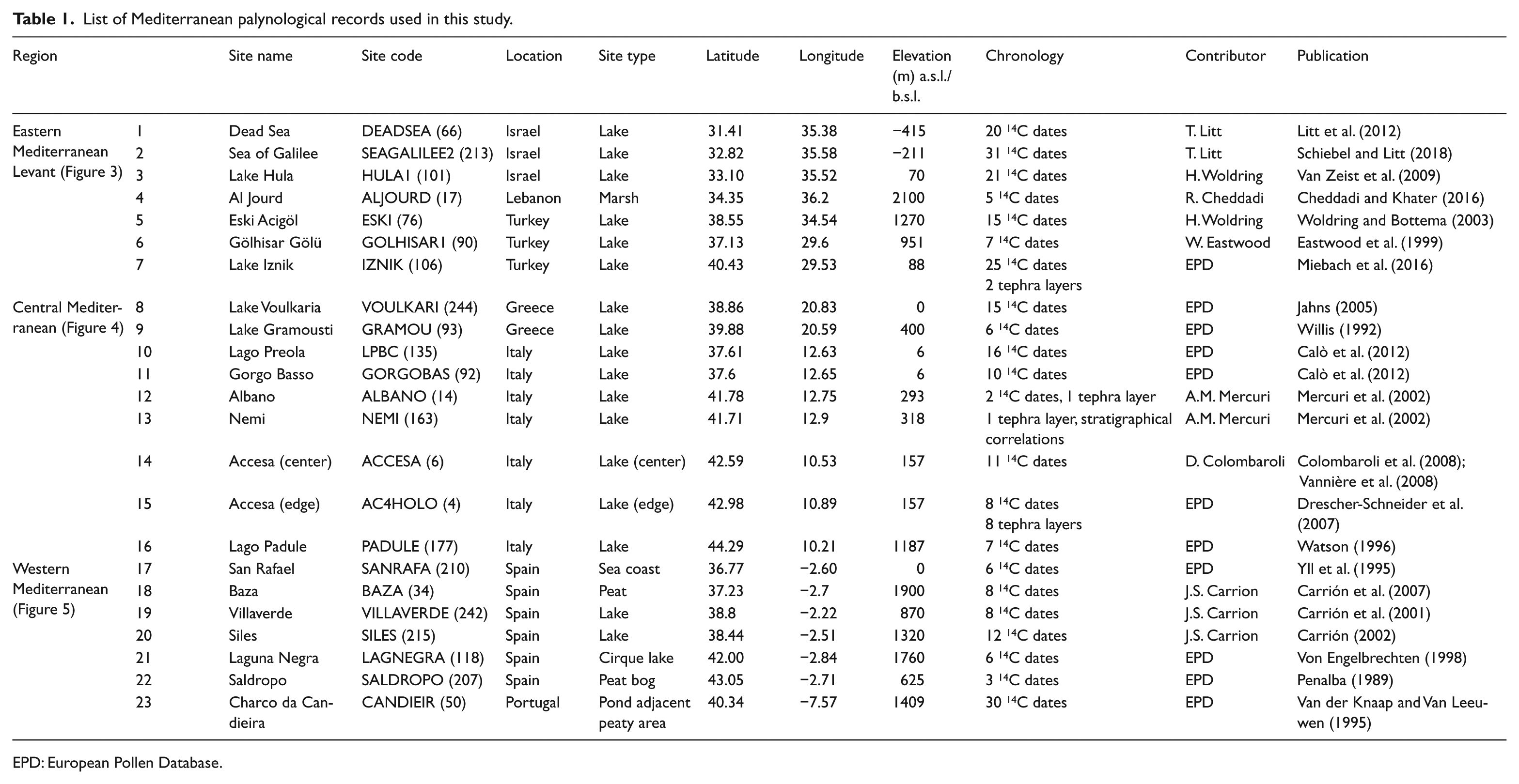
EPD: European Pollen Database.

Olea pollen percentages during the Holocene in the Eastern Mediterranean Levant. Note the different percentage of vertical scales.

Olea pollen percentages during the Holocene in the Central Mediterranean. Note the different percentage of vertical scales.

Olea pollen percentages during the Holocene in the Western Mediterranean. Note the different percentage of vertical scales.
Results
A total of 23 palynological records from the Mediterranean pollen dataset were determined to be suitable to serve as tracers for olive cultivation. Most of these continuous records cover the entire Holocene and were sampled at relatively high resolution. Seven records are available for the Eastern Mediterranean Levant region, nine for the Central Mediterranean, and seven for the Western Mediterranean (Table 1 and Figures 3–5).
Palynological results for the Eastern Mediterranean Levant
This group (Table 1 and Figure 3) consists of seven records: three collected from the southern Levant (Dead Sea, Sea of Galilee, and Lake Hula; Figure S2), one from the northern Levant (Al Jourd), and three from the western part of this region, in Anatolia (Eski Acigol, Gölhisar Gölü, and Lake Iznik). Within the three south Levantine palynological records, Olea pollen is present during the early Holocene (~10,000–7000 yBP). Yet, its presence is inconsistent and is characterized by very low frequencies (it should be noted that the Sea of Galilee record begins only at ~9000 yBP). A dramatic change occurs in the following centuries, when a profound increase in olive pollen is documented within the three south Levantine sequences: in the Dead Sea and Hula records, the rise in olive pollen occurs at ~6500 yBP, while at the Sea of Galilee a somewhat earlier age is suggested – at ~7000 yBP (with olive pollen values of 3.0%, 4.1%, and 6.6%, respectively). Olive pollen percentages retain their high levels until about 4000 yBP (with maximum values of 25.7% in the Dead Sea, 24.0% in the Hula record, and 34.2% in the Sea of Galilee). After ~4000 yBP, a slight decrease is documented; however, the percentages are not as low as those characterizing the early Holocene. At the beginning of the Classical periods, about ~2400 yBP, another profound increase in Olea pollen percentages is documented (with maximum values reaching up to 11.5% at the Dead Sea, 16.0% in the Hula record, and 43.8% at the Sea of Galilee). This olive peak lasts until ~1000 yBP in the Sea of Galilee, while in the two other records, it continues for several additional centuries.
Within the only record available from the northern Levant, from Al Jourd marsh, Olea pollen first appears during the 5th millennium BP, albeit sporadically (0–1.1%). From 3400 yBP onwards, olive pollen is continuously present. High frequencies were recorded between 3000 and 1800 yBP (1.3–5.4%). During the last millennium, a gradual increase can be seen, achieving its maximum values in recent times (5.3%). Within the three westernmost sequences of the Eastern Mediterranean Levant region, Olea curves are intermittent and typified by relatively low frequencies until the late Holocene. At the early stage of the Holocene, somewhat higher values are centered around 7800 and 6000 yBP in all three profiles (e.g. in Lake Iznik Olea levels reached 4.0%). Peaks in olive pollen percentages are documented during the last three millennia: at Eski Acigöl from ~2200 to 1600 yBP (0.3–3.0%), at Gölhisar Gölü from ~3200 to 1600 yBP (0.1–5.0%), and at Lake Iznik from ~2400 to 1400 yBP (15.5–25.4%). The more recent periods within all three records are characterized by an almost total absence of olive pollen.
Palynological results for the Central Mediterranean
This set of records includes nine profiles (Table 1 and Figure 4): two from Greece (Lake Voulkaria and Lake Gramousti), another two from Sicily (Lago Preola and Gorgo Basso), and five from mainland Italy (Albano, Nemi, Accesa (center), Accesa (edge), and Lago Padule). Within the two sequences recovered from Greece, the first half of the Holocene is characterized by an inconsistent appearance of Olea pollen; relatively high values appear at the beginning of the Holocene, around 10,000–9000 yBP (achieving a maximum of 2.9% at Lake Voulkaria and 0.8% at Lake Gramousti). Somewhat higher values are also documented between 7000 and 6000 yBP at Lake Voulkaria (reaching 2.6%). During the second half of the Holocene, olive pollen percentages are more constant at Lake Voulkaria, with increasing percentages observed between ~2600 and 600 yBP (reaching 7.8%). In the Lake Gramousti record, two peaks in olive pollen were registered during the later stage of the Holocene: at ~5100 yBP (1.7%) and at ~1600 yBP (1.4%). The two records from Sicily, Lago Preola, and Gorgo Basso are characterized by an almost total lack of Olea pollen at the beginning of the Holocene, between 10,000 and 8500 yBP. The following millennia, until ~2000 yBP, are marked by higher olive pollen values and an almost constant occurrence, especially in the case of the Gorgo Basso profile (reaching maximum values of 26.1% at ~5900 yBP). The final two millennia in both records are characterized by decreasing Olea percentages and an inconsistent appearance. In the five sequences extracted from mainland Italy, olive pollen values are significantly low in comparison with the other records of the Central Mediterranean region. In addition, their appearance is sporadic, especially during the first half of the Holocene. During the second half of the Holocene, the presence of olive pollen is somewhat more consistent, with the exception being Lake Padule (located in the Apennines). In Lake Albano, Olea frequencies are constant from ~3400 yBP almost to the modern era (reaching a peak of 3.7% at ~2100 yBP). At about the same period, increasing percentages are also documented in the Lake dell’Accesa (center) record with maximum values during ~700 yBP (2.5%). The latter sequence exhibits a more regional reflection of the vegetation in comparison to the other record extracted from the same lake, but from along its edge.
Palynological results for the Western Mediterranean
The group of the westernmost pollen records was divided into two geographical areas (Table 1 and Figure 5): four records were taken from the southern Iberian Peninsula (San Rafael, Baza, Villaverde, and Siles) and three from the northern Iberian Peninsula (Laguna Negra, Saldropo, and Charco da Candieira). Within the former region, the San Rafael sequence exhibits low Olea values during the beginning of the Holocene (0.1–6.0%), followed by increasing percentages during the ~8800–5000 yBP interval (1.6–10.6%). During the 5th and 4th millennium BP, olive pollen was extremely sporadic. In the following millennium, slightly higher values were documented (3.4–7.1%), while during the last 2000 yBP olive pollen decreased profoundly, resembling the Olea pollen levels recorded during the beginning of the Holocene (not exceeding 0.9%). The Baza record begins only at ~8500 yBP. It is characterized by a continuous olive pollen presence throughout the record, with relatively low percentages (1.0–2.2%) until ~2000 yBP. During the last two millennia, a limited increase was registered (1.9–4.5%). The last two records from the southern Iberian Peninsula, Villaverde, and Siles show relatively high frequencies during the early Holocene. Later on, within the Villaverde record, Olea values are low with only sporadic appearances, while at the Siles profile some olive pollen peaks are documented (at ~6500 yBP with 3.2% and at ~5700 yBP with 2.8%). Only during the last two millennia, a minor rise was identified in both records (reaching a maximum of 2.7% and 2.9%, respectively). The sequences from the northern Iberian Peninsula are characterized by extremely low Olea levels and an intermittent occurrence. Only in the Laguna Negra and Charco da Candieira profiles, an increase in olive pollen percentages was recorded during the last millennium (0.6–2.7% and 0.3–3.6%, respectively).
A note on archaeological and archaeobotanical evidence
To complement the pollen data, we examined published archaeological and archaeobotanical information relevant to olive cultivation and olive oil production. Oil production from olives involves three basic steps: the crushing of fruits, the pressing of the crushed pulp, and the separation of oil from water in the juicy product of the pressed pulp (see, for example, Hamilakis, 1996). Stone-cut olive presses and pressing installations comprise the primary archaeological evidence for oil production; however, these may be difficult to date, and their chronological attribution is usually based either on stratigraphic context or spatial distribution in relation to dated sites (keeping in mind presses could remain in use for centuries). The archaeobotanical evidence includes (1) olive stones (endocarps; Figure 2c), (2) wood and charcoal remains (Figure 2d and e), (3) olive waste from olive pressing, and (4) chemical or molecular evidence for olive oil residues. The macro-botanical remains were mostly preserved by charring, though some were also water-logged, desiccated, and/or mineralized. Biases typically encountered with these types of data can stem from methodological issues, such as taphonomic parameters and an overreliance on areas that have been intensively archaeologically explored versus areas with low exposure. In addition, there is a lack of standardization in excavation techniques and means of recovery of macro-botanical remains (ranging from manual collection to dry sieving to flotation – not to mention total neglect). Below we review the relevance of each category for reconstructing olive cultivation.
Olive stones. The presence of olive endocarps in archaeological contexts is well known in prehistoric sites across the Mediterranean even prior to olive cultivation, though they appear in relatively low numbers. A profound increase in olive stone frequencies may point to plant processing (though, given the possibility of transportation of fruit from a distance, it does not always follow that the trees grew nearby; Carrión Marco et al., 2013; Langgut, 2017).The two main features distinguishing the domesticated olive from its wild forms are its larger fruit and its higher oil content, both resulting from the development of the fleshy oil-containing mesocarp (Liphschitz et al., 1991; Zohary and Spiegel-Roy, 1975). Therefore, there have been several attempts to use olive seed size as a proxy for distinguishing between wild and domesticated subspecies (e.g. Dighton et al., 2017; Kislev, 1995; Liphschitz and Bonani, 2000; Liphschitz et al., 1991). However, scientists differ in their approaches and conclusions, primarily because of the considerable overlap between stone size-ranges in wild and domesticated trees (Runnels and Hansen, 1986). The state of preservation (charred/mineralized/water-logged) should also be taken into consideration when measuring and comparing stone size. Terral et al.’s (2004a) investigation is a step forward, proposing specific morphological criteria in order to distinguish between wild and domesticated endocarps. Its weakness, however, lies in the need for a large assemblage of complete olive stones from any given site; unfortunately, such large assemblages are rarely available from early periods (Margaritis, 2013). Another problem lies in the existence of many different varieties of olives, all of which have endocarps that are morphologically variable both in shape and size (e.g. Bosi et al., 2009). Kislev (1995) has suggested that a high degree of morphological heterogeneity in an assemblage, reflecting richness of the genetic pool, should indicate that it is wild. The occurrence of high ratios of crushed olive stones, however, can be used as a positive indication for local olive oil production (Galili et al., 1997; Neef, 1990). Unfortunately, such cases are few and far between.
Olive wood and charcoal remains. These macroremains may be considered a relatively reliable reflection of the local growth of olive, based on the assumption that timber and cuttings for everyday use were usually collected in proximity to occupation sites. Charred olive wood is often assumed to be remnant of fuel material (Chabal, 1988; Théry-Parisot et al., 2010; Zohary et al., 2012: 117). This assumption is especially true after domestication, since pruning was and still is an important and standard practice in olive orchards (Figure 6; Terral, 2000; Zinger, 1985). Pruning is conducive to a significantly higher fruit yield given that, in most cases, olives bear fruit only on 1-year-old branches. Furthermore, pruning also helps to regulate the phenomenon of alternate-year bearing, helps in treating infectious diseases, and keeps the trees at a moderate height, conducive to harvesting (Zinger, 1985). As olive wood has a high density (0.75–0.96 g/cm3; Crivellaro and Schweingruber, 2013: 434; Engel and Frey, 1996: 191), it is considered a high-quality fuel source. Olive timber is also suitable for crafting and construction (Liphschitz et al., 1991). A profound increase in the ratios of Olea wood-charcoals within an archaeobotanical assemblage may therefore point to the presence of local olive orchards (e.g. Benzaquen et al., in press). In a comparison of the three-dimensional structure of wild and domesticated olive wood conducted by Liphschitz et al. (1991), no indicative differences in the structure of the xylem were observed that could be used to perform a differentiation between wild and domesticated forms. In addition, olive wood is characterized in the first place by considerable structural variability due to irregular growth forms (Schweingruber, 1990: 573). It should also be taken into consideration that changes in olive growing conditions, such as an increase/decrease in precipitation and rain-fed versus irrigated olive trees, can also influence the anatomical structure (e.g. the width of annual growth rings when they exist and vessel density; Terral and Durand, 2006).
Olive waste from olive pressing. The solid olive-mill by-product (jift (Arabic) olive cakes or pomace) is composed of olive pulp and olive-fruit epidermis mixed with intact and crushed stones, water, and oil. The discovery of olive waste in an archaeological context clearly points to large-scale olive oil production in the environs of the site (e.g. Neef, 1990). Since olive waste burns at a high and constant temperature, it was considered an ideal fuel source in antiquity (Rowan, 2015). In a traditional or ancient agricultural community, waste from olive oil extraction may have also been used to feed livestock (Galili et al., 1997). Unless the crushed olive oil by-products are water-logged, formed part of a destruction level, and/or were used as fuel, they will be hardly preserved in archaeological contexts (Galili et al., 1997; Livarda and Kotzamani, 2013).
Organic residue of olive oil. The nature and origins of organic remains that cannot be characterized using traditional techniques of archaeobotanical investigation, such as vegetable oils, can be traced by molecular-chemical techniques (residue analysis). Pottery vessels are a good example of archaeological contexts from which residue analyses can extract positive markers of olive oil (Koh and Betancourt, 2010; Namdar et al., 2015; Tanasi et al., 2018). Since olive oil could have been exported, the finding of olive oil organic residue does not necessarily point to olive horticulture in the immediate surroundings of the site. Furthermore, oil can also be produced from wild olives.

An olive orchard in the Judean Mountains (southern Levant). Note the piles of recently pruned olive branches, indicated by the white arrow. Pruning was and still is an important and standard practice in olive orchards (Terral, 2000; Zinger, 1985). It leads to a considerably higher fruit yield (olive bears fruits mostly on 1-year-old branches), assists in regulating the alternate-year bearing phenomenon, helps in treating infectious diseases, and keeps the trees at a moderate height thereby contributing to an overall easier harvest (Zinger, 1985).
The organic residue is therefore only able to point to some familiarity with olive oil, if not to the process of manufacturing itself, in contrast to olive waste which can serve as direct evidence for olive oil production. In the case of macro-botanical remains (wood-charcoal and stones), the situation is more complicated, as described above, especially when trying to distinguish between specimens from the wild and domesticated subspecies. Due to the limitations of these macro-botanical remains for tracing olive cultivation in the early phases of olive domestication, when olive stone sizes had most likely not yet been significantly altered (e.g. Dighton et al., 2017), it seems that the quantitative approach may be considered a relatively reliable indicator for olive cultivation. Still, as in the case of pollen, increasing ratios of olive macro-botanical remains could reflect more favorable climate conditions rather than cultivation. Therefore, this type of evidence should be evaluated not only in relation to its archaeological context (mainly its association with certain implements suggesting specific olive oil processing), but also in relation to the reconstructed environmental conditions.
Discussion
The presence of olive pollen during the early Holocene (~10,000–7000 yBP-albeit frequently) in relatively low proportions, in almost all of the studied palynological records (22 out of 23; Table 1 and Figures 3–5), clearly demonstrates that the investigated regions were part of the natural distribution area of Olea europaea pollen rain during the Pleistocene and served as areas of refugia during the Last Glacial Maximum period. This includes the following regions: the southern Levant, Anatolia, Greece, Sicily, Italy (peninsula and islands), and the Iberian Peninsula. The records were recovered from Mediterranean coastal areas or from hinterland locations that would most likely be characterized by climates favorable to the wild subspecies. It is possible that other areas, also located in thermo-Mediterranean contexts, would have served as refugia (e.g. the northern Levant, Cyprus, Mediterranean France, and the western coasts of North Africa), though, unfortunately, sufficient and comparable palynological records that meet the criteria of this study are not available from all potential regions. In any case, corroborative evidence is provided by the genetic data, which also point to almost the same locations as refugia areas of oleaster (Besnard et al., 2017). The occurrence of Olea pollen across the Mediterranean already during the Pleniglacial indicates that these areas served as long-term refugia; the increase in olive pollen levels during the beginning of the Holocene, in comparison to late Pleistocene values, is related to the climate conditions characterized by the general increase of temperatures and precipitation during the post-glacial period (Carrión et al., 2010 and references therein). At some point during the Holocene, the rise in Olea pollen can be attributed in most cases to the human factor, specifically the early manipulation of oleaster and its cultivation. These activities played a crucial role in the expansion of Olea across the Mediterranean.
Olive cultivation history in the Eastern Mediterranean Levant
The southern Levant
The three records available for the southern Levant demonstrate a sudden and profound increase in Olea pollen percentages around the mid-7th millennium BP (Figures 3 and S2). In the Dead Sea (–415 m below sea level (b.s.l.)) and Hula (70 m above sea level – a.s.l.) records, the estimated date for this dramatic rise in pollen is ~6500 yBP (Litt et al., 2012; Van Zeist et al., 2009, respectively), while at the Sea of Galilee (–211 b.s.l.) the estimated age is ~7000 yBP (Schiebel and Litt, 2018). In two different records recovered from Birkat Ram (Golan plateau, southern Levant), the estimated date for the marked rise in olive pollen percentages was also dated to ~6500 yBP (Neumann et al., 2007; Schiebel, 2013). In all these southern Levantine pollen diagrams, the sudden and dramatic increase in olive percentages (e.g. in the Sea of Galilee, from 3.5% at ~7300 yBP to 17.1% at ~6900 yBP) was not accompanied by increased abundance of other broadleaved trees, such as oaks and pistachios, and therefore cannot be regarded as climate related. We assume, therefore, that this rise reflects the intensification of olive cultivation (see also Supplemental Material, available online), as was first proposed by Baruch and Bottema (1999). The discovery of early residual evidence for olive oil in a pottery vessel (amphoriskos) from ‘En Zippori’ (Lower Galilee, southern Levant), dated to the Late Neolithic-Chalcolithic interface (the Wadi Rabah horizon, 8th millennium BP; Namdar et al., 2015), supports the possibility that the dramatic rise in olive pollen represents an early stage of olive cultivation. The chemical residue in the amphoriskos contains high proportions of oleic acid (C18:1 >70%) in relation to stearic and palmitic acids, accompanied by linoleic acid (C18:2) and the complete absence of linolenic (C18:3) acid (Namdar et al., 2015: Figure 4c). This chemical signature is strongly associated with the presence of olive oil (Boskou, 2002; Evershed et al., 1997; Namdar et al., 2015).
In recent decades, several large, well-preserved, and well-dated archaeobotanical assemblages from Pottery Neolithic villages submerged along the Mediterranean (Carmel) coast of Israel have resulted in a new understanding regarding the earliest date of large-scale olive oil production (Galili et al., 1989, 1997). Beginning at ~7600 yBP, significant quantities of olives were recorded in the four Pottery-Neolithic sites of Kfar Samir, Kfar Galim, Tell Hreis, and Megadim (Carmi and Segal, 1995; Galili et al., 1989, 1997; Galili and Sharvit, 1995; Kislev, 1995). The finds from the submerged villages differ from many typical archaeobotanical olive finds, in that they are numerous, non-charred, and well preserved. They were also found in clear archaeological contexts and were directly 14C dated. The data provide valuable information on subsistence prior to, as well as following, the introduction of olive oil extraction (Galili et al., 2018). In Kfar Samir (~7600–7000 yBP), several stages of the olive oil production (chaîne opératoire) were identified, including crushing basins made of stone, a pit filled with the waste (pomace) produced by olive oil extraction, and strainers made of twigs. The pomace can potentially also represent a further step of emptying the strainer after pressing (strainers are still used in current traditional methods of olive oil production). This is considered the earliest known evidence for olive oil extraction (Galili et al., 1997, 2018). These finds may be contrasted with those from the adjacent but older submerged site of Atlit-Yam (Pre-Pottery Neolithic C; 9000–8500 yBP) where olive remains (both pollen and endocarps) are present in very low quantities (Kislev, 1996), most likely derived from wild olives.
The submerged findings from Kfar Samir are dated to the same period – the Late Neolithic–Chalcolithic interface (the Wadi Rabah horizon) – as the olive oil residue in the pottery vessel from ‘En Zippori’ mentioned above (Namdar et al., 2015). However, it is possible that these finds represent a very early stage of olive tree manipulation when olive fruits for olive oil production were still collected from wild trees. DNA analysis of the olive stones from Kfar Samir provided short sequences but no conclusive evidence regarding domestication (Elbaum et al., 2006). Documenting the exact moment of domestication is complicated as it is a process that does not happen instantly; rather, it involves a long period of transformation, and the situation is even more confusing in areas where wild olive populations are part of the natural environment, as is the case in the southern Levant coast. Domesticated, cultivated, feral, and wild plants may well have been mingled in evolving management strategies, giving the archaeobotanical record a mixed character (e.g. Margaritis, 2013; Zohary et al., 2012). This study shows that the sudden and profound increase in the southern Levant pollen records may indicate large-scale olive management. Early management (proto-cultivation) of wild olive trees probably included collection of branches and intentional pruning for the exploitation of various products: fruit, fodder, timber, and probably fuel.
Olive wood remains occur in four Chalcolithic sites located in the Lower and central Jordan Valley, where wild olives are not found today and to the best of our knowledge were also not present in the 7th millennium BP (Teleilat Ghassul – Meadows, 2001; Abu Hamid and Tell esh Shuna – Neef, 1990; and the somewhat earlier site of Tel Tsaf – Langgut and Benzaquen, in press). In addition, a very important and even critical finding of large amounts of waste from olive pressing demonstrates the widespread phenomenon of olive oil production in the Chalcolithic sites (Neef, 1990), for example, at Pella (central Jordan Valley; Dighton et al., 2017). The finding of olive waste clearly indicates large-scale olive oil production, while the finding of wood in those sites located outside the natural habitats of wild olives is again strong evidence for horticulture and should be attributed to local Chalcolithic olive orchards. Chalcolithic oil production is further supported by the numerous olive stones and wood remains, as well as crushing basins, found at Chalcolithic sites in the Golan Heights (Epstein, 1978, 1993) and in Samaria (Eitam, 1993). All of these findings strongly indicate a well-established olive horticulture no later than ~6000 yBP.
The data presented above can be summarized as follows: the sudden profound rise in the southern Levant of olive pollen curves (Figure 3; for example, in the Sea of Galilee, olive percentages around 6700 yBP are eight times higher than those observed during the early Holocene) suggests that in the mid-7th millennium BP, at the beginning of the Chalcolithic period, a broad enterprise of olive management and exploitation took place. This estimated date accords well with the seminal study conducted more than four decades ago by Zohary and Spiegel-Roy (1975), based mainly on the archaeobotanical evidence (charred seeds and wood) available at the time, which indicated that the olive horticulture was already present in the type-site of Tuleilat el-Ghassul no later than 6000 yBP. The botanical remains gathered throughout the region since then corroborate the idea that the initial steps toward large-scale olive management had already been taken by ~6500 yBP and argue against the attribution of olive cultivation to the Early Bronze Age, one millennium later (Liphschitz et al., 1991). This means that the early management of olive trees corresponds to the establishment of the Mediterranean village economy and the completion of the ‘secondary products revolution’, rather than to urbanization or state formation. It was primarily a rural staple economic strategy that was only secondarily (and much later) co-opted by Early Bronze Age elites as an instrument of political-economic leverage. Similar conclusions have been recently proposed for the expansion of olive in Eastern Crete (Cañellas-Boltà et al., 2018). The palynological, archaeological, and archaeobotanical data from the southern Levant indicate that during the Early Bronze Age, olive orchards were already abundant in the Levant and that olives were an important supplement to grain cropping throughout the Levantine region (Benzaquen et al., in press; Kaniewski et al., 2012; Langgut et al., 2016; Riehl, 2009; Weiss, 2015; Zohary et al., 2012), with olive oil becoming a commodity in international trade (e.g. Langgut et al., 2016; Lev-Yadun and Gophna, 1992).
The northern Levant
In the record from the Al Jourd marsh, Olea pollen does not occur during the first half of the Holocene. Its first appearance is dated to ~4600 yBP (Figure 3; Cheddadi and Khater, 2016). This late occurrence may probably be related to the high elevation of the site (2100 m a.s.l.). Early fruit tree cultivation in the Mediterranean certainly took place at lower elevations and then spread toward higher elevations. The knowledge, and possibly even the plant material itself, could have diffused from the southern regions. In a recent pollen record from the Syrian coast (not covering the entire Holocene and therefore not included in the current dataset), a prominent increase in Olea pollen abundance occurred at ~4800 yBP (Sorrel and Mathis, 2016: Figure 5a). Other palynological investigations in the northern Levant show an increase in Olea values during the Holocene – in the Tell Nebi Mend plain and in the Ghab area (Niklewski and Van Zeist, 1970; Yasuda et al., 2000) – but were unable to establish a robust age model (e.g. Cappers et al., 1998; Meadows, 2005). Based on the relatively well-dated palynological records, it therefore appears that the spread of olive culture in the northern Levant lagged behind the southern Levant (Langgut et al., 2016: Figure 4). This proposal is further supported by Riehl’s synthesis of archaeobotanical data from 138 Levantine sites (over a 5500–2600 yBP time frame), which clearly shows that Early Bronze Age olive cultivation was focused in the southern Levant (Riehl, 2009: Figure 7). However, this study does not distinguish between the sub-phases of the Early Bronze Age and may be skewed by the relative scarcity of Early Bronze Age excavation sites in the northern Levant. Well-dated archaeobotanical evidence from Tell Fadous in northern Lebanon indicates significant olive exploitation in the Early Bronze Age II-III (Genz et al., 2009: Figure 38; Höflmayer et al., 2014). Similar evidence was derived from the archaeobotanical assemblages of Tell Mastuma in northern Syria (Yasuda, 1997: 258, Figure 8). Therefore, based on the palynological and archaeobotanical evidence, it seems that the initial management of olive tree crops in the northern Levant lagged somewhat behind the southern Levant.

Palynological records from the islands of Crete and Zakynthos demonstrating a significant increase in olive pollen at ~6000 yBP. We believe that this rise is indicative of olive horticulture in southern Greece. The sudden dramatic increase was not accompanied by pollen rise of other broadleaved trees and therefore cannot be regarded as climate related. The radiocarbon dates provided with the Tersana and Delphinos records were recalibrated using OxCal v.4.3.2 (Bronk Ramsey, 2017). Olea pollen curves were drawn based on Moody et al. (1996) – the Tersana record, Bottema and Sarpaki (2003) – the Delphinos record and Avramidis et al. (2013) – the Alykes Lagoon record. The solid black line is a fivefold exaggeration curve used to show low Olea percentages.

Suggested dates in yBP for the beginning of olive horticulture in the Mediterranean regions considered in this study. Base map: Google Earth.
In contrast to the palynological, archaeological, and archaeobotanical data, the genetic evidence seems to suggest the northern Levant as the locus of olive domestication (Besnard et al., 2013). These conflicting results may derive from sampling issues within the Besnard et al. (2013) study, as the samples from the southern Levant were collected from only one location (Mount Carmel; Besnard et al., 2013: supplementary information Table S1, available online). Owing to the highly fragmented and human-disturbed Mediterranean habitat in this area, it could not be ruled out that some of the sampled trees/populations were feral. In any event, it seems that further genetic analyses of materials from the southern Levant are required in order to resolve this apparent regional discrepancy.
Anatolia
During the first half of the Holocene, the three records available from Turkey are characterized by intermittent occurrence and very low Olea frequencies (Figure 3). The records were recovered from hinterland locations, most probably portraying favorable thermo-Mediterranean micro-climates, suitable for oleaster survival as refugia.
Within the Gölhisar Gölü sequence (951 m a.s.l.), an increase in Olea is visible at ~3200 yBP, while at the two other locations, Eski Acigöl (1270 m a.s.l.) and Lake Iznik (88 m a.s.l.), the prominent increase in olive pollen was documented about a millennium later. For example, in the latter sequence, Olea pollen rises from 3% at ~2300 yBP to 15% at ~2100 yBP and up to 26% at 1900 yBP (Figure 3). This sudden expansion was understood to mark the beginning of olive horticulture in this area (Eastwood et al., 1999; Miebach et al., 2016). An increase in Olea percentages at ~4600–4500 yBP in Lake Iznik record was suggested by Miebach et al. (2016) to reflect a short-lived small-scale episode of olive cultivation. The olive stone findings from the Early Bronze Age strata of Troy (dated to ca. the middle of the 5th millennium BP) corroborate this early short-lived pollen peak, while also serving as the earliest olive stone remains in the Troad; in the subsequent period, during the Middle Bronze Age, olive was not cultivated in this region (Riehl, 1999). In south-western Turkey, Eastwood et al. (1999) correlate large-scale olive cultivation with the Beyşehir Occupation (BO) phase which began at ~3200 yBP. Recent synthesis of fossil pollen records from the entire Anatolian region corroborates this date (Woodbridge et al., 2019). This phase included the cultivation of other fruit trees such as Juglans, Castanea, and Vitis (Eastwood et al., 1999; Woodbridge et al., 2019). While the palynological evidence suggests that Juglans horticulture in the eastern Mediterranean spread on a north-south axis (most probably from Anatolia to the Levant) and reached the southeasternmost parts of the region (southern Levant) during the first half of the 4th millennium BP (Langgut, 2015), it seems that olive culture spread in the opposite direction. Most of the archaeological findings regarding olive oil production in Anatolia derive from later periods and therefore do not shed additional light on questions regarding early olive horticulture.
Olive cultivation history in the Central Mediterranean
Greece
The two records available from Greece indicate that the beginning of the Holocene (~10,000–9000 yBP) is characterized by a scattered olive pollen presence, while during the subsequent two millennia, it is almost absent. Higher values are documented in the Lake Voulkaria (located at sea level) record between ~7000 and 6000 yBP and after ~5200 yBP. At exactly the same time, a peak in olive pollen percentages is documented at Lake Gramousti (400 m a.s.l.). During the second half of the Holocene, the spread of Olea can be observed from the Geometric to the Classical periods (beginning in the early 3rd millennium BP). These high olive pollen frequencies point to olive horticulture, mainly along the coastal lands. Higher olive percentages during these historical periods were also identified in other records from southern Greece (e.g. Vravron area – Kouli, 2012).
In pollen records from southern mainland Greece and from locations in the Aegean and Ionian Seas that were not included in this study, due to relatively low resolution and/or the limited time span they cover, the increase in Olea percentages, indicating the beginning of olive cultivation, is more profound and is dated earlier (Figure 7). The earliest clear evidence of substantial olive pollen rise occurs at ~6000 yBP in the pollen diagrams from Crete (Bottema and Sarpaki, 2003; Moody et al., 1996). A more accurate date is available from the new, high-resolution pollen study by Cañellas-Boltà et al. (2018), who suggest an age of ~5600 yBP for the beginning of olive tree management in Crete, when Olea pollen rises from ~17% at ~5700 yBP to ~30% at 5500 yBP. A virtually coeval olive pollen increase has been identified on Zakynthos Island in the Ionian Sea (Avramidis et al., 2013). In the northeast Peloponnese, a significant increase in Olea pollen was registered at a much later date: in the region of Lake Lerna at ~4200 yBP (Argive Plain; Jahns, 1993) and in the region of Kleonai and the Kotihi lagoon at ~3800 yBP (Atherden et al., 1993; Lazarova et al., 2012, respectively). In Macedonia, in the vicinity of Lake Dojran, Olea horticulture is suggested to have begun only at ~2500 yBP (Masi et al., 2018). The differences between the palynological records regarding the date of the beginning of olive horticulture may reflect the possibility that the initial management of olive tree crops varied from one area to another, with a clear diffusion from south to north.
The late pollen evidence for olive culture in the two records discussed in this study (Lake Voulkaria and Lake Gramousti) is probably the result of their relatively northern location (Figure 1). However, it can be summarized, based on the other available regional pollen sequences presented above, that the earliest profound increase in olive pollen, indicative of olive cultivation in Greece, took place during the ~6000–5600 yBP interval (Figure 7; Crete – Bottema and Sarpaki, 2003; Cañellas-Boltà et al., 2018; Moody et al., 1996; and Zakynthos Island – Avramidis et al., 2013). In these pollen diagrams, the sudden dramatic rise in olive pollen curves was not accompanied by increasing pollen percentages of other evergreen Mediterranean sclerophyllous trees. This may suggest that Olea pollen intensification was not climate related. Furthermore, not only did the ratios of other trees of the Mediterranean forest/maquis with similar environmental requirements not increase, but oak percentages (mostly those of the evergreen type) were reduced (Avramidis et al., 2013: Figure 4; Bottema and Sarpaki, 2003: Figure 4; Moody et al., 1996: Figure 8), pointing to the possible replacement of parts of the Mediterranean forest/maquis by olive orchards through human agency, as has been suggested, for example, for the Sea of Galilee region in the southern Levant (Baruch, 1986; Horowitz, 1979: 193). Indeed, the Sea of Galilee olive pollen curve used in this study (Figure 3a) and the evergreen oak pollen type curve (Schiebel and Litt, 2018: Figure 6) present opposite trends since the beginning of olive cultivation in the region. The range of ages pointing to the beginning of large-scale olive management in Crete (~6000 yBP vs ~5600 yBP) could stem from differences in dating methods, but it may also indicate an earlier starting date for olive cultivation in Western Crete. The record reported by Moody et al. (1996) is located in western Crete while the palynological sequence of Cañellas-Boltà et al. (2018) is situated at the eastern end of the island (see also Supplemental Material, Figure S4, available online). The archaeobotanical data from southern Greece matches the palynological evidence: olive remains become common in the initial stage of the Bronze Age (from ~5300 yBP) and increase during the course of the Bronze Age (Asouti, 2003; Margaritis, 2013; Valamoti et al., 2018 and references therein).
Islands have always been regarded as sensitive indicators for environmental change and human pressure, due to their isolation and relatively low resilience. In the Balearic Islands, an abrupt increase in Olea pollen was observed almost at the same time as for the Aegean and Ionian Islands (see review by Burjachs et al., 2017). However, in the case of the Western Mediterranean islands, olive pollen escalation was synchronized with a rise in Quercus (most probably evergreen pollen type) and Erica pollen, and a marked decrease in Juniperus, Buxus, and Ephedra pollen (Burjachs et al., 2017: Figures 2–5). These changes point to an expansion of wild rather than of domesticated olive trees.
In correlation with the early Holocene pollen spectra (Figure 3), olive stones and wood-charcoal remains also point toward a rare presence of olive trees during the Late and Final Neolithic (9th–7th millennia BP) in some islands in the Aegean and Ionian seas, either growing naturally in small numbers (Valamoti et al., 2018), and/or exploited at a low level (Margaritis, 2013). The archaeological sites from northern and central mainland Greece are characterized by the almost total absence of olive macro-botanical remains during the Neolithic (see review by Valamoti et al., 2018), as well as pollen (e.g. Kouli and Dermitzakis, 2008). The number of sites where olive remains have been recovered rises dramatically in both Crete and the Peloponnese from the Bronze Age onwards. Based on the robust archaeobotanical evidence (Margaritis, 2013; Valamoti et al., 2018), and as suggested by Renfrew (1972), the Aegean stands out as the core area from which olive horticulture gradually spread at the onset of the Bronze Age, diffusing from islands and coastal locations to the central mainland and to more northerly regions.
The earliest evidence from residue analysis for the use of olive oil in Greece comes from two local jar fragments found in the small fortified hilltop site of Aphrodite’s Kephali in eastern Crete, dated to ~5200–4700 yBP (Koh and Betancourt, 2010: Table 1). Martlew (1999) reports that olive oil residues are present at the Late Neolithic site of Gerani Cave in western Crete (dated to ~5800 yBP); however, the results of this study are not conclusive and could point to other vegetal sources (see also critique by Sarpaki, 2012: 41–42).
The relatively late onset of intensive olive cultivation in the Aegean (at least several centuries after the southern Levant) allows for the possibility that it was initiated as a result of knowledge transfer – or even seedling transfer – from the Levant. However, there is no firm archaeological evidence that can point to contiguous links between the two regions. While it is broadly recognized that maritime capabilities grew markedly in the 6th millennium BP, commerce appears to have been limited to the Aegean basin and the west Anatolian coast, on one hand, and to the Levantine littoral (including occasional contacts with Cyprus), on the other hand (Bar-Yosef Mayer et al., 2015; Broodbank, 2013 and references therein), with no archaeological or archaeobotanical evidence for stepping-stones that may have filled the gap. It is therefore possible that the knowledge of olive cultivation spread through maritime connections, but no less likely that olive cultivation in Greece was an independent event. The latter possibility is supported by genetic studies (Diez et al., 2015), which appear to point to two separate domestication events, one in the eastern and the second in the Central Mediterranean.
The archaeological record related to olive oil processing differs between the two regions: while in the southern Levant the entire chaîne opératoire for the initial stage of olive horticulture can be reconstructed, in southern Greece the archaeological evidence regarding this initial stage is more obscure. For example, the earliest evidence of clay-spouted tubs, presumably used for separating oil and water following pressing, was found at Early Minoan Myrtos (Crete), at ~4200 yBP (Riley, 2002). Burnt olive waste was found also in Crete (Chamalevri-Tzambakas House), dated to ~4100–3900 yBP (Sarpaki, 1999, 2012). Stone presses were found only in the later stages of the Bronze Age. The discrepancy between the two regions regarding the visibility of the archaeological record and archaeobotanical finds are most probably the result of two factors: (1) different states of preservation and (2) the use of different techniques for olive oil extraction; for example, the possibility that at the early stage of olive oil production in the Aegean, wooden rollers were used to crush olives on stone beds. In such a technique, not only does the perishable wood rarely survive in the archaeological record, but the defleshing of the olives would occur without crushing the olive stones (Hamilakis, 1996). The olive fruits could have been crushed on multipurpose stone beds (e.g. surfaces used in the processing of other plant materials). Multifunctional mortars and pestles could have also been used to crush the olive fruit. Differences in production techniques between the Aegean and other Mediterranean regions were also observed in the case of wine production (Frankel and Ayalon, 1988: 31).
Despite the limitations presented above, the presence of olive oil residues nearly contemporaneous with the palynological evidence for large-scale olive management (Figure 7) points to the local production of olive oil early in the 6th millennium BP. It seems that olive horticulture spread from islands, such as Crete and Zakynthos, as well as from coastal locations where olive grows naturally, to mainland Greece.
Sicily
The early Holocene is characterized by a limited appearance of olive pollen in the two records available for Sicily (Lago Preola and Gorgo Basso, both located at few m a.s.l.). Beginning with the 8th millennium BP, an increase in Olea percentages was registered in both records. This rise was accompanied by the intensification of other broadleaved trees such as Quercus ilex and is considered reflective of the dominance of the evergreen forest in the coastal areas of Sicily as a result of an increase in available moisture (Calò et al., 2012; Tinner et al., 2009). A contemporaneous increase in Olea pollen has been documented in other parts of Sicily (e.g. in the Biviere di Gela record, from southern Sicily; Noti et al., 2009). In central Sicily, Lago di Pergusa is outside the natural distribution area of the wild olive tree, but its pollen curve shows a continuous presence along the last 6700 years, most probably reflecting long-distance transport. The sudden Olea pollen rise from ~3200 to 3000 yBP (from ~5% to 17%, respectively), a period in which the area was settled by Sicanians and Sicels, most probably indicates human activity in the area (Sadori et al., 2013, 2016).
Based on the two records presented in this study, the evergreen forests persisted in northern Sicily until 2200 yBP, when human presence intensified (Calò et al., 2012). Since Olea is a dominant component of the local natural forest, and since its pollen values increase significantly during humid phases, it is difficult to use this marker as an indicator for the beginning of olive cultivation in this region. For the same reason, the macro-botanical evidence also does not supply a clear answer regarding the date of cultivation of domesticated olive in Sicily. More direct evidence comes from residues in three Early Bronze pottery vessels found at Castelluccio (southern Sicily): chemical signatures of olive oil were identified, dated to the 5th and the beginning of the 4th millennium BP (Tanasi et al., 2018).
Mainland Italy
In the five Olea pollen records from mainland Italy, the frequency of this taxon is low during the first half of the Holocene (Figure 4). Its occurrence interestingly indicates that small stands, or at least some specimens of olive trees, existed in different regions of the Italian peninsula (Mercuri et al., 2013). The Olea pollen first shows an uninterrupted curve within the Albano and Nemi (293 and 318 m a.s.l., respectively) records starting around 3400 yBP. At the same time, increasing olive percentages are documented in the profile extracted from the inner part of Lake Accesa, which exhibits somewhat higher Olea values than the palynological record recovered from the margins of this lake (Figure 4). The differences are likely owed to the wider geographical catchment of the former record. At Lake Padule, maximum olive percentages were also recorded at ~3400 yBP. Olea pollen recovered from archaeological sites across the Italian peninsula confirms the wide extent of olive cultivation over the last four millennia, with a greater representation observed in southern sites, due to more favorable habitats in that part of mainland Italy (Mercuri et al., 2013). In the regional pollen diagrams, the Olea pollen increase was simultaneous with the rise of walnut and chestnut pollen and follows the spread of cultural landscapes (Mercuri et al., 2013). Evidence for a short-lived episode of olive cultivation during the Early Bronze Age (early 4th millennium BP) has been inferred from charcoal accumulation in two archaeological sites of the Tyrrhenian coast of Calabria, in southern Italy (D’Auria et al., 2017). The presence of olive waste from Tufariello (Buccino) dated ~3800–3400 yBP (the Middle Bronze Age) supplies direct evidence for olive oil production (Rowan, 2015). The earliest chemical signatures of olive oil are those of Broglio di Trebisacce (Cosenza) and Roca Vecchia (Lecce), where large storage jars (dolia) dated to the Late Bronze Age (~3200–3000 yBP) tested positive for oil presence (Tanasi et al., 2018 and references therein).
Olive cultivation history in the western Mediterranean
Southern Iberian Peninsula
Based on the four palynological records used for the southern Iberian Peninsula, Olea curves exhibit an almost continuous presence throughout the entire Holocene (note that the Baza sequence begins only at ~8400 yBP). The San Rafael record (located at sea level), which is the only sequence in this region that has been recovered from the distribution area of the wild olive (Figure 1), shows increasing Olea percentages starting in the early 8th millennium BP and lasting until the late 5th millennium BP. The rise in olive pollen levels was accompanied by increasing percentages of other broadleaved trees common to the thermo-Mediterranean zone and is therefore indicative of more available moisture (Yll et al., 2003). The paleoenvironmental information obtainable from the Siles record supports this vegetation-climate reconstruction. According to Carrión (2002), an early/mid-Holocene wet phase (~7500–5200 yBP) emerges regionally during the period exhibiting maximum forest development and the highest lake levels. The Siles profile is characterized by maximum Holocene Olea pollen percentages between 6800 and 6400 yBP and at ~5600 yBP.
The Baza, Villaverde, and Siles records (1900, 870, and 1320 m a.s.l., respectively) show increasing Olea pollen frequencies during the last two millennia (Figure 5; Carrión, 2002; Carrión et al., 2001, 2007). In all three palynological diagrams, the increase in olive was simultaneous with a sudden change in the appearance of other pollen indicators of human influence on the natural vegetation (Carrión et al., 2001). The same vegetational pattern is demonstrated based on the synthesis of palynological records recovered from the southeastern sector of the Iberian Peninsula conducted by Fyfe et al. (2019). Their study shows an increase in OJC (sum of Olea, Juglans, and Castanea pollen) at the beginning of the 2nd millennium BP (Fyfe et al., 2019: Figure 6). In the San Rafael sequence, the situation is less clear; Olea pollen levels increased during the 3rd millennium BP; however, they declined during the last 2000 years (Yll et al., 2003).
Based on archaeobotanical evidence (higher visibility as well as changes in both olive stone morphology and wood anatomy), an early autochthonous olive cultivation over the course of the 5th millennium BP, during the Chalcolithic/Early Bronze Age, has been posited (Terral, 1996, 2000; Terral and Arnold-Simard, 1996; Terral et al., 2004a). Other studies, also relying on the archaeobotanical record, suggest a much later date for the beginning of olive horticulture (Alonso et al., 2016; Pérez-Jordà et al., 2017). The palynological data from the southern Iberian Peninsula do not support an early cultivation scenario since the rise in Olea pollen is most probably climate related, as discussed above. The increase in olive remains (seeds and charcoal) in the Chalcolithic/Early Bronze Age botanical assemblages is also most likely linked to the early/mid-Holocene humid phase. As presented above, the increase in Olea pollen and other regional pollen indicators point to a profound anthropogenic influence on the natural vegetation only during the last two millennia. Other lines of evidence agree with the palynological data: while olive stones are present in the Chalcolithic period (~mid-5th millennium to mid-4th millennium BP), there is no indication that they were being cultivated, and while their numbers increase with the approach of the Bronze Age (after ~4000 yBP), they are still not substantial. In the Bronze Age, the olive stones found have been regarded as wild and no pottery suggestive of oil production has been found (Stika, 2000). For example, at Cueva de Toro (Malaga), olive seeds were found in a continuous sequence of levels dating from the Middle Neolithic to the Bronze Age, though in relatively low quantities (Buxó and Capdevila, 1997). According to these authors, for those relying on morphometric indices to differentiate between the wild and domesticated types of seeds, the olive seeds resemble the wild types. The wood-charcoal remains also support the suggestion that the increase in olive remains can be attributed to the more favorable climatic conditions prevailing during the early/mid-Holocene. The increase in humidity permitted the species to become very abundant and even to expand into favorable enclaves outside the limits of the thermo-Mediterranean zone (Carrión et al., 2010). A significant increase in olive remains (charcoal and olive stones) in the archaeological record is documented only in the beginning of the First Iron Age (~2800–2600 yBP), mainly from sites located in the thermo-Mediterranean zone (Alonso et al., 2016; Pérez-Jordà et al., 2017). In the middle of the Second Iron Age (~2600–2200 yBP, also called the Iberian period), the olive oil presses are already present in the region (Pérez-Jordà, 2000).
Palynological records from the Balearic Islands were not included in this study since none of the available datasets meet the criteria used for pollen sites in the current research. However, they supply some interesting supplementary observations regarding Olea history in the region. Several pollen diagrams demonstrate an abrupt and profound increase in olive pollen ratios from the mid-late 7th millennium BP, accompanied by other dramatic changes in the main component of the Mediterranean forest/maquis (Cala’n Porter, Minorca – Yll et al., 1997; Algendar, Minorca – Yll et al., 1997; Es Grau, Minorca – Burjachs, 2006; Addaia, Minorca – Servera-Vives et al., 2018; Alcúdia, Majorca – Burjachs et al., 1994). These profound changes in the vegetation composition signify a phase of transformation within the natural landscape (Burjachs et al., 2017 and references therein). Another indication which clearly signifies that the Olea increase is not linked to cultivation derives from the fact that the first documented human presence on the islands is only dated to the second half of the mid-5th millennium BP (Alcover, 2008). Wood management largely reliant on Olea produced a visible impact on the local landscape during the Bronze Age, starting from about 3700 yBP (Servera-Vives et al., 2018; Mercuri et al., 2019). As for other north-western Mediterranean areas (e.g. southern France), none of the available palynological records satisfy the selected criteria for this study. In any event, according to Leveau et al. (1991), the archaeological, archaeobotanical, and palynological data show that olive cultivation is clearly evident in southern France only from the Roman period.
Northern Iberian Peninsula
Since all three palynological records are located outside the natural habitat of wild olive (Figure 1), the low Olea pollen visibility during the early Holocene suggests the proximity of glacial refugia. It is possible that in nearby favorable thermo-Mediterranean micro-climates, survivors of oleaster were part of the Mediterranean forest. In a pollen record extracted from the northeastern coast at Lake Banyoles (Pèrez-Obiol and Julià, 1994), a similar trend to that of the southern peninsula was observed: wild Olea pollen increases during the mid-Holocene together with other evergreen sclerophyllous trees (Quercus ilex-coccifera and Phillyrea; Revelles et al., 2015: Figure 4). This simultaneous rise signifies that climate, rather than human agency, is responsible for the increase in Olea pollen.
Modest increases in olive pollen percentages during the last two millennia in the Laguna Negra and Charco da Candieira records are most probably indicative of the presence of local olive orchards (Figure 5). The latter is the westernmost record examined in this study. Fyfe et al. (2019) suggest a slightly earlier date based on palynological records retrieved from the northeastern sector of the Iberian Peninsula. Their study shows an increase in OJC index by the beginning of the 3rd millennium BP (Fyfe et al., 2019: Figure 6). According to Carrión et al. (2010), the cultivation of the olive in later periods in this region caused the olive trees to become more resistant to continental conditions and even to those prevailing along the Atlantic façade of the Iberian Peninsula. Based on the comprehensive evaluation by Rodríguez-Ariza and Moya (2005), the picture that emerges from the archaeobotanical and archaeological findings confirms the palynological evidence. During the Bronze and Iron Ages (from ~3800 yBP), charcoal remains are mostly restricted to archaeological sites within the thermo-Mediterranean zones. In fact, it is not until the Roman Period (1st–3rd centuries CE) that the range of the charcoal remains extends more strongly into the Mesomediterranean and even Supramediterranean zones and that mills and implements related to olive oil production begin to be found (Rodríguez-Ariza and Moya, 2005). The Saldropo pollen sequence is characterized by the rare and sporadic presence of Olea during the entire Holocene. This record, the northernmost profile discussed in this study, is situated outside the distribution area of both wild and cultivated olives and may be regarded as a ‘control’ record in this research.
The spread of olive cultivation in the Mediterranean
Unlike the Near Eastern founder grain crops that are thought to have originated in a relatively small core area and spread from there as an integrated agro-economic package (Lev-Yadun et al., 2000), fruit trees were adopted from several geographically remote areas (Zohary et al., 2012). The cultivation of olive trees, as in the case of other fruit trees, was mediated by a number of sociocultural adaptations. The process involved a higher level of delayed return, long-term land allocation, and labor investment in oil processing, production structures, and storage facilities (Abbo et al., 2015). As such, olive horticulture could have occurred only after the domestication of annual grain crops and the establishment of sedentary agricultural communities (Abbo et al., 2015; Zohary et al., 2012). Olives are relatively slow-growing and long-lived fruit trees with significant production starting only 5–6 years after planting, and maximal productivity attained many years later, once the trees become large (Zinger, 1985). If well managed, an olive tree can keep fruiting for hundreds of years (Zohary et al., 2012). When an orchard is abandoned, it has been shown that, following a relatively short rehabilitation process, the orchard can once again be encouraged to yield a substantial olive crop. In terms of agricultural/economic efficiency, the rehabilitation of an orchard takes much less time than the establishment of a new one. This could have been one of the reasons why the same sites were repeatedly occupied during peaks of settlement activity in antiquity (Langgut et al., 2014).
The palynological data, supported by the archaeological and archaeobotanical evidence presented here, indicate that olive was first cultivated in the Chalcolithic southern Levant at ~6500 yBP (Figure 3). We suggest in this study that the significant increase in Olea pollen percentages in southern Greece (mainly evident in Crete) about a millennium later, at the beginning of the Early Bronze Age, is also a result of olive horticulture (Figure 7). From these two areas of origin, olive cultivation (probably of the domesticated subspecies) spread across the Mediterranean Basin.
A critical question regarding olive cultivation in southern Greece is whether this process took place independently or was the result of knowledge and/or seedling transfer from the Levant. One should always bear in mind that cultivation and domestication are processes that involve a long period of trial and error (Zohary et al., 2012). Moreover, given similar environments, technologies, and resources, human communities tend to arrive, independently, at similar solutions. This is especially true of the bundle of technological and agricultural developments associated with Sherratt’s ‘secondary products revolution’, which included – alongside olive horticulture – the diffusion (or independent invention) of the traction complex, wool and dairy production, and fruit-tree horticulture (Sherratt, 1981, 1983). Cultraro’s (2013) examination of the evolution of barrel-shaped churns in the eastern and Central Mediterranean is a case in point: although first encountered in the Chalcolithic Levant, they are found virtually coevally in central Europe, whence they may have diffused southward to northern Greece and Anatolia. Their later appearance in Sicily and Crete could be a case of convergent evolution based on a universal goatskin prototype, so that actual contact between distant cultures featuring ceramic churns may never have, in fact, occurred. That said, the Levantine communities stand out for their precociousness, combining multiple new practices and technologies as effective packages for subsistence and for eventual wealth generation as early as the late 7th millennium BP. In the Aegean, this occurred later, in the late 5th millennium BP, and it was only then that the island communities expanded their horizons, as their elites began to engage with the world on a larger scale (Broodbank, 2013: 339).
Cultivation of the highly productive domesticated olive trees in other regions across the Mediterranean Basin occurred much later than in the Levant and the Aegean (Figure 8) and was most likely the outcome of the transfer of knowledge and/or the plant material itself. Based on the palynological dataset presented in this study, olive cultivation began in the northern Levant at about 4800 yBP. In north-western Anatolia, an initial olive cultivation may have occurred at ~4600–4500 yBP (Miebach et al., 2016), while large-scale olive horticulture is assumed palynologically for the entire Anatolian region by 3200 yBP. In mainland Italy, it is dated to 3400 yBP, whereas in the Mediterranean sectors of the Iberian Peninsula olive cultivation is evident palynologically only during the last two millennia (Figure 8). The archaeological record supports a slightly earlier date, during the mid/late 3rd millennium BP.
As is the case with other cultivated crops and innovations, factors which may have reinforced the spread of Olea culture are related to trade connections and to colonization. An extraordinary example of the expansion of olive cultivation into areas far from its natural habitat can be seen in southwest Iran. Within the palynological diagram from Lake Parishan, a short-lived peak of olive pollen was documented, starting at ~2500 yBP and lasting about 300 years (Djamali et al., 2016). Since Olea is not native to this region, this peak points to a period of significant local olive cultivation. It can be hypothesized that the Persians encountered these trees abroad, especially after their conquests in the Eastern Mediterranean, and then introduced them into their homeland (Djamali et al., 2016). This hypothesis also seems to be corroborated by the fact that the term used to indicate the olive in the Achaemenid Elamite and Persian languages (zadaum, zaita, zayt) were west Semitic loanwords (in Hebrew: zayit, in Arabic zaytun). The relatively short duration of olive cultivation in the vicinity of Lake Perishan can be explained in light of the improved trade routes, which made it more efficient to simply import the final products rather than produce them locally. The cessation of olive cultivation could also be the result of climate; the Irano-Turanian environment of southwest Iran is harsher than the Mediterranean vegetation zone where olive cultivation thrives. Orchards could have been paralyzed due to waves of extremely low temperatures that characterize the region from time to time.
Conclusion
This study demonstrates the effective use of fossil pollen as a proxy for tracing the cultivation history of a specific taxon in a vast geographical region. The palynological method was used in this study to trace the history of oleiculture across the Mediterranean. Olive pollen grains reflect human activity when their percentage curves rise fairly suddenly through time, and are not accompanied by other tree members of the Mediterranean forest/maquis with similar environmental requirements and when the rise occurs in combination with consistent archaeological and archaeobotanical evidence. The cultivation of olive trees allowed for the expansion of the species beyond its natural habitats and significantly increased the amount of Olea pollen in the atmosphere.
The presence of olive pollen during the early Holocene in low ratios in almost all of the palynological records used in this study, clearly indicates that the investigated regions served as areas of Pleistocene refugia for Olea europaea. Therefore, Olea europaea is native to the coastal areas of the Levant, Anatolia, Greece, Sicily, Italy, and the Iberian Peninsula.
The pollen data in conjunction with the archaeological and archaeobotanical evidence indicate that primary olive horticulture occurred in the southern Levant, not later than ~6500 yBP. Several centuries later, during the early/mid 6th millennium BP, the palynological evidence indicates that olive cultivation also occurred in the Aegean (Crete). It is not yet clear whether this process can be considered an independent cultivation event or as having resulted from knowledge (and possibly plant) transmission from the southern Levant. In any event, this early olive horticulture corresponds to the establishment of the Mediterranean village economy and the completion of the ‘secondary products revolution’, rather than to urbanization or state formation. It was primarily a rural staple economic strategy that was only secondarily (and much later) co-opted by Early Bronze Age elites as an instrument of political-economic leverage.
From the two areas of origin, the southern Levant and the Aegean, olive horticulture spread across the Mediterranean. Based on the pollen dataset used in this study, the beginning of olive horticulture is dated to ~4800 yBP in the northern Levant. In Anatolia, large-scale olive horticulture is dated to ~3200 yBP and in mainland Italy to ~3400 yBP. In the southern sectors of the Iberian Peninsula, olive horticulture is evident palynologically only during the last two millennia. The archaeological record supports a slightly earlier date, during the mid/late 3rd millennium BP. Although the current palynological results seem to stand and are reinforced by a series of other lines of evidence, one should bear in mind that the results of this study may be skewed by the relative scarcity of palynological, archaeological and archaeobotanical information from specific regions (e.g. the northern Levant).
This study has made a significant contribution to understanding the cultivation history of the olive tree across the Mediterranean in the context of climatic and anthropogenic pressures. Interpretations from this basin-wide regional dataset have potential in informing the future cultivation of this economically important species.
Supplemental Material
Supplementary_Material – Supplemental material for The origin and spread of olive cultivation in the Mediterranean Basin: The fossil pollen evidence
Supplemental material, Supplementary_Material for The origin and spread of olive cultivation in the Mediterranean Basin: The fossil pollen evidence by Dafna Langgut, Rachid Cheddadi, Josѐ Sebastián Carrión, Mark Cavanagh, Daniele Colombaroli, Warren John Eastwood, Raphael Greenberg, Thomas Litt, Anna Maria Mercuri, Andrea Miebach, C Neil Roberts, Henk Woldring and Jessie Woodbridge in The Holocene
Footnotes
Acknowledgements
Part of the pollen data used in this study originated from the European Pollen Database (EPD;  ); the work of the data contributors and the EPD community is gratefully acknowledged. I. Ben-Ezra is thanked for his help with the preparation of Figure 1. Discussions that led to this paper were initiated at a workshop held in September 2017 at the Santuari de Lluc in Mallorca, as part of the Leverhulme-funded Changing the Face of the Mediterranean project. We thank Joan Estrany and the University of the Balearics for help with organising this workshop. This research is a contribution to the Past Global Changes (PAGES) project and its working group LandCover6k, which is supported by the Swiss Academy of Sciences.
Funding
The author(s) received no financial support for the research, authorship, and/or publication of this article.
Supplemental material
Supplemental material for this article is available online.
References
Supplementary Material
Please find the following supplemental material available below.
For Open Access articles published under a Creative Commons License, all supplemental material carries the same license as the article it is associated with.
For non-Open Access articles published, all supplemental material carries a non-exclusive license, and permission requests for re-use of supplemental material or any part of supplemental material shall be sent directly to the copyright owner as specified in the copyright notice associated with the article.
